𝗣𝗔𝗥𝗧 𝟮 HOA Buried the Only Fire Road Under 250 Tons of Rock—Then the Wildfire Came
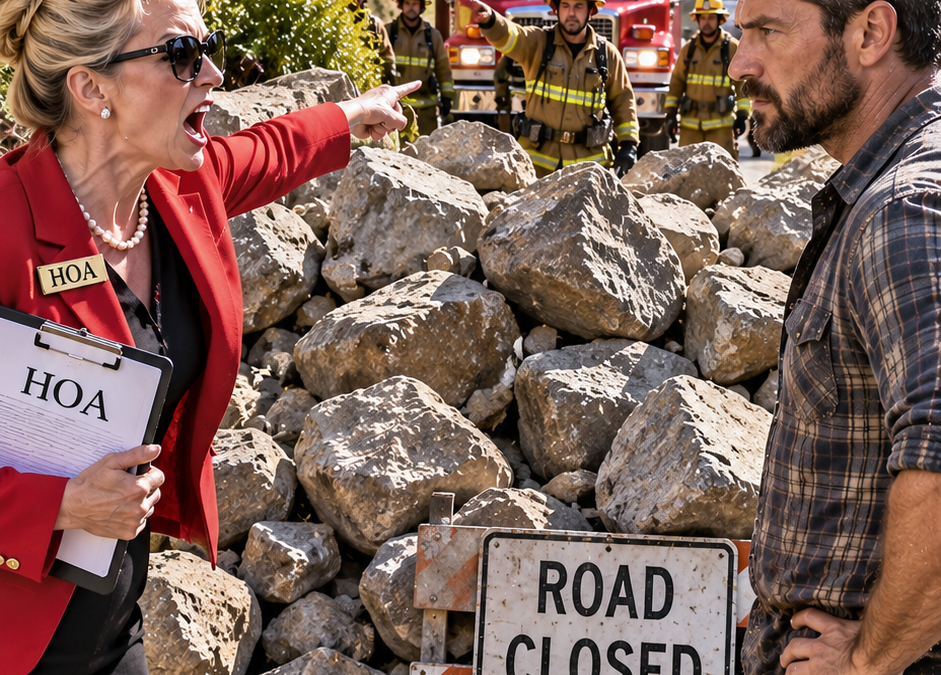
𝗣𝗔𝗥𝗧 𝟮
Fire Lane 7 was older than Blackwood Glen by almost a century.
My grandfather Silas Croft had signed the original easement in 1924.
Back then, the ridge held ranches, timber lots, and a few isolated homesteads.
The agreement was simple.
Property owners could use the road.
The county could use the road.
Emergency services could use the road.
And nobody—nobody—could obstruct it.
That clause existed because mountain people understand a basic truth that luxury developers often discover only after the brochure is printed.
You can own land.
You cannot own terrain.
A ridge decides where vehicles can climb.
A drainage decides where water goes.
A wildfire decides whether your landscaping budget matters.
Priscilla believed otherwise.
She had moved into Blackwood Glen two years earlier and become HOA president within eight months.
That told me everything I needed to know about both her and the residents who elected her.
Before retiring, she’d spent decades in corporate real estate management.
She approached the mountain like a defective office park.
Everything needed standards.
Approved colors.
Approved materials.
Approved sightlines.
My wooden tool shed was a violation because it was visible from the eighth tee.
My firewood stack was “visually disorganized.”
My old Caterpillar D8 bulldozer was apparently “industrial equipment incompatible with the neighborhood’s alpine character.”
The fact that my property predated Blackwood Glen by three generations did not impress her.
In Priscilla’s world, history began when the HOA filed its bylaws.
She once mailed me a five-hundred-dollar-per-day fine demanding that I paint my shed “Blackwood Beige.”
I mailed it back with a photograph of my grandfather standing in front of that shed in 1947.
Under the photograph I wrote:
SHED PREVIOUSLY APPROVED BY PEOPLE WHO OWNED THE MOUNTAIN BEFORE YOUR COMMITTEE EXISTED.
She didn’t enjoy that.
She enjoyed what came next even less.
Because beneath Fire Lane 7 was a water main.
Not one Blackwood Glen built.
Mine.
In 1954, my father and grandfather installed a twelve-inch gravity line from Croft Lake, the spring-fed tarn above my cabin, down through the ridge.
It supplied the old ranch parcels.
Decades later, when developers arrived, they negotiated with my father to tap the line.
Blackwood Glen used that water for ornamental ponds, entrance waterfalls, golf-course irrigation, and most importantly, its private fire suppression network.
The same fire system Priscilla believed made Fire Lane 7 obsolete depended on a pipe directly beneath the road she was burying.
The irony was almost efficient.
That afternoon, I called Arthur Vance.
Arthur had been my friend for forty years and had spent thirty of those years practicing land-use law.
He came to my cabin after dinner carrying a bottle of Scotch and the HOA citation about my shed.
He read the citation.
Then the photographs.
Then the 1924 easement.
“How much granite?”
“About one-sixty tons today.”
He looked over his glasses.
“Today?”
“Three more trucks tomorrow.”
Arthur poured himself two fingers of Scotch.
“How much total?”
“Two-fifty. Maybe more.”
“On top of the water main?”
“Yes.”
He smiled.
I didn’t.
“What?”
“Nothing.”
“Arthur.”
“I was simply wondering whether we should send Priscilla flowers.”
“For what?”
“Doing most of our legal work for us.”
I stared at him.
He tapped the easement.
“If we seek an injunction, her attorneys will argue interpretation.”
“The road can’t be blocked.”
“I agree.”
“They’re clearly blocking it.”
“I agree.”
“So file.”
“No.”
Now it was my turn to stare.
Arthur leaned back.
“If we stop her today, what happens?”
“She removes the rocks.”
“She complains.”
“She sues.”
“She loses.”
“Eventually.”
He sipped the Scotch.
“And learns nothing.”
I frowned.
“That isn’t the goal.”
“No.”
He looked toward the dark ridge through my window.
“But protecting you from the consequences of your neighbor’s stupidity is also not the goal.”
He pulled a yellow legal pad toward himself.
“What does she want?”
“To keep the rocks.”
“And you?”
“To stop being fined for owning a wooden shed on land she doesn’t control.”
“Good.”
He began writing.
“What else?”
I thought.
“If they’re going to alter the easement, they maintain it.”
“Better.”
“And if their work damages the buried infrastructure, they pay.”
Arthur’s smile broadened.
“Now we’re working.”
For the next four hours, we drafted what became the Croft-Blackwood Joint Agreement of Aesthetic Compliance and Infrastructure Liability.
The title sounded boring enough to be dangerous.
The document said I would withdraw my objection to the HOA’s landscape improvements.
In return, Blackwood Glen would permanently rescind every aesthetic citation involving my property.
More importantly, the HOA would assume responsibility for all surface and subsurface infrastructure within the altered easement.
Water lines.
Drainage.
Road access.
Emergency access consequences.
Everything.
Arthur added three separate warnings about the buried main.
Then an indemnity clause.
Then a line explicitly acknowledging that landscape modifications could alter emergency-vehicle access.
I read it.
“This is a trap.”
“No.”
He looked offended.
“This is informed consent.”
“Written by a man smiling like that?”
“That is irrelevant.”
The next afternoon, I carried the agreement into Blackwood Glen’s clubhouse.
Priscilla was chairing a meeting about tennis-court windscreen colors.
Apparently forest-green was too rustic.
I waited.
When the discussion ended, I placed the agreement on the table.
“I don’t want to fight anymore.”
Her eyes lit up.
I nearly admired the speed.
“You’ve reconsidered?”
“You can keep the rock garden.”
She took the document.
“I knew you’d eventually see reason.”
“I want the fines withdrawn.”
“Of course.”
“And responsibility for the modified easement transferred to the HOA.”
She waved a hand.
“Obviously.”
“It’s in there.”
Priscilla skimmed the first page.
Then part of the second.
She stopped reading before the paragraphs that mattered.
Arthur had predicted that too.
I almost interrupted her.
Almost.
Then I remembered the eighty tons already sitting on top of my water main.
She signed.
Used a gold fountain pen.
Then stamped the HOA seal beside her signature.
“There.”
She slid it toward me.
“Now perhaps we can all return to behaving like neighbors.”
I folded my copy.
“That would be nice.”
She smiled.
“The remaining rocks arrive tomorrow.”
“I know.”
“Have a lovely weekend.”
“You too.”
I walked out with the signed agreement inside my jacket.
The next morning, the final trucks came.
More granite hit the road.
The ground shook.
By noon, roughly two hundred fifty tons of stone sat over the old water line.
At 12:17, the pressure gauge in my pump house moved.
At 12:18, it dropped sharply.
At 12:19, it hit zero.
I knew exactly what had happened.
The load had shifted the soil.
The old pipe had failed.
I hiked down the line and found water bubbling through the ground below the granite pile.
Not a leak.
A rupture.
The slope was already softening.
I returned to the pump house.
The gravity system could discharge hundreds of gallons a minute.
If I let it continue, the broken line would saturate the clay beneath the easement.
And a saturated mountain slope carrying two hundred fifty tons of imported granite above it is what engineers call a problem and mountain people call a funeral.
I closed the main valve.
Then padlocked it.
By Tuesday, Blackwood Glen’s entrance waterfall stopped.
Wednesday, the decorative pond dropped.
Thursday, the golf course started turning yellow.
Friday, their fire-control dashboard went amber.
Priscilla called.
“What did you do?”
“Closed the water.”
“You can’t.”
“I can.”
“You’re retaliating.”
“No.”
“Our entire system has lost pressure.”
“I know.”
“You know?”
“Your rocks crushed the main.”
Silence.
Then:
“That is impossible.”
“Water seems unconvinced.”
“You will reopen that valve immediately.”
“No.”
“Caleb.”
“The broken pipe is dumping water into unstable soil.”
“Then repair it.”
“It belongs to you now.”
Another silence.
“What?”
“The agreement.”
Her voice changed.
“That agreement was about landscaping.”
“It was about the easement.”
“You tricked me.”
“I gave you four pages.”
“You knew I didn’t understand the engineering implications.”
“I warned you before you dumped the first truck.”
She hung up.
Three hours later, Arthur received notice of an emergency lawsuit.
He called me laughing.
“What’s funny?”
“They want a judge to order you to reopen the valve.”
“That would cause a landslide.”
“I know.”
“You sound happy.”
“I enjoy when opposing counsel requests geological catastrophe in writing.”
The hearing happened two days later.
Blackwood Glen hired a Denver firm.
Their attorney, Harrison Cole, looked about thirty-five and dressed like he’d been hand-delivered from a catalog titled Litigation for People Who Own Ski Chalets.
He stood before Judge Walter Vance and called me malicious.
“Your Honor, Mr. Croft has deliberately cut off the primary water supply to seventy-two homes.”
Judge Vance looked at me.
“Mr. Croft?”
I stood.
“Yes, sir. I closed the valve.”
Harrison smiled.
“There.”
I continued.
“Because the pipe beneath Fire Lane 7 collapsed after the plaintiff dumped approximately two hundred fifty tons of granite over it.”
His smile faded.
Arthur stood.
“We have a state engineering report.”
The judge read it.
The report was straightforward.
Pipe failure.
Underground erosion.
Subsurface saturation.
Landslide risk.
Estimated water discharge through the rupture: hundreds of gallons per minute.
Judge Vance looked toward Harrison.
“You want this man to reopen the valve?”
“Yes, Your Honor. Temporarily.”
“Where will the water go?”
“Into the system.”
“No.”
Judge Vance lifted the report.
“According to your own engineer, it will go into fractured soil beneath a loaded slope.”
Harrison shifted.
“We would monitor—”
“What?”
“The landslide?”
A few people laughed.
Harrison reddened.
“Your Honor—”
“Do you represent the homeowners?”
“Yes.”
“Then I suggest you stop requesting remedies likely to move their houses downhill.”
Arthur placed the signed agreement into evidence.
The judge read that next.
He looked toward Priscilla.
Then back to Harrison.
“This is signed by the HOA president.”
“Yes, but—”
“Official seal?”
“Yes.”
“Accepts infrastructure liability?”
“It was not intended—”
Judge Vance raised one eyebrow.
“Contracts are rarely improved by explaining what the signer intended not to read.”
I looked down to hide my smile.
The judge continued.
“The HOA altered the easement.”
“Yes.”
“The alteration damaged the pipe.”
“Allegedly.”
“Your engineering report says it did.”
Harrison said nothing.
“The HOA accepted liability for infrastructure damage resulting from that alteration.”
He tapped the contract.
“And emergency access.”
Another pause.
“Motion denied.”
Priscilla’s face went white.
Harrison tried again.
“Your Honor, my clients’ fire system is inactive.”
Judge Vance looked at him.
“Then remove the rocks.”
“That could take weeks.”
“Then your client should have considered that before converting a fire road into landscape architecture.”
Gavel.
Done.
Outside the courthouse, Priscilla intercepted me.
“You think this is funny?”
“No.”
“You knew the pipe would fail.”
“I knew it might.”
“You let us proceed.”
“I warned you.”
“You manipulated that contract.”
“You signed it.”
Her eyes narrowed.
“You’ll regret this.”
I looked at her.
“Priscilla, you’ve already threatened a retired fire warden with consequences while your subdivision sits uphill with no fire water and its only emergency road buried under granite.”
She froze.
“I would spend less time threatening me.”
I nodded toward the mountains.
“And more time looking west.”
She laughed.
The mountain didn’t.
The summer went dry.
Then drier.
By late August, Croft Ridge had gone seventy-eight days without meaningful rain.
Humidity dropped into single digits.
Ponderosa needles crackled underfoot.
Every afternoon I checked wind.
Fuel moisture.
Temperature.
Lightning probability.
Blackwood Glen did not move the rocks.
That was the most extraordinary part.
After losing in court, the board could have corrected the problem.
Hire excavators.
Remove the granite.
Repair the pipe.
Reopen the lane.
Expensive.
Embarrassing.
Necessary.
Priscilla refused.
She told residents the HOA was “evaluating long-term infrastructure alternatives.”
That is how committees say they would rather risk death than admit someone else was right.
On August twenty-fifth, dry thunderstorms formed over the western peaks.
I stood on my porch with a handheld weather meter.
Wind gusting over forty miles an hour.
Humidity four percent.
Dry lightning.
Bad combination.
Then I saw the smoke.
Two miles west.
Thin at first.
Then black.
My radio crackled.
Transformer fire.
Vegetation involved.
Wind pushing east.
I didn’t need another update.
I went inside.
Put on my old yellow Nomex jacket.
Leather gloves.
Radio harness.
When I came back outside, the smoke column had doubled.
Ten minutes later, the fire crowned.
A crown fire doesn’t look like campfire flames moving through trees.
It looks like weather becoming angry.
The tops of entire pines ignite.
Wind carries embers ahead.
The fire jumps roads.
Ravines.
Ridges.
It creates its own turbulence.
And once it reaches that stage, all the money in the world becomes irrelevant if you haven’t already created access and water.
Blackwood Glen’s alarm system began sounding below.
I could hear it from my property.
Then my radio picked up county dispatch.
“Engine Three responding Croft Ridge, structure protection Blackwood Glen.”
Another transmission.
“Primary access Blackwood Boulevard compromised. Transmission pole down. Live wires.”
My stomach tightened.
Then:
“Engine Three divert Fire Lane Seven.”
I closed my eyes.
There it was.
The exact sentence I’d warned Priscilla about almost a year earlier.
I drove my pickup toward the eastern boundary.
Engine Three came climbing from below.
Big four-wheel-drive structural engine.
Four young firefighters in the cab.
Chief Harris at the wheel.
The truck rounded the bend.
Then stopped.
Brakes screamed.
Two hundred fifty tons of granite filled the road.
Harris leaned out.
“What the hell?”
“HOA landscape project.”
His face twisted.
“You’re joking.”
“No.”
Fire roared somewhere beyond the ridge.
Harris looked behind him.
Then at the rock wall.
“We can’t climb that.”
“I know.”
“We can’t back out fast enough if the fire wraps.”
“I know.”
He slammed one fist against the door.
“We need access behind the subdivision.”
“There isn’t any.”
“Caleb!”
Someone came running through the smoke.
Priscilla.
No cashmere.
No tablet.
Her blouse was torn at one sleeve.
Soot covered her face.
She grabbed my jacket.
“Move the rocks.”
“What?”
“Your bulldozer.”
She pointed wildly.
“Move them!”
“Two hundred fifty tons?”
“My house is up there!”
“It’s too late.”
“No!”
She shook me.
“Caleb, please.”
Harris shouted from the engine.
“Fire’s less than ten minutes out!”
Priscilla started crying.
Not elegant tears.
Real fear.
“Please.”
I looked at the rocks.
Then at the firefighters.
They were young.
Too young.
Twenty-one.
Twenty-two.
Maybe twenty-five.
One looked like he was trying not to let the others see his hands shaking.
I knew immediately the rocks could not be moved.
Not fast enough.
Even my D8 would need hours.
Then I looked left.
At my own land.
Sedge Oak Grove.
The oldest stand on the property.
White oaks planted by my grandfather’s father more than a century earlier.
Trees I’d climbed as a boy.
Trees my father had sat beneath before he died.
Beyond them was open ground connecting to the rear of Blackwood Glen.
The distance was maybe three hundred yards.
Could I clear it?
Five minutes if everything went perfectly.
Maybe seven.
The grove would be destroyed.
There was no time to think about what that meant.
I grabbed Harris’ door.
“Back up fifty yards.”
“What?”
“Back up.”
“Why?”
“I’m making you another road.”
I ran.
The Caterpillar sat in the equipment barn.
D8.
Old.
Heavy.
Reliable.
I hit the starter.
Diesel roared.
The machine shook beneath me.
I dropped the blade.
Then pointed it at my own forest.
For one second, I couldn’t move.
The first oak in front of me had been there longer than anyone living in Blackwood Glen.
Then Harris came over the radio.
“Caleb, we have seven minutes.”
I pushed the throttle.
The blade hit the oak.
The impact traveled through the entire machine.
The trunk cracked.
Slowly at first.
Then violently.
The tree came down.
I drove over it.
Second tree.
Third.
Young saplings.
Wild herbs.
Fence.
Everything.
I ripped open a twelve-foot corridor through the heart of my family’s grove.
I don’t remember breathing.
I remember the sound.
Wood breaking.
Tracks grinding stone.
Branches snapping.
The roar of the fire growing louder.
Every few seconds, Harris called distance.
“Five minutes.”
Another oak fell.
“Three minutes.”
I burst through the far edge of the grove.
Open ground.
I swung the D8 sideways, ripped out the last brush line, and keyed the radio.
“Harris. Go.”
Engine Three moved.
The truck roared through the path I’d made.
Past me.
Across my destroyed grove.
Into the defensive clearing behind Blackwood Glen.
The fire arrived less than two minutes later.
The crew survived.
That was enough.
The houses were another matter.
With no water in Blackwood Glen’s suppression system, the decorative sprinkler heads popped out of the lawns and hissed air.
That was all.
Air.
The fire hit imported ornamental trees first.
Then cedar privacy fencing.
Then decks.
Embers blew through shattered glass.
Three homes ignited almost simultaneously.
Priscilla’s was one of them.
She sat in the dirt beside my bulldozer and watched her three-million-dollar glass house burn from one end to the other.
I stood beside her.
Neither of us spoke.
I didn’t say I told you so.
I didn’t have to.
Two hundred fifty tons of granite sat blackening behind us.
The warning had become landscape.
The next morning, Croft Ridge looked like the world had been erased with charcoal.
My cabin survived.
The firebreak I’d carved through my own grove protected it.
But the grove was gone.
Blackwood Glen lost three houses.
Several others were damaged.
The clubhouse survived.
Fire Lane 7 was still blocked.
That part almost felt offensive.
Insurance investigators arrived before noon.
The lead underwriter was a man named Miller.
He walked the site with county fire investigators.
Measured everything.
Photographed everything.
Then asked for records.
Lots of them.
The fire-lane designation.
Court ruling.
Water-main engineering report.
My warnings.
HOA minutes.
And finally the signed liability agreement.
Priscilla tried to describe the fire as an unavoidable natural disaster.
Miller listened.
Then said:
“The fire was natural.”
She nodded eagerly.
“Yes.”
“The loss pathway was not.”
Her face changed.
“What does that mean?”
He pointed toward the granite.
“That road was emergency infrastructure.”
“It was ugly.”
Miller stared at her.
For the first time in my life, I watched an insurance professional look genuinely offended by a sentence.
“The engine couldn’t pass.”
“We had another suppression system.”
“You crushed its supply line.”
“That wasn’t intentional.”
“You were warned.”
“We disputed the warning.”
“You lost that dispute in court.”
Priscilla wrapped a blanket tighter around herself.
“We have twelve million dollars in master coverage.”
Miller nodded.
“Yes.”
“So we’re covered.”
“No.”
Her mouth opened.
“What?”
He held up the policy.
“Your association’s coverage excludes losses materially caused or worsened by willful obstruction of designated emergency infrastructure.”
She looked toward me.
“This is his fault.”
Miller didn’t even turn.
“Mr. Croft destroyed part of his own property to create emergency access for firefighters.”
Then the county investigator added:
“Without that bypass, we likely lose Engine Three and four firefighters.”
That shut everyone up.
Miller continued.
“You also signed an agreement accepting responsibility for the easement and subsurface infrastructure.”
Priscilla’s voice rose.
“That document was deceptive.”
“It was filed.”
“I didn’t understand it.”
“You signed it.”
“I am not an engineer.”
“Then your board should have hired one before placing two hundred fifty tons of rock over a buried water main.”
Residents had started gathering.
People who’d lost homes.
People who’d nearly lost homes.
People who were just beginning to understand why their sprinkler systems had failed.
Sterling, one of the wealthiest residents, pushed forward.
“You knew the road was blocked.”
Priscilla turned.
“We all approved beautification.”
“We didn’t approve destroying fire access.”
“You voted.”
“Based on what you told us.”
Another resident shouted:
“You said the sprinklers made the road unnecessary!”
Priscilla’s face went pale.
“You signed that waiver?”
Sterling demanded.
She didn’t answer.
“Without counsel?”
Still nothing.
“Without telling us it transferred liability?”
“It was an administrative document.”
Miller almost smiled.
“No.”
He held up the agreement.
“It was a contract.”
Priscilla’s tablet slipped from her hand.
It hit one of her precious granite rocks.
Screen shattered.
That was the smallest loss of her week.
The final insurance report took three weeks.
It reconstructed everything.
Date the granite was dumped.
Date water pressure collapsed.
Engineering analysis of the pipe failure.
Court record showing the HOA had been ordered to remove the rocks before fire season.
Board records showing Priscilla had delayed repairs.
Dispatch logs proving Engine Three lost critical response time.
Satellite imagery showing the fire.
My bulldozer route.
Everything.
The conclusion was devastating.
The insurer denied major portions of the HOA claim based on willful negligence and obstruction of designated emergency access.
Individual homeowners discovered their own insurers were now fighting over contribution and liability.
Everybody hired lawyers.
Nothing destroys neighborhood unity like seven-figure property losses and a paper trail.
An emergency HOA meeting was held in a temporary tent because several common buildings were still being used by fire crews.
Priscilla lasted four minutes.
The motion to remove her passed unanimously.
Even board members who had once supported the rock garden suddenly became scholars of emergency-access law.
Amazing what fire does for continuing education.
Then came the lawsuits.
Residents sued the HOA.
The HOA sued contractors.
Contractors sued the landscaper.
The landscaper produced emails showing Priscilla had insisted on the granite despite concerns about the buried utility line.
That was an entertaining development.
Several residents sued Priscilla personally for breach of fiduciary duty and acting outside board authority.
County investigators opened a reckless-endangerment review.
Her assets became part of the litigation.
She sold what remained of her property interests.
The HOA eventually entered court-supervised restructuring.
The famous rock garden?
Removed.
Every stone.
A county crew spent three weeks hauling it away.
Fire Lane 7 reopened.
They rebuilt the water line too.
New pipe.
Reinforced trench.
Protected access.
Large signs now stood at both ends.
EMERGENCY FIRE ACCESS
NO PARKING
NO LANDSCAPING
NO OBSTRUCTION
I requested one additional sign.
Arthur advised me not to.
It would have said:
YES, THIS INCLUDES DECORATIVE GRANITE.
The county declined.
No sense of humor.
Winter came.
Snow covered the burned ridge.
My oak grove was still gone.
That part never became funny.
I would walk the new firebreak sometimes and see stumps where trees had stood my whole life.
People called me a hero for cutting that road.
I didn’t feel heroic.
I felt like a man who had been forced to destroy something he loved because somebody else thought emergency infrastructure was ugly.
Engine Three came up Fire Lane 7 one morning during winter training.
Harris slowed near my cabin.
Two short horn blasts.
I raised my coffee mug.
That was enough.
Priscilla left the valley in November.
Not dramatically.
No press.
No farewell.
A rented moving truck.
I happened to see it from the ridge.
She no longer wore cashmere.
No gold tablet.
No landscaping committee.
Just a woman packing what remained of a life that had once convinced her money could renegotiate topography.
I didn’t wave.
I didn’t need to.
The mountain had said everything.
The new Blackwood Glen board contacted me the following spring.
Their interim president was Sterling.
He looked uncomfortable standing on my porch.
“Caleb.”
“Sterling.”
“We need help.”
“With what?”
“Emergency planning.”
I raised an eyebrow.
“You’re asking the man with the ugly road?”
He winced.
“Fair.”
“What happened to the smart system?”
“We still have it.”
“Good.”
“We also want roads.”
“Even ugly ones?”
“Especially ugly ones.”
That almost made me smile.
We walked Fire Lane 7 together.
The granite was gone.
The rebuilt water line sat beneath reinforced soil.
County engineers had widened two turns.
The new board cleared deadfall and posted emergency maps.
They created secondary evacuation zones.
Installed proper hydrant connections.
Funded defensible-space work.
And, most importantly, they stopped confusing landscaping with safety.
Some of the imported ornamental trees never came back.
Native fire-resistant plantings replaced them.
Residents complained at first.
Then someone reminded them what Japanese cedar looks like while burning.
Complaints declined.
Sterling stopped beside the scar where my oak grove had been.
“We’d like to pay for restoration.”
I looked at him.
“Of what?”
“Your land.”
“You didn’t cut it.”
“We benefited.”
I said nothing.
“Engine Three would’ve been lost.”
“Yes.”
“So would more homes.”
“Probably.”
“Let us help.”
I eventually agreed.
Not full restoration.
You can’t replace century-old trees with a check.
But we planted young oaks.
Native grasses.
Aspen.
Ponderosa where appropriate.
The firebreak remained.
I insisted.
Some scars should stay useful.
Arthur came to the planting day carrying Scotch.
“You’ve become cooperative.”
“Don’t spread it around.”
“You realize, of course, Priscilla would hate this.”
I looked at fifty residents planting native trees beside an unpainted wooden shed.
“That helps.”
Arthur laughed.
We sat on the cabin porch that evening.
He raised his glass toward Fire Lane 7.
“Ugliest road in Colorado.”
“Saved four firefighters.”
“And several million dollars of architecture.”
“Still ugly.”
“Beautifully ugly.”
That was probably the best description.
A year after the fire, county emergency services held a wildfire drill on Croft Ridge.
Engines came up Fire Lane 7.
No obstruction.
No decorative rock wall.
No committee vote required.
Water pressure held.
The smart sprinklers activated.
For once, technology and common sense managed to coexist.
I stood by the boundary watching.
A young firefighter from Engine Three walked over.
I recognized him.
He’d been one of the rookies in the cab the day of the fire.
His name was Tyler.
“Mr. Croft?”
“Caleb.”
He looked toward the new grove.
“I never thanked you.”
“You were busy.”
“I thought we were dead.”
I didn’t answer.
He looked at the young oak trees.
“You lost all that because of us.”
“No.”
He frowned.
“I lost it because the road was blocked.”
That mattered to me.
The firefighters weren’t responsible.
Neither were most homeowners.
Bad leadership has a way of handing the invoice to people who never made the decision.
Tyler nodded.
Then he looked toward Fire Lane 7.
“You know the guys still talk about those rocks.”
“I imagine.”
“One of them calls it Davenport Pass.”
I laughed.
“That terrible?”
“Worse.”
“Good.”
He shook my hand and returned to the engine.
I stood there listening to the trucks idle.
The mountain had changed.
So had Blackwood Glen.
Not completely.
There were still architectural guidelines.
Still committees.
Still arguments about roof colors and driveway lighting.
People remain people.
But nobody complained about Fire Lane 7 anymore.
Nobody suggested making it prettier.
And every time a new homeowner asked why the emergency road was so wide, so plain, and so aggressively unlandscaped, somebody told them the story.
The granite.
The pipe.
The court case.
The fire.
The bulldozer.
The houses.
Priscilla.
I heard one version where I supposedly drove through the grove with flames already touching the bulldozer.
Not true.
Another had me threatening Priscilla with a chainsaw.
Also not true.
Mountain stories grow.
I stopped correcting them.
There was only one part I cared about people remembering accurately.
The fire road had been working before anyone improved it.
That’s the lesson.
Not that old ways are always better.
They aren’t.
Not that technology is bad.
It isn’t.
Blackwood Glen’s sprinkler system was excellent.
Its moisture sensors were excellent.
Its fire modeling was excellent.
None of it mattered without water.
And none of it replaced road access.
Redundancy is what saves people.
Old road.
New sprinklers.
Gravity line.
Fire engine.
Defensible space.
Multiple ways to survive the same failure.
Priscilla couldn’t tolerate redundancy because redundancy looked inefficient.
She wanted a beautiful answer.
One smart system.
One controlled landscape.
One app.
One HOA.
One set of standards.
The mountain doesn’t work that way.
Fire certainly doesn’t.
The older I get, the more I distrust anyone who promises one elegant solution to a problem nature has been complicating for ten thousand years.
Priscilla wanted the road gone because it offended her eyes.
She wanted my shed painted because weathered wood offended her standards.
She wanted dirt replaced with granite because dirt looked cheap.
What she never understood was that rough things often survive for a reason.
That road was rough because fire engines needed traction.
The water line was old because gravity doesn’t require software updates.
My bulldozer was ugly because seventy tons of steel isn’t built for Instagram.
And my grove was wild because roots hold mountain soil better than landscape renderings do.
The irony still makes me smile.
Blackwood Glen spent hundreds of thousands of dollars trying to make the ridge look more expensive.
In the end, the most valuable thing on the mountain was a dirt road they’d buried because it looked poor.
I still drink coffee on the porch most mornings.
Copper mug.
Same stove.
Same shed.
Still unpainted.
The new HOA once sent me an official letter about it.
I opened it carefully.
Inside was a handwritten note from Sterling.
CALAB,
BOARD REVIEWED THE SHED.
UNANIMOUSLY APPROVED AS “HISTORICALLY UGLY.”
PLEASE DO NOT PAINT IT.
I framed that one.
It hangs in the workshop.
Beside it is a photograph I took the morning Priscilla dumped the first load of granite.
She’s standing in white cashmere.
Smiling.
Behind her, eighty tons of rock is falling onto Fire Lane 7.
People sometimes ask why I keep it.
Not for revenge.
Not anymore.
I keep it because arrogance rarely looks dangerous while it’s happening.
Sometimes it looks polished.
Reasonable.
Expensive.
Sometimes it comes with consultants.
Design plans.
An HOA seal.
A three-hundred-thousand-dollar smart system.
Sometimes it tells you an old dirt road is obsolete.
Then smoke fills the sky.
The app stops mattering.
The sprinklers hiss air.
And everyone suddenly remembers why the ugly road existed.
Priscilla Davenport spent a fortune trying to hide Fire Lane 7 under granite because she believed beauty was proof of control.
The wildfire proved otherwise.
Her mansion burned.
Her presidency disappeared.
Her contracts became evidence against her.
Her decorative rocks were hauled away at enormous expense.
And the road she hated is still there.
Bare dirt.
Pine needles.
Ruts.
No landscaping.
No granite.
Nothing beautiful about it.
Unless you’re sitting inside a fire engine with flames behind you.
Then it’s the prettiest road in the world.
Have you finished reading the story and want to read it again?
HOA Buried the Only Fire Road Under 250 Tons of Rock—Then the Wildfire Came
They buried the only fire road under 250 tons of granite.
I warned them exactly what would happen.
Then the mountain caught fire.
The first dump truck reached Croft Ridge a little after seven on a Monday morning.
I felt it before I saw it.
A low diesel vibration traveled through the floorboards of my cabin, rattled one of the old iron pans hanging beside the stove, and put a faint ring into the black coffee sitting in my copper mug.
At sixty-two, after thirty years working as a federal fire warden in western Colorado, I didn’t startle easily.
Mountains have their own language.
Wind in ponderosa crowns.
Ice splitting inside granite.
A frightened elk running downhill.
A fire beginning somewhere too far away to see.
Heavy machinery climbing a road it had no business climbing.
I set down my coffee, picked up my Nikon, and stepped onto the porch.
Three blue dump trucks were grinding toward the eastern boundary of my forty-acre homestead.
Beyond them, perched lower on the slope, stood Blackwood Glen.
Seventy-two luxury homes made almost entirely of glass, steel, imported timber, and financial optimism.
The development had been built over the previous four years.
Its brochures called it “a sustainable alpine sanctuary.”
Which was developer language for cutting down native vegetation, importing Japanese ornamental trees, installing twelve miles of irrigation pipe, and then adding the word eco to every building permit.
At the boundary between my land and Blackwood Glen ran an old dirt road.
Locals called it Pine Needle Trail.
County maps called it Fire Lane 7.
The road wasn’t beautiful.
It was hard-packed earth, red dust, pine needles, and wheel ruts.
It had also existed since before most of Blackwood Glen’s residents’ grandparents were born.
More importantly, it was the only road within five miles with a grade shallow enough and a turning radius wide enough to carry a full-size structural fire engine onto the upper ridge.
That morning, Priscilla Davenport was standing directly beside it.
Cream cashmere wrap.
Gold-cased tablet.
Diamond bracelet.
A woman dressed for a charity luncheon overseeing a geological crime.
The first truck backed up.
“Right there!” she shouted.
The driver stopped.
Air brakes hissed.
Tailgate opened.
Then eighty tons of granite boulders crashed onto Fire Lane 7.
The sound shook the trees.
Dust exploded into the air.
Rocks the size of steamer trunks rolled across the road, crushed young ferns, snapped exposed roots, and came to rest in an enormous gray wall.
Priscilla clapped.
“Perfect!”
I raised my camera.
Click.
Truck.
Click.
License plate.
Click.
Priscilla smiling while emergency infrastructure disappeared under enough stone to rebuild a medieval fortress.
She noticed me.
“Oh, Caleb.”
“Morning.”
She looked at my flannel shirt, then at her landscaping project.
“I suppose you dislike it.”
“I suppose the fire department will dislike it more.”
Her mouth tightened.
“We’re improving the entrance.”
“You’re blocking Fire Lane 7.”
She waved one manicured hand.
“That isn’t a road. It’s an eyesore.”
“It is a designated emergency corridor.”
“We have our own fire suppression system.”
“That won’t move a twenty-five-ton engine up this ridge.”
She tapped her tablet.
“Three hundred thousand dollars.”
“What?”
“Our system.”
She smiled.
“Automated copper sprinkler heads. Smart moisture sensors. App-controlled pressure monitoring.”
I looked at the rocks.
“Does the app move granite?”
Her expression hardened.
“Caleb, Blackwood Glen was designed to modern standards. We are not dependent on dirty diesel trucks crawling past bedroom windows.”
“You are dependent on water.”
“We have water.”
“For now.”
She laughed.
That was the moment I stopped trying to convince her.
Not because I was angry.
Because I’d spent thirty years around fire.
Fire is very patient with arrogant people.
It will wait until every bad decision has matured.
Then it collects them all at once.
I lifted the camera again.
“I’m putting my warning in writing.”
“Write a novel.”
She turned toward the next truck.
“The rocks are staying.”
I looked downhill at seventy-two glass houses shining in the morning sun.
Then at the enormous pile blocking the one road built to save them.
And I remember thinking something simple.
Fine.
But when this goes wrong, I want everyone to know whose idea it was.
PART2
Fire Lane 7 was older than Blackwood Glen by almost a century.
My grandfather Silas Croft had signed the original easement in 1924.
Back then, the ridge held ranches, timber lots, and a few isolated homesteads.
The agreement was simple.
Property owners could use the road.
The county could use the road.
Emergency services could use the road.
And nobody—nobody—could obstruct it.
That clause existed because mountain people understand a basic truth that luxury developers often discover only after the brochure is printed.
You can own land.
You cannot own terrain.
A ridge decides where vehicles can climb.
A drainage decides where water goes.
A wildfire decides whether your landscaping budget matters.
Priscilla believed otherwise.
She had moved into Blackwood Glen two years earlier and become HOA president within eight months.
That told me everything I needed to know about both her and the residents who elected her.
Before retiring, she’d spent decades in corporate real estate management.
She approached the mountain like a defective office park.
Everything needed standards.
Approved colors.
Approved materials.
Approved sightlines.
My wooden tool shed was a violation because it was visible from the eighth tee.
My firewood stack was “visually disorganized.”
My old Caterpillar D8 bulldozer was apparently “industrial equipment incompatible with the neighborhood’s alpine character.”
The fact that my property predated Blackwood Glen by three generations did not impress her.
In Priscilla’s world, history began when the HOA filed its bylaws.
She once mailed me a five-hundred-dollar-per-day fine demanding that I paint my shed “Blackwood Beige.”
I mailed it back with a photograph of my grandfather standing in front of that shed in 1947.
Under the photograph I wrote:
SHED PREVIOUSLY APPROVED BY PEOPLE WHO OWNED THE MOUNTAIN BEFORE YOUR COMMITTEE EXISTED.
She didn’t enjoy that.
She enjoyed what came next even less.
Because beneath Fire Lane 7 was a water main.
Not one Blackwood Glen built.
Mine.
In 1954, my father and grandfather installed a twelve-inch gravity line from Croft Lake, the spring-fed tarn above my cabin, down through the ridge.
It supplied the old ranch parcels.
Decades later, when developers arrived, they negotiated with my father to tap the line.
Blackwood Glen used that water for ornamental ponds, entrance waterfalls, golf-course irrigation, and most importantly, its private fire suppression network.
The same fire system Priscilla believed made Fire Lane 7 obsolete depended on a pipe directly beneath the road she was burying.
The irony was almost efficient.
That afternoon, I called Arthur Vance.
Arthur had been my friend for forty years and had spent thirty of those years practicing land-use law.
He came to my cabin after dinner carrying a bottle of Scotch and the HOA citation about my shed.
He read the citation.
Then the photographs.
Then the 1924 easement.
“How much granite?”
“About one-sixty tons today.”
He looked over his glasses.
“Today?”
“Three more trucks tomorrow.”
Arthur poured himself two fingers of Scotch.
“How much total?”
“Two-fifty. Maybe more.”
“On top of the water main?”
“Yes.”
He smiled.
I didn’t.
“What?”
“Nothing.”
“Arthur.”
“I was simply wondering whether we should send Priscilla flowers.”
“For what?”
“Doing most of our legal work for us.”
I stared at him.
He tapped the easement.
“If we seek an injunction, her attorneys will argue interpretation.”
“The road can’t be blocked.”
“I agree.”
“They’re clearly blocking it.”
“I agree.”
“So file.”
“No.”
Now it was my turn to stare.
Arthur leaned back.
“If we stop her today, what happens?”
“She removes the rocks.”
“She complains.”
“She sues.”
“She loses.”
“Eventually.”
He sipped the Scotch.
“And learns nothing.”
I frowned.
“That isn’t the goal.”
“No.”
He looked toward the dark ridge through my window.
“But protecting you from the consequences of your neighbor’s stupidity is also not the goal.”
He pulled a yellow legal pad toward himself.
“What does she want?”
“To keep the rocks.”
“And you?”
“To stop being fined for owning a wooden shed on land she doesn’t control.”
“Good.”
He began writing.
“What else?”
I thought.
“If they’re going to alter the easement, they maintain it.”
“Better.”
“And if their work damages the buried infrastructure, they pay.”
Arthur’s smile broadened.
“Now we’re working.”
For the next four hours, we drafted what became the Croft-Blackwood Joint Agreement of Aesthetic Compliance and Infrastructure Liability.
The title sounded boring enough to be dangerous.
The document said I would withdraw my objection to the HOA’s landscape improvements.
In return, Blackwood Glen would permanently rescind every aesthetic citation involving my property.
More importantly, the HOA would assume responsibility for all surface and subsurface infrastructure within the altered easement.
Water lines.
Drainage.
Road access.
Emergency access consequences.
Everything.
Arthur added three separate warnings about the buried main.
Then an indemnity clause.
Then a line explicitly acknowledging that landscape modifications could alter emergency-vehicle access.
I read it.
“This is a trap.”
“No.”
He looked offended.
“This is informed consent.”
“Written by a man smiling like that?”
“That is irrelevant.”
The next afternoon, I carried the agreement into Blackwood Glen’s clubhouse.
Priscilla was chairing a meeting about tennis-court windscreen colors.
Apparently forest-green was too rustic.
I waited.
When the discussion ended, I placed the agreement on the table.
“I don’t want to fight anymore.”
Her eyes lit up.
I nearly admired the speed.
“You’ve reconsidered?”
“You can keep the rock garden.”
She took the document.
“I knew you’d eventually see reason.”
“I want the fines withdrawn.”
“Of course.”
“And responsibility for the modified easement transferred to the HOA.”
She waved a hand.
“Obviously.”
“It’s in there.”
Priscilla skimmed the first page.
Then part of the second.
She stopped reading before the paragraphs that mattered.
Arthur had predicted that too.
I almost interrupted her.
Almost.
Then I remembered the eighty tons already sitting on top of my water main.
She signed.
Used a gold fountain pen.
Then stamped the HOA seal beside her signature.
“There.”
She slid it toward me.
“Now perhaps we can all return to behaving like neighbors.”
I folded my copy.
“That would be nice.”
She smiled.
“The remaining rocks arrive tomorrow.”
“I know.”
“Have a lovely weekend.”
“You too.”
I walked out with the signed agreement inside my jacket.
The next morning, the final trucks came.
More granite hit the road.
The ground shook.
By noon, roughly two hundred fifty tons of stone sat over the old water line.
At 12:17, the pressure gauge in my pump house moved.
At 12:18, it dropped sharply.
At 12:19, it hit zero.
I knew exactly what had happened.
The load had shifted the soil.
The old pipe had failed.
I hiked down the line and found water bubbling through the ground below the granite pile.
Not a leak.
A rupture.
The slope was already softening.
I returned to the pump house.
The gravity system could discharge hundreds of gallons a minute.
If I let it continue, the broken line would saturate the clay beneath the easement.
And a saturated mountain slope carrying two hundred fifty tons of imported granite above it is what engineers call a problem and mountain people call a funeral.
I closed the main valve.
Then padlocked it.
By Tuesday, Blackwood Glen’s entrance waterfall stopped.
Wednesday, the decorative pond dropped.
Thursday, the golf course started turning yellow.
Friday, their fire-control dashboard went amber.
Priscilla called.
“What did you do?”
“Closed the water.”
“You can’t.”
“I can.”
“You’re retaliating.”
“No.”
“Our entire system has lost pressure.”
“I know.”
“You know?”
“Your rocks crushed the main.”
Silence.
Then:
“That is impossible.”
“Water seems unconvinced.”
“You will reopen that valve immediately.”
“No.”
“Caleb.”
“The broken pipe is dumping water into unstable soil.”
“Then repair it.”
“It belongs to you now.”
Another silence.
“What?”
“The agreement.”
Her voice changed.
“That agreement was about landscaping.”
“It was about the easement.”
“You tricked me.”
“I gave you four pages.”
“You knew I didn’t understand the engineering implications.”
“I warned you before you dumped the first truck.”
She hung up.
Three hours later, Arthur received notice of an emergency lawsuit.
He called me laughing.
“What’s funny?”
“They want a judge to order you to reopen the valve.”
“That would cause a landslide.”
“I know.”
“You sound happy.”
“I enjoy when opposing counsel requests geological catastrophe in writing.”
The hearing happened two days later.
Blackwood Glen hired a Denver firm.
Their attorney, Harrison Cole, looked about thirty-five and dressed like he’d been hand-delivered from a catalog titled Litigation for People Who Own Ski Chalets.
He stood before Judge Walter Vance and called me malicious.
“Your Honor, Mr. Croft has deliberately cut off the primary water supply to seventy-two homes.”
Judge Vance looked at me.
“Mr. Croft?”
I stood.
“Yes, sir. I closed the valve.”
Harrison smiled.
“There.”
I continued.
“Because the pipe beneath Fire Lane 7 collapsed after the plaintiff dumped approximately two hundred fifty tons of granite over it.”
His smile faded.
Arthur stood.
“We have a state engineering report.”
The judge read it.
The report was straightforward.
Pipe failure.
Underground erosion.
Subsurface saturation.
Landslide risk.
Estimated water discharge through the rupture: hundreds of gallons per minute.
Judge Vance looked toward Harrison.
“You want this man to reopen the valve?”
“Yes, Your Honor. Temporarily.”
“Where will the water go?”
“Into the system.”
“No.”
Judge Vance lifted the report.
“According to your own engineer, it will go into fractured soil beneath a loaded slope.”
Harrison shifted.
“We would monitor—”
“What?”
“The landslide?”
A few people laughed.
Harrison reddened.
“Your Honor—”
“Do you represent the homeowners?”
“Yes.”
“Then I suggest you stop requesting remedies likely to move their houses downhill.”
Arthur placed the signed agreement into evidence.
The judge read that next.
He looked toward Priscilla.
Then back to Harrison.
“This is signed by the HOA president.”
“Yes, but—”
“Official seal?”
“Yes.”
“Accepts infrastructure liability?”
“It was not intended—”
Judge Vance raised one eyebrow.
“Contracts are rarely improved by explaining what the signer intended not to read.”
I looked down to hide my smile.
The judge continued.
“The HOA altered the easement.”
“Yes.”
“The alteration damaged the pipe.”
“Allegedly.”
“Your engineering report says it did.”
Harrison said nothing.
“The HOA accepted liability for infrastructure damage resulting from that alteration.”
He tapped the contract.
“And emergency access.”
Another pause.
“Motion denied.”
Priscilla’s face went white.
Harrison tried again.
“Your Honor, my clients’ fire system is inactive.”
Judge Vance looked at him.
“Then remove the rocks.”
“That could take weeks.”
“Then your client should have considered that before converting a fire road into landscape architecture.”
Gavel.
Done.
Outside the courthouse, Priscilla intercepted me.
“You think this is funny?”
“No.”
“You knew the pipe would fail.”
“I knew it might.”
“You let us proceed.”
“I warned you.”
“You manipulated that contract.”
“You signed it.”
Her eyes narrowed.
“You’ll regret this.”
I looked at her.
“Priscilla, you’ve already threatened a retired fire warden with consequences while your subdivision sits uphill with no fire water and its only emergency road buried under granite.”
She froze.
“I would spend less time threatening me.”
I nodded toward the mountains.
“And more time looking west.”
She laughed.
The mountain didn’t.
The summer went dry.
Then drier.
By late August, Croft Ridge had gone seventy-eight days without meaningful rain.
Humidity dropped into single digits.
Ponderosa needles crackled underfoot.
Every afternoon I checked wind.
Fuel moisture.
Temperature.
Lightning probability.
Blackwood Glen did not move the rocks.
That was the most extraordinary part.
After losing in court, the board could have corrected the problem.
Hire excavators.
Remove the granite.
Repair the pipe.
Reopen the lane.
Expensive.
Embarrassing.
Necessary.
Priscilla refused.
She told residents the HOA was “evaluating long-term infrastructure alternatives.”
That is how committees say they would rather risk death than admit someone else was right.
On August twenty-fifth, dry thunderstorms formed over the western peaks.
I stood on my porch with a handheld weather meter.
Wind gusting over forty miles an hour.
Humidity four percent.
Dry lightning.
Bad combination.
Then I saw the smoke.
Two miles west.
Thin at first.
Then black.
My radio crackled.
Transformer fire.
Vegetation involved.
Wind pushing east.
I didn’t need another update.
I went inside.
Put on my old yellow Nomex jacket.
Leather gloves.
Radio harness.
When I came back outside, the smoke column had doubled.
Ten minutes later, the fire crowned.
A crown fire doesn’t look like campfire flames moving through trees.
It looks like weather becoming angry.
The tops of entire pines ignite.
Wind carries embers ahead.
The fire jumps roads.
Ravines.
Ridges.
It creates its own turbulence.
And once it reaches that stage, all the money in the world becomes irrelevant if you haven’t already created access and water.
Blackwood Glen’s alarm system began sounding below.
I could hear it from my property.
Then my radio picked up county dispatch.
“Engine Three responding Croft Ridge, structure protection Blackwood Glen.”
Another transmission.
“Primary access Blackwood Boulevard compromised. Transmission pole down. Live wires.”
My stomach tightened.
Then:
“Engine Three divert Fire Lane Seven.”
I closed my eyes.
There it was.
The exact sentence I’d warned Priscilla about almost a year earlier.
I drove my pickup toward the eastern boundary.
Engine Three came climbing from below.
Big four-wheel-drive structural engine.
Four young firefighters in the cab.
Chief Harris at the wheel.
The truck rounded the bend.
Then stopped.
Brakes screamed.
Two hundred fifty tons of granite filled the road.
Harris leaned out.
“What the hell?”
“HOA landscape project.”
His face twisted.
“You’re joking.”
“No.”
Fire roared somewhere beyond the ridge.
Harris looked behind him.
Then at the rock wall.
“We can’t climb that.”
“I know.”
“We can’t back out fast enough if the fire wraps.”
“I know.”
He slammed one fist against the door.
“We need access behind the subdivision.”
“There isn’t any.”
“Caleb!”
Someone came running through the smoke.
Priscilla.
No cashmere.
No tablet.
Her blouse was torn at one sleeve.
Soot covered her face.
She grabbed my jacket.
“Move the rocks.”
“What?”
“Your bulldozer.”
She pointed wildly.
“Move them!”
“Two hundred fifty tons?”
“My house is up there!”
“It’s too late.”
“No!”
She shook me.
“Caleb, please.”
Harris shouted from the engine.
“Fire’s less than ten minutes out!”
Priscilla started crying.
Not elegant tears.
Real fear.
“Please.”
I looked at the rocks.
Then at the firefighters.
They were young.
Too young.
Twenty-one.
Twenty-two.
Maybe twenty-five.
One looked like he was trying not to let the others see his hands shaking.
I knew immediately the rocks could not be moved.
Not fast enough.
Even my D8 would need hours.
Then I looked left.
At my own land.
Sedge Oak Grove.
The oldest stand on the property.
White oaks planted by my grandfather’s father more than a century earlier.
Trees I’d climbed as a boy.
Trees my father had sat beneath before he died.
Beyond them was open ground connecting to the rear of Blackwood Glen.
The distance was maybe three hundred yards.
Could I clear it?
Five minutes if everything went perfectly.
Maybe seven.
The grove would be destroyed.
There was no time to think about what that meant.
I grabbed Harris’ door.
“Back up fifty yards.”
“What?”
“Back up.”
“Why?”
“I’m making you another road.”
I ran.
The Caterpillar sat in the equipment barn.
D8.
Old.
Heavy.
Reliable.
I hit the starter.
Diesel roared.
The machine shook beneath me.
I dropped the blade.
Then pointed it at my own forest.
For one second, I couldn’t move.
The first oak in front of me had been there longer than anyone living in Blackwood Glen.
Then Harris came over the radio.
“Caleb, we have seven minutes.”
I pushed the throttle.
The blade hit the oak.
The impact traveled through the entire machine.
The trunk cracked.
Slowly at first.
Then violently.
The tree came down.
I drove over it.
Second tree.
Third.
Young saplings.
Wild herbs.
Fence.
Everything.
I ripped open a twelve-foot corridor through the heart of my family’s grove.
I don’t remember breathing.
I remember the sound.
Wood breaking.
Tracks grinding stone.
Branches snapping.
The roar of the fire growing louder.
Every few seconds, Harris called distance.
“Five minutes.”
Another oak fell.
“Three minutes.”
I burst through the far edge of the grove.
Open ground.
I swung the D8 sideways, ripped out the last brush line, and keyed the radio.
“Harris. Go.”
Engine Three moved.
The truck roared through the path I’d made.
Past me.
Across my destroyed grove.
Into the defensive clearing behind Blackwood Glen.
The fire arrived less than two minutes later.
The crew survived.
That was enough.
The houses were another matter.
With no water in Blackwood Glen’s suppression system, the decorative sprinkler heads popped out of the lawns and hissed air.
That was all.
Air.
The fire hit imported ornamental trees first.
Then cedar privacy fencing.
Then decks.
Embers blew through shattered glass.
Three homes ignited almost simultaneously.
Priscilla’s was one of them.
She sat in the dirt beside my bulldozer and watched her three-million-dollar glass house burn from one end to the other.
I stood beside her.
Neither of us spoke.
I didn’t say I told you so.
I didn’t have to.
Two hundred fifty tons of granite sat blackening behind us.
The warning had become landscape.
The next morning, Croft Ridge looked like the world had been erased with charcoal.
My cabin survived.
The firebreak I’d carved through my own grove protected it.
But the grove was gone.
Blackwood Glen lost three houses.
Several others were damaged.
The clubhouse survived.
Fire Lane 7 was still blocked.
That part almost felt offensive.
Insurance investigators arrived before noon.
The lead underwriter was a man named Miller.
He walked the site with county fire investigators.
Measured everything.
Photographed everything.
Then asked for records.
Lots of them.
The fire-lane designation.
Court ruling.
Water-main engineering report.
My warnings.
HOA minutes.
And finally the signed liability agreement.
Priscilla tried to describe the fire as an unavoidable natural disaster.
Miller listened.
Then said:
“The fire was natural.”
She nodded eagerly.
“Yes.”
“The loss pathway was not.”
Her face changed.
“What does that mean?”
He pointed toward the granite.
“That road was emergency infrastructure.”
“It was ugly.”
Miller stared at her.
For the first time in my life, I watched an insurance professional look genuinely offended by a sentence.
“The engine couldn’t pass.”
“We had another suppression system.”
“You crushed its supply line.”
“That wasn’t intentional.”
“You were warned.”
“We disputed the warning.”
“You lost that dispute in court.”
Priscilla wrapped a blanket tighter around herself.
“We have twelve million dollars in master coverage.”
Miller nodded.
“Yes.”
“So we’re covered.”
“No.”
Her mouth opened.
“What?”
He held up the policy.
“Your association’s coverage excludes losses materially caused or worsened by willful obstruction of designated emergency infrastructure.”
She looked toward me.
“This is his fault.”
Miller didn’t even turn.
“Mr. Croft destroyed part of his own property to create emergency access for firefighters.”
Then the county investigator added:
“Without that bypass, we likely lose Engine Three and four firefighters.”
That shut everyone up.
Miller continued.
“You also signed an agreement accepting responsibility for the easement and subsurface infrastructure.”
Priscilla’s voice rose.
“That document was deceptive.”
“It was filed.”
“I didn’t understand it.”
“You signed it.”
“I am not an engineer.”
“Then your board should have hired one before placing two hundred fifty tons of rock over a buried water main.”
Residents had started gathering.
People who’d lost homes.
People who’d nearly lost homes.
People who were just beginning to understand why their sprinkler systems had failed.
Sterling, one of the wealthiest residents, pushed forward.
“You knew the road was blocked.”
Priscilla turned.
“We all approved beautification.”
“We didn’t approve destroying fire access.”
“You voted.”
“Based on what you told us.”
Another resident shouted:
“You said the sprinklers made the road unnecessary!”
Priscilla’s face went pale.
“You signed that waiver?”
Sterling demanded.
She didn’t answer.
“Without counsel?”
Still nothing.
“Without telling us it transferred liability?”
“It was an administrative document.”
Miller almost smiled.
“No.”
He held up the agreement.
“It was a contract.”
Priscilla’s tablet slipped from her hand.
It hit one of her precious granite rocks.
Screen shattered.
That was the smallest loss of her week.
The final insurance report took three weeks.
It reconstructed everything.
Date the granite was dumped.
Date water pressure collapsed.
Engineering analysis of the pipe failure.
Court record showing the HOA had been ordered to remove the rocks before fire season.
Board records showing Priscilla had delayed repairs.
Dispatch logs proving Engine Three lost critical response time.
Satellite imagery showing the fire.
My bulldozer route.
Everything.
The conclusion was devastating.
The insurer denied major portions of the HOA claim based on willful negligence and obstruction of designated emergency access.
Individual homeowners discovered their own insurers were now fighting over contribution and liability.
Everybody hired lawyers.
Nothing destroys neighborhood unity like seven-figure property losses and a paper trail.
An emergency HOA meeting was held in a temporary tent because several common buildings were still being used by fire crews.
Priscilla lasted four minutes.
The motion to remove her passed unanimously.
Even board members who had once supported the rock garden suddenly became scholars of emergency-access law.
Amazing what fire does for continuing education.
Then came the lawsuits.
Residents sued the HOA.
The HOA sued contractors.
Contractors sued the landscaper.
The landscaper produced emails showing Priscilla had insisted on the granite despite concerns about the buried utility line.
That was an entertaining development.
Several residents sued Priscilla personally for breach of fiduciary duty and acting outside board authority.
County investigators opened a reckless-endangerment review.
Her assets became part of the litigation.
She sold what remained of her property interests.
The HOA eventually entered court-supervised restructuring.
The famous rock garden?
Removed.
Every stone.
A county crew spent three weeks hauling it away.
Fire Lane 7 reopened.
They rebuilt the water line too.
New pipe.
Reinforced trench.
Protected access.
Large signs now stood at both ends.
EMERGENCY FIRE ACCESS
NO PARKING
NO LANDSCAPING
NO OBSTRUCTION
I requested one additional sign.
Arthur advised me not to.
It would have said:
YES, THIS INCLUDES DECORATIVE GRANITE.
The county declined.
No sense of humor.
Winter came.
Snow covered the burned ridge.
My oak grove was still gone.
That part never became funny.
I would walk the new firebreak sometimes and see stumps where trees had stood my whole life.
People called me a hero for cutting that road.
I didn’t feel heroic.
I felt like a man who had been forced to destroy something he loved because somebody else thought emergency infrastructure was ugly.
Engine Three came up Fire Lane 7 one morning during winter training.
Harris slowed near my cabin.
Two short horn blasts.
I raised my coffee mug.
That was enough.
Priscilla left the valley in November.
Not dramatically.
No press.
No farewell.
A rented moving truck.
I happened to see it from the ridge.
She no longer wore cashmere.
No gold tablet.
No landscaping committee.
Just a woman packing what remained of a life that had once convinced her money could renegotiate topography.
I didn’t wave.
I didn’t need to.
The mountain had said everything.
The new Blackwood Glen board contacted me the following spring.
Their interim president was Sterling.
He looked uncomfortable standing on my porch.
“Caleb.”
“Sterling.”
“We need help.”
“With what?”
“Emergency planning.”
I raised an eyebrow.
“You’re asking the man with the ugly road?”
He winced.
“Fair.”
“What happened to the smart system?”
“We still have it.”
“Good.”
“We also want roads.”
“Even ugly ones?”
“Especially ugly ones.”
That almost made me smile.
We walked Fire Lane 7 together.
The granite was gone.
The rebuilt water line sat beneath reinforced soil.
County engineers had widened two turns.
The new board cleared deadfall and posted emergency maps.
They created secondary evacuation zones.
Installed proper hydrant connections.
Funded defensible-space work.
And, most importantly, they stopped confusing landscaping with safety.
Some of the imported ornamental trees never came back.
Native fire-resistant plantings replaced them.
Residents complained at first.
Then someone reminded them what Japanese cedar looks like while burning.
Complaints declined.
Sterling stopped beside the scar where my oak grove had been.
“We’d like to pay for restoration.”
I looked at him.
“Of what?”
“Your land.”
“You didn’t cut it.”
“We benefited.”
I said nothing.
“Engine Three would’ve been lost.”
“Yes.”
“So would more homes.”
“Probably.”
“Let us help.”
I eventually agreed.
Not full restoration.
You can’t replace century-old trees with a check.
But we planted young oaks.
Native grasses.
Aspen.
Ponderosa where appropriate.
The firebreak remained.
I insisted.
Some scars should stay useful.
Arthur came to the planting day carrying Scotch.
“You’ve become cooperative.”
“Don’t spread it around.”
“You realize, of course, Priscilla would hate this.”
I looked at fifty residents planting native trees beside an unpainted wooden shed.
“That helps.”
Arthur laughed.
We sat on the cabin porch that evening.
He raised his glass toward Fire Lane 7.
“Ugliest road in Colorado.”
“Saved four firefighters.”
“And several million dollars of architecture.”
“Still ugly.”
“Beautifully ugly.”
That was probably the best description.
A year after the fire, county emergency services held a wildfire drill on Croft Ridge.
Engines came up Fire Lane 7.
No obstruction.
No decorative rock wall.
No committee vote required.
Water pressure held.
The smart sprinklers activated.
For once, technology and common sense managed to coexist.
I stood by the boundary watching.
A young firefighter from Engine Three walked over.
I recognized him.
He’d been one of the rookies in the cab the day of the fire.
His name was Tyler.
“Mr. Croft?”
“Caleb.”
He looked toward the new grove.
“I never thanked you.”
“You were busy.”
“I thought we were dead.”
I didn’t answer.
He looked at the young oak trees.
“You lost all that because of us.”
“No.”
He frowned.
“I lost it because the road was blocked.”
That mattered to me.
The firefighters weren’t responsible.
Neither were most homeowners.
Bad leadership has a way of handing the invoice to people who never made the decision.
Tyler nodded.
Then he looked toward Fire Lane 7.
“You know the guys still talk about those rocks.”
“I imagine.”
“One of them calls it Davenport Pass.”
I laughed.
“That terrible?”
“Worse.”
“Good.”
He shook my hand and returned to the engine.
I stood there listening to the trucks idle.
The mountain had changed.
So had Blackwood Glen.
Not completely.
There were still architectural guidelines.
Still committees.
Still arguments about roof colors and driveway lighting.
People remain people.
But nobody complained about Fire Lane 7 anymore.
Nobody suggested making it prettier.
And every time a new homeowner asked why the emergency road was so wide, so plain, and so aggressively unlandscaped, somebody told them the story.
The granite.
The pipe.
The court case.
The fire.
The bulldozer.
The houses.
Priscilla.
I heard one version where I supposedly drove through the grove with flames already touching the bulldozer.
Not true.
Another had me threatening Priscilla with a chainsaw.
Also not true.
Mountain stories grow.
I stopped correcting them.
There was only one part I cared about people remembering accurately.
The fire road had been working before anyone improved it.
That’s the lesson.
Not that old ways are always better.
They aren’t.
Not that technology is bad.
It isn’t.
Blackwood Glen’s sprinkler system was excellent.
Its moisture sensors were excellent.
Its fire modeling was excellent.
None of it mattered without water.
And none of it replaced road access.
Redundancy is what saves people.
Old road.
New sprinklers.
Gravity line.
Fire engine.
Defensible space.
Multiple ways to survive the same failure.
Priscilla couldn’t tolerate redundancy because redundancy looked inefficient.
She wanted a beautiful answer.
One smart system.
One controlled landscape.
One app.
One HOA.
One set of standards.
The mountain doesn’t work that way.
Fire certainly doesn’t.
The older I get, the more I distrust anyone who promises one elegant solution to a problem nature has been complicating for ten thousand years.
Priscilla wanted the road gone because it offended her eyes.
She wanted my shed painted because weathered wood offended her standards.
She wanted dirt replaced with granite because dirt looked cheap.
What she never understood was that rough things often survive for a reason.
That road was rough because fire engines needed traction.
The water line was old because gravity doesn’t require software updates.
My bulldozer was ugly because seventy tons of steel isn’t built for Instagram.
And my grove was wild because roots hold mountain soil better than landscape renderings do.
The irony still makes me smile.
Blackwood Glen spent hundreds of thousands of dollars trying to make the ridge look more expensive.
In the end, the most valuable thing on the mountain was a dirt road they’d buried because it looked poor.
I still drink coffee on the porch most mornings.
Copper mug.
Same stove.
Same shed.
Still unpainted.
The new HOA once sent me an official letter about it.
I opened it carefully.
Inside was a handwritten note from Sterling.
CALAB,
BOARD REVIEWED THE SHED.
UNANIMOUSLY APPROVED AS “HISTORICALLY UGLY.”
PLEASE DO NOT PAINT IT.
I framed that one.
It hangs in the workshop.
Beside it is a photograph I took the morning Priscilla dumped the first load of granite.
She’s standing in white cashmere.
Smiling.
Behind her, eighty tons of rock is falling onto Fire Lane 7.
People sometimes ask why I keep it.
Not for revenge.
Not anymore.
I keep it because arrogance rarely looks dangerous while it’s happening.
Sometimes it looks polished.
Reasonable.
Expensive.
Sometimes it comes with consultants.
Design plans.
An HOA seal.
A three-hundred-thousand-dollar smart system.
Sometimes it tells you an old dirt road is obsolete.
Then smoke fills the sky.
The app stops mattering.
The sprinklers hiss air.
And everyone suddenly remembers why the ugly road existed.
Priscilla Davenport spent a fortune trying to hide Fire Lane 7 under granite because she believed beauty was proof of control.
The wildfire proved otherwise.
Her mansion burned.
Her presidency disappeared.
Her contracts became evidence against her.
Her decorative rocks were hauled away at enormous expense.
And the road she hated is still there.
Bare dirt.
Pine needles.
Ruts.
No landscaping.
No granite.
Nothing beautiful about it.
Unless you’re sitting inside a fire engine with flames behind you.
Then it’s the prettiest road in the world.








