𝗣𝗔𝗥𝗧 𝟮 HOA Buried My “Dry Well” Without Permission — Then Their $40,000 Road Split Open Above What They Tried to Hide
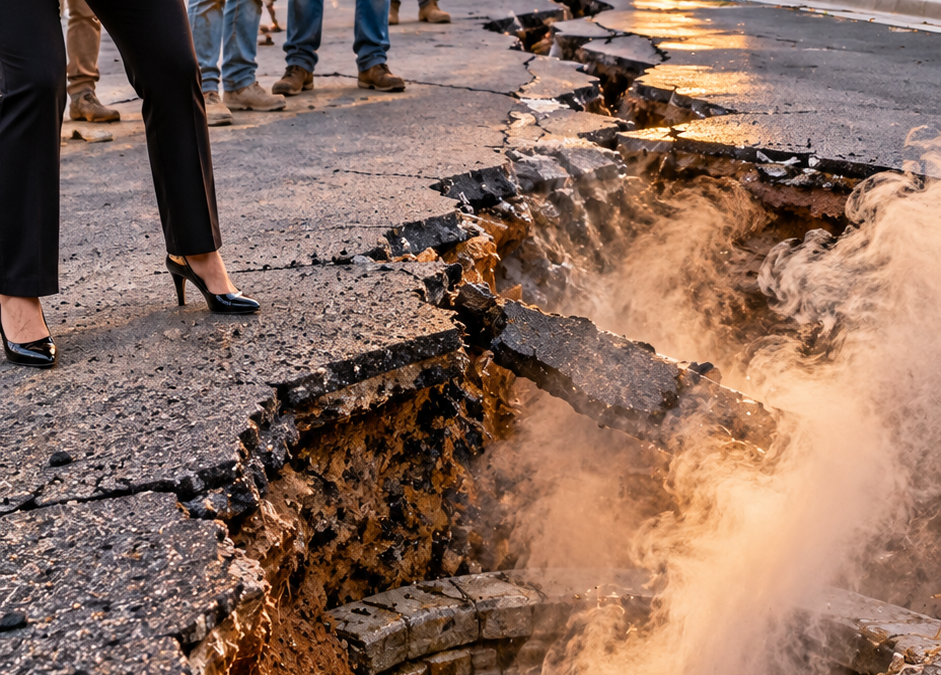
𝗣𝗔𝗥𝗧 𝟮
I found Ray Hallstead through a guy named Martin at the hardware store.
Martin had spent twenty years doing utility locates, and when I described the warm ground, the filled well, and the disappearing midnight asphalt company, he stopped scanning the box of screws I was buying and looked at me.
“You need radar.”
“Ground-penetrating?”
“Yeah.”
“You know somebody?”
He wrote a number on the back of my receipt.
“Ray. Tell him I sent you.”
Ray had run ground-penetrating radar surveys for eleven years before opening his own small company.
When I called, I expected skepticism.
Instead, he asked three questions.
“How old is the well?”
“At least sixty years.”
“How long after they filled it did you notice heat?”
“About three days.”
“And the road cracked after?”
“A week.”
There was a pause.
“I can come Saturday.”
He arrived with a cart-mounted GPR unit that looked like a lawn mower designed by someone who disliked lawns.
For two hours he walked deliberate lines across my yard.
The machine transmitted pulses into the ground while a laptop displayed layered reflections.
Most of my property looked boring.
Ray liked boring.
“Clean layering,” he said.
Then he crossed the old well location.
The screen changed.
He stopped.
Backed up.
Ran the same line again.
“What?”
He pointed.
“See that?”
I saw a curved reflection shaped almost like an upside-down U.
“That’s a hyperbola. Point reflector.”
“Meaning?”
“Something solid is down there.”
“The well casing?”
“No.”
He made another pass perpendicular to the first.
The anomaly persisted.
“Your well went how deep?”
“About forty feet.”
“This is six, maybe seven.”
“How big?”
Ray studied the data.
“Reflection runs roughly eleven feet. Maybe a little more.”
“Pipe?”
“Too broad.”
“What then?”
“Tank. Chamber. Buried structure. Hard to say without excavation.”
I stared at the grass.
For years, I’d mowed directly over whatever he was describing.
Ray continued scanning toward the common-area strip beside the fence.
Then he stopped again.
“Interesting.”
That is not a word you want to hear from a man pointing radar into your yard.
“What?”
“There’s disturbance running away from this.”
“Toward the road?”
He looked northeast.
Exactly where the crack had formed.
“You said the well had always been open?”
“Covered, but vented.”
“Never sealed?”
“No.”
Ray rested both hands on the GPR cart.
“I do radar, Adam. I don’t do environmental chemistry, so understand what I’m saying as a theory.”
“Go ahead.”
“If there’s some buried structure under here generating vapor or heat, that old shaft may have provided a pressure pathway.”
“A vent.”
“Basically.”
“And they plugged it.”
“Then whatever was migrating upward lost its easiest exit.”
He pointed toward the road.
“Pressure, vapor, displaced moisture—it takes another path.”
“And the crack?”
“Could be connected.”
“Could?”
“I’m not signing my name to certainty from one survey.”
Fair enough.
Then he looked back toward the screen.
“But I’ll tell you something I am comfortable saying.”
“What?”
“I don’t like undocumented eleven-foot objects six feet under residential property.”
I laughed once.
Not because it was funny.
Ray didn’t.
“Nobody buries something that size and forgets about it accidentally.”
That night I pulled every property record I could find.
Plat maps.
Planning approvals.
Aerial photographs.
County GIS overlays.
Old tax assessments.
The subdivision had been developed in 2003.
Before that, the entire area belonged to a 340-acre parcel owned by a company called Halverson Agricultural Holdings.
I searched the name.
Mostly dead records.
Old tax liens.
Equipment auctions.
Then I found a scanned 1978 water-quality permit.
HALVERSON AGRICULTURAL HOLDINGS — MATERIALS RECLAMATION SITE
I opened the attachment.
The scan was crooked and yellow.
The site map had been drawn by hand.
I rotated it.
Zoomed in.
Compared the old parcel boundaries with the modern plat.
The former materials-storage area sat almost exactly beneath my backyard and the HOA common strip.
My stomach tightened.
The permit authorized temporary storage and eventual removal of “industrial byproduct materials.”
No chemicals specified.
No inventory.
No closure documents.
The permit expired in 1981.
The records ended there.
No final inspection.
No removal certification.
Nothing saying the site had ever actually been cleaned.
I looked again at Ray’s survey.
An eleven-foot anomaly.
Six feet down.
Directly inside the boundary of a forty-eight-year-old industrial reclamation site.
Then I thought about the fake paving company.
Somebody knew.
I called county environmental health the next morning.
The woman who answered eventually transferred me to an inspector named Priya Anand.
I explained everything.
She listened without interrupting.
At the end, she said, “I can schedule a preliminary site visit in about two weeks.”
“Two weeks?”
“That’s our current field schedule.”
“Someone sent an unlicensed crew to cover the road crack at midnight.”
That produced silence.
I continued.
“The storage site dates to the seventies. There’s no closure report.”
“Do you have that permit?”
“Yes.”
“And the radar survey?”
“Yes.”
“And photographs of the road work?”
“Plenty.”
Her voice changed.
Not dramatically.
Just enough.
“Email everything today.”
“I will.”
“And Mr. Kesler?”
“Yes?”
“Do not allow anyone to disturb that ground.”
“The HOA?”
“Especially the HOA.”
“What happens if this is what it looks like?”
“If someone knowingly concealed a possible hazardous-material site, this stops being ordinary county code enforcement.”
“What does it become?”
“Potential state environmental enforcement.”
Finally.
An official person had said the word I had been avoiding.
Concealment.
I began investigating the midnight contractor.
The company itself did not exist.
But the address on the truck’s magnetic sign belonged to a commercial storage facility forty minutes away.
I searched the unit registration.
The renter was an LLC.
MARCHETTI VENTURES.
Registered eleven months earlier.
Owner:
Carla Marchetti.
I knew the name instantly.
Carla had been president of our HOA for nine years.
Diane Prescott’s predecessor.
I leaned back in my chair.
For the first time since the crew buried my well, the pieces stopped looking random.
Carla had run Sable Ridge for almost a decade.
Diane succeeded her.
Now an unlicensed contractor linked to Carla’s private LLC had been hired by Diane’s board to cover a crack caused shortly after Diane ordered my well sealed.
That wasn’t coincidence.
That was continuity.
I called Ray.
“I found the old land use.”
“What?”
“Industrial reclamation site. Seventies.”
Ray was quiet.
Then:
“That would explain why I didn’t love the radar.”
“There’s no closure report.”
“Then call the county.”
“Already did.”
“Good.”
I hesitated.
“Have you seen anything like this?”
“More than most homeowners would enjoy hearing.”
He explained that huge areas around us had once been agricultural or light-industrial land.
Subdivision development during the eighties, nineties, and early 2000s had sometimes happened with minimal historical environmental investigation.
“Most buried stuff stays buried,” he said. “Until somebody puts in a pool or a sewer line or a foundation.”
“Or plugs a vent.”
“Apparently.”
I stared through the kitchen window toward the southeast corner.
“So that well may have been protecting us.”
“Maybe unintentionally.”
“For sixty years.”
“Sometimes infrastructure survives longer than the memory of why it exists.”
That sentence stayed with me.
I took out a legal pad.
Started building a timeline.
1978 — Halverson reclamation permit.
1981 — permit expires, no closure record.
2003 — subdivision construction begins.
Years later — Carla Marchetti becomes HOA president.
Nine years — Carla controls the board.
Then Diane replaces her.
Three weeks ago — Diane orders my old well filled.
A few days later — ground warms.
One week later — road cracks.
Then — midnight patch job.
Fake contractor.
Storage unit tied to Carla.
I stared at the list.
Secrets don’t survive decades because one person keeps them.
They survive because they become procedures.
A phone number.
A discretionary account.
A sentence passed quietly from one board president to the next.
If this happens, call this person.
Carla still lived in Sable Ridge.
That surprised me.
I had seen her at the mailbox kiosk.
She waved.
She attended the occasional neighborhood barbecue.
She had stood ten yards from me more than once while something from her presidency apparently sat buried under my lawn.
I did not confront her.
Confronting someone before you understand what they know simply gives them time to organize their memory.
I sent everything to Priya instead.
She called the next afternoon.
“We’re moving your inspection up.”
“How far?”
“Four days.”
That Saturday, two county vehicles arrived.
So did a portable coring rig.
Neighbors came outside almost immediately.
Nothing creates community engagement like government vehicles parked near a suspicious hole.
Priya introduced herself.
She was smaller than I expected, calm, and so methodical that Diane would have hated her immediately.
The county team ran its own radar survey.
Their readings confirmed Ray’s anomaly.
Then they collected soil-gas samples.
Then shallow soil cores.
One core came up dark and smelled sharp even from several feet away.
Priya leaned toward it.
“Petroleum hydrocarbon odor.”
“Oil?”
“Could be.”
Another technician took a reading.
Priya added, “Possibly mixed solvents. Field indicators only. We need laboratory confirmation.”
“How long?”
“Two to three weeks.”
“That long?”
“For full compound identification, yes.”
Then she looked toward the cracked road.
“But I have enough to issue an immediate disturbance advisory.”
By Monday, the county order prohibited digging or construction within the affected zone.
It also required disclosure to all residents within one hundred feet.
That ended Diane’s ability to keep things quiet.
The emergency HOA meeting happened Thursday.
I arrived early.
One month earlier, that room had listened politely while Diane suggested I had destabilized the road using excavation equipment that did not exist.
This time people watched her differently.
Fear had shifted directions.
Diane opened with:
“The county’s preliminary observations remain unconfirmed.”
Renee Castillo stood before Diane reached sentence four.
Renee had two small children and pushed a stroller along the access road most mornings.
“You said Adam damaged the road.”
Diane frowned.
“I said our engineering consultant believed activity near the property line could—”
“What engineering consultant?”
I stood.
The room went quiet.
“I’ve requested that report three times.”
Diane looked toward me.
“This isn’t an interrogation.”
“No. It’s an HOA meeting.”
A few people laughed.
Diane did not.
“I’d still like the report.”
“Our counsel is reviewing document requests.”
“So does the report exist?”
She shifted.
“The association consulted appropriate professionals.”
“That wasn’t the question.”
I held up the photograph of the midnight crew.
“I’d also like to know who authorized this company.”
Diane’s expression hardened.
“Maintenance vendors are selected pursuant to board authority.”
“That vendor has no contractor’s license.”
A murmur moved through the room.
“No state registration.”
More murmuring.
“No business address.”
Diane looked toward the other board members.
I continued.
“The address on the truck belongs to a storage unit rented by Marchetti Ventures.”
Then I said the name.
“Carla Marchetti.”
The room reacted.
Carla had been HOA president long enough that almost everyone knew her.
Diane’s face barely changed.
Barely.
But sometimes the smallest movement tells you exactly where the nerve is.
“I don’t understand Carla’s relevance.”
“I didn’t either.”
I set copies of the old permit on the table.
“Until I found this.”
People leaned forward.
“A 1978 county permit for an industrial materials reclamation site on the land beneath this subdivision.”
Diane looked at the document.
“The subdivision passed development review.”
“That doesn’t answer why the old reclamation site has no closure report.”
Nobody spoke.
I pointed toward the county map.
“The former storage area overlaps my backyard.”
Then toward the road.
“The county found contamination exactly where an independent radar operator found a buried structure.”
I held up the fake contractor photograph.
“And after the road cracked, somebody connected to a former HOA president sent an unlicensed crew here at midnight to cover it.”
Diane’s voice became sharper.
“You’re drawing conclusions without evidence.”
“That’s interesting.”
“Excuse me?”
“Because last month you accused me of destabilizing the road without evidence.”
The room went still.
I let that sit.
Then Renee asked:
“Did you know about this before Adam found it?”
Diane said nothing for perhaps three seconds.
It felt like thirty.
“We were aware of historical concerns regarding that section of the property.”
There it was.
Not denial.
Translation.
Renee stared at her.
“You knew.”
“I said historical concerns.”
“You knew.”
“I am not going to characterize incomplete historical information as—”
“Did you know before you filled his well?”
That was the question Diane could not comfortably answer.
She called for order.
Then she tried to move to budget matters.
Nobody allowed it.
Eleven days later, county investigators interviewed Carla Marchetti.
She talked.
A lot.
Priya later told me that once investigators confronted Carla with the storage-unit records, the old permit, the radar survey, and the midnight contractor, she shifted from denial to cooperation rapidly.
Carla said she first learned about the buried waste during her first year as HOA president.
A landscaping contractor had been digging near the common area and struck corroded metal.
There was an oily smell.
Instead of reporting it, Carla paid the contractor from HOA maintenance funds to refill the hole.
Why?
Property values.
She feared environmental investigation would stigmatize the subdivision.
That initial decision became policy.
Heavy rain caused chemical odors?
Blame drainage.
Dead grass?
Bad soil.
Warm ground?
Natural variation.
Every strange symptom received a harmless explanation.
Each lie purchased another year.
Then Carla stepped down.
Before handing Diane the presidency, she told her everything.
The buried waste.
The old industrial use.
The previous contractor.
The history of complaints.
The off-the-books fixes.
Diane had not inherited ignorance.
She inherited a warning.
And then she made a new decision.
My dry well had apparently served as an accidental vent for decades.
Nobody still living there knew that.
When Diane approved what she called a “routine hazard cleanup” and filled it, heat and vapor began seeking another route.
The road cracked.
Diane called Carla.
Carla gave her the contractor contact.
The midnight crew arrived.
The skim coat went down.
And Diane apparently hoped the problem would remain underground until it belonged to somebody else.
The pattern reached further back than I expected.
Priya found an old complaint from a family who had lived near the common area years earlier.
They reported chemical odors after heavy rain.
Their lawn repeatedly died in the same location.
The official HOA response called it:
A NORMAL LOCAL DRAINAGE CONDITION.
The family eventually moved.
I never knew them.
But I thought about them frequently.
Somebody had stood where I was standing.
They had noticed something.
They had asked.
And someone with a binder had calmly told them not to trust what their own senses were telling them.
Carla’s investigator statement eventually ran close to forty pages.
One section stayed with me.
She wrote that she had convinced herself she was protecting homeowners.
If the association reported the buried waste, property values could collapse.
Mortgage lenders might panic.
Home sales might freeze.
So she chose silence.
Maybe in that first year she genuinely believed it.
That’s how terrible decisions often begin.
Not with somebody announcing that they are about to do something dishonest.
With somebody announcing that they are being practical.
Diane did not have that excuse.
By the time the secret reached her, it came with nine years of history.
Complaints.
Payments.
Known symptoms.
A contractor contact.
She understood exactly what she was inheriting.
And when the ground responded after she filled my well, she had a chance to report everything.
Instead, she hired people to work at midnight.
The state opened a formal environmental enforcement case eight days after Carla began cooperating.
The enforcement officer assigned to it was Dennis Okafor.
He called me one afternoon.
“Mr. Kesler, I have a question.”
“Okay.”
“When you researched Halverson Agricultural Holdings, did you look at their other properties?”
“No.”
“You should.”
I sat straighter.
“Why?”
“They operated three additional reclamation sites in this county between 1971 and 1983.”
“What happened to them?”
“One is now a shopping center.”
He paused.
“One became an elementary school.”
I stopped breathing for a second.
“An elementary school?”
“Before you panic, we have no evidence of contamination at that location.”
“But nobody checked.”
“Not specifically for this historical use.”
That evening, I found the school online.
Low brick building.
Bright mural.
Playground.
Baseball field.
Trees planted by people who probably never knew what had existed there before.
I called the district facilities office the next morning.
I eventually reached a maintenance supervisor named Tom Reyes.
I explained why I was calling.
There was silence.
Then Tom said:
“You know, there is one patch.”
“What patch?”
“Beyond the baseball diamond. Grass never grows right.”
“How long?”
“I’ve worked here twenty-one years. As long as I can remember.”
My stomach dropped.
“We reseeded it four or five times.”
“Anyone ever test it?”
“No reason to.”
He sounded troubled now.
“We always assumed construction compaction.”
The state tested the school.
The waiting was awful.
Three weeks later, Dennis called.
“Clean.”
I exhaled.
“Completely?”
“No historical contamination detected.”
The shopping center showed trace residual contamination below remediation thresholds.
No active danger.
Another former site was also clean.
My subdivision was different.
The buried material remained active.
According to Dennis, the old vent pathway may have prevented pressure and vapor from concentrating for decades.
Then somebody capped it.
The HOA called it a useless dry well.
It had quietly been performing a job no one remembered.
Once that became public, the mood inside Sable Ridge changed completely.
Diane was removed from the board nine days after the state case opened.
Unanimous emergency vote.
By then, she had stopped attending meetings.
Her attorney answered communications for her.
Carla was named in the enforcement action as well.
Then came the number that frightened everybody more than the environmental report.
The preliminary remediation estimate:
Between four hundred thousand and seven hundred thousand dollars.
If no outside responsible party could be found, the HOA might be left with the bill.
Which meant us.
Special assessment.
Potentially thousands per home.
Possibly far more.
Suddenly, people I barely knew began knocking on my door.
My porch became an unofficial information desk.
“What happens to our property values?”
“Could the HOA go bankrupt?”
“Will lenders stop financing sales?”
“Can they make us pay this?”
I gave everyone the same answer.
“I don’t know.”
It was amazing how refreshing that phrase became after months of listening to people like Diane answer questions they didn’t understand with absolute confidence.
What I could tell them was what Dennis had told me.
The state was investigating historical corporate liability.
Halverson Agricultural Holdings might no longer exist under that name, but environmental responsibility does not necessarily disappear because a corporation changes stationery.
Then Dennis’s office found the chain.
Halverson Agricultural Holdings had been acquired in 1989.
The acquiring business later merged into a larger agricultural conglomerate.
That conglomerate was eventually absorbed by a national holding company.
Names changed.
Executives changed.
Logos changed.
Liabilities did not automatically vanish.
Dennis explained it simply.
“If the corporate succession can be established, responsibility may follow.”
The state established it.
Six weeks after Molly first refused to cross my lawn, the state sent a formal notice to the current corporate successor.
The company was held responsible for remediation tied to waste left by its predecessor.
They could have fought.
For a while, everyone assumed they would.
Then the state reminded them there were three other Halverson legacy sites now attracting attention.
Public litigation had suddenly become less appealing.
The company settled.
Full site remediation.
Their expense.
No homeowner special assessment.
The night the agreement was announced, the clubhouse was packed.
When the new board president read the part confirming homeowners would not receive remediation assessments, the room made an actual sound.
Not cheering exactly.
Relief.
The sound of three hundred people simultaneously putting down calculators.
Renee turned around.
Found me near the back.
Mouthed:
Thank you.
I nodded.
Dennis called later.
“I want to tell you something,” he said.
“What?”
“Cases like this usually don’t start with dramatic evidence.”
“Mine started with a dog.”
“Exactly.”
He laughed.
“Usually somebody sees dead grass. Smells something. Notices warm soil. They ask whoever seems to be in charge.”
“And get told it’s nothing.”
“And most people accept that.”
“What happens then?”
“Usually?”
“Yeah.”
“Nothing.”
He said it flatly.
“The file disappears. The board changes. The homeowner moves. Ten years later someone notices again.”
“How many cases like this have you actually taken through corporate liability?”
“In eighteen years?”
He thought.
“Four.”
“Four?”
“Counting yours.”
That was difficult to absorb.
“What happened in the others?”
“Two were discovered after people got sick.”
He didn’t need to add anything.
Excavation began four months after the HOA buried my well.
This crew arrived at eight in the morning.
Permits posted.
Barricades installed.
Air monitoring active.
Licensed environmental contractors.
Technicians in protective gear.
Every load documented.
The difference between legitimate remediation and the HOA’s midnight version of “maintenance” was almost comedic.
No magnetic truck signs.
No disappearing before sunrise.
No pretending three inches of asphalt could solve forty years of chemistry.
Neighbors lined the fence.
A local television crew arrived.
I stayed near the same place I had stood months earlier watching workers pour gravel into my well.
The excavator dug carefully through clean fill.
Then older soil.
Then something metallic appeared.
Work slowed.
Technicians moved in.
Eventually, the excavator exposed the first drum.
Large.
Steel.
Heavily corroded.
Then a second.
The crowd became silent.
For months, everything had existed as radar shapes, permits, statements, and laboratory results.
Now two rusting industrial drums sat in daylight.
Physical.
Ugly.
Undeniable.
Sarah Quan, the remediation supervisor, came over after the drums were stabilized.
“You’re Adam?”
“Yes.”
“The homeowner who started the report?”
“I guess.”
She looked at the drums.
“Good catch.”
“My dog gets some credit.”
Sarah smiled.
“Fair.”
“What would have happened if nobody caught it?”
She looked back toward the excavation.
“Hard to predict exactly.”
“Worst case.”
“One of those containers fails completely.”
“And then?”
“Broader soil contamination. Possibly groundwater.”
“How bad?”
“Potentially millions.”
“Years?”
“Could be.”
She pointed toward the corroded metal.
“You found this at a good time.”
I stared at it.
“Funny. Didn’t feel like good timing.”
“It rarely does.”
One of Sarah’s younger technicians, Marcus, asked me something a few days later.
“Why didn’t you just accept the road repair?”
“What?”
“When the HOA patched it.”
He shrugged.
“Most people would’ve seen smooth asphalt the next morning and figured somebody fixed it.”
I looked toward the excavation.
“I wasn’t trying to uncover an environmental conspiracy.”
“No?”
“No.”
“What were you trying to do?”
“Figure out why my dog wouldn’t walk across the yard.”
He laughed.
“That’s it?”
“That’s it.”
Then I thought about it.
“I guess after that, every answer created another question.”
“And you kept asking.”
“Unfortunately for several former HOA presidents.”
Marcus grinned.
The excavation lasted eleven weeks.
Contaminated soil came out.
Clean fill went in.
The old drums were removed.
The surrounding area was tested repeatedly until the state approved restoration.
Then came the question of the well.
Mine was gone.
The HOA’s crew had destroyed it.
Nobody suggested recreating the exact sixty-year-old shaft.
Instead, engineers designed a proper modern pressure-relief and drainage system.
Permitted.
Monitored.
Mapped.
Documented.
Installed almost exactly where the old well had stood.
The new board asked me to attend the design meeting.
Diane had once refused to return my phone call.
The new board gave me copies of the engineering drawings before approving construction.
A small improvement.
The first major policy adopted by the replacement board required independent engineering review for future drainage and infrastructure projects.
Affected homeowners had to receive at least thirty days’ notice.
Supporting documents had to be publicly available.
Contractors had to be licensed.
You might think that last one would not require a formal policy.
Sable Ridge had become a neighborhood where obvious things were now written down.
Renee Castillo won a board seat.
People asked me to run.
I refused.
I had spent enough time in rooms containing folding tables.
I did agree to lead a resident advisory group on environmental and infrastructure issues.
No formal authority.
No budget.
No title anyone would embroider onto a shirt.
Exactly how I liked it.
Our first recommendation was simple.
Audit everything.
Twenty years of maintenance records.
Drainage work.
Road projects.
Utility repairs.
Contractors.
No more assuming that because a project was old, it was harmless.
The audit found no second disaster.
Mostly boring things.
Incomplete easement records.
Expired vendor insurance certificates.
A few drainage repairs performed without ideal documentation.
But boring was wonderful.
I developed a deep appreciation for boring.
The board digitized the entire maintenance archive.
Every resident could search it.
If someone dug near the southeast corner fifty years later, they wouldn’t have to search a forgotten county scan from 1978.
They would know.
The corporate successor to Halverson also agreed to environmental screening of every traceable former reclamation site in its historical chain.
Most were clean.
One abandoned rail property required continued monitoring.
No schools sat on contamination.
No shopping center needed evacuation.
That mattered.
Diane’s situation was less comfortable.
Investigators focused heavily on the unauthorized HOA expenditures and her knowing concealment after the road cracked.
Carla cooperated.
That reduced her exposure.
Diane had not cooperated nearly as enthusiastically.
The county attorney pursued restitution connected to the improper use of association funds.
State regulators also sought to permanently prevent her from holding similar association positions.
Carla reached a settlement that required substantial repayment.
She avoided criminal prosecution.
I had complicated feelings about that.
Carla started the concealment.
But she also eventually gave investigators the history they needed.
Diane inherited a terrible secret.
Then, with full knowledge, made it worse.
There was something almost impressive about her ability to receive nine years of evidence proving concealment was a bad strategy and conclude that concealment simply needed better scheduling.
I saw her once afterward.
Grocery store.
Coffee-filter aisle.
We both reached toward the same box.
She froze.
I stepped back.
“Go ahead.”
She picked it up.
For several seconds neither of us spoke.
Then she said:
“I thought the patch would hold.”
I looked at her.
“What?”
“The road.”
She stared at the box in her hands.
“I thought it would buy time.”
“For what?”
“I don’t know.”
She swallowed.
“A future board. Another repair. Anything.”
“So you knew.”
She gave me a tired look.
“We’re past pretending I didn’t.”
Fair.
She continued.
“I genuinely believed if I could just keep it stable long enough, it wouldn’t become my problem.”
I almost laughed.
Not because it was funny.
Because there it was.
The entire philosophy of bad HOA governance condensed into one sentence.
Keep the problem quiet until someone else inherits it.
I took another package of filters.
“Well,” I said, “that didn’t work.”
No speech.
No threat.
No grand moral lesson.
I left.
That was the last conversation we had.
By October, the restored ground had settled.
New grass covered the excavation area.
The access road had been properly reconstructed, including removal of the ridiculous midnight skim coat.
The new pressure-relief system sat beneath a reinforced access panel near my fence.
It wasn’t attractive.
Nobody cared.
Beauty had fallen several places on Sable Ridge’s infrastructure priority list.
Molly crossed the lawn for the first time without stopping.
She walked directly over the area that had once made her growl.
Sniffed once.
Then flopped down near the fence.
I stood there watching her.
Seven months earlier, the HOA had filled a dry well because someone considered it a liability.
Nobody asked why it existed.
Nobody checked old land records.
Nobody hired a hydrogeologist.
Nobody wondered whether a sixty-year-old structure predating the subdivision might have been serving some function other than offending modern landscaping tastes.
They simply erased it.
When consequences appeared, the board blamed me.
When evidence contradicted them, they hired people after midnight.
When those repairs failed, they called the evidence preliminary.
When investigators found the paper trail, they called the past complicated.
It wasn’t complicated.
They had repeatedly chosen silence because silence was cheaper today.
The invoice simply arrived later.
There is a small plaque beside the new drainage access panel.
I argued against it.
Renee insisted.
Fortunately, she had enough sense not to put my name on it.
It reads:
MAINTAINED UNDER RESIDENT INFRASTRUCTURE OVERSIGHT POLICY
Very bureaucratic.
Perfect.
Not a monument.
A warning.
If somebody wants to dig there in sixty years, they’ll find records.
Plans.
Inspection reports.
Maintenance logs.
They won’t have to rely on a dog.
Sometimes late in the evening I walk to the fence.
The road is quiet.
The ground is cool.
Actually cool.
Ordinary soil at ordinary temperature.
I place my palm against it occasionally.
Maybe that’s strange.
After everything that happened, I like confirmation.
The first time I touched that lawn, heat had been coming through the earth and everybody with authority seemed determined to tell me the ground was normal.
Now it is.
And I know why.
The old well is gone.
I still resent that.
It had survived sixty years and was destroyed in one morning by people who spent more time discussing mailbox paint colors than they spent asking why a forty-foot shaft had been built before their subdivision existed.
But what replaced it is safer.
Documented.
Understood.
That matters more.
Sable Ridge changed too.
Meetings became longer.
People asked irritating questions.
Contractor licenses got checked.
Invoices were reviewed.
Maintenance records were posted.
Board presidents discovered that “because the association approved it” was not a complete explanation.
Diane would have hated the new meetings.
I considered that another sign of progress.
The most satisfying part wasn’t watching her lose the presidency.
It wasn’t Carla signing a restitution agreement.
It wasn’t even seeing the fake paving contractor’s work ripped out in broad daylight.
It was watching the new board approve the drainage system.
The engineer projected the plans on the clubhouse wall.
He explained pressure relief.
Vapor monitoring.
Access requirements.
Maintenance intervals.
Then he stopped.
“Questions?”
Hands went up everywhere.
Not hostile questions.
Not paranoid questions.
Just questions.
The kind Diane used to treat as disobedience.
The engineer answered each one.
Nobody adjourned early.
Nobody tried to hide costs.
Nobody claimed technical reports existed without producing them.
That may not sound like justice.
But after living through the alternative, it felt close.
The HOA had filled my “useless” dry well because they wanted one less ugly problem to look at.
Instead, they uncovered a forty-year-old environmental secret, destroyed two presidencies, triggered a state investigation, exposed a fake contractor, forced a national corporate successor to fund a full remediation, and ended with the neighborhood installing a modern version of the exact pressure-relief function they had paid to eliminate.
The road they blamed me for cracking had to be rebuilt.
The well they called unnecessary was proven essential.
The records they hoped nobody would read became the evidence that buried them.
And Diane Prescott, who once ended meetings before I could finish a question, eventually learned the one rule the ground had been trying to teach her from the beginning.
Covering a crack does not remove what caused it.
It only gives the pressure somewhere else to go.
Have you finished reading the story and want to read it again?
HOA Buried My “Dry Well” Without Permission — Then Their $40,000 Road Split Open Above What They Tried to Hide
They buried my sixty-year-old dry well without permission.
Three days later, heat started rising through my lawn.
A week after that, the HOA’s brand-new road began splitting open.
My name is Adam Kesler, and until that month, the strangest thing about the southeast corner of my property was a forty-foot-deep stone-lined shaft everyone called the dry well.
It had been there longer than my house.
Longer than the subdivision.
Possibly longer than anyone still living nearby could remember.
It didn’t produce water. It didn’t smell. It didn’t flood. It didn’t interfere with the lawn.
It just existed.
Then one Tuesday morning, while I was away picking up equipment, the Sable Ridge HOA decided existence was apparently sufficient grounds for demolition.
I came home to an excavator in my backyard.
A crew had already dumped gravel into the shaft and poured a concrete cap over the top.
I parked sideways in my driveway and ran toward them.
“What are you doing?”
The operator pointed toward a man in a reflective vest.
“HOA authorization.”
“I own this property.”
The man looked at his clipboard.
“Hazard remediation.”
“Who authorized it?”
“The association.”
“I’m asking for a name.”
He stared at the clipboard again as if hoping a constitutional amendment might be hiding between pages.
“Board directive.”
That was all I got.
By the time I called HOA president Diane Prescott, the crew was leaving.
She didn’t answer.
I called again.
Nothing.
I emailed.
No response.
For three days, the woman who normally answered messages about improperly colored porch umbrellas with the speed of an air-traffic controller somehow became unreachable when asked why she had filled a forty-foot shaft on property she didn’t own.
Then my dog noticed the heat.
Molly was nine, stubborn, and normally considered every square inch of my yard her personal jurisdiction.
Thursday morning she stopped at the patio.
Her ears went forward.
A low growl rolled out of her chest.
“Come on.”
She wouldn’t move.
She stared toward the southeast fence.
Friday, same thing.
So I walked across the lawn barefoot.
About eighteen feet from the newly capped well, the ground changed.
Warm.
Not afternoon-sun warm.
It was barely seven in the morning.
This was steady heat rising from below.
I crouched and pressed my palm flat against the grass.
The soil felt almost feverish.
Then I noticed something else.
A faint current of warm air was escaping through a narrow seam beside the new concrete cap.
I held my hand over it.
The ground was breathing.
One week later, the HOA’s newly resurfaced access road cracked.
They had spent roughly forty thousand dollars repaving it that spring and had featured it in the community newsletter with enough photographs to suggest asphalt was a newborn grandchild.
Now a thin fissure ran nearly ten feet across the pavement.
The crack pointed northeast.
Almost perfectly along the same line running away from my old well.
I photographed it.
Then I brought it up at the next board meeting.
Diane didn’t even let me finish.
“Mr. Kesler has apparently been conducting unauthorized excavation along the shared property boundary.”
I stared at her.
“I used a thermometer.”
She continued reading.
“Our engineering consultant believes disturbance near the roadway may have destabilized the subgrade.”
“I haven’t excavated anything.”
Diane turned a page in her binder.
“The board has voted to retain a specialized contractor.”
“What engineering consultant?”
“They’ll begin immediately.”
“Can we see the report?”
“Is there any other new business?”
That was Diane’s preferred method of conflict resolution.
If reality became inconvenient, she declared the agenda complete.
The contractor arrived the following Tuesday.
At 11:47 p.m.
I watched from my dark kitchen as portable floodlights appeared around the cracked road.
No saw-cutting.
No excavation.
No soil inspection.
No core samples.
The crew simply spread a thin black layer over the crack, smoothed it, packed their equipment, and disappeared before one in the morning.
By sunrise, the road looked perfect from twenty feet away.
Up close, I pushed my thumb into the seam.
The material gave under pressure.
Too thin.
Too fresh.
Too quick.
There were no permit signs.
No barricades.
No inspection notice.
I’d photographed the truck before it left.
The magnetic door sign gave me a company name.
I searched the state contractor database.
Nothing.
Business registry.
Nothing.
License number.
There wasn’t one.
The “specialized contractor” hired with our HOA dues did not legally exist.
That was the moment I stopped believing this was about an old well.
Someone wasn’t repairing a road.
Someone was covering something.
PART2
I found Ray Hallstead through a guy named Martin at the hardware store.
Martin had spent twenty years doing utility locates, and when I described the warm ground, the filled well, and the disappearing midnight asphalt company, he stopped scanning the box of screws I was buying and looked at me.
“You need radar.”
“Ground-penetrating?”
“Yeah.”
“You know somebody?”
He wrote a number on the back of my receipt.
“Ray. Tell him I sent you.”
Ray had run ground-penetrating radar surveys for eleven years before opening his own small company.
When I called, I expected skepticism.
Instead, he asked three questions.
“How old is the well?”
“At least sixty years.”
“How long after they filled it did you notice heat?”
“About three days.”
“And the road cracked after?”
“A week.”
There was a pause.
“I can come Saturday.”
He arrived with a cart-mounted GPR unit that looked like a lawn mower designed by someone who disliked lawns.
For two hours he walked deliberate lines across my yard.
The machine transmitted pulses into the ground while a laptop displayed layered reflections.
Most of my property looked boring.
Ray liked boring.
“Clean layering,” he said.
Then he crossed the old well location.
The screen changed.
He stopped.
Backed up.
Ran the same line again.
“What?”
He pointed.
“See that?”
I saw a curved reflection shaped almost like an upside-down U.
“That’s a hyperbola. Point reflector.”
“Meaning?”
“Something solid is down there.”
“The well casing?”
“No.”
He made another pass perpendicular to the first.
The anomaly persisted.
“Your well went how deep?”
“About forty feet.”
“This is six, maybe seven.”
“How big?”
Ray studied the data.
“Reflection runs roughly eleven feet. Maybe a little more.”
“Pipe?”
“Too broad.”
“What then?”
“Tank. Chamber. Buried structure. Hard to say without excavation.”
I stared at the grass.
For years, I’d mowed directly over whatever he was describing.
Ray continued scanning toward the common-area strip beside the fence.
Then he stopped again.
“Interesting.”
That is not a word you want to hear from a man pointing radar into your yard.
“What?”
“There’s disturbance running away from this.”
“Toward the road?”
He looked northeast.
Exactly where the crack had formed.
“You said the well had always been open?”
“Covered, but vented.”
“Never sealed?”
“No.”
Ray rested both hands on the GPR cart.
“I do radar, Adam. I don’t do environmental chemistry, so understand what I’m saying as a theory.”
“Go ahead.”
“If there’s some buried structure under here generating vapor or heat, that old shaft may have provided a pressure pathway.”
“A vent.”
“Basically.”
“And they plugged it.”
“Then whatever was migrating upward lost its easiest exit.”
He pointed toward the road.
“Pressure, vapor, displaced moisture—it takes another path.”
“And the crack?”
“Could be connected.”
“Could?”
“I’m not signing my name to certainty from one survey.”
Fair enough.
Then he looked back toward the screen.
“But I’ll tell you something I am comfortable saying.”
“What?”
“I don’t like undocumented eleven-foot objects six feet under residential property.”
I laughed once.
Not because it was funny.
Ray didn’t.
“Nobody buries something that size and forgets about it accidentally.”
That night I pulled every property record I could find.
Plat maps.
Planning approvals.
Aerial photographs.
County GIS overlays.
Old tax assessments.
The subdivision had been developed in 2003.
Before that, the entire area belonged to a 340-acre parcel owned by a company called Halverson Agricultural Holdings.
I searched the name.
Mostly dead records.
Old tax liens.
Equipment auctions.
Then I found a scanned 1978 water-quality permit.
HALVERSON AGRICULTURAL HOLDINGS — MATERIALS RECLAMATION SITE
I opened the attachment.
The scan was crooked and yellow.
The site map had been drawn by hand.
I rotated it.
Zoomed in.
Compared the old parcel boundaries with the modern plat.
The former materials-storage area sat almost exactly beneath my backyard and the HOA common strip.
My stomach tightened.
The permit authorized temporary storage and eventual removal of “industrial byproduct materials.”
No chemicals specified.
No inventory.
No closure documents.
The permit expired in 1981.
The records ended there.
No final inspection.
No removal certification.
Nothing saying the site had ever actually been cleaned.
I looked again at Ray’s survey.
An eleven-foot anomaly.
Six feet down.
Directly inside the boundary of a forty-eight-year-old industrial reclamation site.
Then I thought about the fake paving company.
Somebody knew.
I called county environmental health the next morning.
The woman who answered eventually transferred me to an inspector named Priya Anand.
I explained everything.
She listened without interrupting.
At the end, she said, “I can schedule a preliminary site visit in about two weeks.”
“Two weeks?”
“That’s our current field schedule.”
“Someone sent an unlicensed crew to cover the road crack at midnight.”
That produced silence.
I continued.
“The storage site dates to the seventies. There’s no closure report.”
“Do you have that permit?”
“Yes.”
“And the radar survey?”
“Yes.”
“And photographs of the road work?”
“Plenty.”
Her voice changed.
Not dramatically.
Just enough.
“Email everything today.”
“I will.”
“And Mr. Kesler?”
“Yes?”
“Do not allow anyone to disturb that ground.”
“The HOA?”
“Especially the HOA.”
“What happens if this is what it looks like?”
“If someone knowingly concealed a possible hazardous-material site, this stops being ordinary county code enforcement.”
“What does it become?”
“Potential state environmental enforcement.”
Finally.
An official person had said the word I had been avoiding.
Concealment.
I began investigating the midnight contractor.
The company itself did not exist.
But the address on the truck’s magnetic sign belonged to a commercial storage facility forty minutes away.
I searched the unit registration.
The renter was an LLC.
MARCHETTI VENTURES.
Registered eleven months earlier.
Owner:
Carla Marchetti.
I knew the name instantly.
Carla had been president of our HOA for nine years.
Diane Prescott’s predecessor.
I leaned back in my chair.
For the first time since the crew buried my well, the pieces stopped looking random.
Carla had run Sable Ridge for almost a decade.
Diane succeeded her.
Now an unlicensed contractor linked to Carla’s private LLC had been hired by Diane’s board to cover a crack caused shortly after Diane ordered my well sealed.
That wasn’t coincidence.
That was continuity.
I called Ray.
“I found the old land use.”
“What?”
“Industrial reclamation site. Seventies.”
Ray was quiet.
Then:
“That would explain why I didn’t love the radar.”
“There’s no closure report.”
“Then call the county.”
“Already did.”
“Good.”
I hesitated.
“Have you seen anything like this?”
“More than most homeowners would enjoy hearing.”
He explained that huge areas around us had once been agricultural or light-industrial land.
Subdivision development during the eighties, nineties, and early 2000s had sometimes happened with minimal historical environmental investigation.
“Most buried stuff stays buried,” he said. “Until somebody puts in a pool or a sewer line or a foundation.”
“Or plugs a vent.”
“Apparently.”
I stared through the kitchen window toward the southeast corner.
“So that well may have been protecting us.”
“Maybe unintentionally.”
“For sixty years.”
“Sometimes infrastructure survives longer than the memory of why it exists.”
That sentence stayed with me.
I took out a legal pad.
Started building a timeline.
1978 — Halverson reclamation permit.
1981 — permit expires, no closure record.
2003 — subdivision construction begins.
Years later — Carla Marchetti becomes HOA president.
Nine years — Carla controls the board.
Then Diane replaces her.
Three weeks ago — Diane orders my old well filled.
A few days later — ground warms.
One week later — road cracks.
Then — midnight patch job.
Fake contractor.
Storage unit tied to Carla.
I stared at the list.
Secrets don’t survive decades because one person keeps them.
They survive because they become procedures.
A phone number.
A discretionary account.
A sentence passed quietly from one board president to the next.
If this happens, call this person.
Carla still lived in Sable Ridge.
That surprised me.
I had seen her at the mailbox kiosk.
She waved.
She attended the occasional neighborhood barbecue.
She had stood ten yards from me more than once while something from her presidency apparently sat buried under my lawn.
I did not confront her.
Confronting someone before you understand what they know simply gives them time to organize their memory.
I sent everything to Priya instead.
She called the next afternoon.
“We’re moving your inspection up.”
“How far?”
“Four days.”
That Saturday, two county vehicles arrived.
So did a portable coring rig.
Neighbors came outside almost immediately.
Nothing creates community engagement like government vehicles parked near a suspicious hole.
Priya introduced herself.
She was smaller than I expected, calm, and so methodical that Diane would have hated her immediately.
The county team ran its own radar survey.
Their readings confirmed Ray’s anomaly.
Then they collected soil-gas samples.
Then shallow soil cores.
One core came up dark and smelled sharp even from several feet away.
Priya leaned toward it.
“Petroleum hydrocarbon odor.”
“Oil?”
“Could be.”
Another technician took a reading.
Priya added, “Possibly mixed solvents. Field indicators only. We need laboratory confirmation.”
“How long?”
“Two to three weeks.”
“That long?”
“For full compound identification, yes.”
Then she looked toward the cracked road.
“But I have enough to issue an immediate disturbance advisory.”
By Monday, the county order prohibited digging or construction within the affected zone.
It also required disclosure to all residents within one hundred feet.
That ended Diane’s ability to keep things quiet.
The emergency HOA meeting happened Thursday.
I arrived early.
One month earlier, that room had listened politely while Diane suggested I had destabilized the road using excavation equipment that did not exist.
This time people watched her differently.
Fear had shifted directions.
Diane opened with:
“The county’s preliminary observations remain unconfirmed.”
Renee Castillo stood before Diane reached sentence four.
Renee had two small children and pushed a stroller along the access road most mornings.
“You said Adam damaged the road.”
Diane frowned.
“I said our engineering consultant believed activity near the property line could—”
“What engineering consultant?”
I stood.
The room went quiet.
“I’ve requested that report three times.”
Diane looked toward me.
“This isn’t an interrogation.”
“No. It’s an HOA meeting.”
A few people laughed.
Diane did not.
“I’d still like the report.”
“Our counsel is reviewing document requests.”
“So does the report exist?”
She shifted.
“The association consulted appropriate professionals.”
“That wasn’t the question.”
I held up the photograph of the midnight crew.
“I’d also like to know who authorized this company.”
Diane’s expression hardened.
“Maintenance vendors are selected pursuant to board authority.”
“That vendor has no contractor’s license.”
A murmur moved through the room.
“No state registration.”
More murmuring.
“No business address.”
Diane looked toward the other board members.
I continued.
“The address on the truck belongs to a storage unit rented by Marchetti Ventures.”
Then I said the name.
“Carla Marchetti.”
The room reacted.
Carla had been HOA president long enough that almost everyone knew her.
Diane’s face barely changed.
Barely.
But sometimes the smallest movement tells you exactly where the nerve is.
“I don’t understand Carla’s relevance.”
“I didn’t either.”
I set copies of the old permit on the table.
“Until I found this.”
People leaned forward.
“A 1978 county permit for an industrial materials reclamation site on the land beneath this subdivision.”
Diane looked at the document.
“The subdivision passed development review.”
“That doesn’t answer why the old reclamation site has no closure report.”
Nobody spoke.
I pointed toward the county map.
“The former storage area overlaps my backyard.”
Then toward the road.
“The county found contamination exactly where an independent radar operator found a buried structure.”
I held up the fake contractor photograph.
“And after the road cracked, somebody connected to a former HOA president sent an unlicensed crew here at midnight to cover it.”
Diane’s voice became sharper.
“You’re drawing conclusions without evidence.”
“That’s interesting.”
“Excuse me?”
“Because last month you accused me of destabilizing the road without evidence.”
The room went still.
I let that sit.
Then Renee asked:
“Did you know about this before Adam found it?”
Diane said nothing for perhaps three seconds.
It felt like thirty.
“We were aware of historical concerns regarding that section of the property.”
There it was.
Not denial.
Translation.
Renee stared at her.
“You knew.”
“I said historical concerns.”
“You knew.”
“I am not going to characterize incomplete historical information as—”
“Did you know before you filled his well?”
That was the question Diane could not comfortably answer.
She called for order.
Then she tried to move to budget matters.
Nobody allowed it.
Eleven days later, county investigators interviewed Carla Marchetti.
She talked.
A lot.
Priya later told me that once investigators confronted Carla with the storage-unit records, the old permit, the radar survey, and the midnight contractor, she shifted from denial to cooperation rapidly.
Carla said she first learned about the buried waste during her first year as HOA president.
A landscaping contractor had been digging near the common area and struck corroded metal.
There was an oily smell.
Instead of reporting it, Carla paid the contractor from HOA maintenance funds to refill the hole.
Why?
Property values.
She feared environmental investigation would stigmatize the subdivision.
That initial decision became policy.
Heavy rain caused chemical odors?
Blame drainage.
Dead grass?
Bad soil.
Warm ground?
Natural variation.
Every strange symptom received a harmless explanation.
Each lie purchased another year.
Then Carla stepped down.
Before handing Diane the presidency, she told her everything.
The buried waste.
The old industrial use.
The previous contractor.
The history of complaints.
The off-the-books fixes.
Diane had not inherited ignorance.
She inherited a warning.
And then she made a new decision.
My dry well had apparently served as an accidental vent for decades.
Nobody still living there knew that.
When Diane approved what she called a “routine hazard cleanup” and filled it, heat and vapor began seeking another route.
The road cracked.
Diane called Carla.
Carla gave her the contractor contact.
The midnight crew arrived.
The skim coat went down.
And Diane apparently hoped the problem would remain underground until it belonged to somebody else.
The pattern reached further back than I expected.
Priya found an old complaint from a family who had lived near the common area years earlier.
They reported chemical odors after heavy rain.
Their lawn repeatedly died in the same location.
The official HOA response called it:
A NORMAL LOCAL DRAINAGE CONDITION.
The family eventually moved.
I never knew them.
But I thought about them frequently.
Somebody had stood where I was standing.
They had noticed something.
They had asked.
And someone with a binder had calmly told them not to trust what their own senses were telling them.
Carla’s investigator statement eventually ran close to forty pages.
One section stayed with me.
She wrote that she had convinced herself she was protecting homeowners.
If the association reported the buried waste, property values could collapse.
Mortgage lenders might panic.
Home sales might freeze.
So she chose silence.
Maybe in that first year she genuinely believed it.
That’s how terrible decisions often begin.
Not with somebody announcing that they are about to do something dishonest.
With somebody announcing that they are being practical.
Diane did not have that excuse.
By the time the secret reached her, it came with nine years of history.
Complaints.
Payments.
Known symptoms.
A contractor contact.
She understood exactly what she was inheriting.
And when the ground responded after she filled my well, she had a chance to report everything.
Instead, she hired people to work at midnight.
The state opened a formal environmental enforcement case eight days after Carla began cooperating.
The enforcement officer assigned to it was Dennis Okafor.
He called me one afternoon.
“Mr. Kesler, I have a question.”
“Okay.”
“When you researched Halverson Agricultural Holdings, did you look at their other properties?”
“No.”
“You should.”
I sat straighter.
“Why?”
“They operated three additional reclamation sites in this county between 1971 and 1983.”
“What happened to them?”
“One is now a shopping center.”
He paused.
“One became an elementary school.”
I stopped breathing for a second.
“An elementary school?”
“Before you panic, we have no evidence of contamination at that location.”
“But nobody checked.”
“Not specifically for this historical use.”
That evening, I found the school online.
Low brick building.
Bright mural.
Playground.
Baseball field.
Trees planted by people who probably never knew what had existed there before.
I called the district facilities office the next morning.
I eventually reached a maintenance supervisor named Tom Reyes.
I explained why I was calling.
There was silence.
Then Tom said:
“You know, there is one patch.”
“What patch?”
“Beyond the baseball diamond. Grass never grows right.”
“How long?”
“I’ve worked here twenty-one years. As long as I can remember.”
My stomach dropped.
“We reseeded it four or five times.”
“Anyone ever test it?”
“No reason to.”
He sounded troubled now.
“We always assumed construction compaction.”
The state tested the school.
The waiting was awful.
Three weeks later, Dennis called.
“Clean.”
I exhaled.
“Completely?”
“No historical contamination detected.”
The shopping center showed trace residual contamination below remediation thresholds.
No active danger.
Another former site was also clean.
My subdivision was different.
The buried material remained active.
According to Dennis, the old vent pathway may have prevented pressure and vapor from concentrating for decades.
Then somebody capped it.
The HOA called it a useless dry well.
It had quietly been performing a job no one remembered.
Once that became public, the mood inside Sable Ridge changed completely.
Diane was removed from the board nine days after the state case opened.
Unanimous emergency vote.
By then, she had stopped attending meetings.
Her attorney answered communications for her.
Carla was named in the enforcement action as well.
Then came the number that frightened everybody more than the environmental report.
The preliminary remediation estimate:
Between four hundred thousand and seven hundred thousand dollars.
If no outside responsible party could be found, the HOA might be left with the bill.
Which meant us.
Special assessment.
Potentially thousands per home.
Possibly far more.
Suddenly, people I barely knew began knocking on my door.
My porch became an unofficial information desk.
“What happens to our property values?”
“Could the HOA go bankrupt?”
“Will lenders stop financing sales?”
“Can they make us pay this?”
I gave everyone the same answer.
“I don’t know.”
It was amazing how refreshing that phrase became after months of listening to people like Diane answer questions they didn’t understand with absolute confidence.
What I could tell them was what Dennis had told me.
The state was investigating historical corporate liability.
Halverson Agricultural Holdings might no longer exist under that name, but environmental responsibility does not necessarily disappear because a corporation changes stationery.
Then Dennis’s office found the chain.
Halverson Agricultural Holdings had been acquired in 1989.
The acquiring business later merged into a larger agricultural conglomerate.
That conglomerate was eventually absorbed by a national holding company.
Names changed.
Executives changed.
Logos changed.
Liabilities did not automatically vanish.
Dennis explained it simply.
“If the corporate succession can be established, responsibility may follow.”
The state established it.
Six weeks after Molly first refused to cross my lawn, the state sent a formal notice to the current corporate successor.
The company was held responsible for remediation tied to waste left by its predecessor.
They could have fought.
For a while, everyone assumed they would.
Then the state reminded them there were three other Halverson legacy sites now attracting attention.
Public litigation had suddenly become less appealing.
The company settled.
Full site remediation.
Their expense.
No homeowner special assessment.
The night the agreement was announced, the clubhouse was packed.
When the new board president read the part confirming homeowners would not receive remediation assessments, the room made an actual sound.
Not cheering exactly.
Relief.
The sound of three hundred people simultaneously putting down calculators.
Renee turned around.
Found me near the back.
Mouthed:
Thank you.
I nodded.
Dennis called later.
“I want to tell you something,” he said.
“What?”
“Cases like this usually don’t start with dramatic evidence.”
“Mine started with a dog.”
“Exactly.”
He laughed.
“Usually somebody sees dead grass. Smells something. Notices warm soil. They ask whoever seems to be in charge.”
“And get told it’s nothing.”
“And most people accept that.”
“What happens then?”
“Usually?”
“Yeah.”
“Nothing.”
He said it flatly.
“The file disappears. The board changes. The homeowner moves. Ten years later someone notices again.”
“How many cases like this have you actually taken through corporate liability?”
“In eighteen years?”
He thought.
“Four.”
“Four?”
“Counting yours.”
That was difficult to absorb.
“What happened in the others?”
“Two were discovered after people got sick.”
He didn’t need to add anything.
Excavation began four months after the HOA buried my well.
This crew arrived at eight in the morning.
Permits posted.
Barricades installed.
Air monitoring active.
Licensed environmental contractors.
Technicians in protective gear.
Every load documented.
The difference between legitimate remediation and the HOA’s midnight version of “maintenance” was almost comedic.
No magnetic truck signs.
No disappearing before sunrise.
No pretending three inches of asphalt could solve forty years of chemistry.
Neighbors lined the fence.
A local television crew arrived.
I stayed near the same place I had stood months earlier watching workers pour gravel into my well.
The excavator dug carefully through clean fill.
Then older soil.
Then something metallic appeared.
Work slowed.
Technicians moved in.
Eventually, the excavator exposed the first drum.
Large.
Steel.
Heavily corroded.
Then a second.
The crowd became silent.
For months, everything had existed as radar shapes, permits, statements, and laboratory results.
Now two rusting industrial drums sat in daylight.
Physical.
Ugly.
Undeniable.
Sarah Quan, the remediation supervisor, came over after the drums were stabilized.
“You’re Adam?”
“Yes.”
“The homeowner who started the report?”
“I guess.”
She looked at the drums.
“Good catch.”
“My dog gets some credit.”
Sarah smiled.
“Fair.”
“What would have happened if nobody caught it?”
She looked back toward the excavation.
“Hard to predict exactly.”
“Worst case.”
“One of those containers fails completely.”
“And then?”
“Broader soil contamination. Possibly groundwater.”
“How bad?”
“Potentially millions.”
“Years?”
“Could be.”
She pointed toward the corroded metal.
“You found this at a good time.”
I stared at it.
“Funny. Didn’t feel like good timing.”
“It rarely does.”
One of Sarah’s younger technicians, Marcus, asked me something a few days later.
“Why didn’t you just accept the road repair?”
“What?”
“When the HOA patched it.”
He shrugged.
“Most people would’ve seen smooth asphalt the next morning and figured somebody fixed it.”
I looked toward the excavation.
“I wasn’t trying to uncover an environmental conspiracy.”
“No?”
“No.”
“What were you trying to do?”
“Figure out why my dog wouldn’t walk across the yard.”
He laughed.
“That’s it?”
“That’s it.”
Then I thought about it.
“I guess after that, every answer created another question.”
“And you kept asking.”
“Unfortunately for several former HOA presidents.”
Marcus grinned.
The excavation lasted eleven weeks.
Contaminated soil came out.
Clean fill went in.
The old drums were removed.
The surrounding area was tested repeatedly until the state approved restoration.
Then came the question of the well.
Mine was gone.
The HOA’s crew had destroyed it.
Nobody suggested recreating the exact sixty-year-old shaft.
Instead, engineers designed a proper modern pressure-relief and drainage system.
Permitted.
Monitored.
Mapped.
Documented.
Installed almost exactly where the old well had stood.
The new board asked me to attend the design meeting.
Diane had once refused to return my phone call.
The new board gave me copies of the engineering drawings before approving construction.
A small improvement.
The first major policy adopted by the replacement board required independent engineering review for future drainage and infrastructure projects.
Affected homeowners had to receive at least thirty days’ notice.
Supporting documents had to be publicly available.
Contractors had to be licensed.
You might think that last one would not require a formal policy.
Sable Ridge had become a neighborhood where obvious things were now written down.
Renee Castillo won a board seat.
People asked me to run.
I refused.
I had spent enough time in rooms containing folding tables.
I did agree to lead a resident advisory group on environmental and infrastructure issues.
No formal authority.
No budget.
No title anyone would embroider onto a shirt.
Exactly how I liked it.
Our first recommendation was simple.
Audit everything.
Twenty years of maintenance records.
Drainage work.
Road projects.
Utility repairs.
Contractors.
No more assuming that because a project was old, it was harmless.
The audit found no second disaster.
Mostly boring things.
Incomplete easement records.
Expired vendor insurance certificates.
A few drainage repairs performed without ideal documentation.
But boring was wonderful.
I developed a deep appreciation for boring.
The board digitized the entire maintenance archive.
Every resident could search it.
If someone dug near the southeast corner fifty years later, they wouldn’t have to search a forgotten county scan from 1978.
They would know.
The corporate successor to Halverson also agreed to environmental screening of every traceable former reclamation site in its historical chain.
Most were clean.
One abandoned rail property required continued monitoring.
No schools sat on contamination.
No shopping center needed evacuation.
That mattered.
Diane’s situation was less comfortable.
Investigators focused heavily on the unauthorized HOA expenditures and her knowing concealment after the road cracked.
Carla cooperated.
That reduced her exposure.
Diane had not cooperated nearly as enthusiastically.
The county attorney pursued restitution connected to the improper use of association funds.
State regulators also sought to permanently prevent her from holding similar association positions.
Carla reached a settlement that required substantial repayment.
She avoided criminal prosecution.
I had complicated feelings about that.
Carla started the concealment.
But she also eventually gave investigators the history they needed.
Diane inherited a terrible secret.
Then, with full knowledge, made it worse.
There was something almost impressive about her ability to receive nine years of evidence proving concealment was a bad strategy and conclude that concealment simply needed better scheduling.
I saw her once afterward.
Grocery store.
Coffee-filter aisle.
We both reached toward the same box.
She froze.
I stepped back.
“Go ahead.”
She picked it up.
For several seconds neither of us spoke.
Then she said:
“I thought the patch would hold.”
I looked at her.
“What?”
“The road.”
She stared at the box in her hands.
“I thought it would buy time.”
“For what?”
“I don’t know.”
She swallowed.
“A future board. Another repair. Anything.”
“So you knew.”
She gave me a tired look.
“We’re past pretending I didn’t.”
Fair.
She continued.
“I genuinely believed if I could just keep it stable long enough, it wouldn’t become my problem.”
I almost laughed.
Not because it was funny.
Because there it was.
The entire philosophy of bad HOA governance condensed into one sentence.
Keep the problem quiet until someone else inherits it.
I took another package of filters.
“Well,” I said, “that didn’t work.”
No speech.
No threat.
No grand moral lesson.
I left.
That was the last conversation we had.
By October, the restored ground had settled.
New grass covered the excavation area.
The access road had been properly reconstructed, including removal of the ridiculous midnight skim coat.
The new pressure-relief system sat beneath a reinforced access panel near my fence.
It wasn’t attractive.
Nobody cared.
Beauty had fallen several places on Sable Ridge’s infrastructure priority list.
Molly crossed the lawn for the first time without stopping.
She walked directly over the area that had once made her growl.
Sniffed once.
Then flopped down near the fence.
I stood there watching her.
Seven months earlier, the HOA had filled a dry well because someone considered it a liability.
Nobody asked why it existed.
Nobody checked old land records.
Nobody hired a hydrogeologist.
Nobody wondered whether a sixty-year-old structure predating the subdivision might have been serving some function other than offending modern landscaping tastes.
They simply erased it.
When consequences appeared, the board blamed me.
When evidence contradicted them, they hired people after midnight.
When those repairs failed, they called the evidence preliminary.
When investigators found the paper trail, they called the past complicated.
It wasn’t complicated.
They had repeatedly chosen silence because silence was cheaper today.
The invoice simply arrived later.
There is a small plaque beside the new drainage access panel.
I argued against it.
Renee insisted.
Fortunately, she had enough sense not to put my name on it.
It reads:
MAINTAINED UNDER RESIDENT INFRASTRUCTURE OVERSIGHT POLICY
Very bureaucratic.
Perfect.
Not a monument.
A warning.
If somebody wants to dig there in sixty years, they’ll find records.
Plans.
Inspection reports.
Maintenance logs.
They won’t have to rely on a dog.
Sometimes late in the evening I walk to the fence.
The road is quiet.
The ground is cool.
Actually cool.
Ordinary soil at ordinary temperature.
I place my palm against it occasionally.
Maybe that’s strange.
After everything that happened, I like confirmation.
The first time I touched that lawn, heat had been coming through the earth and everybody with authority seemed determined to tell me the ground was normal.
Now it is.
And I know why.
The old well is gone.
I still resent that.
It had survived sixty years and was destroyed in one morning by people who spent more time discussing mailbox paint colors than they spent asking why a forty-foot shaft had been built before their subdivision existed.
But what replaced it is safer.
Documented.
Understood.
That matters more.
Sable Ridge changed too.
Meetings became longer.
People asked irritating questions.
Contractor licenses got checked.
Invoices were reviewed.
Maintenance records were posted.
Board presidents discovered that “because the association approved it” was not a complete explanation.
Diane would have hated the new meetings.
I considered that another sign of progress.
The most satisfying part wasn’t watching her lose the presidency.
It wasn’t Carla signing a restitution agreement.
It wasn’t even seeing the fake paving contractor’s work ripped out in broad daylight.
It was watching the new board approve the drainage system.
The engineer projected the plans on the clubhouse wall.
He explained pressure relief.
Vapor monitoring.
Access requirements.
Maintenance intervals.
Then he stopped.
“Questions?”
Hands went up everywhere.
Not hostile questions.
Not paranoid questions.
Just questions.
The kind Diane used to treat as disobedience.
The engineer answered each one.
Nobody adjourned early.
Nobody tried to hide costs.
Nobody claimed technical reports existed without producing them.
That may not sound like justice.
But after living through the alternative, it felt close.
The HOA had filled my “useless” dry well because they wanted one less ugly problem to look at.
Instead, they uncovered a forty-year-old environmental secret, destroyed two presidencies, triggered a state investigation, exposed a fake contractor, forced a national corporate successor to fund a full remediation, and ended with the neighborhood installing a modern version of the exact pressure-relief function they had paid to eliminate.
The road they blamed me for cracking had to be rebuilt.
The well they called unnecessary was proven essential.
The records they hoped nobody would read became the evidence that buried them.
And Diane Prescott, who once ended meetings before I could finish a question, eventually learned the one rule the ground had been trying to teach her from the beginning.
Covering a crack does not remove what caused it.
It only gives the pressure somewhere else to go.








