𝗣𝗔𝗥𝗧 𝟮 HOA Buried My Century-Old Drain—A Year Later Their $350,000 Pool Rose Out of the Ground
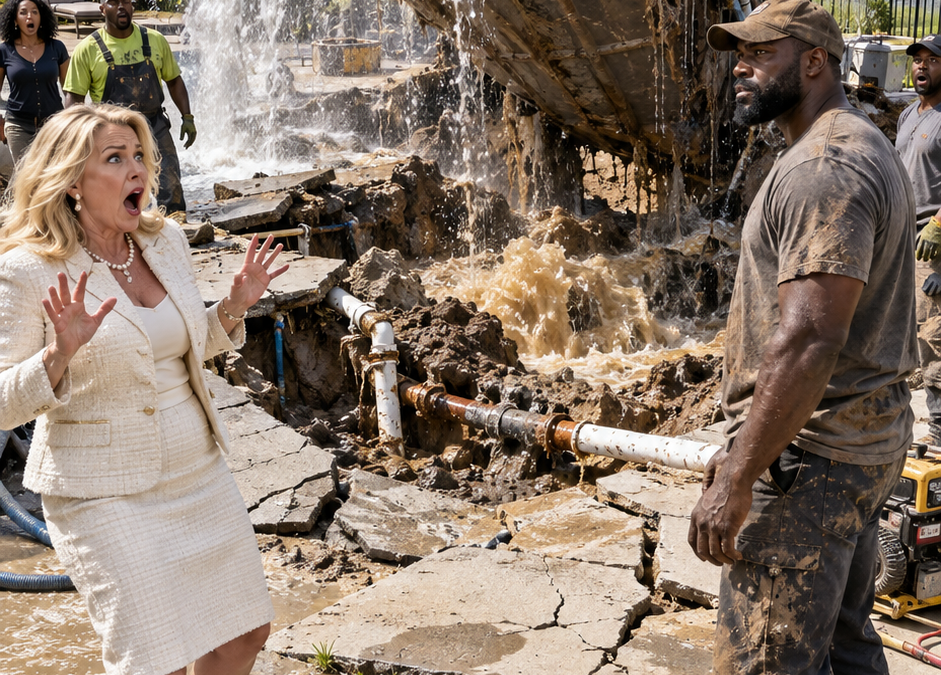
𝗣𝗔𝗥𝗧 𝟮
I was kneeling beside one of my monitoring wells when the sound rolled down the slope.
Diesel engine.
Track clatter.
Steel bucket hitting shale.
I stood.
Bear, my German Shepherd, lifted his head beside me.
“That doesn’t sound good.”
He followed me through the apple rows.
When I reached the northern boundary, I stopped dead.
A fifteen-ton excavator sat directly above Drain 9.
Clara Sterling stood beside it.
She wore a pastel pink hard hat over perfectly arranged hair.
I had to admire the commitment.
Even geological vandalism apparently required coordinated accessories.
“Stop!”
The operator looked toward me.
Clara slowly lowered her sunglasses.
“Austin.”
“Turn the machine off.”
She glanced at the operator.
He idled down.
The valley suddenly went quiet except for the low diesel throb.
I pointed toward the stone arch.
“You are inside a protected historical drainage easement.”
“We are on Ridge View common property.”
“You’re at the boundary of my recorded drainage right.”
She smiled.
“We’ve been through this sort of thing before.”
“No. We haven’t.”
She pointed toward Drain 9.
“This ruin is sitting beside our new pedestrian trail. It collects mud. Mosquitoes. Weeds.”
“It collects groundwater.”
“It looks like something left behind by a mining camp.”
“It was built in 1920.”
“That is not the defense you think it is.”
I took a breath.
Arguing aesthetics with Clara was useless.
So I switched to physics.
“That drain relieves subsurface pressure from the entire eastern ridge.”
She gave the excavator foreman a look that said here we go.
I continued anyway.
“The upper slope is permeable sandstone. Beneath it is expansive bentonite clay. Water enters through the sandstone, hits the clay, then travels laterally toward this outlet.”
“Austin—”
“If you seal the outlet, the water does not disappear.”
“Our engineers designed modern storm drainage.”
“Surface drainage.”
“They installed ten-inch perforated lines.”
“Surface and shallow subsurface.”
Clara folded her arms.
“You always do this.”
“Do what?”
“Use technical language to make simple things sound dangerous.”
I pointed up the ridge.
Above us, construction crews were building Ridge View’s new clubhouse expansion.
The centerpiece was a thirty-meter infinity pool cantilevered near the slope.
“You’re putting forty thousand gallons of water on top of expansive clay.”
She smiled proudly.
“Beautiful, isn’t it?”
“It will be if the groundwater can escape.”
“Our pool is supported on reinforced concrete piers.”
“So?”
“So it isn’t going anywhere.”
I stared at her.
“Clara, Drain 9 has been relieving pressure here for more than a century.”
“And now we have better engineering.”
“Then ask your engineer whether he recommends plugging a natural groundwater discharge point beneath his pool.”
She hesitated.
Only briefly.
Then waved toward the operator.
“Proceed.”
I stepped closer.
“Clara.”
Her smile vanished.
“We are building a three-hundred-fifty-thousand-dollar amenity. I will not let an obsolete pile of rocks compromise our property values.”
“This isn’t about rocks.”
“You’re twenty-seven.”
I almost laughed.
“That’s your engineering argument?”
“I have run this association for fifteen years.”
“And water has been running through this hillside longer than either of us has been alive.”
She pointed toward the machine.
“Proceed.”
The excavator roared.
I could have run toward it.
I could have put myself in front of the bucket.
Instead, I pulled out my phone.
And recorded.
The bucket struck the stone arch.
Once.
Twice.
On the third hit, masonry that had survived a century of freezes, floods, roots, and earthquakes collapsed.
The sound made my stomach turn.
Orange clay pipe shattered behind it.
Clara watched.
Smiling.
Within two hours, the crew cleared the stones.
Then they shoved a steel plug into the exposed drainage throat.
After that came concrete.
Five cubic yards.
Quick-setting.
Industrial grade.
They poured until the old outlet vanished beneath a smooth gray slab.
Clara walked toward me when the work was finished.
“There.”
She brushed dust from her hands.
“Clean.”
“Congratulations.”
She smiled.
“Thank you.”
“That wasn’t praise.”
“I know.”
I pulled a large envelope from under my arm.
“This is a formal notice.”
Her smile thinned.
“My uncle represents Blackwood Orchards. Inside is the original drainage covenant, the recorded boundary documentation, the geological survey, and a written technical warning explaining the hydrostatic consequences of what you just did.”
She took it.
“You already called your lawyer?”
“I called him before your concrete truck arrived.”
That annoyed her.
Good.
“The notice gives Ridge View forty-eight hours to restore drainage.”
She opened the envelope.
Skimmed the first page.
Then the second.
Her eyes moved over words like hydrostatic uplift, pore-water pressure, and historical drainage rights.
Then she ripped the entire packet in half.
Right in front of my camera.
I said nothing.
She tore it again.
Dropped the pieces onto the wet concrete.
Then pressed one beige boot into them.
“Austin, you can take your science project and your uncle’s threats and burn them this winter.”
I looked down at the paper disappearing into gray slurry.
Then back at her.
“The earth has its own schedule.”
She laughed.
“What?”
“You measure time in construction deadlines.”
I nodded toward the pool site.
“The clay measures it in pressure.”
“Austin—”
“You just plugged a relief valve.”
Her smile returned.
“Have a nice afternoon.”
She walked away.
I kept recording.
That evening, Uncle Robert came to the orchard office.
He had represented agricultural landowners for thirty years and had the permanently skeptical expression of a man who made his living reading documents written by people hoping nobody would.
He watched my video twice.
Then he set down his coffee.
“This is almost offensively easy.”
“What is?”
“The injunction.”
He opened the covenant.
“They destroyed a protected drainage structure after receiving notice.”
“They destroyed it before receiving written notice.”
“But after verbal notice on camera.”
“Yes.”
“And then she tore up the written notice on camera.”
“Yes.”
Robert smiled.
“I love organized people.”
“You love arrogant people.”
“Only when they document themselves.”
He closed the folder.
“I can file tomorrow morning. Emergency order. We could have them excavating that concrete by Friday.”
“No.”
Robert stared at me.
“No?”
“I don’t want an injunction.”
He set his coffee down.
“Austin.”
“If we stop them now, what happens?”
“We restore the drain.”
“And Clara pays?”
“Probably legal fees. Restoration. Damages.”
“How much?”
He shrugged.
“Fifteen, twenty thousand.”
“She’ll treat it as a construction expense.”
“She’ll still lose.”
“She won’t learn anything.”
Robert leaned back.
“This is where I remind you that courts exist to prevent damage, not maximize educational experiences.”
“I know.”
“Then what are you proposing?”
I turned my monitor toward him.
Three new sensor channels appeared on the screen.
Piezometer one.
Two.
Three.
“I installed them downstream of the plug.”
Robert looked at the readings.
“You already installed these?”
“This afternoon.”
“You expected this?”
“I expected Clara.”
That earned a laugh.
I zoomed out.
Groundwater pressure was currently low.
Normal.
“I want to monitor what happens when they build the pool.”
Robert studied me.
“You want them to keep building.”
“Yes.”
“Even knowing the drainage is compromised.”
“I warned them.”
“You want a pool filled on that hillside.”
“Exactly.”
Robert’s expression changed.
Slowly.
“You’re playing the long game.”
“No.”
I looked at the pressure graph.
“I’m playing the physical one.”
The following year became known in my head as the year of nothing.
No catastrophe.
No dramatic landslide.
No exploding hillside.
Nothing.
Winter arrived dry.
Spring barely produced rain.
By June, Northern California was entering severe drought.
Creeks shrank.
Grass turned yellow.
The surface soil cracked.
And Clara looked increasingly correct.
At least to people who thought dry dirt meant no groundwater.
Ridge View finished the clubhouse.
Then the infinity pool.
It was beautiful.
I will give them that.
Thirty meters of dark blue tile projected toward the valley, with one side appearing to merge into the horizon.
Forty thousand gallons of imported salt water.
Glass railings.
Granite patio.
Designer loungers.
At sunset, it looked like something from a luxury-resort advertisement.
Clara loved posting photographs from the deck.
She loved one caption most of all.
ONE YEAR SINCE WE REMOVED THE CRUMBLING OLD DRAIN. STILL WAITING FOR THE DISASTER.
Another:
Sometimes modern engineering really is better than folklore.
Then:
Progress 1. Doom Predictions 0.
I never answered.
I checked my dashboard.
That was all.
At the surface, Blackwood Ridge was dry.
Underground, water still moved.
Aquifers don’t care whether grass turns brown.
Water that fell miles away years earlier continued migrating through the sandstone.
When it reached the bentonite layer, it turned sideways.
Then it reached Clara’s concrete plug.
And stopped.
Pressure rose.
May:
Green.
June:
Yellow.
July:
Orange.
August:
One hundred twenty kilopascals.
The clay was saturating.
Expansive bentonite absorbs water aggressively.
As pore pressure rises, effective soil strength decreases.
To most people, dirt is dirt.
To a geologist, soil is a structure.
Mineral grains carry load because they press against one another.
Add enough water pressure between those grains and they stop carrying load efficiently.
The soil can soften.
Shift.
Swell.
Lose shear strength.
In simple terms:
The hill begins behaving less like earth and more like toothpaste.
One afternoon in late August, I was checking a transmitter near the fence when Clara appeared on the walking path.
White poodle.
Diamond leash.
Of course.
“Well.”
I looked up.
“Clara.”
“Still playing with your gadgets?”
“Monitoring.”
“Monitoring what?”
“Groundwater.”
She laughed loudly.
“We haven’t had rain in three months.”
“That doesn’t mean groundwater stopped.”
“The ground is literally cracking.”
“Surface soil.”
She pointed up toward the pool.
“Do you see that?”
“Yes.”
“It has been there almost a year.”
“Yes.”
“It has not moved.”
“Not yet.”
She laughed again.
“Austin, at what point does a professional admit his prediction was wrong?”
“When it’s wrong.”
“You said blocking the drain would cause pressure.”
“It has.”
“Where?”
I showed her the tablet.
She looked at the graph.
Then at me.
“You expect me to be frightened by orange lines?”
“I don’t expect you to do anything.”
“That’s new.”
I zoomed in.
“One hundred twenty kilopascals.”
“And that means?”
“The clay below your pool is highly saturated.”
She glanced toward the cracked summer ground.
“You hear yourself, right?”
“Yes.”
“Your soil is dusty enough to turn my shoes brown and you’re telling me it’s saturated.”
“Twenty feet below you.”
Her smile became pitying.
“Maybe you spent too much time at university.”
“Maybe.”
She tugged the poodle’s leash.
“Our pool weighs hundreds of tons.”
“Yes.”
“It is anchored in concrete.”
“Yes.”
“It isn’t going anywhere.”
I looked at her.
“Nothing happening is not proof nothing is happening.”
That stopped her for half a second.
Then she laughed.
“Enjoy your apples.”
She walked away.
I knelt beside the sensor enclosure.
That was when I saw the seep.
Tiny.
Barely visible.
Yellowish water emerging along one hairline crack beside the concrete plug.
I touched the mud.
Bentonite.
Liquefied clay was beginning to migrate through a new path.
Internal erosion.
Not dramatic yet.
But significant.
I photographed it.
Logged coordinates.
Sent the image to Robert.
He called ten minutes later.
“So?”
“So the hill is starting to find another exit.”
“Should we file now?”
I looked toward the pool.
“No.”
There was a long silence.
Then Robert said:
“You inherited your grandfather’s stubbornness.”
“I thought you liked Grandpa.”
“I did. He was exhausting too.”
September remained dry.
Ridge View celebrated.
The grand opening of the completed clubhouse took place during the last weekend of August.
Catering from San Francisco.
Jazz trio.
County officials.
Real estate editors.
Luxury cars lined the upper road.
I stood among my apple trees listening to the music drift down the slope.
Clara’s voice came over the sound system.
“This club represents what vision can accomplish.”
Applause.
“We refused to let outdated infrastructure and backward thinking prevent progress.”
More applause.
I opened my tablet.
Pore pressure:
128 kilopascals.
Fully saturated deep clay.
She continued.
“This pool is proof that good engineering can overcome natural obstacles.”
I looked at Bear.
“Did you hear that?”
His ears lifted.
“I think she just insulted gravity.”
Bear yawned.
Smart dog.
Then October arrived.
And the weather changed.
A major atmospheric-river event formed over the Pacific.
Forecasts called for five to seven inches of rain within twenty-four hours.
After months of drought.
That combination mattered.
Parched upper soil can shed water rapidly.
Steep slopes concentrate runoff.
But beneath the surface, the groundwater system was already loaded.
My sensors had spent months telling me so.
I prepared the orchard.
Drainage channels cleared.
Equipment moved.
Generators tested.
Young trees braced.
Sensor housings checked.
Batteries replaced.
Bear followed me everywhere.
Ridge View prepared differently.
They moved patio furniture.
Cleared visible storm drains.
Covered outdoor televisions.
And then someone noticed the infinity pool.
I saw the panic from my porch.
Clara stood on the deck in a bright yellow raincoat.
Three maintenance workers dragged heavy blue hoses from the pump room.
I reached for binoculars.
They were draining the pool.
Completely.
I whispered:
“No.”
Not because I wanted to save them.
Because even I hadn’t expected a mistake that perfect.
The maintenance manager, Frank, appeared to be arguing.
I later learned what he said.
“Clara, if we empty it with the ground this wet, that may be dangerous.”
She ordered him to continue.
Her reasoning was simple.
An empty pool could catch stormwater and prevent overflow from flooding the clubhouse.
Surface-water logic.
Unfortunately, pools exist in three dimensions.
A swimming pool is essentially a buried concrete boat.
When full, the water inside contributes enormous downward weight.
Forty thousand gallons of water weighs well over three hundred thousand pounds.
Add the concrete shell itself, and you have significant ballast pressing downward.
Empty the pool?
You remove much of that stabilizing weight.
Normally, that isn’t catastrophic because the surrounding soil is not trying to push the pool upward.
Ridge View’s soil was.
I opened my sensor dashboard.
132 kilopascals.
Storm not yet fully arrived.
The pumps continued.
Forty thousand gallons disappeared.
The pool became a hollow shell.
A concrete boat sitting above a pressurized clay system.
I called Robert.
“Remember when you wanted the injunction?”
“Yes.”
“You’re going to hate what I’m about to say.”
“What did they do?”
“They emptied the pool.”
Silence.
“They what?”
“Completely.”
“In this storm?”
“Yes.”
“Why?”
“To use it as a rainwater basin.”
Robert made a sound I had never heard from him before.
Some combination of laughter and pain.
“Are you recording?”
“Already.”
“Good.”
The rain began around dusk.
By ten, it was violent.
Water hammered the barn roof.
Wind ripped leaves from the orchard.
The hillside disappeared behind curtains of rain.
I sat in my office watching pressure values climb.
Then 180 kilopascals.
Every sensor went red.
I stared at the graph.
There was no longer any question whether the clay was loaded.
The only question was what failed first.
At 10:37 p.m., I heard it.
Even over the rain.
A low groan.
Not thunder.
Concrete.
Structural movement has a sound.
Anyone who has worked around foundations knows it.
Deep.
Slow.
Wrong.
I pulled on my rain gear.
Grabbed the waterproof camera.
Took the searchlight.
Bear tried to follow.
“No.”
He whined.
“You’re staying here.”
I closed him inside.
Then climbed toward the upper orchard.
Rain hit my face sideways.
Mud grabbed at my boots.
I stopped roughly fifty yards below the pool.
The searchlight cut through the storm.
At first, everything looked normal.
Then:
CRACK.
A sound like a rifle shot.
Another.
Then metallic snapping.
Rebar.
I aimed the beam at the pool.
And watched a three-hundred-fifty-thousand-dollar engineering monument begin to move.
Up.
Not downhill.
Up.
The concrete shell rose several inches.
Then another foot.
Granite patio tiles fractured around the edge.
Glass railing bowed.
Another crack.
One foundation element tore free.
Then another.
The entire pool shell lifted higher.
Two feet.
Four.
Six.
I could barely believe what I was seeing.
Hydrostatic uplift is real.
Pool popping is real.
I had calculated the risk.
I had warned them.
I had watched pressure increase for a year.
Still, seeing a structure that large physically emerge from the ground was surreal.
It rose like a submarine.
The pool tilted.
One side lifted faster.
Pipes stretched.
Bent.
Burst.
Electrical conduit snapped.
Sparks flashed blue in the rain.
Glass panels exploded.
The pool eventually sat at an absurd angle, several feet above its original elevation.
Then the earth underneath opened.
Pressurized bentonite slurry erupted through the void.
Yellow clay surged outward.
Thick.
Viscous.
Almost liquid.
It poured across the shattered deck.
Then through the broken clubhouse doors.
Within minutes, the pristine white interior disappeared beneath mud.
Designer sofas.
Custom bar.
Audio equipment.
Imported carpet.
All of it swallowed by the same clay Clara had laughed at because the surface looked dry.
I stood in the storm recording.
I expected to feel triumphant.
I didn’t.
I felt awe.
Cold, almost frightening awe.
Nature had been given one instruction for a century:
Water enters here.
Water exits there.
Clara had changed the second half of that equation.
For twelve months, the hill had been rewriting the answer.
The next morning brought bright blue sky.
That almost felt insulting.
Storm gone.
Disaster fully visible.
The infinity pool sat several feet above grade, cracked and tilted.
Broken reinforcing steel protruded from the shell.
Pipes dangled beneath it.
Mud filled the clubhouse.
The landscaped slope looked bombed.
Residents gathered behind caution tape.
Clara stood among them in a mud-stained jacket.
No linen.
No sunglasses.
No poodle.
I drove up with Robert.
The moment Clara saw me, she pushed through the crowd.
“You!”
Here we go.
“You did this!”
I stopped beside my truck.
“Good morning, Clara.”
“Do not ‘good morning’ me!”
Robert got out slowly.
Clara pointed at me.
“He sabotaged our pool!”
Someone nearby began recording.
Of course.
“You used those sensors.”
I blinked.
“My sensors?”
“You’ve been installing equipment all year.”
“Correct.”
“You did something underground.”
“I measured water pressure.”
“Don’t lie to me!”
She stepped closer.
“You planned this.”
“I predicted it.”
“That’s the same thing!”
“No.”
I almost laughed.
“Predicting sunrise does not mean I moved the sun.”
“You’ve been waiting for this.”
“I’ve been documenting this.”
She turned toward the residents.
“He wanted us to fail!”
I raised my voice.
“I gave you written warning before you buried the drain.”
The crowd quieted.
“I gave you forty-eight hours to restore it.”
Robert lifted his folder.
“And she destroyed the notice on camera.”
Clara’s face changed.
Then she recovered.
“It was harassment.”
Robert smiled.
“Excellent. That sentence will be useful.”
“Who are you?”
“Robert Vance.”
He handed a document to the property manager.
“Attorney for Blackwood Orchards.”
Clara stared at the pages.
“What is this?”
“A complaint.”
“For what?”
Robert began counting.
“Destruction of a protected drainage structure. Interference with a recorded easement. Alteration of a historic watercourse. Damage to agricultural property. And now cross-boundary deposition from your slope failure.”
“This is insane.”
“No.”
Robert looked up at the pool hanging in the air.
“That is.”
Before Clara could answer, a tall man in a gray raincoat walked toward us.
Tablet.
Laser measure.
Hard hat.
“Mr. Vance?”
I nodded.
“Thomas Miller. National Liberty Insurance.”
That got everyone’s attention.
Ridge View’s master policy carried the HOA’s common infrastructure.
Thomas looked at me.
“I understand you have monitoring data.”
“Twelve months.”
His eyebrows rose.
“Continuous?”
“Yes.”
“Calibrated?”
“Yes.”
I handed him a drive.
“Three piezometers. GPS logs. Installation records. Photographs. Video of Drain 9 before removal. Video of demolition. The formal warning. Video of Mrs. Sterling destroying the warning. Pressure trend data. Last night’s failure footage.”
Thomas stared at the drive.
Then at me.
“You really have all that?”
“I like records.”
Robert muttered:
“That is an understatement.”
Thomas reviewed the data.
Residents crowded behind him.
He watched the excavation video.
Clara directing the operator.
The concrete placement.
Then the warning.
Her tearing it up.
He paused the frame.
Looked toward her.
“Mrs. Sterling.”
She folded her arms.
“Did you receive this technical notice?”
“I received a nuisance letter.”
“That wasn’t my question.”
Her expression hardened.
“Yes.”
“Did you provide it to your insurer?”
“No.”
“To your pool contractor?”
“I don’t recall.”
“To the geotechnical engineer?”
“We had our own reports.”
Thomas tapped the tablet.
“This document specifically warns that sealing the drainage outlet could increase groundwater pressure beneath the planned pool.”
“Austin exaggerates everything.”
Thomas looked at the wreckage.
Nobody laughed.
He returned to the data.
Pressure had risen gradually.
Month after month.
Then sharply during the storm.
Clean trend.
Easy to understand.
Then came the empty-pool video.
“What happened here?” Thomas asked.
Frank, the maintenance manager, answered from behind the crowd.
“We pumped it down.”
“How far?”
“All the way.”
“Why?”
Frank looked at Clara.
She said nothing.
“To prevent storm overflow.”
Thomas closed his eyes briefly.
Then opened them.
“You emptied a large in-ground concrete pool during extreme rainfall on a slope with documented groundwater-pressure concerns?”
Frank said:
“I advised against it.”
Clara snapped:
“You said you weren’t sure.”
“I said it could float.”
“You are not a geotechnical engineer.”
“Apparently I didn’t need to be.”
A resident laughed.
Then several.
Clara spun around.
“This is not funny!”
She was right.
It wasn’t.
But after a year of being told the farmer beneath the hill was an idiot, watching her maintenance manager correctly explain buoyancy had a certain quality to it.
Thomas turned toward the board.
“I cannot make a final coverage determination here.”
That was more realistic than the instant verdict Clara had feared.
“But I can tell you this claim will be subject to serious review concerning known conditions, unauthorized drainage alteration, ignored technical warnings, and operational decisions made during the storm.”
Clara said:
“Our policy covers storm damage.”
“Natural storm damage.”
He pointed toward the broken pool.
“We have to determine what portion of this loss arose from the storm and what portion resulted from decisions made by the insured before and during the event.”
That was worse than a simple yes or no.
It meant lawyers.
Engineers.
Depositions.
Months.
Money.
Then Robert added:
“And regardless of their coverage decision, our claims proceed.”
Clara glared at him.
“You people are vultures.”
Robert looked genuinely offended.
“You destroyed his drain.”
“It was ugly!”
Silence.
Even Clara realized too late that she had said it.
Robert smiled.
“Thank you.”
The residents turned toward her.
One man said:
“You told us it was obsolete.”
“It was.”
Another:
“You told us the engineers approved removing it.”
“They did.”
Thomas asked:
“May I see that approval?”
Clara hesitated.
The HOA property manager looked away.
There it was.
The first crack that had nothing to do with concrete.
The emergency meeting happened that afternoon.
Not next month.
Not next week.
Four hours later.
The clubhouse was unusable, so they gathered in the Ridge View tennis pavilion.
I wasn’t a member.
Robert and I were invited anyway.
So was Thomas.
So was Frank.
Clara sat at the front.
The board looked like five people who had just realized their volunteer positions might come with surprisingly professional consequences.
The treasurer spoke first.
“We need immediate estimates.”
A contractor raised his hand.
“Pool demolition and removal: probably ninety to one hundred twenty thousand.”
Groans.
“Slope stabilization depends on engineering.”
“How much?” someone demanded.
“No idea until borings.”
“Clubhouse?”
“Significant remediation.”
Someone asked:
“Insurance?”
Thomas repeated that coverage remained under investigation.
Nobody liked that answer.
Then one homeowner stood.
“Clara told us everything was covered.”
Clara responded:
“Our master policy is comprehensive.”
Thomas said:
“Comprehensive does not mean unconditional.”
Another resident stood.
“My dues paid for that pool.”
“Yes,” Clara said.
“And for burying the drain?”
Silence.
“Did the board vote to remove it?”
The secretary looked through minutes.
“We voted to authorize trail improvements.”
Clara turned.
“Which included drainage modernization.”
“Does it say that?”
The secretary kept reading.
“No.”
Robert leaned toward me.
“Interesting.”
Very.
The vice president asked:
“Clara, who authorized the excavator?”
“As president, I had discretion over common-area beautification.”
“Who authorized pouring concrete into the outlet?”
“The contractor.”
Frank shook his head.
“No.”
Everyone looked at him.
“The contractor asked what you wanted done.”
Clara’s eyes narrowed.
Frank continued.
“You said seal it permanently.”
“You are misremembering.”
“I was standing beside you.”
“I was discussing aesthetics.”
“You said, ‘I never want water coming out of that ugly hole again.’”
The pavilion erupted.
Clara stood.
“This is ridiculous.”
The vice president raised his hands.
“Sit down.”
She stared at him.
He repeated:
“Sit down, Clara.”
Fifteen years as president.
And that was the first time I saw someone on her own board order her to sit.
She did.
Barely.
Robert eventually spoke.
He kept it simple.
“My client warned the association before the alteration was completed.”
He showed the certified notice.
“The association proceeded.”
Next, video.
Clara tearing the pages.
That was devastating.
Not because ripping paper caused the pool to fail.
Because it showed attitude.
Willfulness.
Knowledge.
A resident shouted:
“You knew?”
Clara snapped:
“I knew Austin objected.”
“He told you the hill would build pressure!”
“He is not Ridge View’s engineer.”
I finally stood.
“No.”
Everyone looked at me.
“I’m not.”
I pointed toward the destroyed clubhouse.
“That’s why I told you to show my report to yours.”
Clara said nothing.
I continued.
“I never asked you to believe me because I own apples.”
I held up the original geotechnical summary.
“I asked you to test the condition.”
Someone asked:
“What would testing have cost?”
I answered:
“A few thousand dollars.”
A bitter laugh came from the back.
“Instead we spent three hundred fifty thousand on a pool.”
“Closer to four hundred after finishes,” the treasurer muttered.
That did not help.
A woman stood.
“I move to remove Clara Sterling as president immediately.”
The vice president stared.
Another homeowner called:
“Second.”
The parliamentarian checked the bylaws.
Emergency removal required board action first, then ratification by membership.
The board vote happened right there.
Five to one.
Clara cast the one.
Naturally.
Then the membership vote.
Overwhelming.
Fifteen years of power ended in less than twenty minutes.
Clara sat perfectly still.
I almost felt sorry for her.
Almost.
After the meeting, she found me outside.
Rainwater still dripped from the pavilion roof.
She stopped ten feet away.
“You’re happy.”
“No.”
“Don’t insult me.”
“I’m relieved.”
“You waited an entire year.”
“Yes.”
“You could have stopped this.”
I looked at her.
“I tried.”
“No. You could have sued us immediately.”
“Robert offered.”
Her face twisted.
“And you chose not to.”
“Yes.”
“Why?”
I thought about that.
The honest answer was not flattering.
Part of me wanted Clara to finally encounter a consequence she couldn’t dismiss as a legal nuisance.
But there was another truth.
“I gave you the information.”
“That isn’t an answer.”
“You had engineers.”
Silence.
“You had money.”
Silence.
“You had a board.”
Silence.
“You had a year.”
Her face hardened.
“And you stood there knowing something might happen.”
“I stood there watching instruments tell me pressure was increasing.”
“You wanted the pool to fail.”
“I wanted you to stop pretending the drain didn’t matter.”
“That pool belongs to 120 families.”
“And Drain 9 belonged to four generations of mine.”
She looked away.
For once, neither of us had anything clever to say.
Then she whispered:
“You destroyed everything.”
That sentence irritated me.
Not because it was cruel.
Because it was easy.
So I pointed toward the ridge.
“No.”
She looked at me.
“You buried the drain.”
I gestured toward the tilted pool.
“The hill just sent you the bill.”
She stared at me for several seconds.
Then walked away.
The legal aftermath took months.
Real lawsuits do.
There was no magical check arriving the next morning.
No judge pounding a gavel while dramatic music played.
Engineers examined the failure.
Insurance lawyers argued about causation.
Ridge View blamed the storm.
Contractors blamed design assumptions.
Designers blamed unreported field changes.
Clara blamed me.
The data blamed pressure.
That was the advantage of having twelve months of instrumentation.
The graphs did not hate Clara.
They did not love me.
They did not care about property values.
They simply showed pressure rising after Drain 9 was sealed.
Slowly.
Predictably.
Then sharply during the atmospheric river.
Independent geotechnical consultants eventually concluded that the drainage alteration had materially increased subsurface pressure and that emptying the pool during extreme saturation significantly increased vulnerability to uplift.
That report changed everything.
The insurer contested major parts of the HOA’s common-property claim.
The contractor became involved.
The HOA sued.
The contractor countersued.
Ridge View’s legal calendar became more crowded than its social calendar.
Residents approved a large special assessment for emergency stabilization.
They were furious.
Not at the rain.
Rain had always existed.
They were furious because the failure had been warned about.
That distinction matters.
People forgive unforeseeable disasters.
They have much less patience for disasters preceded by certified mail.
Clara was personally named in several internal claims concerning whether she exceeded her board authority.
Her attorney bills grew.
She sold her house the following spring.
Not immediately destitute.
Not carried away in handcuffs.
Reality is usually less theatrical.
But she left Ridge View.
For a woman who had spent fifteen years treating the neighborhood as her personal kingdom, leaving quietly under the watch of residents she once fined for mailbox colors was punishment enough.
The pool had to be demolished.
Removing it cost nearly as much as some houses in town.
Cranes broke the shell into sections.
Concrete trucks removed debris.
Geotechnical crews drilled new borings.
The clubhouse remained closed.
The slope required drainage galleries, relief wells, and reconstruction.
All things remarkably similar to the drainage concepts Clara had called obsolete.
I attended one engineering meeting.
The consulting firm projected a diagram of the new subsurface system.
Perforated drainage.
Gravel.
Pressure relief outlets.
One engineer said:
“The design goal is to restore a controlled pathway for groundwater migration toward the lower basin.”
I raised my hand.
He stopped.
“Yes?”
“So… a drain.”
Silence.
Then Robert started laughing.
A few residents did too.
The engineer smiled reluctantly.
“A much more sophisticated drain.”
“Of course.”
I let him have that.
Our lawsuit settled later that year.
The HOA compensated Blackwood Orchards for boundary damage, sediment intrusion, destroyed monitoring equipment, legal costs, and restoration work.
It was substantial.
Not life-changing.
But enough.
More importantly, the final agreement required Ridge View to recognize the historical drainage easement permanently.
In writing.
Recorded with the county.
No future board president could redefine it as ugly landscaping.
I used part of the settlement to rebuild Drain 9.
Not exactly as it had been.
Better.
We recovered as many original fieldstones as possible from storage.
A mason rebuilt the arch by hand.
Behind it, we installed a modern high-capacity geocomposite drainage system designed to accommodate current hydrologic conditions.
Stone outside.
Twenty-first-century drainage inside.
Grandpa would have approved.
Probably after complaining the modern pipe looked cheap.
I replanted ferns around the arch.
Moss returned naturally within months.
Then, one cold morning the following spring, water appeared.
First a trickle.
Then a steady stream.
Clear groundwater ran through the rebuilt stone throat and down toward Blackwood Creek.
I sat beside it for almost an hour.
Bear drank from the edge.
“You know,” I told him, “this whole disaster started because somebody thought this was ugly.”
Bear looked at me.
Dogs are excellent at understanding the limits of human intelligence.
Ridge View changed too.
The new board hired independent engineers.
Not contractors connected to board members.
Actual independent consultants.
They created a rule requiring geotechnical review before altering natural drainage.
Another rule required recorded easement verification before common-area construction.
The walking trail remained.
Drain 9 remained visible beside it.
The HOA even installed an interpretive plaque.
That part nearly killed me.
HISTORIC BLACKWOOD DRAINAGE STRUCTURE — EST. 1920
Below it:
This drainage system supports long-term groundwater management and slope stability within the Blackwood Ridge watershed.
I photographed the plaque.
Sent it to Robert.
He replied:
FRAME IT.
I did.
There was one final meeting about eighteen months after the pool failure.
The new HOA invited me to present a short explanation of groundwater behavior to residents.
I almost declined.
Then I remembered Clara saying I used technical language to frighten people.
So I went.
No equations.
No jargon.
I brought a clear plastic container.
Sand.
Clay.
Water.
I layered the sand over the clay.
Poured water onto the top.
It moved through the sand.
Stopped at the clay.
Then traveled sideways.
I opened a small hole at the container’s edge.
Water escaped.
I plugged the hole.
Water accumulated.
Simple.
A child in the front row understood immediately.
“So if you block the hole, it pushes somewhere else?”
“Exactly.”
A retired venture capitalist looked at the model for several seconds.
“That’s it?”
“That’s basically it.”
He frowned.
“We lost a four-hundred-thousand-dollar pool over that?”
“Plus the clubhouse.”
A woman elbowed him.
He sighed.
“Right.”
I didn’t gloat.
Much.
Afterward, Frank approached me.
The former maintenance manager.
He still worked for Ridge View.
Different board.
“I should’ve refused to drain that pool.”
“You warned her.”
“I still did it.”
“She threatened your job.”
“That doesn’t change physics.”
“No.”
He looked toward the rebuilt drain.
“I think about that a lot.”
I understood.
“Use it next time.”
He nodded.
Then smiled.
“There better not be a next time.”
Fair.
Years later, Blackwood Orchards is still here.
So is Drain 9.
Every winter, water flows through it.
Some years heavily.
Some years barely.
But it flows.
I keep the original pressure graphs archived.
The first green readings.
Then yellow.
Orange.
Red.
That upward curve is almost boring to look at.
Which is why people ignored it.
Disasters are exciting at the end.
They are usually boring at the beginning.
A reading moves slightly.
A crack appears.
A pipe is blocked.
A report gets dismissed.
Someone says:
Nothing happened last year.
Someone else says:
We’ve always done it this way.
Then one day something enormous appears to happen all at once.
It didn’t.
The pool did not rise out of the ground in one night.
Not really.
That process began the morning Clara ordered an excavator to destroy a 104-year-old drainage outlet.
It continued when concrete sealed the aquifer throat.
It continued during drought.
During lawn irrigation.
During deep groundwater recharge.
During every week of silence Clara interpreted as proof.
The storm was only the final input.
The pool rising was simply the moment human beings could finally see the problem.
That is what my grandfather meant when he said the earth keeps time differently.
People measure consequences from the moment they become visible.
Nature measures from the first cause.
I still have the video of Clara destroying my warning.
I rarely watch it.
But once every few years, when some developer or new board member questions why Blackwood’s drainage easement is written so aggressively, I send them the engineering report instead.
No drama.
No threat.
Just data.
And if they still argue, I take them to the edge of the orchard.
I point up at the empty section of ridge where Ridge View’s infinity pool used to sit.
There is no pool there anymore.
The replacement clubhouse was built farther back.
Smaller.
Less dramatic.
The slope below it is covered in native vegetation.
Drainage outlets are visible.
Ugly, according to Clara’s old standards.
Beautiful, according to mine.
Sometimes new residents ask what happened to the original pool.
Older residents usually answer before I can.
“The hill pushed it out.”
Not technically perfect.
Good enough.
Clara once told me that modern engineering existed to overcome natural obstacles.
She had it backward.
Good engineering does not defeat nature.
It understands the forces already present and designs around them.
Bad engineering treats warnings as insults.
Bad leadership treats disagreement as disobedience.
And arrogance treats delayed consequences as proof there will be none.
For a year, Clara looked right.
Drain 9 was gone.
The sun kept shining.
The pool glittered.
Residents drank Chardonnay beside it.
She posted photos.
Mocked me.
Called the ground perfectly dry.
And every morning my sensors recorded the truth she couldn’t see.
Pressure.
One kilopascal at a time.
Quiet.
Patient.
Relentless.
Until the night the rain came.
Until the water had nowhere else to go.
Until the expensive concrete shell above it stopped being a swimming pool and became a boat.
And until, inch by inch, the earth lifted Clara Sterling’s masterpiece straight out of the ground.
She had spent a year laughing because nothing happened.
She never understood that nothing happening was the warning.
The hill was simply building the invoice.
And when the bill finally arrived, it came with a $350,000 swimming pool sticking ten feet into the air.
Have you finished reading the story and want to read it again?
HOA Buried My Century-Old Drain—A Year Later Their $350,000 Pool Rose Out of the Ground
They buried the drain I warned them never to touch.
For an entire year, nothing happened.
Then their $350,000 swimming pool started rising out of the ground.
My grandfather used to tell me that people misunderstand water because they only notice it when they can see it.
Rain falling from a roof.
A creek running through a pasture.
A pipe bursting beneath a sink.
Those are the obvious kinds.
The dangerous water, he said, is the water you can’t see.
The water moving through rock.
The water pressing against clay.
The water collecting quietly beneath foundations while people pour wine on expensive patios and congratulate themselves for having defeated nature.
“Never fight water underground,” Grandpa Silas used to tell me. “It has more patience than you do.”
I was twenty-seven when I finally understood exactly what he meant.
My name is Austin Vance.
I inherited Blackwood Orchards after my grandfather died, forty-five acres of heirloom apple trees tucked into a green valley beneath a steep ridge in Northern California.
I had recently finished graduate work in hydrology and engineering geology and turned down several corporate consulting jobs to come home.
My former classmates thought I was insane.
They were designing commercial foundations, transit projects, and hillside developments for firms in Seattle and San Francisco.
I was waking up at five in the morning to check soil moisture beneath Arkansas Black apple trees.
I preferred my choice.
Blackwood wasn’t just a farm.
It was a hundred years of family decisions layered into one piece of ground.
Stone channels.
Old irrigation lines.
Terraces cut by hand.
Drainage structures built before anyone had computers sophisticated enough to tell farmers what their own boots had already taught them.
I added modern equipment to what my grandfather left me.
Drone LiDAR.
Soil-tension probes.
Weather stations.
Groundwater sensors.
Three solar-powered piezometers buried deep along the northern boundary.
Grandpa had trusted his knees and the behavior of barn swallows.
I trusted transducers and spreadsheets.
We usually reached the same conclusion.
The land told you what it needed if you bothered listening.
Unfortunately, the people living above my orchard had decided listening was an outdated practice.
Ridge View Estates had spread across the upper slope during the previous five years.
One hundred twenty luxury houses.
Private gates.
Manicured lawns.
Walking paths.
A clubhouse.
And an HOA president named Clara Sterling, who treated natural terrain the way some people treat an improperly folded napkin.
Something to correct.
Clara was fifty-four, favored cream-colored linen, enormous sunglasses, and the particular tone of voice used by people who believe volume is unnecessary because obedience is inevitable.
She disliked Blackwood Orchards.
The tractors were too loud.
The farm road was too dusty.
My native grasses were too wild.
Birds, according to one complaint she actually sent me, created “unregulated organic debris.”
I framed that letter.
But none of those arguments mattered compared with Drain 9.
Drain 9 sat directly along our northern boundary.
It was an arched stone outlet built in 1920 by Italian stonemasons hired by my great-grandfather.
For more than a century, groundwater moving down from the ridge had followed a hidden sandstone layer until it reached dense bentonite clay.
The clay wouldn’t let it continue downward.
So the water moved sideways.
Drain 9 gave it an exit.
Quietly.
Reliably.
For 104 years.
Then Clara decided it looked ugly beside Ridge View’s new walking trail.
And one Tuesday morning, I heard an excavator start above the orchard.
PART2
I was kneeling beside one of my monitoring wells when the sound rolled down the slope.
Diesel engine.
Track clatter.
Steel bucket hitting shale.
I stood.
Bear, my German Shepherd, lifted his head beside me.
“That doesn’t sound good.”
He followed me through the apple rows.
When I reached the northern boundary, I stopped dead.
A fifteen-ton excavator sat directly above Drain 9.
Clara Sterling stood beside it.
She wore a pastel pink hard hat over perfectly arranged hair.
I had to admire the commitment.
Even geological vandalism apparently required coordinated accessories.
“Stop!”
The operator looked toward me.
Clara slowly lowered her sunglasses.
“Austin.”
“Turn the machine off.”
She glanced at the operator.
He idled down.
The valley suddenly went quiet except for the low diesel throb.
I pointed toward the stone arch.
“You are inside a protected historical drainage easement.”
“We are on Ridge View common property.”
“You’re at the boundary of my recorded drainage right.”
She smiled.
“We’ve been through this sort of thing before.”
“No. We haven’t.”
She pointed toward Drain 9.
“This ruin is sitting beside our new pedestrian trail. It collects mud. Mosquitoes. Weeds.”
“It collects groundwater.”
“It looks like something left behind by a mining camp.”
“It was built in 1920.”
“That is not the defense you think it is.”
I took a breath.
Arguing aesthetics with Clara was useless.
So I switched to physics.
“That drain relieves subsurface pressure from the entire eastern ridge.”
She gave the excavator foreman a look that said here we go.
I continued anyway.
“The upper slope is permeable sandstone. Beneath it is expansive bentonite clay. Water enters through the sandstone, hits the clay, then travels laterally toward this outlet.”
“Austin—”
“If you seal the outlet, the water does not disappear.”
“Our engineers designed modern storm drainage.”
“Surface drainage.”
“They installed ten-inch perforated lines.”
“Surface and shallow subsurface.”
Clara folded her arms.
“You always do this.”
“Do what?”
“Use technical language to make simple things sound dangerous.”
I pointed up the ridge.
Above us, construction crews were building Ridge View’s new clubhouse expansion.
The centerpiece was a thirty-meter infinity pool cantilevered near the slope.
“You’re putting forty thousand gallons of water on top of expansive clay.”
She smiled proudly.
“Beautiful, isn’t it?”
“It will be if the groundwater can escape.”
“Our pool is supported on reinforced concrete piers.”
“So?”
“So it isn’t going anywhere.”
I stared at her.
“Clara, Drain 9 has been relieving pressure here for more than a century.”
“And now we have better engineering.”
“Then ask your engineer whether he recommends plugging a natural groundwater discharge point beneath his pool.”
She hesitated.
Only briefly.
Then waved toward the operator.
“Proceed.”
I stepped closer.
“Clara.”
Her smile vanished.
“We are building a three-hundred-fifty-thousand-dollar amenity. I will not let an obsolete pile of rocks compromise our property values.”
“This isn’t about rocks.”
“You’re twenty-seven.”
I almost laughed.
“That’s your engineering argument?”
“I have run this association for fifteen years.”
“And water has been running through this hillside longer than either of us has been alive.”
She pointed toward the machine.
“Proceed.”
The excavator roared.
I could have run toward it.
I could have put myself in front of the bucket.
Instead, I pulled out my phone.
And recorded.
The bucket struck the stone arch.
Once.
Twice.
On the third hit, masonry that had survived a century of freezes, floods, roots, and earthquakes collapsed.
The sound made my stomach turn.
Orange clay pipe shattered behind it.
Clara watched.
Smiling.
Within two hours, the crew cleared the stones.
Then they shoved a steel plug into the exposed drainage throat.
After that came concrete.
Five cubic yards.
Quick-setting.
Industrial grade.
They poured until the old outlet vanished beneath a smooth gray slab.
Clara walked toward me when the work was finished.
“There.”
She brushed dust from her hands.
“Clean.”
“Congratulations.”
She smiled.
“Thank you.”
“That wasn’t praise.”
“I know.”
I pulled a large envelope from under my arm.
“This is a formal notice.”
Her smile thinned.
“My uncle represents Blackwood Orchards. Inside is the original drainage covenant, the recorded boundary documentation, the geological survey, and a written technical warning explaining the hydrostatic consequences of what you just did.”
She took it.
“You already called your lawyer?”
“I called him before your concrete truck arrived.”
That annoyed her.
Good.
“The notice gives Ridge View forty-eight hours to restore drainage.”
She opened the envelope.
Skimmed the first page.
Then the second.
Her eyes moved over words like hydrostatic uplift, pore-water pressure, and historical drainage rights.
Then she ripped the entire packet in half.
Right in front of my camera.
I said nothing.
She tore it again.
Dropped the pieces onto the wet concrete.
Then pressed one beige boot into them.
“Austin, you can take your science project and your uncle’s threats and burn them this winter.”
I looked down at the paper disappearing into gray slurry.
Then back at her.
“The earth has its own schedule.”
She laughed.
“What?”
“You measure time in construction deadlines.”
I nodded toward the pool site.
“The clay measures it in pressure.”
“Austin—”
“You just plugged a relief valve.”
Her smile returned.
“Have a nice afternoon.”
She walked away.
I kept recording.
That evening, Uncle Robert came to the orchard office.
He had represented agricultural landowners for thirty years and had the permanently skeptical expression of a man who made his living reading documents written by people hoping nobody would.
He watched my video twice.
Then he set down his coffee.
“This is almost offensively easy.”
“What is?”
“The injunction.”
He opened the covenant.
“They destroyed a protected drainage structure after receiving notice.”
“They destroyed it before receiving written notice.”
“But after verbal notice on camera.”
“Yes.”
“And then she tore up the written notice on camera.”
“Yes.”
Robert smiled.
“I love organized people.”
“You love arrogant people.”
“Only when they document themselves.”
He closed the folder.
“I can file tomorrow morning. Emergency order. We could have them excavating that concrete by Friday.”
“No.”
Robert stared at me.
“No?”
“I don’t want an injunction.”
He set his coffee down.
“Austin.”
“If we stop them now, what happens?”
“We restore the drain.”
“And Clara pays?”
“Probably legal fees. Restoration. Damages.”
“How much?”
He shrugged.
“Fifteen, twenty thousand.”
“She’ll treat it as a construction expense.”
“She’ll still lose.”
“She won’t learn anything.”
Robert leaned back.
“This is where I remind you that courts exist to prevent damage, not maximize educational experiences.”
“I know.”
“Then what are you proposing?”
I turned my monitor toward him.
Three new sensor channels appeared on the screen.
Piezometer one.
Two.
Three.
“I installed them downstream of the plug.”
Robert looked at the readings.
“You already installed these?”
“This afternoon.”
“You expected this?”
“I expected Clara.”
That earned a laugh.
I zoomed out.
Groundwater pressure was currently low.
Normal.
“I want to monitor what happens when they build the pool.”
Robert studied me.
“You want them to keep building.”
“Yes.”
“Even knowing the drainage is compromised.”
“I warned them.”
“You want a pool filled on that hillside.”
“Exactly.”
Robert’s expression changed.
Slowly.
“You’re playing the long game.”
“No.”
I looked at the pressure graph.
“I’m playing the physical one.”
The following year became known in my head as the year of nothing.
No catastrophe.
No dramatic landslide.
No exploding hillside.
Nothing.
Winter arrived dry.
Spring barely produced rain.
By June, Northern California was entering severe drought.
Creeks shrank.
Grass turned yellow.
The surface soil cracked.
And Clara looked increasingly correct.
At least to people who thought dry dirt meant no groundwater.
Ridge View finished the clubhouse.
Then the infinity pool.
It was beautiful.
I will give them that.
Thirty meters of dark blue tile projected toward the valley, with one side appearing to merge into the horizon.
Forty thousand gallons of imported salt water.
Glass railings.
Granite patio.
Designer loungers.
At sunset, it looked like something from a luxury-resort advertisement.
Clara loved posting photographs from the deck.
She loved one caption most of all.
ONE YEAR SINCE WE REMOVED THE CRUMBLING OLD DRAIN. STILL WAITING FOR THE DISASTER.
Another:
Sometimes modern engineering really is better than folklore.
Then:
Progress 1. Doom Predictions 0.
I never answered.
I checked my dashboard.
That was all.
At the surface, Blackwood Ridge was dry.
Underground, water still moved.
Aquifers don’t care whether grass turns brown.
Water that fell miles away years earlier continued migrating through the sandstone.
When it reached the bentonite layer, it turned sideways.
Then it reached Clara’s concrete plug.
And stopped.
Pressure rose.
May:
Green.
June:
Yellow.
July:
Orange.
August:
One hundred twenty kilopascals.
The clay was saturating.
Expansive bentonite absorbs water aggressively.
As pore pressure rises, effective soil strength decreases.
To most people, dirt is dirt.
To a geologist, soil is a structure.
Mineral grains carry load because they press against one another.
Add enough water pressure between those grains and they stop carrying load efficiently.
The soil can soften.
Shift.
Swell.
Lose shear strength.
In simple terms:
The hill begins behaving less like earth and more like toothpaste.
One afternoon in late August, I was checking a transmitter near the fence when Clara appeared on the walking path.
White poodle.
Diamond leash.
Of course.
“Well.”
I looked up.
“Clara.”
“Still playing with your gadgets?”
“Monitoring.”
“Monitoring what?”
“Groundwater.”
She laughed loudly.
“We haven’t had rain in three months.”
“That doesn’t mean groundwater stopped.”
“The ground is literally cracking.”
“Surface soil.”
She pointed up toward the pool.
“Do you see that?”
“Yes.”
“It has been there almost a year.”
“Yes.”
“It has not moved.”
“Not yet.”
She laughed again.
“Austin, at what point does a professional admit his prediction was wrong?”
“When it’s wrong.”
“You said blocking the drain would cause pressure.”
“It has.”
“Where?”
I showed her the tablet.
She looked at the graph.
Then at me.
“You expect me to be frightened by orange lines?”
“I don’t expect you to do anything.”
“That’s new.”
I zoomed in.
“One hundred twenty kilopascals.”
“And that means?”
“The clay below your pool is highly saturated.”
She glanced toward the cracked summer ground.
“You hear yourself, right?”
“Yes.”
“Your soil is dusty enough to turn my shoes brown and you’re telling me it’s saturated.”
“Twenty feet below you.”
Her smile became pitying.
“Maybe you spent too much time at university.”
“Maybe.”
She tugged the poodle’s leash.
“Our pool weighs hundreds of tons.”
“Yes.”
“It is anchored in concrete.”
“Yes.”
“It isn’t going anywhere.”
I looked at her.
“Nothing happening is not proof nothing is happening.”
That stopped her for half a second.
Then she laughed.
“Enjoy your apples.”
She walked away.
I knelt beside the sensor enclosure.
That was when I saw the seep.
Tiny.
Barely visible.
Yellowish water emerging along one hairline crack beside the concrete plug.
I touched the mud.
Bentonite.
Liquefied clay was beginning to migrate through a new path.
Internal erosion.
Not dramatic yet.
But significant.
I photographed it.
Logged coordinates.
Sent the image to Robert.
He called ten minutes later.
“So?”
“So the hill is starting to find another exit.”
“Should we file now?”
I looked toward the pool.
“No.”
There was a long silence.
Then Robert said:
“You inherited your grandfather’s stubbornness.”
“I thought you liked Grandpa.”
“I did. He was exhausting too.”
September remained dry.
Ridge View celebrated.
The grand opening of the completed clubhouse took place during the last weekend of August.
Catering from San Francisco.
Jazz trio.
County officials.
Real estate editors.
Luxury cars lined the upper road.
I stood among my apple trees listening to the music drift down the slope.
Clara’s voice came over the sound system.
“This club represents what vision can accomplish.”
Applause.
“We refused to let outdated infrastructure and backward thinking prevent progress.”
More applause.
I opened my tablet.
Pore pressure:
128 kilopascals.
Fully saturated deep clay.
She continued.
“This pool is proof that good engineering can overcome natural obstacles.”
I looked at Bear.
“Did you hear that?”
His ears lifted.
“I think she just insulted gravity.”
Bear yawned.
Smart dog.
Then October arrived.
And the weather changed.
A major atmospheric-river event formed over the Pacific.
Forecasts called for five to seven inches of rain within twenty-four hours.
After months of drought.
That combination mattered.
Parched upper soil can shed water rapidly.
Steep slopes concentrate runoff.
But beneath the surface, the groundwater system was already loaded.
My sensors had spent months telling me so.
I prepared the orchard.
Drainage channels cleared.
Equipment moved.
Generators tested.
Young trees braced.
Sensor housings checked.
Batteries replaced.
Bear followed me everywhere.
Ridge View prepared differently.
They moved patio furniture.
Cleared visible storm drains.
Covered outdoor televisions.
And then someone noticed the infinity pool.
I saw the panic from my porch.
Clara stood on the deck in a bright yellow raincoat.
Three maintenance workers dragged heavy blue hoses from the pump room.
I reached for binoculars.
They were draining the pool.
Completely.
I whispered:
“No.”
Not because I wanted to save them.
Because even I hadn’t expected a mistake that perfect.
The maintenance manager, Frank, appeared to be arguing.
I later learned what he said.
“Clara, if we empty it with the ground this wet, that may be dangerous.”
She ordered him to continue.
Her reasoning was simple.
An empty pool could catch stormwater and prevent overflow from flooding the clubhouse.
Surface-water logic.
Unfortunately, pools exist in three dimensions.
A swimming pool is essentially a buried concrete boat.
When full, the water inside contributes enormous downward weight.
Forty thousand gallons of water weighs well over three hundred thousand pounds.
Add the concrete shell itself, and you have significant ballast pressing downward.
Empty the pool?
You remove much of that stabilizing weight.
Normally, that isn’t catastrophic because the surrounding soil is not trying to push the pool upward.
Ridge View’s soil was.
I opened my sensor dashboard.
132 kilopascals.
Storm not yet fully arrived.
The pumps continued.
Forty thousand gallons disappeared.
The pool became a hollow shell.
A concrete boat sitting above a pressurized clay system.
I called Robert.
“Remember when you wanted the injunction?”
“Yes.”
“You’re going to hate what I’m about to say.”
“What did they do?”
“They emptied the pool.”
Silence.
“They what?”
“Completely.”
“In this storm?”
“Yes.”
“Why?”
“To use it as a rainwater basin.”
Robert made a sound I had never heard from him before.
Some combination of laughter and pain.
“Are you recording?”
“Already.”
“Good.”
The rain began around dusk.
By ten, it was violent.
Water hammered the barn roof.
Wind ripped leaves from the orchard.
The hillside disappeared behind curtains of rain.
I sat in my office watching pressure values climb.
Then 180 kilopascals.
Every sensor went red.
I stared at the graph.
There was no longer any question whether the clay was loaded.
The only question was what failed first.
At 10:37 p.m., I heard it.
Even over the rain.
A low groan.
Not thunder.
Concrete.
Structural movement has a sound.
Anyone who has worked around foundations knows it.
Deep.
Slow.
Wrong.
I pulled on my rain gear.
Grabbed the waterproof camera.
Took the searchlight.
Bear tried to follow.
“No.”
He whined.
“You’re staying here.”
I closed him inside.
Then climbed toward the upper orchard.
Rain hit my face sideways.
Mud grabbed at my boots.
I stopped roughly fifty yards below the pool.
The searchlight cut through the storm.
At first, everything looked normal.
Then:
CRACK.
A sound like a rifle shot.
Another.
Then metallic snapping.
Rebar.
I aimed the beam at the pool.
And watched a three-hundred-fifty-thousand-dollar engineering monument begin to move.
Up.
Not downhill.
Up.
The concrete shell rose several inches.
Then another foot.
Granite patio tiles fractured around the edge.
Glass railing bowed.
Another crack.
One foundation element tore free.
Then another.
The entire pool shell lifted higher.
Two feet.
Four.
Six.
I could barely believe what I was seeing.
Hydrostatic uplift is real.
Pool popping is real.
I had calculated the risk.
I had warned them.
I had watched pressure increase for a year.
Still, seeing a structure that large physically emerge from the ground was surreal.
It rose like a submarine.
The pool tilted.
One side lifted faster.
Pipes stretched.
Bent.
Burst.
Electrical conduit snapped.
Sparks flashed blue in the rain.
Glass panels exploded.
The pool eventually sat at an absurd angle, several feet above its original elevation.
Then the earth underneath opened.
Pressurized bentonite slurry erupted through the void.
Yellow clay surged outward.
Thick.
Viscous.
Almost liquid.
It poured across the shattered deck.
Then through the broken clubhouse doors.
Within minutes, the pristine white interior disappeared beneath mud.
Designer sofas.
Custom bar.
Audio equipment.
Imported carpet.
All of it swallowed by the same clay Clara had laughed at because the surface looked dry.
I stood in the storm recording.
I expected to feel triumphant.
I didn’t.
I felt awe.
Cold, almost frightening awe.
Nature had been given one instruction for a century:
Water enters here.
Water exits there.
Clara had changed the second half of that equation.
For twelve months, the hill had been rewriting the answer.
The next morning brought bright blue sky.
That almost felt insulting.
Storm gone.
Disaster fully visible.
The infinity pool sat several feet above grade, cracked and tilted.
Broken reinforcing steel protruded from the shell.
Pipes dangled beneath it.
Mud filled the clubhouse.
The landscaped slope looked bombed.
Residents gathered behind caution tape.
Clara stood among them in a mud-stained jacket.
No linen.
No sunglasses.
No poodle.
I drove up with Robert.
The moment Clara saw me, she pushed through the crowd.
“You!”
Here we go.
“You did this!”
I stopped beside my truck.
“Good morning, Clara.”
“Do not ‘good morning’ me!”
Robert got out slowly.
Clara pointed at me.
“He sabotaged our pool!”
Someone nearby began recording.
Of course.
“You used those sensors.”
I blinked.
“My sensors?”
“You’ve been installing equipment all year.”
“Correct.”
“You did something underground.”
“I measured water pressure.”
“Don’t lie to me!”
She stepped closer.
“You planned this.”
“I predicted it.”
“That’s the same thing!”
“No.”
I almost laughed.
“Predicting sunrise does not mean I moved the sun.”
“You’ve been waiting for this.”
“I’ve been documenting this.”
She turned toward the residents.
“He wanted us to fail!”
I raised my voice.
“I gave you written warning before you buried the drain.”
The crowd quieted.
“I gave you forty-eight hours to restore it.”
Robert lifted his folder.
“And she destroyed the notice on camera.”
Clara’s face changed.
Then she recovered.
“It was harassment.”
Robert smiled.
“Excellent. That sentence will be useful.”
“Who are you?”
“Robert Vance.”
He handed a document to the property manager.
“Attorney for Blackwood Orchards.”
Clara stared at the pages.
“What is this?”
“A complaint.”
“For what?”
Robert began counting.
“Destruction of a protected drainage structure. Interference with a recorded easement. Alteration of a historic watercourse. Damage to agricultural property. And now cross-boundary deposition from your slope failure.”
“This is insane.”
“No.”
Robert looked up at the pool hanging in the air.
“That is.”
Before Clara could answer, a tall man in a gray raincoat walked toward us.
Tablet.
Laser measure.
Hard hat.
“Mr. Vance?”
I nodded.
“Thomas Miller. National Liberty Insurance.”
That got everyone’s attention.
Ridge View’s master policy carried the HOA’s common infrastructure.
Thomas looked at me.
“I understand you have monitoring data.”
“Twelve months.”
His eyebrows rose.
“Continuous?”
“Yes.”
“Calibrated?”
“Yes.”
I handed him a drive.
“Three piezometers. GPS logs. Installation records. Photographs. Video of Drain 9 before removal. Video of demolition. The formal warning. Video of Mrs. Sterling destroying the warning. Pressure trend data. Last night’s failure footage.”
Thomas stared at the drive.
Then at me.
“You really have all that?”
“I like records.”
Robert muttered:
“That is an understatement.”
Thomas reviewed the data.
Residents crowded behind him.
He watched the excavation video.
Clara directing the operator.
The concrete placement.
Then the warning.
Her tearing it up.
He paused the frame.
Looked toward her.
“Mrs. Sterling.”
She folded her arms.
“Did you receive this technical notice?”
“I received a nuisance letter.”
“That wasn’t my question.”
Her expression hardened.
“Yes.”
“Did you provide it to your insurer?”
“No.”
“To your pool contractor?”
“I don’t recall.”
“To the geotechnical engineer?”
“We had our own reports.”
Thomas tapped the tablet.
“This document specifically warns that sealing the drainage outlet could increase groundwater pressure beneath the planned pool.”
“Austin exaggerates everything.”
Thomas looked at the wreckage.
Nobody laughed.
He returned to the data.
Pressure had risen gradually.
Month after month.
Then sharply during the storm.
Clean trend.
Easy to understand.
Then came the empty-pool video.
“What happened here?” Thomas asked.
Frank, the maintenance manager, answered from behind the crowd.
“We pumped it down.”
“How far?”
“All the way.”
“Why?”
Frank looked at Clara.
She said nothing.
“To prevent storm overflow.”
Thomas closed his eyes briefly.
Then opened them.
“You emptied a large in-ground concrete pool during extreme rainfall on a slope with documented groundwater-pressure concerns?”
Frank said:
“I advised against it.”
Clara snapped:
“You said you weren’t sure.”
“I said it could float.”
“You are not a geotechnical engineer.”
“Apparently I didn’t need to be.”
A resident laughed.
Then several.
Clara spun around.
“This is not funny!”
She was right.
It wasn’t.
But after a year of being told the farmer beneath the hill was an idiot, watching her maintenance manager correctly explain buoyancy had a certain quality to it.
Thomas turned toward the board.
“I cannot make a final coverage determination here.”
That was more realistic than the instant verdict Clara had feared.
“But I can tell you this claim will be subject to serious review concerning known conditions, unauthorized drainage alteration, ignored technical warnings, and operational decisions made during the storm.”
Clara said:
“Our policy covers storm damage.”
“Natural storm damage.”
He pointed toward the broken pool.
“We have to determine what portion of this loss arose from the storm and what portion resulted from decisions made by the insured before and during the event.”
That was worse than a simple yes or no.
It meant lawyers.
Engineers.
Depositions.
Months.
Money.
Then Robert added:
“And regardless of their coverage decision, our claims proceed.”
Clara glared at him.
“You people are vultures.”
Robert looked genuinely offended.
“You destroyed his drain.”
“It was ugly!”
Silence.
Even Clara realized too late that she had said it.
Robert smiled.
“Thank you.”
The residents turned toward her.
One man said:
“You told us it was obsolete.”
“It was.”
Another:
“You told us the engineers approved removing it.”
“They did.”
Thomas asked:
“May I see that approval?”
Clara hesitated.
The HOA property manager looked away.
There it was.
The first crack that had nothing to do with concrete.
The emergency meeting happened that afternoon.
Not next month.
Not next week.
Four hours later.
The clubhouse was unusable, so they gathered in the Ridge View tennis pavilion.
I wasn’t a member.
Robert and I were invited anyway.
So was Thomas.
So was Frank.
Clara sat at the front.
The board looked like five people who had just realized their volunteer positions might come with surprisingly professional consequences.
The treasurer spoke first.
“We need immediate estimates.”
A contractor raised his hand.
“Pool demolition and removal: probably ninety to one hundred twenty thousand.”
Groans.
“Slope stabilization depends on engineering.”
“How much?” someone demanded.
“No idea until borings.”
“Clubhouse?”
“Significant remediation.”
Someone asked:
“Insurance?”
Thomas repeated that coverage remained under investigation.
Nobody liked that answer.
Then one homeowner stood.
“Clara told us everything was covered.”
Clara responded:
“Our master policy is comprehensive.”
Thomas said:
“Comprehensive does not mean unconditional.”
Another resident stood.
“My dues paid for that pool.”
“Yes,” Clara said.
“And for burying the drain?”
Silence.
“Did the board vote to remove it?”
The secretary looked through minutes.
“We voted to authorize trail improvements.”
Clara turned.
“Which included drainage modernization.”
“Does it say that?”
The secretary kept reading.
“No.”
Robert leaned toward me.
“Interesting.”
Very.
The vice president asked:
“Clara, who authorized the excavator?”
“As president, I had discretion over common-area beautification.”
“Who authorized pouring concrete into the outlet?”
“The contractor.”
Frank shook his head.
“No.”
Everyone looked at him.
“The contractor asked what you wanted done.”
Clara’s eyes narrowed.
Frank continued.
“You said seal it permanently.”
“You are misremembering.”
“I was standing beside you.”
“I was discussing aesthetics.”
“You said, ‘I never want water coming out of that ugly hole again.’”
The pavilion erupted.
Clara stood.
“This is ridiculous.”
The vice president raised his hands.
“Sit down.”
She stared at him.
He repeated:
“Sit down, Clara.”
Fifteen years as president.
And that was the first time I saw someone on her own board order her to sit.
She did.
Barely.
Robert eventually spoke.
He kept it simple.
“My client warned the association before the alteration was completed.”
He showed the certified notice.
“The association proceeded.”
Next, video.
Clara tearing the pages.
That was devastating.
Not because ripping paper caused the pool to fail.
Because it showed attitude.
Willfulness.
Knowledge.
A resident shouted:
“You knew?”
Clara snapped:
“I knew Austin objected.”
“He told you the hill would build pressure!”
“He is not Ridge View’s engineer.”
I finally stood.
“No.”
Everyone looked at me.
“I’m not.”
I pointed toward the destroyed clubhouse.
“That’s why I told you to show my report to yours.”
Clara said nothing.
I continued.
“I never asked you to believe me because I own apples.”
I held up the original geotechnical summary.
“I asked you to test the condition.”
Someone asked:
“What would testing have cost?”
I answered:
“A few thousand dollars.”
A bitter laugh came from the back.
“Instead we spent three hundred fifty thousand on a pool.”
“Closer to four hundred after finishes,” the treasurer muttered.
That did not help.
A woman stood.
“I move to remove Clara Sterling as president immediately.”
The vice president stared.
Another homeowner called:
“Second.”
The parliamentarian checked the bylaws.
Emergency removal required board action first, then ratification by membership.
The board vote happened right there.
Five to one.
Clara cast the one.
Naturally.
Then the membership vote.
Overwhelming.
Fifteen years of power ended in less than twenty minutes.
Clara sat perfectly still.
I almost felt sorry for her.
Almost.
After the meeting, she found me outside.
Rainwater still dripped from the pavilion roof.
She stopped ten feet away.
“You’re happy.”
“No.”
“Don’t insult me.”
“I’m relieved.”
“You waited an entire year.”
“Yes.”
“You could have stopped this.”
I looked at her.
“I tried.”
“No. You could have sued us immediately.”
“Robert offered.”
Her face twisted.
“And you chose not to.”
“Yes.”
“Why?”
I thought about that.
The honest answer was not flattering.
Part of me wanted Clara to finally encounter a consequence she couldn’t dismiss as a legal nuisance.
But there was another truth.
“I gave you the information.”
“That isn’t an answer.”
“You had engineers.”
Silence.
“You had money.”
Silence.
“You had a board.”
Silence.
“You had a year.”
Her face hardened.
“And you stood there knowing something might happen.”
“I stood there watching instruments tell me pressure was increasing.”
“You wanted the pool to fail.”
“I wanted you to stop pretending the drain didn’t matter.”
“That pool belongs to 120 families.”
“And Drain 9 belonged to four generations of mine.”
She looked away.
For once, neither of us had anything clever to say.
Then she whispered:
“You destroyed everything.”
That sentence irritated me.
Not because it was cruel.
Because it was easy.
So I pointed toward the ridge.
“No.”
She looked at me.
“You buried the drain.”
I gestured toward the tilted pool.
“The hill just sent you the bill.”
She stared at me for several seconds.
Then walked away.
The legal aftermath took months.
Real lawsuits do.
There was no magical check arriving the next morning.
No judge pounding a gavel while dramatic music played.
Engineers examined the failure.
Insurance lawyers argued about causation.
Ridge View blamed the storm.
Contractors blamed design assumptions.
Designers blamed unreported field changes.
Clara blamed me.
The data blamed pressure.
That was the advantage of having twelve months of instrumentation.
The graphs did not hate Clara.
They did not love me.
They did not care about property values.
They simply showed pressure rising after Drain 9 was sealed.
Slowly.
Predictably.
Then sharply during the atmospheric river.
Independent geotechnical consultants eventually concluded that the drainage alteration had materially increased subsurface pressure and that emptying the pool during extreme saturation significantly increased vulnerability to uplift.
That report changed everything.
The insurer contested major parts of the HOA’s common-property claim.
The contractor became involved.
The HOA sued.
The contractor countersued.
Ridge View’s legal calendar became more crowded than its social calendar.
Residents approved a large special assessment for emergency stabilization.
They were furious.
Not at the rain.
Rain had always existed.
They were furious because the failure had been warned about.
That distinction matters.
People forgive unforeseeable disasters.
They have much less patience for disasters preceded by certified mail.
Clara was personally named in several internal claims concerning whether she exceeded her board authority.
Her attorney bills grew.
She sold her house the following spring.
Not immediately destitute.
Not carried away in handcuffs.
Reality is usually less theatrical.
But she left Ridge View.
For a woman who had spent fifteen years treating the neighborhood as her personal kingdom, leaving quietly under the watch of residents she once fined for mailbox colors was punishment enough.
The pool had to be demolished.
Removing it cost nearly as much as some houses in town.
Cranes broke the shell into sections.
Concrete trucks removed debris.
Geotechnical crews drilled new borings.
The clubhouse remained closed.
The slope required drainage galleries, relief wells, and reconstruction.
All things remarkably similar to the drainage concepts Clara had called obsolete.
I attended one engineering meeting.
The consulting firm projected a diagram of the new subsurface system.
Perforated drainage.
Gravel.
Pressure relief outlets.
One engineer said:
“The design goal is to restore a controlled pathway for groundwater migration toward the lower basin.”
I raised my hand.
He stopped.
“Yes?”
“So… a drain.”
Silence.
Then Robert started laughing.
A few residents did too.
The engineer smiled reluctantly.
“A much more sophisticated drain.”
“Of course.”
I let him have that.
Our lawsuit settled later that year.
The HOA compensated Blackwood Orchards for boundary damage, sediment intrusion, destroyed monitoring equipment, legal costs, and restoration work.
It was substantial.
Not life-changing.
But enough.
More importantly, the final agreement required Ridge View to recognize the historical drainage easement permanently.
In writing.
Recorded with the county.
No future board president could redefine it as ugly landscaping.
I used part of the settlement to rebuild Drain 9.
Not exactly as it had been.
Better.
We recovered as many original fieldstones as possible from storage.
A mason rebuilt the arch by hand.
Behind it, we installed a modern high-capacity geocomposite drainage system designed to accommodate current hydrologic conditions.
Stone outside.
Twenty-first-century drainage inside.
Grandpa would have approved.
Probably after complaining the modern pipe looked cheap.
I replanted ferns around the arch.
Moss returned naturally within months.
Then, one cold morning the following spring, water appeared.
First a trickle.
Then a steady stream.
Clear groundwater ran through the rebuilt stone throat and down toward Blackwood Creek.
I sat beside it for almost an hour.
Bear drank from the edge.
“You know,” I told him, “this whole disaster started because somebody thought this was ugly.”
Bear looked at me.
Dogs are excellent at understanding the limits of human intelligence.
Ridge View changed too.
The new board hired independent engineers.
Not contractors connected to board members.
Actual independent consultants.
They created a rule requiring geotechnical review before altering natural drainage.
Another rule required recorded easement verification before common-area construction.
The walking trail remained.
Drain 9 remained visible beside it.
The HOA even installed an interpretive plaque.
That part nearly killed me.
HISTORIC BLACKWOOD DRAINAGE STRUCTURE — EST. 1920
Below it:
This drainage system supports long-term groundwater management and slope stability within the Blackwood Ridge watershed.
I photographed the plaque.
Sent it to Robert.
He replied:
FRAME IT.
I did.
There was one final meeting about eighteen months after the pool failure.
The new HOA invited me to present a short explanation of groundwater behavior to residents.
I almost declined.
Then I remembered Clara saying I used technical language to frighten people.
So I went.
No equations.
No jargon.
I brought a clear plastic container.
Sand.
Clay.
Water.
I layered the sand over the clay.
Poured water onto the top.
It moved through the sand.
Stopped at the clay.
Then traveled sideways.
I opened a small hole at the container’s edge.
Water escaped.
I plugged the hole.
Water accumulated.
Simple.
A child in the front row understood immediately.
“So if you block the hole, it pushes somewhere else?”
“Exactly.”
A retired venture capitalist looked at the model for several seconds.
“That’s it?”
“That’s basically it.”
He frowned.
“We lost a four-hundred-thousand-dollar pool over that?”
“Plus the clubhouse.”
A woman elbowed him.
He sighed.
“Right.”
I didn’t gloat.
Much.
Afterward, Frank approached me.
The former maintenance manager.
He still worked for Ridge View.
Different board.
“I should’ve refused to drain that pool.”
“You warned her.”
“I still did it.”
“She threatened your job.”
“That doesn’t change physics.”
“No.”
He looked toward the rebuilt drain.
“I think about that a lot.”
I understood.
“Use it next time.”
He nodded.
Then smiled.
“There better not be a next time.”
Fair.
Years later, Blackwood Orchards is still here.
So is Drain 9.
Every winter, water flows through it.
Some years heavily.
Some years barely.
But it flows.
I keep the original pressure graphs archived.
The first green readings.
Then yellow.
Orange.
Red.
That upward curve is almost boring to look at.
Which is why people ignored it.
Disasters are exciting at the end.
They are usually boring at the beginning.
A reading moves slightly.
A crack appears.
A pipe is blocked.
A report gets dismissed.
Someone says:
Nothing happened last year.
Someone else says:
We’ve always done it this way.
Then one day something enormous appears to happen all at once.
It didn’t.
The pool did not rise out of the ground in one night.
Not really.
That process began the morning Clara ordered an excavator to destroy a 104-year-old drainage outlet.
It continued when concrete sealed the aquifer throat.
It continued during drought.
During lawn irrigation.
During deep groundwater recharge.
During every week of silence Clara interpreted as proof.
The storm was only the final input.
The pool rising was simply the moment human beings could finally see the problem.
That is what my grandfather meant when he said the earth keeps time differently.
People measure consequences from the moment they become visible.
Nature measures from the first cause.
I still have the video of Clara destroying my warning.
I rarely watch it.
But once every few years, when some developer or new board member questions why Blackwood’s drainage easement is written so aggressively, I send them the engineering report instead.
No drama.
No threat.
Just data.
And if they still argue, I take them to the edge of the orchard.
I point up at the empty section of ridge where Ridge View’s infinity pool used to sit.
There is no pool there anymore.
The replacement clubhouse was built farther back.
Smaller.
Less dramatic.
The slope below it is covered in native vegetation.
Drainage outlets are visible.
Ugly, according to Clara’s old standards.
Beautiful, according to mine.
Sometimes new residents ask what happened to the original pool.
Older residents usually answer before I can.
“The hill pushed it out.”
Not technically perfect.
Good enough.
Clara once told me that modern engineering existed to overcome natural obstacles.
She had it backward.
Good engineering does not defeat nature.
It understands the forces already present and designs around them.
Bad engineering treats warnings as insults.
Bad leadership treats disagreement as disobedience.
And arrogance treats delayed consequences as proof there will be none.
For a year, Clara looked right.
Drain 9 was gone.
The sun kept shining.
The pool glittered.
Residents drank Chardonnay beside it.
She posted photos.
Mocked me.
Called the ground perfectly dry.
And every morning my sensors recorded the truth she couldn’t see.
Pressure.
One kilopascal at a time.
Quiet.
Patient.
Relentless.
Until the night the rain came.
Until the water had nowhere else to go.
Until the expensive concrete shell above it stopped being a swimming pool and became a boat.
And until, inch by inch, the earth lifted Clara Sterling’s masterpiece straight out of the ground.
She had spent a year laughing because nothing happened.
She never understood that nothing happening was the warning.
The hill was simply building the invoice.
And when the bill finally arrived, it came with a $350,000 swimming pool sticking ten feet into the air.








