𝗙𝗨𝗟𝗟 𝗦𝗧𝗢𝗥𝗬 HOA Built a Warehouse Complex Beside My Private Runway — Then One Night in the Dark Changed Everything
𝗙𝗨𝗟𝗟 𝗦𝗧𝗢𝗥𝗬
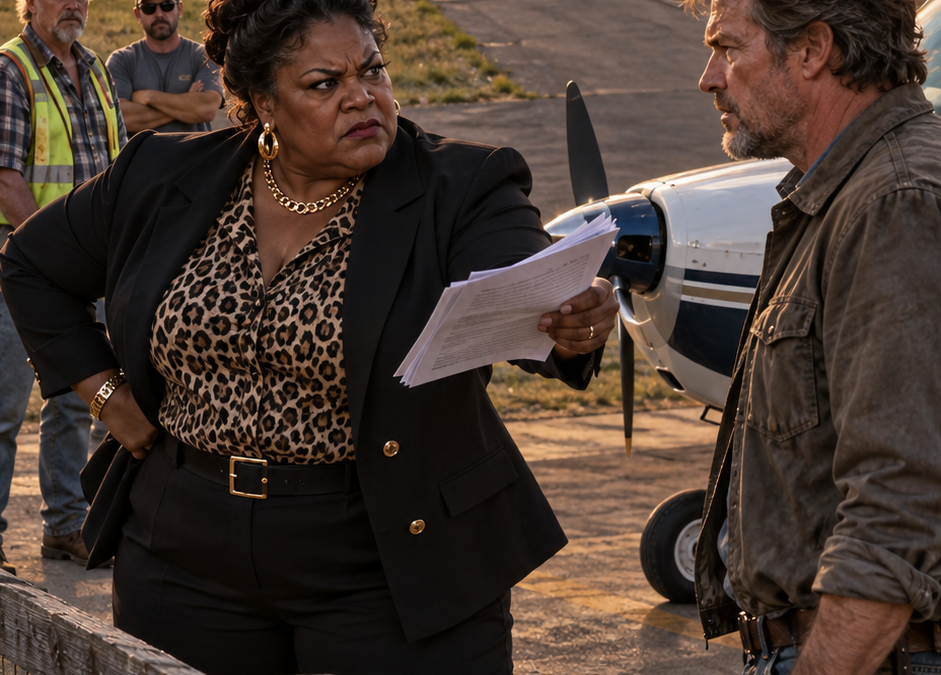
She wanted my signature.
One signature would declare Caldwell Field inactive.
“In exchange,” she said, “your access drive remains untouched, and we resolve the fines before they become a problem.”
“What fines?”
“Potential fines.”
I looked at the document again.
“It’s paperwork,” she said. “Nothing actually changes.”
I handed it back.
“If nothing changes, why do you need my signature?”
She did not answer.
She put the paper inside the folder and walked to her car.
I watched her leave.
Something about the way she carried that folder bothered me.
Not disappointment.
Certainty.
As though my signature was a detail she had expected to solve one way or another.
That night, I lowered an old tin box from the rafters of my hangar.
My father’s box.
Inside were deeds, tax records, surveys, plats, receipts, and documents older than I was.
I sat on the floor beneath a shop light and went through them page by page.
Near the bottom was the original recorded plat for Cedar Hollow.
The runway was shown as a separate parcel.
Separate boundary.
Separate legal description.
Then I found the original declaration.
One sentence changed everything.
Homeowners hold a license to use the landing strip. Title remains with the Caldwell parcel.
I read it four times.
A license.
Permission.
Not ownership.
My father had anticipated the question before Meredith Vance had even been born.
For the first time since the meeting, I felt relief.
The next morning I made copies and drove to the association office.
Meredith sat behind a corner desk.
A little flag stood beside her computer.
I placed the plat and deed in front of her.
“The runway belongs to my parcel. The association has permission to use it.”
She read the document.
Her eyes stopped exactly where mine had.
For about four seconds, her expression disappeared.
Then she pushed the papers back.
“This says you own the dirt.”
“Yes.”
“It doesn’t say you own the sky.”
I almost laughed.
“That isn’t how aviation law works.”
“Bradley.”
She said my name as if correcting a child.
“The eleven acres belong to the association. The county permitted construction on association property.”
“I want the permit file.”
“That’s association business.”
“I’m an association member.”
“Submit a written request.”
She turned toward her monitor.
“There’s a form.”
That conversation taught me something.
I was not arguing with Meredith.
I was entering a process she believed she controlled.
And she intended to make time her weapon.
Construction accelerated.
Building B went up first.
Steel framing rose in four days.
Generators ran after dark.
Every evening, the crane operator left the boom stretched directly through the northern approach.
No obstruction lights.
None.
One night I stood at the runway threshold and measured it visually.
More than a hundred feet of unlit steel lay across an active approach path.
I was furious.
So I counted.
Counting keeps emotion from making decisions for me.
Friday arrived.
I did not move my airplane.
Monday brought a certified letter.
Violation: $250 per day.
Section 14.
Aircraft noise outside permitted hours.
I pulled out the association rules.
Section 14 covered trash containers.
I called Arlene.
“She changed it,” Arlene said.
“When?”
“October.”
“I don’t remember a vote.”
“It was included in the consent packet.”
“Was it discussed?”
Silence.
“Arlene?”
“No.”
Another pause.
“Bradley, I’m not on that board anymore in any way that matters.”
She hung up.
Two days later my gate code stopped working.
I sat in my truck punching the same four digits over and over.
Error.
Error.
Error.
My airplane stood forty feet away on property I owned.
I could see it.
I could not reach it.
The fuel truck came Thursday.
The driver could not get through the gate either.
He waited.
Called dispatch.
Then left.
Friday evening Blue Wing called.
10:40 p.m.
A man in Sunrise Bend had chest pain.
I checked the tanks.
Not enough fuel for the mission with reserves.
No fuel truck could reach me.
For twenty-six years, I had turned down maybe half a dozen flights.
Weather every time.
That night, for the first time in my life, I refused a medical flight because somebody had changed a gate code.
I did not sleep much.
Monday morning I called the county building department.
Howell Grayson answered.
His voice had the patient exhaustion of a man who had explained building codes to irritated citizens for decades.
He located the Copperline file.
“Permits are good,” he said. “Site plan, structural, everything approved.”
“Was there an airspace review?”
“No reason for one.”
“Why?”
I heard paper moving.
“The applicant certified there’s no active public or private airport within two miles.”
I stopped breathing for a moment.
“My runway is four hundred feet from Building B.”
The papers stopped moving.
“Well,” he said slowly, “then somebody signed something they shouldn’t have.”
“Who?”
“I can’t release names over the phone. File a public records request.”
“How long?”
“About ten business days.”
That night I walked to the threshold.
The wind sock knocked softly against the pipe.
The crane was still there.
Still dark.
Arlene came to my hangar Saturday morning.
She carried a banker’s box.
When I tried to help her with it, she turned away.
“I carried it this far.”
She set it on the workbench.
“I kept copies.”
“Of what?”
“Everything.”
Twenty years of association records.
“Meredith asked for the originals when she became president. She never asked whether I had copies.”
Arlene pointed toward the files.
“Second folder from the front.”
I found it.
NORTH RESERVE — RECORDED.
Inside was a document carrying the county recorder’s stamp.
Navigation Easement.
I read it slowly.
Then again.
Decades earlier, a permanent restriction had been recorded against the association’s eleven-acre reserve.
The land was subject to a protected landing corridor.
Structures could not penetrate that corridor above specified heights.
The restriction ran with the land.
It did not matter who owned the property.
It could not simply be voted away.
The association had built warehouses on ground legally restricted for aviation clearance.
Then I reached the final page.
Received and acknowledged for Cedar Hollow Air Park Homeowners Association.
Three years earlier.
Signature:
Meredith Vance.
I stared at it.
“She knew.”
Arlene looked toward the wall.
“She signed for it.”
“That means she knew.”
“Not necessarily.”
I looked at her.
Arlene finally met my eyes.
“It might mean something worse.”
Before leaving, she mentioned a closed board session from the previous spring.
No discussion appeared in the ledger.
Only start and end times.
Then she said something I remembered later.
“Bradley, I’ve known Meredith four years. She has never done anything she couldn’t get paid for.”
The county records arrived Tuesday.
I opened the envelope beside my mailbox.
Two pages.
Site certification.
One box was checked:
NO ACTIVE PUBLIC OR PRIVATE AIRPORT IS LOCATED WITHIN TWO MILES OF THE PROPOSED SITE.
The signature beneath it belonged to Meredith Vance.
Under that was the notary block.
Her stamp.
Her commission number.
Her signature.
She had notarized the certification herself.
I sat on my truck’s tailgate.
Then I checked the date.
Eleven days after she had asked me to sign the decommissioning acknowledgment.
That sequence mattered.
She had asked me to officially close Caldwell Field.
I refused.
Eleven days later she certified that no airport existed there.
That was not a misunderstanding.
Mistakes do not usually arrange themselves in chronological order.
Gwen Rasmussen practiced aviation law in Boise.
Her office was inside an old converted house with a framed Cessna print in the waiting room.
I put three documents on her desk.
The plat.
The navigation easement.
The county certification.
She read all three.
Then she removed her glasses.
“Do you understand what you have?”
“I think I have proof she lied to the county.”
“You have considerably more than that.”
She tapped the navigation easement.
“This is a property right. The association accepted the land subject to it. They cannot vote it away.”
Then she touched the site certification.
“This worries me more.”
“Why?”
“The county controls land-use permits. It does not control navigable airspace. Tall structures near an airport trigger a federal review process.”
“Was one filed?”
Gwen shook her head.
“Nothing.”
No obstruction study.
No hazard determination.
No lighting review.
Nothing.
The federal process had never been triggered because the county had been told Caldwell Field did not exist.
I filed the obstruction complaint that night.
Photographs.
Coordinates.
Building measurements.
My airport registration.
The easement.
Everything.
Gwen sent a formal letter to the board two days later.
Within a week, two directors called me privately.
Neither apologized.
Both asked whether board members could be held personally liable.
Meredith called an emergency meeting.
She stood at the front holding the easement.
“This,” she said, “is a thirty-year-old document nobody has enforced.”
Someone asked whether it remained legally valid.
“Everything is valid until somebody challenges it.”
That was not an answer.
She placed it face down.
“The federal complaint is procedural. Once the registration problem is cleaned up, it will disappear.”
I heard the phrase clearly.
Registration problem.
My registration had no problem.
Caldwell Field was active.
Current.
Renewed.
I thought about those words for nine days.
Then I understood.
By then, she had already moved.
I was changing oil in the hangar when the regional office called.
“Mr. Caldwell, we’re returning your obstruction complaint without action.”
“Why?”
“There’s no active airport at those coordinates.”
I stopped moving.
“What did you say?”
“The facility is listed as closed.”
“That field has operated continuously since 1961.”
“I understand, sir. But I can only work from the record.”
I opened the federal airport directory on my phone.
Caldwell Field.
Status: CLOSED.
Effective two weeks earlier.
Three days later I obtained the closure form.
Request to close private-use facility.
Submitted on behalf of owner.
Owner:
Bradley Caldwell.
Owner signature:
Bradley Caldwell.
Except I had never signed it.
The handwriting was not even convincing.
But nobody processing the form knew what my signature looked like.
The boxes were completed.
The information looked plausible.
So the system processed it.
I stared at my name written by somebody else and felt something colder than anger.
It was the sensation of stepping onto a stair that was not there.
Everything collapsed afterward.
The association recorded an $18,400 lien against my house for fines and “legal costs.”
My hangar insurance was canceled.
The underwriter quoted the federal database.
“Facility shows closed.”
Blue Wing removed Caldwell Field from its emergency pickup list.
Their coordinator called me personally.
“I fought this,” she said. “Legal won’t authorize dispatch to a closed airport.”
Two medical transports that week went through the county airport forty miles east.
Patients who could have been airborne in minutes spent almost another hour on rural roads.
Then Meredith mailed me a handwritten card.
Association letterhead.
Four polite lines.
She congratulated me on “formalizing the status” of my property.
She hoped we could move beyond an unfortunate season.
She invited me to the Copperline ribbon cutting.
There was nothing threatening in the note.
That made it worse.
She was thanking me for something she knew I had never done.
The story spread through Cedar Hollow.
Bradley finally closed his runway.
Bradley regretted it.
Bradley was now suing everybody because he had changed his mind.
A neighbor I had once flown to Spokane for his brother’s funeral confronted me at the feed store.
“Why’d you file the closure if you wanted the field open?”
“I didn’t.”
He gave me the nod people give when they have decided you are lying but do not want an argument.
That hurt more than I expected.
I met Gwen again.
She listened without interrupting.
Then she said, “The forgery is provable.”
“How long?”
“Discovery, motions, expert comparison, maybe trial. Eighteen months if we’re lucky.”
I leaned back.
“In eighteen months those warehouses will be operating.”
“Yes.”
“So I win eventually.”
“Yes.”
“And lose the runway.”
She looked at me.
“You win late.”
For an airport, she said, that could be the same as losing.
That night I sat inside the dark hangar with the door open.
My airplane rested ten yards away.
Nineteen hundred hours flown from Caldwell Field.
Now it was an expensive piece of machinery parked beside an airport that officially did not exist.
I kept thinking about the warehouses.
Then, sometime after midnight, I realized I had been fighting the wrong thing.
The warehouses had existed before my insurance disappeared.
They existed before Blue Wing stopped dispatching me.
They existed before my neighbors began treating me like a liar.
One document had caused all of that.
The closure.
If the closure was fraudulent, everything built on it had a weakness.
So I stopped asking whether the buildings should be there.
I asked a simpler question.
Who pressed Send?
Federal filings leave records.
Not just forms.
Submission information.
Account details.
Contact email.
Phone number.
Metadata.
I requested the underlying submission record.
Nine days later, it arrived.
The email belonged to the Cedar Hollow association office.
The contact phone number was Meredith’s cell.
I knew because it appeared on every violation notice she had sent me.
The filing was submitted at 4:19 p.m. on a Tuesday.
From her office.
She had not hidden herself.
That surprised me.
Then I understood.
Meredith had never believed she needed to hide.
She believed she possessed the authority.
Changing my gate code.
Changing association rules.
Closing my airport.
To her, they were variations of the same administrative act.
Arlene returned two days later with another document.
Closed-session minutes.
Six lines.
The board authorized the president to handle “decommissioning paperwork for the airstrip as needed.”
No authority to sign my name.
No authority to represent herself as the runway owner.
No discussion of federal filings.
Then Arlene removed an envelope from her purse.
“This came from Copperline’s attorney.”
Inside was a one-page side agreement.
Copperline Logistics would pay Meredith Vance personally a consulting fee of $95,000.
Payment condition:
Upon resolution of the approach corridor issue.
I read the number twice.
Ninety-five thousand dollars.
Suddenly the last two months made sense in a way I did not want them to.
The corridor was not simply inconvenient to her project.
It had a price.
I filed the challenge to the airport closure.
Gwen assembled the legal argument.
I provided everything else.
Thirty years of signature examples.
Mortgage documents.
Pilot certificates.
Property records.
Logbooks.
Fuel invoices.
Six months of deliveries to an airport supposedly abandoned.
Nineteen days later the federal record changed.
CALDWELL FIELD — ACTIVE.
No break in operating history.
The closure had been rejected as unauthorized.
I called the regional office immediately.
“Then the obstruction case reopens.”
The man hesitated.
“Those are separate processes.”
“They are the same buildings.”
“Yes, sir. But an obstruction evaluation is a study.”
“How long?”
“Months.”
“Those buildings already exist.”
Another pause.
I understood before he explained.
A study was no longer the right mechanism.
What now existed was an operational safety question.
And a safety question required a documented hazard.
An incident.
A near incident.
Something had to almost happen.
That realization sat badly with me.
Meredith moved the ribbon cutting forward by twelve days.
She claimed scheduling.
Tenant requirements.
Weather.
Copperline received temporary occupancy approval for Building B.
Night operations started.
Forklifts moved through the loading area.
Work lights illuminated the docks.
But above the roofline, the building remained dark.
No red obstruction lights.
Dale Ostrander, the construction superintendent, walked over one evening while I stood near the fence.
He was a heavyset man in his fifties and had always treated me professionally.
“I requested lighting on Building B,” he said.
“You did?”
“Standard obstruction package. Couple thousand dollars. One day, maybe two.”
“What happened?”
“She rejected it.”
“Meredith?”
He took out his phone.
An email.
Four lines.
Lighting is not required. There is no airport at this location according to federal records. Do not add unapproved costs to this scope.
“I keep everything,” Dale said.
“Why?”
“Twenty-two years in construction.”
He shrugged.
“That’s how I got to twenty-two.”
Three nights before the ribbon cutting, Blue Wing called.
10:11 p.m.
Caldwell Field had been restored to the active dispatch list.
A sixty-eight-year-old woman in Sunrise Bend had a cardiac emergency.
Ninety minutes by road.
Twenty-two by air.
I departed Caldwell, picked up the patient and her daughter, and turned home.
I had flown the northern approach into Caldwell Field thousands of times.
Fence.
Hayfield.
Threshold.
Simple.
Familiar.
That night, as I descended, the stars disappeared.
Building B had no windows on the runway-facing side.
The loading lights all pointed inward.
From the air, there was no illuminated building.
There was only a rectangular absence where the horizon should have been.
I saw it late.
Too late.
Training reacted before thought.
Power.
Nose up.
Climb.
We crossed above the roof.
The daughter behind me gasped.
I can still hear that sound.
I did not attempt another landing.
We diverted forty miles east.
The patient reached the hospital thirty-one minutes later than she would have from Caldwell.
She survived.
After they took her away, I remained sitting inside the airplane.
2:00 a.m.
Engine ticking as it cooled.
Hands resting on my knees.
I waited until they stopped shaking.
Then I downloaded the flight data.
Ground track.
Altitude.
Vertical profile.
Distance from the structure when I initiated the climb.
Numbers.
Machines do not exaggerate fear.
At six that morning, I filed the safety report.
Three attachments.
The flight data.
Dale’s email showing Meredith had rejected obstruction lighting.
And Caldwell Field’s restored federal record showing continuous operation since 1961.
At four that afternoon, my phone rang.
A woman spoke.
Calm.
Professional.
“Mr. Caldwell, will you be on site tomorrow morning?”
“Yes.”
“Thank you.”
A brief pause.
“Until then, please remain off the north approach.”
Before I could ask why, she disconnected.
The next morning was the ribbon cutting.
The podium faced away from my runway.
I noticed that immediately.
Rows of folding chairs sat in front of Building A.
A red ribbon stretched across the main dock.
Board members arrived.
Homeowners.
Copperline executives.
A reporter from the Marlo paper.
County building official Howell Grayson stood near the back.
Meredith wore navy.
The crowd quieted when she stepped to the podium.
“This association used to be a hobby club with a mowing budget.”
People laughed.
Real laughter.
From neighbors who had known me for decades.
“Today, we are a financially sustainable community. Dues decrease in January. Our roads have been improved. And a personal disagreement that has consumed entirely too much of this board’s time has finally been resolved.”
She never looked toward me.
That told everyone exactly whom she meant.
They applauded.
Someone handed her oversized ceremonial scissors.
I stood off to the side carrying a thin folder.
Gwen had given me two instructions.
Attend.
Do not speak unless asked.
I obeyed both.
Meredith lifted the scissors.
Then two vehicles came up the access road.
A dark SUV.
A sedan.
Nothing dramatic about them.
They simply parked.
Two people stepped out.
A man wearing an agency windbreaker.
A woman carrying a folder.
The crowd quieted before anyone explained why.
The man approached the podium.
“Ma’am, are you the president of the homeowners association?”
Meredith lowered the scissors.
“I am.”
“Owen Barrett, Flight Standards. This is Ruth Merrick, Airspace.”
He extended a document.
“We’re here under an emergency inspection order covering this facility and the adjacent airport.”
I had never heard that many people become silent at once.
Meredith read the top of the page.
“There’s been a mistake.”
“There may have been,” Barrett said. “That’s why we’re inspecting.”
“This is association property. We have county permits.”
Ruth Merrick answered.
“The county doesn’t control airspace, ma’am.”
“The corridor doesn’t exist.”
“It exists because an active registered airport is located at the end of it.”
Merrick opened her folder.
“The county permit was issued based on a site certification stating no airport existed within two miles. We need the original certification.”
Meredith gripped the paper.
“That certification was accurate. The airport was closed.”
Barrett turned a page toward her.
Current federal record.
Caldwell Field active.
Continuous since 1961.
“There was a closure request,” he said. “That request was invalidated because the signature was not the owner’s.”
For the first time, Meredith looked toward the crowd instead of the officials.
“I was authorized by the board to handle decommissioning paperwork.”
“If there was an error on a form, I can correct it.”
That was when Gwen’s instruction mattered.
I opened my folder.
Handed three pages to Merrick.
Said nothing.
Submission record.
Timestamp.
Association email.
Contact telephone number.
Merrick studied it.
Then she read the phone number aloud.
A phone rang.
Third row.
Meredith’s jacket pocket.
No one moved.
It rang four times.
Stopped.
“That is the number submitted with the airport closure,” Merrick said.
She turned another page.
“And the county site certification contains your signature, notary stamp, and commission number.”
Meredith swallowed.
“That was an administrative convenience.”
Nobody laughed.
Nobody whispered.
Nothing.
She was forced to hear the emptiness after her own explanation.
Merrick reached the final document.
The Copperline agreement.
She passed it to Barrett.
He read it.
Then looked at Meredith.
“Ninety-five thousand dollars payable upon resolution of the approach corridor issue.”
Two board members turned toward each other.
Barrett continued.
“Was this arrangement disclosed to your board?”
Meredith did not answer immediately.
Instead, she changed subjects.
“No one told me these buildings required lighting.”
Dale Ostrander stood several feet away.
He removed his phone.
“Ma’am.”
Everyone looked toward him.
“I requested the obstruction lighting package.”
He extended the phone.
“You declined it in writing.”
Barrett read the message.
Once.
Then again.
Something changed in his expression.
Not anger.
Professional distance.
“You were advised that lighting was appropriate for a structure inside an airport approach.”
He looked at Meredith.
“And you declined it while citing a federal airport record created by a closure filing linked to your own phone number.”
Meredith finally had nothing to say.
Merrick and Barrett walked toward Building B.
They measured instead of arguing.
Rangefinder.
Site plan.
Corridor geometry.
Building B’s rooftop equipment reached approximately fifty-two feet.
The permitted corridor height at that location was thirty-five.
Building C also penetrated the corridor.
Barrett returned with a printed notice.
He taped it to Building B’s dock door.
CESSATION OF OPERATIONS EFFECTIVE IMMEDIATELY PENDING INSPECTION.
The same door still had the ceremonial ribbon stretched across it.
The Copperline regional director stepped away and called someone.
We could hear him.
“Stop all inbound.”
Then:
“I want the site file and representation letter today.”
Howell Grayson approached Barrett.
They spoke quietly.
Grayson wrote in a notebook.
Then he left.
Before eleven, Building B’s temporary certificate of occupancy had been withdrawn.
The crowd dispersed slowly.
Nobody shouted at Meredith.
Nobody confronted her.
The board members who had privately asked me about personal liability simply walked away.
One after another.
Meredith remained near the podium.
Still holding the ceremonial scissors.
Nobody asked for them.
Nobody needed to.
The ribbon was never cut.
An hour later, Ruth Merrick found me.
“How long have you been operating with these structures in place?”
“Nine weeks.”
She wrote it down.
Then she looked toward Building B.
The dark wall that had erased my horizon.
“Mr. Caldwell, I need every flight and logbook entry since construction began.”
The emergency inspection lasted eleven days.
The final findings filled forty pages.
I read every one.
Twice.
Two warehouses penetrated the protected approach corridor.
No federal obstruction filing had ever been submitted.
No hazard evaluation had occurred.
No obstruction lighting had been installed.
The association had been advised to install lighting.
Meredith had rejected it in writing.
The final order arrived in March.
Building B could remain only if it was lowered beneath the corridor limit.
That required removing the rooftop equipment and cutting down the parapet.
Building C had to be demolished.
Completely.
Copperline terminated its lease.
Then sued.
Demolition.
Restoration.
Contract damages.
Engineering costs.
Legal fees.
Cedar Hollow lost roughly $2.4 million.
Twenty-four households.
Six-year special assessment.
Including Meredith’s lot.
I admit I wondered whether anyone personally handed her that bill.
My civil case accelerated once the federal inspection findings became part of the record.
The court enforced the navigation easement.
The board could not vote around it.
Could not ignore it.
Could not pretend it had expired.
The $18,400 lien against my house was removed.
The association’s Section 14 aircraft fines were voided.
I received a judgment of $610,000 for loss of use, insurance losses, the disrupted medical-flight contract, and legal expenses.
The association’s insurer refused to protect Meredith personally.
Their attorney’s letter was simple.
The president had exceeded the lawful authority of her office.
A homeowners association could authorize its president to handle paperwork.
It could not authorize her to impersonate another property owner.
The criminal case followed.
By fall, Meredith pleaded guilty to making a false statement in a filing submitted to a federal agency and submitting paperwork carrying a forged owner signature.
Sixteen months.
Restitution.
Her real estate license disappeared.
So did her notary commission.
The $95,000 consulting fee was never paid.
Copperline’s agreement made payment dependent on successful “resolution” of the approach issue.
She had not resolved anything.
She eventually sold her Cedar Hollow lot to satisfy part of the restitution.
A young couple bought it.
They have a dog now.
A vegetable garden.
They wave when I drive by.
I have never told them who used to live there.
The association held an emergency election.
Arlene Doyle became secretary again.
The first thing the new board did was remove the revised Section 14.
No more aircraft rule hidden inside a consent packet.
No more $250-a-day fines invented after the fact.
Nobody ever gave me a formal apology.
That might surprise people.
After everything, I thought there would be letters.
Meetings.
Someone standing at my hangar saying they should have listened.
That never happened.
Instead, the apologies arrived indirectly.
A neighbor started waving again.
Another stopped me near the mailboxes and asked about the weather.
One man left a homemade pie on my workbench and never explained why.
Eventually I realized that might be all some people were capable of giving.
And somehow, it was enough.
The runway reopened four months after the emergency order.
A sixty-ton crane spent weeks removing rooftop equipment from Building B.
Concrete saws ran across the field.
Building C came down.
Piece by piece.
Steel disappeared.
Then the crews left.
The quiet returned so gradually I almost missed it.
One Thursday Blue Wing called.
“Caldwell Field is back on the active pickup list.”
That same night, my phone rang again.
A man in Sunrise Bend.
Sixty-one years old.
Severe breathing trouble.
The nurse gave me the numbers.
Ninety minutes by road.
Twenty-two by air.
I walked toward my airplane carrying a flashlight.
It was 11:40 p.m.
Before climbing inside, I walked to the runway threshold.
I have done that since I was a boy.
I crouched.
Put my hand against the concrete.
My father poured that slab in 1961.
Near the edge, beneath dirt and grit, are two letters.
You have to brush the surface with your thumb to find them.
B.C.
His initials.
Sixty years in concrete.
The windsock pole knocked softly against its pipe.
Wind from the north.
I stood.
Looked along the approach.
Where Building C had stood, there was open hayfield again.
Fence.
Then sky.
The way my father designed it.
Building B remained, but its roof had been cut below the protected limit.
Buildings A and D remained too.
All three carried synchronized red obstruction lights now.
Visible from miles away.
The homeowners association pays the electric bill.
I walked back to the airplane.
Completed the preflight.
Started the engine.
Taxied toward the threshold.
For one second, my landing light swept across Dad’s initials.
Then I pushed the throttle forward.
The airplane accelerated.
The concrete blurred beneath me.
The wheels lifted almost exactly where those two letters were scratched into the slab.
Twenty-two minutes later, I landed beside a hospital in Boise.
Medical staff rushed the patient toward the doors.
His wife followed.
Before she went inside, she stopped beside me.
She did not know about Meredith.
She did not know about the forged closure.
She did not know about the warehouses, the federal inspection, the lawsuits, the assessments, the demolished building, or the night I had nearly flown into a black wall.
She simply reached out and squeezed my forearm.
Then she hurried after her husband.
She never asked who owned the runway they had taken off from.
She never asked who controlled the air above it.
She only knew that when her husband needed twenty-two minutes instead of ninety, an airplane had been there.
And for the first time in months, that was all I needed the runway to mean.
Have you finished reading the story and want to read it again?
HOA Built a Warehouse Complex Beside My Private Runway — Then One Night in the Dark Changed Everything
I had landed on that runway thousands of times, but that afternoon the horizon was suddenly gone.
The woman responsible told me the sky above my own property no longer belonged to me.
Nine weeks later, two unmarked vehicles arrived just as she was about to cut a ribbon.
My name is Bradley Caldwell, and the first time I realized something was terribly wrong, I was already committed to landing.
I was on short final into Caldwell Field, descending toward the same strip of concrete I had known since childhood, when I saw a roofline where open sky had always been.
For half a second, my mind refused to understand what my eyes were seeing.
Then training took over.
I shoved the throttle forward.
The engine roared.
The nose came up.
The runway dropped beneath me as I climbed.
Four warehouse buildings stood along the north side of the field, their steel walls new enough to shine in the afternoon sun. Loading docks faced my runway. Construction equipment crowded the ground around them.
The closest wall stood roughly four hundred feet from my runway centerline.
Four hundred feet sounds like a lot if you have never flown an airplane.
It does not feel like a lot when you are descending toward concrete with your wheels down and turbulence rolling off a fifty-foot wall.
As I climbed past the site, air spilling around the warehouse hit my left wing hard enough to make the airplane roll.
I corrected automatically.
My pulse did not settle.
I circled once.
The second approach was higher and wider.
I landed near the concrete threshold my father had poured himself in 1961.
By the time I taxied toward my hangar, Meredith Vance was standing beside the fence.
She held several sheets of paper in one hand.
I shut down the engine.
The propeller slowed.
She did not wait for me to climb out.
“You’re done landing here.”
I removed my headset.
“What?”
She lifted the papers.
“The board voted. That’s association property, and so is the air over it.”
For a moment I thought I had misheard her.
“My father built this runway.”
“And now twenty-four families subsidize your hobby.”
I climbed down from the airplane.
“I own the runway parcel.”
“You own a strip of pavement.”
“I hold the deed.”
She smiled without warmth.
“You hold a hobby, Bradley. Twenty-four families have been paying so you can play pilot on weekends. That ends now.”
Behind her, a concrete truck turned toward the construction site.
I pointed at the warehouses.
“Who signed the permit application?”
Her expression hardened.
“That’s association business.”
“I’m a member of the association.”
“You don’t get to interrogate the board.”
She glanced at the aircraft behind me.
“You have until Friday to move it. After that, fines begin.”
Then she turned and walked away.
I watched the concrete truck roll behind her.
At the time, I thought the warehouses were the problem.
They were not.
The real problem was paperwork.
And Meredith Vance understood paperwork better than anyone in Cedar Hollow.
My father bought the property when most of it was hayfield.
There were no manicured roads, no neighborhood entrance signs, no association office.
Just land.
In 1961, he borrowed a bulldozer and cleared approximately 3,200 feet through the center of it.
He poured the threshold himself.
Before the concrete hardened, he scratched his initials into one corner with a nail.
B.C.
I grew up thinking every runway had somebody’s initials in it.
He installed a windsock on a steel pipe beside the strip. More than sixty years later, the pole still knocked against that pipe whenever the wind shifted north.
Years afterward, Dad divided the surrounding acreage into twenty-four residential lots.
Most of the buyers were pilots.
Twenty-four homes.
Twenty-four hangars.
One runway.
He named the place Cedar Hollow.
But he never transferred ownership of the runway to the homeowners association.
That distinction had always mattered to him.
The homeowners received permission to use it.
They did not own it.
The deed remained with the Caldwell parcel.
Eventually, it became mine.
I flew professionally for twenty-six years.
Four years before all this happened, I returned my airline uniform for the last time.
Retirement lasted less than six months.
Then Blue Wing Medical Flights called.
They needed experienced pilots willing to cover rural emergency transfers at night.
I said yes.
Since then, my phone had rung for pregnant women whose babies refused to wait, farmers with cardiac emergencies, injured teenagers, stroke patients, people living in places where the nearest hospital might as well have been another state when every minute mattered.
By road, Sunrise Bend to Boise could take ninety minutes.
By air, twenty-two.
That difference was why Caldwell Field mattered.
Meredith called it my toy.
The people I carried never did.
She had moved into Cedar Hollow four years earlier.
She bought the least expensive property in the development, one without a hangar.
She did not fly.
She worked in commercial real estate.
She also notarized association documents.
Two years after moving in, she became board president because nobody else wanted the job badly enough to run against her.
At first she was pleasant.
Then she started referring to the runway as an “amenity.”
It sounded harmless.
Words like that often do before somebody uses them to take something.
The meeting that changed everything happened on a Tuesday evening.
When I entered the community room, Meredith already had a presentation board standing on an easel.
A rendering showed four modern warehouse buildings on the eleven acres of association-owned reserve land along our northern boundary.
Copperline Logistics wanted the property for a distribution center.
Meredith stood beside the rendering like she was unveiling a monument.
“Lease income,” she said. “Lower dues. New roads. Long-term financial stability.”
Nobody objected to those things.
Why would they?
Then she pointed toward the map.
“Right now, twenty-four families carry the expense of this community so one family can maintain a private airstrip.”
I felt several people look at me.
“That isn’t accurate,” I said.
She continued as if I had not spoken.
“It’s simply the arrangement we inherited. It doesn’t mean it’s the arrangement we have to keep.”
Most of my neighbors were older.
Some were retired pilots.
Others had stopped flying years earlier.
They were not weak people.
But they disliked conflict, and Meredith understood that.
One man near the back raised his hand.
“Would warehouses that close to an active runway be a safety problem?”
Meredith did not hesitate.
“The runway is the liability this association has carried for sixty years.”
And there it was.
In one sentence, she turned my father’s runway into the danger and the warehouses into the solution.
I stood.
“What did the developer do about the approach corridor?”
She smiled.
“The county approved the permits.”
“The county doesn’t control my approach.”
“The county does not require your permission.”
The vote was ten in favor.
Two abstained.
Arlene Doyle, the association secretary, did neither.
Arlene had kept the official ledger for twenty years.
While everyone else looked toward Meredith’s rendering, Arlene looked at me.
Then she closed the ledger, picked it up, and walked out.
After the meeting, Meredith caught me in the parking lot.
“Bradley.”
I stopped.
She opened a folder and removed one sheet of paper.
“I’m trying to make this easy.”
The title read:
ACKNOWLEDGMENT OF DECOMMISSIONING.
She wanted my signature.
One signature would declare Caldwell Field inactive.
“In exchange,” she said, “your access drive remains untouched, and we resolve the fines before they become a problem.”
“What fines?”
“Potential fines.”
I looked at the document again.
“It’s paperwork,” she said. “Nothing actually changes.”
I handed it back.
“If nothing changes, why do you need my signature?”
She did not answer.
She put the paper inside the folder and walked to her car.
I watched her leave.
Something about the way she carried that folder bothered me.
Not disappointment.
Certainty.
As though my signature was a detail she had expected to solve one way or another.
That night, I lowered an old tin box from the rafters of my hangar.
My father’s box.
Inside were deeds, tax records, surveys, plats, receipts, and documents older than I was.
I sat on the floor beneath a shop light and went through them page by page.
Near the bottom was the original recorded plat for Cedar Hollow.
The runway was shown as a separate parcel.
Separate boundary.
Separate legal description.
Then I found the original declaration.
One sentence changed everything.
Homeowners hold a license to use the landing strip. Title remains with the Caldwell parcel.
I read it four times.
A license.
Permission.
Not ownership.
My father had anticipated the question before Meredith Vance had even been born.
For the first time since the meeting, I felt relief.
The next morning I made copies and drove to the association office.
Meredith sat behind a corner desk.
A little flag stood beside her computer.
I placed the plat and deed in front of her.
“The runway belongs to my parcel. The association has permission to use it.”
She read the document.
Her eyes stopped exactly where mine had.
For about four seconds, her expression disappeared.
Then she pushed the papers back.
“This says you own the dirt.”
“Yes.”
“It doesn’t say you own the sky.”
I almost laughed.
“That isn’t how aviation law works.”
“Bradley.”
She said my name as if correcting a child.
“The eleven acres belong to the association. The county permitted construction on association property.”
“I want the permit file.”
“That’s association business.”
“I’m an association member.”
“Submit a written request.”
She turned toward her monitor.
“There’s a form.”
That conversation taught me something.
I was not arguing with Meredith.
I was entering a process she believed she controlled.
And she intended to make time her weapon.
Construction accelerated.
Building B went up first.
Steel framing rose in four days.
Generators ran after dark.
Every evening, the crane operator left the boom stretched directly through the northern approach.
No obstruction lights.
None.
One night I stood at the runway threshold and measured it visually.
More than a hundred feet of unlit steel lay across an active approach path.
I was furious.
So I counted.
Counting keeps emotion from making decisions for me.
Friday arrived.
I did not move my airplane.
Monday brought a certified letter.
Violation: $250 per day.
Section 14.
Aircraft noise outside permitted hours.
I pulled out the association rules.
Section 14 covered trash containers.
I called Arlene.
“She changed it,” Arlene said.
“When?”
“October.”
“I don’t remember a vote.”
“It was included in the consent packet.”
“Was it discussed?”
Silence.
“Arlene?”
“No.”
Another pause.
“Bradley, I’m not on that board anymore in any way that matters.”
She hung up.
Two days later my gate code stopped working.
I sat in my truck punching the same four digits over and over.
Error.
Error.
Error.
My airplane stood forty feet away on property I owned.
I could see it.
I could not reach it.
The fuel truck came Thursday.
The driver could not get through the gate either.
He waited.
Called dispatch.
Then left.
Friday evening Blue Wing called.
10:40 p.m.
A man in Sunrise Bend had chest pain.
I checked the tanks.
Not enough fuel for the mission with reserves.
No fuel truck could reach me.
For twenty-six years, I had turned down maybe half a dozen flights.
Weather every time.
That night, for the first time in my life, I refused a medical flight because somebody had changed a gate code.
I did not sleep much.
Monday morning I called the county building department.
Howell Grayson answered.
His voice had the patient exhaustion of a man who had explained building codes to irritated citizens for decades.
He located the Copperline file.
“Permits are good,” he said. “Site plan, structural, everything approved.”
“Was there an airspace review?”
“No reason for one.”
“Why?”
I heard paper moving.
“The applicant certified there’s no active public or private airport within two miles.”
I stopped breathing for a moment.
“My runway is four hundred feet from Building B.”
The papers stopped moving.
“Well,” he said slowly, “then somebody signed something they shouldn’t have.”
“Who?”
“I can’t release names over the phone. File a public records request.”
“How long?”
“About ten business days.”
That night I walked to the threshold.
The wind sock knocked softly against the pipe.
The crane was still there.
Still dark.
Arlene came to my hangar Saturday morning.
She carried a banker’s box.
When I tried to help her with it, she turned away.
“I carried it this far.”
She set it on the workbench.
“I kept copies.”
“Of what?”
“Everything.”
Twenty years of association records.
“Meredith asked for the originals when she became president. She never asked whether I had copies.”
Arlene pointed toward the files.
“Second folder from the front.”
I found it.
NORTH RESERVE — RECORDED.
Inside was a document carrying the county recorder’s stamp.
Navigation Easement.
I read it slowly.
Then again.
Decades earlier, a permanent restriction had been recorded against the association’s eleven-acre reserve.
The land was subject to a protected landing corridor.
Structures could not penetrate that corridor above specified heights.
The restriction ran with the land.
It did not matter who owned the property.
It could not simply be voted away.
The association had built warehouses on ground legally restricted for aviation clearance.
Then I reached the final page.
Received and acknowledged for Cedar Hollow Air Park Homeowners Association.
Three years earlier.
Signature:
Meredith Vance.
I stared at it.
“She knew.”
Arlene looked toward the wall.
“She signed for it.”
“That means she knew.”
“Not necessarily.”
I looked at her.
Arlene finally met my eyes.
“It might mean something worse.”
Before leaving, she mentioned a closed board session from the previous spring.
No discussion appeared in the ledger.
Only start and end times.
Then she said something I remembered later.
“Bradley, I’ve known Meredith four years. She has never done anything she couldn’t get paid for.”
The county records arrived Tuesday.
I opened the envelope beside my mailbox.
Two pages.
Site certification.
One box was checked:
NO ACTIVE PUBLIC OR PRIVATE AIRPORT IS LOCATED WITHIN TWO MILES OF THE PROPOSED SITE.
The signature beneath it belonged to Meredith Vance.
Under that was the notary block.
Her stamp.
Her commission number.
Her signature.
She had notarized the certification herself.
I sat on my truck’s tailgate.
Then I checked the date.
Eleven days after she had asked me to sign the decommissioning acknowledgment.
That sequence mattered.
She had asked me to officially close Caldwell Field.
I refused.
Eleven days later she certified that no airport existed there.
That was not a misunderstanding.
Mistakes do not usually arrange themselves in chronological order.
Gwen Rasmussen practiced aviation law in Boise.
Her office was inside an old converted house with a framed Cessna print in the waiting room.
I put three documents on her desk.
The plat.
The navigation easement.
The county certification.
She read all three.
Then she removed her glasses.
“Do you understand what you have?”
“I think I have proof she lied to the county.”
“You have considerably more than that.”
She tapped the navigation easement.
“This is a property right. The association accepted the land subject to it. They cannot vote it away.”
Then she touched the site certification.
“This worries me more.”
“Why?”
“The county controls land-use permits. It does not control navigable airspace. Tall structures near an airport trigger a federal review process.”
“Was one filed?”
Gwen shook her head.
“Nothing.”
No obstruction study.
No hazard determination.
No lighting review.
Nothing.
The federal process had never been triggered because the county had been told Caldwell Field did not exist.
I filed the obstruction complaint that night.
Photographs.
Coordinates.
Building measurements.
My airport registration.
The easement.
Everything.
Gwen sent a formal letter to the board two days later.
Within a week, two directors called me privately.
Neither apologized.
Both asked whether board members could be held personally liable.
Meredith called an emergency meeting.
She stood at the front holding the easement.
“This,” she said, “is a thirty-year-old document nobody has enforced.”
Someone asked whether it remained legally valid.
“Everything is valid until somebody challenges it.”
That was not an answer.
She placed it face down.
“The federal complaint is procedural. Once the registration problem is cleaned up, it will disappear.”
I heard the phrase clearly.
Registration problem.
My registration had no problem.
Caldwell Field was active.
Current.
Renewed.
I thought about those words for nine days.
Then I understood.
By then, she had already moved.
I was changing oil in the hangar when the regional office called.
“Mr. Caldwell, we’re returning your obstruction complaint without action.”
“Why?”
“There’s no active airport at those coordinates.”
I stopped moving.
“What did you say?”
“The facility is listed as closed.”
“That field has operated continuously since 1961.”
“I understand, sir. But I can only work from the record.”
I opened the federal airport directory on my phone.
Caldwell Field.
Status: CLOSED.
Effective two weeks earlier.
Three days later I obtained the closure form.
Request to close private-use facility.
Submitted on behalf of owner.
Owner:
Bradley Caldwell.
Owner signature:
Bradley Caldwell.
Except I had never signed it.
The handwriting was not even convincing.
But nobody processing the form knew what my signature looked like.
The boxes were completed.
The information looked plausible.
So the system processed it.
I stared at my name written by somebody else and felt something colder than anger.
It was the sensation of stepping onto a stair that was not there.
Everything collapsed afterward.
The association recorded an $18,400 lien against my house for fines and “legal costs.”
My hangar insurance was canceled.
The underwriter quoted the federal database.
“Facility shows closed.”
Blue Wing removed Caldwell Field from its emergency pickup list.
Their coordinator called me personally.
“I fought this,” she said. “Legal won’t authorize dispatch to a closed airport.”
Two medical transports that week went through the county airport forty miles east.
Patients who could have been airborne in minutes spent almost another hour on rural roads.
Then Meredith mailed me a handwritten card.
Association letterhead.
Four polite lines.
She congratulated me on “formalizing the status” of my property.
She hoped we could move beyond an unfortunate season.
She invited me to the Copperline ribbon cutting.
There was nothing threatening in the note.
That made it worse.
She was thanking me for something she knew I had never done.
The story spread through Cedar Hollow.
Bradley finally closed his runway.
Bradley regretted it.
Bradley was now suing everybody because he had changed his mind.
A neighbor I had once flown to Spokane for his brother’s funeral confronted me at the feed store.
“Why’d you file the closure if you wanted the field open?”
“I didn’t.”
He gave me the nod people give when they have decided you are lying but do not want an argument.
That hurt more than I expected.
I met Gwen again.
She listened without interrupting.
Then she said, “The forgery is provable.”
“How long?”
“Discovery, motions, expert comparison, maybe trial. Eighteen months if we’re lucky.”
I leaned back.
“In eighteen months those warehouses will be operating.”
“Yes.”
“So I win eventually.”
“Yes.”
“And lose the runway.”
She looked at me.
“You win late.”
For an airport, she said, that could be the same as losing.
That night I sat inside the dark hangar with the door open.
My airplane rested ten yards away.
Nineteen hundred hours flown from Caldwell Field.
Now it was an expensive piece of machinery parked beside an airport that officially did not exist.
I kept thinking about the warehouses.
Then, sometime after midnight, I realized I had been fighting the wrong thing.
The warehouses had existed before my insurance disappeared.
They existed before Blue Wing stopped dispatching me.
They existed before my neighbors began treating me like a liar.
One document had caused all of that.
The closure.
If the closure was fraudulent, everything built on it had a weakness.
So I stopped asking whether the buildings should be there.
I asked a simpler question.
Who pressed Send?
Federal filings leave records.
Not just forms.
Submission information.
Account details.
Contact email.
Phone number.
Metadata.
I requested the underlying submission record.
Nine days later, it arrived.
The email belonged to the Cedar Hollow association office.
The contact phone number was Meredith’s cell.
I knew because it appeared on every violation notice she had sent me.
The filing was submitted at 4:19 p.m. on a Tuesday.
From her office.
She had not hidden herself.
That surprised me.
Then I understood.
Meredith had never believed she needed to hide.
She believed she possessed the authority.
Changing my gate code.
Changing association rules.
Closing my airport.
To her, they were variations of the same administrative act.
Arlene returned two days later with another document.
Closed-session minutes.
Six lines.
The board authorized the president to handle “decommissioning paperwork for the airstrip as needed.”
No authority to sign my name.
No authority to represent herself as the runway owner.
No discussion of federal filings.
Then Arlene removed an envelope from her purse.
“This came from Copperline’s attorney.”
Inside was a one-page side agreement.
Copperline Logistics would pay Meredith Vance personally a consulting fee of $95,000.
Payment condition:
Upon resolution of the approach corridor issue.
I read the number twice.
Ninety-five thousand dollars.
Suddenly the last two months made sense in a way I did not want them to.
The corridor was not simply inconvenient to her project.
It had a price.
I filed the challenge to the airport closure.
Gwen assembled the legal argument.
I provided everything else.
Thirty years of signature examples.
Mortgage documents.
Pilot certificates.
Property records.
Logbooks.
Fuel invoices.
Six months of deliveries to an airport supposedly abandoned.
Nineteen days later the federal record changed.
CALDWELL FIELD — ACTIVE.
No break in operating history.
The closure had been rejected as unauthorized.
I called the regional office immediately.
“Then the obstruction case reopens.”
The man hesitated.
“Those are separate processes.”
“They are the same buildings.”
“Yes, sir. But an obstruction evaluation is a study.”
“How long?”
“Months.”
“Those buildings already exist.”
Another pause.
I understood before he explained.
A study was no longer the right mechanism.
What now existed was an operational safety question.
And a safety question required a documented hazard.
An incident.
A near incident.
Something had to almost happen.
That realization sat badly with me.
Meredith moved the ribbon cutting forward by twelve days.
She claimed scheduling.
Tenant requirements.
Weather.
Copperline received temporary occupancy approval for Building B.
Night operations started.
Forklifts moved through the loading area.
Work lights illuminated the docks.
But above the roofline, the building remained dark.
No red obstruction lights.
Dale Ostrander, the construction superintendent, walked over one evening while I stood near the fence.
He was a heavyset man in his fifties and had always treated me professionally.
“I requested lighting on Building B,” he said.
“You did?”
“Standard obstruction package. Couple thousand dollars. One day, maybe two.”
“What happened?”
“She rejected it.”
“Meredith?”
He took out his phone.
An email.
Four lines.
Lighting is not required. There is no airport at this location according to federal records. Do not add unapproved costs to this scope.
“I keep everything,” Dale said.
“Why?”
“Twenty-two years in construction.”
He shrugged.
“That’s how I got to twenty-two.”
Three nights before the ribbon cutting, Blue Wing called.
10:11 p.m.
Caldwell Field had been restored to the active dispatch list.
A sixty-eight-year-old woman in Sunrise Bend had a cardiac emergency.
Ninety minutes by road.
Twenty-two by air.
I departed Caldwell, picked up the patient and her daughter, and turned home.
I had flown the northern approach into Caldwell Field thousands of times.
Fence.
Hayfield.
Threshold.
Simple.
Familiar.
That night, as I descended, the stars disappeared.
Building B had no windows on the runway-facing side.
The loading lights all pointed inward.
From the air, there was no illuminated building.
There was only a rectangular absence where the horizon should have been.
I saw it late.
Too late.
Training reacted before thought.
Power.
Nose up.
Climb.
We crossed above the roof.
The daughter behind me gasped.
I can still hear that sound.
I did not attempt another landing.
We diverted forty miles east.
The patient reached the hospital thirty-one minutes later than she would have from Caldwell.
She survived.
After they took her away, I remained sitting inside the airplane.
2:00 a.m.
Engine ticking as it cooled.
Hands resting on my knees.
I waited until they stopped shaking.
Then I downloaded the flight data.
Ground track.
Altitude.
Vertical profile.
Distance from the structure when I initiated the climb.
Numbers.
Machines do not exaggerate fear.
At six that morning, I filed the safety report.
Three attachments.
The flight data.
Dale’s email showing Meredith had rejected obstruction lighting.
And Caldwell Field’s restored federal record showing continuous operation since 1961.
At four that afternoon, my phone rang.
A woman spoke.
Calm.
Professional.
“Mr. Caldwell, will you be on site tomorrow morning?”
“Yes.”
“Thank you.”
A brief pause.
“Until then, please remain off the north approach.”
Before I could ask why, she disconnected.
The next morning was the ribbon cutting.
The podium faced away from my runway.
I noticed that immediately.
Rows of folding chairs sat in front of Building A.
A red ribbon stretched across the main dock.
Board members arrived.
Homeowners.
Copperline executives.
A reporter from the Marlo paper.
County building official Howell Grayson stood near the back.
Meredith wore navy.
The crowd quieted when she stepped to the podium.
“This association used to be a hobby club with a mowing budget.”
People laughed.
Real laughter.
From neighbors who had known me for decades.
“Today, we are a financially sustainable community. Dues decrease in January. Our roads have been improved. And a personal disagreement that has consumed entirely too much of this board’s time has finally been resolved.”
She never looked toward me.
That told everyone exactly whom she meant.
They applauded.
Someone handed her oversized ceremonial scissors.
I stood off to the side carrying a thin folder.
Gwen had given me two instructions.
Attend.
Do not speak unless asked.
I obeyed both.
Meredith lifted the scissors.
Then two vehicles came up the access road.
A dark SUV.
A sedan.
Nothing dramatic about them.
They simply parked.
Two people stepped out.
A man wearing an agency windbreaker.
A woman carrying a folder.
The crowd quieted before anyone explained why.
The man approached the podium.
“Ma’am, are you the president of the homeowners association?”
Meredith lowered the scissors.
“I am.”
“Owen Barrett, Flight Standards. This is Ruth Merrick, Airspace.”
He extended a document.
“We’re here under an emergency inspection order covering this facility and the adjacent airport.”
I had never heard that many people become silent at once.
Meredith read the top of the page.
“There’s been a mistake.”
“There may have been,” Barrett said. “That’s why we’re inspecting.”
“This is association property. We have county permits.”
Ruth Merrick answered.
“The county doesn’t control airspace, ma’am.”
“The corridor doesn’t exist.”
“It exists because an active registered airport is located at the end of it.”
Merrick opened her folder.
“The county permit was issued based on a site certification stating no airport existed within two miles. We need the original certification.”
Meredith gripped the paper.
“That certification was accurate. The airport was closed.”
Barrett turned a page toward her.
Current federal record.
Caldwell Field active.
Continuous since 1961.
“There was a closure request,” he said. “That request was invalidated because the signature was not the owner’s.”
For the first time, Meredith looked toward the crowd instead of the officials.
“I was authorized by the board to handle decommissioning paperwork.”
“If there was an error on a form, I can correct it.”
That was when Gwen’s instruction mattered.
I opened my folder.
Handed three pages to Merrick.
Said nothing.
Submission record.
Timestamp.
Association email.
Contact telephone number.
Merrick studied it.
Then she read the phone number aloud.
A phone rang.
Third row.
Meredith’s jacket pocket.
No one moved.
It rang four times.
Stopped.
“That is the number submitted with the airport closure,” Merrick said.
She turned another page.
“And the county site certification contains your signature, notary stamp, and commission number.”
Meredith swallowed.
“That was an administrative convenience.”
Nobody laughed.
Nobody whispered.
Nothing.
She was forced to hear the emptiness after her own explanation.
Merrick reached the final document.
The Copperline agreement.
She passed it to Barrett.
He read it.
Then looked at Meredith.
“Ninety-five thousand dollars payable upon resolution of the approach corridor issue.”
Two board members turned toward each other.
Barrett continued.
“Was this arrangement disclosed to your board?”
Meredith did not answer immediately.
Instead, she changed subjects.
“No one told me these buildings required lighting.”
Dale Ostrander stood several feet away.
He removed his phone.
“Ma’am.”
Everyone looked toward him.
“I requested the obstruction lighting package.”
He extended the phone.
“You declined it in writing.”
Barrett read the message.
Once.
Then again.
Something changed in his expression.
Not anger.
Professional distance.
“You were advised that lighting was appropriate for a structure inside an airport approach.”
He looked at Meredith.
“And you declined it while citing a federal airport record created by a closure filing linked to your own phone number.”
Meredith finally had nothing to say.
Merrick and Barrett walked toward Building B.
They measured instead of arguing.
Rangefinder.
Site plan.
Corridor geometry.
Building B’s rooftop equipment reached approximately fifty-two feet.
The permitted corridor height at that location was thirty-five.
Building C also penetrated the corridor.
Barrett returned with a printed notice.
He taped it to Building B’s dock door.
CESSATION OF OPERATIONS EFFECTIVE IMMEDIATELY PENDING INSPECTION.
The same door still had the ceremonial ribbon stretched across it.
The Copperline regional director stepped away and called someone.
We could hear him.
“Stop all inbound.”
Then:
“I want the site file and representation letter today.”
Howell Grayson approached Barrett.
They spoke quietly.
Grayson wrote in a notebook.
Then he left.
Before eleven, Building B’s temporary certificate of occupancy had been withdrawn.
The crowd dispersed slowly.
Nobody shouted at Meredith.
Nobody confronted her.
The board members who had privately asked me about personal liability simply walked away.
One after another.
Meredith remained near the podium.
Still holding the ceremonial scissors.
Nobody asked for them.
Nobody needed to.
The ribbon was never cut.
An hour later, Ruth Merrick found me.
“How long have you been operating with these structures in place?”
“Nine weeks.”
She wrote it down.
Then she looked toward Building B.
The dark wall that had erased my horizon.
“Mr. Caldwell, I need every flight and logbook entry since construction began.”
The emergency inspection lasted eleven days.
The final findings filled forty pages.
I read every one.
Twice.
Two warehouses penetrated the protected approach corridor.
No federal obstruction filing had ever been submitted.
No hazard evaluation had occurred.
No obstruction lighting had been installed.
The association had been advised to install lighting.
Meredith had rejected it in writing.
The final order arrived in March.
Building B could remain only if it was lowered beneath the corridor limit.
That required removing the rooftop equipment and cutting down the parapet.
Building C had to be demolished.
Completely.
Copperline terminated its lease.
Then sued.
Demolition.
Restoration.
Contract damages.
Engineering costs.
Legal fees.
Cedar Hollow lost roughly $2.4 million.
Twenty-four households.
Six-year special assessment.
Including Meredith’s lot.
I admit I wondered whether anyone personally handed her that bill.
My civil case accelerated once the federal inspection findings became part of the record.
The court enforced the navigation easement.
The board could not vote around it.
Could not ignore it.
Could not pretend it had expired.
The $18,400 lien against my house was removed.
The association’s Section 14 aircraft fines were voided.
I received a judgment of $610,000 for loss of use, insurance losses, the disrupted medical-flight contract, and legal expenses.
The association’s insurer refused to protect Meredith personally.
Their attorney’s letter was simple.
The president had exceeded the lawful authority of her office.
A homeowners association could authorize its president to handle paperwork.
It could not authorize her to impersonate another property owner.
The criminal case followed.
By fall, Meredith pleaded guilty to making a false statement in a filing submitted to a federal agency and submitting paperwork carrying a forged owner signature.
Sixteen months.
Restitution.
Her real estate license disappeared.
So did her notary commission.
The $95,000 consulting fee was never paid.
Copperline’s agreement made payment dependent on successful “resolution” of the approach issue.
She had not resolved anything.
She eventually sold her Cedar Hollow lot to satisfy part of the restitution.
A young couple bought it.
They have a dog now.
A vegetable garden.
They wave when I drive by.
I have never told them who used to live there.
The association held an emergency election.
Arlene Doyle became secretary again.
The first thing the new board did was remove the revised Section 14.
No more aircraft rule hidden inside a consent packet.
No more $250-a-day fines invented after the fact.
Nobody ever gave me a formal apology.
That might surprise people.
After everything, I thought there would be letters.
Meetings.
Someone standing at my hangar saying they should have listened.
That never happened.
Instead, the apologies arrived indirectly.
A neighbor started waving again.
Another stopped me near the mailboxes and asked about the weather.
One man left a homemade pie on my workbench and never explained why.
Eventually I realized that might be all some people were capable of giving.
And somehow, it was enough.
The runway reopened four months after the emergency order.
A sixty-ton crane spent weeks removing rooftop equipment from Building B.
Concrete saws ran across the field.
Building C came down.
Piece by piece.
Steel disappeared.
Then the crews left.
The quiet returned so gradually I almost missed it.
One Thursday Blue Wing called.
“Caldwell Field is back on the active pickup list.”
That same night, my phone rang again.
A man in Sunrise Bend.
Sixty-one years old.
Severe breathing trouble.
The nurse gave me the numbers.
Ninety minutes by road.
Twenty-two by air.
I walked toward my airplane carrying a flashlight.
It was 11:40 p.m.
Before climbing inside, I walked to the runway threshold.
I have done that since I was a boy.
I crouched.
Put my hand against the concrete.
My father poured that slab in 1961.
Near the edge, beneath dirt and grit, are two letters.
You have to brush the surface with your thumb to find them.
B.C.
His initials.
Sixty years in concrete.
The windsock pole knocked softly against its pipe.
Wind from the north.
I stood.
Looked along the approach.
Where Building C had stood, there was open hayfield again.
Fence.
Then sky.
The way my father designed it.
Building B remained, but its roof had been cut below the protected limit.
Buildings A and D remained too.
All three carried synchronized red obstruction lights now.
Visible from miles away.
The homeowners association pays the electric bill.
I walked back to the airplane.
Completed the preflight.
Started the engine.
Taxied toward the threshold.
For one second, my landing light swept across Dad’s initials.
Then I pushed the throttle forward.
The airplane accelerated.
The concrete blurred beneath me.
The wheels lifted almost exactly where those two letters were scratched into the slab.
Twenty-two minutes later, I landed beside a hospital in Boise.
Medical staff rushed the patient toward the doors.
His wife followed.
Before she went inside, she stopped beside me.
She did not know about Meredith.
She did not know about the forged closure.
She did not know about the warehouses, the federal inspection, the lawsuits, the assessments, the demolished building, or the night I had nearly flown into a black wall.
She simply reached out and squeezed my forearm.
Then she hurried after her husband.
She never asked who owned the runway they had taken off from.
She never asked who controlled the air above it.
She only knew that when her husband needed twenty-two minutes instead of ninety, an airplane had been there.
And for the first time in months, that was all I needed the runway to mean.








