𝗣𝗔𝗥𝗧 𝟮 HOA Built a Road Through My Wheat Field—Then One Missing Signature Destroyed Their Easement
𝗣𝗔𝗥𝗧 𝟮
The deed chain ran back to the original county grant recorded in Book 14, Page 211.
Four generations.
No break.
No dispute.
No easement across the north field.
At least none that I had ever signed.
That was why instrument 2021-04471 interested me so much.
Three days after Diane’s visit, the HOA letter arrived.
Certified mail.
Return receipt requested.
Two pages.
Signed by Diane Coulter, president of the Millhaven Ridge Community Association.
Countersigned by Gregory Foust, the association’s legal counsel.
The letter stated that Millhaven Ridge possessed a valid public access easement across my north parcel under a 2021 infrastructure agreement approved by the county planning commission.
According to them, the road served two purposes.
Secondary emergency access.
Traffic relief.
The development had 312 homes on the hillside east of my farm.
If its primary entrance became blocked during a wildfire or major accident, county planners wanted another exit route.
I understood that goal.
I was not opposed to emergency access.
I was opposed to somebody deciding my land would provide it without asking me.
The letter cited the recorded instrument.
2021-04471.
I drove to the county recorder’s office that afternoon.
Patricia worked the front counter.
She had been there twenty-two years.
When I gave her the number, she typed it into the system.
“Easement.”
“That’s what I’m told.”
She printed four pages.
I stood at the counter and read them.
The instrument was real.
County stamp.
Date.
Recording number.
Signatures from two planning commissioners.
Diane Coulter’s signature for Millhaven Ridge.
Legal description.
Twelve-foot corridor.
Eastern development line to County Road Seven.
Then I reached the parcel number.
APN 1400720003.
I knew it instantly.
My north field.
I kept reading.
Once.
Twice.
Then a third time.
“Patricia.”
She looked up.
“Where’s the landowner signature?”
She came around the counter.
We went through the document together.
Planning commission.
Association.
Notary.
Legal description.
No Calvin Ree.
No Raymond Ree estate.
No Ree family trust.
Nothing.
Patricia looked at me.
“You didn’t sign?”
“No.”
“You didn’t authorize someone?”
“No.”
She frowned.
“Then you need a lawyer.”
“I was thinking the same thing.”
I ordered a certified copy.
On the drive home, I kept thinking about one sentence.
The easement is recorded.
Diane had been correct.
It was recorded.
The problem was that somebody had managed to record an easement affecting private land without the private landowner apparently agreeing to it.
When I reached the farm, I parked beside the new road.
It looked worse in the afternoon light.
Gravel had been compacted into soil that should have been carrying wheat roots.
The tracks from construction equipment had crushed plants beyond the road’s edges.
Orange flags marked a route across the field as if someone had drawn a line through a map and forgotten the ground below the line belonged to a living person.
I went inside.
Third drawer.
Behind property-tax receipts dating back to 1987.
There was the deed.
I took out the entire file.
Then I called Susan Halverson.
Susan practiced agricultural and real-property law forty minutes south of me.
My neighbor Walt Greyber had given me her number years earlier.
She listened while I described the road.
Then the easement.
Then the missing signature.
“They recorded an easement against your parcel without your consent?”
“That’s what I’m looking at.”
“You have the certified instrument?”
“Yes.”
“Bring it.”
“The deed too?”
“Bring everything.”
The next morning, I carried a banker’s box into Susan’s office.
She spent almost two hours going through the documents.
My deed.
The title history.
The easement.
Tax records.
Old surveys.
Then she went back to instrument 2021-04471.
“Calvin, who applied for this?”
“Millhaven Ridge, apparently.”
“Who represented to the county that they had authority over the property?”
“I don’t know.”
“We’re going to find out.”
She tapped the instrument.
“This paper being recorded does not magically create consent.”
“So the easement is invalid?”
“Based on what I’m seeing, it has a serious defect.”
She was careful with words.
Good lawyers usually are.
“Before I say more, I want the entire planning file.”
“What do I do about the road?”
“Nothing.”
I looked at her.
“Nothing?”
“Photograph it.”
That was different.
“Every angle. Every tire track. Every pile of gravel. Every damaged row of wheat. Date the photographs.”
She stood.
“And do not remove their flags.”
“Why?”
“Because I want to know exactly where they intended to go.”
That afternoon, I photographed everything.
I measured the road.
Twelve feet wide in most places.
Wider where machinery turned.
I photographed damaged wheat beside the gravel.
The drainage rut cut by equipment.
The exposed subsoil.
The orange flags.
Then Susan sent the first letter.
Certified.
Three pages.
Addressed to Diane Coulter.
Copy to Gregory Foust.
Copy to the county planning department.
It identified me as the fee-simple owner of APN 1400720003.
It cited the deed.
Then the easement.
Then the missing consent.
Susan demanded that all work stop immediately.
No more grading.
No more stone.
No traffic over the corridor.
She demanded preservation of every document relating to the application.
Emails.
Meeting minutes.
Survey work.
Internal HOA correspondence.
County communications.
Most importantly:
Any purported landowner consent.
“Why emphasize preservation?” I asked.
“Because documents have a way of becoming difficult to locate after litigation starts.”
“You think someone lied?”
“I think someone represented to the county that this project could legally proceed.”
She closed the file.
“I would like to know what that representation was.”
The HOA responded nine days later.
Gregory Foust signed the letter.
He argued that Millhaven Ridge had relied in good faith on a lawfully recorded county instrument.
If I disputed the validity of that instrument, he said, I should address my concerns to the county planning authority.
No acknowledgement of my missing signature.
No explanation.
No apology.
The final paragraph was worse.
Mr. Foust suggested I consider whether “continued opposition to essential community infrastructure improvements” was in my long-term interest as a valley landowner.
I read it twice.
Then called Susan.
“They’re pointing at the county.”
“I know.”
“You sound pleased.”
“I am.”
“Why?”
“Because they’re distancing themselves from the application.”
“Is that good?”
“It can be.”
A week later, we filed suit.
The complaint named Millhaven Ridge Community Association and the relevant county officials in connection with the disputed instrument.
Claims included trespass and damages to the standing crop.
We sought compensation for destroyed wheat, repair of the soil, restoration of the field, survey costs, attorney’s fees where available, and a declaration that the easement could not lawfully burden my property.
Susan also cited the agricultural trespass provisions that could substantially increase damages if the destruction of cultivated crops proved willful or sufficiently culpable.
That got their attention.
Gregory Foust called the next day.
He wanted mediation.
“We consider it?” I asked.
“Yes.”
“We accept?”
“Not yet.”
While lawyers exchanged letters, Susan hired Dale Ostrander.
Dale had surveyed farms in the county for thirty-four years.
He had surveyed my parcel in 1988.
Again in 2003.
When he stepped out of his truck and looked across the north field, he already knew the ground.
“I remember this one.”
“You should.”
“Your dad argued with me about an iron pin for twenty minutes.”
“He argued with everybody about that iron pin.”
Dale smiled.
“Turned out he was right.”
“That sounds like Dad.”
Dale spent two days rerunning the boundary.
New measurements.
Existing monuments.
Historic surveys.
Recorded deed.
Then he mapped the road.
A week later, he unrolled the certified plat across my kitchen table.
Every inch of the road sat on my property.
None of it touched county right-of-way except at its endpoint.
None of it crossed Millhaven Ridge land except where it originated.
Dale pointed to the corridor.
“Twelve feet nominally. Wider in disturbed areas.”
“Any boundary ambiguity?”
“No.”
“Could somebody reasonably have thought this was county property?”
He looked at me.
“No.”
That answer mattered.
Then Susan obtained the planning file.
That mattered more.
She called me on a Wednesday.
“Come down.”
“What did you find?”
“Something you should read yourself.”
At her office, she had documents spread across the conference table.
Application.
Staff report.
Commission minutes.
Emails.
Draft corridor map.
The easement application had been submitted in March 2021.
Applicant:
Millhaven Ridge Community Association.
Prepared through Gregory Foust.
The parcel number was correct.
The route was correct.
My property had not been mistaken for someone else’s.
They had intentionally sought access across APN 1400720003.
Then Susan handed me the staff report.
I read until I reached one sentence.
Applicant has represented that all necessary landowner consents have been obtained and are on file with applicant.
I looked up.
“Where are they?”
Susan did not answer immediately.
Then she slid the rest of the file toward me.
“No consent.”
“Nothing?”
“No signed agreement.”
“No letter?”
“No.”
“Email?”
“No.”
“Phone memo?”
“No.”
I looked back at the sentence.
“So somebody told the county I had agreed.”
“Somebody represented that the necessary consents existed.”
“I never agreed.”
“I know.”
“And the county never checked.”
“Apparently not.”
The commissioners approved the easement in April 2021.
Their staff had been told landowner consents were already secured.
No reason appeared in the minutes for them to suspect otherwise.
No one contacted me.
No one sent me notice.
No one asked me to attend.
A representation was made.
The county relied on it.
Three years later, graders arrived.
That sentence in the staff report was the hinge.
Without it, the rest of the project had no support.
Susan amended our complaint.
She added allegations based on the false or unsupported representation that landowner consent had been obtained.
Gregory Foust was now dealing not merely with a disagreement over an easement.
He was dealing with his role in obtaining it.
His tone changed.
The first mediation request had been formal.
The next call was urgent.
Then Walt Greyber showed up.
Walt lived south of me.
Retired county engineer.
Thirty years of public infrastructure work.
He stood beside the road with both hands clasped behind his back.
“Ugly.”
“That’s one word.”
He walked a little farther.
“You said the easement was approved in April 2021?”
“Yes.”
He stopped.
“I was at that meeting.”
I turned.
“You remember this?”
“I remember the corridor.”
“Why?”
“Because the route struck me as odd.”
“Did they discuss landowner consent?”
He stared across the field.
“Not that I recall.”
Then he looked at me.
“I took notes.”
Of course he had.
Walt Greyber took notes about rain gauges.
Two days later, he handed me a spiral notebook.
April 2021.
There it was.
Millhaven Ridge Access Corridor — APN 1400720003 — approved on consent representation — no independent verification noted — no landowner present.
Susan read the line twice.
“You wrote this that day?”
“Yes.”
“Not recently?”
Walt looked offended.
“My notes are dated.”
“I had to ask.”
He nodded.
“Fair.”
He signed an affidavit authenticating the notes.
Our file was becoming difficult to explain away.
Deed.
Survey.
Crop photographs.
Easement.
Planning application.
Staff report.
No consent.
Meeting notes.
The evidence all pointed in the same direction.
Then came mediation.
By then months had passed since the road appeared.
Late autumn covered the valley.
The wheat field had changed color around the gravel corridor.
The damaged strip had compacted under weather.
The road remained unusable because Susan had obtained an agreement preventing further work while the case proceeded.
We met in a courthouse annex conference room.
Diane was there.
Gray blazer.
Tablet.
Gregory Foust beside her.
He looked different from the man whose letter had advised me to consider my long-term interests.
More tired.
More careful.
Our mediator was Harold Vane, a retired district judge with white hair and a habit of letting silence do work for him.
Gregory spoke first.
Good-faith reliance.
Recorded instrument.
County approval.
Public-safety purpose.
No malicious intent.
Harold listened.
Then Susan spoke.
She did not make a speech.
She laid paper on the table.
My deed.
Dale Ostrander’s survey.
Instrument 2021-04471.
The easement application.
Planning staff report.
The sentence about consent.
The absence of consent.
Walt’s contemporaneous meeting notes.
Then photographs of the wheat field.
One after another.
When she finished, Harold Vane looked toward Gregory.
“Where is the landowner consent?”
Gregory adjusted a folder.
“The association believed consent had been obtained through prior discussions connected with infrastructure planning.”
“Where is the documentation?”
“There may not be a written record of the specific exchange.”
Harold waited.
Gregory said nothing more.
The mediator picked up the staff report.
“This states that consents were obtained and on file with the applicant.”
“Yes.”
“Are they?”
“No written consent has been located.”
“Did Mr. Ree sign anything?”
“No.”
“Authorize anyone to sign?”
“Not that the current record demonstrates.”
Harold set the paper down.
The room became very quiet.
Then he looked at me.
“Mr. Ree, were you ever approached about this easement before the road was built?”
“No.”
“Ever paid for it?”
“No.”
“Offered compensation?”
“No.”
“Receive notice?”
“No.”
“Give verbal consent?”
“No.”
Diane finally spoke.
“The infrastructure agreement was approved years ago. We were told everything had been handled.”
Harold turned toward her.
“By whom?”
She looked at Gregory.
That moment told me almost everything I needed to know.
We broke for separate sessions.
Susan and I sat in a smaller room.
“What do you want?” she asked.
“My land back.”
“You have it.”
“No. I have gravel in it.”
She nodded.
“Then restoration.”
“Complete restoration.”
“Damages?”
“Whatever the crop loss actually is.”
“Fees?”
“Yes.”
She waited.
“And enhanced damages?”
I thought about that.
The statute gave us leverage.
Potentially substantial leverage.
But I was not trying to destroy an association of 312 homeowners because its leadership had created a mess.
I wanted the false easement removed.
I wanted the soil restored.
I wanted my crop loss covered.
I wanted my legal expenses paid.
And I wanted the public record corrected so nobody could repeat the claim twenty years later.
“Keep the enhanced-damages claim in reserve.”
“You don’t want to demand it?”
“Not if they fix everything else.”
Susan studied me.
“You’re sure?”
“Yes.”
She closed her notebook.
“Then that’s what we do.”
Our settlement position was straightforward.
First, instrument 2021-04471 had to be formally vacated or otherwise corrected so it no longer burdened my title.
Second, Millhaven Ridge would remove every yard of gravel and restore the corridor.
Topsoil replacement.
Proper depth.
Compaction remediation.
Drainage restoration.
Reseeding using the same hard red winter wheat variety.
Third, the association would compensate me for the lost crop using county yield data and commodity prices.
Fourth, they would reimburse survey costs and attorney’s fees.
Fifth, the settlement would make clear that no future access rights existed unless I personally granted them through a lawful recorded instrument.
The mediator left.
Twenty minutes later, Susan returned.
“They’ll do it.”
“All of it?”
“Mostly.”
“What’s the problem?”
“Release language.”
“That’s expected.”
“They want the allegations concerning the consent representation resolved as part of the settlement.”
“And your view?”
“We have a strong record.”
She paused.
“But trial adds expense and probably another year. If your objective is correction rather than punishment, this gets you correction.”
I looked through the window.
Bare fields stretched beyond the courthouse.
My grandfather had believed farming taught a man when to push and when to stop.
There is a difference between winning and continuing to fight because you enjoy winning.
“All right.”
The settlement was drafted over the following weeks.
Eleven pages.
Instrument 2021-04471 would be vacated.
The roadway would be removed.
Restoration would be performed by a licensed contractor acceptable to me.
Minimum topsoil depth.
Soil-conditioning requirements.
Seed rate.
Drainage.
Crop-loss compensation based on documented acreage and county agricultural-extension yield data.
The crop damages came to $14,240.
My legal and survey costs were reimbursed separately.
It was not millions.
I did not need it to be.
The real value was the land.
The easement disappeared.
The road disappeared.
The title stayed clean.
And the association paid the cost of putting my farm back the way they found it.
I signed last.
Same hand.
Steady.
The road had existed because somebody wrote down that consent had been obtained.
Now another document corrected the damage created by that sentence.
There was something fitting about that.
Diane signed for the association.
Gregory signed where required.
Susan closed the file.
Harold Vane looked around the table.
“Then we’re finished.”
We were.
At least legally.
I later heard that Diane stepped down from the HOA presidency after a special board meeting.
Gregory Foust stopped representing the association not long afterward.
I never asked for details.
The county changed its procedures too.
Future easements affecting private land required independent verification of landowner consent before approval.
Susan told me that part with more satisfaction than anything else.
“That’s the useful result,” she said.
“How so?”
“This cannot happen the same way again.”
She was right.
The restoration crew arrived in November.
I met the contractor at the field.
He was careful.
That mattered.
First, they removed the gravel.
Not pushed aside.
Removed.
Then they loosened the compacted soil.
Restored drainage.
Brought in certified agricultural topsoil.
Eight inches minimum across the corridor.
More where grading had cut deeper.
We checked levels.
Then the seedbed was prepared.
Hard red winter wheat.
Same variety.
Same agronomic rate I would have used myself.
On the final afternoon, I walked the full corridor with the contractor.
Where the gravel road had been, there was dark soil.
No flags.
No stone.
No tire ruts.
Just a long seeded strip waiting for weather.
“You satisfied?” he asked.
“I will be in April.”
He understood.
Farmers do not judge restoration on the day dirt is moved.
We judge it when something grows.
Winter came.
Snow covered the field.
The case file went into my office.
Third drawer.
Behind the tax receipts.
Deed.
Survey.
Old title records.
Then the new documents.
Disputed easement.
Planning file.
Settlement.
Vacating instrument.
One complete history.
Every so often during winter, I looked across the north field and wondered whether the restored strip would show.
It probably would at first.
Soil remembers disturbance.
Then March softened the ground.
April came.
One morning, I walked into the north field before breakfast.
The wheat had emerged across all forty-seven acres.
Dense.
Green.
Even.
I followed the old road line from east to west.
At first I could still tell where it had been because I knew exactly where to look.
Then I walked farther.
The difference became harder to see.
Another fifty yards.
Harder still.
By the time I reached the center, the restored corridor was disappearing into the field.
Green wheat on both sides.
Green wheat beneath my boots.
Rows running straight.
Exactly as they should.
I stopped.
The morning was cold enough that my breath showed.
Sunlight moved low across the wheat.
For a moment I thought about Elias.
He first planted this field in 1954.
The soil had not been what he wanted.
So he worked.
Drainage.
Rotation.
Organic matter.
Time.
My father continued it.
Then me.
Almost seventy years of accumulated labor.
That was the part Diane could not see when she stood beside the new gravel road asking whether I planned to use the field that season.
She saw acreage.
A line on an infrastructure plan.
A place to run twelve feet of road.
I saw my grandfather carrying clay in a wheelbarrow.
My father repairing tile drainage after a storm.
My own children riding beside me in a tractor cab.
Forty-seven acres is not just forty-seven acres after enough years.
It becomes memory arranged geographically.
That was why the missing signature mattered so much.
Not because my name carries some special weight.
Because consent is the line between infrastructure and taking.
Between agreement and trespass.
Between somebody negotiating for your land and simply deciding your land is available.
Millhaven Ridge needed secondary emergency access.
That was legitimate.
They could have approached me.
We could have discussed an easement.
Location.
Compensation.
Drainage.
Crop protection.
Emergency-only restrictions.
Maintenance.
Perhaps I would have agreed.
Perhaps I would have proposed another route.
We will never know.
They skipped that part.
Somebody told the county the necessary consent existed.
The county relied on it.
The document was recorded.
Then years later Diane arrived with heavy equipment and certainty.
That certainty was expensive.
Not because I waited six months plotting how to make them pay.
I did not.
I waited because records take time.
Surveys take time.
Public-record requests take time.
Litigation takes time.
Mediation takes time.
Restoring a field takes time.
The six months were not revenge.
They were documentation.
The thing about land disputes is that emotion moves faster than proof.
The smartest thing I did during the entire matter was refuse to run at the speed of my anger.
I photographed.
I obtained the instrument.
I read it.
I found the missing signature.
Susan obtained the planning file.
Dale surveyed the ground.
Walt produced his notes.
Then we put everything in order.
That order mattered.
One document alone might have been argued around.
Together, they became difficult to escape.
The deed said I owned the field.
The survey said the road was entirely inside it.
The easement contained no landowner consent.
The planning report said consent supposedly existed.
The file contained none.
Walt’s notes showed the commission approved the corridor based on that representation.
The physical road showed the consequence.
Once those facts were lined up, nobody needed to shout.
The paper did the shouting.
Later that spring, Walt came by.
We walked into the wheat.
He looked down.
“Can’t see it.”
“You know where to look.”
“I do.”
He walked another twenty feet.
“Still difficult.”
“That’s good.”
He stopped.
“You ever think about letting them build another access route?”
I smiled.
“If they ask.”
“That would be a first.”
“It would.”
He laughed.
Then became serious.
“You know what bothers me?”
“What?”
“The commission approved it because somebody wrote one sentence saying consent existed.”
“I know.”
“We used to require signatures in the file.”
“Apparently they do again.”
He nodded.
“Good.”
We stood quietly.
The wheat moved around our knees.
Then Walt said, “Your grandfather would’ve hated that road.”
“He hated people driving across fields even when they had permission.”
“That sounds right.”
By harvest, the restored corridor yielded slightly below the undisturbed ground.
Not dramatically.
Enough that I noticed.
The following year, the difference narrowed.
Soil heals slowly.
But it heals if you treat it properly.
I kept the orange flag Diane had pushed into my field.
Not on display.
I am not sentimental about things like that.
It sits in the same file cabinet.
Bent wire.
Small piece of faded plastic.
No legal value.
No monetary value.
But sometimes when I open that drawer looking for another document, I see it.
And I remember that morning.
“You’re not going to be using that field this season anyway, are you?”
There was a whole worldview inside that sentence.
Someone had already decided what my land was for.
Someone had decided their need outweighed my ownership.
Someone had decided documentation could come afterward.
That is how overreach usually begins.
Not with villains laughing behind closed doors.
With assumptions.
Then those assumptions become internal memos.
Then applications.
Then recorded instruments.
Then orange flags.
Then graders.
By the time the landowner sees the machinery, everybody involved believes the question was settled months ago.
That is why records matter.
If I had looked at the road and believed Diane simply because she said the county had approved it, that gravel might still be there.
If I had assumed a recorded easement must be valid because it had an instrument number, I might have lost permanent control of a strip through the center of one of my best fields.
Instead, I asked for the document.
Then I read it.
One missing signature.
That was the beginning.
The more important discovery came later.
The county had not simply forgotten to attach my consent.
The application process had moved forward on the representation that consent had already been obtained.
Those are two very different things.
And when the paper trail finally reached the mediation table, even Diane stopped talking about how certain the HOA had been.
Certainty had ceased to matter.
One afternoon after harvest, I climbed into the old grain bin my grandfather built in 1963.
The corrugated steel has gone brown with age.
It should probably have been replaced years ago.
I keep repairing it instead.
Some things earn the right to remain.
From the top platform, I could see most of the north parcel.
No road.
No orange flags.
No gravel.
Only stubble after harvest and the long field stretching toward County Road Seven.
Millhaven Ridge remained on the eastern hillside.
Three hundred twelve houses.
Community center.
Streets.
Families.
Nothing wrong with any of it.
Their land.
Their association.
Their needs.
My land.
My consent.
That distinction was the entire case.
I never hated Diane Coulter.
I never hated the homeowners.
Most of them probably had no idea how that easement was obtained.
Many simply wanted a safe secondary exit from their neighborhood.
I understood that.
The mistake was believing a good objective excused a bad process.
It does not.
You do not protect one group’s safety by quietly deleting another person’s property rights.
You negotiate.
You document.
You compensate.
You record.
In that order.
My grandfather would have understood that without knowing a thing about modern planning commissions.
He spent six years earning enough money to buy ground.
He understood consent.
He understood ownership.
Most importantly, he understood that paperwork was not some separate bureaucratic world floating above the land.
Paper describes the land.
Paper defines what people may do with it.
A deed in a drawer is not symbolic.
A survey pin is not decorative.
A signature is not a technical inconvenience.
They are the structure beneath everything else.
The following spring, I planted soybeans in the north parcel as part of the rotation.
By July, the road line was effectively invisible.
I stood there one evening, trying to find it from memory.
I could approximate it.
Twelve feet wide.
Running east to west.
Two hundred yards.
But the crop no longer cared.
Neither did the field.
That was the ending I wanted.
Not millions.
Not Diane ruined.
Not an HOA destroyed.
A field restored.
A false easement removed.
My legal costs reimbursed.
The crop damage paid.
And a county process changed so the next farmer would not discover an access road after the grader arrived.
Sometimes the most complete victory is not taking everything the law might allow you to take.
Sometimes it is getting back exactly what should never have been taken from you.
That evening, I walked the northern boundary until the sun dropped behind the valley.
The iron survey pins Dale had set were still there.
The deed remained in the third drawer.
Book 14.
Page 211.
Same chain.
Same property.
Same answer it had given from the beginning.
The road had looked permanent when Diane stood beside it.
Gravel has that quality.
It makes people think something has been settled.
But the road had never been the strongest thing on that field.
The strongest thing was the record beneath it.
And once we finally read that record carefully enough, the gravel was the part that disappeared.
Have you finished reading the story and want to read it again?
HOA Built a Road Through My Wheat Field—Then One Missing Signature Destroyed Their Easement
By the time Diane Coulter stood at the edge of my wheat field and casually told me her HOA had every legal right to cut a twelve-foot gravel road through crops my family had been growing for generations, the graders had already torn a raw scar through two hundred yards of green wheat.
She had a survey flag in one hand, a tablet under the other arm, and the absolute confidence of someone who believed that once government paperwork had been stamped and recorded, the man who actually owned the soil no longer mattered.
What Diane did not know was that I was about to find one missing signature buried inside the county file—and once I found out who had claimed that signature existed, the road through my field became the least expensive problem her association had.
“You’re not going to be using that field this season anyway, are you?”
That was the first thing Diane Coulter said to me.
Not good morning.
Not an apology.
Not an explanation for why heavy equipment had crossed my northern boundary and graded a road through standing winter wheat.
Just that.
You’re not going to be using that field this season anyway, are you?
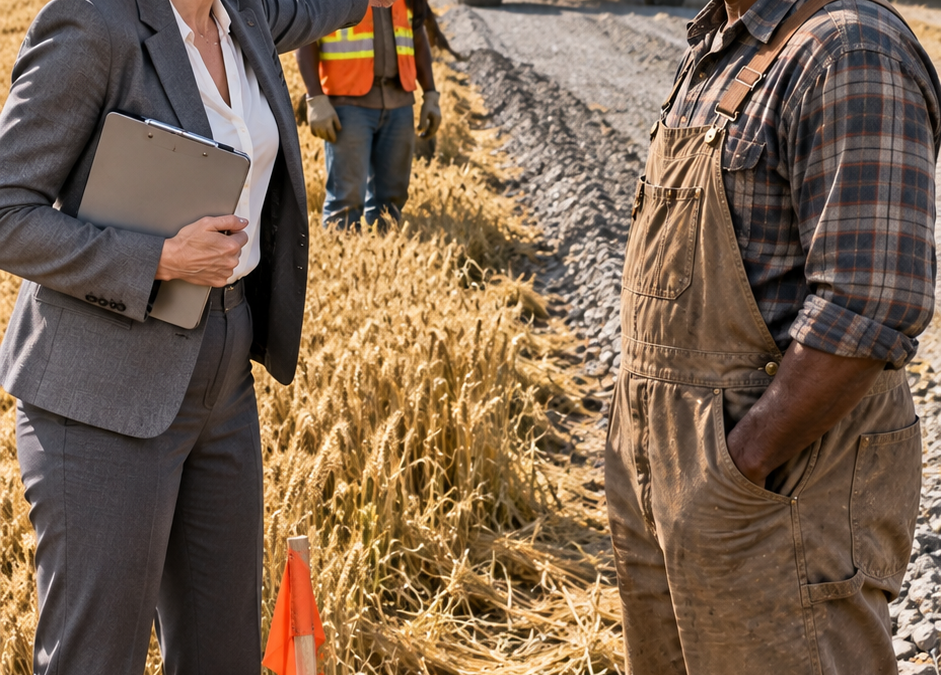
She stood near the fresh gravel in a gray blazer, one orange utility flag pressed into the soil beside her shoe.
Behind her, the new road sliced through my field.
Twelve feet wide.
Nearly two hundred yards long.
The wheat on both sides had been shoved down in broken waves where machinery had entered and turned.
Topsoil lay exposed.
Pale subsoil showed beneath it.
Diesel hung in the morning air beneath the smell of crushed wheat.
I had spent enough years around equipment to recognize what had happened.
A grader.
Probably a skid steer.
At least two dump trucks.
Somebody had planned this.
Somebody had ordered stone.
Somebody had marked a corridor.
And somebody had decided no one needed to ask me.
I looked down at the wheat crushed beneath my boots.
“That’s my crop.”
Diane glanced over her shoulder.
“The association has been granted access for community infrastructure.”
“Granted by whom?”
“The county.”
“To my land?”
She nodded as though the answer were obvious.
“You’ll receive documentation.”
I looked at the orange survey flag.
“Did anyone from the county contact me?”
“That would have been handled during the approval process.”
“Was it?”
Her face changed almost imperceptibly.
Not concern.
Impatience.
“The easement is recorded, Mr. Ree.”
My name is Calvin Ree.
I was fifty-eight years old when this happened, and I had farmed the same ground for thirty-one years.
My father farmed it before me.
His father before him.
The north field Diane was standing in was forty-seven acres of Class II agricultural soil, some of the best ground on my 340-acre farm.
My grandfather, Elias Ree, first planted wheat there in 1954.
Seventy years later, Diane Coulter had just driven a road through it.
And she was explaining to me why that was apparently my problem.
“How wide is this easement supposed to be?” I asked.
“Twelve feet.”
“How long?”
“From the eastern development boundary to County Road Seven.”
“Across this field.”
“Yes.”
“And you’re certain it was legally granted.”
“The instrument is recorded.”
She said that last word carefully.
Recorded.
As though recording a document automatically made every word inside it true.
I had spent too many years managing land to believe that.
“What’s the instrument number?”
She looked at her tablet.
“2021-04471.”
I repeated it once.
Then I took my phone out and typed it into my notes.
Diane watched me.
Something in her posture changed.
Probably because most people argue first.
I did not.
I wanted the number.
Numbers are useful.
So are signatures.
So are dates.
“So what happens now?” I asked.
“The association completes the access road.”
“No.”
Her eyebrows lifted.
“I’m sorry?”
“Nobody comes back onto this field until I see the instrument.”
“The county authorization—”
“I heard you.”
I looked directly at her.
“You’ve already destroyed part of my crop. No one touches another plant until I’ve read what you’re relying on.”
For the first time that morning, her confidence slipped.
Only slightly.
Then it returned.
“You may want to speak with our counsel.”
“I probably will.”
She pulled the orange survey flag from the ground.
I held out my hand.
“Leave that.”
She looked at me.
“It’s evidence now.”
She dropped it.
Then she walked back toward her SUV.
I watched her leave.
For several minutes after the dust settled, I stood beside the road.
The exposed soil bothered me more than the gravel.
People who do not farm tend to see a field as empty ground with plants sitting on top of it.
It is not.
Soil has structure.
Layers.
Drainage.
Compaction.
Organic matter.
Years of amendment and rotation.
You can damage a good field in an afternoon and spend seasons repairing what heavy equipment did in hours.
My grandfather understood that.
Elias Ree bought the original portion of our farm after working six years for another farmer and saving almost everything that did not go toward food or shelter.
He never had much cash.
What he had was patience.
He built the original farmhouse with timber milled from the property.
He dug drainage channels along the north field by hand.
He hauled wet clay in wheelbarrows until water stopped standing there after storms.
Then he planted winter wheat.
At first, yields were poor.
He adjusted.
Added organic matter.
Changed drainage.
Changed rotation.
Kept records.
By the time my father, Raymond, took over, the north field was one of the most productive pieces of ground in the valley.
Dad inherited Elias’s patience.
He also inherited his paperwork.
When Elias died in 1979, every deed was current.
Every tax payment documented.
Every boundary known.
When Dad died in 2004, he left me the same thing.
The deed chain ran back to the original county grant recorded in Book 14, Page 211.
Four generations.
No break.
No dispute.
No easement across the north field.
At least none that I had ever signed.
That was why instrument 2021-04471 interested me so much.
Three days after Diane’s visit, the HOA letter arrived.
Certified mail.
Return receipt requested.
Two pages.
Signed by Diane Coulter, president of the Millhaven Ridge Community Association.
Countersigned by Gregory Foust, the association’s legal counsel.
The letter stated that Millhaven Ridge possessed a valid public access easement across my north parcel under a 2021 infrastructure agreement approved by the county planning commission.
According to them, the road served two purposes.
Secondary emergency access.
Traffic relief.
The development had 312 homes on the hillside east of my farm.
If its primary entrance became blocked during a wildfire or major accident, county planners wanted another exit route.
I understood that goal.
I was not opposed to emergency access.
I was opposed to somebody deciding my land would provide it without asking me.
The letter cited the recorded instrument.
2021-04471.
I drove to the county recorder’s office that afternoon.
Patricia worked the front counter.
She had been there twenty-two years.
When I gave her the number, she typed it into the system.
“Easement.”
“That’s what I’m told.”
She printed four pages.
I stood at the counter and read them.
The instrument was real.
County stamp.
Date.
Recording number.
Signatures from two planning commissioners.
Diane Coulter’s signature for Millhaven Ridge.
Legal description.
Twelve-foot corridor.
Eastern development line to County Road Seven.
Then I reached the parcel number.
APN 1400720003.
I knew it instantly.
My north field.
I kept reading.
Once.
Twice.
Then a third time.
“Patricia.”
She looked up.
“Where’s the landowner signature?”
She came around the counter.
We went through the document together.
Planning commission.
Association.
Notary.
Legal description.
No Calvin Ree.
No Raymond Ree estate.
No Ree family trust.
Nothing.
Patricia looked at me.
“You didn’t sign?”
“No.”
“You didn’t authorize someone?”
“No.”
She frowned.
“Then you need a lawyer.”
“I was thinking the same thing.”
I ordered a certified copy.
On the drive home, I kept thinking about one sentence.
The easement is recorded.
Diane had been correct.
It was recorded.
The problem was that somebody had managed to record an easement affecting private land without the private landowner apparently agreeing to it.
When I reached the farm, I parked beside the new road.
It looked worse in the afternoon light.
Gravel had been compacted into soil that should have been carrying wheat roots.
The tracks from construction equipment had crushed plants beyond the road’s edges.
Orange flags marked a route across the field as if someone had drawn a line through a map and forgotten the ground below the line belonged to a living person.
I went inside.
Third drawer.
Behind property-tax receipts dating back to 1987.
There was the deed.
I took out the entire file.
Then I called Susan Halverson.
Susan practiced agricultural and real-property law forty minutes south of me.
My neighbor Walt Greyber had given me her number years earlier.
She listened while I described the road.
Then the easement.
Then the missing signature.
“They recorded an easement against your parcel without your consent?”
“That’s what I’m looking at.”
“You have the certified instrument?”
“Yes.”
“Bring it.”
“The deed too?”
“Bring everything.”
The next morning, I carried a banker’s box into Susan’s office.
She spent almost two hours going through the documents.
My deed.
The title history.
The easement.
Tax records.
Old surveys.
Then she went back to instrument 2021-04471.
“Calvin, who applied for this?”
“Millhaven Ridge, apparently.”
“Who represented to the county that they had authority over the property?”
“I don’t know.”
“We’re going to find out.”
She tapped the instrument.
“This paper being recorded does not magically create consent.”
“So the easement is invalid?”
“Based on what I’m seeing, it has a serious defect.”
She was careful with words.
Good lawyers usually are.
“Before I say more, I want the entire planning file.”
“What do I do about the road?”
“Nothing.”
I looked at her.
“Nothing?”
“Photograph it.”
That was different.
“Every angle. Every tire track. Every pile of gravel. Every damaged row of wheat. Date the photographs.”
She stood.
“And do not remove their flags.”
“Why?”
“Because I want to know exactly where they intended to go.”
That afternoon, I photographed everything.
I measured the road.
Twelve feet wide in most places.
Wider where machinery turned.
I photographed damaged wheat beside the gravel.
The drainage rut cut by equipment.
The exposed subsoil.
The orange flags.
Then Susan sent the first letter.
Certified.
Three pages.
Addressed to Diane Coulter.
Copy to Gregory Foust.
Copy to the county planning department.
It identified me as the fee-simple owner of APN 1400720003.
It cited the deed.
Then the easement.
Then the missing consent.
Susan demanded that all work stop immediately.
No more grading.
No more stone.
No traffic over the corridor.
She demanded preservation of every document relating to the application.
Emails.
Meeting minutes.
Survey work.
Internal HOA correspondence.
County communications.
Most importantly:
Any purported landowner consent.
“Why emphasize preservation?” I asked.
“Because documents have a way of becoming difficult to locate after litigation starts.”
“You think someone lied?”
“I think someone represented to the county that this project could legally proceed.”
She closed the file.
“I would like to know what that representation was.”
The HOA responded nine days later.
Gregory Foust signed the letter.
He argued that Millhaven Ridge had relied in good faith on a lawfully recorded county instrument.
If I disputed the validity of that instrument, he said, I should address my concerns to the county planning authority.
No acknowledgement of my missing signature.
No explanation.
No apology.
The final paragraph was worse.
Mr. Foust suggested I consider whether “continued opposition to essential community infrastructure improvements” was in my long-term interest as a valley landowner.
I read it twice.
Then called Susan.
“They’re pointing at the county.”
“I know.”
“You sound pleased.”
“I am.”
“Why?”
“Because they’re distancing themselves from the application.”
“Is that good?”
“It can be.”
A week later, we filed suit.
The complaint named Millhaven Ridge Community Association and the relevant county officials in connection with the disputed instrument.
Claims included trespass and damages to the standing crop.
We sought compensation for destroyed wheat, repair of the soil, restoration of the field, survey costs, attorney’s fees where available, and a declaration that the easement could not lawfully burden my property.
Susan also cited the agricultural trespass provisions that could substantially increase damages if the destruction of cultivated crops proved willful or sufficiently culpable.
That got their attention.
Gregory Foust called the next day.
He wanted mediation.
“We consider it?” I asked.
“Yes.”
“We accept?”
“Not yet.”
While lawyers exchanged letters, Susan hired Dale Ostrander.
Dale had surveyed farms in the county for thirty-four years.
He had surveyed my parcel in 1988.
Again in 2003.
When he stepped out of his truck and looked across the north field, he already knew the ground.
“I remember this one.”
“You should.”
“Your dad argued with me about an iron pin for twenty minutes.”
“He argued with everybody about that iron pin.”
Dale smiled.
“Turned out he was right.”
“That sounds like Dad.”
Dale spent two days rerunning the boundary.
New measurements.
Existing monuments.
Historic surveys.
Recorded deed.
Then he mapped the road.
A week later, he unrolled the certified plat across my kitchen table.
Every inch of the road sat on my property.
None of it touched county right-of-way except at its endpoint.
None of it crossed Millhaven Ridge land except where it originated.
Dale pointed to the corridor.
“Twelve feet nominally. Wider in disturbed areas.”
“Any boundary ambiguity?”
“No.”
“Could somebody reasonably have thought this was county property?”
He looked at me.
“No.”
That answer mattered.
Then Susan obtained the planning file.
That mattered more.
She called me on a Wednesday.
“Come down.”
“What did you find?”
“Something you should read yourself.”
At her office, she had documents spread across the conference table.
Application.
Staff report.
Commission minutes.
Emails.
Draft corridor map.
The easement application had been submitted in March 2021.
Applicant:
Millhaven Ridge Community Association.
Prepared through Gregory Foust.
The parcel number was correct.
The route was correct.
My property had not been mistaken for someone else’s.
They had intentionally sought access across APN 1400720003.
Then Susan handed me the staff report.
I read until I reached one sentence.
Applicant has represented that all necessary landowner consents have been obtained and are on file with applicant.
I looked up.
“Where are they?”
Susan did not answer immediately.
Then she slid the rest of the file toward me.
“No consent.”
“Nothing?”
“No signed agreement.”
“No letter?”
“No.”
“Email?”
“No.”
“Phone memo?”
“No.”
I looked back at the sentence.
“So somebody told the county I had agreed.”
“Somebody represented that the necessary consents existed.”
“I never agreed.”
“I know.”
“And the county never checked.”
“Apparently not.”
The commissioners approved the easement in April 2021.
Their staff had been told landowner consents were already secured.
No reason appeared in the minutes for them to suspect otherwise.
No one contacted me.
No one sent me notice.
No one asked me to attend.
A representation was made.
The county relied on it.
Three years later, graders arrived.
That sentence in the staff report was the hinge.
Without it, the rest of the project had no support.
Susan amended our complaint.
She added allegations based on the false or unsupported representation that landowner consent had been obtained.
Gregory Foust was now dealing not merely with a disagreement over an easement.
He was dealing with his role in obtaining it.
His tone changed.
The first mediation request had been formal.
The next call was urgent.
Then Walt Greyber showed up.
Walt lived south of me.
Retired county engineer.
Thirty years of public infrastructure work.
He stood beside the road with both hands clasped behind his back.
“Ugly.”
“That’s one word.”
He walked a little farther.
“You said the easement was approved in April 2021?”
“Yes.”
He stopped.
“I was at that meeting.”
I turned.
“You remember this?”
“I remember the corridor.”
“Why?”
“Because the route struck me as odd.”
“Did they discuss landowner consent?”
He stared across the field.
“Not that I recall.”
Then he looked at me.
“I took notes.”
Of course he had.
Walt Greyber took notes about rain gauges.
Two days later, he handed me a spiral notebook.
April 2021.
There it was.
Millhaven Ridge Access Corridor — APN 1400720003 — approved on consent representation — no independent verification noted — no landowner present.
Susan read the line twice.
“You wrote this that day?”
“Yes.”
“Not recently?”
Walt looked offended.
“My notes are dated.”
“I had to ask.”
He nodded.
“Fair.”
He signed an affidavit authenticating the notes.
Our file was becoming difficult to explain away.
Deed.
Survey.
Crop photographs.
Easement.
Planning application.
Staff report.
No consent.
Meeting notes.
The evidence all pointed in the same direction.
Then came mediation.
By then months had passed since the road appeared.
Late autumn covered the valley.
The wheat field had changed color around the gravel corridor.
The damaged strip had compacted under weather.
The road remained unusable because Susan had obtained an agreement preventing further work while the case proceeded.
We met in a courthouse annex conference room.
Diane was there.
Gray blazer.
Tablet.
Gregory Foust beside her.
He looked different from the man whose letter had advised me to consider my long-term interests.
More tired.
More careful.
Our mediator was Harold Vane, a retired district judge with white hair and a habit of letting silence do work for him.
Gregory spoke first.
Good-faith reliance.
Recorded instrument.
County approval.
Public-safety purpose.
No malicious intent.
Harold listened.
Then Susan spoke.
She did not make a speech.
She laid paper on the table.
My deed.
Dale Ostrander’s survey.
Instrument 2021-04471.
The easement application.
Planning staff report.
The sentence about consent.
The absence of consent.
Walt’s contemporaneous meeting notes.
Then photographs of the wheat field.
One after another.
When she finished, Harold Vane looked toward Gregory.
“Where is the landowner consent?”
Gregory adjusted a folder.
“The association believed consent had been obtained through prior discussions connected with infrastructure planning.”
“Where is the documentation?”
“There may not be a written record of the specific exchange.”
Harold waited.
Gregory said nothing more.
The mediator picked up the staff report.
“This states that consents were obtained and on file with the applicant.”
“Yes.”
“Are they?”
“No written consent has been located.”
“Did Mr. Ree sign anything?”
“No.”
“Authorize anyone to sign?”
“Not that the current record demonstrates.”
Harold set the paper down.
The room became very quiet.
Then he looked at me.
“Mr. Ree, were you ever approached about this easement before the road was built?”
“No.”
“Ever paid for it?”
“No.”
“Offered compensation?”
“No.”
“Receive notice?”
“No.”
“Give verbal consent?”
“No.”
Diane finally spoke.
“The infrastructure agreement was approved years ago. We were told everything had been handled.”
Harold turned toward her.
“By whom?”
She looked at Gregory.
That moment told me almost everything I needed to know.
We broke for separate sessions.
Susan and I sat in a smaller room.
“What do you want?” she asked.
“My land back.”
“You have it.”
“No. I have gravel in it.”
She nodded.
“Then restoration.”
“Complete restoration.”
“Damages?”
“Whatever the crop loss actually is.”
“Fees?”
“Yes.”
She waited.
“And enhanced damages?”
I thought about that.
The statute gave us leverage.
Potentially substantial leverage.
But I was not trying to destroy an association of 312 homeowners because its leadership had created a mess.
I wanted the false easement removed.
I wanted the soil restored.
I wanted my crop loss covered.
I wanted my legal expenses paid.
And I wanted the public record corrected so nobody could repeat the claim twenty years later.
“Keep the enhanced-damages claim in reserve.”
“You don’t want to demand it?”
“Not if they fix everything else.”
Susan studied me.
“You’re sure?”
“Yes.”
She closed her notebook.
“Then that’s what we do.”
Our settlement position was straightforward.
First, instrument 2021-04471 had to be formally vacated or otherwise corrected so it no longer burdened my title.
Second, Millhaven Ridge would remove every yard of gravel and restore the corridor.
Topsoil replacement.
Proper depth.
Compaction remediation.
Drainage restoration.
Reseeding using the same hard red winter wheat variety.
Third, the association would compensate me for the lost crop using county yield data and commodity prices.
Fourth, they would reimburse survey costs and attorney’s fees.
Fifth, the settlement would make clear that no future access rights existed unless I personally granted them through a lawful recorded instrument.
The mediator left.
Twenty minutes later, Susan returned.
“They’ll do it.”
“All of it?”
“Mostly.”
“What’s the problem?”
“Release language.”
“That’s expected.”
“They want the allegations concerning the consent representation resolved as part of the settlement.”
“And your view?”
“We have a strong record.”
She paused.
“But trial adds expense and probably another year. If your objective is correction rather than punishment, this gets you correction.”
I looked through the window.
Bare fields stretched beyond the courthouse.
My grandfather had believed farming taught a man when to push and when to stop.
There is a difference between winning and continuing to fight because you enjoy winning.
“All right.”
The settlement was drafted over the following weeks.
Eleven pages.
Instrument 2021-04471 would be vacated.
The roadway would be removed.
Restoration would be performed by a licensed contractor acceptable to me.
Minimum topsoil depth.
Soil-conditioning requirements.
Seed rate.
Drainage.
Crop-loss compensation based on documented acreage and county agricultural-extension yield data.
The crop damages came to $14,240.
My legal and survey costs were reimbursed separately.
It was not millions.
I did not need it to be.
The real value was the land.
The easement disappeared.
The road disappeared.
The title stayed clean.
And the association paid the cost of putting my farm back the way they found it.
I signed last.
Same hand.
Steady.
The road had existed because somebody wrote down that consent had been obtained.
Now another document corrected the damage created by that sentence.
There was something fitting about that.
Diane signed for the association.
Gregory signed where required.
Susan closed the file.
Harold Vane looked around the table.
“Then we’re finished.”
We were.
At least legally.
I later heard that Diane stepped down from the HOA presidency after a special board meeting.
Gregory Foust stopped representing the association not long afterward.
I never asked for details.
The county changed its procedures too.
Future easements affecting private land required independent verification of landowner consent before approval.
Susan told me that part with more satisfaction than anything else.
“That’s the useful result,” she said.
“How so?”
“This cannot happen the same way again.”
She was right.
The restoration crew arrived in November.
I met the contractor at the field.
He was careful.
That mattered.
First, they removed the gravel.
Not pushed aside.
Removed.
Then they loosened the compacted soil.
Restored drainage.
Brought in certified agricultural topsoil.
Eight inches minimum across the corridor.
More where grading had cut deeper.
We checked levels.
Then the seedbed was prepared.
Hard red winter wheat.
Same variety.
Same agronomic rate I would have used myself.
On the final afternoon, I walked the full corridor with the contractor.
Where the gravel road had been, there was dark soil.
No flags.
No stone.
No tire ruts.
Just a long seeded strip waiting for weather.
“You satisfied?” he asked.
“I will be in April.”
He understood.
Farmers do not judge restoration on the day dirt is moved.
We judge it when something grows.
Winter came.
Snow covered the field.
The case file went into my office.
Third drawer.
Behind the tax receipts.
Deed.
Survey.
Old title records.
Then the new documents.
Disputed easement.
Planning file.
Settlement.
Vacating instrument.
One complete history.
Every so often during winter, I looked across the north field and wondered whether the restored strip would show.
It probably would at first.
Soil remembers disturbance.
Then March softened the ground.
April came.
One morning, I walked into the north field before breakfast.
The wheat had emerged across all forty-seven acres.
Dense.
Green.
Even.
I followed the old road line from east to west.
At first I could still tell where it had been because I knew exactly where to look.
Then I walked farther.
The difference became harder to see.
Another fifty yards.
Harder still.
By the time I reached the center, the restored corridor was disappearing into the field.
Green wheat on both sides.
Green wheat beneath my boots.
Rows running straight.
Exactly as they should.
I stopped.
The morning was cold enough that my breath showed.
Sunlight moved low across the wheat.
For a moment I thought about Elias.
He first planted this field in 1954.
The soil had not been what he wanted.
So he worked.
Drainage.
Rotation.
Organic matter.
Time.
My father continued it.
Then me.
Almost seventy years of accumulated labor.
That was the part Diane could not see when she stood beside the new gravel road asking whether I planned to use the field that season.
She saw acreage.
A line on an infrastructure plan.
A place to run twelve feet of road.
I saw my grandfather carrying clay in a wheelbarrow.
My father repairing tile drainage after a storm.
My own children riding beside me in a tractor cab.
Forty-seven acres is not just forty-seven acres after enough years.
It becomes memory arranged geographically.
That was why the missing signature mattered so much.
Not because my name carries some special weight.
Because consent is the line between infrastructure and taking.
Between agreement and trespass.
Between somebody negotiating for your land and simply deciding your land is available.
Millhaven Ridge needed secondary emergency access.
That was legitimate.
They could have approached me.
We could have discussed an easement.
Location.
Compensation.
Drainage.
Crop protection.
Emergency-only restrictions.
Maintenance.
Perhaps I would have agreed.
Perhaps I would have proposed another route.
We will never know.
They skipped that part.
Somebody told the county the necessary consent existed.
The county relied on it.
The document was recorded.
Then years later Diane arrived with heavy equipment and certainty.
That certainty was expensive.
Not because I waited six months plotting how to make them pay.
I did not.
I waited because records take time.
Surveys take time.
Public-record requests take time.
Litigation takes time.
Mediation takes time.
Restoring a field takes time.
The six months were not revenge.
They were documentation.
The thing about land disputes is that emotion moves faster than proof.
The smartest thing I did during the entire matter was refuse to run at the speed of my anger.
I photographed.
I obtained the instrument.
I read it.
I found the missing signature.
Susan obtained the planning file.
Dale surveyed the ground.
Walt produced his notes.
Then we put everything in order.
That order mattered.
One document alone might have been argued around.
Together, they became difficult to escape.
The deed said I owned the field.
The survey said the road was entirely inside it.
The easement contained no landowner consent.
The planning report said consent supposedly existed.
The file contained none.
Walt’s notes showed the commission approved the corridor based on that representation.
The physical road showed the consequence.
Once those facts were lined up, nobody needed to shout.
The paper did the shouting.
Later that spring, Walt came by.
We walked into the wheat.
He looked down.
“Can’t see it.”
“You know where to look.”
“I do.”
He walked another twenty feet.
“Still difficult.”
“That’s good.”
He stopped.
“You ever think about letting them build another access route?”
I smiled.
“If they ask.”
“That would be a first.”
“It would.”
He laughed.
Then became serious.
“You know what bothers me?”
“What?”
“The commission approved it because somebody wrote one sentence saying consent existed.”
“I know.”
“We used to require signatures in the file.”
“Apparently they do again.”
He nodded.
“Good.”
We stood quietly.
The wheat moved around our knees.
Then Walt said, “Your grandfather would’ve hated that road.”
“He hated people driving across fields even when they had permission.”
“That sounds right.”
By harvest, the restored corridor yielded slightly below the undisturbed ground.
Not dramatically.
Enough that I noticed.
The following year, the difference narrowed.
Soil heals slowly.
But it heals if you treat it properly.
I kept the orange flag Diane had pushed into my field.
Not on display.
I am not sentimental about things like that.
It sits in the same file cabinet.
Bent wire.
Small piece of faded plastic.
No legal value.
No monetary value.
But sometimes when I open that drawer looking for another document, I see it.
And I remember that morning.
“You’re not going to be using that field this season anyway, are you?”
There was a whole worldview inside that sentence.
Someone had already decided what my land was for.
Someone had decided their need outweighed my ownership.
Someone had decided documentation could come afterward.
That is how overreach usually begins.
Not with villains laughing behind closed doors.
With assumptions.
Then those assumptions become internal memos.
Then applications.
Then recorded instruments.
Then orange flags.
Then graders.
By the time the landowner sees the machinery, everybody involved believes the question was settled months ago.
That is why records matter.
If I had looked at the road and believed Diane simply because she said the county had approved it, that gravel might still be there.
If I had assumed a recorded easement must be valid because it had an instrument number, I might have lost permanent control of a strip through the center of one of my best fields.
Instead, I asked for the document.
Then I read it.
One missing signature.
That was the beginning.
The more important discovery came later.
The county had not simply forgotten to attach my consent.
The application process had moved forward on the representation that consent had already been obtained.
Those are two very different things.
And when the paper trail finally reached the mediation table, even Diane stopped talking about how certain the HOA had been.
Certainty had ceased to matter.
One afternoon after harvest, I climbed into the old grain bin my grandfather built in 1963.
The corrugated steel has gone brown with age.
It should probably have been replaced years ago.
I keep repairing it instead.
Some things earn the right to remain.
From the top platform, I could see most of the north parcel.
No road.
No orange flags.
No gravel.
Only stubble after harvest and the long field stretching toward County Road Seven.
Millhaven Ridge remained on the eastern hillside.
Three hundred twelve houses.
Community center.
Streets.
Families.
Nothing wrong with any of it.
Their land.
Their association.
Their needs.
My land.
My consent.
That distinction was the entire case.
I never hated Diane Coulter.
I never hated the homeowners.
Most of them probably had no idea how that easement was obtained.
Many simply wanted a safe secondary exit from their neighborhood.
I understood that.
The mistake was believing a good objective excused a bad process.
It does not.
You do not protect one group’s safety by quietly deleting another person’s property rights.
You negotiate.
You document.
You compensate.
You record.
In that order.
My grandfather would have understood that without knowing a thing about modern planning commissions.
He spent six years earning enough money to buy ground.
He understood consent.
He understood ownership.
Most importantly, he understood that paperwork was not some separate bureaucratic world floating above the land.
Paper describes the land.
Paper defines what people may do with it.
A deed in a drawer is not symbolic.
A survey pin is not decorative.
A signature is not a technical inconvenience.
They are the structure beneath everything else.
The following spring, I planted soybeans in the north parcel as part of the rotation.
By July, the road line was effectively invisible.
I stood there one evening, trying to find it from memory.
I could approximate it.
Twelve feet wide.
Running east to west.
Two hundred yards.
But the crop no longer cared.
Neither did the field.
That was the ending I wanted.
Not millions.
Not Diane ruined.
Not an HOA destroyed.
A field restored.
A false easement removed.
My legal costs reimbursed.
The crop damage paid.
And a county process changed so the next farmer would not discover an access road after the grader arrived.
Sometimes the most complete victory is not taking everything the law might allow you to take.
Sometimes it is getting back exactly what should never have been taken from you.
That evening, I walked the northern boundary until the sun dropped behind the valley.
The iron survey pins Dale had set were still there.
The deed remained in the third drawer.
Book 14.
Page 211.
Same chain.
Same property.
Same answer it had given from the beginning.
The road had looked permanent when Diane stood beside it.
Gravel has that quality.
It makes people think something has been settled.
But the road had never been the strongest thing on that field.
The strongest thing was the record beneath it.
And once we finally read that record carefully enough, the gravel was the part that disappeared.








