𝗣𝗔𝗥𝗧 𝟮 HOA BROKE INTO MY WAREHOUSE—THEN U.S. MARSHALS ASKED WHY THEIR COMMANDER WAS BEING DETAINED
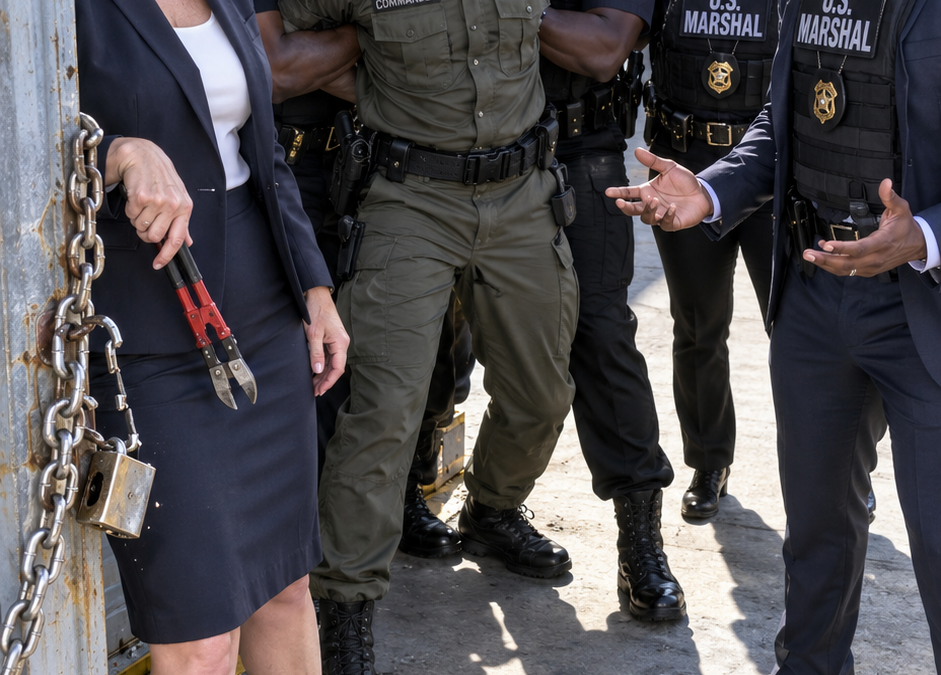
𝗣𝗔𝗥𝗧 𝟮
A man in a dark tactical-style uniform intercepted me before I reached the loading dock.
He was broad through the shoulders, maybe forty-five, with the rigid posture of someone used to being obeyed.
His shirt read KEANE SECURITY SOLUTIONS.
“Sir, this property is temporarily restricted.”
I looked past him.
A forklift was moving pallets inside my building.
“Restricted by whom?”
“Brierstone Estates.”
“No.”
He blinked.
“Excuse me?”
“My name is Gideon Sloan.”
His expression shifted slightly.
I watched recognition arrive.
“You’re the former owner.”
“No.”
That answer bothered him.
He reached into his jacket and unfolded a document.
“We’ve been provided an emergency possession authorization.”
I took the paper.
No court caption.
No recorded instrument number.
No county stamp.
No judicial signature.
Nothing from me.
The document simply declared that Brierstone Estates had assumed emergency operational possession of the site pending completion of an acquisition process.
It was bureaucratic theater.
“What court issued this?”
“It’s an association document.”
“So no court.”
“It authorizes us to secure the site.”
“No, it doesn’t.”
I handed it back.
“This piece of paper does not give you authority to cut my lock.”
His confidence weakened.
Then I heard heels striking concrete.
Marissa Caldwell came through my open bay door carrying a leather folder.
She wore a pale gray coat and the expression of a woman arriving at a meeting she believed she had already won.
“Mr. Sloan.”
“Marissa.”
“You’re trespassing.”
I looked around.
At my warehouse.
At my loading dock.
At my fence.
Then back at her.
“Try that again.”
“This property is under Brierstone control.”
“No.”
“You were notified repeatedly.”
“Yes. You repeatedly sent me demands you had no legal authority to make.”
“Those communications constituted notice.”
“Notice of what?”
“That the association was proceeding.”
“Proceeding to do what?”
She stepped closer.
“Acquire the facility.”
“You never acquired it.”
“That is a matter for attorneys.”
“My attorney told you twice that I wasn’t selling.”
“You refused reasonable cooperation.”
“Correct.”
Her mouth tightened.
The simplicity of the answer irritated her.
Behind Marissa, two people were going through my office.
One had a drawer open.
Another was carrying file boxes.
Farther back, near a reinforced steel records-room door, a worker had a crowbar.
I pointed.
“Stop him.”
Marissa looked over her shoulder.
“No.”
“That room is locked.”
“We’re taking inventory.”
“You are not opening it.”
“Anything inside an association-controlled facility is subject to review.”
I walked toward the door.
The security manager moved with me.
I stopped.
“Your name?”
“Trevor Haynes.”
“Trevor, nobody touches that door.”
Marissa laughed softly.
“You’re giving orders to my security team?”
“I’m giving notice to a man standing inside my building that he is participating in an unlawful entry.”
Trevor looked toward her.
That glance mattered.
It meant he was beginning to understand that whatever Marissa had told him before arriving did not line up cleanly with reality.
Marissa stepped between us.
“Mr. Sloan, you need to leave.”
“Call the police.”
That surprised her.
Only briefly.
Then she smiled.
“I already intended to.”
“Good.”
Her willingness to invite law enforcement told me something important.
Marissa did not believe she was improvising.
She thought she had documentation strong enough to survive scrutiny.
That made the situation more interesting.
Six weeks earlier, she had stood in front of Brierstone residents and presented what she called the Community Operations Expansion.
I knew about the meeting because several homeowners had contacted Everett afterward.
Marissa showed architectural renderings of my warehouse converted into a maintenance center, event hall, and parking facility.
She told residents the association had “secured the site.”
Not hoped to secure it.
Not entered negotiations.
Secured it.
Then the board approved a $4,800 special assessment.
More than $640,000 was collected.
That was the pressure Marissa had created for herself.
If she admitted the warehouse was never hers, she would have to explain why hundreds of families had been charged for renovations on a building whose owner had never agreed to sell.
I walked toward my office.
My laptop was gone.
“Where is my computer?”
Nobody answered.
A rear hallway camera had been unplugged and turned toward the wall.
I pointed at it.
“Who did that?”
Marissa said, “The association is securing sensitive areas.”
“Leave.”
“We’re not leaving.”
“I’m instructing every person here to leave my property.”
“You don’t have possession.”
“I have the deed.”
“We have an active acquisition.”
“No, you have a fantasy.”
Her face hardened.
My phone buzzed.
A message appeared.
ETA 25 MIN — DAMON
I had contacted Damon Kesler before leaving my truck.
Not because I needed federal backup in an HOA dispute.
I had been scheduled to meet him that morning.
When I told him I had walked into a break-in at my warehouse and might be delayed, he decided to come to me.
Marissa noticed the message.
“Who are you calling?”
“Someone I work with.”
“Give me the phone.”
“No.”
She looked at Trevor.
“Take it.”
I lowered my voice.
“Don’t.”
Trevor hesitated.
Marissa mistook that hesitation for weakness.
“Take his phone.”
Trevor stepped forward.
I did not move.
He reached into my jacket pocket and removed it.
“I do not consent to that.”
Marissa folded her arms.
“You’re obstructing association operations.”
“This is not an association facility.”
“You keep saying that.”
“Because it remains true.”
She turned toward the records room.
“Open it.”
Trevor shook his head.
“My people secure property. We don’t break safes or locked interior rooms.”
“It isn’t a safe.”
“It belongs to him.”
Marissa looked at him sharply.
“The association is paying your company tens of thousands of dollars for this project.”
Trevor’s jaw tightened.
That was the leverage.
Money.
Marissa turned toward one of the renovation workers.
“Open it.”
The crowbar went between the steel door and frame.
I spoke loudly enough for every functioning camera in the warehouse to hear.
“Marissa, that room contains documents connected to active litigation between me and Brierstone Estates. Your counsel has been told those materials are protected and must not be disturbed.”
She smiled.
“Then we definitely need to see them.”
That response would matter later.
The worker pulled.
Metal groaned.
The lock gave.
The door opened.
Inside were shelves of property records, insurance files, old business documents, security-camera backups, and the correspondence Everett had exchanged with Brierstone.
Nothing federal.
Nothing classified.
Nothing connected to my work.
I never stored Marshals Service material there.
Marissa apparently expected something very different.
Her eyes swept the shelves.
Then she saw a file box labeled:
BRIERSTONE ACCESS CORRESPONDENCE
She grabbed it.
“You shouldn’t touch that.”
“This concerns association property.”
“It concerns your repeated attempts to obtain rights you don’t have.”
She opened the file.
The first folder contained Everett’s letters.
The second contained certified surveys.
The third contained emails.
Marissa flipped through them quickly.
Then stopped.
I knew exactly which email she had found.
Three months earlier, Everett had sent her an updated boundary survey.
The message was direct.
The recorded Brierstone Estates boundary terminates approximately 397 feet east of Mr. Sloan’s warehouse parcel. No HOA ownership interest, access right, or possessory interest exists.
The email receipt showed Marissa had opened it.
Twice.
She stared at the page.
“You received that.”
She said nothing.
“You knew.”
“This survey is disputed.”
“No, it isn’t.”
“Our consultant had a different interpretation.”
“What consultant?”
She ignored me.
Then she slid several pages away from the others.
“Put those down.”
“These are association documents.”
“No. They’re copies from my attorney.”
“They involve Brierstone.”
“That doesn’t make them yours.”
I looked at Trevor.
“You need to decide whether you want to keep participating in this.”
He glanced at Marissa.
Then at the open steel door.
His confidence from twenty minutes earlier was disappearing.
A sedan entered the gate.
A man climbed out.
Parker Ellison.
Brierstone vice president.
He looked at the cut padlock lying in the gravel.
Then at the sign.
Then at the people inside.
He walked toward Marissa.
“What happened?”
“We took possession.”
Parker stared at her.
“Where’s the purchase agreement?”
Marissa grabbed his elbow.
“Not here.”
“No, Marissa. Where is it?”
“Lower your voice.”
“You told the board it was signed.”
“We have possession documentation.”
“That isn’t what I asked.”
I watched Parker’s face.
This was new information to him.
“You told us Sloan had agreed.”
Marissa leaned closer.
“He effectively did.”
“How do you effectively sell a warehouse?”
“Parker.”
“Where is his signature?”
“Stop.”
That exchange explained more than anything Marissa had said to me.
The board had never seen a legitimate acquisition agreement because there was none.
Parker stepped away.
“I’m calling counsel.”
Marissa blocked him.
“No one leaves until the police arrive.”
I looked at her.
“You’re preventing him from leaving too?”
“I’m preserving the scene.”
I started toward the gate.
Marissa stepped in front of me.
“You’re staying.”
“No.”
“The police need to speak with everyone.”
“I’ll speak with them when they arrive.”
“You are not leaving.”
“You do not have authority to detain me.”
She turned.
“Trevor.”
He did not move immediately.
“Hold him.”
Trevor swallowed.
“Marissa…”
“Your contract depends on this project.”
There it was again.
He and another guard approached me.
I allowed them to guide me toward the loading dock wall.
I did not struggle.
“I am asking to leave.”
Marissa held up her phone and began recording.
“This is Gideon Sloan attempting to interfere with lawful HOA possession—”
I looked directly into her camera.
“This is Gideon Sloan, owner of the property, stating that I am being prevented from leaving my own warehouse after unauthorized individuals cut my gate lock and entered the building.”
She lowered the phone slightly.
“You stormed into an HOA facility.”
“I drove to my warehouse.”
“What do you even do, Mr. Sloan?”
“Federal service.”
She laughed.
“What does that mean? Postal inspector?”
I said nothing.
My position did not matter.
The deed mattered.
The survey mattered.
The broken lock mattered.
Then one of the guards searched my jacket.
I turned my head.
“I do not consent to a search.”
He found the credential case.
Trevor opened it.
Everything changed in his face.
I watched his eyes move across the seal.
UNITED STATES MARSHALS SERVICE
He looked up at me.
“Sir…”
“Close it.”
He did.
Marissa snatched it from his hand.
“What is this?”
“You can read.”
She opened it.
Badge.
Photograph.
Name.
Title.
Her face went still.
Two seconds.
Then her survival instinct took over.
“These could be fake.”
Parker stared at her.
“Marissa.”
“We don’t know.”
“Give them back.”
“No.”
“Those are federal credentials.”
“If they’re genuine, police can confirm that.”
She took my service phone from Trevor too.
Then walked to the portable office trailer near the gate.
She locked both items inside.
I looked at Trevor.
“Remember exactly who instructed you to confiscate those.”
He took a step away from me.
For the first time, he wanted distance.
Then engines sounded outside.
Marissa straightened her coat.
“Finally.”
She believed local police were arriving.
The first vehicle through the gate was black.
So was the second.
And the third.
No municipal markings.
No patrol light bar.
They stopped in formation.
Damon Kesler stepped out first.
Behind him came Paige Sterling and several members of our fugitive-task-force team.
Damon surveyed the scene.
Cut lock.
HOA sign.
Open warehouse.
Private security.
Then me.
Two guards standing close enough to make it obvious I was not free to leave.
His expression changed.
Paige moved first.
“Is Commander Sloan being detained?”
Trevor opened his mouth.
Nothing came out.
Marissa stepped forward.
“He’s being temporarily held because he trespassed on HOA-controlled property.”
Damon slowly turned toward her.
Then back toward me.
“Gideon?”
“I’m fine.”
He looked at Trevor.
Then Marissa.
“Ma’am.”
“Yes?”
“Why are you detaining our task force commander?”
The silence afterward was remarkable.
Parker closed his eyes.
Trevor looked at the ground.
Marissa stared at Damon.
“Task force commander?”
“Yes.”
“This is clearly a misunderstanding.”
“No,” I said.
Everybody looked at me.
“You cut my lock.”
Marissa’s face tightened.
“You entered my warehouse.”
“Gideon—”
“You removed property from my office.”
“This is not—”
“You opened a locked litigation-records room after I warned you not to.”
Her mouth closed.
“You confiscated my phone.”
I looked toward the trailer.
“You confiscated federal credentials and a government device.”
Damon looked sharply at her.
“You have his credentials?”
Marissa said quickly, “We secured what we believed might be fraudulent identification.”
“Where?”
“Safe location.”
I answered.
“Locked inside her trailer.”
Paige moved toward it.
“Stop.”
Everyone turned toward me.
Paige frowned.
“Commander?”
“We do this correctly.”
“They have federal property.”
“I know.”
Damon understood before Paige did.
“This is still his private warehouse.”
“Exactly.”
I looked at my team.
“No search.”
Marissa stared at me.
“No seizure of HOA documents. Nobody opens the trailer. Nobody uses federal authority to resolve the property dispute.”
Damon nodded.
“What do you want?”
“Local law enforcement.”
“For what?”
“Possible burglary. Property damage. Theft or unlawful retention of property. Unlawful detention.”
I looked at Trevor.
“Whatever else the facts support.”
Paige took out her phone.
That decision mattered more than Marissa understood.
If I had used six federal officers to take control of the scene, she could later claim I had weaponized my position to win a civil dispute.
I would not give her that defense.
When Detective Russell Cade arrived, I identified myself first as the property owner.
Not as a commander.
“Do you want to file a complaint?” he asked.
“Yes.”
“In what capacity?”
“Private citizen and owner of this parcel.”
He looked toward the black SUVs.
“And the federal officers?”
“Coworkers who arrived because I had a scheduled operational meeting and stopped responding.”
That was true.
“Are they involved in the property dispute?”
“No.”
“Good.”
Everett arrived eleven minutes later carrying a briefcase and an expression I had seen exactly twice before.
It meant somebody had done something very stupid while he was on his way.
He walked straight to me.
“You okay?”
“Yes.”
“They detained you?”
“Yes.”
He looked at Marissa.
She looked away.
Then Everett opened his case.
Certified deed.
Certified survey.
Title report.
Correspondence.
He handed them to Detective Cade.
Marissa produced her emergency possession authorization.
Cade passed it to Everett.
Everett read it once.
Then again.
“Who signed this on Mr. Sloan’s behalf?”
Marissa pointed.
A signature appeared at the bottom.
G. Sloan
I leaned closer.
“That isn’t mine.”
Marissa spoke quickly.
“Our acquisition consultant obtained it.”
Parker stepped forward.
“What acquisition consultant?”
Marissa turned.
“Parker, not now.”
“No. Right now.”
Cade looked at him.
“You’re the vice president?”
“Yes.”
“Did the board hire an acquisition consultant?”
“Not that I know of.”
Marissa said, “The president has discretionary authority.”
“Not for this.”
“You approved the project.”
“I approved a project after you told us the property had already been secured.”
Marissa’s face flushed.
Cade looked back at the document.
“Ms. Caldwell, what is the consultant’s name?”
She gave him one.
It was a company I had never heard of.
Trevor quietly approached the detective.
“I have something.”
Marissa snapped, “Trevor.”
He ignored her.
His phone contained emails from Marissa.
One read:
OWNER WILL OBJECT. MAINTAIN POSSESSION UNTIL POLICE VALIDATE HOA CONTROL.
Everett read it over Cade’s shoulder.
Then looked at me.
That sentence was devastating.
Cade asked the obvious question.
“If you believed Mr. Sloan voluntarily transferred possession, why were you expecting him to object?”
Marissa took a breath.
“Because he’s been difficult throughout the process.”
“Did he sign an agreement?”
“The consultant said he did.”
“Did you personally witness him sign?”
“No.”
“Did you speak with him about signing?”
“We communicated repeatedly.”
I answered.
“Through my attorney.”
Everett nodded.
“And every communication said no.”
Cade asked Marissa for the original acquisition file.
She claimed it was with counsel.
Everett laid the certified survey across the hood of my truck.
Brierstone’s boundary was impossible to misunderstand.
My warehouse was nearly four hundred feet beyond it.
The only recorded interest anywhere nearby was a narrow utility easement.
No parking rights.
No right of possession.
No right to station security guards.
No right to store equipment.
No access to the building.
Nothing.
Marissa blamed an older survey.
Everett pulled out another document.
“This is the updated survey I sent Ms. Caldwell three months ago.”
Cade checked the email confirmation.
“She opened it?”
“Twice.”
Marissa stared at Everett.
“You had no right to track that.”
“It was a standard digital receipt.”
Parker rubbed both hands over his face.
Then he looked at Marissa.
“You told us he folded.”
She said nothing.
“You literally said, ‘Sloan finally folded.’”
“I meant his legal position was weakening.”
“No, you didn’t.”
“Parker—”
“You let us collect $4,800 from every household.”
The detective looked up.
“How much money?”
Parker hesitated.
“More than six hundred forty thousand dollars.”
“For this warehouse?”
“For the community operations expansion.”
“On property the HOA did not own?”
“I believed it did.”
Marissa interrupted.
“It was in the final stages of acquisition.”
Everett almost smiled.
“You cannot be in the final stages of acquiring something when the owner has never agreed to sell.”
Then I noticed the boxes.
Earlier I assumed the pallets entering my warehouse contained renovation supplies.
Many did.
But several boxes had labels.
BOARD MINUTES — PRIOR YEARS
FINANCIAL RECORDS
BANKING
VENDOR FILES
I pointed.
“Russell.”
Detective Cade followed my gaze.
“Those weren’t here yesterday.”
Marissa said, “They’re association property.”
“I know.”
“Then they’re irrelevant.”
“No.”
I walked closer without touching them.
“Why are years of HOA financial files being moved into a warehouse you supposedly acquired as a maintenance facility?”
Nobody answered.
Parker’s expression changed.
“What are those doing here?”
Marissa said, “Temporary storage.”
“We have storage at the clubhouse.”
“It was being reorganized.”
“When?”
“Today.”
“Who approved moving financial records?”
“I did.”
“Why?”
“Because I’m president.”
Cade raised one hand.
“Do not move those boxes.”
Marissa looked furious.
“They belong to Brierstone.”
“And they are now evidence potentially connected to this incident. They stay exactly where they are until I understand why they’re here.”
That was the first moment the warehouse dispute became something bigger.
Because if Marissa’s only purpose had been to seize a building, bringing years of financial records with her made no sense.
Unless she wanted them out of the clubhouse.
Over the following weeks, the reason became clear.
The $640,000 special assessment did not reconcile.
Not even close.
The forensic accountant eventually assigned to the case found large payments made without proper board votes.
A contractor received a $185,000 deposit despite never beginning work.
A consulting firm received nearly $70,000 for vaguely defined “project coordination.”
Another company received a large acquisition-related payment despite having no clear role in any legitimate purchase.
That company traced back to a longtime business associate of Marissa’s.
The connection predated the warehouse project.
Then investigators found something even worse.
The alleged acquisition agreement carrying my forged signature was dated before Marissa ever publicly claimed negotiations with me had concluded.
The document had been created to make an agreement appear to exist.
Parker began reviewing old meeting records.
What he found nearly ended whatever loyalty he still felt toward Marissa.
An original draft of board minutes contained his objection to collecting assessment money before my warehouse had been purchased.
The official version did not.
His objection had been deleted.
Digital metadata showed the edited version had been saved through Marissa’s account.
Other minutes had been changed too.
Language softened.
Objections disappeared.
Votes appeared more unanimous than they had actually been.
The picture became clearer.
Marissa had never intended to persuade me through an ordinary transaction.
Her strategy was effectively:
Take possession first.
Create physical control.
Start renovations.
Move association property inside.
Present the facility as already operational.
Then force me to choose between an expensive legal fight and selling.
She expected reality to follow appearance.
Once the warehouse looked like Brierstone’s, she believed people would eventually treat it as Brierstone’s.
That morning was supposed to create the point of no return.
Instead, I arrived early.
Then my federal colleagues arrived before she finished setting the stage.
Trevor became one of the most useful witnesses.
He turned over a recorded phone conversation from the previous week.
Marissa’s voice was clear.
“Once we’re inside, he’ll have to fight us to get it back.”
There was no confusion in that sentence.
She knew I had not transferred possession.
She simply intended to make possession expensive to recover.
Marissa responded by sending a mass email throughout Brierstone.
The headline accused me of abusing federal authority.
She claimed armed marshals had raided a legitimate HOA operation.
She said federal officers had intimidated private security.
She framed herself as a community leader standing up to government overreach.
I read the email once.
Then called Everett.
“You’re not responding personally,” he said before I spoke.
“I know.”
“Good.”
His statement consisted of three sentences.
No United States Marshal had seized HOA property.
The warehouse dispute was being handled through local law enforcement and civil court.
I was pursuing my property rights solely as a private citizen.
That was it.
Marissa needed a public fight.
I refused to give her one.
Residents started asking a question far more dangerous than whether I was a federal commander.
Where was their money?
Marissa called an emergency board meeting.
Her solution was to demand retroactive approval of every contract and expenditure connected with the warehouse.
Parker refused.
Two other directors withdrew their support after seeing my deed and the survey.
Marissa lost her majority.
So she went to court.
Her personal attorney filed an emergency motion asking a judge to grant Brierstone continued access to the warehouse because the association had already spent substantial money in good faith preparing the property for community use.
I almost admired the argument.
Marissa had broken into my building.
Then argued that because she had already spent enough money on the break-in, the court should let her remain.
Everett was less charitable.
“This will be short.”
At the hearing, I wore an ordinary suit.
No badge.
No service weapon.
No federal colleagues.
No special introduction.
Just Gideon Sloan.
Property owner.
Everett placed three things before the judge.
My deed.
The certified survey.
An email written by Marissa weeks before the break-in.
The sentence that mattered was buried halfway down.
Sloan will never sign voluntarily.
The judge read it.
Then looked at Marissa’s attorney.
“If the owner would never sign voluntarily, why does your association possess a document purporting to contain his signature?”
Marissa’s attorney requested time.
The judge’s expression suggested he understood why.
Then came the security footage.
It showed me arriving calmly.
Asking for authority.
Ordering people to leave.
Requesting police.
Warning Marissa not to open the records room.
Asking to leave.
Refusing consent to the confiscation of my phone.
Being prevented from exiting.
It showed Marissa taking my credentials.
It showed her directing that they be locked away.
It showed everything she later described as aggressive federal intimidation beginning before anyone knew I worked for the Marshals Service.
That detail mattered.
I had never invoked my position.
Marissa discovered it by searching me.
The judge denied Brierstone’s request.
The association had no possessory interest.
No right of access.
No right to occupy the warehouse.
No right to install signage.
No right to maintain equipment there.
Any remaining HOA property had to be removed under supervised conditions.
The financial records stayed preserved for investigators.
Then the judge prohibited Brierstone from entering my parcel again without my express permission or a valid court order.
Outside the courthouse, homeowners were waiting.
One woman held her special-assessment notice.
She ignored me.
She ignored Everett.
She walked toward Marissa.
“Where did my $4,800 go?”
Marissa kept walking.
The woman followed.
“Marissa, where did our money go?”
No answer.
That became the question Brierstone could no longer avoid.
The board removed Marissa as president.
Parker agreed to coordinate preservation of records but refused to become permanent president.
An independent management firm took over day-to-day operations.
A forensic audit expanded.
Contracts were suspended.
The warehouse project was canceled.
Then prosecutors began reviewing the evidence.
The issues were separated carefully.
Forced entry.
Property damage.
Forgery.
Unlawful detention.
Potential misuse of HOA funds.
Altered corporate records.
Attempted concealment of financial material.
The confiscation of my federal credentials and service phone was referred for separate review because those items had never belonged to me personally in the first place.
They belonged to the United States government.
I stayed out of charging decisions.
That mattered to me.
I had spent my career watching cases become unnecessarily complicated when ego entered them.
Marissa had already done enough damage without me providing her attorney an argument that the task-force commander she embarrassed had retaliated professionally.
So I gave my statement.
Turned over evidence.
Answered questions.
Then went back to work.
My civil claim was different.
I sought compensation for the physical damage to my property.
The cut gate.
Broken locks.
Damaged office furniture.
Missing equipment.
Interrupted leases.
Lost warehouse revenue during the shutdown.
Legal costs.
And damages directly related to the unlawful entry and detention.
I deliberately refused to pursue ordinary Brierstone homeowners personally.
Most had done nothing except trust their board.
That trust had already cost them enough.
The judgment ultimately secured my damages against the parties responsible.
A lien was placed against Marissa’s personal assets to secure what she owed.
Her large house—the same house from which she had spent years lecturing neighbors about property values and community responsibility—was no longer insulated from the financial consequences of what she had done.
I did not visit it.
I did not photograph it.
I did not celebrate.
When Everett called to tell me the judgment had been entered, I asked one question.
“When can the Brierstone signs come down?”
“Today.”
“Good.”
Parker drove to the warehouse himself.
The replacement gate was already installed.
He carried a socket wrench.
Together, without much conversation, we removed the sign Marissa had bolted onto my fence.
BRIERSTONE HOA — AUTHORIZED PERSONNEL ONLY
Parker held it awkwardly.
“What do you want me to do with this?”
I pointed toward a scrap-metal container.
He handed it to me.
I dropped it in.
The steel struck the bottom with a hollow clang.
Parker stood beside me.
“I should have asked to see the agreement.”
“Yes.”
He looked at me.
No anger.
No defensiveness.
Just acceptance.
“I trusted her.”
“I know.”
“We all did.”
“That’s why documents exist.”
He nodded.
“I’m sorry.”
I believed him.
That did not erase anything.
But it mattered.
Several months passed.
Brierstone refunded the unused portion of the warehouse assessment where possible and reallocated other funds only after member approval.
Every questionable warehouse contract was terminated.
New rules required full board approval for expenditures above defined thresholds.
Vendor relationships had to be disclosed.
Acquisition documents had to be reviewed by independent counsel before residents could be assessed for a project.
And perhaps most importantly, no president could ever again announce that property outside Brierstone belonged to the association without first producing a recorded legal instrument proving it.
It was astonishing that such a rule needed to be written.
But after Marissa, nobody objected.
The warehouse returned to normal.
Deliveries.
Contractors.
Forklifts.
Old trucks under canvas.
Quiet weekends.
I replaced the damaged gate with something heavier.
Not because I expected another HOA invasion.
Because after watching someone cut through one lock, I had no desire to install the same lock again.
I added one sign.
No threats.
No dramatic warnings.
Just:
PRIVATE PROPERTY — DELIVERIES BY APPOINTMENT
Damon laughed the first time he saw it.
“That’s it?”
“What did you expect?”
“Maybe ‘U.S. Marshal lives here, choose wisely.’”
“I don’t live here.”
“You know what I mean.”
“No federal signs.”
“I was joking.”
Paige walked up behind him.
“I think you should keep the HOA sign.”
“I threw it away.”
“Evidence?”
“Scrap metal.”
Damon leaned against the loading dock.
“You know we’re never letting you forget this.”
“Forget what?”
“We drove out expecting a ten-minute scheduling conversation and found our commander being detained by an HOA.”
“I was not rescued.”
Paige laughed.
“You were against a wall.”
“I was waiting for local police.”
“With two security guards preventing you from leaving.”
“Yes.”
“And your badge locked inside a trailer.”
“Yes.”
Damon shook his head.
“Sounds rescued.”
“You arrived.”
“Correct.”
“Then I told you not to do anything.”
“That part was deeply disappointing.”
It became a running joke.
But beneath it was something serious.
I had spent years serving warrants, locating fugitives, coordinating arrests, and watching people convince themselves that legal authority came from appearance.
A uniform.
A badge.
A document.
A title.
Marissa had built her entire operation around the same mistake.
She believed control itself proved legitimacy.
Put up a sign.
Hire guards.
Move equipment inside.
Call the warehouse yours.
Tell residents the deal is finished.
Collect the money.
Create enough facts on the ground and hope the paperwork eventually becomes irrelevant.
What she had never understood was that real authority survives verification.
Fake authority depends on nobody checking.
That was why Everett’s letters mattered.
Why the survey mattered.
Why the deed mattered.
Why the security footage mattered.
Why Trevor’s email mattered.
Why Parker’s original meeting minutes mattered.
And why Marissa eventually lost control of everything she had tried to build.
One afternoon, months after the case began, Trevor Haynes returned.
He arrived alone.
No tactical uniform.
No security vehicle.
Just a sedan.
I met him outside the gate.
“I wanted to apologize.”
I waited.
“I shouldn’t have taken your phone.”
“No.”
“I shouldn’t have prevented you from leaving.”
“No.”
“I knew something was wrong before she ordered it.”
That was the part that interested me.
“When?”
“When I saw your deed papers?”
“You hadn’t seen my deed yet.”
He looked embarrassed.
“Before that.”
“How far before?”
“When you asked me what authority we had.”
I nodded.
Trevor looked toward the warehouse.
“Marissa told us the owner had signed and might show up pretending he hadn’t.”
“And you believed her.”
“Yes.”
“Then I arrived and said I owned it.”
“Yes.”
“And you started doubting her.”
“Yes.”
“But you still followed the order.”
He looked at me.
“I did.”
There was no useful reason to make him beg.
“You had a choice.”
“I know.”
“You chose wrong.”
“I know.”
He nodded.
Then he said quietly, “Cost me my company.”
I could have told him that was not my problem.
Instead I said, “Then make a different choice the next time someone paying you asks you to ignore what you know.”
He stared at me for a moment.
Then nodded once.
“Fair.”
He left.
No dramatic reconciliation.
No handshake.
No promise we were friends.
Just accountability.
That was enough.
The strangest ending belonged to the HOA records.
Investigators eventually confirmed that the boxes Marissa brought into my warehouse had not been moved for renovation logistics.
They were supposed to disappear into the confusion of the transition.
Brierstone’s annual audit was approaching.
Those boxes contained old bank records.
Vendor invoices.
Meeting packets.
Draft minutes.
Documents connecting the warehouse payments to individuals Marissa did not want examined too closely.
The plan was surprisingly simple.
Move them.
Create disorder.
Claim records had been misplaced during the facility transition.
By the time anyone realized they were missing, the warehouse would supposedly belong to the association and Marissa would control who entered.
That was why she needed possession so badly.
Not only because she had promised residents a new facility.
The warehouse itself was becoming part of the cover.
She wanted a place she controlled outside the clubhouse where inconvenient records could be moved without immediate scrutiny.
Instead, she brought the evidence directly onto property covered by my cameras.
When the forensic accountants finished, homeowners finally received a full accounting.
Some money had gone to legitimate preparations.
Much had not.
Some contracts lacked authorization.
Some vendors had conflicts nobody disclosed.
The supposed acquisition consultant was linked to Marissa through a longtime business relationship.
Board approval had been exaggerated or manufactured.
Minutes had been modified.
And the forged document bearing my name became the piece no explanation could cleanly overcome.
There is something particularly damaging about a forged signature.
People can argue over memory.
They can debate intention.
They can claim a meeting was misunderstood.
But a signature either belongs to you or it does not.
Mine did not.
Marissa knew it.
The consultant knew it.
And the email saying I would “never sign voluntarily” proved she knew there was no legitimate reason my name should appear there.
Years from now, people in Brierstone will probably remember the black SUVs.
They will remember the federal officers.
They will remember Damon asking why their commander was being detained.
That is the dramatic part.
It is easy to tell.
But that moment was never what destroyed Marissa.
If I had been an electrician, accountant, mechanic, teacher, or retired salesman, the deed would still have been mine.
The lock would still have been cut.
The signature would still have been forged.
The $640,000 would still have required explanation.
The records would still have been moved.
Her actions did not become wrong because I worked for the Marshals Service.
They were already wrong.
My job merely produced one spectacular moment where Marissa’s assumption of authority collided with an institution whose authority she could not bluff.
And even then, I refused to use it against her.
That mattered.
Because the cleanest case was the one she built herself.
Her email.
Her forged agreement.
Her instructions to Trevor.
Her altered minutes.
Her payments.
Her decision to take my phone.
Her decision to confiscate my credentials.
Her decision to move financial records.
Her decision to break open the records room.
Her decision to keep me from leaving.
One choice after another.
All documented.
All voluntary.
All hers.
The last time I stood outside the warehouse and looked toward Brierstone’s rooftops in the distance, the neighborhood seemed almost absurdly peaceful.
From four hundred feet away, you could barely tell where the subdivision ended.
That had always been Marissa’s problem.
She looked at the empty ground between her community and my building and decided proximity meant entitlement.
She wanted a maintenance center.
My warehouse was nearby.
Therefore, in her mind, my refusal became an obstacle rather than an answer.
But ownership is built around the right to say no.
That is what she never accepted.
No, you may not use my parking lot.
No, you may not remove my fence.
No, you may not drive through my property.
No, I will not sign your easement.
No, I will not sell my warehouse.
No.
Marissa heard every one of those answers.
Then decided to manufacture a yes.
It cost her the presidency.
It destroyed her credibility.
It exposed the financial scheme she had been trying to protect.
And it left her personally liable for consequences she had expected hundreds of ordinary homeowners to absorb for her.
I locked the warehouse gate that afternoon.
My own key.
My own lock.
My own property.
No Brierstone sign.
No guards.
No forklift unloading HOA equipment.
Just the quiet industrial road and the sound of the latch settling into place.
For a moment, I remembered the exact expression on Marissa’s face when the black SUVs entered.
She had smiled at first.
She thought local police had finally arrived to remove me.
Then Damon stepped out.
His eyes moved from the severed lock in the gravel to Trevor, to Marissa, and finally to me standing against the wall of a building whose deed carried my name.
“Why are you detaining our task force commander?”
Marissa believed that was the moment everything went wrong.
She was mistaken.
Everything had gone wrong long before then.
It went wrong when she told the board a property had been secured when it had not.
When she collected $4,800 from families for a project built on a lie.
When she ignored two letters from my attorney.
When she opened the survey proving Brierstone stopped nearly four hundred feet away.
When she approved contracts anyway.
When somebody put my forged signature on an acquisition document.
When financial records were packed into boxes for removal before an audit.
When she sent private guards to cut my lock.
By the time three black SUVs arrived, nothing needed to be created against Marissa.
It only needed to be uncovered.
And that was ultimately what brought her down.
Not my badge.
Not federal power.
Not the Marshals Service.
A deed she could not erase.
A signature that was not mine.
A money trail she could not explain.
And one simple question nobody inside Brierstone had asked soon enough:
If Gideon Sloan never sold the warehouse, why was Marissa Caldwell spending hundreds of thousands of dollars pretending he had?
Have you finished reading the story and want to read it again?
HOA BROKE INTO MY WAREHOUSE—THEN U.S. MARSHALS ASKED WHY THEIR COMMANDER WAS BEING DETAINED
By the time HOA President Marissa Caldwell’s crew cut the lock off my warehouse gate, bolted a Brierstone Estates sign onto my fence, emptied my office drawers, and ordered private guards to pin me against my own loading dock, she had already convinced herself that saying the building belonged to the HOA often enough could somehow make thirty years of deeds, surveys, and property records disappear.
I never raised my voice when they took my phone, never resisted when they prevented me from leaving, and never corrected Marissa when she mocked my vague answer that I worked in federal service—even after one of her guards found my credentials and she personally locked both my United States Marshals Service identification and government phone inside her trailer because she declared they might be fake.
Then three black SUVs rolled through the broken gate, my deputy commander stepped out, stared at the guards holding me against the wall, and asked Marissa one question that turned her staged HOA takeover into something much more dangerous: “Why are you detaining our task force commander?”
My name is Gideon Sloan.
And the strangest thing about that morning was that I had warned Marissa several times that she was making a mistake.
Not the kind of warning people give when they are trying to sound intimidating.
I never told her she had no idea who she was dealing with.
I never threatened federal charges.
I never reached for my credentials.
I never used my position with the Marshals Service to make a private property dispute disappear.
I told her only what mattered.
“This property belongs to me.”
She laughed.
“You lost control of this property when you refused to cooperate with the community.”
That sentence told me everything I needed to know about Marissa Caldwell.
She did not see ownership as a legal condition.
She saw it as obedience.
My warehouse stood at the end of Mill Creek Industrial Road, beyond the last landscaped entrance of Brierstone Estates, where freshly painted fences gave way to cracked asphalt, drainage ditches, loading docks, and steel buildings.
I had bought the place years before Brierstone’s expansion reached anywhere near it.
I leased several bays to local contractors.
I used one section for storage.
And in the rear, beneath canvas covers, sat two old trucks I had been restoring whenever work gave me a free weekend.
There was nothing glamorous about the place.
That was why I liked it.
It was mine.
No HOA covenant touched it.
No Brierstone deed included it.
No association easement crossed the building.
The recorded subdivision boundary stopped nearly four hundred feet away.
That should have made the matter simple.
Instead, Marissa spent more than a year trying to make my property useful to her.
First she wanted access through my parking lot.
Then permission for HOA maintenance vehicles to use my road.
Then she demanded that I remove part of my perimeter fence because it interfered with what she called “planned community circulation.”
Finally she sent me something titled a Community Access Agreement.
My attorney, Everett Shaw, read it and called me immediately.
“Gideon, do not sign this.”
“I wasn’t planning to.”
“This isn’t temporary access.”
“I know.”
“It gives them a permanent easement.”
“I know.”
“And language broad enough to expand usage later.”
“I know.”
Everett paused.
“Why do I get the feeling she thinks you’re eventually going to get tired of saying no?”
“Because that’s exactly what she thinks.”
I never argued with Marissa directly.
Every letter went to Everett.
Every demand was answered in writing.
Every response said essentially the same thing.
The warehouse was private property.
Brierstone Estates had no legal interest in it.
No agreement existed.
No permission had been granted.
Then, on a gray Monday morning, I turned onto Mill Creek Industrial Road and saw my gate standing open.
The original steel padlock was lying in the gravel.
Cut clean through.
And attached to my fence was a brand-new sign.
BRIERSTONE HOA — AUTHORIZED PERSONNEL ONLY
I stopped my truck.
For several seconds, I simply looked at it.
Then I took out my phone.
Photograph of the lock.
Photograph of the sign.
Photograph of two private-security vehicles inside my gate.
Photograph of the forklift moving through my open loading bay.
Photograph of license plates.
Then I called Everett.
He asked one question.
“Did you sign anything?”
“No.”
“Lease?”
“No.”
“Easement?”
“No.”
“Transfer?”
“Nothing.”
“Then don’t touch anything until I get there.”
I looked through the windshield at strangers walking in and out of my warehouse.
“Everett.”
“Yes?”
“They’re already inside.”
There was a pause.
“Document everything.”
That was exactly what I intended to do.
I stepped out of the truck and walked through my own broken gate.
I had no idea that before the morning was over, someone would forge my signature, confiscate federal property, prevent me from leaving my own land, and accidentally expose why more than $640,000 of Brierstone homeowners’ money had been poured into a warehouse the association had never owned.
PART2
A man in a dark tactical-style uniform intercepted me before I reached the loading dock.
He was broad through the shoulders, maybe forty-five, with the rigid posture of someone used to being obeyed.
His shirt read KEANE SECURITY SOLUTIONS.
“Sir, this property is temporarily restricted.”
I looked past him.
A forklift was moving pallets inside my building.
“Restricted by whom?”
“Brierstone Estates.”
“No.”
He blinked.
“Excuse me?”
“My name is Gideon Sloan.”
His expression shifted slightly.
I watched recognition arrive.
“You’re the former owner.”
“No.”
That answer bothered him.
He reached into his jacket and unfolded a document.
“We’ve been provided an emergency possession authorization.”
I took the paper.
No court caption.
No recorded instrument number.
No county stamp.
No judicial signature.
Nothing from me.
The document simply declared that Brierstone Estates had assumed emergency operational possession of the site pending completion of an acquisition process.
It was bureaucratic theater.
“What court issued this?”
“It’s an association document.”
“So no court.”
“It authorizes us to secure the site.”
“No, it doesn’t.”
I handed it back.
“This piece of paper does not give you authority to cut my lock.”
His confidence weakened.
Then I heard heels striking concrete.
Marissa Caldwell came through my open bay door carrying a leather folder.
She wore a pale gray coat and the expression of a woman arriving at a meeting she believed she had already won.
“Mr. Sloan.”
“Marissa.”
“You’re trespassing.”
I looked around.
At my warehouse.
At my loading dock.
At my fence.
Then back at her.
“Try that again.”
“This property is under Brierstone control.”
“No.”
“You were notified repeatedly.”
“Yes. You repeatedly sent me demands you had no legal authority to make.”
“Those communications constituted notice.”
“Notice of what?”
“That the association was proceeding.”
“Proceeding to do what?”
She stepped closer.
“Acquire the facility.”
“You never acquired it.”
“That is a matter for attorneys.”
“My attorney told you twice that I wasn’t selling.”
“You refused reasonable cooperation.”
“Correct.”
Her mouth tightened.
The simplicity of the answer irritated her.
Behind Marissa, two people were going through my office.
One had a drawer open.
Another was carrying file boxes.
Farther back, near a reinforced steel records-room door, a worker had a crowbar.
I pointed.
“Stop him.”
Marissa looked over her shoulder.
“No.”
“That room is locked.”
“We’re taking inventory.”
“You are not opening it.”
“Anything inside an association-controlled facility is subject to review.”
I walked toward the door.
The security manager moved with me.
I stopped.
“Your name?”
“Trevor Haynes.”
“Trevor, nobody touches that door.”
Marissa laughed softly.
“You’re giving orders to my security team?”
“I’m giving notice to a man standing inside my building that he is participating in an unlawful entry.”
Trevor looked toward her.
That glance mattered.
It meant he was beginning to understand that whatever Marissa had told him before arriving did not line up cleanly with reality.
Marissa stepped between us.
“Mr. Sloan, you need to leave.”
“Call the police.”
That surprised her.
Only briefly.
Then she smiled.
“I already intended to.”
“Good.”
Her willingness to invite law enforcement told me something important.
Marissa did not believe she was improvising.
She thought she had documentation strong enough to survive scrutiny.
That made the situation more interesting.
Six weeks earlier, she had stood in front of Brierstone residents and presented what she called the Community Operations Expansion.
I knew about the meeting because several homeowners had contacted Everett afterward.
Marissa showed architectural renderings of my warehouse converted into a maintenance center, event hall, and parking facility.
She told residents the association had “secured the site.”
Not hoped to secure it.
Not entered negotiations.
Secured it.
Then the board approved a $4,800 special assessment.
More than $640,000 was collected.
That was the pressure Marissa had created for herself.
If she admitted the warehouse was never hers, she would have to explain why hundreds of families had been charged for renovations on a building whose owner had never agreed to sell.
I walked toward my office.
My laptop was gone.
“Where is my computer?”
Nobody answered.
A rear hallway camera had been unplugged and turned toward the wall.
I pointed at it.
“Who did that?”
Marissa said, “The association is securing sensitive areas.”
“Leave.”
“We’re not leaving.”
“I’m instructing every person here to leave my property.”
“You don’t have possession.”
“I have the deed.”
“We have an active acquisition.”
“No, you have a fantasy.”
Her face hardened.
My phone buzzed.
A message appeared.
ETA 25 MIN — DAMON
I had contacted Damon Kesler before leaving my truck.
Not because I needed federal backup in an HOA dispute.
I had been scheduled to meet him that morning.
When I told him I had walked into a break-in at my warehouse and might be delayed, he decided to come to me.
Marissa noticed the message.
“Who are you calling?”
“Someone I work with.”
“Give me the phone.”
“No.”
She looked at Trevor.
“Take it.”
I lowered my voice.
“Don’t.”
Trevor hesitated.
Marissa mistook that hesitation for weakness.
“Take his phone.”
Trevor stepped forward.
I did not move.
He reached into my jacket pocket and removed it.
“I do not consent to that.”
Marissa folded her arms.
“You’re obstructing association operations.”
“This is not an association facility.”
“You keep saying that.”
“Because it remains true.”
She turned toward the records room.
“Open it.”
Trevor shook his head.
“My people secure property. We don’t break safes or locked interior rooms.”
“It isn’t a safe.”
“It belongs to him.”
Marissa looked at him sharply.
“The association is paying your company tens of thousands of dollars for this project.”
Trevor’s jaw tightened.
That was the leverage.
Money.
Marissa turned toward one of the renovation workers.
“Open it.”
The crowbar went between the steel door and frame.
I spoke loudly enough for every functioning camera in the warehouse to hear.
“Marissa, that room contains documents connected to active litigation between me and Brierstone Estates. Your counsel has been told those materials are protected and must not be disturbed.”
She smiled.
“Then we definitely need to see them.”
That response would matter later.
The worker pulled.
Metal groaned.
The lock gave.
The door opened.
Inside were shelves of property records, insurance files, old business documents, security-camera backups, and the correspondence Everett had exchanged with Brierstone.
Nothing federal.
Nothing classified.
Nothing connected to my work.
I never stored Marshals Service material there.
Marissa apparently expected something very different.
Her eyes swept the shelves.
Then she saw a file box labeled:
BRIERSTONE ACCESS CORRESPONDENCE
She grabbed it.
“You shouldn’t touch that.”
“This concerns association property.”
“It concerns your repeated attempts to obtain rights you don’t have.”
She opened the file.
The first folder contained Everett’s letters.
The second contained certified surveys.
The third contained emails.
Marissa flipped through them quickly.
Then stopped.
I knew exactly which email she had found.
Three months earlier, Everett had sent her an updated boundary survey.
The message was direct.
The recorded Brierstone Estates boundary terminates approximately 397 feet east of Mr. Sloan’s warehouse parcel. No HOA ownership interest, access right, or possessory interest exists.
The email receipt showed Marissa had opened it.
Twice.
She stared at the page.
“You received that.”
She said nothing.
“You knew.”
“This survey is disputed.”
“No, it isn’t.”
“Our consultant had a different interpretation.”
“What consultant?”
She ignored me.
Then she slid several pages away from the others.
“Put those down.”
“These are association documents.”
“No. They’re copies from my attorney.”
“They involve Brierstone.”
“That doesn’t make them yours.”
I looked at Trevor.
“You need to decide whether you want to keep participating in this.”
He glanced at Marissa.
Then at the open steel door.
His confidence from twenty minutes earlier was disappearing.
A sedan entered the gate.
A man climbed out.
Parker Ellison.
Brierstone vice president.
He looked at the cut padlock lying in the gravel.
Then at the sign.
Then at the people inside.
He walked toward Marissa.
“What happened?”
“We took possession.”
Parker stared at her.
“Where’s the purchase agreement?”
Marissa grabbed his elbow.
“Not here.”
“No, Marissa. Where is it?”
“Lower your voice.”
“You told the board it was signed.”
“We have possession documentation.”
“That isn’t what I asked.”
I watched Parker’s face.
This was new information to him.
“You told us Sloan had agreed.”
Marissa leaned closer.
“He effectively did.”
“How do you effectively sell a warehouse?”
“Parker.”
“Where is his signature?”
“Stop.”
That exchange explained more than anything Marissa had said to me.
The board had never seen a legitimate acquisition agreement because there was none.
Parker stepped away.
“I’m calling counsel.”
Marissa blocked him.
“No one leaves until the police arrive.”
I looked at her.
“You’re preventing him from leaving too?”
“I’m preserving the scene.”
I started toward the gate.
Marissa stepped in front of me.
“You’re staying.”
“No.”
“The police need to speak with everyone.”
“I’ll speak with them when they arrive.”
“You are not leaving.”
“You do not have authority to detain me.”
She turned.
“Trevor.”
He did not move immediately.
“Hold him.”
Trevor swallowed.
“Marissa…”
“Your contract depends on this project.”
There it was again.
He and another guard approached me.
I allowed them to guide me toward the loading dock wall.
I did not struggle.
“I am asking to leave.”
Marissa held up her phone and began recording.
“This is Gideon Sloan attempting to interfere with lawful HOA possession—”
I looked directly into her camera.
“This is Gideon Sloan, owner of the property, stating that I am being prevented from leaving my own warehouse after unauthorized individuals cut my gate lock and entered the building.”
She lowered the phone slightly.
“You stormed into an HOA facility.”
“I drove to my warehouse.”
“What do you even do, Mr. Sloan?”
“Federal service.”
She laughed.
“What does that mean? Postal inspector?”
I said nothing.
My position did not matter.
The deed mattered.
The survey mattered.
The broken lock mattered.
Then one of the guards searched my jacket.
I turned my head.
“I do not consent to a search.”
He found the credential case.
Trevor opened it.
Everything changed in his face.
I watched his eyes move across the seal.
UNITED STATES MARSHALS SERVICE
He looked up at me.
“Sir…”
“Close it.”
He did.
Marissa snatched it from his hand.
“What is this?”
“You can read.”
She opened it.
Badge.
Photograph.
Name.
Title.
Her face went still.
Two seconds.
Then her survival instinct took over.
“These could be fake.”
Parker stared at her.
“Marissa.”
“We don’t know.”
“Give them back.”
“No.”
“Those are federal credentials.”
“If they’re genuine, police can confirm that.”
She took my service phone from Trevor too.
Then walked to the portable office trailer near the gate.
She locked both items inside.
I looked at Trevor.
“Remember exactly who instructed you to confiscate those.”
He took a step away from me.
For the first time, he wanted distance.
Then engines sounded outside.
Marissa straightened her coat.
“Finally.”
She believed local police were arriving.
The first vehicle through the gate was black.
So was the second.
And the third.
No municipal markings.
No patrol light bar.
They stopped in formation.
Damon Kesler stepped out first.
Behind him came Paige Sterling and several members of our fugitive-task-force team.
Damon surveyed the scene.
Cut lock.
HOA sign.
Open warehouse.
Private security.
Then me.
Two guards standing close enough to make it obvious I was not free to leave.
His expression changed.
Paige moved first.
“Is Commander Sloan being detained?”
Trevor opened his mouth.
Nothing came out.
Marissa stepped forward.
“He’s being temporarily held because he trespassed on HOA-controlled property.”
Damon slowly turned toward her.
Then back toward me.
“Gideon?”
“I’m fine.”
He looked at Trevor.
Then Marissa.
“Ma’am.”
“Yes?”
“Why are you detaining our task force commander?”
The silence afterward was remarkable.
Parker closed his eyes.
Trevor looked at the ground.
Marissa stared at Damon.
“Task force commander?”
“Yes.”
“This is clearly a misunderstanding.”
“No,” I said.
Everybody looked at me.
“You cut my lock.”
Marissa’s face tightened.
“You entered my warehouse.”
“Gideon—”
“You removed property from my office.”
“This is not—”
“You opened a locked litigation-records room after I warned you not to.”
Her mouth closed.
“You confiscated my phone.”
I looked toward the trailer.
“You confiscated federal credentials and a government device.”
Damon looked sharply at her.
“You have his credentials?”
Marissa said quickly, “We secured what we believed might be fraudulent identification.”
“Where?”
“Safe location.”
I answered.
“Locked inside her trailer.”
Paige moved toward it.
“Stop.”
Everyone turned toward me.
Paige frowned.
“Commander?”
“We do this correctly.”
“They have federal property.”
“I know.”
Damon understood before Paige did.
“This is still his private warehouse.”
“Exactly.”
I looked at my team.
“No search.”
Marissa stared at me.
“No seizure of HOA documents. Nobody opens the trailer. Nobody uses federal authority to resolve the property dispute.”
Damon nodded.
“What do you want?”
“Local law enforcement.”
“For what?”
“Possible burglary. Property damage. Theft or unlawful retention of property. Unlawful detention.”
I looked at Trevor.
“Whatever else the facts support.”
Paige took out her phone.
That decision mattered more than Marissa understood.
If I had used six federal officers to take control of the scene, she could later claim I had weaponized my position to win a civil dispute.
I would not give her that defense.
When Detective Russell Cade arrived, I identified myself first as the property owner.
Not as a commander.
“Do you want to file a complaint?” he asked.
“Yes.”
“In what capacity?”
“Private citizen and owner of this parcel.”
He looked toward the black SUVs.
“And the federal officers?”
“Coworkers who arrived because I had a scheduled operational meeting and stopped responding.”
That was true.
“Are they involved in the property dispute?”
“No.”
“Good.”
Everett arrived eleven minutes later carrying a briefcase and an expression I had seen exactly twice before.
It meant somebody had done something very stupid while he was on his way.
He walked straight to me.
“You okay?”
“Yes.”
“They detained you?”
“Yes.”
He looked at Marissa.
She looked away.
Then Everett opened his case.
Certified deed.
Certified survey.
Title report.
Correspondence.
He handed them to Detective Cade.
Marissa produced her emergency possession authorization.
Cade passed it to Everett.
Everett read it once.
Then again.
“Who signed this on Mr. Sloan’s behalf?”
Marissa pointed.
A signature appeared at the bottom.
G. Sloan
I leaned closer.
“That isn’t mine.”
Marissa spoke quickly.
“Our acquisition consultant obtained it.”
Parker stepped forward.
“What acquisition consultant?”
Marissa turned.
“Parker, not now.”
“No. Right now.”
Cade looked at him.
“You’re the vice president?”
“Yes.”
“Did the board hire an acquisition consultant?”
“Not that I know of.”
Marissa said, “The president has discretionary authority.”
“Not for this.”
“You approved the project.”
“I approved a project after you told us the property had already been secured.”
Marissa’s face flushed.
Cade looked back at the document.
“Ms. Caldwell, what is the consultant’s name?”
She gave him one.
It was a company I had never heard of.
Trevor quietly approached the detective.
“I have something.”
Marissa snapped, “Trevor.”
He ignored her.
His phone contained emails from Marissa.
One read:
OWNER WILL OBJECT. MAINTAIN POSSESSION UNTIL POLICE VALIDATE HOA CONTROL.
Everett read it over Cade’s shoulder.
Then looked at me.
That sentence was devastating.
Cade asked the obvious question.
“If you believed Mr. Sloan voluntarily transferred possession, why were you expecting him to object?”
Marissa took a breath.
“Because he’s been difficult throughout the process.”
“Did he sign an agreement?”
“The consultant said he did.”
“Did you personally witness him sign?”
“No.”
“Did you speak with him about signing?”
“We communicated repeatedly.”
I answered.
“Through my attorney.”
Everett nodded.
“And every communication said no.”
Cade asked Marissa for the original acquisition file.
She claimed it was with counsel.
Everett laid the certified survey across the hood of my truck.
Brierstone’s boundary was impossible to misunderstand.
My warehouse was nearly four hundred feet beyond it.
The only recorded interest anywhere nearby was a narrow utility easement.
No parking rights.
No right of possession.
No right to station security guards.
No right to store equipment.
No access to the building.
Nothing.
Marissa blamed an older survey.
Everett pulled out another document.
“This is the updated survey I sent Ms. Caldwell three months ago.”
Cade checked the email confirmation.
“She opened it?”
“Twice.”
Marissa stared at Everett.
“You had no right to track that.”
“It was a standard digital receipt.”
Parker rubbed both hands over his face.
Then he looked at Marissa.
“You told us he folded.”
She said nothing.
“You literally said, ‘Sloan finally folded.’”
“I meant his legal position was weakening.”
“No, you didn’t.”
“Parker—”
“You let us collect $4,800 from every household.”
The detective looked up.
“How much money?”
Parker hesitated.
“More than six hundred forty thousand dollars.”
“For this warehouse?”
“For the community operations expansion.”
“On property the HOA did not own?”
“I believed it did.”
Marissa interrupted.
“It was in the final stages of acquisition.”
Everett almost smiled.
“You cannot be in the final stages of acquiring something when the owner has never agreed to sell.”
Then I noticed the boxes.
Earlier I assumed the pallets entering my warehouse contained renovation supplies.
Many did.
But several boxes had labels.
BOARD MINUTES — PRIOR YEARS
FINANCIAL RECORDS
BANKING
VENDOR FILES
I pointed.
“Russell.”
Detective Cade followed my gaze.
“Those weren’t here yesterday.”
Marissa said, “They’re association property.”
“I know.”
“Then they’re irrelevant.”
“No.”
I walked closer without touching them.
“Why are years of HOA financial files being moved into a warehouse you supposedly acquired as a maintenance facility?”
Nobody answered.
Parker’s expression changed.
“What are those doing here?”
Marissa said, “Temporary storage.”
“We have storage at the clubhouse.”
“It was being reorganized.”
“When?”
“Today.”
“Who approved moving financial records?”
“I did.”
“Why?”
“Because I’m president.”
Cade raised one hand.
“Do not move those boxes.”
Marissa looked furious.
“They belong to Brierstone.”
“And they are now evidence potentially connected to this incident. They stay exactly where they are until I understand why they’re here.”
That was the first moment the warehouse dispute became something bigger.
Because if Marissa’s only purpose had been to seize a building, bringing years of financial records with her made no sense.
Unless she wanted them out of the clubhouse.
Over the following weeks, the reason became clear.
The $640,000 special assessment did not reconcile.
Not even close.
The forensic accountant eventually assigned to the case found large payments made without proper board votes.
A contractor received a $185,000 deposit despite never beginning work.
A consulting firm received nearly $70,000 for vaguely defined “project coordination.”
Another company received a large acquisition-related payment despite having no clear role in any legitimate purchase.
That company traced back to a longtime business associate of Marissa’s.
The connection predated the warehouse project.
Then investigators found something even worse.
The alleged acquisition agreement carrying my forged signature was dated before Marissa ever publicly claimed negotiations with me had concluded.
The document had been created to make an agreement appear to exist.
Parker began reviewing old meeting records.
What he found nearly ended whatever loyalty he still felt toward Marissa.
An original draft of board minutes contained his objection to collecting assessment money before my warehouse had been purchased.
The official version did not.
His objection had been deleted.
Digital metadata showed the edited version had been saved through Marissa’s account.
Other minutes had been changed too.
Language softened.
Objections disappeared.
Votes appeared more unanimous than they had actually been.
The picture became clearer.
Marissa had never intended to persuade me through an ordinary transaction.
Her strategy was effectively:
Take possession first.
Create physical control.
Start renovations.
Move association property inside.
Present the facility as already operational.
Then force me to choose between an expensive legal fight and selling.
She expected reality to follow appearance.
Once the warehouse looked like Brierstone’s, she believed people would eventually treat it as Brierstone’s.
That morning was supposed to create the point of no return.
Instead, I arrived early.
Then my federal colleagues arrived before she finished setting the stage.
Trevor became one of the most useful witnesses.
He turned over a recorded phone conversation from the previous week.
Marissa’s voice was clear.
“Once we’re inside, he’ll have to fight us to get it back.”
There was no confusion in that sentence.
She knew I had not transferred possession.
She simply intended to make possession expensive to recover.
Marissa responded by sending a mass email throughout Brierstone.
The headline accused me of abusing federal authority.
She claimed armed marshals had raided a legitimate HOA operation.
She said federal officers had intimidated private security.
She framed herself as a community leader standing up to government overreach.
I read the email once.
Then called Everett.
“You’re not responding personally,” he said before I spoke.
“I know.”
“Good.”
His statement consisted of three sentences.
No United States Marshal had seized HOA property.
The warehouse dispute was being handled through local law enforcement and civil court.
I was pursuing my property rights solely as a private citizen.
That was it.
Marissa needed a public fight.
I refused to give her one.
Residents started asking a question far more dangerous than whether I was a federal commander.
Where was their money?
Marissa called an emergency board meeting.
Her solution was to demand retroactive approval of every contract and expenditure connected with the warehouse.
Parker refused.
Two other directors withdrew their support after seeing my deed and the survey.
Marissa lost her majority.
So she went to court.
Her personal attorney filed an emergency motion asking a judge to grant Brierstone continued access to the warehouse because the association had already spent substantial money in good faith preparing the property for community use.
I almost admired the argument.
Marissa had broken into my building.
Then argued that because she had already spent enough money on the break-in, the court should let her remain.
Everett was less charitable.
“This will be short.”
At the hearing, I wore an ordinary suit.
No badge.
No service weapon.
No federal colleagues.
No special introduction.
Just Gideon Sloan.
Property owner.
Everett placed three things before the judge.
My deed.
The certified survey.
An email written by Marissa weeks before the break-in.
The sentence that mattered was buried halfway down.
Sloan will never sign voluntarily.
The judge read it.
Then looked at Marissa’s attorney.
“If the owner would never sign voluntarily, why does your association possess a document purporting to contain his signature?”
Marissa’s attorney requested time.
The judge’s expression suggested he understood why.
Then came the security footage.
It showed me arriving calmly.
Asking for authority.
Ordering people to leave.
Requesting police.
Warning Marissa not to open the records room.
Asking to leave.
Refusing consent to the confiscation of my phone.
Being prevented from exiting.
It showed Marissa taking my credentials.
It showed her directing that they be locked away.
It showed everything she later described as aggressive federal intimidation beginning before anyone knew I worked for the Marshals Service.
That detail mattered.
I had never invoked my position.
Marissa discovered it by searching me.
The judge denied Brierstone’s request.
The association had no possessory interest.
No right of access.
No right to occupy the warehouse.
No right to install signage.
No right to maintain equipment there.
Any remaining HOA property had to be removed under supervised conditions.
The financial records stayed preserved for investigators.
Then the judge prohibited Brierstone from entering my parcel again without my express permission or a valid court order.
Outside the courthouse, homeowners were waiting.
One woman held her special-assessment notice.
She ignored me.
She ignored Everett.
She walked toward Marissa.
“Where did my $4,800 go?”
Marissa kept walking.
The woman followed.
“Marissa, where did our money go?”
No answer.
That became the question Brierstone could no longer avoid.
The board removed Marissa as president.
Parker agreed to coordinate preservation of records but refused to become permanent president.
An independent management firm took over day-to-day operations.
A forensic audit expanded.
Contracts were suspended.
The warehouse project was canceled.
Then prosecutors began reviewing the evidence.
The issues were separated carefully.
Forced entry.
Property damage.
Forgery.
Unlawful detention.
Potential misuse of HOA funds.
Altered corporate records.
Attempted concealment of financial material.
The confiscation of my federal credentials and service phone was referred for separate review because those items had never belonged to me personally in the first place.
They belonged to the United States government.
I stayed out of charging decisions.
That mattered to me.
I had spent my career watching cases become unnecessarily complicated when ego entered them.
Marissa had already done enough damage without me providing her attorney an argument that the task-force commander she embarrassed had retaliated professionally.
So I gave my statement.
Turned over evidence.
Answered questions.
Then went back to work.
My civil claim was different.
I sought compensation for the physical damage to my property.
The cut gate.
Broken locks.
Damaged office furniture.
Missing equipment.
Interrupted leases.
Lost warehouse revenue during the shutdown.
Legal costs.
And damages directly related to the unlawful entry and detention.
I deliberately refused to pursue ordinary Brierstone homeowners personally.
Most had done nothing except trust their board.
That trust had already cost them enough.
The judgment ultimately secured my damages against the parties responsible.
A lien was placed against Marissa’s personal assets to secure what she owed.
Her large house—the same house from which she had spent years lecturing neighbors about property values and community responsibility—was no longer insulated from the financial consequences of what she had done.
I did not visit it.
I did not photograph it.
I did not celebrate.
When Everett called to tell me the judgment had been entered, I asked one question.
“When can the Brierstone signs come down?”
“Today.”
“Good.”
Parker drove to the warehouse himself.
The replacement gate was already installed.
He carried a socket wrench.
Together, without much conversation, we removed the sign Marissa had bolted onto my fence.
BRIERSTONE HOA — AUTHORIZED PERSONNEL ONLY
Parker held it awkwardly.
“What do you want me to do with this?”
I pointed toward a scrap-metal container.
He handed it to me.
I dropped it in.
The steel struck the bottom with a hollow clang.
Parker stood beside me.
“I should have asked to see the agreement.”
“Yes.”
He looked at me.
No anger.
No defensiveness.
Just acceptance.
“I trusted her.”
“I know.”
“We all did.”
“That’s why documents exist.”
He nodded.
“I’m sorry.”
I believed him.
That did not erase anything.
But it mattered.
Several months passed.
Brierstone refunded the unused portion of the warehouse assessment where possible and reallocated other funds only after member approval.
Every questionable warehouse contract was terminated.
New rules required full board approval for expenditures above defined thresholds.
Vendor relationships had to be disclosed.
Acquisition documents had to be reviewed by independent counsel before residents could be assessed for a project.
And perhaps most importantly, no president could ever again announce that property outside Brierstone belonged to the association without first producing a recorded legal instrument proving it.
It was astonishing that such a rule needed to be written.
But after Marissa, nobody objected.
The warehouse returned to normal.
Deliveries.
Contractors.
Forklifts.
Old trucks under canvas.
Quiet weekends.
I replaced the damaged gate with something heavier.
Not because I expected another HOA invasion.
Because after watching someone cut through one lock, I had no desire to install the same lock again.
I added one sign.
No threats.
No dramatic warnings.
Just:
PRIVATE PROPERTY — DELIVERIES BY APPOINTMENT
Damon laughed the first time he saw it.
“That’s it?”
“What did you expect?”
“Maybe ‘U.S. Marshal lives here, choose wisely.’”
“I don’t live here.”
“You know what I mean.”
“No federal signs.”
“I was joking.”
Paige walked up behind him.
“I think you should keep the HOA sign.”
“I threw it away.”
“Evidence?”
“Scrap metal.”
Damon leaned against the loading dock.
“You know we’re never letting you forget this.”
“Forget what?”
“We drove out expecting a ten-minute scheduling conversation and found our commander being detained by an HOA.”
“I was not rescued.”
Paige laughed.
“You were against a wall.”
“I was waiting for local police.”
“With two security guards preventing you from leaving.”
“Yes.”
“And your badge locked inside a trailer.”
“Yes.”
Damon shook his head.
“Sounds rescued.”
“You arrived.”
“Correct.”
“Then I told you not to do anything.”
“That part was deeply disappointing.”
It became a running joke.
But beneath it was something serious.
I had spent years serving warrants, locating fugitives, coordinating arrests, and watching people convince themselves that legal authority came from appearance.
A uniform.
A badge.
A document.
A title.
Marissa had built her entire operation around the same mistake.
She believed control itself proved legitimacy.
Put up a sign.
Hire guards.
Move equipment inside.
Call the warehouse yours.
Tell residents the deal is finished.
Collect the money.
Create enough facts on the ground and hope the paperwork eventually becomes irrelevant.
What she had never understood was that real authority survives verification.
Fake authority depends on nobody checking.
That was why Everett’s letters mattered.
Why the survey mattered.
Why the deed mattered.
Why the security footage mattered.
Why Trevor’s email mattered.
Why Parker’s original meeting minutes mattered.
And why Marissa eventually lost control of everything she had tried to build.
One afternoon, months after the case began, Trevor Haynes returned.
He arrived alone.
No tactical uniform.
No security vehicle.
Just a sedan.
I met him outside the gate.
“I wanted to apologize.”
I waited.
“I shouldn’t have taken your phone.”
“No.”
“I shouldn’t have prevented you from leaving.”
“No.”
“I knew something was wrong before she ordered it.”
That was the part that interested me.
“When?”
“When I saw your deed papers?”
“You hadn’t seen my deed yet.”
He looked embarrassed.
“Before that.”
“How far before?”
“When you asked me what authority we had.”
I nodded.
Trevor looked toward the warehouse.
“Marissa told us the owner had signed and might show up pretending he hadn’t.”
“And you believed her.”
“Yes.”
“Then I arrived and said I owned it.”
“Yes.”
“And you started doubting her.”
“Yes.”
“But you still followed the order.”
He looked at me.
“I did.”
There was no useful reason to make him beg.
“You had a choice.”
“I know.”
“You chose wrong.”
“I know.”
He nodded.
Then he said quietly, “Cost me my company.”
I could have told him that was not my problem.
Instead I said, “Then make a different choice the next time someone paying you asks you to ignore what you know.”
He stared at me for a moment.
Then nodded once.
“Fair.”
He left.
No dramatic reconciliation.
No handshake.
No promise we were friends.
Just accountability.
That was enough.
The strangest ending belonged to the HOA records.
Investigators eventually confirmed that the boxes Marissa brought into my warehouse had not been moved for renovation logistics.
They were supposed to disappear into the confusion of the transition.
Brierstone’s annual audit was approaching.
Those boxes contained old bank records.
Vendor invoices.
Meeting packets.
Draft minutes.
Documents connecting the warehouse payments to individuals Marissa did not want examined too closely.
The plan was surprisingly simple.
Move them.
Create disorder.
Claim records had been misplaced during the facility transition.
By the time anyone realized they were missing, the warehouse would supposedly belong to the association and Marissa would control who entered.
That was why she needed possession so badly.
Not only because she had promised residents a new facility.
The warehouse itself was becoming part of the cover.
She wanted a place she controlled outside the clubhouse where inconvenient records could be moved without immediate scrutiny.
Instead, she brought the evidence directly onto property covered by my cameras.
When the forensic accountants finished, homeowners finally received a full accounting.
Some money had gone to legitimate preparations.
Much had not.
Some contracts lacked authorization.
Some vendors had conflicts nobody disclosed.
The supposed acquisition consultant was linked to Marissa through a longtime business relationship.
Board approval had been exaggerated or manufactured.
Minutes had been modified.
And the forged document bearing my name became the piece no explanation could cleanly overcome.
There is something particularly damaging about a forged signature.
People can argue over memory.
They can debate intention.
They can claim a meeting was misunderstood.
But a signature either belongs to you or it does not.
Mine did not.
Marissa knew it.
The consultant knew it.
And the email saying I would “never sign voluntarily” proved she knew there was no legitimate reason my name should appear there.
Years from now, people in Brierstone will probably remember the black SUVs.
They will remember the federal officers.
They will remember Damon asking why their commander was being detained.
That is the dramatic part.
It is easy to tell.
But that moment was never what destroyed Marissa.
If I had been an electrician, accountant, mechanic, teacher, or retired salesman, the deed would still have been mine.
The lock would still have been cut.
The signature would still have been forged.
The $640,000 would still have required explanation.
The records would still have been moved.
Her actions did not become wrong because I worked for the Marshals Service.
They were already wrong.
My job merely produced one spectacular moment where Marissa’s assumption of authority collided with an institution whose authority she could not bluff.
And even then, I refused to use it against her.
That mattered.
Because the cleanest case was the one she built herself.
Her email.
Her forged agreement.
Her instructions to Trevor.
Her altered minutes.
Her payments.
Her decision to take my phone.
Her decision to confiscate my credentials.
Her decision to move financial records.
Her decision to break open the records room.
Her decision to keep me from leaving.
One choice after another.
All documented.
All voluntary.
All hers.
The last time I stood outside the warehouse and looked toward Brierstone’s rooftops in the distance, the neighborhood seemed almost absurdly peaceful.
From four hundred feet away, you could barely tell where the subdivision ended.
That had always been Marissa’s problem.
She looked at the empty ground between her community and my building and decided proximity meant entitlement.
She wanted a maintenance center.
My warehouse was nearby.
Therefore, in her mind, my refusal became an obstacle rather than an answer.
But ownership is built around the right to say no.
That is what she never accepted.
No, you may not use my parking lot.
No, you may not remove my fence.
No, you may not drive through my property.
No, I will not sign your easement.
No, I will not sell my warehouse.
No.
Marissa heard every one of those answers.
Then decided to manufacture a yes.
It cost her the presidency.
It destroyed her credibility.
It exposed the financial scheme she had been trying to protect.
And it left her personally liable for consequences she had expected hundreds of ordinary homeowners to absorb for her.
I locked the warehouse gate that afternoon.
My own key.
My own lock.
My own property.
No Brierstone sign.
No guards.
No forklift unloading HOA equipment.
Just the quiet industrial road and the sound of the latch settling into place.
For a moment, I remembered the exact expression on Marissa’s face when the black SUVs entered.
She had smiled at first.
She thought local police had finally arrived to remove me.
Then Damon stepped out.
His eyes moved from the severed lock in the gravel to Trevor, to Marissa, and finally to me standing against the wall of a building whose deed carried my name.
“Why are you detaining our task force commander?”
Marissa believed that was the moment everything went wrong.
She was mistaken.
Everything had gone wrong long before then.
It went wrong when she told the board a property had been secured when it had not.
When she collected $4,800 from families for a project built on a lie.
When she ignored two letters from my attorney.
When she opened the survey proving Brierstone stopped nearly four hundred feet away.
When she approved contracts anyway.
When somebody put my forged signature on an acquisition document.
When financial records were packed into boxes for removal before an audit.
When she sent private guards to cut my lock.
By the time three black SUVs arrived, nothing needed to be created against Marissa.
It only needed to be uncovered.
And that was ultimately what brought her down.
Not my badge.
Not federal power.
Not the Marshals Service.
A deed she could not erase.
A signature that was not mine.
A money trail she could not explain.
And one simple question nobody inside Brierstone had asked soon enough:
If Gideon Sloan never sold the warehouse, why was Marissa Caldwell spending hundreds of thousands of dollars pretending he had?








