𝗙𝗨𝗟𝗟 𝗦𝗧𝗢𝗥𝗬 HOA Blocked My Lumber Trucks—Then Their Builder Found the Clause That Could Kill All 11 Homes
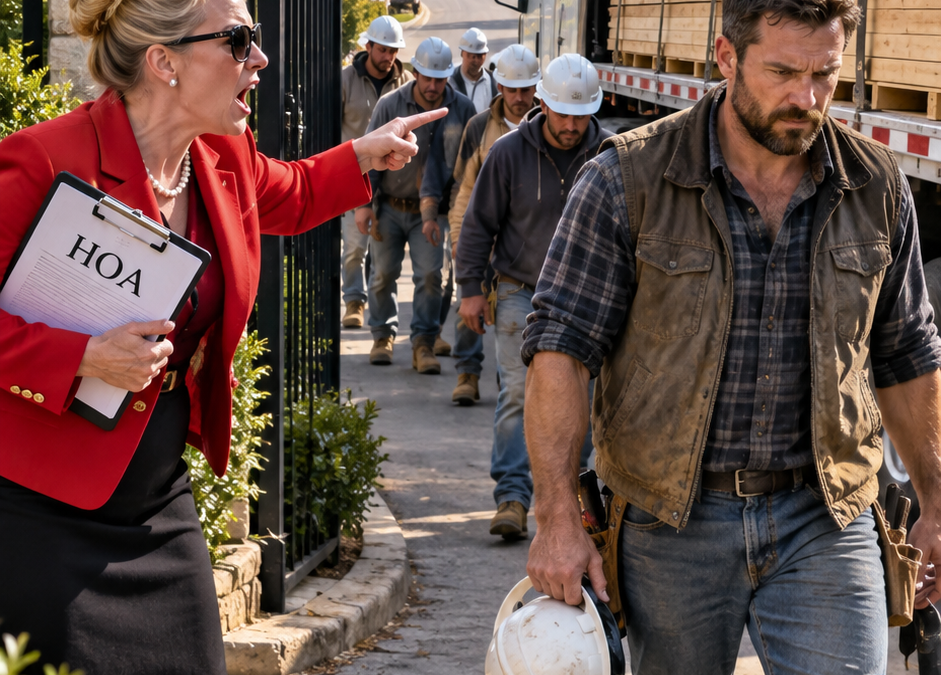
𝗣𝗔𝗥𝗧 𝟮
I called Marisol Tran before I even got back into my truck.
She answered on the second ring.
“Derek, please tell me those were not your trucks I just watched turn around on the site cameras.”
“They were.”
Silence.
I could hear office noise behind her, then a door closing.
“What happened?”
“HOA says I’m running a home-based commercial operation.”
Another silence.
This one felt different.
Not confused.
Calculating.
“They blocked Holt Materials?”
“Every vehicle associated with my LLC.”
“When?”
“This morning. Effective immediately.”
She exhaled.
Marisol ran the Cedar Hollow build for Ashgate Construction.
She was one of those general contractors who treated schedules like scripture and excuses like a contagious disease.
If you told her framing lumber would arrive Tuesday at seven, she expected it Tuesday at seven, not Tuesday at seven-fifteen with a story about traffic.
I liked working with her because she was demanding in a way that made sense.
She wanted the job done.
She paid invoices.
She returned calls.
In construction, that practically qualified her for sainthood.
“How much do you have staged?” she asked.
“All of it.”
“All?”
“You wanted one supplier for the entire phase. Eleven houses, synchronized framing schedule, single invoice system, no subcontractor chasing three different yards. Remember?”
“I remember.”
“So every board you need for the next two weeks is either sitting in my yard or sitting on a truck that just got kicked out of your subdivision.”
She went quiet again.
I leaned against my pickup.
“Marisol.”
“I’m here.”
“You don’t sound surprised.”
“I’m surprised it got this bad this fast.”
That was not the answer I wanted.
“What does that mean?”
“Give me an hour.”
“What do you know?”
“Derek, give me an hour.”
“Marisol—”
“I need to make some calls.”
She hung up.
I sat in my truck for eleven minutes without starting it.
The HOA notice was on the passenger seat.
I kept looking at the phrase home-based commercial operation.
My commercial yard was four miles away.
Fenced.
Permitted.
Inspected.
Every truck that had arrived that morning came from that yard.
Not from my driveway.
Not from my garage.
Not from some imaginary lumber empire concealed behind my mailbox.
I started thinking about money.
That is what people assume business owners do anyway, usually while picturing us swimming through gold coins like cartoon ducks.
The reality was less glamorous.
I had payroll in nine days.
Two drivers hired specifically for this development.
Equipment payments.
Fuel.
Insurance.
Material already purchased.
The Cedar Hollow contract was supposed to carry us through a slow season and fund upgrades I had postponed for years.
One notice could turn that entire calculation upside down.
And the person who issued it either had not bothered to check whether the violation was real—
or had checked and simply did not care.
I drove home.
Before I went inside, I called my wife.
“I need you to hear something from me before it hits the neighborhood group chat.”
“That sentence never means anything good.”
“The HOA blocked the Cedar Hollow deliveries.”
“All of them?”
“All.”
“For how long?”
“Pending review.”
“How long is that?”
“It means however long they decide it means.”
She was quiet.
“Derek, that contract is half your spring.”
“I’m aware.”
“You hired people for it.”
“I’m aware of that too.”
“What are you going to do?”
I looked at the notice.
“Read.”
That night, I covered the kitchen table with documents.
When I had worked supply-chain auditing years earlier, I learned something useful about bad deals and dishonest people.
Most fraud does not look dramatic.
It does not arrive wearing sunglasses and carrying a briefcase full of cash.
It looks boring.
It hides in invoices.
Authorization forms.
Vendor registrations.
Insurance riders.
Covenant notices.
It survives because nobody wants to read page thirty-seven.
That was why I started reading.
By midnight, I knew the HOA had cited a covenant that did not apply to me.
By one in the morning, I had downloaded Cedar Hollow’s public board minutes.
By two, I was pulling filings from the county recorder, secretary of state, and insurance commissioner.
And sometime after two-thirty, I found something that made me stop drinking coffee.
Two weeks earlier, Cedar Hollow had bound a new policy called community development disruption coverage.
The annual premium was listed at roughly eighty thousand dollars.
The policy included a payout provision triggered if active development inside the HOA’s jurisdiction suffered a qualifying delay.
I stared at the effective date.
Two weeks.
The HOA had purchased an expensive insurance product designed to respond when development stopped.
Two weeks later, the HOA stopped development.
I did not sleep.
At six the next morning, I started calling board members.
Two ignored me.
One texted:
BOARD CANNOT DISCUSS ACTIVE ENFORCEMENT MATTERS.
Which was impressive, considering I had not asked him to discuss anything. I had asked whether he knew my business was four miles away.
Bianca answered.
“I’ll meet you at the clubhouse.”
She was already there when I arrived.
No makeup.
Coffee untouched.
Folder on the table.
She looked like she had spent the night discovering how expensive trust could become.
“Tell me exactly what you signed,” I said.
She slid the notice toward herself.
“Preston brought me an enforcement authorization Tuesday.”
“Preston?”
“Preston Vance. Finance chair.”
“I know who he is.”
“He said a resident was operating commercial trucking from a residential address. Said the violation was ongoing and exposed the association to liability.”
“And you signed.”
“Yes.”
“You verified the address?”
Her face tightened.
“No.”
At least she did not insult me by pretending otherwise.
“He said it was urgent.”
“My yard is four miles from here.”
“I know that now.”
“He knew I supplied the ridge.”
“I would think so.”
“Then why tell you this was a residential business complaint?”
She stared at the table.
“I don’t know.”
I pulled another sheet from my folder.
“Did the board authorize development disruption coverage?”
Her head came up.
“What?”
“New policy. Bound two weeks ago.”
She frowned.
“I’d have to check.”
“Eighty-thousand-dollar annual premium. Pays when construction gets delayed past a contractual threshold.”
Her face changed.
“You’re sure?”
I pushed the filing across.
“I’m sure the state insurance commissioner thinks it exists.”
She read.
I watched her eyes move.
“When did this become effective?”
“Two weeks before my trucks were blocked.”
She looked at me.
“You’re saying the association bought insurance that benefits from a construction delay, and then two weeks later we caused a construction delay?”
“I’m saying those are two facts.”
“Who authorized it?”
I tapped the page.
She read the name.
Preston Vance.
For a while, neither of us spoke.
Then she leaned back.
“He handles insurance.”
“I gathered that.”
“He handles reserve accounts, vendor contracts, financial planning.”
“Convenient portfolio.”
She gave me a look.
“Sorry.”
“No. You’re not.”
“No.”
She rubbed her forehead.
“I sign his recommendations.”
“That seems to be becoming a theme.”
That one hurt.
I saw it.
I almost regretted saying it.
Almost.
“Derek, if you came here to tell me I should have read everything more carefully, save your breath. I’ve been telling myself that since yesterday.”
“I didn’t come here for an apology.”
“Then why are you here?”
“Because either your finance chair made two spectacularly stupid decisions in fourteen days, or they’re connected.”
She looked down at the policy again.
My phone rang.
Marisol.
“I need to talk to you in person,” she said.
“I’m at the clubhouse.”
“Stay there.”
Nine minutes later, she walked in carrying a laptop.
No greeting.
No small talk.
She sat down.
“I found something.”
Bianca and I exchanged a look.
Marisol opened the computer.
“Our development agreement with Cedar Hollow contains a delay liability clause.”
“What kind?”
“If the HOA causes more than five consecutive business days of access restriction, Ashgate can declare material breach and terminate without penalty.”
I stared at her.
“Five days?”
“Five.”
“No damages?”
“None on our side.”
Bianca spoke quietly.
“So if the HOA keeps his trucks out for five business days, your company can walk away from eleven houses?”
“Yes.”
“And you knew that clause existed?”
“Since contract execution.”
I looked at Marisol.
“Did you know somebody was going to block me?”
“No.”
“Did you tell anybody about the clause recently?”
“No.”
“Then somebody else knew.”
She closed the laptop halfway.
“That’s what worries me.”
Bianca looked between us.
“Why?”
Marisol turned to her.
“Because your insurance pays when construction is delayed.”
Then she pointed at the laptop.
“My company can leave if the delay is caused specifically by your association.”
She paused.
“That combination is very precise.”
The room went quiet.
Outside, sprinklers clicked across the clubhouse lawn like nothing important was happening.
I pictured the ridge.
Eleven houses.
Open framing.
No roofs.
Storm coming.
Five-day clock ticking.
Finally, I said, “If Ashgate walks, what happens to the development?”
Neither woman answered.
That was when I started believing the lumber trucks were not really the target.
They were just the lever.
I spent the next day pulling public records.
People imagine investigations as dramatic.
They think of hidden cameras, anonymous envelopes, whispered meetings in parking garages.
Mine involved reading PDFs until my eyes hurt.
The disruption policy named Cedar Hollow HOA as policyholder.
The servicing agent was Halcort Risk Partners.
Its manager was Delia Ashworth.
That name meant nothing to me.
So I searched her business registrations.
Three companies came up.
A nail salon.
A pet grooming operation.
And Meridian Point Holdings LLC.
I opened the filing.
Managing members:
Delia Ashworth.
Preston Vance.
I stared at the screen for so long my wife walked past the kitchen twice before asking whether I was all right.
“Depends how you define all right.”
“What did you find?”
“The man who bought the insurance owns another company with the woman servicing it.”
“That sounds bad.”
“It gets worse.”
I called Bianca.
“I need board minutes from fourteen months ago.”
“Why fourteen?”
“That’s when Meridian Point Holdings formed.”
“What is Meridian Point?”
“A company Preston co-owns.”
Silence.
“With who?”
“The manager of the insurance servicing firm.”
Another silence.
Then:
“I’ll call you back.”
Forty minutes later, she did.
Her voice was different.
Flat.
Controlled.
Angry enough that she had apparently gone through panic and come out the other side.
“There’s a rezoning application.”
“For what?”
“Parcel adjacent to Cedar Hollow’s current expansion.”
“Applicant?”
“Meridian Point Developments.”
I stood up from the kitchen chair without knowing why.
“Same company?”
“Different entity. Same registered agent.”
“What are they asking for?”
“Mixed-use commercial.”
“And the condition?”
Her voice slowed.
“Contingent on demonstrated nonviability of the current residential development plan.”
I almost laughed.
Not because anything was funny.
Because sometimes dishonesty becomes so elaborate that it circles back around to being insultingly simple.
“They need the housing project to fail.”
“That is what it says.”
“No. Bianca, that’s not a zoning application.”
“What is it?”
“It’s a business plan with eleven unfinished houses standing in the way.”
She said nothing.
I kept going.
“If Ashgate leaves, the residential project becomes nonviable. Meridian Point gets its trigger condition. Your finance chair owns Meridian Point.”
“I brought him onto the board.”
Her voice cracked.
“I recommended him.”
“Bianca—”
“I told everybody his development background made him perfect for finance.”
“You didn’t know.”
“I signed the notice.”
“You signed something he misrepresented.”
“My name is still on it.”
That was the problem with signatures.
They do not record doubt.
They do not record deception.
They do not record the moment someone says, Trust me, this is routine.
Ink is brutally simple.
It only says you signed.
Years earlier, I had audited a produce distributor whose CFO had quietly skimmed a percentage of invoices through a relative’s brokerage company.
The owner personally initialed every invoice.
When we exposed it, he kept asking one question.
How did I not see it?
The answer was always the same.
Because it had been designed to look ordinary.
That was what Preston had done.
He had not hidden his scheme in darkness.
He had hidden it inside routine governance.
An insurance recommendation.
An emergency compliance form.
A signature request.
A paragraph nobody read closely because Preston had handled the numbers for eight years and nothing terrible had happened yet.
Trust is efficient right up until somebody monetizes it.
I spent Saturday reading the entire rezoning application.
Forty-one pages.
Survey references.
Acreage calculations.
Planning contingencies.
Environmental appendices.
The applicant had remarkably detailed knowledge of the eleven-lot parcel.
Then I read the insurance policy in full.
The payout threshold did not require permanent failure.
It only required documented delay beyond the specified period.
That mattered.
Preston did not need Ashgate to leave.
The delay itself could trigger roughly ninety thousand dollars in insurance proceeds under the policy structure.
Ashgate leaving would simply be the better outcome.
The bigger prize.
Delay created the payout.
Contract termination created nonviability.
Nonviability advanced the rezoning.
Rezoning created Meridian Point’s opportunity.
It was not one bet.
It was a staircase.
Every step paid him something.
And my trucks had been selected to kick the first one loose.
I called Bianca again.
“The insurance money isn’t the motive.”
“What?”
“It’s fuel.”
“For what?”
“The land play.”
I paced the kitchen.
“If the project collapses, Meridian Point has to move fast. Before the HOA hires another contractor. Before homeowners organize. Before another developer sees distressed land and jumps in.”
“And you think the insurance proceeds provide capital.”
“Some of it. Enough to create momentum.”
“How do we prove that?”
“We may not need to yet.”
“That’s convenient.”
“We don’t need to prove where money eventually goes. We need to prove that Preston created a conflict, manipulated an enforcement action, and positioned a company he owns to benefit from the failure.”
She exhaled.
“When does Ashgate’s five-day window close?”
“Thursday.”
“The rezoning filing?”
“I’m checking.”
“So we’re racing two clocks.”
“Probably three.”
“What’s the third?”
I looked out the window.
Clouds were building.
“Rain.”
Sunday morning, Marisol called.
Her voice sounded tired.
“Before you tell me anything else, I need to tell you something.”
“That sentence should be illegal.”
“I’m serious.”
“So am I.”
She paused.
“I knew about the five-day exit window before your trucks got blocked.”
“I assumed you knew the contract.”
“No. I mean I had been thinking about using it.”
I stopped moving.
“How long?”
“Eleven days.”
The number landed hard.
Eleven days.
Before the enforcement notice.
“Why?”
“Because Cedar Hollow has become a bad contract.”
“How bad?”
“Bad enough that we’re losing money on every house.”
She explained.
Materials costs had climbed.
Labor estimates were wrong.
Two subcontractors were fighting payment terms.
Custom finish packages had been underbid.
Ashgate’s internal projections showed the project bleeding cash all the way to completion.
“So you wanted out.”
“I wanted an exit that didn’t put Ashgate in breach.”
“And then the HOA blocked my trucks.”
“Yes.”
“And you saw your door.”
“Yes.”
At least she said it.
No theatrical denial.
No speech about friendship.
Just yes.
I sat at the table.
“Why didn’t you immediately demand they lift the restriction?”
“Because for the first few hours, I didn’t know if I wanted them to.”
There it was.
I felt anger rise, but not in the clean way anger usually does.
Marisol had not created the problem.
But she had looked at the fire and briefly decided warmth was more useful than a bucket.
“You let the clock run.”
“I did.”
“My employees have payroll.”
“I know.”
“My company could have taken the fall.”
“I know.”
“Eleven families could have lost houses.”
“I know that too.”
“Then give me one reason I shouldn’t hang up.”
“Because I changed my mind.”
I laughed once.
“That is not the sales pitch you think it is.”
“Derek, listen.”
I said nothing.
She continued.
“The first day, I thought this was a stupid HOA mistake. If it stayed a mistake, I would have pressured them to reverse it. A functioning development is still worth more to Ashgate long term than an escape clause.”
“But?”
“But once I found out about the insurance policy, I realized somebody engineered the delay.”
“And suddenly walking away looked worse.”
“Yes.”
“For your conscience?”
“For my company.”
I appreciated that answer more than I expected.
She did not pretend moral purity had arrived on a white horse.
She had done the calculation.
“If Ashgate walks away knowing a supplier was deliberately framed, and that comes out later—and it will—my reputation is finished in this county.”
“So now saving me is good business.”
“Partly.”
“At least you’re honest.”
“I’m trying to be.”
“Dangerous habit.”
“I’ve heard.”
Then she said something more important.
“I went to Preston yesterday.”
That got my attention.
“You confronted him?”
“I asked him to recommend lifting the restriction.”
“What did he say?”
“No.”
“Just no?”
“He gave me a lecture about procedural integrity.”
I laughed.
Marisol almost did too.
“Apparently,” she said, “reversing an enforcement action without full compliance review could expose the association to selective enforcement claims.”
“That’s impressive.”
“Which part?”
“The man manufacturing a violation suddenly discovering due process.”
“I thought you’d appreciate that.”
“What else?”
“He ended the call in under two minutes.”
That mattered.
If Preston wanted only an insurance-triggering delay, he could have taken a graceful off-ramp.
Marisol had handed him one.
He refused.
Which meant the timeline mattered more than appearances.
“He needs the five days,” I said.
“That’s what I think.”
“Why?”
“I checked Meridian Point’s rezoning calendar.”
I waited.
“The filing lapses if the underlying development conditions aren’t met within seven days.”
I sat upright.
“And Ashgate’s exit clause activates in five.”
“Yes.”
There it was.
Not a coincidence anymore.
A schedule.
Preston needed Ashgate’s termination to establish nonviability before Meridian Point’s application deadline.
The clock was not just ticking.
It had been engineered.
Marisol continued.
“My regional director knows there may be a problem.”
“What kind of problem?”
“The kind where I either explain why Ashgate stayed in a losing project after discovering fraud, or explain why we profited from it.”
“Sounds fun.”
“I’ve had better Sundays.”
“What are you doing?”
“I’m bringing in our senior compliance officer.”
“Who?”
“Renata Alvarez. Fraud and vendor integrity.”
“When?”
“Tonight.”
“For the board meeting?”
“Yes.”
“You think Bianca will hold one?”
“She’d better.”
“She already scheduled Wednesday.”
“Good.”
I looked at the calendar.
Thursday was the fifth business day.
Wednesday night was our last chance before Preston’s machine finished doing exactly what he built it to do.
The emergency meeting packed the clubhouse.
Apparently nothing fills folding chairs faster than the possibility that someone has been using HOA bylaws to stage a land grab.
Homeowners from all eleven pending lots came.
Existing residents came.
Board members arrived carrying binders.
Marisol sat beside Renata Alvarez, Ashgate’s compliance officer.
Renata was calm in a way that made everyone else look noisy.
Before the meeting, she spent twenty minutes reviewing my file.
Insurance documents.
Entity filings.
Rezoning paperwork.
Marisol’s request to lift the restriction.
The covenant enforcement notice.
The five-day clause.
My timeline.
She circled dates with a red pen.
Then she looked at me.
“This holds together.”
That sentence did more for me than three days of coffee.
I had printed thirty copies of the timeline.
One page.
Simple.
No accusations.
Just dates.
Meridian Point formed.
Rezoning application filed.
Disruption insurance bound.
Enforcement authorization signed.
Lumber trucks blocked.
Ashgate delay window begins.
Rezoning deadline approaching.
Sometimes the best way to expose a complicated scheme is to stop explaining it.
Put the calendar on one page and let people feel stupid on their own.
Preston arrived five minutes before the meeting.
Gray suit.
Legal pad.
Uncapped pen.
Relaxed expression.
He looked like a man prepared to explain reserve-fund percentages to a room of bored homeowners until everybody surrendered from dehydration.
Bianca stood at the front.
She did not sit in the president’s chair.
That caught my attention.
“Before we begin normal discussion,” she said, “I need to address the enforcement action issued against Holt Materials Logistics.”
Preston’s pen stopped.
Bianca held up the notice.
“Four days ago, I authorized emergency covenant enforcement based on information presented to me by Finance Chair Preston Vance.”
The room shifted.
She continued.
“I was told this concerned a home-based commercial trucking operation associated with a residential address.”
She looked toward me.
“That information was false.”
Preston moved.
“Bianca—”
“You’ll have the floor when I finish.”
He leaned back.
She explained that Holt Materials operated from a properly zoned commercial yard four miles away.
Then she displayed the disruption policy.
“Two weeks before the enforcement notice, the association bound a development disruption insurance policy recommended by Mr. Vance.”
She put the document down.
“The policy financially responds to qualifying construction delays.”
Murmuring spread through the room.
Preston lifted his hand.
“Risk-management products are standard—”
Carol Whitfield, another board member, spoke without looking at him.
“Let her finish, Preston.”
That was the moment his expression changed.
Barely.
But I saw it.
For eight years, Preston had apparently lived in a world where everybody let him finish.
Now somebody had interrupted him.
Bianca placed another document on the table.
“Halcort Risk Partners services the policy.”
Another.
“Halcort’s manager, Delia Ashworth, is also a managing member of Meridian Point Holdings.”
Another.
“Mr. Vance is her co-managing member.”
Now the room was silent.
A homeowner in the second row whispered something I could not hear.
Bianca continued.
“Meridian Point has a related rezoning application involving land adjacent to the eleven-home expansion.”
She raised the application.
“The rezoning request is contingent on demonstrated nonviability of the existing residential development.”
Then Marisol stood.
“Ashgate Construction’s agreement with Cedar Hollow permits us to terminate without penalty after five consecutive business days of HOA-imposed access restriction.”
She paused.
“We are currently inside that window.”
A woman near the back gasped.
Probably one of the buyers.
Marisol looked toward her.
“For clarity, Ashgate has not terminated the contract.”
Then she looked at Preston.
“But the restriction placed on Mr. Holt’s deliveries created the exact contractual condition under which we could.”
Renata spoke.
“My name is Renata Alvarez. I am Ashgate’s senior compliance officer.”
No drama.
No raised voice.
“This policy does not require project termination to trigger its disruption threshold.”
She tapped the insurance document.
“A documented qualifying delay is sufficient.”
She turned one page.
“So the financial structure has two levels. Continued access restriction creates a potential insurance benefit. Continued restriction beyond Ashgate’s contract window creates a potential project termination. That termination, in turn, supports the nonviability condition in Meridian Point’s rezoning application.”
She folded her hands.
“In other words, the same event can satisfy multiple financial and contractual objectives.”
Preston cleared his throat.
“Those are speculative interpretations.”
Renata nodded.
“They are interpretations.”
Then she pointed at the dates.
“The dates are not.”
I almost smiled.
Preston looked at Bianca.
“This association carries legitimate exposure. Any suggestion that prudent insurance planning constitutes misconduct is irresponsible.”
I spoke for the first time.
“Then explain Meridian Point.”
He looked at me.
“What about it?”
“Your ownership.”
“A private investment interest unrelated to HOA governance.”
“Unrelated?”
“Yes.”
I stood.
“Your private company needs this residential development to become nonviable.”
“That is not what the application says.”
I held up the page.
“It literally says demonstrated nonviability of current residential development plans.”
“That is zoning language.”
“Right. And somehow your zoning language, your insurance policy, your HOA enforcement notice, and Ashgate’s five-day exit clause all got invited to the same party.”
A few people laughed.
Preston did not.
I continued.
“You told Bianca I was operating a commercial trucking business from a residential address.”
“That was the compliance information provided to me.”
“By who?”
He paused.
That was his first real mistake.
“Who provided it?” I repeated.
“I’d have to review the file.”
“So you pushed an emergency enforcement action without knowing who made the complaint.”
“I did not say that.”
“Then say who.”
“I said I would review the file.”
“You had four days.”
His jaw tightened.
I pointed toward Bianca.
“She checked the address in under twenty minutes.”
Then I pointed toward myself.
“I checked it in zero minutes because it’s my business.”
Laughter again.
This time sharper.
Preston looked around the room.
The audience was no longer neutral.
That is the danger of relying on complexity.
Once people finally understand the trick, they become offended you thought they were too stupid to understand it.
Carol Whitfield leaned forward.
“Preston, I’m going to ask you a direct question.”
He looked at her.
“Did you use your position on this board to create an access restriction against the sole supplier for the eleven-home project while holding an ownership interest in a company positioned to benefit if that project became nonviable?”
Preston stared at her.
Nobody moved.
Rain began hitting the clubhouse windows.
Soft at first.
Then harder.
The storm had arrived early.
Of course it had.
For several seconds, the only sound in the room was water against glass.
Finally, Preston stood.
“I’m not going to respond to allegations involving private business interests without counsel.”
Bianca’s expression went cold.
“You had counsel when you recommended an eighty-thousand-dollar annual policy?”
“I said I won’t discuss this further.”
“You were willing to discuss Mr. Holt’s business.”
“That was an enforcement matter.”
“You shut down his trucks.”
“I recommended enforcement.”
“Based on false information.”
“That has not been established.”
I laughed.
He looked at me.
I spread my hands.
“Preston, my lumber yard is still four miles away. Unless you plan to physically drag it into the subdivision before midnight, I think we can safely establish that part.”
Even Bianca smiled.
Only for a second.
Preston closed his legal pad.
“I need to consult counsel.”
Then he walked toward the door.
Nobody stopped him.
That was probably the smartest thing anyone had done for him all week.
He stepped into the rain without an umbrella.
The door shut.
And the room erupted.
Not cheering.
Questions.
Anger.
Homeowners wanting to know whether their deposits were safe.
Board members asking how the insurance policy had passed review.
People demanding an audit of every vendor Preston had recommended.
One man wanted to know whether the HOA could seize Preston’s house.
Bianca had to explain that this was still America.
Eventually she called the room back to order.
“First motion,” she said. “Immediate rescission of the enforcement notice against Holt Materials Logistics.”
Eleven votes.
Zero opposed.
“Second motion. Refer all documents concerning Mr. Vance’s conduct to association counsel and the county district attorney’s economic crimes division.”
Eleven votes.
Zero opposed.
Then Bianca turned to Marisol.
“Ms. Tran, I’m asking you on the record whether Ashgate will reconsider any planned contract termination now that the access restriction has been rescinded.”
Every homeowner in the room looked at her.
Marisol looked at me.
It was a strange moment.
Four days earlier, she had quietly hoped the clock would save her company from a losing contract.
Now she had to decide whether saving her own reputation required saving the development too.
I nodded.
Not because I was forgiving everything.
Because eleven families had nothing to do with any of this.
And because every board those houses needed was already stacked in my yard.
Marisol stood.
“Ashgate will remain.”
A sound went through the room.
Relief.
Real relief.
“But I have one condition.”
Bianca nodded.
“Name it.”
“Full schedule transparency from now forward. Homeowners receive direct milestone updates. Material delays, board actions, compliance issues—everything that could affect delivery dates gets disclosed.”
“Agreed.”
“No informal finance-chair approvals.”
Bianca almost laughed.
“Very agreed.”
“And nobody blocks Derek’s trucks unless one of them is actually on fire.”
I said, “Even then, call me first.”
That got the biggest laugh of the night.
My trucks rolled through Cedar Hollow the next morning.
Rico drove the first one.
Same gate.
Same security booth.
Different atmosphere.
The young guard raised the arm before Rico fully stopped.
Rico slowed anyway.
Rolled down the window.
“You sure?”
The kid looked miserable.
“Yes, sir.”
“You want to check a clipboard?”
“No, sir.”
“Maybe call somebody?”
“No, sir.”
Rico grinned.
“Shame. I was starting to enjoy our relationship.”
Then he drove through.
Rain had soaked the exposed structures.
Marisol’s crews spent days checking subfloor, drying material, inspecting framing, and replacing warped sections.
The delay cost money.
Real money.
There was nothing magical about stopping Preston’s scheme.
Fraud does not disappear without leaving a bill.
But the houses survived.
That was what mattered.
Within a week, the disruption insurance claim was frozen and then voided once the fraud referral landed with investigators.
Meridian Point’s rezoning application collapsed just as quickly.
The planning commission learned that one of the applicant company’s owners had governance authority inside the HOA responsible for the very conditions being cited as evidence of development nonviability.
That did not go over well.
Apparently planning commissioners dislike discovering that “market conditions” were personally manufactured by the applicant.
Who knew?
Preston resigned from the HOA board two days after the emergency meeting.
Four sentences.
Personal reasons.
Appreciated the opportunity to serve.
Wished the community well.
Not one word about Meridian Point.
Not one word about the insurance.
Not one word about my company.
It was the administrative equivalent of setting a building on fire and resigning because the office temperature had become uncomfortable.
The county filed charges within the month.
I learned later that Renata’s breakdown of the policy had helped investigators immensely.
It gave them a clean sequence.
Conflict.
Mechanism.
Financial trigger.
Contractual consequence.
Rezoning benefit.
They still pulled records.
They still interviewed people.
But they were not starting with a mystery anymore.
They were starting with a calendar.
The insurance premium was clawed back into the HOA reserve fund.
Which I found particularly satisfying.
Preston had spent years telling everyone he was protecting reserves.
In the end, the reserves needed protection from Preston.
The planning commission held a formal hearing on Meridian Point three weeks later.
I attended.
Not because I needed to.
Because sometimes you owe yourself the pleasure of watching paperwork do its job correctly.
There were no dramatic speeches.
No shouting.
No angry homeowners filling the hallway.
The commission chair read the contingency language.
Then she asked one question.
“Did any officer or managing member of the applicant entity hold a governance position with authority over the homeowners association controlling access to the affected development?”
County staff answered yes.
The application was dismissed.
Eleven minutes.
That was all.
Fourteen months of planning.
Shell companies.
Insurance structures.
Emergency enforcement notices.
Board manipulation.
All of it killed in eleven minutes because somebody finally asked the question Preston had counted on nobody asking.
I drove home smiling.
Not celebrating criminal charges.
Not celebrating anybody losing money.
Celebrating something much simpler.
The system had finally become inconvenient for the person abusing it.
Construction resumed.
Nail guns echoed across the ridge.
Roof sheathing went up.
Windows arrived.
Mechanical crews came behind the framers.
The place stopped looking like a cemetery of expensive lumber and started looking like a neighborhood again.
Bianca called me after the rain finally cleared.
“I owe you an apology.”
“You already gave me one.”
“Not the public one.”
“That sounded pretty public.”
“I mean a real one.”
I leaned against a stack of treated lumber in my yard.
“All right.”
She took a breath.
“I trusted the wrong man.”
“Yes.”
“I stopped reading his recommendations carefully.”
“Yes.”
“I signed something I should have verified.”
“Yes.”
“Derek, you’re terrible at accepting apologies.”
“I accept it.”
“You’re not supposed to agree with every bad thing I say about myself.”
“I’m a materials supplier, Bianca, not a therapist.”
She laughed.
It was the first relaxed sound I had heard from her since the gate incident.
Then she grew serious.
“My signature nearly cost your company six figures.”
“Preston cost my company money.”
“My name was on the notice.”
“And your name was also on the meeting that exposed him.”
“That doesn’t erase the first part.”
“No.”
I thought about it.
“But it tells me what you did after you learned the truth.”
She was quiet.
“The guilty version of this story ends differently.”
“How?”
“You protect him.”
She said nothing.
“You hide the documents. Delay the meeting. Call lawyers before homeowners. Blame me. Blame Ashgate. Call it a misunderstanding.”
I looked across my yard.
My drivers were loading another order.
“You didn’t do any of that.”
“I was angry.”
“Good.”
“At him.”
“Also good.”
“At myself too.”
“That part’s less useful.”
She sighed.
“The board wants to talk to you.”
“That sentence makes me nervous now.”
“About a long-term materials agreement.”
I raised an eyebrow even though she could not see me.
“For Cedar Hollow?”
“For future phases.”
“Directly with the HOA?”
“Yes.”
I laughed.
Six days earlier, their security guard had turned forty thousand dollars of my lumber around at the gate.
Now they wanted me under contract.
America.
“What should I tell them?” she asked.
“Tell them I’ll take the meeting.”
“I will.”
“But I have one condition.”
She groaned.
“Everyone has conditions now.”
“Mine’s simple.”
“What?”
“Everybody reads their own contracts.”
She laughed again.
“All of them?”
“All the way to the end.”
“Even the boring parts?”
“Especially the boring parts.”
“I think this board has learned that lesson.”
“Some of you learned it the hard way.”
“And Preston?”
I watched Rico pull the first truck of the morning toward the loading dock.
Right on time.
I smiled.
“Preston’s about to learn it the expensive way.”
Months later, the eleven Cedar Hollow houses stood finished.
Roofs complete.
Driveways poured.
Landscaping in.
Families moving furniture through front doors that had almost never existed.
I drove through the development once near sunset and stopped at the ridge.
Nobody noticed me.
That was fine.
Kids were riding bikes.
A couple stood in a driveway arguing about where to put a grill.
Somebody was installing a mailbox crooked enough to guarantee future HOA correspondence.
Normal neighborhood problems.
Exactly what Preston had almost destroyed.
I thought about the morning my trucks had been turned around.
How powerless it felt.
One piece of paper.
One gate.
One man abusing authority three steps removed from me.
That was all it took to threaten my employees, my contract, eleven homes, and an entire construction schedule.
But that same paper trail had destroyed him.
That was the irony I appreciated most.
Preston’s plan depended on documents because documents made everything look legitimate.
Insurance forms.
Board authorizations.
Entity registrations.
Rezoning applications.
Contract clauses.
He trusted paper because paper seemed quiet.
Paper did not argue.
Paper did not accuse.
Paper did not raise its voice in board meetings.
What Preston forgot was that paper also remembers.
Every date.
Every signature.
Every ownership interest.
Every carefully worded contingency.
Every supposedly unrelated transaction.
He had built his scheme out of documents because he assumed nobody would read all of them together.
I did.
And once we laid them on one table, his clever little masterpiece looked less like sophisticated finance and more like a man wearing four fake mustaches and insisting nobody could possibly recognize him.
Rico pulled up beside me in one of our trucks.
Window down.
“You sightseeing?”
“Something like that.”
He glanced toward the finished homes.
“Hard to believe we almost lost this contract.”
“We?”
He frowned.
“Okay. You almost lost the contract. I was just the guy who got publicly rejected by a gate.”
“You recovered.”
“Emotionally? Still working through it.”
I laughed.
He nodded toward one of the houses.
“Worth it?”
I thought for a second.
The delays had hurt.
The investigation had been stressful.
Ashgate had renegotiated portions of its pricing structure after the fraud became public, enough to keep the project viable.
My company had gotten a longer-term supply agreement.
Bianca’s board had adopted dual review on major insurance and financial contracts.
Residents had created an independent finance committee.
Preston was gone.
Meridian Point was gone.
The eleven houses were not.
“Yeah,” I said. “Worth it.”
Rico put the truck in gear.
“Good.”
Then he grinned.
“Because I’ve got another load coming through tomorrow.”
“Try not to start an economic crimes investigation this time.”
“No promises.”
He drove away.
I stayed another minute.
The sun dropped behind the completed roofs.
Eleven of them.
Preston had wanted those frames empty, wet, abandoned, and useful as evidence that residential development had failed.
Instead, families were turning lights on inside them.
His company never got the land.
His rezoning application died.
His insurance strategy collapsed.
His board position disappeared.
His carefully engineered five-day delay became the very timeline investigators used against him.
And my lumber?
It went exactly where it had been intended to go from the beginning.
Into walls.
Into roofs.
Into homes.
The most satisfying part was not that Preston lost.
It was how he lost.
He had counted on everyone being too busy, too trusting, or too intimidated by official-looking paperwork to ask one more question.
He almost succeeded.
Then a lumber supplier read the fine print.
And suddenly the man who had spent months arranging everybody else’s failure was the only project in Cedar Hollow that actually collapsed.
Have you finished reading the story and want to read it again?
HOA Blocked My Lumber Trucks—Then Their Builder Found the Clause That Could Kill All 11 Homes
They stopped my trucks at the gate.
Eleven homes froze in place before lunch.
And the paperwork told me this was no accident.
The gate arm dropped before Rico even had time to touch the brakes.
I was three vehicles behind him, sitting in my pickup with a paper cup of coffee between my knees, watching one of my best drivers lean out the window of a loaded flatbed and argue with a security guard who looked young enough to still get nervous buying beer.
Rico had been driving for me twelve years.
He had hauled lumber through snowstorms, flash floods, road closures, and once through a construction entrance where a backhoe operator had accidentally buried half the access road under six feet of clay.
I had never seen him angry over a gate.
That morning, he was angry.
Behind his truck sat two more of mine, all three loaded with framing lumber for the eleven luxury homes rising along the north ridge of Cedar Hollow Estates.
Nearly forty thousand dollars in material was sitting there with engines idling.
I climbed out.
The guard saw me coming and straightened.
“Mr. Holt?”
That stopped me.
He already knew my name.
“That’s me.”
He held out a folded sheet of paper without stepping away from the little security booth.
“Standing order, sir.”
I opened it.
Cedar Hollow Estates Homeowners Association.
Emergency Enforcement Notice.
Covenant Section 4.12.
Prohibition of Home-Based Commercial Operations.
Effective immediately, all commercial vehicle traffic associated with Holt Materials Logistics LLC was prohibited from entering HOA-controlled roads pending review.
I read it twice.
Then a third time, mostly because stupidity sometimes improves if you stare at it long enough.
This one didn’t.
“There’s a problem,” I said.
The guard looked relieved, as if discovering a problem might somehow remove him from the conversation.
“I just enforce what’s on the sheet, sir.”
“My company isn’t operated from my house.”
He said nothing.
“My commercial yard is four miles from here.”
Still nothing.
“It’s zoned industrial-light. Permitted. Inspected. Been there eleven years.”
He shifted his weight.
“I understand, sir.”
“No, you understand words. I’m not sure anybody involved understands the sentence.”
Rico leaned out of the truck again.
“Derek?”
“Hold up.”
That was when a silver SUV came through from the inside of the subdivision and stopped hard near the gate.
A woman stepped out wearing sunglasses and a blazer that looked like she had put it on while running down a hallway.
I recognized her.
Bianca Reyes.
President of the Cedar Hollow HOA.
I had seen her smiling from the community newsletter often enough to know exactly who she was.
She looked considerably less cheerful in person.
“What’s happening?” she called.
The guard held up his clipboard.
“Ma’am, I’ve got standing instructions—”
“From who?”
He hesitated.
She walked over, snatched the top page toward herself, and started reading.
Then her expression changed.
“This went out under my signature?”
“Yes, ma’am.”
“I signed a covenant enforcement authorization involving a home business.”
She looked at me.
Then at the three loaded lumber trucks.
Then toward the ridge, where eleven partially framed houses stood open to the sky.
“I did not authorize blocking the supplier for the ridge development.”
Now the guard looked like he wished somebody would arrest him just so he could leave.
Bianca looked back at the notice.
“Mr. Holt, you’re supplying all eleven houses?”
“All eleven.”
Her eyes closed for half a second.
“How much material is staged?”
“Everything they need for the next two weeks.”
The color drained from her face.
“Give me until this afternoon.”
“That doesn’t help my drivers.”
“I know.”
“It doesn’t help six framing crews.”
“I know.”
“And it definitely doesn’t help eleven houses with rain coming Thursday.”
Her jaw tightened.
“I know.”
Then she got back in her SUV and drove toward the clubhouse fast enough to suggest Cedar Hollow’s fifteen-mile-per-hour speed limit was more of a philosophical concept than a rule.
I looked at Rico.
He looked at me.
The guard stared at the pavement.
“Turn them around,” I said.
Rico’s face hardened.
“Forty grand sitting in the heat.”
“I know.”
“Crews are waiting.”
“I know.”
“This is insane.”
“That,” I said, folding the HOA notice, “is the first accurate thing anybody has said this morning.”
The trucks began turning.
Slowly.
Three enormous flatbeds making humiliating three-point turns while a security guard stood beside an HOA gate and eleven unfinished houses waited on the ridge.
As Rico pulled away, I looked at the notice again.
My company had not violated the covenant they cited.
My business was not located in Cedar Hollow.
I did not even live in Cedar Hollow.
Someone had either made an absurd mistake—
or needed an absurd mistake to exist on paper.
And I had spent fifteen years learning that when paperwork made no sense financially, the fastest way to understand it was to ask who benefited from everybody else believing it.
PART2
I called Marisol Tran before I even got back into my truck.
She answered on the second ring.
“Derek, please tell me those were not your trucks I just watched turn around on the site cameras.”
“They were.”
Silence.
I could hear office noise behind her, then a door closing.
“What happened?”
“HOA says I’m running a home-based commercial operation.”
Another silence.
This one felt different.
Not confused.
Calculating.
“They blocked Holt Materials?”
“Every vehicle associated with my LLC.”
“When?”
“This morning. Effective immediately.”
She exhaled.
Marisol ran the Cedar Hollow build for Ashgate Construction.
She was one of those general contractors who treated schedules like scripture and excuses like a contagious disease.
If you told her framing lumber would arrive Tuesday at seven, she expected it Tuesday at seven, not Tuesday at seven-fifteen with a story about traffic.
I liked working with her because she was demanding in a way that made sense.
She wanted the job done.
She paid invoices.
She returned calls.
In construction, that practically qualified her for sainthood.
“How much do you have staged?” she asked.
“All of it.”
“All?”
“You wanted one supplier for the entire phase. Eleven houses, synchronized framing schedule, single invoice system, no subcontractor chasing three different yards. Remember?”
“I remember.”
“So every board you need for the next two weeks is either sitting in my yard or sitting on a truck that just got kicked out of your subdivision.”
She went quiet again.
I leaned against my pickup.
“Marisol.”
“I’m here.”
“You don’t sound surprised.”
“I’m surprised it got this bad this fast.”
That was not the answer I wanted.
“What does that mean?”
“Give me an hour.”
“What do you know?”
“Derek, give me an hour.”
“Marisol—”
“I need to make some calls.”
She hung up.
I sat in my truck for eleven minutes without starting it.
The HOA notice was on the passenger seat.
I kept looking at the phrase home-based commercial operation.
My commercial yard was four miles away.
Fenced.
Permitted.
Inspected.
Every truck that had arrived that morning came from that yard.
Not from my driveway.
Not from my garage.
Not from some imaginary lumber empire concealed behind my mailbox.
I started thinking about money.
That is what people assume business owners do anyway, usually while picturing us swimming through gold coins like cartoon ducks.
The reality was less glamorous.
I had payroll in nine days.
Two drivers hired specifically for this development.
Equipment payments.
Fuel.
Insurance.
Material already purchased.
The Cedar Hollow contract was supposed to carry us through a slow season and fund upgrades I had postponed for years.
One notice could turn that entire calculation upside down.
And the person who issued it either had not bothered to check whether the violation was real—
or had checked and simply did not care.
I drove home.
Before I went inside, I called my wife.
“I need you to hear something from me before it hits the neighborhood group chat.”
“That sentence never means anything good.”
“The HOA blocked the Cedar Hollow deliveries.”
“All of them?”
“All.”
“For how long?”
“Pending review.”
“How long is that?”
“It means however long they decide it means.”
She was quiet.
“Derek, that contract is half your spring.”
“I’m aware.”
“You hired people for it.”
“I’m aware of that too.”
“What are you going to do?”
I looked at the notice.
“Read.”
That night, I covered the kitchen table with documents.
When I had worked supply-chain auditing years earlier, I learned something useful about bad deals and dishonest people.
Most fraud does not look dramatic.
It does not arrive wearing sunglasses and carrying a briefcase full of cash.
It looks boring.
It hides in invoices.
Authorization forms.
Vendor registrations.
Insurance riders.
Covenant notices.
It survives because nobody wants to read page thirty-seven.
That was why I started reading.
By midnight, I knew the HOA had cited a covenant that did not apply to me.
By one in the morning, I had downloaded Cedar Hollow’s public board minutes.
By two, I was pulling filings from the county recorder, secretary of state, and insurance commissioner.
And sometime after two-thirty, I found something that made me stop drinking coffee.
Two weeks earlier, Cedar Hollow had bound a new policy called community development disruption coverage.
The annual premium was listed at roughly eighty thousand dollars.
The policy included a payout provision triggered if active development inside the HOA’s jurisdiction suffered a qualifying delay.
I stared at the effective date.
Two weeks.
The HOA had purchased an expensive insurance product designed to respond when development stopped.
Two weeks later, the HOA stopped development.
I did not sleep.
At six the next morning, I started calling board members.
Two ignored me.
One texted:
BOARD CANNOT DISCUSS ACTIVE ENFORCEMENT MATTERS.
Which was impressive, considering I had not asked him to discuss anything. I had asked whether he knew my business was four miles away.
Bianca answered.
“I’ll meet you at the clubhouse.”
She was already there when I arrived.
No makeup.
Coffee untouched.
Folder on the table.
She looked like she had spent the night discovering how expensive trust could become.
“Tell me exactly what you signed,” I said.
She slid the notice toward herself.
“Preston brought me an enforcement authorization Tuesday.”
“Preston?”
“Preston Vance. Finance chair.”
“I know who he is.”
“He said a resident was operating commercial trucking from a residential address. Said the violation was ongoing and exposed the association to liability.”
“And you signed.”
“Yes.”
“You verified the address?”
Her face tightened.
“No.”
At least she did not insult me by pretending otherwise.
“He said it was urgent.”
“My yard is four miles from here.”
“I know that now.”
“He knew I supplied the ridge.”
“I would think so.”
“Then why tell you this was a residential business complaint?”
She stared at the table.
“I don’t know.”
I pulled another sheet from my folder.
“Did the board authorize development disruption coverage?”
Her head came up.
“What?”
“New policy. Bound two weeks ago.”
She frowned.
“I’d have to check.”
“Eighty-thousand-dollar annual premium. Pays when construction gets delayed past a contractual threshold.”
Her face changed.
“You’re sure?”
I pushed the filing across.
“I’m sure the state insurance commissioner thinks it exists.”
She read.
I watched her eyes move.
“When did this become effective?”
“Two weeks before my trucks were blocked.”
She looked at me.
“You’re saying the association bought insurance that benefits from a construction delay, and then two weeks later we caused a construction delay?”
“I’m saying those are two facts.”
“Who authorized it?”
I tapped the page.
She read the name.
Preston Vance.
For a while, neither of us spoke.
Then she leaned back.
“He handles insurance.”
“I gathered that.”
“He handles reserve accounts, vendor contracts, financial planning.”
“Convenient portfolio.”
She gave me a look.
“Sorry.”
“No. You’re not.”
“No.”
She rubbed her forehead.
“I sign his recommendations.”
“That seems to be becoming a theme.”
That one hurt.
I saw it.
I almost regretted saying it.
Almost.
“Derek, if you came here to tell me I should have read everything more carefully, save your breath. I’ve been telling myself that since yesterday.”
“I didn’t come here for an apology.”
“Then why are you here?”
“Because either your finance chair made two spectacularly stupid decisions in fourteen days, or they’re connected.”
She looked down at the policy again.
My phone rang.
Marisol.
“I need to talk to you in person,” she said.
“I’m at the clubhouse.”
“Stay there.”
Nine minutes later, she walked in carrying a laptop.
No greeting.
No small talk.
She sat down.
“I found something.”
Bianca and I exchanged a look.
Marisol opened the computer.
“Our development agreement with Cedar Hollow contains a delay liability clause.”
“What kind?”
“If the HOA causes more than five consecutive business days of access restriction, Ashgate can declare material breach and terminate without penalty.”
I stared at her.
“Five days?”
“Five.”
“No damages?”
“None on our side.”
Bianca spoke quietly.
“So if the HOA keeps his trucks out for five business days, your company can walk away from eleven houses?”
“Yes.”
“And you knew that clause existed?”
“Since contract execution.”
I looked at Marisol.
“Did you know somebody was going to block me?”
“No.”
“Did you tell anybody about the clause recently?”
“No.”
“Then somebody else knew.”
She closed the laptop halfway.
“That’s what worries me.”
Bianca looked between us.
“Why?”
Marisol turned to her.
“Because your insurance pays when construction is delayed.”
Then she pointed at the laptop.
“My company can leave if the delay is caused specifically by your association.”
She paused.
“That combination is very precise.”
The room went quiet.
Outside, sprinklers clicked across the clubhouse lawn like nothing important was happening.
I pictured the ridge.
Eleven houses.
Open framing.
No roofs.
Storm coming.
Five-day clock ticking.
Finally, I said, “If Ashgate walks, what happens to the development?”
Neither woman answered.
That was when I started believing the lumber trucks were not really the target.
They were just the lever.
I spent the next day pulling public records.
People imagine investigations as dramatic.
They think of hidden cameras, anonymous envelopes, whispered meetings in parking garages.
Mine involved reading PDFs until my eyes hurt.
The disruption policy named Cedar Hollow HOA as policyholder.
The servicing agent was Halcort Risk Partners.
Its manager was Delia Ashworth.
That name meant nothing to me.
So I searched her business registrations.
Three companies came up.
A nail salon.
A pet grooming operation.
And Meridian Point Holdings LLC.
I opened the filing.
Managing members:
Delia Ashworth.
Preston Vance.
I stared at the screen for so long my wife walked past the kitchen twice before asking whether I was all right.
“Depends how you define all right.”
“What did you find?”
“The man who bought the insurance owns another company with the woman servicing it.”
“That sounds bad.”
“It gets worse.”
I called Bianca.
“I need board minutes from fourteen months ago.”
“Why fourteen?”
“That’s when Meridian Point Holdings formed.”
“What is Meridian Point?”
“A company Preston co-owns.”
Silence.
“With who?”
“The manager of the insurance servicing firm.”
Another silence.
Then:
“I’ll call you back.”
Forty minutes later, she did.
Her voice was different.
Flat.
Controlled.
Angry enough that she had apparently gone through panic and come out the other side.
“There’s a rezoning application.”
“For what?”
“Parcel adjacent to Cedar Hollow’s current expansion.”
“Applicant?”
“Meridian Point Developments.”
I stood up from the kitchen chair without knowing why.
“Same company?”
“Different entity. Same registered agent.”
“What are they asking for?”
“Mixed-use commercial.”
“And the condition?”
Her voice slowed.
“Contingent on demonstrated nonviability of the current residential development plan.”
I almost laughed.
Not because anything was funny.
Because sometimes dishonesty becomes so elaborate that it circles back around to being insultingly simple.
“They need the housing project to fail.”
“That is what it says.”
“No. Bianca, that’s not a zoning application.”
“What is it?”
“It’s a business plan with eleven unfinished houses standing in the way.”
She said nothing.
I kept going.
“If Ashgate leaves, the residential project becomes nonviable. Meridian Point gets its trigger condition. Your finance chair owns Meridian Point.”
“I brought him onto the board.”
Her voice cracked.
“I recommended him.”
“Bianca—”
“I told everybody his development background made him perfect for finance.”
“You didn’t know.”
“I signed the notice.”
“You signed something he misrepresented.”
“My name is still on it.”
That was the problem with signatures.
They do not record doubt.
They do not record deception.
They do not record the moment someone says, Trust me, this is routine.
Ink is brutally simple.
It only says you signed.
Years earlier, I had audited a produce distributor whose CFO had quietly skimmed a percentage of invoices through a relative’s brokerage company.
The owner personally initialed every invoice.
When we exposed it, he kept asking one question.
How did I not see it?
The answer was always the same.
Because it had been designed to look ordinary.
That was what Preston had done.
He had not hidden his scheme in darkness.
He had hidden it inside routine governance.
An insurance recommendation.
An emergency compliance form.
A signature request.
A paragraph nobody read closely because Preston had handled the numbers for eight years and nothing terrible had happened yet.
Trust is efficient right up until somebody monetizes it.
I spent Saturday reading the entire rezoning application.
Forty-one pages.
Survey references.
Acreage calculations.
Planning contingencies.
Environmental appendices.
The applicant had remarkably detailed knowledge of the eleven-lot parcel.
Then I read the insurance policy in full.
The payout threshold did not require permanent failure.
It only required documented delay beyond the specified period.
That mattered.
Preston did not need Ashgate to leave.
The delay itself could trigger roughly ninety thousand dollars in insurance proceeds under the policy structure.
Ashgate leaving would simply be the better outcome.
The bigger prize.
Delay created the payout.
Contract termination created nonviability.
Nonviability advanced the rezoning.
Rezoning created Meridian Point’s opportunity.
It was not one bet.
It was a staircase.
Every step paid him something.
And my trucks had been selected to kick the first one loose.
I called Bianca again.
“The insurance money isn’t the motive.”
“What?”
“It’s fuel.”
“For what?”
“The land play.”
I paced the kitchen.
“If the project collapses, Meridian Point has to move fast. Before the HOA hires another contractor. Before homeowners organize. Before another developer sees distressed land and jumps in.”
“And you think the insurance proceeds provide capital.”
“Some of it. Enough to create momentum.”
“How do we prove that?”
“We may not need to yet.”
“That’s convenient.”
“We don’t need to prove where money eventually goes. We need to prove that Preston created a conflict, manipulated an enforcement action, and positioned a company he owns to benefit from the failure.”
She exhaled.
“When does Ashgate’s five-day window close?”
“Thursday.”
“The rezoning filing?”
“I’m checking.”
“So we’re racing two clocks.”
“Probably three.”
“What’s the third?”
I looked out the window.
Clouds were building.
“Rain.”
Sunday morning, Marisol called.
Her voice sounded tired.
“Before you tell me anything else, I need to tell you something.”
“That sentence should be illegal.”
“I’m serious.”
“So am I.”
She paused.
“I knew about the five-day exit window before your trucks got blocked.”
“I assumed you knew the contract.”
“No. I mean I had been thinking about using it.”
I stopped moving.
“How long?”
“Eleven days.”
The number landed hard.
Eleven days.
Before the enforcement notice.
“Why?”
“Because Cedar Hollow has become a bad contract.”
“How bad?”
“Bad enough that we’re losing money on every house.”
She explained.
Materials costs had climbed.
Labor estimates were wrong.
Two subcontractors were fighting payment terms.
Custom finish packages had been underbid.
Ashgate’s internal projections showed the project bleeding cash all the way to completion.
“So you wanted out.”
“I wanted an exit that didn’t put Ashgate in breach.”
“And then the HOA blocked my trucks.”
“Yes.”
“And you saw your door.”
“Yes.”
At least she said it.
No theatrical denial.
No speech about friendship.
Just yes.
I sat at the table.
“Why didn’t you immediately demand they lift the restriction?”
“Because for the first few hours, I didn’t know if I wanted them to.”
There it was.
I felt anger rise, but not in the clean way anger usually does.
Marisol had not created the problem.
But she had looked at the fire and briefly decided warmth was more useful than a bucket.
“You let the clock run.”
“I did.”
“My employees have payroll.”
“I know.”
“My company could have taken the fall.”
“I know.”
“Eleven families could have lost houses.”
“I know that too.”
“Then give me one reason I shouldn’t hang up.”
“Because I changed my mind.”
I laughed once.
“That is not the sales pitch you think it is.”
“Derek, listen.”
I said nothing.
She continued.
“The first day, I thought this was a stupid HOA mistake. If it stayed a mistake, I would have pressured them to reverse it. A functioning development is still worth more to Ashgate long term than an escape clause.”
“But?”
“But once I found out about the insurance policy, I realized somebody engineered the delay.”
“And suddenly walking away looked worse.”
“Yes.”
“For your conscience?”
“For my company.”
I appreciated that answer more than I expected.
She did not pretend moral purity had arrived on a white horse.
She had done the calculation.
“If Ashgate walks away knowing a supplier was deliberately framed, and that comes out later—and it will—my reputation is finished in this county.”
“So now saving me is good business.”
“Partly.”
“At least you’re honest.”
“I’m trying to be.”
“Dangerous habit.”
“I’ve heard.”
Then she said something more important.
“I went to Preston yesterday.”
That got my attention.
“You confronted him?”
“I asked him to recommend lifting the restriction.”
“What did he say?”
“No.”
“Just no?”
“He gave me a lecture about procedural integrity.”
I laughed.
Marisol almost did too.
“Apparently,” she said, “reversing an enforcement action without full compliance review could expose the association to selective enforcement claims.”
“That’s impressive.”
“Which part?”
“The man manufacturing a violation suddenly discovering due process.”
“I thought you’d appreciate that.”
“What else?”
“He ended the call in under two minutes.”
That mattered.
If Preston wanted only an insurance-triggering delay, he could have taken a graceful off-ramp.
Marisol had handed him one.
He refused.
Which meant the timeline mattered more than appearances.
“He needs the five days,” I said.
“That’s what I think.”
“Why?”
“I checked Meridian Point’s rezoning calendar.”
I waited.
“The filing lapses if the underlying development conditions aren’t met within seven days.”
I sat upright.
“And Ashgate’s exit clause activates in five.”
“Yes.”
There it was.
Not a coincidence anymore.
A schedule.
Preston needed Ashgate’s termination to establish nonviability before Meridian Point’s application deadline.
The clock was not just ticking.
It had been engineered.
Marisol continued.
“My regional director knows there may be a problem.”
“What kind of problem?”
“The kind where I either explain why Ashgate stayed in a losing project after discovering fraud, or explain why we profited from it.”
“Sounds fun.”
“I’ve had better Sundays.”
“What are you doing?”
“I’m bringing in our senior compliance officer.”
“Who?”
“Renata Alvarez. Fraud and vendor integrity.”
“When?”
“Tonight.”
“For the board meeting?”
“Yes.”
“You think Bianca will hold one?”
“She’d better.”
“She already scheduled Wednesday.”
“Good.”
I looked at the calendar.
Thursday was the fifth business day.
Wednesday night was our last chance before Preston’s machine finished doing exactly what he built it to do.
The emergency meeting packed the clubhouse.
Apparently nothing fills folding chairs faster than the possibility that someone has been using HOA bylaws to stage a land grab.
Homeowners from all eleven pending lots came.
Existing residents came.
Board members arrived carrying binders.
Marisol sat beside Renata Alvarez, Ashgate’s compliance officer.
Renata was calm in a way that made everyone else look noisy.
Before the meeting, she spent twenty minutes reviewing my file.
Insurance documents.
Entity filings.
Rezoning paperwork.
Marisol’s request to lift the restriction.
The covenant enforcement notice.
The five-day clause.
My timeline.
She circled dates with a red pen.
Then she looked at me.
“This holds together.”
That sentence did more for me than three days of coffee.
I had printed thirty copies of the timeline.
One page.
Simple.
No accusations.
Just dates.
Meridian Point formed.
Rezoning application filed.
Disruption insurance bound.
Enforcement authorization signed.
Lumber trucks blocked.
Ashgate delay window begins.
Rezoning deadline approaching.
Sometimes the best way to expose a complicated scheme is to stop explaining it.
Put the calendar on one page and let people feel stupid on their own.
Preston arrived five minutes before the meeting.
Gray suit.
Legal pad.
Uncapped pen.
Relaxed expression.
He looked like a man prepared to explain reserve-fund percentages to a room of bored homeowners until everybody surrendered from dehydration.
Bianca stood at the front.
She did not sit in the president’s chair.
That caught my attention.
“Before we begin normal discussion,” she said, “I need to address the enforcement action issued against Holt Materials Logistics.”
Preston’s pen stopped.
Bianca held up the notice.
“Four days ago, I authorized emergency covenant enforcement based on information presented to me by Finance Chair Preston Vance.”
The room shifted.
She continued.
“I was told this concerned a home-based commercial trucking operation associated with a residential address.”
She looked toward me.
“That information was false.”
Preston moved.
“Bianca—”
“You’ll have the floor when I finish.”
He leaned back.
She explained that Holt Materials operated from a properly zoned commercial yard four miles away.
Then she displayed the disruption policy.
“Two weeks before the enforcement notice, the association bound a development disruption insurance policy recommended by Mr. Vance.”
She put the document down.
“The policy financially responds to qualifying construction delays.”
Murmuring spread through the room.
Preston lifted his hand.
“Risk-management products are standard—”
Carol Whitfield, another board member, spoke without looking at him.
“Let her finish, Preston.”
That was the moment his expression changed.
Barely.
But I saw it.
For eight years, Preston had apparently lived in a world where everybody let him finish.
Now somebody had interrupted him.
Bianca placed another document on the table.
“Halcort Risk Partners services the policy.”
Another.
“Halcort’s manager, Delia Ashworth, is also a managing member of Meridian Point Holdings.”
Another.
“Mr. Vance is her co-managing member.”
Now the room was silent.
A homeowner in the second row whispered something I could not hear.
Bianca continued.
“Meridian Point has a related rezoning application involving land adjacent to the eleven-home expansion.”
She raised the application.
“The rezoning request is contingent on demonstrated nonviability of the existing residential development.”
Then Marisol stood.
“Ashgate Construction’s agreement with Cedar Hollow permits us to terminate without penalty after five consecutive business days of HOA-imposed access restriction.”
She paused.
“We are currently inside that window.”
A woman near the back gasped.
Probably one of the buyers.
Marisol looked toward her.
“For clarity, Ashgate has not terminated the contract.”
Then she looked at Preston.
“But the restriction placed on Mr. Holt’s deliveries created the exact contractual condition under which we could.”
Renata spoke.
“My name is Renata Alvarez. I am Ashgate’s senior compliance officer.”
No drama.
No raised voice.
“This policy does not require project termination to trigger its disruption threshold.”
She tapped the insurance document.
“A documented qualifying delay is sufficient.”
She turned one page.
“So the financial structure has two levels. Continued access restriction creates a potential insurance benefit. Continued restriction beyond Ashgate’s contract window creates a potential project termination. That termination, in turn, supports the nonviability condition in Meridian Point’s rezoning application.”
She folded her hands.
“In other words, the same event can satisfy multiple financial and contractual objectives.”
Preston cleared his throat.
“Those are speculative interpretations.”
Renata nodded.
“They are interpretations.”
Then she pointed at the dates.
“The dates are not.”
I almost smiled.
Preston looked at Bianca.
“This association carries legitimate exposure. Any suggestion that prudent insurance planning constitutes misconduct is irresponsible.”
I spoke for the first time.
“Then explain Meridian Point.”
He looked at me.
“What about it?”
“Your ownership.”
“A private investment interest unrelated to HOA governance.”
“Unrelated?”
“Yes.”
I stood.
“Your private company needs this residential development to become nonviable.”
“That is not what the application says.”
I held up the page.
“It literally says demonstrated nonviability of current residential development plans.”
“That is zoning language.”
“Right. And somehow your zoning language, your insurance policy, your HOA enforcement notice, and Ashgate’s five-day exit clause all got invited to the same party.”
A few people laughed.
Preston did not.
I continued.
“You told Bianca I was operating a commercial trucking business from a residential address.”
“That was the compliance information provided to me.”
“By who?”
He paused.
That was his first real mistake.
“Who provided it?” I repeated.
“I’d have to review the file.”
“So you pushed an emergency enforcement action without knowing who made the complaint.”
“I did not say that.”
“Then say who.”
“I said I would review the file.”
“You had four days.”
His jaw tightened.
I pointed toward Bianca.
“She checked the address in under twenty minutes.”
Then I pointed toward myself.
“I checked it in zero minutes because it’s my business.”
Laughter again.
This time sharper.
Preston looked around the room.
The audience was no longer neutral.
That is the danger of relying on complexity.
Once people finally understand the trick, they become offended you thought they were too stupid to understand it.
Carol Whitfield leaned forward.
“Preston, I’m going to ask you a direct question.”
He looked at her.
“Did you use your position on this board to create an access restriction against the sole supplier for the eleven-home project while holding an ownership interest in a company positioned to benefit if that project became nonviable?”
Preston stared at her.
Nobody moved.
Rain began hitting the clubhouse windows.
Soft at first.
Then harder.
The storm had arrived early.
Of course it had.
For several seconds, the only sound in the room was water against glass.
Finally, Preston stood.
“I’m not going to respond to allegations involving private business interests without counsel.”
Bianca’s expression went cold.
“You had counsel when you recommended an eighty-thousand-dollar annual policy?”
“I said I won’t discuss this further.”
“You were willing to discuss Mr. Holt’s business.”
“That was an enforcement matter.”
“You shut down his trucks.”
“I recommended enforcement.”
“Based on false information.”
“That has not been established.”
I laughed.
He looked at me.
I spread my hands.
“Preston, my lumber yard is still four miles away. Unless you plan to physically drag it into the subdivision before midnight, I think we can safely establish that part.”
Even Bianca smiled.
Only for a second.
Preston closed his legal pad.
“I need to consult counsel.”
Then he walked toward the door.
Nobody stopped him.
That was probably the smartest thing anyone had done for him all week.
He stepped into the rain without an umbrella.
The door shut.
And the room erupted.
Not cheering.
Questions.
Anger.
Homeowners wanting to know whether their deposits were safe.
Board members asking how the insurance policy had passed review.
People demanding an audit of every vendor Preston had recommended.
One man wanted to know whether the HOA could seize Preston’s house.
Bianca had to explain that this was still America.
Eventually she called the room back to order.
“First motion,” she said. “Immediate rescission of the enforcement notice against Holt Materials Logistics.”
Eleven votes.
Zero opposed.
“Second motion. Refer all documents concerning Mr. Vance’s conduct to association counsel and the county district attorney’s economic crimes division.”
Eleven votes.
Zero opposed.
Then Bianca turned to Marisol.
“Ms. Tran, I’m asking you on the record whether Ashgate will reconsider any planned contract termination now that the access restriction has been rescinded.”
Every homeowner in the room looked at her.
Marisol looked at me.
It was a strange moment.
Four days earlier, she had quietly hoped the clock would save her company from a losing contract.
Now she had to decide whether saving her own reputation required saving the development too.
I nodded.
Not because I was forgiving everything.
Because eleven families had nothing to do with any of this.
And because every board those houses needed was already stacked in my yard.
Marisol stood.
“Ashgate will remain.”
A sound went through the room.
Relief.
Real relief.
“But I have one condition.”
Bianca nodded.
“Name it.”
“Full schedule transparency from now forward. Homeowners receive direct milestone updates. Material delays, board actions, compliance issues—everything that could affect delivery dates gets disclosed.”
“Agreed.”
“No informal finance-chair approvals.”
Bianca almost laughed.
“Very agreed.”
“And nobody blocks Derek’s trucks unless one of them is actually on fire.”
I said, “Even then, call me first.”
That got the biggest laugh of the night.
My trucks rolled through Cedar Hollow the next morning.
Rico drove the first one.
Same gate.
Same security booth.
Different atmosphere.
The young guard raised the arm before Rico fully stopped.
Rico slowed anyway.
Rolled down the window.
“You sure?”
The kid looked miserable.
“Yes, sir.”
“You want to check a clipboard?”
“No, sir.”
“Maybe call somebody?”
“No, sir.”
Rico grinned.
“Shame. I was starting to enjoy our relationship.”
Then he drove through.
Rain had soaked the exposed structures.
Marisol’s crews spent days checking subfloor, drying material, inspecting framing, and replacing warped sections.
The delay cost money.
Real money.
There was nothing magical about stopping Preston’s scheme.
Fraud does not disappear without leaving a bill.
But the houses survived.
That was what mattered.
Within a week, the disruption insurance claim was frozen and then voided once the fraud referral landed with investigators.
Meridian Point’s rezoning application collapsed just as quickly.
The planning commission learned that one of the applicant company’s owners had governance authority inside the HOA responsible for the very conditions being cited as evidence of development nonviability.
That did not go over well.
Apparently planning commissioners dislike discovering that “market conditions” were personally manufactured by the applicant.
Who knew?
Preston resigned from the HOA board two days after the emergency meeting.
Four sentences.
Personal reasons.
Appreciated the opportunity to serve.
Wished the community well.
Not one word about Meridian Point.
Not one word about the insurance.
Not one word about my company.
It was the administrative equivalent of setting a building on fire and resigning because the office temperature had become uncomfortable.
The county filed charges within the month.
I learned later that Renata’s breakdown of the policy had helped investigators immensely.
It gave them a clean sequence.
Conflict.
Mechanism.
Financial trigger.
Contractual consequence.
Rezoning benefit.
They still pulled records.
They still interviewed people.
But they were not starting with a mystery anymore.
They were starting with a calendar.
The insurance premium was clawed back into the HOA reserve fund.
Which I found particularly satisfying.
Preston had spent years telling everyone he was protecting reserves.
In the end, the reserves needed protection from Preston.
The planning commission held a formal hearing on Meridian Point three weeks later.
I attended.
Not because I needed to.
Because sometimes you owe yourself the pleasure of watching paperwork do its job correctly.
There were no dramatic speeches.
No shouting.
No angry homeowners filling the hallway.
The commission chair read the contingency language.
Then she asked one question.
“Did any officer or managing member of the applicant entity hold a governance position with authority over the homeowners association controlling access to the affected development?”
County staff answered yes.
The application was dismissed.
Eleven minutes.
That was all.
Fourteen months of planning.
Shell companies.
Insurance structures.
Emergency enforcement notices.
Board manipulation.
All of it killed in eleven minutes because somebody finally asked the question Preston had counted on nobody asking.
I drove home smiling.
Not celebrating criminal charges.
Not celebrating anybody losing money.
Celebrating something much simpler.
The system had finally become inconvenient for the person abusing it.
Construction resumed.
Nail guns echoed across the ridge.
Roof sheathing went up.
Windows arrived.
Mechanical crews came behind the framers.
The place stopped looking like a cemetery of expensive lumber and started looking like a neighborhood again.
Bianca called me after the rain finally cleared.
“I owe you an apology.”
“You already gave me one.”
“Not the public one.”
“That sounded pretty public.”
“I mean a real one.”
I leaned against a stack of treated lumber in my yard.
“All right.”
She took a breath.
“I trusted the wrong man.”
“Yes.”
“I stopped reading his recommendations carefully.”
“Yes.”
“I signed something I should have verified.”
“Yes.”
“Derek, you’re terrible at accepting apologies.”
“I accept it.”
“You’re not supposed to agree with every bad thing I say about myself.”
“I’m a materials supplier, Bianca, not a therapist.”
She laughed.
It was the first relaxed sound I had heard from her since the gate incident.
Then she grew serious.
“My signature nearly cost your company six figures.”
“Preston cost my company money.”
“My name was on the notice.”
“And your name was also on the meeting that exposed him.”
“That doesn’t erase the first part.”
“No.”
I thought about it.
“But it tells me what you did after you learned the truth.”
She was quiet.
“The guilty version of this story ends differently.”
“How?”
“You protect him.”
She said nothing.
“You hide the documents. Delay the meeting. Call lawyers before homeowners. Blame me. Blame Ashgate. Call it a misunderstanding.”
I looked across my yard.
My drivers were loading another order.
“You didn’t do any of that.”
“I was angry.”
“Good.”
“At him.”
“Also good.”
“At myself too.”
“That part’s less useful.”
She sighed.
“The board wants to talk to you.”
“That sentence makes me nervous now.”
“About a long-term materials agreement.”
I raised an eyebrow even though she could not see me.
“For Cedar Hollow?”
“For future phases.”
“Directly with the HOA?”
“Yes.”
I laughed.
Six days earlier, their security guard had turned forty thousand dollars of my lumber around at the gate.
Now they wanted me under contract.
America.
“What should I tell them?” she asked.
“Tell them I’ll take the meeting.”
“I will.”
“But I have one condition.”
She groaned.
“Everyone has conditions now.”
“Mine’s simple.”
“What?”
“Everybody reads their own contracts.”
She laughed again.
“All of them?”
“All the way to the end.”
“Even the boring parts?”
“Especially the boring parts.”
“I think this board has learned that lesson.”
“Some of you learned it the hard way.”
“And Preston?”
I watched Rico pull the first truck of the morning toward the loading dock.
Right on time.
I smiled.
“Preston’s about to learn it the expensive way.”
Months later, the eleven Cedar Hollow houses stood finished.
Roofs complete.
Driveways poured.
Landscaping in.
Families moving furniture through front doors that had almost never existed.
I drove through the development once near sunset and stopped at the ridge.
Nobody noticed me.
That was fine.
Kids were riding bikes.
A couple stood in a driveway arguing about where to put a grill.
Somebody was installing a mailbox crooked enough to guarantee future HOA correspondence.
Normal neighborhood problems.
Exactly what Preston had almost destroyed.
I thought about the morning my trucks had been turned around.
How powerless it felt.
One piece of paper.
One gate.
One man abusing authority three steps removed from me.
That was all it took to threaten my employees, my contract, eleven homes, and an entire construction schedule.
But that same paper trail had destroyed him.
That was the irony I appreciated most.
Preston’s plan depended on documents because documents made everything look legitimate.
Insurance forms.
Board authorizations.
Entity registrations.
Rezoning applications.
Contract clauses.
He trusted paper because paper seemed quiet.
Paper did not argue.
Paper did not accuse.
Paper did not raise its voice in board meetings.
What Preston forgot was that paper also remembers.
Every date.
Every signature.
Every ownership interest.
Every carefully worded contingency.
Every supposedly unrelated transaction.
He had built his scheme out of documents because he assumed nobody would read all of them together.
I did.
And once we laid them on one table, his clever little masterpiece looked less like sophisticated finance and more like a man wearing four fake mustaches and insisting nobody could possibly recognize him.
Rico pulled up beside me in one of our trucks.
Window down.
“You sightseeing?”
“Something like that.”
He glanced toward the finished homes.
“Hard to believe we almost lost this contract.”
“We?”
He frowned.
“Okay. You almost lost the contract. I was just the guy who got publicly rejected by a gate.”
“You recovered.”
“Emotionally? Still working through it.”
I laughed.
He nodded toward one of the houses.
“Worth it?”
I thought for a second.
The delays had hurt.
The investigation had been stressful.
Ashgate had renegotiated portions of its pricing structure after the fraud became public, enough to keep the project viable.
My company had gotten a longer-term supply agreement.
Bianca’s board had adopted dual review on major insurance and financial contracts.
Residents had created an independent finance committee.
Preston was gone.
Meridian Point was gone.
The eleven houses were not.
“Yeah,” I said. “Worth it.”
Rico put the truck in gear.
“Good.”
Then he grinned.
“Because I’ve got another load coming through tomorrow.”
“Try not to start an economic crimes investigation this time.”
“No promises.”
He drove away.
I stayed another minute.
The sun dropped behind the completed roofs.
Eleven of them.
Preston had wanted those frames empty, wet, abandoned, and useful as evidence that residential development had failed.
Instead, families were turning lights on inside them.
His company never got the land.
His rezoning application died.
His insurance strategy collapsed.
His board position disappeared.
His carefully engineered five-day delay became the very timeline investigators used against him.
And my lumber?
It went exactly where it had been intended to go from the beginning.
Into walls.
Into roofs.
Into homes.
The most satisfying part was not that Preston lost.
It was how he lost.
He had counted on everyone being too busy, too trusting, or too intimidated by official-looking paperwork to ask one more question.
He almost succeeded.
Then a lumber supplier read the fine print.
And suddenly the man who had spent months arranging everybody else’s failure was the only project in Cedar Hollow that actually collapsed.








