𝗣𝗔𝗥𝗧 𝟮 HOA Blocked My Emergency Evacuation Road—Then the Fire Chief Asked Who Defied His Order
𝗣𝗔𝗥𝗧 𝟮
Nobody answered immediately.
That was the first interesting thing.
Until then, Valerie had answered everything.
Who controlled the road?
She did.
Who decided access?
She did.
Who authorized the security guards?
She did.
Who determined whether the county had authority?
Apparently she did that too.
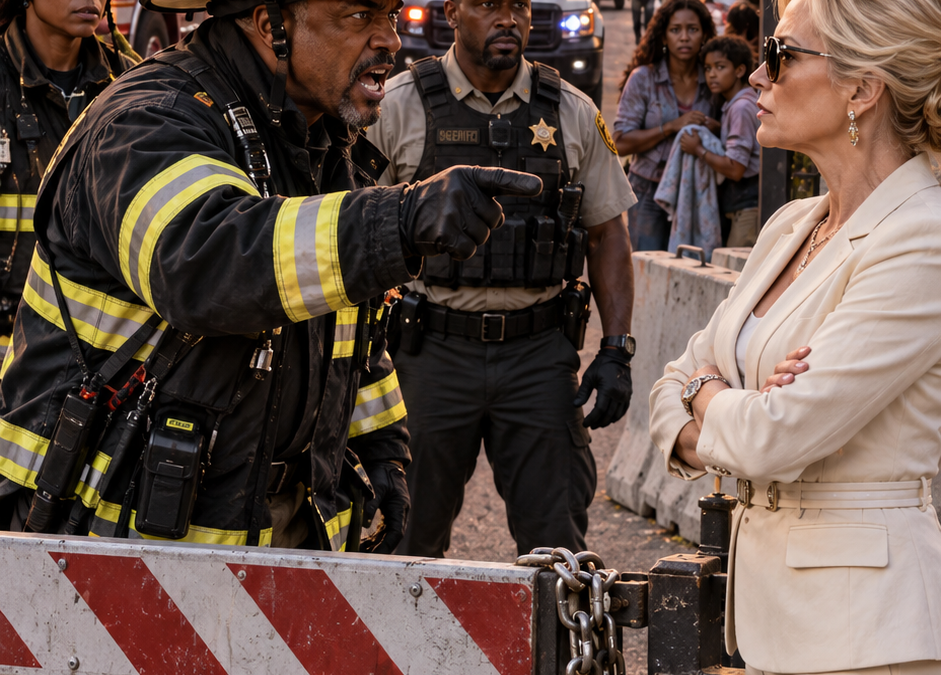
But with Fire Chief Roland Beckett standing in front of the barricade, surrounded by engines that physically could not pass through it, Valerie suddenly discovered the value of silence.
Roland waited.
He was in his late fifties, broad-shouldered, gray at the temples, and built like a man who had spent thirty years wearing turnout gear.
I had known him from my volunteer days.
He rarely raised his voice.
He did not need to.
“Who installed this?”
Valerie stepped forward.
“I’m Valerie Sloan. President of Alder Crest.”
“That wasn’t my question.”
She blinked.
“The association authorized temporary traffic control.”
Roland looked toward the concrete barriers.
“During an evacuation?”
“This road is private.”
“Yes.”
That answer surprised her.
Roland continued.
“And it is designated emergency corridor E4.”
Valerie crossed her arms.
“There is a property dispute.”
“There is a fire.”
She began again.
“Our association has invested heavily in the access junction, and we have security obligations—”
“Were you instructed to keep Route E4 open?”
She stopped.
Roland repeated it.
“Were you instructed to keep this road open?”
“Yes, but—”
He turned toward the barricade.
“Then who defied my emergency order?”
I held out my phone.
“Chief.”
He took it.
The recording began with me standing beside the fence.
My voice:
“Are you physically preventing me from opening an evacuation route ordered open by the county?”
Miles Corbett, the security contractor, said nothing.
Valerie answered for him.
“Yes. This is HOA property and it stays closed.”
Roland watched the full clip.
No expression.
Then handed the phone to Deputy Fire Marshal Tessa Crowley.
“Preserve that.”
Tessa nodded.
Roland turned toward his crew.
“Remove everything.”
Valerie stepped forward.
“You cannot destroy association property.”
Roland looked at her.
“This is an active evacuation corridor.”
“You need legal authorization.”
“I have an emergency order.”
“That doesn’t override ownership.”
“It overrides your barricade.”
He pointed.
“Cut it.”
Firefighters moved.
Hydraulic cutters went through the steel chain.
A chainsaw took the wooden section.
A tow cable hooked around the first concrete barrier.
The engine pulled.
Concrete scraped across gravel.
Valerie shouted over the noise.
“You will be billed for every dollar of damage!”
Roland did not even look at her.
“Send it to the county.”
Behind me, residents had started arriving.
Alder Crest Drive was deteriorating fast.
First came Carol Ashby.
Then Walt Oakes.
Then a dozen vehicles.
Then more.
Within minutes, nearly thirty cars were lined up in the smoke.
Headlights glowed in daylight because the sky had turned orange-brown.
Ash fell across windshields.
People stepped out.
“What happened?”
“Why is the road closed?”
“Is this the evacuation route?”
Valerie tried to regain control.
“Everybody remain calm. The association is managing access.”
Walt stared at her.
“Managing it?”
He pointed at the fire engine blocked behind concrete.
“You blocked the fire department.”
“We are protecting community property.”
A woman several cars back leaned on her horn.
Another joined.
Then another.
Soon the entire line was sounding.
Valerie stood rigidly beside the fence as though refusing to react might somehow make the noise less humiliating.
The first barrier moved.
Then the second.
A gap opened.
Roland ordered evacuees released southbound.
Cars started through.
Slowly.
One at a time.
Walt lowered his window when he reached me.
“Grant.”
“Yeah?”
“I should’ve said something sooner.”
“Just keep moving.”
He nodded.
Then drove through Mercer Cut.
Tessa approached Miles.
“Who told you to install the barricade?”
Miles looked at Valerie.
Valerie looked at him.
Neither answered.
Tessa held out her hand.
“Contract.”
Miles hesitated.
Then gave her the folder.
Private security agreement.
Authorized by:
Valerie Sloan.
Purpose:
Prevent unauthorized use of association infrastructure.
Tessa flipped pages.
“Your company believes this road belongs to the HOA?”
Miles looked uncomfortable.
“That’s what we were told.”
“By who?”
He looked at Valerie again.
“She provided the property representation.”
Valerie snapped.
“This is a complicated ownership matter.”
I laughed once.
Not because it was funny.
Because fire was now less than six miles away and she was still trying to litigate a gravel road at the roadside.
Tessa’s radio crackled.
She listened.
Then looked toward Roland.
“East route is gone.”
Everyone turned.
She continued.
“Utility poles down across Alder Crest Drive. Full closure.”
Roland looked at me.
“Mercer Cut is now sole viable evacuation.”
Valerie’s face changed.
Only slightly.
But I saw it.
For the first time, she understood that the road she had blocked was no longer a backup.
It was the exit.
The only one.
Roland pointed toward the remaining barriers.
“Move faster.”
His crews did.
Then Tessa’s radio sounded again.
Different report.
She listened longer.
“What?”
Roland asked.
“Second obstruction.”
My stomach dropped.
“Where?”
“South end. Roughly a mile down Mercer Cut.”
Valerie looked away.
I knew immediately.
“You put another gate there.”
She said nothing.
Miles stared at her.
“You what?”
Valerie finally spoke.
“It was necessary.”
Miles stepped toward her.
“You told me we were securing this junction.”
“The second location was handled separately.”
“You blocked both ends?”
“It prevents unauthorized bypass.”
I felt something cold move through my chest.
If evacuees had entered Mercer Cut before discovering the southern blockade, they could have been trapped inside the corridor.
Cars backed up.
Smoke thickening.
Fire behind them.
Locked steel ahead.
Roland did not yell.
That made it worse.
“Who installed the southern gate?”
Valerie replied.
“A contractor.”
“When?”
“This morning.”
“After the fire warning?”
“Yes.”
Tessa looked at her.
“You intentionally sealed both ends of a designated evacuation corridor during a red-flag event?”
Valerie answered instantly.
“To protect our infrastructure.”
Nobody said anything for several seconds.
Even Miles looked sick.
Roland keyed his radio.
“Unit Four, proceed south. Remove Gate Two immediately.”
Then he looked back at Valerie.
“Do not leave this location.”
Her chin lifted.
“Am I under arrest?”
“No.”
“Then you cannot detain me.”
“I said do not leave.”
“That sounds like detention.”
Tessa stepped closer.
“Ms. Sloan, nobody has arrested you. We are preserving an emergency scene and taking statements.”
Valerie folded her arms again.
“What happens next is a legal matter.”
Tessa nodded.
“Yes.”
That was the first thing Valerie said all afternoon that everyone agreed with.
Lena Whitmore arrived fifteen minutes later.
County emergency management.
She carried a laminated evacuation map.
She spread it across the hood of her truck.
Bright orange line.
E4.
Mercer Cut Road.
Printed beside it:
KEEP CLEAR DURING RED FLAG CONDITIONS OR DECLARED EVACUATION.
Then Lena produced another document.
Receipt acknowledgment.
Valerie Sloan.
Signed six months earlier.
I stared at the signature.
Lena said:
“You attended the annual evacuation briefing.”
Valerie shrugged.
“I attend many county meetings.”
“This route was specifically discussed.”
“I don’t remember.”
“You signed the packet.”
“That doesn’t mean I agreed with the county’s property interpretation.”
Lena looked at her.
“This is not an ownership transfer.”
“Exactly.”
“It is an emergency-access agreement executed with the actual property owner.”
She pointed at me.
“Grant.”
Then at Valerie.
“Your association is not a party to it.”
Valerie’s face hardened.
“This road serves our community.”
“Yes.”
“Then we have responsibility for it.”
“No.”
Lena’s tone never changed.
“You have responsibility to use it when ordered.”
Derek Winslow arrived during that exchange.
Derek was the HOA vice president.
He had supported Valerie on most issues for years.
I had always considered him the kind of man who preferred a bad compromise to an uncomfortable confrontation.
That day changed him.
He looked at the removed barriers.
Then the evacuation map.
Then Valerie.
“What did you do?”
She turned.
“Derek, this is being exaggerated.”
“Did you block E4?”
“We implemented temporary access control.”
“During the fire?”
“It was already planned.”
He stared.
“Planned?”
That opened another door.
Tessa looked at him.
“You have board records?”
Derek nodded slowly.
“There was a closed session three days ago.”
Valerie snapped.
“Board discussions are confidential.”
Tessa said:
“Not necessarily from an investigation.”
Derek looked at Valerie.
Then made a decision.
“I have the minutes.”
He retrieved them from his vehicle.
The agenda contained a proposal:
PERMANENT TRAFFIC CONTROL INITIATIVE.
According to the notes, Valerie wanted to establish a private checkpoint at Mercer Cut.
Long term.
The stated rationale:
Community safety.
Traffic management.
Property protection.
But the discussion showed something else.
If Alder Crest controlled access long enough, Valerie believed the association could strengthen its claim to “practical management authority” over the junction.
Derek had objected.
The board had not approved the required funding vote.
Valerie signed the security contract anyway.
Tessa read the minutes.
“This was not emergency planning.”
Derek shook his head.
“No.”
“This started before the fire.”
“Yes.”
Valerie interrupted.
“The fire accelerated a decision that was already necessary.”
I looked at her.
“You used an evacuation to seize a road.”
She pointed at me.
“You’ve refused reasonable community control for two years.”
“Because you don’t own it.”
“The road directly affects our residents.”
“So does weather. You don’t own that either.”
Derek almost smiled.
Wrong time.
But I saw it.
The radios became louder.
Spot fire western slope.
Wind shift.
Roland turned to his crews.
“We need water.”
I pointed toward my ranch.
“Forty thousand gallons.”
He looked at me.
“Usable?”
“Pump-fed reserve. Fire fitting on the south side.”
“How fast?”
“Five minutes.”
He keyed his radio.
“Tender Two, follow Mercer.”
I drove ahead.
The water tender followed.
We connected to my reserve.
For the next several hours, my ranch became part of the suppression operation.
That mattered to me more than the argument.
Fire does not care who won a property dispute.
It does not care about HOA politics.
It does not care whether a board president has learned a lesson.
It burns what is available.
Roland routed one wildland engine through Mercer Cut toward the western slope.
The exact road Valerie had blocked.
The unit later reached a spot fire before it crossed into heavier brush.
Roland told me afterward that another fifteen or twenty minutes could have changed the entire night.
That statement stayed with me.
Fifteen minutes.
The width between inconvenience and disaster can be surprisingly small.
While crews worked, Valerie called Alder Crest’s attorney.
Speakerphone.
Bad idea.
“Daniel, I need you at the command post.”
The attorney sounded confused.
“Is the evacuation still active?”
“Yes.”
“Is Mercer Cut designated as an evacuation route?”
“Technically.”
Tessa looked at me.
I looked away so I would not laugh.
The attorney continued.
“Did county emergency management instruct the association to keep it open?”
Valerie hesitated.
“Yes, but—”
“Did you block it after receiving that instruction?”
Silence.
“Valerie?”
“We maintained association control.”
“That was not my question.”
She glanced at Tessa.
“I’m not discussing this on speaker.”
The attorney’s tone changed.
“Do not answer additional investigative questions without counsel.”
He ended the call.
Tessa had heard everything she needed.
Then a sheriff’s SUV arrived.
Two deputies.
Another emergency-management truck followed.
Valerie watched the convoy.
I said quietly:
“You wanted jurisdiction.”
She looked at me.
“Now you have plenty.”
Statements began.
Separate.
Miles first.
Then Derek.
Then me.
Then Valerie.
Miles cooperated fully.
He handed over his phone.
Every message.
One stood out immediately.
MILES:
Emergency management says gate must remain open.
VALERIE:
They can sue us afterward.
That was the line.
Not because it sounded dramatic.
Because it showed knowledge.
She knew the order.
She chose defiance.
Another exchange:
MILES:
Fire activity increasing. Recommend opening checkpoint.
VALERIE:
Negative. Maintain closure until I approve release.
Another:
MILES:
County vehicles may arrive.
VALERIE:
Do not open for county personnel without my authorization.
Tessa read them.
Then looked at Miles.
“You followed these instructions?”
“Yes.”
“Why?”
“My contract was with the association.”
“You knew there was an emergency order?”
“Eventually, yes.”
“Then why didn’t you open it?”
He looked toward Valerie.
“She threatened termination.”
Tessa wrote something.
“That will be in your statement.”
Miles nodded.
He knew he had made a serious mistake.
The difference was he stopped defending it.
Valerie did not.
She kept insisting the barriers were intended to prevent uncontrolled movement.
Investigators later found messages where she discussed how to describe them publicly.
One message said:
Frame as safety management if county challenges.
Another:
Keep cameras recording. Need evidence we warned people.
She had been constructing a defense before the barricade was complete.
That detail disturbed me.
This was not panic.
It was planning.
My statement took almost an hour.
I gave them everything.
The old emergency-access agreement.
My deed.
County map.
Valerie’s invoices.
Her requests for an access badge.
My video.
Lena’s instructions.
The timeline.
The deputy finally asked:
“Do you want to pursue charges?”
“That’s not my decision.”
“Do you want to make a complaint?”
“Yes.”
“For what?”
“Put everything on record.”
“Anything else?”
“Keep the road open.”
That was all I wanted.
By evening, Derek had convened an emergency board meeting by phone.
Valerie attempted to stop it.
But the bylaws allowed the vice president to act when the president had a direct conflict.
The vote:
Six to one.
Valerie suspended.
The one dissenting vote was hers.
Her access to HOA accounts was frozen.
Administrative logins disabled.
Security permissions revoked.
Clubhouse office access suspended.
Then the financial records surfaced.
Roughly $84,000 spent.
Security contractor.
Barriers.
Outside counsel.
Private survey.
Gate installation.
All tied to Valerie’s campaign to gain control over Mercer Cut.
The required board approvals were missing.
Derek handed everything to investigators.
I expected satisfaction.
I felt none.
The fire was still active.
That mattered more.
By late evening, ash covered my truck.
The ridge glowed in places.
Roland’s crews worked until close to midnight.
Finally, the wind eased.
A containment line held.
The immediate threat to Alder Crest decreased.
Roland stopped beside me before leaving.
“You all right?”
“I’ve had better afternoons.”
He looked toward the cleared road.
“That route mattered.”
“I know.”
“No. I mean tonight.”
He pointed toward the western slope.
“One engine got through here and caught that spot before it ran.”
I said nothing.
He continued.
“If these barriers were still up, we lose time.”
“How much?”
“Maybe fifteen minutes.”
“That bad?”
“In that terrain?”
He nodded.
“Could be.”
I looked toward where Valerie stood with a deputy.
Roland followed my eyes.
“Tomorrow this stops being my fire problem.”
“What becomes of it?”
“Someone else’s paperwork problem.”
I almost smiled.
Valerie had always loved paperwork.
Morning came.
Smoke.
Gray light.
No flames near the neighborhood.
The fire marshal’s investigation formally opened.
Potential issues included:
Obstruction of emergency access.
Failure to comply with a lawful emergency order.
Interference with fire apparatus.
Unauthorized construction within the emergency corridor.
Misrepresentation of property rights.
Improper expenditure of HOA money.
Nobody announced conclusions prematurely.
The evidence had to be reviewed.
I respected that.
Residents wanted blood.
Some told me to sue Alder Crest for everything.
Walt said:
“If somebody did that to me, I’d own their clubhouse by Christmas.”
“No.”
He looked at me.
“No?”
“I don’t want their clubhouse.”
“They almost got people trapped.”
“Valerie did.”
“The board let her.”
“Some of them did.”
“You’re being generous.”
“No.”
I shook my head.
“I’m being specific.”
There were homeowners in Alder Crest who had no idea what Valerie was doing.
Elderly residents.
Caregivers.
Maintenance staff.
People who simply trusted the board.
I had no interest in bankrupting them for her decisions.
So I gave the new board conditions.
Permanent removal of all unauthorized barriers.
Written recognition that Mercer Cut belonged to me.
No HOA claim to the road.
No access-control scheme.
Emergency Route E4 open during every red-flag activation or evacuation order.
No locked gates during declared emergencies.
Joint coordination with county emergency management.
Clear signage.
They accepted.
Fast.
Derek became acting president.
His first formal letter arrived a week later.
ALDER CREST HOMEOWNERS ASSOCIATION ACKNOWLEDGES THAT MERCER CUT ROAD CROSSES PRIVATE PROPERTY OWNED BY GRANT MERCER AND THAT THE ASSOCIATION CLAIMS NO OWNERSHIP INTEREST IN THE ROAD OR LAND BENEATH IT.
I framed it.
Not because I needed a trophy.
Because memory gets creative.
Paper does not.
Valerie still attended the next association meeting.
Suspended.
Under investigation.
Still convinced she could win the room.
The clubhouse was packed.
I attended because Derek asked me to.
Valerie stood.
“I acted to protect Alder Crest.”
Nobody responded.
She continued.
“Mr. Mercer has spent years resisting reasonable safety oversight.”
I placed a folder on the table.
Evacuation order.
Video.
Texts.
Signed map.
Photographs.
Security contract.
Second gate.
I asked one question.
“Which part of locking the only exit was safety?”
Silence.
Valerie looked around.
Nobody rescued her.
Derek introduced a motion.
Remove Valerie Sloan from the board.
Vote:
Nine to zero.
She lost the seat.
No authority.
No committee.
No accounts.
No security contract.
No association counsel acting at her direction.
Nothing.
After the meeting, she walked into the parking lot.
Tessa Crowley waited beside a fire marshal vehicle.
Two sheriff’s investigators stood nearby.
Tessa handed Valerie a folder.
Not handcuffs.
Not some dramatic roadside arrest.
Formal notice.
The investigative file had been forwarded to the district attorney for review.
Valerie looked at me.
“You did this.”
“No.”
“You have been trying to destroy me for two years.”
“No.”
“Then what do you call this?”
I looked toward the open gate beyond the clubhouse.
“You locked the road.”
That was all.
She stood there under the parking lot lights.
Then left.
Months passed.
Mercer Cut changed.
County funding widened several narrow sections.
Reflective markers went in.
Emergency signs.
Turnouts.
An automated gate with county override capability.
The basic ownership never changed.
Mine.
Normal day?
Private road.
Declared emergency?
Evacuation corridor.
Simple.
Written.
Clear.
Valerie’s consequences came gradually.
She remained out of HOA leadership.
Association financial authority permanently gone.
Some insurance coverage was denied for actions found outside her authorized role.
Alder Crest sought repayment of unauthorized expenditures.
Fire-safety administrative penalties proceeded separately.
The district attorney reviewed the obstruction allegations.
Miles cooperated.
His security company terminated its HOA contract.
He admitted he should have refused the order the moment the emergency directive became clear.
That mattered.
Responsibility does not disappear because someone above you gives a bad instruction.
But cooperation matters too.
The concrete barriers were removed permanently.
Some were sold for scrap.
The red HOA sign became evidence.
That felt appropriate.
The county used the incident in future emergency briefings.
Not with Valerie’s name plastered everywhere.
The point was bigger than one woman.
Private developments could not treat emergency infrastructure as optional.
Lena helped revise county agreements.
New language became explicit.
No private restriction may supersede emergency activation.
No secondary gate without county-approved emergency override.
No barriers within designated apparatus clearance.
No ambiguity.
Derek also changed Alder Crest policy.
Any future emergency-access decision required coordination with county emergency management.
Major security contracts needed recorded board approval.
No president acting alone.
Residents complained at first about bureaucracy.
Then somebody reminded them what unrecorded discretion had looked like during the fire.
Complaints stopped.
Late that summer, the county held an evacuation drill.
Roland returned.
So did Tessa.
Residents lined driveways.
The alert sounded.
Mercer Cut’s emergency gate released automatically.
Cars moved.
No checkpoint.
No security guards asking for HOA permission.
Fire engines rolled through without slowing.
Roland stood beside me.
“Look at that.”
“What?”
“Functional government.”
I laughed.
“That sounded almost optimistic.”
“Don’t repeat it.”
The last fire engine cleared the corridor.
Tessa joined us.
“Drill passed.”
“Any complaints?” I asked.
“Only that the route is dusty.”
I looked toward Alder Crest.
“Some traditions survive.”
Roland pointed toward the new sign.
EMERGENCY EVACUATION ROUTE
DO NOT BLOCK
“You think anyone tries again?”
I looked at four empty bolt holes near the fence.
The old HOA sign had been mounted there.
“No.”
“Confident?”
“Not twice.”
Later, Tessa mentioned the district attorney’s review was moving forward.
She did not give me details she should not.
I did not ask.
By then, I had stopped thinking in terms of winning.
The fire was out.
The road was open.
That was enough.
One evening, I walked Mercer Cut alone.
Past the old northern checkpoint.
Past the place where thirty cars had been trapped.
Past the turn where smoke had reduced visibility to a few hundred feet.
Past the southern gate Valerie had installed without telling her own security contractor.
Nothing remained.
No barriers.
No chains.
No black SUVs.
Just gravel.
My father had driven tractors over that same ground.
I had driven fire engines over it as a volunteer.
Now people living in million-dollar homes depended on it when their polished main road failed.
None of that gave the HOA ownership.
But ownership did not stop me from letting people use it when lives mattered.
That was the distinction Valerie never understood.
She thought control meant ownership.
I thought ownership meant responsibility.
Years later, residents still occasionally stopped me.
Carol Ashby did once at the feed store.
“Grant.”
“Carol.”
“I never thanked you.”
“For what?”
“The road.”
“You don’t need to.”
“We were trapped.”
“Not for long.”
“Long enough.”
She looked down.
“I believed Valerie.”
“A lot of people did.”
“She sounded so certain.”
“That was her best skill.”
Carol smiled sadly.
“I should’ve questioned her.”
“Maybe.”
I picked up a sack of mineral supplement.
“But certainty is persuasive.”
“Even when it’s wrong.”
“Especially then.”
The county fire report eventually became public.
It confirmed the basic timeline.
Evacuation order.
Route activation.
Obstruction.
Delayed access.
Second barrier.
Messages.
Removal.
Suppression use.
People around the county read it.
Other HOAs quietly reviewed their evacuation plans.
Some discovered locked gates that should not have been locked.
Others found landscaping narrowing apparatus access.
One development removed decorative bollards.
Another rewrote security procedures.
That might have been the best outcome.
Our disaster became somebody else’s prevention.
A year later, another red-flag warning came.
No fire.
Just weather.
My phone buzzed.
I drove down Mercer Cut anyway.
Checked the gate.
Open mechanism working.
County override active.
Water tank full.
Sign visible.
Derek arrived in his pickup.
“Everything good?”
“So far.”
He looked at the road.
“You know, two years ago Valerie wanted us to pave this and take control of it.”
“I remember.”
“She thought gravel made the neighborhood look unfinished.”
“I remember that too.”
He kicked at the road.
“Looks pretty good now.”
“It’s still gravel.”
“Yeah.”
He smiled.
“Maybe that wasn’t the real problem.”
“No.”
“What was?”
I looked toward Alder Crest.
“She couldn’t stand owning less authority than she wanted.”
Derek nodded.
“That sounds right.”
He drove away.
That evening, I sat on my porch.
The valley was quiet.
No smoke.
No sirens.
Mercer Cut disappeared between the trees.
Private road.
Emergency route.
Both could be true.
That was what Valerie had never understood.
The county did not need to steal my land to use it in an emergency.
I did not need to surrender ownership to help my neighbors.
Alder Crest did not need to control the road to benefit from it.
Cooperation had solved the problem years before Valerie created one.
Her entire crisis began because a functioning agreement did not give her personal authority.
So she replaced cooperation with control.
Then she nearly trapped an entire neighborhood.
I still think about Roland’s question.
Who defied my emergency order?
At the time, it sounded like the beginning of Valerie’s downfall.
It wasn’t.
Her downfall started earlier.
It started when she saw a fire coming and still believed protecting her control mattered more than keeping an exit open.
Everything after that was paperwork.
The texts.
The contracts.
The signed map.
The second gate.
The spending.
The investigation.
The board vote.
The consequences.
The real decision happened when she looked at a road marked KEEP CLEAR and ordered it locked anyway.
Months after the drill, Roland visited the ranch.
No uniform.
Just jeans and coffee.
We sat outside the repair shop.
“You miss volunteering?” he asked.
“Sometimes.”
“Come back.”
“No.”
“You’d pass the physical.”
“That is not the problem.”
“What is?”
“I enjoy sleeping.”
He laughed.
Then looked toward Mercer Cut.
“You did good that day.”
“I opened a road.”
“You tried.”
“You opened it.”
“We cut a fence.”
“That too.”
He sipped coffee.
“If you had fought those guards instead of recording them, everything gets harder.”
“I know.”
“If you had dragged the barriers with your truck, Valerie claims you created the danger.”
“I know.”
“You still think like a firefighter.”
“Unfortunately.”
He smiled.
“Fortunately.”
After he left, I walked down to the gate.
Four bolt holes.
New reflective sign.
Fresh county markers.
I ran my hand across the steel post.
For years, Valerie had tried to turn Mercer Cut into an HOA road.
She sent fines.
Invented fees.
Demanded access badges.
Hired security.
Built barricades.
Installed two gates.
Spent $84,000.
And in the end, the legal record became clearer than it had ever been before.
Mercer Cut belonged to me.
Alder Crest had no ownership claim.
During emergencies, it opened automatically.
No president could override it.
No private security guard could lock it.
No landscaping concern could close it.
No internal HOA vote could cancel a county evacuation order.
That was the final result.
Not revenge.
Clarity.
A wildfire exposed the cost of pretending private authority outranked emergency law.
Valerie Sloan had three SUVs.
Concrete barriers.
Steel fencing.
Security guards.
A second locked gate.
And an HOA title she believed gave her the last word.
Then the fire chief arrived.
He needed only one question.
Who defied my emergency order?
Everyone already knew the answer.
Have you finished reading the story and want to read it again?
HOA Blocked My Emergency Evacuation Road—Then the Fire Chief Asked Who Defied His Order
The wildfire was six miles away.
The HOA locked the only road out.
Then the fire chief arrived.
My name is Grant Mercer, and before that afternoon, I thought I understood exactly how dangerous arrogance could be.
I had spent fifteen years as a volunteer firefighter.
I had seen people ignore evacuation orders because they wanted to save a boat.
I had seen homeowners waste precious minutes hosing roofs while flames moved faster than they could imagine.
I had seen drivers stop in smoke so thick they could barely see their own hoods because they suddenly decided turning around was safer than trusting the road in front of them.
Fire does strange things to judgment.
But I had never seen someone deliberately lock an evacuation road because she was worried fleeing residents might damage landscaping.
That was Valerie Sloan.
President of the Alder Crest Homeowners Association.
Two years before the fire, Valerie had decided Mercer Cut Road should belong to her HOA.
It did not.
The road crossed my land west of Alder Crest and connected the valley directly to State Route 18.
My family had owned that ground for generations.
Years earlier, the county asked whether Mercer Cut could be designated a secondary emergency corridor.
I agreed.
No payment.
No special benefit.
Just a written emergency-access agreement.
The conditions were simple.
No permanent obstruction.
No locked gate during a declared emergency.
No claim by Alder Crest that the road belonged to the association.
For years, nobody cared about Mercer Cut.
Residents preferred Alder Crest Drive, the wide paved road running east toward town.
Mercer Cut was gravel.
Dusty.
Narrower.
Used mostly by my ranch trucks, repair customers, county crews, and the occasional lost delivery driver.
Then Valerie became president.
Suddenly I began receiving letters.
Heavy equipment on Mercer Cut supposedly harmed community aesthetics.
Farm trucks lowered property values.
Dust created a nuisance.
My road needed an HOA access-control plan.
Then she demanded I apply for an Alder Crest vehicle badge to cross a junction sitting partly on my own property.
I ignored her.
She sent invoices.
I ignored those too.
The week the wildfire started, the county issued a red-flag warning.
Hot wind.
Dry brush.
Low humidity.
Exactly the combination that made everyone with fire experience start checking hoses, water tanks, radios, and fuel.
I checked my forty-thousand-gallon reserve tank.
Tested the generator.
Cleared brush near the buildings.
Verified the Mercer Cut gate opened freely.
Everything worked.
Then, late that afternoon, smoke rose beyond the western ridge.
My phone buzzed.
WILDFIRE ALERT. PREPARE TO EVACUATE.
I stepped outside.
The smoke was dark copper.
Low.
Moving fast.
Then I saw a flatbed truck heading toward Mercer Cut.
It carried concrete barriers.
By the time I reached the junction, three black SUVs were parked sideways across the road.
Security guards were unloading fencing.
A steel chain had already been stretched across the opening.
And hanging from it was a red HOA sign.
PRIVATE COMMUNITY ACCESS
NO ENTRY
Valerie Sloan stood behind the barricade.
I held up the county evacuation agreement.
“Open the road.”
She folded her arms.
“Nobody uses association infrastructure without authorization.”
“This isn’t association infrastructure.”
“It serves Alder Crest.”
“That does not make it yours.”
She smiled.
“You’ll need permission from me to use it now.”
Behind us, the smoke column grew larger.
I looked at the barriers.
Then at her.
“Valerie, if the evacuation order activates Mercer Cut, this gate opens.”
“No.”
“That is not a negotiation.”
“It is on HOA-controlled access.”
I called county emergency management.
Five minutes later, Coordinator Lena Whitmore confirmed Mercer Cut remained Route E4.
Official evacuation corridor.
She ordered the obstruction removed.
Valerie refused even to take the phone.
Then another alert hit.
MANDATORY EVACUATION EXPANDED.
A distant explosion rolled across the valley.
Power lines had started coming down along Alder Crest Drive.
And Valerie still would not move the barricade.
Twenty minutes later, sirens rose through the smoke.
A command vehicle appeared first.
Two wildland engines followed.
Then a water tender.
They stopped directly in front of Valerie’s concrete blocks.
Fire Chief Roland Beckett stepped out.
He looked at the barricade.
Then at the HOA sign.
Then at Valerie.
His voice was calm.
“Who defied my emergency order?”
PART2
Nobody answered immediately.
That was the first interesting thing.
Until then, Valerie had answered everything.
Who controlled the road?
She did.
Who decided access?
She did.
Who authorized the security guards?
She did.
Who determined whether the county had authority?
Apparently she did that too.
But with Fire Chief Roland Beckett standing in front of the barricade, surrounded by engines that physically could not pass through it, Valerie suddenly discovered the value of silence.
Roland waited.
He was in his late fifties, broad-shouldered, gray at the temples, and built like a man who had spent thirty years wearing turnout gear.
I had known him from my volunteer days.
He rarely raised his voice.
He did not need to.
“Who installed this?”
Valerie stepped forward.
“I’m Valerie Sloan. President of Alder Crest.”
“That wasn’t my question.”
She blinked.
“The association authorized temporary traffic control.”
Roland looked toward the concrete barriers.
“During an evacuation?”
“This road is private.”
“Yes.”
That answer surprised her.
Roland continued.
“And it is designated emergency corridor E4.”
Valerie crossed her arms.
“There is a property dispute.”
“There is a fire.”
She began again.
“Our association has invested heavily in the access junction, and we have security obligations—”
“Were you instructed to keep Route E4 open?”
She stopped.
Roland repeated it.
“Were you instructed to keep this road open?”
“Yes, but—”
He turned toward the barricade.
“Then who defied my emergency order?”
I held out my phone.
“Chief.”
He took it.
The recording began with me standing beside the fence.
My voice:
“Are you physically preventing me from opening an evacuation route ordered open by the county?”
Miles Corbett, the security contractor, said nothing.
Valerie answered for him.
“Yes. This is HOA property and it stays closed.”
Roland watched the full clip.
No expression.
Then handed the phone to Deputy Fire Marshal Tessa Crowley.
“Preserve that.”
Tessa nodded.
Roland turned toward his crew.
“Remove everything.”
Valerie stepped forward.
“You cannot destroy association property.”
Roland looked at her.
“This is an active evacuation corridor.”
“You need legal authorization.”
“I have an emergency order.”
“That doesn’t override ownership.”
“It overrides your barricade.”
He pointed.
“Cut it.”
Firefighters moved.
Hydraulic cutters went through the steel chain.
A chainsaw took the wooden section.
A tow cable hooked around the first concrete barrier.
The engine pulled.
Concrete scraped across gravel.
Valerie shouted over the noise.
“You will be billed for every dollar of damage!”
Roland did not even look at her.
“Send it to the county.”
Behind me, residents had started arriving.
Alder Crest Drive was deteriorating fast.
First came Carol Ashby.
Then Walt Oakes.
Then a dozen vehicles.
Then more.
Within minutes, nearly thirty cars were lined up in the smoke.
Headlights glowed in daylight because the sky had turned orange-brown.
Ash fell across windshields.
People stepped out.
“What happened?”
“Why is the road closed?”
“Is this the evacuation route?”
Valerie tried to regain control.
“Everybody remain calm. The association is managing access.”
Walt stared at her.
“Managing it?”
He pointed at the fire engine blocked behind concrete.
“You blocked the fire department.”
“We are protecting community property.”
A woman several cars back leaned on her horn.
Another joined.
Then another.
Soon the entire line was sounding.
Valerie stood rigidly beside the fence as though refusing to react might somehow make the noise less humiliating.
The first barrier moved.
Then the second.
A gap opened.
Roland ordered evacuees released southbound.
Cars started through.
Slowly.
One at a time.
Walt lowered his window when he reached me.
“Grant.”
“Yeah?”
“I should’ve said something sooner.”
“Just keep moving.”
He nodded.
Then drove through Mercer Cut.
Tessa approached Miles.
“Who told you to install the barricade?”
Miles looked at Valerie.
Valerie looked at him.
Neither answered.
Tessa held out her hand.
“Contract.”
Miles hesitated.
Then gave her the folder.
Private security agreement.
Authorized by:
Valerie Sloan.
Purpose:
Prevent unauthorized use of association infrastructure.
Tessa flipped pages.
“Your company believes this road belongs to the HOA?”
Miles looked uncomfortable.
“That’s what we were told.”
“By who?”
He looked at Valerie again.
“She provided the property representation.”
Valerie snapped.
“This is a complicated ownership matter.”
I laughed once.
Not because it was funny.
Because fire was now less than six miles away and she was still trying to litigate a gravel road at the roadside.
Tessa’s radio crackled.
She listened.
Then looked toward Roland.
“East route is gone.”
Everyone turned.
She continued.
“Utility poles down across Alder Crest Drive. Full closure.”
Roland looked at me.
“Mercer Cut is now sole viable evacuation.”
Valerie’s face changed.
Only slightly.
But I saw it.
For the first time, she understood that the road she had blocked was no longer a backup.
It was the exit.
The only one.
Roland pointed toward the remaining barriers.
“Move faster.”
His crews did.
Then Tessa’s radio sounded again.
Different report.
She listened longer.
“What?”
Roland asked.
“Second obstruction.”
My stomach dropped.
“Where?”
“South end. Roughly a mile down Mercer Cut.”
Valerie looked away.
I knew immediately.
“You put another gate there.”
She said nothing.
Miles stared at her.
“You what?”
Valerie finally spoke.
“It was necessary.”
Miles stepped toward her.
“You told me we were securing this junction.”
“The second location was handled separately.”
“You blocked both ends?”
“It prevents unauthorized bypass.”
I felt something cold move through my chest.
If evacuees had entered Mercer Cut before discovering the southern blockade, they could have been trapped inside the corridor.
Cars backed up.
Smoke thickening.
Fire behind them.
Locked steel ahead.
Roland did not yell.
That made it worse.
“Who installed the southern gate?”
Valerie replied.
“A contractor.”
“When?”
“This morning.”
“After the fire warning?”
“Yes.”
Tessa looked at her.
“You intentionally sealed both ends of a designated evacuation corridor during a red-flag event?”
Valerie answered instantly.
“To protect our infrastructure.”
Nobody said anything for several seconds.
Even Miles looked sick.
Roland keyed his radio.
“Unit Four, proceed south. Remove Gate Two immediately.”
Then he looked back at Valerie.
“Do not leave this location.”
Her chin lifted.
“Am I under arrest?”
“No.”
“Then you cannot detain me.”
“I said do not leave.”
“That sounds like detention.”
Tessa stepped closer.
“Ms. Sloan, nobody has arrested you. We are preserving an emergency scene and taking statements.”
Valerie folded her arms again.
“What happens next is a legal matter.”
Tessa nodded.
“Yes.”
That was the first thing Valerie said all afternoon that everyone agreed with.
Lena Whitmore arrived fifteen minutes later.
County emergency management.
She carried a laminated evacuation map.
She spread it across the hood of her truck.
Bright orange line.
E4.
Mercer Cut Road.
Printed beside it:
KEEP CLEAR DURING RED FLAG CONDITIONS OR DECLARED EVACUATION.
Then Lena produced another document.
Receipt acknowledgment.
Valerie Sloan.
Signed six months earlier.
I stared at the signature.
Lena said:
“You attended the annual evacuation briefing.”
Valerie shrugged.
“I attend many county meetings.”
“This route was specifically discussed.”
“I don’t remember.”
“You signed the packet.”
“That doesn’t mean I agreed with the county’s property interpretation.”
Lena looked at her.
“This is not an ownership transfer.”
“Exactly.”
“It is an emergency-access agreement executed with the actual property owner.”
She pointed at me.
“Grant.”
Then at Valerie.
“Your association is not a party to it.”
Valerie’s face hardened.
“This road serves our community.”
“Yes.”
“Then we have responsibility for it.”
“No.”
Lena’s tone never changed.
“You have responsibility to use it when ordered.”
Derek Winslow arrived during that exchange.
Derek was the HOA vice president.
He had supported Valerie on most issues for years.
I had always considered him the kind of man who preferred a bad compromise to an uncomfortable confrontation.
That day changed him.
He looked at the removed barriers.
Then the evacuation map.
Then Valerie.
“What did you do?”
She turned.
“Derek, this is being exaggerated.”
“Did you block E4?”
“We implemented temporary access control.”
“During the fire?”
“It was already planned.”
He stared.
“Planned?”
That opened another door.
Tessa looked at him.
“You have board records?”
Derek nodded slowly.
“There was a closed session three days ago.”
Valerie snapped.
“Board discussions are confidential.”
Tessa said:
“Not necessarily from an investigation.”
Derek looked at Valerie.
Then made a decision.
“I have the minutes.”
He retrieved them from his vehicle.
The agenda contained a proposal:
PERMANENT TRAFFIC CONTROL INITIATIVE.
According to the notes, Valerie wanted to establish a private checkpoint at Mercer Cut.
Long term.
The stated rationale:
Community safety.
Traffic management.
Property protection.
But the discussion showed something else.
If Alder Crest controlled access long enough, Valerie believed the association could strengthen its claim to “practical management authority” over the junction.
Derek had objected.
The board had not approved the required funding vote.
Valerie signed the security contract anyway.
Tessa read the minutes.
“This was not emergency planning.”
Derek shook his head.
“No.”
“This started before the fire.”
“Yes.”
Valerie interrupted.
“The fire accelerated a decision that was already necessary.”
I looked at her.
“You used an evacuation to seize a road.”
She pointed at me.
“You’ve refused reasonable community control for two years.”
“Because you don’t own it.”
“The road directly affects our residents.”
“So does weather. You don’t own that either.”
Derek almost smiled.
Wrong time.
But I saw it.
The radios became louder.
Spot fire western slope.
Wind shift.
Roland turned to his crews.
“We need water.”
I pointed toward my ranch.
“Forty thousand gallons.”
He looked at me.
“Usable?”
“Pump-fed reserve. Fire fitting on the south side.”
“How fast?”
“Five minutes.”
He keyed his radio.
“Tender Two, follow Mercer.”
I drove ahead.
The water tender followed.
We connected to my reserve.
For the next several hours, my ranch became part of the suppression operation.
That mattered to me more than the argument.
Fire does not care who won a property dispute.
It does not care about HOA politics.
It does not care whether a board president has learned a lesson.
It burns what is available.
Roland routed one wildland engine through Mercer Cut toward the western slope.
The exact road Valerie had blocked.
The unit later reached a spot fire before it crossed into heavier brush.
Roland told me afterward that another fifteen or twenty minutes could have changed the entire night.
That statement stayed with me.
Fifteen minutes.
The width between inconvenience and disaster can be surprisingly small.
While crews worked, Valerie called Alder Crest’s attorney.
Speakerphone.
Bad idea.
“Daniel, I need you at the command post.”
The attorney sounded confused.
“Is the evacuation still active?”
“Yes.”
“Is Mercer Cut designated as an evacuation route?”
“Technically.”
Tessa looked at me.
I looked away so I would not laugh.
The attorney continued.
“Did county emergency management instruct the association to keep it open?”
Valerie hesitated.
“Yes, but—”
“Did you block it after receiving that instruction?”
Silence.
“Valerie?”
“We maintained association control.”
“That was not my question.”
She glanced at Tessa.
“I’m not discussing this on speaker.”
The attorney’s tone changed.
“Do not answer additional investigative questions without counsel.”
He ended the call.
Tessa had heard everything she needed.
Then a sheriff’s SUV arrived.
Two deputies.
Another emergency-management truck followed.
Valerie watched the convoy.
I said quietly:
“You wanted jurisdiction.”
She looked at me.
“Now you have plenty.”
Statements began.
Separate.
Miles first.
Then Derek.
Then me.
Then Valerie.
Miles cooperated fully.
He handed over his phone.
Every message.
One stood out immediately.
MILES:
Emergency management says gate must remain open.
VALERIE:
They can sue us afterward.
That was the line.
Not because it sounded dramatic.
Because it showed knowledge.
She knew the order.
She chose defiance.
Another exchange:
MILES:
Fire activity increasing. Recommend opening checkpoint.
VALERIE:
Negative. Maintain closure until I approve release.
Another:
MILES:
County vehicles may arrive.
VALERIE:
Do not open for county personnel without my authorization.
Tessa read them.
Then looked at Miles.
“You followed these instructions?”
“Yes.”
“Why?”
“My contract was with the association.”
“You knew there was an emergency order?”
“Eventually, yes.”
“Then why didn’t you open it?”
He looked toward Valerie.
“She threatened termination.”
Tessa wrote something.
“That will be in your statement.”
Miles nodded.
He knew he had made a serious mistake.
The difference was he stopped defending it.
Valerie did not.
She kept insisting the barriers were intended to prevent uncontrolled movement.
Investigators later found messages where she discussed how to describe them publicly.
One message said:
Frame as safety management if county challenges.
Another:
Keep cameras recording. Need evidence we warned people.
She had been constructing a defense before the barricade was complete.
That detail disturbed me.
This was not panic.
It was planning.
My statement took almost an hour.
I gave them everything.
The old emergency-access agreement.
My deed.
County map.
Valerie’s invoices.
Her requests for an access badge.
My video.
Lena’s instructions.
The timeline.
The deputy finally asked:
“Do you want to pursue charges?”
“That’s not my decision.”
“Do you want to make a complaint?”
“Yes.”
“For what?”
“Put everything on record.”
“Anything else?”
“Keep the road open.”
That was all I wanted.
By evening, Derek had convened an emergency board meeting by phone.
Valerie attempted to stop it.
But the bylaws allowed the vice president to act when the president had a direct conflict.
The vote:
Six to one.
Valerie suspended.
The one dissenting vote was hers.
Her access to HOA accounts was frozen.
Administrative logins disabled.
Security permissions revoked.
Clubhouse office access suspended.
Then the financial records surfaced.
Roughly $84,000 spent.
Security contractor.
Barriers.
Outside counsel.
Private survey.
Gate installation.
All tied to Valerie’s campaign to gain control over Mercer Cut.
The required board approvals were missing.
Derek handed everything to investigators.
I expected satisfaction.
I felt none.
The fire was still active.
That mattered more.
By late evening, ash covered my truck.
The ridge glowed in places.
Roland’s crews worked until close to midnight.
Finally, the wind eased.
A containment line held.
The immediate threat to Alder Crest decreased.
Roland stopped beside me before leaving.
“You all right?”
“I’ve had better afternoons.”
He looked toward the cleared road.
“That route mattered.”
“I know.”
“No. I mean tonight.”
He pointed toward the western slope.
“One engine got through here and caught that spot before it ran.”
I said nothing.
He continued.
“If these barriers were still up, we lose time.”
“How much?”
“Maybe fifteen minutes.”
“That bad?”
“In that terrain?”
He nodded.
“Could be.”
I looked toward where Valerie stood with a deputy.
Roland followed my eyes.
“Tomorrow this stops being my fire problem.”
“What becomes of it?”
“Someone else’s paperwork problem.”
I almost smiled.
Valerie had always loved paperwork.
Morning came.
Smoke.
Gray light.
No flames near the neighborhood.
The fire marshal’s investigation formally opened.
Potential issues included:
Obstruction of emergency access.
Failure to comply with a lawful emergency order.
Interference with fire apparatus.
Unauthorized construction within the emergency corridor.
Misrepresentation of property rights.
Improper expenditure of HOA money.
Nobody announced conclusions prematurely.
The evidence had to be reviewed.
I respected that.
Residents wanted blood.
Some told me to sue Alder Crest for everything.
Walt said:
“If somebody did that to me, I’d own their clubhouse by Christmas.”
“No.”
He looked at me.
“No?”
“I don’t want their clubhouse.”
“They almost got people trapped.”
“Valerie did.”
“The board let her.”
“Some of them did.”
“You’re being generous.”
“No.”
I shook my head.
“I’m being specific.”
There were homeowners in Alder Crest who had no idea what Valerie was doing.
Elderly residents.
Caregivers.
Maintenance staff.
People who simply trusted the board.
I had no interest in bankrupting them for her decisions.
So I gave the new board conditions.
Permanent removal of all unauthorized barriers.
Written recognition that Mercer Cut belonged to me.
No HOA claim to the road.
No access-control scheme.
Emergency Route E4 open during every red-flag activation or evacuation order.
No locked gates during declared emergencies.
Joint coordination with county emergency management.
Clear signage.
They accepted.
Fast.
Derek became acting president.
His first formal letter arrived a week later.
ALDER CREST HOMEOWNERS ASSOCIATION ACKNOWLEDGES THAT MERCER CUT ROAD CROSSES PRIVATE PROPERTY OWNED BY GRANT MERCER AND THAT THE ASSOCIATION CLAIMS NO OWNERSHIP INTEREST IN THE ROAD OR LAND BENEATH IT.
I framed it.
Not because I needed a trophy.
Because memory gets creative.
Paper does not.
Valerie still attended the next association meeting.
Suspended.
Under investigation.
Still convinced she could win the room.
The clubhouse was packed.
I attended because Derek asked me to.
Valerie stood.
“I acted to protect Alder Crest.”
Nobody responded.
She continued.
“Mr. Mercer has spent years resisting reasonable safety oversight.”
I placed a folder on the table.
Evacuation order.
Video.
Texts.
Signed map.
Photographs.
Security contract.
Second gate.
I asked one question.
“Which part of locking the only exit was safety?”
Silence.
Valerie looked around.
Nobody rescued her.
Derek introduced a motion.
Remove Valerie Sloan from the board.
Vote:
Nine to zero.
She lost the seat.
No authority.
No committee.
No accounts.
No security contract.
No association counsel acting at her direction.
Nothing.
After the meeting, she walked into the parking lot.
Tessa Crowley waited beside a fire marshal vehicle.
Two sheriff’s investigators stood nearby.
Tessa handed Valerie a folder.
Not handcuffs.
Not some dramatic roadside arrest.
Formal notice.
The investigative file had been forwarded to the district attorney for review.
Valerie looked at me.
“You did this.”
“No.”
“You have been trying to destroy me for two years.”
“No.”
“Then what do you call this?”
I looked toward the open gate beyond the clubhouse.
“You locked the road.”
That was all.
She stood there under the parking lot lights.
Then left.
Months passed.
Mercer Cut changed.
County funding widened several narrow sections.
Reflective markers went in.
Emergency signs.
Turnouts.
An automated gate with county override capability.
The basic ownership never changed.
Mine.
Normal day?
Private road.
Declared emergency?
Evacuation corridor.
Simple.
Written.
Clear.
Valerie’s consequences came gradually.
She remained out of HOA leadership.
Association financial authority permanently gone.
Some insurance coverage was denied for actions found outside her authorized role.
Alder Crest sought repayment of unauthorized expenditures.
Fire-safety administrative penalties proceeded separately.
The district attorney reviewed the obstruction allegations.
Miles cooperated.
His security company terminated its HOA contract.
He admitted he should have refused the order the moment the emergency directive became clear.
That mattered.
Responsibility does not disappear because someone above you gives a bad instruction.
But cooperation matters too.
The concrete barriers were removed permanently.
Some were sold for scrap.
The red HOA sign became evidence.
That felt appropriate.
The county used the incident in future emergency briefings.
Not with Valerie’s name plastered everywhere.
The point was bigger than one woman.
Private developments could not treat emergency infrastructure as optional.
Lena helped revise county agreements.
New language became explicit.
No private restriction may supersede emergency activation.
No secondary gate without county-approved emergency override.
No barriers within designated apparatus clearance.
No ambiguity.
Derek also changed Alder Crest policy.
Any future emergency-access decision required coordination with county emergency management.
Major security contracts needed recorded board approval.
No president acting alone.
Residents complained at first about bureaucracy.
Then somebody reminded them what unrecorded discretion had looked like during the fire.
Complaints stopped.
Late that summer, the county held an evacuation drill.
Roland returned.
So did Tessa.
Residents lined driveways.
The alert sounded.
Mercer Cut’s emergency gate released automatically.
Cars moved.
No checkpoint.
No security guards asking for HOA permission.
Fire engines rolled through without slowing.
Roland stood beside me.
“Look at that.”
“What?”
“Functional government.”
I laughed.
“That sounded almost optimistic.”
“Don’t repeat it.”
The last fire engine cleared the corridor.
Tessa joined us.
“Drill passed.”
“Any complaints?” I asked.
“Only that the route is dusty.”
I looked toward Alder Crest.
“Some traditions survive.”
Roland pointed toward the new sign.
EMERGENCY EVACUATION ROUTE
DO NOT BLOCK
“You think anyone tries again?”
I looked at four empty bolt holes near the fence.
The old HOA sign had been mounted there.
“No.”
“Confident?”
“Not twice.”
Later, Tessa mentioned the district attorney’s review was moving forward.
She did not give me details she should not.
I did not ask.
By then, I had stopped thinking in terms of winning.
The fire was out.
The road was open.
That was enough.
One evening, I walked Mercer Cut alone.
Past the old northern checkpoint.
Past the place where thirty cars had been trapped.
Past the turn where smoke had reduced visibility to a few hundred feet.
Past the southern gate Valerie had installed without telling her own security contractor.
Nothing remained.
No barriers.
No chains.
No black SUVs.
Just gravel.
My father had driven tractors over that same ground.
I had driven fire engines over it as a volunteer.
Now people living in million-dollar homes depended on it when their polished main road failed.
None of that gave the HOA ownership.
But ownership did not stop me from letting people use it when lives mattered.
That was the distinction Valerie never understood.
She thought control meant ownership.
I thought ownership meant responsibility.
Years later, residents still occasionally stopped me.
Carol Ashby did once at the feed store.
“Grant.”
“Carol.”
“I never thanked you.”
“For what?”
“The road.”
“You don’t need to.”
“We were trapped.”
“Not for long.”
“Long enough.”
She looked down.
“I believed Valerie.”
“A lot of people did.”
“She sounded so certain.”
“That was her best skill.”
Carol smiled sadly.
“I should’ve questioned her.”
“Maybe.”
I picked up a sack of mineral supplement.
“But certainty is persuasive.”
“Even when it’s wrong.”
“Especially then.”
The county fire report eventually became public.
It confirmed the basic timeline.
Evacuation order.
Route activation.
Obstruction.
Delayed access.
Second barrier.
Messages.
Removal.
Suppression use.
People around the county read it.
Other HOAs quietly reviewed their evacuation plans.
Some discovered locked gates that should not have been locked.
Others found landscaping narrowing apparatus access.
One development removed decorative bollards.
Another rewrote security procedures.
That might have been the best outcome.
Our disaster became somebody else’s prevention.
A year later, another red-flag warning came.
No fire.
Just weather.
My phone buzzed.
I drove down Mercer Cut anyway.
Checked the gate.
Open mechanism working.
County override active.
Water tank full.
Sign visible.
Derek arrived in his pickup.
“Everything good?”
“So far.”
He looked at the road.
“You know, two years ago Valerie wanted us to pave this and take control of it.”
“I remember.”
“She thought gravel made the neighborhood look unfinished.”
“I remember that too.”
He kicked at the road.
“Looks pretty good now.”
“It’s still gravel.”
“Yeah.”
He smiled.
“Maybe that wasn’t the real problem.”
“No.”
“What was?”
I looked toward Alder Crest.
“She couldn’t stand owning less authority than she wanted.”
Derek nodded.
“That sounds right.”
He drove away.
That evening, I sat on my porch.
The valley was quiet.
No smoke.
No sirens.
Mercer Cut disappeared between the trees.
Private road.
Emergency route.
Both could be true.
That was what Valerie had never understood.
The county did not need to steal my land to use it in an emergency.
I did not need to surrender ownership to help my neighbors.
Alder Crest did not need to control the road to benefit from it.
Cooperation had solved the problem years before Valerie created one.
Her entire crisis began because a functioning agreement did not give her personal authority.
So she replaced cooperation with control.
Then she nearly trapped an entire neighborhood.
I still think about Roland’s question.
Who defied my emergency order?
At the time, it sounded like the beginning of Valerie’s downfall.
It wasn’t.
Her downfall started earlier.
It started when she saw a fire coming and still believed protecting her control mattered more than keeping an exit open.
Everything after that was paperwork.
The texts.
The contracts.
The signed map.
The second gate.
The spending.
The investigation.
The board vote.
The consequences.
The real decision happened when she looked at a road marked KEEP CLEAR and ordered it locked anyway.
Months after the drill, Roland visited the ranch.
No uniform.
Just jeans and coffee.
We sat outside the repair shop.
“You miss volunteering?” he asked.
“Sometimes.”
“Come back.”
“No.”
“You’d pass the physical.”
“That is not the problem.”
“What is?”
“I enjoy sleeping.”
He laughed.
Then looked toward Mercer Cut.
“You did good that day.”
“I opened a road.”
“You tried.”
“You opened it.”
“We cut a fence.”
“That too.”
He sipped coffee.
“If you had fought those guards instead of recording them, everything gets harder.”
“I know.”
“If you had dragged the barriers with your truck, Valerie claims you created the danger.”
“I know.”
“You still think like a firefighter.”
“Unfortunately.”
He smiled.
“Fortunately.”
After he left, I walked down to the gate.
Four bolt holes.
New reflective sign.
Fresh county markers.
I ran my hand across the steel post.
For years, Valerie had tried to turn Mercer Cut into an HOA road.
She sent fines.
Invented fees.
Demanded access badges.
Hired security.
Built barricades.
Installed two gates.
Spent $84,000.
And in the end, the legal record became clearer than it had ever been before.
Mercer Cut belonged to me.
Alder Crest had no ownership claim.
During emergencies, it opened automatically.
No president could override it.
No private security guard could lock it.
No landscaping concern could close it.
No internal HOA vote could cancel a county evacuation order.
That was the final result.
Not revenge.
Clarity.
A wildfire exposed the cost of pretending private authority outranked emergency law.
Valerie Sloan had three SUVs.
Concrete barriers.
Steel fencing.
Security guards.
A second locked gate.
And an HOA title she believed gave her the last word.
Then the fire chief arrived.
He needed only one question.
Who defied my emergency order?
Everyone already knew the answer.








