𝗣𝗔𝗥𝗧 𝟮 His Eyes Said, “Don’t Leave Me Too”—I Found Him Freezing on a Chicago Sidewalk
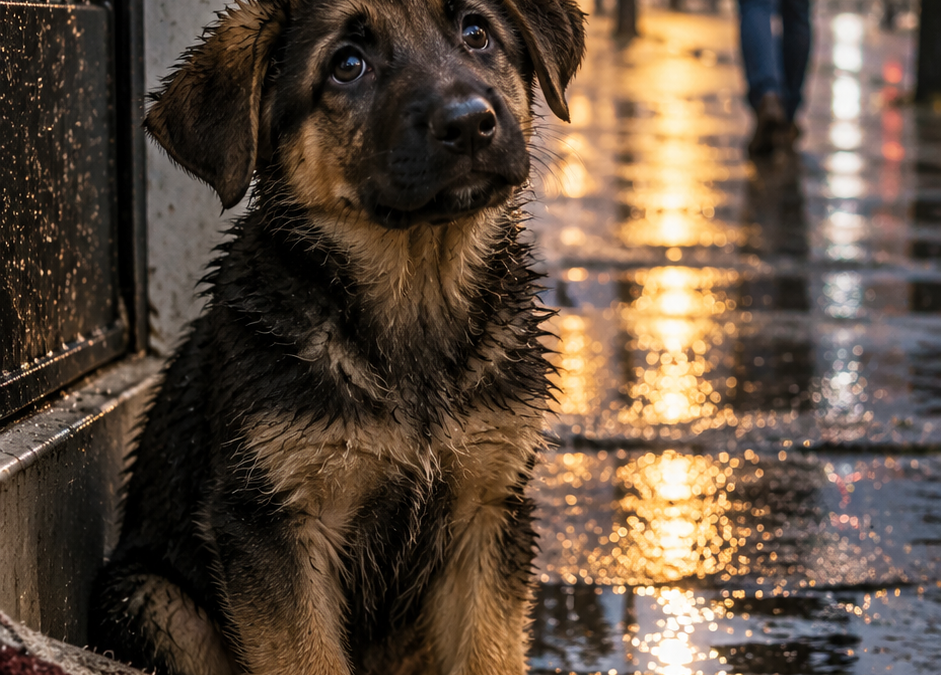
𝗣𝗔𝗥𝗧 𝟮
I stayed on that sidewalk longer than common sense recommended.
The cold worked quickly.
Within minutes, my fingers hurt.
Then they stopped hurting as much, which was worse.
I flexed them inside my gloves.
The puppy watched.
Every motion mattered.
If I shifted too fast, his shoulders jerked.
If a car horn sounded, he flinched.
If someone passed too close behind me, his eyes followed them until they disappeared.
This wasn’t ordinary caution.
This was a dog who expected people to hurt him.
I had never rescued a dog before.
I wasn’t trained in animal behavior.
I had no crate in my car.
No emergency blanket.
No special equipment.
I was just a man sitting beside groceries in freezing weather trying not to make a bad situation worse.
The puppy’s body trembled again.
Harder.
His jaw began chattering.
Clack.
Clack.
Clack.
The sound destroyed whatever hesitation I had left.
“Okay.”
I moved closer.
His eyes widened.
“I’m sorry, buddy.”
Another inch.
“I can’t wait anymore.”
His breathing accelerated.
“I know.”
I removed one glove so he could smell my hand.
I held it several inches from his nose.
He stared.
Then leaned forward the smallest amount.
Sniff.
Once.
He pulled back.
“Good.”
Again.
This time his nose brushed my fingertips.
Cold.
Almost shockingly cold.
“That’s enough.”
I moved my hand away.
His eyes followed it.
I looked at his paw.
The position made me sick.
Maybe broken.
Maybe crushed.
Maybe struck by a vehicle.
I had no way to know.
His pads were cracked.
There was dried blood near the nails.
He had clearly tried to move.
Maybe crawl.
Maybe follow someone.
Maybe escape something.
I looked down the street.
“Who did this to you?”
The puppy didn’t answer.
Of course.
But anger rose anyway.
Not wild anger.
Cold anger.
The kind that sits behind your ribs and refuses to leave.
How do you abandon a puppy in weather like this?
How do you watch a baby animal limp and decide somebody else will handle it?
How many people had seen him before I did?
Five?
Fifty?
A hundred?
The question was useless.
I turned back.
His eyes were starting to close.
“No.”
That frightened me.
“Hey.”
His eyes opened weakly.
“Stay with me.”
I slid closer.
He whimpered.
“I know.”
My hands went beneath his chest and hips.
The moment I lifted him, he made a soft cry.
Pain.
I nearly put him down.
But another gust hit us.
No.
We were done waiting.
“I’m sorry.”
I stood carefully.
His whole body stiffened.
Then something unexpected happened.
He pressed into me.
Not fighting.
Not struggling.
Just pressing.
His head slipped into the crook of my elbow.
His nose pushed against my wrist.
I froze.
For one second, I couldn’t breathe.
Maybe he wanted warmth.
Probably.
Maybe he was too weak to resist.
Possibly.
But his body settled against mine like something inside him had made a decision.
This human is frightening.
But the cold is worse.
I opened my coat and tucked him against my chest.
“You’re okay.”
The words came automatically.
They weren’t true yet.
But I wanted them to become true.
My apartment was only a few blocks away.
Instinct told me to go home.
Warm room.
Blankets.
Food.
My wife.
But that paw worried me.
So did his breathing.
So did the way he had nearly fallen asleep outside.
I pulled out my phone.
The screen barely responded to my fingers.
Veterinarian near me.
Ten-minute walk.
Normally nothing.
That afternoon it looked like crossing Illinois on foot.
I picked up my grocery bag with one hand.
Then dropped it again.
Forget the bread.
Forget the eggs.
I left everything beside the wall.
The puppy mattered more.
I began walking.
His heart hammered against my chest.
Fast.
Too fast.
“You need a name.”
I don’t know why I said it.
Maybe talking kept me from panicking.
He gave no response.
I looked at the trees along the street.
Their branches were bare.
A dead brown leaf scraped across the snow.
“Leaf.”
One ear twitched.
I almost laughed.
“Seriously?”
Another twitch.
“All right.”
I adjusted him.
“Leaf.”
His head remained tucked against me.
“It’s temporary.”
That was a lie too.
I didn’t know it yet.
We moved through the cold.
Every block felt twice as long.
I kept talking.
“You’re doing good.”
His breathing remained shallow.
“Almost there.”
I had no idea whether that was true.
“Don’t give up.”
A bus passed.
Warm exhaust washed briefly over us.
Leaf stirred.
“Yeah. Chicago public transit finally contributed something useful.”
No response.
“Tough audience.”
I crossed another street.
My arms were starting to ache.
He weighed almost nothing, but I had been holding him rigidly, afraid any movement would hurt his leg.
At last, I saw the veterinary sign.
I nearly cried from relief.
The clinic door felt impossibly heavy.
I shoved it open with my shoulder.
Warm air hit us.
Leaf moved.
Just a little.
The receptionist looked up.
Her expression changed instantly.
“Oh my God.”
“I found him outside.”
She stood.
“How long?”
“I don’t know.”
“Bring him back.”
No paperwork.
No insurance question.
No lecture.
Just movement.
I followed her through a door.
A veterinarian appeared.
Dr. Patel.
Late thirties.
Dark hair pulled back.
Calm face.
The sort of person whose calm makes you understand how serious things are.
“Put him here.”
The metal exam table made Leaf whimper.
I immediately kept one hand under his chest.
“He doesn’t like the surface.”
“We’ll get padding.”
A technician brought thick towels.
They placed him on top.
Dr. Patel touched his ears.
Gums.
Chest.
Paws.
Leaf trembled.
“What’s his temperature?”
The technician checked.
Then looked at the veterinarian.
Dr. Patel’s jaw tightened.
“How bad?” I asked.
“Severe hypothermia.”
My stomach dropped.
“Can you fix it?”
“We can treat it.”
That wasn’t the answer I wanted.
“Will he live?”
“We need to warm him slowly. Fluids. Monitor heart rhythm. We don’t know how long he was exposed.”
She examined the injured front leg.
Leaf cried.
I almost pulled her hand away.
Dr. Patel stopped immediately.
“Easy.”
Leaf looked at me.
His eyes seemed enormous.
“I’m here.”
Dr. Patel palpated carefully.
“Good news.”
I almost laughed at the phrase.
“What?”
“I don’t feel a fracture.”
“You’re sure?”
“We’ll image it, but this feels more like severe soft-tissue trauma. Contusion, maybe sprain.”
“So the leg heals?”
“Likely.”
“And the cold?”
“That’s the urgent part.”
The technician brought a warming blanket.
Another started preparing an IV.
Leaf tried to lift his head.
Failed.
I placed my hand beside his face.
He turned toward it.
His nose touched my palm.
“Hey.”
His eyes held mine.
There it was again.
That look.
Don’t leave.
I leaned closer.
“I’m not going anywhere.”
The technician shaved a small patch for the IV.
Leaf barely reacted.
That worried me more than if he had fought.
Dr. Patel saw my expression.
“We’re working on him.”
“He should be fighting more.”
“He’s exhausted.”
I swallowed.
“Another hour out there?”
Dr. Patel paused.
“Maybe less.”
I looked down.
Lucky.
People would later call him lucky.
I hated the word at first.
Nothing about his condition looked lucky.
But eventually I understood.
Luck wasn’t what had happened before I found him.
Luck was the moment after.
The door opening.
The clinic being close.
The receptionist moving quickly.
The IV sliding into place.
The heated blanket rising around him.
Maybe luck starts late sometimes.
Leaf’s heart rate steadied gradually.
His temperature began climbing.
Tenths of a degree.
Slow.
Controlled.
I sat beside him.
Twenty minutes.
Forty.
An hour.
Eventually Dr. Patel came over.
“He’s responding.”
I exhaled.
“Meaning?”
“Meaning I’m happier than I was sixty minutes ago.”
I nodded.
That was enough.
“For now.”
She gave me the look professionals give anxious people when they know every sentence will generate another question.
“We’ll keep him several hours.”
“Can I stay?”
“In the waiting room.”
“He doesn’t know anyone here.”
“He’ll be monitored constantly.”
I looked at Leaf.
His eyes were closed.
“What happens after?”
“If he remains stable, because he appears to be a stray, we’ll contact animal control and arrange shelter placement unless an owner is located.”
“Shelter.”
“Yes.”
The word landed strangely.
Of course.
Logical.
Responsible.
A shelter could scan for a chip.
Check lost-dog reports.
Handle legal ownership.
Place him with experienced fosters.
Everything about that answer made sense.
And I hated it.
I sat in the waiting room.
Outside, snow began falling again.
People came and went carrying cats.
Old dogs.
A rabbit in a carrier.
I stared through the small window in the treatment-room door whenever someone passed.
Eventually I called my wife.
She answered quickly.
“Michael?”
“Hey.”
“You’ve been gone forever. Where are you?”
“At a vet.”
Silence.
“What happened?”
“I found a dog.”
Another pause.
“What kind of dog?”
“German Shepherd puppy.”
“Are you hurt?”
“No.”
“Him?”
“Yes.”
My voice cracked unexpectedly.
I cleared my throat.
“He was outside. Freezing.”
“How bad?”
“They said another hour…”
I stopped.
My wife, Rachel, waited.
“What do you need?”
That question nearly undid me.
Not: Why did you get involved?
Not: How much will this cost?
Not: Are you bringing some strange dog home?
What do you need?
“I don’t know.”
“Okay.”
“They’re talking about shelter placement tonight.”
“And?”
I stared at the floor.
“I don’t know if I can do that.”
Rachel was quiet.
Then she said, “Then don’t decide based on what you think you’re supposed to do.”
“What does that mean?”
“It means if you think he belongs with us tonight, bring him home.”
I closed my eyes.
“You haven’t even seen him.”
“I’ve seen you.”
That was Rachel.
Simple sentences that left nowhere to hide.
“We have Jacob.”
“I know.”
“What if the puppy is scared of kids?”
“Then we keep them separated until we know more.”
“What if he needs expensive treatment?”
“Then we figure it out.”
“What if—”
“Michael.”
I stopped.
“Do what you think is right.”
I leaned back.
Through the treatment-room window, I could see part of Leaf’s blanket.
“Okay.”
When they finally let me see him again, evening had fallen.
The city outside had become blue-gray with snow and headlights.
Leaf looked even smaller under the blankets.
His front leg was wrapped.
The IV remained taped in place.
But he was awake.
I entered.
His head moved.
Those eyes found me immediately.
Not the nurse.
Not the door.
Me.
I crossed the room.
“Hey.”
Leaf’s nose lifted.
I placed my hand beside him.
He pressed his face into my palm.
Without hesitation.
The nurse smiled.
“Well.”
“What?”
“He’s been pretty shut down.”
I scratched gently beneath his chin.
“He recognizes warmth.”
“Maybe.”
She checked the fluids.
“We’re arranging shelter transfer later.”
I looked at her.
“Can that wait?”
She stopped.
“I want to foster him.”
The words came out before I could reconsider them.
“Tonight?”
“Yes.”
“You’ll need to coordinate through the proper process.”
“Fine.”
“Follow-up care.”
“Yes.”
“Quiet environment.”
“Yes.”
“He may have behavioral issues once he feels physically stronger.”
“Yes.”
“He may not be house-trained.”
“Okay.”
“You have other animals?”
“No.”
“Children?”
“An eight-year-old son.”
Her expression became serious.
“Then supervision will matter. We don’t know his history.”
“I understand.”
She studied me.
“You’ve thought about this?”
“For approximately six hours.”
“That’s not very long.”
“It feels like six years.”
She smiled faintly.
“I’ll talk to the doctor.”
The paperwork took longer than the decision.
Temporary foster agreement.
Contact information.
Medical discharge.
Follow-up appointment.
Instructions.
Keep warm.
Limit movement.
Small meals.
Watch for vomiting.
Check gum color.
Call immediately if breathing changes.
No unsupervised contact with Jacob.
Give Leaf space.
Let him approach.
Do not overwhelm him.
I listened as though someone were giving me instructions for defusing explosives.
Dr. Patel noticed.
“You don’t have to look terrified.”
“I am terrified.”
“That’s healthier than thinking you know everything.”
“Excellent.”
“He needs patience more than perfection.”
I looked at Leaf.
“I can do patience.”
I hoped I could.
They removed the IV.
Bundled him into a fleece blanket.
Dr. Patel handed him to me.
Leaf immediately curled inward against my chest.
The first time I carried him, his body had felt rigid.
Now he softened slightly.
Not fully.
But enough.
I whispered, “We’re going home.”
His eyes closed.
Outside, the cold hit us again.
I held him tighter.
A friend from work drove us because I had walked to the clinic.
I climbed into the back seat.
Leaf stayed in my arms.
Streetlights passed in slow intervals.
Chicago moved outside the windows.
Same city.
Same cold.
Different future.
When we pulled into the driveway, the porch light was on.
Rachel opened the door before I reached it.
She had probably been watching from the window.
Jacob stood several feet behind her in pajamas.
Rachel’s expression changed the second she saw Leaf.
“Oh, Michael.”
“I know.”
“He’s tiny.”
“He’s underweight.”
Jacob stepped forward.
I immediately held up one hand.
“Slow.”
He stopped.
“Is that him?”
“Yes.”
“Leaf?”
“You like the name?”
Jacob thought.
“Yeah.”
I crouched while still holding the puppy.
“This is important.”
Jacob’s face became serious.
“He’s scared.”
“Okay.”
“He’s hurt.”
“Okay.”
“He may not want you close.”
Jacob nodded.
“That doesn’t mean he doesn’t like you.”
“Okay.”
“It means we let him choose.”
Jacob looked at Leaf.
Then whispered, “Hi.”
Leaf’s ears moved.
Jacob smiled.
“That counts.”
We set up a bed near the fireplace.
Not too close.
Warm enough.
Blankets.
Water.
The clinic had sent home soft food.
Rachel heated a little low-sodium broth.
Leaf smelled it.
His nose lifted.
“Interested,” she whispered.
I held the bowl.
He licked once.
Then again.
Slow.
Jacob sat six feet away.
No one crowded him.
No one celebrated loudly.
We just watched a puppy drink something warm in a quiet house.
It felt strangely sacred.
Later, Jacob brought one of his stuffed animals.
A faded brown bear.
He placed it several feet from Leaf.
“What’s that?” I asked.
“So he has somebody when we sleep.”
I looked at my son.
“You know he has us.”
“I know.”
“Then why the bear?”
Jacob shrugged.
“In case he forgets.”
I had to look away.
That first night started peacefully.
Leaf slept beside our bed.
I refused to put him alone downstairs.
Rachel didn’t argue.
Around two in the morning, I woke to a sound.
Whimper.
Soft.
Then another.
I turned on the lamp.
Leaf was asleep.
But his body was moving.
Front legs twitching.
Head jerking.
His face tightened.
A tiny yelp escaped him.
“Rachel.”
She woke.
“What?”
“He’s dreaming.”
Leaf whimpered again.
Not ordinary puppy dreaming.
Panic.
His breathing sped up.
I slid from the bed.
“Leaf.”
No response.
I touched the blanket.
Not him.
“Buddy.”
His eyes flew open.
Wild.
He tried to stand.
The injured leg folded.
He cried.
“Easy.”
I froze.
Leaf looked around.
Bedroom.
Lamp.
Me.
His breathing came in gasps.
Then his eyes found my hand.
Slowly, he lowered his head.
Pressed his nose against my wrist.
The shaking began again.
Not from cold this time.
Memory.
At least that was how it looked.
I lay down on the floor beside him.
Rachel leaned over the edge of the mattress.
“You coming back up?”
“Eventually.”
She knew I wasn’t.
She handed me a blanket.
“Then don’t freeze.”
I stayed beside Leaf.
Every time the furnace turned on, he flinched.
Every time pipes clicked, his ears snapped upright.
Every creak became a threat.
I whispered the same thing all night.
“You’re safe.”
Again.
“You’re safe.”
Again.
“I’ve got you.”
At some point, his body moved closer.
His back touched my chest.
Then he slept.
Really slept.
By dawn, my neck hurt badly enough that I could barely turn my head.
I didn’t care.
Leaf was breathing slowly.
Steadily.
Safe.
The next morning brought our first real setback.
Food.
I placed a bowl down.
Leaf stared at it.
His body stiffened.
“Breakfast.”
Nothing.
I moved away.
Still nothing.
He looked at the bowl.
Then at me.
Fear.
Not disinterest.
Fear.
I sat.
“You’ve got to eat.”
Leaf backed away.
His tail disappeared beneath him.
I stopped.
“Okay.”
Rachel entered.
“What happened?”
“He’s afraid of the bowl.”
She looked.
“Maybe not the bowl.”
“What then?”
“Maybe the situation.”
I hated not knowing.
Had someone taken food away?
Punished him while eating?
Made him compete?
Starved him?
Every imagined answer was worse than the last.
Jacob entered wearing socks.
“Can I sit?”
I nodded.
“Over there.”
He sat several feet from Leaf.
No eye contact.
No reaching.
He simply leaned against the cabinet.
“It’s okay,” he said.
Leaf’s ears moved.
Jacob looked at me.
I touched one finger to my lips.
Wait.
Jacob waited.
Children are terrible at waiting until they understand why it matters.
Then they can become surprisingly good at it.
Leaf looked toward the food.
Then Jacob.
Food.
Jacob.
One step.
Pause.
Another.
He approached the bowl.
Sniffed.
Retreated.
Jacob whispered, “It’s yours.”
Leaf stopped.
“Dad?”
“Yeah?”
“Can I put some on the floor?”
“Slowly.”
Jacob took one piece of soft food.
Set it halfway between himself and Leaf.
Then pulled his hand back.
Leaf approached.
Ate it.
Another.
Jacob placed it closer to the bowl.
Leaf ate.
Again.
Within ten minutes, he reached the bowl.
He ate three bites.
Stopped.
Looked at us.
Nothing happened.
No one yelled.
No hand took it away.
No punishment came.
He ate again.
Rachel wiped her eyes.
I pretended not to notice.
That afternoon, Jacob held out his palm.
Leaf approached.
Nose touched skin.
Jacob’s eyes widened.
“Dad.”
I smiled.
“Don’t move.”
“He trusts me.”
“Maybe a little.”
Leaf sniffed again.
Then backed away.
Jacob whispered, “That’s okay.”
That was the right answer.
Trust was not a switch.
It was a collection of moments.
Hands that didn’t hit.
Bowls that stayed.
Doors that opened and the same people returned.
Voices that remained soft.
Nightmares that ended with someone still beside you.
The next evening, Jacob rolled a small red ball across the floor.
It stopped near Leaf’s paws.
Leaf stared.
Jacob waited.
Leaf touched it with one paw.
The ball moved.
He jumped.
Jacob almost laughed but caught himself.
Leaf looked at the ball.
Touched again.
It rolled.
This time he followed.
Three limping steps.
Tap.
Jacob whispered, “Good boy.”
Leaf looked at him.
Then—
His tail moved.
One tiny motion.
I stopped breathing.
Another.
Not much.
Two inches at most.
But a wag.
Rachel grabbed my hand.
Neither of us spoke.
Jacob smiled like he had just been handed the entire world.
“Dad.”
“I see it.”
“He’s happy.”
“Careful.”
I didn’t want to turn one tail wag into a burden.
Leaf was allowed to be complicated.
Allowed to be afraid tomorrow.
Allowed to go backward.
But yes.
For that second, something in him felt safe enough to move.
I crouched.
Leaf came toward me.
He leaned his shoulder against my knee.
His tail wagged once more.
“Hey, buddy.”
I scratched his neck.
“That’s what we’re working toward.”
Not perfect.
Not healed.
Safe.
The veterinary follow-up a week later brought more good news.
Leaf had gained weight.
His temperature was normal.
Bloodwork looked good.
The leg was improving.
Dr. Patel flexed it gently.
Leaf flinched but didn’t cry.
“No fracture,” she confirmed. “Severe contusion and soft tissue injury. Probably caused by blunt impact.”
“Vehicle?”
“Possible.”
“Person?”
“Also possible.”
I hated that.
“Will he always limp?”
“Probably not. Maybe slightly when tired for a while.”
Leaf leaned against my shoe.
Dr. Patel smiled.
“He seems attached.”
“That’s temporary.”
She looked at me.
I looked at Leaf.
Leaf looked at me.
Dr. Patel raised an eyebrow.
“Very temporary.”
I laughed.
By then I knew.
The foster paperwork had always been fiction.
Not legally.
Emotionally.
Leaf was ours.
We still had to follow the formal process.
No microchip had been found.
No credible owner came forward.
Required stray-hold procedures passed.
The shelter contacted us.
“Do you want to continue fostering?”
I answered too quickly.
“Yes.”
The woman laughed.
“And if he becomes available for adoption?”
“Yes.”
“I haven’t asked the question yet.”
“Yes.”
There was a pause.
“You want to adopt him.”
“Very much.”
Weeks passed.
Leaf became more puppy every day.
That sounds strange.
But trauma had hidden his age.
At first, he seemed ancient.
Still.
Watchful.
Exhausted.
Then the real puppy emerged.
He stole socks.
He discovered that toilet paper could be unrolled through three rooms.
He attempted to eat one of Jacob’s homework sheets.
Jacob insisted this was excellent because “the dog ate my homework” was finally a true excuse.
Rachel was less impressed.
Leaf barked at a snowman.
Then tried to make friends with it.
The snowman did not reciprocate.
He discovered stairs.
Then forgot how stairs worked halfway down and slid the remaining six steps on his chest.
He stood up looking offended.
Jacob laughed so hard he fell onto the floor.
Leaf attacked him with kisses.
That was the first time I saw him fully play.
No checking the exits.
No stopping every few seconds at a noise.
Just joy.
His leg strengthened.
The limp became smaller.
Then appeared only after heavy activity.
We followed physical-rest instructions carefully.
Leaf disagreed enthusiastically.
“You are recovering,” I told him.
He brought me the red ball.
“No.”
Ball in my lap.
“No.”
Ball again.
“Leaf.”
Tail wag.
“You’re manipulative.”
Jacob shouted from the hallway, “That means he’s smart!”
“Homework!”
Silence.
Leaf and I exchanged a look.
“Children.”
His ears moved.
The nightmares took longer.
Some nights were good.
Some weren’t.
He would wake suddenly.
Panting.
Eyes searching.
At first, I slept on the floor with him every time.
Then Dr. Patel suggested something important.
“Comfort him, but don’t teach him that panic is required to get closeness.”
That made sense.
So we developed a routine.
Leaf woke.
I spoke.
“Leaf.”
He looked.
“You’re home.”
Same words every time.
Not frantic.
Not overly emotional.
Home.
Eventually, he learned the phrase.
I knew because months later, during a thunderstorm, he woke frightened.
I said, “You’re home.”
His muscles softened.
He laid his head back down.
Words can become places.
For Leaf, home became one.
Jacob became his person.
I was the one who found him.
Fed him.
Took him to appointments.
Trained him.
But Jacob?
Jacob was chosen.
Leaf waited outside his bedroom every morning.
Walked him to the front door before school.
Listened for the school bus in the afternoon.
The moment Jacob came home, Leaf ran.
At first with a limp.
Then without one.
Jacob dropped his backpack.
Leaf nearly knocked him over.
I pretended to discourage it.
“Four paws on the floor.”
Leaf ignored me.
Jacob hugged him.
“Four paws.”
Two paws came down.
Progress.
At night, Leaf began sleeping outside Jacob’s room.
Then inside.
We put a dog bed near the wall.
Leaf ignored it.
Preferred the rug.
Then the foot of Jacob’s bed.
Then, one morning, I found him stretched beside my son with his head on the pillow.
“Absolutely not.”
Jacob opened one eye.
“He was cold.”
“This dog has more fur than everyone in this house combined.”
Leaf yawned.
Rachel appeared behind me.
“Take a picture before you move him.”
I looked at her.
“Whose side are you on?”
She took out her phone.
“Not yours.”
We never successfully removed Leaf from Jacob’s bed.
That battle ended before it began.
Three weeks after I found him, snow fell heavily overnight.
The next morning, Leaf stood at the back door.
I opened it.
He saw snow.
His body froze.
Not cold.
Memory.
He backed up.
I closed the door.
No forcing.
I crouched.
“That’s okay.”
Jacob came down.
“What’s wrong?”
“Snow.”
Jacob understood immediately.
“Oh.”
We stood with Leaf inside.
Jacob put on his coat.
Opened the door.
Stepped outside alone.
Leaf watched.
Jacob scooped up snow.
Made a small ball.
Dropped it.
Leaf tilted his head.
Jacob kicked snow.
Powder flew.
Leaf’s ears lifted.
Then Jacob did something brilliant.
He rolled the red ball into the snow.
Leaf’s entire body leaned forward.
Ball.
Snow.
Trauma.
Ball.
He made a decision.
One paw outside.
Back inside.
Again.
Paw.
Then two.
He stepped onto the porch.
The snow crunched.
Leaf jumped.
Jacob laughed softly.
“Come on.”
Leaf walked farther.
Ten feet.
Twenty.
Then Jacob threw the ball.
Leaf ran.
The first few strides were stiff.
Then something released.
He charged through the snow.
Black-and-tan body against white.
He found the ball.
Buried his nose.
Came up with snow across his face.
Jacob laughed.
Leaf barked.
Then ran in circles.
I stood inside the doorway.
Rachel beside me.
My eyes burned.
“That sidewalk,” I whispered.
She took my hand.
“I know.”
Same cold.
Different meaning.
That is healing.
Not erasing.
Changing what comes after.
Leaf spent twenty minutes in the yard.
When he came inside, snow melted onto the floor.
Rachel complained.
Jacob towel-dried him.
Leaf shook water onto everyone.
Chaos.
Warmth.
Home.
The formal adoption became final in February.
The paperwork was almost insultingly ordinary.
Name.
Address.
Vaccination plan.
Registration.
Microchip.
Agreement.
Signature.
I stared at the line labeled Animal Name.
LEAF DELANEY.
I laughed.
The shelter worker looked at me.
“What?”
“Nothing.”
“You okay?”
“Yeah.”
I signed.
Official.
Leaf had a last name.
More importantly, nobody could take him somewhere else simply because paperwork said he was temporary.
I brought the certificate home.
Jacob read it.
“He’s really ours?”
“He has been for a while.”
“But forever?”
I looked at Leaf.
He sat beside Jacob, one ear tilted.
“Yes.”
Jacob hugged him.
“Forever.”
That word frightened me slightly.
Forever is a dangerous promise.
Life doesn’t always cooperate.
But what we meant was simple.
For as long as Leaf had us, we would not abandon him.
That was something we could promise.
Months later, I walked with Leaf past the street where I had found him.
I didn’t plan it.
We had been working on leash training.
He was bigger now.
Strong.
Healthy.
Coat shiny.
The injured leg almost perfect.
Then I recognized the wall.
My pace slowed.
Leaf noticed.
He sniffed the sidewalk.
Did he remember?
I don’t know.
Dogs remember through smell and association in ways we can only partially understand.
He stopped near the exact spot.
My stomach tightened.
Cars passed.
People walked.
Same city.
He sniffed once.
Twice.
Then looked up at me.
Those brown eyes.
Same eyes.
Different dog.
“Hey.”
His tail wagged.
I crouched.
“This is where you found me.”
Technically inaccurate.
But emotionally true.
Leaf leaned into me.
I scratched his chest.
A man walked past carrying coffee.
For one second, I remembered the person who had called Leaf just a stray.
I wanted to be angry.
Maybe part of me still was.
But Leaf didn’t care.
He wasn’t living in that moment anymore.
Why should I force him back into it?
I stood.
“Come on.”
We walked home.
Leaf didn’t look back.
That became important to me.
He didn’t look back.
At the wall.
At the cold place.
At whatever had happened before.
Forward.
Home.
Jacob.
Rachel.
Warm floors.
Red ball.
Dinner.
Bed.
The world he had now.
A year later, Leaf weighed seventy-four pounds.
The tiny freezing puppy was gone.
In his place stood a beautiful German Shepherd with a broad chest, bright eyes, and an alarming ability to locate cheese from two rooms away.
He still had quirks.
Metal bowls made him uncomfortable.
We used ceramic.
Raised voices bothered him.
We kept conflict calm.
Someone approaching too quickly could make him step backward.
We respected that.
He loved children.
Especially Jacob.
He hated the vacuum cleaner with a passion that suggested ancestral conflict.
Snow became his favorite thing.
Every winter, when the first storm arrived, Leaf sat at the back door waiting.
The dog who had once almost died from cold now demanded to run through it.
Life contains strange poetry.
I became more aware of animals after Leaf.
Not in some grand heroic way.
I simply started noticing.
The dog tied outside a store too long.
The cat beneath a parked car.
The lost-dog flyer.
The frightened animal somebody else might dismiss as inconvenient.
Leaf had changed the way I looked.
Before him, I probably believed cruelty was something committed only by obviously terrible people.
After him, I understood indifference could be cruel too.
Walking past.
Assuming somebody else will help.
Reducing suffering to “not my problem.”
I almost did that.
That truth kept me humble.
I was not better than every person on that sidewalk.
I simply stopped.
One moment.
One decision.
That was all.
Leaf never knew any of this.
He did not know he represented some moral lesson.
He had no interest in symbolism.
He wanted breakfast.
Walks.
Jacob.
His red ball, eventually replaced six times because German Shepherd jaws are not known for respecting sentimentality.
And the corner of our couch Rachel claimed he wasn’t allowed on.
He was absolutely allowed on it.
We all knew.
One night, maybe eighteen months after his rescue, I woke around two.
Same hour as those first nightmares.
I automatically looked toward the foot of the bed.
Empty.
My heart jumped.
Then I remembered.
Leaf slept with Jacob now.
I walked down the hall.
The bedroom door was partly open.
Leaf was curled against my son.
Jacob’s hand rested on his back.
Both asleep.
No whimpering.
No twitching.
No panic.
Leaf’s breathing was slow.
Deep.
Safe.
I stood there for a long time.
That first night, I had lain on a hardwood floor telling him:
You’re safe.
You’re home.
I wondered when the words stopped being reassurance and became facts.
Maybe there wasn’t one moment.
Maybe home is built through repetition.
Breakfast appearing every morning.
The same people returning.
The door closing without trapping you.
Hands reaching without hurting.
Being sick and cared for.
Being scared and not punished.
Falling asleep.
Waking up.
Everyone still there.
Again.
Again.
Again.
Until one day your body finally believes what your mind has been too afraid to trust.
I closed Jacob’s door quietly.
Leaf opened one eye.
He saw me.
His tail tapped the mattress once.
Then his eye closed.
No need to follow.
He knew I wasn’t leaving.
That may have been the greatest change of all.
Years passed.
Jacob grew taller.
Leaf developed gray around his muzzle.
I did too.
The puppy became the dog our neighborhood children knew by name.
People would call from across the sidewalk.
“Leaf!”
His tail went wild.
Nobody saw the animal I had first seen.
That was okay.
I remembered for him.
Sometimes I still thought about that afternoon.
Below zero.
Salt on the pavement.
His twisted paw.
Frost along his eyelashes.
The man saying, “Just a stray.”
I would look at Leaf sleeping across our living-room floor and think how little we understand about the lives we dismiss.
Just a stray.
No.
He was Jacob’s best friend.
Rachel’s shadow in the kitchen.
My walking companion.
The first sound we heard when someone approached the house.
The warm body beside us during winter storms.
The dog who somehow knew when one of us was sad and would quietly place his head on a knee.
A whole life existed inside the puppy people had stepped around.
They simply hadn’t stopped long enough to see it.
I used to say I saved Leaf.
I don’t anymore.
Saving sounds like one action.
I picked him up.
Took him to a veterinarian.
Brought him home.
Important things.
But rescue lasted much longer than that.
Rescue was Jacob sitting silently on the kitchen floor.
Rachel warming broth.
Dr. Patel treating hypothermia.
The shelter employee guiding us through foster paperwork.
Weeks of patience.
Months of training.
Hundreds of ordinary mornings.
Leaf also participated in his own rescue.
That matters.
He chose to sniff my hand.
He chose to lean into my arms.
He chose to approach Jacob.
He chose the food bowl.
The ball.
The snow.
The world again.
We gave him opportunities.
He did the brave part.
Trusting after fear may be one of the hardest things any living creature does.
Leaf did it inch by inch.
Years later, on one bitter Chicago morning, I stood outside with him while snow fell around us.
He was older.
Slower.
Still beautiful.
Jacob was away at college.
Leaf missed him badly whenever he left.
I threw the newest version of the red ball.
Leaf ran.
Not as fast.
He picked it up.
Returned.
Dropped it at my feet.
“Again?”
His tail moved.
I threw.
He chased.
Snow clung to his muzzle.
I remembered his face against that wall.
The trembling.
The desperate eyes.
Don’t leave me too.
I crouched when he came back.
Leaf pressed his forehead against my chest.
My hands moved through thick warm fur.
“You worried for nothing.”
His ear turned.
“We stayed.”
Tail.
“You stayed too.”
He leaned harder.
The cold wind moved around us.
Chicago traffic sounded in the distance.
But Leaf wasn’t shivering.
He wasn’t alone.
He wasn’t waiting for someone to notice him.
He knew where the back door was.
He knew where his bowl sat.
He knew which bedroom belonged to Jacob.
He knew Rachel kept treats in the cabinet above the refrigerator.
He knew the couch was his despite official family propaganda.
He knew my footsteps.
My voice.
My hands.
Most of all, he knew something the puppy on the frozen sidewalk could not have imagined.
When night came, nobody was going to leave him outside.
I picked up the ball.
“Come on.”
Leaf followed me toward the house.
At the door, he paused and looked back at the snow.
For a moment, he stood there between two worlds.
Cold behind him.
Warmth ahead.
Then he walked inside.
The door closed.
Leaf shook snow across the entryway.
Rachel shouted from the kitchen.
“Michael!”
“It was the dog.”
Leaf looked at me.
I looked at him.
We had been blaming each other for years.
Fair partnership.
He trotted toward the kitchen.
I followed.
And as I watched that once-frozen German Shepherd disappear around the corner toward the people he loved, I thought about the question his eyes had asked me on that first afternoon.
Don’t leave me too.
I wish I could go back and answer him sooner.
Not with the frightened promise I made while he lay on a veterinary table.
With everything I know now.
I would kneel beside that shaking puppy, look directly into those exhausted brown eyes, and tell him exactly what came next.
No.
I’m not leaving.
Not today.
Not when you wake up afraid at two in the morning.
Not when food scares you.
Not when your leg hurts.
Not when trusting us feels impossible.
Not when you make mistakes.
Not when healing takes longer than we hope.
You are not going back to that sidewalk.
You are not disposable.
You are not “just a stray.”
You are Leaf.
And you are coming home.
Have you finished reading the story and want to read it again?
His Eyes Said, “Don’t Leave Me Too”—I Found Him Freezing on a Chicago Sidewalk
Everyone else kept walking.
He was running out of time.
Then he looked straight at me.
My name is Michael Delaney, and I was forty-two the afternoon I found a German Shepherd puppy curled against a brick wall on a frozen Chicago sidewalk.
I had left home for bread and eggs.
That was it.
Nothing heroic.
Nothing planned.
The temperature had dropped below zero, the kind of Chicago cold that turned every breath into smoke and made the wind feel sharp enough to cut through wool. Salt whitened the edges of the sidewalk. Cars hissed over slush. People walked quickly with coffee cups tucked beneath gloved hands, shoulders raised against the wind.
I almost passed him too.
That is the part I still hate admitting.
At first, he looked like a dark pile of dirty fabric against the wall.
Then the pile moved.
A head lifted.
Two oversized ears.
Black-and-tan fur.
A face much too young to look that tired.
I stopped.
The puppy was maybe four or five months old.
He was trembling so violently I could hear his teeth clicking together even over the traffic.
His ribs showed beneath a coat matted with road salt, dirt, and something dark that looked like dried blood. His front paw was twisted inward, held several inches above the pavement.
He had been crying.
I could see it in the wet tracks beneath his eyes.
And when he looked at me, I swear I heard words even though his mouth never opened.
Don’t leave me too.
A woman walked past carrying shopping bags.
She glanced down.
Kept going.
A couple stepped around him.
Neither stopped.
Then a man with a phone pressed to his ear looked at the puppy and muttered, “Just a stray.”
Just a stray.
As if those three words turned suffering into background scenery.
As if being unwanted somehow meant the cold hurt less.
I crouched several feet away.
The puppy’s entire body tightened.
“Hey.”
His ears moved.
“That’s all right.”
I put the grocery bag down.
Bread.
Eggs.
Some canned soup.
Completely ridiculous things to be carrying while a living creature froze in front of me.
“I’m not going to hurt you.”
His eyes stayed locked on mine.
He didn’t bark.
Didn’t growl.
Didn’t run.
At first, I thought that was encouraging.
Then I realized he might simply be too weak.
A gust of wind tore through the street.
Paper skittered along the curb.
The puppy whimpered and curled tighter.
My chest hurt.
I removed my scarf.
Slowly, I laid it on the pavement between us.
He flinched.
I stopped moving.
“Okay.”
He stared at the scarf.
Then at me.
His breathing came in ragged little clouds.
I moved one hand forward.
Palm open.
“You don’t know me.”
His nose twitched.
“That’s fair.”
Another inch.
“But I can’t leave you here.”
The puppy looked at my hand as though hands were complicated things.
Something to fear.
Something he might remember being gentle once.
I sat down on the icy pavement.
Cold immediately pushed through my jeans.
I didn’t care.
For several minutes, neither of us moved.
People continued passing.
Traffic continued.
Chicago continued.
But the world had narrowed to one frightened puppy and one decision.
Stay.
Or walk away like everybody else.
I looked into those exhausted brown eyes.
“I’m staying.”
His ears twitched.
And somewhere beneath the fear, I saw the smallest flicker of something that looked almost like hope.
PART2
I stayed on that sidewalk longer than common sense recommended.
The cold worked quickly.
Within minutes, my fingers hurt.
Then they stopped hurting as much, which was worse.
I flexed them inside my gloves.
The puppy watched.
Every motion mattered.
If I shifted too fast, his shoulders jerked.
If a car horn sounded, he flinched.
If someone passed too close behind me, his eyes followed them until they disappeared.
This wasn’t ordinary caution.
This was a dog who expected people to hurt him.
I had never rescued a dog before.
I wasn’t trained in animal behavior.
I had no crate in my car.
No emergency blanket.
No special equipment.
I was just a man sitting beside groceries in freezing weather trying not to make a bad situation worse.
The puppy’s body trembled again.
Harder.
His jaw began chattering.
Clack.
Clack.
Clack.
The sound destroyed whatever hesitation I had left.
“Okay.”
I moved closer.
His eyes widened.
“I’m sorry, buddy.”
Another inch.
“I can’t wait anymore.”
His breathing accelerated.
“I know.”
I removed one glove so he could smell my hand.
I held it several inches from his nose.
He stared.
Then leaned forward the smallest amount.
Sniff.
Once.
He pulled back.
“Good.”
Again.
This time his nose brushed my fingertips.
Cold.
Almost shockingly cold.
“That’s enough.”
I moved my hand away.
His eyes followed it.
I looked at his paw.
The position made me sick.
Maybe broken.
Maybe crushed.
Maybe struck by a vehicle.
I had no way to know.
His pads were cracked.
There was dried blood near the nails.
He had clearly tried to move.
Maybe crawl.
Maybe follow someone.
Maybe escape something.
I looked down the street.
“Who did this to you?”
The puppy didn’t answer.
Of course.
But anger rose anyway.
Not wild anger.
Cold anger.
The kind that sits behind your ribs and refuses to leave.
How do you abandon a puppy in weather like this?
How do you watch a baby animal limp and decide somebody else will handle it?
How many people had seen him before I did?
Five?
Fifty?
A hundred?
The question was useless.
I turned back.
His eyes were starting to close.
“No.”
That frightened me.
“Hey.”
His eyes opened weakly.
“Stay with me.”
I slid closer.
He whimpered.
“I know.”
My hands went beneath his chest and hips.
The moment I lifted him, he made a soft cry.
Pain.
I nearly put him down.
But another gust hit us.
No.
We were done waiting.
“I’m sorry.”
I stood carefully.
His whole body stiffened.
Then something unexpected happened.
He pressed into me.
Not fighting.
Not struggling.
Just pressing.
His head slipped into the crook of my elbow.
His nose pushed against my wrist.
I froze.
For one second, I couldn’t breathe.
Maybe he wanted warmth.
Probably.
Maybe he was too weak to resist.
Possibly.
But his body settled against mine like something inside him had made a decision.
This human is frightening.
But the cold is worse.
I opened my coat and tucked him against my chest.
“You’re okay.”
The words came automatically.
They weren’t true yet.
But I wanted them to become true.
My apartment was only a few blocks away.
Instinct told me to go home.
Warm room.
Blankets.
Food.
My wife.
But that paw worried me.
So did his breathing.
So did the way he had nearly fallen asleep outside.
I pulled out my phone.
The screen barely responded to my fingers.
Veterinarian near me.
Ten-minute walk.
Normally nothing.
That afternoon it looked like crossing Illinois on foot.
I picked up my grocery bag with one hand.
Then dropped it again.
Forget the bread.
Forget the eggs.
I left everything beside the wall.
The puppy mattered more.
I began walking.
His heart hammered against my chest.
Fast.
Too fast.
“You need a name.”
I don’t know why I said it.
Maybe talking kept me from panicking.
He gave no response.
I looked at the trees along the street.
Their branches were bare.
A dead brown leaf scraped across the snow.
“Leaf.”
One ear twitched.
I almost laughed.
“Seriously?”
Another twitch.
“All right.”
I adjusted him.
“Leaf.”
His head remained tucked against me.
“It’s temporary.”
That was a lie too.
I didn’t know it yet.
We moved through the cold.
Every block felt twice as long.
I kept talking.
“You’re doing good.”
His breathing remained shallow.
“Almost there.”
I had no idea whether that was true.
“Don’t give up.”
A bus passed.
Warm exhaust washed briefly over us.
Leaf stirred.
“Yeah. Chicago public transit finally contributed something useful.”
No response.
“Tough audience.”
I crossed another street.
My arms were starting to ache.
He weighed almost nothing, but I had been holding him rigidly, afraid any movement would hurt his leg.
At last, I saw the veterinary sign.
I nearly cried from relief.
The clinic door felt impossibly heavy.
I shoved it open with my shoulder.
Warm air hit us.
Leaf moved.
Just a little.
The receptionist looked up.
Her expression changed instantly.
“Oh my God.”
“I found him outside.”
She stood.
“How long?”
“I don’t know.”
“Bring him back.”
No paperwork.
No insurance question.
No lecture.
Just movement.
I followed her through a door.
A veterinarian appeared.
Dr. Patel.
Late thirties.
Dark hair pulled back.
Calm face.
The sort of person whose calm makes you understand how serious things are.
“Put him here.”
The metal exam table made Leaf whimper.
I immediately kept one hand under his chest.
“He doesn’t like the surface.”
“We’ll get padding.”
A technician brought thick towels.
They placed him on top.
Dr. Patel touched his ears.
Gums.
Chest.
Paws.
Leaf trembled.
“What’s his temperature?”
The technician checked.
Then looked at the veterinarian.
Dr. Patel’s jaw tightened.
“How bad?” I asked.
“Severe hypothermia.”
My stomach dropped.
“Can you fix it?”
“We can treat it.”
That wasn’t the answer I wanted.
“Will he live?”
“We need to warm him slowly. Fluids. Monitor heart rhythm. We don’t know how long he was exposed.”
She examined the injured front leg.
Leaf cried.
I almost pulled her hand away.
Dr. Patel stopped immediately.
“Easy.”
Leaf looked at me.
His eyes seemed enormous.
“I’m here.”
Dr. Patel palpated carefully.
“Good news.”
I almost laughed at the phrase.
“What?”
“I don’t feel a fracture.”
“You’re sure?”
“We’ll image it, but this feels more like severe soft-tissue trauma. Contusion, maybe sprain.”
“So the leg heals?”
“Likely.”
“And the cold?”
“That’s the urgent part.”
The technician brought a warming blanket.
Another started preparing an IV.
Leaf tried to lift his head.
Failed.
I placed my hand beside his face.
He turned toward it.
His nose touched my palm.
“Hey.”
His eyes held mine.
There it was again.
That look.
Don’t leave.
I leaned closer.
“I’m not going anywhere.”
The technician shaved a small patch for the IV.
Leaf barely reacted.
That worried me more than if he had fought.
Dr. Patel saw my expression.
“We’re working on him.”
“He should be fighting more.”
“He’s exhausted.”
I swallowed.
“Another hour out there?”
Dr. Patel paused.
“Maybe less.”
I looked down.
Lucky.
People would later call him lucky.
I hated the word at first.
Nothing about his condition looked lucky.
But eventually I understood.
Luck wasn’t what had happened before I found him.
Luck was the moment after.
The door opening.
The clinic being close.
The receptionist moving quickly.
The IV sliding into place.
The heated blanket rising around him.
Maybe luck starts late sometimes.
Leaf’s heart rate steadied gradually.
His temperature began climbing.
Tenths of a degree.
Slow.
Controlled.
I sat beside him.
Twenty minutes.
Forty.
An hour.
Eventually Dr. Patel came over.
“He’s responding.”
I exhaled.
“Meaning?”
“Meaning I’m happier than I was sixty minutes ago.”
I nodded.
That was enough.
“For now.”
She gave me the look professionals give anxious people when they know every sentence will generate another question.
“We’ll keep him several hours.”
“Can I stay?”
“In the waiting room.”
“He doesn’t know anyone here.”
“He’ll be monitored constantly.”
I looked at Leaf.
His eyes were closed.
“What happens after?”
“If he remains stable, because he appears to be a stray, we’ll contact animal control and arrange shelter placement unless an owner is located.”
“Shelter.”
“Yes.”
The word landed strangely.
Of course.
Logical.
Responsible.
A shelter could scan for a chip.
Check lost-dog reports.
Handle legal ownership.
Place him with experienced fosters.
Everything about that answer made sense.
And I hated it.
I sat in the waiting room.
Outside, snow began falling again.
People came and went carrying cats.
Old dogs.
A rabbit in a carrier.
I stared through the small window in the treatment-room door whenever someone passed.
Eventually I called my wife.
She answered quickly.
“Michael?”
“Hey.”
“You’ve been gone forever. Where are you?”
“At a vet.”
Silence.
“What happened?”
“I found a dog.”
Another pause.
“What kind of dog?”
“German Shepherd puppy.”
“Are you hurt?”
“No.”
“Him?”
“Yes.”
My voice cracked unexpectedly.
I cleared my throat.
“He was outside. Freezing.”
“How bad?”
“They said another hour…”
I stopped.
My wife, Rachel, waited.
“What do you need?”
That question nearly undid me.
Not: Why did you get involved?
Not: How much will this cost?
Not: Are you bringing some strange dog home?
What do you need?
“I don’t know.”
“Okay.”
“They’re talking about shelter placement tonight.”
“And?”
I stared at the floor.
“I don’t know if I can do that.”
Rachel was quiet.
Then she said, “Then don’t decide based on what you think you’re supposed to do.”
“What does that mean?”
“It means if you think he belongs with us tonight, bring him home.”
I closed my eyes.
“You haven’t even seen him.”
“I’ve seen you.”
That was Rachel.
Simple sentences that left nowhere to hide.
“We have Jacob.”
“I know.”
“What if the puppy is scared of kids?”
“Then we keep them separated until we know more.”
“What if he needs expensive treatment?”
“Then we figure it out.”
“What if—”
“Michael.”
I stopped.
“Do what you think is right.”
I leaned back.
Through the treatment-room window, I could see part of Leaf’s blanket.
“Okay.”
When they finally let me see him again, evening had fallen.
The city outside had become blue-gray with snow and headlights.
Leaf looked even smaller under the blankets.
His front leg was wrapped.
The IV remained taped in place.
But he was awake.
I entered.
His head moved.
Those eyes found me immediately.
Not the nurse.
Not the door.
Me.
I crossed the room.
“Hey.”
Leaf’s nose lifted.
I placed my hand beside him.
He pressed his face into my palm.
Without hesitation.
The nurse smiled.
“Well.”
“What?”
“He’s been pretty shut down.”
I scratched gently beneath his chin.
“He recognizes warmth.”
“Maybe.”
She checked the fluids.
“We’re arranging shelter transfer later.”
I looked at her.
“Can that wait?”
She stopped.
“I want to foster him.”
The words came out before I could reconsider them.
“Tonight?”
“Yes.”
“You’ll need to coordinate through the proper process.”
“Fine.”
“Follow-up care.”
“Yes.”
“Quiet environment.”
“Yes.”
“He may have behavioral issues once he feels physically stronger.”
“Yes.”
“He may not be house-trained.”
“Okay.”
“You have other animals?”
“No.”
“Children?”
“An eight-year-old son.”
Her expression became serious.
“Then supervision will matter. We don’t know his history.”
“I understand.”
She studied me.
“You’ve thought about this?”
“For approximately six hours.”
“That’s not very long.”
“It feels like six years.”
She smiled faintly.
“I’ll talk to the doctor.”
The paperwork took longer than the decision.
Temporary foster agreement.
Contact information.
Medical discharge.
Follow-up appointment.
Instructions.
Keep warm.
Limit movement.
Small meals.
Watch for vomiting.
Check gum color.
Call immediately if breathing changes.
No unsupervised contact with Jacob.
Give Leaf space.
Let him approach.
Do not overwhelm him.
I listened as though someone were giving me instructions for defusing explosives.
Dr. Patel noticed.
“You don’t have to look terrified.”
“I am terrified.”
“That’s healthier than thinking you know everything.”
“Excellent.”
“He needs patience more than perfection.”
I looked at Leaf.
“I can do patience.”
I hoped I could.
They removed the IV.
Bundled him into a fleece blanket.
Dr. Patel handed him to me.
Leaf immediately curled inward against my chest.
The first time I carried him, his body had felt rigid.
Now he softened slightly.
Not fully.
But enough.
I whispered, “We’re going home.”
His eyes closed.
Outside, the cold hit us again.
I held him tighter.
A friend from work drove us because I had walked to the clinic.
I climbed into the back seat.
Leaf stayed in my arms.
Streetlights passed in slow intervals.
Chicago moved outside the windows.
Same city.
Same cold.
Different future.
When we pulled into the driveway, the porch light was on.
Rachel opened the door before I reached it.
She had probably been watching from the window.
Jacob stood several feet behind her in pajamas.
Rachel’s expression changed the second she saw Leaf.
“Oh, Michael.”
“I know.”
“He’s tiny.”
“He’s underweight.”
Jacob stepped forward.
I immediately held up one hand.
“Slow.”
He stopped.
“Is that him?”
“Yes.”
“Leaf?”
“You like the name?”
Jacob thought.
“Yeah.”
I crouched while still holding the puppy.
“This is important.”
Jacob’s face became serious.
“He’s scared.”
“Okay.”
“He’s hurt.”
“Okay.”
“He may not want you close.”
Jacob nodded.
“That doesn’t mean he doesn’t like you.”
“Okay.”
“It means we let him choose.”
Jacob looked at Leaf.
Then whispered, “Hi.”
Leaf’s ears moved.
Jacob smiled.
“That counts.”
We set up a bed near the fireplace.
Not too close.
Warm enough.
Blankets.
Water.
The clinic had sent home soft food.
Rachel heated a little low-sodium broth.
Leaf smelled it.
His nose lifted.
“Interested,” she whispered.
I held the bowl.
He licked once.
Then again.
Slow.
Jacob sat six feet away.
No one crowded him.
No one celebrated loudly.
We just watched a puppy drink something warm in a quiet house.
It felt strangely sacred.
Later, Jacob brought one of his stuffed animals.
A faded brown bear.
He placed it several feet from Leaf.
“What’s that?” I asked.
“So he has somebody when we sleep.”
I looked at my son.
“You know he has us.”
“I know.”
“Then why the bear?”
Jacob shrugged.
“In case he forgets.”
I had to look away.
That first night started peacefully.
Leaf slept beside our bed.
I refused to put him alone downstairs.
Rachel didn’t argue.
Around two in the morning, I woke to a sound.
Whimper.
Soft.
Then another.
I turned on the lamp.
Leaf was asleep.
But his body was moving.
Front legs twitching.
Head jerking.
His face tightened.
A tiny yelp escaped him.
“Rachel.”
She woke.
“What?”
“He’s dreaming.”
Leaf whimpered again.
Not ordinary puppy dreaming.
Panic.
His breathing sped up.
I slid from the bed.
“Leaf.”
No response.
I touched the blanket.
Not him.
“Buddy.”
His eyes flew open.
Wild.
He tried to stand.
The injured leg folded.
He cried.
“Easy.”
I froze.
Leaf looked around.
Bedroom.
Lamp.
Me.
His breathing came in gasps.
Then his eyes found my hand.
Slowly, he lowered his head.
Pressed his nose against my wrist.
The shaking began again.
Not from cold this time.
Memory.
At least that was how it looked.
I lay down on the floor beside him.
Rachel leaned over the edge of the mattress.
“You coming back up?”
“Eventually.”
She knew I wasn’t.
She handed me a blanket.
“Then don’t freeze.”
I stayed beside Leaf.
Every time the furnace turned on, he flinched.
Every time pipes clicked, his ears snapped upright.
Every creak became a threat.
I whispered the same thing all night.
“You’re safe.”
Again.
“You’re safe.”
Again.
“I’ve got you.”
At some point, his body moved closer.
His back touched my chest.
Then he slept.
Really slept.
By dawn, my neck hurt badly enough that I could barely turn my head.
I didn’t care.
Leaf was breathing slowly.
Steadily.
Safe.
The next morning brought our first real setback.
Food.
I placed a bowl down.
Leaf stared at it.
His body stiffened.
“Breakfast.”
Nothing.
I moved away.
Still nothing.
He looked at the bowl.
Then at me.
Fear.
Not disinterest.
Fear.
I sat.
“You’ve got to eat.”
Leaf backed away.
His tail disappeared beneath him.
I stopped.
“Okay.”
Rachel entered.
“What happened?”
“He’s afraid of the bowl.”
She looked.
“Maybe not the bowl.”
“What then?”
“Maybe the situation.”
I hated not knowing.
Had someone taken food away?
Punished him while eating?
Made him compete?
Starved him?
Every imagined answer was worse than the last.
Jacob entered wearing socks.
“Can I sit?”
I nodded.
“Over there.”
He sat several feet from Leaf.
No eye contact.
No reaching.
He simply leaned against the cabinet.
“It’s okay,” he said.
Leaf’s ears moved.
Jacob looked at me.
I touched one finger to my lips.
Wait.
Jacob waited.
Children are terrible at waiting until they understand why it matters.
Then they can become surprisingly good at it.
Leaf looked toward the food.
Then Jacob.
Food.
Jacob.
One step.
Pause.
Another.
He approached the bowl.
Sniffed.
Retreated.
Jacob whispered, “It’s yours.”
Leaf stopped.
“Dad?”
“Yeah?”
“Can I put some on the floor?”
“Slowly.”
Jacob took one piece of soft food.
Set it halfway between himself and Leaf.
Then pulled his hand back.
Leaf approached.
Ate it.
Another.
Jacob placed it closer to the bowl.
Leaf ate.
Again.
Within ten minutes, he reached the bowl.
He ate three bites.
Stopped.
Looked at us.
Nothing happened.
No one yelled.
No hand took it away.
No punishment came.
He ate again.
Rachel wiped her eyes.
I pretended not to notice.
That afternoon, Jacob held out his palm.
Leaf approached.
Nose touched skin.
Jacob’s eyes widened.
“Dad.”
I smiled.
“Don’t move.”
“He trusts me.”
“Maybe a little.”
Leaf sniffed again.
Then backed away.
Jacob whispered, “That’s okay.”
That was the right answer.
Trust was not a switch.
It was a collection of moments.
Hands that didn’t hit.
Bowls that stayed.
Doors that opened and the same people returned.
Voices that remained soft.
Nightmares that ended with someone still beside you.
The next evening, Jacob rolled a small red ball across the floor.
It stopped near Leaf’s paws.
Leaf stared.
Jacob waited.
Leaf touched it with one paw.
The ball moved.
He jumped.
Jacob almost laughed but caught himself.
Leaf looked at the ball.
Touched again.
It rolled.
This time he followed.
Three limping steps.
Tap.
Jacob whispered, “Good boy.”
Leaf looked at him.
Then—
His tail moved.
One tiny motion.
I stopped breathing.
Another.
Not much.
Two inches at most.
But a wag.
Rachel grabbed my hand.
Neither of us spoke.
Jacob smiled like he had just been handed the entire world.
“Dad.”
“I see it.”
“He’s happy.”
“Careful.”
I didn’t want to turn one tail wag into a burden.
Leaf was allowed to be complicated.
Allowed to be afraid tomorrow.
Allowed to go backward.
But yes.
For that second, something in him felt safe enough to move.
I crouched.
Leaf came toward me.
He leaned his shoulder against my knee.
His tail wagged once more.
“Hey, buddy.”
I scratched his neck.
“That’s what we’re working toward.”
Not perfect.
Not healed.
Safe.
The veterinary follow-up a week later brought more good news.
Leaf had gained weight.
His temperature was normal.
Bloodwork looked good.
The leg was improving.
Dr. Patel flexed it gently.
Leaf flinched but didn’t cry.
“No fracture,” she confirmed. “Severe contusion and soft tissue injury. Probably caused by blunt impact.”
“Vehicle?”
“Possible.”
“Person?”
“Also possible.”
I hated that.
“Will he always limp?”
“Probably not. Maybe slightly when tired for a while.”
Leaf leaned against my shoe.
Dr. Patel smiled.
“He seems attached.”
“That’s temporary.”
She looked at me.
I looked at Leaf.
Leaf looked at me.
Dr. Patel raised an eyebrow.
“Very temporary.”
I laughed.
By then I knew.
The foster paperwork had always been fiction.
Not legally.
Emotionally.
Leaf was ours.
We still had to follow the formal process.
No microchip had been found.
No credible owner came forward.
Required stray-hold procedures passed.
The shelter contacted us.
“Do you want to continue fostering?”
I answered too quickly.
“Yes.”
The woman laughed.
“And if he becomes available for adoption?”
“Yes.”
“I haven’t asked the question yet.”
“Yes.”
There was a pause.
“You want to adopt him.”
“Very much.”
Weeks passed.
Leaf became more puppy every day.
That sounds strange.
But trauma had hidden his age.
At first, he seemed ancient.
Still.
Watchful.
Exhausted.
Then the real puppy emerged.
He stole socks.
He discovered that toilet paper could be unrolled through three rooms.
He attempted to eat one of Jacob’s homework sheets.
Jacob insisted this was excellent because “the dog ate my homework” was finally a true excuse.
Rachel was less impressed.
Leaf barked at a snowman.
Then tried to make friends with it.
The snowman did not reciprocate.
He discovered stairs.
Then forgot how stairs worked halfway down and slid the remaining six steps on his chest.
He stood up looking offended.
Jacob laughed so hard he fell onto the floor.
Leaf attacked him with kisses.
That was the first time I saw him fully play.
No checking the exits.
No stopping every few seconds at a noise.
Just joy.
His leg strengthened.
The limp became smaller.
Then appeared only after heavy activity.
We followed physical-rest instructions carefully.
Leaf disagreed enthusiastically.
“You are recovering,” I told him.
He brought me the red ball.
“No.”
Ball in my lap.
“No.”
Ball again.
“Leaf.”
Tail wag.
“You’re manipulative.”
Jacob shouted from the hallway, “That means he’s smart!”
“Homework!”
Silence.
Leaf and I exchanged a look.
“Children.”
His ears moved.
The nightmares took longer.
Some nights were good.
Some weren’t.
He would wake suddenly.
Panting.
Eyes searching.
At first, I slept on the floor with him every time.
Then Dr. Patel suggested something important.
“Comfort him, but don’t teach him that panic is required to get closeness.”
That made sense.
So we developed a routine.
Leaf woke.
I spoke.
“Leaf.”
He looked.
“You’re home.”
Same words every time.
Not frantic.
Not overly emotional.
Home.
Eventually, he learned the phrase.
I knew because months later, during a thunderstorm, he woke frightened.
I said, “You’re home.”
His muscles softened.
He laid his head back down.
Words can become places.
For Leaf, home became one.
Jacob became his person.
I was the one who found him.
Fed him.
Took him to appointments.
Trained him.
But Jacob?
Jacob was chosen.
Leaf waited outside his bedroom every morning.
Walked him to the front door before school.
Listened for the school bus in the afternoon.
The moment Jacob came home, Leaf ran.
At first with a limp.
Then without one.
Jacob dropped his backpack.
Leaf nearly knocked him over.
I pretended to discourage it.
“Four paws on the floor.”
Leaf ignored me.
Jacob hugged him.
“Four paws.”
Two paws came down.
Progress.
At night, Leaf began sleeping outside Jacob’s room.
Then inside.
We put a dog bed near the wall.
Leaf ignored it.
Preferred the rug.
Then the foot of Jacob’s bed.
Then, one morning, I found him stretched beside my son with his head on the pillow.
“Absolutely not.”
Jacob opened one eye.
“He was cold.”
“This dog has more fur than everyone in this house combined.”
Leaf yawned.
Rachel appeared behind me.
“Take a picture before you move him.”
I looked at her.
“Whose side are you on?”
She took out her phone.
“Not yours.”
We never successfully removed Leaf from Jacob’s bed.
That battle ended before it began.
Three weeks after I found him, snow fell heavily overnight.
The next morning, Leaf stood at the back door.
I opened it.
He saw snow.
His body froze.
Not cold.
Memory.
He backed up.
I closed the door.
No forcing.
I crouched.
“That’s okay.”
Jacob came down.
“What’s wrong?”
“Snow.”
Jacob understood immediately.
“Oh.”
We stood with Leaf inside.
Jacob put on his coat.
Opened the door.
Stepped outside alone.
Leaf watched.
Jacob scooped up snow.
Made a small ball.
Dropped it.
Leaf tilted his head.
Jacob kicked snow.
Powder flew.
Leaf’s ears lifted.
Then Jacob did something brilliant.
He rolled the red ball into the snow.
Leaf’s entire body leaned forward.
Ball.
Snow.
Trauma.
Ball.
He made a decision.
One paw outside.
Back inside.
Again.
Paw.
Then two.
He stepped onto the porch.
The snow crunched.
Leaf jumped.
Jacob laughed softly.
“Come on.”
Leaf walked farther.
Ten feet.
Twenty.
Then Jacob threw the ball.
Leaf ran.
The first few strides were stiff.
Then something released.
He charged through the snow.
Black-and-tan body against white.
He found the ball.
Buried his nose.
Came up with snow across his face.
Jacob laughed.
Leaf barked.
Then ran in circles.
I stood inside the doorway.
Rachel beside me.
My eyes burned.
“That sidewalk,” I whispered.
She took my hand.
“I know.”
Same cold.
Different meaning.
That is healing.
Not erasing.
Changing what comes after.
Leaf spent twenty minutes in the yard.
When he came inside, snow melted onto the floor.
Rachel complained.
Jacob towel-dried him.
Leaf shook water onto everyone.
Chaos.
Warmth.
Home.
The formal adoption became final in February.
The paperwork was almost insultingly ordinary.
Name.
Address.
Vaccination plan.
Registration.
Microchip.
Agreement.
Signature.
I stared at the line labeled Animal Name.
LEAF DELANEY.
I laughed.
The shelter worker looked at me.
“What?”
“Nothing.”
“You okay?”
“Yeah.”
I signed.
Official.
Leaf had a last name.
More importantly, nobody could take him somewhere else simply because paperwork said he was temporary.
I brought the certificate home.
Jacob read it.
“He’s really ours?”
“He has been for a while.”
“But forever?”
I looked at Leaf.
He sat beside Jacob, one ear tilted.
“Yes.”
Jacob hugged him.
“Forever.”
That word frightened me slightly.
Forever is a dangerous promise.
Life doesn’t always cooperate.
But what we meant was simple.
For as long as Leaf had us, we would not abandon him.
That was something we could promise.
Months later, I walked with Leaf past the street where I had found him.
I didn’t plan it.
We had been working on leash training.
He was bigger now.
Strong.
Healthy.
Coat shiny.
The injured leg almost perfect.
Then I recognized the wall.
My pace slowed.
Leaf noticed.
He sniffed the sidewalk.
Did he remember?
I don’t know.
Dogs remember through smell and association in ways we can only partially understand.
He stopped near the exact spot.
My stomach tightened.
Cars passed.
People walked.
Same city.
He sniffed once.
Twice.
Then looked up at me.
Those brown eyes.
Same eyes.
Different dog.
“Hey.”
His tail wagged.
I crouched.
“This is where you found me.”
Technically inaccurate.
But emotionally true.
Leaf leaned into me.
I scratched his chest.
A man walked past carrying coffee.
For one second, I remembered the person who had called Leaf just a stray.
I wanted to be angry.
Maybe part of me still was.
But Leaf didn’t care.
He wasn’t living in that moment anymore.
Why should I force him back into it?
I stood.
“Come on.”
We walked home.
Leaf didn’t look back.
That became important to me.
He didn’t look back.
At the wall.
At the cold place.
At whatever had happened before.
Forward.
Home.
Jacob.
Rachel.
Warm floors.
Red ball.
Dinner.
Bed.
The world he had now.
A year later, Leaf weighed seventy-four pounds.
The tiny freezing puppy was gone.
In his place stood a beautiful German Shepherd with a broad chest, bright eyes, and an alarming ability to locate cheese from two rooms away.
He still had quirks.
Metal bowls made him uncomfortable.
We used ceramic.
Raised voices bothered him.
We kept conflict calm.
Someone approaching too quickly could make him step backward.
We respected that.
He loved children.
Especially Jacob.
He hated the vacuum cleaner with a passion that suggested ancestral conflict.
Snow became his favorite thing.
Every winter, when the first storm arrived, Leaf sat at the back door waiting.
The dog who had once almost died from cold now demanded to run through it.
Life contains strange poetry.
I became more aware of animals after Leaf.
Not in some grand heroic way.
I simply started noticing.
The dog tied outside a store too long.
The cat beneath a parked car.
The lost-dog flyer.
The frightened animal somebody else might dismiss as inconvenient.
Leaf had changed the way I looked.
Before him, I probably believed cruelty was something committed only by obviously terrible people.
After him, I understood indifference could be cruel too.
Walking past.
Assuming somebody else will help.
Reducing suffering to “not my problem.”
I almost did that.
That truth kept me humble.
I was not better than every person on that sidewalk.
I simply stopped.
One moment.
One decision.
That was all.
Leaf never knew any of this.
He did not know he represented some moral lesson.
He had no interest in symbolism.
He wanted breakfast.
Walks.
Jacob.
His red ball, eventually replaced six times because German Shepherd jaws are not known for respecting sentimentality.
And the corner of our couch Rachel claimed he wasn’t allowed on.
He was absolutely allowed on it.
We all knew.
One night, maybe eighteen months after his rescue, I woke around two.
Same hour as those first nightmares.
I automatically looked toward the foot of the bed.
Empty.
My heart jumped.
Then I remembered.
Leaf slept with Jacob now.
I walked down the hall.
The bedroom door was partly open.
Leaf was curled against my son.
Jacob’s hand rested on his back.
Both asleep.
No whimpering.
No twitching.
No panic.
Leaf’s breathing was slow.
Deep.
Safe.
I stood there for a long time.
That first night, I had lain on a hardwood floor telling him:
You’re safe.
You’re home.
I wondered when the words stopped being reassurance and became facts.
Maybe there wasn’t one moment.
Maybe home is built through repetition.
Breakfast appearing every morning.
The same people returning.
The door closing without trapping you.
Hands reaching without hurting.
Being sick and cared for.
Being scared and not punished.
Falling asleep.
Waking up.
Everyone still there.
Again.
Again.
Again.
Until one day your body finally believes what your mind has been too afraid to trust.
I closed Jacob’s door quietly.
Leaf opened one eye.
He saw me.
His tail tapped the mattress once.
Then his eye closed.
No need to follow.
He knew I wasn’t leaving.
That may have been the greatest change of all.
Years passed.
Jacob grew taller.
Leaf developed gray around his muzzle.
I did too.
The puppy became the dog our neighborhood children knew by name.
People would call from across the sidewalk.
“Leaf!”
His tail went wild.
Nobody saw the animal I had first seen.
That was okay.
I remembered for him.
Sometimes I still thought about that afternoon.
Below zero.
Salt on the pavement.
His twisted paw.
Frost along his eyelashes.
The man saying, “Just a stray.”
I would look at Leaf sleeping across our living-room floor and think how little we understand about the lives we dismiss.
Just a stray.
No.
He was Jacob’s best friend.
Rachel’s shadow in the kitchen.
My walking companion.
The first sound we heard when someone approached the house.
The warm body beside us during winter storms.
The dog who somehow knew when one of us was sad and would quietly place his head on a knee.
A whole life existed inside the puppy people had stepped around.
They simply hadn’t stopped long enough to see it.
I used to say I saved Leaf.
I don’t anymore.
Saving sounds like one action.
I picked him up.
Took him to a veterinarian.
Brought him home.
Important things.
But rescue lasted much longer than that.
Rescue was Jacob sitting silently on the kitchen floor.
Rachel warming broth.
Dr. Patel treating hypothermia.
The shelter employee guiding us through foster paperwork.
Weeks of patience.
Months of training.
Hundreds of ordinary mornings.
Leaf also participated in his own rescue.
That matters.
He chose to sniff my hand.
He chose to lean into my arms.
He chose to approach Jacob.
He chose the food bowl.
The ball.
The snow.
The world again.
We gave him opportunities.
He did the brave part.
Trusting after fear may be one of the hardest things any living creature does.
Leaf did it inch by inch.
Years later, on one bitter Chicago morning, I stood outside with him while snow fell around us.
He was older.
Slower.
Still beautiful.
Jacob was away at college.
Leaf missed him badly whenever he left.
I threw the newest version of the red ball.
Leaf ran.
Not as fast.
He picked it up.
Returned.
Dropped it at my feet.
“Again?”
His tail moved.
I threw.
He chased.
Snow clung to his muzzle.
I remembered his face against that wall.
The trembling.
The desperate eyes.
Don’t leave me too.
I crouched when he came back.
Leaf pressed his forehead against my chest.
My hands moved through thick warm fur.
“You worried for nothing.”
His ear turned.
“We stayed.”
Tail.
“You stayed too.”
He leaned harder.
The cold wind moved around us.
Chicago traffic sounded in the distance.
But Leaf wasn’t shivering.
He wasn’t alone.
He wasn’t waiting for someone to notice him.
He knew where the back door was.
He knew where his bowl sat.
He knew which bedroom belonged to Jacob.
He knew Rachel kept treats in the cabinet above the refrigerator.
He knew the couch was his despite official family propaganda.
He knew my footsteps.
My voice.
My hands.
Most of all, he knew something the puppy on the frozen sidewalk could not have imagined.
When night came, nobody was going to leave him outside.
I picked up the ball.
“Come on.”
Leaf followed me toward the house.
At the door, he paused and looked back at the snow.
For a moment, he stood there between two worlds.
Cold behind him.
Warmth ahead.
Then he walked inside.
The door closed.
Leaf shook snow across the entryway.
Rachel shouted from the kitchen.
“Michael!”
“It was the dog.”
Leaf looked at me.
I looked at him.
We had been blaming each other for years.
Fair partnership.
He trotted toward the kitchen.
I followed.
And as I watched that once-frozen German Shepherd disappear around the corner toward the people he loved, I thought about the question his eyes had asked me on that first afternoon.
Don’t leave me too.
I wish I could go back and answer him sooner.
Not with the frightened promise I made while he lay on a veterinary table.
With everything I know now.
I would kneel beside that shaking puppy, look directly into those exhausted brown eyes, and tell him exactly what came next.
No.
I’m not leaving.
Not today.
Not when you wake up afraid at two in the morning.
Not when food scares you.
Not when your leg hurts.
Not when trusting us feels impossible.
Not when you make mistakes.
Not when healing takes longer than we hope.
You are not going back to that sidewalk.
You are not disposable.
You are not “just a stray.”
You are Leaf.
And you are coming home.








