𝗙𝗨𝗟𝗟 𝗦𝗧𝗢𝗥𝗬 He Waited Outside the Hospital Door for a Man Who Would Never Walk Through It Again
𝗣𝗔𝗥𝗧 𝟮
The two officers who came were gentle with him.
One crouched beside the bench.
“Poor little fellow.”
I looked at her.
“What happens to him?”
“We’ll take him to the shelter.”
“Do you know if there is any family?”
“We’ll check.”
She examined the information they had been given.
“From what we understand, the owner lived alone.”
I looked down at the dog.
“And if there’s no family?”
“He’ll be evaluated, cared for, and eventually placed for adoption.”
That was the correct answer.
A reasonable answer.
A responsible answer.
I knew that.
But reason had very little to do with what I felt when they took him from my arms.
The officer placed him in a carrier.
For the first time, he seemed nervous.
He turned around.
His eyes found mine.
Then they moved back toward the emergency-room doors.
Even as they carried him away, he was still looking for his owner.
I stood there until he disappeared.
Then I returned to work.
At least, physically I did.
Mentally, part of me remained in that waiting room.
All day, I kept seeing those eyes.
Between patients, I thought about him.
While reviewing a chart, I thought about him.
While eating something that barely qualified as lunch, I remembered the way he had rested his head against my shoulder.
I told myself the shelter would take care of him.
That was what shelters did.
He would be fed.
He would be safe.
Someone would adopt him.
There was no reason for me to be involved.
By the time I went home that evening, I had almost convinced myself.
I took off my shoes, sat in my chair, and leaned my head back.
The house was quiet.
Normally, after a difficult shift, quiet was exactly what I wanted.
That night, it bothered me.
I closed my eyes.
Immediately, I saw him.
Sitting on the man’s coat.
Watching the door.
I opened my eyes.
“This is ridiculous,” I said aloud.
The empty room offered no argument.
I made dinner.
Barely touched it.
I tried reading.
I read the same paragraph three times.
I turned on the television.
I couldn’t tell you what was playing.
Finally, I went to bed.
Sometime after midnight, I was still awake.
I rolled over.
Then onto my back.
Then onto my other side.
The dog was still in my thoughts.
What was he doing right now?
Was he sleeping?
Was he frightened?
Was he still waiting?
That final question bothered me most.
Was he still waiting?
I sat up.
The room was dark.
For a long time, I remained there with my feet on the floor.
I didn’t own a dog.
My work schedule was demanding.
My life was orderly.
Predictable.
I had spent years organizing everything around medicine.
There was always a practical reason not to complicate it.
And yet, sometime in those early morning hours, practicality lost the argument.
“I just need to see him,” I whispered.
That was what I told myself.
Just see him.
Make sure he was all right.
Nothing more.
The next morning, I called animal control.
I explained who I was.
“The physician from the hospital,” I said. “There was an elderly gentleman brought in two nights ago. He had a small Bichon Frise with him.”
There was a pause.
Then the woman on the phone said, “Yes. I know which dog you mean.”
My heart gave an unexpected little jump.
“Is he okay?”
“Physically, yes.”
Something in her tone caught me.
“And otherwise?”
Another pause.
“He’s having a hard time.”
I closed my eyes.
“Where is he?”
She gave me the shelter address.
I wrote it on a small piece of paper.
Then I folded that paper and put it in my pocket.
For the rest of the day, I felt it there.
During rounds, my fingers brushed against it.
During lunch, I took it out and looked at it.
Once, I nearly threw it away.
This wasn’t my responsibility.
I had done my part.
The man had been my patient.
The dog had been taken somewhere safe.
There was no logical reason for me to become involved.
Then I remembered those eyes.
I folded the paper again.
At the end of my shift, I drove to the shelter.
The sun was already dropping behind the buildings when I arrived.
I parked outside and remained in my car.
Five minutes passed.
Maybe more.
I stared at the entrance.
I still wasn’t sure what I expected to accomplish.
Perhaps I wanted reassurance.
Perhaps I believed that if I saw him happy, playing with other dogs, I could finally go home and forget about him.
That seemed reasonable.
I got out.
The moment I entered the shelter, the sound reached me.
Barking.
Some sharp and excited.
Some deep.
Some anxious.
A young woman at the front desk looked up.
“Can I help you?”
“I’m looking for a dog.”
She smiled.
“That describes most people who come through that door.”
Despite myself, I smiled too.
“A small Bichon Frise. Gray and white. He was brought in after his owner died at the hospital.”
Her expression changed immediately.
“Oh.”
“You know him?”
“Yes.”
Something about the softness in her voice made my chest tighten.
“How is he?”
She hesitated.
“Come with me.”
We walked through a long corridor.
Dogs approached the fronts of their kennels as we passed.
Some barked.
Some wagged their tails.
Others simply watched.
We stopped near the end.
The volunteer pointed.
“There he is.”
I looked inside.
My heart sank.
He was sitting in the back corner on a folded blanket.
He looked smaller than I remembered.
Maybe he hadn’t actually lost much weight.
Maybe grief simply made him appear fragile.
His head was lowered.
He didn’t react when we stopped outside the kennel.
“Does he eat?” I asked.
“Enough.”
“Does he interact with anyone?”
“Sometimes.”
She folded her arms loosely.
“He’s very gentle. He lets us handle him. He goes outside. But mostly…”
She glanced at him.
“He waits.”
That word again.
“Waits for what?”
She looked at me.
“I think you know.”
I did.
She opened the kennel.
“You can go in if you want.”
I stepped inside and crouched.
For several seconds, he didn’t move.
“Hey, little guy.”
His head lifted.
He looked at me.
I watched recognition happen.
It wasn’t dramatic.
There was no barking, no wild jumping.
His eyes simply changed.
He stood.
Slowly, he crossed the kennel.
Then he sat directly in front of me.
I held out my hand.
He sniffed my fingers.
A second later, he placed his head against my knee.
That was all it took.
Something inside me collapsed.
I sat on the floor.
I pulled him against my chest.
And I cried.
Not loudly.
Not uncontrollably.
Just the quiet tears of a man who had spent years being composed for everyone else.
“I’m sorry,” I whispered.
I wasn’t even sure who I was apologizing to.
Him.
His owner.
Myself.
Maybe all three.
He rested against me exactly as he had in the hospital.
After a while, I noticed the volunteer had stepped away to give us privacy.
I stroked the dog’s back.
“You remember me, don’t you?”
His eyes lifted toward mine.
“Yeah,” I whispered. “I remember you too.”
We stayed that way for a long time.
Eventually, the volunteer returned.
“He’s different with you.”
I looked up.
“What do you mean?”
“We haven’t seen him approach anyone like that.”
I glanced down at him.
“Maybe he remembers the hospital.”
“I’m sure he does.”
“Does he understand what happened?”
She was quiet for a moment.
“I can’t answer that.”
Neither could I.
Before I left that evening, I held him again.
The shelter was closing.
I knew I had to go.
When I stood, he stood too.
I moved toward the kennel door.
He followed.
I stepped outside.
He tried to follow me.
The volunteer gently blocked him.
My chest tightened.
“I’ll come back,” I told him.
He stared at me.
“I promise.”
Driving home, I realized what I had just done.
I had made a promise to a dog.
And somehow, it felt as binding as any promise I had ever made.
The next day, I returned.
This time, when he saw me, he stood immediately.
His tail moved.
Only once or twice.
But it moved.
I laughed.
“There you are.”
The volunteer smiled.
“That’s new.”
They let me take him outside.
We walked to a nearby park.
He moved slowly at first.
He sniffed the grass.
Paused beneath a tree.
Then stopped and stared toward the parking lot.
A man was getting out of a car.
The dog’s whole body became alert.
He watched.
The man walked away.
The little dog’s posture fell again.
I knew exactly what had happened.
He was looking for him.
His owner.
His person.
His world.
I crouched.
“That’s not him, buddy.”
He looked up at me.
I touched his head.
“I’m sorry.”
We continued walking.
I went back the following day.
And the next.
Soon, going to the shelter became part of my routine.
Hospital.
Shelter.
Home.
At first, I told myself I was helping him through grief.
I didn’t understand yet that he was doing something similar for me.
Medicine teaches you how fragile the body is.
We see people on ordinary days that become the last ordinary days of their lives.
A breakfast becomes the last breakfast.
A phone call becomes the last conversation.
Someone leaves their home expecting to return by dinner and never returns at all.
Doctors know this intellectually.
But knowing something and feeling it are different things.
That little dog made me feel it.
His owner had probably left home without imagining anything extraordinary would happen.
Maybe he had fed the dog.
Maybe he had scratched him behind the ears.
Maybe he’d said, “I’ll be back.”
Maybe those had been their final ordinary moments.
And now one half of that small family was gone.
The other half was still waiting.
Day by day, though, something began to change.
The dog started meeting me near the front of the kennel.
Then he began wagging his tail.
Then came the first bark.
It happened when I was leaving one evening.
I had just reached the end of the corridor when I heard a sharp sound behind me.
I turned.
He stood at his kennel door.
He barked again.
The volunteer laughed.
“I think he’s telling you not to go.”
I walked back.
“You know I have to work.”
He pushed his nose against the kennel door.
“I’ll be back tomorrow.”
His tail wagged.
I smiled.
“You’re getting demanding.”
For the first time since meeting him, I felt something stronger than sadness when I looked at him.
I felt hope.
Over the next several weeks, I watched pieces of his personality return.
He discovered that he liked chasing dry leaves.
He preferred walking on grass rather than pavement.
He had a habit of stopping every few minutes to look behind him, apparently to make sure I was still there.
He loved having the fur beneath his chin scratched.
And when he became tired, he leaned against my leg.
One afternoon, we sat together on a park bench.
He was beside me, watching people pass.
An older gentleman approached from a distance.
The dog’s ears rose.
His body stiffened.
For one painful second, I knew what he was thinking.
Then the stranger came closer.
The dog realized it wasn’t his owner.
He lowered his head.
I placed my hand on his back.
That old waiting had not disappeared.
Maybe it never would.
And suddenly I understood something.
I couldn’t replace the man he had lost.
I shouldn’t even try.
Love was not a position that became vacant and could simply be filled by the next person.
What he had shared with his owner belonged to them.
It always would.
But perhaps grief didn’t require replacement.
Perhaps it required room.
Room for the old love to remain while something new grew beside it.
I looked down at him.
He had moved closer.
His body rested against my hip.
And in that moment, the decision felt less like a decision than an acknowledgment of something that had already happened.
I loved him.
I had been pretending this was temporary.
It wasn’t.
The following morning, I called the shelter.
“I’d like to adopt him.”
The woman on the phone laughed softly.
“We were wondering when you were going to figure that out.”
I smiled.
“Was it that obvious?”
“To everyone except you.”
There was paperwork.
A home evaluation.
Questions about my schedule.
Questions about veterinary care.
Questions about whether I understood the responsibility.
I answered every one.
My work schedule was still demanding, but I made arrangements.
For the first time in years, I reorganized my life around something other than medicine.
It felt surprisingly easy.
On the day I brought him home, the shelter staff gathered near the front desk.
Someone had packed his blanket.
Someone else handed me his documents.
The young volunteer who had first taken me to his kennel knelt beside him.
“You got lucky,” she whispered.
Then she looked up at me.
“So did you.”
I couldn’t argue.
Outside, I opened the passenger door.
He hesitated.
“Come on.”
I lifted him into the car.
He settled onto the seat.
For a moment, he looked toward the shelter entrance.
Then he looked at me.
“Ready?”
His tail moved.
I started the engine.
During the drive home, he sat quietly and watched the world through the window.
Buildings passed.
Cars passed.
People crossed streets.
The light was beginning to soften toward evening.
Every few minutes, I glanced at him.
Once, he caught me doing it.
“You’re really coming home with me,” I said.
He simply stared.
I laughed.
“Guess we’d better figure this out together.”
When we reached my house, I opened the car door.
He jumped down.
Then stopped.
He examined the yard.
The walkway.
The front door.
I unlocked it.
“Go ahead.”
He stayed beside me.
I stepped inside.
He followed.
At first, he explored cautiously.
The living room.
The kitchen.
The hallway.
He sniffed everything.
Then he returned to where I stood.
For several seconds, we looked at each other.
I knelt.
“This is your home now.”
He walked toward me and rested his head against my knee.
The gesture was so familiar that it took me back instantly to the hospital waiting room.
Only this time, he wasn’t staring past me at a door.
He was looking at me.
I put my arms around him.
“You’re home,” I whispered.
That first night, I placed his bed near mine.
He circled it twice.
Lay down.
Got back up.
Walked to my bedroom doorway.
Looked down the hall.
Then returned.
I wondered whether he was waiting again.
I turned off the light.
Sometime during the night, I woke and found him sleeping beside the bed.
One paw rested on my slipper.
As if he needed proof that I was still there.
The next morning, when I got ready for work, he became anxious.
The moment I picked up my coat, his body changed.
He followed me.
I walked toward the door.
He followed faster.
When I reached for the handle, he whimpered.
I froze.
Of course.
His owner had left once.
And never returned.
I crouched.
“I’m coming back.”
He stared at me.
“I know you don’t believe that yet.”
I rubbed his ears.
“But I’m coming back.”
Leaving him that morning was harder than I expected.
I had arranged for someone to check on him during the day.
Still, all through my shift, I wondered how he was doing.
When I finally drove home, I found myself speeding slightly before catching myself and slowing down.
I opened the front door.
For half a second, there was silence.
Then I heard paws.
He came racing around the corner.
Not walking.
Not cautiously approaching.
Running.
He skidded on the floor and nearly crashed into my legs.
I laughed and dropped to my knees.
“See?”
He jumped against me.
“I told you.”
His tail was moving so fast that his entire body seemed to wag.
“I came back.”
That became our ritual.
Every morning, I left.
Every evening, I returned.
And gradually, he learned.
The coat did not mean disappearance.
The closing door did not mean abandonment.
Waiting did not always end in loss.
Sometimes, the person you loved actually came home.
Weeks became months.
The sadness in his face softened.
He began carrying toys around the house.
He slept stretched across the rug.
He developed a ridiculous habit of following me into the kitchen every time he heard a cabinet open.
He waited beside the bathroom door.
He claimed one corner of the couch as if he had paid for it.
When I worked late, he greeted me with exaggerated outrage before immediately forgiving me.
He brought noise into a house that had been quiet for too many years.
And something changed in me too.
For most of my adult life, I had believed that being needed was something that happened at the hospital.
Patients needed me.
Nurses needed decisions.
Families needed explanations.
But professional responsibility is different from being personally awaited.
Before him, no one watched the window for my car.
No one ran toward the door when my key turned in the lock.
No one cared whether I sat in one chair or another as long as I was there.
He did.
A year has passed now.
He’s healthy.
His coat is full and soft.
His eyes are bright.
He runs more than he walks.
He has learned exactly where treats are stored and has become highly skilled at pretending he hasn’t been fed.
Sometimes I catch him near the front door.
He’ll sit there quietly.
Watching.
The first few times, seeing him do it hurt.
It reminded me of that hospital bench.
Of his owner’s coat beneath him.
Of that impossible expectation in his eyes.
But his waiting is different now.
Because when I come home, he hears my key.
His ears rise.
His tail begins to move.
And before I’ve fully opened the door, he’s already there.
Sometimes I kneel and hold him for a moment longer than necessary.
“I’m back.”
He licks my chin.
“I told you I’d come back.”
I still think about his first owner.
I never want the little dog to forget him.
That man loved him.
I know he did.
A dog doesn’t wait like that for someone who meant nothing.
Somewhere in the ordinary days before that ambulance ride, an old man created a world in which a tiny dog felt safe, loved, and certain that his person would always return.
Death interrupted that promise.
It didn’t erase the love behind it.
I understand that better now.
As a physician, I have spent years studying what keeps the human body alive.
The heart.
The lungs.
The brain.
Blood moving through vessels.
Electrical signals passing through tissue.
We can measure all of it.
We can monitor it.
Sometimes we can repair it.
Sometimes we cannot.
But there are things medicine cannot place on a monitor.
Loyalty.
Grief.
Memory.
Love.
Hope.
I learned those things from a little dog sitting on a hospital bench.
I don’t know what happens to animals after death.
Science gives me no answer for that, and I won’t pretend certainty where I have none.
But there is one thought I allow myself.
Someday, far from now, perhaps that little dog will somehow find the man who disappeared behind those hospital doors.
Maybe there will be no confusion then.
No waiting room.
No locked door.
No ambulance.
Perhaps his old owner will kneel, open his arms, and the little dog will run toward him.
And if such a moment exists, I imagine the dog telling him something without needing words.
I waited for you.
I never stopped loving you.
I was scared when you didn’t come back.
But someone found me.
He took care of me.
He kept coming home.
Until then, that is my job.
Not to replace the man he lost.
Not to erase what came before me.
Only to make sure the rest of his life is filled with warmth, safety, and the certainty that he belongs somewhere.
Some evenings, we sit together beside the window.
He watches the street.
I watch him.
Occasionally, he lifts his head when someone walks past.
Then he settles again, leaning against my leg.
Those moments remind me how our story began.
A dying man entered my emergency department.
I couldn’t save him.
For a long time, that fact was the part of the story I carried most heavily.
Now I understand there was another life connected to his that night.
A small life.
A frightened life.
One that needed someone to notice.
I used to think I went to the shelter because I couldn’t forget the dog’s eyes.
Maybe that’s true.
But after everything that happened, I suspect the truth goes deeper.
I thought I was going there to rescue him from his loneliness.
I didn’t realize how much loneliness existed in my own life until he walked into it.
He lost his person.
I had spent years keeping enough distance from loss that I rarely allowed myself to need anyone.
Somehow, we met exactly where those two wounds crossed.
He taught me that moving forward doesn’t require forgetting.
That love for someone who is gone does not diminish because another love arrives.
The heart is capable of carrying both.
Loss and gratitude.
Memory and hope.
Yesterday and tomorrow.
That tiny dog still remembers a man who once meant everything to him.
And now, when I return from the hospital each evening, he waits for me too.
The difference is that this time, the door opens.
This time, I walk through it.
And every single time I see him running toward me, I understand the promise I made without realizing it on the day I entered that shelter.
You waited once for someone who could not come back.
You will never have to wonder whether I am coming back too.
I bend down.
He jumps into my arms.
I hold him against my chest.
And for a moment, I can almost see the frightened little dog from the hospital waiting room—the one sitting on an old man’s coat, staring at a door, believing with all his heart that love would return.
In a way, he had been right.
It just returned through a different door.
And now, at last, he is no longer waiting for home.
He is home.
Have you finished reading the story and want to read it again?
He Waited Outside the Hospital Door for a Man Who Would Never Walk Through It Again
The little gray-and-white dog sat on a hospital bench with his eyes fixed on the emergency-room doors, waiting for the one person in his world who was never going to walk through them again.
I had spent my career learning how to face death, how to speak calmly when families fell apart, and how to keep moving after losing patients—but nothing in my medical training had prepared me for the hope in that dog’s eyes.
I thought the hardest part of that night was telling myself we had done everything possible to save his owner, but I had no idea that one silent look from a ten-pound dog was about to follow me home, steal my sleep, and change the rest of my life.
I was the physician on duty that night.
The emergency call came late, when the hospital had settled into that strange rhythm only night-shift workers understand. The halls were quieter, the fluorescent lights seemed harsher, and every sound—the wheels of a stretcher, the beep of a monitor, the squeak of rubber soles—felt magnified.
An elderly man had collapsed at home.
He lived alone.
By the time the paramedics brought him through our doors, he was critically ill.
We moved immediately.
There was no time for introductions, no time to learn much about him beyond what the paramedics could tell us. His condition was unstable, and for the next several hours, my entire world narrowed to numbers on monitors, medication doses, blood pressure readings, oxygen levels, and the faces of the nurses working beside me.
We fought for him.
That phrase is used so often in medicine that sometimes people forget what it actually means.
It means refusing to give up while there is still something left to try.
It means watching a monitor for the smallest improvement.
It means one nurse preparing medication while another adjusts equipment and someone else calls for laboratory results.
It means believing, for as long as the evidence allows you to believe, that perhaps the next intervention will be the one that turns everything around.
That night, none of them did.
Near dawn, the room became quiet.
Not completely quiet. Hospitals are never truly silent.
But there is a particular kind of silence that settles over a room when everyone realizes the battle is over.
I stood there for a moment after we stopped.
The nurses began the necessary work.
Someone covered him.
Someone documented the time.
Someone spoke quietly beside me.
I removed my gloves.
There are deaths that strike you immediately, and there are deaths you learn to place somewhere inside yourself because if you carried every one of them openly, you would eventually become unable to function.
I had learned to do that.
Or at least I believed I had.
I stepped outside to begin the paperwork.
And that was when I saw him.
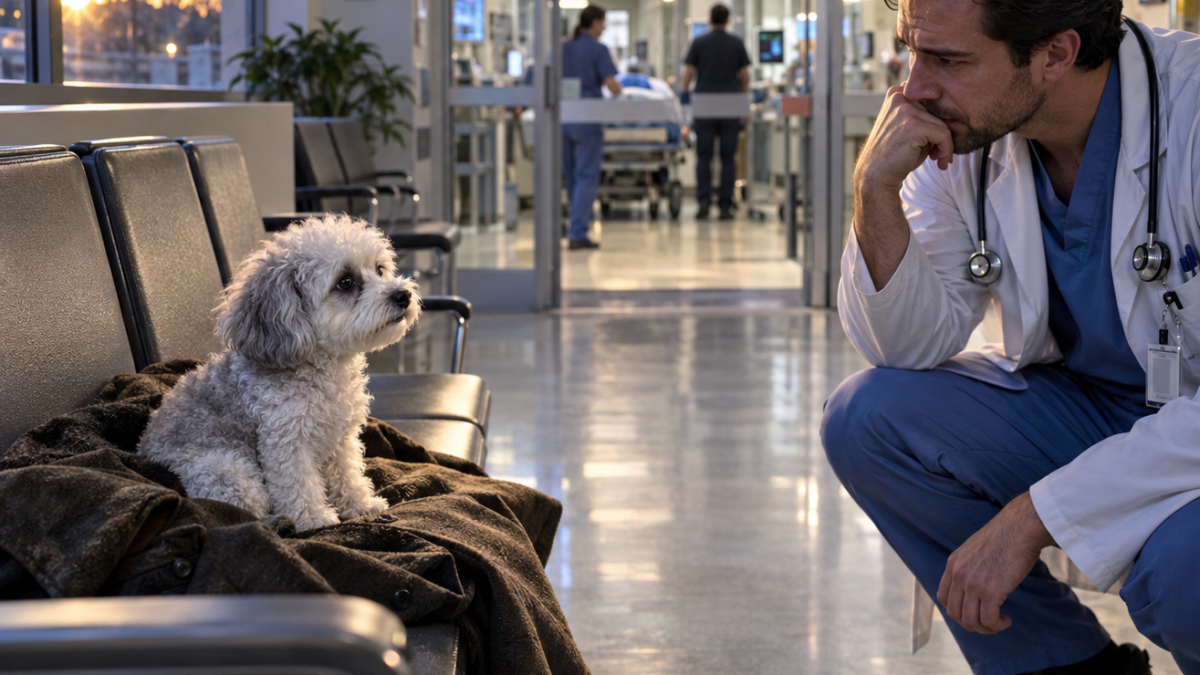
A tiny Bichon Frise sat on a bench in the waiting room.
His fur was soft-looking but slightly disheveled, mostly pale gray and white. He was sitting on an old coat that I recognized as belonging to the man we had just lost.
For a moment, I simply stared.
The dog wasn’t barking.
He wasn’t whining.
He wasn’t running around looking frightened.
He was sitting perfectly still.
And he was staring at the door.
The same door I had just walked through.
I looked toward the reception desk.
“Did he come in with the patient?”
One of the nurses nodded.
“The paramedics said he wouldn’t leave him.”
Apparently, when the ambulance crew entered the man’s home, the dog had refused to stay behind. He had followed them, frantic at first, until someone finally lifted him into the ambulance.
The man’s coat had been removed during transport and later placed on the waiting-room bench.
The dog had climbed onto it.
And there he had remained.
Waiting.
I looked at him again.
He seemed completely certain about what was supposed to happen next.
His person would come through that door.
His person would take the coat.
His person would bend down, call him, and bring him home.
That was how the world worked.
At least, that was how his world had always worked.
He didn’t understand cardiac failure.
He didn’t understand emergency medicine.
He didn’t understand death.
He understood doors.
He understood waiting.
He understood that the person he loved had disappeared behind one door, and therefore that person should eventually come back through it.
I walked toward him slowly.
His eyes shifted from the door to me.
I stopped a few feet away.
“Hey, little guy.”
His ears moved slightly.
Nothing else.
I crouched.
He studied my face.
I have delivered terrible news to families.
I have sat across from husbands and wives and children and explained that medicine had reached its limit.
There are words for those moments.
Awful words.
Necessary words.
“I’m sorry.”
“We did everything we could.”
“He didn’t make it.”
“There was nothing more we could do.”
But kneeling in front of that little dog, I had no words at all.
Because he looked at me as if he were asking a question.
You were in there.
You came through that door.
Where is he?
I swallowed.
“He isn’t coming out, buddy.”
The dog tilted his head.
My throat tightened.
Of course he didn’t understand.
Maybe that made it worse.
I moved a little closer.
He didn’t back away.
I reached toward him slowly, giving him every opportunity to pull away.
He stayed where he was.
When my hand touched the fur beneath his chin, his eyes softened.
Then something happened that I still remember with painful clarity.
He leaned toward me.
Just slightly at first.
Then completely.
I lifted him into my arms.
He didn’t resist.
He pressed his small body against my chest and laid his head on my shoulder.
And then I felt him tremble.
I don’t know whether dogs understand death in the way we do.
I’m a physician, not an animal behaviorist.
I won’t pretend to know something I don’t.
But I knew what I was holding.
I was holding a living creature whose entire sense of safety had vanished.
His world had gone behind a door.
And his world wasn’t coming back.
I held him longer than I intended.
For several minutes, I wasn’t a doctor.
I wasn’t thinking about charts or signatures or the next patient.
I was simply a man holding a grieving dog.
Eventually, animal control arrived.
The two officers who came were gentle with him.
One crouched beside the bench.
“Poor little fellow.”
I looked at her.
“What happens to him?”
“We’ll take him to the shelter.”
“Do you know if there is any family?”
“We’ll check.”
She examined the information they had been given.
“From what we understand, the owner lived alone.”
I looked down at the dog.
“And if there’s no family?”
“He’ll be evaluated, cared for, and eventually placed for adoption.”
That was the correct answer.
A reasonable answer.
A responsible answer.
I knew that.
But reason had very little to do with what I felt when they took him from my arms.
The officer placed him in a carrier.
For the first time, he seemed nervous.
He turned around.
His eyes found mine.
Then they moved back toward the emergency-room doors.
Even as they carried him away, he was still looking for his owner.
I stood there until he disappeared.
Then I returned to work.
At least, physically I did.
Mentally, part of me remained in that waiting room.
All day, I kept seeing those eyes.
Between patients, I thought about him.
While reviewing a chart, I thought about him.
While eating something that barely qualified as lunch, I remembered the way he had rested his head against my shoulder.
I told myself the shelter would take care of him.
That was what shelters did.
He would be fed.
He would be safe.
Someone would adopt him.
There was no reason for me to be involved.
By the time I went home that evening, I had almost convinced myself.
I took off my shoes, sat in my chair, and leaned my head back.
The house was quiet.
Normally, after a difficult shift, quiet was exactly what I wanted.
That night, it bothered me.
I closed my eyes.
Immediately, I saw him.
Sitting on the man’s coat.
Watching the door.
I opened my eyes.
“This is ridiculous,” I said aloud.
The empty room offered no argument.
I made dinner.
Barely touched it.
I tried reading.
I read the same paragraph three times.
I turned on the television.
I couldn’t tell you what was playing.
Finally, I went to bed.
Sometime after midnight, I was still awake.
I rolled over.
Then onto my back.
Then onto my other side.
The dog was still in my thoughts.
What was he doing right now?
Was he sleeping?
Was he frightened?
Was he still waiting?
That final question bothered me most.
Was he still waiting?
I sat up.
The room was dark.
For a long time, I remained there with my feet on the floor.
I didn’t own a dog.
My work schedule was demanding.
My life was orderly.
Predictable.
I had spent years organizing everything around medicine.
There was always a practical reason not to complicate it.
And yet, sometime in those early morning hours, practicality lost the argument.
“I just need to see him,” I whispered.
That was what I told myself.
Just see him.
Make sure he was all right.
Nothing more.
The next morning, I called animal control.
I explained who I was.
“The physician from the hospital,” I said. “There was an elderly gentleman brought in two nights ago. He had a small Bichon Frise with him.”
There was a pause.
Then the woman on the phone said, “Yes. I know which dog you mean.”
My heart gave an unexpected little jump.
“Is he okay?”
“Physically, yes.”
Something in her tone caught me.
“And otherwise?”
Another pause.
“He’s having a hard time.”
I closed my eyes.
“Where is he?”
She gave me the shelter address.
I wrote it on a small piece of paper.
Then I folded that paper and put it in my pocket.
For the rest of the day, I felt it there.
During rounds, my fingers brushed against it.
During lunch, I took it out and looked at it.
Once, I nearly threw it away.
This wasn’t my responsibility.
I had done my part.
The man had been my patient.
The dog had been taken somewhere safe.
There was no logical reason for me to become involved.
Then I remembered those eyes.
I folded the paper again.
At the end of my shift, I drove to the shelter.
The sun was already dropping behind the buildings when I arrived.
I parked outside and remained in my car.
Five minutes passed.
Maybe more.
I stared at the entrance.
I still wasn’t sure what I expected to accomplish.
Perhaps I wanted reassurance.
Perhaps I believed that if I saw him happy, playing with other dogs, I could finally go home and forget about him.
That seemed reasonable.
I got out.
The moment I entered the shelter, the sound reached me.
Barking.
Some sharp and excited.
Some deep.
Some anxious.
A young woman at the front desk looked up.
“Can I help you?”
“I’m looking for a dog.”
She smiled.
“That describes most people who come through that door.”
Despite myself, I smiled too.
“A small Bichon Frise. Gray and white. He was brought in after his owner died at the hospital.”
Her expression changed immediately.
“Oh.”
“You know him?”
“Yes.”
Something about the softness in her voice made my chest tighten.
“How is he?”
She hesitated.
“Come with me.”
We walked through a long corridor.
Dogs approached the fronts of their kennels as we passed.
Some barked.
Some wagged their tails.
Others simply watched.
We stopped near the end.
The volunteer pointed.
“There he is.”
I looked inside.
My heart sank.
He was sitting in the back corner on a folded blanket.
He looked smaller than I remembered.
Maybe he hadn’t actually lost much weight.
Maybe grief simply made him appear fragile.
His head was lowered.
He didn’t react when we stopped outside the kennel.
“Does he eat?” I asked.
“Enough.”
“Does he interact with anyone?”
“Sometimes.”
She folded her arms loosely.
“He’s very gentle. He lets us handle him. He goes outside. But mostly…”
She glanced at him.
“He waits.”
That word again.
“Waits for what?”
She looked at me.
“I think you know.”
I did.
She opened the kennel.
“You can go in if you want.”
I stepped inside and crouched.
For several seconds, he didn’t move.
“Hey, little guy.”
His head lifted.
He looked at me.
I watched recognition happen.
It wasn’t dramatic.
There was no barking, no wild jumping.
His eyes simply changed.
He stood.
Slowly, he crossed the kennel.
Then he sat directly in front of me.
I held out my hand.
He sniffed my fingers.
A second later, he placed his head against my knee.
That was all it took.
Something inside me collapsed.
I sat on the floor.
I pulled him against my chest.
And I cried.
Not loudly.
Not uncontrollably.
Just the quiet tears of a man who had spent years being composed for everyone else.
“I’m sorry,” I whispered.
I wasn’t even sure who I was apologizing to.
Him.
His owner.
Myself.
Maybe all three.
He rested against me exactly as he had in the hospital.
After a while, I noticed the volunteer had stepped away to give us privacy.
I stroked the dog’s back.
“You remember me, don’t you?”
His eyes lifted toward mine.
“Yeah,” I whispered. “I remember you too.”
We stayed that way for a long time.
Eventually, the volunteer returned.
“He’s different with you.”
I looked up.
“What do you mean?”
“We haven’t seen him approach anyone like that.”
I glanced down at him.
“Maybe he remembers the hospital.”
“I’m sure he does.”
“Does he understand what happened?”
She was quiet for a moment.
“I can’t answer that.”
Neither could I.
Before I left that evening, I held him again.
The shelter was closing.
I knew I had to go.
When I stood, he stood too.
I moved toward the kennel door.
He followed.
I stepped outside.
He tried to follow me.
The volunteer gently blocked him.
My chest tightened.
“I’ll come back,” I told him.
He stared at me.
“I promise.”
Driving home, I realized what I had just done.
I had made a promise to a dog.
And somehow, it felt as binding as any promise I had ever made.
The next day, I returned.
This time, when he saw me, he stood immediately.
His tail moved.
Only once or twice.
But it moved.
I laughed.
“There you are.”
The volunteer smiled.
“That’s new.”
They let me take him outside.
We walked to a nearby park.
He moved slowly at first.
He sniffed the grass.
Paused beneath a tree.
Then stopped and stared toward the parking lot.
A man was getting out of a car.
The dog’s whole body became alert.
He watched.
The man walked away.
The little dog’s posture fell again.
I knew exactly what had happened.
He was looking for him.
His owner.
His person.
His world.
I crouched.
“That’s not him, buddy.”
He looked up at me.
I touched his head.
“I’m sorry.”
We continued walking.
I went back the following day.
And the next.
Soon, going to the shelter became part of my routine.
Hospital.
Shelter.
Home.
At first, I told myself I was helping him through grief.
I didn’t understand yet that he was doing something similar for me.
Medicine teaches you how fragile the body is.
We see people on ordinary days that become the last ordinary days of their lives.
A breakfast becomes the last breakfast.
A phone call becomes the last conversation.
Someone leaves their home expecting to return by dinner and never returns at all.
Doctors know this intellectually.
But knowing something and feeling it are different things.
That little dog made me feel it.
His owner had probably left home without imagining anything extraordinary would happen.
Maybe he had fed the dog.
Maybe he had scratched him behind the ears.
Maybe he’d said, “I’ll be back.”
Maybe those had been their final ordinary moments.
And now one half of that small family was gone.
The other half was still waiting.
Day by day, though, something began to change.
The dog started meeting me near the front of the kennel.
Then he began wagging his tail.
Then came the first bark.
It happened when I was leaving one evening.
I had just reached the end of the corridor when I heard a sharp sound behind me.
I turned.
He stood at his kennel door.
He barked again.
The volunteer laughed.
“I think he’s telling you not to go.”
I walked back.
“You know I have to work.”
He pushed his nose against the kennel door.
“I’ll be back tomorrow.”
His tail wagged.
I smiled.
“You’re getting demanding.”
For the first time since meeting him, I felt something stronger than sadness when I looked at him.
I felt hope.
Over the next several weeks, I watched pieces of his personality return.
He discovered that he liked chasing dry leaves.
He preferred walking on grass rather than pavement.
He had a habit of stopping every few minutes to look behind him, apparently to make sure I was still there.
He loved having the fur beneath his chin scratched.
And when he became tired, he leaned against my leg.
One afternoon, we sat together on a park bench.
He was beside me, watching people pass.
An older gentleman approached from a distance.
The dog’s ears rose.
His body stiffened.
For one painful second, I knew what he was thinking.
Then the stranger came closer.
The dog realized it wasn’t his owner.
He lowered his head.
I placed my hand on his back.
That old waiting had not disappeared.
Maybe it never would.
And suddenly I understood something.
I couldn’t replace the man he had lost.
I shouldn’t even try.
Love was not a position that became vacant and could simply be filled by the next person.
What he had shared with his owner belonged to them.
It always would.
But perhaps grief didn’t require replacement.
Perhaps it required room.
Room for the old love to remain while something new grew beside it.
I looked down at him.
He had moved closer.
His body rested against my hip.
And in that moment, the decision felt less like a decision than an acknowledgment of something that had already happened.
I loved him.
I had been pretending this was temporary.
It wasn’t.
The following morning, I called the shelter.
“I’d like to adopt him.”
The woman on the phone laughed softly.
“We were wondering when you were going to figure that out.”
I smiled.
“Was it that obvious?”
“To everyone except you.”
There was paperwork.
A home evaluation.
Questions about my schedule.
Questions about veterinary care.
Questions about whether I understood the responsibility.
I answered every one.
My work schedule was still demanding, but I made arrangements.
For the first time in years, I reorganized my life around something other than medicine.
It felt surprisingly easy.
On the day I brought him home, the shelter staff gathered near the front desk.
Someone had packed his blanket.
Someone else handed me his documents.
The young volunteer who had first taken me to his kennel knelt beside him.
“You got lucky,” she whispered.
Then she looked up at me.
“So did you.”
I couldn’t argue.
Outside, I opened the passenger door.
He hesitated.
“Come on.”
I lifted him into the car.
He settled onto the seat.
For a moment, he looked toward the shelter entrance.
Then he looked at me.
“Ready?”
His tail moved.
I started the engine.
During the drive home, he sat quietly and watched the world through the window.
Buildings passed.
Cars passed.
People crossed streets.
The light was beginning to soften toward evening.
Every few minutes, I glanced at him.
Once, he caught me doing it.
“You’re really coming home with me,” I said.
He simply stared.
I laughed.
“Guess we’d better figure this out together.”
When we reached my house, I opened the car door.
He jumped down.
Then stopped.
He examined the yard.
The walkway.
The front door.
I unlocked it.
“Go ahead.”
He stayed beside me.
I stepped inside.
He followed.
At first, he explored cautiously.
The living room.
The kitchen.
The hallway.
He sniffed everything.
Then he returned to where I stood.
For several seconds, we looked at each other.
I knelt.
“This is your home now.”
He walked toward me and rested his head against my knee.
The gesture was so familiar that it took me back instantly to the hospital waiting room.
Only this time, he wasn’t staring past me at a door.
He was looking at me.
I put my arms around him.
“You’re home,” I whispered.
That first night, I placed his bed near mine.
He circled it twice.
Lay down.
Got back up.
Walked to my bedroom doorway.
Looked down the hall.
Then returned.
I wondered whether he was waiting again.
I turned off the light.
Sometime during the night, I woke and found him sleeping beside the bed.
One paw rested on my slipper.
As if he needed proof that I was still there.
The next morning, when I got ready for work, he became anxious.
The moment I picked up my coat, his body changed.
He followed me.
I walked toward the door.
He followed faster.
When I reached for the handle, he whimpered.
I froze.
Of course.
His owner had left once.
And never returned.
I crouched.
“I’m coming back.”
He stared at me.
“I know you don’t believe that yet.”
I rubbed his ears.
“But I’m coming back.”
Leaving him that morning was harder than I expected.
I had arranged for someone to check on him during the day.
Still, all through my shift, I wondered how he was doing.
When I finally drove home, I found myself speeding slightly before catching myself and slowing down.
I opened the front door.
For half a second, there was silence.
Then I heard paws.
He came racing around the corner.
Not walking.
Not cautiously approaching.
Running.
He skidded on the floor and nearly crashed into my legs.
I laughed and dropped to my knees.
“See?”
He jumped against me.
“I told you.”
His tail was moving so fast that his entire body seemed to wag.
“I came back.”
That became our ritual.
Every morning, I left.
Every evening, I returned.
And gradually, he learned.
The coat did not mean disappearance.
The closing door did not mean abandonment.
Waiting did not always end in loss.
Sometimes, the person you loved actually came home.
Weeks became months.
The sadness in his face softened.
He began carrying toys around the house.
He slept stretched across the rug.
He developed a ridiculous habit of following me into the kitchen every time he heard a cabinet open.
He waited beside the bathroom door.
He claimed one corner of the couch as if he had paid for it.
When I worked late, he greeted me with exaggerated outrage before immediately forgiving me.
He brought noise into a house that had been quiet for too many years.
And something changed in me too.
For most of my adult life, I had believed that being needed was something that happened at the hospital.
Patients needed me.
Nurses needed decisions.
Families needed explanations.
But professional responsibility is different from being personally awaited.
Before him, no one watched the window for my car.
No one ran toward the door when my key turned in the lock.
No one cared whether I sat in one chair or another as long as I was there.
He did.
A year has passed now.
He’s healthy.
His coat is full and soft.
His eyes are bright.
He runs more than he walks.
He has learned exactly where treats are stored and has become highly skilled at pretending he hasn’t been fed.
Sometimes I catch him near the front door.
He’ll sit there quietly.
Watching.
The first few times, seeing him do it hurt.
It reminded me of that hospital bench.
Of his owner’s coat beneath him.
Of that impossible expectation in his eyes.
But his waiting is different now.
Because when I come home, he hears my key.
His ears rise.
His tail begins to move.
And before I’ve fully opened the door, he’s already there.
Sometimes I kneel and hold him for a moment longer than necessary.
“I’m back.”
He licks my chin.
“I told you I’d come back.”
I still think about his first owner.
I never want the little dog to forget him.
That man loved him.
I know he did.
A dog doesn’t wait like that for someone who meant nothing.
Somewhere in the ordinary days before that ambulance ride, an old man created a world in which a tiny dog felt safe, loved, and certain that his person would always return.
Death interrupted that promise.
It didn’t erase the love behind it.
I understand that better now.
As a physician, I have spent years studying what keeps the human body alive.
The heart.
The lungs.
The brain.
Blood moving through vessels.
Electrical signals passing through tissue.
We can measure all of it.
We can monitor it.
Sometimes we can repair it.
Sometimes we cannot.
But there are things medicine cannot place on a monitor.
Loyalty.
Grief.
Memory.
Love.
Hope.
I learned those things from a little dog sitting on a hospital bench.
I don’t know what happens to animals after death.
Science gives me no answer for that, and I won’t pretend certainty where I have none.
But there is one thought I allow myself.
Someday, far from now, perhaps that little dog will somehow find the man who disappeared behind those hospital doors.
Maybe there will be no confusion then.
No waiting room.
No locked door.
No ambulance.
Perhaps his old owner will kneel, open his arms, and the little dog will run toward him.
And if such a moment exists, I imagine the dog telling him something without needing words.
I waited for you.
I never stopped loving you.
I was scared when you didn’t come back.
But someone found me.
He took care of me.
He kept coming home.
Until then, that is my job.
Not to replace the man he lost.
Not to erase what came before me.
Only to make sure the rest of his life is filled with warmth, safety, and the certainty that he belongs somewhere.
Some evenings, we sit together beside the window.
He watches the street.
I watch him.
Occasionally, he lifts his head when someone walks past.
Then he settles again, leaning against my leg.
Those moments remind me how our story began.
A dying man entered my emergency department.
I couldn’t save him.
For a long time, that fact was the part of the story I carried most heavily.
Now I understand there was another life connected to his that night.
A small life.
A frightened life.
One that needed someone to notice.
I used to think I went to the shelter because I couldn’t forget the dog’s eyes.
Maybe that’s true.
But after everything that happened, I suspect the truth goes deeper.
I thought I was going there to rescue him from his loneliness.
I didn’t realize how much loneliness existed in my own life until he walked into it.
He lost his person.
I had spent years keeping enough distance from loss that I rarely allowed myself to need anyone.
Somehow, we met exactly where those two wounds crossed.
He taught me that moving forward doesn’t require forgetting.
That love for someone who is gone does not diminish because another love arrives.
The heart is capable of carrying both.
Loss and gratitude.
Memory and hope.
Yesterday and tomorrow.
That tiny dog still remembers a man who once meant everything to him.
And now, when I return from the hospital each evening, he waits for me too.
The difference is that this time, the door opens.
This time, I walk through it.
And every single time I see him running toward me, I understand the promise I made without realizing it on the day I entered that shelter.
You waited once for someone who could not come back.
You will never have to wonder whether I am coming back too.
I bend down.
He jumps into my arms.
I hold him against my chest.
And for a moment, I can almost see the frightened little dog from the hospital waiting room—the one sitting on an old man’s coat, staring at a door, believing with all his heart that love would return.
In a way, he had been right.
It just returned through a different door.
And now, at last, he is no longer waiting for home.
He is home.








