𝗣𝗔𝗥𝗧 𝟮 He Waited at the Same Chess Table Every Day—But the Man He Loved Was Never Coming Back
𝗣𝗔𝗥𝗧 𝟮
A woman walking a terrier shook her head.
“Poor thing.”
Someone else muttered, “Animal control should deal with that.”
Should.
Wonderful word.
It performs action without requiring the speaker to participate.
An older man lowered himself onto the bench beside me.
Thin.
Gray beard.
Newspaper tucked under one arm.
He followed my gaze.
“You’ve seen him before?”
“Yesterday.”
The man nodded.
“That’s Aster.”
The name changed everything instantly.
I looked at the dog again.
“Aster?”
“Yeah.”
“Owner around?”
The old man went quiet.
Then tapped two fingers against his chest.
“Heart.”
I didn’t understand.
“His owner?”
“Henry.”
He pointed at the empty bench across from Aster.
“Used to sit right there every morning.”
I looked at the bench.
“He’s dead?”
“Three weeks now.”
Something inside me dropped.
The man introduced himself as Malcolm.
He’d played chess with Henry for years.
Henry Walsh, seventy-one, retired high-school mathematics teacher.
Widower.
No children that anyone knew about.
Came to the park almost every morning.
Played chess.
Fed pigeons despite city signs suggesting otherwise.
Drank terrible coffee.
And brought Aster everywhere.
“He taught the dog to move pieces.”
I glanced at him.
“What?”
Malcolm smiled faintly.
“Not actual chess. Henry wasn’t delusional. But he’d point, give a command, dog would push the piece with his nose.”
Tourists loved it.
Children especially.
Henry would pretend Aster was a prodigy.
“He’d say the dog had a dangerous endgame.”
I smiled despite myself.
“What happened?”
Malcolm’s smile disappeared.
“Henry was sitting right there.”
He pointed again.
“Made one move. Then leaned back. Said he felt funny.”
Paramedics came.
Too late.
“And Aster?”
Malcolm looked toward him.
“Police tried taking him away that day. Dog slipped whoever grabbed him.”
“Then what?”
“Next morning, he came back.”
I stared.
“Where does he sleep?”
“No idea. Maybe near Henry’s building. Maybe under something around here.”
“And nobody took him?”
“We thought family would.”
“Wasn’t there family?”
“Apparently not much.”
Malcolm unfolded his newspaper but didn’t open it.
“Aster comes every morning. Stays until late. Rain too.”
My chest tightened.
“Every day?”
“Every day.”
I looked across the path.
Aster still faced the empty bench.
That changed the scene completely.
He wasn’t waiting for food.
He wasn’t guarding territory.
He wasn’t lost.
He knew exactly where he was.
He just didn’t know death had made the appointment impossible.
Or maybe he knew.
Maybe dogs understand absence better than we do and simply refuse its terms.
I stayed another hour.
Aster never left.
The next day I returned with food.
A sandwich for myself.
Soft dog food from a nearby shop for him.
I placed it maybe ten feet away.
Aster ignored it.
I moved farther back.
Waited.
Eventually he rose.
Slowly.
That worried me.
He was young, but his movements lacked energy.
He walked to the bowl.
Sniffed.
Ate three bites.
Paused.
Looked toward the empty bench.
Ate another.
Then returned to the chess table.
I felt absurdly defeated.
I’d fed him.
That was all.
Food couldn’t compete with grief.
An older woman sat near me.
I’d seen her around the park before.
Heavy brown coat.
Sunflower seeds permanently in one pocket.
She followed my gaze.
“You know about Henry?”
“Yeah.”
She nodded.
“I’m Ruth.”
“Daniel.”
She tossed seeds toward several pigeons.
“Aster loved him.”
“So everybody says.”
“No.”
She looked at me.
“I mean that dog was attached to him in a way you don’t see often.”
Henry talked to Aster constantly.
During games.
Walking.
Feeding birds.
He would explain chess strategy to him like the dog was preparing for a tournament.
Aster sat beside him.
Listened.
Sometimes barked when Henry blundered.
Ruth laughed at the memory.
“Henry would say, ‘See? Even the dog knows that was stupid.'”
I looked at Aster’s paws.
One rested near a black rook.
“Why doesn’t somebody take him?”
Ruth’s face changed.
“People tried.”
“Who?”
“Couple rescue volunteers.”
“And?”
“He panicked when they pulled him away.”
“Bit?”
“No. Just fought to come back.”
“So they left him?”
“They were going to return with equipment, but then someone complained they were trying to steal a dog.”
“Wonderful.”
“New York.”
Fair.
We sat quietly.
Then laughter came from behind us.
A group of college students had gathered near Aster.
One took a photo.
Another pointed.
“He’s waiting for his next match.”
Aster ignored them.
Then one boy clapped loudly.
“Go on, mutt.”
Nothing.
“Move.”
He stepped closer.
Something in me snapped.
“Hey.”
The boy turned.
“Back off.”
He looked genuinely confused.
“What’s your problem?”
“He’s not bothering you.”
“It’s a dog.”
“Excellent observation.”
His friends laughed.
The boy frowned.
“Whatever.”
They walked away.
I stood there with my fists clenched.
Aster looked at me once.
Then back at Henry’s seat.
That glance embarrassed me.
Not because I’d confronted the student.
Because I’d spent two days acting morally superior to people walking past while still doing almost exactly the same thing.
Watching.
Feeling.
Leaving.
That night, I couldn’t sleep.
I kept seeing Aster.
But another dog started entering the memory.
Rusty.
My German Shepherd when I was fifteen.
He had belonged technically to the family.
In reality, he was mine.
Rusty followed me to school some mornings.
Waited near the fence.
Slept outside my bedroom.
At fourteen, I found that annoying.
At fifteen, essential.
At sixteen, he disappeared for almost two days.
I searched everywhere.
Flyers.
Bike rides.
Neighbors.
Alleys.
We found him under the back steps.
His heart was failing.
The veterinarian said it had probably been developing for months.
I had spent the previous afternoon at a friend’s house.
That detail became irrationally important.
For years, I believed I should have been there.
Rusty died with my father beside him.
Not me.
I never forgave myself.
I stopped talking about him.
Then adulthood happened.
College.
Work.
New York.
Relationships.
Breakups.
Deadlines.
My life filled.
The guilt simply learned to sit quietly.
Aster brought it back.
The next morning, I went to Petco.
Stainless-steel bowl.
Water dish.
Red leash.
Fleece blanket.
Sensitive-stomach kibble.
Treats.
The cashier smiled.
“New puppy?”
“Something like that.”
I carried everything to Washington Square Park.
Aster sat in his usual place.
I laid the blanket several feet from the chess table.
Water.
Food.
Then moved back.
Aster noticed.
His nose worked.
Finally, he rose.
Walked toward the bowl.
Ate slowly.
Not ravenously.
Suspiciously.
Afterward, he drank.
Then returned to the board.
Paws up.
Eyes forward.
“You’re welcome,” I muttered.
Nothing.
I sat nearby until sunset.
Aster never acknowledged me again.
The next day I brought no food.
Just coffee.
Notebook.
Time.
I treated it like an appointment.
Ten in the morning.
Same bench.
Aster already present.
I sat.
Wrote a few lines.
Looked up.
Waited.
At noon, I moved the water bowl closer to his table.
He waited almost ten minutes before drinking.
That counted as progress.
At one point, a chess piece fell from the board.
White knight.
Aster looked down.
Then raised one paw.
Nudged it.
Not randomly.
Toward the center of the board.
I stopped writing.
He knew.
Not chess.
Memory.
Routine.
Henry had taught him that touching those pieces created interaction.
Praise.
Laughter.
Attention.
Aster wasn’t guarding a board.
He was maintaining a ritual.
That hurt worse.
That evening, I went through an old box beneath my bed.
Found photographs.
Receipts.
Books.
A picture of Rusty and me.
Fifteen years old.
Barefoot.
Arms around his neck.
He looked directly at the camera.
I didn’t.
I sat on the floor holding the photo for a long time.
Maybe Aster wasn’t the only creature waiting at a place somebody had left.
The following morning, I arrived before most chess players.
Aster was there.
Of course.
For the first time, I sat across from him.
Henry’s seat.
Aster’s head rose.
I stopped immediately.
“Too much?”
He stared.
Didn’t growl.
Didn’t leave.
I put my coffee on the board.
Then reached inside my coat.
I had brought a bishop from an old chess set I’d inherited.
Don’t ask why.
At two in the morning it had seemed meaningful.
In daylight it felt theatrical.
Still, I placed the bishop near the center.
Aster looked at it.
Then at me.
Not through me.
At me.
My pulse jumped.
“Your move.”
His paw moved.
Touched the square beside the bishop.
Then rested.
No barking.
No miracle.
But he had looked at me from Henry’s side of the world.
That mattered.
I stayed.
Rain came that evening.
Not heavy at first.
Mist.
Streetlights reflected off wet stone.
I told myself Aster wouldn’t be there.
No dog would sit in that weather.
Of course he was.
Soaked.
Fur plastered to his body.
Paws on the board.
I stood under an umbrella thirty feet away feeling furious.
At him.
At Henry for dying.
At every rescue organization that had apparently failed to solve this.
At myself for expecting grief to behave intelligently.
I ran home.
Grabbed the fleece blanket.
Returned.
Aster remained.
I sat beside him.
Not across.
Beside.
Wrapped the blanket around both of us.
For several minutes, he stayed rigid.
Rain hit the chessboard.
Water gathered between squares.
Then Aster exhaled.
Long.
His body shifted.
And his head came down onto my knee.
I stopped breathing.
Not because I was afraid.
Because if I moved, the moment might vanish.
His fur was soaked.
Heavy.
Warm underneath.
I laid one hand gently between his ears.
Aster didn’t flinch.
We sat in the rain.
People walked past.
Some stared.
Nobody mattered.
For the first time since I’d met him, Aster wasn’t waiting alone.
I don’t know how long we stayed.
Maybe forty minutes.
Maybe two hours.
Grief distorts time.
Eventually he closed his eyes.
Actually closed them.
That was when I decided enough was enough.
The next morning, I called a veterinarian.
East Village Animal Hospital had a cancellation at noon.
“Rescue case?”
“I guess.”
“Can you transport him?”
“I’ll find out.”
Borrowed crate from my neighbor.
Red leash.
Treats.
Blanket.
I found Aster lying beside the table.
Not sitting.
That scared me.
His ribs looked more visible.
“Aster.”
Ear twitch.
I knelt.
Showed him the leash.
No grabbing.
Just presented it.
He watched.
I looped it slowly.
He tensed.
Then looked toward Henry’s bench.
“It’s okay.”
I hated how inadequate words were.
“You can come back.”
That seemed important.
Not goodbye.
Not removal.
Temporary.
Aster stood.
Walked with me.
Every few steps, he looked backward.
At the chess tables.
At Henry’s bench.
By the park exit, his legs slowed.
“Come on.”
I crouched.
“Just one block.”
He looked at me.
Then stepped outside the park.
The veterinarian, Dr. Priya Patel, examined him for almost an hour.
Weight loss.
Dehydration.
Stress.
Mild anemia.
Parasites.
No major orthopedic problem.
But his heart rhythm concerned her.
“Is it serious?”
“Could be stress-related.”
“Stress can do that?”
“Prolonged stress affects the body. Appetite, sleep, immune function, cardiac rhythm.”
She looked at his chart.
“He’s young. That’s in his favor.”
“How young?”
“Seven to eight months.”
Aster should have been eating furniture.
Instead, grief had aged him.
Patel sat beside me.
“His biggest issue may be behavioral.”
“What does that mean?”
“He’s shut down.”
“Can that kill him?”
She chose her words carefully.
“Not directly in the way people say ‘died of sadness.’ But chronic refusal to eat, dehydration, stress, lack of rest—yes, those consequences can become dangerous.”
Better answer.
More honest.
“I’d like to keep him overnight.”
My stomach tightened.
“Will he panic?”
“Possibly.”
“We can keep his blanket.”
“Yes.”
I removed the bishop from my pocket.
Then stopped.
Wrong piece.
Henry’s old game.
Memory.
I needed something more central.
The next few hours were terrible.
I went home.
Couldn’t write.
Couldn’t eat.
At seven, my phone rang.
Dr. Patel.
“Aster’s stable.”
I exhaled.
“But?”
“He hasn’t eaten.”
“Water?”
“Very little.”
“Behavior?”
“Curled in the back corner. Doesn’t engage.”
I grabbed my coat.
“Can I come?”
“Yes.”
I was there fifteen minutes later.
Aster lay inside a recovery kennel.
Head down.
Eyes open.
When I entered, his ears rose.
Nothing else.
“Aster.”
His eyes found me.
Recognition.
Small.
But there.
I crouched outside the kennel.
“I brought something.”
The bishop was in my pocket.
But before coming to the hospital, I’d stopped by the recreation center near the park.
They had old donated chess sets.
Incomplete.
Broken.
I asked for one piece.
A wooden king.
I slid it onto the floor.
Aster looked.
For several seconds, nothing happened.
Then his head lifted.
He moved one paw.
Placed it over the king.
My throat closed.
“Yeah.”
Aster stared at it.
Then nudged the piece toward me.
One inch.
Maybe two.
Dr. Patel stood behind me.
Neither of us spoke.
I placed my hand near the king.
Aster lowered his head beside it.
A technician appeared at the doorway.
“He drank.”
Patel turned.
“What?”
“Just now. He drank.”
I looked at Aster.
His eyes closed.
That was enough for me.
“When can he leave?”
“Tomorrow would be safer.”
“No.”
Patel raised an eyebrow.
I corrected.
“Sorry. Can I stay?”
She looked at me.
Then Aster.
“Yes.”
I sat on the floor outside his kennel until almost midnight.
He ate three bites of food.
Then five.
I slept in a plastic chair.
At some point, I woke with my neck bent at an angle that should have required surgery.
Aster was watching me.
“You’re welcome.”
Tail moved.
Barely.
I smiled.
By morning, Dr. Patel cleared him for discharge.
“Who’s fostering him?”
I hesitated.
“I am.”
“Temporary?”
Aster stood beside me.
Red leash.
Wooden king in my pocket.
“No.”
Patel smiled.
“Thought so.”
The adoption/legal process was less poetic.
Animal control.
Search for next of kin.
Owner records.
Microchip.
Henry had registered Aster.
No relative claimed him.
After the required procedures, Aster became mine.
On paper.
Emotionally, it took longer.
The first days at my apartment were quiet.
I put the fleece blanket in the living room.
Aster stayed there.
Food only when I backed away.
Water mostly at night.
If I entered too quickly, his body stiffened.
Not fear exactly.
Habit.
Waiting.
I began leaving the wooden king near his bed.
Not always.
Just enough.
On the third morning, I woke to the sound of nails on hardwood.
Aster stood outside my bedroom.
He looked at me.
Then walked away.
“Good morning to you too.”
Progress.
By the end of the first week, he ate while I stayed in the room.
Second week, he slept deeper.
Third week, he placed his head on my foot while I worked.
No ceremony.
I was typing.
Suddenly weight.
I looked down.
Aster’s head.
Eyes closed.
I didn’t move for an hour.
My leg went numb.
Worth it.
Washington Square remained the difficult part.
I avoided it initially.
We walked other streets.
Different routes.
Then one morning, Aster pulled gently toward the park.
I stopped.
“You sure?”
Tail neutral.
He pulled again.
We entered.
His whole body changed.
Ears high.
Nose working.
Steps faster.
He knew every path.
Every corner.
Every smell.
When the chess tables came into view, he stopped.
I waited.
Aster stared.
Henry’s bench was empty.
No rain.
No crowd.
Just morning.
Aster walked forward.
Slow.
Reached the table.
Then something changed.
He did not climb into his old position.
Instead, he sat beside me.
I pulled the wooden king from my pocket.
Placed it on the board.
Aster looked.
Then nudged the bench with his paw.
Henry’s bench.
I swallowed.
“You want me there?”
Aster waited.
I sat across from him.
Exactly where Henry had sat.
It felt wrong.
Then right.
Then both.
Aster rested his paws on the edge.
Looked at the king.
Then at me.
For twenty minutes, we sat.
No game.
No trick.
No attempt to replace anyone.
That mattered.
I could not become Henry.
I shouldn’t.
Aster didn’t need Henry replaced.
He needed life after Henry.
Those are different things.
An elderly chess player stopped.
“That’s Henry’s dog.”
“Aster.”
“Looks better.”
“He is.”
The man smiled.
“Henry would’ve liked that.”
I looked at the board.
“Hope so.”
Aster touched the king.
The man laughed.
“He still plays?”
“Apparently I’m losing.”
Word spread.
The chess players accepted me slowly.
Not as Henry.
As Daniel.
Aster became part of the park again.
Different now.
People fed him too much.
Children asked to pet him.
I became the irritating adult who explained they had to ask first.
Malcolm still came most mornings.
First time he saw Aster on the leash, his eyes filled.
“Well.”
“Yeah.”
He crouched.
Aster sniffed him.
Malcolm rubbed his chest.
“You finally got off that damn table.”
Aster licked his chin.
“Henry would be furious.”
“Why?”
“He always said the dog had terrible taste in people.”
I laughed.
Aster barked once.
Malcolm pointed.
“See?”
Months passed.
Aster became a puppy again.
That was perhaps the greatest miracle.
Not supernatural.
Behavioral.
Physical.
Ordinary.
He stole socks.
Chewed the corner of a manuscript.
I discovered this after printing thirty pages.
“Aster.”
He looked innocent.
“That was chapter nine.”
Tail wag.
“Critics are usually subtler.”
He stole another page.
I learned to close my office door.
At the dog run, he initially stood near me.
Then one day, another shepherd invited him to play.
Aster hesitated.
Then ran.
Full sprint.
Seven months of puppy energy apparently stored in reserve.
He chased.
Was chased.
Rolled.
Barked.
For ten minutes, he looked nothing like the dog at the chess table.
I stood outside the fence crying.
Embarrassing.
A woman asked if I was okay.
“Allergies.”
In February.
She was polite enough not to challenge it.
At home, Aster slept near my bed.
Not on it.
He had standards.
At two in the morning, sometimes he woke.
Walked into the living room.
Stood near the wooden king I’d placed on a shelf.
Then returned.
Memory remained.
Healing did not require forgetting.
I learned that too.
My own memory of Rusty changed.
Aster didn’t erase the guilt.
He exposed how useless it had become.
I was fifteen.
Rusty’s heart failed.
I wasn’t a veterinarian.
I wasn’t responsible for preventing death because I loved him.
That conclusion had taken me twenty-seven years and one grieving shepherd to reach.
One night I took out the old photograph of Rusty.
Aster sniffed it.
Then sneezed.
“Very respectful.”
He laid down.
I looked at the picture.
For the first time, I remembered the good years before the final two days.
That was Aster’s lesson.
Grief compresses a life around its ending.
Love expands it again.
Henry had died at one chess table.
But Henry and Aster had also shared hundreds of mornings.
Games.
Walks.
Food.
Birds.
Laughter.
Those mattered more than the final absence.
I started interviewing people who had known Henry.
Not for publication initially.
Malcolm.
Ruth.
Chess regulars.
A deli owner.
A former student who recognized Henry from a photo.
Stories emerged.
Henry had taught math for thirty-eight years.
Never raised his voice in class.
Played terrible piano.
Loved endgames.
Had been married to Alice for forty-five years until cancer took her.
Aster came later.
A student of Henry’s had found the puppy through a rescue and thought he needed companionship.
He did.
Henry apparently resisted.
Then became ridiculous.
Bought Aster a winter coat.
Cooked chicken.
Talked to him like a person.
I wrote it all down.
One afternoon, Malcolm asked, “You writing about him?”
“Maybe.”
“Henry would hate that.”
“Why?”
“He believed writers were people who turned simple things into fifty pages.”
I smiled.
“He wasn’t wrong.”
The essay became one of the most personal things I’d ever written.
Not about rescue.
About waiting.
Henry.
Aster.
Rusty.
Grief as loyalty with nowhere to go.
I almost didn’t publish it.
Then I did.
The response surprised me.
People sent stories.
Dogs waiting at doors after owners died.
Cats sleeping on clothing.
Humans continuing habits because changing them felt like betrayal.
One message stayed with me.
A woman wrote:
You don’t stop loving the person who left. You just make room beside the love for what comes next.
That described Aster exactly.
The park changed around us.
Spring.
Summer.
Fall.
Aster grew.
By his first birthday, he was seventy pounds.
Healthy.
Glossy coat.
Broad chest.
Still one habit remained.
Every morning we crossed Washington Square, Aster slowed near Henry’s table.
Sometimes he stopped.
Sometimes didn’t.
When he did, I waited.
No pulling.
No “come on.”
He looked.
Remembered.
Then moved.
The first time he walked past without stopping, I almost called it progress.
Then I decided that was unfair.
Stopping wasn’t failure.
Continuing afterward was what mattered.
One summer afternoon, the same kind of students who’d once mocked him gathered near the table.
Not the same people.
Different generation.
A boy laughed.
“Yo, chess dog.”
Aster looked.
Tail wag.
He approached.
The boy crouched.
Aster pushed the wooden king with his nose.
Everybody laughed.
This time, not at him.
With him.
Funny how context changes sound.
The park had once treated his grief like spectacle.
Now he was part of its life again.
I preferred that.
Aster became well known.
Chess players joked he had an opening repertoire.
Tourists photographed him.
I allowed it when he seemed comfortable.
No forced poses.
No circus.
He had already spent enough time being watched instead of helped.
One autumn morning, a man approached.
Mid-fifties.
He stood at Henry’s bench.
Didn’t sit.
He looked at Aster.
“Is that Henry Walsh’s dog?”
“Yes.”
The man’s eyes filled.
“I’m his nephew.”
I stood.
“You knew Henry?”
“Not well enough.”
His name was Thomas.
He lived in Pennsylvania.
Had heard about Henry’s death late.
Family had been fractured for years.
No villain.
Just distance.
Pride.
Old disagreements.
Life.
Thomas had assumed animal control had taken Aster.
He had no idea the dog remained in the park.
He crouched.
“Aster.”
The dog stared.
Then sniffed.
No dramatic recognition.
Thomas laughed through tears.
“Of course you don’t remember me.”
I stayed quiet.
Thomas looked at the board.
“Uncle Henry taught me chess here.”
We sat.
He told stories.
Henry had been stubborn.
Generous.
Difficult.
Funny.
Human.
The conversation filled gaps.
Before leaving, Thomas asked if I planned to keep Aster.
“Yes.”
“Good.”
No challenge.
No claim.
He handed me an envelope.
Inside was a photograph of Henry and Aster at the chess table.
Aster maybe four months old.
One paw on a rook.
Henry laughing.
I stared.
“I thought you should have it.”
“Thank you.”
That photo went on my wall beside Rusty’s.
Not replacing.
Adding.
Aster aged.
Slowly at first.
Years.
People think rescue stories end when the animal comes home.
They don’t.
Coming home is usually where the long story starts.
Veterinary appointments.
Training.
Rent.
Dog hair.
Walks in freezing rain.
Emergency diarrhea at three in the morning.
The glamorous details.
Aster developed into a calm, intelligent dog.
He learned commands quickly.
He could actually move selected chess pieces on cue.
Henry’s training had stuck.
I never turned it into a trick for crowds.
Sometimes, privately, I’d set the board.
Point.
“Bishop.”
Aster nudged it.
“Rook.”
Wrong piece.
“Cheater.”
Tail wag.
The king remained special.
Whenever I set it down, Aster became quieter.
He touched it gently.
Then looked at me.
I never fully understood what it meant to him.
Memory.
Object association.
Reward history.
Henry.
Probably all of it.
At five, Aster started accompanying me to readings.
Not inside crowded halls usually.
Small bookstores.
Outdoor events.
He lay near my chair.
One editor called him my “co-author.”
Accurate.
He had eaten enough drafts to qualify.
At seven, gray began at the muzzle.
I hated that.
At eight, we shortened long walks.
At nine, arthritis entered one hip.
At ten, he stopped chasing pigeons.
He had finally discovered dignity.
Or exhaustion.
Washington Square remained ours.
Henry’s table was still there.
Stone lasts longer than people.
One morning, city workers replaced the bench across from it.
I felt unexpectedly angry.
Old bench removed.
New one installed.
Clean.
No Henry.
Then I caught myself.
Memory doesn’t live in wood.
Aster sniffed the new bench.
Lifted one leg.
Claimed it.
Henry, wherever he was, would have appreciated the disrespect.
At eleven, Aster’s heart rhythm changed.
Dr. Patel was still practicing.
More gray in her hair.
More gray in mine.
She listened twice.
Then ordered tests.
Cardiomyopathy.
Not immediately catastrophic.
Manageable for a while.
The irony nearly destroyed me.
Rusty.
Heart.
Now Aster.
I sat in the exam room staring at the floor.
Patel noticed.
“You okay?”
“No.”
She waited.
I told her about Rusty.
Everything.
The guilt.
Finding him.
Not being there.
Patel listened.
Then said, “Daniel, loving an animal doesn’t grant control over mortality.”
I laughed bitterly.
“Everybody apparently understands that except me.”
“Most people don’t understand it until they have to.”
Aster put his head on my knee.
Same gesture.
Years ago.
Rain.
Chess table.
Hospital.
Home.
I scratched his ears.
“How long?”
Patel gave me the answer veterinarians hate.
“We don’t know.”
So we took what we got.
Medication.
Monitoring.
Slower walks.
More sitting.
That suited Aster.
Chess is not strenuous.
At twelve, he still visited the park.
We took breaks.
I carried water.
People who remembered him as a puppy were shocked by his white muzzle.
“That’s Aster?”
“Still cheating at chess.”
He would push the king.
Children laughed.
One little boy asked, “Who’s he playing?”
I looked across the board.
Nobody.
Then me.
“Old friend.”
The boy accepted that.
Children are good at answers adults overcomplicate.
The final winter came quietly.
Aster stopped eating breakfast one morning.
Then ate dinner.
Then skipped another.
His breathing changed.
Patel adjusted medication.
For a month, we stabilized.
Then less.
I knew.
Of course I knew.
Knowing doesn’t help.
One cold February morning, Aster stood at the apartment door.
Leash hanging nearby.
“You want out?”
Tail moved.
Barely.
We walked to Washington Square.
Slow.
Very slow.
Snow from the previous night had melted along the paths.
The chess tables were mostly empty.
Aster led me toward Henry’s.
He stopped.
Looked at the table.
Then at me.
I sat in Henry’s bench.
Aster stood beside me.
I placed the wooden king on the board.
His nose touched it.
Then nudged it toward me.
Exactly like the hospital years earlier.
My throat closed.
“Your move?”
He looked at me.
Then lowered himself beside my feet.
Not his old side.
Mine.
We stayed there almost an hour.
Malcolm had died years before.
Ruth had moved to Florida.
Henry gone.
Rusty gone.
Years passing.
Park still noisy.
Pigeons still opportunistic.
Life is rude about continuing.
I rested my hand on Aster’s head.
“Ready?”
He closed his eyes.
I don’t know what I meant by the question.
Neither did he.
We went home.
That night, breathing became difficult.
Patel came to the apartment the next morning.
No emergency hospital.
No fluorescent lights.
No crate.
Aster lay on his fleece blanket.
The original one.
I had kept replacing it with nicer beds.
He kept choosing the old blanket.
Of course.
The wooden king rested nearby.
I sat on the floor.
Aster’s head on my leg.
“Hey.”
His eyes opened.
“Remember the park?”
Tail movement.
“Bad place to live.”
Another tiny movement.
“Good place to play chess.”
I cried then.
Not gracefully.
I had spent years writing language for other people.
At the moment language mattered most, I had almost none.
“You waited long enough.”
Aster breathed.
“You don’t have to wait anymore.”
Patel gave the sedative.
His body relaxed.
For the first time, no tension.
No watching.
No expectation.
I touched his face.
“You were a good dog.”
Understatement.
“You were Henry’s good dog.”
His eyes half closed.
“And mine.”
That mattered too.
Not replacement.
Continuation.
“And Rusty would have hated you.”
Patel laughed softly.
I did too.
Aster’s breathing slowed.
I placed the king beneath his paw.
“Your move.”
One breath.
Another.
Then stillness.
I sat there long after.
The apartment felt impossible without his breathing.
Eventually I returned to Washington Square alone.
Not immediately.
Weeks later.
I carried the king.
Sat at Henry’s table.
The board was empty.
I placed the piece in the center.
People moved around me.
Coffee.
Phones.
Laughter.
A German Shepherd passed with another owner.
My chest hurt.
I stayed.
For years, I had wondered whether Aster had understood Henry was gone.
Now I understood the question differently.
Aster hadn’t needed to understand death intellectually.
He had needed help learning that continuing wasn’t betrayal.
That was what we’d done together.
Henry remained loved.
Aster still came home with me.
Rusty remained loved.
I still allowed Aster into my life.
Grief had taught both of us the wrong lesson at first.
Wait.
Freeze.
Don’t move.
Don’t replace.
Don’t risk.
Love taught us another.
Carry it.
Move anyway.
The essay I eventually wrote about Aster wasn’t really about dogs.
It was about loyalty after the person is gone.
About how devotion can become a prison if nobody shows you another way to hold it.
I wrote about the chess table.
Henry.
The rain.
The king.
Aster’s first night in my apartment.
His first run.
His last morning.
I ended with the board.
Not empty.
Open.
Because that’s what changed.
For weeks, Aster had treated Henry’s absence like a game paused mid-move.
He stayed because leaving felt like abandoning the man who had left him.
Years later, he could sit at the same table, remember, and still walk home.
That was healing.
Not forgetting.
Movement.
The students who laughed at him disappeared from the story.
The strangers who called him dirty disappeared.
The people who said animal control should handle him disappeared.
Not because they were punished.
Because they never mattered enough to survive inside Aster’s life.
Henry mattered.
I mattered.
The people who brought food mattered.
Dr. Patel mattered.
Malcolm.
Ruth.
Thomas.
The children who eventually learned his name.
Those were the people who remained.
Indifference lost.
Mockery lost.
The empty bench lost its power.
Aster did not spend his life waiting.
That is the part I want remembered.
He waited for weeks.
Yes.
Long enough to become thin.
Long enough to become silent.
Long enough that grief began affecting his body.
But he didn’t wait forever.
One rainy night, he put his head on a stranger’s knee.
One hospital night, he pushed a wooden king toward a man who wasn’t Henry.
One morning, he left the park.
One day, he came back.
And eventually, he learned that returning and leaving could both be acts of love.
I kept the king.
It sits on my desk now.
Beside the photograph of Henry and Aster.
Beside Rusty.
Three lives tied together by a dog who once refused to leave a chess table.
Sometimes I pick up the piece when I’m stuck writing.
Turn it over.
Think about Aster.
Chess teaches you that a game changes every time one piece moves.
Grief works the same way.
You cannot restore the previous board.
You make the next move from where you are.
Aster spent weeks refusing to move.
So did I, in ways nobody could see.
Then we moved together.
That was enough.
Years after his death, I still walk through Washington Square.
The table remains.
Different players.
Different tourists.
Sometimes a shepherd passes and looks toward it.
I always notice.
Once, a teenage boy sat there with his dog.
He had taught the dog to tap pieces with one paw.
Terrible technique.
Aster would have objected.
I watched from a distance.
The boy laughed.
The dog barked.
A pigeon stole something from a paper bag.
For a second, the past and present overlapped.
Henry.
Aster.
Me.
Strangers.
Then separated again.
I didn’t feel sad.
Not exactly.
I felt grateful.
Aster had once sat at that table convinced the only person who mattered had disappeared.
He couldn’t imagine another chapter.
Neither could I.
We were both wrong.
The man he waited for never returned.
That truth never changed.
Henry was gone.
Nothing made that less painful.
But Aster eventually discovered something grief had hidden from him:
The death of one love does not prohibit another.
It doesn’t erase what came before.
It doesn’t compete.
The heart isn’t a chessboard with only one king.
There’s room.
More than you think.
Henry gave Aster his first home.
I gave him his second.
Aster gave me something I didn’t know I needed.
Permission to stop standing guard over old guilt.
The world saw a dirty puppy sitting at a chess table.
A stray.
A nuisance.
A strange park story.
I eventually saw what he really was.
A young dog keeping an appointment with love.
He didn’t understand why the other player had stopped showing up.
So he held the place.
Day after day.
Rain.
Heat.
Laughter.
Hunger.
He stayed.
Until somebody finally sat across from him.
Not to replace Henry.
Just to make sure the next move wasn’t made alone.
That was all I did.
I sat down.
Aster did the rest.
He ate.
Trusted.
Walked.
Played.
Grew.
Loved.
Aged.
And when his own game finally ended, he wasn’t beneath a chess table waiting for somebody who would never come.
He was home.
His head was in my lap.
The wooden king rested under his paw.
He knew exactly who was beside him.
And this time, nobody walked away.
Have you finished reading the story and want to read it again?
He Waited at the Same Chess Table Every Day—But the Man He Loved Was Never Coming Back
The puppy never left the chess table.
Everyone in Washington Square Park knew who he was waiting for.
Nobody had the courage to tell him the man was dead.
My name is Daniel Morris, and the first time I saw Aster, I walked away from him.
That matters.
People like rescue stories better when the person telling them recognized the moment immediately, dropped everything, and became heroic before the second paragraph.
That isn’t what happened.
I was forty-two, living two blocks from Washington Square Park in a narrow apartment filled with books, unfinished manuscripts, coffee cups, and all the evidence of a man who had become very good at keeping his life manageable.
I wrote for a living.
Mostly magazine pieces, travel essays, occasional ghostwriting jobs for people who wanted books without the inconvenience of writing them.
My schedule was flexible.
My emotional life was not.
That afternoon, I had grabbed coffee from a cart near the fountain and was crossing the park on my usual route home when I noticed the German Shepherd puppy sitting at one of the stone chess tables.
Seven months old, I guessed.
Maybe eight.
Black and tan.
Too thin.
Dirty around the paws.
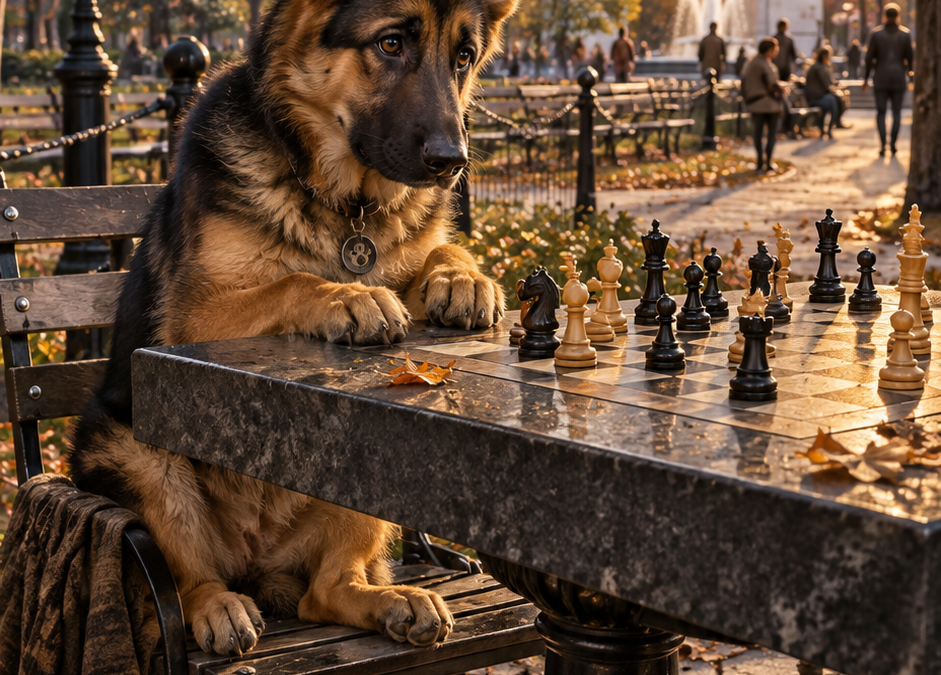
His front feet rested on the edge of the concrete board.
Across from him was an empty bench.
He stared at it.
Not at the pigeons.
Not at the tourists.
Not at the chess players arguing three tables away about whether a rook move was legal.
The empty bench.
A pigeon landed beside his paw.
Pecked at crumbs.
Nothing.
One of his ears twitched when a taxi horn sounded from Fifth Avenue, but his eyes stayed forward.
I slowed.
At first I assumed someone owned him.
Washington Square Park is full of characters who seem impossible until you’ve lived in New York long enough to stop asking questions.
Chess hustlers.
Street musicians.
A man who once spent six months dressed like a nineteenth-century poet for reasons nobody ever fully understood.
A German Shepherd sitting at a chessboard didn’t even make the top twenty.
Then two teenagers passed.
One pointed.
“Yo, he’s waiting for his opponent.”
The other laughed.
The puppy didn’t.
A woman pushing a stroller stopped.
Her toddler stretched one hand toward him.
“Doggy.”
The woman pulled the child’s hand back.
“No, honey. Don’t touch. He’s dirty.”
Dirty.
One word.
That was apparently enough to turn a living animal into scenery.
I moved closer.
The puppy didn’t react.
His coat was matted beneath his belly.
There was no bowl.
No leash.
No collar I could see beneath the thick fur around his neck.
Just him.
The chessboard.
The empty seat.
Something about the stillness bothered me.
Dogs aren’t naturally still like that at seven months.
German Shepherd puppies especially.
They’re supposed to be badly assembled machines powered by curiosity and terrible judgment.
This one looked old.
Not physically.
Emotionally.
I stood maybe six feet away.
“Hey.”
Nothing.
I crouched.
His eyes moved toward me for half a second.
Then returned to the bench.
I should have done something.
Called someone.
Bought food.
Asked around.
Instead, I told myself exactly what every busy person tells himself when responsibility appears without an appointment.
Somebody must know him.
Somebody must be handling it.
I had work.
I had a deadline.
I walked away.
Halfway across the park, I looked back.
Aster was still sitting at the chess table.
The crowd moved around him.
He didn’t move at all.
I told myself I would forget him.
I didn’t.
PART2
The next morning, I returned earlier than usual.
I pretended the decision had nothing to do with the dog.
Writers are excellent at constructing convincing narratives around their own cowardice.
I told myself I needed air.
The apartment was stuffy.
I wanted to think through a difficult paragraph.
Washington Square in the morning was quieter.
Fewer tourists.
More dog walkers.
Older men setting up chess pieces.
Delivery trucks growling along the surrounding streets.
Aster was already there.
Same table.
Same position.
His front paws rested against the concrete edge.
His eyes stared across the board.
A crow landed near one of the pawns somebody had left behind.
Cawed.
Aster didn’t react.
I sat on a bench across the path.
Pretended to read email.
For nearly fifteen minutes, I watched him.
People noticed.
That was the part that started bothering me.
They knew him.
A man in a Yankees cap passed and said, “Still here, huh?”
A woman walking a terrier shook her head.
“Poor thing.”
Someone else muttered, “Animal control should deal with that.”
Should.
Wonderful word.
It performs action without requiring the speaker to participate.
An older man lowered himself onto the bench beside me.
Thin.
Gray beard.
Newspaper tucked under one arm.
He followed my gaze.
“You’ve seen him before?”
“Yesterday.”
The man nodded.
“That’s Aster.”
The name changed everything instantly.
I looked at the dog again.
“Aster?”
“Yeah.”
“Owner around?”
The old man went quiet.
Then tapped two fingers against his chest.
“Heart.”
I didn’t understand.
“His owner?”
“Henry.”
He pointed at the empty bench across from Aster.
“Used to sit right there every morning.”
I looked at the bench.
“He’s dead?”
“Three weeks now.”
Something inside me dropped.
The man introduced himself as Malcolm.
He’d played chess with Henry for years.
Henry Walsh, seventy-one, retired high-school mathematics teacher.
Widower.
No children that anyone knew about.
Came to the park almost every morning.
Played chess.
Fed pigeons despite city signs suggesting otherwise.
Drank terrible coffee.
And brought Aster everywhere.
“He taught the dog to move pieces.”
I glanced at him.
“What?”
Malcolm smiled faintly.
“Not actual chess. Henry wasn’t delusional. But he’d point, give a command, dog would push the piece with his nose.”
Tourists loved it.
Children especially.
Henry would pretend Aster was a prodigy.
“He’d say the dog had a dangerous endgame.”
I smiled despite myself.
“What happened?”
Malcolm’s smile disappeared.
“Henry was sitting right there.”
He pointed again.
“Made one move. Then leaned back. Said he felt funny.”
Paramedics came.
Too late.
“And Aster?”
Malcolm looked toward him.
“Police tried taking him away that day. Dog slipped whoever grabbed him.”
“Then what?”
“Next morning, he came back.”
I stared.
“Where does he sleep?”
“No idea. Maybe near Henry’s building. Maybe under something around here.”
“And nobody took him?”
“We thought family would.”
“Wasn’t there family?”
“Apparently not much.”
Malcolm unfolded his newspaper but didn’t open it.
“Aster comes every morning. Stays until late. Rain too.”
My chest tightened.
“Every day?”
“Every day.”
I looked across the path.
Aster still faced the empty bench.
That changed the scene completely.
He wasn’t waiting for food.
He wasn’t guarding territory.
He wasn’t lost.
He knew exactly where he was.
He just didn’t know death had made the appointment impossible.
Or maybe he knew.
Maybe dogs understand absence better than we do and simply refuse its terms.
I stayed another hour.
Aster never left.
The next day I returned with food.
A sandwich for myself.
Soft dog food from a nearby shop for him.
I placed it maybe ten feet away.
Aster ignored it.
I moved farther back.
Waited.
Eventually he rose.
Slowly.
That worried me.
He was young, but his movements lacked energy.
He walked to the bowl.
Sniffed.
Ate three bites.
Paused.
Looked toward the empty bench.
Ate another.
Then returned to the chess table.
I felt absurdly defeated.
I’d fed him.
That was all.
Food couldn’t compete with grief.
An older woman sat near me.
I’d seen her around the park before.
Heavy brown coat.
Sunflower seeds permanently in one pocket.
She followed my gaze.
“You know about Henry?”
“Yeah.”
She nodded.
“I’m Ruth.”
“Daniel.”
She tossed seeds toward several pigeons.
“Aster loved him.”
“So everybody says.”
“No.”
She looked at me.
“I mean that dog was attached to him in a way you don’t see often.”
Henry talked to Aster constantly.
During games.
Walking.
Feeding birds.
He would explain chess strategy to him like the dog was preparing for a tournament.
Aster sat beside him.
Listened.
Sometimes barked when Henry blundered.
Ruth laughed at the memory.
“Henry would say, ‘See? Even the dog knows that was stupid.'”
I looked at Aster’s paws.
One rested near a black rook.
“Why doesn’t somebody take him?”
Ruth’s face changed.
“People tried.”
“Who?”
“Couple rescue volunteers.”
“And?”
“He panicked when they pulled him away.”
“Bit?”
“No. Just fought to come back.”
“So they left him?”
“They were going to return with equipment, but then someone complained they were trying to steal a dog.”
“Wonderful.”
“New York.”
Fair.
We sat quietly.
Then laughter came from behind us.
A group of college students had gathered near Aster.
One took a photo.
Another pointed.
“He’s waiting for his next match.”
Aster ignored them.
Then one boy clapped loudly.
“Go on, mutt.”
Nothing.
“Move.”
He stepped closer.
Something in me snapped.
“Hey.”
The boy turned.
“Back off.”
He looked genuinely confused.
“What’s your problem?”
“He’s not bothering you.”
“It’s a dog.”
“Excellent observation.”
His friends laughed.
The boy frowned.
“Whatever.”
They walked away.
I stood there with my fists clenched.
Aster looked at me once.
Then back at Henry’s seat.
That glance embarrassed me.
Not because I’d confronted the student.
Because I’d spent two days acting morally superior to people walking past while still doing almost exactly the same thing.
Watching.
Feeling.
Leaving.
That night, I couldn’t sleep.
I kept seeing Aster.
But another dog started entering the memory.
Rusty.
My German Shepherd when I was fifteen.
He had belonged technically to the family.
In reality, he was mine.
Rusty followed me to school some mornings.
Waited near the fence.
Slept outside my bedroom.
At fourteen, I found that annoying.
At fifteen, essential.
At sixteen, he disappeared for almost two days.
I searched everywhere.
Flyers.
Bike rides.
Neighbors.
Alleys.
We found him under the back steps.
His heart was failing.
The veterinarian said it had probably been developing for months.
I had spent the previous afternoon at a friend’s house.
That detail became irrationally important.
For years, I believed I should have been there.
Rusty died with my father beside him.
Not me.
I never forgave myself.
I stopped talking about him.
Then adulthood happened.
College.
Work.
New York.
Relationships.
Breakups.
Deadlines.
My life filled.
The guilt simply learned to sit quietly.
Aster brought it back.
The next morning, I went to Petco.
Stainless-steel bowl.
Water dish.
Red leash.
Fleece blanket.
Sensitive-stomach kibble.
Treats.
The cashier smiled.
“New puppy?”
“Something like that.”
I carried everything to Washington Square Park.
Aster sat in his usual place.
I laid the blanket several feet from the chess table.
Water.
Food.
Then moved back.
Aster noticed.
His nose worked.
Finally, he rose.
Walked toward the bowl.
Ate slowly.
Not ravenously.
Suspiciously.
Afterward, he drank.
Then returned to the board.
Paws up.
Eyes forward.
“You’re welcome,” I muttered.
Nothing.
I sat nearby until sunset.
Aster never acknowledged me again.
The next day I brought no food.
Just coffee.
Notebook.
Time.
I treated it like an appointment.
Ten in the morning.
Same bench.
Aster already present.
I sat.
Wrote a few lines.
Looked up.
Waited.
At noon, I moved the water bowl closer to his table.
He waited almost ten minutes before drinking.
That counted as progress.
At one point, a chess piece fell from the board.
White knight.
Aster looked down.
Then raised one paw.
Nudged it.
Not randomly.
Toward the center of the board.
I stopped writing.
He knew.
Not chess.
Memory.
Routine.
Henry had taught him that touching those pieces created interaction.
Praise.
Laughter.
Attention.
Aster wasn’t guarding a board.
He was maintaining a ritual.
That hurt worse.
That evening, I went through an old box beneath my bed.
Found photographs.
Receipts.
Books.
A picture of Rusty and me.
Fifteen years old.
Barefoot.
Arms around his neck.
He looked directly at the camera.
I didn’t.
I sat on the floor holding the photo for a long time.
Maybe Aster wasn’t the only creature waiting at a place somebody had left.
The following morning, I arrived before most chess players.
Aster was there.
Of course.
For the first time, I sat across from him.
Henry’s seat.
Aster’s head rose.
I stopped immediately.
“Too much?”
He stared.
Didn’t growl.
Didn’t leave.
I put my coffee on the board.
Then reached inside my coat.
I had brought a bishop from an old chess set I’d inherited.
Don’t ask why.
At two in the morning it had seemed meaningful.
In daylight it felt theatrical.
Still, I placed the bishop near the center.
Aster looked at it.
Then at me.
Not through me.
At me.
My pulse jumped.
“Your move.”
His paw moved.
Touched the square beside the bishop.
Then rested.
No barking.
No miracle.
But he had looked at me from Henry’s side of the world.
That mattered.
I stayed.
Rain came that evening.
Not heavy at first.
Mist.
Streetlights reflected off wet stone.
I told myself Aster wouldn’t be there.
No dog would sit in that weather.
Of course he was.
Soaked.
Fur plastered to his body.
Paws on the board.
I stood under an umbrella thirty feet away feeling furious.
At him.
At Henry for dying.
At every rescue organization that had apparently failed to solve this.
At myself for expecting grief to behave intelligently.
I ran home.
Grabbed the fleece blanket.
Returned.
Aster remained.
I sat beside him.
Not across.
Beside.
Wrapped the blanket around both of us.
For several minutes, he stayed rigid.
Rain hit the chessboard.
Water gathered between squares.
Then Aster exhaled.
Long.
His body shifted.
And his head came down onto my knee.
I stopped breathing.
Not because I was afraid.
Because if I moved, the moment might vanish.
His fur was soaked.
Heavy.
Warm underneath.
I laid one hand gently between his ears.
Aster didn’t flinch.
We sat in the rain.
People walked past.
Some stared.
Nobody mattered.
For the first time since I’d met him, Aster wasn’t waiting alone.
I don’t know how long we stayed.
Maybe forty minutes.
Maybe two hours.
Grief distorts time.
Eventually he closed his eyes.
Actually closed them.
That was when I decided enough was enough.
The next morning, I called a veterinarian.
East Village Animal Hospital had a cancellation at noon.
“Rescue case?”
“I guess.”
“Can you transport him?”
“I’ll find out.”
Borrowed crate from my neighbor.
Red leash.
Treats.
Blanket.
I found Aster lying beside the table.
Not sitting.
That scared me.
His ribs looked more visible.
“Aster.”
Ear twitch.
I knelt.
Showed him the leash.
No grabbing.
Just presented it.
He watched.
I looped it slowly.
He tensed.
Then looked toward Henry’s bench.
“It’s okay.”
I hated how inadequate words were.
“You can come back.”
That seemed important.
Not goodbye.
Not removal.
Temporary.
Aster stood.
Walked with me.
Every few steps, he looked backward.
At the chess tables.
At Henry’s bench.
By the park exit, his legs slowed.
“Come on.”
I crouched.
“Just one block.”
He looked at me.
Then stepped outside the park.
The veterinarian, Dr. Priya Patel, examined him for almost an hour.
Weight loss.
Dehydration.
Stress.
Mild anemia.
Parasites.
No major orthopedic problem.
But his heart rhythm concerned her.
“Is it serious?”
“Could be stress-related.”
“Stress can do that?”
“Prolonged stress affects the body. Appetite, sleep, immune function, cardiac rhythm.”
She looked at his chart.
“He’s young. That’s in his favor.”
“How young?”
“Seven to eight months.”
Aster should have been eating furniture.
Instead, grief had aged him.
Patel sat beside me.
“His biggest issue may be behavioral.”
“What does that mean?”
“He’s shut down.”
“Can that kill him?”
She chose her words carefully.
“Not directly in the way people say ‘died of sadness.’ But chronic refusal to eat, dehydration, stress, lack of rest—yes, those consequences can become dangerous.”
Better answer.
More honest.
“I’d like to keep him overnight.”
My stomach tightened.
“Will he panic?”
“Possibly.”
“We can keep his blanket.”
“Yes.”
I removed the bishop from my pocket.
Then stopped.
Wrong piece.
Henry’s old game.
Memory.
I needed something more central.
The next few hours were terrible.
I went home.
Couldn’t write.
Couldn’t eat.
At seven, my phone rang.
Dr. Patel.
“Aster’s stable.”
I exhaled.
“But?”
“He hasn’t eaten.”
“Water?”
“Very little.”
“Behavior?”
“Curled in the back corner. Doesn’t engage.”
I grabbed my coat.
“Can I come?”
“Yes.”
I was there fifteen minutes later.
Aster lay inside a recovery kennel.
Head down.
Eyes open.
When I entered, his ears rose.
Nothing else.
“Aster.”
His eyes found me.
Recognition.
Small.
But there.
I crouched outside the kennel.
“I brought something.”
The bishop was in my pocket.
But before coming to the hospital, I’d stopped by the recreation center near the park.
They had old donated chess sets.
Incomplete.
Broken.
I asked for one piece.
A wooden king.
I slid it onto the floor.
Aster looked.
For several seconds, nothing happened.
Then his head lifted.
He moved one paw.
Placed it over the king.
My throat closed.
“Yeah.”
Aster stared at it.
Then nudged the piece toward me.
One inch.
Maybe two.
Dr. Patel stood behind me.
Neither of us spoke.
I placed my hand near the king.
Aster lowered his head beside it.
A technician appeared at the doorway.
“He drank.”
Patel turned.
“What?”
“Just now. He drank.”
I looked at Aster.
His eyes closed.
That was enough for me.
“When can he leave?”
“Tomorrow would be safer.”
“No.”
Patel raised an eyebrow.
I corrected.
“Sorry. Can I stay?”
She looked at me.
Then Aster.
“Yes.”
I sat on the floor outside his kennel until almost midnight.
He ate three bites of food.
Then five.
I slept in a plastic chair.
At some point, I woke with my neck bent at an angle that should have required surgery.
Aster was watching me.
“You’re welcome.”
Tail moved.
Barely.
I smiled.
By morning, Dr. Patel cleared him for discharge.
“Who’s fostering him?”
I hesitated.
“I am.”
“Temporary?”
Aster stood beside me.
Red leash.
Wooden king in my pocket.
“No.”
Patel smiled.
“Thought so.”
The adoption/legal process was less poetic.
Animal control.
Search for next of kin.
Owner records.
Microchip.
Henry had registered Aster.
No relative claimed him.
After the required procedures, Aster became mine.
On paper.
Emotionally, it took longer.
The first days at my apartment were quiet.
I put the fleece blanket in the living room.
Aster stayed there.
Food only when I backed away.
Water mostly at night.
If I entered too quickly, his body stiffened.
Not fear exactly.
Habit.
Waiting.
I began leaving the wooden king near his bed.
Not always.
Just enough.
On the third morning, I woke to the sound of nails on hardwood.
Aster stood outside my bedroom.
He looked at me.
Then walked away.
“Good morning to you too.”
Progress.
By the end of the first week, he ate while I stayed in the room.
Second week, he slept deeper.
Third week, he placed his head on my foot while I worked.
No ceremony.
I was typing.
Suddenly weight.
I looked down.
Aster’s head.
Eyes closed.
I didn’t move for an hour.
My leg went numb.
Worth it.
Washington Square remained the difficult part.
I avoided it initially.
We walked other streets.
Different routes.
Then one morning, Aster pulled gently toward the park.
I stopped.
“You sure?”
Tail neutral.
He pulled again.
We entered.
His whole body changed.
Ears high.
Nose working.
Steps faster.
He knew every path.
Every corner.
Every smell.
When the chess tables came into view, he stopped.
I waited.
Aster stared.
Henry’s bench was empty.
No rain.
No crowd.
Just morning.
Aster walked forward.
Slow.
Reached the table.
Then something changed.
He did not climb into his old position.
Instead, he sat beside me.
I pulled the wooden king from my pocket.
Placed it on the board.
Aster looked.
Then nudged the bench with his paw.
Henry’s bench.
I swallowed.
“You want me there?”
Aster waited.
I sat across from him.
Exactly where Henry had sat.
It felt wrong.
Then right.
Then both.
Aster rested his paws on the edge.
Looked at the king.
Then at me.
For twenty minutes, we sat.
No game.
No trick.
No attempt to replace anyone.
That mattered.
I could not become Henry.
I shouldn’t.
Aster didn’t need Henry replaced.
He needed life after Henry.
Those are different things.
An elderly chess player stopped.
“That’s Henry’s dog.”
“Aster.”
“Looks better.”
“He is.”
The man smiled.
“Henry would’ve liked that.”
I looked at the board.
“Hope so.”
Aster touched the king.
The man laughed.
“He still plays?”
“Apparently I’m losing.”
Word spread.
The chess players accepted me slowly.
Not as Henry.
As Daniel.
Aster became part of the park again.
Different now.
People fed him too much.
Children asked to pet him.
I became the irritating adult who explained they had to ask first.
Malcolm still came most mornings.
First time he saw Aster on the leash, his eyes filled.
“Well.”
“Yeah.”
He crouched.
Aster sniffed him.
Malcolm rubbed his chest.
“You finally got off that damn table.”
Aster licked his chin.
“Henry would be furious.”
“Why?”
“He always said the dog had terrible taste in people.”
I laughed.
Aster barked once.
Malcolm pointed.
“See?”
Months passed.
Aster became a puppy again.
That was perhaps the greatest miracle.
Not supernatural.
Behavioral.
Physical.
Ordinary.
He stole socks.
Chewed the corner of a manuscript.
I discovered this after printing thirty pages.
“Aster.”
He looked innocent.
“That was chapter nine.”
Tail wag.
“Critics are usually subtler.”
He stole another page.
I learned to close my office door.
At the dog run, he initially stood near me.
Then one day, another shepherd invited him to play.
Aster hesitated.
Then ran.
Full sprint.
Seven months of puppy energy apparently stored in reserve.
He chased.
Was chased.
Rolled.
Barked.
For ten minutes, he looked nothing like the dog at the chess table.
I stood outside the fence crying.
Embarrassing.
A woman asked if I was okay.
“Allergies.”
In February.
She was polite enough not to challenge it.
At home, Aster slept near my bed.
Not on it.
He had standards.
At two in the morning, sometimes he woke.
Walked into the living room.
Stood near the wooden king I’d placed on a shelf.
Then returned.
Memory remained.
Healing did not require forgetting.
I learned that too.
My own memory of Rusty changed.
Aster didn’t erase the guilt.
He exposed how useless it had become.
I was fifteen.
Rusty’s heart failed.
I wasn’t a veterinarian.
I wasn’t responsible for preventing death because I loved him.
That conclusion had taken me twenty-seven years and one grieving shepherd to reach.
One night I took out the old photograph of Rusty.
Aster sniffed it.
Then sneezed.
“Very respectful.”
He laid down.
I looked at the picture.
For the first time, I remembered the good years before the final two days.
That was Aster’s lesson.
Grief compresses a life around its ending.
Love expands it again.
Henry had died at one chess table.
But Henry and Aster had also shared hundreds of mornings.
Games.
Walks.
Food.
Birds.
Laughter.
Those mattered more than the final absence.
I started interviewing people who had known Henry.
Not for publication initially.
Malcolm.
Ruth.
Chess regulars.
A deli owner.
A former student who recognized Henry from a photo.
Stories emerged.
Henry had taught math for thirty-eight years.
Never raised his voice in class.
Played terrible piano.
Loved endgames.
Had been married to Alice for forty-five years until cancer took her.
Aster came later.
A student of Henry’s had found the puppy through a rescue and thought he needed companionship.
He did.
Henry apparently resisted.
Then became ridiculous.
Bought Aster a winter coat.
Cooked chicken.
Talked to him like a person.
I wrote it all down.
One afternoon, Malcolm asked, “You writing about him?”
“Maybe.”
“Henry would hate that.”
“Why?”
“He believed writers were people who turned simple things into fifty pages.”
I smiled.
“He wasn’t wrong.”
The essay became one of the most personal things I’d ever written.
Not about rescue.
About waiting.
Henry.
Aster.
Rusty.
Grief as loyalty with nowhere to go.
I almost didn’t publish it.
Then I did.
The response surprised me.
People sent stories.
Dogs waiting at doors after owners died.
Cats sleeping on clothing.
Humans continuing habits because changing them felt like betrayal.
One message stayed with me.
A woman wrote:
You don’t stop loving the person who left. You just make room beside the love for what comes next.
That described Aster exactly.
The park changed around us.
Spring.
Summer.
Fall.
Aster grew.
By his first birthday, he was seventy pounds.
Healthy.
Glossy coat.
Broad chest.
Still one habit remained.
Every morning we crossed Washington Square, Aster slowed near Henry’s table.
Sometimes he stopped.
Sometimes didn’t.
When he did, I waited.
No pulling.
No “come on.”
He looked.
Remembered.
Then moved.
The first time he walked past without stopping, I almost called it progress.
Then I decided that was unfair.
Stopping wasn’t failure.
Continuing afterward was what mattered.
One summer afternoon, the same kind of students who’d once mocked him gathered near the table.
Not the same people.
Different generation.
A boy laughed.
“Yo, chess dog.”
Aster looked.
Tail wag.
He approached.
The boy crouched.
Aster pushed the wooden king with his nose.
Everybody laughed.
This time, not at him.
With him.
Funny how context changes sound.
The park had once treated his grief like spectacle.
Now he was part of its life again.
I preferred that.
Aster became well known.
Chess players joked he had an opening repertoire.
Tourists photographed him.
I allowed it when he seemed comfortable.
No forced poses.
No circus.
He had already spent enough time being watched instead of helped.
One autumn morning, a man approached.
Mid-fifties.
He stood at Henry’s bench.
Didn’t sit.
He looked at Aster.
“Is that Henry Walsh’s dog?”
“Yes.”
The man’s eyes filled.
“I’m his nephew.”
I stood.
“You knew Henry?”
“Not well enough.”
His name was Thomas.
He lived in Pennsylvania.
Had heard about Henry’s death late.
Family had been fractured for years.
No villain.
Just distance.
Pride.
Old disagreements.
Life.
Thomas had assumed animal control had taken Aster.
He had no idea the dog remained in the park.
He crouched.
“Aster.”
The dog stared.
Then sniffed.
No dramatic recognition.
Thomas laughed through tears.
“Of course you don’t remember me.”
I stayed quiet.
Thomas looked at the board.
“Uncle Henry taught me chess here.”
We sat.
He told stories.
Henry had been stubborn.
Generous.
Difficult.
Funny.
Human.
The conversation filled gaps.
Before leaving, Thomas asked if I planned to keep Aster.
“Yes.”
“Good.”
No challenge.
No claim.
He handed me an envelope.
Inside was a photograph of Henry and Aster at the chess table.
Aster maybe four months old.
One paw on a rook.
Henry laughing.
I stared.
“I thought you should have it.”
“Thank you.”
That photo went on my wall beside Rusty’s.
Not replacing.
Adding.
Aster aged.
Slowly at first.
Years.
People think rescue stories end when the animal comes home.
They don’t.
Coming home is usually where the long story starts.
Veterinary appointments.
Training.
Rent.
Dog hair.
Walks in freezing rain.
Emergency diarrhea at three in the morning.
The glamorous details.
Aster developed into a calm, intelligent dog.
He learned commands quickly.
He could actually move selected chess pieces on cue.
Henry’s training had stuck.
I never turned it into a trick for crowds.
Sometimes, privately, I’d set the board.
Point.
“Bishop.”
Aster nudged it.
“Rook.”
Wrong piece.
“Cheater.”
Tail wag.
The king remained special.
Whenever I set it down, Aster became quieter.
He touched it gently.
Then looked at me.
I never fully understood what it meant to him.
Memory.
Object association.
Reward history.
Henry.
Probably all of it.
At five, Aster started accompanying me to readings.
Not inside crowded halls usually.
Small bookstores.
Outdoor events.
He lay near my chair.
One editor called him my “co-author.”
Accurate.
He had eaten enough drafts to qualify.
At seven, gray began at the muzzle.
I hated that.
At eight, we shortened long walks.
At nine, arthritis entered one hip.
At ten, he stopped chasing pigeons.
He had finally discovered dignity.
Or exhaustion.
Washington Square remained ours.
Henry’s table was still there.
Stone lasts longer than people.
One morning, city workers replaced the bench across from it.
I felt unexpectedly angry.
Old bench removed.
New one installed.
Clean.
No Henry.
Then I caught myself.
Memory doesn’t live in wood.
Aster sniffed the new bench.
Lifted one leg.
Claimed it.
Henry, wherever he was, would have appreciated the disrespect.
At eleven, Aster’s heart rhythm changed.
Dr. Patel was still practicing.
More gray in her hair.
More gray in mine.
She listened twice.
Then ordered tests.
Cardiomyopathy.
Not immediately catastrophic.
Manageable for a while.
The irony nearly destroyed me.
Rusty.
Heart.
Now Aster.
I sat in the exam room staring at the floor.
Patel noticed.
“You okay?”
“No.”
She waited.
I told her about Rusty.
Everything.
The guilt.
Finding him.
Not being there.
Patel listened.
Then said, “Daniel, loving an animal doesn’t grant control over mortality.”
I laughed bitterly.
“Everybody apparently understands that except me.”
“Most people don’t understand it until they have to.”
Aster put his head on my knee.
Same gesture.
Years ago.
Rain.
Chess table.
Hospital.
Home.
I scratched his ears.
“How long?”
Patel gave me the answer veterinarians hate.
“We don’t know.”
So we took what we got.
Medication.
Monitoring.
Slower walks.
More sitting.
That suited Aster.
Chess is not strenuous.
At twelve, he still visited the park.
We took breaks.
I carried water.
People who remembered him as a puppy were shocked by his white muzzle.
“That’s Aster?”
“Still cheating at chess.”
He would push the king.
Children laughed.
One little boy asked, “Who’s he playing?”
I looked across the board.
Nobody.
Then me.
“Old friend.”
The boy accepted that.
Children are good at answers adults overcomplicate.
The final winter came quietly.
Aster stopped eating breakfast one morning.
Then ate dinner.
Then skipped another.
His breathing changed.
Patel adjusted medication.
For a month, we stabilized.
Then less.
I knew.
Of course I knew.
Knowing doesn’t help.
One cold February morning, Aster stood at the apartment door.
Leash hanging nearby.
“You want out?”
Tail moved.
Barely.
We walked to Washington Square.
Slow.
Very slow.
Snow from the previous night had melted along the paths.
The chess tables were mostly empty.
Aster led me toward Henry’s.
He stopped.
Looked at the table.
Then at me.
I sat in Henry’s bench.
Aster stood beside me.
I placed the wooden king on the board.
His nose touched it.
Then nudged it toward me.
Exactly like the hospital years earlier.
My throat closed.
“Your move?”
He looked at me.
Then lowered himself beside my feet.
Not his old side.
Mine.
We stayed there almost an hour.
Malcolm had died years before.
Ruth had moved to Florida.
Henry gone.
Rusty gone.
Years passing.
Park still noisy.
Pigeons still opportunistic.
Life is rude about continuing.
I rested my hand on Aster’s head.
“Ready?”
He closed his eyes.
I don’t know what I meant by the question.
Neither did he.
We went home.
That night, breathing became difficult.
Patel came to the apartment the next morning.
No emergency hospital.
No fluorescent lights.
No crate.
Aster lay on his fleece blanket.
The original one.
I had kept replacing it with nicer beds.
He kept choosing the old blanket.
Of course.
The wooden king rested nearby.
I sat on the floor.
Aster’s head on my leg.
“Hey.”
His eyes opened.
“Remember the park?”
Tail movement.
“Bad place to live.”
Another tiny movement.
“Good place to play chess.”
I cried then.
Not gracefully.
I had spent years writing language for other people.
At the moment language mattered most, I had almost none.
“You waited long enough.”
Aster breathed.
“You don’t have to wait anymore.”
Patel gave the sedative.
His body relaxed.
For the first time, no tension.
No watching.
No expectation.
I touched his face.
“You were a good dog.”
Understatement.
“You were Henry’s good dog.”
His eyes half closed.
“And mine.”
That mattered too.
Not replacement.
Continuation.
“And Rusty would have hated you.”
Patel laughed softly.
I did too.
Aster’s breathing slowed.
I placed the king beneath his paw.
“Your move.”
One breath.
Another.
Then stillness.
I sat there long after.
The apartment felt impossible without his breathing.
Eventually I returned to Washington Square alone.
Not immediately.
Weeks later.
I carried the king.
Sat at Henry’s table.
The board was empty.
I placed the piece in the center.
People moved around me.
Coffee.
Phones.
Laughter.
A German Shepherd passed with another owner.
My chest hurt.
I stayed.
For years, I had wondered whether Aster had understood Henry was gone.
Now I understood the question differently.
Aster hadn’t needed to understand death intellectually.
He had needed help learning that continuing wasn’t betrayal.
That was what we’d done together.
Henry remained loved.
Aster still came home with me.
Rusty remained loved.
I still allowed Aster into my life.
Grief had taught both of us the wrong lesson at first.
Wait.
Freeze.
Don’t move.
Don’t replace.
Don’t risk.
Love taught us another.
Carry it.
Move anyway.
The essay I eventually wrote about Aster wasn’t really about dogs.
It was about loyalty after the person is gone.
About how devotion can become a prison if nobody shows you another way to hold it.
I wrote about the chess table.
Henry.
The rain.
The king.
Aster’s first night in my apartment.
His first run.
His last morning.
I ended with the board.
Not empty.
Open.
Because that’s what changed.
For weeks, Aster had treated Henry’s absence like a game paused mid-move.
He stayed because leaving felt like abandoning the man who had left him.
Years later, he could sit at the same table, remember, and still walk home.
That was healing.
Not forgetting.
Movement.
The students who laughed at him disappeared from the story.
The strangers who called him dirty disappeared.
The people who said animal control should handle him disappeared.
Not because they were punished.
Because they never mattered enough to survive inside Aster’s life.
Henry mattered.
I mattered.
The people who brought food mattered.
Dr. Patel mattered.
Malcolm.
Ruth.
Thomas.
The children who eventually learned his name.
Those were the people who remained.
Indifference lost.
Mockery lost.
The empty bench lost its power.
Aster did not spend his life waiting.
That is the part I want remembered.
He waited for weeks.
Yes.
Long enough to become thin.
Long enough to become silent.
Long enough that grief began affecting his body.
But he didn’t wait forever.
One rainy night, he put his head on a stranger’s knee.
One hospital night, he pushed a wooden king toward a man who wasn’t Henry.
One morning, he left the park.
One day, he came back.
And eventually, he learned that returning and leaving could both be acts of love.
I kept the king.
It sits on my desk now.
Beside the photograph of Henry and Aster.
Beside Rusty.
Three lives tied together by a dog who once refused to leave a chess table.
Sometimes I pick up the piece when I’m stuck writing.
Turn it over.
Think about Aster.
Chess teaches you that a game changes every time one piece moves.
Grief works the same way.
You cannot restore the previous board.
You make the next move from where you are.
Aster spent weeks refusing to move.
So did I, in ways nobody could see.
Then we moved together.
That was enough.
Years after his death, I still walk through Washington Square.
The table remains.
Different players.
Different tourists.
Sometimes a shepherd passes and looks toward it.
I always notice.
Once, a teenage boy sat there with his dog.
He had taught the dog to tap pieces with one paw.
Terrible technique.
Aster would have objected.
I watched from a distance.
The boy laughed.
The dog barked.
A pigeon stole something from a paper bag.
For a second, the past and present overlapped.
Henry.
Aster.
Me.
Strangers.
Then separated again.
I didn’t feel sad.
Not exactly.
I felt grateful.
Aster had once sat at that table convinced the only person who mattered had disappeared.
He couldn’t imagine another chapter.
Neither could I.
We were both wrong.
The man he waited for never returned.
That truth never changed.
Henry was gone.
Nothing made that less painful.
But Aster eventually discovered something grief had hidden from him:
The death of one love does not prohibit another.
It doesn’t erase what came before.
It doesn’t compete.
The heart isn’t a chessboard with only one king.
There’s room.
More than you think.
Henry gave Aster his first home.
I gave him his second.
Aster gave me something I didn’t know I needed.
Permission to stop standing guard over old guilt.
The world saw a dirty puppy sitting at a chess table.
A stray.
A nuisance.
A strange park story.
I eventually saw what he really was.
A young dog keeping an appointment with love.
He didn’t understand why the other player had stopped showing up.
So he held the place.
Day after day.
Rain.
Heat.
Laughter.
Hunger.
He stayed.
Until somebody finally sat across from him.
Not to replace Henry.
Just to make sure the next move wasn’t made alone.
That was all I did.
I sat down.
Aster did the rest.
He ate.
Trusted.
Walked.
Played.
Grew.
Loved.
Aged.
And when his own game finally ended, he wasn’t beneath a chess table waiting for somebody who would never come.
He was home.
His head was in my lap.
The wooden king rested under his paw.
He knew exactly who was beside him.
And this time, nobody walked away.








