𝗣𝗔𝗥𝗧 𝟮 He Waited 26 Days for the Family Who Left Him—Then One Car Finally Came Back
𝗣𝗔𝗥𝗧 𝟮
I placed the bowl on the grass.
He didn’t move.
I backed away.
“All right.”
I crossed the street again.
From my window, I watched him sniff the food.
He waited another ten minutes.
Then ate.
That night, he slept near the mailbox.
The next morning, he was there when I woke.
Same position.
Same road.
Same expectation.
I brought him breakfast.
He waited until I left before eating.
That became our routine.
The first few days, I assumed someone would return.
Every car that slowed near the house made him stand.
Every engine made his head lift.
Every familiar shape in the distance pulled him to his feet.
Sometimes he walked several yards toward an approaching vehicle, tail beginning to move.
Then, when it passed, he returned to the mailbox.
By the fourth day, I called animal control.
A young officer came in a county vehicle.
He stood beside me at the edge of my yard.
“How long has he been there?”
“Four days.”
“Owner information?”
“I don’t know.”
“You saw them leave?”
“Yes.”
“Without the dog?”
“Yes.”
He sighed.
“Have you approached him?”
“I feed him.”
“Does he let you touch him?”
“No.”
“Growl?”
“No.”
“Bark?”
“No.”
The officer walked toward him slowly.
The Labrador stood.
“Easy, buddy.”
The dog backed away.
The officer stopped.
Held out a hand.
“Come on.”
The dog moved around him.
Then returned directly to the mailbox.
The officer looked at me.
I folded my arms.
“Well?”
“He’s not aggressive.”
“I know.”
“He’s also not technically confined.”
“Someone abandoned him.”
“Possibly.”
“Possibly?”
He looked uncomfortable.
“I’m not arguing with you, ma’am.”
“Elizabeth.”
“Elizabeth.”
He glanced toward the dog.
“We can try to identify the registered owner.”
“Please do.”
“But if he isn’t posing a threat and we can’t safely secure him without escalating the situation, there are limits to what I can do immediately.”
“So he just stays here?”
“For now.”
I didn’t like the answer.
But I understood.
The dog had chosen a location.
He was not wandering.
He wasn’t attacking anyone.
He wasn’t chasing traffic.
He was waiting.
The officer tried once more.
The Labrador moved away.
Then came back the moment the man retreated.
“He’s attached to the property.”
“No,” I said.
The officer looked at me.
“He’s attached to the people.”
That was the difference.
A house meant nothing without the scent and voices inside it.
I watched the dog that afternoon and thought about names.
I didn’t know his real one.
I could have asked around.
Perhaps someone knew.
But instead, a name came to me.
Benny.
That had been my husband’s name.
Benjamin.
Everyone called him Ben.
I almost never did.
I called him Benny when I wanted to annoy him.
“Benny, take the trash out.”
“Don’t call me Benny.”
“Benny, your socks are on the floor.”
“I’m sixty-eight years old.”
“Then you should know where the hamper is, Benny.”
He would glare.
I would laugh.
Twenty-three years of marriage and somehow that silly name became one of the things I missed most.
The dog had the same stubbornness.
Same quiet loyalty.
Same willingness to sit in one place until the world changed around him.
So in my thoughts, I called him Benny.
I never said it aloud.
Not then.
The first week passed.
Rain came on day seven.
Heavy autumn rain.
I expected him to seek shelter beneath the porch.
He did not.
He remained beside the mailbox.
His fur darkened with water.
He lowered his head against the wind.
I stood beneath my umbrella and crossed the street.
“This is ridiculous.”
He watched me.
“You’re going to get sick.”
He didn’t move.
I put the food beneath a covered area near the driveway.
He waited.
I stepped closer than usual.
He stood.
Not threatening.
Just uncertain.
“All right.”
I stopped.
“I won’t touch you.”
His eyes remained on me.
“You don’t know me.”
I looked toward the empty house.
“But apparently the people you did know aren’t coming back.”
The words hurt me as soon as I said them.
Because I wasn’t sure whether I was talking to him.
Or myself.
I went home.
From the kitchen, I saw him eventually move beneath the edge of the porch.
Only after darkness came.
By morning, he was back at the mailbox.
Day nine.
Day ten.
Day eleven.
I began measuring my life by that dog.
Wake up.
Coffee.
Look outside.
Benny.
Breakfast.
Benny.
Lunch.
Benny.
Evening.
Benny.
I bought dog food.
The cashier looked at me.
“You got a dog?”
“Not exactly.”
“What does that mean?”
“I have a dog who doesn’t know he’s mine.”
She laughed.
I didn’t.
Because he wasn’t mine.
He belonged to someone.
At least in his mind.
And that distinction mattered.
I never crossed the road expecting gratitude.
I didn’t call him.
Didn’t try to lure him into my yard.
I placed food and water.
That was all.
I knew enough about grief not to drag anyone through it faster than they could move.
My husband had been gone four years.
People told me I was strong.
They said it because I kept my house clean.
Because I paid bills.
Because I went to the grocery store.
Because I smiled when neighbors asked how I was.
People confuse functioning with healing.
After Ben died, I kept living.
But for a long time, I did what that Labrador was doing.
I waited.
Not literally by the mailbox.
But emotionally.
Part of me remained exactly where life had left me.
In the hospital corridor after the nurse came out.
At the funeral.
In our bedroom when I first saw his side of the bed empty.
There are many ways to wait for someone who cannot return.
I hadn’t realized mine until I watched Benny.
By day fourteen, he allowed me to stand a little closer.
I sat on the curb once.
He remained by the mailbox.
Ten feet between us.
“Good morning.”
His ears moved.
“I’m eighty years old, you know.”
No response.
“I’m not supposed to be crossing streets twice a day carrying your dinner.”
He blinked.
“You could at least come halfway.”
Nothing.
I sighed.
“You really are a Benny.”
For the first time, I said the name aloud.
The dog looked directly at me.
I laughed.
“Oh, don’t encourage me.”
His tail moved.
Barely.
One sweep against the grass.
I stared.
“Did you just…”
It stopped.
I smiled.
“Fine. Benny it is.”
From then on, I used the name.
I don’t know whether he understood it.
Dogs learn sound and tone.
Perhaps he only knew that particular sound meant food and a quiet old woman.
But over time, his eyes began turning toward me when I said it.
“Benny.”
Look.
“Benny.”
Look.
That was enough.
On day seventeen, the weather turned cold.
I brought out an old blanket.
It had belonged to Ben.
Dark green.
Wool.
I almost put it back in the closet.
For years, I kept things because touching them felt like touching him.
His shirts.
A jacket.
An old mug.
The blanket.
Then I looked across the street and saw Benny curled against the base of the mailbox.
I carried it over.
He stood as I approached.
I laid it near the porch.
“You can use this or not.”
He watched.
“My Benny liked it.”
I swallowed.
“The human one.”
I stepped back.
“He was stubborn too.”
The dog remained still.
“Actually, you’re easier.”
I went home.
That evening, the Labrador lay on the blanket.
I sat at my kitchen table and cried.
I wasn’t sure why.
Maybe because something that had belonged to my husband was warming another living creature.
For the first time, it didn’t feel like losing Ben again.
It felt like letting something of him continue.
The days kept passing.
Nineteen.
Twenty.
Twenty-one.
The empty house was eventually listed as sold.
I noticed a real-estate sign disappear from the yard.
Someone had bought it.
I wondered what would happen to Benny when they came.
Animal control returned once.
Same result.
They had apparently been unable to get a useful response from the former owners.
I didn’t ask for details.
I was too angry.
I didn’t want names.
I didn’t want excuses.
I wanted them to drive back.
Open the door.
Call their dog.
That was all.
But life rarely gives us the ending we think is owed.
Day twenty-three.
Benny finally let me touch him.
It happened accidentally.
I placed his bowl down.
He remained nearby instead of moving away.
I crouched.
His nose moved toward my sleeve.
I stayed still.
He sniffed.
Then my fingers brushed the side of his neck.
His body tensed.
I pulled back.
“Sorry.”
He looked at me.
I waited.
Then, very carefully, I touched him again.
His fur was rough from weather.
Warm underneath.
I stroked once.
Stopped.
Benny did not leave.
My throat tightened.
“Thank you.”
That was all.
Day twenty-five.
I remember thinking that perhaps tomorrow I would try to bring him into my yard.
Not the house.
Just the yard.
I imagined opening my gate.
Leaving food there.
Giving him the choice.
I didn’t know that the choice would come to him first.
The twenty-sixth morning began quietly.
I washed dishes after breakfast.
Benny was in his usual place.
Sunlight.
Cool air.
No rain.
I had just dried a plate when I heard an engine.
Not unusual.
But this one slowed.
Then stopped.
I looked out the window.
A truck had pulled into the driveway across the street.
Benny stood.
His entire body changed.
He stared.
Then suddenly he ran.
For twenty-six days, I had watched that dog move like something inside him was heavy.
Now he flew.
He sprinted toward the vehicle.
His tail whipped back and forth.
He barked.
Loud.
Joyful.
Wild.
I had never heard him bark before.
My hands froze in the dishwater.
“Oh, Benny.”
For one beautiful second, I believed it too.
They’re back.
I stepped closer to the window.
Benny circled the truck.
He jumped once near the driver’s door.
Barked again.
His entire body seemed too full of happiness to contain.
The driver’s door opened.
A man stepped out.
Benny stopped.
I frowned.
I had never seen him before.
The passenger door opened.
A woman.
Then two children climbed from the back.
None of them looked familiar.
Benny stood in front of them.
Tail still moving.
But slower now.
The man looked at the dog.
Then at the woman.
“Is this someone’s dog?”
I could hear part of it through the open kitchen window.
The woman shrugged.
“Maybe the neighbors’.”
One of the children reached toward Benny.
The mother said, “Don’t touch him yet.”
Benny looked from one face to another.
His tail stopped.
He sniffed the man.
Then the woman.
He moved toward the children.
Then back toward the man.
I knew what he was doing.
Looking for recognition.
Where have you been?
Call me.
Say my name.
Open your arms.
Tell me the waiting is over.
But these people had never seen him.
They didn’t know what twenty-six days meant.
They didn’t know the rain.
The cold.
The meals beside the road.
The engines he had watched.
The nights he had slept facing the corner where the old family’s car disappeared.
The man walked toward the house.
Benny followed.
The woman unlocked the door.
Benny moved faster.
For a moment, hope returned to his body.
Home.
The door opened.
The family entered.
Benny approached.
The woman turned.
“Whoa. Stay.”
She gently blocked him with one leg.
“Not inside.”
Benny stopped.
The door closed.
And there he was.
Outside.
Again.
I felt something tear through me.
Not anger this time.
Not exactly.
Because these people had done nothing wrong.
They didn’t know him.
The house belonged to them now.
But Benny didn’t understand deeds.
Sales contracts.
Ownership.
He understood that the door to his home had just opened.
And once again, he had not been invited through it.
He stared at the closed door.
Waited.
Then turned toward the mailbox.
For several seconds, he looked at it.
The place he had guarded for twenty-six days.
Then he looked at the road.
Nothing.
Finally, he turned his head.
Across the street.
Toward my house.
Toward me.
I was already at the front door.
I don’t remember deciding to move.
I simply found myself standing on my porch.
“Benny.”
His ears lifted.
For twenty-six days, I had crossed to him.
That afternoon, he crossed to me.
One step.
Then another.
He moved slowly.
No running.
No wagging.
He crossed the street.
Walked through my open gate.
Stopped in front of me.
His eyes looked older than they had that morning.
I crouched despite my knees.
“Hello, sweetheart.”
He stood there.
I held out my hand.
He pressed his nose against it.
Then stepped past me.
Across the threshold.
Into my house.
I closed the door.
Benny walked into the living room.
He didn’t explore.
Didn’t sniff the furniture.
Didn’t pace.
He simply chose a place near the wall and sat.
Then lay down.
A long sound left his body.
A sigh.
Not ordinary tiredness.
It sounded like surrender.
I sat beside him.
Neither of us moved.
Outside, the new family carried boxes into the house where Benny had spent eight years.
Inside mine, he finally stopped waiting beside the road.
But ending the waiting did not mean the pain ended.
The first day, he refused food.
I put a bowl near him.
He looked at it.
Turned away.
Water, yes.
Food, no.
The second day was the same.
I made chicken.
Nothing.
The third day, I sat on the floor with the bowl between us.
“Benny.”
He didn’t lift his head.
“You need to eat.”
No response.
“I know.”
I leaned against the couch.
“You think there’s no point.”
His eyes moved toward me.
“I’ve felt that.”
I didn’t push the bowl closer.
“When Ben died, people kept bringing casseroles.”
One ear moved.
“So many casseroles.”
I smiled sadly.
“Apparently grief makes people believe you need lasagna.”
Benny’s head remained on his paws.
“I ate because people watched.”
I stared toward the window.
“But nothing tasted like anything.”
My fingers touched his back.
“Then one day it did.”
His breathing remained slow.
“It wasn’t betrayal.”
I looked at him.
“Eating didn’t mean I loved him less.”
My voice broke.
“Living didn’t mean I loved him less.”
I stayed there until evening.
He didn’t eat.
But the next morning, some food was gone.
Not much.
Enough.
“Good boy,” I whispered.
Then immediately corrected myself.
“No pressure.”
At eighty, I had learned something younger people often don’t understand.
Healing hates an audience.
The moment everyone watches for progress, progress becomes performance.
So I stopped expecting.
Every morning, I made coffee.
Then I sat on the floor beside Benny.
Sometimes I talked.
Sometimes I didn’t.
Some days I rested my hand on his back.
Some days he didn’t want it.
I respected that.
He slept.
He watched the window.
But he no longer went to the door.
By the end of the first week, he was eating half his meals.
By the start of the second, he began moving through the house.
Carefully.
Room to room.
He smelled the couch.
The dining table.
The hallway.
Ben’s old chair.
That one interested him.
He stood beside it for a long time.
I watched from the kitchen.
“That belonged to someone stubborn.”
Benny looked at me.
“Don’t get ideas.”
He walked around the chair.
Lay beside it.
My chest tightened.
That night, I sat in Ben’s chair for the first time in months.
Benny slept at my feet.
There are moments when grief changes without announcing itself.
That was one.
I didn’t feel as though I had replaced my husband.
I felt as though the room had finally remembered how to breathe.
Near the end of the second week, Benny approached me on his own.
I was reading.
He stood beside my chair.
I lowered the book.
“What?”
He sat.
Then slowly placed his head on my knees.
I froze.
Twenty-six days beside the mailbox.
Two weeks inside my home.
And finally, he chose contact.
My hand rested between his ears.
I began crying before I could stop myself.
“Oh, Benny.”
He lifted his head.
Looked at my face.
Then licked my hand once.
Only once.
As though making a point.
I laughed through tears.
“Thank you.”
He rested his head again.
We stayed there until sunset.
Week three brought the first tail wag.
Tiny.
I almost missed it.
I came into the kitchen in the morning and said, “Good morning.”
His tail moved once against the floor.
I stopped.
He looked at me.
I pretended nothing had happened.
I had learned not to celebrate too loudly.
“Breakfast?”
Another small movement.
I turned toward the counter so he wouldn’t see my smile.
Week four brought the tennis ball.
I found it in a cabinet in the garage.
I had no idea why we owned one.
Ben and I hadn’t played tennis.
Maybe it had belonged to a grandchild visiting years ago.
I washed it.
Placed it on the living-room floor.
Benny ignored it for two days.
Then one afternoon, while I was folding laundry, I heard something roll.
I looked up.
Benny had the ball in his mouth.
He stood there.
Watching me.
I slowly lowered the towel.
“Is that for me?”
He came forward.
Dropped it near my feet.
I picked it up.
“You’re eighty in dog years too, aren’t you?”
His ears lifted.
“Maybe worse.”
I rolled the ball across the floor.
Not threw.
Rolled.
Benny trotted after it.
Picked it up.
Brought it back.
My heart nearly exploded.
“Again?”
He dropped it.
I rolled it farther.
This time he ran.
Not fast.
But ran.
When he returned, his tail was wagging.
Really wagging.
I laughed.
Loud.
The sound startled both of us.
I hadn’t heard myself laugh like that since before Ben became sick.
Benny looked at me.
Then bounced once on his front paws.
“Oh, now you’re showing off.”
We played for ten minutes.
That night, he slept beside Ben’s chair.
His body pressed against my slipper.
I put my hand on his head.
He sighed.
The first night in my house, that sound had been empty.
This time, it sounded different.
Settled.
Safe.
Home.
Week five frightened him.
That was when I decided he needed to go outside beyond the yard.
The first few weeks, I had let him use the backyard.
He seemed comfortable there.
High fence.
Quiet.
No view of the mailbox unless he moved to one corner.
He avoided that corner.
But eventually, a dog needed more.
Smells.
Movement.
World.
I clipped on a leash.
The moment I opened the front door, Benny froze.
I felt the tension through the leash.
“It’s okay.”
He stared outside.
Across the street.
The mailbox.
Still there.
The same box.
Same post.
Same patch of grass.
For a second, I feared I had made a mistake.
Benny stepped onto the porch.
Stopped.
His eyes locked on it.
I did not pull.
One minute passed.
Then two.
Then three.
A car went by.
He watched.
My hand remained loose on the leash.
“If you want to go back inside, we go back.”
He looked at me.
I meant it.
He could decide.
Benny looked once more toward the mailbox.
Then he turned.
Toward me.
I stepped down from the porch.
He followed.
We walked in the opposite direction.
At the corner, I glanced back.
Benny didn’t.
The park was only four blocks away.
He smelled everything.
Tree trunks.
Grass.
A bench.
A lamppost.
Another dog’s tracks.
For twenty-six days, his world had been one road.
Now suddenly there were hundreds of directions.
He seemed almost overwhelmed.
Then a breeze moved through the trees.
Benny lifted his head.
His eyes softened.
We walked farther.
He never looked back.
Week six brought his first joyful bark.
A squirrel invaded the yard.
Benny saw it from the porch.
His entire body lifted.
The squirrel froze.
Benny barked.
The squirrel ran.
Benny barked again.
I laughed.
“Benny!”
He looked back at me.
Tail high.
Eyes bright.
“You terrified it.”
He seemed pleased.
I laughed harder.
The squirrel survived.
Benny rediscovered his dignity.
By week seven, I realized something had happened without me noticing the exact day.
He had stopped waiting.
Not just by the mailbox.
Everywhere.
He no longer watched the front door for ghosts.
No longer slept facing the window.
No longer listened to every engine.
Instead, he developed routines.
Morning: sit beside my bed until I woke.
Kitchen: supervise coffee.
Breakfast: stare at me as if starvation had occurred overnight.
Noon: walk.
Afternoon: sleep.
Evening: sit near my chair.
Bedtime: inspect the hallway before settling down.
He followed me from room to room.
At first, I thought he was anxious.
Then I realized he simply preferred company.
So did I.
I began talking to him constantly.
“Your breakfast is in the bowl, not in my toast.”
Look.
“No.”
Look.
“Benny.”
Tail.
“You are shameless.”
I told him about Ben too.
At first, I felt strange doing it.
Then it became easy.
One evening, I sat in the living room with Benny’s head on my lap.
“My husband hated broccoli.”
Benny sighed.
“He told people he was allergic.”
I smiled.
“He wasn’t.”
Benny looked up.
“He just didn’t like it.”
His head returned to my knees.
“He was afraid of hospitals.”
I stroked his ear.
“Wouldn’t admit that either.”
I paused.
“At the end, I think he was more afraid of leaving me.”
My voice weakened.
Benny lifted his head.
“I told him I’d be fine.”
I stared across the room.
“I lied.”
Benny licked my wrist.
“I think he knew.”
I started crying.
Not violently.
Just the kind of tears that come after being stored too long.
Benny moved closer.
I wrapped my arms around him.
“I’ve been waiting too, haven’t I?”
He rested against my chest.
Not for Ben to literally return.
I knew death.
I wasn’t confused.
But some part of me had refused to move because moving felt disloyal.
I had kept his coat in the closet.
His chair untouched.
His tools in the garage exactly where he left them.
I still bought the brand of cereal he liked even though I never ate it.
I had turned remembrance into a kind of stillness.
Benny understood stillness.
He had lived beside a mailbox because loyalty told him leaving would mean giving up.
I had been doing the same thing.
Different mailbox.
Same waiting.
A few days later, I opened Ben’s closet.
I stood there for nearly an hour.
Then I took out three shirts.
Not everything.
Just three.
I donated them.
When I returned home, Benny met me at the door.
I knelt.
“That was hard.”
He pushed his nose against my hand.
“But I came back.”
Those words stopped me.
I came back.
That became one of the promises between us.
Whenever I went to the store, Benny watched me prepare to leave.
At first, he panicked.
The moment I picked up my purse, he followed closely.
If I touched the front door, his breathing changed.
I understood.
One abandoned dog does not become secure because one person is kind for a month.
Trust needs repetition.
So every time I left, I said the same thing.
“I’m coming back.”
The first few times, he waited beside the door.
When I returned, he exploded with relief.
Jumping.
Tail whipping.
Whining.
I knelt every time.
“I told you.”
Gradually, the panic faded.
He learned something simple but enormous.
Goodbye did not always mean gone.
Sometimes goodbye meant groceries.
Sometimes goodbye meant doctor appointment.
Sometimes goodbye meant thirty minutes.
And the door opened again.
That lesson healed something in both of us.
A month became two.
Two became three.
Winter came.
Benny slept near the heater.
I bought him a ridiculous red blanket.
He pretended not to like it and then slept on it every night.
The new family across the street eventually learned the story.
The woman came over one afternoon.
“I think that’s the dog that was here when we moved in.”
I nodded.
“It is.”
She looked embarrassed.
“We didn’t know.”
“I know.”
“We thought he belonged to you.”
“He does now.”
She smiled.
“I’m glad.”
One of her children sometimes waved at Benny.
He wagged his tail.
No resentment.
Dogs are often kinder with the past than people are.
I still looked at the mailbox sometimes.
But Benny didn’t.
One evening in early spring, we sat on the back porch.
The sky was orange.
Warm air.
Birds.
Benny lay across my feet.
I looked down at him.
“You know something?”
His ear moved.
“You are my home now.”
He lifted his head.
I smiled.
“I know this house is technically the home.”
He stood.
“But you know what I mean.”
Then he did something he had never done before.
Benny climbed awkwardly onto my lap.
He was far too large.
“Good Lord.”
He ignored my protest.
He pressed his chest against mine.
Put his head near my shoulder.
Closed his eyes.
I wrapped my arms around him.
“All right.”
I kissed the top of his head.
“You win.”
We sat there until my legs went numb.
Two old souls.
One abandoned by choice.
One abandoned by death.
Both learning that survival and living were not the same thing.
A year has passed now.
Benny is nine.
I’m eighty-one.
He has become a completely different dog.
Or maybe this is who he always was before abandonment covered him.
He loves the park.
He is convinced every squirrel represents a personal insult.
He greets the mail carrier.
Ironically, he loves her.
Sometimes I joke that after twenty-six days beside a mailbox, he considers postal service sacred.
He runs.
Not as fast as he did toward that truck on the twenty-sixth day.
I don’t think I will ever forget that run.
The joy in it.
The certainty.
That was the most painful part.
He wasn’t cautiously hopeful.
He believed completely.
His family was back.
His waiting had worked.
And then strangers stepped out.
Sometimes heartbreak is not losing hope.
It is having hope confirmed for three seconds before reality takes it away again.
I think that moment broke his attachment to the road.
Not because he stopped loving the family who left.
I don’t believe animals erase love that easily.
But something inside him finally understood what I had been unable to explain.
They are not coming.
That realization nearly destroyed him.
But it also freed him.
There is a terrible mercy in certainty.
As long as we believe someone might return, we remain tied to the place where they left us.
Once we know they won’t, grief can begin moving.
Slowly.
Painfully.
But moving.
Benny taught me that.
For years after Ben died, I believed I had accepted it.
I had signed the papers.
Planned the funeral.
Chose the flowers.
Received condolences.
Put away medications.
Closed accounts.
All the practical machinery of death.
But acceptance is not paperwork.
I had still been waiting for my old life.
For mornings with two coffee cups.
For his shoes by the door.
For arguments about the thermostat.
For the sound of his keys.
I never expected him physically to return.
I expected myself to return.
To become the woman I had been when he was alive.
That woman was gone too.
Benny helped me understand that I didn’t need to get her back.
I needed to become someone else.
Someone who could remember without stopping.
Someone who could miss and still move.
Someone who could open the door to a creature standing outside.
Our mornings are simple now.
I wake.
Usually Benny is already watching me.
“How long have you been sitting there?”
Tail wag.
“That’s creepy.”
More wagging.
I put on my robe.
He runs toward the kitchen.
I make coffee.
He eats breakfast.
Then I open the back door.
Benny runs into the yard.
Sometimes he stops in sunlight.
Raises his head.
Closes his eyes.
Breathes.
The first time I saw him do that, I cried.
Freedom can look very ordinary.
A dog standing in grass.
An old woman drinking coffee.
No dramatic music.
No crowd.
Just a living creature who no longer believes he must remain beside the place where he was left.
Sometimes neighbors ask how Benny became mine.
I usually say, “He moved in.”
That’s easier.
The full story takes time.
But when someone really wants to know, I tell them.
I tell them about the moving truck.
The mailbox.
Twenty-six days.
Rain.
Cold.
Food bowls.
The truck arriving.
Benny running.
The strangers.
The closed door.
Then I tell them about the step.
The first step toward my house.
Because that is actually the part I remember most.
Not his abandonment.
His choice.
He could have returned to the mailbox.
He had done it every day.
Instead, he looked at me.
Crossed the road.
One step.
Then another.
I used to think I rescued him.
I don’t anymore.
I fed him.
Opened a door.
Stayed.
That’s all.
Benny did the hardest part himself.
He chose to walk away from the place where love had failed him.
And in doing that, he taught me to do the same.
I don’t mean leave Ben behind.
Never.
Love doesn’t require erasure.
I still keep photographs.
I still speak to him sometimes.
I still have his favorite mug.
The green blanket Benny slept on during those first cold nights is still in the living room.
But memory no longer feels like a locked room.
It is a room I can enter and leave.
That is different.
Benny helped me find the door.
Last month, I drove to the cemetery.
I hadn’t gone in almost a year.
Benny came with me.
He sat beside me near Ben’s grave.
I touched the headstone.
“Hello, Benny.”
I laughed at myself.
“Not you.”
The dog looked up.
“The other one.”
I told my husband about him.
I told him everything.
The mailbox.
The twenty-six days.
The new family.
The tennis ball.
The squirrels.
How Benny sleeps beside his chair.
Then I said something I had not been able to say for four years.
“I’m okay.”
Benny leaned against my leg.
I looked at Ben’s name carved in stone.
“I really am.”
I cried.
But I meant it.
On the drive home, Benny sat in the passenger seat.
Window slightly open.
Nose toward the air.
We passed our street.
Then turned in.
I saw the mailbox across from my house.
For a second, I remembered the black dog sitting beside it.
Wet.
Cold.
Watching.
Waiting.
Then I looked at Benny beside me.
His eyes were on my house.
Not the old one.
Mine.
The moment I parked, he knew.
He stood.
Tail wagging.
I opened the door.
“Home.”
He jumped out.
Ran to my porch.
Waited for me at the door.
That is the difference now.
He waits.
But not with despair.
Waiting itself is not cruel.
It becomes cruel only when no one returns.
When Benny waits for me, he knows the ending.
I open the door.
I come back from the store.
I wake in the morning.
I sit in the chair.
I am there.
And he is there.
Home isn’t the place where nobody ever leaves.
That would be impossible.
People go to work.
People travel.
People grow old.
People die.
Home is the place where leaving does not always mean abandonment.
Home is trust.
Home is memory without fear.
Home is knowing you matter to someone even when they are out of sight.
I wish Benny’s first family had taken him.
I will never pretend otherwise.
Sometimes people hear our story and say, “Everything happens for a reason.”
I don’t say that.
Some things happen because people make cruel choices.
Abandonment is not destiny.
It is abandonment.
Benny did not need to be hurt so that I could love him.
I did not need my husband to die so that Benny could enter my life.
Life is not that neat.
What matters is what we do afterward.
Bad things happen.
Then someone brings food.
Someone opens a gate.
Someone sits on the floor.
Someone stays.
That is where meaning comes from.
Not the wound.
The response.
I don’t know why that family left Benny.
Maybe there was an explanation.
Maybe there wasn’t.
At this point, it doesn’t matter.
Benny no longer wakes wondering.
And neither do I.
A few mornings ago, I stood at the kitchen window with my coffee.
Exactly where I had stood the day the moving truck came.
The street looked almost the same.
Cars.
Trees.
Mailboxes.
The house across the road.
The new family’s curtains in the windows.
For a moment, I saw the past layered over the present.
The truck.
The boxes.
A black Labrador by the mailbox.
Then Benny walked into the kitchen behind me.
His nails clicked on the floor.
He pressed his nose against my hand.
I looked down.
“Want breakfast?”
Tail.
“Of course.”
I opened the cabinet.
He turned in an impatient circle.
I laughed.
There was no road in his eyes anymore.
No car he expected.
No closed door haunting him.
Just breakfast.
Me.
Morning.
Life.
That simplicity felt miraculous.
Later, I opened the back door.
Benny ran into the yard.
Stopped in the sun.
Lifted his face.
Eyes closed.
Breathing.
Free.
I stood in the doorway.
For years, I believed being home meant being surrounded by everything that had always been there.
Same walls.
Same furniture.
Same person beside you.
I was wrong.
Home can change.
Sometimes it disappears.
Sometimes it moves across the street.
Sometimes it arrives on four paws after sitting beside a mailbox for twenty-six days.
My name is Elizabeth.
I’m eighty-one now.
I have lived in this house for more than forty years.
For most of that time, I thought the house itself was what made it home.
Then Ben died, and every room remained exactly where it had always been.
Yet for years, nothing felt like home.
Benny taught me the difference.
A house is where your belongings wait.
Home is where your heart no longer has to.
He no longer sits across the street looking for the people who left.
I no longer sit in this house waiting for the life I lost.
We remember.
That is not the same as waiting.
We love what came before.
That is not the same as refusing what comes next.
Sometimes, in the evenings, Benny lies beside my chair while the sunset fills the living room.
I read.
He sleeps.
Every now and then, he lifts his head simply to make sure I am still there.
I look down.
“Yes.”
His eyes soften.
“I’m here.”
Then he sleeps again.
I think those two words may be the purest form of love I know.
I’m here.
Not forever.
Nothing is forever.
But now.
Today.
This morning.
Tonight.
I’m here.
One day, Benny will be gone.
I know that.
At eighty-one, I no longer make bargains with time.
He is nine.
Maybe we have years.
Maybe less.
I don’t need to know.
What matters is that he will never spend another day wondering whether he was left because he wasn’t worth coming back for.
When his life ends, whenever that is, he will know exactly where he belongs.
And perhaps when mine does too, someone else will understand what we gave each other.
He gave me motion when I had mistaken stillness for loyalty.
I gave him permanence when abandonment had taught him that doors could close without warning.
Together, we learned something neither of us could learn alone.
Loyalty does not mean remaining forever at the place where you were hurt.
Love does not demand that you refuse every new hand because one disappeared.
And moving forward does not erase who came before.
Sometimes the bravest thing a faithful heart can do is stop watching the road.
Turn around.
See the person who has quietly been there all along.
And take one step toward them.
Then another.
Until one day, without even realizing exactly when it happened, you are no longer waiting.
You are living.
You are loved.
And you are home.
Have you finished reading the story and want to read it again?
He Waited 26 Days for the Family Who Left Him—Then One Car Finally Came Back
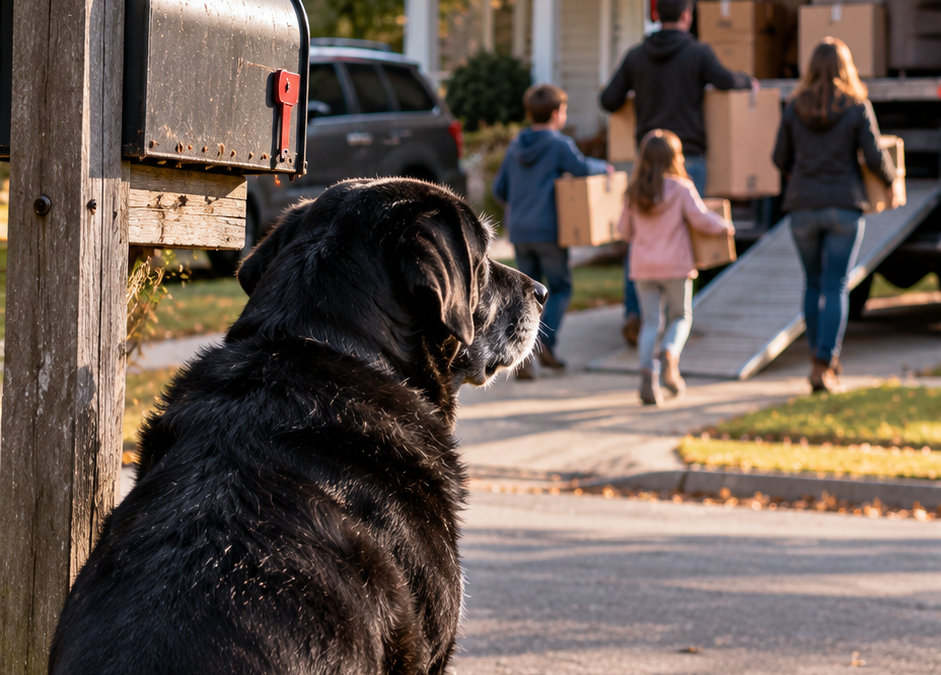
Every morning for twenty-six days, I carried food across the street to a black Labrador who refused to leave the mailbox because he believed the family who abandoned him would eventually come home.
On the twenty-sixth day, a vehicle finally turned into the driveway, and for the first time since the moving truck disappeared, he ran with his whole body shaking from joy.
What happened when those doors opened broke something inside him—and it was only then that he finally looked across the street and realized I had been waiting too.
My name is Elizabeth.
I am eighty years old, and I have lived in the same house for forty years.
When you stay in one place that long, you learn the rhythms of a street the way other people learn a piece of music.
You know which neighbor leaves for work before sunrise.
You know which dog barks at the garbage truck every Thursday.
You know when children are late for school by the speed of their parents’ cars.
You know which houses are full of arguments and which ones are full of silence.
And if you are old enough, you learn that houses change hands far more easily than memories do.
My kitchen window faces the house across the street.
For years, my husband and I drank our morning coffee there.
After he died, I kept doing it alone.
Habit can survive a person.
Sometimes that is comforting.
Sometimes it is cruel.
That particular morning began like any other.
I woke early.
My knees hurt.
The coffee was too strong because I had forgotten how many spoonfuls I’d used.
I opened the curtains and saw the moving truck.
It was parked across the street.
Large.
White.
Rear doors open.
Two men were carrying furniture from the house.
A couch.
A dining table.
Boxes.
Lamps.
A mattress.
Nothing unusual about that.
People moved.
Families changed.
Life continued whether we were ready or not.
Then I saw the dog.
He was sitting beside the mailbox.
A black Labrador.
Large but not young.
Gray already beginning around his muzzle.
He sat with his body completely still while his eyes followed every object leaving the house.
I had seen him before, of course.
For years.
He sometimes appeared in the yard.
Sometimes I saw one of the children throwing a ball for him.
Sometimes he sat near the porch while the father washed the car.
I had never spoken to the family more than a few polite words.
We were neighbors in the modern sense.
Close enough to wave.
Not close enough to know each other’s lives.
But I knew the dog.
Not his name.
Just his face.
That morning, something about him bothered me.
He didn’t bark.
Didn’t chase the movers.
Didn’t pace.
He simply watched.
I remember standing with my coffee cup in both hands and thinking, He’s confused.
Animals notice disruption long before we imagine they do.
Furniture disappearing.
Doors staying open.
Strangers carrying familiar things away.
The smells of the house changing.
The family moving quickly.
The dog knew something was wrong.
He just didn’t know what.
A little after ten, the last large box disappeared into the truck.
The mother came outside.
Then the father.
The children followed.
I watched the dog stand.
His tail moved once.
The father closed the front door.
The family walked toward their car.
The Labrador followed several steps.
Then stopped.
I leaned closer to the window.
Surely someone was going to call him.
No one did.
The children got into the back seat.
The mother entered the passenger side.
The father started the engine.
The dog moved toward them.
The car rolled backward.
He followed.
“Wait,” I whispered.
The car turned onto the street.
The Labrador began running.
At first, I thought perhaps they had forgotten something.
Perhaps they would stop.
They did not.
The dog ran behind the car.
Faster.
His ears bounced.
His legs stretched into a full sprint.
I put my cup down.
“No.”
The vehicle reached the end of the street.
Turned.
Disappeared.
The dog stopped at the intersection.
He stood there.
For a long time.
Then he slowly turned around.
He walked back.
Not ran.
Walked.
He returned to the mailbox.
Sat.
And looked down the road.
I stared from my kitchen window.
I told myself there had to be an explanation.
Maybe someone was coming back for him.
Maybe a relative was collecting him later.
Maybe the family was making more than one trip.
Maybe the movers couldn’t transport animals.
Maybe.
At eighty, you learn how easily people use “maybe” to protect themselves from accepting what they already understand.
By noon, nobody returned.
At two, the dog was still there.
At four, still there.
When evening came, I crossed the street.
I carried a bowl of water and some leftover chicken.
He watched me approach.
I stopped several feet away.
“Hello.”
His eyes followed me.
“Are you hungry?”
Nothing.
I placed the bowl on the grass.
He didn’t move.
I backed away.
“All right.”
I crossed the street again.
From my window, I watched him sniff the food.
He waited another ten minutes.
Then ate.
That night, he slept near the mailbox.
The next morning, he was there when I woke.
Same position.
Same road.
Same expectation.
I brought him breakfast.
He waited until I left before eating.
That became our routine.
The first few days, I assumed someone would return.
Every car that slowed near the house made him stand.
Every engine made his head lift.
Every familiar shape in the distance pulled him to his feet.
Sometimes he walked several yards toward an approaching vehicle, tail beginning to move.
Then, when it passed, he returned to the mailbox.
By the fourth day, I called animal control.
A young officer came in a county vehicle.
He stood beside me at the edge of my yard.
“How long has he been there?”
“Four days.”
“Owner information?”
“I don’t know.”
“You saw them leave?”
“Yes.”
“Without the dog?”
“Yes.”
He sighed.
“Have you approached him?”
“I feed him.”
“Does he let you touch him?”
“No.”
“Growl?”
“No.”
“Bark?”
“No.”
The officer walked toward him slowly.
The Labrador stood.
“Easy, buddy.”
The dog backed away.
The officer stopped.
Held out a hand.
“Come on.”
The dog moved around him.
Then returned directly to the mailbox.
The officer looked at me.
I folded my arms.
“Well?”
“He’s not aggressive.”
“I know.”
“He’s also not technically confined.”
“Someone abandoned him.”
“Possibly.”
“Possibly?”
He looked uncomfortable.
“I’m not arguing with you, ma’am.”
“Elizabeth.”
“Elizabeth.”
He glanced toward the dog.
“We can try to identify the registered owner.”
“Please do.”
“But if he isn’t posing a threat and we can’t safely secure him without escalating the situation, there are limits to what I can do immediately.”
“So he just stays here?”
“For now.”
I didn’t like the answer.
But I understood.
The dog had chosen a location.
He was not wandering.
He wasn’t attacking anyone.
He wasn’t chasing traffic.
He was waiting.
The officer tried once more.
The Labrador moved away.
Then came back the moment the man retreated.
“He’s attached to the property.”
“No,” I said.
The officer looked at me.
“He’s attached to the people.”
That was the difference.
A house meant nothing without the scent and voices inside it.
I watched the dog that afternoon and thought about names.
I didn’t know his real one.
I could have asked around.
Perhaps someone knew.
But instead, a name came to me.
Benny.
That had been my husband’s name.
Benjamin.
Everyone called him Ben.
I almost never did.
I called him Benny when I wanted to annoy him.
“Benny, take the trash out.”
“Don’t call me Benny.”
“Benny, your socks are on the floor.”
“I’m sixty-eight years old.”
“Then you should know where the hamper is, Benny.”
He would glare.
I would laugh.
Twenty-three years of marriage and somehow that silly name became one of the things I missed most.
The dog had the same stubbornness.
Same quiet loyalty.
Same willingness to sit in one place until the world changed around him.
So in my thoughts, I called him Benny.
I never said it aloud.
Not then.
The first week passed.
Rain came on day seven.
Heavy autumn rain.
I expected him to seek shelter beneath the porch.
He did not.
He remained beside the mailbox.
His fur darkened with water.
He lowered his head against the wind.
I stood beneath my umbrella and crossed the street.
“This is ridiculous.”
He watched me.
“You’re going to get sick.”
He didn’t move.
I put the food beneath a covered area near the driveway.
He waited.
I stepped closer than usual.
He stood.
Not threatening.
Just uncertain.
“All right.”
I stopped.
“I won’t touch you.”
His eyes remained on me.
“You don’t know me.”
I looked toward the empty house.
“But apparently the people you did know aren’t coming back.”
The words hurt me as soon as I said them.
Because I wasn’t sure whether I was talking to him.
Or myself.
I went home.
From the kitchen, I saw him eventually move beneath the edge of the porch.
Only after darkness came.
By morning, he was back at the mailbox.
Day nine.
Day ten.
Day eleven.
I began measuring my life by that dog.
Wake up.
Coffee.
Look outside.
Benny.
Breakfast.
Benny.
Lunch.
Benny.
Evening.
Benny.
I bought dog food.
The cashier looked at me.
“You got a dog?”
“Not exactly.”
“What does that mean?”
“I have a dog who doesn’t know he’s mine.”
She laughed.
I didn’t.
Because he wasn’t mine.
He belonged to someone.
At least in his mind.
And that distinction mattered.
I never crossed the road expecting gratitude.
I didn’t call him.
Didn’t try to lure him into my yard.
I placed food and water.
That was all.
I knew enough about grief not to drag anyone through it faster than they could move.
My husband had been gone four years.
People told me I was strong.
They said it because I kept my house clean.
Because I paid bills.
Because I went to the grocery store.
Because I smiled when neighbors asked how I was.
People confuse functioning with healing.
After Ben died, I kept living.
But for a long time, I did what that Labrador was doing.
I waited.
Not literally by the mailbox.
But emotionally.
Part of me remained exactly where life had left me.
In the hospital corridor after the nurse came out.
At the funeral.
In our bedroom when I first saw his side of the bed empty.
There are many ways to wait for someone who cannot return.
I hadn’t realized mine until I watched Benny.
By day fourteen, he allowed me to stand a little closer.
I sat on the curb once.
He remained by the mailbox.
Ten feet between us.
“Good morning.”
His ears moved.
“I’m eighty years old, you know.”
No response.
“I’m not supposed to be crossing streets twice a day carrying your dinner.”
He blinked.
“You could at least come halfway.”
Nothing.
I sighed.
“You really are a Benny.”
For the first time, I said the name aloud.
The dog looked directly at me.
I laughed.
“Oh, don’t encourage me.”
His tail moved.
Barely.
One sweep against the grass.
I stared.
“Did you just…”
It stopped.
I smiled.
“Fine. Benny it is.”
From then on, I used the name.
I don’t know whether he understood it.
Dogs learn sound and tone.
Perhaps he only knew that particular sound meant food and a quiet old woman.
But over time, his eyes began turning toward me when I said it.
“Benny.”
Look.
“Benny.”
Look.
That was enough.
On day seventeen, the weather turned cold.
I brought out an old blanket.
It had belonged to Ben.
Dark green.
Wool.
I almost put it back in the closet.
For years, I kept things because touching them felt like touching him.
His shirts.
A jacket.
An old mug.
The blanket.
Then I looked across the street and saw Benny curled against the base of the mailbox.
I carried it over.
He stood as I approached.
I laid it near the porch.
“You can use this or not.”
He watched.
“My Benny liked it.”
I swallowed.
“The human one.”
I stepped back.
“He was stubborn too.”
The dog remained still.
“Actually, you’re easier.”
I went home.
That evening, the Labrador lay on the blanket.
I sat at my kitchen table and cried.
I wasn’t sure why.
Maybe because something that had belonged to my husband was warming another living creature.
For the first time, it didn’t feel like losing Ben again.
It felt like letting something of him continue.
The days kept passing.
Nineteen.
Twenty.
Twenty-one.
The empty house was eventually listed as sold.
I noticed a real-estate sign disappear from the yard.
Someone had bought it.
I wondered what would happen to Benny when they came.
Animal control returned once.
Same result.
They had apparently been unable to get a useful response from the former owners.
I didn’t ask for details.
I was too angry.
I didn’t want names.
I didn’t want excuses.
I wanted them to drive back.
Open the door.
Call their dog.
That was all.
But life rarely gives us the ending we think is owed.
Day twenty-three.
Benny finally let me touch him.
It happened accidentally.
I placed his bowl down.
He remained nearby instead of moving away.
I crouched.
His nose moved toward my sleeve.
I stayed still.
He sniffed.
Then my fingers brushed the side of his neck.
His body tensed.
I pulled back.
“Sorry.”
He looked at me.
I waited.
Then, very carefully, I touched him again.
His fur was rough from weather.
Warm underneath.
I stroked once.
Stopped.
Benny did not leave.
My throat tightened.
“Thank you.”
That was all.
Day twenty-five.
I remember thinking that perhaps tomorrow I would try to bring him into my yard.
Not the house.
Just the yard.
I imagined opening my gate.
Leaving food there.
Giving him the choice.
I didn’t know that the choice would come to him first.
The twenty-sixth morning began quietly.
I washed dishes after breakfast.
Benny was in his usual place.
Sunlight.
Cool air.
No rain.
I had just dried a plate when I heard an engine.
Not unusual.
But this one slowed.
Then stopped.
I looked out the window.
A truck had pulled into the driveway across the street.
Benny stood.
His entire body changed.
He stared.
Then suddenly he ran.
For twenty-six days, I had watched that dog move like something inside him was heavy.
Now he flew.
He sprinted toward the vehicle.
His tail whipped back and forth.
He barked.
Loud.
Joyful.
Wild.
I had never heard him bark before.
My hands froze in the dishwater.
“Oh, Benny.”
For one beautiful second, I believed it too.
They’re back.
I stepped closer to the window.
Benny circled the truck.
He jumped once near the driver’s door.
Barked again.
His entire body seemed too full of happiness to contain.
The driver’s door opened.
A man stepped out.
Benny stopped.
I frowned.
I had never seen him before.
The passenger door opened.
A woman.
Then two children climbed from the back.
None of them looked familiar.
Benny stood in front of them.
Tail still moving.
But slower now.
The man looked at the dog.
Then at the woman.
“Is this someone’s dog?”
I could hear part of it through the open kitchen window.
The woman shrugged.
“Maybe the neighbors’.”
One of the children reached toward Benny.
The mother said, “Don’t touch him yet.”
Benny looked from one face to another.
His tail stopped.
He sniffed the man.
Then the woman.
He moved toward the children.
Then back toward the man.
I knew what he was doing.
Looking for recognition.
Where have you been?
Call me.
Say my name.
Open your arms.
Tell me the waiting is over.
But these people had never seen him.
They didn’t know what twenty-six days meant.
They didn’t know the rain.
The cold.
The meals beside the road.
The engines he had watched.
The nights he had slept facing the corner where the old family’s car disappeared.
The man walked toward the house.
Benny followed.
The woman unlocked the door.
Benny moved faster.
For a moment, hope returned to his body.
Home.
The door opened.
The family entered.
Benny approached.
The woman turned.
“Whoa. Stay.”
She gently blocked him with one leg.
“Not inside.”
Benny stopped.
The door closed.
And there he was.
Outside.
Again.
I felt something tear through me.
Not anger this time.
Not exactly.
Because these people had done nothing wrong.
They didn’t know him.
The house belonged to them now.
But Benny didn’t understand deeds.
Sales contracts.
Ownership.
He understood that the door to his home had just opened.
And once again, he had not been invited through it.
He stared at the closed door.
Waited.
Then turned toward the mailbox.
For several seconds, he looked at it.
The place he had guarded for twenty-six days.
Then he looked at the road.
Nothing.
Finally, he turned his head.
Across the street.
Toward my house.
Toward me.
I was already at the front door.
I don’t remember deciding to move.
I simply found myself standing on my porch.
“Benny.”
His ears lifted.
For twenty-six days, I had crossed to him.
That afternoon, he crossed to me.
One step.
Then another.
He moved slowly.
No running.
No wagging.
He crossed the street.
Walked through my open gate.
Stopped in front of me.
His eyes looked older than they had that morning.
I crouched despite my knees.
“Hello, sweetheart.”
He stood there.
I held out my hand.
He pressed his nose against it.
Then stepped past me.
Across the threshold.
Into my house.
I closed the door.
Benny walked into the living room.
He didn’t explore.
Didn’t sniff the furniture.
Didn’t pace.
He simply chose a place near the wall and sat.
Then lay down.
A long sound left his body.
A sigh.
Not ordinary tiredness.
It sounded like surrender.
I sat beside him.
Neither of us moved.
Outside, the new family carried boxes into the house where Benny had spent eight years.
Inside mine, he finally stopped waiting beside the road.
But ending the waiting did not mean the pain ended.
The first day, he refused food.
I put a bowl near him.
He looked at it.
Turned away.
Water, yes.
Food, no.
The second day was the same.
I made chicken.
Nothing.
The third day, I sat on the floor with the bowl between us.
“Benny.”
He didn’t lift his head.
“You need to eat.”
No response.
“I know.”
I leaned against the couch.
“You think there’s no point.”
His eyes moved toward me.
“I’ve felt that.”
I didn’t push the bowl closer.
“When Ben died, people kept bringing casseroles.”
One ear moved.
“So many casseroles.”
I smiled sadly.
“Apparently grief makes people believe you need lasagna.”
Benny’s head remained on his paws.
“I ate because people watched.”
I stared toward the window.
“But nothing tasted like anything.”
My fingers touched his back.
“Then one day it did.”
His breathing remained slow.
“It wasn’t betrayal.”
I looked at him.
“Eating didn’t mean I loved him less.”
My voice broke.
“Living didn’t mean I loved him less.”
I stayed there until evening.
He didn’t eat.
But the next morning, some food was gone.
Not much.
Enough.
“Good boy,” I whispered.
Then immediately corrected myself.
“No pressure.”
At eighty, I had learned something younger people often don’t understand.
Healing hates an audience.
The moment everyone watches for progress, progress becomes performance.
So I stopped expecting.
Every morning, I made coffee.
Then I sat on the floor beside Benny.
Sometimes I talked.
Sometimes I didn’t.
Some days I rested my hand on his back.
Some days he didn’t want it.
I respected that.
He slept.
He watched the window.
But he no longer went to the door.
By the end of the first week, he was eating half his meals.
By the start of the second, he began moving through the house.
Carefully.
Room to room.
He smelled the couch.
The dining table.
The hallway.
Ben’s old chair.
That one interested him.
He stood beside it for a long time.
I watched from the kitchen.
“That belonged to someone stubborn.”
Benny looked at me.
“Don’t get ideas.”
He walked around the chair.
Lay beside it.
My chest tightened.
That night, I sat in Ben’s chair for the first time in months.
Benny slept at my feet.
There are moments when grief changes without announcing itself.
That was one.
I didn’t feel as though I had replaced my husband.
I felt as though the room had finally remembered how to breathe.
Near the end of the second week, Benny approached me on his own.
I was reading.
He stood beside my chair.
I lowered the book.
“What?”
He sat.
Then slowly placed his head on my knees.
I froze.
Twenty-six days beside the mailbox.
Two weeks inside my home.
And finally, he chose contact.
My hand rested between his ears.
I began crying before I could stop myself.
“Oh, Benny.”
He lifted his head.
Looked at my face.
Then licked my hand once.
Only once.
As though making a point.
I laughed through tears.
“Thank you.”
He rested his head again.
We stayed there until sunset.
Week three brought the first tail wag.
Tiny.
I almost missed it.
I came into the kitchen in the morning and said, “Good morning.”
His tail moved once against the floor.
I stopped.
He looked at me.
I pretended nothing had happened.
I had learned not to celebrate too loudly.
“Breakfast?”
Another small movement.
I turned toward the counter so he wouldn’t see my smile.
Week four brought the tennis ball.
I found it in a cabinet in the garage.
I had no idea why we owned one.
Ben and I hadn’t played tennis.
Maybe it had belonged to a grandchild visiting years ago.
I washed it.
Placed it on the living-room floor.
Benny ignored it for two days.
Then one afternoon, while I was folding laundry, I heard something roll.
I looked up.
Benny had the ball in his mouth.
He stood there.
Watching me.
I slowly lowered the towel.
“Is that for me?”
He came forward.
Dropped it near my feet.
I picked it up.
“You’re eighty in dog years too, aren’t you?”
His ears lifted.
“Maybe worse.”
I rolled the ball across the floor.
Not threw.
Rolled.
Benny trotted after it.
Picked it up.
Brought it back.
My heart nearly exploded.
“Again?”
He dropped it.
I rolled it farther.
This time he ran.
Not fast.
But ran.
When he returned, his tail was wagging.
Really wagging.
I laughed.
Loud.
The sound startled both of us.
I hadn’t heard myself laugh like that since before Ben became sick.
Benny looked at me.
Then bounced once on his front paws.
“Oh, now you’re showing off.”
We played for ten minutes.
That night, he slept beside Ben’s chair.
His body pressed against my slipper.
I put my hand on his head.
He sighed.
The first night in my house, that sound had been empty.
This time, it sounded different.
Settled.
Safe.
Home.
Week five frightened him.
That was when I decided he needed to go outside beyond the yard.
The first few weeks, I had let him use the backyard.
He seemed comfortable there.
High fence.
Quiet.
No view of the mailbox unless he moved to one corner.
He avoided that corner.
But eventually, a dog needed more.
Smells.
Movement.
World.
I clipped on a leash.
The moment I opened the front door, Benny froze.
I felt the tension through the leash.
“It’s okay.”
He stared outside.
Across the street.
The mailbox.
Still there.
The same box.
Same post.
Same patch of grass.
For a second, I feared I had made a mistake.
Benny stepped onto the porch.
Stopped.
His eyes locked on it.
I did not pull.
One minute passed.
Then two.
Then three.
A car went by.
He watched.
My hand remained loose on the leash.
“If you want to go back inside, we go back.”
He looked at me.
I meant it.
He could decide.
Benny looked once more toward the mailbox.
Then he turned.
Toward me.
I stepped down from the porch.
He followed.
We walked in the opposite direction.
At the corner, I glanced back.
Benny didn’t.
The park was only four blocks away.
He smelled everything.
Tree trunks.
Grass.
A bench.
A lamppost.
Another dog’s tracks.
For twenty-six days, his world had been one road.
Now suddenly there were hundreds of directions.
He seemed almost overwhelmed.
Then a breeze moved through the trees.
Benny lifted his head.
His eyes softened.
We walked farther.
He never looked back.
Week six brought his first joyful bark.
A squirrel invaded the yard.
Benny saw it from the porch.
His entire body lifted.
The squirrel froze.
Benny barked.
The squirrel ran.
Benny barked again.
I laughed.
“Benny!”
He looked back at me.
Tail high.
Eyes bright.
“You terrified it.”
He seemed pleased.
I laughed harder.
The squirrel survived.
Benny rediscovered his dignity.
By week seven, I realized something had happened without me noticing the exact day.
He had stopped waiting.
Not just by the mailbox.
Everywhere.
He no longer watched the front door for ghosts.
No longer slept facing the window.
No longer listened to every engine.
Instead, he developed routines.
Morning: sit beside my bed until I woke.
Kitchen: supervise coffee.
Breakfast: stare at me as if starvation had occurred overnight.
Noon: walk.
Afternoon: sleep.
Evening: sit near my chair.
Bedtime: inspect the hallway before settling down.
He followed me from room to room.
At first, I thought he was anxious.
Then I realized he simply preferred company.
So did I.
I began talking to him constantly.
“Your breakfast is in the bowl, not in my toast.”
Look.
“No.”
Look.
“Benny.”
Tail.
“You are shameless.”
I told him about Ben too.
At first, I felt strange doing it.
Then it became easy.
One evening, I sat in the living room with Benny’s head on my lap.
“My husband hated broccoli.”
Benny sighed.
“He told people he was allergic.”
I smiled.
“He wasn’t.”
Benny looked up.
“He just didn’t like it.”
His head returned to my knees.
“He was afraid of hospitals.”
I stroked his ear.
“Wouldn’t admit that either.”
I paused.
“At the end, I think he was more afraid of leaving me.”
My voice weakened.
Benny lifted his head.
“I told him I’d be fine.”
I stared across the room.
“I lied.”
Benny licked my wrist.
“I think he knew.”
I started crying.
Not violently.
Just the kind of tears that come after being stored too long.
Benny moved closer.
I wrapped my arms around him.
“I’ve been waiting too, haven’t I?”
He rested against my chest.
Not for Ben to literally return.
I knew death.
I wasn’t confused.
But some part of me had refused to move because moving felt disloyal.
I had kept his coat in the closet.
His chair untouched.
His tools in the garage exactly where he left them.
I still bought the brand of cereal he liked even though I never ate it.
I had turned remembrance into a kind of stillness.
Benny understood stillness.
He had lived beside a mailbox because loyalty told him leaving would mean giving up.
I had been doing the same thing.
Different mailbox.
Same waiting.
A few days later, I opened Ben’s closet.
I stood there for nearly an hour.
Then I took out three shirts.
Not everything.
Just three.
I donated them.
When I returned home, Benny met me at the door.
I knelt.
“That was hard.”
He pushed his nose against my hand.
“But I came back.”
Those words stopped me.
I came back.
That became one of the promises between us.
Whenever I went to the store, Benny watched me prepare to leave.
At first, he panicked.
The moment I picked up my purse, he followed closely.
If I touched the front door, his breathing changed.
I understood.
One abandoned dog does not become secure because one person is kind for a month.
Trust needs repetition.
So every time I left, I said the same thing.
“I’m coming back.”
The first few times, he waited beside the door.
When I returned, he exploded with relief.
Jumping.
Tail whipping.
Whining.
I knelt every time.
“I told you.”
Gradually, the panic faded.
He learned something simple but enormous.
Goodbye did not always mean gone.
Sometimes goodbye meant groceries.
Sometimes goodbye meant doctor appointment.
Sometimes goodbye meant thirty minutes.
And the door opened again.
That lesson healed something in both of us.
A month became two.
Two became three.
Winter came.
Benny slept near the heater.
I bought him a ridiculous red blanket.
He pretended not to like it and then slept on it every night.
The new family across the street eventually learned the story.
The woman came over one afternoon.
“I think that’s the dog that was here when we moved in.”
I nodded.
“It is.”
She looked embarrassed.
“We didn’t know.”
“I know.”
“We thought he belonged to you.”
“He does now.”
She smiled.
“I’m glad.”
One of her children sometimes waved at Benny.
He wagged his tail.
No resentment.
Dogs are often kinder with the past than people are.
I still looked at the mailbox sometimes.
But Benny didn’t.
One evening in early spring, we sat on the back porch.
The sky was orange.
Warm air.
Birds.
Benny lay across my feet.
I looked down at him.
“You know something?”
His ear moved.
“You are my home now.”
He lifted his head.
I smiled.
“I know this house is technically the home.”
He stood.
“But you know what I mean.”
Then he did something he had never done before.
Benny climbed awkwardly onto my lap.
He was far too large.
“Good Lord.”
He ignored my protest.
He pressed his chest against mine.
Put his head near my shoulder.
Closed his eyes.
I wrapped my arms around him.
“All right.”
I kissed the top of his head.
“You win.”
We sat there until my legs went numb.
Two old souls.
One abandoned by choice.
One abandoned by death.
Both learning that survival and living were not the same thing.
A year has passed now.
Benny is nine.
I’m eighty-one.
He has become a completely different dog.
Or maybe this is who he always was before abandonment covered him.
He loves the park.
He is convinced every squirrel represents a personal insult.
He greets the mail carrier.
Ironically, he loves her.
Sometimes I joke that after twenty-six days beside a mailbox, he considers postal service sacred.
He runs.
Not as fast as he did toward that truck on the twenty-sixth day.
I don’t think I will ever forget that run.
The joy in it.
The certainty.
That was the most painful part.
He wasn’t cautiously hopeful.
He believed completely.
His family was back.
His waiting had worked.
And then strangers stepped out.
Sometimes heartbreak is not losing hope.
It is having hope confirmed for three seconds before reality takes it away again.
I think that moment broke his attachment to the road.
Not because he stopped loving the family who left.
I don’t believe animals erase love that easily.
But something inside him finally understood what I had been unable to explain.
They are not coming.
That realization nearly destroyed him.
But it also freed him.
There is a terrible mercy in certainty.
As long as we believe someone might return, we remain tied to the place where they left us.
Once we know they won’t, grief can begin moving.
Slowly.
Painfully.
But moving.
Benny taught me that.
For years after Ben died, I believed I had accepted it.
I had signed the papers.
Planned the funeral.
Chose the flowers.
Received condolences.
Put away medications.
Closed accounts.
All the practical machinery of death.
But acceptance is not paperwork.
I had still been waiting for my old life.
For mornings with two coffee cups.
For his shoes by the door.
For arguments about the thermostat.
For the sound of his keys.
I never expected him physically to return.
I expected myself to return.
To become the woman I had been when he was alive.
That woman was gone too.
Benny helped me understand that I didn’t need to get her back.
I needed to become someone else.
Someone who could remember without stopping.
Someone who could miss and still move.
Someone who could open the door to a creature standing outside.
Our mornings are simple now.
I wake.
Usually Benny is already watching me.
“How long have you been sitting there?”
Tail wag.
“That’s creepy.”
More wagging.
I put on my robe.
He runs toward the kitchen.
I make coffee.
He eats breakfast.
Then I open the back door.
Benny runs into the yard.
Sometimes he stops in sunlight.
Raises his head.
Closes his eyes.
Breathes.
The first time I saw him do that, I cried.
Freedom can look very ordinary.
A dog standing in grass.
An old woman drinking coffee.
No dramatic music.
No crowd.
Just a living creature who no longer believes he must remain beside the place where he was left.
Sometimes neighbors ask how Benny became mine.
I usually say, “He moved in.”
That’s easier.
The full story takes time.
But when someone really wants to know, I tell them.
I tell them about the moving truck.
The mailbox.
Twenty-six days.
Rain.
Cold.
Food bowls.
The truck arriving.
Benny running.
The strangers.
The closed door.
Then I tell them about the step.
The first step toward my house.
Because that is actually the part I remember most.
Not his abandonment.
His choice.
He could have returned to the mailbox.
He had done it every day.
Instead, he looked at me.
Crossed the road.
One step.
Then another.
I used to think I rescued him.
I don’t anymore.
I fed him.
Opened a door.
Stayed.
That’s all.
Benny did the hardest part himself.
He chose to walk away from the place where love had failed him.
And in doing that, he taught me to do the same.
I don’t mean leave Ben behind.
Never.
Love doesn’t require erasure.
I still keep photographs.
I still speak to him sometimes.
I still have his favorite mug.
The green blanket Benny slept on during those first cold nights is still in the living room.
But memory no longer feels like a locked room.
It is a room I can enter and leave.
That is different.
Benny helped me find the door.
Last month, I drove to the cemetery.
I hadn’t gone in almost a year.
Benny came with me.
He sat beside me near Ben’s grave.
I touched the headstone.
“Hello, Benny.”
I laughed at myself.
“Not you.”
The dog looked up.
“The other one.”
I told my husband about him.
I told him everything.
The mailbox.
The twenty-six days.
The new family.
The tennis ball.
The squirrels.
How Benny sleeps beside his chair.
Then I said something I had not been able to say for four years.
“I’m okay.”
Benny leaned against my leg.
I looked at Ben’s name carved in stone.
“I really am.”
I cried.
But I meant it.
On the drive home, Benny sat in the passenger seat.
Window slightly open.
Nose toward the air.
We passed our street.
Then turned in.
I saw the mailbox across from my house.
For a second, I remembered the black dog sitting beside it.
Wet.
Cold.
Watching.
Waiting.
Then I looked at Benny beside me.
His eyes were on my house.
Not the old one.
Mine.
The moment I parked, he knew.
He stood.
Tail wagging.
I opened the door.
“Home.”
He jumped out.
Ran to my porch.
Waited for me at the door.
That is the difference now.
He waits.
But not with despair.
Waiting itself is not cruel.
It becomes cruel only when no one returns.
When Benny waits for me, he knows the ending.
I open the door.
I come back from the store.
I wake in the morning.
I sit in the chair.
I am there.
And he is there.
Home isn’t the place where nobody ever leaves.
That would be impossible.
People go to work.
People travel.
People grow old.
People die.
Home is the place where leaving does not always mean abandonment.
Home is trust.
Home is memory without fear.
Home is knowing you matter to someone even when they are out of sight.
I wish Benny’s first family had taken him.
I will never pretend otherwise.
Sometimes people hear our story and say, “Everything happens for a reason.”
I don’t say that.
Some things happen because people make cruel choices.
Abandonment is not destiny.
It is abandonment.
Benny did not need to be hurt so that I could love him.
I did not need my husband to die so that Benny could enter my life.
Life is not that neat.
What matters is what we do afterward.
Bad things happen.
Then someone brings food.
Someone opens a gate.
Someone sits on the floor.
Someone stays.
That is where meaning comes from.
Not the wound.
The response.
I don’t know why that family left Benny.
Maybe there was an explanation.
Maybe there wasn’t.
At this point, it doesn’t matter.
Benny no longer wakes wondering.
And neither do I.
A few mornings ago, I stood at the kitchen window with my coffee.
Exactly where I had stood the day the moving truck came.
The street looked almost the same.
Cars.
Trees.
Mailboxes.
The house across the road.
The new family’s curtains in the windows.
For a moment, I saw the past layered over the present.
The truck.
The boxes.
A black Labrador by the mailbox.
Then Benny walked into the kitchen behind me.
His nails clicked on the floor.
He pressed his nose against my hand.
I looked down.
“Want breakfast?”
Tail.
“Of course.”
I opened the cabinet.
He turned in an impatient circle.
I laughed.
There was no road in his eyes anymore.
No car he expected.
No closed door haunting him.
Just breakfast.
Me.
Morning.
Life.
That simplicity felt miraculous.
Later, I opened the back door.
Benny ran into the yard.
Stopped in the sun.
Lifted his face.
Eyes closed.
Breathing.
Free.
I stood in the doorway.
For years, I believed being home meant being surrounded by everything that had always been there.
Same walls.
Same furniture.
Same person beside you.
I was wrong.
Home can change.
Sometimes it disappears.
Sometimes it moves across the street.
Sometimes it arrives on four paws after sitting beside a mailbox for twenty-six days.
My name is Elizabeth.
I’m eighty-one now.
I have lived in this house for more than forty years.
For most of that time, I thought the house itself was what made it home.
Then Ben died, and every room remained exactly where it had always been.
Yet for years, nothing felt like home.
Benny taught me the difference.
A house is where your belongings wait.
Home is where your heart no longer has to.
He no longer sits across the street looking for the people who left.
I no longer sit in this house waiting for the life I lost.
We remember.
That is not the same as waiting.
We love what came before.
That is not the same as refusing what comes next.
Sometimes, in the evenings, Benny lies beside my chair while the sunset fills the living room.
I read.
He sleeps.
Every now and then, he lifts his head simply to make sure I am still there.
I look down.
“Yes.”
His eyes soften.
“I’m here.”
Then he sleeps again.
I think those two words may be the purest form of love I know.
I’m here.
Not forever.
Nothing is forever.
But now.
Today.
This morning.
Tonight.
I’m here.
One day, Benny will be gone.
I know that.
At eighty-one, I no longer make bargains with time.
He is nine.
Maybe we have years.
Maybe less.
I don’t need to know.
What matters is that he will never spend another day wondering whether he was left because he wasn’t worth coming back for.
When his life ends, whenever that is, he will know exactly where he belongs.
And perhaps when mine does too, someone else will understand what we gave each other.
He gave me motion when I had mistaken stillness for loyalty.
I gave him permanence when abandonment had taught him that doors could close without warning.
Together, we learned something neither of us could learn alone.
Loyalty does not mean remaining forever at the place where you were hurt.
Love does not demand that you refuse every new hand because one disappeared.
And moving forward does not erase who came before.
Sometimes the bravest thing a faithful heart can do is stop watching the road.
Turn around.
See the person who has quietly been there all along.
And take one step toward them.
Then another.
Until one day, without even realizing exactly when it happened, you are no longer waiting.
You are living.
You are loved.
And you are home.








