𝗙𝗨𝗟𝗟 𝗦𝗧𝗢𝗥𝗬 He Spent Years Chained to One Tree—But When I Cut Him Free, He Didn’t Run
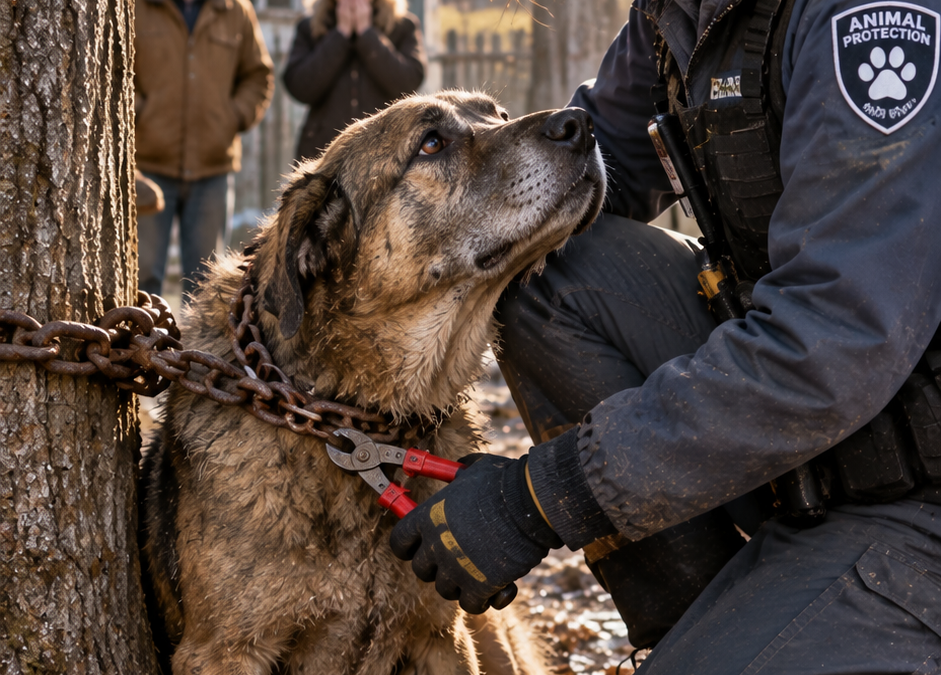
𝗣𝗔𝗥𝗧 𝟮
She shook her head.
“Sometimes he stands when someone comes outside. Mostly he just lies there.”
I photographed the yard from outside the property.
Chain.
Bowls.
Shelter.
Condition of the dog.
Ground.
I called our office to verify ownership information.
The registered homeowner was an older man named Robert Phelps.
I knocked.
No answer.
Knocked again.
Eventually, I heard movement.
A man opened the door only a few inches.
“What?”
“I’m Officer Carter with Animal Protection Services.”
His expression changed immediately.
Not surprise.
Annoyance.
“What about?”
“The dog in your yard.”
“He’s fine.”
“I need to assess him.”
“No, you don’t.”
I kept my voice calm.
“Sir, we’ve received a welfare complaint.”
“People should mind their own business.”
“I need to check the dog’s condition, food, water, shelter, and tether.”
“He has all that.”
“I still need to see him.”
The door opened farther.
Mr. Phelps was probably in his sixties.
He looked tired and irritated.
“That dog has been out there his whole life.”
That sentence hit me harder than he seemed to realize.
“How old is he?”
“I don’t know. Six? Seven?”
My chest tightened.
“You’ve owned him that long?”
“Yeah.”
“And he’s been tethered there?”
“He’s a dog.”
I felt anger rise.
Training tells you what to do with anger.
Put it somewhere later.
Don’t use it now.
“May I enter the yard?”
He stared.
“You going to make trouble?”
“I’m trying to assess your dog.”
“He gets fed.”
“May I enter?”
Finally, he shrugged.
“Whatever.”
He closed the door.
He didn’t come with me.
That told me something too.
I opened the side gate.
The dog lifted his head again.
I stopped several yards away.
“Hey.”
No response.
“My name is Emma.”
Nothing.
Of course, animals do not need our introductions.
Still, saying my name made me feel less like another stranger approaching him with a purpose.
I crouched.
Usually, I would offer a treat.
Margaret taught me to make first contact as nonthreatening as possible.
That afternoon, something told me not to.
Not because he would refuse.
Because bribing him felt wrong somehow.
He wasn’t avoiding me.
He was beyond avoiding.
I walked slowly toward the tree.
His eyes followed me.
His body didn’t move.
The chain was thick.
Heavy links.
Far heavier than necessary for a dog his size.
The collar beneath it was old leather, stiff with dirt.
I could see irritation around his neck.
I knelt near the chain.
The dog remained lying down.
“You’ve been here a long time, haven’t you?”
One ear moved.
I looked at the water.
Unclean.
The food bowl.
Empty.
The shelter.
Poor.
The body condition alone was enough to require intervention.
I called Margaret.
“I need authorization for emergency removal.”
“Tell me what you have.”
I did.
She listened.
Then asked, “Immediate risk?”
“Severe emaciation. Poor water. Skin damage. Extreme muscle wasting. Tethering appears chronic.”
“Owner cooperative?”
“Technically.”
“Veterinary transport available?”
“Yes.”
“Document everything.”
“I am.”
A pause.
Then Margaret said, “Bring him in.”
I hung up.
By then, several neighbors had appeared near their fences.
News travels quickly on quiet streets.
I heard murmuring.
One older man said, “About time.”
Another woman covered her mouth when she saw me kneel beside the dog.
I inspected the hardware.
The chain was looped and secured around the tree.
The clasp near the dog’s collar had rusted enough that opening it normally looked unreliable.
I took out my cutters.
The sound made the dog’s eyes shift.
“You’re okay.”
I positioned the tool around one link.
The chain was tougher than it looked.
I squeezed.
Nothing.
I adjusted.
Tried again.
Metal groaned.
The dog watched.
“Come on.”
I changed position.
My arms began aching.
For several minutes, that old chain fought harder to stay in place than anyone had fought to remove it in years.
I remember thinking how cruelly symbolic that felt.
Then, finally—
snap.
The link broke.
One section dropped into the mud.
The sound was surprisingly small.
After all those years, freedom arrived with a quiet metallic thud.
I sat back.
The dog didn’t move.
Nobody moved.
I had expected some reaction.
Maybe panic.
Maybe an attempt to flee.
Dogs who have been tethered for long periods sometimes bolt when restraint disappears.
The gate had been secured, and another officer had arrived by then to make sure the area stayed controlled.
Still, we were ready.
The dog remained on the ground.
Five seconds.
Ten.
Then he moved one front paw.
He pushed himself upright.
The effort alone made his legs tremble.
He stood.
Barely.
His body swayed.
I stayed on my knees.
“Easy.”
He looked toward the open yard.
He could go anywhere within the fence now.
For the first time in years, no chain stopped him.
He took one step.
Then another.
Not toward the gate.
Not toward the far side of the yard.
Toward me.
I froze.
His legs shook so badly I thought he might fall.
He kept coming.
One step.
Pause.
Another.
By the time he reached me, I could hear his breathing.
I held still.
He stopped inches away.
His nose almost touched my cheek.
For one second, we looked at each other.
Then he leaned forward.
And rested his head against my chest.
Not lightly.
All of it.
The weight of his skull.
His neck.
His exhaustion.
Everything.
I automatically raised one arm around him.
His body leaned into mine.
I felt heat through my uniform.
I felt him breathe.
Slow.
Unsteady.
He stayed there.
I had spent seven months learning how to remain professional in difficult scenes.
Margaret had taught me that tears could wait until after the animal was safe.
That day, they didn’t.
The first tear fell onto his dirty fur.
Then another.
I wasn’t sobbing.
I couldn’t have spoken if I tried.
I simply held him.
And cried.
Behind me, the yard had gone silent.
Even the neighbors stopped whispering.
The dog didn’t move.
He pressed his head against me as though he had reached the only destination he had wanted.
I remember thinking, You are free.
Why aren’t you running?
Then another thought came.
Maybe freedom wasn’t what he needed first.
Maybe he needed to know freedom wasn’t another form of abandonment.
I don’t know how long we remained that way.
Five minutes.
Ten.
Time felt irrelevant.
Eventually, I eased back enough to look at him.
His eyes were different.
Still tired.
Still cautious.
But no longer empty.
There was a question in them.
Not joy.
Not yet.
More like:
What happens now?
I placed my hand against his cheek.
“Now you come with me.”
His eyes stayed on mine.
“I’ve got you.”
We used a blanket as an improvised sling because he was too weak to walk far.
When I lifted him, I almost gasped.
He weighed far less than a dog his size should have.
He didn’t struggle.
He simply rested against me.
As though resistance was something he had used up years ago.
I placed him carefully on the rear seat of my department vehicle.
Before closing the door, I looked at the chain still lying beneath the tree.
For years, that chain had defined the entire size of his world.
A circle of mud.
A bowl.
A tree.
A shelter he could barely reach.
Then I looked at the dog inside my vehicle.
His world had just become bigger than he could possibly understand.
Mrs. Kellerman approached.
“Will he be okay?”
“I don’t know yet.”
Her face fell.
“But he’s coming with us.”
She nodded quickly.
“Thank you.”
I looked at her.
“You called.”
“I only made a phone call.”
“So did nobody else.”
She lowered her eyes.
“I kept wondering if I was overreacting.”
“You weren’t.”
As I prepared to leave, she asked, “Does he have a name?”
I realized I hadn’t heard one from Mr. Phelps.
Technically, ownership records had listed him simply as “dog.”
I looked through the window.
The dog’s head was resting against the seat.
Outside the yard, a willow tree across the street moved gently in the wind.
The word came without effort.
“Willow.”
Mrs. Kellerman smiled.
“Willow.”
I nodded.
“That’s what I’m calling him.”
At the shelter, Margaret was waiting.
The moment I opened the vehicle door, her expression changed.
Margaret had seen almost everything during twenty-seven years of animal welfare work.
Starvation.
Hoarding.
Abuse.
Fighting operations.
Puppy mills.
Neglect.
Animals abandoned in empty houses.
Very little surprised her.
Willow did.
She stood silently while we carried him inside.
Then she looked at me.
“You cut the chain yourself?”
“Yes.”
“He let you approach?”
“Yes.”
“He did anything after?”
I swallowed.
“He came to me.”
Margaret looked again at Willow.
There was something in her face I had never seen before.
Not exactly surprise.
Respect.
Mixed with sadness.
“He waited a long time.”
“I know.”
She touched my shoulder.
“Emma.”
“Yeah?”
“This part feels good right now.”
I knew there was a warning coming.
She continued.
“But rescue is not the chain falling.”
I frowned.
“It’s what happens after.”
I remembered those words later.
Many times.
That afternoon, we settled Willow in the medical ward.
He had a thick bed.
Clean blankets.
Fresh water.
Food prepared in controlled portions.
He ignored almost all of it.
He lay on the floor instead of the bed.
Head on his paws.
Eyes following me.
Every time I stood to leave, his head rose.
So I sat again.
“You’re making this difficult.”
His ears shifted.
“You have an actual bed now.”
Nothing.
“Very expensive blanket.”
Nothing.
I pointed.
“Use it.”
He stared.
I sighed.
“Fine.”
That first night, I didn’t go home.
Margaret found me spreading a spare blanket on the floor.
“You planning to move in?”
“Just tonight.”
She raised one eyebrow.
“He watches the door every time I leave.”
“Which is exactly why you eventually have to leave.”
“I know.”
“Do you?”
I looked at Willow.
“Tomorrow.”
Margaret sighed.
“One night.”
“Thank you.”
She walked away.
Then turned.
“Emma?”
“Yeah?”
“Don’t confuse being his safety with becoming his only way to feel safe.”
I remembered that too.
Willow refused the mattress.
I lay on it instead.
He remained on the floor.
About three feet away.
For an hour, we simply watched each other.
The shelter quieted around us.
Dogs barked occasionally in distant kennels.
A door closed.
A cart rolled down a hallway.
Willow’s eyes remained open.
“I’m staying.”
His ears moved.
“You can sleep.”
Nothing.
I turned onto my side.
“I’m not going anywhere.”
Eventually, his eyes closed.
Then opened.
Closed again.
At some point after midnight, I fell asleep.
When I woke before sunrise, Willow was still beside me.
But closer.
His front paw was touching the edge of my blanket.
Dr. Helen Ellison arrived at seven.
She was our primary veterinarian.
Early fifties.
Quiet hands.
Sharp eyes.
The sort of person who could make an animal feel less afraid simply by slowing herself down.
She examined Willow for more than an hour.
Teeth.
Eyes.
Ears.
Skin.
Paws.
Joints.
Blood.
Heart.
Lungs.
She photographed the damaged area around his neck.
Measured his body condition.
Checked the muscle wasting in his rear legs.
Willow tolerated almost everything.
Not because he enjoyed it.
Because he seemed willing to trust anyone I allowed near him.
That realization frightened me.
Trust shouldn’t be that easy after what he had survived.
It made me feel responsible for every person who entered his space.
Dr. Ellison finally sat back.
“Severely underweight.”
I nodded.
“Significant muscle atrophy.”
“Can he recover?”
“Likely, yes.”
“Likely?”
She looked at me.
“Emma, he’s lived with restricted movement for years. We don’t rebuild that in a week.”
“What else?”
“Skin inflammation. Pressure damage around the neck. Some arthritis. Probably nutritional deficiencies. We’ll know more when the bloodwork returns.”
I watched Willow.
His head rested against the towel.
“His heart?”
Dr. Ellison put away her stethoscope.
“Surprisingly stable.”
“What does that mean?”
She thought for a moment.
“It means his body has been asked to tolerate far more than it should have.”
“That’s not what you mean.”
She smiled faintly.
“No.”
I waited.
Dr. Ellison looked at Willow.
“It means, somehow, he kept going.”
Those words stayed with me.
Later that morning, I called Mrs. Kellerman.
“He’s safe.”
She exhaled audibly.
“Thank God.”
“We have a long recovery ahead.”
“But he’ll live?”
“We’re hopeful.”
She became quiet.
Then said, “I kept watching him from my window.”
“How long?”
“Every day since we moved in.”
“Why did you finally call?”
Another pause.
“Because yesterday morning it rained.”
I waited.
“He didn’t move when it started.”
Her voice shook.
“He just lay there. And I thought, if I close this curtain again, then I’m choosing this too.”
I swallowed.
“You made the right call.”
“I didn’t know who would come.”
“I did.”
She laughed softly through tears.
“Yes. You did.”
The first week was difficult.
Willow ate very little unless I sat beside him.
At first, Dr. Ellison worried it might be nausea or another medical issue.
But the pattern became obvious.
If I placed food down and walked away, he watched me.
If I sat beside the bowl and rested one hand near him, he ate.
Small bites.
Slowly.
I didn’t touch him while he was eating.
I just stayed.
Margaret watched once from the doorway.
“He associated safety with you very quickly.”
“Is that bad?”
“Not bad.”
She leaned against the frame.
“But temporary.”
“I know.”
“Do you?”
I sighed.
“You ask that a lot.”
“Because you answer too quickly.”
I looked at Willow.
“How do I help him trust other people?”
“The same way he learned to trust you.”
“By cutting a chain?”
Margaret almost smiled.
“No.”
She walked over and sat several feet from Willow.
“By giving him choices.”
That became our approach.
No forcing unnecessary contact.
No crowding.
No pulling him toward experiences because we thought he should enjoy them.
People sat near him.
Waited.
Let him decide.
The first volunteer he approached after me was a teenage boy named Luis.
Luis came every Thursday to clean kennels and refill water bowls.
He wasn’t confident around large dogs.
That made him naturally cautious.
One afternoon, Luis sat on the floor reading while I worked at the desk nearby.
Willow watched him.
After fifteen minutes, he stood.
Walked over.
Sniffed Luis’s shoe.
Luis froze.
“Don’t move,” I whispered.
“I’m trying not to breathe.”
Willow sniffed his hand.
Then walked away.
Luis looked at me like he had just won a championship.
“Did that count?”
“It counted.”
Tiny things became victories.
Willow stepping onto a soft bed voluntarily.
Willow eating when I stood six feet away.
Then ten.
Willow drinking clean water without waiting for me.
Willow allowing Dr. Ellison to examine him while I stayed outside the room.
Willow wagging his tail once.
That first tail wag happened two and a half weeks after rescue.
I walked into the medical ward.
“Morning.”
His tail moved against the blanket.
One slow sweep.
I stopped.
“Did you just—”
Another sweep.
My eyes filled.
“Don’t do that.”
His tail moved again.
“You’re going to ruin me.”
Dr. Ellison laughed from across the room.
“You’re already ruined.”
Willow slowly gained weight.
Not dramatically.
Half a pound.
Then another.
His coat began changing.
At first, brushing him revealed layers of dead fur and dirt.
We worked carefully because his skin was sensitive.
Eventually, the dull brown-gray coat gave way to warmer color beneath.
There was gold along his sides.
Dark shading around his muzzle.
He became beautiful.
Not because he hadn’t been beautiful before.
Because now his body finally had enough resources to show what had been hidden.
His legs were another challenge.
Years on a short chain had weakened muscles and limited normal movement.
We began physical therapy.
Short walks inside the shelter first.
Then the hallway.
Then the enclosed yard.
The first time we took him outside untethered, he stood just beyond the door.
The yard was fenced.
Safe.
Large compared with anything he had known.
Willow froze.
I waited beside him.
“Go ahead.”
He looked at me.
The grass moved in the breeze.
Birds made noise in the trees.
A dog barked far away.
Willow took one step.
Then stopped.
Two more.
He lowered his nose.
Smelled grass.
Actually smelled it.
I realized that for years he had probably experienced the world only within the radius of his chain.
Now every scent continued beyond where restraint used to stop him.
He walked ten feet.
Then twenty.
Then suddenly looked back.
I was still there.
“You’re okay.”
He came back to me.
Touched my leg.
Then went out again.
Margaret watched from near the building.
“Don’t follow every time.”
“I’m not.”
“You want to.”
“Yes.”
“Let him discover that distance doesn’t mean disappearance.”
That was hard.
For him.
For me.
Over the next month, Willow learned the yard.
Then a leash.
A leash frightened me at first.
The irony wasn’t lost on anyone.
We had removed a chain.
Now I was attaching something around him again.
The first time I clipped the lightweight leash to his harness, his body stiffened.
I immediately stopped.
“Okay.”
He looked back.
“No pulling.”
I laid the leash on the ground.
We sat beside it.
The next day, I clipped it for three seconds.
Then removed it.
The next day, ten seconds.
Eventually, Willow learned the difference.
A chain traps.
A leash connects.
One says you cannot leave.
The other says we’re going together.
The first time we walked through the shelter gate, Willow stopped.
The road stretched ahead.
No fence immediately in front of him.
No chain.
No tree.
Nothing defining how far he could go except the loose leash between us.
His body tightened.
I stood beside him.
“We can go back.”
He looked at me.
“We don’t have to do this today.”
He stared down the road.
Then stepped forward.
One step.
Then another.
I walked with him.
We went maybe fifty yards.
It took fifteen minutes.
I didn’t care.
At one point, Willow stopped beside a patch of flowers growing along the sidewalk.
He smelled them for almost a full minute.
I cried later thinking about that.
Not because flowers matter particularly to dogs.
Because he had been denied the right to choose where to put his nose.
People think freedom is large.
Open fields.
Running.
Gates swinging wide.
Sometimes freedom is being allowed to stop at a flower because you feel like it.
As Willow improved, I told him things.
Everything.
That became our routine.
I sat beside him after difficult calls.
“I don’t think I’m good at this.”
His head lifted.
“Today I found four puppies in a garage.”
He listened.
“They’re safe. But I keep thinking about how long they were there before anyone noticed.”
Willow moved closer.
Another night, I said, “Margaret thinks I take everything too personally.”
His ears moved.
“She didn’t actually say that.”
I smiled.
“She said if I carry every case home, eventually my house won’t have room for me.”
Willow rested his head on my knee.
I told him about my grandmother.
She had raised me from the time I was nine.
She believed kindness was discipline, not sentiment.
“Anybody can be nice when it costs nothing,” she used to say.
“The question is what kind of person you are when kindness requires something.”
She died two years before I began the job.
Sometimes, working with Willow, I wished she could see me.
I told him that too.
“She would’ve loved you.”
Willow sighed.
“She would have fed you too much.”
Another sigh.
“Definitely.”
Talking to him helped.
It wasn’t therapy.
It wasn’t magic.
But animals create a different kind of silence around pain.
A human listening to your doubts often feels obligated to solve them.
Willow never did.
He stayed.
Some evenings, that was enough.
About two months after the rescue, I walked into the ward after a brutal day.
We had removed several cats from a hoarding situation.
Nothing catastrophic.
Everyone alive.
Still, the smell and the conditions had stayed in my head.
I sat beside Willow without speaking.
For once, I had nothing to tell him.
He stood.
Walked over.
And put his head on my knee.
I closed my eyes.
“Thank you.”
I still don’t know exactly who I was thanking.
Willow.
Mrs. Kellerman.
Margaret.
My grandmother.
Maybe all of them.
Maybe life itself for occasionally giving something back after taking so much.
Willow continued gaining strength.
He began playing.
At first, he didn’t understand toys.
We rolled a soft ball toward him.
He watched it pass.
I threw another.
Nothing.
Luis tried.
Still nothing.
Then one afternoon, a rope toy fell from a shelf.
Willow startled.
The rope landed near his paws.
He sniffed it.
Picked it up.
Everyone in the room froze.
He dropped it.
Then picked it up again.
I whispered, “Good.”
Willow shook his head once.
The rope swung.
He startled himself.
Then did it again.
Luis laughed.
Willow looked at him.
And for the first time, I saw what I can only describe as playfulness in his face.
He shook the rope harder.
I grabbed the other end gently.
Willow pulled.
Weakly at first.
Then harder.
We played tug for maybe thirty seconds.
It felt monumental.
A dog who had spent years surviving had found thirty seconds for fun.
That is what recovery looked like.
Not forgetting.
Not erasing.
Making room for something new.
Soon Willow became healthy enough that a question I had been avoiding could no longer be avoided.
Adoption.
Margaret chose the moment carefully.
One evening, she sat in the chair near my desk.
Arms crossed.
I immediately knew.
“What?”
“You know.”
“I don’t.”
“You do.”
I looked through the office window.
Willow was lying in the yard.
Sunlight covered his back.
He had gained enough weight that his body finally looked strong.
“What about him?”
“We need to start discussing placement.”
I said nothing.
Margaret waited.
“We can wait longer.”
“That’s not what I’m saying.”
“He has special needs.”
“Every dog has special needs if you pay enough attention.”
“He needs someone patient.”
“Yes.”
“Someone who understands his history.”
“Yes.”
“Someone he trusts.”
Margaret’s mouth moved slightly.
“What?”
“Nothing.”
“Margaret.”
She leaned forward.
“Emma, do you want me to find him another home?”
The question hit me harder than I expected.
I looked at Willow.
He lifted his head, as if he felt my attention.
“This is my job.”
“That’s not an answer.”
“We rescue them and place them.”
“Usually.”
“I can’t adopt every dog.”
“Absolutely not.”
“I live in an apartment.”
“Allows dogs.”
“My schedule is unpredictable.”
“You’re already here constantly.”
I frowned.
“You’ve thought this through.”
“For weeks.”
“You could have said something.”
“I wanted you to arrive before I did.”
I looked down.
Margaret softened.
“Emma.”
“What?”
“You didn’t rescue Willow so he would owe you.”
“I know.”
“And you shouldn’t adopt him because you’re afraid no one else can love him correctly.”
“I know.”
“But if the best home for him happens to be yours, pretending otherwise doesn’t make you more professional.”
I looked out the window again.
Willow stood.
Walked toward the building.
Stopped at the door.
Waiting for me.
“I don’t know if I’m ready.”
Margaret smiled.
“Neither does he.”
“What does that mean?”
“It means homes aren’t built because everyone involved feels perfectly ready.”
She stood.
“You’ve already chosen.”
I looked at her.
“You just haven’t admitted it.”
That night, I barely slept.
I made lists.
Practical lists.
Rent.
Food.
Veterinary costs.
Work hours.
Backup care.
Exercise.
Training.
Space.
Then I made another list without meaning to.
Things Willow already did at my apartment during trial visits.
Slept by the door.
Watched the window.
Followed me to the kitchen.
Rested his head on my leg.
Looked for me when I entered another room.
I laughed at myself.
By morning, I knew.
I went to work.
Willow was in the yard.
I sat beside him.
He came over immediately.
“Okay.”
His ears moved.
“I need you to understand something.”
He rested his chin on my knee.
“This is a terrible way to negotiate.”
His tail moved once.
“If you come home with me, there are rules.”
Another tail movement.
“No destroying furniture.”
He blinked.
“No stealing food.”
He leaned harder against me.
“And you’re not allowed to make me cry every other day.”
Willow closed his eyes.
“That’s probably impossible.”
I wrapped my arms around his neck.
“You’re coming home.”
Margaret watched from the doorway.
“I knew it.”
I didn’t turn around.
“Go away.”
She laughed.
I completed the paperwork that afternoon.
The official process felt almost absurd after everything we’d already lived through.
Name.
Address.
Veterinary plan.
Emergency contact.
Signature.
Initial.
Signature again.
At the bottom, I wrote:
Willow.
Owner:
Emma Carter.
I stared at those words.
Owner.
I didn’t like them.
Guardian felt better.
Friend.
Family.
Still, I signed.
I brought Willow home on a Friday evening.
My apartment wasn’t large.
One bedroom.
Big windows.
A tiny balcony.
I had prepared everything.
Bed.
Bowls.
Toys.
Blankets.
A mat near the door.
Willow entered slowly.
He smelled every corner.
The couch.
The table.
The hallway.
He walked into the bedroom.
Then back out.
Finally, he stopped at the living-room window.
Outside, people walked dogs along the sidewalk.
Cars passed.
Trees moved in the wind.
Willow stood there for several minutes.
I didn’t interrupt.
I wondered what the world looked like to an animal who had spent years seeing almost the same patch of earth every day.
After a while, he turned.
Walked to me.
Sat at my feet.
I knelt.
“This is yours.”
His head tilted.
“The whole thing.”
I pointed around.
“You can go from there to there.”
He stared.
“Whenever you want.”
He leaned forward.
His head rested against my chest.
Exactly where it had rested the day the chain fell.
Only this time, the gesture felt different.
The first time, it had felt like surrender.
Now it felt like certainty.
The first few weeks at home were not perfect.
Recovery doesn’t become simple because paperwork says “adopted.”
Willow struggled when I left for work.
Even though he came with me often, sometimes I needed him home.
The first time I left him alone for twenty minutes, I watched from a camera.
He stood at the door the entire time.
No barking.
No destruction.
Just waiting.
That hurt more somehow.
We worked on it gradually.
One minute.
Five.
Ten.
I always returned.
That was the lesson.
Leaving did not equal abandonment.
A closed door did not mean forever.
One afternoon, I returned from the grocery store and found Willow sleeping.
He hadn’t heard me enter.
I stood in the hallway smiling like an idiot.
He had slept while I was gone.
That meant trust.
At night, he initially slept on the floor beside my bed.
I had bought him an expensive orthopedic dog bed.
He ignored it.
One morning, around three, I woke because the mattress shifted.
Willow had climbed halfway onto the bed.
He froze when I opened my eyes.
“Really?”
He stared.
“You have your own bed.”
Nothing.
“This is manipulation.”
He put one paw on the mattress.
I sighed.
“Fine.”
He climbed up.
From that night on, my bed became our bed.
He slept with his back pressed against mine.
Sometimes, during storms, he woke.
Rain made him restless at first.
I imagined years beneath that tree.
No roof.
No escape.
Water soaking his coat.
Mud beneath him.
Thunder overhead.
The first major storm after adoption, I woke and found him standing beside the window.
I got out of bed.
“It’s okay.”
Lightning flashed.
Willow flinched.
I sat on the floor.
He came to me.
Rested his head on my chest.
That position again.
I wrapped a blanket around us.
“You’re dry.”
Thunder.
“There’s a roof.”
Rain struck the glass.
“You don’t have to survive tonight.”
His body slowly relaxed.
Eventually, he slept.
Months passed.
Willow became stronger than I had ever imagined.
He could walk miles.
Run short distances.
Climb stairs.
Play tug.
He discovered squirrels and apparently considered their presence a personal insult.
He discovered cheese.
That became a problem.
He learned the sound of my refrigerator opening from anywhere in the apartment.
“You’re unbelievable.”
Tail wag.
“You were dignified when I met you.”
Tail wag.
“Now you’re a criminal.”
Willow stared at the cheese.
I always gave him a tiny piece.
He also became part of my work in a way I hadn’t expected.
I didn’t bring him on field cases, of course.
But he became known around the shelter.
New officers heard his story.
Volunteers sat with him.
Sometimes frightened rescue dogs seemed calmer when Willow was nearby.
He wasn’t a therapy animal.
Not officially.
But he carried a quietness with him.
One afternoon, a newly rescued hound refused to leave a transport crate.
Everyone had tried.
I sat nearby with Willow.
The hound watched him.
Willow lay down.
Twenty minutes later, the hound stepped out.
Margaret looked at me.
“Softest voice.”
I smiled.
“He didn’t say anything.”
“Exactly.”
Mrs. Kellerman visited too.
The first time she saw Willow after several months, she cried.
“He looks completely different.”
Willow approached her.
She crouched.
“I’m the nosy neighbor who called on you.”
I laughed.
“Heroic title.”
She stroked his face.
“I almost didn’t call.”
I looked at her.
“But you did.”
She nodded.
Willow leaned into her hand.
Mrs. Kellerman cried harder.
“I keep thinking about that.”
“What?”
“How close I came to saying it wasn’t my place.”
I sat beside her.
“Most rescue stories start before the rescuer arrives.”
She looked confused.
“Someone notices first.”
I nodded toward Willow.
“You noticed.”
That mattered.
People like to imagine rescue as the dramatic moment.
Cutting a chain.
Opening a cage.
Carrying an animal away.
But Willow taught me that rescue is a chain of decisions.
Mrs. Kellerman looked out her window.
She paid attention.
She called.
Our dispatcher answered.
I drove.
Margaret authorized removal.
Dr. Ellison treated him.
Volunteers sat beside him.
Luis read books near him.
Everyone became one link in the opposite kind of chain.
Not one that imprisoned.
One that pulled him toward life.
About a year after I found Willow, I drove back through his old neighborhood.
I hadn’t planned to stop.
Then I saw the tree.
The house had changed owners.
The yard looked different.
New fence.
New grass growing where Willow’s circle of dirt had once been.
The tree remained.
I parked.
Willow was in the back seat.
I hesitated.
Then opened the door.
“Want to walk?”
We crossed the sidewalk.
I didn’t enter the property.
We stood outside.
Willow looked toward the tree.
His body became very still.
I watched him carefully.
“Do you remember?”
Of course he did.
Scent memory alone probably told him enough.
For several seconds, he stared.
Then he looked at me.
I braced for fear.
Instead, Willow stepped closer.
Touched my leg.
Then turned away from the tree.
He started walking down the sidewalk.
I followed.
No pulling.
No hesitation.
He didn’t need to confront the past.
He didn’t need a dramatic victory over the place.
He simply chose another direction.
I think about that often.
Humans love closure.
We want to return.
Understand.
Confront.
Explain.
Animals sometimes teach a simpler wisdom.
The door is open.
Walk through it.
Willow and I continued down the street until we reached a small park.
I unclipped his long line inside the fenced area.
He ran.
Not fast.
His old joints would never make him a racing dog.
But he ran freely.
Across grass.
Past a bench.
Under trees.
Then he turned.
Looked for me.
I raised my hand.
“I’m here.”
He ran back.
I knelt.
Willow pressed his head against my chest.
I laughed.
“You know you don’t have to keep doing that.”
His tail wagged.
I held him.
Maybe he did have to.
Maybe I did too.
Now, when people ask me why I stayed in animal protection work, I think of Willow.
Seven months into the job, I wasn’t sure I was strong enough.
I thought strength meant not crying.
Not taking cases personally.
Never feeling overwhelmed.
Margaret taught me otherwise.
Willow proved it.
Strength is not being untouched by suffering.
If suffering stops touching you completely, you probably shouldn’t do this work.
Strength is letting it matter without letting it destroy your ability to act.
Strength is steady hands while your heart breaks.
Strength is making the call.
Entering the yard.
Cutting the chain.
Then coming back tomorrow.
And the next day.
And the next.
Because Margaret was right.
Rescue wasn’t the chain falling.
That was only the beginning.
Rescue was Willow learning food would come every day.
Learning rain could stay outside the window.
Learning hands could touch without hurting.
Learning a leash could lead somewhere good.
Learning that when I went to work, I came home.
Learning he could sleep deeply.
Learning play.
Learning choice.
Learning that freedom wasn’t the absence of connection.
It was the ability to choose connection.
That may be the greatest thing Willow taught me.
For years, he had no choice.
Tree.
Chain.
Circle of dirt.
When the chain fell, he was finally free to go anywhere.
And he came to me.
People sometimes say animals stay because they depend on us.
That is partly true.
But after Willow became healthy, he didn’t stay because he couldn’t leave.
He stayed because every day, he chose to.
There is something humbling about being chosen by an animal who knows exactly what captivity feels like.
I try never to forget that.
Tonight, Willow is lying beside me while I write.
He’s older now.
There is gray around his muzzle.
He snores more than he used to.
His left hip bothers him on cold mornings, so Dr. Ellison has him on medication.
He still steals my side of the bed.
He still believes cheese belongs equally to both of us.
Outside, rain is falling.
Years ago, rain meant mud.
Cold.
No escape.
Tonight, it strikes the window while Willow sleeps beneath a warm blanket.
A few minutes ago, thunder rolled in the distance.
He opened one eye.
Looked at me.
Then went back to sleep.
That may be the most beautiful thing I have ever seen.
Not a dramatic rescue.
Not a broken chain.
A dog hearing a storm and deciding he is safe enough to keep sleeping.
Sometimes people ask whether Willow saved me too.
I used to resist that kind of language.
It sounded too sentimental.
I was the officer.
He was the animal.
I removed him.
I arranged treatment.
I adopted him.
Simple.
Except it isn’t.
Before Willow, I believed this job required me to harden myself.
Every terrible case felt like evidence that I needed thicker walls.
Then Willow came into my life and did the opposite.
He taught me that softness isn’t the enemy of strength.
My grandmother had said it first.
Kindness is a strength, not a weakness.
Willow made me understand what she meant.
Softness allowed Mrs. Kellerman to care about a dog that wasn’t hers.
Softness made me kneel instead of stand over him.
Softness made volunteers wait instead of force.
Softness gave Willow room to become himself.
And somehow, the same softness made all of us stronger.
I still work in animal protection.
Margaret eventually retired.
On her last day, I gave her a framed photo of Willow sitting beside me in the park.
She stared at it for a long time.
Then said, “You did good.”
Coming from Margaret, that was practically a speech.
“You did most of the teaching.”
She shook her head.
“No.”
She pointed at Willow.
“He did.”
I laughed.
“That’s annoyingly wise.”
“I’ve had twenty-seven years of practice.”
Before she left, she hugged me.
Then whispered, “Remember what comes after.”
I knew exactly what she meant.
The chain is only the beginning.
I carry that into every case now.
When a younger officer gets excited because we’ve removed an animal from a terrible place, I let them feel the victory.
Then I remind them.
“Now the real work starts.”
Food.
Medicine.
Patience.
Trust.
Routine.
Choice.
Home.
The space after the chain falls.
Willow is the reason I understand that.
Some nights, when I cannot sleep, I think back to that yard.
I remember the mud.
The heavy metal links.
Neighbors watching.
My hands tightening around the cutters.
The snap.
Then silence.
I remember expecting Willow to run.
Instead, I remember him standing.
Shaking.
Walking toward me.
Then the weight of his head against my chest.
At the time, I thought he was thanking me.
I don’t believe that anymore.
Dogs don’t owe gratitude for being rescued from suffering humans should never have allowed.
I think Willow was asking something.
Can I trust what comes next?
My answer wasn’t the words I said in that yard.
It became everything after.
Every meal.
Every walk.
Every return home.
Every storm under a roof.
Every night beside me.
Every morning when he opened his eyes and discovered I was still there.
That was the answer.
Yes.
You can trust what comes next.
Willow shifts in his sleep now.
One paw reaches across the blanket and touches my hand.
I stop typing.
Rest my fingers over his paw.
He doesn’t wake.
Outside, the rain is slowing.
The clouds are beginning to break.
For years, this dog knew only one tree, one chain, one piece of ground.
Now he has windows.
Parks.
Roads.
Beds.
People who know his name.
A home.
Choice.
And me.
But the strangest thing is that when I think back to the moment he first became free, I no longer remember the chain most clearly.
I remember the direction he chose after it fell.
He could have gone anywhere.
He came to me.
And I have spent every day since trying to deserve that choice.
Have you finished reading the story and want to read it again?
He Spent Years Chained to One Tree—But When I Cut Him Free, He Didn’t Run
He had spent years tied to the same tree, surviving rain, summer heat, frozen nights, and the kind of loneliness that slowly teaches an animal not to expect anyone to come.
When I finally cut through the chain around his neck, everyone standing near that yard expected him to bolt through the open gate and run as far from that place as his weakened legs could carry him.
But instead of running toward freedom, he staggered straight toward me—and what he did when he reached me changed everything I thought I understood about rescue.
My name is Emma Carter.
At the time, I had been an animal protection officer for exactly seven months.
Seven months sounds like enough time to learn a job.
It isn’t.
Not this one.
I had learned procedures.
I knew how to photograph evidence, document injuries, identify inadequate shelter, check food and water access, write reports, speak with owners, contact law enforcement, and arrange emergency veterinary care.
I knew how to put on bite-resistant gloves.
I knew how to use a catch pole, although I hated using one unless absolutely necessary.
I knew the difference between a frightened dog and an aggressive one.
At least I thought I did.
What I had not learned was how to keep every animal from following me home inside my head.
That was harder.
My mentor, Margaret Hayes, had warned me about that on my first week.
Margaret had worked in animal welfare for twenty-seven years.
She was the kind of woman who could walk into a yard with six barking dogs and somehow make the entire atmosphere quieter simply by standing there.
She never moved quickly unless she had to.
Never shouted when a calm voice would work.
Never confused authority with aggression.
“Most frightened animals have already had enough people trying to overpower them,” she told me once. “Don’t be one more.”
Margaret believed patience was part of the uniform.
She also believed young officers talked too much.
I was twenty-nine then and still had the habit of filling silence when I felt uncertain.
Margaret didn’t.
She could sit beside a terrified dog for forty minutes without saying a word.
“Why don’t you keep talking to him?” I asked during one of our first cases.
She looked at me.
“Because he already knows I’m here.”
That was Margaret.
Three words where I would have used thirty.
She taught me another lesson I remembered almost every day.
“The softest voice often travels the farthest, Emma.”
And then there was the sentence she used whenever I hesitated.
“Trust your instincts. Just make sure your instincts have facts standing behind them.”
I was still learning that balance on the Tuesday morning we received the call about the chained dog.
The woman who reported it was named Mrs. Kellerman.
She had moved into the neighborhood less than two weeks earlier.
She called our office just after nine.
I happened to answer.
“Animal Protection Services. This is Officer Carter.”
There was a pause.
Then a woman’s voice said, “I’m not sure if I’m overreacting.”
That sentence usually meant someone had spent days convincing themselves not to call.
“It’s okay,” I said. “Tell me what you’re seeing.”
“It’s the dog next door.”
“What about him?”
“He’s tied to a tree.”
“Right now?”
“Every day.”
I picked up a pen.
“How long have you observed him?”
“Since we moved in. Eleven days.”
“Do you ever see anyone bring him inside?”
“No.”
“Walk him?”
“No.”
“Move him somewhere else?”
“No.”
“Food and water?”
“There are bowls, but I can’t tell what’s in them.”
I wrote everything down.
Mrs. Kellerman lowered her voice.
“I asked another neighbor.”
“What did they say?”
She hesitated.
“They said he’s been there for years.”
My pen stopped.
“Years?”
“That’s what they told me.”
“Same tree?”
“Yes.”
I asked for the address.
Then I asked the usual questions.
Was the dog injured?
Could she see visible wounds?
Did the chain appear embedded?
Was there shelter?
Was anyone home?
She answered as carefully as she could.
Before we ended the call, she said, “I kept thinking maybe it wasn’t my business.”
“It became your business when you noticed.”
“I should have called sooner.”
“You called now.”
She went quiet.
Then said, “Please come.”
“I will.”
Margaret was finishing paperwork when I told her.
She looked at the notes.
“You’re taking it?”
“If that’s okay.”
She gave me the look she always gave when I asked permission for something I already had authority to do.
“You’re the officer assigned.”
“I know.”
“Then why are you asking me?”
I exhaled.
“Because you’ve been doing this since before I could read.”
“That’s a terrible reason.”
Despite herself, she smiled.
Then she became serious.
“Call for backup if you need it. Document before you alter anything unless the animal is in immediate danger.”
“I know.”
“I know you know.”
She handed the paper back.
“And Emma?”
“Yeah?”
“Don’t decide what the story is before you arrive.”
That was important.
Reports can make your mind create a picture before your eyes have seen anything.
Sometimes the reality is better.
Sometimes much worse.
I drove out shortly after noon.
The neighborhood was older.
Small detached homes.
Narrow driveways.
Large trees whose roots had cracked parts of the sidewalks.
The house was near the end of the street.
I recognized Mrs. Kellerman’s place first because she was standing near her kitchen window watching for me.
She came outside as I parked.
“Officer?”
“Emma Carter.”
She shook my hand.
“Thank you for coming.”
“Show me.”
She led me along the side of her yard but stopped before the property line.
“You can see him from here.”
At first, I saw the tree.
Large.
Old.
Its trunk thick enough that I couldn’t have wrapped both arms around it.
Then I saw the chain.
It ran from around the trunk across a patch of bare earth.
No grass grew there.
Only mud, dirt, and a few scattered leaves.
At the end of the chain was the dog.
He was lying on his side.
For one horrible second, I wondered if he was dead.
Then his chest moved.
Barely.
I walked closer to the fence.
My stomach tightened.
He was difficult to describe because neglect had erased much of what he probably once looked like.
Medium to large.
Some kind of mixed breed.
Maybe shepherd.
Maybe retriever.
Maybe both.
His coat was long enough that it should have been beautiful.
Instead it was tangled into dirty clumps.
His ribs were visible beneath it.
His hips projected sharply.
The fur around his neck had been worn thin where the collar and chain rubbed.
There was a battered plastic water dish nearby.
The water inside looked brown.
A metal food bowl was overturned.
A small wooden structure sat several feet away, but the chain did not appear long enough for him to reach the deepest part of it comfortably.
He lifted his head.
Then he looked at me.
I have seen frightened animals.
Angry animals.
Animals desperate enough to bite anything that comes close.
His eyes showed none of that.
That was worse.
There was no challenge in them.
No curiosity.
Almost no fear.
Just absence.
Like a light had been switched off because keeping it on had become pointless.
I had been trained not to assign human emotions carelessly to animals.
But there are things you recognize without needing a textbook.
That dog had stopped expecting anything.
Mrs. Kellerman stood behind me.
“That’s how he always is.”
“Does he bark?”
“I’ve never heard him.”
“Ever?”
She shook her head.
“Sometimes he stands when someone comes outside. Mostly he just lies there.”
I photographed the yard from outside the property.
Chain.
Bowls.
Shelter.
Condition of the dog.
Ground.
I called our office to verify ownership information.
The registered homeowner was an older man named Robert Phelps.
I knocked.
No answer.
Knocked again.
Eventually, I heard movement.
A man opened the door only a few inches.
“What?”
“I’m Officer Carter with Animal Protection Services.”
His expression changed immediately.
Not surprise.
Annoyance.
“What about?”
“The dog in your yard.”
“He’s fine.”
“I need to assess him.”
“No, you don’t.”
I kept my voice calm.
“Sir, we’ve received a welfare complaint.”
“People should mind their own business.”
“I need to check the dog’s condition, food, water, shelter, and tether.”
“He has all that.”
“I still need to see him.”
The door opened farther.
Mr. Phelps was probably in his sixties.
He looked tired and irritated.
“That dog has been out there his whole life.”
That sentence hit me harder than he seemed to realize.
“How old is he?”
“I don’t know. Six? Seven?”
My chest tightened.
“You’ve owned him that long?”
“Yeah.”
“And he’s been tethered there?”
“He’s a dog.”
I felt anger rise.
Training tells you what to do with anger.
Put it somewhere later.
Don’t use it now.
“May I enter the yard?”
He stared.
“You going to make trouble?”
“I’m trying to assess your dog.”
“He gets fed.”
“May I enter?”
Finally, he shrugged.
“Whatever.”
He closed the door.
He didn’t come with me.
That told me something too.
I opened the side gate.
The dog lifted his head again.
I stopped several yards away.
“Hey.”
No response.
“My name is Emma.”
Nothing.
Of course, animals do not need our introductions.
Still, saying my name made me feel less like another stranger approaching him with a purpose.
I crouched.
Usually, I would offer a treat.
Margaret taught me to make first contact as nonthreatening as possible.
That afternoon, something told me not to.
Not because he would refuse.
Because bribing him felt wrong somehow.
He wasn’t avoiding me.
He was beyond avoiding.
I walked slowly toward the tree.
His eyes followed me.
His body didn’t move.
The chain was thick.
Heavy links.
Far heavier than necessary for a dog his size.
The collar beneath it was old leather, stiff with dirt.
I could see irritation around his neck.
I knelt near the chain.
The dog remained lying down.
“You’ve been here a long time, haven’t you?”
One ear moved.
I looked at the water.
Unclean.
The food bowl.
Empty.
The shelter.
Poor.
The body condition alone was enough to require intervention.
I called Margaret.
“I need authorization for emergency removal.”
“Tell me what you have.”
I did.
She listened.
Then asked, “Immediate risk?”
“Severe emaciation. Poor water. Skin damage. Extreme muscle wasting. Tethering appears chronic.”
“Owner cooperative?”
“Technically.”
“Veterinary transport available?”
“Yes.”
“Document everything.”
“I am.”
A pause.
Then Margaret said, “Bring him in.”
I hung up.
By then, several neighbors had appeared near their fences.
News travels quickly on quiet streets.
I heard murmuring.
One older man said, “About time.”
Another woman covered her mouth when she saw me kneel beside the dog.
I inspected the hardware.
The chain was looped and secured around the tree.
The clasp near the dog’s collar had rusted enough that opening it normally looked unreliable.
I took out my cutters.
The sound made the dog’s eyes shift.
“You’re okay.”
I positioned the tool around one link.
The chain was tougher than it looked.
I squeezed.
Nothing.
I adjusted.
Tried again.
Metal groaned.
The dog watched.
“Come on.”
I changed position.
My arms began aching.
For several minutes, that old chain fought harder to stay in place than anyone had fought to remove it in years.
I remember thinking how cruelly symbolic that felt.
Then, finally—
snap.
The link broke.
One section dropped into the mud.
The sound was surprisingly small.
After all those years, freedom arrived with a quiet metallic thud.
I sat back.
The dog didn’t move.
Nobody moved.
I had expected some reaction.
Maybe panic.
Maybe an attempt to flee.
Dogs who have been tethered for long periods sometimes bolt when restraint disappears.
The gate had been secured, and another officer had arrived by then to make sure the area stayed controlled.
Still, we were ready.
The dog remained on the ground.
Five seconds.
Ten.
Then he moved one front paw.
He pushed himself upright.
The effort alone made his legs tremble.
He stood.
Barely.
His body swayed.
I stayed on my knees.
“Easy.”
He looked toward the open yard.
He could go anywhere within the fence now.
For the first time in years, no chain stopped him.
He took one step.
Then another.
Not toward the gate.
Not toward the far side of the yard.
Toward me.
I froze.
His legs shook so badly I thought he might fall.
He kept coming.
One step.
Pause.
Another.
By the time he reached me, I could hear his breathing.
I held still.
He stopped inches away.
His nose almost touched my cheek.
For one second, we looked at each other.
Then he leaned forward.
And rested his head against my chest.
Not lightly.
All of it.
The weight of his skull.
His neck.
His exhaustion.
Everything.
I automatically raised one arm around him.
His body leaned into mine.
I felt heat through my uniform.
I felt him breathe.
Slow.
Unsteady.
He stayed there.
I had spent seven months learning how to remain professional in difficult scenes.
Margaret had taught me that tears could wait until after the animal was safe.
That day, they didn’t.
The first tear fell onto his dirty fur.
Then another.
I wasn’t sobbing.
I couldn’t have spoken if I tried.
I simply held him.
And cried.
Behind me, the yard had gone silent.
Even the neighbors stopped whispering.
The dog didn’t move.
He pressed his head against me as though he had reached the only destination he had wanted.
I remember thinking, You are free.
Why aren’t you running?
Then another thought came.
Maybe freedom wasn’t what he needed first.
Maybe he needed to know freedom wasn’t another form of abandonment.
I don’t know how long we remained that way.
Five minutes.
Ten.
Time felt irrelevant.
Eventually, I eased back enough to look at him.
His eyes were different.
Still tired.
Still cautious.
But no longer empty.
There was a question in them.
Not joy.
Not yet.
More like:
What happens now?
I placed my hand against his cheek.
“Now you come with me.”
His eyes stayed on mine.
“I’ve got you.”
We used a blanket as an improvised sling because he was too weak to walk far.
When I lifted him, I almost gasped.
He weighed far less than a dog his size should have.
He didn’t struggle.
He simply rested against me.
As though resistance was something he had used up years ago.
I placed him carefully on the rear seat of my department vehicle.
Before closing the door, I looked at the chain still lying beneath the tree.
For years, that chain had defined the entire size of his world.
A circle of mud.
A bowl.
A tree.
A shelter he could barely reach.
Then I looked at the dog inside my vehicle.
His world had just become bigger than he could possibly understand.
Mrs. Kellerman approached.
“Will he be okay?”
“I don’t know yet.”
Her face fell.
“But he’s coming with us.”
She nodded quickly.
“Thank you.”
I looked at her.
“You called.”
“I only made a phone call.”
“So did nobody else.”
She lowered her eyes.
“I kept wondering if I was overreacting.”
“You weren’t.”
As I prepared to leave, she asked, “Does he have a name?”
I realized I hadn’t heard one from Mr. Phelps.
Technically, ownership records had listed him simply as “dog.”
I looked through the window.
The dog’s head was resting against the seat.
Outside the yard, a willow tree across the street moved gently in the wind.
The word came without effort.
“Willow.”
Mrs. Kellerman smiled.
“Willow.”
I nodded.
“That’s what I’m calling him.”
At the shelter, Margaret was waiting.
The moment I opened the vehicle door, her expression changed.
Margaret had seen almost everything during twenty-seven years of animal welfare work.
Starvation.
Hoarding.
Abuse.
Fighting operations.
Puppy mills.
Neglect.
Animals abandoned in empty houses.
Very little surprised her.
Willow did.
She stood silently while we carried him inside.
Then she looked at me.
“You cut the chain yourself?”
“Yes.”
“He let you approach?”
“Yes.”
“He did anything after?”
I swallowed.
“He came to me.”
Margaret looked again at Willow.
There was something in her face I had never seen before.
Not exactly surprise.
Respect.
Mixed with sadness.
“He waited a long time.”
“I know.”
She touched my shoulder.
“Emma.”
“Yeah?”
“This part feels good right now.”
I knew there was a warning coming.
She continued.
“But rescue is not the chain falling.”
I frowned.
“It’s what happens after.”
I remembered those words later.
Many times.
That afternoon, we settled Willow in the medical ward.
He had a thick bed.
Clean blankets.
Fresh water.
Food prepared in controlled portions.
He ignored almost all of it.
He lay on the floor instead of the bed.
Head on his paws.
Eyes following me.
Every time I stood to leave, his head rose.
So I sat again.
“You’re making this difficult.”
His ears shifted.
“You have an actual bed now.”
Nothing.
“Very expensive blanket.”
Nothing.
I pointed.
“Use it.”
He stared.
I sighed.
“Fine.”
That first night, I didn’t go home.
Margaret found me spreading a spare blanket on the floor.
“You planning to move in?”
“Just tonight.”
She raised one eyebrow.
“He watches the door every time I leave.”
“Which is exactly why you eventually have to leave.”
“I know.”
“Do you?”
I looked at Willow.
“Tomorrow.”
Margaret sighed.
“One night.”
“Thank you.”
She walked away.
Then turned.
“Emma?”
“Yeah?”
“Don’t confuse being his safety with becoming his only way to feel safe.”
I remembered that too.
Willow refused the mattress.
I lay on it instead.
He remained on the floor.
About three feet away.
For an hour, we simply watched each other.
The shelter quieted around us.
Dogs barked occasionally in distant kennels.
A door closed.
A cart rolled down a hallway.
Willow’s eyes remained open.
“I’m staying.”
His ears moved.
“You can sleep.”
Nothing.
I turned onto my side.
“I’m not going anywhere.”
Eventually, his eyes closed.
Then opened.
Closed again.
At some point after midnight, I fell asleep.
When I woke before sunrise, Willow was still beside me.
But closer.
His front paw was touching the edge of my blanket.
Dr. Helen Ellison arrived at seven.
She was our primary veterinarian.
Early fifties.
Quiet hands.
Sharp eyes.
The sort of person who could make an animal feel less afraid simply by slowing herself down.
She examined Willow for more than an hour.
Teeth.
Eyes.
Ears.
Skin.
Paws.
Joints.
Blood.
Heart.
Lungs.
She photographed the damaged area around his neck.
Measured his body condition.
Checked the muscle wasting in his rear legs.
Willow tolerated almost everything.
Not because he enjoyed it.
Because he seemed willing to trust anyone I allowed near him.
That realization frightened me.
Trust shouldn’t be that easy after what he had survived.
It made me feel responsible for every person who entered his space.
Dr. Ellison finally sat back.
“Severely underweight.”
I nodded.
“Significant muscle atrophy.”
“Can he recover?”
“Likely, yes.”
“Likely?”
She looked at me.
“Emma, he’s lived with restricted movement for years. We don’t rebuild that in a week.”
“What else?”
“Skin inflammation. Pressure damage around the neck. Some arthritis. Probably nutritional deficiencies. We’ll know more when the bloodwork returns.”
I watched Willow.
His head rested against the towel.
“His heart?”
Dr. Ellison put away her stethoscope.
“Surprisingly stable.”
“What does that mean?”
She thought for a moment.
“It means his body has been asked to tolerate far more than it should have.”
“That’s not what you mean.”
She smiled faintly.
“No.”
I waited.
Dr. Ellison looked at Willow.
“It means, somehow, he kept going.”
Those words stayed with me.
Later that morning, I called Mrs. Kellerman.
“He’s safe.”
She exhaled audibly.
“Thank God.”
“We have a long recovery ahead.”
“But he’ll live?”
“We’re hopeful.”
She became quiet.
Then said, “I kept watching him from my window.”
“How long?”
“Every day since we moved in.”
“Why did you finally call?”
Another pause.
“Because yesterday morning it rained.”
I waited.
“He didn’t move when it started.”
Her voice shook.
“He just lay there. And I thought, if I close this curtain again, then I’m choosing this too.”
I swallowed.
“You made the right call.”
“I didn’t know who would come.”
“I did.”
She laughed softly through tears.
“Yes. You did.”
The first week was difficult.
Willow ate very little unless I sat beside him.
At first, Dr. Ellison worried it might be nausea or another medical issue.
But the pattern became obvious.
If I placed food down and walked away, he watched me.
If I sat beside the bowl and rested one hand near him, he ate.
Small bites.
Slowly.
I didn’t touch him while he was eating.
I just stayed.
Margaret watched once from the doorway.
“He associated safety with you very quickly.”
“Is that bad?”
“Not bad.”
She leaned against the frame.
“But temporary.”
“I know.”
“Do you?”
I sighed.
“You ask that a lot.”
“Because you answer too quickly.”
I looked at Willow.
“How do I help him trust other people?”
“The same way he learned to trust you.”
“By cutting a chain?”
Margaret almost smiled.
“No.”
She walked over and sat several feet from Willow.
“By giving him choices.”
That became our approach.
No forcing unnecessary contact.
No crowding.
No pulling him toward experiences because we thought he should enjoy them.
People sat near him.
Waited.
Let him decide.
The first volunteer he approached after me was a teenage boy named Luis.
Luis came every Thursday to clean kennels and refill water bowls.
He wasn’t confident around large dogs.
That made him naturally cautious.
One afternoon, Luis sat on the floor reading while I worked at the desk nearby.
Willow watched him.
After fifteen minutes, he stood.
Walked over.
Sniffed Luis’s shoe.
Luis froze.
“Don’t move,” I whispered.
“I’m trying not to breathe.”
Willow sniffed his hand.
Then walked away.
Luis looked at me like he had just won a championship.
“Did that count?”
“It counted.”
Tiny things became victories.
Willow stepping onto a soft bed voluntarily.
Willow eating when I stood six feet away.
Then ten.
Willow drinking clean water without waiting for me.
Willow allowing Dr. Ellison to examine him while I stayed outside the room.
Willow wagging his tail once.
That first tail wag happened two and a half weeks after rescue.
I walked into the medical ward.
“Morning.”
His tail moved against the blanket.
One slow sweep.
I stopped.
“Did you just—”
Another sweep.
My eyes filled.
“Don’t do that.”
His tail moved again.
“You’re going to ruin me.”
Dr. Ellison laughed from across the room.
“You’re already ruined.”
Willow slowly gained weight.
Not dramatically.
Half a pound.
Then another.
His coat began changing.
At first, brushing him revealed layers of dead fur and dirt.
We worked carefully because his skin was sensitive.
Eventually, the dull brown-gray coat gave way to warmer color beneath.
There was gold along his sides.
Dark shading around his muzzle.
He became beautiful.
Not because he hadn’t been beautiful before.
Because now his body finally had enough resources to show what had been hidden.
His legs were another challenge.
Years on a short chain had weakened muscles and limited normal movement.
We began physical therapy.
Short walks inside the shelter first.
Then the hallway.
Then the enclosed yard.
The first time we took him outside untethered, he stood just beyond the door.
The yard was fenced.
Safe.
Large compared with anything he had known.
Willow froze.
I waited beside him.
“Go ahead.”
He looked at me.
The grass moved in the breeze.
Birds made noise in the trees.
A dog barked far away.
Willow took one step.
Then stopped.
Two more.
He lowered his nose.
Smelled grass.
Actually smelled it.
I realized that for years he had probably experienced the world only within the radius of his chain.
Now every scent continued beyond where restraint used to stop him.
He walked ten feet.
Then twenty.
Then suddenly looked back.
I was still there.
“You’re okay.”
He came back to me.
Touched my leg.
Then went out again.
Margaret watched from near the building.
“Don’t follow every time.”
“I’m not.”
“You want to.”
“Yes.”
“Let him discover that distance doesn’t mean disappearance.”
That was hard.
For him.
For me.
Over the next month, Willow learned the yard.
Then a leash.
A leash frightened me at first.
The irony wasn’t lost on anyone.
We had removed a chain.
Now I was attaching something around him again.
The first time I clipped the lightweight leash to his harness, his body stiffened.
I immediately stopped.
“Okay.”
He looked back.
“No pulling.”
I laid the leash on the ground.
We sat beside it.
The next day, I clipped it for three seconds.
Then removed it.
The next day, ten seconds.
Eventually, Willow learned the difference.
A chain traps.
A leash connects.
One says you cannot leave.
The other says we’re going together.
The first time we walked through the shelter gate, Willow stopped.
The road stretched ahead.
No fence immediately in front of him.
No chain.
No tree.
Nothing defining how far he could go except the loose leash between us.
His body tightened.
I stood beside him.
“We can go back.”
He looked at me.
“We don’t have to do this today.”
He stared down the road.
Then stepped forward.
One step.
Then another.
I walked with him.
We went maybe fifty yards.
It took fifteen minutes.
I didn’t care.
At one point, Willow stopped beside a patch of flowers growing along the sidewalk.
He smelled them for almost a full minute.
I cried later thinking about that.
Not because flowers matter particularly to dogs.
Because he had been denied the right to choose where to put his nose.
People think freedom is large.
Open fields.
Running.
Gates swinging wide.
Sometimes freedom is being allowed to stop at a flower because you feel like it.
As Willow improved, I told him things.
Everything.
That became our routine.
I sat beside him after difficult calls.
“I don’t think I’m good at this.”
His head lifted.
“Today I found four puppies in a garage.”
He listened.
“They’re safe. But I keep thinking about how long they were there before anyone noticed.”
Willow moved closer.
Another night, I said, “Margaret thinks I take everything too personally.”
His ears moved.
“She didn’t actually say that.”
I smiled.
“She said if I carry every case home, eventually my house won’t have room for me.”
Willow rested his head on my knee.
I told him about my grandmother.
She had raised me from the time I was nine.
She believed kindness was discipline, not sentiment.
“Anybody can be nice when it costs nothing,” she used to say.
“The question is what kind of person you are when kindness requires something.”
She died two years before I began the job.
Sometimes, working with Willow, I wished she could see me.
I told him that too.
“She would’ve loved you.”
Willow sighed.
“She would have fed you too much.”
Another sigh.
“Definitely.”
Talking to him helped.
It wasn’t therapy.
It wasn’t magic.
But animals create a different kind of silence around pain.
A human listening to your doubts often feels obligated to solve them.
Willow never did.
He stayed.
Some evenings, that was enough.
About two months after the rescue, I walked into the ward after a brutal day.
We had removed several cats from a hoarding situation.
Nothing catastrophic.
Everyone alive.
Still, the smell and the conditions had stayed in my head.
I sat beside Willow without speaking.
For once, I had nothing to tell him.
He stood.
Walked over.
And put his head on my knee.
I closed my eyes.
“Thank you.”
I still don’t know exactly who I was thanking.
Willow.
Mrs. Kellerman.
Margaret.
My grandmother.
Maybe all of them.
Maybe life itself for occasionally giving something back after taking so much.
Willow continued gaining strength.
He began playing.
At first, he didn’t understand toys.
We rolled a soft ball toward him.
He watched it pass.
I threw another.
Nothing.
Luis tried.
Still nothing.
Then one afternoon, a rope toy fell from a shelf.
Willow startled.
The rope landed near his paws.
He sniffed it.
Picked it up.
Everyone in the room froze.
He dropped it.
Then picked it up again.
I whispered, “Good.”
Willow shook his head once.
The rope swung.
He startled himself.
Then did it again.
Luis laughed.
Willow looked at him.
And for the first time, I saw what I can only describe as playfulness in his face.
He shook the rope harder.
I grabbed the other end gently.
Willow pulled.
Weakly at first.
Then harder.
We played tug for maybe thirty seconds.
It felt monumental.
A dog who had spent years surviving had found thirty seconds for fun.
That is what recovery looked like.
Not forgetting.
Not erasing.
Making room for something new.
Soon Willow became healthy enough that a question I had been avoiding could no longer be avoided.
Adoption.
Margaret chose the moment carefully.
One evening, she sat in the chair near my desk.
Arms crossed.
I immediately knew.
“What?”
“You know.”
“I don’t.”
“You do.”
I looked through the office window.
Willow was lying in the yard.
Sunlight covered his back.
He had gained enough weight that his body finally looked strong.
“What about him?”
“We need to start discussing placement.”
I said nothing.
Margaret waited.
“We can wait longer.”
“That’s not what I’m saying.”
“He has special needs.”
“Every dog has special needs if you pay enough attention.”
“He needs someone patient.”
“Yes.”
“Someone who understands his history.”
“Yes.”
“Someone he trusts.”
Margaret’s mouth moved slightly.
“What?”
“Nothing.”
“Margaret.”
She leaned forward.
“Emma, do you want me to find him another home?”
The question hit me harder than I expected.
I looked at Willow.
He lifted his head, as if he felt my attention.
“This is my job.”
“That’s not an answer.”
“We rescue them and place them.”
“Usually.”
“I can’t adopt every dog.”
“Absolutely not.”
“I live in an apartment.”
“Allows dogs.”
“My schedule is unpredictable.”
“You’re already here constantly.”
I frowned.
“You’ve thought this through.”
“For weeks.”
“You could have said something.”
“I wanted you to arrive before I did.”
I looked down.
Margaret softened.
“Emma.”
“What?”
“You didn’t rescue Willow so he would owe you.”
“I know.”
“And you shouldn’t adopt him because you’re afraid no one else can love him correctly.”
“I know.”
“But if the best home for him happens to be yours, pretending otherwise doesn’t make you more professional.”
I looked out the window again.
Willow stood.
Walked toward the building.
Stopped at the door.
Waiting for me.
“I don’t know if I’m ready.”
Margaret smiled.
“Neither does he.”
“What does that mean?”
“It means homes aren’t built because everyone involved feels perfectly ready.”
She stood.
“You’ve already chosen.”
I looked at her.
“You just haven’t admitted it.”
That night, I barely slept.
I made lists.
Practical lists.
Rent.
Food.
Veterinary costs.
Work hours.
Backup care.
Exercise.
Training.
Space.
Then I made another list without meaning to.
Things Willow already did at my apartment during trial visits.
Slept by the door.
Watched the window.
Followed me to the kitchen.
Rested his head on my leg.
Looked for me when I entered another room.
I laughed at myself.
By morning, I knew.
I went to work.
Willow was in the yard.
I sat beside him.
He came over immediately.
“Okay.”
His ears moved.
“I need you to understand something.”
He rested his chin on my knee.
“This is a terrible way to negotiate.”
His tail moved once.
“If you come home with me, there are rules.”
Another tail movement.
“No destroying furniture.”
He blinked.
“No stealing food.”
He leaned harder against me.
“And you’re not allowed to make me cry every other day.”
Willow closed his eyes.
“That’s probably impossible.”
I wrapped my arms around his neck.
“You’re coming home.”
Margaret watched from the doorway.
“I knew it.”
I didn’t turn around.
“Go away.”
She laughed.
I completed the paperwork that afternoon.
The official process felt almost absurd after everything we’d already lived through.
Name.
Address.
Veterinary plan.
Emergency contact.
Signature.
Initial.
Signature again.
At the bottom, I wrote:
Willow.
Owner:
Emma Carter.
I stared at those words.
Owner.
I didn’t like them.
Guardian felt better.
Friend.
Family.
Still, I signed.
I brought Willow home on a Friday evening.
My apartment wasn’t large.
One bedroom.
Big windows.
A tiny balcony.
I had prepared everything.
Bed.
Bowls.
Toys.
Blankets.
A mat near the door.
Willow entered slowly.
He smelled every corner.
The couch.
The table.
The hallway.
He walked into the bedroom.
Then back out.
Finally, he stopped at the living-room window.
Outside, people walked dogs along the sidewalk.
Cars passed.
Trees moved in the wind.
Willow stood there for several minutes.
I didn’t interrupt.
I wondered what the world looked like to an animal who had spent years seeing almost the same patch of earth every day.
After a while, he turned.
Walked to me.
Sat at my feet.
I knelt.
“This is yours.”
His head tilted.
“The whole thing.”
I pointed around.
“You can go from there to there.”
He stared.
“Whenever you want.”
He leaned forward.
His head rested against my chest.
Exactly where it had rested the day the chain fell.
Only this time, the gesture felt different.
The first time, it had felt like surrender.
Now it felt like certainty.
The first few weeks at home were not perfect.
Recovery doesn’t become simple because paperwork says “adopted.”
Willow struggled when I left for work.
Even though he came with me often, sometimes I needed him home.
The first time I left him alone for twenty minutes, I watched from a camera.
He stood at the door the entire time.
No barking.
No destruction.
Just waiting.
That hurt more somehow.
We worked on it gradually.
One minute.
Five.
Ten.
I always returned.
That was the lesson.
Leaving did not equal abandonment.
A closed door did not mean forever.
One afternoon, I returned from the grocery store and found Willow sleeping.
He hadn’t heard me enter.
I stood in the hallway smiling like an idiot.
He had slept while I was gone.
That meant trust.
At night, he initially slept on the floor beside my bed.
I had bought him an expensive orthopedic dog bed.
He ignored it.
One morning, around three, I woke because the mattress shifted.
Willow had climbed halfway onto the bed.
He froze when I opened my eyes.
“Really?”
He stared.
“You have your own bed.”
Nothing.
“This is manipulation.”
He put one paw on the mattress.
I sighed.
“Fine.”
He climbed up.
From that night on, my bed became our bed.
He slept with his back pressed against mine.
Sometimes, during storms, he woke.
Rain made him restless at first.
I imagined years beneath that tree.
No roof.
No escape.
Water soaking his coat.
Mud beneath him.
Thunder overhead.
The first major storm after adoption, I woke and found him standing beside the window.
I got out of bed.
“It’s okay.”
Lightning flashed.
Willow flinched.
I sat on the floor.
He came to me.
Rested his head on my chest.
That position again.
I wrapped a blanket around us.
“You’re dry.”
Thunder.
“There’s a roof.”
Rain struck the glass.
“You don’t have to survive tonight.”
His body slowly relaxed.
Eventually, he slept.
Months passed.
Willow became stronger than I had ever imagined.
He could walk miles.
Run short distances.
Climb stairs.
Play tug.
He discovered squirrels and apparently considered their presence a personal insult.
He discovered cheese.
That became a problem.
He learned the sound of my refrigerator opening from anywhere in the apartment.
“You’re unbelievable.”
Tail wag.
“You were dignified when I met you.”
Tail wag.
“Now you’re a criminal.”
Willow stared at the cheese.
I always gave him a tiny piece.
He also became part of my work in a way I hadn’t expected.
I didn’t bring him on field cases, of course.
But he became known around the shelter.
New officers heard his story.
Volunteers sat with him.
Sometimes frightened rescue dogs seemed calmer when Willow was nearby.
He wasn’t a therapy animal.
Not officially.
But he carried a quietness with him.
One afternoon, a newly rescued hound refused to leave a transport crate.
Everyone had tried.
I sat nearby with Willow.
The hound watched him.
Willow lay down.
Twenty minutes later, the hound stepped out.
Margaret looked at me.
“Softest voice.”
I smiled.
“He didn’t say anything.”
“Exactly.”
Mrs. Kellerman visited too.
The first time she saw Willow after several months, she cried.
“He looks completely different.”
Willow approached her.
She crouched.
“I’m the nosy neighbor who called on you.”
I laughed.
“Heroic title.”
She stroked his face.
“I almost didn’t call.”
I looked at her.
“But you did.”
She nodded.
Willow leaned into her hand.
Mrs. Kellerman cried harder.
“I keep thinking about that.”
“What?”
“How close I came to saying it wasn’t my place.”
I sat beside her.
“Most rescue stories start before the rescuer arrives.”
She looked confused.
“Someone notices first.”
I nodded toward Willow.
“You noticed.”
That mattered.
People like to imagine rescue as the dramatic moment.
Cutting a chain.
Opening a cage.
Carrying an animal away.
But Willow taught me that rescue is a chain of decisions.
Mrs. Kellerman looked out her window.
She paid attention.
She called.
Our dispatcher answered.
I drove.
Margaret authorized removal.
Dr. Ellison treated him.
Volunteers sat beside him.
Luis read books near him.
Everyone became one link in the opposite kind of chain.
Not one that imprisoned.
One that pulled him toward life.
About a year after I found Willow, I drove back through his old neighborhood.
I hadn’t planned to stop.
Then I saw the tree.
The house had changed owners.
The yard looked different.
New fence.
New grass growing where Willow’s circle of dirt had once been.
The tree remained.
I parked.
Willow was in the back seat.
I hesitated.
Then opened the door.
“Want to walk?”
We crossed the sidewalk.
I didn’t enter the property.
We stood outside.
Willow looked toward the tree.
His body became very still.
I watched him carefully.
“Do you remember?”
Of course he did.
Scent memory alone probably told him enough.
For several seconds, he stared.
Then he looked at me.
I braced for fear.
Instead, Willow stepped closer.
Touched my leg.
Then turned away from the tree.
He started walking down the sidewalk.
I followed.
No pulling.
No hesitation.
He didn’t need to confront the past.
He didn’t need a dramatic victory over the place.
He simply chose another direction.
I think about that often.
Humans love closure.
We want to return.
Understand.
Confront.
Explain.
Animals sometimes teach a simpler wisdom.
The door is open.
Walk through it.
Willow and I continued down the street until we reached a small park.
I unclipped his long line inside the fenced area.
He ran.
Not fast.
His old joints would never make him a racing dog.
But he ran freely.
Across grass.
Past a bench.
Under trees.
Then he turned.
Looked for me.
I raised my hand.
“I’m here.”
He ran back.
I knelt.
Willow pressed his head against my chest.
I laughed.
“You know you don’t have to keep doing that.”
His tail wagged.
I held him.
Maybe he did have to.
Maybe I did too.
Now, when people ask me why I stayed in animal protection work, I think of Willow.
Seven months into the job, I wasn’t sure I was strong enough.
I thought strength meant not crying.
Not taking cases personally.
Never feeling overwhelmed.
Margaret taught me otherwise.
Willow proved it.
Strength is not being untouched by suffering.
If suffering stops touching you completely, you probably shouldn’t do this work.
Strength is letting it matter without letting it destroy your ability to act.
Strength is steady hands while your heart breaks.
Strength is making the call.
Entering the yard.
Cutting the chain.
Then coming back tomorrow.
And the next day.
And the next.
Because Margaret was right.
Rescue wasn’t the chain falling.
That was only the beginning.
Rescue was Willow learning food would come every day.
Learning rain could stay outside the window.
Learning hands could touch without hurting.
Learning a leash could lead somewhere good.
Learning that when I went to work, I came home.
Learning he could sleep deeply.
Learning play.
Learning choice.
Learning that freedom wasn’t the absence of connection.
It was the ability to choose connection.
That may be the greatest thing Willow taught me.
For years, he had no choice.
Tree.
Chain.
Circle of dirt.
When the chain fell, he was finally free to go anywhere.
And he came to me.
People sometimes say animals stay because they depend on us.
That is partly true.
But after Willow became healthy, he didn’t stay because he couldn’t leave.
He stayed because every day, he chose to.
There is something humbling about being chosen by an animal who knows exactly what captivity feels like.
I try never to forget that.
Tonight, Willow is lying beside me while I write.
He’s older now.
There is gray around his muzzle.
He snores more than he used to.
His left hip bothers him on cold mornings, so Dr. Ellison has him on medication.
He still steals my side of the bed.
He still believes cheese belongs equally to both of us.
Outside, rain is falling.
Years ago, rain meant mud.
Cold.
No escape.
Tonight, it strikes the window while Willow sleeps beneath a warm blanket.
A few minutes ago, thunder rolled in the distance.
He opened one eye.
Looked at me.
Then went back to sleep.
That may be the most beautiful thing I have ever seen.
Not a dramatic rescue.
Not a broken chain.
A dog hearing a storm and deciding he is safe enough to keep sleeping.
Sometimes people ask whether Willow saved me too.
I used to resist that kind of language.
It sounded too sentimental.
I was the officer.
He was the animal.
I removed him.
I arranged treatment.
I adopted him.
Simple.
Except it isn’t.
Before Willow, I believed this job required me to harden myself.
Every terrible case felt like evidence that I needed thicker walls.
Then Willow came into my life and did the opposite.
He taught me that softness isn’t the enemy of strength.
My grandmother had said it first.
Kindness is a strength, not a weakness.
Willow made me understand what she meant.
Softness allowed Mrs. Kellerman to care about a dog that wasn’t hers.
Softness made me kneel instead of stand over him.
Softness made volunteers wait instead of force.
Softness gave Willow room to become himself.
And somehow, the same softness made all of us stronger.
I still work in animal protection.
Margaret eventually retired.
On her last day, I gave her a framed photo of Willow sitting beside me in the park.
She stared at it for a long time.
Then said, “You did good.”
Coming from Margaret, that was practically a speech.
“You did most of the teaching.”
She shook her head.
“No.”
She pointed at Willow.
“He did.”
I laughed.
“That’s annoyingly wise.”
“I’ve had twenty-seven years of practice.”
Before she left, she hugged me.
Then whispered, “Remember what comes after.”
I knew exactly what she meant.
The chain is only the beginning.
I carry that into every case now.
When a younger officer gets excited because we’ve removed an animal from a terrible place, I let them feel the victory.
Then I remind them.
“Now the real work starts.”
Food.
Medicine.
Patience.
Trust.
Routine.
Choice.
Home.
The space after the chain falls.
Willow is the reason I understand that.
Some nights, when I cannot sleep, I think back to that yard.
I remember the mud.
The heavy metal links.
Neighbors watching.
My hands tightening around the cutters.
The snap.
Then silence.
I remember expecting Willow to run.
Instead, I remember him standing.
Shaking.
Walking toward me.
Then the weight of his head against my chest.
At the time, I thought he was thanking me.
I don’t believe that anymore.
Dogs don’t owe gratitude for being rescued from suffering humans should never have allowed.
I think Willow was asking something.
Can I trust what comes next?
My answer wasn’t the words I said in that yard.
It became everything after.
Every meal.
Every walk.
Every return home.
Every storm under a roof.
Every night beside me.
Every morning when he opened his eyes and discovered I was still there.
That was the answer.
Yes.
You can trust what comes next.
Willow shifts in his sleep now.
One paw reaches across the blanket and touches my hand.
I stop typing.
Rest my fingers over his paw.
He doesn’t wake.
Outside, the rain is slowing.
The clouds are beginning to break.
For years, this dog knew only one tree, one chain, one piece of ground.
Now he has windows.
Parks.
Roads.
Beds.
People who know his name.
A home.
Choice.
And me.
But the strangest thing is that when I think back to the moment he first became free, I no longer remember the chain most clearly.
I remember the direction he chose after it fell.
He could have gone anywhere.
He came to me.
And I have spent every day since trying to deserve that choice.








