𝗣𝗔𝗥𝗧 𝟮 He Smiled Through Hunger at a New York Restaurant Door—Then I Learned Why He Wouldn’t Step Inside
𝗣𝗔𝗥𝗧 𝟮
I didn’t sleep much.
At two in the morning, I got up and opened my refrigerator.
Leftover noodles.
Eggs.
Half a roasted chicken.
I stared at the chicken.
Then at myself reflected faintly in the dark kitchen window.
“This is ridiculous.”
My reflection offered no useful guidance.
I packed some plain chicken into a container anyway.
Then I searched emergency veterinary clinics.
Then animal rescues.
Then information about injured stray dogs.
Then, because the internet is designed to turn mild concern into total panic, pictures of infected dog ears.
By four, I was convinced the puppy had twelve diseases and I was unqualified to identify any of them.
At six-thirty, I gave up on sleep.
Showered.
Put on my old Patagonia rain jacket.
Packed the chicken.
A bottle of water.
A collapsible bowl I’d bought at a twenty-four-hour pharmacy after realizing I did not own a single thing designed for a dog.
And a slip lead.
The cashier had looked at the leash and said, “New dog?”
“No.”
Apparently I was still committed to denial.
The rain had weakened to mist by the time I reached the restaurant.
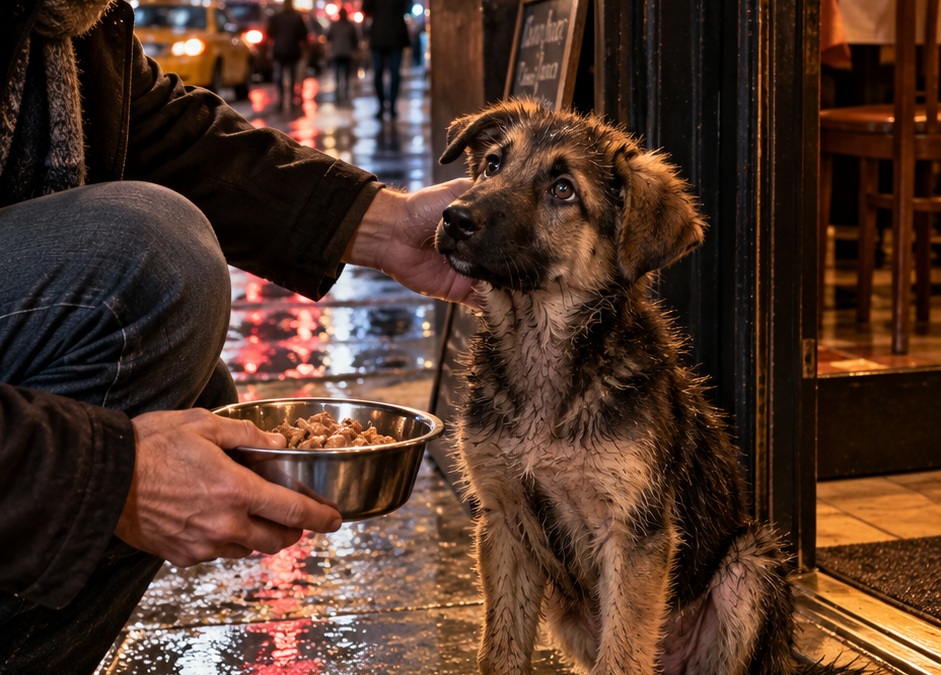
The puppy was still there.
Same doorway.
Same position.
Same bent ear.
Same smile.
My stomach dropped.
“You stayed.”
He looked at me.
Tail moved once.
Then I noticed the man beside the trash bins.
Sixties.
Maybe older.
Gray stubble.
Faded city maintenance jacket.
Paper cup steaming in one hand.
He looked at the container I was carrying.
“You came back.”
I stopped.
“You know him?”
“Know of him.”
The man nodded toward the puppy.
“Been around maybe two weeks. Maybe more.”
“Two weeks?”
“Moves around. But this door’s his favorite.”
“Why?”
“Warm.”
Of course.
The man extended a hand.
“Milo.”
“Marcus.”
We shook.
“You work here?”
“Janitor. Nights.”
Milo sipped his tea.
“I give him scraps when I can.”
“Restaurant know?”
He smiled without humor.
“What do you think?”
I looked at the puppy.
“Why hasn’t anyone called animal control?”
“Somebody probably has.”
“Probably?”
“City’s full of urgent things.”
Milo glanced at the puppy.
“He’s polite. Doesn’t bite. Doesn’t chase anyone. That makes him easy to ignore.”
That sentence landed hard.
Easy to ignore.
The puppy watched us.
Milo crouched.
“His ear smells bad.”
“I noticed.”
“Skin too.”
Up close, I could see what he meant.
Patchy fur along the shoulders.
Dandruff.
Red areas near the chest.
The ear was worse.
Swollen.
Crusted.
There was a smell beneath wet fur and street grime.
Infection.
The puppy lowered his head when I crouched.
Not submissive exactly.
Anticipatory.
Like he expected hands to come next.
I kept mine in my lap.
“I brought food.”
Milo nodded.
“Small amount.”
“Right.”
I placed chicken on the pavement.
The puppy stared.
Then looked at us.
Milo said softly, “Go on, kid.”
He stepped forward.
One piece.
Chewed.
Another.
Too fast.
I spread the pieces farther apart so he couldn’t inhale them.
He ate every one.
No growling.
No guarding.
Just efficiency.
When the food was gone, he licked the wet pavement where it had been.
I turned away for a second.
That bothered me more than I expected.
Milo noticed.
“Yeah.”
I exhaled.
“How does he act if you touch him?”
“I don’t.”
“Never?”
“Not much.”
“Why?”
Milo nodded toward the ear.
“He flinches.”
Good answer.
Respectful answer.
The restaurant door cracked open.
A young employee leaned out.
“Please don’t feed him here.”
Milo stood.
“We’re not making a mess.”
“My manager said—”
“We’re making a friend.”
The employee looked exhausted.
“I’m just doing what I’m told.”
Milo softened slightly.
“Yeah.”
So was everybody.
That’s how cruelty often survives.
Nobody owns it.
Everybody is just doing what they’re told.
I opened the slip lead.
The puppy saw it.
Backed away.
I stopped.
“Okay.”
Milo watched.
“You taking him?”
“If he’ll come.”
“If he were mine, he’d have a name.”
The puppy looked between us.
“Give him one,” Milo said.
I laughed once.
“I don’t know anything about naming dogs.”
“Name’s not for you.”
That sounded annoyingly wise.
I looked at the puppy.
Rain on his muzzle.
Big paws.
Dark eyes.
Half-healed ear.
Some absurdly noble name came into my head.
“Aurelion.”
Milo raised both eyebrows.
“That’s a lot of name for a starving puppy.”
“Ari.”
The puppy’s ears moved.
I said it again.
“Ari.”
Tail.
One small wag.
Milo smiled.
“Looks like he voted.”
I set the leash on the ground between us.
Not reaching.
Ari sniffed.
Then chicken residue on my fingers.
Then the loop.
I picked it up slowly.
He stiffened.
Stopped.
I lowered it again.
“Your choice.”
Minutes passed.
Milo didn’t speak.
Neither did I.
Ari approached.
Sniffed the leash.
I widened the loop and held it low.
He stretched his neck.
Retreated.
Tried again.
Then something shifted.
He pushed his nose through.
Not all the way.
Enough.
I didn’t tighten it.
He took another step.
The loop slid gently over his head.
I almost forgot to breathe.
“Good boy.”
Ari immediately moved closer.
Not away.
His body pressed against my knee.
Trembling.
I touched his shoulder.
He flinched.
But didn’t leave.
I slid one hand beneath his chest.
The other under his hips.
He was alarmingly light.
When I lifted him, Ari froze.
Then his head rested against my neck.
Milo looked away.
Maybe rain.
Maybe not.
“We’re going to a clinic,” I said.
Ari’s good ear brushed my cheek.
“Today.”
That sounded brave.
My checking account did not feel brave.
I had some savings.
Not a fortune.
New York rent had already developed a personal interest in destroying me.
Still, once Ari’s body settled against mine, cost became an abstract problem for later.
Milo followed us.
“You coming?”
“Somebody should make sure you don’t run off with my dog.”
I looked at him.
“Your dog?”
“I’ve been feeding him longer.”
“Then why am I carrying him?”
“Bad knees.”
Fair.
The emergency veterinary clinic was twenty minutes away by cab.
The driver saw Ari.
“You got a blanket?”
I looked down.
No.
The driver opened the trunk and pulled out an old moving blanket.
“Seats.”
Then, softer:
“For him too.”
New York does that sometimes.
Breaks your faith in humanity and then repairs it before the next traffic light.
Ari lay across my lap.
Milo sat beside us.
The dog shook every time the cab hit a pothole.
I kept one hand on his chest.
“You’re okay.”
I had no evidence.
Still said it.
At the clinic, Ari refused to enter.
The automatic doors opened.
He stopped dead.
Wouldn’t move.
Not pulling backward.
Just frozen.
Milo looked down.
“Doorway again.”
I understood.
For two weeks—maybe longer—Ari had lived at thresholds.
Close enough to people to survive.
Never inside.
A door meant division.
Not welcome.
I crouched.
“It’s okay.”
His eyes moved toward me.
“Different door.”
No movement.
So I lifted him.
He let me.
Inside, the lobby smelled of disinfectant, wet dog, and coffee that had committed crimes against coffee.
Ari curled against my shin.
Reception asked questions.
Owner?
No.
Chip?
Unknown.
Age?
Estimate seven months.
History?
Unknown.
Name?
“Aurelion.”
The receptionist looked up.
“Aurelion?”
“Ari.”
“Thank you.”
Even she thought the name was excessive.
A veterinary technician approached sideways.
Didn’t reach over his head.
Good.
Ari watched her hands.
“Hi, sweetheart.”
She looked at the ear.
“That’s infected.”
“We guessed.”
“How long?”
“No idea.”
The vet joined us.
Dr. Patel.
Calm voice.
Sharp eyes.
She examined Ari as much as he would tolerate without restraint.
Weight.
Thirty-seven pounds.
Far too low.
Temperature.
High.
Skin lesions.
Ear infection severe enough that she became quiet.
I knew quiet.
Quiet from medical professionals is never good.
“What?”
Dr. Patel lifted her eyes.
“The tissue at the edge is damaged. We need to sedate him, clean the ear thoroughly, see how much is viable.”
“Meaning?”
“Meaning he may lose a small portion of the ear.”
Milo muttered something under his breath.
I looked at Ari.
He was smiling again.
Not happy.
Appeasing.
Tail low.
Mouth pulled back.
Trying to reassure us.
That smile made me furious.
At the city.
At whoever owned him.
At every person who had taught him that friendliness was a survival tool.
Dr. Patel continued.
“Skin infection is treatable. Malnutrition needs careful correction. Bloodwork first. Pain medication now.”
“Do it.”
“We need financial authorization.”
Of course.
Numbers arrived.
Bloodwork.
Sedation.
Procedure.
Medication.
Observation.
Possible overnight stay.
I swallowed.
Milo stared at the estimate.
“Jesus.”
My savings account screamed.
I signed.
Milo looked at me.
“You don’t have to do this.”
I kept writing.
“Apparently I do.”
“No. I mean it.”
He lowered his voice.
“City could take custody.”
“Then what?”
“Treatment. Shelter.”
“Maybe.”
“Marcus.”
I stopped.
He was right.
Technically.
I could hand Ari over.
Walk away knowing I’d done more than most people.
That would be defensible.
Reasonable.
Responsible even.
Ari pressed his side against my leg.
I looked down.
He smiled.
I signed the final line.
“He’s coming home with me.”
Milo stared.
“You decided that when?”
“Apparently sometime between chicken and bankruptcy.”
The vet smiled.
“Let’s get him stable first.”
They took Ari through the swinging doors.
He looked back once.
That nearly broke me.
Then he disappeared.
The waiting room changed after that.
Without Ari leaning against my leg, everything felt colder.
Milo sat across from me.
His tea had long since gone cold.
“You live alone?”
“Yeah.”
“Dog experience?”
“None.”
He laughed.
“Excellent.”
“Helpful.”
“You always make life decisions like this?”
“Usually I compare prices first.”
A nurse appeared forty minutes later.
“Marcus?”
I stood.
“His fever is climbing.”
My stomach dropped.
“We need to proceed with the ear now rather than wait.”
“Is he stable enough?”
“Yes. We think delaying could allow infection to worsen.”
Another authorization form.
I didn’t read the total.
Signed.
“Bring him back.”
The nurse’s expression softened.
“We’ll take care of him.”
The procedure took less than two hours.
Felt like six.
Dr. Patel came out near two in the morning.
“He’s awake.”
I stood.
“How much ear?”
“Less than we feared.”
I exhaled.
“We removed necrotic tissue at the edge, thoroughly cleaned the canal, treated the infection, started systemic antibiotics. He’ll look different, but he’ll keep most of the ear.”
“Pain?”
“Controlled.”
“Skin?”
“Likely bacterial and secondary to poor condition. Treatable.”
“He’s going to live?”
Dr. Patel nodded.
“Assuming no complications, yes.”
That was the first moment all night when my body believed the floor was stable.
Ari came out wrapped in a blanket.
His damaged ear was bandaged carefully.
One section of shoulder shaved.
Eyes heavy from anesthesia.
He looked terrible.
He also looked alive.
I knelt.
“Ari.”
His eyes opened.
He recognized the sound.
Head lifted.
Barely.
Then dropped into my palm.
Milo made a rough sound behind me.
“Guess he chose right.”
I looked at the dog.
“I hope so.”
Ari slept at the clinic until morning.
I completed stray intake and foster-to-adopt arrangements through a partner shelter so everything would be legal.
No chip.
No owner information.
No missing report that matched immediately.
Mandatory hold period.
If someone proved ownership, there would be questions.
If nobody did, I could adopt.
At the shelter desk, a clerk asked:
“Name?”
“Aurelion.”
She paused.
“Ari.”
She nodded with visible relief.
I carried him home that afternoon.
My apartment was not prepared.
No bed.
No bowls.
No crate.
No toys.
I lived like a man who expected no dependent organism except one houseplant, and even that relationship was unstable.
Milo came with us carrying supplies donated by the shelter.
He walked inside, looked around, and frowned.
“You own nothing soft.”
“I own a couch.”
“For you.”
“It’s communal now, apparently.”
Ari stood near the entrance.
Wouldn’t cross farther.
Leash slack.
Head low.
He looked into the apartment.
Then behind him toward the hallway.
I took off my coat.
Put it on the floor six feet inside.
Ari knew that scent.
He sniffed.
One step.
Stopped.
Milo placed a bowl of water near the coat.
Another step.
Ari drank.
Then retreated to the door.
No pressure.
We sat.
Ordered food.
Talked.
Ignored him enough to be useful.
After thirty minutes, Ari lay down.
Still beside the door.
Milo pointed.
“He’s guarding his exit.”
“I know.”
“He thinks he may need it.”
That hurt.
At midnight, Ari was still there.
I had set up a soft bed beside the couch.
He ignored it.
I tried moving it closer.
No.
Eventually I lay on the floor six feet away.
“This is stupid.”
Ari’s good ear moved.
“I am thirty-eight years old.”
Nothing.
“I have a mattress.”
He sighed.
I stayed.
At some point, I woke because his paw was touching my hand.
Not leaning.
Just resting there.
The next week became medicine.
Food.
Cleaning.
Sleep deprivation.
More medicine.
Ari hated ear treatment.
Understandably.
The first time I approached with cleaning solution, he flattened.
Smile returned.
That awful apologetic smile.
I stopped.
Put everything down.
Sat.
“You’re not in trouble.”
His eyes tracked my hands.
“We have to do this.”
No movement.
“But I’m not going to ambush you.”
I showed him the cotton.
The bottle.
Food.
Touch shoulder.
Treat.
Stop.
Again.
Over days, he learned the sequence.
Never loved it.
Accepted it.
That’s enough.
Milo appeared almost daily.
Always claiming coincidence.
“I was nearby.”
“You live in Queens.”
“New York’s compact.”
He brought rice.
Chicken.
A used dog bed from his sister.
A rope toy.
A stainless-steel bowl.
Then complained Ari ate better than he did.
Ari adored him.
The first time Milo entered, Ari’s tail wagged openly.
Milo stared.
“Look at that.”
“Favoritism.”
“I fed him before you existed.”
“You met him two weeks before me.”
“Historical seniority.”
Ari pressed against him.
Traitor.
The first medical setback came five days after Ari went home.
Fever.
Fast breathing.
Refused dinner.
I called Dr. Patel.
“Bring him.”
We took a cab.
Ari lay across my lap.
His head heavy.
Every red light felt malicious.
At the clinic, bloodwork suggested the infection had flared.
Maybe secondary skin involvement.
Maybe his immune system simply had too much recovering to do at once.
They admitted him.
Again.
Same doors.
Same emptiness in my arms.
I sat.
Milo arrived forty minutes later, soaked from rain.
“You called him?”
I asked.
He removed his hat.
“No.”
“Then how—”
“You texted me three question marks.”
I checked my phone.
I had.
Apparently panic communicates efficiently.
“What if he doesn’t make it?”
The sentence escaped before I could stop it.
Milo sat.
“What if he does?”
I stared.
“That’s all?”
“What else do you want?”
“A guarantee.”
“Wrong city.”
He leaned back.
“Wrong planet.”
We waited.
Three-fourteen in the morning.
I remember because the clock seemed offensive.
Dr. Patel came out.
“He’s responding.”
I stood.
“Can I see him?”
“Briefly.”
Ari lay under a blanket.
IV attached.
Breathing calmer.
I approached.
His eyes opened.
Head lifted.
He pushed his muzzle into my wrist.
I crouched.
“Still here.”
Tail moved.
Weakly.
“You are very expensive.”
Another tiny wag.
Dr. Patel laughed behind me.
“He should recover.”
I closed my eyes.
“Thank you.”
The following week was better.
Then the next.
Ari gained weight.
Fur grew.
Skin cleared.
Ear healed into a permanent uneven shape.
One edge slightly shorter and curved.
It gave him character.
Milo called it his “war ear.”
I told him not to romanticize medical neglect.
Milo ignored me.
Ari started discovering that apartments contained interesting objects.
Shoes.
Socks.
Paper towels.
The corner of a rug.
One remote control.
I came home one evening and found plastic pieces scattered across the living room.
Ari sat in the middle.
Smiling.
Not apologetically now.
Proudly.
I held up the remains.
“Explain.”
Tail wag.
“This controlled my television.”
More wag.
“You have destroyed entertainment.”
Ari picked up another piece.
“Do not consume the evidence.”
I traded for a treat.
Then bought him more toys.
The rope toy became his favorite.
Milo took credit.
Of course.
Outside was harder.
New York is an assault even for confident dogs.
Horns.
Buses.
Subway grates.
Garbage trucks.
Sirens.
Construction.
People who believe “Can I pet him?” is something best asked after their hand is already above the dog’s head.
I learned to say no.
Often.
Firmly.
Ari needed distance.
His first walk lasted six minutes.
Apartment hallway.
Elevator.
Lobby.
Sidewalk.
Taxi horn.
Freeze.
Back home.
Success.
Second walk, eight minutes.
Delivery cart rattled.
Ari backed into my leg.
I didn’t pull.
Didn’t soothe dramatically.
Just stood.
He recovered.
Third walk, ten minutes.
Lamp post.
Pigeon.
An entire world apparently hidden in urine molecules.
His confidence grew.
Two feet at a time.
The doorway remained his obsession.
At night, he slept beside the apartment door.
Body curled.
Head pointed toward the hall.
I bought a bed.
He ignored it.
Moved it near the door.
He slept beside it.
Apparently furniture was offensive.
Milo said, “Give him time.”
I did.
Then came the night he slipped the leash.
My fault.
The collar wasn’t fitted tightly enough beneath his thickening coat.
We had walked six blocks.
A truck dropped something metal.
Crash.
Ari spun.
Backward.
Collar slipped over his head.
Gone.
My heart stopped.
“Ari!”
He ran.
Not randomly.
South.
I followed.
Through pedestrians.
Across a crosswalk.
Almost into a bike lane.
“Ari!”
He didn’t look.
Every nightmare arrived at once.
Traffic.
Lost dog.
Hit by car.
Gone forever.
I ran harder.
Then I realized where he was going.
The restaurant.
By the time I reached it, lungs burning, Ari was sitting outside the same doorway.
Exactly where I had first seen him.
Rain had started again.
Of course.
The restaurant had changed its awning.
Same brass plate.
Same warm light.
Same smell of food.
Ari sat.
Staring inside.
For one terrible moment, I thought he had chosen the old life over me.
Ridiculous.
Dogs don’t narrate their choices that way.
Still, fear is irrational.
I stopped ten feet away.
“Ari.”
His head turned.
Ears lifted.
Tail moved.
I crouched.
“No chasing.”
He stood.
I expected him to run.
Instead, he walked toward me.
Slow.
Then faster.
Then straight into my chest.
I fell backward onto the wet sidewalk.
Wrapped both arms around him.
“You absolute idiot.”
He licked my chin.
“You came back.”
Tail against pavement.
“You came back.”
The restaurant door opened.
The same manager looked out.
Recognized me.
Then Ari.
His expression changed.
“That’s him?”
“Yeah.”
“He looks good.”
Ari stood beside me.
No retreat.
No shrinking.
The manager looked ashamed.
“I’m glad.”
I believed him.
People aren’t always villains just because they failed one moment.
Sometimes they get to see the consequence of somebody choosing differently.
I clipped a backup slip lead around Ari.
Then sat with him for another minute.
He looked toward the door.
No begging.
No hunger.
Just memory.
“Ready?”
He looked at me.
We went home.
That night, Ari did not sleep beside the apartment door.
He lay beside my bed.
Head on the floor.
One paw touching my shoe.
I said nothing.
Some victories don’t need interpretation.
Three months after I found him, his coat shone.
The German Shepherd shape emerged fully.
Long back.
Broadening chest.
Big feet.
Alert eyes.
The damaged ear gave him permanent asymmetry.
I loved it.
He had gained nearly twenty pounds.
The skin infection was gone.
Medication finished.
He could walk through three neighborhoods without shutting down.
He had learned sit.
Down.
Stay.
Leave it.
Heel, depending on whether pigeons were involved.
Life started feeling normal.
Then thunder hit Manhattan.
Hard.
The first crack shook the windows.
Ari shot upright.
Second crash.
He bolted toward the door.
Claws scraped wood.
Panic.
Not alertness.
Not fear.
Full-body terror.
“Ari.”
He didn’t hear me.
Another thunderclap.
He threw himself against the door.
I moved toward him.
Stopped.
Don’t grab.
His eyes were wild.
Body trembling.
I sat on the floor.
“Ari.”
Nothing.
Lightning.
He barked.
Whined.
Scratched.
I lowered my voice.
“Here.”
Slow breath.
“I am here.”
He paced.
Door.
Window.
Door.
Then came toward me.
Retreated.
Came again.
I stayed.
Another thunderclap.
Ari pressed his body into my chest so hard I nearly tipped backward.
I wrapped one arm around him only after he leaned.
His heart hammered.
“It’s weather.”
His head buried beneath my chin.
“Not the street.”
Another boom.
“Not rain outside the restaurant.”
His body shook.
“Not hunger.”
I rested my cheek against his head.
“Not anymore.”
Someone knocked.
Milo.
Of course.
I opened the door.
He took one look at Ari.
“Storm.”
“Yeah.”
“Bad?”
“Very.”
Milo sat across the room.
No crowding.
Ari looked at him.
Another thunder roll.
Milo said quietly, “He’s remembering.”
“Probably.”
“Nights outside.”
“I know.”
Milo leaned against the couch.
“You can’t tell him it never happened.”
“No.”
“Just show him it’s not happening now.”
That was exactly it.
We stayed on the floor for almost two hours.
Thunder weakened.
Rain softened.
Ari’s breathing slowed.
Eventually he fell asleep with his head on my thigh.
Milo stood.
“Coffee?”
“At two in the morning?”
“You’re learning nothing from dog ownership.”
He made coffee.
We sat in the kitchen.
Ari slept.
“Sometimes healing isn’t the body,” Milo said.
I looked at him.
“You’re exhausting when you’re wise.”
He smiled.
“Occupational hazard.”
After that, storms became training.
No forcing.
Curtains drawn.
White noise.
Safe corner.
Food if Ari would take it.
Milo’s visits.
My presence.
The panic never disappeared instantly.
But each storm, recovery came faster.
Twenty minutes.
Then ten.
Then five.
Two years later, thunder still made Ari lift his head.
But that was all.
Progress.
Belonging arrived quietly too.
Crosswalks.
Morning routine.
Ari waiting while I tied my shoes.
His head appearing around the bathroom door.
His body stretched across the kitchen floor while I cooked.
His disgust toward the vacuum.
His obsession with one particular squeaky duck.
The first time I came home from work and Ari rolled onto his back in the hallway, paws in the air, mouth open in ridiculous joy, I stopped.
That smile.
Same face.
Completely different meaning.
The smile outside the restaurant had said:
Please don’t make me leave.
This one said:
You came back.
I knelt.
Rubbed his chest.
“You know something?”
Tail hammered floor.
“You’re spoiled.”
More tail.
“Deeply.”
Ari sneezed.
Milo kept visiting.
He claimed Ari needed “working-class influences” to counteract my apartment lifestyle.
I pointed out Milo had once brought a dog three kinds of roast meat in one evening.
He rejected the accusation as propaganda.
Ari adored him until the end.
The restaurant staff changed too.
One day, almost a year after the rescue, the manager saw us walking past.
“Marcus.”
I stopped.
Ari looked at the doorway.
No fear.
No hunger.
The manager came outside holding a small paper container.
“Chicken. Plain.”
I looked at Ari.
Then him.
“You’re bribing him.”
“Trying to improve my reputation.”
Ari took the chicken.
The manager crouched but didn’t reach.
“He really was out here every night.”
“Yeah.”
“I should’ve done more.”
I could have punished him with guilt.
Part of me wanted to.
Instead I said, “You can do more next time.”
He nodded.
That was enough.
A month later, I saw a water bowl outside the restaurant.
Then a small sign with a local rescue number.
Not redemption worthy of a movie.
Just improvement.
I respected that more.
Ari eventually became familiar in the neighborhood.
Not famous.
I didn’t want him turned into content.
He was a dog.
Not a moral lesson with fur.
Still, people recognized the damaged ear.
“The restaurant shepherd.”
I corrected them.
“Ari.”
Names matter.
The old janitor from the building across the street knew him.
The flower vendor.
The woman at the deli.
A delivery rider who always carried biscuits.
Ari greeted most people politely.
Never desperate.
Never apologetic.
He had preferences now.
That was perhaps my favorite transformation.
Outside the restaurant, hunger had made him grateful for anything.
Years later, he’d sniff a cheap biscuit and occasionally decline it.
Milo was offended.
“Unbelievable.”
Ari looked away.
“You used to eat garbage.”
Ari sat.
“He forgot his roots.”
I laughed.
“No. He discovered standards.”
That’s what safety gives you.
The ability to say no.
Ari could say no.
To a treat.
To a stranger’s hand.
To a dog he didn’t want to greet.
To going outside in heavy rain.
That last one felt personally insulting given his history.
I would open the door.
Rain.
Ari would look at me.
Then inside.
“Seriously?”
He sat.
“You lived outside.”
No movement.
“This is revisionist history.”
He walked toward the couch.
I bought a raincoat.
Milo nearly died laughing.
“Look at you.”
“What?”
“The man who worried about vet bills now buys custom waterproof clothing.”
“It’s functional.”
“It has his name embroidered.”
“Gift.”
“From who?”
I didn’t answer.
Milo laughed harder.
Years passed.
Ari became a full-grown shepherd.
Seventy-eight pounds.
Confident.
Healthy.
His coat deep black and warm tan.
The scarred ear remained folded slightly.
People sometimes asked what happened.
I usually said, “Old infection.”
Didn’t offer the whole story unless it mattered.
Ari wasn’t defined by the worst part.
Neither was I.
That surprised me.
Before him, I lived the way a lot of people in New York do.
Efficiently.
Work.
Apartment.
Gym occasionally.
Takeout.
Streaming.
Friends when schedules aligned.
Everything functional.
Nothing rooted.
I knew hundreds of people.
Needed almost nobody.
Ari changed the architecture of my day.
Walks forced me outside.
Routine forced me home.
His attention forced me to notice.
Pigeons.
Weather.
Neighbors.
The old man who sat every morning on the same bench.
The woman who fed sparrows.
The homeless veteran whose dog always wore a red bandanna.
The city slowed around Ari.
Or maybe I did.
Milo said it one evening.
“He saved you.”
I rolled my eyes.
“I knew you were going to become sentimental eventually.”
“I mean it.”
“Ari needed antibiotics. I needed a hobby.”
Milo looked at me.
“Right.”
I hated when he did that.
The truth was more complicated.
I had not been broken.
Ari didn’t magically repair me.
That’s a cheap way to describe a relationship.
What he changed was attention.
He made my life less abstract.
Somebody needed breakfast.
Somebody waited for me.
Somebody celebrated my return with zero professional restraint.
Responsibility narrowed the world in a good way.
Care gave the days shape.
That isn’t rescue.
That’s relationship.
When Ari turned five, Milo retired.
The restaurant threw him a small party because apparently the manager had eventually discovered he had a heart.
Ari attended.
Outside patio.
Milo sat with one hand buried in Ari’s fur.
“You remember this place?”
Ari looked toward the door.
Then at Milo.
Tail wag.
“I do,” Milo said.
His voice changed.
“I remember when you wouldn’t put a paw inside.”
Ari put both front paws on Milo’s knees.
“Show-off.”
We laughed.
Milo moved to New Jersey afterward to live near his daughter.
He still came into the city once a month.
Always visited Ari.
Always brought food despite repeated instructions.
Then one winter, he missed a visit.
Then another.
His daughter called.
Stroke.
Hospital.
Recovery uncertain.
I went with Ari.
The hospital allowed a brief outdoor visit during rehabilitation.
Milo came out in a wheelchair.
Thinner.
One side weak.
Ari saw him from thirty feet away.
Stopped.
Then pulled.
Not wildly.
Purposefully.
He reached Milo.
Placed his head in the old man’s lap.
Milo’s good hand moved onto the damaged ear.
“Hey, kid.”
Ari didn’t move.
Milo cried.
I pretended not to notice.
“You kept coming back,” Milo whispered.
Ari leaned harder.
I understood then that Ari’s world had always been built out of return.
I returned to the restaurant.
Milo returned with scraps.
I returned from work.
The vet returned him from treatment.
The door opened.
Someone came back.
That was trust for him.
Not affection.
Return.
Milo improved enough to walk with a cane.
He visited again.
Ari nearly knocked him over.
“Easy!”
Tail wag.
“Ungrateful animal.”
I caught Ari’s harness.
Milo laughed.
“I’m glad he forgot I’m fragile.”
“That’s optimism.”
The years became softer after that.
Then Ari started slowing.
Nothing dramatic.
At first, hesitation before jumping into the car.
Then stiffness after long walks.
Gray hair on the muzzle.
I hated every one.
“You’re seven.”
Ari looked at me.
“That’s not old.”
Tail.
“Correct.”
At nine, arthritis arrived.
Medication helped.
Rug runners appeared in the apartment.
A ramp for the car.
Extra bed.
Then another because he refused to walk eight feet apparently.
Milo called my home “geriatric shepherd headquarters.”
Fair.
The restaurant doorway remained part of our walking route.
Ari always slowed there.
Not fearfully.
Just noticing.
Sometimes the manager would come out.
New manager now.
Old one had retired.
But the water bowl stayed.
The rescue number stayed.
People forgot why.
Institutions keep small improvements long after the original guilt disappears.
I liked that.
One night, rain fell exactly the way it had the first time.
Cold.
Fine.
Persistent.
Ari and I stopped beneath the awning.
He was ten.
Gray-faced.
Ear permanently bent.
Still handsome.
He watched plates of food move past the window.
Then looked at me.
I laughed.
“You are not hungry.”
He sat.
“You ate forty minutes ago.”
Smile.
Not apology.
Manipulation.
“Unbelievable.”
The door opened.
Warm air.
Garlic.
Laughter.
Ari didn’t step backward.
Didn’t flatten.
He moved closer to the heat.
Because now he knew he was allowed to occupy space.
That almost made me cry.
A waiter recognized him.
“Chicken?”
Ari stood immediately.
Traitor.
The waiter brought a small plain piece.
Ari accepted it.
I rubbed his shoulders.
The rain collected around his paws.
Same doorway.
Different life.
“Look at you.”
He leaned against me.
I thought about the first smile.
What I had mistaken for sweetness.
How desperate politeness can look like friendliness.
How survival teaches animals—and people—to become convenient.
To need less.
Ask less.
Take up less space.
Ari spent the rest of his life unlearning that.
He took up plenty of space.
My hallway.
Bedside.
Back seat.
Schedule.
Budget.
Heart.
Good.
At eleven, his health changed.
Kidney values.
Then appetite.
Then weight.
We managed it.
Special diet.
Medication.
Regular bloodwork.
He still enjoyed walks.
Still liked Milo.
Still hated rain.
Then cancer.
The word I had spent years pretending belonged to somebody else’s dog.
We had options.
Some treatment.
Limited benefit.
Potentially difficult recovery.
I asked Dr. Patel—yes, the same vet, older now—what she would do if he were hers.
She looked at Ari.
Then me.
“I’d protect the good days.”
That became the plan.
Food he liked.
Short walks.
No heroic medicine for my benefit.
Pain control.
Comfort.
Time.
Milo came.
Sat on the floor beside him.
Ari rested his head on the old man’s leg.
“We’re falling apart together,” Milo said.
I laughed.
Then cried.
No shame left.
Ari’s final week was rainy.
Of course.
New York had a sense of narrative.
He stopped eating much.
Still drank.
Still wanted me near.
The final morning, he walked to the apartment door.
I opened it.
We went downstairs slowly.
Outside, rain.
Ari looked toward the restaurant route.
“Really?”
He took one step.
I followed.
We walked three blocks.
Rested.
Another block.
At the doorway, Ari stopped.
The restaurant wasn’t open yet.
Dark glass.
No plates.
No people.
Just us.
I sat on the wet sidewalk.
Ari lowered himself beside me.
His breathing was slow.
I rested a hand on the scarred ear.
“You know what happened here?”
His eyes closed.
“Probably not.”
Rain dotted his coat.
“You smiled at me.”
Tail moved once.
“You were starving and you smiled.”
I swallowed.
“I almost walked past.”
His head shifted into my palm.
“I’ve hated that for twelve years.”
Ari opened his eyes.
Calm.
No accusation.
Dogs are inconveniently uninterested in the guilt we use to punish ourselves.
“I came back, though.”
His tail moved again.
“That counts?”
He breathed.
I decided yes.
We sat there until the rain soaked through my jeans.
Then I carried him home.
Seventy-something pounds reduced by illness, but still heavy enough to remind me I wasn’t thirty-eight anymore.
He rested his head against my shoulder.
Just like the first morning.
Only now there was no trembling.
At home, Milo arrived.
Dr. Patel came later.
We had arranged euthanasia in the apartment.
Ari lay on his bed.
The same rope toy beside him.
Milo on one side.
Me on the other.
Dr. Patel gave the first medication.
Ari relaxed.
His eyes stayed on mine.
I touched his chest.
“You’re home.”
His breathing slowed.
“Not a doorway.”
Milo covered his mouth.
“Not a shadow.”
I bent down.
“Home.”
Ari’s tongue touched my wrist.
One slow lick.
Then his eyes closed.
His breathing stopped a few minutes later.
The apartment became impossibly quiet.
Milo sat for a long time.
Finally, he said:
“Guess he chose right.”
The same words from the clinic twelve years earlier.
I looked at Ari.
“No.”
My voice broke.
“We both did.”
Afterward, I couldn’t walk past the restaurant for months.
Changed routes.
Crossed streets.
Avoided the whole block.
Eventually that became ridiculous.
Ari had spent years turning that doorway into something ordinary.
I wasn’t going to turn it back into a monument to pain.
So one evening I went.
The water bowl was outside.
A young employee filled it.
A homeless man nearby had a small mutt beside him.
The manager brought out plain chicken in a paper container.
No one chased them.
No one complained.
I stood across the street.
Maybe Ari changed that.
Maybe not entirely.
Doesn’t matter.
Good things rarely belong to one cause.
They accumulate.
Milo joined me.
He moved slower now.
Cane.
Gray hair.
“Thinking about him?”
“Always.”
He nodded.
“You getting another dog?”
“No.”
“That’s what people say.”
“I’m serious.”
“Sure.”
Six months later, Milo sent me a photograph.
A shepherd mix at a rescue in Queens.
Seven years old.
One ear bent.
I called him immediately.
“You did that on purpose.”
“What?”
“The ear.”
“No idea what you’re talking about.”
“I am not adopting a dog because his ear is crooked.”
“Okay.”
Silence.
“What’s his name?”
Milo laughed.
“Benny.”
I went to meet him.
Not because I needed another Ari.
There would never be another.
Benny was nothing like him.
More reserved.
Less playful.
Older.
Liked women more than men.
Suspicious of elevators.
Hated squeaky toys.
I sat beside his kennel.
Didn’t reach.
He approached.
Sniffed.
Sat on my shoe.
I sighed.
“You people are organized.”
Three weeks later, Benny came home.
He never replaced Ari.
That isn’t how love works.
New relationships don’t overwrite old ones.
They expand the map.
I kept Ari’s collar.
His city shelter paperwork.
First vet invoice, though I still resented it.
One photograph from his fifth birthday.
And Milo had saved something I didn’t know existed.
A picture from that first week.
Ari outside the restaurant.
Thin.
Wet.
Bent ear.
Smiling.
Milo had taken it before I met him.
He gave it to me in an envelope.
“I thought you’d want this eventually.”
I stared.
The dog in the picture barely looked like the one I remembered from later years.
That expression.
Apologetic.
Small.
Trying not to be a problem.
I cried.
Then I put the photo in a drawer.
Not because it was painful.
Because I didn’t want the worst day to become the most important image.
I framed another one.
Ari at eight years old.
On his back in Central Park grass.
All four paws in the air.
Mouth open.
Healthy.
Ridiculous.
Taking up as much space as physically possible.
That was him.
Not the doorway.
Not hunger.
Not infection.
Not the broken ear.
Those things happened.
They didn’t get ownership.
That’s what people misunderstand about rescue stories.
The dramatic moment is rarely the real story.
Finding the dog?
That’s a moment.
Vet treatment?
A chapter.
Adoption?
Paperwork.
The story is afterward.
Medicine at midnight.
Training in rain.
Fear returning.
The first relaxed sleep.
The first refusal of a bad treat.
The first time a dog stops checking whether you’re leaving.
Years.
Ordinary years.
That’s what makes rescue matter.
Ari didn’t need me to save him once.
He needed me to return thousands of times.
Breakfast.
Walk.
Home from work.
Vet visits.
Thunderstorms.
Rain.
Old age.
Cancer.
Again.
Again.
Again.
And he returned too.
After slipping the leash.
After panic.
After every memory that told him doors meant exclusion.
He came back.
That became the rhythm of our life.
Return.
Milo once told me that dogs don’t understand promises.
I disagree now.
Maybe not the words.
But they understand patterns.
A promise is just a pattern maintained long enough.
Food arrives.
Hands stay gentle.
Doors open.
Pain gets treated.
You come home.
I almost walked past Ari because New York taught me that not everything I see is mine to solve.
That’s true.
No one person can stop for everything.
But sometimes something stops you.
A smile that doesn’t belong on a hungry face.
A dog standing in rain outside a warm room.
Eyes watching food but never asking.
And then you have a choice.
Keep walking.
Or turn around.
I turned around.
Not because I was heroic.
Because once I really saw him, pretending I hadn’t became impossible.
Years later, that was the part I remembered most.
Not the surgery.
Not the bills.
Not even the relapse.
The first moment.
Rain.
Restaurant light.
Ari shrinking himself beside the door.
And me saying:
“Buddy, I see you.”
At the time, I thought those words were for him.
Maybe they were for me too.
Because after Ari, I saw more.
The old man feeding pigeons.
The janitor leaving scraps for a dog nobody wanted.
The vet working past midnight.
The restaurant manager learning from failure.
The rescue staff answering phones.
The stranger who gave us a cab blanket.
People.
Animals.
Small acts.
A city that could be brutal and generous on the same block.
Ari didn’t make New York kinder.
He made me better at noticing where kindness already existed—and where it was missing.
His scars stayed visible his entire life.
Especially the ear.
Children sometimes asked.
“What happened?”
I usually said:
“He had a rough start.”
Then they’d pet him.
Ari would lean closer.
That was enough.
The scar told one story.
His body told another.
Healthy weight.
Strong legs.
Soft coat.
Relaxed mouth.
Trust.
The smile changed.
That was the real miracle.
Outside the restaurant, his smile had been survival.
At home, years later, it became joy.
Same dog.
Same mouth.
Different world.
And if I could go back to that first night, stand beside my thirty-eight-year-old self while he hesitated on the sidewalk, I wouldn’t tell him what was coming.
I wouldn’t mention the bills.
Sleepless nights.
Destroyed remote.
Thunderstorm panic.
The runaway scare.
Milo’s friendship.
Twelve years.
Cancer.
Loss.
I would only say one thing.
Turn around.
Because the dog at that doorway wasn’t asking for your whole life.
Not yet.
He was asking for one person to stop.
Everything else would grow from there.
And it did.
A hungry German Shepherd puppy stood outside a restaurant in Manhattan rain, smiling as though he needed to apologize for existing.
By the end of his life, Ari had forgotten how to apologize.
He occupied couches.
Blocked hallways.
Rejected inferior treats.
Demanded walks.
Stole pillows.
Slept upside down.
Leaned his full weight against people he loved.
And smiled without asking permission.
That’s the ending I keep.
Not a starving dog outside a locked door.
A beloved old shepherd asleep inside, certain the door would always open for him.
Have you finished reading the story and want to read it again?
He Smiled Through Hunger at a New York Restaurant Door—Then I Learned Why He Wouldn’t Step Inside
He never begged.
He just smiled through the hunger.
And I almost became one more person who walked past him.
My name is Marcus Hale, and I was thirty-eight years old the first time I saw the German Shepherd puppy standing outside a restaurant in Manhattan rain.
I say standing because technically that was what he was doing.
But barely.
His legs looked too thin beneath him, his black-and-tan coat darkened by rain until he almost blended into the wet sidewalk. One ear stood normally. The other folded strangely near the tip, crusted along the edge and swollen enough that even from ten feet away I knew something was wrong.
He couldn’t have been more than seven months old.
Maybe younger.
His body looked like hunger had been slowly erasing him.
Still, he smiled.
That is the detail I remember most.
Not a happy smile.
Not the open-mouthed, tongue-out expression of a dog racing through a park.
This was smaller.
Careful.
The corners of his mouth pulled back slightly whenever somebody looked at him, as if he had learned that appearing friendly made people less likely to chase him away.
The restaurant door opened.
Warm light spilled across the sidewalk.
Garlic.
Butter.
Roasted meat.
Laughter.
A server carried two plates past the glass.
The puppy’s eyes followed them.
His nose lifted.
He didn’t step forward.
Didn’t whine.
Didn’t scratch at the door.
He knew the boundary.
That was what hurt.
Some dogs beg because they believe the world might say yes.
This one behaved like he had already been told no enough times to stop asking.
I was walking home after work, coat zipped high against the rain, one hand wrapped around my phone because I was pretending an email mattered more than everything around me.
I saw him.
Slowed.
Then kept walking.
Three steps.
Four.
Five.
I wish I could tell you I was immediately the kind of person who stopped.
I wasn’t.
New York trains you to filter.
Man asleep in a doorway.
Delivery bike on the sidewalk.
Somebody arguing into a phone.
Somebody crying.
Lost glove.
Broken umbrella.
Stray cat under a car.
You see everything or you survive by seeing almost nothing.
I told myself the puppy probably belonged to someone inside.
Then I looked back.
No leash.
No collar I could see.
No one checking on him.
The rain ran from the edge of his damaged ear.
He watched another plate pass behind the glass.
Still smiling.
I stopped.
The worst part was how relieved he looked when I turned around.
As if even the act of being noticed had become a gift.
I crouched several feet away.
“Hey, buddy.”
The puppy lifted his head.
His tail moved once.
Not a wag exactly.
Permission.
I held out my hand.
He didn’t approach.
Instead, he smiled a little harder and lowered himself.
Making himself smaller.
Less troublesome.
The gesture hit me somewhere I wasn’t prepared to be hit.
“That’s okay.”
I kept my hand where it was.
“You don’t have to come over.”
Rain darkened my jeans.
Taxi lights stretched through puddles.
People moved around us.
A man stepped over the puppy’s tail without slowing.
The restaurant door opened again.
Heat washed over us.
The puppy’s nose lifted.
The manager appeared in the doorway.
Middle-aged man.
Pressed shirt.
Exhausted expression.
He looked at the dog, then me.
“Sir, please don’t encourage him here.”
I looked up.
“He’s hungry.”
“We’ve had complaints.”
“About him?”
“He blocks the entrance.”
The puppy immediately stepped backward.
That was the terrible part.
He understood the tone.
He moved away before anybody touched him.
The manager sighed.
“I’m sorry. We can’t have dogs gathering here.”
Dogs.
Plural.
As if an entire canine crime syndicate was threatening dinner service.
I stood.
The puppy kept backing toward the wall.
I wanted to argue.
Instead, I realized arguing wasn’t going to feed him, treat his ear, or get him out of the rain.
So I left.
Not completely.
Before I turned the corner, I looked back.
The puppy had returned to the edge of the doorway.
Not inside.
Never inside.
Just close enough to feel the warmth whenever somebody opened it.
He looked at me.
I raised one hand.
“I’ll come back.”
The words came out before I had decided whether I meant them.
The puppy tilted his head.
I walked home.
And for the rest of the night, every time I closed my eyes, I saw that impossible smile waiting outside a door he believed wasn’t meant for him.
PART2
I didn’t sleep much.
At two in the morning, I got up and opened my refrigerator.
Leftover noodles.
Eggs.
Half a roasted chicken.
I stared at the chicken.
Then at myself reflected faintly in the dark kitchen window.
“This is ridiculous.”
My reflection offered no useful guidance.
I packed some plain chicken into a container anyway.
Then I searched emergency veterinary clinics.
Then animal rescues.
Then information about injured stray dogs.
Then, because the internet is designed to turn mild concern into total panic, pictures of infected dog ears.
By four, I was convinced the puppy had twelve diseases and I was unqualified to identify any of them.
At six-thirty, I gave up on sleep.
Showered.
Put on my old Patagonia rain jacket.
Packed the chicken.
A bottle of water.
A collapsible bowl I’d bought at a twenty-four-hour pharmacy after realizing I did not own a single thing designed for a dog.
And a slip lead.
The cashier had looked at the leash and said, “New dog?”
“No.”
Apparently I was still committed to denial.
The rain had weakened to mist by the time I reached the restaurant.
The puppy was still there.
Same doorway.
Same position.
Same bent ear.
Same smile.
My stomach dropped.
“You stayed.”
He looked at me.
Tail moved once.
Then I noticed the man beside the trash bins.
Sixties.
Maybe older.
Gray stubble.
Faded city maintenance jacket.
Paper cup steaming in one hand.
He looked at the container I was carrying.
“You came back.”
I stopped.
“You know him?”
“Know of him.”
The man nodded toward the puppy.
“Been around maybe two weeks. Maybe more.”
“Two weeks?”
“Moves around. But this door’s his favorite.”
“Why?”
“Warm.”
Of course.
The man extended a hand.
“Milo.”
“Marcus.”
We shook.
“You work here?”
“Janitor. Nights.”
Milo sipped his tea.
“I give him scraps when I can.”
“Restaurant know?”
He smiled without humor.
“What do you think?”
I looked at the puppy.
“Why hasn’t anyone called animal control?”
“Somebody probably has.”
“Probably?”
“City’s full of urgent things.”
Milo glanced at the puppy.
“He’s polite. Doesn’t bite. Doesn’t chase anyone. That makes him easy to ignore.”
That sentence landed hard.
Easy to ignore.
The puppy watched us.
Milo crouched.
“His ear smells bad.”
“I noticed.”
“Skin too.”
Up close, I could see what he meant.
Patchy fur along the shoulders.
Dandruff.
Red areas near the chest.
The ear was worse.
Swollen.
Crusted.
There was a smell beneath wet fur and street grime.
Infection.
The puppy lowered his head when I crouched.
Not submissive exactly.
Anticipatory.
Like he expected hands to come next.
I kept mine in my lap.
“I brought food.”
Milo nodded.
“Small amount.”
“Right.”
I placed chicken on the pavement.
The puppy stared.
Then looked at us.
Milo said softly, “Go on, kid.”
He stepped forward.
One piece.
Chewed.
Another.
Too fast.
I spread the pieces farther apart so he couldn’t inhale them.
He ate every one.
No growling.
No guarding.
Just efficiency.
When the food was gone, he licked the wet pavement where it had been.
I turned away for a second.
That bothered me more than I expected.
Milo noticed.
“Yeah.”
I exhaled.
“How does he act if you touch him?”
“I don’t.”
“Never?”
“Not much.”
“Why?”
Milo nodded toward the ear.
“He flinches.”
Good answer.
Respectful answer.
The restaurant door cracked open.
A young employee leaned out.
“Please don’t feed him here.”
Milo stood.
“We’re not making a mess.”
“My manager said—”
“We’re making a friend.”
The employee looked exhausted.
“I’m just doing what I’m told.”
Milo softened slightly.
“Yeah.”
So was everybody.
That’s how cruelty often survives.
Nobody owns it.
Everybody is just doing what they’re told.
I opened the slip lead.
The puppy saw it.
Backed away.
I stopped.
“Okay.”
Milo watched.
“You taking him?”
“If he’ll come.”
“If he were mine, he’d have a name.”
The puppy looked between us.
“Give him one,” Milo said.
I laughed once.
“I don’t know anything about naming dogs.”
“Name’s not for you.”
That sounded annoyingly wise.
I looked at the puppy.
Rain on his muzzle.
Big paws.
Dark eyes.
Half-healed ear.
Some absurdly noble name came into my head.
“Aurelion.”
Milo raised both eyebrows.
“That’s a lot of name for a starving puppy.”
“Ari.”
The puppy’s ears moved.
I said it again.
“Ari.”
Tail.
One small wag.
Milo smiled.
“Looks like he voted.”
I set the leash on the ground between us.
Not reaching.
Ari sniffed.
Then chicken residue on my fingers.
Then the loop.
I picked it up slowly.
He stiffened.
Stopped.
I lowered it again.
“Your choice.”
Minutes passed.
Milo didn’t speak.
Neither did I.
Ari approached.
Sniffed the leash.
I widened the loop and held it low.
He stretched his neck.
Retreated.
Tried again.
Then something shifted.
He pushed his nose through.
Not all the way.
Enough.
I didn’t tighten it.
He took another step.
The loop slid gently over his head.
I almost forgot to breathe.
“Good boy.”
Ari immediately moved closer.
Not away.
His body pressed against my knee.
Trembling.
I touched his shoulder.
He flinched.
But didn’t leave.
I slid one hand beneath his chest.
The other under his hips.
He was alarmingly light.
When I lifted him, Ari froze.
Then his head rested against my neck.
Milo looked away.
Maybe rain.
Maybe not.
“We’re going to a clinic,” I said.
Ari’s good ear brushed my cheek.
“Today.”
That sounded brave.
My checking account did not feel brave.
I had some savings.
Not a fortune.
New York rent had already developed a personal interest in destroying me.
Still, once Ari’s body settled against mine, cost became an abstract problem for later.
Milo followed us.
“You coming?”
“Somebody should make sure you don’t run off with my dog.”
I looked at him.
“Your dog?”
“I’ve been feeding him longer.”
“Then why am I carrying him?”
“Bad knees.”
Fair.
The emergency veterinary clinic was twenty minutes away by cab.
The driver saw Ari.
“You got a blanket?”
I looked down.
No.
The driver opened the trunk and pulled out an old moving blanket.
“Seats.”
Then, softer:
“For him too.”
New York does that sometimes.
Breaks your faith in humanity and then repairs it before the next traffic light.
Ari lay across my lap.
Milo sat beside us.
The dog shook every time the cab hit a pothole.
I kept one hand on his chest.
“You’re okay.”
I had no evidence.
Still said it.
At the clinic, Ari refused to enter.
The automatic doors opened.
He stopped dead.
Wouldn’t move.
Not pulling backward.
Just frozen.
Milo looked down.
“Doorway again.”
I understood.
For two weeks—maybe longer—Ari had lived at thresholds.
Close enough to people to survive.
Never inside.
A door meant division.
Not welcome.
I crouched.
“It’s okay.”
His eyes moved toward me.
“Different door.”
No movement.
So I lifted him.
He let me.
Inside, the lobby smelled of disinfectant, wet dog, and coffee that had committed crimes against coffee.
Ari curled against my shin.
Reception asked questions.
Owner?
No.
Chip?
Unknown.
Age?
Estimate seven months.
History?
Unknown.
Name?
“Aurelion.”
The receptionist looked up.
“Aurelion?”
“Ari.”
“Thank you.”
Even she thought the name was excessive.
A veterinary technician approached sideways.
Didn’t reach over his head.
Good.
Ari watched her hands.
“Hi, sweetheart.”
She looked at the ear.
“That’s infected.”
“We guessed.”
“How long?”
“No idea.”
The vet joined us.
Dr. Patel.
Calm voice.
Sharp eyes.
She examined Ari as much as he would tolerate without restraint.
Weight.
Thirty-seven pounds.
Far too low.
Temperature.
High.
Skin lesions.
Ear infection severe enough that she became quiet.
I knew quiet.
Quiet from medical professionals is never good.
“What?”
Dr. Patel lifted her eyes.
“The tissue at the edge is damaged. We need to sedate him, clean the ear thoroughly, see how much is viable.”
“Meaning?”
“Meaning he may lose a small portion of the ear.”
Milo muttered something under his breath.
I looked at Ari.
He was smiling again.
Not happy.
Appeasing.
Tail low.
Mouth pulled back.
Trying to reassure us.
That smile made me furious.
At the city.
At whoever owned him.
At every person who had taught him that friendliness was a survival tool.
Dr. Patel continued.
“Skin infection is treatable. Malnutrition needs careful correction. Bloodwork first. Pain medication now.”
“Do it.”
“We need financial authorization.”
Of course.
Numbers arrived.
Bloodwork.
Sedation.
Procedure.
Medication.
Observation.
Possible overnight stay.
I swallowed.
Milo stared at the estimate.
“Jesus.”
My savings account screamed.
I signed.
Milo looked at me.
“You don’t have to do this.”
I kept writing.
“Apparently I do.”
“No. I mean it.”
He lowered his voice.
“City could take custody.”
“Then what?”
“Treatment. Shelter.”
“Maybe.”
“Marcus.”
I stopped.
He was right.
Technically.
I could hand Ari over.
Walk away knowing I’d done more than most people.
That would be defensible.
Reasonable.
Responsible even.
Ari pressed his side against my leg.
I looked down.
He smiled.
I signed the final line.
“He’s coming home with me.”
Milo stared.
“You decided that when?”
“Apparently sometime between chicken and bankruptcy.”
The vet smiled.
“Let’s get him stable first.”
They took Ari through the swinging doors.
He looked back once.
That nearly broke me.
Then he disappeared.
The waiting room changed after that.
Without Ari leaning against my leg, everything felt colder.
Milo sat across from me.
His tea had long since gone cold.
“You live alone?”
“Yeah.”
“Dog experience?”
“None.”
He laughed.
“Excellent.”
“Helpful.”
“You always make life decisions like this?”
“Usually I compare prices first.”
A nurse appeared forty minutes later.
“Marcus?”
I stood.
“His fever is climbing.”
My stomach dropped.
“We need to proceed with the ear now rather than wait.”
“Is he stable enough?”
“Yes. We think delaying could allow infection to worsen.”
Another authorization form.
I didn’t read the total.
Signed.
“Bring him back.”
The nurse’s expression softened.
“We’ll take care of him.”
The procedure took less than two hours.
Felt like six.
Dr. Patel came out near two in the morning.
“He’s awake.”
I stood.
“How much ear?”
“Less than we feared.”
I exhaled.
“We removed necrotic tissue at the edge, thoroughly cleaned the canal, treated the infection, started systemic antibiotics. He’ll look different, but he’ll keep most of the ear.”
“Pain?”
“Controlled.”
“Skin?”
“Likely bacterial and secondary to poor condition. Treatable.”
“He’s going to live?”
Dr. Patel nodded.
“Assuming no complications, yes.”
That was the first moment all night when my body believed the floor was stable.
Ari came out wrapped in a blanket.
His damaged ear was bandaged carefully.
One section of shoulder shaved.
Eyes heavy from anesthesia.
He looked terrible.
He also looked alive.
I knelt.
“Ari.”
His eyes opened.
He recognized the sound.
Head lifted.
Barely.
Then dropped into my palm.
Milo made a rough sound behind me.
“Guess he chose right.”
I looked at the dog.
“I hope so.”
Ari slept at the clinic until morning.
I completed stray intake and foster-to-adopt arrangements through a partner shelter so everything would be legal.
No chip.
No owner information.
No missing report that matched immediately.
Mandatory hold period.
If someone proved ownership, there would be questions.
If nobody did, I could adopt.
At the shelter desk, a clerk asked:
“Name?”
“Aurelion.”
She paused.
“Ari.”
She nodded with visible relief.
I carried him home that afternoon.
My apartment was not prepared.
No bed.
No bowls.
No crate.
No toys.
I lived like a man who expected no dependent organism except one houseplant, and even that relationship was unstable.
Milo came with us carrying supplies donated by the shelter.
He walked inside, looked around, and frowned.
“You own nothing soft.”
“I own a couch.”
“For you.”
“It’s communal now, apparently.”
Ari stood near the entrance.
Wouldn’t cross farther.
Leash slack.
Head low.
He looked into the apartment.
Then behind him toward the hallway.
I took off my coat.
Put it on the floor six feet inside.
Ari knew that scent.
He sniffed.
One step.
Stopped.
Milo placed a bowl of water near the coat.
Another step.
Ari drank.
Then retreated to the door.
No pressure.
We sat.
Ordered food.
Talked.
Ignored him enough to be useful.
After thirty minutes, Ari lay down.
Still beside the door.
Milo pointed.
“He’s guarding his exit.”
“I know.”
“He thinks he may need it.”
That hurt.
At midnight, Ari was still there.
I had set up a soft bed beside the couch.
He ignored it.
I tried moving it closer.
No.
Eventually I lay on the floor six feet away.
“This is stupid.”
Ari’s good ear moved.
“I am thirty-eight years old.”
Nothing.
“I have a mattress.”
He sighed.
I stayed.
At some point, I woke because his paw was touching my hand.
Not leaning.
Just resting there.
The next week became medicine.
Food.
Cleaning.
Sleep deprivation.
More medicine.
Ari hated ear treatment.
Understandably.
The first time I approached with cleaning solution, he flattened.
Smile returned.
That awful apologetic smile.
I stopped.
Put everything down.
Sat.
“You’re not in trouble.”
His eyes tracked my hands.
“We have to do this.”
No movement.
“But I’m not going to ambush you.”
I showed him the cotton.
The bottle.
Food.
Touch shoulder.
Treat.
Stop.
Again.
Over days, he learned the sequence.
Never loved it.
Accepted it.
That’s enough.
Milo appeared almost daily.
Always claiming coincidence.
“I was nearby.”
“You live in Queens.”
“New York’s compact.”
He brought rice.
Chicken.
A used dog bed from his sister.
A rope toy.
A stainless-steel bowl.
Then complained Ari ate better than he did.
Ari adored him.
The first time Milo entered, Ari’s tail wagged openly.
Milo stared.
“Look at that.”
“Favoritism.”
“I fed him before you existed.”
“You met him two weeks before me.”
“Historical seniority.”
Ari pressed against him.
Traitor.
The first medical setback came five days after Ari went home.
Fever.
Fast breathing.
Refused dinner.
I called Dr. Patel.
“Bring him.”
We took a cab.
Ari lay across my lap.
His head heavy.
Every red light felt malicious.
At the clinic, bloodwork suggested the infection had flared.
Maybe secondary skin involvement.
Maybe his immune system simply had too much recovering to do at once.
They admitted him.
Again.
Same doors.
Same emptiness in my arms.
I sat.
Milo arrived forty minutes later, soaked from rain.
“You called him?”
I asked.
He removed his hat.
“No.”
“Then how—”
“You texted me three question marks.”
I checked my phone.
I had.
Apparently panic communicates efficiently.
“What if he doesn’t make it?”
The sentence escaped before I could stop it.
Milo sat.
“What if he does?”
I stared.
“That’s all?”
“What else do you want?”
“A guarantee.”
“Wrong city.”
He leaned back.
“Wrong planet.”
We waited.
Three-fourteen in the morning.
I remember because the clock seemed offensive.
Dr. Patel came out.
“He’s responding.”
I stood.
“Can I see him?”
“Briefly.”
Ari lay under a blanket.
IV attached.
Breathing calmer.
I approached.
His eyes opened.
Head lifted.
He pushed his muzzle into my wrist.
I crouched.
“Still here.”
Tail moved.
Weakly.
“You are very expensive.”
Another tiny wag.
Dr. Patel laughed behind me.
“He should recover.”
I closed my eyes.
“Thank you.”
The following week was better.
Then the next.
Ari gained weight.
Fur grew.
Skin cleared.
Ear healed into a permanent uneven shape.
One edge slightly shorter and curved.
It gave him character.
Milo called it his “war ear.”
I told him not to romanticize medical neglect.
Milo ignored me.
Ari started discovering that apartments contained interesting objects.
Shoes.
Socks.
Paper towels.
The corner of a rug.
One remote control.
I came home one evening and found plastic pieces scattered across the living room.
Ari sat in the middle.
Smiling.
Not apologetically now.
Proudly.
I held up the remains.
“Explain.”
Tail wag.
“This controlled my television.”
More wag.
“You have destroyed entertainment.”
Ari picked up another piece.
“Do not consume the evidence.”
I traded for a treat.
Then bought him more toys.
The rope toy became his favorite.
Milo took credit.
Of course.
Outside was harder.
New York is an assault even for confident dogs.
Horns.
Buses.
Subway grates.
Garbage trucks.
Sirens.
Construction.
People who believe “Can I pet him?” is something best asked after their hand is already above the dog’s head.
I learned to say no.
Often.
Firmly.
Ari needed distance.
His first walk lasted six minutes.
Apartment hallway.
Elevator.
Lobby.
Sidewalk.
Taxi horn.
Freeze.
Back home.
Success.
Second walk, eight minutes.
Delivery cart rattled.
Ari backed into my leg.
I didn’t pull.
Didn’t soothe dramatically.
Just stood.
He recovered.
Third walk, ten minutes.
Lamp post.
Pigeon.
An entire world apparently hidden in urine molecules.
His confidence grew.
Two feet at a time.
The doorway remained his obsession.
At night, he slept beside the apartment door.
Body curled.
Head pointed toward the hall.
I bought a bed.
He ignored it.
Moved it near the door.
He slept beside it.
Apparently furniture was offensive.
Milo said, “Give him time.”
I did.
Then came the night he slipped the leash.
My fault.
The collar wasn’t fitted tightly enough beneath his thickening coat.
We had walked six blocks.
A truck dropped something metal.
Crash.
Ari spun.
Backward.
Collar slipped over his head.
Gone.
My heart stopped.
“Ari!”
He ran.
Not randomly.
South.
I followed.
Through pedestrians.
Across a crosswalk.
Almost into a bike lane.
“Ari!”
He didn’t look.
Every nightmare arrived at once.
Traffic.
Lost dog.
Hit by car.
Gone forever.
I ran harder.
Then I realized where he was going.
The restaurant.
By the time I reached it, lungs burning, Ari was sitting outside the same doorway.
Exactly where I had first seen him.
Rain had started again.
Of course.
The restaurant had changed its awning.
Same brass plate.
Same warm light.
Same smell of food.
Ari sat.
Staring inside.
For one terrible moment, I thought he had chosen the old life over me.
Ridiculous.
Dogs don’t narrate their choices that way.
Still, fear is irrational.
I stopped ten feet away.
“Ari.”
His head turned.
Ears lifted.
Tail moved.
I crouched.
“No chasing.”
He stood.
I expected him to run.
Instead, he walked toward me.
Slow.
Then faster.
Then straight into my chest.
I fell backward onto the wet sidewalk.
Wrapped both arms around him.
“You absolute idiot.”
He licked my chin.
“You came back.”
Tail against pavement.
“You came back.”
The restaurant door opened.
The same manager looked out.
Recognized me.
Then Ari.
His expression changed.
“That’s him?”
“Yeah.”
“He looks good.”
Ari stood beside me.
No retreat.
No shrinking.
The manager looked ashamed.
“I’m glad.”
I believed him.
People aren’t always villains just because they failed one moment.
Sometimes they get to see the consequence of somebody choosing differently.
I clipped a backup slip lead around Ari.
Then sat with him for another minute.
He looked toward the door.
No begging.
No hunger.
Just memory.
“Ready?”
He looked at me.
We went home.
That night, Ari did not sleep beside the apartment door.
He lay beside my bed.
Head on the floor.
One paw touching my shoe.
I said nothing.
Some victories don’t need interpretation.
Three months after I found him, his coat shone.
The German Shepherd shape emerged fully.
Long back.
Broadening chest.
Big feet.
Alert eyes.
The damaged ear gave him permanent asymmetry.
I loved it.
He had gained nearly twenty pounds.
The skin infection was gone.
Medication finished.
He could walk through three neighborhoods without shutting down.
He had learned sit.
Down.
Stay.
Leave it.
Heel, depending on whether pigeons were involved.
Life started feeling normal.
Then thunder hit Manhattan.
Hard.
The first crack shook the windows.
Ari shot upright.
Second crash.
He bolted toward the door.
Claws scraped wood.
Panic.
Not alertness.
Not fear.
Full-body terror.
“Ari.”
He didn’t hear me.
Another thunderclap.
He threw himself against the door.
I moved toward him.
Stopped.
Don’t grab.
His eyes were wild.
Body trembling.
I sat on the floor.
“Ari.”
Nothing.
Lightning.
He barked.
Whined.
Scratched.
I lowered my voice.
“Here.”
Slow breath.
“I am here.”
He paced.
Door.
Window.
Door.
Then came toward me.
Retreated.
Came again.
I stayed.
Another thunderclap.
Ari pressed his body into my chest so hard I nearly tipped backward.
I wrapped one arm around him only after he leaned.
His heart hammered.
“It’s weather.”
His head buried beneath my chin.
“Not the street.”
Another boom.
“Not rain outside the restaurant.”
His body shook.
“Not hunger.”
I rested my cheek against his head.
“Not anymore.”
Someone knocked.
Milo.
Of course.
I opened the door.
He took one look at Ari.
“Storm.”
“Yeah.”
“Bad?”
“Very.”
Milo sat across the room.
No crowding.
Ari looked at him.
Another thunder roll.
Milo said quietly, “He’s remembering.”
“Probably.”
“Nights outside.”
“I know.”
Milo leaned against the couch.
“You can’t tell him it never happened.”
“No.”
“Just show him it’s not happening now.”
That was exactly it.
We stayed on the floor for almost two hours.
Thunder weakened.
Rain softened.
Ari’s breathing slowed.
Eventually he fell asleep with his head on my thigh.
Milo stood.
“Coffee?”
“At two in the morning?”
“You’re learning nothing from dog ownership.”
He made coffee.
We sat in the kitchen.
Ari slept.
“Sometimes healing isn’t the body,” Milo said.
I looked at him.
“You’re exhausting when you’re wise.”
He smiled.
“Occupational hazard.”
After that, storms became training.
No forcing.
Curtains drawn.
White noise.
Safe corner.
Food if Ari would take it.
Milo’s visits.
My presence.
The panic never disappeared instantly.
But each storm, recovery came faster.
Twenty minutes.
Then ten.
Then five.
Two years later, thunder still made Ari lift his head.
But that was all.
Progress.
Belonging arrived quietly too.
Crosswalks.
Morning routine.
Ari waiting while I tied my shoes.
His head appearing around the bathroom door.
His body stretched across the kitchen floor while I cooked.
His disgust toward the vacuum.
His obsession with one particular squeaky duck.
The first time I came home from work and Ari rolled onto his back in the hallway, paws in the air, mouth open in ridiculous joy, I stopped.
That smile.
Same face.
Completely different meaning.
The smile outside the restaurant had said:
Please don’t make me leave.
This one said:
You came back.
I knelt.
Rubbed his chest.
“You know something?”
Tail hammered floor.
“You’re spoiled.”
More tail.
“Deeply.”
Ari sneezed.
Milo kept visiting.
He claimed Ari needed “working-class influences” to counteract my apartment lifestyle.
I pointed out Milo had once brought a dog three kinds of roast meat in one evening.
He rejected the accusation as propaganda.
Ari adored him until the end.
The restaurant staff changed too.
One day, almost a year after the rescue, the manager saw us walking past.
“Marcus.”
I stopped.
Ari looked at the doorway.
No fear.
No hunger.
The manager came outside holding a small paper container.
“Chicken. Plain.”
I looked at Ari.
Then him.
“You’re bribing him.”
“Trying to improve my reputation.”
Ari took the chicken.
The manager crouched but didn’t reach.
“He really was out here every night.”
“Yeah.”
“I should’ve done more.”
I could have punished him with guilt.
Part of me wanted to.
Instead I said, “You can do more next time.”
He nodded.
That was enough.
A month later, I saw a water bowl outside the restaurant.
Then a small sign with a local rescue number.
Not redemption worthy of a movie.
Just improvement.
I respected that more.
Ari eventually became familiar in the neighborhood.
Not famous.
I didn’t want him turned into content.
He was a dog.
Not a moral lesson with fur.
Still, people recognized the damaged ear.
“The restaurant shepherd.”
I corrected them.
“Ari.”
Names matter.
The old janitor from the building across the street knew him.
The flower vendor.
The woman at the deli.
A delivery rider who always carried biscuits.
Ari greeted most people politely.
Never desperate.
Never apologetic.
He had preferences now.
That was perhaps my favorite transformation.
Outside the restaurant, hunger had made him grateful for anything.
Years later, he’d sniff a cheap biscuit and occasionally decline it.
Milo was offended.
“Unbelievable.”
Ari looked away.
“You used to eat garbage.”
Ari sat.
“He forgot his roots.”
I laughed.
“No. He discovered standards.”
That’s what safety gives you.
The ability to say no.
Ari could say no.
To a treat.
To a stranger’s hand.
To a dog he didn’t want to greet.
To going outside in heavy rain.
That last one felt personally insulting given his history.
I would open the door.
Rain.
Ari would look at me.
Then inside.
“Seriously?”
He sat.
“You lived outside.”
No movement.
“This is revisionist history.”
He walked toward the couch.
I bought a raincoat.
Milo nearly died laughing.
“Look at you.”
“What?”
“The man who worried about vet bills now buys custom waterproof clothing.”
“It’s functional.”
“It has his name embroidered.”
“Gift.”
“From who?”
I didn’t answer.
Milo laughed harder.
Years passed.
Ari became a full-grown shepherd.
Seventy-eight pounds.
Confident.
Healthy.
His coat deep black and warm tan.
The scarred ear remained folded slightly.
People sometimes asked what happened.
I usually said, “Old infection.”
Didn’t offer the whole story unless it mattered.
Ari wasn’t defined by the worst part.
Neither was I.
That surprised me.
Before him, I lived the way a lot of people in New York do.
Efficiently.
Work.
Apartment.
Gym occasionally.
Takeout.
Streaming.
Friends when schedules aligned.
Everything functional.
Nothing rooted.
I knew hundreds of people.
Needed almost nobody.
Ari changed the architecture of my day.
Walks forced me outside.
Routine forced me home.
His attention forced me to notice.
Pigeons.
Weather.
Neighbors.
The old man who sat every morning on the same bench.
The woman who fed sparrows.
The homeless veteran whose dog always wore a red bandanna.
The city slowed around Ari.
Or maybe I did.
Milo said it one evening.
“He saved you.”
I rolled my eyes.
“I knew you were going to become sentimental eventually.”
“I mean it.”
“Ari needed antibiotics. I needed a hobby.”
Milo looked at me.
“Right.”
I hated when he did that.
The truth was more complicated.
I had not been broken.
Ari didn’t magically repair me.
That’s a cheap way to describe a relationship.
What he changed was attention.
He made my life less abstract.
Somebody needed breakfast.
Somebody waited for me.
Somebody celebrated my return with zero professional restraint.
Responsibility narrowed the world in a good way.
Care gave the days shape.
That isn’t rescue.
That’s relationship.
When Ari turned five, Milo retired.
The restaurant threw him a small party because apparently the manager had eventually discovered he had a heart.
Ari attended.
Outside patio.
Milo sat with one hand buried in Ari’s fur.
“You remember this place?”
Ari looked toward the door.
Then at Milo.
Tail wag.
“I do,” Milo said.
His voice changed.
“I remember when you wouldn’t put a paw inside.”
Ari put both front paws on Milo’s knees.
“Show-off.”
We laughed.
Milo moved to New Jersey afterward to live near his daughter.
He still came into the city once a month.
Always visited Ari.
Always brought food despite repeated instructions.
Then one winter, he missed a visit.
Then another.
His daughter called.
Stroke.
Hospital.
Recovery uncertain.
I went with Ari.
The hospital allowed a brief outdoor visit during rehabilitation.
Milo came out in a wheelchair.
Thinner.
One side weak.
Ari saw him from thirty feet away.
Stopped.
Then pulled.
Not wildly.
Purposefully.
He reached Milo.
Placed his head in the old man’s lap.
Milo’s good hand moved onto the damaged ear.
“Hey, kid.”
Ari didn’t move.
Milo cried.
I pretended not to notice.
“You kept coming back,” Milo whispered.
Ari leaned harder.
I understood then that Ari’s world had always been built out of return.
I returned to the restaurant.
Milo returned with scraps.
I returned from work.
The vet returned him from treatment.
The door opened.
Someone came back.
That was trust for him.
Not affection.
Return.
Milo improved enough to walk with a cane.
He visited again.
Ari nearly knocked him over.
“Easy!”
Tail wag.
“Ungrateful animal.”
I caught Ari’s harness.
Milo laughed.
“I’m glad he forgot I’m fragile.”
“That’s optimism.”
The years became softer after that.
Then Ari started slowing.
Nothing dramatic.
At first, hesitation before jumping into the car.
Then stiffness after long walks.
Gray hair on the muzzle.
I hated every one.
“You’re seven.”
Ari looked at me.
“That’s not old.”
Tail.
“Correct.”
At nine, arthritis arrived.
Medication helped.
Rug runners appeared in the apartment.
A ramp for the car.
Extra bed.
Then another because he refused to walk eight feet apparently.
Milo called my home “geriatric shepherd headquarters.”
Fair.
The restaurant doorway remained part of our walking route.
Ari always slowed there.
Not fearfully.
Just noticing.
Sometimes the manager would come out.
New manager now.
Old one had retired.
But the water bowl stayed.
The rescue number stayed.
People forgot why.
Institutions keep small improvements long after the original guilt disappears.
I liked that.
One night, rain fell exactly the way it had the first time.
Cold.
Fine.
Persistent.
Ari and I stopped beneath the awning.
He was ten.
Gray-faced.
Ear permanently bent.
Still handsome.
He watched plates of food move past the window.
Then looked at me.
I laughed.
“You are not hungry.”
He sat.
“You ate forty minutes ago.”
Smile.
Not apology.
Manipulation.
“Unbelievable.”
The door opened.
Warm air.
Garlic.
Laughter.
Ari didn’t step backward.
Didn’t flatten.
He moved closer to the heat.
Because now he knew he was allowed to occupy space.
That almost made me cry.
A waiter recognized him.
“Chicken?”
Ari stood immediately.
Traitor.
The waiter brought a small plain piece.
Ari accepted it.
I rubbed his shoulders.
The rain collected around his paws.
Same doorway.
Different life.
“Look at you.”
He leaned against me.
I thought about the first smile.
What I had mistaken for sweetness.
How desperate politeness can look like friendliness.
How survival teaches animals—and people—to become convenient.
To need less.
Ask less.
Take up less space.
Ari spent the rest of his life unlearning that.
He took up plenty of space.
My hallway.
Bedside.
Back seat.
Schedule.
Budget.
Heart.
Good.
At eleven, his health changed.
Kidney values.
Then appetite.
Then weight.
We managed it.
Special diet.
Medication.
Regular bloodwork.
He still enjoyed walks.
Still liked Milo.
Still hated rain.
Then cancer.
The word I had spent years pretending belonged to somebody else’s dog.
We had options.
Some treatment.
Limited benefit.
Potentially difficult recovery.
I asked Dr. Patel—yes, the same vet, older now—what she would do if he were hers.
She looked at Ari.
Then me.
“I’d protect the good days.”
That became the plan.
Food he liked.
Short walks.
No heroic medicine for my benefit.
Pain control.
Comfort.
Time.
Milo came.
Sat on the floor beside him.
Ari rested his head on the old man’s leg.
“We’re falling apart together,” Milo said.
I laughed.
Then cried.
No shame left.
Ari’s final week was rainy.
Of course.
New York had a sense of narrative.
He stopped eating much.
Still drank.
Still wanted me near.
The final morning, he walked to the apartment door.
I opened it.
We went downstairs slowly.
Outside, rain.
Ari looked toward the restaurant route.
“Really?”
He took one step.
I followed.
We walked three blocks.
Rested.
Another block.
At the doorway, Ari stopped.
The restaurant wasn’t open yet.
Dark glass.
No plates.
No people.
Just us.
I sat on the wet sidewalk.
Ari lowered himself beside me.
His breathing was slow.
I rested a hand on the scarred ear.
“You know what happened here?”
His eyes closed.
“Probably not.”
Rain dotted his coat.
“You smiled at me.”
Tail moved once.
“You were starving and you smiled.”
I swallowed.
“I almost walked past.”
His head shifted into my palm.
“I’ve hated that for twelve years.”
Ari opened his eyes.
Calm.
No accusation.
Dogs are inconveniently uninterested in the guilt we use to punish ourselves.
“I came back, though.”
His tail moved again.
“That counts?”
He breathed.
I decided yes.
We sat there until the rain soaked through my jeans.
Then I carried him home.
Seventy-something pounds reduced by illness, but still heavy enough to remind me I wasn’t thirty-eight anymore.
He rested his head against my shoulder.
Just like the first morning.
Only now there was no trembling.
At home, Milo arrived.
Dr. Patel came later.
We had arranged euthanasia in the apartment.
Ari lay on his bed.
The same rope toy beside him.
Milo on one side.
Me on the other.
Dr. Patel gave the first medication.
Ari relaxed.
His eyes stayed on mine.
I touched his chest.
“You’re home.”
His breathing slowed.
“Not a doorway.”
Milo covered his mouth.
“Not a shadow.”
I bent down.
“Home.”
Ari’s tongue touched my wrist.
One slow lick.
Then his eyes closed.
His breathing stopped a few minutes later.
The apartment became impossibly quiet.
Milo sat for a long time.
Finally, he said:
“Guess he chose right.”
The same words from the clinic twelve years earlier.
I looked at Ari.
“No.”
My voice broke.
“We both did.”
Afterward, I couldn’t walk past the restaurant for months.
Changed routes.
Crossed streets.
Avoided the whole block.
Eventually that became ridiculous.
Ari had spent years turning that doorway into something ordinary.
I wasn’t going to turn it back into a monument to pain.
So one evening I went.
The water bowl was outside.
A young employee filled it.
A homeless man nearby had a small mutt beside him.
The manager brought out plain chicken in a paper container.
No one chased them.
No one complained.
I stood across the street.
Maybe Ari changed that.
Maybe not entirely.
Doesn’t matter.
Good things rarely belong to one cause.
They accumulate.
Milo joined me.
He moved slower now.
Cane.
Gray hair.
“Thinking about him?”
“Always.”
He nodded.
“You getting another dog?”
“No.”
“That’s what people say.”
“I’m serious.”
“Sure.”
Six months later, Milo sent me a photograph.
A shepherd mix at a rescue in Queens.
Seven years old.
One ear bent.
I called him immediately.
“You did that on purpose.”
“What?”
“The ear.”
“No idea what you’re talking about.”
“I am not adopting a dog because his ear is crooked.”
“Okay.”
Silence.
“What’s his name?”
Milo laughed.
“Benny.”
I went to meet him.
Not because I needed another Ari.
There would never be another.
Benny was nothing like him.
More reserved.
Less playful.
Older.
Liked women more than men.
Suspicious of elevators.
Hated squeaky toys.
I sat beside his kennel.
Didn’t reach.
He approached.
Sniffed.
Sat on my shoe.
I sighed.
“You people are organized.”
Three weeks later, Benny came home.
He never replaced Ari.
That isn’t how love works.
New relationships don’t overwrite old ones.
They expand the map.
I kept Ari’s collar.
His city shelter paperwork.
First vet invoice, though I still resented it.
One photograph from his fifth birthday.
And Milo had saved something I didn’t know existed.
A picture from that first week.
Ari outside the restaurant.
Thin.
Wet.
Bent ear.
Smiling.
Milo had taken it before I met him.
He gave it to me in an envelope.
“I thought you’d want this eventually.”
I stared.
The dog in the picture barely looked like the one I remembered from later years.
That expression.
Apologetic.
Small.
Trying not to be a problem.
I cried.
Then I put the photo in a drawer.
Not because it was painful.
Because I didn’t want the worst day to become the most important image.
I framed another one.
Ari at eight years old.
On his back in Central Park grass.
All four paws in the air.
Mouth open.
Healthy.
Ridiculous.
Taking up as much space as physically possible.
That was him.
Not the doorway.
Not hunger.
Not infection.
Not the broken ear.
Those things happened.
They didn’t get ownership.
That’s what people misunderstand about rescue stories.
The dramatic moment is rarely the real story.
Finding the dog?
That’s a moment.
Vet treatment?
A chapter.
Adoption?
Paperwork.
The story is afterward.
Medicine at midnight.
Training in rain.
Fear returning.
The first relaxed sleep.
The first refusal of a bad treat.
The first time a dog stops checking whether you’re leaving.
Years.
Ordinary years.
That’s what makes rescue matter.
Ari didn’t need me to save him once.
He needed me to return thousands of times.
Breakfast.
Walk.
Home from work.
Vet visits.
Thunderstorms.
Rain.
Old age.
Cancer.
Again.
Again.
Again.
And he returned too.
After slipping the leash.
After panic.
After every memory that told him doors meant exclusion.
He came back.
That became the rhythm of our life.
Return.
Milo once told me that dogs don’t understand promises.
I disagree now.
Maybe not the words.
But they understand patterns.
A promise is just a pattern maintained long enough.
Food arrives.
Hands stay gentle.
Doors open.
Pain gets treated.
You come home.
I almost walked past Ari because New York taught me that not everything I see is mine to solve.
That’s true.
No one person can stop for everything.
But sometimes something stops you.
A smile that doesn’t belong on a hungry face.
A dog standing in rain outside a warm room.
Eyes watching food but never asking.
And then you have a choice.
Keep walking.
Or turn around.
I turned around.
Not because I was heroic.
Because once I really saw him, pretending I hadn’t became impossible.
Years later, that was the part I remembered most.
Not the surgery.
Not the bills.
Not even the relapse.
The first moment.
Rain.
Restaurant light.
Ari shrinking himself beside the door.
And me saying:
“Buddy, I see you.”
At the time, I thought those words were for him.
Maybe they were for me too.
Because after Ari, I saw more.
The old man feeding pigeons.
The janitor leaving scraps for a dog nobody wanted.
The vet working past midnight.
The restaurant manager learning from failure.
The rescue staff answering phones.
The stranger who gave us a cab blanket.
People.
Animals.
Small acts.
A city that could be brutal and generous on the same block.
Ari didn’t make New York kinder.
He made me better at noticing where kindness already existed—and where it was missing.
His scars stayed visible his entire life.
Especially the ear.
Children sometimes asked.
“What happened?”
I usually said:
“He had a rough start.”
Then they’d pet him.
Ari would lean closer.
That was enough.
The scar told one story.
His body told another.
Healthy weight.
Strong legs.
Soft coat.
Relaxed mouth.
Trust.
The smile changed.
That was the real miracle.
Outside the restaurant, his smile had been survival.
At home, years later, it became joy.
Same dog.
Same mouth.
Different world.
And if I could go back to that first night, stand beside my thirty-eight-year-old self while he hesitated on the sidewalk, I wouldn’t tell him what was coming.
I wouldn’t mention the bills.
Sleepless nights.
Destroyed remote.
Thunderstorm panic.
The runaway scare.
Milo’s friendship.
Twelve years.
Cancer.
Loss.
I would only say one thing.
Turn around.
Because the dog at that doorway wasn’t asking for your whole life.
Not yet.
He was asking for one person to stop.
Everything else would grow from there.
And it did.
A hungry German Shepherd puppy stood outside a restaurant in Manhattan rain, smiling as though he needed to apologize for existing.
By the end of his life, Ari had forgotten how to apologize.
He occupied couches.
Blocked hallways.
Rejected inferior treats.
Demanded walks.
Stole pillows.
Slept upside down.
Leaned his full weight against people he loved.
And smiled without asking permission.
That’s the ending I keep.
Not a starving dog outside a locked door.
A beloved old shepherd asleep inside, certain the door would always open for him.








