𝗣𝗔𝗥𝗧 𝟮 He Had Already Decided What I Was Worth Before I Ever Sat Down at His Table
𝗣𝗔𝗥𝗧 𝟮
She stopped.
Her shoulders straightened instantly.
Ryan had not raised his voice.
He did not need to.
“You don’t need to replace her meal.”
The young woman swallowed.
“She didn’t get to eat, sir.”
“That is not your problem.”
Her eyes moved toward me.
I could see the conflict.
Kindness on one side.
Rank on the other.
Ryan watched her.
“Return to your seat.”
I raised one hand.
“It’s all right.”
She looked toward me.
I gave her a small smile.
“Thank you for trying.”
Her mouth tightened.
“I’m sorry, ma’am.”
“You have nothing to apologize for.”
That seemed to confuse her.
Then she returned to her table.
Ryan watched until she sat.
Only then did he turn back toward his lunch.
I looked down at the empty tray.
My stomach was not the problem.
The problem was the lesson everyone had just watched.
Help someone only if someone senior has not told you not to.
Compassion is negotiable.
Rank decides whether courtesy is deserved.
Three weeks earlier, I had read almost those exact lessons in a stack of anonymous climate reports.
Not in those words.
Soldiers rarely write like psychologists.
They write in fragments.
“I don’t ask questions anymore.”
“Leadership is different when visitors come.”
“Some people can say anything if their numbers are good.”
“If you complain, you become the problem.”
“No one will put it in writing.”
That last sentence had stayed with me.
No one will put it in writing.
I was Lieutenant General Claire Morgan.
At Army headquarters, I led a strategic command culture review program that was supposed to identify risks before they became scandals, resignations, investigations, or funerals.
Most of my installation visits were announced.
That had become a problem.
The moment a three-star general appeared on a schedule, entire buildings became honest-looking.
Floors were polished.
Boards were updated.
Commanders memorized talking points.
Officers who normally ignored junior soldiers suddenly remembered everyone’s names.
Coffee appeared in conference rooms nobody normally used.
Even arguments disappeared.
A scheduled inspection did not show me an organization.
It showed me its costume.
So when Fort Halstead appeared repeatedly in reports describing intimidation, public humiliation, retaliatory assignments, and a strange gap between excellent performance metrics and terrible climate surveys, I requested something different.
No ceremony.
No public schedule.
No staff escort for the first ninety minutes.
Only Brigadier General Thomas Whitaker, the installation commander, his command sergeant major, and two headquarters officials knew I was arriving that morning.
Even they were told not to approach me until later.
I wore my standard uniform, but without the visible outer identifiers people would normally use to place me instantly in a hierarchy.
My ID remained tucked beneath my jacket fold.
No entourage.
No aides.
No flags.
No one clearing rooms before I entered.
I did not disguise myself.
I simply removed the warning label.
Within twenty minutes, Major Ryan Cole had knocked my lunch onto the floor.
For an inspector, it was almost efficient.
Across the cafeteria, Lieutenant Emily Parker kept watching me.
She was young enough that concern still showed openly on her face before training told her to hide it.
Beside her sat Captain Marcus Reed.
Emily leaned closer to him.
I could not hear every word.
But I caught enough.
“Who is she?”
Marcus glanced toward me.
“No idea.”
“Contractor?”
“Maybe.”
“She doesn’t act like one.”
“What’s that supposed to mean?”
“She’s not angry.”
I almost smiled.
The observation was better than she knew.
Emily looked toward Ryan.
I followed her gaze.
He had already returned to conversation as though nothing had happened.
I knew his file.
Major Ryan Cole.
Executive officer for one of Fort Halstead’s largest logistics support groups.
Nine months on the installation.
Strong evaluations.
Above-average readiness results.
Highly praised for discipline.
Known for clean briefings and fast execution.
None of that contradicted what I had just witnessed.
That was the trap.
People assume cruelty must produce incompetence.
Sometimes it produces numbers.
Fear can make deadlines look impressive.
Silence can make meetings efficient.
People who are afraid of embarrassment often prepare obsessively.
A toxic leader can look exceptional for a long time if you measure only output.
I also knew Ryan’s name appeared in three anonymous complaints.
Nothing criminal.
Nothing that would trigger an automatic investigation.
Public humiliation.
Punitive scheduling.
Selective aggression.
One lieutenant wrote:
“He never does it when senior leadership is there.”
That sentence was why I had wanted time alone.
A few minutes later, Colonel Daniel Mercer entered.
Ryan changed in less than three seconds.
I watched it happen.
He rose halfway.
Smiled.
Shifted his tone.
“Sir.”
Mercer commanded Ryan’s group.
He had missed the tray incident.
He sat down.
Ryan immediately became thoughtful.
Measured.
Professional.
The transformation would have been impressive if it had not been so revealing.
“How’s the afternoon exercise looking?” Mercer asked.
“On schedule, sir.”
“Any issues?”
“Nothing significant.”
Mercer unwrapped his utensils.
“We need to talk about the latest climate survey.”
Ryan’s jaw tightened just slightly.
I leaned back in my chair.
That timing was almost too good.
“The numbers still concern me,” Mercer said.
Ryan took a drink of water.
“With respect, sir, I think the survey is being overread.”
“Twenty-eight percent of respondents say they’re uncomfortable raising concerns.”
“People often confuse accountability with discomfort.”
Mercer frowned.
“That isn’t the same thing.”
“No, sir. But standards create resistance.”
“And the comments about retaliation?”
Ryan shrugged lightly.
“Perception.”
“Fear is perception?”
“Sometimes.”
I watched him carefully.
Then he said the sentence that explained nearly everything.
“Sometimes people call discomfort fear.”
I lowered my eyes.
For years I had watched institutions excuse abusive behavior with softer words.
Pressure.
Directness.
Standards.
Intensity.
Hard leadership.
Discomfort.
Language matters because it determines what organizations are willing to tolerate.
Call humiliation humiliation and leaders must address it.
Call it discomfort and the victim suddenly sounds weak.
Mercer continued.
“The installation commander asked specifically about these results.”
“I’ve prepared corrective measures.”
“What measures?”
“Leadership refreshers. Communication development. Supervisor engagement.”
I nearly smiled.
Ryan saw me.
His eyes narrowed.
He stopped talking for half a second.
Mercer followed his gaze.
“Someone you know?”
“No, sir.”
Ryan’s voice became dismissive.
“Just someone who sat at the wrong table.”
Mercer glanced at me.
He did not see the food beneath Ryan’s table from his angle.
He looked back.
Ryan had already moved on.
That mattered.
He did not tell his commander what had happened.
Not because he knew it was criminal.
Because he knew it would look bad.
People reveal their own standards by what they hide.
A few minutes later, Emily stood.
Marcus caught her sleeve.
“What are you doing?”
“Coffee.”
“The coffee is the other direction.”
Emily looked at him.
“I know.”
She approached me.
“Ma’am.”
I looked up.
“Yes?”
Her voice dropped.
“I’m sorry about what happened.”
“You didn’t do it.”
“No.”
She looked over her shoulder.
Ryan was watching.
“But a lot of us saw it.”
“What should you have done?”
The question surprised her.
Her eyebrows lifted.
“I don’t know.”
I waited.
She thought again.
“We should have said something.”
“Why didn’t you?”
That one took longer.
Emily stared at the floor.
“Because sometimes saying something creates another problem.”
“For whom?”
She met my eyes.
“For whoever says it.”
There it was.
No survey language.
No consultant terminology.
Just truth.
I memorized it.
“What’s your name?”
“Lieutenant Emily Parker.”
“Assignment?”
“Logistics planning.”
“How long at Fort Halstead?”
“Fourteen months.”
I nodded.
“Thank you.”
She looked confused.
“For what?”
“For answering honestly.”
Ryan’s voice crossed the room.
“Parker.”
Emily stiffened.
“Yes, sir?”
“Did you need something over there?”
“No, sir.”
“Then finish your lunch.”
Color rose into her cheeks.
“Yes, sir.”
I raised one eyebrow.
Ryan saw it.
Emily returned to her seat.
That tiny exchange told me the climate survey was probably conservative.
People always underreport what they have normalized.
Ryan checked his phone several minutes later.
His body changed instantly.
“Sir.”
Mercer looked up.
“What?”
“The installation commander is coming through.”
Mercer straightened.
“When?”
“Now.”
“Why?”
“I wasn’t notified.”
Other officers started receiving messages.
The cafeteria transformed.
It was fascinating.
Chairs moved.
Jackets were adjusted.
Napkins disappeared.
Conversations became careful.
People who had been slouching sat upright.
The invisible current of hierarchy ran through the room.
I remained where Ryan had ordered me to sit.
Brigadier General Thomas Whitaker was respected across Fort Halstead.
His record suggested he deserved most of that respect.
But even strong commanders suffer from distance.
The higher you rise, the more people begin editing reality before it reaches you.
Whitaker knew that.
It was one reason he had agreed to my unannounced arrival.
Ryan stood beside Mercer.
“What’s he doing here?” Mercer asked.
“I don’t know, sir.”
“You said headquarters inspection activity wasn’t until Thursday.”
“It isn’t.”
“It’s Tuesday.”
“I’m aware.”
I looked toward the kitchen.
A worker came through with clean trays.
The stack shifted.
I reached out and steadied one before it fell.
“Thank you, ma’am.”
“You’re welcome.”
When I looked back, Ryan was watching me.
He seemed offended that I still existed.
Then he walked over.
“Ma’am.”
“Yes?”
“Since senior leadership is entering, you should clear this area.”
I looked around.
“I’m sitting at a table.”
“It’s adjacent to their route.”
“Then they can walk past.”
His nostrils flared.
“I’m trying to prevent another misunderstanding.”
I looked at him.
“Another?”
“You already created enough unnecessary attention.”
“I created it?”
“You sat where you were not supposed to sit.”
“You knocked my lunch onto the floor.”
“I moved the tray.”
“It landed on the floor.”
“You are being dramatic.”
I looked beneath the command table.
My potatoes were still there.
“No,” I said.
“I’m being precise.”
He lowered his voice.
“Whatever business brought you here can wait. Move to the side hallway until the general passes.”
“No.”
He blinked.
“Excuse me?”
“That won’t be necessary.”
“Was my instruction unclear?”
“No.”
“Then move.”
“I understood you perfectly.”
He stepped closer.
The same young specialist who had tried to bring me food watched from across the room.
Emily was watching too.
Marcus had stopped eating.
Ryan lowered his voice further.
“I don’t know who you think you are.”
I almost told him.
It was tempting.
Not because I wanted revenge.
Because I knew exactly what would happen.
His face would change.
His spine would straighten.
His voice would soften.
He would apologize.
He might even become charming.
And everything useful about the morning would disappear.
So I asked:
“Does everyone here move when you tell them?”
“When I have authority, yes.”
“And when you don’t?”
He smiled.
“People with judgment usually know the difference.”
“That’s useful.”
His forehead creased.
“What is?”
“Your answer.”
The main doors opened.
“Attention on deck!”
Ryan spun away from me.
The transformation happened again.
Instantly.
His entire body became professional.
Command voice.
Controlled expression.
Open posture.
The room stood.
Brigadier General Thomas Whitaker entered beside Command Sergeant Major Luis Alvarez.
Four colonels followed.
Two senior civilians came behind them.
More staff entered afterward.
Ryan positioned himself beside Mercer.
“Good afternoon, General.”
Whitaker glanced toward him.
“Major.”
Ryan smiled.
Whitaker kept walking.
The smile disappeared.
Whitaker passed the command table.
People turned.
He continued down the center aisle.
Toward the kitchen.
Toward me.
I stood.
Ryan watched him approaching.
I saw his brain searching through possibilities.
Civilian official?
Contractor?
Inspector?
He looked at my jacket again.
Nothing.
Whitaker stopped several feet away.
His posture reflected the kind of respect Ryan had spent the last twenty minutes assuming I did not deserve.
“General Morgan.”
The room died.
No whispers.
No clattering utensils.
Nothing.
For one second, even Ryan seemed to stop breathing.
I nodded.
“General Whitaker.”
His eyes shifted briefly to the empty tray.
“Your team is assembled at headquarters.”
“They’re early.”
“Twelve minutes.”
“That’s acceptable.”
Then Whitaker noticed the food beneath the distant table.
His expression changed.
“What happened?”
Ryan answered before I could.
“Sir, there was a misunderstanding.”
Every face turned toward him.
I looked at Ryan.
He looked nothing like the man who had knocked away my tray.
His voice was softer.
Measured.
Almost respectful.
“What misunderstanding?” Whitaker asked.
Ryan swallowed.
“She entered without visible identification and sat in the command seating area.”
I corrected him calmly.
“I sat in an open chair.”
“Yes, ma’am.”
Whitaker’s eyes narrowed.
“And the meal?”
Ryan hesitated.
I let the silence do the work.
“I moved the tray.”
“Where?”
Ryan looked at the floor.
“It fell.”
I spoke.
“He struck it aside.”
Ryan turned toward me.
“I didn’t intentionally throw the food.”
“That is true.”
Relief flickered across his face.
I continued.
“You intentionally struck the tray. The food falling was a predictable result.”
The relief disappeared.
Whitaker’s expression hardened.
Ryan straightened.
“Sir, I believed General Morgan was violating seating protocol.”
“What protocol?” I asked.
He looked at me.
“The command seating convention.”
“Written?”
“No, ma’am.”
“Was the table marked?”
“No, ma’am.”
“Did I refuse an instruction before you touched my tray?”
A pause.
“No, ma’am.”
“Then protocol was not the issue.”
Ryan stared ahead.
“The issue was what you assumed about me.”
Nobody moved.
“You looked at my clothing, saw no rank you recognized, and decided courtesy was optional.”
The sentence landed quietly.
Ryan said nothing.
Whitaker looked across the cafeteria.
“Everyone sit.”
People lowered themselves into chairs.
Nobody resumed eating.
Whitaker turned toward me.
“Would you prefer we discuss this privately?”
“No.”
Ryan looked at me.
I continued.
“Not yet.”
Whitaker understood immediately.
I picked up the fork from my tray.
“Major Cole told me some people only understand when they’re reminded where they belong.”
Ryan’s jaw tightened.
“He may be correct.”
Whitaker waited.
I turned toward Emily.
“Lieutenant Parker.”
She looked as if someone had fired a warning shot.
“Yes, ma’am.”
“Earlier, why did you say nobody challenged Major Cole?”
Emily swallowed.
Ryan stared at her.
I softened my tone.
“Take your time.”
She looked at me.
“Because speaking up can create problems.”
“For whom?”
“The person who speaks.”
Whitaker turned toward Ryan.
I turned toward the young specialist.
“You.”
She stood quickly.
“Specialist Jenna Brooks, ma’am.”
“You attempted to bring me another meal.”
“Yes, ma’am.”
“What happened?”
She glanced at Ryan.
I held her gaze.
“You are not being evaluated.”
She inhaled.
“Major Cole told me to sit down.”
“Did helping me violate a policy?”
“No, ma’am.”
“Why obey?”
“Because he’s a major.”
Ryan closed his eyes briefly.
I nodded.
“That answer is why we are not discussing only a lunch tray.”
Ryan finally spoke.
“With respect, General, I think the incident is being expanded beyond what occurred.”
I turned to him.
“How should it be understood?”
“As poor judgment.”
“Whose?”
“Mine.”
“Only yours?”
His expression changed.
I looked around the cafeteria.
“Dozens of people watched.”
Several looked away.
“One lieutenant apologized to me for something she did not do.”
Emily looked down.
“One specialist believed kindness required permission from a superior.”
Jenna swallowed.
“Several people smiled when Major Cole humiliated me because they did not know whether refusing to smile would be noticed.”
That created visible discomfort.
Good.
I continued.
“That is not one poor decision.”
I looked directly at Ryan.
“That is culture.”
Colonel Mercer’s face changed.
He understood immediately that the scope had widened.
I turned to him.
“Colonel Mercer.”
“Yes, ma’am.”
“Did you witness what happened?”
“No.”
“Did Major Cole tell you?”
Mercer glanced toward Ryan.
“No.”
“Minutes afterward, what did he tell you about unit discipline?”
Mercer hesitated.
“That it had improved.”
“And the climate survey?”
“He believed complaints reflected resistance to standards.”
“Did you accept that?”
“Not completely.”
“But enough to move on.”
Mercer looked down.
“Yes.”
I nodded.
There was no satisfaction in it.
That was important.
I had no interest in turning Ryan into a theatrical villain while everybody else claimed innocence.
Bad systems grow because responsibility is distributed.
One person harms.
Another rationalizes.
Another stays silent.
Another changes the subject.
Another says there is not enough evidence.
Another says the numbers are good.
And one day everyone looks shocked that the culture became dangerous.
Whitaker glanced at the clock.
“My office?”
“My inspection team can wait fifteen minutes.”
He nodded.
“Of course.”
I looked around the cafeteria.
“Finish lunch.”
Nobody moved.
“That is not a test.”
A few nervous laughs escaped.
The sound mattered.
Not because it was funny.
Because it was the first noise in ten minutes not controlled by Ryan.
Whitaker gestured toward the serving line.
“We can have another meal brought.”
I looked at Jenna.
“Specialist Brooks.”
“Yes, ma’am.”
“Was the chicken worth replacing?”
She froze.
Then gave the smallest smile.
“Honestly, ma’am? No.”
A few people laughed.
This time more naturally.
“What is safer?”
“The grilled cheese.”
I looked at Whitaker.
“Grilled cheese.”
Ryan remained standing.
Whitaker turned toward him.
“Major Cole, report to my office after—”
“No.”
I interrupted gently.
Whitaker looked at me.
“Have him report to the inspection conference first.”
Ryan’s face tightened.
Whitaker nodded.
“Understood.”
I lifted my empty tray.
Then stopped.
“Major?”
Ryan turned.
“Yes, General?”
I pointed toward the food beneath the table.
“Please clean that up.”
He stared at the mess.
I added:
“I would ask the same of anyone responsible for it.”
For one second I wondered whether pride would overpower judgment.
Then he nodded.
“Yes, ma’am.”
He walked toward the spill.
He crouched.
Picked up the cup.
Then the food.
Nobody laughed.
I was glad.
Humiliation had already caused enough damage that day.
I did not need to reverse the roles.
Accountability was not vengeance.
The difference mattered more than most leaders understood.
Twenty minutes later, I entered Fort Halstead headquarters.
My inspection team was waiting.
No ceremonial introductions.
No slide presentation.
I had prohibited both.
Brigadier General Whitaker sat opposite me.
Colonel Mercer beside him.
Ryan near the end of the table.
My deputy inspector, Colonel James Holt, placed the preliminary climate packet in front of me.
I did not open it immediately.
Whitaker spoke first.
“General Morgan, I owe you an apology.”
“No.”
He paused.
“I command this installation.”
“That creates responsibility. It does not make you personally responsible for every choice made before you know about it.”
“I should have known.”
“That is a different conversation.”
He nodded.
I opened the folder.
“Fort Halstead’s readiness numbers are strong.”
Mercer looked surprised.
Ryan did too.
“The logistics group is meeting demanding timelines. Training results are above average. Operational output is real.”
Ryan’s shoulders relaxed a fraction.
Then I continued.
“My question is what that output costs.”
The room shifted.
I pulled out a sheet.
“Sixteen climate comments describe public humiliation by supervisors.”
Another page.
“Nine describe fear of retaliation.”
Another.
“Seven state that leaders change behavior when senior visitors arrive.”
I looked at Ryan.
“Three refer to you by name or position.”
He inhaled.
“Ma’am, may I respond?”
“Yes.”
“I have always maintained high standards.”
“I believe you.”
That surprised him.
“I also understand some personnel dislike my communication style.”
“Communication style?”
“Yes, ma’am.”
I leaned forward.
“What communication style knocked my tray onto the floor?”
Ryan stopped.
“This is not rhetorical.”
I held his gaze.
“Categorize it.”
He looked toward Mercer.
No help came.
“It was disrespectful.”
“To whom?”
“To you.”
I shook my head.
“No.”
Ryan looked confused.
“You are still framing the harm around my rank.”
Silence.
“It was disrespectful before you knew I was a general.”
His face changed.
“That is why the incident matters.”
Ryan looked down.
“If your regret depends on who I turned out to be, you have learned nothing.”
He swallowed.
“If you regret the act because no human being in that cafeteria should have been treated that way, then we have somewhere to begin.”
Several seconds passed.
Finally:
“It was wrong.”
I waited.
He looked uncomfortable with the silence.
Good.
Then he continued.
“I assumed you had no authority.”
“Yes.”
“I treated that as permission.”
“Closer.”
His face tightened.
“I wanted everyone to see me correct you.”
No one moved.
That admission mattered.
“What did you think it would accomplish?”
“Order.”
“Did it?”
“No.”
“What did it accomplish?”
Ryan stared at the notebook.
“Fear.”
I said nothing.
It needed to remain his word.
Whitaker leaned forward.
“How long?”
Ryan looked at him.
“How long what, sir?”
“How long have you led like this?”
Ryan looked toward the window.
“I don’t know.”
Mercer spoke.
“You know.”
Ryan closed his eyes.
“Years.”
The room went very quiet.
I turned to Mercer.
“Did you know?”
“Not at this level.”
“What level did you know?”
Mercer rubbed his forehead.
“I knew he was aggressive.”
“What did you do?”
“Coached him.”
“Documented?”
“No.”
“Consequences?”
“No formal action.”
“Why?”
Mercer hesitated.
That hesitation mattered more than the answer.
“Because his performance was excellent.”
I wrote five words on a blank sheet.
RESULTS EXCUSED BEHAVIOR.
I turned it toward the table.
“That is the larger finding.”
Mercer looked at it.
Ryan did too.
“One bad leader can injure a unit.”
I tapped the paper.
“A system that rewards his output while ignoring his methods teaches every ambitious subordinate that the behavior works.”
Mercer nodded slowly.
I turned back to Ryan.
“Were you ever praised for being hard on people?”
“Yes.”
“By whom?”
“Several commanders.”
“Were those commanders present during the conduct described in the survey?”
“Usually not.”
“What did they observe?”
“Formal events.”
“When you behaved differently.”
Ryan looked down again.
He understood.
The inspection continued for the rest of the afternoon.
No one enjoyed it.
That was normal.
We interviewed soldiers privately.
Then supervisors.
Then civilian employees.
The pattern grew clearer.
Ryan was not an anomaly.
He was an extreme expression of a wider permission structure.
Supervisors avoided conflict with high performers.
Junior leaders interpreted aggression as confidence.
Senior leaders saw good metrics and assumed methods were sound.
Complaints were examined individually, never as a pattern.
And because none of the incidents seemed catastrophic alone, all of them survived.
A reassigned weekend.
A mocking remark.
A public correction.
A meeting invitation withdrawn.
A soldier asked to rewrite a report six times over formatting.
A lieutenant ridiculed for challenging a plan.
One by one, they looked minor.
Together, they formed a language everyone understood.
Do not irritate powerful people.
Lieutenant Emily Parker entered the conference room late that afternoon.
Her hands were clasped so tightly the knuckles were white.
Ryan sat across from her.
I stayed off to the side.
“Lieutenant,” I said, “speak freely.”
She nodded.
Then looked at Ryan.
“Sir, three months ago I questioned the vehicle allocation schedule.”
Ryan remembered.
I saw it instantly.
Emily continued.
“You asked in front of the staff whether I needed remedial mentoring to understand basic planning.”
Ryan stared at the table.
“People laughed.”
Her voice shook.
“The numbers were wrong.”
I asked:
“Were they?”
“Yes, ma’am.”
“What happened?”
“We missed the movement window two days later.”
Ryan closed his eyes.
Emily continued.
“I should have pushed harder.”
“No.”
She looked at me.
“You should have been allowed to question an operational plan without having your competence attacked.”
Her eyes became wet.
“That is not the same thing.”
Ryan finally spoke.
“Lieutenant Parker.”
She looked at him.
“I remember.”
She waited.
“You were right.”
Emily did not smile.
“That wasn’t the worst part.”
Ryan frowned.
“What was?”
“I stopped asking questions afterward.”
The sentence hit the room harder than anything I had said all day.
Emily continued.
“So did other people.”
Ryan looked at me.
I said nothing.
“So even when you weren’t in the room,” she said, “we acted like you were.”
Ryan leaned back slowly.
There are moments when leaders finally understand that harm does not end when they leave.
Fear remains.
It edits conversations.
It kills dissent before it becomes audible.
It turns competent people into quiet employees.
Specialist Jenna Brooks came next.
She held a water bottle with both hands.
I asked why she had tried to bring me food.
Her answer was simple.
“You looked embarrassed.”
Ryan flinched.
“And why did you stop?”
“He told me to.”
“Were you afraid of disciplinary action?”
She hesitated.
“Yes.”
Ryan looked shocked.
“Have I ever formally punished you for something like that?”
“No, sir.”
“Then why assume I would?”
She looked directly at him.
“Because I’ve watched what happens when people annoy you.”
Ryan had no answer.
Jenna gave examples.
Weekend inventory reassignment.
Exclusion from a planning meeting.
A specialist publicly mocked over formatting.
Ryan tried explaining each.
Every explanation sounded plausible.
That was exactly the problem.
I stopped him.
“Major.”
He looked at me.
“You can justify every single action individually.”
“Yes, ma’am.”
“Your people are responding to the pattern.”
His jaw tightened.
“What would you have me say?”
“Nothing.”
He looked surprised.
“Listen.”
So he did.
Not comfortably.
Not gracefully.
Several times he tried to interrupt.
Once he became visibly angry.
Whitaker started to intervene.
I raised a hand.
Ryan eventually settled.
By the end of two hours, he looked exhausted.
That was fine.
Listening becomes exhausting when someone has spent years controlling the conversation.
When we finished, Ryan stayed seated.
“General.”
“Yes?”
“Am I being relieved?”
I did not answer immediately.
“That decision will not be made as theater.”
He nodded.
“Until the review is complete, you will be removed from direct supervisory authority.”
His face tightened.
“That is not punishment.”
I continued.
“It protects the process and the people participating in it.”
“Yes, ma’am.”
Mercer said:
“I’ll prepare the administrative action.”
Ryan stood.
Then looked at me.
“I’m sorry about your lunch.”
I held his gaze.
“That is not the apology that matters.”
He understood.
The following morning, rumors had spread across Fort Halstead.
Some said I had arrived undercover.
Others claimed Ryan had been arrested.
Neither was true.
During the morning briefing, I corrected the first rumor.
“I was not disguised.”
The room quieted.
“My identity simply was not announced.”
I paused.
“That distinction is important.”
Officers listened carefully.
“Major Cole treated me differently because he believed I was unimportant.”
I looked around the room.
“The inspection did not create that behavior.”
Another pause.
“It removed the incentive to hide it.”
Nobody wrote for several seconds.
Then pens started moving.
Over the next two days, my team expanded the review.
Maintenance crews.
Medical staff.
Supply personnel.
Young lieutenants.
Senior NCOs.
Civilian workers.
The pattern was broader than Ryan.
Many people respected Whitaker.
Most believed Mercer was competent.
Yet bad information weakened as it traveled upward.
Harassment became friction.
Fear became morale.
Morale became communication.
Communication became training.
Then somebody built a PowerPoint deck.
During one senior meeting, I finally said:
“You cannot PowerPoint your way out of fear.”
No one laughed.
I had not intended a joke.
By Thursday, the preliminary recommendations were ready.
The conference room was full.
Ryan attended.
He wore the same uniform.
But not the same posture.
The confidence that had once looked like certainty now looked more cautious.
Whether that meant growth or merely damage control, I did not know.
Whitaker opened the meeting.
“General Morgan.”
I began with strengths.
Readiness was real.
Training performance was high.
Some programs were exemplary.
Then the failures.
Supervisory complaint systems lacked follow-through.
High performers received too much behavioral latitude.
Junior personnel believed reporting would damage careers.
Public humiliation had become normalized in several work centers.
And Ryan’s conduct represented the clearest documented example.
I turned toward him.
“Major Cole will not immediately return to his executive position.”
He nodded.
“He will be reassigned while a formal command climate investigation continues.”
Another nod.
“His upcoming promotion recommendation will be reviewed.”
That hurt.
His expression showed it.
“Leadership development will be mandatory.”
“Yes, ma’am.”
“You will also participate in structured feedback sessions.”
He looked up.
“With junior personnel?”
“Especially junior personnel.”
He swallowed.
“Yes, ma’am.”
Mercer would receive documented responsibility for supervisory failures.
Whitaker approved new reporting procedures.
Repeated complaints involving the same supervisor could no longer be treated as unrelated single incidents.
Senior leaders would review patterns.
Not only events.
Nobody left completely untouched.
That was deliberate.
I did not believe one person had created Fort Halstead’s problem.
Ryan harmed people.
Mercer excused warning signs.
Systems rewarded output.
Other people stayed quiet because silence was safer.
Fear explained those choices.
It did not eliminate their consequences.
Near the end, I placed a photograph on the table.
One of the cafeteria workers had sent it to the inspection team.
My overturned lunch.
The cup on its side.
Food across the floor.
Ryan stared at it.
“This photo will not appear in the final report,” I said.
He looked surprised.
“Why not?”
“Because the tray is not the important evidence.”
I looked toward Whitaker.
“What happened afterward is.”
I began counting.
“Lieutenant Parker apologized for someone else’s conduct.”
Emily lowered her eyes.
“Specialist Brooks believed helping a stranger required command permission.”
Jenna sat straighter.
“Several officers laughed because they did not know whether refusing to laugh would be noticed.”
Mercer looked uncomfortable.
“A group commander accepted an explanation because the performance metrics were excellent.”
Then Ryan.
“And one major transformed his entire personality the instant senior leadership entered the room.”
Nobody spoke.
I tapped the photograph.
“The tray was plastic.”
I looked around the table.
“The damage was trust.”
The meeting ended.
People began gathering folders.
Ryan remained seated.
“General?”
I stopped.
“One question.”
“Yes.”
“If you had been a civilian contractor…”
He paused.
“Would all this have happened?”
I understood what he was really asking.
Would anyone have cared if he had humiliated someone without stars on her shoulders?
“The review probably would not have accelerated this quickly.”
His jaw tightened.
“That’s worse.”
“Yes.”
He looked toward the photograph.
For the first time all week, his answer required no correction.
Three days later, I returned to the cafeteria alone.
No staff.
No announcement.
This time, people knew me.
As soon as I entered, chairs began moving.
I raised a hand.
“Please don’t.”
A few soldiers froze halfway up.
“Eat.”
They sat.
Jenna was behind the serving line.
“General.”
“Specialist.”
She held up the chicken.
I stared at it.
“Still dangerous?”
Her smile widened.
“Possibly more dangerous.”
“Grilled cheese.”
“Yes, ma’am.”
I carried my tray through the room.
The command table had open seats.
Nobody guarded them.
Nobody needed to.
I kept walking.
Emily Parker was seated near the kitchen doors.
Exactly where Ryan had sent me the first day.
I stopped.
“Is this seat taken?”
She nearly choked on her drink.
“No, ma’am.”
I sat.
She looked toward the command table.
“You know you can sit over there.”
“I know.”
We ate quietly.
The cafeteria sounded different.
Perhaps only because I knew more now.
Perhaps not.
Nearby, three lieutenants were arguing about a training timeline.
One contradicted a captain.
The captain disagreed.
Nobody humiliated anyone.
Emily noticed me listening.
“It’s changing.”
“Maybe.”
“You don’t sound optimistic.”
“I’m cautious.”
She smiled.
“That sounds like a general answer.”
“It is.”
“What happens to Major Cole?”
“He has work to do.”
“Will he stay in?”
“That depends on the investigation and on him.”
Emily pushed her cup aside.
“Do you think people change?”
I looked toward the main entrance.
“I think consequences can create the conditions for change.”
“That wasn’t what I asked.”
I smiled.
“No.”
She waited.
Eventually I said:
“Yes. Sometimes.”
The doors opened.
Ryan entered.
Conversation dipped.
He noticed.
Months earlier, he might have pretended not to.
Now he simply accepted it.
He collected his lunch.
His old executive staff identifier was gone.
He looked toward the command table.
Then toward us.
He hesitated.
Emily stiffened.
I kept eating.
Ryan walked over.
“General Morgan.”
“Major.”
“Lieutenant Parker.”
“Sir.”
He held his tray.
“May I sit?”
Emily looked at me.
I shook my head slightly.
Not my decision.
I said:
“It’s Lieutenant Parker’s table.”
Ryan looked directly at her.
The change in his face was small but important.
“May I?”
Emily studied him.
“Yes, sir.”
He sat.
Silence followed.
Real silence.
Not fearful silence.
Just uncomfortable human silence.
I let it remain.
Ryan eventually spoke.
“Lieutenant.”
Emily looked at him.
“I owe you an apology.”
She said nothing.
“I made disagreement dangerous.”
Her expression stayed guarded.
Ryan continued.
“I thought embarrassment would make people sharper.”
He looked down.
“It made them quieter.”
Emily folded her hands.
“You were right about that.”
He nodded.
“And you were right about the vehicle allocation.”
“I know.”
The answer surprised him.
Then he almost smiled.
“You should.”
He inhaled.
“I’m sorry.”
Emily waited.
Then nodded.
“Thank you.”
No forgiveness.
No emotional reunion.
That was appropriate.
Apologies do not purchase trust.
They only make rebuilding possible.
Ryan looked at me.
“I apologized to Specialist Brooks yesterday.”
“How did it go?”
“She told me I sounded like I was reading from a policy memorandum.”
Emily covered a smile.
I failed to hide mine.
“What did you do?”
“Tried again.”
“And?”
“She rated the second attempt as marginally human.”
Emily laughed.
Ryan laughed too.
It was awkward.
But nobody seemed afraid of the sound.
A kitchen worker passed carrying several trays.
The top one shifted.
Ryan reached out and caught it.
The worker blinked.
“Thanks, sir.”
“No problem.”
I watched.
Ryan noticed.
“I know what you’re thinking.”
“What?”
“You’re evaluating that.”
“No.”
He looked surprised.
“I was watching someone catch a tray.”
He stared at me.
Then lowered his eyes.
“That seems deserved.”
I let it go.
The Army likes clean endings.
Mission accomplished.
Objective achieved.
Problem corrected.
Human beings are rarely that cooperative.
Fort Halstead did not become healthy in a week.
Some soldiers still did not trust the reporting process.
Some leaders resented the review.
A few called the changes an overreaction.
Several believed Ryan had been unfairly singled out because of who I was.
Others thought he should have been removed permanently.
The truth was less convenient.
Culture changes slowly because culture is memory.
People remember who was punished.
Who was protected.
Who spoke.
Who suffered afterward.
They remember whether leaders asked questions.
They remember whether those questions were safe.
Emily started challenging planning assumptions again.
Jenna applied for a leadership course.
Mercer began holding monthly forums without staff officers filtering the questions first.
Whitaker required commanders to personally review repeated climate concerns.
And Ryan remained under formal evaluation.
His promotion was no longer automatic.
His position was no longer guaranteed.
He had lost influence.
What he did with that loss would tell us whether the lesson had reached him.
When I finished lunch, I carried my tray toward the return station.
Ryan stood.
“General.”
I turned.
“Yes?”
“I’ve been thinking about something.”
“That sounds dangerous.”
Emily smiled.
Ryan almost did.
“The first day.”
I waited.
“When I told you people needed to know where they belonged.”
“Yes.”
He looked across the cafeteria.
“I think I was talking about myself.”
I said nothing.
“I needed people to know I outranked them.”
His face tightened.
“I needed them to see that.”
I nodded slowly.
“That is more accurate.”
“I don’t like admitting it.”
“Growth rarely improves your comfort.”
He exhaled.
“I’ve noticed.”
I turned toward the exit.
“General Morgan?”
“Yes?”
“If you came here again and nobody knew who you were, would you do it the same way?”
I considered the question.
“I hope I would not need to.”
Ryan looked down.
“So do I.”
I started toward the door.
“General!”
Jenna called from the serving counter.
I turned.
She held up a wrapped sandwich.
“For the road.”
“I already ate.”
“Backup grilled cheese.”
Several soldiers laughed.
I walked back and accepted it.
“Thank you, Specialist.”
She looked toward Ryan.
“Nobody’s knocking that one down.”
Ryan raised both hands.
“I’m nowhere near it.”
The cafeteria laughed.
Not the nervous laughter I had heard the first day.
Not the laughter of people checking whether a major expected them to participate.
Ordinary laughter.
Loose.
Unmanaged.
That difference mattered more than any policy recommendation in my report.
I walked outside.
General Whitaker was waiting beside the headquarters vehicle.
“How was lunch?”
I held up the wrapped sandwich.
“Better.”
“That’s a low standard.”
“Low standards are useful occasionally.”
He opened the rear door.
I stopped.
Through the cafeteria windows, I could still see Ryan and Emily.
Emily was talking.
Ryan was listening.
Whitaker followed my gaze.
“Do you think he’ll recover?”
I knew what he meant.
Professionally.
Personally.
As a leader.
There was no honest yes or no.
“I don’t know.”
Whitaker nodded.
“But he knows what the problem was now.”
“The tray?”
“No.”
I looked through the glass.
“The person he thought he was allowed to treat that way.”
Whitaker said nothing.
I entered the vehicle.
As we pulled away, Fort Halstead disappeared slowly behind tall Carolina pines.
My report would take weeks.
There would be arguments over wording.
Legal reviews.
Personnel decisions.
Discussions about proportionality.
Some people would insist Ryan’s performance deserved greater weight.
Others would insist his behavior disqualified him completely.
Senior leadership would ask whether Mercer had failed badly enough to affect promotion.
Someone would suggest another mandatory training package.
Someone always did.
Those things were inevitable.
But I kept thinking about the cafeteria.
Not the first day.
The last one.
Emily spoke.
Ryan listened.
Nobody laughed because they were afraid not to.
That was not redemption.
It was not proof.
It did not erase anything.
But it was movement.
And sometimes movement is the only honest beginning.
My phone buzzed.
Another installation.
Another inspection.
Another headquarters staff already preparing a welcome schedule.
I read the message.
Then looked toward Whitaker.
“General.”
“Yes?”
“Next time headquarters announces an inspection…”
He waited.
“Cancel the welcome banner.”
He laughed.
“What should we put up instead?”
“Nothing.”
“Nothing?”
I looked through the rear window toward the fading installation.
“Just let us walk in.”
Whitaker nodded.
I settled back into the seat.
Because the truth about leadership was never clearest when everyone knew a general was watching.
It appeared in the smaller moments.
An open chair.
A junior officer asking a question.
A frightened specialist carrying an extra plate.
A stranger without visible authority.
A tray balanced on the edge of a table.
That was where character lived.
Before the salutes.
Before the briefings.
Before anyone important entered the room.
The afternoon I arrived at Fort Halstead, Ryan Cole looked at me and decided I did not matter.
He thought the biggest mistake he made was failing to recognize three stars.
It wasn’t.
His mistake happened earlier.
The moment he believed respect was something another person had to outrank him to deserve.
Have you finished reading the story and want to read it again?
He Had Already Decided What I Was Worth Before I Ever Sat Down at His Table
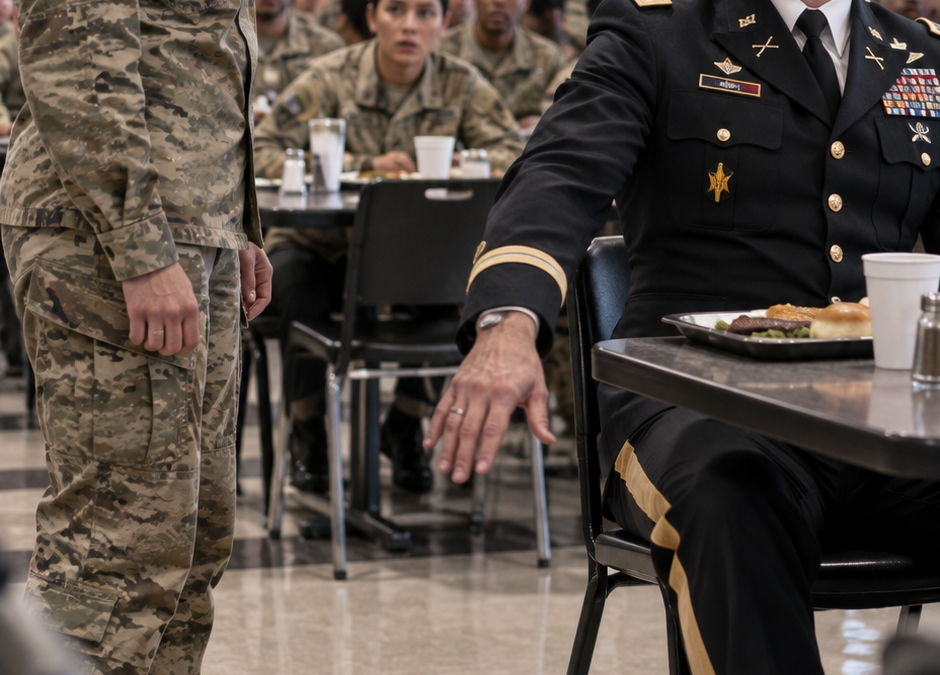
The tray hit the floor before I had even taken my first bite.
Nobody laughed.
Nobody moved.
And as mashed potatoes spread across the polished tile at my feet, I realized I had found exactly the kind of leadership problem Fort Halstead had spent months insisting did not exist.
“Your tray belongs on the floor, not at this table.”
Major Ryan Cole said it calmly.
That was the part I remembered most.
Not the impact.
Not the fork skittering beneath a chair.
Not the plastic cup spinning in a slow circle before finally stopping against the toe of his boot.
His calmness.
There was no sudden loss of temper in him.
No embarrassment.
No instant regret.
He had struck the edge of my tray with the back of his hand deliberately enough to send my lunch sliding across the table and crashing onto the cafeteria floor.
Then he leaned back in his chair as if he had corrected a seating chart.
Around us, the entire room had gone silent.
Fort Halstead’s main dining facility was usually loud at noon.
Metal chairs dragged over tile.
Young officers talked over one another.
Enlisted soldiers complained about equipment, schedules, weather, and whatever had gone wrong before breakfast.
The kitchen staff shouted numbers through the serving window.
Trays clattered.
Coffee machines hissed.
People laughed.
All of it stopped.
A hundred people had just watched a major knock a stranger’s lunch onto the floor.
And the first thing I noticed was not anger.
It was familiarity.
Some looked uncomfortable.
Some stared at their plates.
Some watched Ryan carefully, waiting to see whether they were expected to smile.
That told me more than the tray ever could.
I remained standing beside the chair.
My right hand was still lifted slightly, frozen where the tray had been moments before.
Ryan looked at me.
His uniform was immaculate.
Every button in place.
Boots polished.
Hair regulation-perfect.
He had the kind of appearance that photographed well beside senior commanders.
There was nothing wild about him.
Nothing obviously cruel.
That mattered too.
People imagine bad leaders as loud, unstable, impossible to miss.
The dangerous ones are often far more disciplined.
They learn exactly how much harm can be delivered without leaving evidence.
“That seating area is reserved for command officers,” Ryan said.
I looked down at my lunch.
Most of it was on the floor.
“You could have told me.”
My voice remained quiet.
I saw immediately that the quietness bothered him.
Anger would have made more sense to him.
An argument would have put us into a familiar structure.
He had rank.
I appeared not to.
He could have won that exchange.
Instead, I simply looked at him.
Ryan gave a short laugh.
“Some people don’t understand polite instructions.”
Two captains sitting beside him smiled.
Not naturally.
One showed his teeth for half a second and then immediately looked down.
The other stirred his potatoes with a fork despite clearly having lost his appetite.
Fear is rarely dramatic when it settles into an organization.
It becomes etiquette.
I bent down to retrieve my fork.
Ryan moved his boot beside it.
“Leave it.”
I looked up.
He pointed toward several smaller tables beside the kitchen doors.
“Sit over there.”
I straightened slowly.
Every face in the room seemed to be waiting for mine to change.
Humiliation depends on witnesses.
Ryan understood that instinctively.
He wanted me angry.
Embarrassed.
Perhaps apologetic.
Instead, I picked up the plastic tray.
“Do you usually treat people you haven’t met this way?”
His arms folded across his chest.
“Only people who don’t understand where they belong.”
There it was.
Not a slip.
Not an unfortunate choice of words.
A belief.
I studied him for several seconds.
“Interesting.”
The single word tightened his expression.
“What’s interesting?”
I did not answer.
I turned and walked toward the tables beside the kitchen.
Whispers followed me.
Ryan did not call after me.
He believed the moment had ended exactly as he intended.
That belief was useful.
I sat near the swinging doors separating the cafeteria from the kitchen.
Steam escaped every time one opened.
The smell of detergent mixed with fried chicken and overcooked vegetables.
Behind me, workers moved through stainless-steel stations with the relentless efficiency of people who knew lunch did not care about anyone’s feelings.
The room gradually began breathing again.
Voices returned.
Quieter at first.
Then louder.
But people kept looking at me.
I placed the fork on the empty tray.
There was almost nothing left to eat.
A smear of potatoes.
A little gravy.
I folded my hands.
And waited.
I had learned years earlier that silence makes certain people nervous.
Especially when they believe they have just won.
A young specialist rose from a table near the far wall.
She picked up a fresh plate.
Chicken.
Potatoes.
Green beans.
She glanced once toward Ryan.
Then started walking toward me.
I noticed the decision before anyone else seemed to.
Ryan noticed too.
“Specialist.”
She stopped.
Her shoulders straightened instantly.
Ryan had not raised his voice.
He did not need to.
“You don’t need to replace her meal.”
The young woman swallowed.
“She didn’t get to eat, sir.”
“That is not your problem.”
Her eyes moved toward me.
I could see the conflict.
Kindness on one side.
Rank on the other.
Ryan watched her.
“Return to your seat.”
I raised one hand.
“It’s all right.”
She looked toward me.
I gave her a small smile.
“Thank you for trying.”
Her mouth tightened.
“I’m sorry, ma’am.”
“You have nothing to apologize for.”
That seemed to confuse her.
Then she returned to her table.
Ryan watched until she sat.
Only then did he turn back toward his lunch.
I looked down at the empty tray.
My stomach was not the problem.
The problem was the lesson everyone had just watched.
Help someone only if someone senior has not told you not to.
Compassion is negotiable.
Rank decides whether courtesy is deserved.
Three weeks earlier, I had read almost those exact lessons in a stack of anonymous climate reports.
Not in those words.
Soldiers rarely write like psychologists.
They write in fragments.
“I don’t ask questions anymore.”
“Leadership is different when visitors come.”
“Some people can say anything if their numbers are good.”
“If you complain, you become the problem.”
“No one will put it in writing.”
That last sentence had stayed with me.
No one will put it in writing.
I was Lieutenant General Claire Morgan.
At Army headquarters, I led a strategic command culture review program that was supposed to identify risks before they became scandals, resignations, investigations, or funerals.
Most of my installation visits were announced.
That had become a problem.
The moment a three-star general appeared on a schedule, entire buildings became honest-looking.
Floors were polished.
Boards were updated.
Commanders memorized talking points.
Officers who normally ignored junior soldiers suddenly remembered everyone’s names.
Coffee appeared in conference rooms nobody normally used.
Even arguments disappeared.
A scheduled inspection did not show me an organization.
It showed me its costume.
So when Fort Halstead appeared repeatedly in reports describing intimidation, public humiliation, retaliatory assignments, and a strange gap between excellent performance metrics and terrible climate surveys, I requested something different.
No ceremony.
No public schedule.
No staff escort for the first ninety minutes.
Only Brigadier General Thomas Whitaker, the installation commander, his command sergeant major, and two headquarters officials knew I was arriving that morning.
Even they were told not to approach me until later.
I wore my standard uniform, but without the visible outer identifiers people would normally use to place me instantly in a hierarchy.
My ID remained tucked beneath my jacket fold.
No entourage.
No aides.
No flags.
No one clearing rooms before I entered.
I did not disguise myself.
I simply removed the warning label.
Within twenty minutes, Major Ryan Cole had knocked my lunch onto the floor.
For an inspector, it was almost efficient.
Across the cafeteria, Lieutenant Emily Parker kept watching me.
She was young enough that concern still showed openly on her face before training told her to hide it.
Beside her sat Captain Marcus Reed.
Emily leaned closer to him.
I could not hear every word.
But I caught enough.
“Who is she?”
Marcus glanced toward me.
“No idea.”
“Contractor?”
“Maybe.”
“She doesn’t act like one.”
“What’s that supposed to mean?”
“She’s not angry.”
I almost smiled.
The observation was better than she knew.
Emily looked toward Ryan.
I followed her gaze.
He had already returned to conversation as though nothing had happened.
I knew his file.
Major Ryan Cole.
Executive officer for one of Fort Halstead’s largest logistics support groups.
Nine months on the installation.
Strong evaluations.
Above-average readiness results.
Highly praised for discipline.
Known for clean briefings and fast execution.
None of that contradicted what I had just witnessed.
That was the trap.
People assume cruelty must produce incompetence.
Sometimes it produces numbers.
Fear can make deadlines look impressive.
Silence can make meetings efficient.
People who are afraid of embarrassment often prepare obsessively.
A toxic leader can look exceptional for a long time if you measure only output.
I also knew Ryan’s name appeared in three anonymous complaints.
Nothing criminal.
Nothing that would trigger an automatic investigation.
Public humiliation.
Punitive scheduling.
Selective aggression.
One lieutenant wrote:
“He never does it when senior leadership is there.”
That sentence was why I had wanted time alone.
A few minutes later, Colonel Daniel Mercer entered.
Ryan changed in less than three seconds.
I watched it happen.
He rose halfway.
Smiled.
Shifted his tone.
“Sir.”
Mercer commanded Ryan’s group.
He had missed the tray incident.
He sat down.
Ryan immediately became thoughtful.
Measured.
Professional.
The transformation would have been impressive if it had not been so revealing.
“How’s the afternoon exercise looking?” Mercer asked.
“On schedule, sir.”
“Any issues?”
“Nothing significant.”
Mercer unwrapped his utensils.
“We need to talk about the latest climate survey.”
Ryan’s jaw tightened just slightly.
I leaned back in my chair.
That timing was almost too good.
“The numbers still concern me,” Mercer said.
Ryan took a drink of water.
“With respect, sir, I think the survey is being overread.”
“Twenty-eight percent of respondents say they’re uncomfortable raising concerns.”
“People often confuse accountability with discomfort.”
Mercer frowned.
“That isn’t the same thing.”
“No, sir. But standards create resistance.”
“And the comments about retaliation?”
Ryan shrugged lightly.
“Perception.”
“Fear is perception?”
“Sometimes.”
I watched him carefully.
Then he said the sentence that explained nearly everything.
“Sometimes people call discomfort fear.”
I lowered my eyes.
For years I had watched institutions excuse abusive behavior with softer words.
Pressure.
Directness.
Standards.
Intensity.
Hard leadership.
Discomfort.
Language matters because it determines what organizations are willing to tolerate.
Call humiliation humiliation and leaders must address it.
Call it discomfort and the victim suddenly sounds weak.
Mercer continued.
“The installation commander asked specifically about these results.”
“I’ve prepared corrective measures.”
“What measures?”
“Leadership refreshers. Communication development. Supervisor engagement.”
I nearly smiled.
Ryan saw me.
His eyes narrowed.
He stopped talking for half a second.
Mercer followed his gaze.
“Someone you know?”
“No, sir.”
Ryan’s voice became dismissive.
“Just someone who sat at the wrong table.”
Mercer glanced at me.
He did not see the food beneath Ryan’s table from his angle.
He looked back.
Ryan had already moved on.
That mattered.
He did not tell his commander what had happened.
Not because he knew it was criminal.
Because he knew it would look bad.
People reveal their own standards by what they hide.
A few minutes later, Emily stood.
Marcus caught her sleeve.
“What are you doing?”
“Coffee.”
“The coffee is the other direction.”
Emily looked at him.
“I know.”
She approached me.
“Ma’am.”
I looked up.
“Yes?”
Her voice dropped.
“I’m sorry about what happened.”
“You didn’t do it.”
“No.”
She looked over her shoulder.
Ryan was watching.
“But a lot of us saw it.”
“What should you have done?”
The question surprised her.
Her eyebrows lifted.
“I don’t know.”
I waited.
She thought again.
“We should have said something.”
“Why didn’t you?”
That one took longer.
Emily stared at the floor.
“Because sometimes saying something creates another problem.”
“For whom?”
She met my eyes.
“For whoever says it.”
There it was.
No survey language.
No consultant terminology.
Just truth.
I memorized it.
“What’s your name?”
“Lieutenant Emily Parker.”
“Assignment?”
“Logistics planning.”
“How long at Fort Halstead?”
“Fourteen months.”
I nodded.
“Thank you.”
She looked confused.
“For what?”
“For answering honestly.”
Ryan’s voice crossed the room.
“Parker.”
Emily stiffened.
“Yes, sir?”
“Did you need something over there?”
“No, sir.”
“Then finish your lunch.”
Color rose into her cheeks.
“Yes, sir.”
I raised one eyebrow.
Ryan saw it.
Emily returned to her seat.
That tiny exchange told me the climate survey was probably conservative.
People always underreport what they have normalized.
Ryan checked his phone several minutes later.
His body changed instantly.
“Sir.”
Mercer looked up.
“What?”
“The installation commander is coming through.”
Mercer straightened.
“When?”
“Now.”
“Why?”
“I wasn’t notified.”
Other officers started receiving messages.
The cafeteria transformed.
It was fascinating.
Chairs moved.
Jackets were adjusted.
Napkins disappeared.
Conversations became careful.
People who had been slouching sat upright.
The invisible current of hierarchy ran through the room.
I remained where Ryan had ordered me to sit.
Brigadier General Thomas Whitaker was respected across Fort Halstead.
His record suggested he deserved most of that respect.
But even strong commanders suffer from distance.
The higher you rise, the more people begin editing reality before it reaches you.
Whitaker knew that.
It was one reason he had agreed to my unannounced arrival.
Ryan stood beside Mercer.
“What’s he doing here?” Mercer asked.
“I don’t know, sir.”
“You said headquarters inspection activity wasn’t until Thursday.”
“It isn’t.”
“It’s Tuesday.”
“I’m aware.”
I looked toward the kitchen.
A worker came through with clean trays.
The stack shifted.
I reached out and steadied one before it fell.
“Thank you, ma’am.”
“You’re welcome.”
When I looked back, Ryan was watching me.
He seemed offended that I still existed.
Then he walked over.
“Ma’am.”
“Yes?”
“Since senior leadership is entering, you should clear this area.”
I looked around.
“I’m sitting at a table.”
“It’s adjacent to their route.”
“Then they can walk past.”
His nostrils flared.
“I’m trying to prevent another misunderstanding.”
I looked at him.
“Another?”
“You already created enough unnecessary attention.”
“I created it?”
“You sat where you were not supposed to sit.”
“You knocked my lunch onto the floor.”
“I moved the tray.”
“It landed on the floor.”
“You are being dramatic.”
I looked beneath the command table.
My potatoes were still there.
“No,” I said.
“I’m being precise.”
He lowered his voice.
“Whatever business brought you here can wait. Move to the side hallway until the general passes.”
“No.”
He blinked.
“Excuse me?”
“That won’t be necessary.”
“Was my instruction unclear?”
“No.”
“Then move.”
“I understood you perfectly.”
He stepped closer.
The same young specialist who had tried to bring me food watched from across the room.
Emily was watching too.
Marcus had stopped eating.
Ryan lowered his voice further.
“I don’t know who you think you are.”
I almost told him.
It was tempting.
Not because I wanted revenge.
Because I knew exactly what would happen.
His face would change.
His spine would straighten.
His voice would soften.
He would apologize.
He might even become charming.
And everything useful about the morning would disappear.
So I asked:
“Does everyone here move when you tell them?”
“When I have authority, yes.”
“And when you don’t?”
He smiled.
“People with judgment usually know the difference.”
“That’s useful.”
His forehead creased.
“What is?”
“Your answer.”
The main doors opened.
“Attention on deck!”
Ryan spun away from me.
The transformation happened again.
Instantly.
His entire body became professional.
Command voice.
Controlled expression.
Open posture.
The room stood.
Brigadier General Thomas Whitaker entered beside Command Sergeant Major Luis Alvarez.
Four colonels followed.
Two senior civilians came behind them.
More staff entered afterward.
Ryan positioned himself beside Mercer.
“Good afternoon, General.”
Whitaker glanced toward him.
“Major.”
Ryan smiled.
Whitaker kept walking.
The smile disappeared.
Whitaker passed the command table.
People turned.
He continued down the center aisle.
Toward the kitchen.
Toward me.
I stood.
Ryan watched him approaching.
I saw his brain searching through possibilities.
Civilian official?
Contractor?
Inspector?
He looked at my jacket again.
Nothing.
Whitaker stopped several feet away.
His posture reflected the kind of respect Ryan had spent the last twenty minutes assuming I did not deserve.
“General Morgan.”
The room died.
No whispers.
No clattering utensils.
Nothing.
For one second, even Ryan seemed to stop breathing.
I nodded.
“General Whitaker.”
His eyes shifted briefly to the empty tray.
“Your team is assembled at headquarters.”
“They’re early.”
“Twelve minutes.”
“That’s acceptable.”
Then Whitaker noticed the food beneath the distant table.
His expression changed.
“What happened?”
Ryan answered before I could.
“Sir, there was a misunderstanding.”
Every face turned toward him.
I looked at Ryan.
He looked nothing like the man who had knocked away my tray.
His voice was softer.
Measured.
Almost respectful.
“What misunderstanding?” Whitaker asked.
Ryan swallowed.
“She entered without visible identification and sat in the command seating area.”
I corrected him calmly.
“I sat in an open chair.”
“Yes, ma’am.”
Whitaker’s eyes narrowed.
“And the meal?”
Ryan hesitated.
I let the silence do the work.
“I moved the tray.”
“Where?”
Ryan looked at the floor.
“It fell.”
I spoke.
“He struck it aside.”
Ryan turned toward me.
“I didn’t intentionally throw the food.”
“That is true.”
Relief flickered across his face.
I continued.
“You intentionally struck the tray. The food falling was a predictable result.”
The relief disappeared.
Whitaker’s expression hardened.
Ryan straightened.
“Sir, I believed General Morgan was violating seating protocol.”
“What protocol?” I asked.
He looked at me.
“The command seating convention.”
“Written?”
“No, ma’am.”
“Was the table marked?”
“No, ma’am.”
“Did I refuse an instruction before you touched my tray?”
A pause.
“No, ma’am.”
“Then protocol was not the issue.”
Ryan stared ahead.
“The issue was what you assumed about me.”
Nobody moved.
“You looked at my clothing, saw no rank you recognized, and decided courtesy was optional.”
The sentence landed quietly.
Ryan said nothing.
Whitaker looked across the cafeteria.
“Everyone sit.”
People lowered themselves into chairs.
Nobody resumed eating.
Whitaker turned toward me.
“Would you prefer we discuss this privately?”
“No.”
Ryan looked at me.
I continued.
“Not yet.”
Whitaker understood immediately.
I picked up the fork from my tray.
“Major Cole told me some people only understand when they’re reminded where they belong.”
Ryan’s jaw tightened.
“He may be correct.”
Whitaker waited.
I turned toward Emily.
“Lieutenant Parker.”
She looked as if someone had fired a warning shot.
“Yes, ma’am.”
“Earlier, why did you say nobody challenged Major Cole?”
Emily swallowed.
Ryan stared at her.
I softened my tone.
“Take your time.”
She looked at me.
“Because speaking up can create problems.”
“For whom?”
“The person who speaks.”
Whitaker turned toward Ryan.
I turned toward the young specialist.
“You.”
She stood quickly.
“Specialist Jenna Brooks, ma’am.”
“You attempted to bring me another meal.”
“Yes, ma’am.”
“What happened?”
She glanced at Ryan.
I held her gaze.
“You are not being evaluated.”
She inhaled.
“Major Cole told me to sit down.”
“Did helping me violate a policy?”
“No, ma’am.”
“Why obey?”
“Because he’s a major.”
Ryan closed his eyes briefly.
I nodded.
“That answer is why we are not discussing only a lunch tray.”
Ryan finally spoke.
“With respect, General, I think the incident is being expanded beyond what occurred.”
I turned to him.
“How should it be understood?”
“As poor judgment.”
“Whose?”
“Mine.”
“Only yours?”
His expression changed.
I looked around the cafeteria.
“Dozens of people watched.”
Several looked away.
“One lieutenant apologized to me for something she did not do.”
Emily looked down.
“One specialist believed kindness required permission from a superior.”
Jenna swallowed.
“Several people smiled when Major Cole humiliated me because they did not know whether refusing to smile would be noticed.”
That created visible discomfort.
Good.
I continued.
“That is not one poor decision.”
I looked directly at Ryan.
“That is culture.”
Colonel Mercer’s face changed.
He understood immediately that the scope had widened.
I turned to him.
“Colonel Mercer.”
“Yes, ma’am.”
“Did you witness what happened?”
“No.”
“Did Major Cole tell you?”
Mercer glanced toward Ryan.
“No.”
“Minutes afterward, what did he tell you about unit discipline?”
Mercer hesitated.
“That it had improved.”
“And the climate survey?”
“He believed complaints reflected resistance to standards.”
“Did you accept that?”
“Not completely.”
“But enough to move on.”
Mercer looked down.
“Yes.”
I nodded.
There was no satisfaction in it.
That was important.
I had no interest in turning Ryan into a theatrical villain while everybody else claimed innocence.
Bad systems grow because responsibility is distributed.
One person harms.
Another rationalizes.
Another stays silent.
Another changes the subject.
Another says there is not enough evidence.
Another says the numbers are good.
And one day everyone looks shocked that the culture became dangerous.
Whitaker glanced at the clock.
“My office?”
“My inspection team can wait fifteen minutes.”
He nodded.
“Of course.”
I looked around the cafeteria.
“Finish lunch.”
Nobody moved.
“That is not a test.”
A few nervous laughs escaped.
The sound mattered.
Not because it was funny.
Because it was the first noise in ten minutes not controlled by Ryan.
Whitaker gestured toward the serving line.
“We can have another meal brought.”
I looked at Jenna.
“Specialist Brooks.”
“Yes, ma’am.”
“Was the chicken worth replacing?”
She froze.
Then gave the smallest smile.
“Honestly, ma’am? No.”
A few people laughed.
This time more naturally.
“What is safer?”
“The grilled cheese.”
I looked at Whitaker.
“Grilled cheese.”
Ryan remained standing.
Whitaker turned toward him.
“Major Cole, report to my office after—”
“No.”
I interrupted gently.
Whitaker looked at me.
“Have him report to the inspection conference first.”
Ryan’s face tightened.
Whitaker nodded.
“Understood.”
I lifted my empty tray.
Then stopped.
“Major?”
Ryan turned.
“Yes, General?”
I pointed toward the food beneath the table.
“Please clean that up.”
He stared at the mess.
I added:
“I would ask the same of anyone responsible for it.”
For one second I wondered whether pride would overpower judgment.
Then he nodded.
“Yes, ma’am.”
He walked toward the spill.
He crouched.
Picked up the cup.
Then the food.
Nobody laughed.
I was glad.
Humiliation had already caused enough damage that day.
I did not need to reverse the roles.
Accountability was not vengeance.
The difference mattered more than most leaders understood.
Twenty minutes later, I entered Fort Halstead headquarters.
My inspection team was waiting.
No ceremonial introductions.
No slide presentation.
I had prohibited both.
Brigadier General Whitaker sat opposite me.
Colonel Mercer beside him.
Ryan near the end of the table.
My deputy inspector, Colonel James Holt, placed the preliminary climate packet in front of me.
I did not open it immediately.
Whitaker spoke first.
“General Morgan, I owe you an apology.”
“No.”
He paused.
“I command this installation.”
“That creates responsibility. It does not make you personally responsible for every choice made before you know about it.”
“I should have known.”
“That is a different conversation.”
He nodded.
I opened the folder.
“Fort Halstead’s readiness numbers are strong.”
Mercer looked surprised.
Ryan did too.
“The logistics group is meeting demanding timelines. Training results are above average. Operational output is real.”
Ryan’s shoulders relaxed a fraction.
Then I continued.
“My question is what that output costs.”
The room shifted.
I pulled out a sheet.
“Sixteen climate comments describe public humiliation by supervisors.”
Another page.
“Nine describe fear of retaliation.”
Another.
“Seven state that leaders change behavior when senior visitors arrive.”
I looked at Ryan.
“Three refer to you by name or position.”
He inhaled.
“Ma’am, may I respond?”
“Yes.”
“I have always maintained high standards.”
“I believe you.”
That surprised him.
“I also understand some personnel dislike my communication style.”
“Communication style?”
“Yes, ma’am.”
I leaned forward.
“What communication style knocked my tray onto the floor?”
Ryan stopped.
“This is not rhetorical.”
I held his gaze.
“Categorize it.”
He looked toward Mercer.
No help came.
“It was disrespectful.”
“To whom?”
“To you.”
I shook my head.
“No.”
Ryan looked confused.
“You are still framing the harm around my rank.”
Silence.
“It was disrespectful before you knew I was a general.”
His face changed.
“That is why the incident matters.”
Ryan looked down.
“If your regret depends on who I turned out to be, you have learned nothing.”
He swallowed.
“If you regret the act because no human being in that cafeteria should have been treated that way, then we have somewhere to begin.”
Several seconds passed.
Finally:
“It was wrong.”
I waited.
He looked uncomfortable with the silence.
Good.
Then he continued.
“I assumed you had no authority.”
“Yes.”
“I treated that as permission.”
“Closer.”
His face tightened.
“I wanted everyone to see me correct you.”
No one moved.
That admission mattered.
“What did you think it would accomplish?”
“Order.”
“Did it?”
“No.”
“What did it accomplish?”
Ryan stared at the notebook.
“Fear.”
I said nothing.
It needed to remain his word.
Whitaker leaned forward.
“How long?”
Ryan looked at him.
“How long what, sir?”
“How long have you led like this?”
Ryan looked toward the window.
“I don’t know.”
Mercer spoke.
“You know.”
Ryan closed his eyes.
“Years.”
The room went very quiet.
I turned to Mercer.
“Did you know?”
“Not at this level.”
“What level did you know?”
Mercer rubbed his forehead.
“I knew he was aggressive.”
“What did you do?”
“Coached him.”
“Documented?”
“No.”
“Consequences?”
“No formal action.”
“Why?”
Mercer hesitated.
That hesitation mattered more than the answer.
“Because his performance was excellent.”
I wrote five words on a blank sheet.
RESULTS EXCUSED BEHAVIOR.
I turned it toward the table.
“That is the larger finding.”
Mercer looked at it.
Ryan did too.
“One bad leader can injure a unit.”
I tapped the paper.
“A system that rewards his output while ignoring his methods teaches every ambitious subordinate that the behavior works.”
Mercer nodded slowly.
I turned back to Ryan.
“Were you ever praised for being hard on people?”
“Yes.”
“By whom?”
“Several commanders.”
“Were those commanders present during the conduct described in the survey?”
“Usually not.”
“What did they observe?”
“Formal events.”
“When you behaved differently.”
Ryan looked down again.
He understood.
The inspection continued for the rest of the afternoon.
No one enjoyed it.
That was normal.
We interviewed soldiers privately.
Then supervisors.
Then civilian employees.
The pattern grew clearer.
Ryan was not an anomaly.
He was an extreme expression of a wider permission structure.
Supervisors avoided conflict with high performers.
Junior leaders interpreted aggression as confidence.
Senior leaders saw good metrics and assumed methods were sound.
Complaints were examined individually, never as a pattern.
And because none of the incidents seemed catastrophic alone, all of them survived.
A reassigned weekend.
A mocking remark.
A public correction.
A meeting invitation withdrawn.
A soldier asked to rewrite a report six times over formatting.
A lieutenant ridiculed for challenging a plan.
One by one, they looked minor.
Together, they formed a language everyone understood.
Do not irritate powerful people.
Lieutenant Emily Parker entered the conference room late that afternoon.
Her hands were clasped so tightly the knuckles were white.
Ryan sat across from her.
I stayed off to the side.
“Lieutenant,” I said, “speak freely.”
She nodded.
Then looked at Ryan.
“Sir, three months ago I questioned the vehicle allocation schedule.”
Ryan remembered.
I saw it instantly.
Emily continued.
“You asked in front of the staff whether I needed remedial mentoring to understand basic planning.”
Ryan stared at the table.
“People laughed.”
Her voice shook.
“The numbers were wrong.”
I asked:
“Were they?”
“Yes, ma’am.”
“What happened?”
“We missed the movement window two days later.”
Ryan closed his eyes.
Emily continued.
“I should have pushed harder.”
“No.”
She looked at me.
“You should have been allowed to question an operational plan without having your competence attacked.”
Her eyes became wet.
“That is not the same thing.”
Ryan finally spoke.
“Lieutenant Parker.”
She looked at him.
“I remember.”
She waited.
“You were right.”
Emily did not smile.
“That wasn’t the worst part.”
Ryan frowned.
“What was?”
“I stopped asking questions afterward.”
The sentence hit the room harder than anything I had said all day.
Emily continued.
“So did other people.”
Ryan looked at me.
I said nothing.
“So even when you weren’t in the room,” she said, “we acted like you were.”
Ryan leaned back slowly.
There are moments when leaders finally understand that harm does not end when they leave.
Fear remains.
It edits conversations.
It kills dissent before it becomes audible.
It turns competent people into quiet employees.
Specialist Jenna Brooks came next.
She held a water bottle with both hands.
I asked why she had tried to bring me food.
Her answer was simple.
“You looked embarrassed.”
Ryan flinched.
“And why did you stop?”
“He told me to.”
“Were you afraid of disciplinary action?”
She hesitated.
“Yes.”
Ryan looked shocked.
“Have I ever formally punished you for something like that?”
“No, sir.”
“Then why assume I would?”
She looked directly at him.
“Because I’ve watched what happens when people annoy you.”
Ryan had no answer.
Jenna gave examples.
Weekend inventory reassignment.
Exclusion from a planning meeting.
A specialist publicly mocked over formatting.
Ryan tried explaining each.
Every explanation sounded plausible.
That was exactly the problem.
I stopped him.
“Major.”
He looked at me.
“You can justify every single action individually.”
“Yes, ma’am.”
“Your people are responding to the pattern.”
His jaw tightened.
“What would you have me say?”
“Nothing.”
He looked surprised.
“Listen.”
So he did.
Not comfortably.
Not gracefully.
Several times he tried to interrupt.
Once he became visibly angry.
Whitaker started to intervene.
I raised a hand.
Ryan eventually settled.
By the end of two hours, he looked exhausted.
That was fine.
Listening becomes exhausting when someone has spent years controlling the conversation.
When we finished, Ryan stayed seated.
“General.”
“Yes?”
“Am I being relieved?”
I did not answer immediately.
“That decision will not be made as theater.”
He nodded.
“Until the review is complete, you will be removed from direct supervisory authority.”
His face tightened.
“That is not punishment.”
I continued.
“It protects the process and the people participating in it.”
“Yes, ma’am.”
Mercer said:
“I’ll prepare the administrative action.”
Ryan stood.
Then looked at me.
“I’m sorry about your lunch.”
I held his gaze.
“That is not the apology that matters.”
He understood.
The following morning, rumors had spread across Fort Halstead.
Some said I had arrived undercover.
Others claimed Ryan had been arrested.
Neither was true.
During the morning briefing, I corrected the first rumor.
“I was not disguised.”
The room quieted.
“My identity simply was not announced.”
I paused.
“That distinction is important.”
Officers listened carefully.
“Major Cole treated me differently because he believed I was unimportant.”
I looked around the room.
“The inspection did not create that behavior.”
Another pause.
“It removed the incentive to hide it.”
Nobody wrote for several seconds.
Then pens started moving.
Over the next two days, my team expanded the review.
Maintenance crews.
Medical staff.
Supply personnel.
Young lieutenants.
Senior NCOs.
Civilian workers.
The pattern was broader than Ryan.
Many people respected Whitaker.
Most believed Mercer was competent.
Yet bad information weakened as it traveled upward.
Harassment became friction.
Fear became morale.
Morale became communication.
Communication became training.
Then somebody built a PowerPoint deck.
During one senior meeting, I finally said:
“You cannot PowerPoint your way out of fear.”
No one laughed.
I had not intended a joke.
By Thursday, the preliminary recommendations were ready.
The conference room was full.
Ryan attended.
He wore the same uniform.
But not the same posture.
The confidence that had once looked like certainty now looked more cautious.
Whether that meant growth or merely damage control, I did not know.
Whitaker opened the meeting.
“General Morgan.”
I began with strengths.
Readiness was real.
Training performance was high.
Some programs were exemplary.
Then the failures.
Supervisory complaint systems lacked follow-through.
High performers received too much behavioral latitude.
Junior personnel believed reporting would damage careers.
Public humiliation had become normalized in several work centers.
And Ryan’s conduct represented the clearest documented example.
I turned toward him.
“Major Cole will not immediately return to his executive position.”
He nodded.
“He will be reassigned while a formal command climate investigation continues.”
Another nod.
“His upcoming promotion recommendation will be reviewed.”
That hurt.
His expression showed it.
“Leadership development will be mandatory.”
“Yes, ma’am.”
“You will also participate in structured feedback sessions.”
He looked up.
“With junior personnel?”
“Especially junior personnel.”
He swallowed.
“Yes, ma’am.”
Mercer would receive documented responsibility for supervisory failures.
Whitaker approved new reporting procedures.
Repeated complaints involving the same supervisor could no longer be treated as unrelated single incidents.
Senior leaders would review patterns.
Not only events.
Nobody left completely untouched.
That was deliberate.
I did not believe one person had created Fort Halstead’s problem.
Ryan harmed people.
Mercer excused warning signs.
Systems rewarded output.
Other people stayed quiet because silence was safer.
Fear explained those choices.
It did not eliminate their consequences.
Near the end, I placed a photograph on the table.
One of the cafeteria workers had sent it to the inspection team.
My overturned lunch.
The cup on its side.
Food across the floor.
Ryan stared at it.
“This photo will not appear in the final report,” I said.
He looked surprised.
“Why not?”
“Because the tray is not the important evidence.”
I looked toward Whitaker.
“What happened afterward is.”
I began counting.
“Lieutenant Parker apologized for someone else’s conduct.”
Emily lowered her eyes.
“Specialist Brooks believed helping a stranger required command permission.”
Jenna sat straighter.
“Several officers laughed because they did not know whether refusing to laugh would be noticed.”
Mercer looked uncomfortable.
“A group commander accepted an explanation because the performance metrics were excellent.”
Then Ryan.
“And one major transformed his entire personality the instant senior leadership entered the room.”
Nobody spoke.
I tapped the photograph.
“The tray was plastic.”
I looked around the table.
“The damage was trust.”
The meeting ended.
People began gathering folders.
Ryan remained seated.
“General?”
I stopped.
“One question.”
“Yes.”
“If you had been a civilian contractor…”
He paused.
“Would all this have happened?”
I understood what he was really asking.
Would anyone have cared if he had humiliated someone without stars on her shoulders?
“The review probably would not have accelerated this quickly.”
His jaw tightened.
“That’s worse.”
“Yes.”
He looked toward the photograph.
For the first time all week, his answer required no correction.
Three days later, I returned to the cafeteria alone.
No staff.
No announcement.
This time, people knew me.
As soon as I entered, chairs began moving.
I raised a hand.
“Please don’t.”
A few soldiers froze halfway up.
“Eat.”
They sat.
Jenna was behind the serving line.
“General.”
“Specialist.”
She held up the chicken.
I stared at it.
“Still dangerous?”
Her smile widened.
“Possibly more dangerous.”
“Grilled cheese.”
“Yes, ma’am.”
I carried my tray through the room.
The command table had open seats.
Nobody guarded them.
Nobody needed to.
I kept walking.
Emily Parker was seated near the kitchen doors.
Exactly where Ryan had sent me the first day.
I stopped.
“Is this seat taken?”
She nearly choked on her drink.
“No, ma’am.”
I sat.
She looked toward the command table.
“You know you can sit over there.”
“I know.”
We ate quietly.
The cafeteria sounded different.
Perhaps only because I knew more now.
Perhaps not.
Nearby, three lieutenants were arguing about a training timeline.
One contradicted a captain.
The captain disagreed.
Nobody humiliated anyone.
Emily noticed me listening.
“It’s changing.”
“Maybe.”
“You don’t sound optimistic.”
“I’m cautious.”
She smiled.
“That sounds like a general answer.”
“It is.”
“What happens to Major Cole?”
“He has work to do.”
“Will he stay in?”
“That depends on the investigation and on him.”
Emily pushed her cup aside.
“Do you think people change?”
I looked toward the main entrance.
“I think consequences can create the conditions for change.”
“That wasn’t what I asked.”
I smiled.
“No.”
She waited.
Eventually I said:
“Yes. Sometimes.”
The doors opened.
Ryan entered.
Conversation dipped.
He noticed.
Months earlier, he might have pretended not to.
Now he simply accepted it.
He collected his lunch.
His old executive staff identifier was gone.
He looked toward the command table.
Then toward us.
He hesitated.
Emily stiffened.
I kept eating.
Ryan walked over.
“General Morgan.”
“Major.”
“Lieutenant Parker.”
“Sir.”
He held his tray.
“May I sit?”
Emily looked at me.
I shook my head slightly.
Not my decision.
I said:
“It’s Lieutenant Parker’s table.”
Ryan looked directly at her.
The change in his face was small but important.
“May I?”
Emily studied him.
“Yes, sir.”
He sat.
Silence followed.
Real silence.
Not fearful silence.
Just uncomfortable human silence.
I let it remain.
Ryan eventually spoke.
“Lieutenant.”
Emily looked at him.
“I owe you an apology.”
She said nothing.
“I made disagreement dangerous.”
Her expression stayed guarded.
Ryan continued.
“I thought embarrassment would make people sharper.”
He looked down.
“It made them quieter.”
Emily folded her hands.
“You were right about that.”
He nodded.
“And you were right about the vehicle allocation.”
“I know.”
The answer surprised him.
Then he almost smiled.
“You should.”
He inhaled.
“I’m sorry.”
Emily waited.
Then nodded.
“Thank you.”
No forgiveness.
No emotional reunion.
That was appropriate.
Apologies do not purchase trust.
They only make rebuilding possible.
Ryan looked at me.
“I apologized to Specialist Brooks yesterday.”
“How did it go?”
“She told me I sounded like I was reading from a policy memorandum.”
Emily covered a smile.
I failed to hide mine.
“What did you do?”
“Tried again.”
“And?”
“She rated the second attempt as marginally human.”
Emily laughed.
Ryan laughed too.
It was awkward.
But nobody seemed afraid of the sound.
A kitchen worker passed carrying several trays.
The top one shifted.
Ryan reached out and caught it.
The worker blinked.
“Thanks, sir.”
“No problem.”
I watched.
Ryan noticed.
“I know what you’re thinking.”
“What?”
“You’re evaluating that.”
“No.”
He looked surprised.
“I was watching someone catch a tray.”
He stared at me.
Then lowered his eyes.
“That seems deserved.”
I let it go.
The Army likes clean endings.
Mission accomplished.
Objective achieved.
Problem corrected.
Human beings are rarely that cooperative.
Fort Halstead did not become healthy in a week.
Some soldiers still did not trust the reporting process.
Some leaders resented the review.
A few called the changes an overreaction.
Several believed Ryan had been unfairly singled out because of who I was.
Others thought he should have been removed permanently.
The truth was less convenient.
Culture changes slowly because culture is memory.
People remember who was punished.
Who was protected.
Who spoke.
Who suffered afterward.
They remember whether leaders asked questions.
They remember whether those questions were safe.
Emily started challenging planning assumptions again.
Jenna applied for a leadership course.
Mercer began holding monthly forums without staff officers filtering the questions first.
Whitaker required commanders to personally review repeated climate concerns.
And Ryan remained under formal evaluation.
His promotion was no longer automatic.
His position was no longer guaranteed.
He had lost influence.
What he did with that loss would tell us whether the lesson had reached him.
When I finished lunch, I carried my tray toward the return station.
Ryan stood.
“General.”
I turned.
“Yes?”
“I’ve been thinking about something.”
“That sounds dangerous.”
Emily smiled.
Ryan almost did.
“The first day.”
I waited.
“When I told you people needed to know where they belonged.”
“Yes.”
He looked across the cafeteria.
“I think I was talking about myself.”
I said nothing.
“I needed people to know I outranked them.”
His face tightened.
“I needed them to see that.”
I nodded slowly.
“That is more accurate.”
“I don’t like admitting it.”
“Growth rarely improves your comfort.”
He exhaled.
“I’ve noticed.”
I turned toward the exit.
“General Morgan?”
“Yes?”
“If you came here again and nobody knew who you were, would you do it the same way?”
I considered the question.
“I hope I would not need to.”
Ryan looked down.
“So do I.”
I started toward the door.
“General!”
Jenna called from the serving counter.
I turned.
She held up a wrapped sandwich.
“For the road.”
“I already ate.”
“Backup grilled cheese.”
Several soldiers laughed.
I walked back and accepted it.
“Thank you, Specialist.”
She looked toward Ryan.
“Nobody’s knocking that one down.”
Ryan raised both hands.
“I’m nowhere near it.”
The cafeteria laughed.
Not the nervous laughter I had heard the first day.
Not the laughter of people checking whether a major expected them to participate.
Ordinary laughter.
Loose.
Unmanaged.
That difference mattered more than any policy recommendation in my report.
I walked outside.
General Whitaker was waiting beside the headquarters vehicle.
“How was lunch?”
I held up the wrapped sandwich.
“Better.”
“That’s a low standard.”
“Low standards are useful occasionally.”
He opened the rear door.
I stopped.
Through the cafeteria windows, I could still see Ryan and Emily.
Emily was talking.
Ryan was listening.
Whitaker followed my gaze.
“Do you think he’ll recover?”
I knew what he meant.
Professionally.
Personally.
As a leader.
There was no honest yes or no.
“I don’t know.”
Whitaker nodded.
“But he knows what the problem was now.”
“The tray?”
“No.”
I looked through the glass.
“The person he thought he was allowed to treat that way.”
Whitaker said nothing.
I entered the vehicle.
As we pulled away, Fort Halstead disappeared slowly behind tall Carolina pines.
My report would take weeks.
There would be arguments over wording.
Legal reviews.
Personnel decisions.
Discussions about proportionality.
Some people would insist Ryan’s performance deserved greater weight.
Others would insist his behavior disqualified him completely.
Senior leadership would ask whether Mercer had failed badly enough to affect promotion.
Someone would suggest another mandatory training package.
Someone always did.
Those things were inevitable.
But I kept thinking about the cafeteria.
Not the first day.
The last one.
Emily spoke.
Ryan listened.
Nobody laughed because they were afraid not to.
That was not redemption.
It was not proof.
It did not erase anything.
But it was movement.
And sometimes movement is the only honest beginning.
My phone buzzed.
Another installation.
Another inspection.
Another headquarters staff already preparing a welcome schedule.
I read the message.
Then looked toward Whitaker.
“General.”
“Yes?”
“Next time headquarters announces an inspection…”
He waited.
“Cancel the welcome banner.”
He laughed.
“What should we put up instead?”
“Nothing.”
“Nothing?”
I looked through the rear window toward the fading installation.
“Just let us walk in.”
Whitaker nodded.
I settled back into the seat.
Because the truth about leadership was never clearest when everyone knew a general was watching.
It appeared in the smaller moments.
An open chair.
A junior officer asking a question.
A frightened specialist carrying an extra plate.
A stranger without visible authority.
A tray balanced on the edge of a table.
That was where character lived.
Before the salutes.
Before the briefings.
Before anyone important entered the room.
The afternoon I arrived at Fort Halstead, Ryan Cole looked at me and decided I did not matter.
He thought the biggest mistake he made was failing to recognize three stars.
It wasn’t.
His mistake happened earlier.
The moment he believed respect was something another person had to outrank him to deserve.








