𝗣𝗔𝗥𝗧 𝟮 The SEAL Asked for Seven Seats, but the Eighth Place at the Table Held a Secret None of Them Were Ready to Face
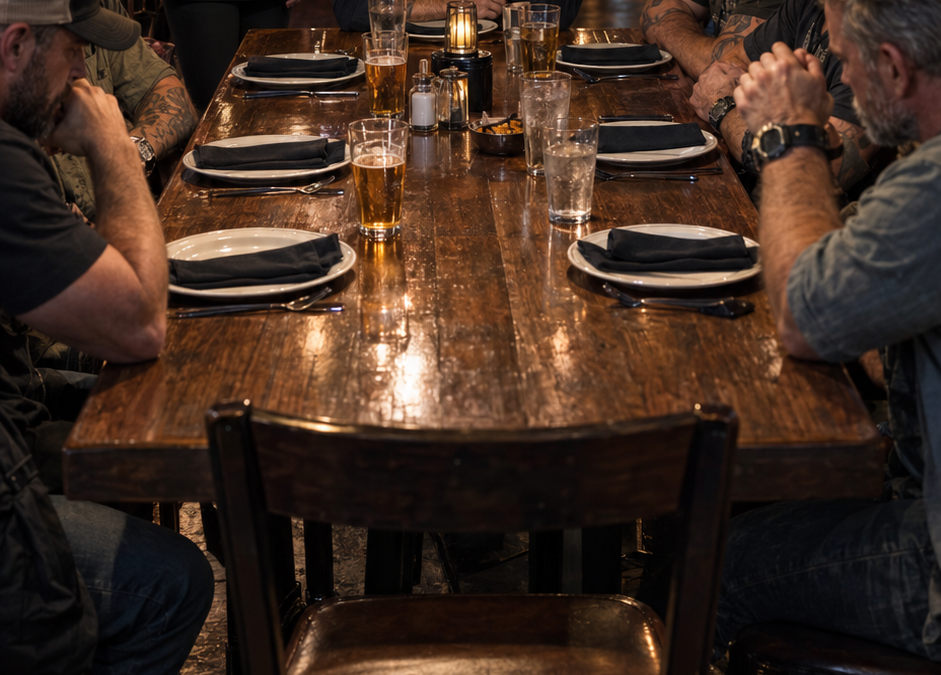
𝗣𝗔𝗥𝗧 𝟮
There were thousands of men lost in places like the one I had served.
Thousands of teams with empty chairs.
Thousands of Tuesdays.
I told myself that while I carried the tray back.
Seven glasses went in front of seven men.
The eighth I placed before the empty chair.
No one spoke.
The leader gave me one quiet nod.
“Thank you.”
I turned away.
Behind me, the youngest man said, “He would’ve hated this place.”
A man across from him almost laughed.
“No. He would’ve complained about the music, then eaten half the menu.”
Someone muttered something I couldn’t hear.
Then another voice said clearly:
“That was before Eastern Ridge.”
My hand tightened around the tray.
For one terrible second, Miller’s disappeared.
I smelled dust.
Hot metal.
Blood.
I heard rotor noise somewhere far away.
I felt a hand squeezing mine.
Eastern Ridge.
Three years.
Tuesday.
Eight glasses.
I knew.
I knew exactly who the empty chair belonged to.
Daniel Alvarez.
Dany.
The man whose last forty minutes had followed me across an ocean, through three surgeries, eighteen months of rehabilitation, a medical board, two apartments, and three states.
The man I had never been able to forget.
They did not recognize me.
Why would they?
I had never belonged to their unit.
I had been attached to a medical element operating farther south.
Our convoy had been redirected when the casualty call came in.
Their team had already been scattered by the time Dany reached the damaged position where I was treating wounded men.
By the time his teammates made contact with the evacuation route, he had already been moved.
They had never seen me.
To them, I was probably no more than initials on a bloodstained transfer tag.
O.H.
That was all.
I could have left it there.
I could have brought their food.
Refilled water.
Cleared plates.
Gone home after closing.
Placed my usual second glass across from my usual empty chair.
Nobody would ever have known.
That had been the point of my new life.
Not to be known.
Instead, I walked to the service station.
I took a clean dinner plate.
A folded napkin.
A fork.
A knife.
A spoon.
Then I returned to the booth.
The conversation stopped.
I placed the plate in front of the empty chair.
Then the silverware.
The napkin.
I straightened the bourbon glass above the knife.
The same way I had set the place at my own kitchen table each anniversary.
When I finished, there were eight complete settings.
Not seven men with an extra drink.
Eight places.
The youngest man’s expression changed first.
His jaw tightened.
Two others exchanged uneasy looks.
I immediately realized how it must appear.
An intrusion.
A waitress they had never met inserting herself into something private.
Something sacred.
The leader stared at the eighth place.
Then he pushed his chair back.
The legs scraped sharply across the floor.
Several people turned.
He stood.
His grief had suddenly hardened into something close to anger.
“Why?”
His voice was low.
I looked at him.
“Why did you set eight?”
I felt every eye at the table move toward me.
“We asked for seven seats and eight glasses,” he said. “Not eight dinner settings.”
“I know.”
The youngest man shoved his chair backward.
“What do you think this is?”
“Luke.”
The leader said his name as a warning.
Luke ignored him.
“You see veterans come in and you think you understand?”
His voice rose.
“People do that all the time. Buy a drink. Shake a hand. Say thank you for your service so they can feel good about themselves.”
He pointed toward the empty chair.
“That isn’t decoration.”
The words hit harder than he knew.
My left shoulder drew inward instinctively.
Scar tissue tightened beneath my sleeve.
I had heard grief come out sounding like anger before.
I knew what it was.
That did not make it painless.
The leader raised one hand.
Luke stopped.
I reached for the plate.
“I’m sorry.”
That would have been the simplest way out.
I could say I misunderstood.
Clear the setting.
Walk away.
Return to Olivia Hart, waitress.
Nobody had to know about the woman who once wore Navy medical insignia.
Nobody had to know what I had washed from my hands.
Nobody had to know why I could still feel Dany’s fingers losing strength inside mine.
I lifted the plate.
Half an inch.
Then I saw the bourbon glass.
For one second it became a metal cup sitting beside a field medical kit beneath a white, unforgiving sky.
I heard Dany’s voice.
Save my seat.
My hand stopped.
The leader’s fingers gripped the edge of the table.
His anger was not there because the empty place meant nothing.
It was there because it meant everything.
If I took the plate away, I would be removing Dany from that table a second time.
I lowered it again.
Luke stared at me.
“What are you doing?”
I looked at the empty chair.
Then I said the words that had lived inside me for three years.
“Because Dany doesn’t like sitting alone.”
Everything stopped.
Not literally.
The jukebox kept playing.
Somewhere in the kitchen, metal clattered against metal.
A refrigerator compressor hummed.
But at that booth, seven men stopped breathing.
The leader’s face went white.
Luke’s anger disappeared.
A bottle cap slipped from another man’s fingers, rolled in a circle across the tabletop, and dropped onto the floor.
No one bent down to pick it up.
The leader slowly lowered himself into his chair.
“What did you say?”
I could not repeat it.
Luke stood again.
This time there was no anger on his face.
Only shock.
“Who told you his name?”
“No one tonight.”
“Did you look us up?”
“No.”
“You heard one of us say it.”
The leader turned toward him.
“No one said Dany.”
Luke’s mouth closed.
That was true.
Since they entered, they had said he.
Brother.
The idiot.
Not Dany.
Not Daniel.
The leader turned back to me.
“My name is Ray Coleman.”
So that was who he was.
Chief Coleman.
Dany had spoken his name near the end.
Ray’s voice became careful.
“Daniel Alvarez is the man this table is for.”
I swallowed.
“He died three years ago.”
“I know.”
Ray stared at me.
“How?”
There were moments when a life changes loudly.
A gunshot.
A diagnosis.
A crash.
An explosion.
And there are moments when nothing happens except that you decide to stop hiding.
I looked around Miller’s.
Frank still had his coffee raised halfway to his mouth.
Megan stood near the hostess station.
My manager, Tom, had stepped out of the kitchen and was watching from a distance, clearly unsure whether he should intervene.
For two years, these people had accepted the version of me I offered them.
One honest sentence would change that.
Ray said quietly, “Please.”
The anger was gone.
What remained in his voice frightened me more.
Hope.
I took a breath.
“I knew him.”
Luke shook his head immediately.
“From where?”
I looked at Ray.
“Eastern Ridge.”
His expression changed.
“You were there?”
“Yes.”
Luke looked me over from head to toe.
Blue waitress shirt.
Apron.
Black pants.
“No civilians were working that position.”
“I wasn’t a civilian.”
Nobody moved.
“I was a Navy combat medic.”
The words felt strange coming out loud.
“I was cross-attached to a medical element with the joint unit operating south of your team. When the first casualty call came through, our convoy was redirected.”
Ray leaned forward.
I continued.
“Communications were breaking down. People were being moved in pieces. Dany was separated during the withdrawal and brought into the position where I was already treating two wounded men.”
Ray’s eyes dropped to my left arm.
I had unconsciously pulled it closer to my body.
“You were the medic?”
“One of them.”
“The transfer record…”
His voice faded.
Then he looked back up.
“The medic who signed O.H.?”
I nodded.
A man sitting beside Luke covered his mouth.
Another stared down at the table.
Ray’s face tightened.
“We tried to find you.”
I said nothing.
“We had a unit designation. By the time we got back, that unit had rotated. Records gave us nothing useful.”
“I went to surgery.”
His eyes closed for a moment.
When they opened again, they were shining.
“You said you knew Dany.”
“Yes.”
“What does that mean?”
I looked at the empty place setting.
“It means I was with him for his final forty minutes.”
Ray inhaled sharply.
Luke sat down.
One of the men whispered something I could not hear.
Ray leaned forward.
For three years, he had carried a question.
I recognized it before he asked.
“Was he alone?”
His voice broke on the last word.
“Please.”
I felt my throat tighten.
“Was Dany alone when he died?”
“No.”
Ray stared at me.
“No,” I repeated. “He was never alone.”
His shoulders sagged.
Not relief.
Not exactly.
More like some unbearable weight had shifted one inch.
He still needed to know whether I was simply being kind.
Whether I was giving grieving men the answer everyone gives grieving families.
He needed details.
Truth.
I untied my apron.
Tom took one step toward me.
I looked at him.
“I need a few minutes.”
He studied the seven men.
Then me.
Finally, he nodded.
“Take what you need.”
I folded my apron across the back of an empty chair.
Ray moved sideways in the booth.
There was only one real open seat.
Dany’s.
I hesitated.
For three years, those men had protected that chair.
Then Ray touched the table beside it.
“Sit.”
I did.
The untouched bourbon stood near my hand.
I did not touch it.
“I wasn’t your team’s medic,” I said. “I need you to understand that first.”
Ray nodded.
“Our convoy got the casualty call after the eastern position started breaking apart. When Dany reached us, I was treating two other men.”
I could see it again as I spoke.
The damaged structure.
Concrete split open by impact.
Dust suspended in the air.
A medic yelling for more gauze.
Someone outside shouting coordinates into a radio.
Dany being carried in.
“He had a wound below the ribs.”
Ben—one of the older men—closed his eyes.
“There was significant internal bleeding. More than we could control in the field.”
I looked at Ray.
“The aircraft was supposed to be ten minutes out.”
Ray whispered, “It never came.”
“Not there.”
Incoming fire forced the evacuation point to change.
“Ten minutes became fifteen. Then twenty.”
Luke stared at the bourbon bottle.
“Did he know?”
I took a breath.
“Yes.”
Luke’s eyes closed.
“I didn’t lie to him.”
That surprised them.
Ray frowned.
“He asked me if I was good at lying.”
A quiet, painful smile appeared on Ray’s face.
“That sounds like him.”
“I told him I was terrible at it.”
Ben let out something between a laugh and a sob.
I remembered Dany looking up at me, his face pale beneath the dust.
Good, Doc.
Then don’t start now.
“He told me not to.”
Luke wiped his eyes with the heel of his hand.
I went on.
“He stayed conscious almost the entire time.”
“What did he say?” Owen asked.
“Everything.”
That was the only honest answer.
“He didn’t want silence.”
So I had kept him talking.
At first, Dany complained.
The dust in his boots.
The temperature.
The food.
The fact that his team allegedly owed him money from a card game.
Ray gave a weak laugh.
“He cheated.”
I looked at him.
“He said you’d say that.”
For the first time, a real sound of laughter moved around the table.
Small.
Broken.
But real.
Then I started telling them the things Dany had trusted me to remember.
“He said Chief Coleman kept peppermints in his shirt pocket because he was trying to quit smoking without letting the team know.”
Ray’s hand automatically moved toward his chest.
The men around him looked at him.
He gave a helpless shake of his head.
“I thought nobody knew.”
“He knew.”
Ben stared at me.
“What else?”
I looked at him.
“He said Ben Torres called his daughter every Sunday at exactly seven. Even if he had to borrow somebody else’s phone.”
Ben’s face collapsed.
He turned away and covered his eyes.
“She was eleven.”
His voice shook.
“She waited by the phone.”
I nodded.
“He knew.”
I turned toward Owen.
“He said Owen Briggs carried his mother’s cornbread recipe folded in his wallet.”
Owen blinked.
“That bastard stole that out of my locker.”
“And he said you still couldn’t make it correctly.”
Owen bowed his head and laughed into one hand.
“He wasn’t wrong.”
The men were crying now.
Not all openly.
Some stared down.
Some rubbed their faces.
Some smiled through it.
For three years, their friend had existed in the dark space between the last time they saw him alive and the moment they received confirmation he was dead.
I was giving them back forty minutes.
Dany had given me something for nearly every man.
“Sam.”
A broad man near the wall looked up.
“He said the money under the spare tire was for the truck repair you two fought about.”
Sam froze.
Then he laughed once.
“You’ve got to be kidding me.”
“I’m not.”
“He swore he spent that money.”
“He didn’t.”
Sam rubbed both hands across his face.
I looked toward Isaiah.
“He said you pretended you didn’t pray.”
Isaiah stopped moving.
“But he said you prayed for everyone else when you thought they were sleeping.”
Isaiah lowered his head.
For a long moment, he did not speak.
Then he quietly crossed himself.
Finally, my eyes reached Luke.
His face was already wet.
I almost did not say it.
Then I remembered Dany making me promise.
“He talked about Emily.”
Luke closed his eyes.
“He said you needed to stop postponing the wedding.”
Luke made a broken sound.
“He said fear wasn’t a good enough reason to keep her waiting.”
Luke bent forward.
Both hands covered his face.
“We got married six months later.”
I smiled faintly.
“He would’ve liked that.”
Luke cried harder.
Ray put one hand on the back of his neck.
Then Ray realized I had not yet told him what Dany said about him.
His expression changed.
“What about me?”
I looked at the man who had carried responsibility for three years.
“He knew you’d blame yourself.”
Ray’s jaw tightened.
“He said you blamed yourself for every man who got hurt.”
Ray looked away.
“He told me the attack separated him from the team.”
I spoke slowly.
“Not your orders.”
Ray’s eyes filled.
“He said you would spend years treating that distinction like it mattered.”
Ray pressed his fist against his mouth.
It took him several seconds to breathe normally again.
“I changed the withdrawal route.”
“No.”
He looked at me.
“No?”
“That’s what he told me to tell you.”
I could almost hear Dany’s voice again.
Tell Chief the attack did it.
Not him.
He’ll argue.
Don’t let him.
“He said you would argue.”
Several men laughed softly through their tears.
Ray stared at the empty place.
“He knew me.”
“Yes.”
I let silence settle for a moment.
Then Ben asked the question I had known would come.
“Was he scared?”
There was no kind answer to that question.
So I gave him the truthful one.
“Yes.”
Nobody flinched.
“He didn’t want to die.”
Ray stared at me.
“I didn’t tell him he wasn’t going to.”
“You didn’t?”
“I couldn’t promise that.”
My voice lowered.
“I promised him what I could.”
“What?”
“That I would stay.”
No one spoke.
“I told him I would tell him the truth. I told him somebody would be touching him when it happened.”
I looked at my hand.
“He held onto me.”
The scar beneath my sleeve burned even though it had long since healed.
“When breathing got harder, I wet a cloth and held it against his lips.”
I could see the light.
That was one detail I had never been able to forget.
Sunlight came through a break in the wall and slowly moved across the floor.
Dany watched it.
At one point, I tore a medical package open with my teeth.
“He laughed.”
Luke looked up.
“At what?”
“He said the Navy had finally trained me in useful table manners.”
Owen laughed out loud.
This time the whole table joined him.
It lasted only a few seconds.
But those seconds mattered.
Because suddenly Dany was not only dying.
He was Dany.
Funny.
Annoying.
Sharp.
Alive.
“When he got weaker, he started talking about your dinners.”
Ray nodded.
“We used to do Tuesdays whenever everyone was in the same place.”
“That’s what he said.”
My throat tightened.
“He asked me whether you still would.”
Ray whispered, “We do.”
“I told him I thought you would.”
I stared at the eighth glass.
“He smiled.”
Nobody moved.
“Then he asked me to tell you something.”
Luke already knew.
I could see it in his face.
“Tell them to save my seat.”
Luke broke first.
He bowed over the table and cried.
Ben put both hands over his eyes.
Owen turned his face toward the wall.
Ray pressed his palms against the wood.
I looked at the plate I had placed there.
“That’s why I set it.”
Ray stared at me.
“For three years, I couldn’t find your names through anything I was still allowed to access.”
My voice began to shake.
“So I saved his place myself.”
No one said anything.
“Every year?”
I nodded.
“Every year.”
Ray looked at Dany’s place setting.
Understanding moved across his face.
I had not invaded their ritual.
We had been performing the same ritual in different states.
Seven men at one table.
One woman at another.
All keeping a promise to the same dead man.
Ray wiped his face.
“You were alone too.”
I had not expected that sentence.
It hurt more than anything else he had said.
I looked down.
“I suppose I was.”
That should have been enough.
I had told them what they needed.
Dany had not been abandoned.
His final thoughts had been of them.
The chair made sense now.
But Ray noticed something.
My left hand had started rubbing unconsciously over my right wrist.
“What happened to you?”
I looked up.
“You said surgery.”
“It was later.”
“After Dany?”
I did not answer immediately.
The team watched me.
The ridge had never ended with Dany.
That was simply where my mind had always chosen to stop.
“There was another casualty.”
My voice sounded distant to me.
“He stopped breathing while I was still holding Dany’s hand.”
Ray’s face tightened.
“I moved over to him.”
The memories came faster now.
Hands.
Blood.
A chest that would not rise.
Someone shouting that the evacuation point had shifted again.
The concussion of an impact close enough to turn the world white.
“Shrapnel came through the position.”
My fingers tightened.
“It hit my left shoulder.”
Luke looked at my arm.
I continued before sympathy could stop me.
“I wrapped it myself.”
“With one hand?” Ben asked.
“Yes.”
“And kept working?”
“There were still people alive.”
Nobody knew what to say to that.
I did not consider it heroic.
At the time, it had simply been what was next.
One patient.
Then another.
Pressure.
Airway.
Bleeding.
Move.
Think later.
“I stayed until the aircraft came.”
I swallowed.
“Three surgeries.”
My gaze dropped.
“Eighteen months of rehabilitation.”
Ray spoke quietly.
“Medical board?”
“Yes.”
“Non-deployable?”
“Permanent.”
“Did you appeal?”
“No.”
Luke stared at me.
“Why not?”
I almost gave him the answer I had given myself for years.
My shoulder.
Permanent nerve damage.
Range of motion.
Pain.
But the truth had already entered the room.
There was no point lying now.
“My shoulder was finished.”
I paused.
“But that wasn’t the whole reason.”
Ray waited.
“Part of me was finished too.”
Nobody interrupted.
“I told myself I was leaving because the Navy made the decision for me.”
My eyes returned to Dany’s chair.
“But part of me never really left that ridge.”
Luke looked sick.
He remembered what he had said to me earlier.
That isn’t decoration.
He rubbed both hands over his face.
“Olivia.”
I looked at him.
“I’m sorry.”
“You didn’t know.”
“That’s not enough.”
His voice shook.
“I looked at your uniform tonight and decided it told me who you were.”
I glanced down at my waitress shirt.
“I saw a waitress,” he said. “And I decided you couldn’t possibly understand what that chair meant.”
I said nothing.
“I was protecting my idea of who had the right to miss him.”
That sentence stayed between us.
Then I shook my head.
“You were protecting your friend.”
“No.”
Luke looked toward Dany’s glass.
“I think I was hiding inside anger because grief was harder.”
Ray put his hand on Luke’s shoulder.
I understood that too well to argue.
Ray stood.
For a moment, I thought he needed air.
Instead, he reached inside his jacket.
He removed a small cloth bundle tied with a worn black cord.
Every man at the table changed when they saw it.
Luke sat straighter.
Ben wiped his face.
Owen’s mouth opened slightly.
Ray held the bundle with both hands.
“We brought this every year.”
I stared at it.
“Why?”
“We made an agreement.”
He looked at me.
“There was somebody else at Dany’s last position.”
I could not speak.
“The records didn’t give us a name.”
Ray swallowed.
“Just initials.”
O.H.
“We didn’t know if that medic lived.”
My eyes moved to the bundle.
“But we knew somebody stayed with him.”
“How?”
Ray looked at Ben.
Ben answered.
“When we got his personal effects, we were told how he was found before transfer.”
His voice broke.
“His hands had been folded together carefully.”
I remembered doing it.
After death, I had closed Dany’s eyes.
Cleaned what blood I could from his face.
Placed one hand over the other.
Not because procedure demanded it.
Because dignity did.
Ben continued.
“We figured whoever did that was carrying something too.”
Ray untied the cord.
“We told Dany’s mother that if we ever found that person, we wanted to give them something.”
The cloth opened.
Inside lay a faded unit patch.
One corner had been worn almost smooth.
I recognized it immediately.
I had seen that insignia on Dany’s shoulder.
Dusty.
Darkened.
Blood near the edge.
My breath stopped.
“This was his?”
“Spare.”
Ray placed it in my palm.
“He carried it in his vest.”
The fabric felt impossibly light.
Yet I could barely hold it.
“His mother gave it to us.”
My fingers closed around the worn stitching.
For three years, Dany existed in my memory only as a wounded man.
Pale skin.
Shallow breathing.
Dust in his hair.
Blood beneath my hands.
The patch changed something.
He had touched this before the ridge.
Packed it.
Carried it.
He had been healthy while it was near him.
Probably laughing.
Complaining.
Cheating at cards.
Living.
I bent my head.
Tears fell onto my hand.
Ray had not finished.
“There was a second part to the agreement.”
I looked up.
“Whoever got that patch got a place with us.”
I stared at him.
He pointed to the chair beneath me.
“That was Dany’s seat.”
My throat tightened.
“From tonight on, it’s yours whenever you want it.”
For several seconds, I could not understand what he had said.
I had prepared for blame.
Questions.
Maybe resentment.
I had never prepared for belonging.
“I can’t replace him.”
Ray shook his head.
“No one asked you to.”
Ben spoke softly.
“You brought part of him back.”
Owen nodded.
“And you carried the part none of us could.”
Luke wiped his eyes.
“You shouldn’t have had to do that alone.”
I looked around the booth.
Seven strangers who were not strangers anymore.
Men I had known only through Dany’s last stories.
Chief with his peppermints.
Ben and his Sunday phone calls.
Owen with terrible cornbread.
Isaiah praying when no one was looking.
Luke terrified of getting married.
They had lived in my mind for three years without faces.
Now they sat around me.
Real.
Older.
Hurt.
Alive.
Ray reached for the bourbon.
He poured eight small measures.
One glass for each man.
One for me.
Dany’s was filled last.
I picked up his glass and moved it into the center of the table.
Ray raised his own.
“For Daniel Alvarez.”
Seven glasses rose.
Then Ray looked at me.
“You finish it.”
My hand shook as I lifted mine.
I had never spoken Dany’s name to people who had loved him.
Until that night, his memory existed inside me in isolation.
Now I looked at the men he had spent his final minutes trying to protect.
“For Dany.”
My voice cracked.
“He was afraid.”
No one looked away.
“He was brave.”
My eyes filled.
“And even while he knew he might not make it, he spent his last minutes worrying about all of you.”
Luke cried silently.
I looked at the glass in the center.
“He wasn’t alone then.”
I paused.
“And he isn’t alone tonight.”
Eight glasses touched above the empty plate.
That sound broke something open inside me.
Not violently.
Gently.
Like a locked door finally admitting it had never needed to stay closed forever.
We ordered food.
Almost none of us ate while it was hot.
Every time Tom tried to send out replacement fries, somebody started another story.
For three years, I had known Dany only through forty minutes of suffering.
That night, they gave me the rest of him.
They told me about his singing.
Apparently it was catastrophic.
“He knew one key,” Owen said.
“Wrong,” Luke replied. “He knew no keys.”
Ray swore Dany once sang through an entire six-hour drive until the team threatened to leave him at a gas station.
Ben told me Dany borrowed tools and never returned them.
Luke corrected him.
“He returned them.”
“Where?”
“In other people’s bags.”
They told me about the breakfasts he ordered after overnight missions.
Eggs.
Pancakes.
Bacon.
Hash browns.
Toast.
Coffee.
Sometimes steak.
“He ate like someone had personally offended him by inventing hunger,” Ray said.
I laughed so hard my shoulder hurt.
I did not care.
At one point, Owen described Dany trying to cook his mother’s cornbread.
“He almost set off the alarm.”
“That was you,” Ben said.
“That was one time.”
“Three times.”
I listened.
Slowly, the wounded man beneath the broken wall stood up inside my memory.
His face regained color.
His voice grew stronger.
His body became more than the body I had tried to save.
He became tall.
Loud.
Annoying.
Funny.
Hungry.
Human.
And for the first time since the ridge, remembering Dany did not hurt only because of how he died.
It hurt because I finally understood more fully how he had lived.
Near midnight, Tom flicked the lights gently to remind us we had been closed for twenty minutes.
No one noticed.
He eventually came over.
“Olivia.”
I looked up.
“You can stay.”
I smiled.
“We should probably let you go home.”
Tom studied the table.
Then he looked at the patch in my hand.
“I didn’t know.”
“I know.”
He nodded once.
“You don’t owe me an explanation.”
That kindness almost made me cry again.
The men stood slowly.
No one seemed ready to leave.
Ray reached for his wallet.
He pulled out a photograph.
“I want you to have this.”
I took it.
My breath caught.
Dany stood beside an old truck under bright sunlight.
Dark sunglasses.
Wide grin.
One hand resting on the hood.
I stared.
I had never seen him standing.
That detail nearly destroyed me.
In every memory I possessed, Dany was lying down.
Against a wall.
On a stretcher.
Still after death.
I had never known how tall he was.
How broad his shoulders were.
How his smile changed his entire face.
The photograph gave him back gravity.
Strength.
Motion.
Life.
“I’ve never seen him like this,” I whispered.
Ray understood immediately.
“Keep it.”
“I can’t take your only—”
“We have copies.”
My thumb moved over the edge.
“Thank you.”
Ray grabbed a receipt.
He wrote a phone number and a date on the back.
Same Tuesday.
Next year.
Then he handed it to me.
“Wherever we meet, your place will be set.”
I stared at the paper.
Seven men waited.
I nodded.
“I’ll be there.”
Luke lingered after the others began moving toward the door.
He looked at me.
“I need to say something.”
“You already apologized.”
“Not enough.”
I waited.
“When you told me Dany talked about Emily…”
His eyes filled again.
“I almost canceled that wedding.”
“Why?”
“Because after he died, everything good felt wrong.”
I understood.
“Like enjoying anything meant you had forgotten him.”
He nodded.
“Emily told me that wasn’t how grief worked.”
“She was right.”
“Dany apparently agreed.”
I smiled.
Luke breathed out.
“I wish he could’ve seen it.”
“Maybe you carried him there more than you realized.”
Luke wiped one eye.
“Thank you for staying with him.”
Those words hit me with unexpected force.
I had spent three years replaying every medical decision.
Every pressure point.
Every minute waiting for evacuation.
Every possibility.
Could I have done more?
Should I have noticed something sooner?
Could another medic have saved him?
I had asked myself those questions thousands of times.
But Luke did not say thank you for saving him.
Because I had not.
He said thank you for staying.
For the first time, I allowed myself to consider that perhaps staying had mattered too.
“I promised him I would.”
Luke nodded.
“You kept it.”
They left a few minutes later.
I stood alone beside the booth.
Eight glasses.
Eight plates.
One chair that no longer felt empty.
I cleaned every place except Dany’s.
That one I left until last.
Then I carried his untouched plate into the kitchen.
At home, I did something different.
For three years, I had come home on that anniversary, set two glasses on my kitchen table, and sat facing an empty chair.
That night, I placed the unit patch beside Dany’s photograph.
Then I put away the second glass.
Not because I had forgotten him.
Because I finally knew I did not have to remember him alone.
I slept for six straight hours.
That may not sound remarkable.
For me, it was.
The following Tuesday, the bell above Miller’s door rang at 6:12 p.m.
I looked up.
Luke stood there with a woman beside him.
She had dark hair and kind eyes.
Luke looked almost nervous.
“Olivia?”
I smiled.
“Hi.”
“This is Emily.”
My heart tightened.
Emily looked at Luke.
Then at me.
He had clearly told her everything.
She stepped forward and hugged me.
I froze.
Only for a second.
Then I hugged her back.
“He talked about me?”
she whispered.
“Yes.”
Luke looked embarrassed.
“Apparently I was an idiot.”
Emily laughed through tears.
“He got that right.”
They stayed for dinner.
Before leaving, Emily asked whether I would like to see their wedding photographs.
I said yes.
She showed me nearly all of them.
There were hundreds.
Luke laughing.
Emily crying.
Their families.
Flowers.
Dancing.
One photograph showed a small empty seat near the front.
A single folded card rested on it.
DANY.
I touched the screen.
Luke looked down.
“He got there.”
“Yes,” I said.
“He did.”
Ben stopped by two weeks later while traveling for work.
Owen came the month after that carrying a pan wrapped in aluminum foil.
“What is it?”
I asked.
He looked insulted.
“Cornbread.”
I took one bite.
Then stared at him.
“Dany was right.”
Owen pointed at me.
“That is betrayal.”
I laughed until tears came.
Ray called once a month.
Sometimes he asked about my shoulder.
Sometimes he remembered something Dany had said years earlier.
Sometimes he did not have a reason.
“Just checking in.”
Those calls mattered more than either of us said.
Over time, the seven men became familiar faces at Miller’s.
Not always together.
Ray came twice.
Ben passed through town when work brought him nearby.
Luke and Emily visited whenever they drove to see family.
When one of the others could not come, someone usually sent me a picture.
Slowly, my life widened.
The ridge did not disappear.
Nothing erased it.
But it stopped belonging entirely to me.
That difference was enormous.
I began sleeping better.
Not every night.
But enough.
I started physical therapy again after abandoning it for almost a year.
My shoulder would never be normal.
The therapist said so plainly.
I appreciated plain truth.
But strength improved.
Mobility improved.
Pain became something I managed instead of something I obeyed.
One Saturday afternoon, I pulled the storage box from beneath my bed.
For twenty minutes, I only sat beside it.
Then I opened it.
The smell of fabric and cardboard brought everything back.
I touched my old uniform.
My medical insignia.
The ribbons.
A photograph of three medics standing beside a transport vehicle.
I was younger.
Tanner.
Smiling.
I barely recognized myself.
For years, I had treated that woman as though she had died overseas.
Olivia the medic.
Olivia who could kneel in blood and keep her hands steady.
Olivia who believed she could save everyone if she worked fast enough.
The medical board had ended her career.
I had turned that into something larger.
I had decided it ended her.
But sitting on the floor with Dany’s patch beside me, I finally understood something.
People do not disappear just because the uniform changes.
I had accused Luke of nothing when he saw a waitress and assumed that was my whole life.
Yet I had done the same thing to myself.
I had looked in the mirror at an apron and decided the medic no longer existed.
She did.
She always had.
I did not put the uniform back on.
I did not need to.
I folded it carefully.
Then I took one photograph from the box and placed it on my dresser.
That was enough.
One year after the night seven men walked into Miller’s, I arrived for work early.
Tom found me in the back booth.
“What are you doing?”
“Setting a table.”
He looked at the place settings.
One.
Two.
Three.
Four.
Five.
Six.
Seven.
Eight.
Then a ninth glass in the center.
Dany’s.
Tom smiled.
“Need the booth tonight?”
“Yes.”
“It’s yours.”
At 7:48, Luke and Emily arrived.
At 7:55, Ben.
Owen showed up carrying another pan of cornbread.
“No.”
I pointed at it.
He looked offended.
“I improved.”
“You said that last time.”
At 8:03, Isaiah came through the door.
Sam followed.
Two minutes later, Ray entered with the others.
For the first time, I saw all seven men walk into Miller’s and felt no urge to disappear.
Ray stopped at the booth.
His eyes moved across the table.
Then to me.
“You remembered.”
“Of course.”
He looked at the chair I had once occupied only with hesitation.
My place.
I sat down.
Dany’s glass remained in the center.
Nobody questioned where anything belonged.
Dinner lasted three hours.
We toasted.
We laughed.
We told stories.
We cried.
Nobody apologized for any of it.
Later that year, Tom asked me whether I wanted to hang a photograph behind the bar.
I knew immediately which one.
Dany beside the truck.
Ray sent me a larger copy.
We framed it.
Beneath it, Tom mounted a small brass plate.
DANIEL “DANY” ALVAREZ.
No rank.
No dates.
Just his name.
Customers sometimes asked who he was.
At first, I tried giving long explanations.
Eventually, I found a better answer.
“A man who hated sitting alone.”
Most people smiled without understanding.
That was all right.
The people who needed to understand did.
Three years after Dany died, I believed his final forty minutes were something I would carry until they crushed whatever remained of me.
I was wrong.
Grief had convinced me that love worked like weight.
That the more people you lost, the more you carried.
But that Tuesday night taught me something different.
Some things become lighter when they are shared.
Not less important.
Not less painful.
Just possible to hold.
For years, Ray and his men had carried the uncertainty of Dany’s death.
For years, I had carried the certainty of it.
They needed what I knew.
I needed what they remembered.
Together, we gave one another back the parts of him we had been missing.
They gave me the man who laughed beside trucks, cheated at cards, stole recipes, sang badly, ate impossible breakfasts, and loved seven men enough to spend his final breaths worrying about their lives.
I gave them the frightened man beneath the broken wall who never stopped being brave simply because he admitted he was afraid.
Neither version was complete alone.
That became the real meaning of the eighth chair.
It was never about replacing Dany.
It was about refusing to let loss remove people from the table entirely.
Years have passed now.
I still work at Miller’s.
Not because I am hiding anymore.
Because I like it.
I like Frank’s coffee.
I like Janice complaining about lemon.
I like watching families celebrate anniversaries.
I like knowing that small acts of care still matter.
My shoulder still hurts when the weather changes.
There are nights when I wake up remembering dust and blood.
There are songs I cannot hear without being taken somewhere else.
Healing did not erase those things.
It simply gave them somewhere to go.
Every year, on the same Tuesday, the booth in the back is reserved.
Eight living people gather around it whenever we can.
Sometimes someone cannot travel.
Sometimes a flight is delayed.
Sometimes work interferes.
Life does what life does.
But Dany’s glass is always there.
So is his photograph.
So is the old unit patch, which I keep in a small protective frame at home and bring with me once a year.
Luke and Emily eventually had a son.
His middle name is Daniel.
Ben’s daughter grew up and gave him two grandchildren.
Owen still cannot make cornbread properly.
He insists this is slander.
Isaiah still pretends he does not pray as often as everyone knows he does.
Ray finally quit carrying peppermints after more than twenty years.
I bought him a bag for his birthday.
He did not find it funny.
Everyone else did.
And sometimes, after dinner, when the laughter fades and glasses sit half empty beneath the yellow lights, I look around that booth and think about the first thing Ray ever said to me.
Table for seven.
He had been right.
There were seven men.
But grief has its own arithmetic.
Sometimes seven people enter a room carrying an eighth between them.
Sometimes one empty chair contains more presence than every occupied seat.
And sometimes a woman who thinks she has lost her place in the world discovers that someone she could not save has been quietly leading her toward another one.
That first night, I believed I was setting Dany’s place.
I understand it differently now.
He was setting mine.
The table had once held an empty chair for a man seven brothers had lost.
Then it made room for the woman who carried his final forty minutes.
Nothing about his death changed.
Nothing could.
But the burden changed hands.
The unanswered questions ended.
The silence ended.
And on every Tuesday that matters, seven still becomes eight.
Not because we stopped grieving him.
Because none of us has to grieve him alone anymore.
Have you finished reading the story and want to read it again?
He Asked Me for a Table for Seven—But the Empty Chair Was the One Place I Couldn’t Leave Unset
They asked me for seven seats.
I set eight.
The moment their leader looked at the empty chair, I knew three years of silence were about to end.
Tuesday nights at Miller’s Bar and Grill were usually the kind of quiet I had built my new life around.
By eight o’clock, the dinner rush was over. The families with restless children had gone home. The construction crews had paid their tabs. The jukebox had settled into old country songs nobody really listened to, and the remaining customers were mostly regulars who liked their coffee hot, their conversations short, and their tables exactly where they had always been.
I knew all of them.
Frank Miller—not related to the owner—sat at the end of the bar every Tuesday with black coffee and half a slice of apple pie.
Mr. Harlan, a widower in his seventies, wanted the corner booth because his wife had liked sitting there before she died.
Janice from the pharmacy always ordered iced tea without lemon and complained if I brought her a straw.
I remembered those things because remembering small things had become useful.
Safe.
Once, my memory had been filled with frequencies, blood types, medication dosages, casualty reports, coordinates, evacuation routes, and the sound of men trying not to scream.
Now I remembered who wanted ranch dressing.
People at Miller’s knew me as Olivia Hart, the blonde waitress with tired blue eyes and a left arm that did not move quite as freely as the right.
That was enough.
It had taken me two years to make it enough.
When customers noticed the stiffness in my shoulder, I said I had been in an accident.
When someone asked whether I had family nearby, I said no.
When a veteran saw the way I automatically scanned a crowded room and asked if I had served, I smiled and told him I had worked around military people once.
None of those answers were completely false.
That made them easier to live with.
The truth was folded inside a storage box beneath my bed three states away from the base where the Navy had finally decided I was no longer deployable.
Inside that box were my uniforms, medical insignia, photographs, commendations, a few letters I had never answered, and a transfer order I had not looked at in almost three years.
I had been a Navy combat medic.
I had served with joint units overseas.
I had learned how to hold pressure on wounds while rounds cracked above concrete walls.
I had learned how to start an IV in darkness.
I had learned how much blood a human body could lose and still fight to stay alive.
I had learned how quickly forty minutes could become the rest of your life.
And every year, on one particular Tuesday, I remembered all of it.
That Tuesday had come again.
I knew the date before I opened my eyes that morning.
My phone screen only confirmed what my body already understood.
For three years, I had marked that anniversary the same way.
I worked.
I kept moving.
I avoided the news.
I did not open the storage box.
Then, after my shift, I went home, made something simple, placed two glasses on my kitchen table, and sat across from an empty chair.
I had never told anyone why.
At four that afternoon, I tied my apron around my waist and started my shift.
At six, I served an elderly couple celebrating forty-three years of marriage.
At seven-thirty, a truck driver told me his daughter had called to say he was going to be a grandfather.
I brought him a free piece of pie.
He cried.
I smiled.
All the while, another clock was running inside my head.
At 8:17 p.m., I looked toward the empty stool at the far end of the bar.
Three years earlier, at almost that exact minute, a wounded man beneath a broken wall had looked up at me and asked if I was good at lying.
I turned away before the rest of the memory could arrive.
At 8:23, the front door opened.
Seven men walked in.
They did not enter loudly.
That was the first thing I noticed.
Large groups of men usually changed the energy of a room. They laughed too hard, called across tables, slapped shoulders, argued about where to sit.
These seven did none of that.
The first man through the door was broad-shouldered, somewhere near fifty, with close-cropped gray beginning at his temples.
He paused just inside.
His eyes moved once across the room.
Entrance.
Kitchen.
Hallway.
Windows.
Bar.
Emergency exit.
The movement was subtle enough that almost nobody else would have noticed.
I did.
The six behind him did the same thing.
Not one after another like men copying a leader.
Automatically.
Years of habit.
Two of the younger men positioned themselves where they could see the entrance without discussing it.
One chose a seat with his back protected by the wall.
Another noticed the dark reflection in the harbor photograph hanging above the rear booth and used it to watch the room behind him.
Jeans.
Work jackets.
Plain shirts.
No uniforms.
They did not need them.
I knew what they were.
More importantly, I knew what they had been together.
A team.
The leader walked to the hostess stand.
“Table for seven,” he said.
His voice was controlled, but something underneath it sounded strained.
Our hostess, Megan, grabbed seven menus.
“We’ve got plenty up front.”
“The back booth, if that’s okay.”
Megan shrugged.
“Sure.”
The largest booth in Miller’s sat beneath a framed photograph of a harbor at sunrise.
It faced the entrance.
The seven men followed Megan toward it.
I watched them from the service station.
One man removed his baseball cap and turned it slowly in both hands.
Another sat down and immediately pressed his palms against the table as if steadying himself.
The youngest looked no older than thirty.
Grief had put years on him anyway.
Nobody opened a menu.
Nobody smiled.
And no one sat in the chair at the open end of the table.
I stopped polishing the glass in my hand.
There are kinds of silence you recognize only after you have lived through them.
That was one.
Megan came back toward me.
“Your table.”
I nodded.
My feet felt heavier with every step.
“Evening.”
Seven faces turned toward me.
“Can I start you with something to drink?”
The leader looked up.
“Bourbon. One bottle.”
“Sure.”
He hesitated.
“And eight glasses.”
My pencil stopped against my order pad.
Only for a second.
But he saw it.
His eyes rose to mine.
I kept my face neutral.
“Eight glasses,” I repeated.
“Yes.”
“Anything to eat?”
“We will.”
He glanced around the table.
“Give us a few minutes.”
“All right.”
I started to turn away.
Then one of the younger men spoke.
“Three years shouldn’t still feel like yesterday.”
A man beside him answered softly.
“It does tonight.”
I kept walking.
At the bar, I placed eight low glasses on a tray and lifted a bottle of bourbon from the shelf.
My fingers had started to feel cold.
It could have been coincidence.
Military team.
Anniversary.
Eight glasses for seven men.
There were thousands of men lost in places like the one I had served.
Thousands of teams with empty chairs.
Thousands of Tuesdays.
I told myself that while I carried the tray back.
Seven glasses went in front of seven men.
The eighth I placed before the empty chair.
No one spoke.
The leader gave me one quiet nod.
“Thank you.”
I turned away.
Behind me, the youngest man said, “He would’ve hated this place.”
A man across from him almost laughed.
“No. He would’ve complained about the music, then eaten half the menu.”
Someone muttered something I couldn’t hear.
Then another voice said clearly:
“That was before Eastern Ridge.”
My hand tightened around the tray.
For one terrible second, Miller’s disappeared.
I smelled dust.
Hot metal.
Blood.
I heard rotor noise somewhere far away.
I felt a hand squeezing mine.
Eastern Ridge.
Three years.
Tuesday.
Eight glasses.
I knew.
I knew exactly who the empty chair belonged to.
Daniel Alvarez.
Dany.
The man whose last forty minutes had followed me across an ocean, through three surgeries, eighteen months of rehabilitation, a medical board, two apartments, and three states.
The man I had never been able to forget.
They did not recognize me.
Why would they?
I had never belonged to their unit.
I had been attached to a medical element operating farther south.
Our convoy had been redirected when the casualty call came in.
Their team had already been scattered by the time Dany reached the damaged position where I was treating wounded men.
By the time his teammates made contact with the evacuation route, he had already been moved.
They had never seen me.
To them, I was probably no more than initials on a bloodstained transfer tag.
O.H.
That was all.
I could have left it there.
I could have brought their food.
Refilled water.
Cleared plates.
Gone home after closing.
Placed my usual second glass across from my usual empty chair.
Nobody would ever have known.
That had been the point of my new life.
Not to be known.
Instead, I walked to the service station.
I took a clean dinner plate.
A folded napkin.
A fork.
A knife.
A spoon.
Then I returned to the booth.
The conversation stopped.
I placed the plate in front of the empty chair.
Then the silverware.
The napkin.
I straightened the bourbon glass above the knife.
The same way I had set the place at my own kitchen table each anniversary.
When I finished, there were eight complete settings.
Not seven men with an extra drink.
Eight places.
The youngest man’s expression changed first.
His jaw tightened.
Two others exchanged uneasy looks.
I immediately realized how it must appear.
An intrusion.
A waitress they had never met inserting herself into something private.
Something sacred.
The leader stared at the eighth place.
Then he pushed his chair back.
The legs scraped sharply across the floor.
Several people turned.
He stood.
His grief had suddenly hardened into something close to anger.
“Why?”
His voice was low.
I looked at him.
“Why did you set eight?”
I felt every eye at the table move toward me.
“We asked for seven seats and eight glasses,” he said. “Not eight dinner settings.”
“I know.”
The youngest man shoved his chair backward.
“What do you think this is?”
“Luke.”
The leader said his name as a warning.
Luke ignored him.
“You see veterans come in and you think you understand?”
His voice rose.
“People do that all the time. Buy a drink. Shake a hand. Say thank you for your service so they can feel good about themselves.”
He pointed toward the empty chair.
“That isn’t decoration.”
The words hit harder than he knew.
My left shoulder drew inward instinctively.
Scar tissue tightened beneath my sleeve.
I had heard grief come out sounding like anger before.
I knew what it was.
That did not make it painless.
The leader raised one hand.
Luke stopped.
I reached for the plate.
“I’m sorry.”
That would have been the simplest way out.
I could say I misunderstood.
Clear the setting.
Walk away.
Return to Olivia Hart, waitress.
Nobody had to know about the woman who once wore Navy medical insignia.
Nobody had to know what I had washed from my hands.
Nobody had to know why I could still feel Dany’s fingers losing strength inside mine.
I lifted the plate.
Half an inch.
Then I saw the bourbon glass.
For one second it became a metal cup sitting beside a field medical kit beneath a white, unforgiving sky.
I heard Dany’s voice.
Save my seat.
My hand stopped.
The leader’s fingers gripped the edge of the table.
His anger was not there because the empty place meant nothing.
It was there because it meant everything.
If I took the plate away, I would be removing Dany from that table a second time.
I lowered it again.
Luke stared at me.
“What are you doing?”
I looked at the empty chair.
Then I said the words that had lived inside me for three years.
“Because Dany doesn’t like sitting alone.”
Everything stopped.
Not literally.
The jukebox kept playing.
Somewhere in the kitchen, metal clattered against metal.
A refrigerator compressor hummed.
But at that booth, seven men stopped breathing.
The leader’s face went white.
Luke’s anger disappeared.
A bottle cap slipped from another man’s fingers, rolled in a circle across the tabletop, and dropped onto the floor.
No one bent down to pick it up.
The leader slowly lowered himself into his chair.
“What did you say?”
I could not repeat it.
Luke stood again.
This time there was no anger on his face.
Only shock.
“Who told you his name?”
“No one tonight.”
“Did you look us up?”
“No.”
“You heard one of us say it.”
The leader turned toward him.
“No one said Dany.”
Luke’s mouth closed.
That was true.
Since they entered, they had said he.
Brother.
The idiot.
Not Dany.
Not Daniel.
The leader turned back to me.
“My name is Ray Coleman.”
So that was who he was.
Chief Coleman.
Dany had spoken his name near the end.
Ray’s voice became careful.
“Daniel Alvarez is the man this table is for.”
I swallowed.
“He died three years ago.”
“I know.”
Ray stared at me.
“How?”
There were moments when a life changes loudly.
A gunshot.
A diagnosis.
A crash.
An explosion.
And there are moments when nothing happens except that you decide to stop hiding.
I looked around Miller’s.
Frank still had his coffee raised halfway to his mouth.
Megan stood near the hostess station.
My manager, Tom, had stepped out of the kitchen and was watching from a distance, clearly unsure whether he should intervene.
For two years, these people had accepted the version of me I offered them.
One honest sentence would change that.
Ray said quietly, “Please.”
The anger was gone.
What remained in his voice frightened me more.
Hope.
I took a breath.
“I knew him.”
Luke shook his head immediately.
“From where?”
I looked at Ray.
“Eastern Ridge.”
His expression changed.
“You were there?”
“Yes.”
Luke looked me over from head to toe.
Blue waitress shirt.
Apron.
Black pants.
“No civilians were working that position.”
“I wasn’t a civilian.”
Nobody moved.
“I was a Navy combat medic.”
The words felt strange coming out loud.
“I was cross-attached to a medical element with the joint unit operating south of your team. When the first casualty call came through, our convoy was redirected.”
Ray leaned forward.
I continued.
“Communications were breaking down. People were being moved in pieces. Dany was separated during the withdrawal and brought into the position where I was already treating two wounded men.”
Ray’s eyes dropped to my left arm.
I had unconsciously pulled it closer to my body.
“You were the medic?”
“One of them.”
“The transfer record…”
His voice faded.
Then he looked back up.
“The medic who signed O.H.?”
I nodded.
A man sitting beside Luke covered his mouth.
Another stared down at the table.
Ray’s face tightened.
“We tried to find you.”
I said nothing.
“We had a unit designation. By the time we got back, that unit had rotated. Records gave us nothing useful.”
“I went to surgery.”
His eyes closed for a moment.
When they opened again, they were shining.
“You said you knew Dany.”
“Yes.”
“What does that mean?”
I looked at the empty place setting.
“It means I was with him for his final forty minutes.”
Ray inhaled sharply.
Luke sat down.
One of the men whispered something I could not hear.
Ray leaned forward.
For three years, he had carried a question.
I recognized it before he asked.
“Was he alone?”
His voice broke on the last word.
“Please.”
I felt my throat tighten.
“Was Dany alone when he died?”
“No.”
Ray stared at me.
“No,” I repeated. “He was never alone.”
His shoulders sagged.
Not relief.
Not exactly.
More like some unbearable weight had shifted one inch.
He still needed to know whether I was simply being kind.
Whether I was giving grieving men the answer everyone gives grieving families.
He needed details.
Truth.
I untied my apron.
Tom took one step toward me.
I looked at him.
“I need a few minutes.”
He studied the seven men.
Then me.
Finally, he nodded.
“Take what you need.”
I folded my apron across the back of an empty chair.
Ray moved sideways in the booth.
There was only one real open seat.
Dany’s.
I hesitated.
For three years, those men had protected that chair.
Then Ray touched the table beside it.
“Sit.”
I did.
The untouched bourbon stood near my hand.
I did not touch it.
“I wasn’t your team’s medic,” I said. “I need you to understand that first.”
Ray nodded.
“Our convoy got the casualty call after the eastern position started breaking apart. When Dany reached us, I was treating two other men.”
I could see it again as I spoke.
The damaged structure.
Concrete split open by impact.
Dust suspended in the air.
A medic yelling for more gauze.
Someone outside shouting coordinates into a radio.
Dany being carried in.
“He had a wound below the ribs.”
Ben—one of the older men—closed his eyes.
“There was significant internal bleeding. More than we could control in the field.”
I looked at Ray.
“The aircraft was supposed to be ten minutes out.”
Ray whispered, “It never came.”
“Not there.”
Incoming fire forced the evacuation point to change.
“Ten minutes became fifteen. Then twenty.”
Luke stared at the bourbon bottle.
“Did he know?”
I took a breath.
“Yes.”
Luke’s eyes closed.
“I didn’t lie to him.”
That surprised them.
Ray frowned.
“He asked me if I was good at lying.”
A quiet, painful smile appeared on Ray’s face.
“That sounds like him.”
“I told him I was terrible at it.”
Ben let out something between a laugh and a sob.
I remembered Dany looking up at me, his face pale beneath the dust.
Good, Doc.
Then don’t start now.
“He told me not to.”
Luke wiped his eyes with the heel of his hand.
I went on.
“He stayed conscious almost the entire time.”
“What did he say?” Owen asked.
“Everything.”
That was the only honest answer.
“He didn’t want silence.”
So I had kept him talking.
At first, Dany complained.
The dust in his boots.
The temperature.
The food.
The fact that his team allegedly owed him money from a card game.
Ray gave a weak laugh.
“He cheated.”
I looked at him.
“He said you’d say that.”
For the first time, a real sound of laughter moved around the table.
Small.
Broken.
But real.
Then I started telling them the things Dany had trusted me to remember.
“He said Chief Coleman kept peppermints in his shirt pocket because he was trying to quit smoking without letting the team know.”
Ray’s hand automatically moved toward his chest.
The men around him looked at him.
He gave a helpless shake of his head.
“I thought nobody knew.”
“He knew.”
Ben stared at me.
“What else?”
I looked at him.
“He said Ben Torres called his daughter every Sunday at exactly seven. Even if he had to borrow somebody else’s phone.”
Ben’s face collapsed.
He turned away and covered his eyes.
“She was eleven.”
His voice shook.
“She waited by the phone.”
I nodded.
“He knew.”
I turned toward Owen.
“He said Owen Briggs carried his mother’s cornbread recipe folded in his wallet.”
Owen blinked.
“That bastard stole that out of my locker.”
“And he said you still couldn’t make it correctly.”
Owen bowed his head and laughed into one hand.
“He wasn’t wrong.”
The men were crying now.
Not all openly.
Some stared down.
Some rubbed their faces.
Some smiled through it.
For three years, their friend had existed in the dark space between the last time they saw him alive and the moment they received confirmation he was dead.
I was giving them back forty minutes.
Dany had given me something for nearly every man.
“Sam.”
A broad man near the wall looked up.
“He said the money under the spare tire was for the truck repair you two fought about.”
Sam froze.
Then he laughed once.
“You’ve got to be kidding me.”
“I’m not.”
“He swore he spent that money.”
“He didn’t.”
Sam rubbed both hands across his face.
I looked toward Isaiah.
“He said you pretended you didn’t pray.”
Isaiah stopped moving.
“But he said you prayed for everyone else when you thought they were sleeping.”
Isaiah lowered his head.
For a long moment, he did not speak.
Then he quietly crossed himself.
Finally, my eyes reached Luke.
His face was already wet.
I almost did not say it.
Then I remembered Dany making me promise.
“He talked about Emily.”
Luke closed his eyes.
“He said you needed to stop postponing the wedding.”
Luke made a broken sound.
“He said fear wasn’t a good enough reason to keep her waiting.”
Luke bent forward.
Both hands covered his face.
“We got married six months later.”
I smiled faintly.
“He would’ve liked that.”
Luke cried harder.
Ray put one hand on the back of his neck.
Then Ray realized I had not yet told him what Dany said about him.
His expression changed.
“What about me?”
I looked at the man who had carried responsibility for three years.
“He knew you’d blame yourself.”
Ray’s jaw tightened.
“He said you blamed yourself for every man who got hurt.”
Ray looked away.
“He told me the attack separated him from the team.”
I spoke slowly.
“Not your orders.”
Ray’s eyes filled.
“He said you would spend years treating that distinction like it mattered.”
Ray pressed his fist against his mouth.
It took him several seconds to breathe normally again.
“I changed the withdrawal route.”
“No.”
He looked at me.
“No?”
“That’s what he told me to tell you.”
I could almost hear Dany’s voice again.
Tell Chief the attack did it.
Not him.
He’ll argue.
Don’t let him.
“He said you would argue.”
Several men laughed softly through their tears.
Ray stared at the empty place.
“He knew me.”
“Yes.”
I let silence settle for a moment.
Then Ben asked the question I had known would come.
“Was he scared?”
There was no kind answer to that question.
So I gave him the truthful one.
“Yes.”
Nobody flinched.
“He didn’t want to die.”
Ray stared at me.
“I didn’t tell him he wasn’t going to.”
“You didn’t?”
“I couldn’t promise that.”
My voice lowered.
“I promised him what I could.”
“What?”
“That I would stay.”
No one spoke.
“I told him I would tell him the truth. I told him somebody would be touching him when it happened.”
I looked at my hand.
“He held onto me.”
The scar beneath my sleeve burned even though it had long since healed.
“When breathing got harder, I wet a cloth and held it against his lips.”
I could see the light.
That was one detail I had never been able to forget.
Sunlight came through a break in the wall and slowly moved across the floor.
Dany watched it.
At one point, I tore a medical package open with my teeth.
“He laughed.”
Luke looked up.
“At what?”
“He said the Navy had finally trained me in useful table manners.”
Owen laughed out loud.
This time the whole table joined him.
It lasted only a few seconds.
But those seconds mattered.
Because suddenly Dany was not only dying.
He was Dany.
Funny.
Annoying.
Sharp.
Alive.
“When he got weaker, he started talking about your dinners.”
Ray nodded.
“We used to do Tuesdays whenever everyone was in the same place.”
“That’s what he said.”
My throat tightened.
“He asked me whether you still would.”
Ray whispered, “We do.”
“I told him I thought you would.”
I stared at the eighth glass.
“He smiled.”
Nobody moved.
“Then he asked me to tell you something.”
Luke already knew.
I could see it in his face.
“Tell them to save my seat.”
Luke broke first.
He bowed over the table and cried.
Ben put both hands over his eyes.
Owen turned his face toward the wall.
Ray pressed his palms against the wood.
I looked at the plate I had placed there.
“That’s why I set it.”
Ray stared at me.
“For three years, I couldn’t find your names through anything I was still allowed to access.”
My voice began to shake.
“So I saved his place myself.”
No one said anything.
“Every year?”
I nodded.
“Every year.”
Ray looked at Dany’s place setting.
Understanding moved across his face.
I had not invaded their ritual.
We had been performing the same ritual in different states.
Seven men at one table.
One woman at another.
All keeping a promise to the same dead man.
Ray wiped his face.
“You were alone too.”
I had not expected that sentence.
It hurt more than anything else he had said.
I looked down.
“I suppose I was.”
That should have been enough.
I had told them what they needed.
Dany had not been abandoned.
His final thoughts had been of them.
The chair made sense now.
But Ray noticed something.
My left hand had started rubbing unconsciously over my right wrist.
“What happened to you?”
I looked up.
“You said surgery.”
“It was later.”
“After Dany?”
I did not answer immediately.
The team watched me.
The ridge had never ended with Dany.
That was simply where my mind had always chosen to stop.
“There was another casualty.”
My voice sounded distant to me.
“He stopped breathing while I was still holding Dany’s hand.”
Ray’s face tightened.
“I moved over to him.”
The memories came faster now.
Hands.
Blood.
A chest that would not rise.
Someone shouting that the evacuation point had shifted again.
The concussion of an impact close enough to turn the world white.
“Shrapnel came through the position.”
My fingers tightened.
“It hit my left shoulder.”
Luke looked at my arm.
I continued before sympathy could stop me.
“I wrapped it myself.”
“With one hand?” Ben asked.
“Yes.”
“And kept working?”
“There were still people alive.”
Nobody knew what to say to that.
I did not consider it heroic.
At the time, it had simply been what was next.
One patient.
Then another.
Pressure.
Airway.
Bleeding.
Move.
Think later.
“I stayed until the aircraft came.”
I swallowed.
“Three surgeries.”
My gaze dropped.
“Eighteen months of rehabilitation.”
Ray spoke quietly.
“Medical board?”
“Yes.”
“Non-deployable?”
“Permanent.”
“Did you appeal?”
“No.”
Luke stared at me.
“Why not?”
I almost gave him the answer I had given myself for years.
My shoulder.
Permanent nerve damage.
Range of motion.
Pain.
But the truth had already entered the room.
There was no point lying now.
“My shoulder was finished.”
I paused.
“But that wasn’t the whole reason.”
Ray waited.
“Part of me was finished too.”
Nobody interrupted.
“I told myself I was leaving because the Navy made the decision for me.”
My eyes returned to Dany’s chair.
“But part of me never really left that ridge.”
Luke looked sick.
He remembered what he had said to me earlier.
That isn’t decoration.
He rubbed both hands over his face.
“Olivia.”
I looked at him.
“I’m sorry.”
“You didn’t know.”
“That’s not enough.”
His voice shook.
“I looked at your uniform tonight and decided it told me who you were.”
I glanced down at my waitress shirt.
“I saw a waitress,” he said. “And I decided you couldn’t possibly understand what that chair meant.”
I said nothing.
“I was protecting my idea of who had the right to miss him.”
That sentence stayed between us.
Then I shook my head.
“You were protecting your friend.”
“No.”
Luke looked toward Dany’s glass.
“I think I was hiding inside anger because grief was harder.”
Ray put his hand on Luke’s shoulder.
I understood that too well to argue.
Ray stood.
For a moment, I thought he needed air.
Instead, he reached inside his jacket.
He removed a small cloth bundle tied with a worn black cord.
Every man at the table changed when they saw it.
Luke sat straighter.
Ben wiped his face.
Owen’s mouth opened slightly.
Ray held the bundle with both hands.
“We brought this every year.”
I stared at it.
“Why?”
“We made an agreement.”
He looked at me.
“There was somebody else at Dany’s last position.”
I could not speak.
“The records didn’t give us a name.”
Ray swallowed.
“Just initials.”
O.H.
“We didn’t know if that medic lived.”
My eyes moved to the bundle.
“But we knew somebody stayed with him.”
“How?”
Ray looked at Ben.
Ben answered.
“When we got his personal effects, we were told how he was found before transfer.”
His voice broke.
“His hands had been folded together carefully.”
I remembered doing it.
After death, I had closed Dany’s eyes.
Cleaned what blood I could from his face.
Placed one hand over the other.
Not because procedure demanded it.
Because dignity did.
Ben continued.
“We figured whoever did that was carrying something too.”
Ray untied the cord.
“We told Dany’s mother that if we ever found that person, we wanted to give them something.”
The cloth opened.
Inside lay a faded unit patch.
One corner had been worn almost smooth.
I recognized it immediately.
I had seen that insignia on Dany’s shoulder.
Dusty.
Darkened.
Blood near the edge.
My breath stopped.
“This was his?”
“Spare.”
Ray placed it in my palm.
“He carried it in his vest.”
The fabric felt impossibly light.
Yet I could barely hold it.
“His mother gave it to us.”
My fingers closed around the worn stitching.
For three years, Dany existed in my memory only as a wounded man.
Pale skin.
Shallow breathing.
Dust in his hair.
Blood beneath my hands.
The patch changed something.
He had touched this before the ridge.
Packed it.
Carried it.
He had been healthy while it was near him.
Probably laughing.
Complaining.
Cheating at cards.
Living.
I bent my head.
Tears fell onto my hand.
Ray had not finished.
“There was a second part to the agreement.”
I looked up.
“Whoever got that patch got a place with us.”
I stared at him.
He pointed to the chair beneath me.
“That was Dany’s seat.”
My throat tightened.
“From tonight on, it’s yours whenever you want it.”
For several seconds, I could not understand what he had said.
I had prepared for blame.
Questions.
Maybe resentment.
I had never prepared for belonging.
“I can’t replace him.”
Ray shook his head.
“No one asked you to.”
Ben spoke softly.
“You brought part of him back.”
Owen nodded.
“And you carried the part none of us could.”
Luke wiped his eyes.
“You shouldn’t have had to do that alone.”
I looked around the booth.
Seven strangers who were not strangers anymore.
Men I had known only through Dany’s last stories.
Chief with his peppermints.
Ben and his Sunday phone calls.
Owen with terrible cornbread.
Isaiah praying when no one was looking.
Luke terrified of getting married.
They had lived in my mind for three years without faces.
Now they sat around me.
Real.
Older.
Hurt.
Alive.
Ray reached for the bourbon.
He poured eight small measures.
One glass for each man.
One for me.
Dany’s was filled last.
I picked up his glass and moved it into the center of the table.
Ray raised his own.
“For Daniel Alvarez.”
Seven glasses rose.
Then Ray looked at me.
“You finish it.”
My hand shook as I lifted mine.
I had never spoken Dany’s name to people who had loved him.
Until that night, his memory existed inside me in isolation.
Now I looked at the men he had spent his final minutes trying to protect.
“For Dany.”
My voice cracked.
“He was afraid.”
No one looked away.
“He was brave.”
My eyes filled.
“And even while he knew he might not make it, he spent his last minutes worrying about all of you.”
Luke cried silently.
I looked at the glass in the center.
“He wasn’t alone then.”
I paused.
“And he isn’t alone tonight.”
Eight glasses touched above the empty plate.
That sound broke something open inside me.
Not violently.
Gently.
Like a locked door finally admitting it had never needed to stay closed forever.
We ordered food.
Almost none of us ate while it was hot.
Every time Tom tried to send out replacement fries, somebody started another story.
For three years, I had known Dany only through forty minutes of suffering.
That night, they gave me the rest of him.
They told me about his singing.
Apparently it was catastrophic.
“He knew one key,” Owen said.
“Wrong,” Luke replied. “He knew no keys.”
Ray swore Dany once sang through an entire six-hour drive until the team threatened to leave him at a gas station.
Ben told me Dany borrowed tools and never returned them.
Luke corrected him.
“He returned them.”
“Where?”
“In other people’s bags.”
They told me about the breakfasts he ordered after overnight missions.
Eggs.
Pancakes.
Bacon.
Hash browns.
Toast.
Coffee.
Sometimes steak.
“He ate like someone had personally offended him by inventing hunger,” Ray said.
I laughed so hard my shoulder hurt.
I did not care.
At one point, Owen described Dany trying to cook his mother’s cornbread.
“He almost set off the alarm.”
“That was you,” Ben said.
“That was one time.”
“Three times.”
I listened.
Slowly, the wounded man beneath the broken wall stood up inside my memory.
His face regained color.
His voice grew stronger.
His body became more than the body I had tried to save.
He became tall.
Loud.
Annoying.
Funny.
Hungry.
Human.
And for the first time since the ridge, remembering Dany did not hurt only because of how he died.
It hurt because I finally understood more fully how he had lived.
Near midnight, Tom flicked the lights gently to remind us we had been closed for twenty minutes.
No one noticed.
He eventually came over.
“Olivia.”
I looked up.
“You can stay.”
I smiled.
“We should probably let you go home.”
Tom studied the table.
Then he looked at the patch in my hand.
“I didn’t know.”
“I know.”
He nodded once.
“You don’t owe me an explanation.”
That kindness almost made me cry again.
The men stood slowly.
No one seemed ready to leave.
Ray reached for his wallet.
He pulled out a photograph.
“I want you to have this.”
I took it.
My breath caught.
Dany stood beside an old truck under bright sunlight.
Dark sunglasses.
Wide grin.
One hand resting on the hood.
I stared.
I had never seen him standing.
That detail nearly destroyed me.
In every memory I possessed, Dany was lying down.
Against a wall.
On a stretcher.
Still after death.
I had never known how tall he was.
How broad his shoulders were.
How his smile changed his entire face.
The photograph gave him back gravity.
Strength.
Motion.
Life.
“I’ve never seen him like this,” I whispered.
Ray understood immediately.
“Keep it.”
“I can’t take your only—”
“We have copies.”
My thumb moved over the edge.
“Thank you.”
Ray grabbed a receipt.
He wrote a phone number and a date on the back.
Same Tuesday.
Next year.
Then he handed it to me.
“Wherever we meet, your place will be set.”
I stared at the paper.
Seven men waited.
I nodded.
“I’ll be there.”
Luke lingered after the others began moving toward the door.
He looked at me.
“I need to say something.”
“You already apologized.”
“Not enough.”
I waited.
“When you told me Dany talked about Emily…”
His eyes filled again.
“I almost canceled that wedding.”
“Why?”
“Because after he died, everything good felt wrong.”
I understood.
“Like enjoying anything meant you had forgotten him.”
He nodded.
“Emily told me that wasn’t how grief worked.”
“She was right.”
“Dany apparently agreed.”
I smiled.
Luke breathed out.
“I wish he could’ve seen it.”
“Maybe you carried him there more than you realized.”
Luke wiped one eye.
“Thank you for staying with him.”
Those words hit me with unexpected force.
I had spent three years replaying every medical decision.
Every pressure point.
Every minute waiting for evacuation.
Every possibility.
Could I have done more?
Should I have noticed something sooner?
Could another medic have saved him?
I had asked myself those questions thousands of times.
But Luke did not say thank you for saving him.
Because I had not.
He said thank you for staying.
For the first time, I allowed myself to consider that perhaps staying had mattered too.
“I promised him I would.”
Luke nodded.
“You kept it.”
They left a few minutes later.
I stood alone beside the booth.
Eight glasses.
Eight plates.
One chair that no longer felt empty.
I cleaned every place except Dany’s.
That one I left until last.
Then I carried his untouched plate into the kitchen.
At home, I did something different.
For three years, I had come home on that anniversary, set two glasses on my kitchen table, and sat facing an empty chair.
That night, I placed the unit patch beside Dany’s photograph.
Then I put away the second glass.
Not because I had forgotten him.
Because I finally knew I did not have to remember him alone.
I slept for six straight hours.
That may not sound remarkable.
For me, it was.
The following Tuesday, the bell above Miller’s door rang at 6:12 p.m.
I looked up.
Luke stood there with a woman beside him.
She had dark hair and kind eyes.
Luke looked almost nervous.
“Olivia?”
I smiled.
“Hi.”
“This is Emily.”
My heart tightened.
Emily looked at Luke.
Then at me.
He had clearly told her everything.
She stepped forward and hugged me.
I froze.
Only for a second.
Then I hugged her back.
“He talked about me?”
she whispered.
“Yes.”
Luke looked embarrassed.
“Apparently I was an idiot.”
Emily laughed through tears.
“He got that right.”
They stayed for dinner.
Before leaving, Emily asked whether I would like to see their wedding photographs.
I said yes.
She showed me nearly all of them.
There were hundreds.
Luke laughing.
Emily crying.
Their families.
Flowers.
Dancing.
One photograph showed a small empty seat near the front.
A single folded card rested on it.
DANY.
I touched the screen.
Luke looked down.
“He got there.”
“Yes,” I said.
“He did.”
Ben stopped by two weeks later while traveling for work.
Owen came the month after that carrying a pan wrapped in aluminum foil.
“What is it?”
I asked.
He looked insulted.
“Cornbread.”
I took one bite.
Then stared at him.
“Dany was right.”
Owen pointed at me.
“That is betrayal.”
I laughed until tears came.
Ray called once a month.
Sometimes he asked about my shoulder.
Sometimes he remembered something Dany had said years earlier.
Sometimes he did not have a reason.
“Just checking in.”
Those calls mattered more than either of us said.
Over time, the seven men became familiar faces at Miller’s.
Not always together.
Ray came twice.
Ben passed through town when work brought him nearby.
Luke and Emily visited whenever they drove to see family.
When one of the others could not come, someone usually sent me a picture.
Slowly, my life widened.
The ridge did not disappear.
Nothing erased it.
But it stopped belonging entirely to me.
That difference was enormous.
I began sleeping better.
Not every night.
But enough.
I started physical therapy again after abandoning it for almost a year.
My shoulder would never be normal.
The therapist said so plainly.
I appreciated plain truth.
But strength improved.
Mobility improved.
Pain became something I managed instead of something I obeyed.
One Saturday afternoon, I pulled the storage box from beneath my bed.
For twenty minutes, I only sat beside it.
Then I opened it.
The smell of fabric and cardboard brought everything back.
I touched my old uniform.
My medical insignia.
The ribbons.
A photograph of three medics standing beside a transport vehicle.
I was younger.
Tanner.
Smiling.
I barely recognized myself.
For years, I had treated that woman as though she had died overseas.
Olivia the medic.
Olivia who could kneel in blood and keep her hands steady.
Olivia who believed she could save everyone if she worked fast enough.
The medical board had ended her career.
I had turned that into something larger.
I had decided it ended her.
But sitting on the floor with Dany’s patch beside me, I finally understood something.
People do not disappear just because the uniform changes.
I had accused Luke of nothing when he saw a waitress and assumed that was my whole life.
Yet I had done the same thing to myself.
I had looked in the mirror at an apron and decided the medic no longer existed.
She did.
She always had.
I did not put the uniform back on.
I did not need to.
I folded it carefully.
Then I took one photograph from the box and placed it on my dresser.
That was enough.
One year after the night seven men walked into Miller’s, I arrived for work early.
Tom found me in the back booth.
“What are you doing?”
“Setting a table.”
He looked at the place settings.
One.
Two.
Three.
Four.
Five.
Six.
Seven.
Eight.
Then a ninth glass in the center.
Dany’s.
Tom smiled.
“Need the booth tonight?”
“Yes.”
“It’s yours.”
At 7:48, Luke and Emily arrived.
At 7:55, Ben.
Owen showed up carrying another pan of cornbread.
“No.”
I pointed at it.
He looked offended.
“I improved.”
“You said that last time.”
At 8:03, Isaiah came through the door.
Sam followed.
Two minutes later, Ray entered with the others.
For the first time, I saw all seven men walk into Miller’s and felt no urge to disappear.
Ray stopped at the booth.
His eyes moved across the table.
Then to me.
“You remembered.”
“Of course.”
He looked at the chair I had once occupied only with hesitation.
My place.
I sat down.
Dany’s glass remained in the center.
Nobody questioned where anything belonged.
Dinner lasted three hours.
We toasted.
We laughed.
We told stories.
We cried.
Nobody apologized for any of it.
Later that year, Tom asked me whether I wanted to hang a photograph behind the bar.
I knew immediately which one.
Dany beside the truck.
Ray sent me a larger copy.
We framed it.
Beneath it, Tom mounted a small brass plate.
DANIEL “DANY” ALVAREZ.
No rank.
No dates.
Just his name.
Customers sometimes asked who he was.
At first, I tried giving long explanations.
Eventually, I found a better answer.
“A man who hated sitting alone.”
Most people smiled without understanding.
That was all right.
The people who needed to understand did.
Three years after Dany died, I believed his final forty minutes were something I would carry until they crushed whatever remained of me.
I was wrong.
Grief had convinced me that love worked like weight.
That the more people you lost, the more you carried.
But that Tuesday night taught me something different.
Some things become lighter when they are shared.
Not less important.
Not less painful.
Just possible to hold.
For years, Ray and his men had carried the uncertainty of Dany’s death.
For years, I had carried the certainty of it.
They needed what I knew.
I needed what they remembered.
Together, we gave one another back the parts of him we had been missing.
They gave me the man who laughed beside trucks, cheated at cards, stole recipes, sang badly, ate impossible breakfasts, and loved seven men enough to spend his final breaths worrying about their lives.
I gave them the frightened man beneath the broken wall who never stopped being brave simply because he admitted he was afraid.
Neither version was complete alone.
That became the real meaning of the eighth chair.
It was never about replacing Dany.
It was about refusing to let loss remove people from the table entirely.
Years have passed now.
I still work at Miller’s.
Not because I am hiding anymore.
Because I like it.
I like Frank’s coffee.
I like Janice complaining about lemon.
I like watching families celebrate anniversaries.
I like knowing that small acts of care still matter.
My shoulder still hurts when the weather changes.
There are nights when I wake up remembering dust and blood.
There are songs I cannot hear without being taken somewhere else.
Healing did not erase those things.
It simply gave them somewhere to go.
Every year, on the same Tuesday, the booth in the back is reserved.
Eight living people gather around it whenever we can.
Sometimes someone cannot travel.
Sometimes a flight is delayed.
Sometimes work interferes.
Life does what life does.
But Dany’s glass is always there.
So is his photograph.
So is the old unit patch, which I keep in a small protective frame at home and bring with me once a year.
Luke and Emily eventually had a son.
His middle name is Daniel.
Ben’s daughter grew up and gave him two grandchildren.
Owen still cannot make cornbread properly.
He insists this is slander.
Isaiah still pretends he does not pray as often as everyone knows he does.
Ray finally quit carrying peppermints after more than twenty years.
I bought him a bag for his birthday.
He did not find it funny.
Everyone else did.
And sometimes, after dinner, when the laughter fades and glasses sit half empty beneath the yellow lights, I look around that booth and think about the first thing Ray ever said to me.
Table for seven.
He had been right.
There were seven men.
But grief has its own arithmetic.
Sometimes seven people enter a room carrying an eighth between them.
Sometimes one empty chair contains more presence than every occupied seat.
And sometimes a woman who thinks she has lost her place in the world discovers that someone she could not save has been quietly leading her toward another one.
That first night, I believed I was setting Dany’s place.
I understand it differently now.
He was setting mine.
The table had once held an empty chair for a man seven brothers had lost.
Then it made room for the woman who carried his final forty minutes.
Nothing about his death changed.
Nothing could.
But the burden changed hands.
The unanswered questions ended.
The silence ended.
And on every Tuesday that matters, seven still becomes eight.
Not because we stopped grieving him.
Because none of us has to grieve him alone anymore.








