𝗙𝗨𝗟𝗟 𝗦𝗧𝗢𝗥𝗬 Grandpa Left Me a Key Because He Knew My Family Would Lie First
𝗙𝗨𝗟𝗟 𝗦𝗧𝗢𝗥𝗬
The key stopped in front of my hand.
Mom slammed both palms onto the table.
“You will not open that unit.”
The room went silent.
I looked at her.
“Why?”
She seemed to realize too late that she had answered before she had been asked.
Dad turned toward her.
“Diane.”
Mom’s lips parted, but no sound came out.
Mr. Bennett lifted another letter.
“If Evelyn is hearing this,” he read, “Diane has likely already tried to stop the audit.”
Mom went white.
Not pale.
White.
The way people look when a secret they believed buried has just answered from the grave.
Mr. Bennett handed me a personal note from Grandpa.
I opened it.
His handwriting filled the page, slightly shakier than I remembered.
Evie,
I kept your secret because you asked me to.
Your parents think you have wasted your life because they never bothered to learn what you gave it to. Chloe thinks you are the disappointing sister because that is the story she was handed, and stories become comfortable when everyone repeats them.
But I still remember seeing you in uniform.
I had never been prouder.
My throat tightened.
For several seconds, the words blurred.
Mom stared at me.
“What uniform?”
I reached into my briefcase and removed my identification folder.
I placed it on the table.
Dad picked it up first.
His eyes moved across the card.
Colonel Evelyn G. Miller.
United States Army.
He did not speak.
Chloe gave a nervous laugh.
“That’s fake.”
“No,” I said.
Dad looked up slowly.
“You’re a colonel?”
“Yes.”
The word settled between us with the weight of all the years they had not asked.
Mom stepped backward.
For the first time in my life, she looked uncertain around me.
Mr. Bennett pushed an authorization form toward me.
“As trustee, Colonel Miller, you can begin the audit immediately.”
Mom’s voice cracked.
“Evelyn, don’t sign that.”
She was not ordering me anymore.
She was begging.
I picked up the pen.
Grandpa had told me to keep my head down.
Listen carefully.
Trust paperwork over people.
So I signed.
Mr. Bennett took the page.
“The audit begins immediately.”
Mom screamed.
Not words at first.
Just sound.
Chloe started crying, but not from grief. Dad stood so quickly his chair struck the wall.
I slipped Grandpa’s key into my pocket and rose.
“You have no idea what you just did!” Mom shouted.
I looked directly at her.
“No, Mom.”
Then I thought of Grandpa’s final message.
“But I think he did.”
The elevator doors closed on my mother’s shouting.
For several seconds, nobody inside spoke.
Mr. Bennett stood beside me with his leather portfolio tucked beneath one arm. Across from us, an associate from his firm—a quiet woman named Rachel Kim—held two document cases and stared politely at the floor indicator.
I watched the numbers descend.
Four.
Three.
Two.
My pulse was steady.
That surprised me.
I had stood in command centers while decisions worth millions of dollars and hundreds of careers waited on a single sentence. I had boarded aircraft knowing the next twenty hours would belong to contingency plans and incomplete information. I knew how to function while everyone else was reacting.
But this was different.
This was not a mission.
It was my family.
And there had never been a field manual for that.
Mr. Bennett glanced at me.
“Would you like some time before we proceed?”
“No.”
“You don’t have to visit the bank today.”
“I know.”
“The audit can begin independently.”
“I know that too.”
He studied my face for a moment and seemed to understand that repeating options would not change my answer.
“All right.”
Rachel cleared her throat gently.
“Your grandfather was very specific that, if possible, the safe deposit box should be opened before the storage unit.”
“Did he say why?”
“No,” she said. “Only that the order mattered.”
I touched the brass key through the fabric of my pocket.
That sounded like Grandpa.
He had spent forty-two years building Miller Storage Solutions from a two-warehouse operation into a regional commercial storage company with facilities across three states. To strangers, he seemed old-fashioned. To family, he seemed predictable.
But Grandpa had never been careless.
He remembered every birthday, every contract clause, every conversation that mattered.
He once corrected a restaurant bill because they had charged him for two coffees instead of one.
It had been seventy-five cents.
Not because he cared about seventy-five cents.
Because, as he told me later, “If you ignore small errors because they’re small, you train yourself not to notice larger ones.”
At the time, I had laughed.
Now I wondered how many small errors he had noticed before anyone else.
Outside, the morning had turned gray. A thin September rain coated the sidewalks as we stepped beneath the awning.
Mr. Bennett’s driver was waiting.
I stopped before getting into the car.
“My mother knew about the storage unit.”
“Yes.”
“How?”
“I don’t know.”
“Did Grandpa tell her?”
“Not according to anything in our files.”
That settled in me uneasily.
Rachel added, “It’s possible she became aware of it through company records.”
“Then the unit is connected to the business.”
“Possibly.”
I looked back toward the office building.
My family was still upstairs.
Chloe had inherited ten million dollars, at least on paper.
I had inherited control of a company I had never worked for.
And somewhere between those two facts was a truth my grandfather apparently did not trust anyone else to handle.
I got into the car.
“Let’s open the box.”
The bank occupied the ground floor of a limestone building that smelled faintly of polished wood and old carpet.
We were shown through two secured doors into a private viewing room.
A bank officer brought in Box 417.
It was longer than I expected.
She inserted one key.
I inserted Grandpa’s.
The lock turned with a soft mechanical click.
The officer left us alone.
For a moment, nobody moved.
I stared at the lid.
I thought about all the things that could be inside.
Stock certificates.
Cash.
Old contracts.
Evidence of tax fraud.
Letters.
Photographs.
Some dramatic explanation for why my mother had turned pale at the mention of an audit.
Instead, when I lifted the lid, the first thing I saw was a blue three-ring binder.
Grandpa had labeled it in black marker.
EVELYN — START HERE.
I almost smiled.
Of course he had.
Beneath it lay several envelopes, a flash drive, a small notebook, and copies of corporate ledgers.
I opened the binder.
The first page contained one handwritten sentence.
Evelyn, facts first. Feelings later. You’ll need both, but not in that order.
I closed my eyes briefly.
“Sounds like him,” Mr. Bennett said.
“Yes.”
I turned the page.
The binder was organized by year.
Grandpa had created a timeline beginning seven years earlier.
Not accusations.
Not conclusions.
Transactions.
Board decisions.
Property sales.
Management fees.
Loans made between affiliated companies.
Signatures.
Dates.
Amounts.
One company appeared repeatedly.
Northbridge Advisory LLC.
“Do you know it?” I asked.
Mr. Bennett leaned closer.
“No.”
Rachel typed the name into her tablet.
“It appears to be a consulting firm.”
“Who owns it?”
“I’ll have the forensic team confirm.”
I kept reading.
Miller Storage Solutions had paid Northbridge hundreds of thousands of dollars in strategic advisory fees.
Then more.
Then significantly more.
According to Grandpa’s handwritten notes, the work product was vague.
Market analysis.
Executive consulting.
Expansion strategy.
In the margins, he had written questions.
Where is report?
Who approved?
Why no competitive bid?
Why same amount quarterly?
Then, beside one payment, he had written a name.
Diane.
My mother.
I sat back.
Mr. Bennett’s expression tightened.
I did not say anything.
There was no point.
Not yet.
Facts first.
Feelings later.
I turned another page.
Three years earlier, Grandpa had discovered that Northbridge Advisory was owned through another entity called Sheridan Holdings.
Sheridan Holdings, in turn, had been established by someone named Eric Dalton.
I did not know him well.
But beneath the name Grandpa had written:
Diane’s cousin. College friend of Robert.
Robert was my father.
Rachel looked up from her tablet.
“Eric Dalton was your mother’s cousin?”
“Second cousin, I think. I’ve met him twice.”
“What does he do?”
“I thought he sold commercial insurance.”
Mr. Bennett exhaled slowly.
Grandpa’s notes continued.
There was no single giant transfer.
No missing ten million dollars.
That almost made the records more troubling.
There were dozens of smaller payments made over years.
Consulting contracts.
Reimbursements.
Lease adjustments.
Management fees.
A warehouse sale at a price Grandpa believed was below market value.
A loan from Miller Storage Solutions to a development partnership that had never been repaid in full.
Again and again, money moved through ordinary business mechanisms.
Nothing about it looked dramatic.
That was the problem.
Someone had understood exactly how not to look dramatic.
“How much?” I asked.
Rachel had begun adding numbers into a worksheet.
“Just from the pages we’ve seen?”
“Yes.”
She hesitated.
“Roughly six-point-eight million.”
I stared at her.
“And that’s incomplete?”
“Very.”
The room became extremely quiet.
I had expected wrongdoing.
I had not expected scale.
Then I noticed something else.
Beside several payments, Grandpa had drawn a small triangle.
I turned pages backward.
The same symbol appeared repeatedly.
“What does this mean?”
Mr. Bennett shook his head.
I opened the small notebook from the box.
On the first page, Grandpa had written:
Triangle = transaction Diane opposed.
I stopped.
Rachel looked over.
“So those payments weren’t approved by your mother?”
“Apparently not.”
The assumption I had been forming shifted.
I went through the pages again.
Many of the questionable transfers had Mom’s name beside them because she had objected.
Grandpa had written short notes.
Diane requested suspension.
Diane asked for external review.
Robert dismissed concern.
Diane refused signature.
Diane said Chloe not involved.
I leaned back slowly.
Mr. Bennett frowned.
“That complicates matters.”
“Yes.”
More than complicated.
It rewrote the scene in the conference room.
Mom had not necessarily feared the audit because she had stolen money.
She might have feared what the audit would expose about someone else.
I thought about my father sitting calmly beside her.
His relaxed expression.
His nod when Mom said I could earn my own.
His silence when the trust was announced.
His face after the audit suspension.
Had I read him wrong?
Or had Grandpa wanted me to question everyone?
I turned another page.
Near the end of the binder, Grandpa’s handwriting became shakier.
He had written a summary.
Robert insists all transactions legitimate.
Diane insists family discussions must remain private.
Chloe knows something is wrong but not what.
Evelyn is the only one with enough distance to act without protecting a position.
I reread that sentence.
Enough distance.
It was a strange kindness and a painful truth.
I had spent most of my adult life far enough from my family that they knew the outline of me but not the details. At holidays, Dad asked whether I was still doing government work. Mom asked whether I had considered something with more advancement. Chloe talked about her marketing firm, vacations, renovations, and people I had never met.
Nobody asked what I actually did.
Grandpa had.
He never asked operational questions.
He never crossed boundaries.
But he knew enough.
Once, years ago, when I came home two days late for Thanksgiving because of what I described only as work complications, he handed me coffee the next morning and said, “Leadership usually means arriving after everyone else has started complaining.”
I remembered laughing.
Then he had added, “People confuse visibility with importance.”
That sentence had stayed with me through every promotion.
I closed the binder.
“There are letters.”
There were three envelopes.
The first was marked:
FOR EVELYN AFTER THE BINDER.
I opened it.
His handwriting filled four pages.
Dear Evie,
If you are reading this, I ran out of time or courage. Probably time. I’ve rarely lacked the other thing, though your grandmother would say I confuse stubbornness with bravery.
I smiled despite myself.
Mr. Bennett politely looked away.
I continued.
Your mother is not innocent in all of this, but do not make the mistake of deciding too quickly what she is guilty of.
My smile disappeared.
There are different ways families become dishonest. Sometimes people steal. Sometimes they lie. Sometimes they convince themselves that silence keeps peace.
Your mother chose silence too many times.
Your father chose certainty.
Those are not the same failure.
I read that paragraph twice.
Then continued.
Years ago, I made Robert president of Miller Storage because he was ambitious, disciplined, and persuasive. I believed those qualities would become wisdom with time. Sometimes they did.
Sometimes they became pride.
He wanted expansion.
I wanted stability.
We argued.
I stepped back because I thought leadership meant allowing the next generation to lead.
That may have been my largest mistake.
Robert began arranging partnerships I did not understand or approve. When Diane questioned him, he told her she was undermining him. When I questioned him, he reminded me that I had retired.
Most of his decisions were legal.
Some were even profitable.
But not all were wise.
And a few may have crossed lines I cannot determine without a proper audit.
My shoulders tightened.
Grandpa had not known everything.
That mattered.
This was not a dead man handing me a verdict.
He was handing me a question.
Then came the part I had not expected.
Do not assume the ten million for Chloe was a reward.
It is a safeguard.
I looked up.
“What does that mean?” Rachel asked quietly.
“I don’t know yet.”
I kept reading.
Chloe has spent her life trying to become whatever her parents needed her to be. Your mother needed closeness. Your father needed admiration. Chloe provided both.
You escaped that pattern, though I doubt it felt like escape at the time.
I left her the money because if this company collapses, she may discover she has built her identity on something that never belonged to her.
I left you control because you know how to carry responsibility without needing applause for it.
I had to stop.
For a few seconds, I saw Grandpa as he had been at eighty-two, standing in my kitchen wearing suspenders and criticizing my coffee.
“You have machines that cost more than my first truck,” he had said, “and they still can’t make decent coffee.”
I remembered his hands.
Large.
Veined.
Steady until the final year.
I had never asked him whether he was proud of me.
I hadn’t thought I needed to.
Maybe part of me had always needed to.
I read the final lines.
The storage unit contains the original records I removed from the office when I realized some files had been altered.
Before you judge anyone, speak to your mother alone.
Not because she deserves protection.
Because you deserve the full story.
Love,
Grandpa
I folded the letter.
Nobody spoke for a long moment.
Then my phone rang.
Mom.
I watched it vibrate once.
Twice.
Then stop.
A text appeared.
Please don’t go to the storage unit until you talk to me.
Another followed.
I should have told you years ago.
I stared at the message.
Mr. Bennett said, “Your grandfather did ask you to speak with her.”
“I know.”
“What do you want to do?”
I thought about command decisions.
People imagined officers made choices because they possessed certainty.
Mostly, we made choices because waiting for certainty could become its own mistake.
But Grandpa had left instructions.
And the first instruction had been simpler than everything else.
Listen carefully.
“I’ll meet her.”
Mom chose a small restaurant near the river.
Not one of her usual places.
No white tablecloths.
No maître d’ who knew her name.
Just a quiet café with wooden booths and a chalkboard menu.
She was already seated when I arrived.
She had removed the pearls.
I noticed immediately.
For as long as I could remember, Mom wore pearls whenever something mattered.
Weddings.
Funerals.
Graduations.
Christmas dinners.
Chloe’s engagement.
Grandpa’s will reading.
The absence of them made her look less polished.
Also smaller.
I slid into the booth across from her.
“Where’s Dad?”
“At home.”
“Does he know you’re meeting me?”
“Yes.”
“Does he know what you’re going to tell me?”
She looked toward the rain streaking the window.
“I don’t know what I’m going to tell you.”
“Then start with the truth.”
Her eyes came back to mine.
“That sounds like your grandfather.”
“It is.”
A server approached.
Mom ordered tea.
I ordered coffee.
Neither of us touched the menus.
When we were alone again, she folded her hands.
“I wasn’t supposed to know about the storage unit.”
“How did you?”
“I saw the rental payment eighteen months ago.”
“On company records?”
“Yes.”
“Why were you looking?”
“Because I had started looking at everything.”
That was the first answer I believed without reservation.
She continued.
“Your father had been making decisions without discussing them with me.”
“You mean business decisions?”
“At first.”
She stopped when the server returned with our drinks.
I waited.
Mom held the tea cup between both hands.
“When your grandfather retired, he wanted your father to run the company. Robert had worked there since before you were born. He understood the business. He was good with clients. Good with banks. Good at making people believe the future was bigger than the past.”
“That sounds like praise.”
“It is.”
Her expression softened briefly.
“Your father is not a villain, Evelyn.”
“I didn’t say he was.”
“No. But I know the way you look when you’re assessing a situation.”
I raised an eyebrow.
“You know that?”
“Yes.”
The answer surprised me.
She looked down.
“Maybe I knew more about you than you think.”
“Then why did you act like I stocked printer paper in a federal basement?”
A painful little smile appeared.
“I didn’t think that.”
“You asked me at Christmas whether my job offered management training.”
“I remember.”
“I had already commanded more than eight hundred soldiers.”
She looked at me.
“I know that now.”
“No. You knew today.”
She flinched.
I regretted the sharpness almost immediately.
Not because it wasn’t true.
Because I had not come here to win.
I had come to understand.
I wrapped my hands around the coffee mug.
“Tell me about Dad.”
She nodded slowly.
“After Harold stepped back, your father expanded aggressively. New properties. New debt. Partnerships. It worked at first. Revenue doubled in five years.”
“And Northbridge?”
Her face changed.
“You found it.”
“Grandpa documented it.”
Mom closed her eyes.
“I asked Robert to stop those payments.”
“Why?”
“Because Eric Dalton wasn’t providing anything worth what we were paying.”
“Your cousin.”
“Second cousin. We weren’t close.”
“Dad’s friend?”
“They knew each other in college.”
“What was the arrangement?”
She took a breath.
“Eric introduced Robert to investors. Developers. People who had access to land and financing. He became a kind of intermediary.”
“For nearly seven million dollars?”
“No.”
Her answer came quickly.
“Not at first.”
I waited.
“The first contract was eighty thousand a year. Reasonable enough. Then there were bonuses. Additional consulting arrangements. Separate entities. It became difficult to follow.”
“Did Dad personally benefit?”
Mom stared at her tea.
“I don’t know.”
That was not the answer I expected.
“You don’t know?”
“I asked.”
“And?”
“He became furious.”
She rubbed the edge of the saucer with her thumb.
“Not violent. Not threatening. Just… insulted. As though my asking proved I didn’t trust him.”
“Did you?”
“At first, yes.”
“And later?”
She looked directly at me.
“No.”
The word rested between us.
Trust rarely disappears in one dramatic moment.
Usually it thins.
A question not answered.
A receipt explained too quickly.
A phone call taken in another room.
A decision made without consultation.
Eventually, people look at what remains and cannot remember which small crack allowed the first drop of water through.
“What did you do?”
“I went to your grandfather.”
“When?”
“Three years ago.”
The same year I became colonel.
The same year Grandpa had apparently discovered the scale of the transfers.
“He believed you?”
“He believed there was enough uncertainty to justify looking.”
“Why didn’t he order an audit then?”
“He tried.”
“What happened?”
“Your father said an external audit would damage lender confidence and jeopardize two acquisitions. He argued that everything was already reviewed by the company accountants.”
“That doesn’t answer why Grandpa stopped.”
“Because I asked him to.”
I stared at her.
There it was.
Her failure.
Not theft.
Silence.
Grandpa had written exactly that.
“Why?”
Mom’s eyes filled, but her voice remained steady.
“Chloe.”
I said nothing.
“She was engaged then. Your father had made her vice president of community relations. She was planning the wedding. She adored him.”
“And an audit would have changed that?”
“I thought it might.”
“So you protected Dad.”
“I thought I was protecting Chloe.”
“That’s not the same thing.”
“No.”
Her voice softened.
“I know that now.”
I looked out at the river. Traffic moved slowly over the bridge. People with umbrellas hurried along the opposite sidewalk.
Ordinary life.
Nothing in the world looked as complicated as the conversation at our table.
“Did Chloe know?”
“Not the details.”
“What did she know?”
“She knew I was worried about money moving through outside companies. She knew your father and grandfather were arguing.”
“And the ten million?”
“I had no idea Harold planned to leave her that much.”
“Did Dad?”
“I don’t think so.”
“Why did you say at the reading that Chloe gets the ten million?”
Mom looked embarrassed.
“Because your father told me that was likely.”
“Before the reading?”
“Yes.”
“How did he know?”
“He said Harold had mentioned wanting to make sure Chloe was secure.”
“Did Grandpa tell you anything about leaving me control?”
“No.”
“What did Dad expect me to inherit?”
She hesitated.
“A small trust. Maybe the lake property.”
So Dad had walked into the reading believing he knew the structure of the estate.
Chloe rewarded.
Me acknowledged.
Him still running the company.
Then Grandpa changed the board.
I asked, “Why did you tell me I could earn my own?”
Mom’s face tightened.
“I was repeating something your father had said for years.”
“That doesn’t answer why.”
“No.”
She looked down.
“Because it was easier than admitting I didn’t understand your life.”
That answer hurt more than cruelty would have.
Cruelty could be dismissed.
Indifference had roots.
“You could have asked.”
“I should have.”
“For twenty years.”
“Yes.”
“You came to my promotion to major.”
“I thought it was some administrative grade.”
“It was an officer rank.”
“I know.”
“You never asked.”
“No.”
I watched her carefully.
“Why?”
Mom gave a small, tired sigh.
“Because your life made me uncomfortable.”
“My life?”
“You left.”
“I joined the Army.”
“You left us.”
“I was twenty-two.”
“I know.”
“Those aren’t the same thing.”
“I know that too.”
Her voice trembled for the first time.
“When you were young, you were the child I understood least. Chloe wanted what I wanted for her. She liked the same things I liked. Home. Family dinners. Familiar people. You were always looking toward somewhere else.”
“So you punished me for leaving?”
“No.”
She looked horrified.
“Evelyn, no.”
“Then what?”
“I told myself you didn’t need us.”
I leaned back.
There are sentences that explain years.
Not excuse them.
Explain them.
I told myself you didn’t need us.
I had heard versions of it before.
From subordinates whose parents stopped calling because they seemed successful.
From spouses who mistook independence for distance.
From leaders who neglected strong performers because quiet competence required less attention.
People often poured themselves toward the loudest need in the room.
Then acted surprised when the quiet person learned to live without them.
Mom continued.
“Every time you came home, you seemed more self-contained. More capable. I didn’t know how to enter your world without feeling foolish.”
“So you didn’t.”
“No.”
The rain ticked softly against the window.
I thought of Grandpa.
People deserve to know only what you decide they deserve.
For years, I had believed secrecy was a shield.
Maybe some of it had become habit.
Maybe I had also made it easy for my family not to know me.
That did not absolve them.
But truth rarely belonged entirely to one person.
“Tell me why you tried to stop the audit today.”
Mom’s fingers tightened around the cup.
“Because if your father did something illegal, the audit will find it.”
“And if he didn’t?”
“It may still destroy his reputation.”
“That’s not a reason to avoid facts.”
“I know.”
“Then what are you really afraid of?”
She looked at me for a long time.
“When I asked him about Northbridge last year, he told me something.”
“What?”
“He said, ‘You signed enough of those papers to go down with me.’”
The café seemed suddenly colder.
“What did you sign?”
“I don’t know.”
“That’s not good enough.”
“I know.”
“What did you sign?”
“Corporate resolutions. Loan documents. Partnership approvals. Things he brought home. Things I signed because we had been married thirty-eight years.”
My jaw tightened.
“That’s why Grandpa wrote that you weren’t innocent.”
“Yes.”
“Did you read them?”
“Some.”
“All?”
“No.”
I nodded slowly.
Not criminal certainty.
Negligence, perhaps.
Blind trust.
Maybe more.
The audit would decide.
Mom’s eyes filled again.
“I’m not asking you to stop it.”
That surprised me.
“You were this morning.”
“I was.”
“What changed?”
“You opened the box, didn’t you?”
I said nothing.
She gave a sad smile.
“You have Harold’s face when you know something.”
I looked down at my coffee.
“He told me to talk to you.”
Her eyes closed.
For a moment, grief passed plainly across her face.
“He still thought I deserved that.”
“He said I deserved the full story.”
“That sounds more like him.”
We sat quietly.
Then I asked the question I had been avoiding.
“Do you love Dad?”
Mom looked startled.
“Of course.”
“That’s not always the same as trusting him.”
“No.”
She turned toward the window.
“I love the man who danced with me in a community hall when we were twenty-one. I love the father who spent three nights building Chloe a science fair model because she had broken hers. I love the man who drove eight hours when you broke your ankle at training.”
I looked at her.
“I didn’t know that.”
“He sat in the hospital parking lot.”
“What?”
“You told us not to come.”
“I said I was fine.”
“He came anyway.”
“Why didn’t he come inside?”
“You had already been discharged by the time he arrived. He was furious with himself. He never told you because you called from the road and sounded so annoyed that we had worried.”
I stared at the table.
Another hidden truth.
Small.
Human.
Nothing like the numbers in Grandpa’s binder.
Yet somehow just as destabilizing.
Mom continued.
“I love your father. But I don’t know whether the man I love is the same man who signed those contracts.”
“People can be both.”
“I know.”
“Good and wrong.”
“Yes.”
“Loving and dishonest.”
“Yes.”
Her voice barely carried.
“That’s what I’m afraid of.”
I did not go to the storage unit that afternoon.
Instead, I met the forensic accounting team.
There were four of them.
Their lead, Martin Reyes, had spent twenty-six years examining corporate fraud, disputed trusts, and ownership battles. He was in his late fifties, wore rimless glasses, and had the calm manner of a man who had learned that complicated numbers did not require complicated speech.
He looked through Grandpa’s binder for thirty minutes without interruption.
Then he closed it.
“Your grandfather was methodical.”
“Yes.”
“He was also careful not to overstate what he knew.”
“That matters to me.”
“It should.”
“What happens next?”
“We preserve records, mirror systems, review banking data, compare original documents with electronic versions, and trace related-party transactions.”
“How long before you know whether money was improperly diverted?”
“Some answers will come quickly. Others won’t.”
“Start with Northbridge.”
“We will.”
“And the affiliated development partnerships.”
“Yes.”
I paused.
“I don’t want theatrics.”
Martin glanced up.
“Meaning?”
“No dramatic accusations. No unnecessary disruption to employees. No people marched out of offices because someone wants to look decisive.”
His expression softened slightly.
“I agree.”
“The company employs how many?”
“About six hundred, according to current filings.”
“Those employees didn’t create my family’s problems.”
“No.”
“Protect operations.”
“We can structure the audit around that.”
I nodded.
“Do it.”
It felt familiar then.
Not the family part.
The work.
Set objectives.
Define constraints.
Protect people unrelated to the dispute.
Follow evidence.
Avoid assumptions.
My grandfather had not left control to someone who knew storage facilities.
He had left it to someone who knew how to operate under uncertainty.
That realization frightened me more than the title of trustee ever could.
I arrived at the storage unit the next morning at nine.
Mr. Bennett came with me.
So did Martin.
The facility was one of Miller Storage Solutions’ older properties, built in the early nineties on the edge of town.
I remembered visiting as a child.
Grandpa had once paid Chloe and me five dollars each to sweep an empty unit. Chloe quit after fifteen minutes because she said the dust was ruining her sneakers. I finished both halves.
Grandpa gave me ten dollars and Chloe two.
Mom made him change it.
He refused.
“Work isn’t divided by intention,” he told her. “It’s divided by who finishes.”
I had not thought about that day in years.
The manager recognized me.
“Ms. Miller?”
“Evelyn is fine.”
He glanced at Mr. Bennett.
“I’m sorry about your grandfather.”
“Thank you.”
“He came by a lot.”
“How often?”
“Every few weeks this last year.”
“Was he alone?”
“Usually.”
“Usually?”
The manager hesitated.
“Your father came once.”
Martin and I exchanged a look.
“When?”
“Maybe two months ago.”
“Did he enter Grandpa’s unit?”
“No. Your grandfather met him in the office.”
“Did they argue?”
The manager looked uncomfortable.
“Not exactly.”
“What did you hear?”
“Nothing specific. Your grandfather told him, ‘Some things belong to the truth before they belong to the family.’”
That sounded like him.
The manager led us down a clean corridor.
Unit 214.
I unlocked it.
Inside were shelves.
Boxes.
File cabinets.
Nothing dramatic.
No secret vault.
No piles of cash.
Just paperwork.
Years of it.
Grandpa had labeled every box.
PROPERTY SALES.
RELATED-PARTY TRANSACTIONS.
BOARD MINUTES.
NORTHBRIDGE.
ROBERT — PERSONAL CORRESPONDENCE.
DIANE — SIGNATURE FILES.
CHLOE — DO NOT BLAME.
I stared at the last label.
Martin said quietly, “He was thinking ahead.”
“Yes.”
We began with the Northbridge box.
Original invoices.
Contracts.
Emails printed on paper.
Grandpa had apparently distrusted digital permanence near the end.
For hours, Martin reviewed documents while I sorted.
A pattern emerged.
Northbridge had charged Miller Storage for legitimate consulting work initially.
Then the invoices broadened.
Strategic relationships.
Executive access.
Development facilitation.
Some had detailed backup.
Others did not.
Then Martin found the first important inconsistency.
“This invoice.”
He placed two documents side by side.
“Your grandfather had both versions.”
They shared the same invoice number.
One version billed Miller Storage $92,000.
The other billed $192,000.
The description was identical.
“Which amount was paid?”
“$192,000.”
“Who changed it?”
“We’ll need metadata or email history.”
He pointed to a handwritten approval on the larger invoice.
Robert Miller.
My father.
I felt no triumph.
Only heaviness.
“Keep going.”
An hour later, we found another.
Then another.
Not all doubled.
Some increased by twenty thousand.
Some fifty.
One by one, minor discrepancies became a pattern.
Finally, Martin sat back.
“This doesn’t prove where the excess money went.”
“But it proves invoice alteration.”
“It strongly suggests it.”
“By Dad?”
“It proves he approved the higher versions.”
I nodded.
Facts first.
Feelings later.
Then Mr. Bennett called from across the room.
“Evelyn.”
He was holding a thin folder.
“What?”
“This one is marked with your name.”
I took it.
EVELYN — IF ROBERT DENIES EVERYTHING.
Inside was a copy of a bank statement.
Not Dad’s.
Not Mom’s.
An account belonging to Sheridan Holdings.
Several incoming transfers from Northbridge.
Then outgoing transfers to another entity.
RGM Capital Partners.
I stared at the initials.
Robert George Miller.
My father.
Martin came closer.
“Do we know ownership?”
“Not yet.”
Bennett handed me the next page.
A corporate registration.
RGM Capital Partners.
Managing member: Robert G. Miller.
My throat tightened.
The numbers were not enormous individually.
Forty thousand.
Seventy-five thousand.
One hundred ten thousand.
But they recurred.
Over years.
“How much?” I asked.
Martin began calculating.
Mr. Bennett looked toward the door as though giving me privacy in a room with nowhere private to go.
Finally Martin said, “Based only on these statements, about two-point-three million.”
I sat down on the edge of a storage carton.
Grandpa had known.
Or suspected enough.
Dad had personally received money connected to a consultant being paid by the family company.
That did not automatically prove theft.
There could be an ownership interest.
A disclosed partnership.
Legitimate compensation.
But Grandpa had placed the records in a secret unit.
My father had never mentioned RGM Capital.
And my mother had said she did not know whether he personally benefited.
Now I did.
At least indirectly.
Mr. Bennett asked, “Do you want to call him?”
“No.”
“Why?”
“Because we still don’t know what the payments represent.”
Martin nodded approvingly.
“That’s the right approach.”
I almost laughed.
My grandfather would have liked Martin.
We kept working.
By late afternoon, my eyes hurt from reading.
Then I reached the box labeled DIANE — SIGNATURE FILES.
Inside were copies of documents Mom had signed.
Grandpa had highlighted specific pages.
Some were standard board resolutions.
Some authorized bank loans.
Some approved acquisitions.
Then I found a guarantee.
Mom had personally guaranteed a five-million-dollar development loan.
Her signature was real.
But attached behind it was a disclosure statement describing the purpose of the loan.
Acquisition and construction of the Benton Ridge Storage Facility.
I knew that property.
It existed.
I had driven past it once.
But Grandpa had written in the margin:
Only $3.1M used for Benton Ridge. Where remainder?
Martin examined the closing file.
“Could be working capital.”
“Could be.”
He kept reading.
Then he stopped.
“Here.”
A disbursement schedule showed $1.4 million transferred at closing to an entity called Marlowe Development Services.
“Who owns that?”
Rachel, who had joined us in the afternoon, searched the corporate database.
Her expression changed.
“Eric Dalton.”
Mom’s cousin.
Dad’s friend.
Again.
Martin leaned back.
“Now we have a recurring network.”
I looked at the boxes stacked against the wall.
Grandpa had spent years assembling this.
Not because he wanted revenge.
Because he wanted enough evidence that someone outside the family story could understand it.
A daughter raised to trust her husband.
A husband raised to believe the company belonged to his future.
A younger daughter who built her life around family approval.
An older daughter who left.
And an old man who realized too late that stepping back from leadership did not mean responsibility had disappeared.
It simply changed shape.
As daylight faded through the narrow window near the ceiling, I opened the final folder in Mom’s box.
Inside was a letter.
Not from Grandpa.
From Dad.
Diane,
I know you think I’ve taken risks you wouldn’t take. That’s because you’ve never understood what it takes to grow something.
Your father built a good company.
I’m building a lasting one.
There are arrangements I cannot explain to every board member, accountant, or family member without destroying their usefulness.
You signed what you signed because you trusted me.
Please don’t make the mistake of deciding that trust was foolish simply because Harold is frightened by change.
Robert
I read it twice.
The arrogance bothered me.
But one phrase bothered me more.
Arrangements I cannot explain.
Martin noticed.
“That could mean many things.”
“I know.”
“Not all of them illegal.”
“I know that too.”
He nodded.
I appreciated that he did not try to tell me what I should feel.
I placed the letter back in the folder.
Then Rachel, who was sorting Grandpa’s personal correspondence box, said, “Colonel Miller?”
I looked up.
She rarely used my rank.
Something in her voice made everyone stop.
“What did you find?”
She held an unopened envelope.
On the front, Grandpa had written:
TO ROBERT — NEVER SENT.
Inside was a letter dated six weeks before Grandpa died.
Robert,
I have spent three years assuming your worst mistake was greed.
I may have been wrong.
I now think your worst mistake was believing you could fix an old problem by hiding it inside new business.
You told me the Northbridge payments were necessary because of what happened in 2018.
You told me if the truth came out, Diane would lose everything, Chloe would lose faith in you, and the company could fail.
I believed fear had made you dishonest.
Now I wonder whether guilt did.
If Evelyn is reading this someday, she deserves to know what happened in 2018.
But she should not hear it from my notes.
She should hear it from you.
I lowered the page.
No one spoke.
Seven years earlier.
The exact beginning of Grandpa’s audit timeline.
The exact year the questionable transactions began.
I turned the letter over.
On the back, Grandpa had written one final line.
Ask Robert about Lakeview.
I looked at Mr. Bennett.
“What is Lakeview?”
He shook his head.
Martin searched his notes.
Rachel typed quickly.
Then she stopped.
“There was a company called Lakeview Storage Partners.”
“Affiliated with Miller?”
“Previously.”
“What happened to it?”
She looked at me.
“It dissolved in 2018.”
“Who owned it?”
Her fingers moved again.
Then her face changed.
“Your grandfather.”
I waited.
“And?”
“Your father.”
I felt the air leave my lungs.
“Anyone else?”
“Yes.”
She looked at the screen.
“Diane Miller.”
My mother.
Then Rachel scrolled.
“There’s one more original partner.”
“Who?”
“Not a family member.”
“Name?”
She hesitated.
“Thomas Hale.”
The name meant nothing to me.
Until Mr. Bennett spoke.
Very softly.
“I know that name.”
I turned toward him.
He had gone pale.
“From where?”
He looked at the letter in my hands.
Then at Grandpa’s boxes.
“Thomas Hale was Harold’s first business partner.”
I frowned.
“I thought Grandpa started Miller Storage alone.”
“That’s what most people believe.”
“Why?”
Mr. Bennett took a slow breath.
“Because Thomas Hale disappeared from the company records nearly thirty years ago.”
“Disappeared how?”
“He sold his interest.”
“To Grandpa?”
“That was always my understanding.”
“And Lakeview?”
Bennett shook his head.
“I didn’t know Hale still had any business connection to your grandfather.”
Rachel stared at her tablet.
“There’s something else.”
“What?”
“Lakeview didn’t simply dissolve.”
She turned the screen toward me.
“In 2018, its primary property was sold.”
“To whom?”
She scrolled.
Then looked up.
“Northbridge Advisory LLC.”
Nobody said anything.
Rain began tapping against the metal roof of the storage building.
Soft.
Steady.
Ordinary.
I looked down at Grandpa’s unsent letter.
I had thought the audit was about money leaving the company.
Now it looked as though the money might have been moving because of something that happened before Northbridge existed.
Something involving my grandfather.
My father.
My mother.
And a man whose name had been quietly erased from our family’s version of the company’s history.
I folded the letter carefully.
“Find Thomas Hale.”
Rachel nodded.
Martin gathered the banking records.
Mr. Bennett stared toward the rows of boxes as though realizing, as I was, that Grandpa had not left me a simple case of financial misconduct.
He had left me a history nobody had ever told properly.
And somewhere inside that history was the reason my father had spent seven years moving money through companies he refused to explain.
My phone buzzed.
A message from Dad.
I heard you talked to your mother.
I looked at the screen.
A second message appeared.
Before you decide what kind of man I am, ask Bennett what your grandfather did to Thomas Hale.
I slowly raised my eyes.
Mr. Bennett was watching me.
For the first time since the will reading, the lawyer looked afraid of what came next.
“Tell me,” I said.
Bennett’s mouth tightened.
“I was junior counsel then.”
“That wasn’t my question.”
“No,” he said quietly. “It wasn’t.”
He removed his glasses and rubbed the bridge of his nose.
“Thomas Hale and your grandfather started with two warehouses. Harold ran operations. Thomas brought capital and contacts. They were close at first.”
“What happened?”
“Thomas wanted to sell early. Harold didn’t. They argued. Eventually Thomas accepted a buyout.”
“You said that was your understanding.”
“It was.”
“What changed?”
Bennett looked toward Grandpa’s boxes.
“Years later, Thomas claimed he had been
𝗧𝗛𝗘 𝗘𝗡𝗗
Grandpa Left Me a Key Because He Knew My Family Would Lie First
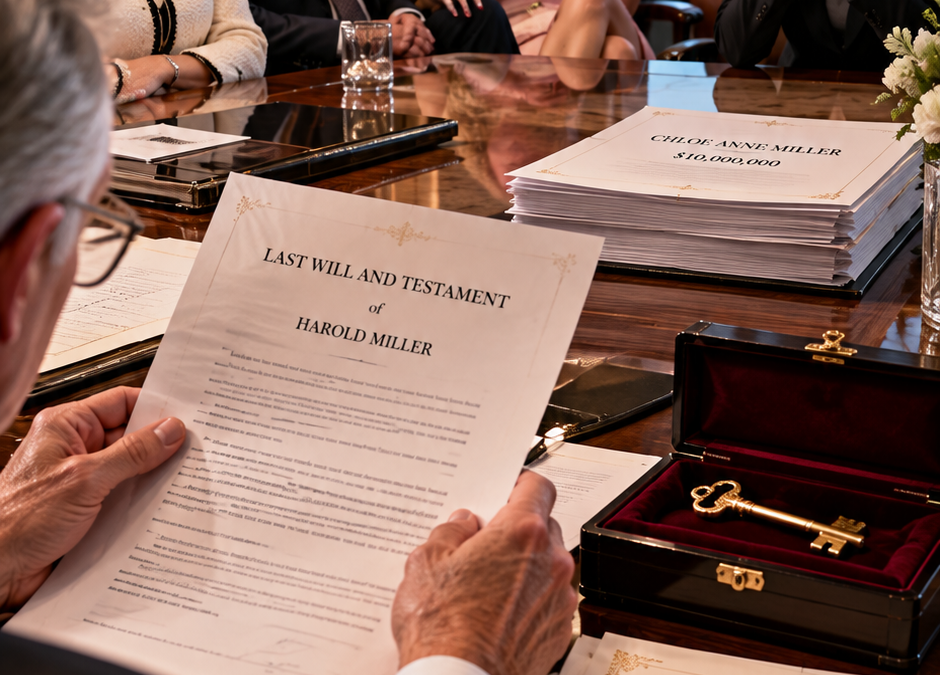
At my grandfather’s will reading, my parents smiled while my younger sister inherited ten million dollars.
My mother touched the pearls at her throat, leaned back in her chair, and said, “Evelyn can earn her own.”
She said it as though she were discussing the weather.
As though my life had been one long exercise in being almost useful enough to mention.
My father nodded beside her.
Chloe, my younger sister, sat across the conference table with one leg crossed over the other, manicured nails tapping against her phone, already wearing the expression of someone trying very hard not to look pleased.
I sat alone at the far end of the table at Bennett & Shore, the law firm my grandfather had used for thirty-seven years.
Everyone in that room thought they already knew how the morning would end.
Chloe would receive the money.
My parents would remain in control of the family company.
And I would leave with some polite consolation prize, maybe a lake cabin nobody used anymore or a small trust designed to keep me from complaining.
They believed I worked in federal logistics.
That was technically true.
It was also like describing a battlefield as an outdoor workplace.
For almost twenty years, I had served in the United States Army. I had commanded soldiers overseas, managed major operations, briefed generals, and worked inside secure facilities my family could not have entered even if someone had drawn them a map.
Three years earlier, I had been promoted to colonel.
Nobody in my family knew.
Not because I had hidden everything.
Because nobody had cared enough to ask.
At holidays, Dad usually said, “Still doing government work?”
Mom asked if I had considered finding something “with more advancement.”
Chloe called me “the practical one,” which in our family meant invisible unless something needed to be carried, fixed, arranged, or endured.
Grandpa Harold had been different.
He noticed.
Not loudly. Not dramatically. Grandpa had never wasted words when silence could make someone else reveal more.
He noticed the government vehicles that sometimes dropped me off at odd hours. He noticed the long absences I explained too carefully. He noticed the garment bag in my hall closet during one unexpected visit years earlier, the one containing dress blues and medals I had not intended anyone to see.
He never pushed.
He only said, “People deserve to know only what you decide they deserve.”
Now he was dead.
And his final voicemail had been looping in my head since the funeral.
Keep your head down. Listen carefully. Trust paperwork over people.
At the time, I thought grief had made him cryptic.
Sitting in that conference room, watching my mother smile before the will was even read, I realized he had been warning me.
Mr. Bennett, silver-haired, precise, and calm in the way only old attorneys can be calm, opened the will.
He had barely begun when Mom interrupted.
“Chloe gets the ten million,” she said confidently. “Harold made that clear.”
Mr. Bennett paused.
Dad reached for his coffee as if this were a board meeting and not the legal distribution of a dead man’s life.
“Your grandfather believed Evelyn needed character,” he said.
I almost laughed.
If twenty years in uniform had not given me character, I doubted being excluded from an inheritance would finish the job.
Mr. Bennett adjusted his glasses.
“The will does provide a monetary distribution to Chloe Anne Miller in the amount of ten million dollars.”
Chloe’s expression brightened.
Mom reached for her water.
Dad nodded once, satisfied.
Then Mr. Bennett opened a second folder.
“There is an additional directive.”
Mom’s hand stopped halfway to the glass.
Mr. Bennett removed a sealed envelope, its flap marked with Grandpa’s signature.
“This document was delivered to our office six weeks before Mr. Miller’s death.”
Dad leaned forward.
“What document?”
Mr. Bennett broke the seal.
“Harold Miller establishes an irrevocable controlling trust holding fifty-one percent of Miller Storage Solutions.”
The room changed.
Not loudly.
No one gasped.
No one shouted.
But something invisible shifted across the conference table.
Dad’s relaxed posture disappeared.
Mom sat perfectly still.
Chloe looked up from her phone.
Mr. Bennett continued.
“Primary beneficiary and trustee: Evelyn Grace Miller.”
Nobody moved.
Even I did not move.
Because I had expected something.
A letter.
A box.
Maybe an instruction.
I had not expected control of the company my grandfather had spent forty-two years building.
Mom shot to her feet.
“No.”
Mr. Bennett did not blink.
“The documents are valid.”
“No,” she repeated. “Harold would never—”
“He did.”
Dad’s face hardened.
“There must be conditions.”
“There are,” Mr. Bennett said.
He turned the page.
“All distributions, including Chloe Miller’s ten-million-dollar inheritance, are suspended pending a forensic audit of Miller Storage Solutions, family trusts, affiliated entities, and transfers made during the last seven years.”
Chloe’s smile vanished.
Dad stared at Mom.
And I watched something change in my mother’s face.
Fear.
Not anger.
Not confusion.
Fear.
That was when my grandfather’s voicemail stopped sounding strange.
Trust paperwork over people.
Mr. Bennett slid a brass key across the table toward me.
“Your grandfather also granted you access to Safe Deposit Box 417 and a private storage unit held under a separate corporate lease.”
The key stopped in front of my hand.
Mom slammed both palms onto the table.
“You will not open that unit.”
The room went silent.
I looked at her.
“Why?”
She seemed to realize too late that she had answered before she had been asked.
Dad turned toward her.
“Diane.”
Mom’s lips parted, but no sound came out.
Mr. Bennett lifted another letter.
“If Evelyn is hearing this,” he read, “Diane has likely already tried to stop the audit.”
Mom went white.
Not pale.
White.
The way people look when a secret they believed buried has just answered from the grave.
Mr. Bennett handed me a personal note from Grandpa.
I opened it.
His handwriting filled the page, slightly shakier than I remembered.
Evie,
I kept your secret because you asked me to.
Your parents think you have wasted your life because they never bothered to learn what you gave it to. Chloe thinks you are the disappointing sister because that is the story she was handed, and stories become comfortable when everyone repeats them.
But I still remember seeing you in uniform.
I had never been prouder.
My throat tightened.
For several seconds, the words blurred.
Mom stared at me.
“What uniform?”
I reached into my briefcase and removed my identification folder.
I placed it on the table.
Dad picked it up first.
His eyes moved across the card.
Colonel Evelyn G. Miller.
United States Army.
He did not speak.
Chloe gave a nervous laugh.
“That’s fake.”
“No,” I said.
Dad looked up slowly.
“You’re a colonel?”
“Yes.”
The word settled between us with the weight of all the years they had not asked.
Mom stepped backward.
For the first time in my life, she looked uncertain around me.
Mr. Bennett pushed an authorization form toward me.
“As trustee, Colonel Miller, you can begin the audit immediately.”
Mom’s voice cracked.
“Evelyn, don’t sign that.”
She was not ordering me anymore.
She was begging.
I picked up the pen.
Grandpa had told me to keep my head down.
Listen carefully.
Trust paperwork over people.
So I signed.
Mr. Bennett took the page.
“The audit begins immediately.”
Mom screamed.
Not words at first.
Just sound.
Chloe started crying, but not from grief. Dad stood so quickly his chair struck the wall.
I slipped Grandpa’s key into my pocket and rose.
“You have no idea what you just did!” Mom shouted.
I looked directly at her.
“No, Mom.”
Then I thought of Grandpa’s final message.
“But I think he did.”
The elevator doors closed on my mother’s shouting.
For several seconds, nobody inside spoke.
Mr. Bennett stood beside me with his leather portfolio tucked beneath one arm. Across from us, an associate from his firm—a quiet woman named Rachel Kim—held two document cases and stared politely at the floor indicator.
I watched the numbers descend.
Four.
Three.
Two.
My pulse was steady.
That surprised me.
I had stood in command centers while decisions worth millions of dollars and hundreds of careers waited on a single sentence. I had boarded aircraft knowing the next twenty hours would belong to contingency plans and incomplete information. I knew how to function while everyone else was reacting.
But this was different.
This was not a mission.
It was my family.
And there had never been a field manual for that.
Mr. Bennett glanced at me.
“Would you like some time before we proceed?”
“No.”
“You don’t have to visit the bank today.”
“I know.”
“The audit can begin independently.”
“I know that too.”
He studied my face for a moment and seemed to understand that repeating options would not change my answer.
“All right.”
Rachel cleared her throat gently.
“Your grandfather was very specific that, if possible, the safe deposit box should be opened before the storage unit.”
“Did he say why?”
“No,” she said. “Only that the order mattered.”
I touched the brass key through the fabric of my pocket.
That sounded like Grandpa.
He had spent forty-two years building Miller Storage Solutions from a two-warehouse operation into a regional commercial storage company with facilities across three states. To strangers, he seemed old-fashioned. To family, he seemed predictable.
But Grandpa had never been careless.
He remembered every birthday, every contract clause, every conversation that mattered.
He once corrected a restaurant bill because they had charged him for two coffees instead of one.
It had been seventy-five cents.
Not because he cared about seventy-five cents.
Because, as he told me later, “If you ignore small errors because they’re small, you train yourself not to notice larger ones.”
At the time, I had laughed.
Now I wondered how many small errors he had noticed before anyone else.
Outside, the morning had turned gray. A thin September rain coated the sidewalks as we stepped beneath the awning.
Mr. Bennett’s driver was waiting.
I stopped before getting into the car.
“My mother knew about the storage unit.”
“Yes.”
“How?”
“I don’t know.”
“Did Grandpa tell her?”
“Not according to anything in our files.”
That settled in me uneasily.
Rachel added, “It’s possible she became aware of it through company records.”
“Then the unit is connected to the business.”
“Possibly.”
I looked back toward the office building.
My family was still upstairs.
Chloe had inherited ten million dollars, at least on paper.
I had inherited control of a company I had never worked for.
And somewhere between those two facts was a truth my grandfather apparently did not trust anyone else to handle.
I got into the car.
“Let’s open the box.”
The bank occupied the ground floor of a limestone building that smelled faintly of polished wood and old carpet.
We were shown through two secured doors into a private viewing room.
A bank officer brought in Box 417.
It was longer than I expected.
She inserted one key.
I inserted Grandpa’s.
The lock turned with a soft mechanical click.
The officer left us alone.
For a moment, nobody moved.
I stared at the lid.
I thought about all the things that could be inside.
Stock certificates.
Cash.
Old contracts.
Evidence of tax fraud.
Letters.
Photographs.
Some dramatic explanation for why my mother had turned pale at the mention of an audit.
Instead, when I lifted the lid, the first thing I saw was a blue three-ring binder.
Grandpa had labeled it in black marker.
EVELYN — START HERE.
I almost smiled.
Of course he had.
Beneath it lay several envelopes, a flash drive, a small notebook, and copies of corporate ledgers.
I opened the binder.
The first page contained one handwritten sentence.
Evelyn, facts first. Feelings later. You’ll need both, but not in that order.
I closed my eyes briefly.
“Sounds like him,” Mr. Bennett said.
“Yes.”
I turned the page.
The binder was organized by year.
Grandpa had created a timeline beginning seven years earlier.
Not accusations.
Not conclusions.
Transactions.
Board decisions.
Property sales.
Management fees.
Loans made between affiliated companies.
Signatures.
Dates.
Amounts.
One company appeared repeatedly.
Northbridge Advisory LLC.
“Do you know it?” I asked.
Mr. Bennett leaned closer.
“No.”
Rachel typed the name into her tablet.
“It appears to be a consulting firm.”
“Who owns it?”
“I’ll have the forensic team confirm.”
I kept reading.
Miller Storage Solutions had paid Northbridge hundreds of thousands of dollars in strategic advisory fees.
Then more.
Then significantly more.
According to Grandpa’s handwritten notes, the work product was vague.
Market analysis.
Executive consulting.
Expansion strategy.
In the margins, he had written questions.
Where is report?
Who approved?
Why no competitive bid?
Why same amount quarterly?
Then, beside one payment, he had written a name.
Diane.
My mother.
I sat back.
Mr. Bennett’s expression tightened.
I did not say anything.
There was no point.
Not yet.
Facts first.
Feelings later.
I turned another page.
Three years earlier, Grandpa had discovered that Northbridge Advisory was owned through another entity called Sheridan Holdings.
Sheridan Holdings, in turn, had been established by someone named Eric Dalton.
I did not know him well.
But beneath the name Grandpa had written:
Diane’s cousin. College friend of Robert.
Robert was my father.
Rachel looked up from her tablet.
“Eric Dalton was your mother’s cousin?”
“Second cousin, I think. I’ve met him twice.”
“What does he do?”
“I thought he sold commercial insurance.”
Mr. Bennett exhaled slowly.
Grandpa’s notes continued.
There was no single giant transfer.
No missing ten million dollars.
That almost made the records more troubling.
There were dozens of smaller payments made over years.
Consulting contracts.
Reimbursements.
Lease adjustments.
Management fees.
A warehouse sale at a price Grandpa believed was below market value.
A loan from Miller Storage Solutions to a development partnership that had never been repaid in full.
Again and again, money moved through ordinary business mechanisms.
Nothing about it looked dramatic.
That was the problem.
Someone had understood exactly how not to look dramatic.
“How much?” I asked.
Rachel had begun adding numbers into a worksheet.
“Just from the pages we’ve seen?”
“Yes.”
She hesitated.
“Roughly six-point-eight million.”
I stared at her.
“And that’s incomplete?”
“Very.”
The room became extremely quiet.
I had expected wrongdoing.
I had not expected scale.
Then I noticed something else.
Beside several payments, Grandpa had drawn a small triangle.
I turned pages backward.
The same symbol appeared repeatedly.
“What does this mean?”
Mr. Bennett shook his head.
I opened the small notebook from the box.
On the first page, Grandpa had written:
Triangle = transaction Diane opposed.
I stopped.
Rachel looked over.
“So those payments weren’t approved by your mother?”
“Apparently not.”
The assumption I had been forming shifted.
I went through the pages again.
Many of the questionable transfers had Mom’s name beside them because she had objected.
Grandpa had written short notes.
Diane requested suspension.
Diane asked for external review.
Robert dismissed concern.
Diane refused signature.
Diane said Chloe not involved.
I leaned back slowly.
Mr. Bennett frowned.
“That complicates matters.”
“Yes.”
More than complicated.
It rewrote the scene in the conference room.
Mom had not necessarily feared the audit because she had stolen money.
She might have feared what the audit would expose about someone else.
I thought about my father sitting calmly beside her.
His relaxed expression.
His nod when Mom said I could earn my own.
His silence when the trust was announced.
His face after the audit suspension.
Had I read him wrong?
Or had Grandpa wanted me to question everyone?
I turned another page.
Near the end of the binder, Grandpa’s handwriting became shakier.
He had written a summary.
Robert insists all transactions legitimate.
Diane insists family discussions must remain private.
Chloe knows something is wrong but not what.
Evelyn is the only one with enough distance to act without protecting a position.
I reread that sentence.
Enough distance.
It was a strange kindness and a painful truth.
I had spent most of my adult life far enough from my family that they knew the outline of me but not the details. At holidays, Dad asked whether I was still doing government work. Mom asked whether I had considered something with more advancement. Chloe talked about her marketing firm, vacations, renovations, and people I had never met.
Nobody asked what I actually did.
Grandpa had.
He never asked operational questions.
He never crossed boundaries.
But he knew enough.
Once, years ago, when I came home two days late for Thanksgiving because of what I described only as work complications, he handed me coffee the next morning and said, “Leadership usually means arriving after everyone else has started complaining.”
I remembered laughing.
Then he had added, “People confuse visibility with importance.”
That sentence had stayed with me through every promotion.
I closed the binder.
“There are letters.”
There were three envelopes.
The first was marked:
FOR EVELYN AFTER THE BINDER.
I opened it.
His handwriting filled four pages.
Dear Evie,
If you are reading this, I ran out of time or courage. Probably time. I’ve rarely lacked the other thing, though your grandmother would say I confuse stubbornness with bravery.
I smiled despite myself.
Mr. Bennett politely looked away.
I continued.
Your mother is not innocent in all of this, but do not make the mistake of deciding too quickly what she is guilty of.
My smile disappeared.
There are different ways families become dishonest. Sometimes people steal. Sometimes they lie. Sometimes they convince themselves that silence keeps peace.
Your mother chose silence too many times.
Your father chose certainty.
Those are not the same failure.
I read that paragraph twice.
Then continued.
Years ago, I made Robert president of Miller Storage because he was ambitious, disciplined, and persuasive. I believed those qualities would become wisdom with time. Sometimes they did.
Sometimes they became pride.
He wanted expansion.
I wanted stability.
We argued.
I stepped back because I thought leadership meant allowing the next generation to lead.
That may have been my largest mistake.
Robert began arranging partnerships I did not understand or approve. When Diane questioned him, he told her she was undermining him. When I questioned him, he reminded me that I had retired.
Most of his decisions were legal.
Some were even profitable.
But not all were wise.
And a few may have crossed lines I cannot determine without a proper audit.
My shoulders tightened.
Grandpa had not known everything.
That mattered.
This was not a dead man handing me a verdict.
He was handing me a question.
Then came the part I had not expected.
Do not assume the ten million for Chloe was a reward.
It is a safeguard.
I looked up.
“What does that mean?” Rachel asked quietly.
“I don’t know yet.”
I kept reading.
Chloe has spent her life trying to become whatever her parents needed her to be. Your mother needed closeness. Your father needed admiration. Chloe provided both.
You escaped that pattern, though I doubt it felt like escape at the time.
I left her the money because if this company collapses, she may discover she has built her identity on something that never belonged to her.
I left you control because you know how to carry responsibility without needing applause for it.
I had to stop.
For a few seconds, I saw Grandpa as he had been at eighty-two, standing in my kitchen wearing suspenders and criticizing my coffee.
“You have machines that cost more than my first truck,” he had said, “and they still can’t make decent coffee.”
I remembered his hands.
Large.
Veined.
Steady until the final year.
I had never asked him whether he was proud of me.
I hadn’t thought I needed to.
Maybe part of me had always needed to.
I read the final lines.
The storage unit contains the original records I removed from the office when I realized some files had been altered.
Before you judge anyone, speak to your mother alone.
Not because she deserves protection.
Because you deserve the full story.
Love,
Grandpa
I folded the letter.
Nobody spoke for a long moment.
Then my phone rang.
Mom.
I watched it vibrate once.
Twice.
Then stop.
A text appeared.
Please don’t go to the storage unit until you talk to me.
Another followed.
I should have told you years ago.
I stared at the message.
Mr. Bennett said, “Your grandfather did ask you to speak with her.”
“I know.”
“What do you want to do?”
I thought about command decisions.
People imagined officers made choices because they possessed certainty.
Mostly, we made choices because waiting for certainty could become its own mistake.
But Grandpa had left instructions.
And the first instruction had been simpler than everything else.
Listen carefully.
“I’ll meet her.”
Mom chose a small restaurant near the river.
Not one of her usual places.
No white tablecloths.
No maître d’ who knew her name.
Just a quiet café with wooden booths and a chalkboard menu.
She was already seated when I arrived.
She had removed the pearls.
I noticed immediately.
For as long as I could remember, Mom wore pearls whenever something mattered.
Weddings.
Funerals.
Graduations.
Christmas dinners.
Chloe’s engagement.
Grandpa’s will reading.
The absence of them made her look less polished.
Also smaller.
I slid into the booth across from her.
“Where’s Dad?”
“At home.”
“Does he know you’re meeting me?”
“Yes.”
“Does he know what you’re going to tell me?”
She looked toward the rain streaking the window.
“I don’t know what I’m going to tell you.”
“Then start with the truth.”
Her eyes came back to mine.
“That sounds like your grandfather.”
“It is.”
A server approached.
Mom ordered tea.
I ordered coffee.
Neither of us touched the menus.
When we were alone again, she folded her hands.
“I wasn’t supposed to know about the storage unit.”
“How did you?”
“I saw the rental payment eighteen months ago.”
“On company records?”
“Yes.”
“Why were you looking?”
“Because I had started looking at everything.”
That was the first answer I believed without reservation.
She continued.
“Your father had been making decisions without discussing them with me.”
“You mean business decisions?”
“At first.”
She stopped when the server returned with our drinks.
I waited.
Mom held the tea cup between both hands.
“When your grandfather retired, he wanted your father to run the company. Robert had worked there since before you were born. He understood the business. He was good with clients. Good with banks. Good at making people believe the future was bigger than the past.”
“That sounds like praise.”
“It is.”
Her expression softened briefly.
“Your father is not a villain, Evelyn.”
“I didn’t say he was.”
“No. But I know the way you look when you’re assessing a situation.”
I raised an eyebrow.
“You know that?”
“Yes.”
The answer surprised me.
She looked down.
“Maybe I knew more about you than you think.”
“Then why did you act like I stocked printer paper in a federal basement?”
A painful little smile appeared.
“I didn’t think that.”
“You asked me at Christmas whether my job offered management training.”
“I remember.”
“I had already commanded more than eight hundred soldiers.”
She looked at me.
“I know that now.”
“No. You knew today.”
She flinched.
I regretted the sharpness almost immediately.
Not because it wasn’t true.
Because I had not come here to win.
I had come to understand.
I wrapped my hands around the coffee mug.
“Tell me about Dad.”
She nodded slowly.
“After Harold stepped back, your father expanded aggressively. New properties. New debt. Partnerships. It worked at first. Revenue doubled in five years.”
“And Northbridge?”
Her face changed.
“You found it.”
“Grandpa documented it.”
Mom closed her eyes.
“I asked Robert to stop those payments.”
“Why?”
“Because Eric Dalton wasn’t providing anything worth what we were paying.”
“Your cousin.”
“Second cousin. We weren’t close.”
“Dad’s friend?”
“They knew each other in college.”
“What was the arrangement?”
She took a breath.
“Eric introduced Robert to investors. Developers. People who had access to land and financing. He became a kind of intermediary.”
“For nearly seven million dollars?”
“No.”
Her answer came quickly.
“Not at first.”
I waited.
“The first contract was eighty thousand a year. Reasonable enough. Then there were bonuses. Additional consulting arrangements. Separate entities. It became difficult to follow.”
“Did Dad personally benefit?”
Mom stared at her tea.
“I don’t know.”
That was not the answer I expected.
“You don’t know?”
“I asked.”
“And?”
“He became furious.”
She rubbed the edge of the saucer with her thumb.
“Not violent. Not threatening. Just… insulted. As though my asking proved I didn’t trust him.”
“Did you?”
“At first, yes.”
“And later?”
She looked directly at me.
“No.”
The word rested between us.
Trust rarely disappears in one dramatic moment.
Usually it thins.
A question not answered.
A receipt explained too quickly.
A phone call taken in another room.
A decision made without consultation.
Eventually, people look at what remains and cannot remember which small crack allowed the first drop of water through.
“What did you do?”
“I went to your grandfather.”
“When?”
“Three years ago.”
The same year I became colonel.
The same year Grandpa had apparently discovered the scale of the transfers.
“He believed you?”
“He believed there was enough uncertainty to justify looking.”
“Why didn’t he order an audit then?”
“He tried.”
“What happened?”
“Your father said an external audit would damage lender confidence and jeopardize two acquisitions. He argued that everything was already reviewed by the company accountants.”
“That doesn’t answer why Grandpa stopped.”
“Because I asked him to.”
I stared at her.
There it was.
Her failure.
Not theft.
Silence.
Grandpa had written exactly that.
“Why?”
Mom’s eyes filled, but her voice remained steady.
“Chloe.”
I said nothing.
“She was engaged then. Your father had made her vice president of community relations. She was planning the wedding. She adored him.”
“And an audit would have changed that?”
“I thought it might.”
“So you protected Dad.”
“I thought I was protecting Chloe.”
“That’s not the same thing.”
“No.”
Her voice softened.
“I know that now.”
I looked out at the river. Traffic moved slowly over the bridge. People with umbrellas hurried along the opposite sidewalk.
Ordinary life.
Nothing in the world looked as complicated as the conversation at our table.
“Did Chloe know?”
“Not the details.”
“What did she know?”
“She knew I was worried about money moving through outside companies. She knew your father and grandfather were arguing.”
“And the ten million?”
“I had no idea Harold planned to leave her that much.”
“Did Dad?”
“I don’t think so.”
“Why did you say at the reading that Chloe gets the ten million?”
Mom looked embarrassed.
“Because your father told me that was likely.”
“Before the reading?”
“Yes.”
“How did he know?”
“He said Harold had mentioned wanting to make sure Chloe was secure.”
“Did Grandpa tell you anything about leaving me control?”
“No.”
“What did Dad expect me to inherit?”
She hesitated.
“A small trust. Maybe the lake property.”
So Dad had walked into the reading believing he knew the structure of the estate.
Chloe rewarded.
Me acknowledged.
Him still running the company.
Then Grandpa changed the board.
I asked, “Why did you tell me I could earn my own?”
Mom’s face tightened.
“I was repeating something your father had said for years.”
“That doesn’t answer why.”
“No.”
She looked down.
“Because it was easier than admitting I didn’t understand your life.”
That answer hurt more than cruelty would have.
Cruelty could be dismissed.
Indifference had roots.
“You could have asked.”
“I should have.”
“For twenty years.”
“Yes.”
“You came to my promotion to major.”
“I thought it was some administrative grade.”
“It was an officer rank.”
“I know.”
“You never asked.”
“No.”
I watched her carefully.
“Why?”
Mom gave a small, tired sigh.
“Because your life made me uncomfortable.”
“My life?”
“You left.”
“I joined the Army.”
“You left us.”
“I was twenty-two.”
“I know.”
“Those aren’t the same thing.”
“I know that too.”
Her voice trembled for the first time.
“When you were young, you were the child I understood least. Chloe wanted what I wanted for her. She liked the same things I liked. Home. Family dinners. Familiar people. You were always looking toward somewhere else.”
“So you punished me for leaving?”
“No.”
She looked horrified.
“Evelyn, no.”
“Then what?”
“I told myself you didn’t need us.”
I leaned back.
There are sentences that explain years.
Not excuse them.
Explain them.
I told myself you didn’t need us.
I had heard versions of it before.
From subordinates whose parents stopped calling because they seemed successful.
From spouses who mistook independence for distance.
From leaders who neglected strong performers because quiet competence required less attention.
People often poured themselves toward the loudest need in the room.
Then acted surprised when the quiet person learned to live without them.
Mom continued.
“Every time you came home, you seemed more self-contained. More capable. I didn’t know how to enter your world without feeling foolish.”
“So you didn’t.”
“No.”
The rain ticked softly against the window.
I thought of Grandpa.
People deserve to know only what you decide they deserve.
For years, I had believed secrecy was a shield.
Maybe some of it had become habit.
Maybe I had also made it easy for my family not to know me.
That did not absolve them.
But truth rarely belonged entirely to one person.
“Tell me why you tried to stop the audit today.”
Mom’s fingers tightened around the cup.
“Because if your father did something illegal, the audit will find it.”
“And if he didn’t?”
“It may still destroy his reputation.”
“That’s not a reason to avoid facts.”
“I know.”
“Then what are you really afraid of?”
She looked at me for a long time.
“When I asked him about Northbridge last year, he told me something.”
“What?”
“He said, ‘You signed enough of those papers to go down with me.’”
The café seemed suddenly colder.
“What did you sign?”
“I don’t know.”
“That’s not good enough.”
“I know.”
“What did you sign?”
“Corporate resolutions. Loan documents. Partnership approvals. Things he brought home. Things I signed because we had been married thirty-eight years.”
My jaw tightened.
“That’s why Grandpa wrote that you weren’t innocent.”
“Yes.”
“Did you read them?”
“Some.”
“All?”
“No.”
I nodded slowly.
Not criminal certainty.
Negligence, perhaps.
Blind trust.
Maybe more.
The audit would decide.
Mom’s eyes filled again.
“I’m not asking you to stop it.”
That surprised me.
“You were this morning.”
“I was.”
“What changed?”
“You opened the box, didn’t you?”
I said nothing.
She gave a sad smile.
“You have Harold’s face when you know something.”
I looked down at my coffee.
“He told me to talk to you.”
Her eyes closed.
For a moment, grief passed plainly across her face.
“He still thought I deserved that.”
“He said I deserved the full story.”
“That sounds more like him.”
We sat quietly.
Then I asked the question I had been avoiding.
“Do you love Dad?”
Mom looked startled.
“Of course.”
“That’s not always the same as trusting him.”
“No.”
She turned toward the window.
“I love the man who danced with me in a community hall when we were twenty-one. I love the father who spent three nights building Chloe a science fair model because she had broken hers. I love the man who drove eight hours when you broke your ankle at training.”
I looked at her.
“I didn’t know that.”
“He sat in the hospital parking lot.”
“What?”
“You told us not to come.”
“I said I was fine.”
“He came anyway.”
“Why didn’t he come inside?”
“You had already been discharged by the time he arrived. He was furious with himself. He never told you because you called from the road and sounded so annoyed that we had worried.”
I stared at the table.
Another hidden truth.
Small.
Human.
Nothing like the numbers in Grandpa’s binder.
Yet somehow just as destabilizing.
Mom continued.
“I love your father. But I don’t know whether the man I love is the same man who signed those contracts.”
“People can be both.”
“I know.”
“Good and wrong.”
“Yes.”
“Loving and dishonest.”
“Yes.”
Her voice barely carried.
“That’s what I’m afraid of.”
I did not go to the storage unit that afternoon.
Instead, I met the forensic accounting team.
There were four of them.
Their lead, Martin Reyes, had spent twenty-six years examining corporate fraud, disputed trusts, and ownership battles. He was in his late fifties, wore rimless glasses, and had the calm manner of a man who had learned that complicated numbers did not require complicated speech.
He looked through Grandpa’s binder for thirty minutes without interruption.
Then he closed it.
“Your grandfather was methodical.”
“Yes.”
“He was also careful not to overstate what he knew.”
“That matters to me.”
“It should.”
“What happens next?”
“We preserve records, mirror systems, review banking data, compare original documents with electronic versions, and trace related-party transactions.”
“How long before you know whether money was improperly diverted?”
“Some answers will come quickly. Others won’t.”
“Start with Northbridge.”
“We will.”
“And the affiliated development partnerships.”
“Yes.”
I paused.
“I don’t want theatrics.”
Martin glanced up.
“Meaning?”
“No dramatic accusations. No unnecessary disruption to employees. No people marched out of offices because someone wants to look decisive.”
His expression softened slightly.
“I agree.”
“The company employs how many?”
“About six hundred, according to current filings.”
“Those employees didn’t create my family’s problems.”
“No.”
“Protect operations.”
“We can structure the audit around that.”
I nodded.
“Do it.”
It felt familiar then.
Not the family part.
The work.
Set objectives.
Define constraints.
Protect people unrelated to the dispute.
Follow evidence.
Avoid assumptions.
My grandfather had not left control to someone who knew storage facilities.
He had left it to someone who knew how to operate under uncertainty.
That realization frightened me more than the title of trustee ever could.
I arrived at the storage unit the next morning at nine.
Mr. Bennett came with me.
So did Martin.
The facility was one of Miller Storage Solutions’ older properties, built in the early nineties on the edge of town.
I remembered visiting as a child.
Grandpa had once paid Chloe and me five dollars each to sweep an empty unit. Chloe quit after fifteen minutes because she said the dust was ruining her sneakers. I finished both halves.
Grandpa gave me ten dollars and Chloe two.
Mom made him change it.
He refused.
“Work isn’t divided by intention,” he told her. “It’s divided by who finishes.”
I had not thought about that day in years.
The manager recognized me.
“Ms. Miller?”
“Evelyn is fine.”
He glanced at Mr. Bennett.
“I’m sorry about your grandfather.”
“Thank you.”
“He came by a lot.”
“How often?”
“Every few weeks this last year.”
“Was he alone?”
“Usually.”
“Usually?”
The manager hesitated.
“Your father came once.”
Martin and I exchanged a look.
“When?”
“Maybe two months ago.”
“Did he enter Grandpa’s unit?”
“No. Your grandfather met him in the office.”
“Did they argue?”
The manager looked uncomfortable.
“Not exactly.”
“What did you hear?”
“Nothing specific. Your grandfather told him, ‘Some things belong to the truth before they belong to the family.’”
That sounded like him.
The manager led us down a clean corridor.
Unit 214.
I unlocked it.
Inside were shelves.
Boxes.
File cabinets.
Nothing dramatic.
No secret vault.
No piles of cash.
Just paperwork.
Years of it.
Grandpa had labeled every box.
PROPERTY SALES.
RELATED-PARTY TRANSACTIONS.
BOARD MINUTES.
NORTHBRIDGE.
ROBERT — PERSONAL CORRESPONDENCE.
DIANE — SIGNATURE FILES.
CHLOE — DO NOT BLAME.
I stared at the last label.
Martin said quietly, “He was thinking ahead.”
“Yes.”
We began with the Northbridge box.
Original invoices.
Contracts.
Emails printed on paper.
Grandpa had apparently distrusted digital permanence near the end.
For hours, Martin reviewed documents while I sorted.
A pattern emerged.
Northbridge had charged Miller Storage for legitimate consulting work initially.
Then the invoices broadened.
Strategic relationships.
Executive access.
Development facilitation.
Some had detailed backup.
Others did not.
Then Martin found the first important inconsistency.
“This invoice.”
He placed two documents side by side.
“Your grandfather had both versions.”
They shared the same invoice number.
One version billed Miller Storage $92,000.
The other billed $192,000.
The description was identical.
“Which amount was paid?”
“$192,000.”
“Who changed it?”
“We’ll need metadata or email history.”
He pointed to a handwritten approval on the larger invoice.
Robert Miller.
My father.
I felt no triumph.
Only heaviness.
“Keep going.”
An hour later, we found another.
Then another.
Not all doubled.
Some increased by twenty thousand.
Some fifty.
One by one, minor discrepancies became a pattern.
Finally, Martin sat back.
“This doesn’t prove where the excess money went.”
“But it proves invoice alteration.”
“It strongly suggests it.”
“By Dad?”
“It proves he approved the higher versions.”
I nodded.
Facts first.
Feelings later.
Then Mr. Bennett called from across the room.
“Evelyn.”
He was holding a thin folder.
“What?”
“This one is marked with your name.”
I took it.
EVELYN — IF ROBERT DENIES EVERYTHING.
Inside was a copy of a bank statement.
Not Dad’s.
Not Mom’s.
An account belonging to Sheridan Holdings.
Several incoming transfers from Northbridge.
Then outgoing transfers to another entity.
RGM Capital Partners.
I stared at the initials.
Robert George Miller.
My father.
Martin came closer.
“Do we know ownership?”
“Not yet.”
Bennett handed me the next page.
A corporate registration.
RGM Capital Partners.
Managing member: Robert G. Miller.
My throat tightened.
The numbers were not enormous individually.
Forty thousand.
Seventy-five thousand.
One hundred ten thousand.
But they recurred.
Over years.
“How much?” I asked.
Martin began calculating.
Mr. Bennett looked toward the door as though giving me privacy in a room with nowhere private to go.
Finally Martin said, “Based only on these statements, about two-point-three million.”
I sat down on the edge of a storage carton.
Grandpa had known.
Or suspected enough.
Dad had personally received money connected to a consultant being paid by the family company.
That did not automatically prove theft.
There could be an ownership interest.
A disclosed partnership.
Legitimate compensation.
But Grandpa had placed the records in a secret unit.
My father had never mentioned RGM Capital.
And my mother had said she did not know whether he personally benefited.
Now I did.
At least indirectly.
Mr. Bennett asked, “Do you want to call him?”
“No.”
“Why?”
“Because we still don’t know what the payments represent.”
Martin nodded approvingly.
“That’s the right approach.”
I almost laughed.
My grandfather would have liked Martin.
We kept working.
By late afternoon, my eyes hurt from reading.
Then I reached the box labeled DIANE — SIGNATURE FILES.
Inside were copies of documents Mom had signed.
Grandpa had highlighted specific pages.
Some were standard board resolutions.
Some authorized bank loans.
Some approved acquisitions.
Then I found a guarantee.
Mom had personally guaranteed a five-million-dollar development loan.
Her signature was real.
But attached behind it was a disclosure statement describing the purpose of the loan.
Acquisition and construction of the Benton Ridge Storage Facility.
I knew that property.
It existed.
I had driven past it once.
But Grandpa had written in the margin:
Only $3.1M used for Benton Ridge. Where remainder?
Martin examined the closing file.
“Could be working capital.”
“Could be.”
He kept reading.
Then he stopped.
“Here.”
A disbursement schedule showed $1.4 million transferred at closing to an entity called Marlowe Development Services.
“Who owns that?”
Rachel, who had joined us in the afternoon, searched the corporate database.
Her expression changed.
“Eric Dalton.”
Mom’s cousin.
Dad’s friend.
Again.
Martin leaned back.
“Now we have a recurring network.”
I looked at the boxes stacked against the wall.
Grandpa had spent years assembling this.
Not because he wanted revenge.
Because he wanted enough evidence that someone outside the family story could understand it.
A daughter raised to trust her husband.
A husband raised to believe the company belonged to his future.
A younger daughter who built her life around family approval.
An older daughter who left.
And an old man who realized too late that stepping back from leadership did not mean responsibility had disappeared.
It simply changed shape.
As daylight faded through the narrow window near the ceiling, I opened the final folder in Mom’s box.
Inside was a letter.
Not from Grandpa.
From Dad.
Diane,
I know you think I’ve taken risks you wouldn’t take. That’s because you’ve never understood what it takes to grow something.
Your father built a good company.
I’m building a lasting one.
There are arrangements I cannot explain to every board member, accountant, or family member without destroying their usefulness.
You signed what you signed because you trusted me.
Please don’t make the mistake of deciding that trust was foolish simply because Harold is frightened by change.
Robert
I read it twice.
The arrogance bothered me.
But one phrase bothered me more.
Arrangements I cannot explain.
Martin noticed.
“That could mean many things.”
“I know.”
“Not all of them illegal.”
“I know that too.”
He nodded.
I appreciated that he did not try to tell me what I should feel.
I placed the letter back in the folder.
Then Rachel, who was sorting Grandpa’s personal correspondence box, said, “Colonel Miller?”
I looked up.
She rarely used my rank.
Something in her voice made everyone stop.
“What did you find?”
She held an unopened envelope.
On the front, Grandpa had written:
TO ROBERT — NEVER SENT.
Inside was a letter dated six weeks before Grandpa died.
Robert,
I have spent three years assuming your worst mistake was greed.
I may have been wrong.
I now think your worst mistake was believing you could fix an old problem by hiding it inside new business.
You told me the Northbridge payments were necessary because of what happened in 2018.
You told me if the truth came out, Diane would lose everything, Chloe would lose faith in you, and the company could fail.
I believed fear had made you dishonest.
Now I wonder whether guilt did.
If Evelyn is reading this someday, she deserves to know what happened in 2018.
But she should not hear it from my notes.
She should hear it from you.
I lowered the page.
No one spoke.
Seven years earlier.
The exact beginning of Grandpa’s audit timeline.
The exact year the questionable transactions began.
I turned the letter over.
On the back, Grandpa had written one final line.
Ask Robert about Lakeview.
I looked at Mr. Bennett.
“What is Lakeview?”
He shook his head.
Martin searched his notes.
Rachel typed quickly.
Then she stopped.
“There was a company called Lakeview Storage Partners.”
“Affiliated with Miller?”
“Previously.”
“What happened to it?”
She looked at me.
“It dissolved in 2018.”
“Who owned it?”
Her fingers moved again.
Then her face changed.
“Your grandfather.”
I waited.
“And?”
“Your father.”
I felt the air leave my lungs.
“Anyone else?”
“Yes.”
She looked at the screen.
“Diane Miller.”
My mother.
Then Rachel scrolled.
“There’s one more original partner.”
“Who?”
“Not a family member.”
“Name?”
She hesitated.
“Thomas Hale.”
The name meant nothing to me.
Until Mr. Bennett spoke.
Very softly.
“I know that name.”
I turned toward him.
He had gone pale.
“From where?”
He looked at the letter in my hands.
Then at Grandpa’s boxes.
“Thomas Hale was Harold’s first business partner.”
I frowned.
“I thought Grandpa started Miller Storage alone.”
“That’s what most people believe.”
“Why?”
Mr. Bennett took a slow breath.
“Because Thomas Hale disappeared from the company records nearly thirty years ago.”
“Disappeared how?”
“He sold his interest.”
“To Grandpa?”
“That was always my understanding.”
“And Lakeview?”
Bennett shook his head.
“I didn’t know Hale still had any business connection to your grandfather.”
Rachel stared at her tablet.
“There’s something else.”
“What?”
“Lakeview didn’t simply dissolve.”
She turned the screen toward me.
“In 2018, its primary property was sold.”
“To whom?”
She scrolled.
Then looked up.
“Northbridge Advisory LLC.”
Nobody said anything.
Rain began tapping against the metal roof of the storage building.
Soft.
Steady.
Ordinary.
I looked down at Grandpa’s unsent letter.
I had thought the audit was about money leaving the company.
Now it looked as though the money might have been moving because of something that happened before Northbridge existed.
Something involving my grandfather.
My father.
My mother.
And a man whose name had been quietly erased from our family’s version of the company’s history.
I folded the letter carefully.
“Find Thomas Hale.”
Rachel nodded.
Martin gathered the banking records.
Mr. Bennett stared toward the rows of boxes as though realizing, as I was, that Grandpa had not left me a simple case of financial misconduct.
He had left me a history nobody had ever told properly.
And somewhere inside that history was the reason my father had spent seven years moving money through companies he refused to explain.
My phone buzzed.
A message from Dad.
I heard you talked to your mother.
I looked at the screen.
A second message appeared.
Before you decide what kind of man I am, ask Bennett what your grandfather did to Thomas Hale.
I slowly raised my eyes.
Mr. Bennett was watching me.
For the first time since the will reading, the lawyer looked afraid of what came next.
“Tell me,” I said.
Bennett’s mouth tightened.
“I was junior counsel then.”
“That wasn’t my question.”
“No,” he said quietly. “It wasn’t.”
He removed his glasses and rubbed the bridge of his nose.
“Thomas Hale and your grandfather started with two warehouses. Harold ran operations. Thomas brought capital and contacts. They were close at first.”
“What happened?”
“Thomas wanted to sell early. Harold didn’t. They argued. Eventually Thomas accepted a buyout.”
“You said that was your understanding.”
“It was.”
“What changed?”
Bennett looked toward Grandpa’s boxes.
“Years later, Thomas claimed he had been








