𝗙𝗨𝗟𝗟 𝗦𝗧𝗢𝗥𝗬 Grandpa Had Been Waiting Years for the Day Someone Ordered Him Away From That Lake
𝗙𝗨𝗟𝗟 𝗦𝗧𝗢𝗥𝗬
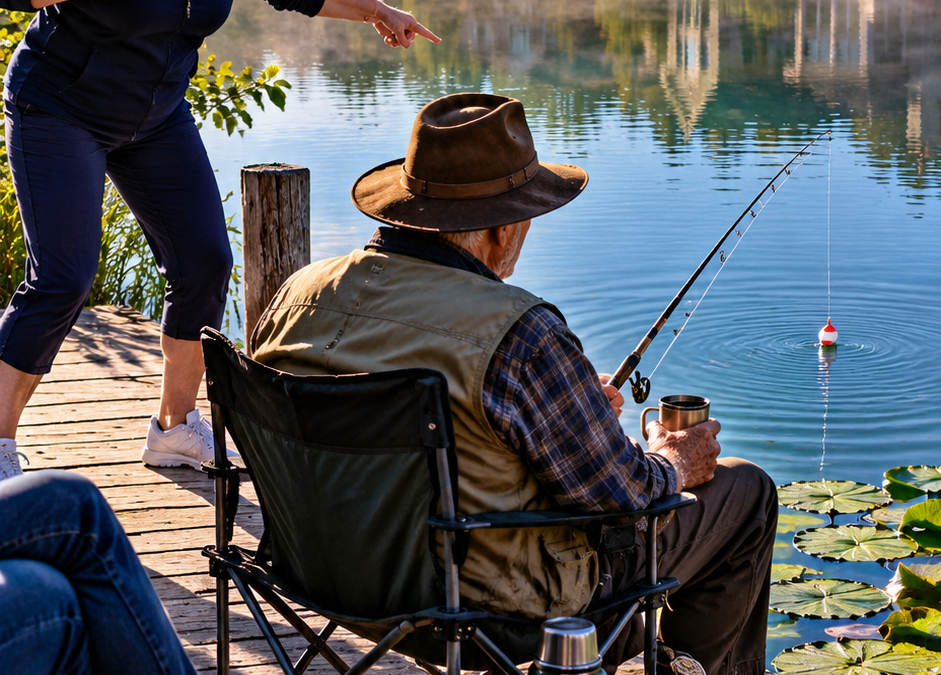
Grandpa didn’t move.
The bobber dipped once, then rose.
Karen saw it and looked even more offended, as if the fish had also violated community standards.
“Grandpa,” I said quietly.
He held up one finger.
Not to Karen.
To me.
Wait.
So I waited.
The police cruiser arrived less than ten minutes later, which told me Karen had likely called through somebody she knew instead of the normal nonemergency line. The officer who stepped out looked younger than I expected, maybe late twenties, with a cautious expression that suggested he had handled enough HOA calls to know they often sounded more urgent than they were.
Karen moved toward him immediately.
“Officer, thank you for coming so quickly,” she said. “This man is trespassing on HOA property and refusing to leave.”
The officer looked toward Grandpa, then toward me, then at the lake.
Grandpa quietly reeled in his line and set the rod across his knees.
The gesture bothered me more than I expected. Seeing him lower that rod, even calmly, made anger rise in my throat. That dock had held half my childhood. It had held Grandpa through grief, through birthdays, through the long silence after Grandma died. And now Karen stood there trying to erase him from it with one phone call.
The officer approached carefully. “Morning. I’m Officer Ramirez. Can someone tell me what’s going on?”
Karen started before anyone else could speak.
“This gentleman is fishing in a private HOA lake. He is not a resident. He does not have permission. He was told to leave and refused.”
Officer Ramirez looked at Grandpa. “Sir?”
Grandpa picked up his coffee and took a slow drink before answering.
“I’ve been fishing here since before her subdivision existed.”
Karen scoffed. “That doesn’t give him rights.”
Grandpa looked at the officer. “Before I leave, ask her who actually owns this easement.”
Karen’s expression changed.
Not much.
Just enough.
The officer noticed it too.
“What easement?” he asked.
Grandpa reached into one of the pockets of his fishing vest. He didn’t hurry. His fingers searched inside the canvas, past hooks and folded tissues and an old pocketknife, until he pulled out a worn document sealed in a clear plastic sleeve.
The paper inside looked older than I was.
Maybe older than my father.
The edges had yellowed. The folds were deep and soft from years of handling. Blue ink markings crossed the bottom where a county clerk had stamped it decades before.
Grandpa handed it to Officer Ramirez.
Karen’s confidence cracked a little more.
“What is that?” she asked.
Grandpa didn’t answer her.
Officer Ramirez opened the sleeve carefully and studied the document.
I stepped closer and read over his shoulder.
It was a deed record. Not a photocopy of an HOA rule. Not a welcome packet. Not one of those glossy maps developers hand out to make everything look simpler than it is.
This was a recorded property document tied to the land beneath and around the lake.
Officer Ramirez read silently for almost a full minute.
Then he looked at Karen. “Do you have the HOA’s recorded easement documentation?”
Karen lifted her chin. “Our attorney has everything.”
“Can you produce it?”
“Not here.”
Grandpa smiled gently. “Might be a good time to call him.”
Karen shot him a look sharp enough to cut rope.
Then she turned away and made the call.
I could hear pieces of it.
“Dock.”
“Old man.”
“Claims he has a deed.”
“No, he won’t leave.”
“Yes, police are here.”
While she talked, Officer Ramirez asked Grandpa a few basic questions. Name. Address. How often he accessed the dock. Whether he had ever been formally told not to fish there before.
Grandpa answered each one plainly.
“My name is Henry Whitaker.”
“I live on the south parcel.”
“I access the lake from the old right-of-way.”
“I’ve used this dock since 1968.”
“No, nobody with authority has ever removed me.”
Karen turned back at that. “That is not accurate.”
Grandpa looked at her. “Name one person with authority.”
She opened her mouth, then closed it.
That was the thing about Grandpa. He didn’t argue broadly. He didn’t chase every insult. He asked narrow questions and let people trap themselves against the answer.
Ten minutes later, a black sedan pulled up near the path.
A man stepped out carrying a thick leather folder and wearing the expression of someone who had expected a quick cleanup job. I recognized him from county meetings: Philip Harlan, the HOA attorney. Expensive suit, polished shoes, silver hair, calm voice. He had built a career making unreasonable people sound procedural.
Karen hurried toward him.
“That’s him,” she said, pointing at Grandpa. “This lake belongs to us. He’s refusing to leave.”
Harlan gave Grandpa a professional smile. “Mr. Whitaker, I understand there’s been some confusion.”
Grandpa looked at him from his folding chair. “No confusion on my end.”
The attorney’s smile tightened.
Officer Ramirez handed him the document. “Sir, can you review this and explain the easement situation?”
Harlan took the paper with the confidence of a man used to reading documents faster than everyone else in the room.
For the first thirty seconds, nothing changed.
Then his eyes slowed.
He turned one page.
Then another.
Then he went back to the first page.
Karen watched him impatiently. “Philip?”
He didn’t answer.
That was when I felt it—the air shifting.
The same dock. Same lake. Same morning light spreading across the water.
But suddenly everyone seemed to understand that this was no longer about an old man fishing.
The attorney opened his leather folder and pulled out the HOA’s records. He laid them on the dock railing, using a binder clip to keep the breeze from lifting them. There were maps, title summaries, covenant pages, and what looked like an easement agreement from the early development period.
Grandpa’s bobber still floated near the lilies where he had left it after casting again.
Because yes, while Karen had been calling the attorney and the officer had been reading, Grandpa had quietly put his line back in the water.
Karen had been too distracted to notice.
I had noticed.
And it made me want to grin.
Harlan compared one page against another.
Then he asked Karen, very quietly, “When did the HOA purchase the easement interest?”
Karen frowned. “What?”
“When did the association purchase the easement interest from the original landholder?”
She looked annoyed. “You have the records.”
“I have the HOA’s access documents,” he said. “I am asking whether you know when the underlying easement interest was purchased or transferred.”
Karen folded her arms. “The lake has always been part of the community.”
Grandpa chuckled softly.
Everyone looked at him.
He didn’t explain the laugh.
He just watched his bobber.
Officer Ramirez cleared his throat. “Mr. Harlan, what are we looking at?”
The attorney took off his glasses and rubbed the bridge of his nose.
That was the first real sign of trouble.
Lawyers don’t remove their glasses like that when things are simple.
“There appears,” Harlan said carefully, “to be a discrepancy between the HOA’s operating assumption and the original easement language.”
Karen stared at him. “What does that mean?”
“It means,” Grandpa said, “you built a fence around a promise and started calling it ownership.”
Nobody spoke for a moment.
Then Harlan turned to the officer. “The HOA’s lake access depends on a recorded easement. That easement was valued as part of the development rights associated with Willow Creek Estates. Based on the assessment and market documents I’ve seen, the access arrangement has been treated as an asset worth close to two million dollars.”
Karen’s posture straightened, as if the dollar amount helped her.
But Grandpa reached into another pocket of his vest.
And Harlan saw him do it.
The attorney’s face changed again.
Grandpa pulled out a folded property map.
This one was backed with old cloth and had been repaired with clear tape along the creases. He spread it slowly across his knees, then handed it to Officer Ramirez.
The officer held it open while Harlan leaned in.
I saw the boundary line immediately.
It ran across the lake access point like a scar.
Not along the edge where the HOA maps usually showed it. Not outside the shoreline. Not neatly around Grandpa’s old parcel the way the subdivision brochures suggested.
Straight through the controlling access corridor.
Grandpa tapped one section with a crooked finger. “That’s mine.”
Karen said, “That map is ancient.”
Grandpa nodded. “So is the right.”
Harlan didn’t correct him.
That was when Karen began to understand.
I watched it happen in real time—the slow draining of certainty from her face. She had walked onto the dock believing she was confronting a trespasser. Now her own attorney was reading old records under police supervision while my grandfather sat there calmly holding decades of proof in a fishing vest.
Officer Ramirez looked from the map to the documents. “So Mr. Whitaker has a property interest connected to this access point?”
Harlan answered reluctantly. “Yes.”
Karen snapped, “But he doesn’t own the HOA lake.”
Grandpa looked up. “Never said I did.”
“Then you can’t just use it whenever you want.”
He tilted his head. “Actually, I can use the access I retained.”
Karen turned to Harlan. “Tell him.”
But Harlan did not tell him.
Instead, he opened another page from Grandpa’s document and read the clause that would ruin Karen’s morning.
“The original conveyance reserved lake access and recreational use rights to the Whitaker parcel and its lawful successors,” he said slowly. “The association’s easement rights were conditional upon noninterference with that reserved use.”
Karen blinked. “Conditional?”
The word seemed to scare her more than police had.
Harlan kept reading.
His voice grew flatter with each line.
The easement had never been absolute. The developer had received limited access across a defined corridor, but the original owner—Grandpa’s father—had reserved a controlling interest tied to the south parcel. The HOA could maintain access for residents only so long as it did not deny, obstruct, or claim exclusive control over the retained rights.
There had also been a breach clause.
I saw Harlan find it.
I saw his thumb stop on the page.
Grandpa sat perfectly still.
Karen whispered, “What breach clause?”
Harlan didn’t answer her right away.
He looked at Grandpa instead. “Mr. Whitaker, have you previously notified the association of interference?”
Grandpa reached into the vest again.
This time, he pulled out a smaller packet.
Copies of letters.
Certified mail receipts.
County filings.
My mouth went dry.
I had known Grandpa was organized. I had known he kept old records in metal boxes stacked in his den. I had not known he carried this much history on his body like ammunition.
He handed the packet to Harlan.
“Three notices,” Grandpa said. “One when they put up the gate on the path. One when they posted the residents-only sign. One when Karen here told my neighbor I had no right to set foot near the water.”
Karen’s eyes widened. “I never—”
Grandpa looked at her.
Just looked.
She stopped.
Harlan read the notices.
The first had been sent six years earlier, after the HOA installed a decorative gate at the old access path and gave residents key fobs while leaving Grandpa locked out.
The second had been sent three years later, after a sign appeared saying Willow Creek Residents and Guests Only.
The third had been sent eight months ago, after Karen confronted a visiting surveyor Grandpa had hired and claimed the HOA had “full shoreline control.”
Each notice cited the easement conditions.
Each demanded correction.
Each warned that continued interference could affect the HOA’s access rights.
And each had been ignored.
Grandpa had not been passive.
He had been patient.
Those are very different things.
Officer Ramirez looked at Harlan. “Does this mean Mr. Whitaker is trespassing?”
“No,” Harlan said.
The word landed hard.
Karen turned on him. “Philip.”
“He is not trespassing,” Harlan repeated, more firmly this time.
Grandpa picked up his rod again.
The bobber twitched.
Karen seemed offended by the movement, as if the fish had chosen a legal side.
“But the HOA maintains this dock,” she said.
Grandpa shook his head. “The HOA replaced boards on a dock built from access it didn’t own outright. Maintenance doesn’t erase title.”
Harlan exhaled through his nose. “He is correct.”
For a second, all I heard was water touching wood.
Then Officer Ramirez asked the question that brought everything into focus.
“What happens if the HOA interfered with the reserved rights?”
Harlan closed his folder halfway, then opened it again, as if closing it might make the answer disappear.
“The original easement contains a termination provision,” he said. “If the association or its successors materially obstruct the reserved access rights after notice, the grantor’s successor may record revocation of the access easement.”
Karen stared at him. “May?”
Grandpa reached into the last pocket of his vest.
He pulled out one final document.
Unlike the others, this one was new.
Crisp.
Stamped.
Recorded.
Harlan took it.
I watched his eyes move over the page. Once. Twice. Then stop at the county recording mark near the top.
The old man had come fishing with the ending already folded in his pocket.
Harlan’s face went gray around the mouth.
Karen noticed. “What is it?”
He did not answer her immediately.
Grandpa did.
“It’s the notice I recorded after the third violation went unanswered.”
Karen shook her head. “No.”
Harlan looked at her then.
Not as her ally.
Not as her shield.
As a lawyer staring at a client who had just created a catastrophe in front of a witness with a badge.
“The easement is revoked,” he said.
Karen took a step back.
The dock boards creaked under her shoes.
“No,” she said again, softer this time. “That can’t be right.”
Harlan’s voice stayed controlled, but the control had effort in it now. “It appears the association’s access arrangement is compromised at minimum and likely terminated pending formal resolution. We need to review the full title chain immediately.”
Grandpa calmly reeled in his line.
A small bass broke the surface, flashed green in the sunlight, and came up fighting.
For one ridiculous second, everyone watched the fish.
Even Karen.
Grandpa brought it in gently, removed the hook, and lowered it back into the water.
“Too small,” he said.
I had to turn away to hide my smile.
Karen, meanwhile, looked like the world had shifted under her feet.
“What happens to the HOA?” she asked.
Harlan closed the folder completely this time. “We need an emergency board meeting.”
“That’s not an answer.”
“No,” he said, glancing at Grandpa. “It is the beginning of one.”
Officer Ramirez returned Grandpa’s documents with visible care. “Mr. Whitaker, based on what I’ve seen here, I have no basis to remove you from this dock.”
“Appreciate it, Officer.”
The officer turned to Karen. “This appears to be a civil property matter, and from the documents provided, he has documented rights connected to this access. I’d advise everyone to stop making trespass allegations until your counsel sorts it out.”
Karen’s mouth tightened.
For once, she did not have a response.
Grandpa put every document back into its proper pocket. Deed in the inside left. Map folded twice in the wide lower pocket. Notices in the right. Revocation in the small zippered compartment near his chest.
He had a system.
Of course he did.
Then he leaned back in his folding chair, recast his line, and settled his hat lower over his brow.
The police officer left first.
Then Harlan walked Karen off the dock, speaking in a low voice I could not fully hear. But I caught enough.
“Emergency meeting.”
“Title review.”
“Potential loss of access.”
“Valuation impact.”
“Do not speak to him again without counsel present.”
That last line made Grandpa smile.
By noon, every house around the lake seemed to know something had happened.
Curtains moved. Men in golf shirts gathered near driveways. Two women stopped mid-walk and stared toward the dock. A maintenance cart rolled to the path entrance, paused, then turned around without coming closer.
The lake had always been the selling point for Willow Creek Estates. Every listing mentioned it. Every brochure showed it at sunset. The HOA newsletter called it “the heart of the community.” They held summer cookouts there, youth fishing days, wine tastings, and holiday lantern walks around the shore.
And now the board had to explain that the old man they had tried to remove might control the access arrangement underneath the whole thing.
Grandpa stayed until his usual time.
Not a minute longer.
That mattered to him.
He didn’t linger to gloat. He didn’t wave papers at passing residents. He didn’t make speeches. At ten-thirty, just like always, he packed his tackle, folded his chair, picked up his thermos, and walked back toward the south path with me beside him.
I waited until we were past the willows before speaking.
“How long have you had that revocation notice?”
“Recorded it three months ago.”
I stopped walking. “Three months?”
He kept moving. “You coming?”
I caught up. “You never told anyone?”
“Told the county clerk.”
“That’s not what I mean.”
Grandpa looked ahead, his boots crunching softly on gravel. “People like Karen don’t hear warnings. They hear challenges.”
“So you were waiting?”
He smiled faintly. “I was fishing.”
That was Grandpa’s answer for everything he didn’t want to discuss yet.
But later, at his kitchen table, he told me more.
The house smelled like black coffee and old wood. Sunlight came through the lace curtains Grandma had picked out thirty years before, landing on the scarred oak table where Grandpa spread the documents one by one.
The lake, he explained, had never been simple.
His father, Samuel Whitaker, had owned the south parcel and the narrow strip that connected the old county road to the water. When developers came in the 1970s, they wanted lake access because lake access sold houses. They negotiated with Grandpa’s father, who agreed to grant a limited easement so future residents could use a defined access path and shared dock area.
But Samuel had distrusted developers.
“Smart man,” Grandpa said, tapping ash from an unlit pipe he still held out of habit.
So Samuel reserved rights for his own parcel. Fishing. Walking access. Dock use. The right to cross the corridor without obstruction. He also included a condition: the subdivision and its successors could not interfere with those reserved rights. If they did, and failed to cure the violation after notice, the easement could be revoked by recorded instrument.
For decades, nobody tested it.
The original residents knew Grandpa. Many had grown up seeing him there. Some came over to talk. Some brought their kids to learn how to fish. Back then, the lake felt shared in the way old rural places sometimes were—not because nobody owned anything, but because everyone knew exactly who did, and respected it.
Then the neighborhood changed.
The first generation sold. New buyers arrived with higher fences, stricter expectations, and less memory. Management companies changed. Board members rotated in and out. The original easement became a line item in a title summary nobody read all the way through. The HOA began treating access as ownership because ownership was easier to explain.
Then Karen joined the board.
“She didn’t start it,” Grandpa said. “But she made it worse.”
She had pushed for fobs on the gate, private-resident signage, shoreline enforcement, and what she called “amenity protection.” Grandpa had objected quietly at first. Then formally. Then legally.
The HOA ignored him.
Not because his records were weak.
Because he was old.
Because he lived in a modest farmhouse instead of a lakefront colonial.
Because his truck had rust over the wheel wells.
Because he carried worms in a coffee can and wore boots with cracked soles.
Because they assumed if he had power, he would look like they did.
That was the part that burned in me.
I looked at the letters on the table, each one signed in Grandpa’s careful handwriting.
“You gave them every chance,” I said.
“I gave them more than they deserved.”
“Why?”
He looked toward the window, where the lake shimmered beyond the trees. “Because your grandmother loved that water. And because I didn’t want a fight if one could be avoided.”
His voice changed when he mentioned Grandma.
Softened.
Not broke exactly, but moved around something tender.
“She used to sit on that dock with me,” he said. “Not because she cared about fishing. She brought books. Sometimes she read. Sometimes she watched birds. Sometimes she just told me I was using the wrong bait.”
I smiled.
“She was usually right,” he added.
Then his face went still again.
“When they locked that gate the first time, I thought about her standing there with groceries in one hand and a book under her arm, being told she didn’t belong at the water her family had protected before those houses were poured. That was when I wrote the first notice.”
I understood then that the fight had never really been about fishing.
Fishing was just the visible part.
The real injury was erasure.
The HOA had not only tried to restrict Grandpa’s access. They had tried to rewrite the story of the land so completely that he became an intruder inside his own history.
That afternoon, the board held its emergency meeting.
We knew because three people called Grandpa before dinner.
The first was Mrs. Ellison, who had lived in Willow Creek since the early years and still remembered Grandpa helping her late husband pull a canoe out of the mud after a storm. She was angry, but not at him.
“They never told us there was a condition,” she said loudly enough that I could hear through the receiver. “They said the HOA owned all lake access outright.”
Grandpa listened. “That’s what they wanted to believe.”
The second call came from a younger resident named Mark, who apologized even though he had not been involved.
“I just bought here last year,” he said. “The lake access was in the listing. If that’s in jeopardy, this affects everybody.”
“Yes,” Grandpa said. “It does.”
The third call came from Harlan.
Grandpa put it on speaker at my request.
The attorney sounded tired.
“Mr. Whitaker, the board has authorized me to open a discussion regarding temporary access arrangements while we review the status of the recorded revocation.”
Grandpa sat back. “Temporary arrangements?”
“We would like to avoid disruption to residents.”
“I wanted to avoid disruption too,” Grandpa said. “That’s why I sent three notices.”
There was a pause.
“Yes,” Harlan said. “I have reviewed those notices.”
“And?”
“And the association should have responded.”
Grandpa said nothing.
Harlan continued. “The board is prepared to discuss reinstatement or replacement of access rights, subject to mutually agreeable terms.”
That was lawyer language for: We need something from you.
Grandpa looked at me.
There was no triumph in his eyes. No greed. No revenge.
Just exhaustion and resolve.
“What terms?” he asked.
Harlan cleared his throat. “That would require negotiation.”
Grandpa’s voice remained mild. “Then here’s the first term. Karen Dorsey does not speak to me again.”
Another pause.
“I believe that can be arranged.”
“Second. The residents-only sign comes down.”
“Yes.”
“Third. Any gate or lock blocking my access is removed or keyed for my use without requiring permission from the HOA.”
“Reasonable.”
“Fourth. The association sends written correction to all residents acknowledging that the Whitaker parcel has reserved lake access rights and that I am not trespassing when using them.”
That pause lasted longer.
“Mr. Whitaker,” Harlan said carefully, “that may create concern among residents.”
Grandpa leaned closer to the phone. “Good.”
Harlan exhaled. “I will present it to the board.”
“And Philip?”
“Yes?”
“The lake doesn’t need peace built on lies. It needs people who remember what paper they signed.”
The call ended soon after.
I stared at Grandpa across the table.
“You just negotiated with an HOA attorney like you were ordering breakfast.”
He shrugged. “I know what I want.”
“And what if they refuse?”
“Then they can explain to every homeowner why access to the lake got tangled up because they were too proud to apologize to an old fisherman.”
That was the moment I realized Grandpa had not merely preserved documents.
He had preserved leverage.
The next morning, I woke before dawn to the sound of him moving around the kitchen.
When I came downstairs, he already had coffee made. His vest hung over one chair. His tackle box sat by the door.
“You’re going back?” I asked.
He looked at me as if the question made no sense.
“Fish still live there.”
I laughed quietly. “You know the whole neighborhood is probably watching.”
“Then they’ll learn something about casting.”
We walked together through the south path while the morning was still gray.
The residents-only sign was gone.
Only two metal posts remained where it had stood.
Grandpa noticed but said nothing.
At the dock, the air was cool and still. No Karen. No police cruiser. No attorney with a leather folder. Just lake water touching old wood and a heron standing near the reeds like it had witnessed everything and found people exhausting.
Grandpa unfolded his chair.
I sat beside him.
For several minutes, neither of us spoke.
He baited his hook, cast the line, and watched the bobber land exactly where he wanted it.
Then he smiled at the water.
Not because he had beaten Karen.
Not because the HOA was scared.
Not because a two-million-dollar easement had suddenly become a problem the board could no longer ignore.
He smiled because he was back where he belonged.
And this time, nobody dared tell him otherwise.
Over the next few weeks, the story spread through Willow Creek Estates in fragments.
Some residents were furious with the board. Others were embarrassed. A few tried to blame Grandpa, as if keeping records for decades had been an act of aggression. But the people who understood property law, even a little, knew the truth was worse than gossip.
The HOA had not lost control because Grandpa tricked them.
They had lost control because they had ignored the condition attached to the very access they depended on.
Karen resigned from the lake committee first.
Then from the board.
The official email said she wanted to “focus on personal priorities,” which was the kind of phrase people use when the real explanation has too many legal footnotes.
A month later, the HOA sent Grandpa a formal letter.
It acknowledged his reserved access rights.
It confirmed he was not a trespasser.
It promised no association representative would interfere with his use of the dock or shoreline access.
It also requested negotiation of a revised long-term easement agreement.
Grandpa read the letter once, folded it, and tucked it into a folder labeled Willow Creek — Current.
“You going to let them buy it back?” I asked.
He sat in his recliner beneath a framed photo of Grandma holding a catfish almost as long as her arm.
“Maybe.”
“Really?”
He nodded. “Residents didn’t all do this. Some of them just bought houses and believed what they were told.”
That was Grandpa too.
Hard where he needed to be.
Fair where he could afford to be.
“But,” he added, “it won’t be free.”
I smiled. “I didn’t think so.”
“And it won’t be silent.”
That mattered more to him than the money.
Any new agreement would have to state the history clearly. The Whitaker rights. The reserved access. The condition. The violations. The correction. No more pretending the lake had always belonged solely to the HOA. No more erasing the old parcel from the story because it complicated the brochure.
The land would tell the truth in writing.
That was what Grandpa wanted.
By the end of summer, the HOA had entered negotiations. I sat in on two meetings because Grandpa asked me to. Harlan was careful, respectful, and visibly annoyed whenever a board member tried to minimize what had happened.
Karen never attended.
At the second meeting, one board member asked whether Grandpa would consider giving up fishing access in exchange for higher compensation.
Grandpa looked at him for a long time.
“No,” he said.
The man shifted uncomfortably. “We only mean it might simplify the arrangement.”
Grandpa’s face stayed calm. “For you.”
The room went quiet.
He leaned forward, both hands resting on his cane.
“My wife sat at that lake. My father protected that access when men in suits told him not to worry about details. My grandchildren learned to fish there. I don’t need simplified. I need honored.”
Nobody suggested it again.
The final agreement came months later.
It restored limited HOA access under strict written terms. It recognized Grandpa’s rights permanently. It required the HOA to maintain the dock without restricting his use. It removed exclusive language from resident materials. It created penalties for interference. And yes, it involved compensation—enough that Grandpa could have replaced his old truck three times over, though he only replaced the tires and repaired the heater.
“Don’t need a new truck,” he told me. “This one knows the road.”
The first community event after the agreement was signed happened on a Saturday in early fall.
The HOA hosted a youth fishing morning.
Grandpa was invited.
Not as a guest.
As the person who had the longest continuous history with the lake.
He almost didn’t go. He said organized fishing sounded suspicious. But Mrs. Ellison called him personally and told him half the children in the neighborhood had never baited a hook properly, which offended him enough to attend.
I drove him there.
Children gathered along the dock with bright plastic tackle boxes and new rods still stiff from the store. Parents stood behind them holding coffee cups. The mood was awkward at first. Everyone knew enough of the story to understand that the old man in the canvas vest was not just another attendee.
Then one little boy tangled his line so badly his father looked ready to give up.
Grandpa walked over.
“Mind if I show you?” he asked.
The boy handed him the rod.
Grandpa untangled it without complaint, retied the hook, pinched on a sinker, and showed him how to cast without whipping the person behind him.
The boy caught a bluegill twenty minutes later and screamed like he had landed a whale.
After that, the awkwardness broke.
Children came to Grandpa with knots, bait questions, stuck reels, and stories about fish that had definitely been bigger before they got away. He answered every one seriously. He did not mention easements. He did not mention Karen. He did not mention the police.
He just taught them the lake.
Near the end of the morning, I saw him standing at the edge of the dock, looking across the water toward the old south path.
For a moment, his face seemed younger and sadder at the same time.
I walked up beside him. “You okay?”
He nodded.
“Thinking about Grandma?”
He smiled faintly. “She would’ve liked that little boy. Loud as a crow.”
I laughed.
Grandpa looked at the water again. “She also would’ve told me not to enjoy being right too much.”
“Did you?”
“Enjoy being right?”
“Yes.”
He considered that.
“No,” he said finally. “I enjoyed not being erased.”
That sentence stayed with me.
Long after the legal fight ended.
Long after the signs changed.
Long after the HOA stopped pretending the lake had no memory before its bylaws.
I moved out of Grandpa’s house the following spring, into a small rental ten minutes away. My life slowly rebuilt itself. Not all at once. Not dramatically. Just piece by piece, the way fences get repaired after a storm. One post. One rail. One day of work at a time.
But I still came to the dock with him.
Sometimes every week.
Sometimes less.
He got slower over the next few years. His hands stiffened. His casts grew shorter. Some mornings, I baited the hook for him and pretended not to notice that he let me. The folding chair stayed the same. The thermos stayed the same. The lake changed constantly and somehow not at all.
People from Willow Creek learned to wave.
Some stopped to talk.
A few apologized, years too late, but sincerely enough that Grandpa accepted it.
And no one ever called him a trespasser again.
The last time Karen saw him there, she was walking a small dog along the far path. She stopped when she noticed us. For a long second, she stood completely still.
Grandpa lifted one hand.
Not mockingly.
Not warmly.
Just a simple acknowledgment.
Karen hesitated.
Then she nodded and kept walking.
I asked him why he waved.
He watched his bobber. “Because the lake’s peaceful today.”
That was Grandpa’s way.
He would fight when the truth required it.
But he did not feed bitterness once the fight was over.
I think about that morning often—the one when Karen stormed down the dock, certain she could remove him with a phone call. I remember Officer Ramirez holding that old deed like it might fall apart in his hands. I remember Harlan’s face when he realized the HOA’s two-million-dollar assumption had been built over a clause nobody bothered to respect. I remember Grandpa reaching into pocket after pocket, producing not anger, not threats, but proof.
That is what people like Karen never understand.
Quiet men are not always weak.
Old papers are not always meaningless.
And land remembers the names of those who cared for it long before anyone tried to rename it.
Grandpa passed away three winters later.
It was peaceful. He was at home. The lake was frozen at the edges that morning, silver under a pale sky. In his vest, hanging by the back door, I found the same plastic sleeve with the old deed still inside.
He had written something on a small card tucked behind it.
For whoever needs reminding.
That was all.
At his funeral, people from Willow Creek came. More than I expected. Mrs. Ellison cried. Officer Ramirez, no longer quite so young, stood at the back in uniform. Even Philip Harlan sent flowers with a note that said, He taught a community to read its own history.
I kept the fishing rod.
Not because it was valuable.
It wasn’t.
The cork handle was worn smooth. The reel clicked oddly. The finish had peeled near the tip.
But every spring, when the mornings soften and mist rises off the lake, I take that rod down to the dock. I sit in Grandpa’s old chair. I pour coffee from his dented green thermos. I cast toward the lily pads.
The HOA houses still face the water.
The dock still creaks.
The lake still rewards patience.
And every time the bobber settles on the surface, I remember the morning everyone thought Grandpa had come there only to fish.
They never understood.
He had come there to remind them who had been there first.
𝗧𝗛𝗘 𝗘𝗡𝗗
Grandpa Had Been Waiting Years for the Day Someone Ordered Him Away From That Lake
The police officer thought he had been called to remove an old man from a dock.
Karen thought she was defending the HOA’s private lake from a harmless trespasser.
Neither of them understood that my grandfather had brought the document that could change everything before his bobber even touched the water.
Every morning, before the neighborhood sprinklers started ticking and before the lake turned bright with the reflection of expensive roofs, my grandfather sat in the same folding chair at the end of the old wooden dock.
He never rushed.
That was the first thing people noticed about him if they paid attention long enough. Grandpa moved like a man who knew exactly how much of the world could wait. He tied his knots slowly. He opened his tackle box carefully. He poured coffee from the same dented green thermos he had carried for as long as I could remember. Then he cast his line into the water with one clean motion and sat back as if the entire morning had been placed there just for him.
The lake was quiet at that hour.
Mist sat low over the surface. Ducks moved through it in broken lines. The reeds near the eastern bank whispered when the breeze came off the hills. Beyond them, the HOA houses stood in neat rows with their stone mailboxes, perfect lawns, and wide windows facing water they liked to call theirs.
But Grandpa had been fishing that lake long before those houses existed.
Long before the entrance sign for Willow Creek Estates went up.
Long before the HOA board began acting like the shoreline had appeared on earth only after their covenants were printed.
When I was little, Grandpa used to bring me there before sunrise. He would hand me a small rod with chipped red paint and whisper like the fish could understand English.
“Patience,” he would say. “Water rewards people who know how to wait.”
At the time, I thought he was talking about fishing.
Later, I understood he had been talking about nearly everything.
That morning, I had gone with him because I needed the quiet too. I was thirty-two, newly divorced, and staying at his place for a while until I could figure out what my life was supposed to look like after the wreckage. Grandpa never asked more than once about painful things. He simply made coffee, set out an extra mug, and said, “Dock’s open if you want to come.”
So I came.
He wore his faded canvas fishing vest, the one with too many pockets, and his old brown hat with sweat stains across the brim. His hands were swollen at the knuckles from arthritis, but they were still steady when he threaded the line. He had a way of making old age look less like weakness and more like endurance.
We had been there maybe twenty minutes.
The bobber drifted gently near a patch of lily pads. Grandpa sipped his coffee. I sat on the edge of the dock with my boots hanging above the water, watching the mist lift.
For the first time in weeks, my chest didn’t feel tight.
Then I heard the voice.
“Excuse me!”
It came from across the water, sharp enough to slice through the morning.
Grandpa didn’t turn.
I did.
Karen Dorsey was marching along the gravel path that curved around the lake, her arms swinging hard, her white tennis shoes flashing beneath cropped navy pants. Even from a distance, I knew it was her. Everyone who lived near Willow Creek Estates knew Karen. She was the kind of HOA representative who could turn a trash can placement into a moral emergency.
She saw Grandpa’s fishing line before she saw me.
Or maybe she saw both of us and decided he was the easier target.
She moved faster when she reached the dock entrance, her face tight with outrage, her phone already in one hand.
“You cannot fish here,” she snapped.
Grandpa watched his bobber.
Karen stepped onto the dock like she owned the boards under her feet. “Sir, I’m speaking to you.”
Grandpa smiled faintly. “I heard you.”
“Then remove your fishing line from this lake.”
He glanced up at her, polite as a church usher. “Morning, Karen.”
Her face hardened at the sound of her name. “This lake is HOA property. It is for residents and authorized guests only.”
Grandpa nodded toward the water. “Beautiful morning for it.”
“This is not a joke.”
“No,” he said. “It’s a lake.”
I almost laughed, but Karen’s glare landed on me before the sound got out.
“And who are you?” she demanded.
“His grandson.”
“Then you can help him pack up.”
Grandpa reached for his thermos again. “No need. I just got settled.”
Karen pointed at his fishing rod. “That line comes out of the water now.”
The dock seemed to go colder.
Grandpa had spent most of his life being underestimated by people who mistook quiet for surrender. He had served in the Army when he was young, worked railroad maintenance for twenty-seven years, buried his wife, raised three children, and held onto a piece of lake access after developers spent decades trying to make him feel like a problem that needed to disappear.
He had not survived all of that to be frightened by Karen Dorsey’s finger.
He looked at her hand, then at her face.
“Show me the rule,” he said.
Karen blinked. “Excuse me?”
“You said I can’t fish here. Show me the recorded rule that says so.”
She gave a short laugh. “I don’t need to prove HOA rules to you.”
“You do if you want me to obey one.”
Her cheeks flushed. “This lake belongs to Willow Creek Estates.”
Grandpa turned his eyes back to the bobber. “No, it doesn’t.”
Karen stood there for a second, apparently stunned that he had contradicted her without raising his voice.
Then she lifted her phone.
“Fine,” she said. “We’ll let the police handle this.”
I stood up. “You’re calling the police because an eighty-one-year-old man is fishing?”
“I am reporting trespassing on HOA property.”
Grandpa didn’t move.
The bobber dipped once, then rose.
Karen saw it and looked even more offended, as if the fish had also violated community standards.
“Grandpa,” I said quietly.
He held up one finger.
Not to Karen.
To me.
Wait.
So I waited.
The police cruiser arrived less than ten minutes later, which told me Karen had likely called through somebody she knew instead of the normal nonemergency line. The officer who stepped out looked younger than I expected, maybe late twenties, with a cautious expression that suggested he had handled enough HOA calls to know they often sounded more urgent than they were.
Karen moved toward him immediately.
“Officer, thank you for coming so quickly,” she said. “This man is trespassing on HOA property and refusing to leave.”
The officer looked toward Grandpa, then toward me, then at the lake.
Grandpa quietly reeled in his line and set the rod across his knees.
The gesture bothered me more than I expected. Seeing him lower that rod, even calmly, made anger rise in my throat. That dock had held half my childhood. It had held Grandpa through grief, through birthdays, through the long silence after Grandma died. And now Karen stood there trying to erase him from it with one phone call.
The officer approached carefully. “Morning. I’m Officer Ramirez. Can someone tell me what’s going on?”
Karen started before anyone else could speak.
“This gentleman is fishing in a private HOA lake. He is not a resident. He does not have permission. He was told to leave and refused.”
Officer Ramirez looked at Grandpa. “Sir?”
Grandpa picked up his coffee and took a slow drink before answering.
“I’ve been fishing here since before her subdivision existed.”
Karen scoffed. “That doesn’t give him rights.”
Grandpa looked at the officer. “Before I leave, ask her who actually owns this easement.”
Karen’s expression changed.
Not much.
Just enough.
The officer noticed it too.
“What easement?” he asked.
Grandpa reached into one of the pockets of his fishing vest. He didn’t hurry. His fingers searched inside the canvas, past hooks and folded tissues and an old pocketknife, until he pulled out a worn document sealed in a clear plastic sleeve.
The paper inside looked older than I was.
Maybe older than my father.
The edges had yellowed. The folds were deep and soft from years of handling. Blue ink markings crossed the bottom where a county clerk had stamped it decades before.
Grandpa handed it to Officer Ramirez.
Karen’s confidence cracked a little more.
“What is that?” she asked.
Grandpa didn’t answer her.
Officer Ramirez opened the sleeve carefully and studied the document.
I stepped closer and read over his shoulder.
It was a deed record. Not a photocopy of an HOA rule. Not a welcome packet. Not one of those glossy maps developers hand out to make everything look simpler than it is.
This was a recorded property document tied to the land beneath and around the lake.
Officer Ramirez read silently for almost a full minute.
Then he looked at Karen. “Do you have the HOA’s recorded easement documentation?”
Karen lifted her chin. “Our attorney has everything.”
“Can you produce it?”
“Not here.”
Grandpa smiled gently. “Might be a good time to call him.”
Karen shot him a look sharp enough to cut rope.
Then she turned away and made the call.
I could hear pieces of it.
“Dock.”
“Old man.”
“Claims he has a deed.”
“No, he won’t leave.”
“Yes, police are here.”
While she talked, Officer Ramirez asked Grandpa a few basic questions. Name. Address. How often he accessed the dock. Whether he had ever been formally told not to fish there before.
Grandpa answered each one plainly.
“My name is Henry Whitaker.”
“I live on the south parcel.”
“I access the lake from the old right-of-way.”
“I’ve used this dock since 1968.”
“No, nobody with authority has ever removed me.”
Karen turned back at that. “That is not accurate.”
Grandpa looked at her. “Name one person with authority.”
She opened her mouth, then closed it.
That was the thing about Grandpa. He didn’t argue broadly. He didn’t chase every insult. He asked narrow questions and let people trap themselves against the answer.
Ten minutes later, a black sedan pulled up near the path.
A man stepped out carrying a thick leather folder and wearing the expression of someone who had expected a quick cleanup job. I recognized him from county meetings: Philip Harlan, the HOA attorney. Expensive suit, polished shoes, silver hair, calm voice. He had built a career making unreasonable people sound procedural.
Karen hurried toward him.
“That’s him,” she said, pointing at Grandpa. “This lake belongs to us. He’s refusing to leave.”
Harlan gave Grandpa a professional smile. “Mr. Whitaker, I understand there’s been some confusion.”
Grandpa looked at him from his folding chair. “No confusion on my end.”
The attorney’s smile tightened.
Officer Ramirez handed him the document. “Sir, can you review this and explain the easement situation?”
Harlan took the paper with the confidence of a man used to reading documents faster than everyone else in the room.
For the first thirty seconds, nothing changed.
Then his eyes slowed.
He turned one page.
Then another.
Then he went back to the first page.
Karen watched him impatiently. “Philip?”
He didn’t answer.
That was when I felt it—the air shifting.
The same dock. Same lake. Same morning light spreading across the water.
But suddenly everyone seemed to understand that this was no longer about an old man fishing.
The attorney opened his leather folder and pulled out the HOA’s records. He laid them on the dock railing, using a binder clip to keep the breeze from lifting them. There were maps, title summaries, covenant pages, and what looked like an easement agreement from the early development period.
Grandpa’s bobber still floated near the lilies where he had left it after casting again.
Because yes, while Karen had been calling the attorney and the officer had been reading, Grandpa had quietly put his line back in the water.
Karen had been too distracted to notice.
I had noticed.
And it made me want to grin.
Harlan compared one page against another.
Then he asked Karen, very quietly, “When did the HOA purchase the easement interest?”
Karen frowned. “What?”
“When did the association purchase the easement interest from the original landholder?”
She looked annoyed. “You have the records.”
“I have the HOA’s access documents,” he said. “I am asking whether you know when the underlying easement interest was purchased or transferred.”
Karen folded her arms. “The lake has always been part of the community.”
Grandpa chuckled softly.
Everyone looked at him.
He didn’t explain the laugh.
He just watched his bobber.
Officer Ramirez cleared his throat. “Mr. Harlan, what are we looking at?”
The attorney took off his glasses and rubbed the bridge of his nose.
That was the first real sign of trouble.
Lawyers don’t remove their glasses like that when things are simple.
“There appears,” Harlan said carefully, “to be a discrepancy between the HOA’s operating assumption and the original easement language.”
Karen stared at him. “What does that mean?”
“It means,” Grandpa said, “you built a fence around a promise and started calling it ownership.”
Nobody spoke for a moment.
Then Harlan turned to the officer. “The HOA’s lake access depends on a recorded easement. That easement was valued as part of the development rights associated with Willow Creek Estates. Based on the assessment and market documents I’ve seen, the access arrangement has been treated as an asset worth close to two million dollars.”
Karen’s posture straightened, as if the dollar amount helped her.
But Grandpa reached into another pocket of his vest.
And Harlan saw him do it.
The attorney’s face changed again.
Grandpa pulled out a folded property map.
This one was backed with old cloth and had been repaired with clear tape along the creases. He spread it slowly across his knees, then handed it to Officer Ramirez.
The officer held it open while Harlan leaned in.
I saw the boundary line immediately.
It ran across the lake access point like a scar.
Not along the edge where the HOA maps usually showed it. Not outside the shoreline. Not neatly around Grandpa’s old parcel the way the subdivision brochures suggested.
Straight through the controlling access corridor.
Grandpa tapped one section with a crooked finger. “That’s mine.”
Karen said, “That map is ancient.”
Grandpa nodded. “So is the right.”
Harlan didn’t correct him.
That was when Karen began to understand.
I watched it happen in real time—the slow draining of certainty from her face. She had walked onto the dock believing she was confronting a trespasser. Now her own attorney was reading old records under police supervision while my grandfather sat there calmly holding decades of proof in a fishing vest.
Officer Ramirez looked from the map to the documents. “So Mr. Whitaker has a property interest connected to this access point?”
Harlan answered reluctantly. “Yes.”
Karen snapped, “But he doesn’t own the HOA lake.”
Grandpa looked up. “Never said I did.”
“Then you can’t just use it whenever you want.”
He tilted his head. “Actually, I can use the access I retained.”
Karen turned to Harlan. “Tell him.”
But Harlan did not tell him.
Instead, he opened another page from Grandpa’s document and read the clause that would ruin Karen’s morning.
“The original conveyance reserved lake access and recreational use rights to the Whitaker parcel and its lawful successors,” he said slowly. “The association’s easement rights were conditional upon noninterference with that reserved use.”
Karen blinked. “Conditional?”
The word seemed to scare her more than police had.
Harlan kept reading.
His voice grew flatter with each line.
The easement had never been absolute. The developer had received limited access across a defined corridor, but the original owner—Grandpa’s father—had reserved a controlling interest tied to the south parcel. The HOA could maintain access for residents only so long as it did not deny, obstruct, or claim exclusive control over the retained rights.
There had also been a breach clause.
I saw Harlan find it.
I saw his thumb stop on the page.
Grandpa sat perfectly still.
Karen whispered, “What breach clause?”
Harlan didn’t answer her right away.
He looked at Grandpa instead. “Mr. Whitaker, have you previously notified the association of interference?”
Grandpa reached into the vest again.
This time, he pulled out a smaller packet.
Copies of letters.
Certified mail receipts.
County filings.
My mouth went dry.
I had known Grandpa was organized. I had known he kept old records in metal boxes stacked in his den. I had not known he carried this much history on his body like ammunition.
He handed the packet to Harlan.
“Three notices,” Grandpa said. “One when they put up the gate on the path. One when they posted the residents-only sign. One when Karen here told my neighbor I had no right to set foot near the water.”
Karen’s eyes widened. “I never—”
Grandpa looked at her.
Just looked.
She stopped.
Harlan read the notices.
The first had been sent six years earlier, after the HOA installed a decorative gate at the old access path and gave residents key fobs while leaving Grandpa locked out.
The second had been sent three years later, after a sign appeared saying Willow Creek Residents and Guests Only.
The third had been sent eight months ago, after Karen confronted a visiting surveyor Grandpa had hired and claimed the HOA had “full shoreline control.”
Each notice cited the easement conditions.
Each demanded correction.
Each warned that continued interference could affect the HOA’s access rights.
And each had been ignored.
Grandpa had not been passive.
He had been patient.
Those are very different things.
Officer Ramirez looked at Harlan. “Does this mean Mr. Whitaker is trespassing?”
“No,” Harlan said.
The word landed hard.
Karen turned on him. “Philip.”
“He is not trespassing,” Harlan repeated, more firmly this time.
Grandpa picked up his rod again.
The bobber twitched.
Karen seemed offended by the movement, as if the fish had chosen a legal side.
“But the HOA maintains this dock,” she said.
Grandpa shook his head. “The HOA replaced boards on a dock built from access it didn’t own outright. Maintenance doesn’t erase title.”
Harlan exhaled through his nose. “He is correct.”
For a second, all I heard was water touching wood.
Then Officer Ramirez asked the question that brought everything into focus.
“What happens if the HOA interfered with the reserved rights?”
Harlan closed his folder halfway, then opened it again, as if closing it might make the answer disappear.
“The original easement contains a termination provision,” he said. “If the association or its successors materially obstruct the reserved access rights after notice, the grantor’s successor may record revocation of the access easement.”
Karen stared at him. “May?”
Grandpa reached into the last pocket of his vest.
He pulled out one final document.
Unlike the others, this one was new.
Crisp.
Stamped.
Recorded.
Harlan took it.
I watched his eyes move over the page. Once. Twice. Then stop at the county recording mark near the top.
The old man had come fishing with the ending already folded in his pocket.
Harlan’s face went gray around the mouth.
Karen noticed. “What is it?”
He did not answer her immediately.
Grandpa did.
“It’s the notice I recorded after the third violation went unanswered.”
Karen shook her head. “No.”
Harlan looked at her then.
Not as her ally.
Not as her shield.
As a lawyer staring at a client who had just created a catastrophe in front of a witness with a badge.
“The easement is revoked,” he said.
Karen took a step back.
The dock boards creaked under her shoes.
“No,” she said again, softer this time. “That can’t be right.”
Harlan’s voice stayed controlled, but the control had effort in it now. “It appears the association’s access arrangement is compromised at minimum and likely terminated pending formal resolution. We need to review the full title chain immediately.”
Grandpa calmly reeled in his line.
A small bass broke the surface, flashed green in the sunlight, and came up fighting.
For one ridiculous second, everyone watched the fish.
Even Karen.
Grandpa brought it in gently, removed the hook, and lowered it back into the water.
“Too small,” he said.
I had to turn away to hide my smile.
Karen, meanwhile, looked like the world had shifted under her feet.
“What happens to the HOA?” she asked.
Harlan closed the folder completely this time. “We need an emergency board meeting.”
“That’s not an answer.”
“No,” he said, glancing at Grandpa. “It is the beginning of one.”
Officer Ramirez returned Grandpa’s documents with visible care. “Mr. Whitaker, based on what I’ve seen here, I have no basis to remove you from this dock.”
“Appreciate it, Officer.”
The officer turned to Karen. “This appears to be a civil property matter, and from the documents provided, he has documented rights connected to this access. I’d advise everyone to stop making trespass allegations until your counsel sorts it out.”
Karen’s mouth tightened.
For once, she did not have a response.
Grandpa put every document back into its proper pocket. Deed in the inside left. Map folded twice in the wide lower pocket. Notices in the right. Revocation in the small zippered compartment near his chest.
He had a system.
Of course he did.
Then he leaned back in his folding chair, recast his line, and settled his hat lower over his brow.
The police officer left first.
Then Harlan walked Karen off the dock, speaking in a low voice I could not fully hear. But I caught enough.
“Emergency meeting.”
“Title review.”
“Potential loss of access.”
“Valuation impact.”
“Do not speak to him again without counsel present.”
That last line made Grandpa smile.
By noon, every house around the lake seemed to know something had happened.
Curtains moved. Men in golf shirts gathered near driveways. Two women stopped mid-walk and stared toward the dock. A maintenance cart rolled to the path entrance, paused, then turned around without coming closer.
The lake had always been the selling point for Willow Creek Estates. Every listing mentioned it. Every brochure showed it at sunset. The HOA newsletter called it “the heart of the community.” They held summer cookouts there, youth fishing days, wine tastings, and holiday lantern walks around the shore.
And now the board had to explain that the old man they had tried to remove might control the access arrangement underneath the whole thing.
Grandpa stayed until his usual time.
Not a minute longer.
That mattered to him.
He didn’t linger to gloat. He didn’t wave papers at passing residents. He didn’t make speeches. At ten-thirty, just like always, he packed his tackle, folded his chair, picked up his thermos, and walked back toward the south path with me beside him.
I waited until we were past the willows before speaking.
“How long have you had that revocation notice?”
“Recorded it three months ago.”
I stopped walking. “Three months?”
He kept moving. “You coming?”
I caught up. “You never told anyone?”
“Told the county clerk.”
“That’s not what I mean.”
Grandpa looked ahead, his boots crunching softly on gravel. “People like Karen don’t hear warnings. They hear challenges.”
“So you were waiting?”
He smiled faintly. “I was fishing.”
That was Grandpa’s answer for everything he didn’t want to discuss yet.
But later, at his kitchen table, he told me more.
The house smelled like black coffee and old wood. Sunlight came through the lace curtains Grandma had picked out thirty years before, landing on the scarred oak table where Grandpa spread the documents one by one.
The lake, he explained, had never been simple.
His father, Samuel Whitaker, had owned the south parcel and the narrow strip that connected the old county road to the water. When developers came in the 1970s, they wanted lake access because lake access sold houses. They negotiated with Grandpa’s father, who agreed to grant a limited easement so future residents could use a defined access path and shared dock area.
But Samuel had distrusted developers.
“Smart man,” Grandpa said, tapping ash from an unlit pipe he still held out of habit.
So Samuel reserved rights for his own parcel. Fishing. Walking access. Dock use. The right to cross the corridor without obstruction. He also included a condition: the subdivision and its successors could not interfere with those reserved rights. If they did, and failed to cure the violation after notice, the easement could be revoked by recorded instrument.
For decades, nobody tested it.
The original residents knew Grandpa. Many had grown up seeing him there. Some came over to talk. Some brought their kids to learn how to fish. Back then, the lake felt shared in the way old rural places sometimes were—not because nobody owned anything, but because everyone knew exactly who did, and respected it.
Then the neighborhood changed.
The first generation sold. New buyers arrived with higher fences, stricter expectations, and less memory. Management companies changed. Board members rotated in and out. The original easement became a line item in a title summary nobody read all the way through. The HOA began treating access as ownership because ownership was easier to explain.
Then Karen joined the board.
“She didn’t start it,” Grandpa said. “But she made it worse.”
She had pushed for fobs on the gate, private-resident signage, shoreline enforcement, and what she called “amenity protection.” Grandpa had objected quietly at first. Then formally. Then legally.
The HOA ignored him.
Not because his records were weak.
Because he was old.
Because he lived in a modest farmhouse instead of a lakefront colonial.
Because his truck had rust over the wheel wells.
Because he carried worms in a coffee can and wore boots with cracked soles.
Because they assumed if he had power, he would look like they did.
That was the part that burned in me.
I looked at the letters on the table, each one signed in Grandpa’s careful handwriting.
“You gave them every chance,” I said.
“I gave them more than they deserved.”
“Why?”
He looked toward the window, where the lake shimmered beyond the trees. “Because your grandmother loved that water. And because I didn’t want a fight if one could be avoided.”
His voice changed when he mentioned Grandma.
Softened.
Not broke exactly, but moved around something tender.
“She used to sit on that dock with me,” he said. “Not because she cared about fishing. She brought books. Sometimes she read. Sometimes she watched birds. Sometimes she just told me I was using the wrong bait.”
I smiled.
“She was usually right,” he added.
Then his face went still again.
“When they locked that gate the first time, I thought about her standing there with groceries in one hand and a book under her arm, being told she didn’t belong at the water her family had protected before those houses were poured. That was when I wrote the first notice.”
I understood then that the fight had never really been about fishing.
Fishing was just the visible part.
The real injury was erasure.
The HOA had not only tried to restrict Grandpa’s access. They had tried to rewrite the story of the land so completely that he became an intruder inside his own history.
That afternoon, the board held its emergency meeting.
We knew because three people called Grandpa before dinner.
The first was Mrs. Ellison, who had lived in Willow Creek since the early years and still remembered Grandpa helping her late husband pull a canoe out of the mud after a storm. She was angry, but not at him.
“They never told us there was a condition,” she said loudly enough that I could hear through the receiver. “They said the HOA owned all lake access outright.”
Grandpa listened. “That’s what they wanted to believe.”
The second call came from a younger resident named Mark, who apologized even though he had not been involved.
“I just bought here last year,” he said. “The lake access was in the listing. If that’s in jeopardy, this affects everybody.”
“Yes,” Grandpa said. “It does.”
The third call came from Harlan.
Grandpa put it on speaker at my request.
The attorney sounded tired.
“Mr. Whitaker, the board has authorized me to open a discussion regarding temporary access arrangements while we review the status of the recorded revocation.”
Grandpa sat back. “Temporary arrangements?”
“We would like to avoid disruption to residents.”
“I wanted to avoid disruption too,” Grandpa said. “That’s why I sent three notices.”
There was a pause.
“Yes,” Harlan said. “I have reviewed those notices.”
“And?”
“And the association should have responded.”
Grandpa said nothing.
Harlan continued. “The board is prepared to discuss reinstatement or replacement of access rights, subject to mutually agreeable terms.”
That was lawyer language for: We need something from you.
Grandpa looked at me.
There was no triumph in his eyes. No greed. No revenge.
Just exhaustion and resolve.
“What terms?” he asked.
Harlan cleared his throat. “That would require negotiation.”
Grandpa’s voice remained mild. “Then here’s the first term. Karen Dorsey does not speak to me again.”
Another pause.
“I believe that can be arranged.”
“Second. The residents-only sign comes down.”
“Yes.”
“Third. Any gate or lock blocking my access is removed or keyed for my use without requiring permission from the HOA.”
“Reasonable.”
“Fourth. The association sends written correction to all residents acknowledging that the Whitaker parcel has reserved lake access rights and that I am not trespassing when using them.”
That pause lasted longer.
“Mr. Whitaker,” Harlan said carefully, “that may create concern among residents.”
Grandpa leaned closer to the phone. “Good.”
Harlan exhaled. “I will present it to the board.”
“And Philip?”
“Yes?”
“The lake doesn’t need peace built on lies. It needs people who remember what paper they signed.”
The call ended soon after.
I stared at Grandpa across the table.
“You just negotiated with an HOA attorney like you were ordering breakfast.”
He shrugged. “I know what I want.”
“And what if they refuse?”
“Then they can explain to every homeowner why access to the lake got tangled up because they were too proud to apologize to an old fisherman.”
That was the moment I realized Grandpa had not merely preserved documents.
He had preserved leverage.
The next morning, I woke before dawn to the sound of him moving around the kitchen.
When I came downstairs, he already had coffee made. His vest hung over one chair. His tackle box sat by the door.
“You’re going back?” I asked.
He looked at me as if the question made no sense.
“Fish still live there.”
I laughed quietly. “You know the whole neighborhood is probably watching.”
“Then they’ll learn something about casting.”
We walked together through the south path while the morning was still gray.
The residents-only sign was gone.
Only two metal posts remained where it had stood.
Grandpa noticed but said nothing.
At the dock, the air was cool and still. No Karen. No police cruiser. No attorney with a leather folder. Just lake water touching old wood and a heron standing near the reeds like it had witnessed everything and found people exhausting.
Grandpa unfolded his chair.
I sat beside him.
For several minutes, neither of us spoke.
He baited his hook, cast the line, and watched the bobber land exactly where he wanted it.
Then he smiled at the water.
Not because he had beaten Karen.
Not because the HOA was scared.
Not because a two-million-dollar easement had suddenly become a problem the board could no longer ignore.
He smiled because he was back where he belonged.
And this time, nobody dared tell him otherwise.
Over the next few weeks, the story spread through Willow Creek Estates in fragments.
Some residents were furious with the board. Others were embarrassed. A few tried to blame Grandpa, as if keeping records for decades had been an act of aggression. But the people who understood property law, even a little, knew the truth was worse than gossip.
The HOA had not lost control because Grandpa tricked them.
They had lost control because they had ignored the condition attached to the very access they depended on.
Karen resigned from the lake committee first.
Then from the board.
The official email said she wanted to “focus on personal priorities,” which was the kind of phrase people use when the real explanation has too many legal footnotes.
A month later, the HOA sent Grandpa a formal letter.
It acknowledged his reserved access rights.
It confirmed he was not a trespasser.
It promised no association representative would interfere with his use of the dock or shoreline access.
It also requested negotiation of a revised long-term easement agreement.
Grandpa read the letter once, folded it, and tucked it into a folder labeled Willow Creek — Current.
“You going to let them buy it back?” I asked.
He sat in his recliner beneath a framed photo of Grandma holding a catfish almost as long as her arm.
“Maybe.”
“Really?”
He nodded. “Residents didn’t all do this. Some of them just bought houses and believed what they were told.”
That was Grandpa too.
Hard where he needed to be.
Fair where he could afford to be.
“But,” he added, “it won’t be free.”
I smiled. “I didn’t think so.”
“And it won’t be silent.”
That mattered more to him than the money.
Any new agreement would have to state the history clearly. The Whitaker rights. The reserved access. The condition. The violations. The correction. No more pretending the lake had always belonged solely to the HOA. No more erasing the old parcel from the story because it complicated the brochure.
The land would tell the truth in writing.
That was what Grandpa wanted.
By the end of summer, the HOA had entered negotiations. I sat in on two meetings because Grandpa asked me to. Harlan was careful, respectful, and visibly annoyed whenever a board member tried to minimize what had happened.
Karen never attended.
At the second meeting, one board member asked whether Grandpa would consider giving up fishing access in exchange for higher compensation.
Grandpa looked at him for a long time.
“No,” he said.
The man shifted uncomfortably. “We only mean it might simplify the arrangement.”
Grandpa’s face stayed calm. “For you.”
The room went quiet.
He leaned forward, both hands resting on his cane.
“My wife sat at that lake. My father protected that access when men in suits told him not to worry about details. My grandchildren learned to fish there. I don’t need simplified. I need honored.”
Nobody suggested it again.
The final agreement came months later.
It restored limited HOA access under strict written terms. It recognized Grandpa’s rights permanently. It required the HOA to maintain the dock without restricting his use. It removed exclusive language from resident materials. It created penalties for interference. And yes, it involved compensation—enough that Grandpa could have replaced his old truck three times over, though he only replaced the tires and repaired the heater.
“Don’t need a new truck,” he told me. “This one knows the road.”
The first community event after the agreement was signed happened on a Saturday in early fall.
The HOA hosted a youth fishing morning.
Grandpa was invited.
Not as a guest.
As the person who had the longest continuous history with the lake.
He almost didn’t go. He said organized fishing sounded suspicious. But Mrs. Ellison called him personally and told him half the children in the neighborhood had never baited a hook properly, which offended him enough to attend.
I drove him there.
Children gathered along the dock with bright plastic tackle boxes and new rods still stiff from the store. Parents stood behind them holding coffee cups. The mood was awkward at first. Everyone knew enough of the story to understand that the old man in the canvas vest was not just another attendee.
Then one little boy tangled his line so badly his father looked ready to give up.
Grandpa walked over.
“Mind if I show you?” he asked.
The boy handed him the rod.
Grandpa untangled it without complaint, retied the hook, pinched on a sinker, and showed him how to cast without whipping the person behind him.
The boy caught a bluegill twenty minutes later and screamed like he had landed a whale.
After that, the awkwardness broke.
Children came to Grandpa with knots, bait questions, stuck reels, and stories about fish that had definitely been bigger before they got away. He answered every one seriously. He did not mention easements. He did not mention Karen. He did not mention the police.
He just taught them the lake.
Near the end of the morning, I saw him standing at the edge of the dock, looking across the water toward the old south path.
For a moment, his face seemed younger and sadder at the same time.
I walked up beside him. “You okay?”
He nodded.
“Thinking about Grandma?”
He smiled faintly. “She would’ve liked that little boy. Loud as a crow.”
I laughed.
Grandpa looked at the water again. “She also would’ve told me not to enjoy being right too much.”
“Did you?”
“Enjoy being right?”
“Yes.”
He considered that.
“No,” he said finally. “I enjoyed not being erased.”
That sentence stayed with me.
Long after the legal fight ended.
Long after the signs changed.
Long after the HOA stopped pretending the lake had no memory before its bylaws.
I moved out of Grandpa’s house the following spring, into a small rental ten minutes away. My life slowly rebuilt itself. Not all at once. Not dramatically. Just piece by piece, the way fences get repaired after a storm. One post. One rail. One day of work at a time.
But I still came to the dock with him.
Sometimes every week.
Sometimes less.
He got slower over the next few years. His hands stiffened. His casts grew shorter. Some mornings, I baited the hook for him and pretended not to notice that he let me. The folding chair stayed the same. The thermos stayed the same. The lake changed constantly and somehow not at all.
People from Willow Creek learned to wave.
Some stopped to talk.
A few apologized, years too late, but sincerely enough that Grandpa accepted it.
And no one ever called him a trespasser again.
The last time Karen saw him there, she was walking a small dog along the far path. She stopped when she noticed us. For a long second, she stood completely still.
Grandpa lifted one hand.
Not mockingly.
Not warmly.
Just a simple acknowledgment.
Karen hesitated.
Then she nodded and kept walking.
I asked him why he waved.
He watched his bobber. “Because the lake’s peaceful today.”
That was Grandpa’s way.
He would fight when the truth required it.
But he did not feed bitterness once the fight was over.
I think about that morning often—the one when Karen stormed down the dock, certain she could remove him with a phone call. I remember Officer Ramirez holding that old deed like it might fall apart in his hands. I remember Harlan’s face when he realized the HOA’s two-million-dollar assumption had been built over a clause nobody bothered to respect. I remember Grandpa reaching into pocket after pocket, producing not anger, not threats, but proof.
That is what people like Karen never understand.
Quiet men are not always weak.
Old papers are not always meaningless.
And land remembers the names of those who cared for it long before anyone tried to rename it.
Grandpa passed away three winters later.
It was peaceful. He was at home. The lake was frozen at the edges that morning, silver under a pale sky. In his vest, hanging by the back door, I found the same plastic sleeve with the old deed still inside.
He had written something on a small card tucked behind it.
For whoever needs reminding.
That was all.
At his funeral, people from Willow Creek came. More than I expected. Mrs. Ellison cried. Officer Ramirez, no longer quite so young, stood at the back in uniform. Even Philip Harlan sent flowers with a note that said, He taught a community to read its own history.
I kept the fishing rod.
Not because it was valuable.
It wasn’t.
The cork handle was worn smooth. The reel clicked oddly. The finish had peeled near the tip.
But every spring, when the mornings soften and mist rises off the lake, I take that rod down to the dock. I sit in Grandpa’s old chair. I pour coffee from his dented green thermos. I cast toward the lily pads.
The HOA houses still face the water.
The dock still creaks.
The lake still rewards patience.
And every time the bobber settles on the surface, I remember the morning everyone thought Grandpa had come there only to fish.
They never understood.
He had come there to remind them who had been there first.








