FULL : The moment my wealthy neighbor’s black-belt son slapped $10,000 onto a table and challenged me to take him down – TR19
PART 2
Richard Caldwell had gone pale.
Not embarrassed. Not angry.
Afraid.
Across the mat, Ethan pushed himself onto one elbow, still stunned that the quiet woman he had mocked had taken him down in seconds.
“What does my father have to do with this?”
Nobody answered.
The older veteran who had stepped from the crowd kept his eyes fixed on Richard.
“You remember Bagram, don’t you?”
Richard adjusted the cuff of his expensive shirt. “I have no idea what you’re talking about.”
“My name is Samuel Mercer.”
Something flickered in Richard’s eyes.
It vanished quickly, but Samuel and I both saw it.
“You remember me,” Samuel said.
Richard pointed toward the street. “You need to leave.”
Samuel didn’t move.
“Richard owned Caldwell Strategic Logistics,” he told the crowd. “The company held a Department of Defense subcontract in Afghanistan.”
A murmur spread beneath the fundraiser tent. Everyone in Larksburg Court knew Caldwell Development—the luxury apartments, retail centers, and commercial properties. Nobody had heard of Caldwell Strategic Logistics.
Richard looked around at the phones still recording.
“This is a private event.”
“No,” Walt said, stepping beside Samuel. “It’s a veterans fundraiser.”
That distinction mattered.
Richard demanded that everyone stop recording. Nobody listened.
Then he looked directly at me.
“Captain Hayes,” he said.
My stomach tightened.
Richard had just exposed himself.
Until that moment, I had never told anyone on Larksburg Court my former rank.
Ethan stared at his father. “You said she was some supply officer.”
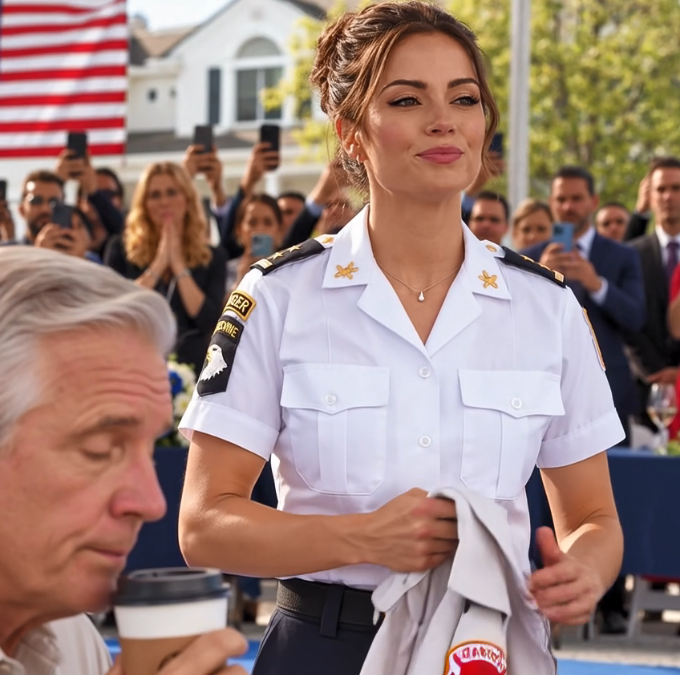
I stepped off the mat and picked up my jacket.
For three weeks, Ethan had blocked my driveway, mocked women in the Army, and asked strangely specific questions. Had I served in Afghanistan? Had I ever worked with Rangers? Did I know anything about Bagram?
I had assumed he was arrogant and bored.
Now those questions rearranged themselves into something uglier.
“Did your father ask you to question me?” I asked.
“No.”
“Ethan,” Richard snapped, “stop talking.”
Every phone turned toward him.
Ethan looked at his father. “Why?”
Samuel gave a grim nod. “There it is.”
Richard pointed at me. “You have no idea what you’re dragging into this neighborhood.”
“I didn’t bring it here.”
“You did,” Samuel said.
Then he faced the crowd.
“In August 2018, a convoy left Bagram Airfield carrying communications equipment and medical supplies. Its route was changed less than three hours before departure.”
The fundraiser disappeared around me.
I was thirty-two again, standing in an operations room with dust in my mouth and a red line drawn across a terrain map. I had rejected that alternate route twice because it had no aerial surveillance and too many exposed approaches.
A civilian contractor told me the shipment was behind schedule.
“Then it arrives late,” I had replied.
Twenty minutes later, the order came from above.
Use the alternate route.
I demanded written authorization and received it.
That document later kept me out of prison.
It did not keep three soldiers alive.
“The convoy was ambushed,” Samuel said.
A woman near the auction table covered her mouth.
Ethan looked at me. “Were people killed?”
“Three.”
His face changed.
“The attack wasn’t random,” I continued. “The people waiting on that road knew where the convoy would be.”
Samuel explained that we recovered part of the shipment two weeks later in a warehouse outside Kabul. Inside were crates that never appeared on the official manifest—encrypted radio components, night-vision equipment, and drone parts.
Restricted military technology.
Richard dismissed it as speculation assembled from incomplete reports.
Samuel reached into his jacket and removed a folded document.
“I signed the recovery inventory.”
Then he looked at me.
“And Victoria signed the original incident report.”
“That report disappeared,” I said.
Richard seized on the statement.
“She withdrew it.”
“No. I was ordered to sign a revised version.”
I had refused.
That refusal ended my career more effectively than any wound could have.
The official story called the ambush an intelligence failure. But intelligence had warned us against the alternate route. Someone connected to the logistics operation requested the change, cargo records were altered, equipment disappeared, and expensive lawyers spent years explaining why none of those facts belonged in the same investigation.
I filed a complaint with the Inspector General.
Then came closed-door interviews, stalled evaluations, a psychological assessment I had never requested, and a medical separation built around my injured knee.
Richard asked what had happened to my complaint.
“You already know,” I replied.
That silenced him.
Ethan turned toward his father.
“You knew who she was before she moved here?”
Richard said nothing.
“Did you tell me to bother her?”
“I told you to find out whether she remembered anything.”
Shock moved through the crowd.
Ethan stepped backward as though his father had struck him.
“You used me?”
“I protected you.”
“From what?”
“From this—from people digging up accusations that nearly destroyed everything I built.”
Samuel’s expression hardened.
“Three soldiers came home in flag-draped coffins.”
Richard insisted he had never leaked the route.
“Your company arranged the transport,” Samuel said.
“My company was not me.”
“You approved the local partner, the subcontract amendment, and the manifest.”
Richard’s voice cracked.
“Yes, but I did not leak the route.”
He looked at me.
“You think I’ve spent eight years afraid you would expose me?”
“Haven’t you?”
“No. I’ve spent eight years afraid you would remember the man standing beside me.”
A memory opened.
Bagram, the night before the ambush.
Two officers. An intelligence liaison. Three contractors. Richard.
And a silent civilian near the door wearing a silver watch.
When the transport representative pushed for the alternate road, that man nodded once. Everyone senior to me stopped objecting.
Samuel saw recognition in my face.
Richard admitted he had named the man during sealed testimony in 2020.
“How do you know about that?” I asked Samuel.
“Because your complaint was reopened eleven months ago.”
The words hit harder than Ethan’s challenge ever could.
Nobody had contacted me.
“Why was it reopened?”
“A former Caldwell Strategic Logistics employee turned over internal archives—emails, payment ledgers, satellite-phone logs, and route-change requests.”
Richard demanded the source’s name.
Samuel hesitated.
“The source disappeared six days ago. His apartment was empty. His car was still there.”
Then Samuel handed me an old photograph.
Seven people stood outside a prefabricated operations building at Bagram. I recognized my younger self, Richard, and the silent man with the silver watch.
But something in the window behind them caught my attention.
A uniformed figure appeared in the reflection. Only part of the right shoulder was visible, but I recognized the unit insignia.
Richard saw what I was studying, and the color drained from his face.
“Who took this?” I asked.
“Daniel Voss,” Samuel answered.
Richard stumbled into an auction table. A glass shattered.
“That man is dead.”
Daniel Voss had officially died in the same ambush that killed my soldiers. He was a civilian communications specialist, thirty-four years old, married, with one daughter. His body had never been recovered, but blood and personal effects were discovered inside a burned vehicle.
Then I remembered the morning of departure.
Daniel had handed me a radio ten minutes before the convoy rolled out.
He was not wearing body armor.
I asked whether he was coming with us.
“They changed my assignment,” he told me.
“Who?”
“Corporate.”
Then someone called my name, and I walked away.
“He wasn’t in the convoy,” I said.
Samuel frowned. “The report listed him.”
“The report was false.”
Richard lowered himself into a chair.
“Daniel found the payments,” he whispered.
“What payments?”
Richard looked at the phones, his son, and the neighbors who had treated him like a king.
Then he finally confessed.
The unlisted equipment was not being stolen from the convoy.
It was being delivered.
The vehicles were supposed to stop at an unofficial checkpoint. The hidden crates would be removed, and the convoy would continue. Because those crates never appeared on the manifest, nothing would be reported missing.
“But the convoy was ambushed instead,” Richard said. “That was never the plan.”
“You were trafficking restricted military equipment,” Samuel said.
“I was told it was an intelligence operation.”
“By whom?”
Richard looked at the silent man in the photograph.
“Marcus Vale.”
Before we could say more, a black SUV stopped beside my house.
A woman in her forties stepped out wearing a gray jacket. She crossed the street without acknowledging the dozens of phones pointed at her.
Richard stood.
“Victoria, don’t go near her.”
The woman stopped at the mat.
“Captain Hayes?”
She reached slowly into her jacket and tossed me an old military challenge coin.
One side carried my former unit’s insignia. The other had two initials scratched into the metal.
D.V.
“Daniel told me you would recognize it,” she said.
“Daniel is alive?”
“For now.”
She removed a black flash drive.
“Daniel copied everything before he disappeared—contracts, audio recordings, payment ledgers, convoy changes, names, and the original footage from the operations room.”
“What does he want from me?”
“He wants you to finish what you started eight years ago.”
My phone rang.
Unknown number.
When I answered, static filled the line.
Then a tired voice spoke.
“Captain Hayes?”
My knees nearly failed.
“Daniel?”
“Don’t trust the woman who brought you the drive.”
I slowly turned toward her.
Behind her, the SUV’s rear door opened.
Daniel told me to ask who her father was.
The woman’s smile vanished.
“My name is Evelyn Vale,” she said. “Marcus Vale is my father.”
Richard made a choking sound.
Evelyn admitted she had once worked as junior counsel for her father’s consulting company. My complaint had crossed her desk, and she had helped challenge my credibility because she believed Marcus.
That changed when she discovered payments routed through subcontractors connected to the diverted equipment.
“My father controlled the operation,” she said.
Daniel confirmed that the flash drive was genuine but incomplete. There was another recording—the meeting before the convoy left.
Evelyn had believed it destroyed.
Daniel had lied to protect it.
“The recording shows who ordered the route change,” he said.
“Marcus Vale?”
“Vale wanted the shipment moved, but someone else finalized the road change—the officer whose signature ended your career.”
The call disconnected.
Richard named that officer.
Lieutenant Colonel Rebecca Shaw.
My battalion commander.
The woman who sat beside my hospital bed after the ambush and told me to heal first and fight later.
The woman whose signature later removed me from operational command.
Samuel objected immediately.
“Shaw wasn’t in the room when the route change came through. I was attached to logistics oversight. She arrived afterward.”
I stared at him.
“Everybody knows pieces of my life except me.”
Headlights swept across the tent.
A dark sedan stopped at the curb, and an elderly woman stepped out with silver hair, a straight posture, and a walking cane.
Rebecca Shaw crossed the street.
She stopped in front of me.
“Captain Hayes.”
“You signed it.”
“My recommendation ending your operational status? Yes.”
“The route change?”
“No.”
“Then why did you remove me?”
“Because the morning after you filed your complaint, Marcus Vale asked for your travel schedule.”
She opened her purse and handed me an envelope containing memoranda, threat assessments, transfer recommendations, and medical paperwork.
One note read:
IMMEDIATE REASSIGNMENT ADVISED. THREAT ASSESSMENT ACTIVE.
“I never saw this.”
“You weren’t supposed to.”
“You let me believe I failed.”
“I let Vale believe bureaucracy had defeated you.”
Shaw used my injured knee, psychological evaluation, and reassignment to make me look exhausted, wounded, and professionally irrelevant.
Vale stopped watching me.
“You allowed me to hate you for eight years.”
“Yes.”
“That wasn’t your choice to make.”
“No,” she said softly. “But you survived.”
Another black sedan appeared at the end of the street.
An elegant man stepped out wearing a gray suit and a silver watch.
Marcus Vale walked toward us without bodyguards or visible fear.
He greeted Rebecca as though they had met for dinner.
Then he looked at me.
“Captain Hayes.”
“Who changed the route?”
Vale smiled.
“You still believe there is one villain.”
Richard accused him openly.
“You were supposed to remove the crates. Nobody was supposed to die.”
Vale’s smile vanished.
Evelyn raised her phone.
“But federal investigators listening to this call might care that you knew about the crates,” she said.
For the first time, Marcus Vale looked afraid.
He tried to redirect the blame toward Shaw and Daniel.
That was when Shaw admitted she had removed Daniel from the convoy.
The night before departure, Daniel brought her evidence that manifests were being falsified. Hours later, someone searched his quarters. Shaw hid him and falsified his assignment record.
When the convoy was attacked, Daniel’s belongings were found in a burned vehicle because someone had planted them there.
“They wanted us to believe Daniel died with the others,” Shaw said.
Then I remembered Marcus walking through the operations building after the attack, asking one question repeatedly.
Was Voss confirmed dead?
“You were checking whether Daniel had survived,” I said.
Sirens grew louder in the distance.
Richard faced his son.
“I should have spoken eight years ago. I told myself I was protecting the company and protecting you. I was protecting myself.”
Then he looked at me.
“I’ll testify.”
Vale warned that he would go to prison.
“Maybe,” Richard answered.
That stripped the confidence from Vale’s face.
My phone rang again.
Daniel.
“Look across the street,” he said.
A thin, bearded man stepped from behind Walt’s house.
Older than his photograph, but alive.
Daniel Voss walked beneath the fundraiser lights carrying a small digital recorder.
Marcus backed away.
“Impossible.”
Daniel stopped in front of him.
“No. Just inconvenient.”
He pressed play.
Marcus Vale’s voice filled the street.
“Change the route. Caldwell’s people will handle the checkpoint. Shaw can sign the cleanup afterward.”
Then Rebecca’s younger voice entered the recording.
“If anything happens to Hayes or her team, I bury you.”
Daniel turned toward me.
“That was the moment Shaw turned against him.”
Federal vehicles arrived minutes later.
There was no chase or gunfire—only badges, sealed evidence bags, and Marcus Vale realizing that his greatest protection had never been money.
It had been everyone else’s silence.
Before investigators led him away, he looked at me.
“You think this restores eight years?”
“No.”
“Then what did you win?”
I looked at Daniel, Shaw, Samuel, and the phones that had recorded everything.
“I wasn’t trying to win.”
The months that followed changed the story of Bagram.
Evelyn surrendered records she had preserved. Richard testified. Daniel authenticated the duplicate manifests. Samuel produced the recovery inventory. Shaw opened her private archive and revealed the original report I had been told was lost.
Every page remained intact.
I had never withdrawn a single word.
Investigators found that Marcus Vale had exploited legitimate operations to divert restricted equipment through unauthorized channels. Richard had approved commercial arrangements without asking questions he suspected he would not like answered. When soldiers died, he chose silence.
Vale kept everyone controlled by making each person fear the others.
Ethan came to my door a week after the fundraiser.
No expensive car. No camera. No smirk.
He carried the white envelope containing the ten thousand dollars he had placed on the table before challenging me.
“I lost.”
“This stopped being about the match.”
“Not to me. I humiliated you because I wanted everyone watching me.”
He lowered his eyes.
“Then I saw what they saw.”
I accepted the money and donated every dollar to the veterans fund.
Ethan handed me another envelope containing a fifty-thousand-dollar check from his tournament savings for the families of the three soldiers killed in the ambush.
“Give it to them yourself,” I said.
“Why?”
“Because writing a check is easy. Looking into their eyes isn’t.”
Two months later, Ethan did it.
Richard went with him.
So did I.
Sergeant Luis Ortega’s mother embraced me.
“I couldn’t save him,” I whispered.
She touched my face.
“I didn’t say you saved him. I said you brought my boy home.”
For eight years, I had carried three ghosts.
That afternoon, they finally felt less like ghosts and more like men whose names could be spoken without destroying me.
Three weeks later, an official Army letter arrived.
Rebecca had written two words on the envelope:
OPEN IT.
My record had been amended. The disputed evaluation was removed, my complaint findings were corrected, and a commendation recommended in 2018 had finally been approved.
I sat alone at my kitchen table and cried.
Not because the Army had admitted I was right.
Because someone had kept the truth alive when I no longer had the strength to carry it.
One year after Ethan slapped ten thousand dollars onto that fundraiser table, Larksburg Court held another event in the same park.
The enormous Caldwell sponsor banner was gone.
A smaller sign stood in its place:
THE ORTEGA–MILLER–JENSEN VETERANS SUPPORT FUND.
The three soldiers’ families stood beneath it.
Daniel was there, no longer hiding, with the daughter he had been unable to see safely for years.
Evelyn had entered a cooperation agreement and rebuilt her life away from her father.
Richard sold most of his holdings while the investigation continued. Part of the money went into a fund for veterans and military families harmed by contractor misconduct.
He never called it redemption.
He simply arrived every Saturday and carried tables.
Ethan continued training jiu-jitsu, but his arrogance had changed into discipline. Under Carlos’s supervision, he taught free youth classes twice a week.
That afternoon, Ethan handed me an envelope.
“It isn’t money,” he promised.
Inside was the restored photograph from Bagram.
On the back, he had written:
Sometimes the person in the background is the reason you survived the picture.
Rebecca stood twenty feet away.
I walked toward her.
“You could have told me.”
“I could have.”
“I hated you.”
“I know.”
“For years.”
“You were very committed to it.”
I laughed despite myself.
Then I hugged her.
She remained stiff for a moment before holding me back.
Later, Carlos called us toward the blue mats.
Ethan stepped onto them and raised both hands.
“No money this time.”
“Smart.”
“No ego either.”
“I’ll believe that when I see it.”
He pointed toward a ten-year-old girl wearing an oversized gi.
Luis Ortega’s niece.
“She wants to learn the takedown you used on me.”
The girl corrected him.
“I’ve been asking for four months.”
I stepped onto the mat.
She looked up at me.
“Were you really a Ranger?”
“Yes.”
“Were you scared?”
The question caught me.
“Yes.”
“But Rangers aren’t scared.”
“Everyone is scared sometimes.”
“Then how were you brave?”
I tapped the center of her chest.
“Being brave doesn’t mean fear disappears. It means fear doesn’t make every decision.”
She considered that, then pointed toward Ethan.
“Can I throw him now?”
“Absolutely.”
Ten minutes later, she sent Ethan rolling dramatically across the mat.
He stayed flat on his back.
“I’ve made another terrible decision.”
The girl raised both arms while the crowd cheered.
Then Denise brought me a wooden box.
Inside was a challenge coin engraved with three sets of initials:
L.O.
T.M.
A.J.
Beneath them were five words:
WE CAME HOME WITH YOU.
My vision blurred.
Luis’s mother smiled.
“We had it made.”
Rebecca touched my shoulder.
“What now, Captain?”
There had been a time when hearing that rank hurt.
Now it no longer defined what I had lost.
It reminded me of what had survived.
Across the mat, Ethan taught the children how to fall safely. Richard carried chairs. Daniel laughed with his daughter. Samuel and Walt argued over who had first recognized my Ranger scroll.
Beside the veterans booth stood a new sign:
HAYES RESILIENCE & SELF-DEFENSE CENTER
INSTRUCTOR: VICTORIA HAYES
Rebecca had funded it anonymously.
When I confronted her, she looked offended.
“Prove it.”
Then Luis’s niece ran toward me carrying Ethan’s original white envelope.
Inside was a single dollar and a handwritten note:
Ten thousand dollars started the fight. One dollar starts something better. First student enrolled.
“Classes begin next month,” I told her.
She shook her head.
“Start now.”
For eight years, I had waited for someone to return my career, my name, my certainty, and the life I had before Bagram.
Standing beneath the evening sky, I finally understood that I did not need my old life returned.
I had built a new one.
I removed my jacket, revealing the Ranger scroll on my shoulder.
The girl stepped onto the mat and raised her hands.
“Ready?” I asked.
She grinned.
“Try to take me down.”
Behind us, Ethan groaned.
The neighborhood burst into laughter.
For the first time since Bagram, I heard no echoes behind that sound.
Only home.
THE END
Have you finished reading the story and want to read it again?
PART 2
Richard Caldwell had gone pale.
Not embarrassed. Not angry.
Afraid.
Across the mat, Ethan pushed himself onto one elbow, still stunned that the quiet woman he had mocked had taken him down in seconds.
“What does my father have to do with this?”
Nobody answered.
The older veteran who had stepped from the crowd kept his eyes fixed on Richard.
“You remember Bagram, don’t you?”
Richard adjusted the cuff of his expensive shirt. “I have no idea what you’re talking about.”
“My name is Samuel Mercer.”
Something flickered in Richard’s eyes.
It vanished quickly, but Samuel and I both saw it.
“You remember me,” Samuel said.
Richard pointed toward the street. “You need to leave.”
Samuel didn’t move.
“Richard owned Caldwell Strategic Logistics,” he told the crowd. “The company held a Department of Defense subcontract in Afghanistan.”
A murmur spread beneath the fundraiser tent. Everyone in Larksburg Court knew Caldwell Development—the luxury apartments, retail centers, and commercial properties. Nobody had heard of Caldwell Strategic Logistics.
Richard looked around at the phones still recording.
“This is a private event.”
“No,” Walt said, stepping beside Samuel. “It’s a veterans fundraiser.”
That distinction mattered.
Richard demanded that everyone stop recording. Nobody listened.
Then he looked directly at me.
“Captain Hayes,” he said.
My stomach tightened.
Richard had just exposed himself.
Until that moment, I had never told anyone on Larksburg Court my former rank.
Ethan stared at his father. “You said she was some supply officer.”
I stepped off the mat and picked up my jacket.
For three weeks, Ethan had blocked my driveway, mocked women in the Army, and asked strangely specific questions. Had I served in Afghanistan? Had I ever worked with Rangers? Did I know anything about Bagram?
I had assumed he was arrogant and bored.
Now those questions rearranged themselves into something uglier.
“Did your father ask you to question me?” I asked.
“No.”
“Ethan,” Richard snapped, “stop talking.”
Every phone turned toward him.
Ethan looked at his father. “Why?”
Samuel gave a grim nod. “There it is.”
Richard pointed at me. “You have no idea what you’re dragging into this neighborhood.”
“I didn’t bring it here.”
“You did,” Samuel said.
Then he faced the crowd.
“In August 2018, a convoy left Bagram Airfield carrying communications equipment and medical supplies. Its route was changed less than three hours before departure.”
The fundraiser disappeared around me.
I was thirty-two again, standing in an operations room with dust in my mouth and a red line drawn across a terrain map. I had rejected that alternate route twice because it had no aerial surveillance and too many exposed approaches.
A civilian contractor told me the shipment was behind schedule.
“Then it arrives late,” I had replied.
Twenty minutes later, the order came from above.
Use the alternate route.
I demanded written authorization and received it.
That document later kept me out of prison.
It did not keep three soldiers alive.
“The convoy was ambushed,” Samuel said.
A woman near the auction table covered her mouth.
Ethan looked at me. “Were people killed?”
“Three.”
His face changed.
“The attack wasn’t random,” I continued. “The people waiting on that road knew where the convoy would be.”
Samuel explained that we recovered part of the shipment two weeks later in a warehouse outside Kabul. Inside were crates that never appeared on the official manifest—encrypted radio components, night-vision equipment, and drone parts.
Restricted military technology.
Richard dismissed it as speculation assembled from incomplete reports.
Samuel reached into his jacket and removed a folded document.
“I signed the recovery inventory.”
Then he looked at me.
“And Victoria signed the original incident report.”
“That report disappeared,” I said.
Richard seized on the statement.
“She withdrew it.”
“No. I was ordered to sign a revised version.”
I had refused.
That refusal ended my career more effectively than any wound could have.
The official story called the ambush an intelligence failure. But intelligence had warned us against the alternate route. Someone connected to the logistics operation requested the change, cargo records were altered, equipment disappeared, and expensive lawyers spent years explaining why none of those facts belonged in the same investigation.
I filed a complaint with the Inspector General.
Then came closed-door interviews, stalled evaluations, a psychological assessment I had never requested, and a medical separation built around my injured knee.
Richard asked what had happened to my complaint.
“You already know,” I replied.
That silenced him.
Ethan turned toward his father.
“You knew who she was before she moved here?”
Richard said nothing.
“Did you tell me to bother her?”
“I told you to find out whether she remembered anything.”
Shock moved through the crowd.
Ethan stepped backward as though his father had struck him.
“You used me?”
“I protected you.”
“From what?”
“From this—from people digging up accusations that nearly destroyed everything I built.”
Samuel’s expression hardened.
“Three soldiers came home in flag-draped coffins.”
Richard insisted he had never leaked the route.
“Your company arranged the transport,” Samuel said.
“My company was not me.”
“You approved the local partner, the subcontract amendment, and the manifest.”
Richard’s voice cracked.
“Yes, but I did not leak the route.”
He looked at me.
“You think I’ve spent eight years afraid you would expose me?”
“Haven’t you?”
“No. I’ve spent eight years afraid you would remember the man standing beside me.”
A memory opened.
Bagram, the night before the ambush.
Two officers. An intelligence liaison. Three contractors. Richard.
And a silent civilian near the door wearing a silver watch.
When the transport representative pushed for the alternate road, that man nodded once. Everyone senior to me stopped objecting.
Samuel saw recognition in my face.
Richard admitted he had named the man during sealed testimony in 2020.
“How do you know about that?” I asked Samuel.
“Because your complaint was reopened eleven months ago.”
The words hit harder than Ethan’s challenge ever could.
Nobody had contacted me.
“Why was it reopened?”
“A former Caldwell Strategic Logistics employee turned over internal archives—emails, payment ledgers, satellite-phone logs, and route-change requests.”
Richard demanded the source’s name.
Samuel hesitated.
“The source disappeared six days ago. His apartment was empty. His car was still there.”
Then Samuel handed me an old photograph.
Seven people stood outside a prefabricated operations building at Bagram. I recognized my younger self, Richard, and the silent man with the silver watch.
But something in the window behind them caught my attention.
A uniformed figure appeared in the reflection. Only part of the right shoulder was visible, but I recognized the unit insignia.
Richard saw what I was studying, and the color drained from his face.
“Who took this?” I asked.
“Daniel Voss,” Samuel answered.
Richard stumbled into an auction table. A glass shattered.
“That man is dead.”
Daniel Voss had officially died in the same ambush that killed my soldiers. He was a civilian communications specialist, thirty-four years old, married, with one daughter. His body had never been recovered, but blood and personal effects were discovered inside a burned vehicle.
Then I remembered the morning of departure.
Daniel had handed me a radio ten minutes before the convoy rolled out.
He was not wearing body armor.
I asked whether he was coming with us.
“They changed my assignment,” he told me.
“Who?”
“Corporate.”
Then someone called my name, and I walked away.
“He wasn’t in the convoy,” I said.
Samuel frowned. “The report listed him.”
“The report was false.”
Richard lowered himself into a chair.
“Daniel found the payments,” he whispered.
“What payments?”
Richard looked at the phones, his son, and the neighbors who had treated him like a king.
Then he finally confessed.
The unlisted equipment was not being stolen from the convoy.
It was being delivered.
The vehicles were supposed to stop at an unofficial checkpoint. The hidden crates would be removed, and the convoy would continue. Because those crates never appeared on the manifest, nothing would be reported missing.
“But the convoy was ambushed instead,” Richard said. “That was never the plan.”
“You were trafficking restricted military equipment,” Samuel said.
“I was told it was an intelligence operation.”
“By whom?”
Richard looked at the silent man in the photograph.
“Marcus Vale.”
Before we could say more, a black SUV stopped beside my house.
A woman in her forties stepped out wearing a gray jacket. She crossed the street without acknowledging the dozens of phones pointed at her.
Richard stood.
“Victoria, don’t go near her.”
The woman stopped at the mat.
“Captain Hayes?”
She reached slowly into her jacket and tossed me an old military challenge coin.
One side carried my former unit’s insignia. The other had two initials scratched into the metal.
D.V.
“Daniel told me you would recognize it,” she said.
“Daniel is alive?”
“For now.”
She removed a black flash drive.
“Daniel copied everything before he disappeared—contracts, audio recordings, payment ledgers, convoy changes, names, and the original footage from the operations room.”
“What does he want from me?”
“He wants you to finish what you started eight years ago.”
My phone rang.
Unknown number.
When I answered, static filled the line.
Then a tired voice spoke.
“Captain Hayes?”
My knees nearly failed.
“Daniel?”
“Don’t trust the woman who brought you the drive.”
I slowly turned toward her.
Behind her, the SUV’s rear door opened.
Daniel told me to ask who her father was.
The woman’s smile vanished.
“My name is Evelyn Vale,” she said. “Marcus Vale is my father.”
Richard made a choking sound.
Evelyn admitted she had once worked as junior counsel for her father’s consulting company. My complaint had crossed her desk, and she had helped challenge my credibility because she believed Marcus.
That changed when she discovered payments routed through subcontractors connected to the diverted equipment.
“My father controlled the operation,” she said.
Daniel confirmed that the flash drive was genuine but incomplete. There was another recording—the meeting before the convoy left.
Evelyn had believed it destroyed.
Daniel had lied to protect it.
“The recording shows who ordered the route change,” he said.
“Marcus Vale?”
“Vale wanted the shipment moved, but someone else finalized the road change—the officer whose signature ended your career.”
The call disconnected.
Richard named that officer.
Lieutenant Colonel Rebecca Shaw.
My battalion commander.
The woman who sat beside my hospital bed after the ambush and told me to heal first and fight later.
The woman whose signature later removed me from operational command.
Samuel objected immediately.
“Shaw wasn’t in the room when the route change came through. I was attached to logistics oversight. She arrived afterward.”
I stared at him.
“Everybody knows pieces of my life except me.”
Headlights swept across the tent.
A dark sedan stopped at the curb, and an elderly woman stepped out with silver hair, a straight posture, and a walking cane.
Rebecca Shaw crossed the street.
She stopped in front of me.
“Captain Hayes.”
“You signed it.”
“My recommendation ending your operational status? Yes.”
“The route change?”
“No.”
“Then why did you remove me?”
“Because the morning after you filed your complaint, Marcus Vale asked for your travel schedule.”
She opened her purse and handed me an envelope containing memoranda, threat assessments, transfer recommendations, and medical paperwork.
One note read:
IMMEDIATE REASSIGNMENT ADVISED. THREAT ASSESSMENT ACTIVE.
“I never saw this.”
“You weren’t supposed to.”
“You let me believe I failed.”
“I let Vale believe bureaucracy had defeated you.”
Shaw used my injured knee, psychological evaluation, and reassignment to make me look exhausted, wounded, and professionally irrelevant.
Vale stopped watching me.
“You allowed me to hate you for eight years.”
“Yes.”
“That wasn’t your choice to make.”
“No,” she said softly. “But you survived.”
Another black sedan appeared at the end of the street.
An elegant man stepped out wearing a gray suit and a silver watch.
Marcus Vale walked toward us without bodyguards or visible fear.
He greeted Rebecca as though they had met for dinner.
Then he looked at me.
“Captain Hayes.”
“Who changed the route?”
Vale smiled.
“You still believe there is one villain.”
Richard accused him openly.
“You were supposed to remove the crates. Nobody was supposed to die.”
Vale’s smile vanished.
Evelyn raised her phone.
“But federal investigators listening to this call might care that you knew about the crates,” she said.
For the first time, Marcus Vale looked afraid.
He tried to redirect the blame toward Shaw and Daniel.
That was when Shaw admitted she had removed Daniel from the convoy.
The night before departure, Daniel brought her evidence that manifests were being falsified. Hours later, someone searched his quarters. Shaw hid him and falsified his assignment record.
When the convoy was attacked, Daniel’s belongings were found in a burned vehicle because someone had planted them there.
“They wanted us to believe Daniel died with the others,” Shaw said.
Then I remembered Marcus walking through the operations building after the attack, asking one question repeatedly.
Was Voss confirmed dead?
“You were checking whether Daniel had survived,” I said.
Sirens grew louder in the distance.
Richard faced his son.
“I should have spoken eight years ago. I told myself I was protecting the company and protecting you. I was protecting myself.”
Then he looked at me.
“I’ll testify.”
Vale warned that he would go to prison.
“Maybe,” Richard answered.
That stripped the confidence from Vale’s face.
My phone rang again.
Daniel.
“Look across the street,” he said.
A thin, bearded man stepped from behind Walt’s house.
Older than his photograph, but alive.
Daniel Voss walked beneath the fundraiser lights carrying a small digital recorder.
Marcus backed away.
“Impossible.”
Daniel stopped in front of him.
“No. Just inconvenient.”
He pressed play.
Marcus Vale’s voice filled the street.
“Change the route. Caldwell’s people will handle the checkpoint. Shaw can sign the cleanup afterward.”
Then Rebecca’s younger voice entered the recording.
“If anything happens to Hayes or her team, I bury you.”
Daniel turned toward me.
“That was the moment Shaw turned against him.”
Federal vehicles arrived minutes later.
There was no chase or gunfire—only badges, sealed evidence bags, and Marcus Vale realizing that his greatest protection had never been money.
It had been everyone else’s silence.
Before investigators led him away, he looked at me.
“You think this restores eight years?”
“No.”
“Then what did you win?”
I looked at Daniel, Shaw, Samuel, and the phones that had recorded everything.
“I wasn’t trying to win.”
The months that followed changed the story of Bagram.
Evelyn surrendered records she had preserved. Richard testified. Daniel authenticated the duplicate manifests. Samuel produced the recovery inventory. Shaw opened her private archive and revealed the original report I had been told was lost.
Every page remained intact.
I had never withdrawn a single word.
Investigators found that Marcus Vale had exploited legitimate operations to divert restricted equipment through unauthorized channels. Richard had approved commercial arrangements without asking questions he suspected he would not like answered. When soldiers died, he chose silence.
Vale kept everyone controlled by making each person fear the others.
Ethan came to my door a week after the fundraiser.
No expensive car. No camera. No smirk.
He carried the white envelope containing the ten thousand dollars he had placed on the table before challenging me.
“I lost.”
“This stopped being about the match.”
“Not to me. I humiliated you because I wanted everyone watching me.”
He lowered his eyes.
“Then I saw what they saw.”
I accepted the money and donated every dollar to the veterans fund.
Ethan handed me another envelope containing a fifty-thousand-dollar check from his tournament savings for the families of the three soldiers killed in the ambush.
“Give it to them yourself,” I said.
“Why?”
“Because writing a check is easy. Looking into their eyes isn’t.”
Two months later, Ethan did it.
Richard went with him.
So did I.
Sergeant Luis Ortega’s mother embraced me.
“I couldn’t save him,” I whispered.
She touched my face.
“I didn’t say you saved him. I said you brought my boy home.”
For eight years, I had carried three ghosts.
That afternoon, they finally felt less like ghosts and more like men whose names could be spoken without destroying me.
Three weeks later, an official Army letter arrived.
Rebecca had written two words on the envelope:
OPEN IT.
My record had been amended. The disputed evaluation was removed, my complaint findings were corrected, and a commendation recommended in 2018 had finally been approved.
I sat alone at my kitchen table and cried.
Not because the Army had admitted I was right.
Because someone had kept the truth alive when I no longer had the strength to carry it.
One year after Ethan slapped ten thousand dollars onto that fundraiser table, Larksburg Court held another event in the same park.
The enormous Caldwell sponsor banner was gone.
A smaller sign stood in its place:
THE ORTEGA–MILLER–JENSEN VETERANS SUPPORT FUND.
The three soldiers’ families stood beneath it.
Daniel was there, no longer hiding, with the daughter he had been unable to see safely for years.
Evelyn had entered a cooperation agreement and rebuilt her life away from her father.
Richard sold most of his holdings while the investigation continued. Part of the money went into a fund for veterans and military families harmed by contractor misconduct.
He never called it redemption.
He simply arrived every Saturday and carried tables.
Ethan continued training jiu-jitsu, but his arrogance had changed into discipline. Under Carlos’s supervision, he taught free youth classes twice a week.
That afternoon, Ethan handed me an envelope.
“It isn’t money,” he promised.
Inside was the restored photograph from Bagram.
On the back, he had written:
Sometimes the person in the background is the reason you survived the picture.
Rebecca stood twenty feet away.
I walked toward her.
“You could have told me.”
“I could have.”
“I hated you.”
“I know.”
“For years.”
“You were very committed to it.”
I laughed despite myself.
Then I hugged her.
She remained stiff for a moment before holding me back.
Later, Carlos called us toward the blue mats.
Ethan stepped onto them and raised both hands.
“No money this time.”
“Smart.”
“No ego either.”
“I’ll believe that when I see it.”
He pointed toward a ten-year-old girl wearing an oversized gi.
Luis Ortega’s niece.
“She wants to learn the takedown you used on me.”
The girl corrected him.
“I’ve been asking for four months.”
I stepped onto the mat.
She looked up at me.
“Were you really a Ranger?”
“Yes.”
“Were you scared?”
The question caught me.
“Yes.”
“But Rangers aren’t scared.”
“Everyone is scared sometimes.”
“Then how were you brave?”
I tapped the center of her chest.
“Being brave doesn’t mean fear disappears. It means fear doesn’t make every decision.”
She considered that, then pointed toward Ethan.
“Can I throw him now?”
“Absolutely.”
Ten minutes later, she sent Ethan rolling dramatically across the mat.
He stayed flat on his back.
“I’ve made another terrible decision.”
The girl raised both arms while the crowd cheered.
Then Denise brought me a wooden box.
Inside was a challenge coin engraved with three sets of initials:
L.O.
T.M.
A.J.
Beneath them were five words:
WE CAME HOME WITH YOU.
My vision blurred.
Luis’s mother smiled.
“We had it made.”
Rebecca touched my shoulder.
“What now, Captain?”
There had been a time when hearing that rank hurt.
Now it no longer defined what I had lost.
It reminded me of what had survived.
Across the mat, Ethan taught the children how to fall safely. Richard carried chairs. Daniel laughed with his daughter. Samuel and Walt argued over who had first recognized my Ranger scroll.
Beside the veterans booth stood a new sign:
HAYES RESILIENCE & SELF-DEFENSE CENTER
INSTRUCTOR: VICTORIA HAYES
Rebecca had funded it anonymously.
When I confronted her, she looked offended.
“Prove it.”
Then Luis’s niece ran toward me carrying Ethan’s original white envelope.
Inside was a single dollar and a handwritten note:
Ten thousand dollars started the fight. One dollar starts something better. First student enrolled.
“Classes begin next month,” I told her.
She shook her head.
“Start now.”
For eight years, I had waited for someone to return my career, my name, my certainty, and the life I had before Bagram.
Standing beneath the evening sky, I finally understood that I did not need my old life returned.
I had built a new one.
I removed my jacket, revealing the Ranger scroll on my shoulder.
The girl stepped onto the mat and raised her hands.
“Ready?” I asked.
She grinned.
“Try to take me down.”
Behind us, Ethan groaned.
The neighborhood burst into laughter.
For the first time since Bagram, I heard no echoes behind that sound.
Only home.
THE END








