For Two Years, an Abandoned Dog Waited Inside the House Where His Owner Had Disappeared
𝗙𝗨𝗟𝗟 𝗦𝗧𝗢𝗥𝗬
He blinked.
“But you’re not alone anymore.”
I sat with him for a while, speaking softly and allowing him to rest.
Occasionally, he shifted his eyes toward me.
Most of the time, he simply slept.
I couldn’t stop comparing that quiet room with the abandoned house.
Here, his bedding was clean.
His wounds were being treated.
His meals were carefully prepared.
And whenever something changed in his condition, someone was nearby to notice.
It was everything he should have had all along.
The next few days demanded patience.
We couldn’t rush his recovery, no matter how badly we wanted to see him improve.
His body needed time to respond to nutritional support.
His skin needed time to heal.
The sores that had developed during his prolonged neglect required consistent attention.
And the parasites that had caused him so much additional discomfort had to be eliminated.
Every part of his recovery seemed connected to another.
If his skin hurt, resting comfortably became difficult.
If he remained exhausted, eating required tremendous effort.
If his nutritional needs weren’t carefully managed, his already fragile body could face additional complications.
I began learning to appreciate the smallest changes.
One morning, the veterinary staff told me he had tolerated his feeding better than before.
I smiled so broadly that one of the technicians laughed.
“That’s good news, isn’t it?”
“It’s wonderful.”
Another day, he seemed more alert.
When I approached, he followed me with his eyes instead of remaining almost completely unresponsive.
“Well, hello there.”
I knelt beside him.
“You’re looking at me today.”
His ears moved slightly.
I felt tears gathering again.
“That’s my boy.”
I knew that calling him strong didn’t make his medical problems disappear.
But I needed him to know, in whatever way he could understand, that somebody was still there.
Somebody was paying attention.
Somebody was coming back.
I think that last part mattered to me most.
After everything he had endured in the abandoned house, I couldn’t bear the thought of him waking up and believing he had been forgotten again.
So whenever I visited, I approached with the same gentle greeting.
“Hello, sweetheart. It’s me.”
At first, there was almost no response.
Then he began moving his eyes toward my voice.
Eventually, I noticed that his expression seemed to change slightly when I entered the room.
Perhaps he was simply becoming more alert as his strength returned.
Perhaps he was beginning to recognize me.
Either way, those small changes made the difficult days easier.
His cleaning and wound care remained delicate.
He had so little fur left that much of his skin was exposed, and the inflamed areas required particularly gentle treatment.
Sometimes, while helping care for him, I found myself imagining what his coat might have looked like before he became so ill.
Had he once been a fluffy dog who enjoyed having his ears scratched?
Had he spent evenings curled beside someone’s chair?
Had he eagerly greeted his owner at the door?
I didn’t know.
There was no one standing beside us who could tell me about his former personality.
No photographs of happier days had accompanied him out of the house.
All we had was the animal in front of us and the fragile possibility of helping him become comfortable again.
I decided that was enough.
We didn’t need to know every detail of his past to give him a different future.
During one of his cleaning sessions, he lifted his head a fraction of an inch.
I noticed immediately.
“Hey, look at you.”
He couldn’t maintain the position for long.
His head lowered again.
But the movement had been deliberate.
I looked toward the person assisting me.
“Did you see that?”
“He’s getting a little stronger.”
I smiled down at him.
“That’s right, sweetheart.”
I gently stroked his head.
“Take your time.”
The words became almost a daily ritual.
Take your time.
There was no reason to force his body to accomplish things it wasn’t ready to do.
If he needed to sleep, he could sleep.
If sitting upright was too difficult, he could remain comfortably supported.
And if all he could manage during a particular feeding was the amount prescribed by the veterinarian, that was enough.
For the first time in a very long while, he didn’t have to struggle through everything alone.
Still, there were moments when fear returned.
Sometimes I looked at his thin body and wondered whether we had discovered him too late.
His ribs were still prominent.
His skin was still healing.
He remained so weak that even the smallest effort seemed exhausting.
I would sit beside him and imagine the empty rooms of the abandoned house.
What if we hadn’t gone there?
What if another week had passed?
What if nobody had discovered him until the silence inside that building became permanent?
I hated those thoughts.
But they reminded me how precious every day of progress was.
One evening, after helping settle him into clean bedding, I noticed him watching me.
“What’s the matter, sweetheart?”
His eyes followed my hand as I adjusted the blanket.
I reached toward him.
He made a tiny movement with his head.
For an instant, I thought he might be trying to move closer.
I rested my hand gently against him.
“There you go.”
His body relaxed.
I stayed until he fell asleep.
There was something incredibly moving about watching a dog who had endured so much finally rest without being surrounded by filth and neglect.
His recovery wasn’t dramatic.
There was no sudden moment when he jumped to his feet, wagged his tail, and became a completely different animal.
Instead, it unfolded through dozens of quiet victories that might have seemed insignificant to anyone who hadn’t seen the condition in which we found him.
He began tolerating his meals better.
His breathing became calmer.
His body gradually grew cleaner and more comfortable as treatment continued.
The terrible odor that had accompanied him out of the abandoned house began fading.
And then, as we approached the tenth day after his rescue, something happened that I had been afraid to hope for.
He sat up.
I had just approached his resting place when I noticed that he was moving differently.
His front legs shifted beneath him.
For a moment, I thought he was simply trying to find a more comfortable position.
Then he began pushing himself upward.
“Oh, sweetheart.”
I stopped moving.
He struggled.
His body trembled with the effort.
I wanted to reach forward and help immediately, but I also wanted to see whether he could manage the movement safely.
A caretaker stayed beside him, ready to support him if necessary.
“Easy,” I whispered.
He continued pushing.
His front legs straightened.
Then, slowly, unbelievably, he lifted his body into a sitting position.
I stared.
For several seconds, I couldn’t speak.
The dog who had been unable to lift himself from the filthy floor of an abandoned house was sitting upright.
He looked terribly thin.
His skin still showed the effects of prolonged neglect.
And he seemed exhausted by the effort.
But he was sitting.
“Oh, my God.”
My voice broke.
“Look at you.”
He turned his head slightly toward me.
I knelt.
“You’re sitting up!”
The caretaker smiled.
“He’s been making progress.”
I pressed one hand against my mouth.
I had been present for countless difficult moments during his care, but nothing had prepared me for the emotion of watching him accomplish something so ordinary.
Most dogs sit without thinking about it.
They sit when they want a treat.
They sit when they wait for a walk.
They sit beside their owners while somebody watches television or prepares dinner.
For this dog, sitting upright represented an extraordinary return of strength.
It meant his body was beginning to recover from a level of neglect that had nearly destroyed him.
I gently stroked his head.
“You’re doing so well.”
He blinked.
I laughed through my tears.
“I know. I know you’re probably wondering why I’m making such a fuss.”
He remained upright for a little while longer before needing to rest.
When he finally lowered himself back onto the bedding, I felt nothing but pride.
Ten days earlier, he had been unable to move.
Now he had shown us that his body was beginning to reclaim some of the abilities that starvation and illness had taken away.
His appetite was improving too.
The carefully managed meals that had initially required so much effort were becoming easier for him to accept.
He began eating a little more according to his veterinary feeding plan, and the additional nourishment gradually helped him gain weight.
I watched those changes with almost obsessive attention.
Every small improvement mattered.
When the staff told me his skin was beginning to heal, I wanted to celebrate.
When I noticed that he appeared more comfortable during rest, I felt deeply relieved.
And when he looked toward me with growing alertness, I sometimes found myself talking to him as though we were old friends.
“Remember that terrible house?”
Of course, he didn’t answer.
“I wish I knew what you were thinking when we found you.”
He watched me.
I gently touched his head.
“But you don’t have to go back there.”
That was the one part of his future I felt certain about.
He would not return to the abandoned property.
His recovery was still incomplete, and I couldn’t predict exactly what challenges lay ahead.
He might need months of additional care.
His skin would require continued treatment.
His severely weakened body would need gradual rehabilitation before he could walk comfortably again.
But the life he had endured inside that house was over.
As he became increasingly responsive, I began noticing glimpses of the personality that had almost disappeared beneath his illness.
He showed curiosity when people approached.
Sometimes, he watched us prepare his food with growing interest.
He seemed to appreciate gentle contact, particularly when he was feeling comfortable.
And although his movements remained limited, he no longer appeared quite so disconnected from the world surrounding him.
One afternoon, I sat beside him while he rested.
He lifted his head and watched me.
“Hello, handsome.”
His expression was still tired.
But there was something different about him.
He was no longer simply enduring each moment.
He was beginning to participate in the world again.
I offered my hand.
After a short pause, he moved his muzzle toward it.
The movement was small.
But it was voluntary.
He wanted to be close.
I gently stroked the side of his face.
“There you are.”
My eyes filled again.
I thought about the dog who had been left in the abandoned house.
Perhaps he had once known affection.
Perhaps his first owner had cared for him before leaving.
I couldn’t know what memories he carried.
But I hoped we were helping him build new ones.
Memories of gentle hands.
Clean bedding.
Food that arrived every day.
And familiar voices belonging to people who actually returned when they said they would.
Sometimes, as I watched him resting, I wondered what his future home might look like.
Would he eventually sleep beside someone’s bed?
Would he have a favorite blanket?
Would he learn to enjoy short walks once his strength returned?
Would he become one of those affectionate dogs who follows his owner from room to room, determined never to miss an opportunity for companionship?
I hoped so.
But I reminded myself not to rush toward a happy ending that hadn’t arrived yet.
He was still recovering.
His body had endured extraordinary hardship.
And the most important thing we could give him was continued care without unrealistic expectations.
If he needed additional time, he would have it.
If he needed more medical treatment, we would do everything possible to provide it.
If he remained frightened or uncertain around people, we would continue approaching him patiently.
His progress didn’t have to follow anybody else’s schedule.
One evening, as I prepared to leave, I turned back toward his resting place.
He was lying comfortably on clean bedding.
His eyes were open, following me.
“I’ll be back, sweetheart.”
I paused.
Those words suddenly felt heavier than I had intended.
For two years, the house where he had lived had remained empty of its former human occupants.
I couldn’t know how often he had expected someone to return.
But I knew what it meant to make a promise to an animal who depended on you.
I walked back and knelt beside him.
“You’re not being left behind again.”
He watched me quietly.
I gently stroked his head.
“I’ll see you tomorrow.”
When I returned the next day, he was resting.
As soon as I spoke, his eyes shifted toward me.
“Good morning, sweetheart.”
He lifted his head slightly.
I smiled.
“There you are.”
He was still terribly thin.
He still needed continued treatment and rehabilitation.
But he was alive, more comfortable, and slowly regaining strength.
And the frightened, broken dog we had discovered inside that abandoned house was beginning to understand something that should have been ordinary all along.
People could leave a room and still come back for him.
The tenth day had given us a glimpse of what recovery might look like.
The days afterward offered more small reasons to hope.
His meals became a little easier.
He seemed increasingly comfortable.
And he continued showing us that somewhere beneath the devastating effects of neglect, there was a living, feeling creature who had not completely surrendered.
I sometimes think about that abandoned house.
The dusty windows.
The empty rooms.
The silence in the hallway.
And the moment I first saw him lying motionless on the floor.
I remember wondering whether we had reached him in time.
I remember being terrified that lifting him might be more than his fragile body could bear.
And I remember the helplessness I felt when he managed only a few bites of food before collapsing again.
But now, when I think about him, another image comes to mind.
A clean, quiet room.
A soft bed.
A little more weight beginning to return to his body.
And a dog who can finally lift himself into a sitting position and look toward the people who care about him.
He has not finished recovering.
There is still a long road ahead, and nobody can promise that every consequence of his suffering will disappear.
But the terrible loneliness that defined his life inside the abandoned house has ended.
He no longer has to wait on a filthy floor, wondering whether someone will notice that he is still alive.
He no longer has to struggle for every scrap of food he can find.
And when he is too weak to stand, there are people beside him who will help.
For two years, that empty house had been the place where he remained after the life he knew disappeared.
Now it is simply the place where we found him.
His life is moving forward.
And every morning, when I return and see him looking toward me with a little more strength in his eyes, I know that whatever challenges remain, he will face them surrounded by people who have already decided that he matters.
𝗧𝗛𝗘 𝗘𝗡𝗗
For Two Years, an Abandoned Dog Waited Inside the House Where His Owner Had Disappeared
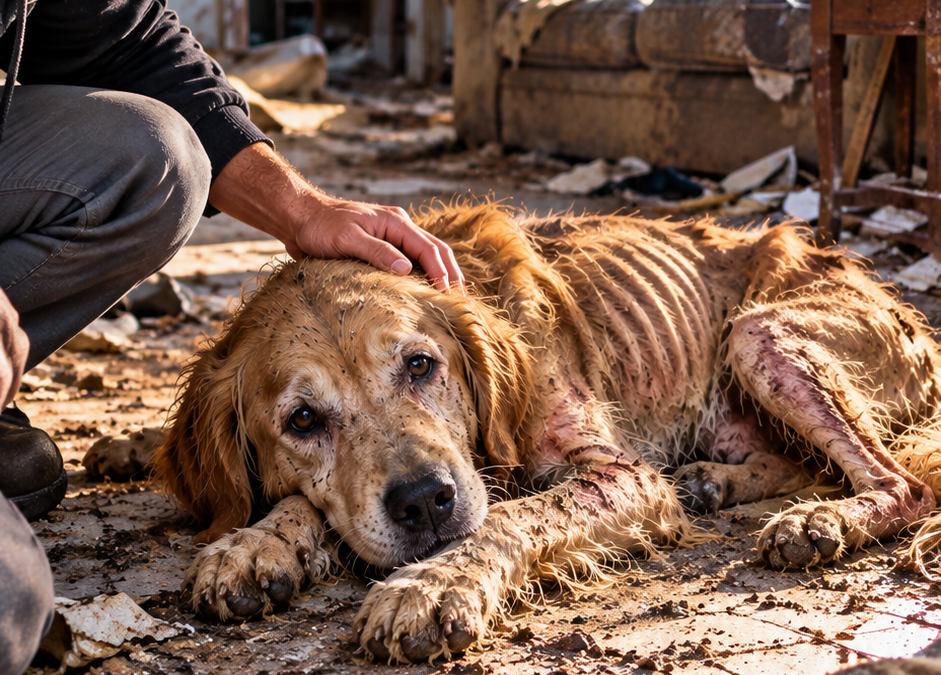
The house had been empty for two years, but someone was still waiting inside. When I found him lying on the filthy floor, he was so weak that he couldn’t even lift his head to look at me. What frightened me most was the possibility that he had stopped expecting anyone to come back.
I will never forget the smell of that house.
It reached me before I had even stepped completely through the doorway—a suffocating mixture of dust, damp wood, rotting debris, and something far worse that I recognized immediately as the unmistakable odor of prolonged animal neglect.
The windows were filthy. Sunlight struggled through the glass, illuminating clouds of dust floating above an abandoned living room. Old furniture stood in awkward positions, and the walls bore the marks of a home that had slowly surrendered to time.
Nobody had lived there for two years.
At least, that was what we had been told.
The previous owner had moved away, leaving the property behind. Whatever life had once filled those rooms had disappeared, and the house had been allowed to deteriorate in silence.
But someone had been left behind.
Somewhere inside that decaying building was a dog.
I had seen animals rescued from terrible circumstances before, but something about this situation disturbed me before we even found him. Perhaps it was the thought of a dog remaining in the place where his owner had once lived, surrounded by the fading traces of a familiar life.
Perhaps it was the extraordinary length of time the house had stood abandoned.
Or perhaps it was simply the terrible silence.
I stepped carefully across the dusty floor.
“Hello?”
My voice echoed through the empty rooms.
“Hey, sweetheart. Where are you?”
There was no answer.
I looked toward the dark hallway, where an open doorway led into another room.
“Come on, buddy. We’re here to help.”
Still nothing.
I turned toward the other rescuer standing behind me.
“Are we sure he’s still inside?”
“That’s what we were told.”
I swallowed.
The thought of finding him too late had been following me since we arrived.
We moved farther into the house.
Then I saw something lying on the floor.
At first, my mind refused to recognize what I was looking at.
There was a thin, almost hairless body stretched across the filthy surface, so frail and motionless that it seemed impossible for it to belong to a living animal.
I hurried forward.
“Oh, my God.”
It was the dog.
His ribs protruded sharply beneath his damaged skin. His hips and spine were painfully visible, and large areas of his body had lost almost all their fur.
Inflamed sores covered his exposed skin.
Fleas crawled through the patches of hair that remained.
His legs lay awkwardly beneath him, as though he had collapsed and simply lacked the strength to reposition himself.
And his eyes—
I still have difficulty describing those eyes.
They were open, but there was almost no reaction when I approached.
He looked exhausted beyond anything I had imagined.
I knelt beside him.
“Hey, baby.”
His eyes shifted slightly toward my voice.
That tiny movement was the first evidence that he was still fully aware of our presence.
I reached toward him, then hesitated.
His skin looked so painful that I was frightened even to touch him.
“Can you hear me?”
He blinked.
“Oh, sweetheart.”
I sat back on my heels, fighting the urge to cry.
Until that moment, the information we had received about the abandoned property had seemed almost unbelievable. I had known we might find a neglected dog, but I hadn’t been prepared for an animal whose condition suggested such prolonged and devastating suffering.
The house was empty.
There were no reassuring footsteps coming down the hallway.
No familiar person calling his name.
No clean bed waiting for him in another room.
Whatever had happened after the owner left, this dog had somehow remained connected to that place.
I looked around the room and wondered how many times he might have heard noises outside and lifted his head, hoping someone familiar had returned.
Perhaps he had once hurried toward the door when he heard a car.
Perhaps he had waited beside a window.
Perhaps, as his strength disappeared, he had gradually stopped moving at all.
I couldn’t know what he remembered or why he had remained there.
But the idea that he had spent so long alone in a house that no longer held the people he knew was almost unbearable.
I gently placed my hand near his muzzle.
He didn’t pull away.
“You’re not staying here, sweetheart.”
His eyes remained fixed on me.
“I promise. We’re getting you out.”
We had brought food, hoping it might encourage him to respond.
I placed a small amount near him while we assessed his condition.
He noticed it.
That surprised me.
His nose moved slightly, and he made a weak effort to lift his head.
“That’s right, baby. There’s food.”
With enormous difficulty, he managed to take a few bites.
For one brief moment, I felt hopeful.
Then his head began to lower.
His body seemed to give up beneath him.
I immediately moved closer.
“Easy. Easy, sweetheart.”
He collapsed back against the floor.
I felt my throat tighten.
He was so hungry that the smell of food had been enough to make him try, but he was too exhausted to continue eating.
It was one of the most heartbreaking things I had ever witnessed.
Most hungry dogs become excited when food appears. They approach eagerly, wag their tails, or begin eating with obvious relief.
This dog could barely manage the effort of swallowing a few bites.
I looked toward my fellow rescuer.
“We have to get him medical help immediately.”
We stopped trying to feed him and concentrated on getting him safely into professional care.
As we prepared to move him, I examined his condition more closely.
His remaining fur was matted and filthy.
The sores covering his skin appeared painful, and the flea infestation was severe.
There were signs that he had lost control of his bodily functions, leaving him lying in conditions no animal should ever have to endure.
I felt anger rising inside me.
Not the kind of anger that makes you want to shout.
The quieter, heavier kind that settles in your chest when you realize how completely another living being has been failed.
Two years.
The house had been abandoned for two years.
I looked down at the dog.
How had he survived for so long?
Had he found occasional food or water somewhere around the property before becoming too weak to move?
Had anyone noticed him in the past and assumed somebody else was caring for him?
How long had he been lying on that floor?
I had no answers.
And I knew that standing there asking questions would not help him.
I gently slid my hands beneath his frail body while another rescuer supported him.
“All right, baby. We’re going to pick you up.”
His eyes widened slightly.
I paused.
“It’s okay. I’ve got you.”
We lifted him as carefully as possible.
He weighed so little that I felt almost sick.
His body rested against my arms without resistance. He made no attempt to struggle or escape, and I couldn’t tell whether that was because he trusted us or because he no longer possessed the strength to object.
I supported his head as we carried him through the hallway.
The floorboards creaked beneath our feet.
When we reached the doorway, sunlight fell across his damaged skin.
I glanced down.
“You’re coming with us.”
He blinked.
“That’s right. You’re leaving this place.”
Outside, the air felt almost painfully fresh after the suffocating atmosphere of the house.
We carefully settled him into the vehicle, protecting his fragile body and keeping him as comfortable as possible.
I sat close enough to monitor him during the journey.
Every time his breathing seemed to change, my heart accelerated.
“Come on, sweetheart.”
His eyes were half closed.
“Just stay with me.”
The veterinary team was prepared to assess him when we arrived.
I explained everything we knew: the abandoned house, the previous owner’s departure two years earlier, the dog’s inability to stand, his severe malnutrition, and the terrible condition of his skin.
The veterinarian listened carefully.
Then she began examining him.
I watched her expression.
She was professional and controlled, but I could see how concerned she was.
“He’s extremely debilitated,” she explained.
I looked toward the examination table.
“Can he recover?”
“We need to stabilize him and evaluate everything that’s happening. His condition is very serious.”
She explained that a dog experiencing such profound malnutrition required carefully managed nutritional support. Feeding him too much too quickly could create additional medical complications.
His dehydration, parasites, skin disease, and extensive sores also needed treatment.
I nodded, trying to remember every word.
“Whatever he needs.”
She looked at me.
“We’ll start with the most urgent problems and monitor how he responds.”
I stepped closer to the table.
The dog lay quietly, his eyes following the movement of a technician’s hands.
I gently touched an area of his body where his skin wasn’t inflamed.
“You’re going to have people looking after you now.”
He blinked.
I wished he could understand that the terrible uncertainty of the abandoned house was over.
He wouldn’t have to wonder when food might appear.
He wouldn’t have to remain lying in his own waste because he lacked the strength to move.
And if his body responded to treatment, he would never again need to survive in a place where nobody came when he needed help.
But first, he had to make it through the coming days.
Those early hours were frightening.
His body was desperately weak, and the veterinary team had to address several serious problems simultaneously.
He needed appropriate hydration and carefully introduced nourishment.
His parasite infestation required treatment.
His painful skin had to be cleaned and protected.
And he needed a quiet, comfortable environment where he could rest without being overwhelmed by unnecessary handling.
I stayed involved in his care, determined that he would receive everything we could reasonably provide.
When I returned to see him, I approached slowly.
“Hello, sweetheart.”
His eyes moved toward my voice.
I smiled.
“There you are.”
He didn’t wag his tail.
He couldn’t lift his head.
But he looked at me.
After finding him nearly motionless on the floor, even that felt significant.
I pulled a chair close to his resting place.
“I know you don’t feel good right now.”
He blinked.
“But you’re not alone anymore.”
I sat with him for a while, speaking softly and allowing him to rest.
Occasionally, he shifted his eyes toward me.
Most of the time, he simply slept.
I couldn’t stop comparing that quiet room with the abandoned house.
Here, his bedding was clean.
His wounds were being treated.
His meals were carefully prepared.
And whenever something changed in his condition, someone was nearby to notice.
It was everything he should have had all along.
The next few days demanded patience.
We couldn’t rush his recovery, no matter how badly we wanted to see him improve.
His body needed time to respond to nutritional support.
His skin needed time to heal.
The sores that had developed during his prolonged neglect required consistent attention.
And the parasites that had caused him so much additional discomfort had to be eliminated.
Every part of his recovery seemed connected to another.
If his skin hurt, resting comfortably became difficult.
If he remained exhausted, eating required tremendous effort.
If his nutritional needs weren’t carefully managed, his already fragile body could face additional complications.
I began learning to appreciate the smallest changes.
One morning, the veterinary staff told me he had tolerated his feeding better than before.
I smiled so broadly that one of the technicians laughed.
“That’s good news, isn’t it?”
“It’s wonderful.”
Another day, he seemed more alert.
When I approached, he followed me with his eyes instead of remaining almost completely unresponsive.
“Well, hello there.”
I knelt beside him.
“You’re looking at me today.”
His ears moved slightly.
I felt tears gathering again.
“That’s my boy.”
I knew that calling him strong didn’t make his medical problems disappear.
But I needed him to know, in whatever way he could understand, that somebody was still there.
Somebody was paying attention.
Somebody was coming back.
I think that last part mattered to me most.
After everything he had endured in the abandoned house, I couldn’t bear the thought of him waking up and believing he had been forgotten again.
So whenever I visited, I approached with the same gentle greeting.
“Hello, sweetheart. It’s me.”
At first, there was almost no response.
Then he began moving his eyes toward my voice.
Eventually, I noticed that his expression seemed to change slightly when I entered the room.
Perhaps he was simply becoming more alert as his strength returned.
Perhaps he was beginning to recognize me.
Either way, those small changes made the difficult days easier.
His cleaning and wound care remained delicate.
He had so little fur left that much of his skin was exposed, and the inflamed areas required particularly gentle treatment.
Sometimes, while helping care for him, I found myself imagining what his coat might have looked like before he became so ill.
Had he once been a fluffy dog who enjoyed having his ears scratched?
Had he spent evenings curled beside someone’s chair?
Had he eagerly greeted his owner at the door?
I didn’t know.
There was no one standing beside us who could tell me about his former personality.
No photographs of happier days had accompanied him out of the house.
All we had was the animal in front of us and the fragile possibility of helping him become comfortable again.
I decided that was enough.
We didn’t need to know every detail of his past to give him a different future.
During one of his cleaning sessions, he lifted his head a fraction of an inch.
I noticed immediately.
“Hey, look at you.”
He couldn’t maintain the position for long.
His head lowered again.
But the movement had been deliberate.
I looked toward the person assisting me.
“Did you see that?”
“He’s getting a little stronger.”
I smiled down at him.
“That’s right, sweetheart.”
I gently stroked his head.
“Take your time.”
The words became almost a daily ritual.
Take your time.
There was no reason to force his body to accomplish things it wasn’t ready to do.
If he needed to sleep, he could sleep.
If sitting upright was too difficult, he could remain comfortably supported.
And if all he could manage during a particular feeding was the amount prescribed by the veterinarian, that was enough.
For the first time in a very long while, he didn’t have to struggle through everything alone.
Still, there were moments when fear returned.
Sometimes I looked at his thin body and wondered whether we had discovered him too late.
His ribs were still prominent.
His skin was still healing.
He remained so weak that even the smallest effort seemed exhausting.
I would sit beside him and imagine the empty rooms of the abandoned house.
What if we hadn’t gone there?
What if another week had passed?
What if nobody had discovered him until the silence inside that building became permanent?
I hated those thoughts.
But they reminded me how precious every day of progress was.
One evening, after helping settle him into clean bedding, I noticed him watching me.
“What’s the matter, sweetheart?”
His eyes followed my hand as I adjusted the blanket.
I reached toward him.
He made a tiny movement with his head.
For an instant, I thought he might be trying to move closer.
I rested my hand gently against him.
“There you go.”
His body relaxed.
I stayed until he fell asleep.
There was something incredibly moving about watching a dog who had endured so much finally rest without being surrounded by filth and neglect.
His recovery wasn’t dramatic.
There was no sudden moment when he jumped to his feet, wagged his tail, and became a completely different animal.
Instead, it unfolded through dozens of quiet victories that might have seemed insignificant to anyone who hadn’t seen the condition in which we found him.
He began tolerating his meals better.
His breathing became calmer.
His body gradually grew cleaner and more comfortable as treatment continued.
The terrible odor that had accompanied him out of the abandoned house began fading.
And then, as we approached the tenth day after his rescue, something happened that I had been afraid to hope for.
He sat up.
I had just approached his resting place when I noticed that he was moving differently.
His front legs shifted beneath him.
For a moment, I thought he was simply trying to find a more comfortable position.
Then he began pushing himself upward.
“Oh, sweetheart.”
I stopped moving.
He struggled.
His body trembled with the effort.
I wanted to reach forward and help immediately, but I also wanted to see whether he could manage the movement safely.
A caretaker stayed beside him, ready to support him if necessary.
“Easy,” I whispered.
He continued pushing.
His front legs straightened.
Then, slowly, unbelievably, he lifted his body into a sitting position.
I stared.
For several seconds, I couldn’t speak.
The dog who had been unable to lift himself from the filthy floor of an abandoned house was sitting upright.
He looked terribly thin.
His skin still showed the effects of prolonged neglect.
And he seemed exhausted by the effort.
But he was sitting.
“Oh, my God.”
My voice broke.
“Look at you.”
He turned his head slightly toward me.
I knelt.
“You’re sitting up!”
The caretaker smiled.
“He’s been making progress.”
I pressed one hand against my mouth.
I had been present for countless difficult moments during his care, but nothing had prepared me for the emotion of watching him accomplish something so ordinary.
Most dogs sit without thinking about it.
They sit when they want a treat.
They sit when they wait for a walk.
They sit beside their owners while somebody watches television or prepares dinner.
For this dog, sitting upright represented an extraordinary return of strength.
It meant his body was beginning to recover from a level of neglect that had nearly destroyed him.
I gently stroked his head.
“You’re doing so well.”
He blinked.
I laughed through my tears.
“I know. I know you’re probably wondering why I’m making such a fuss.”
He remained upright for a little while longer before needing to rest.
When he finally lowered himself back onto the bedding, I felt nothing but pride.
Ten days earlier, he had been unable to move.
Now he had shown us that his body was beginning to reclaim some of the abilities that starvation and illness had taken away.
His appetite was improving too.
The carefully managed meals that had initially required so much effort were becoming easier for him to accept.
He began eating a little more according to his veterinary feeding plan, and the additional nourishment gradually helped him gain weight.
I watched those changes with almost obsessive attention.
Every small improvement mattered.
When the staff told me his skin was beginning to heal, I wanted to celebrate.
When I noticed that he appeared more comfortable during rest, I felt deeply relieved.
And when he looked toward me with growing alertness, I sometimes found myself talking to him as though we were old friends.
“Remember that terrible house?”
Of course, he didn’t answer.
“I wish I knew what you were thinking when we found you.”
He watched me.
I gently touched his head.
“But you don’t have to go back there.”
That was the one part of his future I felt certain about.
He would not return to the abandoned property.
His recovery was still incomplete, and I couldn’t predict exactly what challenges lay ahead.
He might need months of additional care.
His skin would require continued treatment.
His severely weakened body would need gradual rehabilitation before he could walk comfortably again.
But the life he had endured inside that house was over.
As he became increasingly responsive, I began noticing glimpses of the personality that had almost disappeared beneath his illness.
He showed curiosity when people approached.
Sometimes, he watched us prepare his food with growing interest.
He seemed to appreciate gentle contact, particularly when he was feeling comfortable.
And although his movements remained limited, he no longer appeared quite so disconnected from the world surrounding him.
One afternoon, I sat beside him while he rested.
He lifted his head and watched me.
“Hello, handsome.”
His expression was still tired.
But there was something different about him.
He was no longer simply enduring each moment.
He was beginning to participate in the world again.
I offered my hand.
After a short pause, he moved his muzzle toward it.
The movement was small.
But it was voluntary.
He wanted to be close.
I gently stroked the side of his face.
“There you are.”
My eyes filled again.
I thought about the dog who had been left in the abandoned house.
Perhaps he had once known affection.
Perhaps his first owner had cared for him before leaving.
I couldn’t know what memories he carried.
But I hoped we were helping him build new ones.
Memories of gentle hands.
Clean bedding.
Food that arrived every day.
And familiar voices belonging to people who actually returned when they said they would.
Sometimes, as I watched him resting, I wondered what his future home might look like.
Would he eventually sleep beside someone’s bed?
Would he have a favorite blanket?
Would he learn to enjoy short walks once his strength returned?
Would he become one of those affectionate dogs who follows his owner from room to room, determined never to miss an opportunity for companionship?
I hoped so.
But I reminded myself not to rush toward a happy ending that hadn’t arrived yet.
He was still recovering.
His body had endured extraordinary hardship.
And the most important thing we could give him was continued care without unrealistic expectations.
If he needed additional time, he would have it.
If he needed more medical treatment, we would do everything possible to provide it.
If he remained frightened or uncertain around people, we would continue approaching him patiently.
His progress didn’t have to follow anybody else’s schedule.
One evening, as I prepared to leave, I turned back toward his resting place.
He was lying comfortably on clean bedding.
His eyes were open, following me.
“I’ll be back, sweetheart.”
I paused.
Those words suddenly felt heavier than I had intended.
For two years, the house where he had lived had remained empty of its former human occupants.
I couldn’t know how often he had expected someone to return.
But I knew what it meant to make a promise to an animal who depended on you.
I walked back and knelt beside him.
“You’re not being left behind again.”
He watched me quietly.
I gently stroked his head.
“I’ll see you tomorrow.”
When I returned the next day, he was resting.
As soon as I spoke, his eyes shifted toward me.
“Good morning, sweetheart.”
He lifted his head slightly.
I smiled.
“There you are.”
He was still terribly thin.
He still needed continued treatment and rehabilitation.
But he was alive, more comfortable, and slowly regaining strength.
And the frightened, broken dog we had discovered inside that abandoned house was beginning to understand something that should have been ordinary all along.
People could leave a room and still come back for him.
The tenth day had given us a glimpse of what recovery might look like.
The days afterward offered more small reasons to hope.
His meals became a little easier.
He seemed increasingly comfortable.
And he continued showing us that somewhere beneath the devastating effects of neglect, there was a living, feeling creature who had not completely surrendered.
I sometimes think about that abandoned house.
The dusty windows.
The empty rooms.
The silence in the hallway.
And the moment I first saw him lying motionless on the floor.
I remember wondering whether we had reached him in time.
I remember being terrified that lifting him might be more than his fragile body could bear.
And I remember the helplessness I felt when he managed only a few bites of food before collapsing again.
But now, when I think about him, another image comes to mind.
A clean, quiet room.
A soft bed.
A little more weight beginning to return to his body.
And a dog who can finally lift himself into a sitting position and look toward the people who care about him.
He has not finished recovering.
There is still a long road ahead, and nobody can promise that every consequence of his suffering will disappear.
But the terrible loneliness that defined his life inside the abandoned house has ended.
He no longer has to wait on a filthy floor, wondering whether someone will notice that he is still alive.
He no longer has to struggle for every scrap of food he can find.
And when he is too weak to stand, there are people beside him who will help.
For two years, that empty house had been the place where he remained after the life he knew disappeared.
Now it is simply the place where we found him.
His life is moving forward.
And every morning, when I return and see him looking toward me with a little more strength in his eyes, I know that whatever challenges remain, he will face them surrounded by people who have already decided that he matters.








