The Photograph in His Jacket Held a Face I Had Spent Three Years Trying to Forget
𝗣𝗔𝗥𝗧 𝟮
The morning I met Marcus Reyes, the mission had already gone bad before sunrise.
I cannot say where we were.
I can say the light was brutal.
White sun.
Pale dust.
Everything flattened by heat even though morning had barely begun.
A position that should have held did not.
The first casualty went down near a low wall.
Then another.
Communication became inconsistent.
People started shouting names instead of call signs.
That is usually when you know plans have stopped mattering.
I moved from one wounded man to the next.
Some injuries were survivable.
Some were not.
The cruelest part of combat medicine is learning the difference quickly enough to spend your time where it can still change something.
Marcus was almost out of time when I reached him.
I did not know his name.
I knew only that somebody yelled, “Chest wound!”
I dropped beside him.
He was lying partly on his left side.
His rifle strap was trapped under his shoulder.
Blood covered the front of his uniform.
Every breath produced a wet bubbling sound below his right collarbone.
I cut the fabric open.
Entry wound.
I rolled him just enough to check his back.
Exit wound high on the right side.
His breathing was already failing.
I remember looking at my watch.
Then his face.
Then my kit.
His skin had begun changing color.
I had minutes.
Maybe less.
The standard chest seal in my bag was damaged.
The medical bag had taken debris earlier.
The package was sliced.
I opened it anyway.
Dust had contaminated the adhesive.
I pressed the seal over the wound.
The lower edge lifted when Marcus exhaled.
I tried again.
Same result.
“Come on,” I muttered.
Marcus heard me.
His eyes found mine.
He tried to speak.
“Don’t.”
I pressed a hand against his chest.
“Save your air.”
He tried to sit up.
I put my knee against his hip.
“Absolutely not.”
He fought me weakly.
“You sit up, I’m going to hit you.”
His mouth moved.
No sound.
“Good. We understand each other.”
I ripped through the kit.
No second usable seal.
So I improvised.
Clear plastic from an IV bag.
Tape from a splint roll.
Last clean gauze to dry enough blood from his skin for anything to stick.
I secured the plastic on three sides.
Not four.
Three.
A flutter valve.
Crude.
Effective.
For a few breaths, he improved.
Then pressure started building again.
His breathing became shallower.
His eyes widened.
He knew something was wrong even if he didn’t know what.
I lifted one corner of the dressing.
Air escaped.
Then I prepared the needle.
Marcus reached for my vest.
His hand missed.
Tried again.
This time he caught one of the front loops and held on.
“Stay with me.”
I inserted the needle.
He made a sound through clenched teeth.
“Yeah,” I said. “I know.”
His breathing changed.
Not good.
Better.
Better was enough.
Someone shouted from my right.
Another wounded operator.
I ignored it for three seconds.
Marcus needed those three.
His eyes were losing focus.
I slapped his cheek lightly.
“Hey.”
He looked at me.
“Stay here.”
His fingers tightened on my vest.
“I have to move.”
He shook his head.
Barely.
“Listen to me.”
I leaned closer because gunfire made normal speech useless.
“You are getting out.”
His lips moved.
I couldn’t hear.
“What?”
He tried again.
Three words.
“Don’t let go.”
For half a second, everything around us disappeared.
Not the noise.
Not the shooting.
Something inside me simply narrowed.
He thought he was dying.
I had seen that expression before.
Not fear of pain.
Fear of disappearing while nobody noticed.
I put my hand over his.
“I won’t.”
His grip remained for another few seconds.
Then the tension went out of his fingers.
His eyes closed.
I kept working.
I stayed with him until the evacuation team reached us.
When they lifted him onto the board, he was still breathing.
Barely.
That counted.
Collins came in after his own arm had been wrapped.
Red cloth around the forearm.
He helped move Marcus.
I remember Marcus’s watch because it had cracked.
The hands had stopped at 6:17.
Then they carried him away.
I never learned whether he survived.
There was no time.
Somebody yelled for a medic twenty yards beyond the wall.
I grabbed my kit.
Ran.
Made it about twelve yards.
Then the blast hit.
I remember light.
Pressure.
The ground.
Then pain arrived in pieces.
Left shoulder first.
Then side.
Then something strangely absent in two fingers.
I looked down.
Blood.
Too much to ignore.
Not enough to stop.
Collins was still calling.
So I got up.
That part became a point of argument later.
Doctors asked why I moved after being wounded.
Physical therapists asked.
Psychologists asked.
One medical officer asked as though the question itself might reveal poor judgment.
I always gave the same answer.
Because somebody was calling.
There was no more complicated reason.
I treated Collins.
Then another man.
Then another.
At some point I tied pressure against my own side.
At some point someone asked whether I was hit and I said, “Later.”
I remember saying that word several times.
Later.
Later.
Later.
For years afterward I thought about how dangerous that word could be.
The second evacuation eventually took me.
I remembered the aircraft floor.
A medic cutting my sleeve open.
Someone saying, “You should have told us.”
Then darkness.
When I woke, my left hand did not feel like mine.
Three surgeries followed.
The first lasted seven hours.
The second repaired damage that had not been fully visible on the first imaging.
The third was less dramatic and somehow more frightening because by then everyone had stopped discussing survival and started discussing function.
Would the arm move?
Would strength return?
Would fine motor control come back?
Could I work?
Could I deploy?
Could I remain who I had been?
Doctors spoke in percentages.
I hated percentages.
Fifty percent range.
Seventy percent strength.
Possible permanent nerve deficit.
Likely reduced endurance.
Maybe.
Possibly.
Uncertain.
I had spent my career making decisions in uncertainty.
I discovered I tolerated uncertainty much less when I was the patient.
Rehabilitation lasted eighteen months.
People imagine rehab as heroic because movies compress it into music and determination.
Real rehabilitation is humiliating.
I celebrated moving my arm three degrees farther than the week before.
I cried because I dropped a coffee mug.
I spent forty minutes learning to fasten a button one morning.
I relearned motions I had once performed under fire without looking.
Some days I improved.
Some days my body seemed to forget progress overnight.
The first time a therapist told me I had gained half an inch of controlled motion, everyone smiled.
I went home and threw a shoe across my apartment with my right hand because half an inch felt obscene compared with the life I had lost.
No one tells you how grief behaves when the dead person is yourself.
Not your body.
Your identity.
The version of you who expected to wake up and keep doing what she had always done.
The medical board came after the third surgery and months of assessment.
They were professional.
Respectful.
Almost kind.
That made it worse.
Non-deployable.
That was the word.
I listened.
Nodded.
Asked the required questions.
Did not appeal.
People later assumed I had accepted the decision with unusual grace.
There was nothing graceful about it.
I simply had no fight left for that particular battle.
I packed my uniforms into boxes.
Closed them.
Moved.
Found work where the speed of my left hand did not determine whether another human being breathed.
That was how Mason’s Bar became my life.
And that was how, three years after Marcus Reyes almost died beneath my hands, I started pouring beer for him without knowing who he was.
He recognized me even less.
Why would he?
He had seen my face for maybe four seconds through blood loss, pain, dust, and oxygen deprivation.
My hair had been hidden under a helmet.
I had weighed more then.
My posture had been different.
I had not yet learned to protect my left shoulder without thinking.
To Marcus, the medic who saved him belonged to another world.
Not behind a bar wiping beer rings from wood.
By his third Friday, he arrived later than usual.
The dinner crowd had thinned.
Rain tapped against the front windows.
An old country song played low enough that conversation covered most of it.
I placed his usual beer on the coaster.
“Long day?”
Marcus looked at me.
Usually he answered questions with some variation of “Not bad.”
That night he said, “Long three years.”
Something in the answer made me pause.
Not enough to ask.
I nodded.
“Sounds expensive.”
He looked confused.
“The beer,” I said.
“Three years’ worth?”
I gave him the smallest smile.
“If you drink fast.”
That almost got a laugh.
I moved away.
When I returned to clear two empty glasses, I noticed him watching my arm.
My left.
Not staring.
Observing.
I lifted both glasses with my right hand.
The left remained closer to my body.
His gaze dropped before I looked directly at him.
My instincts stirred.
Not alarm.
Recognition of attention.
Then his hand went to the inside of his jacket.
The pocket.
The flat object.
For three weeks, he had checked that pocket.
That night, he finally reached inside.
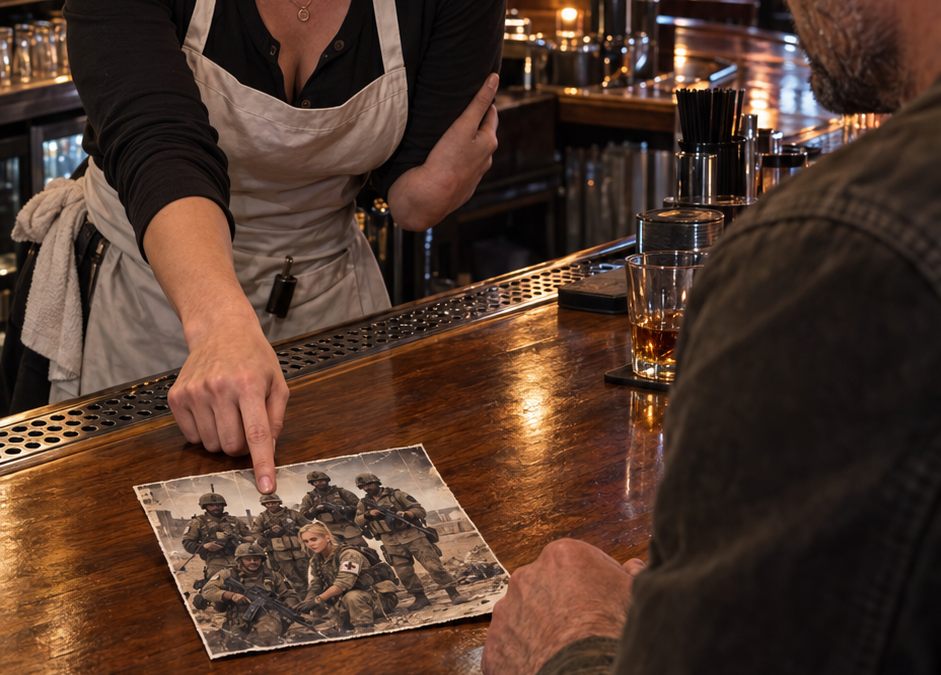
He pulled out a photograph.
The edges were worn soft.
Creased slightly near one corner.
He looked at it for several seconds before placing it face up on the counter.
Then he stared into his beer.
I was counting change at the register.
I turned.
Handed a customer his bills.
Reached toward an empty glass beside Marcus.
My eyes crossed the photograph.
Kept moving.
Then returned.
My hand stopped in midair.
Six figures.
Combat gear.
Dust.
Hard white sky.
A ridge behind them.
Damaged wall to the left.
A medical pack near the edge of the frame.
I knew the place.
I knew the men.
Most of all, I knew the woman kneeling partly behind Marcus.
Helmet.
Face turned slightly toward the camera.
Me.
The picture had been taken twelve minutes before the shooting started.
I knew because I remembered complaining that someone was wasting time.
Collins had told me, “One picture won’t kill you.”
I had answered, “That statement is statistically unsupported.”
They had laughed.
Twelve minutes later, we stopped laughing.
I set the glass down carefully.
Marcus noticed.
His fingers rested on the edge of the photograph.
“You recognize the place?”
My throat tightened.
I kept looking.
Faces.
Some I had treated.
Some I had not seen since.
Memories arrived not as a story but as flashes.
Red cloth.
Broken watch.
Blood.
Dust.
White sky.
Marcus’s hand gripping my vest.
Don’t let go.
I forced my eyes toward him.
“Looking for someone?”
My voice sounded different even to me.
Marcus nodded.
“The medic.”
My heart beat harder.
“What medic?”
“The one who saved my life.”
He turned the photograph slightly.
“Three years ago.”
I said nothing.
“I never learned her name.”
He tapped one finger near the kneeling figure.
“I saw her face for maybe four seconds before I went under.”
My left shoulder tightened instinctively.
“By the time I woke up, she was gone.”
I looked at Marcus properly for the first time.
Age had changed him.
Recovery had changed him more.
His face was fuller.
There was gray at his temples.
A small line near the mouth I did not remember.
No blood.
No dust.
No terror.
But the eyes were the same.
I knew them.
I had watched those eyes fight to stay open.
Marcus continued because he mistook my silence for interest.
Maybe it was.
He told me about the evacuation.
The hospital.
The missing name.
The attached medics rotating between units.
The after-action report identifying me only by role.
He had started asking questions almost immediately.
At first, he assumed somebody would know.
A week.
Maybe two.
Then people transferred.
Records stayed sealed.
Different medics had touched different casualties.
Memories contradicted one another.
The photograph became the only evidence Marcus trusted.
He carried it to reunions.
Hospitals.
Former teammates.
Contacts.
Anyone who might recognize the woman.
Twice, someone claimed to be me.
I looked up.
“Claimed?”
“Two different women.”
“Why?”
“One wanted attention. I don’t know about the other.”
His expression hardened slightly.
“Both knew enough to sound real at first.”
“What happened?”
“I asked questions.”
“And?”
“They failed.”
I looked back at the photograph.
Something painful moved through me.
Not anger.
Sadness.
Marcus had spent three years searching for a woman who was busy learning how to lift a coffee mug.
He had been carrying my face while I had been trying to bury it.
“Why keep looking?”
He glanced down.
“Because being wrong twice didn’t change what she did.”
The answer reached somewhere I had kept closed.
I dried my hand on my apron.
Then leaned closer to the photograph.
My finger moved before I had fully decided to speak.
I touched the image near the kneeling medic.
“That’s me.”
Marcus did not react the way people do in stories.
No instant tears.
No relief.
No reaching across the bar.
His hand tightened around the bottle.
His entire body became still.
Then caution replaced surprise.
I recognized that too.
Someone trained him well.
Or pain did.
He looked from my face to the picture.
Back again.
“Two women told me that.”
“I figured.”
“One was very convincing.”
“So am I supposed to be insulted?”
He did not smile.
I didn’t blame him.
Marcus flattened the photograph beneath his palm.
“Prove it.”
The words were quiet.
Not cruel.
Still, something in me recoiled.
I had spent eighteen months proving what my own body could and could not do.
I had no appetite for another examination.
I stepped back.
“You brought the picture into my bar.”
“And you said you were her.”
“I am.”
“So prove it.”
I looked at his face.
Not accusation.
Fear.
He wanted me to be telling the truth.
That was exactly why he could not believe me yet.
I understood.
“How?”
“The wound.”
I waited.
“Where?”
“Below your right collarbone.”
His eyes sharpened.
“Exit?”
“High right back.”
He said nothing.
“You were partly on your left side when I reached you. Rifle strap trapped under your shoulder.”
Something changed in his expression.
Small.
I continued.
“Every breath pushed blood through the front wound.”
Marcus stared.
“Position?”
“What?”
“When you treated me.”
“I approached from your feet because the wall behind your head was taking fire.”
He looked down at the counter.
“Chest seal.”
My stomach tightened.
“What happened to it?”
“The package was sliced.”
His gaze rose.
“My bag had been hit. Seal was contaminated with dust.”
“And?”
“I tried it anyway.”
“What happened?”
“The lower edge lifted when you exhaled.”
Marcus’s fingers loosened slightly around the bottle.
I could have stopped there.
I didn’t.
“I cut clear plastic from an IV bag.”
His face went pale.
“Used my last clean gauze to dry your skin. Tape from the splint roll.”
“How many sides?”
“Three.”
He closed his eyes briefly.
“Why?”
“So pressure could vent.”
When he opened them again, suspicion remained.
Less of it.
Not gone.
“The second woman said four.”
“She would have killed you.”
His mouth tightened.
I regretted the bluntness.
Then decided not to.
It was true.
“What happened when my breathing got worse?”
“I lifted the lower corner.”
“And then?”
“Needle decompression.”
Marcus looked at my hands.
For the first time, I wondered what he saw.
A waitress’s hands.
Clean nails.
Small burn near one thumb from a coffee pot.
Nothing that said they had once been covered in his blood.
“What was I holding?”
“A radio handset.”
His face froze.
“Broken.”
I continued.
“You wouldn’t release it. I told you your team could hear you without it.”
He swallowed.
“Who helped put me on the board?”
“Collins.”
“Right away?”
“No.”
His eyes narrowed.
“He came after his arm was wrapped.”
“Which arm?”
“Left.”
“What was on it?”
“Red cloth.”
Marcus’s beer sat forgotten.
“Watch.”
I glanced toward his wrist.
Different watch now.
“Cracked.”
“What time?”
I could see it.
Dust across the face.
Glass broken diagonally.
Hands motionless.
“6:17.”
Marcus turned away.
Only for a second.
When he faced me again, his composure had changed.
The questions were no longer an interrogation.
They were a man running out of reasons not to believe.
Still, one remained.
“The words.”
My chest went cold.
I had known we would get there.
“What words?”
He stared directly at me.
“Before I passed out.”
I said nothing.
“I tried to say something.”
Rain ticked against the window.
Someone laughed behind me.
Ice dropped into the metal bin.
The room continued normally.
I didn’t.
Marcus’s voice softened.
“I never put it in a report.”
My left hand found my right wrist.
“I never told the team.”
My heartbeat filled my ears.
“Never told my family.”
I looked away.
He continued.
“I’ve never told anyone.”
The bar disappeared.
I was beneath the white sky again.
Heat.
Blood.
His fingers locked around my vest.
His eyes wide with the specific terror of a man whose lungs no longer obeyed him.
His lips moving.
Three words.
I closed my eyes.
When I opened them, Marcus was still there.
Alive.
Waiting.
“You said, ‘Don’t let go.’”
His face emptied.
I could barely continue.
“I told you I wouldn’t.”
Marcus’s mouth opened.
No sound.
“You tried to nod.”
I felt tears rise.
“You were already losing consciousness.”
His hand left the bottle.
He turned his face away from me and pressed his fingers against his mouth.
For several seconds, he simply breathed.
Then his shoulders moved.
Once.
He forced them still.
I had seen men do that before.
Hold grief inside muscle.
Control what could not be controlled internally by controlling posture.
When he looked back, his eyes were wet.
“You really didn’t.”
I shook my head.
“What?”
“You didn’t let go.”
My voice failed.
I tried again.
“Not until they took you from me.”
Marcus looked at the photograph.
Then at me.
For three years, he had apparently imagined finding a medic still in uniform.
Still somewhere in that world.
Instead, he had found me in an apron beside a refrigerator filled with beer.
“Olivia.”
It was the first time he said my name.
“Olivia Hart.”
I nodded.
He looked at my left arm.
“What happened after?”
I knew what he meant.
I began wiping a section of counter that was already clean.
“Your helicopter was full.”
He waited.
“You left with the first critical group.”
“And you?”
“I wasn’t supposed to need evacuation.”
His eyes went toward my shoulder.
I continued.
“Collins called from beyond the wall.”
“You went back.”
“There was another casualty.”
“Olivia.”
“What?”
“You were already exhausted.”
“So was everyone.”
“You went back.”
I looked at him.
“Yes.”
“How far?”
“Twelve yards.”
His face changed.
He had already guessed the rest.
“Blast?”
“Shrapnel.”
“Shoulder?”
“And side.”
He stared at my arm.
I hated pity.
I saw it coming.
Before it could arrive, I said, “Don’t.”
Marcus stopped.
“You don’t get to turn this into something you owe me.”
His jaw tightened.
“You were wounded after saving me.”
“I was wounded because someone fired at us.”
“You ran toward another casualty.”
“Yes.”
“After treating me.”
“Yes.”
“So if I hadn’t—”
“No.”
The word came out sharp enough that a customer two stools down glanced over.
I lowered my voice.
“No.”
Marcus looked at me.
“You do not get to do that.”
“Do what?”
“Take responsibility for a chain of events because you happened to be inside it.”
His expression hardened.
“I would have been dead.”
“Probably.”
“And you might still have your career.”
“Maybe.”
“That matters.”
“It does.”
“Then—”
“But it isn’t yours.”
I leaned on the counter.
“I chose to move toward Collins. I would choose it again.”
Marcus said nothing.
“Collins lived.”
His eyes dropped to the photograph.
“So did you.”
I pointed to another man.
“So did he.”
Then another.
“And him.”
My throat tightened.
“That morning cost me things.”
I looked at my left hand.
“But don’t cheapen what I chose by turning it into something I regret because you survived.”
Marcus absorbed that in silence.
Then he asked, “How bad?”
“The shoulder?”
He nodded.
“Three surgeries.”
His face tightened.
“Eighteen months rehab.”
“Did you go back?”
“No.”
I said it before he could ask more.
“Medical board ruled me non-deployable.”
He looked genuinely stricken.
“I’m sorry.”
“I know.”
“Did you appeal?”
“No.”
“Why?”
That question always had too many answers.
I gave him the simplest.
“I was tired.”
Marcus waited.
Maybe he expected more.
I found myself giving it.
“People think fighting is always noble.”
I glanced toward the bottles behind me.
“Sometimes you reach a point where accepting reality isn’t quitting. It’s just refusing to bleed against a door that isn’t opening.”
He looked at my shoulder again.
“So you came here.”
“Eventually.”
“To work in a bar.”
“Yes.”
“That must have been…”
He stopped.
I smiled without humor.
“Careful.”
“I was going to say difficult.”
“It was.”
The anger inside me faded.
The truth was, I had once considered waitressing an insult.
Not because the work lacked dignity.
Because I had measured myself only against who I used to be.
If I could not do trauma medicine, everything else felt smaller.
That belief had been cruel.
Not to the job.
To me.
Marcus looked down.
“We meet every year.”
I frowned.
“Who?”
He touched the photograph.
“The five of us.”
Something tightened under my ribs.
“Everyone survived?”
“All five.”
I had known statistically.
Now I knew.
Every face in the photograph except mine had gone home.
Relief arrived so suddenly that I had to grip the counter.
Marcus noticed.
“You didn’t know.”
“No.”
“None of it?”
“No.”
He looked stunned.
“The reports—”
“I stopped reading anything connected to the unit.”
“Why?”
Because I couldn’t.
I shrugged instead.
He understood anyway.
“Same date every year,” he said.
“Different place sometimes.”
He pointed to Collins.
“He opened a repair shop with his son.”
My eyes stung.
“He did?”
Marcus smiled.
“Complains more now.”
“That sounds right.”
He pointed to another teammate.
“Dawson has two daughters.”
I laughed softly.
“He used to say he’d never have kids.”
“He has two. Completely terrified of both.”
Another.
“Peterson became a grandfather.”
“No.”
“Yes.”
“He was thirty going on seventy when I knew him.”
“Still is.”
We both smiled.
Marcus looked at me carefully.
“They still talk about you.”
The smile left my face.
“They don’t know my name.”
“No.”
“Then what do they say?”
“The medic.”
I looked away.
“Every year we raise a glass.”
I suddenly hated the quiet in the bar.
“To what?”
Marcus hesitated.
“To the woman who kept that position from becoming a body count.”
I swallowed.
“You don’t have to tell them.”
He looked surprised.
“Olivia.”
“I mean it.”
“They’ve been looking too.”
“I know.”
“No, you don’t.”
He leaned forward.
“They want to know you.”
My shoulder tightened.
I stepped back.
Marcus noticed.
Immediately.
To his credit, he stopped.
“No pressure.”
I almost laughed.
“You just found a woman you’ve searched for for three years and you’re telling me no pressure?”
“Fair.”
He lifted both hands slightly.
“I mean not tonight.”
That helped.
Then he reached into his jacket again.
Past the pocket where the photograph had lived.
“There is something else.”
I watched his hand emerge holding a folded envelope.
Old.
Edges worn.
Two words written across the front.
THE MEDIC.
I stared.
Marcus placed it beside the photograph.
My voice came out quieter than I intended.
“What is that?”
“A letter.”
“I can see that.”
“I wrote it in the hospital.”
“When?”
“Four days after surgery.”
I looked at him.
“You wrote a letter to someone whose name you didn’t know?”
He nodded.
“I assumed finding you would take a week.”
A tired smile appeared.
“Maybe a month.”
“And then?”
“Then carrying the letter became easier than admitting I might never hand it over.”
I touched the envelope.
Did not pick it up.
The paper had softened where someone had opened and closed the folds again and again.
“You carried this for three years.”
“Yes.”
“Every day?”
“Most.”
Something inside me gave way.
Medals had been placed in my hands.
Letters from officers.
Commendations.
Official language praising courage, performance, devotion to duty.
I had read them with gratitude and emotional distance.
The words belonged to institutions.
This envelope belonged to a bleeding man whose eyes I had watched close.
I picked it up.
Opened it carefully.
Something fell onto the counter.
A hospital identification band.
Cut through one side.
Marcus picked it up.
“I forgot that was in there.”
“What is it?”
“My discharge band.”
I looked at him.
“They took it off the day I left.”
“Why put it in the letter?”
He rolled it between his fingers.
“Because that was the day I knew you had actually saved me.”
I unfolded the page.
The handwriting was uneven.
Marcus watched me read.
The letter began simply.
To the medic who wouldn’t let go.
I had to stop.
I looked up.
He said nothing.
I continued.
He thanked me for the minutes I had bought him.
Not hours.
Not years.
Minutes.
He wrote that the surgeons said those minutes were everything.
He wrote that he didn’t yet know what he was supposed to do with a life he had expected to lose.
He promised not to waste it.
He said if he ever found me, he wanted to tell me himself.
Near the bottom, one sentence had been underlined twice.
A stranger’s hands became the reason my family did not have to bury me.
The words blurred.
I blinked.
Tried again.
No use.
I set the letter down before tears landed on it.
Marcus looked away, giving me privacy in the middle of a public bar.
That kindness made it worse.
“I thought I failed.”
He turned back.
“What?”
The confession came before I could stop it.
“For a long time.”
“With me?”
“No.”
I wiped my face.
“With everything after.”
Marcus stayed still.
I had no reason to tell him this.
Which was perhaps why I did.
“The first surgery was seven hours.”
I looked at my arm.
“The second one repaired damage they didn’t see clearly the first time.”
He listened.
“After the third, the surgeon told me strength might return but precision probably wouldn’t.”
My throat tightened.
“I nodded like he was talking about weather.”
Marcus said nothing.
“I went home after one rehab session and tried to make coffee.”
I smiled bitterly.
“Very complicated mission.”
A tiny smile appeared on his face.
“I dropped the mug.”
I looked down.
“It shattered.”
The memory remained absurdly clear.
Brown coffee spreading across tile.
White pieces.
My left hand still half closed around nothing.
“I just sat on the floor.”
Marcus’s smile disappeared.
“I had treated men while bullets hit walls around me. I had worked by feel in darkness.”
I flexed my fingers unconsciously.
“And I couldn’t hold a coffee cup.”
My voice cracked.
“I sat there until the coffee went cold.”
Marcus lowered his eyes.
“Rehab celebrates things that normal life teaches you to ignore.”
“Like what?”
“Two more degrees of rotation.”
I laughed weakly.
“Buttoning your shirt without help.”
I lifted my arm slightly.
“Getting your hand above shoulder height.”
He looked at me.
“The hardest day wasn’t surgery.”
“Medical board?”
I shook my head.
“After.”
“When?”
“The morning I packed my uniforms.”
That memory had never softened.
“I put them in boxes.”
“Why?”
“I knew no one was going to ask me to wear them again.”
Silence settled.
“I had built my entire sense of usefulness around being the person who could help when things were worst.”
Marcus leaned forward slightly.
“And suddenly my hands were unreliable.”
I looked around the bar.
“So I chose a life where nobody dies if I move too slowly.”
His eyes filled.
“I thought this was hiding.”
I gestured toward the room.
“The bar.”
“Yeah.”
Marcus looked around too.
The widower at table six.
A construction worker laughing with his brother.
A woman reading alone near the window.
Then he looked back at me.
“You remember everybody’s drink.”
“What?”
“You noticed my shoulder posture before I noticed yours.”
I frowned.
“You know when people want to talk and when they don’t.”
I said nothing.
“You think you stopped taking care of people because you aren’t carrying a trauma kit.”
“That is not the same thing.”
“No.”
He nodded toward the folded letter.
“But maybe useful isn’t as narrow as you decided it was.”
I looked at him.
Marcus tapped the page lightly.
“You promised a dying man you wouldn’t let go.”
His voice softened.
“Maybe you’ve spent three years keeping that promise for everybody except yourself.”
I hated him a little for saying it.
Only because it landed exactly where it needed to.
For eighteen months, physical therapists had told me progress was not linear.
Counselors had told me identity could evolve.
Doctors had told me capability was not worth.
Friends had told me I was more than a uniform.
I heard them.
I understood them intellectually.
Marcus’s sentence was different.
Maybe because he was living evidence of the version of me I thought I had lost.
I looked at the photograph.
Five men.
One medic.
The last calm minute.
Marcus said, “Meet them.”
My stomach turned.
“I don’t know.”
“No ceremony.”
“I don’t know.”
“No uniforms.”
“Marcus.”
“No speeches unless you want them.”
“I said I don’t know.”
He stopped.
“Okay.”
I looked at him.
He meant it.
“Really?”
“Really.”
“You searched for me for three years.”
“Correct.”
“And now you’re going to be patient?”
“I didn’t say I’m happy about it.”
That made me laugh.
A real laugh.
The first one of the night.
Marcus smiled.
I folded the letter along the lines already worn into it.
Placed the hospital band inside.
Then slipped both into my apron pocket.
“You’re taking that?”
“You carried it long enough.”
Something changed in his face.
Relief.
Not the dramatic kind.
The kind that looked almost like fatigue leaving.
When I went home that night, I put the letter on my kitchen table.
I did not open it again.
Not that night.
The next morning, I read it before coffee.
Then again before work.
For six days, it remained on the table.
Sometimes I passed it without looking.
Sometimes I touched the corner.
On the seventh morning, I called Marcus.
He answered on the first ring.
“Everything okay?”
“You gave me your number.”
“Yes.”
“For the meeting.”
Silence.
Then, carefully, “You want to meet them?”
“I think so.”
“You think?”
“Don’t make me hang up.”
“Understood.”
“Marcus.”
“Yeah?”
“No surprise people.”
“Five.”
“No ceremony.”
“No ceremony.”
“No uniforms.”
“I cannot control what adults wear, Olivia.”
“Marcus.”
“I’ll make recommendations.”
I almost smiled.
“Three weeks.”
“Why three?”
“Because that’s what I’m offering.”
“Three weeks.”
He agreed.
The meeting took place at a small family restaurant overlooking the harbor.
Private back room.
No banners.
No unit memorabilia.
No dramatic setup.
Marcus had listened.
I wore a dark blue dress my mother had once bought me because the shoulder cut allowed movement without pulling against the scar.
I almost changed four times.
Then I nearly didn’t go.
Marcus met me outside the back room.
He wore a button-down shirt.
No jacket.
No photograph.
For once, nothing hidden against his chest.
“You okay?”
“No.”
“Good.”
I glared at him.
“That means you’re honest.”
“Still hate that answer.”
“We can leave.”
I looked toward the door.
“You mean that?”
“Yes.”
“Even after three years?”
“Yes.”
I believed him.
That was why I reached for the handle.
Before I touched it, the door opened from the other side.
A man stood there.
Older.
Heavier.
Shorter hair.
Left forearm marked by a pale scar.
Collins.
For several seconds, neither of us moved.
His eyes changed before his expression did.
“Doc?”
The word nearly took my knees.
I had not been called that in three years.
I swallowed.
“Hey, Collins.”
He looked at my shoulder.
Then my face.
Then his own left arm.
He raised it slightly.
“You wrapped this while you were bleeding worse than I was.”
I smiled despite myself.
“You complained the entire time.”
Collins laughed.
Then started crying in the same breath.
“Yeah.”
“I remember.”
“You told me I was being dramatic.”
“You were.”
“You had metal in your shoulder.”
“Still dramatic.”
He covered his mouth.
I stepped forward.
He didn’t move until I did.
Then we hugged carefully.
He was still afraid of hurting my shoulder.
Some habits outlive battlefields.
Behind him, four men stood.
Marcus joined them.
For a terrible second, I felt the old instinct to scan for casualties.
Then I forced myself to see what was actually there.
Life.
Dawson.
Peterson.
Miller.
Marcus.
Collins.
Alive.
Older.
Ordinary.
The men I had remembered covered in dust were wearing collared shirts and jackets.
Dawson introduced himself.
I said, “I know.”
He laughed.
Peterson did the same.
“I know.”
Miller opened his mouth.
“Still know.”
That broke the tension.
They laughed.
So did I.
No one saluted.
Thank God.
No one gave speeches.
At first, anyway.
We sat around a table overlooking the harbor.
Marcus had placed the old photograph in the center.
Not as evidence anymore.
As history.
Collins went first.
He showed me a photo on his phone.
A garage.
Sign over the entrance.
His son standing beside him.
“We opened it eighteen months ago.”
I stared.
“You were going to open a repair shop.”
“You remember?”
“You talked about engines during treatment.”
“I was trying not to pass out.”
“You were very committed to automotive entrepreneurship.”
He laughed.
Then Dawson showed me his daughters.
Two girls.
One twelve.
One nine.
“You said you never wanted children.”
“That was before somebody smarter than me disagreed.”
Peterson became a grandfather.
He showed me seventeen photos of the same baby.
I pretended not to notice he was crying while he scrolled.
Miller had attended his sister’s wedding.
Then his niece’s graduation.
Ordinary events.
Birthdays.
Businesses.
Hospital rooms.
Barbecues.
School photographs.
Each man placed a piece of life in front of me.
Not monuments.
Not heroism.
Time.
That was what I had helped buy.
Time.
Marcus watched me absorbing it.
Eventually he said, “Now do you understand the letter?”
I looked at him.
“No.”
He frowned.
I smiled.
“I’m starting to.”
Lunch became dinner.
Nobody seemed eager to leave.
At one point Collins asked, “What do we call you?”
I blinked.
“Olivia?”
“I mean…”
He gestured helplessly.
“The medic?”
“No.”
“Doc?”
Something inside me softened.
“If you want.”
He smiled.
“Doc.”
That word no longer sounded like a title I had lost.
It sounded like a piece of myself being returned without conditions.
Near sunset, Marcus picked up the old photograph.
“We always thought this was the last picture of us before everything changed.”
He placed it flat on the table.
Six people beneath the white sun.
I looked at my younger face.
Helmet.
Medical pack.
No idea what would happen twelve minutes later.
Marcus glanced toward the restaurant employee clearing plates.
“Would you mind taking a picture?”
The employee smiled.
“Sure.”
Collins pulled a chair toward the middle.
I looked at it.
“No.”
Everyone stopped.
Collins froze.
“What?”
I took the chair and moved it back beside the others.
“I wasn’t above the team.”
I placed it in line.
“I was attached to it.”
Marcus smiled slowly.
“Fair.”
We stood near the harbor window.
Six of us.
Shoulder to shoulder.
Collins on my left.
Marcus on my right.
The others behind.
My damaged shoulder protested slightly when Marcus moved closer.
He noticed.
“Too close?”
“No.”
“You sure?”
“Yes.”
The restaurant employee lifted the camera.
Marcus leaned toward me.
“Ready?”
I looked at the men.
Three years earlier, I had believed that mission had marked the end of the most meaningful part of my life.
I had been wrong.
The work had ended.
Meaning had not.
I looked at Marcus.
“Ready.”
The camera flashed.
In the first photograph, we had smiled because we didn’t know what was coming.
In the second, we smiled because we knew exactly what we had survived.
Months passed.
I kept working at Mason’s.
Some people expected me to leave after reconnecting with the team.
I didn’t.
The bar no longer felt like a hiding place.
That changed everything.
My shoulder still hurt.
Rain still made it stiff.
I still had bad nights.
Sometimes a helicopter passed low enough to wake something old in my body.
Sometimes a dropped tray made my hand close around an imaginary medical kit.
Healing did not erase reflexes.
It changed what happened after them.
I learned to breathe.
Name the room.
Bar.
Wood counter.
Tuesday.
Safe.
Marcus kept coming in.
Still Tuesdays most often.
Same stool.
Same beer.
He eventually stopped asking for the glass he never used.
Collins visited whenever work brought him south.
Dawson once arrived with both daughters, who immediately embarrassed him by telling me every story he had hoped they wouldn’t.
Peterson brought photographs of the grandchild whether anyone requested them or not.
Miller showed up rarely but called on birthdays.
The last stool stopped belonging to solitude.
One afternoon, Marcus came in carrying two frames.
I stared at them.
“What did you do?”
“Nothing dramatic.”
“That usually means something dramatic.”
He placed the first frame on the counter.
The old photograph.
Restored.
Not over-edited.
Just cleaned enough that the faces were clearer.
I touched the edge.
“You fixed it.”
“Copy.”
He pulled out the second.
The harbor photograph.
Six people.
Older.
Different.
Alive.
“What am I supposed to do with these?”
“Put them somewhere.”
“Very specific.”
“I’m not an interior designer.”
I looked behind the bar.
There was an empty stretch of wall near the register.
My manager let me hang both photographs there.
Old first.
New beside it.
Customers started noticing.
Some asked.
“That’s you?”
Sometimes I answered.
Sometimes I didn’t.
I no longer felt required to hide.
I also no longer felt required to explain.
There is freedom in both.
One Tuesday, months after we met, Marcus sat beneath the two photographs.
He looked up at them while I poured his beer.
“Which one do you like better?”
“The new one.”
“Why?”
“My hair.”
I stared.
“You searched three years for a combat medic and this is what you’ve become?”
He smiled.
“Also nobody is actively trying to kill us in the second one.”
“Strong argument.”
I set his beer down.
Marcus looked at the photographs again.
“Do you ever wish it hadn’t happened?”
I knew what he meant.
The mission.
The injury.
Everything after.
I considered the question carefully.
“Yes.”
He looked surprised.
“Parts.”
I leaned against the counter.
“I wish you hadn’t been shot.”
“Agreed.”
“I wish Collins hadn’t been hit.”
“Also agreed.”
“I wish my shoulder still worked the way it used to.”
His expression softened.
“I wish I hadn’t lost eighteen months fighting for movement that never fully came back.”
I looked at the photograph.
“But wishing pain hadn’t happened isn’t the same as wishing my life were somebody else’s.”
Marcus nodded.
“That took me a long time.”
“How long?”
“Still working on it.”
He lifted his bottle.
“Same.”
That became the truth between us.
We were not fixed.
Neither of us needed to be.
Three years earlier, Marcus had believed finding me would close something.
I had believed losing my career had closed everything.
We were both wrong.
Life rarely closes cleanly.
It keeps opening strange doors inside things you thought were endings.
One evening, I found Marcus looking at the old photograph with unusual concentration.
“What?”
He pointed to the medic.
Me.
“Remember what you said when you saw this?”
“Unfortunately.”
“‘That’s me.’”
“Yes.”
He smiled.
“You sounded annoyed.”
“I was working.”
“I had searched three years.”
“I had tables.”
He laughed.
Then grew quiet.
“I still don’t understand how close I came to never finding you.”
I set down the towel in my hands.
“But you did.”
“I know.”
He touched the small scar beneath his right collarbone.
“What if I’d stopped carrying the picture?”
“You probably would have had better posture.”
“Olivia.”
“I don’t know.”
I looked at him.
“There are too many things we can torture ourselves with using what if.”
He listened.
“What if your medic bag hadn’t been damaged?”
“What if I hadn’t been twelve yards from the blast?”
“What if your evacuation had gone somewhere else?”
I shrugged.
“We can make ourselves miserable inventing versions of history.”
Marcus looked down.
“So what do you do instead?”
I thought about it.
“Use the one we got.”
He smiled slightly.
“That sounds like you.”
“Terrifying?”
“Bossy.”
“Drink your beer.”
“Yes, Doc.”
The word still did something to me.
Not pain.
Not exactly.
A connection.
I had once believed becoming non-deployable meant I no longer deserved the identity.
I understood now that medic had never been only a job title.
It was how I moved through people.
How I noticed.
How I stayed.
My left hand would never be as fast as it had once been.
That did not erase what those hands had done.
It did not erase Marcus.
Or Collins.
Or the lives that continued because, for a few terrible minutes, my body had known what to do.
And maybe the life I built afterward was not smaller.
Maybe I had simply been measuring it with the wrong instrument.
The final piece came almost a year after Marcus first walked into Mason’s.
The team gathered again on the anniversary of the mission.
This time, I went willingly.
No three-week deadline.
No standing outside the door trying to decide whether I could enter.
Marcus reserved the same harbor restaurant.
When I arrived, the new photograph was already sitting on the table.
Six glasses waited.
Not five.
Collins raised his first.
“To Doc.”
I groaned.
“No speeches.”
“This isn’t a speech.”
“Sounds suspicious.”
Marcus grinned.
“Let him talk.”
Collins looked at me.
“For three years, we toasted a woman we couldn’t name.”
The room became quiet.
I felt my throat tighten.
“We knew what she’d done, but not where she’d gone.”
He glanced around at the others.
“Turns out she was pouring beer and hiding from us.”
I pointed at him.
“Careful.”
Everyone laughed.
Then Collins’s expression softened.
“So tonight we’re not drinking to the unknown medic.”
He raised his glass.
“We’re drinking to Olivia.”
Five men looked at me.
Not at my shoulder.
Not at the scar.
Not at a uniform that no longer existed.
Me.
I lifted my glass.
Marcus watched me.
“You okay?”
I nodded.
This time, I meant it.
“Yeah.”
Six glasses touched.
The sound was small.
Nothing like gunfire.
Nothing like helicopter blades.
Nothing like a blast.
Just glass meeting glass.
Ordinary.
I had spent years believing ordinary was what remained after my real life ended.
Now I understood.
Ordinary was what we had been fighting for all along.
Marcus had not survived so he could spend the rest of his life proving he had once been wounded.
Collins had not survived to remain forever defined by a red cloth around his arm.
I had not survived three surgeries and eighteen months of rehabilitation merely to mourn the woman who used to wear a uniform.
We survived for this.
Daughters.
Grandchildren.
Repair shops.
Bad beer.
Rain against windows.
Arguments about motorcycles.
Photographs taken after the worst thing had already happened.
A hand steady enough to pour a drink even if it could no longer perform surgery under fire.
At the end of the evening, Marcus handed me something.
Not an envelope this time.
A copy of the original photograph.
On the back, the five men had written messages.
Collins: You still wrap too tight.
Dawson: My daughters know your name now.
Peterson: Grandfather because of you.
Miller: We never forgot.
Marcus’s line was last.
You kept your promise. Now keep holding on.
I read it twice.
Then folded my arms around the photograph.
Marcus looked worried.
“You hate it.”
“No.”
“Too much?”
“No.”
“What?”
I wiped my eyes.
“You’re still annoying.”
His face relaxed.
“Good.”
I looked at the old picture.
A younger version of me knelt at the edge of the frame.
Helmet low.
Medical bag near my boots.
For years, I could not look at her without thinking about everything she lost afterward.
Her shoulder.
Her career.
Her certainty.
Now I saw something else.
She had no idea what she was about to save.
Neither did Marcus.
Neither did any of us.
That may be the strange mercy of life.
We almost never understand the full consequence of what we do while we’re doing it.
Sometimes you hold pressure for four minutes and somewhere beyond your sight, a man eventually gets to sit beside his father at the end of his life.
Sometimes you wrap an arm and years later that man opens a repair shop with his son.
Sometimes you lose a uniform and think the meaningful part of you disappeared with it.
Then one night, a stranger places an old photograph on your counter.
You look down.
You recognize the dust.
The faces.
The sky.
You point toward a woman you have spent years trying not to miss.
And you say two words that change both your lives.
That’s me.
For a long time, I thought those words meant only that I had identified myself in a photograph.
I understand them differently now.
That’s me.
The medic.
The waitress.
The woman with the damaged shoulder.
The woman who stayed.
The woman who left the service.
The woman who once believed ordinary meant insignificant.
The woman whose hands were still useful.
All of them.
Me.
And for the first time in years, I no longer needed to choose which version deserved to survive.








