𝗣𝗔𝗥𝗧 𝟮 For Seven Days, a Police Dog Waited at the Glass Doors—Then His Partner Finally Called His Name
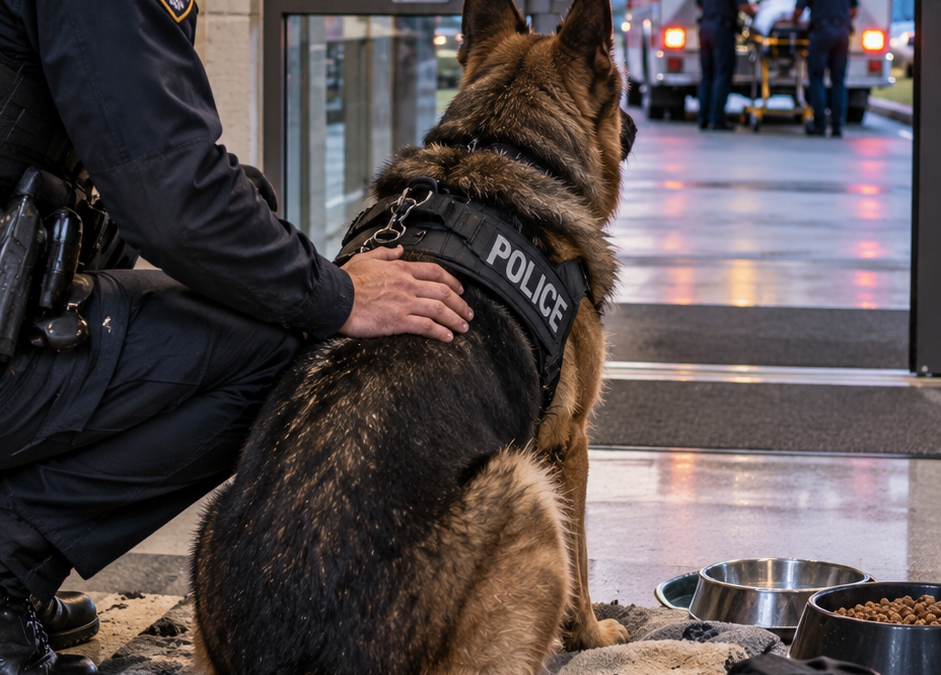
𝗣𝗔𝗥𝗧 𝟮
His ears were forward.
His eyes never left Daniel.
The ambulance arrived in six minutes.
Six minutes is fast.
When your friend is unconscious on the pavement, six minutes feels endless.
The paramedics took over.
They worked on Daniel while we held Rex back.
That was one of the hardest parts.
He knew something was wrong.
He knew strangers were touching his partner.
Everything in him wanted to go closer.
But he was trained.
I held his collar and said, “Stay.”
He stayed.
Barely.
When the paramedics loaded Daniel onto the stretcher, Rex made a sound I had never heard from him before.
Not a bark.
Not a growl.
Almost a whine, but deeper.
“Easy, boy.”
The stretcher went into the ambulance.
The doors closed.
Then the vehicle pulled away.
Rex stood in the middle of the asphalt watching it.
He didn’t bark.
He didn’t run after it.
He didn’t pull against me.
He simply watched.
The ambulance turned at the end of the street.
For another second, the flashing lights were visible.
Then they were gone.
Rex remained still.
I touched his back.
“Come on.”
He didn’t move.
“Rex.”
Slowly, he turned.
He walked toward the station entrance.
He stopped directly in front of the glass doors.
Then he sat.
At the time, I thought he was waiting for Daniel to come back from wherever the ambulance had taken him.
That made sense.
Daniel left.
Daniel always returned.
As far as Rex understood, this was simply another absence.
We had no idea that his waiting had begun.
The hospital called less than an hour later.
Daniel had been admitted.
His condition was serious.
He was unconscious.
That was all they could tell us initially.
Captain Marshall informed the department.
Work continued because it had to.
Calls kept coming.
Reports still needed filing.
People still needed officers.
But the entire station felt different.
Every time I passed the lobby, I saw Rex sitting near the doors.
“Come on, buddy.”
He looked at me.
Then back outside.
Around noon, I brought him water.
I placed the bowl beside him.
“Drink.”
He sniffed it.
Nothing more.
I left it there.
Later, someone brought his food.
He ignored that too.
By evening, rain had started.
We moved him just inside the entrance where he could still see the street through the glass.
He resisted at first.
Not aggressively.
He simply kept returning to the same position.
Front paws aligned.
Head high.
Eyes fixed forward.
Waiting.
Daniel normally kept Rex’s sleeping area in a room behind the courtyard.
There was a raised bed, a water bowl, some equipment, and a blanket Rex had used for years.
That evening, I attached his leash.
“Come on.”
He stood.
For one second, I thought it had worked.
We walked maybe three steps.
Then Rex stopped.
He looked at me.
Looked toward the hallway leading to his room.
Then turned his head back toward the entrance.
“Daniel isn’t coming tonight.”
I wish I hadn’t said it that way.
Rex stared at me.
Of course he didn’t understand the words.
But he understood tone.
I loosened the leash.
“You need sleep.”
He remained where he was.
I tried again.
Nothing.
Finally, I took the leash off.
Rex immediately returned to the doors.
He sat.
Captain Marshall came up beside me.
“Leave him for tonight.”
“He hasn’t eaten.”
“He will.”
I wasn’t sure.
That first night, I stayed late.
Around midnight, I walked into the lobby.
Rex was awake.
“You’re still here.”
His ears moved.
I sat on the floor beside him.
For a while, neither of us did anything.
Cars passed occasionally.
Every set of headlights made Rex lift his head.
Every time someone approached the station, he straightened.
Every time it turned out not to be Daniel, he settled again.
Watching him was painful.
Because hope is beautiful when it has somewhere to go.
That night, Rex’s hope had nowhere to go except through those doors.
The next morning, he was still there.
Day two.
He drank a little water.
Barely ate.
I called the hospital.
No meaningful change.
Daniel remained unconscious.
I went back to Rex.
“He’s still there.”
Rex looked up.
“I don’t know if he can hear anybody.”
His eyes stayed on mine.
“But if he can, I’m sure he’s thinking about you.”
I don’t know why I kept talking to him.
Maybe for him.
Maybe for myself.
By the third day, everyone in the station had adjusted their movements around Rex.
Officers stepped around him entering and leaving.
Someone placed a blanket near the glass doors.
Someone else moved his bowls closer.
One dispatcher brought a piece of chicken.
Rex sniffed it.
Didn’t eat.
“Come on, Rex,” she whispered.
She placed it near his paws.
“You need something.”
He looked outside.
She walked away wiping her eyes.
What affected us wasn’t simply that he missed Daniel.
Dogs miss people.
We all knew that.
What affected us was his certainty.
Rex seemed convinced that if he stayed where Daniel could find him, everything would eventually become normal.
He wasn’t searching the building.
He wasn’t restless.
He wasn’t confused.
He had chosen one place.
The place Daniel would see when he came back.
And he waited.
On the third evening, I sat beside him again.
“You know, you’re making everybody miserable.”
His ear moved.
“I’m serious.”
Nothing.
“Marshall nearly stepped over your tail this morning.”
Rex blinked.
“That’s a dangerous move. The captain is too old to fall.”
If Daniel had been there, he would have laughed.
That thought caught me unexpectedly.
I looked away.
For the first time since the ambulance left, I admitted something I hadn’t said aloud.
I was afraid Daniel might not return.
We were police officers.
We were used to danger having a shape.
A weapon.
A vehicle.
A person.
Something you could see and react to.
This was different.
Daniel had simply fallen.
One second standing.
The next unconscious.
There had been no warning I understood.
And now he was in a hospital bed while his dog waited for him beside the door.
“He’s tough,” I told Rex.
The dog continued looking outside.
“So are you.”
Day four brought more rain.
Hard rain this time.
It hammered the station windows.
Rex became restless whenever vehicles pulled in.
He stood each time.
Watched.
Sat again.
I finally got him to eat several bites by sitting beside him and offering them from my hand.
“Good.”
He chewed slowly.
I offered another.
He took it.
The third he refused.
“Stubborn.”
He turned away.
I rubbed the side of his neck.
“You learned that from Daniel.”
That afternoon, Captain Marshall watched Rex for nearly a minute.
“Sam.”
“Yeah?”
“How much has he eaten?”
“Not enough.”
“Drinking?”
“Some.”
“Sleeping?”
“Hard to know.”
Marshall sighed.
“We need a plan.”
“I know.”
“He’s working himself down.”
“I know.”
I hated saying it.
Because Marshall wasn’t being cruel.
He cared about Rex.
But he also had responsibility for the animal’s welfare.
Waiting had begun to cost Rex physically.
His eyes looked tired.
His posture wasn’t as sharp.
He had started lying down for brief periods but always with his head facing the entrance.
That night, I slept on a couch at the station.
I told everyone I was working paperwork.
No one believed me.
At two in the morning, I checked the lobby.
Rex was asleep.
For maybe five minutes.
Then headlights crossed the glass.
His eyes opened immediately.
He stood.
A patrol car parked outside.
Officer Ramirez entered.
Rex watched him.
Then sat again.
Ramirez looked at me.
“How long can he do this?”
I shook my head.
“I don’t know.”
Day five was when Captain Marshall called me into his office.
He closed the door.
That told me the conversation wasn’t casual.
“Sit down.”
I stayed standing.
He gave me a tired look.
“Fine.”
He folded his hands.
“We can’t keep doing this.”
I knew immediately.
“Rex.”
“Yes.”
“He needs to eat normally. He needs rest. He needs routine.”
“He has a routine.”
“Waiting at the door isn’t a routine.”
“To him it is.”
Marshall leaned back.
“Sam.”
I said nothing.
“We’re considering temporary foster placement.”
My stomach tightened.
“No.”
“It’s not permanent.”
“No.”
“He could stay with one of our K-9 families until Daniel—”
“If you move him now, you’re going to take away the only thing he’s holding onto.”
Marshall’s face hardened slightly.
“I’m responsible for that dog’s health.”
“So am I.”
“Then look at him.”
“I do. Every hour.”
“Exactly.”
He lowered his voice.
“He’s exhausting himself.”
I knew that.
That was the problem.
Marshall wasn’t wrong.
I walked to the window.
For a few seconds, neither of us spoke.
Then I said, “Give me one more day.”
“Sam—”
“One day.”
“For what?”
“I don’t know yet.”
He shook his head.
“That’s not a plan.”
“No. But moving Rex somewhere unfamiliar while Daniel’s still unconscious isn’t a plan either.”
“It’s veterinary guidance.”
“And I respect it.”
I turned.
“But that dog thinks Daniel disappeared. If we remove him from the last place Daniel left, what do you think he understands?”
Marshall stared at me.
“Nothing.”
“Exactly.”
I stepped closer.
“Let me find another way.”
He was silent for a long moment.
Finally he said, “Tomorrow.”
“Thank you.”
“If there isn’t a better solution tomorrow, we move him.”
I nodded.
When I left his office, Rex was exactly where I expected.
I sat beside him.
“Bought you a day.”
His eyes shifted toward me.
“Don’t make me regret it.”
Day six.
I called the hospital early.
Dr. Frances Moran answered after I was transferred twice.
She had been overseeing Daniel’s care.
“Officer Carter?”
“Yes.”
“Mr. Reynolds remains stable.”
Stable.
That word had become both comforting and unbearable.
“Has he woken up?”
“No.”
“Any response?”
“There are some encouraging signs, but I don’t want to overstate them.”
I hesitated.
“Doctor, I need to ask you something strange.”
“I’m listening.”
“Daniel has a K-9 partner.”
“I’ve heard.”
“He’s been waiting at the station doors since Daniel was taken away.”
There was silence.
“He won’t leave?”
“Not voluntarily. Barely eats. Doesn’t really sleep.”
“I see.”
“I know you can’t let dogs into intensive care.”
“Generally, no.”
“Could Daniel hear him somehow?”
Another silence.
“What do you mean?”
“A recording. A bark. Anything.”
Dr. Moran exhaled.
“There’s no guarantee it would have an effect.”
“I know.”
“And we need to be careful about stimulation depending on his condition.”
“Understood.”
“But…”
I waited.
She continued.
“Familiar voices can matter.”
I looked through the office window toward Rex.
“What if Daniel wakes up?”
“Then we’ll reassess.”
“Could he speak to Rex?”
“If he’s alert enough.”
“Doctor, I know this sounds ridiculous.”
“It doesn’t.”
Her answer surprised me.
She said, “I’ve been practicing medicine for twenty-five years. People respond to things we can’t always measure neatly.”
I leaned against the desk.
“So you’re saying his dog might help.”
“I’m saying familiar connection sometimes matters.”
She paused.
“Sometimes a voice is more powerful than medicine in ways medicine can’t explain.”
I thanked her.
Then I went back to Rex.
He was lying down now.
His chin rested on his paws.
“One more day, buddy.”
His eyes opened.
“I need you to give me one more day.”
That night was the worst.
Rex seemed exhausted.
I got him to drink.
He ate a few bites.
Then he returned to the doors.
Rainwater slid down the glass.
Streetlights blurred outside.
I sat next to him.
“I wish I could explain this.”
Rex looked at me.
“Daniel didn’t leave you.”
I swallowed.
“He didn’t choose not to come back.”
The dog’s ears tilted.
“He’s fighting.”
I put my hand on Rex’s back.
“So I need you to fight too.”
For a long time, he stayed against my hand.
Then he lowered his head.
We both slept there.
Me against the wall.
Rex beside the doors.
At 6:43 Sunday morning, my phone rang.
Day seven.
I had been awake for maybe twenty minutes.
The hospital number flashed on the screen.
My heart started racing before I answered.
“Carter.”
“Officer Carter? This is Dr. Moran.”
I stood.
Rex lifted his head.
“Is Daniel—”
“He’s awake.”
For a second, I couldn’t speak.
“He’s awake?”
“Yes.”
I closed my eyes.
“How is he?”
“We’re still monitoring him closely. He’s weak, but he’s alert. He’s speaking.”
I laughed once.
I don’t know why.
Relief sometimes comes out strangely.
“Can I talk to him?”
“That’s why I’m calling.”
I looked at Rex.
Dr. Moran said, “He keeps asking for his dog.”
I was already moving.
“Give me thirty seconds.”
“Officer—”
I ran through the hall.
“Rex.”
He stood immediately.
I dropped to one knee.
The phone was against my ear.
“Daniel?”
There was static.
Then a voice.
Weak.
Rough.
But his.
“Sam?”
I almost lost whatever professional composure I had left.
“You scared the hell out of us.”
A faint breath that might have been a laugh.
“Rex?”
“He’s right here.”
I switched the phone to speaker.
Rex stared at it.
“Daniel, say something.”
A pause.
Then Daniel’s voice came through.
“Rex.”
The dog froze.
I will never forget that moment.
His ears snapped forward.
His eyes widened.
He looked at the phone.
Then at me.
Then back at the phone.
Daniel spoke again.
“Hey, buddy.”
Rex stepped closer.
His nose touched the device.
Daniel’s voice cracked.
“I’m here.”
Rex made that same low sound I had heard beside the ambulance.
Only now it was different.
Not panic.
Recognition.
Daniel whispered, “I’m coming back.”
Rex’s tail moved.
Barely an inch.
Exactly the way it always did when he was happy.
Then another inch.
“Good boy,” Daniel said.
Rex sat.
I put the phone close to his ear.
Daniel breathed.
“I’m sorry, buddy.”
Rex’s shoulders dropped.
For seven days, I had watched tension live inside that dog.
Constantly alert.
Constantly waiting.
For the first time since Thursday morning, it disappeared.
Rex slowly lowered himself to the floor.
His front legs stretched forward.
His head rested on his paws.
His eyes closed.
I touched his neck.
“Yeah.”
My voice broke.
“You heard him.”
Daniel said weakly through the phone, “Is he okay?”
I laughed while wiping my eyes.
“He is now.”
Rex slept for almost four hours.
Deep sleep.
No headlights woke him.
No footsteps.
No doors.
Nothing.
He finally knew what we had been unable to explain.
Daniel was still somewhere in his world.
Waiting had worked.
Three days later, on Wednesday morning, Dr. Moran called again.
“We’ve approved a short visit.”
“You’re serious?”
“Very short.”
“I’ll have him there.”
“Officer Carter.”
“Yeah?”
“Make sure he’s clean.”
I looked at Rex.
He had been sleeping on a police station floor for a week.
“That may take some work.”
We washed him.
Brushed him.
Cleaned his collar until the metal badge caught the light.
When we left for the hospital, Rex walked beside me differently.
During the week of waiting, every step had seemed heavy.
Now he had purpose again.
He knew something was ahead.
Maybe Daniel’s scent was on me from the phone.
Maybe he understood nothing except that my mood had changed.
But he walked with his head high.
At the hospital entrance, a nurse met us.
“Rex?”
I nodded.
She smiled.
“We’ve been hearing about you.”
Rex ignored her.
We entered.
Hospitals are full of smells that overwhelm humans.
Disinfectant.
Plastic.
Coffee.
Medication.
Food.
For Rex, the experience must have been enormous.
Still, he stayed focused.
We moved down a long hallway.
People stopped.
A nurse stepped aside.
Another whispered, “That’s him.”
Rex never looked at them.
Then we reached Daniel’s room.
I stopped outside.
My hand rested against Rex’s neck.
His breathing changed.
He knew.
Daniel was close.
I bent toward him.
“Easy.”
His ears lifted.
“Go get him.”
The door opened.
Rex stepped inside.
Then stopped.
Daniel lay in the hospital bed.
He looked smaller than I remembered.
Pale.
Tired.
There were monitors around him.
Lines.
Medical equipment.
But his eyes were open.
And they were fixed on Rex.
For maybe two seconds, neither moved.
Then Daniel smiled.
“Hey, buddy.”
Rex ran.
I had seen that dog chase suspects.
Run obstacle courses.
Sprint during training.
I had never seen him move like that.
He crossed the room with no hesitation.
At the bed, he slowed just enough to keep from hurting Daniel.
Then he rose carefully and placed his front paws against the mattress.
Daniel lifted one shaking hand.
Rex pushed his head underneath it.
Daniel touched him.
That was all it took.
Rex’s tail began moving.
Once.
Twice.
Then faster.
His entire body started wagging.
Daniel laughed.
Actually laughed.
The sound was weak.
But it filled the room.
“I knew you’d wait.”
Rex licked his hand.
Daniel tried to pull him closer.
I stepped forward to help position the dog safely.
Once Rex was beside him, he lowered his head onto Daniel’s chest.
Daniel placed his hand over the dog’s neck.
Neither moved.
I backed toward the doorway.
I felt like an intruder.
Dr. Moran stood beside me.
For a while, we watched without speaking.
Then Rex made a soft sound.
A short bark.
I’d heard every working sound he had.
Alerts.
Commands.
Excitement.
Warnings.
This was different.
Dr. Moran whispered, “What was that?”
I shook my head.
“I’ve never heard it.”
Daniel smiled.
Rex licked his cheek.
Daniel closed his eyes.
His hand remained on Rex.
Dr. Moran looked at me.
“I’ve worked here twenty-five years.”
I nodded.
“I’ve seen families bring patients back emotionally when nothing else could reach them.”
She watched Daniel.
“But this is something.”
I looked at Rex.
“What?”
She smiled.
“Your dog just gave him a reason to think beyond this room.”
I corrected her automatically.
“Daniel’s dog.”
She looked at me.
“Right.”
Then, after a pause, she said, “Partner.”
That word fit.
Rex stayed for twenty minutes.
When it was time to leave, Daniel whispered, “Tomorrow?”
I looked at Dr. Moran.
She gave a small nod.
“Tomorrow.”
Daniel touched Rex’s ear.
“You hear that?”
Rex stared at him.
“Tomorrow.”
Leaving was difficult.
Rex resisted slightly at the doorway.
Not like before.
He didn’t panic.
He just looked back repeatedly.
I crouched.
“He’s staying here.”
Rex looked at me.
“But we’re coming back.”
I don’t know if he understood the sentence.
He followed me anyway.
The next day, we returned.
And the day after that.
Every afternoon, Rex entered Daniel’s room and sat beside his bed.
Sometimes Daniel was strong enough to scratch his neck.
Sometimes he only rested his hand there.
Rex didn’t care.
He didn’t ask Daniel to throw anything.
Didn’t demand play.
Didn’t become restless.
He simply stayed.
On difficult days, Daniel looked exhausted.
Rex would place his muzzle beneath Daniel’s palm.
Daniel’s fingers would move.
One stroke.
Then another.
It gave him something physical to do.
Something familiar.
Something that belonged to his life before hospital gowns and monitors.
Dr. Moran noticed changes.
Daniel began eating better.
Participating more actively in therapy.
Sitting up longer.
Asking when he could leave.
One afternoon, I walked into his room and found him arguing with a physical therapist.
“I can walk farther.”
She folded her arms.
“You said that yesterday.”
“I was right yesterday.”
“You almost fell.”
“I didn’t.”
“Because I caught you.”
Daniel looked at me.
“Sam, tell her.”
I pointed at the therapist.
“She’s right.”
“Traitor.”
Rex’s tail moved.
I laughed.
“Even he agrees.”
Daniel looked at the dog.
“You’re supposed to be on my side.”
Rex put his head on the bed.
The therapist smiled.
“He’s smarter than you.”
Daniel began laughing.
That was the first time things felt almost normal.
He remained hospitalized for two more weeks.
Every day, Rex visited when allowed.
Every day, Daniel became a little more like himself.
I won’t say Rex medically cured him.
That would be wrong.
Doctors treated Daniel.
Nurses monitored him.
Therapists worked with him.
Medicine and professional care kept him alive and helped him recover.
But anyone who watched those two together could see that Rex gave him something medicine couldn’t prescribe.
A reason to look forward.
A connection to home.
A reminder that life outside the hospital had not gone anywhere.
When Daniel finally received permission to leave, we decided not to tell Rex exactly when.
Of course, we couldn’t actually tell him.
But we kept the morning normal.
I brought Rex to the station.
He sat near the doors again.
For a second, seeing him there brought back the entire week.
But this time, he wasn’t rigid.
He wasn’t starving.
He wasn’t waiting in fear.
He watched the street calmly.
As if he already knew.
A car turned into the lot.
Rex stood.
I watched his body change.
Ears forward.
Tail lifted.
The car stopped.
Passenger door opened.
Daniel stepped out.
He moved slowly.
He had lost weight.
His face was thinner.
But he was standing.
Rex exploded forward.
“Rex!”
I don’t know why I shouted.
There was no stopping him anyway.
He ran across the pavement.
Daniel crouched as much as he safely could.
Rex reached him.
Daniel wrapped both arms around the dog.
Rex pushed against his chest.
Licked his face.
His tail moved so violently his whole body shook.
Daniel buried his face in Rex’s neck.
“I’m here.”
He said it again.
“I’m here, buddy.”
I stood maybe twenty feet away.
So did half the station.
Nobody tried to hide what they were feeling.
Ramirez wiped his face.
One dispatcher openly cried.
Even Captain Marshall looked suspiciously interested in the pavement.
Daniel finally looked up.
His eyes met mine.
“Seven days?”
I nodded.
“He barely moved.”
Daniel looked down at Rex.
“You waited seven days?”
Rex licked his chin.
Daniel laughed.
“You’re crazy.”
I walked over.
“He gets that from you.”
Daniel held out one arm.
I hugged him.
“Good to have you back.”
He gripped my shoulder.
“Good to be back.”
Then he looked at Rex.
“Very good.”
Recovery didn’t end the day Daniel left the hospital.
There were appointments.
Therapy.
Restrictions.
More rest than he wanted.
Paperwork.
Evaluations before he could return to full duty.
Daniel hated being patient.
Rex became surprisingly good at enforcing patience.
During those first weeks, if Daniel moved too quickly around the house, Rex followed closely.
If Daniel lay down, Rex lay beside him.
If someone visited, Rex positioned himself where he could see Daniel.
“He’s babysitting me,” Daniel complained once.
“Good.”
“I’m thirty-eight years old.”
“Doesn’t seem to impress him.”
Daniel looked at Rex.
The dog stared back.
“Disrespectful.”
Rex’s tail moved.
Eventually, Daniel returned to the station.
Not full duty immediately.
Light responsibilities first.
The morning he arrived in uniform again, every officer stopped what they were doing.
Daniel hated attention.
Which made it better.
Captain Marshall shook his hand.
“Welcome back.”
Daniel nodded.
“Thank you, sir.”
Marshall looked at Rex.
“And you.”
Rex sat beside Daniel.
Marshall pointed at him.
“No more seven-day protests in my lobby.”
Daniel smiled.
“I’ll talk to him.”
I said, “He doesn’t listen.”
Rex looked at me.
Daniel laughed.
Over the following months, they returned to training.
Slowly.
Carefully.
The first time Daniel gave Rex a full sequence of commands again, I stood nearby.
Rex executed every one perfectly.
Then returned to Daniel’s side.
Daniel rested one hand on his head.
For a second, their eyes met.
Nobody else would have noticed anything unusual.
I did.
There was something different.
Before Daniel collapsed, the bond between them had been strong.
Afterward, there was an awareness inside it.
They had both experienced absence.
Both had learned that the other could disappear.
And both had learned that separation did not mean abandonment.
Daniel once told me something about those hospital days.
We were sitting in the break room months later.
Rex slept near his chair.
Daniel said, “I remember hearing him.”
“What?”
“On the phone.”
“The first call?”
He nodded.
“I was barely awake.”
I set down my coffee.
“You remember it?”
“Pieces.”
He looked toward Rex.
“I remember asking where he was.”
“He was at the doors.”
“I know.”
Daniel’s jaw tightened.
“When I heard him breathe through the phone, that’s when I understood how long I’d been gone.”
I didn’t say anything.
Daniel continued.
“I thought, I need to get back to him.”
He smiled faintly.
“Stupid, right?”
“No.”
“I had doctors telling me to fight. Family calling. Everybody.”
He looked at Rex.
“But hearing him made everything real.”
“Dr. Moran said something similar.”
“What?”
“That he gave you something outside the room to move toward.”
Daniel nodded.
“Exactly.”
Rex woke.
He lifted his head.
Daniel reached down.
The dog immediately settled again.
I watched them.
“You know what he taught everybody, right?”
Daniel frowned.
“What?”
“That you’re replaceable.”
He stared at me.
I smiled.
“The dog carried the emotional weight of the station for a week.”
Daniel threw a napkin at me.
Rex’s tail thumped.
Humor made the memory easier.
But the truth remained.
Those seven days changed all of us.
I had spent years thinking I understood loyalty.
Police work uses the word often.
Loyalty to your partner.
Loyalty to the department.
Loyalty to the people you’re responsible for protecting.
But loyalty can become abstract when you say it often enough.
Rex made it physical.
Loyalty was sitting in one place because that was where the person you loved would know to find you.
Loyalty was refusing to accept absence as abandonment.
Loyalty was staying through hunger, rain, exhaustion, confusion, and fear.
Not because anyone ordered you to.
Because leaving felt impossible.
People sometimes romanticize dogs too much.
We give human explanations to every behavior.
I know that.
Rex was a trained animal responding to the disappearance of the person at the center of his working and personal life.
There are behavioral explanations.
Bonding.
Routine.
Attachment.
Conditioning.
All of those are true.
None of them make what happened less meaningful.
Sometimes understanding the mechanism doesn’t diminish the emotion.
It makes it more extraordinary.
Rex’s entire world had been built around trust in Daniel.
Daniel gave commands.
Daniel fed him.
Daniel trained him.
Daniel opened the vehicle door.
Daniel stood beside him in dangerous situations.
Daniel was home.
Then one Thursday morning, that person disappeared into an ambulance.
Rex couldn’t understand intensive care.
He couldn’t understand unconsciousness.
He couldn’t understand medical uncertainty.
He understood one thing.
Daniel had left through those doors.
So Rex waited there.
Seven days later, Daniel’s voice came through a phone.
And that was enough for him to rest.
Years have passed since then.
Daniel and Rex continued working together after his recovery.
They walked the same streets.
Ran the same training exercises.
Answered calls.
Protected people who never knew the full story of the dog stepping out of the patrol vehicle.
Sometimes I would watch them from across the parking lot.
Daniel would say something.
Rex’s ear would move.
Then that tiny tail motion.
One inch.
The first sign.
I always noticed.
Because I knew what it meant.
He’s here.
You’re here.
We’re okay.
I am Sam Carter.
I’ve been a police officer long enough to see people at their worst and at their best.
I’ve watched strangers risk themselves for people they didn’t know.
I’ve seen officers carry injured children.
I’ve seen victims forgive.
I’ve seen families break apart.
I’ve seen them rebuild.
I used to think the strongest moments in this job happened under flashing lights.
They don’t always.
Sometimes they happen in a quiet police station at three in the morning, when a dog lies beside a glass door waiting for someone who cannot come.
Sometimes they happen through a phone speaker.
Sometimes in a hospital room when an exhausted man touches the head of the partner who refused to stop believing he would return.
And sometimes courage isn’t moving forward.
Sometimes courage is staying exactly where you are.
Waiting.
Believing.
Refusing to give up.
Whenever I pass those glass doors now, I still see Rex there in my memory.
Head raised.
Eyes on the street.
One day.
Two.
Three.
Seven.
I see the bowls nobody could convince him to finish.
The blanket beside him.
The rain sliding down the glass.
I remember sitting next to him and trying to explain something no words could make him understand.
Then I remember Daniel’s voice on the phone.
“Rex, I’m here.”
And I remember the dog finally lying down.
Not because he had given up.
Because he finally knew he didn’t have to keep watch.
His partner was coming back.
That is what those seven days taught me.
Loyalty isn’t a slogan.
It isn’t something you say when life is easy.
It’s the choice to remain when there is no guarantee.
It’s faith without explanation.
Presence without reward.
And sometimes it is one exhausted German Shepherd sitting in front of two glass doors, believing with everything inside him that the person he loves will eventually walk through them again.
Rex believed.
Daniel returned.
And none of us who witnessed it ever looked at the word loyalty the same way again.
Have you finished reading the story and want to read it again?
For Seven Days, a Police Dog Waited at the Glass Doors—Then His Partner Finally Called His Name
For seven days, Rex sat outside the glass doors of our police station staring at the street, refusing to understand why Officer Daniel Reynolds had left in an ambulance and never come back.
We brought him food, water, blankets, and even tried to move him to the room where he had slept beside Daniel for years, but every time we touched his leash, he looked at us, turned back toward those doors, and resumed the same silent vigil.
Then, on the seventh morning, my phone rang from the hospital—and when I held it beside Rex’s ear and he heard Daniel whisper his name, I watched a dog who had barely rested for a week finally understand that the man he loved was still alive.
My name is Sam Carter.
I’m thirty-four years old, and at the time this happened, I had been working beside Officer Daniel Reynolds for three years.
Daniel was thirty-eight.
He had been with our department for twelve years and had the kind of reputation that takes a long time to build.
Reliable.
Calm.
Patient.
He was the officer you wanted beside you when a situation began to turn ugly because he never seemed to let adrenaline make decisions for him.
People trusted him.
So did dogs.
Especially Rex.
Rex was a German Shepherd assigned to Daniel as his K-9 partner.
Calling them handler and dog never felt entirely accurate to me.
Technically, yes.
Daniel was the handler.
Rex was the police dog.
There were commands, certifications, training schedules, protocols, reports, and all the structure required for a working K-9 team.
But anyone who spent more than a week around those two understood that the official language missed something important.
They weren’t simply coworkers.
They knew each other too well.
Daniel could tell Rex was uneasy before the rest of us noticed a single change in him.
Rex could tell Daniel was tired before Daniel admitted it.
I knew that dog almost as well as I knew most of the officers in our station.
I knew how his breathing changed when he was alert.
I knew that when he was genuinely happy, his tail didn’t immediately wag wildly the way a pet dog’s might.
It moved barely an inch at first.
Then a little more.
I knew how his ears tilted when he detected something unfamiliar.
I knew the low sound he made when he wanted Daniel’s attention without breaking focus.
And I knew the expression in his eyes when he was waiting for a command.
But nothing in my training prepared me for what Rex did during those seven days.
It began on a Thursday morning.
The day wasn’t supposed to be memorable.
There was no major call.
No pursuit.
No dangerous suspect.
No emergency that should have become a story people at our station would still be telling years later.
We were running a routine training exercise in the rear lot.
Daniel and Rex had done versions of it hundreds of times.
I was standing maybe fifteen feet away when Daniel stopped.
At first, I thought he had seen something.
His left hand went to his chest.
He took one step.
Then another.
“Daniel?”
He looked toward me.
Something was wrong.
Not confusion.
Pain.
He dropped to one knee.
I ran.
“Daniel!”
Rex reached him almost at the same time.
Daniel tried to speak.
His mouth moved.
No words came.
Then he collapsed.
Everything after that happened very quickly.
And somehow far too slowly.
I called for medical help.
Another officer ran outside.
Someone brought the emergency kit.
I remember kneeling beside Daniel.
I remember saying his name over and over.
I remember Rex standing inches away, rigid, watching every movement.
“Stay back, Rex.”
His ears were forward.
His eyes never left Daniel.
The ambulance arrived in six minutes.
Six minutes is fast.
When your friend is unconscious on the pavement, six minutes feels endless.
The paramedics took over.
They worked on Daniel while we held Rex back.
That was one of the hardest parts.
He knew something was wrong.
He knew strangers were touching his partner.
Everything in him wanted to go closer.
But he was trained.
I held his collar and said, “Stay.”
He stayed.
Barely.
When the paramedics loaded Daniel onto the stretcher, Rex made a sound I had never heard from him before.
Not a bark.
Not a growl.
Almost a whine, but deeper.
“Easy, boy.”
The stretcher went into the ambulance.
The doors closed.
Then the vehicle pulled away.
Rex stood in the middle of the asphalt watching it.
He didn’t bark.
He didn’t run after it.
He didn’t pull against me.
He simply watched.
The ambulance turned at the end of the street.
For another second, the flashing lights were visible.
Then they were gone.
Rex remained still.
I touched his back.
“Come on.”
He didn’t move.
“Rex.”
Slowly, he turned.
He walked toward the station entrance.
He stopped directly in front of the glass doors.
Then he sat.
At the time, I thought he was waiting for Daniel to come back from wherever the ambulance had taken him.
That made sense.
Daniel left.
Daniel always returned.
As far as Rex understood, this was simply another absence.
We had no idea that his waiting had begun.
The hospital called less than an hour later.
Daniel had been admitted.
His condition was serious.
He was unconscious.
That was all they could tell us initially.
Captain Marshall informed the department.
Work continued because it had to.
Calls kept coming.
Reports still needed filing.
People still needed officers.
But the entire station felt different.
Every time I passed the lobby, I saw Rex sitting near the doors.
“Come on, buddy.”
He looked at me.
Then back outside.
Around noon, I brought him water.
I placed the bowl beside him.
“Drink.”
He sniffed it.
Nothing more.
I left it there.
Later, someone brought his food.
He ignored that too.
By evening, rain had started.
We moved him just inside the entrance where he could still see the street through the glass.
He resisted at first.
Not aggressively.
He simply kept returning to the same position.
Front paws aligned.
Head high.
Eyes fixed forward.
Waiting.
Daniel normally kept Rex’s sleeping area in a room behind the courtyard.
There was a raised bed, a water bowl, some equipment, and a blanket Rex had used for years.
That evening, I attached his leash.
“Come on.”
He stood.
For one second, I thought it had worked.
We walked maybe three steps.
Then Rex stopped.
He looked at me.
Looked toward the hallway leading to his room.
Then turned his head back toward the entrance.
“Daniel isn’t coming tonight.”
I wish I hadn’t said it that way.
Rex stared at me.
Of course he didn’t understand the words.
But he understood tone.
I loosened the leash.
“You need sleep.”
He remained where he was.
I tried again.
Nothing.
Finally, I took the leash off.
Rex immediately returned to the doors.
He sat.
Captain Marshall came up beside me.
“Leave him for tonight.”
“He hasn’t eaten.”
“He will.”
I wasn’t sure.
That first night, I stayed late.
Around midnight, I walked into the lobby.
Rex was awake.
“You’re still here.”
His ears moved.
I sat on the floor beside him.
For a while, neither of us did anything.
Cars passed occasionally.
Every set of headlights made Rex lift his head.
Every time someone approached the station, he straightened.
Every time it turned out not to be Daniel, he settled again.
Watching him was painful.
Because hope is beautiful when it has somewhere to go.
That night, Rex’s hope had nowhere to go except through those doors.
The next morning, he was still there.
Day two.
He drank a little water.
Barely ate.
I called the hospital.
No meaningful change.
Daniel remained unconscious.
I went back to Rex.
“He’s still there.”
Rex looked up.
“I don’t know if he can hear anybody.”
His eyes stayed on mine.
“But if he can, I’m sure he’s thinking about you.”
I don’t know why I kept talking to him.
Maybe for him.
Maybe for myself.
By the third day, everyone in the station had adjusted their movements around Rex.
Officers stepped around him entering and leaving.
Someone placed a blanket near the glass doors.
Someone else moved his bowls closer.
One dispatcher brought a piece of chicken.
Rex sniffed it.
Didn’t eat.
“Come on, Rex,” she whispered.
She placed it near his paws.
“You need something.”
He looked outside.
She walked away wiping her eyes.
What affected us wasn’t simply that he missed Daniel.
Dogs miss people.
We all knew that.
What affected us was his certainty.
Rex seemed convinced that if he stayed where Daniel could find him, everything would eventually become normal.
He wasn’t searching the building.
He wasn’t restless.
He wasn’t confused.
He had chosen one place.
The place Daniel would see when he came back.
And he waited.
On the third evening, I sat beside him again.
“You know, you’re making everybody miserable.”
His ear moved.
“I’m serious.”
Nothing.
“Marshall nearly stepped over your tail this morning.”
Rex blinked.
“That’s a dangerous move. The captain is too old to fall.”
If Daniel had been there, he would have laughed.
That thought caught me unexpectedly.
I looked away.
For the first time since the ambulance left, I admitted something I hadn’t said aloud.
I was afraid Daniel might not return.
We were police officers.
We were used to danger having a shape.
A weapon.
A vehicle.
A person.
Something you could see and react to.
This was different.
Daniel had simply fallen.
One second standing.
The next unconscious.
There had been no warning I understood.
And now he was in a hospital bed while his dog waited for him beside the door.
“He’s tough,” I told Rex.
The dog continued looking outside.
“So are you.”
Day four brought more rain.
Hard rain this time.
It hammered the station windows.
Rex became restless whenever vehicles pulled in.
He stood each time.
Watched.
Sat again.
I finally got him to eat several bites by sitting beside him and offering them from my hand.
“Good.”
He chewed slowly.
I offered another.
He took it.
The third he refused.
“Stubborn.”
He turned away.
I rubbed the side of his neck.
“You learned that from Daniel.”
That afternoon, Captain Marshall watched Rex for nearly a minute.
“Sam.”
“Yeah?”
“How much has he eaten?”
“Not enough.”
“Drinking?”
“Some.”
“Sleeping?”
“Hard to know.”
Marshall sighed.
“We need a plan.”
“I know.”
“He’s working himself down.”
“I know.”
I hated saying it.
Because Marshall wasn’t being cruel.
He cared about Rex.
But he also had responsibility for the animal’s welfare.
Waiting had begun to cost Rex physically.
His eyes looked tired.
His posture wasn’t as sharp.
He had started lying down for brief periods but always with his head facing the entrance.
That night, I slept on a couch at the station.
I told everyone I was working paperwork.
No one believed me.
At two in the morning, I checked the lobby.
Rex was asleep.
For maybe five minutes.
Then headlights crossed the glass.
His eyes opened immediately.
He stood.
A patrol car parked outside.
Officer Ramirez entered.
Rex watched him.
Then sat again.
Ramirez looked at me.
“How long can he do this?”
I shook my head.
“I don’t know.”
Day five was when Captain Marshall called me into his office.
He closed the door.
That told me the conversation wasn’t casual.
“Sit down.”
I stayed standing.
He gave me a tired look.
“Fine.”
He folded his hands.
“We can’t keep doing this.”
I knew immediately.
“Rex.”
“Yes.”
“He needs to eat normally. He needs rest. He needs routine.”
“He has a routine.”
“Waiting at the door isn’t a routine.”
“To him it is.”
Marshall leaned back.
“Sam.”
I said nothing.
“We’re considering temporary foster placement.”
My stomach tightened.
“No.”
“It’s not permanent.”
“No.”
“He could stay with one of our K-9 families until Daniel—”
“If you move him now, you’re going to take away the only thing he’s holding onto.”
Marshall’s face hardened slightly.
“I’m responsible for that dog’s health.”
“So am I.”
“Then look at him.”
“I do. Every hour.”
“Exactly.”
He lowered his voice.
“He’s exhausting himself.”
I knew that.
That was the problem.
Marshall wasn’t wrong.
I walked to the window.
For a few seconds, neither of us spoke.
Then I said, “Give me one more day.”
“Sam—”
“One day.”
“For what?”
“I don’t know yet.”
He shook his head.
“That’s not a plan.”
“No. But moving Rex somewhere unfamiliar while Daniel’s still unconscious isn’t a plan either.”
“It’s veterinary guidance.”
“And I respect it.”
I turned.
“But that dog thinks Daniel disappeared. If we remove him from the last place Daniel left, what do you think he understands?”
Marshall stared at me.
“Nothing.”
“Exactly.”
I stepped closer.
“Let me find another way.”
He was silent for a long moment.
Finally he said, “Tomorrow.”
“Thank you.”
“If there isn’t a better solution tomorrow, we move him.”
I nodded.
When I left his office, Rex was exactly where I expected.
I sat beside him.
“Bought you a day.”
His eyes shifted toward me.
“Don’t make me regret it.”
Day six.
I called the hospital early.
Dr. Frances Moran answered after I was transferred twice.
She had been overseeing Daniel’s care.
“Officer Carter?”
“Yes.”
“Mr. Reynolds remains stable.”
Stable.
That word had become both comforting and unbearable.
“Has he woken up?”
“No.”
“Any response?”
“There are some encouraging signs, but I don’t want to overstate them.”
I hesitated.
“Doctor, I need to ask you something strange.”
“I’m listening.”
“Daniel has a K-9 partner.”
“I’ve heard.”
“He’s been waiting at the station doors since Daniel was taken away.”
There was silence.
“He won’t leave?”
“Not voluntarily. Barely eats. Doesn’t really sleep.”
“I see.”
“I know you can’t let dogs into intensive care.”
“Generally, no.”
“Could Daniel hear him somehow?”
Another silence.
“What do you mean?”
“A recording. A bark. Anything.”
Dr. Moran exhaled.
“There’s no guarantee it would have an effect.”
“I know.”
“And we need to be careful about stimulation depending on his condition.”
“Understood.”
“But…”
I waited.
She continued.
“Familiar voices can matter.”
I looked through the office window toward Rex.
“What if Daniel wakes up?”
“Then we’ll reassess.”
“Could he speak to Rex?”
“If he’s alert enough.”
“Doctor, I know this sounds ridiculous.”
“It doesn’t.”
Her answer surprised me.
She said, “I’ve been practicing medicine for twenty-five years. People respond to things we can’t always measure neatly.”
I leaned against the desk.
“So you’re saying his dog might help.”
“I’m saying familiar connection sometimes matters.”
She paused.
“Sometimes a voice is more powerful than medicine in ways medicine can’t explain.”
I thanked her.
Then I went back to Rex.
He was lying down now.
His chin rested on his paws.
“One more day, buddy.”
His eyes opened.
“I need you to give me one more day.”
That night was the worst.
Rex seemed exhausted.
I got him to drink.
He ate a few bites.
Then he returned to the doors.
Rainwater slid down the glass.
Streetlights blurred outside.
I sat next to him.
“I wish I could explain this.”
Rex looked at me.
“Daniel didn’t leave you.”
I swallowed.
“He didn’t choose not to come back.”
The dog’s ears tilted.
“He’s fighting.”
I put my hand on Rex’s back.
“So I need you to fight too.”
For a long time, he stayed against my hand.
Then he lowered his head.
We both slept there.
Me against the wall.
Rex beside the doors.
At 6:43 Sunday morning, my phone rang.
Day seven.
I had been awake for maybe twenty minutes.
The hospital number flashed on the screen.
My heart started racing before I answered.
“Carter.”
“Officer Carter? This is Dr. Moran.”
I stood.
Rex lifted his head.
“Is Daniel—”
“He’s awake.”
For a second, I couldn’t speak.
“He’s awake?”
“Yes.”
I closed my eyes.
“How is he?”
“We’re still monitoring him closely. He’s weak, but he’s alert. He’s speaking.”
I laughed once.
I don’t know why.
Relief sometimes comes out strangely.
“Can I talk to him?”
“That’s why I’m calling.”
I looked at Rex.
Dr. Moran said, “He keeps asking for his dog.”
I was already moving.
“Give me thirty seconds.”
“Officer—”
I ran through the hall.
“Rex.”
He stood immediately.
I dropped to one knee.
The phone was against my ear.
“Daniel?”
There was static.
Then a voice.
Weak.
Rough.
But his.
“Sam?”
I almost lost whatever professional composure I had left.
“You scared the hell out of us.”
A faint breath that might have been a laugh.
“Rex?”
“He’s right here.”
I switched the phone to speaker.
Rex stared at it.
“Daniel, say something.”
A pause.
Then Daniel’s voice came through.
“Rex.”
The dog froze.
I will never forget that moment.
His ears snapped forward.
His eyes widened.
He looked at the phone.
Then at me.
Then back at the phone.
Daniel spoke again.
“Hey, buddy.”
Rex stepped closer.
His nose touched the device.
Daniel’s voice cracked.
“I’m here.”
Rex made that same low sound I had heard beside the ambulance.
Only now it was different.
Not panic.
Recognition.
Daniel whispered, “I’m coming back.”
Rex’s tail moved.
Barely an inch.
Exactly the way it always did when he was happy.
Then another inch.
“Good boy,” Daniel said.
Rex sat.
I put the phone close to his ear.
Daniel breathed.
“I’m sorry, buddy.”
Rex’s shoulders dropped.
For seven days, I had watched tension live inside that dog.
Constantly alert.
Constantly waiting.
For the first time since Thursday morning, it disappeared.
Rex slowly lowered himself to the floor.
His front legs stretched forward.
His head rested on his paws.
His eyes closed.
I touched his neck.
“Yeah.”
My voice broke.
“You heard him.”
Daniel said weakly through the phone, “Is he okay?”
I laughed while wiping my eyes.
“He is now.”
Rex slept for almost four hours.
Deep sleep.
No headlights woke him.
No footsteps.
No doors.
Nothing.
He finally knew what we had been unable to explain.
Daniel was still somewhere in his world.
Waiting had worked.
Three days later, on Wednesday morning, Dr. Moran called again.
“We’ve approved a short visit.”
“You’re serious?”
“Very short.”
“I’ll have him there.”
“Officer Carter.”
“Yeah?”
“Make sure he’s clean.”
I looked at Rex.
He had been sleeping on a police station floor for a week.
“That may take some work.”
We washed him.
Brushed him.
Cleaned his collar until the metal badge caught the light.
When we left for the hospital, Rex walked beside me differently.
During the week of waiting, every step had seemed heavy.
Now he had purpose again.
He knew something was ahead.
Maybe Daniel’s scent was on me from the phone.
Maybe he understood nothing except that my mood had changed.
But he walked with his head high.
At the hospital entrance, a nurse met us.
“Rex?”
I nodded.
She smiled.
“We’ve been hearing about you.”
Rex ignored her.
We entered.
Hospitals are full of smells that overwhelm humans.
Disinfectant.
Plastic.
Coffee.
Medication.
Food.
For Rex, the experience must have been enormous.
Still, he stayed focused.
We moved down a long hallway.
People stopped.
A nurse stepped aside.
Another whispered, “That’s him.”
Rex never looked at them.
Then we reached Daniel’s room.
I stopped outside.
My hand rested against Rex’s neck.
His breathing changed.
He knew.
Daniel was close.
I bent toward him.
“Easy.”
His ears lifted.
“Go get him.”
The door opened.
Rex stepped inside.
Then stopped.
Daniel lay in the hospital bed.
He looked smaller than I remembered.
Pale.
Tired.
There were monitors around him.
Lines.
Medical equipment.
But his eyes were open.
And they were fixed on Rex.
For maybe two seconds, neither moved.
Then Daniel smiled.
“Hey, buddy.”
Rex ran.
I had seen that dog chase suspects.
Run obstacle courses.
Sprint during training.
I had never seen him move like that.
He crossed the room with no hesitation.
At the bed, he slowed just enough to keep from hurting Daniel.
Then he rose carefully and placed his front paws against the mattress.
Daniel lifted one shaking hand.
Rex pushed his head underneath it.
Daniel touched him.
That was all it took.
Rex’s tail began moving.
Once.
Twice.
Then faster.
His entire body started wagging.
Daniel laughed.
Actually laughed.
The sound was weak.
But it filled the room.
“I knew you’d wait.”
Rex licked his hand.
Daniel tried to pull him closer.
I stepped forward to help position the dog safely.
Once Rex was beside him, he lowered his head onto Daniel’s chest.
Daniel placed his hand over the dog’s neck.
Neither moved.
I backed toward the doorway.
I felt like an intruder.
Dr. Moran stood beside me.
For a while, we watched without speaking.
Then Rex made a soft sound.
A short bark.
I’d heard every working sound he had.
Alerts.
Commands.
Excitement.
Warnings.
This was different.
Dr. Moran whispered, “What was that?”
I shook my head.
“I’ve never heard it.”
Daniel smiled.
Rex licked his cheek.
Daniel closed his eyes.
His hand remained on Rex.
Dr. Moran looked at me.
“I’ve worked here twenty-five years.”
I nodded.
“I’ve seen families bring patients back emotionally when nothing else could reach them.”
She watched Daniel.
“But this is something.”
I looked at Rex.
“What?”
She smiled.
“Your dog just gave him a reason to think beyond this room.”
I corrected her automatically.
“Daniel’s dog.”
She looked at me.
“Right.”
Then, after a pause, she said, “Partner.”
That word fit.
Rex stayed for twenty minutes.
When it was time to leave, Daniel whispered, “Tomorrow?”
I looked at Dr. Moran.
She gave a small nod.
“Tomorrow.”
Daniel touched Rex’s ear.
“You hear that?”
Rex stared at him.
“Tomorrow.”
Leaving was difficult.
Rex resisted slightly at the doorway.
Not like before.
He didn’t panic.
He just looked back repeatedly.
I crouched.
“He’s staying here.”
Rex looked at me.
“But we’re coming back.”
I don’t know if he understood the sentence.
He followed me anyway.
The next day, we returned.
And the day after that.
Every afternoon, Rex entered Daniel’s room and sat beside his bed.
Sometimes Daniel was strong enough to scratch his neck.
Sometimes he only rested his hand there.
Rex didn’t care.
He didn’t ask Daniel to throw anything.
Didn’t demand play.
Didn’t become restless.
He simply stayed.
On difficult days, Daniel looked exhausted.
Rex would place his muzzle beneath Daniel’s palm.
Daniel’s fingers would move.
One stroke.
Then another.
It gave him something physical to do.
Something familiar.
Something that belonged to his life before hospital gowns and monitors.
Dr. Moran noticed changes.
Daniel began eating better.
Participating more actively in therapy.
Sitting up longer.
Asking when he could leave.
One afternoon, I walked into his room and found him arguing with a physical therapist.
“I can walk farther.”
She folded her arms.
“You said that yesterday.”
“I was right yesterday.”
“You almost fell.”
“I didn’t.”
“Because I caught you.”
Daniel looked at me.
“Sam, tell her.”
I pointed at the therapist.
“She’s right.”
“Traitor.”
Rex’s tail moved.
I laughed.
“Even he agrees.”
Daniel looked at the dog.
“You’re supposed to be on my side.”
Rex put his head on the bed.
The therapist smiled.
“He’s smarter than you.”
Daniel began laughing.
That was the first time things felt almost normal.
He remained hospitalized for two more weeks.
Every day, Rex visited when allowed.
Every day, Daniel became a little more like himself.
I won’t say Rex medically cured him.
That would be wrong.
Doctors treated Daniel.
Nurses monitored him.
Therapists worked with him.
Medicine and professional care kept him alive and helped him recover.
But anyone who watched those two together could see that Rex gave him something medicine couldn’t prescribe.
A reason to look forward.
A connection to home.
A reminder that life outside the hospital had not gone anywhere.
When Daniel finally received permission to leave, we decided not to tell Rex exactly when.
Of course, we couldn’t actually tell him.
But we kept the morning normal.
I brought Rex to the station.
He sat near the doors again.
For a second, seeing him there brought back the entire week.
But this time, he wasn’t rigid.
He wasn’t starving.
He wasn’t waiting in fear.
He watched the street calmly.
As if he already knew.
A car turned into the lot.
Rex stood.
I watched his body change.
Ears forward.
Tail lifted.
The car stopped.
Passenger door opened.
Daniel stepped out.
He moved slowly.
He had lost weight.
His face was thinner.
But he was standing.
Rex exploded forward.
“Rex!”
I don’t know why I shouted.
There was no stopping him anyway.
He ran across the pavement.
Daniel crouched as much as he safely could.
Rex reached him.
Daniel wrapped both arms around the dog.
Rex pushed against his chest.
Licked his face.
His tail moved so violently his whole body shook.
Daniel buried his face in Rex’s neck.
“I’m here.”
He said it again.
“I’m here, buddy.”
I stood maybe twenty feet away.
So did half the station.
Nobody tried to hide what they were feeling.
Ramirez wiped his face.
One dispatcher openly cried.
Even Captain Marshall looked suspiciously interested in the pavement.
Daniel finally looked up.
His eyes met mine.
“Seven days?”
I nodded.
“He barely moved.”
Daniel looked down at Rex.
“You waited seven days?”
Rex licked his chin.
Daniel laughed.
“You’re crazy.”
I walked over.
“He gets that from you.”
Daniel held out one arm.
I hugged him.
“Good to have you back.”
He gripped my shoulder.
“Good to be back.”
Then he looked at Rex.
“Very good.”
Recovery didn’t end the day Daniel left the hospital.
There were appointments.
Therapy.
Restrictions.
More rest than he wanted.
Paperwork.
Evaluations before he could return to full duty.
Daniel hated being patient.
Rex became surprisingly good at enforcing patience.
During those first weeks, if Daniel moved too quickly around the house, Rex followed closely.
If Daniel lay down, Rex lay beside him.
If someone visited, Rex positioned himself where he could see Daniel.
“He’s babysitting me,” Daniel complained once.
“Good.”
“I’m thirty-eight years old.”
“Doesn’t seem to impress him.”
Daniel looked at Rex.
The dog stared back.
“Disrespectful.”
Rex’s tail moved.
Eventually, Daniel returned to the station.
Not full duty immediately.
Light responsibilities first.
The morning he arrived in uniform again, every officer stopped what they were doing.
Daniel hated attention.
Which made it better.
Captain Marshall shook his hand.
“Welcome back.”
Daniel nodded.
“Thank you, sir.”
Marshall looked at Rex.
“And you.”
Rex sat beside Daniel.
Marshall pointed at him.
“No more seven-day protests in my lobby.”
Daniel smiled.
“I’ll talk to him.”
I said, “He doesn’t listen.”
Rex looked at me.
Daniel laughed.
Over the following months, they returned to training.
Slowly.
Carefully.
The first time Daniel gave Rex a full sequence of commands again, I stood nearby.
Rex executed every one perfectly.
Then returned to Daniel’s side.
Daniel rested one hand on his head.
For a second, their eyes met.
Nobody else would have noticed anything unusual.
I did.
There was something different.
Before Daniel collapsed, the bond between them had been strong.
Afterward, there was an awareness inside it.
They had both experienced absence.
Both had learned that the other could disappear.
And both had learned that separation did not mean abandonment.
Daniel once told me something about those hospital days.
We were sitting in the break room months later.
Rex slept near his chair.
Daniel said, “I remember hearing him.”
“What?”
“On the phone.”
“The first call?”
He nodded.
“I was barely awake.”
I set down my coffee.
“You remember it?”
“Pieces.”
He looked toward Rex.
“I remember asking where he was.”
“He was at the doors.”
“I know.”
Daniel’s jaw tightened.
“When I heard him breathe through the phone, that’s when I understood how long I’d been gone.”
I didn’t say anything.
Daniel continued.
“I thought, I need to get back to him.”
He smiled faintly.
“Stupid, right?”
“No.”
“I had doctors telling me to fight. Family calling. Everybody.”
He looked at Rex.
“But hearing him made everything real.”
“Dr. Moran said something similar.”
“What?”
“That he gave you something outside the room to move toward.”
Daniel nodded.
“Exactly.”
Rex woke.
He lifted his head.
Daniel reached down.
The dog immediately settled again.
I watched them.
“You know what he taught everybody, right?”
Daniel frowned.
“What?”
“That you’re replaceable.”
He stared at me.
I smiled.
“The dog carried the emotional weight of the station for a week.”
Daniel threw a napkin at me.
Rex’s tail thumped.
Humor made the memory easier.
But the truth remained.
Those seven days changed all of us.
I had spent years thinking I understood loyalty.
Police work uses the word often.
Loyalty to your partner.
Loyalty to the department.
Loyalty to the people you’re responsible for protecting.
But loyalty can become abstract when you say it often enough.
Rex made it physical.
Loyalty was sitting in one place because that was where the person you loved would know to find you.
Loyalty was refusing to accept absence as abandonment.
Loyalty was staying through hunger, rain, exhaustion, confusion, and fear.
Not because anyone ordered you to.
Because leaving felt impossible.
People sometimes romanticize dogs too much.
We give human explanations to every behavior.
I know that.
Rex was a trained animal responding to the disappearance of the person at the center of his working and personal life.
There are behavioral explanations.
Bonding.
Routine.
Attachment.
Conditioning.
All of those are true.
None of them make what happened less meaningful.
Sometimes understanding the mechanism doesn’t diminish the emotion.
It makes it more extraordinary.
Rex’s entire world had been built around trust in Daniel.
Daniel gave commands.
Daniel fed him.
Daniel trained him.
Daniel opened the vehicle door.
Daniel stood beside him in dangerous situations.
Daniel was home.
Then one Thursday morning, that person disappeared into an ambulance.
Rex couldn’t understand intensive care.
He couldn’t understand unconsciousness.
He couldn’t understand medical uncertainty.
He understood one thing.
Daniel had left through those doors.
So Rex waited there.
Seven days later, Daniel’s voice came through a phone.
And that was enough for him to rest.
Years have passed since then.
Daniel and Rex continued working together after his recovery.
They walked the same streets.
Ran the same training exercises.
Answered calls.
Protected people who never knew the full story of the dog stepping out of the patrol vehicle.
Sometimes I would watch them from across the parking lot.
Daniel would say something.
Rex’s ear would move.
Then that tiny tail motion.
One inch.
The first sign.
I always noticed.
Because I knew what it meant.
He’s here.
You’re here.
We’re okay.
I am Sam Carter.
I’ve been a police officer long enough to see people at their worst and at their best.
I’ve watched strangers risk themselves for people they didn’t know.
I’ve seen officers carry injured children.
I’ve seen victims forgive.
I’ve seen families break apart.
I’ve seen them rebuild.
I used to think the strongest moments in this job happened under flashing lights.
They don’t always.
Sometimes they happen in a quiet police station at three in the morning, when a dog lies beside a glass door waiting for someone who cannot come.
Sometimes they happen through a phone speaker.
Sometimes in a hospital room when an exhausted man touches the head of the partner who refused to stop believing he would return.
And sometimes courage isn’t moving forward.
Sometimes courage is staying exactly where you are.
Waiting.
Believing.
Refusing to give up.
Whenever I pass those glass doors now, I still see Rex there in my memory.
Head raised.
Eyes on the street.
One day.
Two.
Three.
Seven.
I see the bowls nobody could convince him to finish.
The blanket beside him.
The rain sliding down the glass.
I remember sitting next to him and trying to explain something no words could make him understand.
Then I remember Daniel’s voice on the phone.
“Rex, I’m here.”
And I remember the dog finally lying down.
Not because he had given up.
Because he finally knew he didn’t have to keep watch.
His partner was coming back.
That is what those seven days taught me.
Loyalty isn’t a slogan.
It isn’t something you say when life is easy.
It’s the choice to remain when there is no guarantee.
It’s faith without explanation.
Presence without reward.
And sometimes it is one exhausted German Shepherd sitting in front of two glass doors, believing with everything inside him that the person he loves will eventually walk through them again.
Rex believed.
Daniel returned.
And none of us who witnessed it ever looked at the word loyalty the same way again.








