𝗣𝗔𝗥𝗧 𝟮 “Five Beers,” the SEAL Said—But My Hand Reached for a Sixth Glass Before I Knew Why
𝗣𝗔𝗥𝗧 𝟮
Behind him, the younger man pushed his sleeve toward his elbow.
A small compass tattoo appeared on the inside of his wrist.
My pen stopped moving.
At the table, another man unwrapped a peppermint.
My heart missed one beat.
Then another.
I looked toward the broadest man in the group.
Heavy shoulders.
Hands that looked permanently marked by grease despite being clean.
And beside him sat a man whose face seemed almost deliberately expressionless.
A photograph surfaced in my memory.
Six men standing beside a transport aircraft.
Sunburned.
Exhausted.
Grinning as if the camera had interrupted an argument.
I had seen that photograph for maybe twenty seconds.
Eighteen months earlier.
But I remembered every face.
I remembered every name.
I remembered the man who had shown it to me.
I turned away before any of them could notice what was happening.
Five beers.
That was all they had ordered.
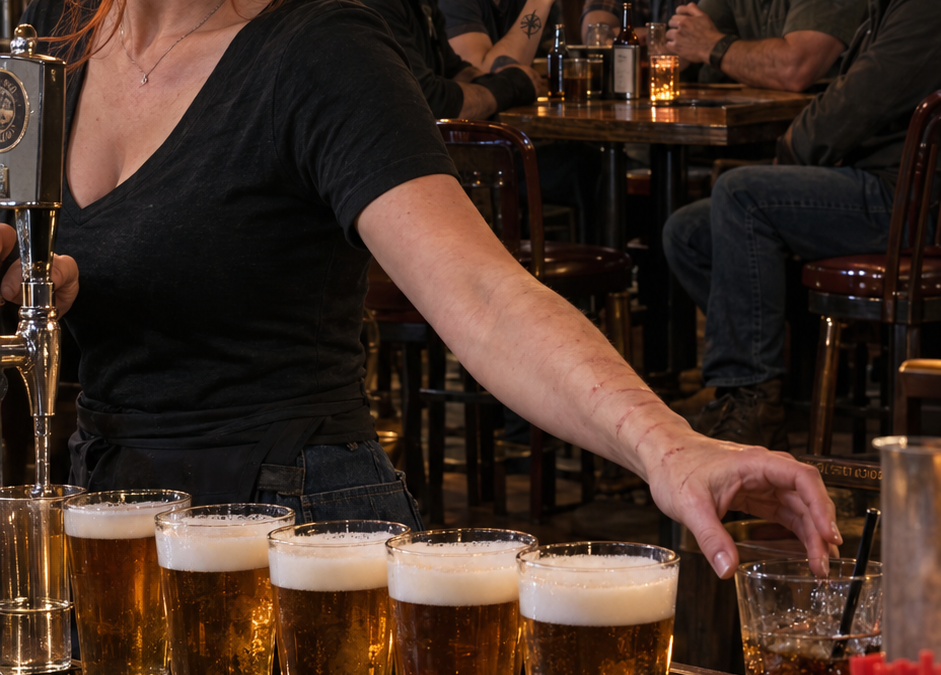
I pulled the first glass beneath the tap.
Then the second.
Third.
Fourth.
Fifth.
Foam climbed the sides before settling.
My hands were trembling by then.
I told myself I was tired.
I told myself I was inventing connections because grief had a way of turning coincidence into patterns.
Then, without deciding to, I reached for a sixth glass.
My fingers moved toward the soda gun.
I pressed the Coke button.
Dark liquid filled the glass with a soft hiss.
Bubbles raced upward.
I stared at it.
And eighteen months disappeared.
I could hear Jake Rourke laughing in a clinic chair again.
“I don’t drink beer,” he had told me.
“Never?”
“Five men on my team drink enough to keep the entire industry alive. Somebody has to maintain standards.”
“What do you drink?”
He had lifted the Coke bottle in his hand like a man making a toast.
“The drink of responsible adults.”
I had rolled my eyes.
He had grinned.
Now five beers stood in front of me.
And one Coke.
There had been six men in that photograph.
Only five had walked into Miller’s.
I could have poured the Coke down the drain.
I could have pretended I had made a mistake.
I could have delivered the five beers and spent the rest of the night hiding in the kitchen.
That would have been easier.
I had spent a year building my life around easier.
Instead, I placed all six drinks on a tray.
My legs felt strangely heavy as I crossed the floor.
Their conversation faded when I approached.
I put one beer in front of each man.
Reeves.
Torres.
Bennett.
Cole.
Wallace.
I had never met any of them before.
But Jake had said their names enough that seeing them felt like recognizing people from a dream.
Then I placed the Coke in the open space at the end of the table.
There was no sixth chair.
Just an empty section of dark wood where one could have gone.
Cold drops began collecting on the outside of the glass.
Nobody spoke.
Five pairs of eyes moved from the Coke to me.
The tall man—the one I knew had to be Master Chief Reeves—looked at the drinks as if counting them might change what was in front of him.
Finally, he said, “We’re only five.”
I held the empty tray against my waist.
“I know.”
The man with the compass tattoo leaned forward.
Reeves looked at me harder.
There was no anger in his face yet.
Only caution.
The kind men like him developed after enough years of protecting information, people, memories.
“Then who’s that for?”
For one second, I could not answer.
I saw a different room.
White clinic walls.
A shoulder wrapped in gauze.
A bottle of Coke balanced against Jake’s thigh.
His smile when he thought he was being charming.
His face under emergency lights months later, gray with blood loss.
His fingers closing around my wrist because he was afraid to disappear.
I looked at the empty place beside the five men.
“This one’s for Jake.”
The name struck the table like a round hitting metal.
Reeves went white.
Cole stopped with a peppermint halfway to his mouth.
Wallace’s fingers tightened around the edge of the table.
Bennett glanced toward the entrance as if someone must have followed them.
Torres did not look at me.
He looked at Reeves.
Reeves stood.
Slowly.
His chair scraped across the floor.
Every instinct in my body recognized controlled danger.
But his hands were trembling.
“How do you know that name?”
The room around us seemed to shrink.
My manager stopped beside the register.
Two regulars looked over.
To them, it probably seemed as though five intimidating strangers were confronting a waitress over a glass of soda.
They could not see the dead man standing between us.
“No one told me,” I said.
Torres spoke next.
“Did somebody know we were coming here?”
“No.”
“Did you look us up after we walked in?”
“No.”
“Then how do you know Jake?”
I took a breath.
“You came here because it’s been one year.”
The men exchanged looks.
Torres’s expression sharpened.
“One year since what?”
He was testing me.
I understood why.
“Since the Eastern Extraction.”
Nobody moved.
I turned toward Reeves.
“You’re Master Chief Reeves.”
His face changed.
I looked at Torres.
“Compass tattoo. Jake said you trusted it more than you trusted most officers.”
Torres looked down at his wrist.
“Bennett hates having his picture taken.”
Bennett’s jaw tightened.
“Cole carried peppermints because he was quitting cigarettes and didn’t want the rest of you making a big deal about it.”
Cole slowly set the peppermint on the table.
Then I looked at Wallace.
“And Wallace can repair any engine on earth except his own truck.”
Wallace whispered, “Jesus.”
Reeves sank slowly back into his chair.
“Where did you hear that?”
“From Jake.”
I had spent a year avoiding his name.
Now saying it hurt less than I expected.
Maybe because I was finally saying it to people who understood what it cost.
“He showed me your team photograph eighteen months ago.”
Torres stared at me.
“Where?”
“At a forward clinic.”
Silence.
“I treated his shoulder after an extraction vehicle rolled down a rocky slope.”
Something changed in Wallace’s face.
Not shock.
Recognition.
“You’re the red-haired medic.”
My fingers tightened around the tray.
Reeves looked at him.
Wallace gave a faint, disbelieving shake of his head.
“Jake talked about a medic with red hair. Said she scared him more than enemy fire because she remembered every stupid thing he said.”
A broken smile touched Cole’s mouth.
“He talked about her for months.”
I stood completely still.
For a year, I had assumed whatever existed between Jake and me had belonged only to those quiet clinic rooms.
To sunset conversations.
To appointments he did not need.
To promises we never had the courage to define.
Hearing that he had spoken about me felt like discovering I had not imagined an entire part of my own life.
Reeves looked at Wallace.
“Did he ever say her name?”
Torres answered.
“Olivia.”
Reeves looked at me.
Until that moment, nobody had asked my name.
My uniform did not have a tag.
The receipt was still tucked inside my apron.
“Is that you?”
I nodded.
“Olivia Hart.”
Reeves closed his eyes.
When he opened them, there was no suspicion left.
Only pain.
“Jake said Olivia treated his shoulder.”
“He came back for follow-ups.”
Reeves rubbed a hand over his face.
“The Eastern Extraction report listed a medic with the initials O.H.”
My throat tightened.
“That was me too.”
Nobody at the table breathed normally after that.
I forced myself to continue.
“I was the medic who worked on Jake before the helicopter came.”
Torres stared.
“For how long?”
“Forty minutes.”
Reeves’s eyes dropped to the Coke.
When he looked at me again, something in his face had broken open.
“You’re her.”
I swallowed.
“Who?”
“The woman we’ve been trying to find.”
His hand moved toward the inside of his jacket.
My stomach tightened.
“Why?”
Reeves stopped.
Then he looked around the room.
“Sit down.”
I almost laughed because the command sounded exactly like something Jake would have mocked.
“I’m working.”
My manager was still watching from across the room.
When our eyes met, he gave me a small nod.
I had never told him about the Navy.
Never told him anything real, if I was being truthful.
But he saw something on my face and understood that the table mattered more than Tuesday-night receipts.
Wallace pulled a chair from the neighboring table.
He placed it beside the open space.
Beside Jake’s Coke.
I sat.
My empty tray rested across my knees like a shield.
Reeves did not reach into his jacket again.
Instead, he folded both hands in front of him.
“Before I give you what I have, I need to ask you something.”
I stared at him.
“What?”
“I need to know what happened during those forty minutes.”
The bar sounds returned faintly around us.
Music.
Glasses.
The kitchen printer.
But the table existed in another world.
Reeves continued.
“The report told us where Jake was hit. It told us when evacuation arrived. It told us the general nature of his injuries.”
His voice roughened.
“It never told us who was holding him together while we were still pinned down trying to get to that ridge.”
I looked at the Coke.
The bubbles were beginning to disappear.
“He came in conscious,” I said.
And suddenly I was there again.
Six months after Jake’s shoulder injury, I had been assigned to a joint extraction team during an operation that started going wrong before sunrise.
The first casualty reached us bleeding from his leg.
The second had blast injuries.
The third man was Jake.
I recognized him before the litter touched the ground.
For one terrible second, training disappeared.
All I saw was the man who had stood outside my clinic at sunset, turning his keys around one finger.
Then he looked at me.
And smiled.
Barely.
“You have terrible timing, Red.”
I remember wanting to scream at him not to joke.
Instead, I became his medic.
Because if I became Olivia, the woman who cared about Jake, even for ten seconds, I might lose the focus that kept him alive.
“Shrapnel entered beneath his right ribs,” I told the table. “There was vascular damage. More bleeding than I could completely control outside surgery.”
Reeves listened without blinking.
“I packed the wound. Replaced dressings. Started fluids. Watched his breathing. Kept checking for changes.”
I could still smell blood.
Dust.
Hot metal.
The strange chemical scent of medical supplies mixed with smoke.
“The position was taking fire. Twice debris came down around us.”
Bennett looked up sharply.
“What did you do?”
“I covered him.”
“With what?”
I gave him a tired look.
“Myself.”
Nobody said anything.
That was the part reports never understood.
Reports could reduce a forty-minute fight for one human life into times, dosages and procedures.
They did not record fear.
They did not record Jake squeezing my wrist whenever his vision blurred.
They did not record me lying close enough to hear him breathe while fragments struck the ground nearby.
They did not record how hard it was to keep my voice steady.
“He knew it was bad,” I continued.
Reeves’s jaw tightened.
“Of course he did.”
“He asked if I had found our bar yet.”
Cole shut his eyes.
I looked at him.
“He remembered?”
I nodded.
“I told him he was supposed to get back first.”
The memory cut deeper now that I was saying it aloud.
Jake had struggled to breathe.
Still, he smiled.
“The deal still counts.”
“Jake—”
“Worst beer in the building.”
“Save your oxygen.”
“The company might make up for it.”
I had pressed harder against his wound because my hands were the only thing I trusted.
“Stay with me.”
His fingers closed around my wrist.
“I’ve got you.”
I had said those words hundreds of times during my career.
Sometimes they meant I knew what I was doing.
Sometimes they meant I would not leave.
Sometimes they were the closest thing a medic could offer to a prayer.
When the evacuation aircraft finally arrived, Jake was weak but conscious.
The flight medic checked my work and told me Jake was stable enough to survive transport to surgery.
Stable.
I had built my entire next year around that word.
“They loaded him first,” I told the men.
My voice had begun shaking.
“He reached toward me.”
Reeves looked down.
“Couldn’t lift his arm?”
“No.”
I touched the place on my own hand where his fingers had brushed mine.
“I told him I would see him after surgery.”
My throat closed.
“That was the last thing I ever said to him.”
No one interrupted.
“I stayed behind with two other casualties. I got back to base hours later on another aircraft. They told me Jake was in surgery.”
I looked directly at Reeves.
“The next morning, someone told me he survived the first operation.”
He did not answer.
“I thought that meant he was going to live.”
Silence.
“For three days, nobody told me anything else.”
I could still picture the operations room.
The clipped pages.
The radio logs.
The smell of burnt coffee.
“I walked in looking for an update.”
My hands had gone cold.
“There was a casualty list beside the radio.”
Torres whispered, “You found out from a list?”
I nodded.
“His name was halfway down.”
Reeves muttered something under his breath.
“No officer called me in. No surgeon explained what happened.”
The memory was so ordinary that it remained cruel.
A typed name.
Between two other typed names.
No ceremony.
No warning.
One second Jake had existed somewhere in a hospital.
The next, he belonged to a list.
“The review cleared me,” I said. “They told me my treatment had been fast and technically correct. They said getting him to surgery alive meant I had done my job.”
Wallace leaned back slowly.
“But you didn’t believe them.”
“No.”
“Why?”
I looked at him.
“Because he still died.”
No one at that table tried to argue immediately.
That mattered.
People who had never been there always rushed to fix grief with logic.
You did your best.
You couldn’t control it.
It wasn’t your fault.
All true.
All useless when spoken before the pain was ready to hear them.
“I had nine years of names by then,” I said. “Jake was just the one that made the next name impossible.”
I stared at my hands.
“I requested separation a few weeks later.”
The paperwork took three months.
I packed my uniforms into a storage box.
Moved three states away.
Found Miller’s.
And tried to become somebody who had never watched men die.
“I thought leaving would make it quieter.”
Torres asked, “Did it?”
“No.”
Reeves closed his eyes.
Then he said, “Olivia, you didn’t know.”
I looked at him.
“Know what?”
The five men exchanged glances.
Every instinct in me tightened.
Reeves exhaled slowly.
“Jake woke up after the first surgery.”
My hands stopped moving.
The bar disappeared.
“What?”
“He was awake for several hours.”
I felt as if someone had struck me directly in the chest.
“No.”
“He was weak. Doctors were worried about internal complications, but he was awake and coherent.”
I stared at Reeves.
For a year, one of the worst thoughts I carried was that Jake might never have known whether I survived the ridge.
I imagined him being flown away under fluorescent lights.
Imagined strangers surrounding him.
Imagined him dying without ever knowing whether the last person he reached toward had made it home.
Reeves continued softly.
“I got ten minutes with him before we were ordered out.”
My voice came out thin.
“Did he say anything?”
Reeves looked at me.
“The first thing he asked was whether the red-haired medic made it back.”
I pressed my fingers against my mouth.
I could not stop the sound that escaped me.
It was not quite a sob.
More like something inside me finally losing the strength to stay contained.
“I told him every medic on the extraction roster was accounted for.”
I bowed my head.
“He knew?”
“He knew you lived.”
A tear hit the back of my hand.
Then another.
Cole leaned forward.
“He talked about you before the mission too.”
I looked at him.
“What did he say?”
For the first time that night, some of the pain in Cole’s face gave way to affection.
“He came back from that shoulder injury completely unbearable.”
Torres gave a quiet snort.
“He was already unbearable.”
“Worse,” Cole said.
Despite myself, I almost smiled.
“He told us about this medic who remembered all five of our names after looking at one photograph.”
Wallace pointed at me.
“He said you drank Coke with him.”
“I hated Coke.”
Five men stared at me.
Wallace laughed.
A real laugh.
Brief.
Rough.
“You think Jake didn’t know?”
I blinked.
“He knew?”
“Of course he knew.”
The realization embarrassed me so badly I almost forgot to be devastated.
“I thought I was being polite.”
Torres shook his head.
“He said you made the same face after every sip.”
Bennett spoke for the first time in several minutes.
“He thought it was the funniest thing he’d ever seen.”
I covered my eyes.
“Oh, God.”
Cole smiled.
“He also told us you checked the appointment schedule before pretending to be surprised when he showed up.”
I looked up sharply.
“I did not.”
Five expressions told me nobody believed me.
“All right,” I said. “Maybe once.”
“Repeatedly,” Wallace said.
My cheeks were hot.
The ache in my chest had changed.
Still grief.
But now memory was becoming warm around the edges.
Jake had known.
He had seen me more clearly than I understood.
Torres folded his arms.
“He spent half a deployment asking us whether buying a woman the worst beer in the first bar he found counted as a proper first date.”
I stared at him.
“What did you tell him?”
“That it absolutely did not.”
“That sounds reasonable.”
Reeves added, “I told him the beer didn’t matter if he actually had the courage to ask you.”
I swallowed.
“He never did.”
“No,” Reeves said. “He ran out of time.”
Those words could have destroyed the moment.
Instead, Reeves continued.
“But he was going to.”
He told me Jake had carried a photograph of me.
Not a portrait.
I had never posed for one.
It was a distant picture taken during a unit gathering. I was standing outside the clinic door, half turned toward someone outside the frame.
Jake had kept it behind the photograph of his team.
Reeves found it among his belongings after he died.
“That was when we realized he hadn’t just been entertaining himself with clinic stories,” Torres said.
I looked toward the Coke.
For twelve months I had wondered whether I had given ordinary moments too much meaning because Jake was dead.
Maybe the sunset had simply been a sunset.
Maybe the unnecessary appointments were really paperwork.
Maybe “when I get back” had been something he said to everyone.
Now five men were telling me those moments had mattered on both sides.
It should have made me happy.
Instead, grief shifted shape again.
“I should have told him.”
Reeves frowned.
“Told him what?”
“That I…”
The words failed.
I forced them out.
“That I was waiting too.”
No one made me finish the sentence.
I looked down.
“We were both so careful. There was always another mission. Another rotation. Another rule. Another reason to wait.”
Cole whispered, “Yeah.”
“That’s the part that hurts now. Not just losing him.”
I wiped my cheek.
“Knowing there was something good there and thinking we had unlimited time to decide what to do with it.”
Reeves sat completely still.
Then he said, “That’s why I’ve been looking for you.”
My gaze dropped to his jacket.
He reached inside.
This time, he withdrew something.
A small envelope.
It had been folded once through the middle.
The corners were worn soft.
My name was written across the front.
OLIVIA.
The letters were uneven.
Beneath them were two more words.
FOR RED.
I stopped breathing.
I knew Jake’s handwriting.
I had seen it on clinic forms.
Medication acknowledgments.
A ridiculous note he once left beside two Cokes:
One for the doctor. One for the difficult patient.
This was his hand.
But weaker.
The letters wandered slightly.
I looked at Reeves.
“What is that?”
His eyes shone.
“Jake wrote it after surgery.”
Everything inside me went silent.
“When?”
“Two days after the extraction.”
My hand rose toward the envelope and stopped.
“He wrote to me?”
Reeves nodded.
“A nurse brought him paper.”
I could barely hear him over the sound of blood rushing in my ears.
“His hand wouldn’t stop shaking. He refused help.”
Of course he had.
Jake could be half dead and still decide poor penmanship was preferable to admitting weakness.
Reeves rubbed his thumb along the table.
“When I visited him, he gave me this.”
His voice broke.
“He said if he didn’t walk out of that hospital, I had to find you.”
I stared at the envelope.
“And you kept it for a year?”
“I gave him my word.”
“Why didn’t anyone send it?”
“We tried.”
He explained what had happened after Jake died.
The medical roster from the joint operation listed me only by initials because I had been temporarily attached.
O.H.
By the time Reeves connected those initials to Olivia Hart, my separation from the Navy was complete.
My contact information had become protected.
Official inquiries were made.
Requests disappeared into administrative channels.
Nobody would release an address to five former teammates simply because they said they carried a dead man’s letter.
Reeves took the envelope through another deployment.
Through airports.
Inspections.
Moves.
Rain.
He never opened it.
Eventually, he discharged.
A month before that Tuesday night, he moved to the same town where I had been hiding.
Pure chance.
The five of them had gathered for the first anniversary of Jake’s death.
They chose Miller’s because it looked quiet.
Because none of them had a history there.
Because grief is sometimes easier in places where nobody knows your name.
They had walked into the first bar that felt anonymous.
And found me.
Reeves placed the envelope beside Jake’s Coke.
“It belongs to you.”
I could not touch it.
Not yet.
“You never read it?”
“No.”
“Not once?”
“He told me it was yours.”
A year of carrying it.
A year of searching.
And he had never broken the seal.
I looked around the table.
The five strangers who were no longer strangers watched me without demanding anything.
Reeves spoke gently.
“You get to choose how this happens.”
I frowned.
“What do you mean?”
“You can take it home.”
My heart pounded.
“Or?”
“Or read it here.”
I stared at the envelope.
Reeves continued.
“If you want privacy, we’ll leave. If you want us to stay, we stay.”
The easiest thing would have been to take Jake’s letter home.
Lock my apartment door.
Sit on the floor.
Read it alone.
Cry where nobody could see.
That was how I had handled everything for a year.
Alone.
But then I looked at the five men.
Jake’s five men.
The faces from the photograph.
The people who had known parts of him I never got the chance to know.
And I realized I did not want his final words to become another memory I carried by myself.
“Stay.”
Reeves’s face softened.
“All of us?”
I nodded.
“He trusted you with it.”
I reached for the envelope.
“I don’t want to read this like the rest of his life happened somewhere I wasn’t allowed to see.”
Wallace quietly brought me a glass of water.
Torres pulled my chair closer to the table.
Nobody spoke while I picked up the envelope.
The paper felt warm from the room.
My thumb rested beneath the seal.
For one irrational second, I thought that if I did not open it, Jake could remain suspended in possibility.
Still recovering.
Still planning the worst beer in the building.
Still somewhere in a future we had not yet reached.
Then I broke the seal.
Inside was one sheet of paper.
His handwriting slanted badly.
I recognized the first word.
Red.
My vision blurred immediately.
I blinked until I could read.
Jake had written that the doctors kept using long words and serious faces, which he assumed was medical code for we don’t want to promise you anything.
That sounded so much like him that a broken laugh escaped me.
Then I reached the next paragraph.
And stopped.
You gave me forty minutes when I probably had four.
My fingers tightened on the paper.
I continued.
He remembered the ridge.
He remembered debris falling.
He remembered me covering him.
He remembered that I never lied about how bad the injury was.
Most of all, he remembered my hand holding his when the aircraft arrived.
Then came the words I had needed for an entire year without knowing they existed.
If this reaches you, do not turn those forty minutes into proof that you failed.
I could no longer read without tears dropping onto the page.
I brushed them away before they touched the ink.
Those minutes are why I reached this room awake. They gave me enough time to hear that my team survived. They gave me enough time to know you made it out too.
I pressed my free hand against my chest.
Reeves looked down.
Nobody interrupted.
Whatever happens after this belongs to the wound, Red. Not to you.
That sentence broke me.
Not dramatically.
I did not scream.
I did not collapse.
I simply stopped being able to hold everything inside.
My shoulders folded.
The page shook between my hands.
For a year, the review board had told me I had done everything correctly.
Doctors had told me the injury was catastrophic.
Supervisors had told me he reached surgery because of my work.
I had dismissed all of them.
Because none of them were Jake.
But Jake had known exactly what I would do to myself.
He had lain in a hospital bed, unsure whether he would survive, and used part of whatever strength he had left to make sure I understood that he did not blame me.
I wiped my face and kept reading.
The next paragraph took me back eighteen months.
Jake called his shoulder injury the luckiest bad day of his life.
He said it brought him into my clinic.
He admitted he knew I hated Coke.
Across the table, Wallace made a quiet sound that might have been laughter.
I looked up through tears.
“Not one word.”
He raised both hands.
I returned to the letter.
Jake knew I checked the appointment schedule.
He knew some of his paperwork never actually required a personal visit.
He wrote that he had once carried a blank form halfway across the compound because he needed an excuse to see whether I would smile when he walked through the door.
I closed my eyes.
“Idiot.”
Cole whispered, “Absolutely.”
Then I reached the part of the letter that hurt in an entirely different way.
I spent nine years thinking I didn’t need a future past the next mission.
I inhaled slowly.
Then you laughed outside the clinic, and for the first time in a long time, I wondered what one might look like.
My lips trembled.
You were standing in it.
I could not move.
Neither could anyone else.
The next line was shorter.
I should have told you before I left.
I whispered, “Yes.”
My voice cracked.
“Yes, you should have.”
Another tear fell.
If I get another chance, I will.
Then:
If I don’t, please know it was real.
I lowered the page.
For several seconds, I could not read.
That was what I had needed almost as much as forgiveness.
Proof that I had not invented us because grief made memories brighter.
Jake had felt it.
The awkward appointments.
The Cokes.
The photograph.
The sunset.
The unfinished bar invitation.
It had all been real.
Torres turned his face away and rubbed his eyes.
Bennett stared at the table.
Cole rolled a peppermint slowly between his fingers.
Wallace’s jaw worked as if he was trying not to cry.
Reeves simply waited.
I lifted the page again.
Jake told me to keep helping people if I still could.
But he added one condition.
Do not confuse service with punishment.
I stopped.
Those six words felt as if he had written them after seeing the year I had not lived yet.
I had spent years believing endurance and duty were the same thing.
I had kept going because stopping felt like failure.
Then after Jake died, I had done the opposite.
I stopped everything because continuing felt like betrayal.
Jake’s letter allowed for something between those extremes.
Live.
But do not punish yourself for living.
Help.
But do not bleed forever to prove you cared.
He wrote that failing to save every person did not erase the people who had survived because I was there.
I thought about nine years of patients.
Faces I had deliberately stopped remembering because the dead had become louder than the living.
Then I reached the final paragraph.
And through my tears, I smiled.
Reeves will make sure you get the beer.
Reeves groaned.
I looked at him.
He shook his head.
“Of course he did.”
I kept reading.
It’ll probably be terrible because Reeves has no taste.
Torres laughed.
Reeves muttered, “Dead for a year and still disrespectful.”
I was crying hard enough that I could barely see.
Make him buy himself a Coke and tell him I said responsible adults have standards.
That was the final sentence.
No grand goodbye.
No dramatic declaration.
Just Jake.
Exactly Jake.
I reached the bottom of the page.
For a long time, nobody said anything.
I folded the letter carefully along its original lines but did not place it back in the envelope.
Not yet.
I wanted his handwriting visible for another minute.
Cole finally spoke.
“We knew he cared about you.”
His voice was rough.
“I don’t think we knew how much.”
Bennett looked at Jake’s drink.
“Jake made everything sound easy.”
Torres nodded.
“Even things that weren’t.”
I looked at Reeves.
“You really never read it?”
“No.”
“You carried this for a year and never once opened it?”
His gaze met mine.
“I gave him my word.”
I folded the page again.
“Thank you.”
Reeves shook his head.
“He was annoying enough alive. I wasn’t going to risk him haunting me.”
A laugh escaped me.
Wallace laughed too.
Then Torres.
Soon all five men were laughing.
Not loudly.
Not because anything was funny enough to erase grief.
But because grief had finally made room for something beside itself.
I looked at the Coke.
For the first time in a year, remembering Jake did not feel like touching an open wound.
Reeves raised one finger toward my manager.
“Sir.”
My manager approached cautiously.
“What can I get you?”
Reeves looked at me.
Then back at him.
“I need the worst beer you have.”
My manager frowned.
“The worst?”
“The absolute worst.”
“There’s one brand nobody has ordered in about four months.”
“Perfect.”
My manager looked at me.
I nodded.
A minute later, he returned with a bottle.
Reeves placed it in front of me.
Five beers stood before five men.
Jake’s Coke remained in the sixth place.
Now the terrible beer sat before me.
Seven drinks.
Six living people.
One promise that had taken a year to reach its destination.
Reeves lifted his glass.
We all followed.
“To Jake Rourke.”
His voice nearly broke on the name.
“The only man I ever knew who could turn bad taste into a final order.”
I raised the beer.
“To Jake.”
The words no longer hurt in the same way.
“For the forty minutes he trusted me with.”
My eyes burned.
“And for making sure I finally understood what they meant.”
The glasses met above the table.
I took one sip of the beer.
It was atrocious.
I made a face.
Torres started laughing before I could even swallow.
I wiped my mouth.
“That is terrible.”
Reeves looked offended.
“I was following instructions.”
“He would have loved this.”
That sentence brought another silence.
But this one was gentle.
Jake’s Coke sat untouched.
Nobody needed to drink it.
It was not there because he might return.
It was there because absence deserves a place too.
We stayed at the table until Miller’s was almost empty.
The men told me stories.
Not heroic stories.
Jake would have hated being remembered only through heroism.
They told me he once tried to cook eggs using a metal cup and nearly started a fire.
They told me about the time Wallace’s truck broke down for the third time in one month and Jake brought a folding chair just so he could sit beside the road and criticize the repair.
They told me he stole Cole’s peppermints and then complained they tasted terrible.
They told me he once switched Torres’s compass around as a joke and nearly got punched.
I told them about the blank clinic forms.
The two Cokes.
The way Jake flirted when he was in pain because silence frightened him more.
The way his expression changed whenever I stopped joking back.
For the first time, I was not remembering him alone.
That changed something.
Before they left, Reeves told me they met every year on the anniversary.
Wherever duty allowed.
Whatever city they were in.
Five beers.
One Coke.
From then on, he said, there would also be one terrible beer if I joined them.
Torres did the math.
“That’s seven drinks for six people.”
“Jake would complain we were wasting money,” Wallace said.
I folded my arms.
“Then he can pay next year.”
That made them laugh again.
I promised I would come.
But Jake’s letter did more than give me five new friends.
Two weeks later, Reeves walked back into Miller’s alone.
He carried a folder.
I saw him and immediately said, “If that contains another emotional surprise, I’m quitting.”
He almost smiled.
“It’s paperwork.”
“That can be worse.”
He slid the folder across the counter.
Inside was information about a veteran support program.
It paired former combat medics and experienced service members with veterans struggling after discharge.
I read the first page twice.
“I don’t know.”
“You don’t have to decide now.”
“I left for a reason.”
“I know.”
“I’m not a therapist.”
“They know.”
“I don’t want to go back.”
Reeves shook his head.
“I’m not asking you to go back.”
He tapped the folder.
“I’m asking whether there’s a way forward that doesn’t require you to pretend those nine years never happened.”
That sounded too much like Jake’s letter.
Do not confuse service with punishment.
I took the folder home.
For a month, it sat on my kitchen table.
Some nights I opened it.
Some nights I moved it beneath a stack of mail because looking at it made me angry.
Eventually, I filled out the application.
I kept working at Miller’s.
I liked the ordinary rhythm of the place.
I liked knowing emergencies there were small.
But one afternoon each week, I began meeting veterans who needed someone who could sit across from difficult memories without flinching.
The first man barely spoke.
The second talked for two straight hours.
One woman apologized every five minutes for crying.
I told her she did not need my permission.
Over time, I understood what Jake had meant.
Helping did not have to mean returning to the version of myself that had broken.
I could use what I knew without sacrificing myself to it.
I could remember the people I had lost without joining them in spirit.
The letter did not restore the life I had before Jake died.
Nothing could.
It did something better.
It gave me permission to build a different one.
One year later, on another Tuesday night, the door to Miller’s opened.
I already knew who would enter.
Reeves came first.
Same scar.
Same instinctive glance toward the exits.
Torres followed, compass visible beneath his rolled sleeve.
Cole had a peppermint.
Bennett still looked mildly annoyed by the existence of cameras.
Wallace had grease beneath one thumbnail.
I stood behind the bar smiling.
Reeves looked around.
“You knew we were coming.”
“I remember things.”
Torres groaned.
“Jake warned us about that.”
Their table was already prepared.
This time, there was a sixth chair.
On the table stood a small framed photograph.
Jake beside the transport aircraft.
Healthy.
Sunburned.
Grinning.
I had made a copy of the photograph Reeves eventually gave me.
Nothing formal.
Nothing ceremonial.
Just Jake looking exactly like the man I wanted to remember.
I approached carrying a tray.
Five beers.
One cold Coke.
And the worst beer my manager had managed to locate.
Reeves looked at the bottle.
“You found something worse?”
“I worked hard.”
“That is deeply concerning.”
I placed the beers around the table.
Then the Coke.
Exactly where Jake would have sat.
Finally, I put the terrible beer in front of my own chair.
Nobody went silent this time.
Nobody looked frightened by the sixth glass.
There were no questions.
No suspicion.
Jake’s name no longer entered the room like an explosion.
It belonged there.
I sat.
Reeves lifted his beer.
Before he could speak, I took a sip from mine.
It was somehow worse than the year before.
I nearly gagged.
Torres laughed.
“Well?”
I looked at Reeves.
“Not even slightly improved.”
Five men burst out laughing.
And something extraordinary happened.
Their laughter did not tear me open.
A year earlier, hearing Jake remembered had felt like reopening a wound.
Now it felt like keeping a promise.
I looked at his photograph.
At the Coke beneath it.
At the five men who had walked into my bar as strangers.
At the letter folded safely inside my apartment at home.
Jake had promised me the first bar we found.
He never made it through the door.
For a long time, I believed that meant the promise died with him.
I had been wrong.
The bar found us anyway.
So did the beer.
So did the five men whose names I had memorized from a photograph.
And somehow, so did Jake.
Not in the way I once wanted.
Not walking through the entrance with that stupid grin.
Not complaining about my drink.
Not sitting close enough for us to finally admit what we had spent months avoiding.
I never got that future.
I had to make peace with that.
But I learned something I wish I had understood sooner.
A future does not become meaningless simply because the person you imagined beside you cannot reach it.
Sometimes love leaves behind instructions.
Sometimes friendship carries a letter for a year.
Sometimes a man dying in a hospital uses his last strength not to mourn what he is losing, but to release someone else from the guilt he knows she will carry.
And sometimes healing begins with something as small and ridiculous as a glass of Coke placed where no sixth person is sitting.
I raised my terrible beer.
The others lifted theirs.
Reeves looked at Jake’s photograph.
“To the man with the worst taste at this table.”
I shook my head.
“He’s not drinking the beer.”
“That was his plan all along,” Torres said.
“Coward,” Wallace added.
We laughed.
Then I looked at the empty chair.
“To Jake.”
Five voices answered.
“To Jake.”
The glasses touched.
The Coke remained untouched in the center of the table.
Not because we were waiting for him to come back.
We had all learned better than that.
It stayed there because remembrance did not require pretending death had not happened.
It required allowing love to remain after it had.
For years, I had believed my job was to keep people from dying.
When I could not, I called myself a failure.
Jake’s final letter taught me a harder truth.
Sometimes all we can give another person is time.
Forty minutes.
One more conversation.
One final promise.
A chance to know the people they love survived.
And sometimes those minutes are not evidence of failure.
Sometimes they are the gift.
I looked around the table at Reeves, Torres, Bennett, Cole and Wallace.
Then at the photograph.
Then at the Coke.
I had spent a year running from the moment Jake died.
But sitting there, surrounded by people who carried different pieces of him, I finally understood that I did not have to run from the life he had touched.
Jake had asked Reeves to find me.
He had.
Jake had promised me a terrible beer.
I got one.
He had wanted me to understand that the forty minutes I gave him mattered.
Eventually, I did.
And as the six of us sat in that quiet bar laughing beneath the Tuesday-night lights, I realized the promise had never really been about the drink.
It was about reaching the table.
Somehow, after two years, we finally had.
Have you finished reading the story and want to read it again?
“Five Beers,” the SEAL Said—But My Hand Reached for a Sixth Glass Before I Knew Why
Five men ordered five beers, but my hands remembered a sixth man before my mind did.
I set a Coke in the empty space at their table, and every face went still.
When I whispered his name, I realized the grief I had run three states to escape had just walked into my bar.
PART2
My name is Olivia Hart.
For nine months, I had been nothing more complicated than the red-haired waitress at Miller’s Bar and Grill.
That was exactly how I wanted it.
I knew which floorboard creaked near the kitchen. I knew which regular wanted coffee before he sat down and which one would send back his fries if they weren’t nearly burned. I knew the old jukebox occasionally swallowed dollar bills, the ice machine groaned before it stopped working, and Tuesday nights were usually quiet enough for me to wipe down the same counter three times just to keep my hands busy.
What nobody there knew was that I had spent nine years as a Navy combat medic attached to special operations extraction teams.
Nobody knew why I could tell the difference between a car backfiring and a rifle shot before anyone else in the room reacted.
Nobody knew why I always chose the chair facing the door during staff meetings.
Nobody asked about the thin white scars across my hands or why, whenever somebody dropped a tray in the kitchen, my shoulders locked before I could stop them.
To them, I was simply Olivia.
Quiet.
Reliable.
Good with names.
A little too observant.
That was enough.
I had chosen that town because it sat three states away from my old base and almost a hundred miles from the nearest major military installation. I wanted distance—not just measured in miles, but in questions.
I wanted a life where the worst thing bleeding on my shift was a medium-rare burger.
I wanted emergencies that could be solved with a broom, a mop, or a phone call to maintenance.
Most of all, I wanted to stop memorizing the names of men I could not save.
For a while, Miller’s gave me that.
Then five strangers walked in on a Tuesday night.
They did not look remarkable to anyone else.
They wore jeans, boots, plain jackets. No uniforms. No medals. No insignia.
But I noticed the way they entered.
One looked left.
Another looked right.
The tallest man automatically chose the chair with the clearest view of the entrance.
The youngest sat where he could see both the hallway to the restrooms and the kitchen door.
Nobody discussed it.
They did not need to.
Some habits live in the body long after orders stop coming.
I knew because I had the same ones.
The tall man approached the bar while the others took their seats.
“What can I get you?” I asked.
“Five beers.”
His voice was calm.
Nothing strange about the order.
Nothing strange about him.
Then he turned slightly beneath the hanging light, and I saw the pale scar cutting through his right eyebrow.
My chest tightened.
Not enough to hurt.
Just enough to make breathing suddenly feel like something I had to remember how to do.
I picked up my order pad even though I did not need it.
“Five?”
“That’s right.”
Behind him, the younger man pushed his sleeve toward his elbow.
A small compass tattoo appeared on the inside of his wrist.
My pen stopped moving.
At the table, another man unwrapped a peppermint.
My heart missed one beat.
Then another.
I looked toward the broadest man in the group.
Heavy shoulders.
Hands that looked permanently marked by grease despite being clean.
And beside him sat a man whose face seemed almost deliberately expressionless.
A photograph surfaced in my memory.
Six men standing beside a transport aircraft.
Sunburned.
Exhausted.
Grinning as if the camera had interrupted an argument.
I had seen that photograph for maybe twenty seconds.
Eighteen months earlier.
But I remembered every face.
I remembered every name.
I remembered the man who had shown it to me.
I turned away before any of them could notice what was happening.
Five beers.
That was all they had ordered.
I pulled the first glass beneath the tap.
Then the second.
Third.
Fourth.
Fifth.
Foam climbed the sides before settling.
My hands were trembling by then.
I told myself I was tired.
I told myself I was inventing connections because grief had a way of turning coincidence into patterns.
Then, without deciding to, I reached for a sixth glass.
My fingers moved toward the soda gun.
I pressed the Coke button.
Dark liquid filled the glass with a soft hiss.
Bubbles raced upward.
I stared at it.
And eighteen months disappeared.
I could hear Jake Rourke laughing in a clinic chair again.
“I don’t drink beer,” he had told me.
“Never?”
“Five men on my team drink enough to keep the entire industry alive. Somebody has to maintain standards.”
“What do you drink?”
He had lifted the Coke bottle in his hand like a man making a toast.
“The drink of responsible adults.”
I had rolled my eyes.
He had grinned.
Now five beers stood in front of me.
And one Coke.
There had been six men in that photograph.
Only five had walked into Miller’s.
I could have poured the Coke down the drain.
I could have pretended I had made a mistake.
I could have delivered the five beers and spent the rest of the night hiding in the kitchen.
That would have been easier.
I had spent a year building my life around easier.
Instead, I placed all six drinks on a tray.
My legs felt strangely heavy as I crossed the floor.
Their conversation faded when I approached.
I put one beer in front of each man.
Reeves.
Torres.
Bennett.
Cole.
Wallace.
I had never met any of them before.
But Jake had said their names enough that seeing them felt like recognizing people from a dream.
Then I placed the Coke in the open space at the end of the table.
There was no sixth chair.
Just an empty section of dark wood where one could have gone.
Cold drops began collecting on the outside of the glass.
Nobody spoke.
Five pairs of eyes moved from the Coke to me.
The tall man—the one I knew had to be Master Chief Reeves—looked at the drinks as if counting them might change what was in front of him.
Finally, he said, “We’re only five.”
I held the empty tray against my waist.
“I know.”
The man with the compass tattoo leaned forward.
Reeves looked at me harder.
There was no anger in his face yet.
Only caution.
The kind men like him developed after enough years of protecting information, people, memories.
“Then who’s that for?”
For one second, I could not answer.
I saw a different room.
White clinic walls.
A shoulder wrapped in gauze.
A bottle of Coke balanced against Jake’s thigh.
His smile when he thought he was being charming.
His face under emergency lights months later, gray with blood loss.
His fingers closing around my wrist because he was afraid to disappear.
I looked at the empty place beside the five men.
“This one’s for Jake.”
The name struck the table like a round hitting metal.
Reeves went white.
Cole stopped with a peppermint halfway to his mouth.
Wallace’s fingers tightened around the edge of the table.
Bennett glanced toward the entrance as if someone must have followed them.
Torres did not look at me.
He looked at Reeves.
Reeves stood.
Slowly.
His chair scraped across the floor.
Every instinct in my body recognized controlled danger.
But his hands were trembling.
“How do you know that name?”
The room around us seemed to shrink.
My manager stopped beside the register.
Two regulars looked over.
To them, it probably seemed as though five intimidating strangers were confronting a waitress over a glass of soda.
They could not see the dead man standing between us.
“No one told me,” I said.
Torres spoke next.
“Did somebody know we were coming here?”
“No.”
“Did you look us up after we walked in?”
“No.”
“Then how do you know Jake?”
I took a breath.
“You came here because it’s been one year.”
The men exchanged looks.
Torres’s expression sharpened.
“One year since what?”
He was testing me.
I understood why.
“Since the Eastern Extraction.”
Nobody moved.
I turned toward Reeves.
“You’re Master Chief Reeves.”
His face changed.
I looked at Torres.
“Compass tattoo. Jake said you trusted it more than you trusted most officers.”
Torres looked down at his wrist.
“Bennett hates having his picture taken.”
Bennett’s jaw tightened.
“Cole carried peppermints because he was quitting cigarettes and didn’t want the rest of you making a big deal about it.”
Cole slowly set the peppermint on the table.
Then I looked at Wallace.
“And Wallace can repair any engine on earth except his own truck.”
Wallace whispered, “Jesus.”
Reeves sank slowly back into his chair.
“Where did you hear that?”
“From Jake.”
I had spent a year avoiding his name.
Now saying it hurt less than I expected.
Maybe because I was finally saying it to people who understood what it cost.
“He showed me your team photograph eighteen months ago.”
Torres stared at me.
“Where?”
“At a forward clinic.”
Silence.
“I treated his shoulder after an extraction vehicle rolled down a rocky slope.”
Something changed in Wallace’s face.
Not shock.
Recognition.
“You’re the red-haired medic.”
My fingers tightened around the tray.
Reeves looked at him.
Wallace gave a faint, disbelieving shake of his head.
“Jake talked about a medic with red hair. Said she scared him more than enemy fire because she remembered every stupid thing he said.”
A broken smile touched Cole’s mouth.
“He talked about her for months.”
I stood completely still.
For a year, I had assumed whatever existed between Jake and me had belonged only to those quiet clinic rooms.
To sunset conversations.
To appointments he did not need.
To promises we never had the courage to define.
Hearing that he had spoken about me felt like discovering I had not imagined an entire part of my own life.
Reeves looked at Wallace.
“Did he ever say her name?”
Torres answered.
“Olivia.”
Reeves looked at me.
Until that moment, nobody had asked my name.
My uniform did not have a tag.
The receipt was still tucked inside my apron.
“Is that you?”
I nodded.
“Olivia Hart.”
Reeves closed his eyes.
When he opened them, there was no suspicion left.
Only pain.
“Jake said Olivia treated his shoulder.”
“He came back for follow-ups.”
Reeves rubbed a hand over his face.
“The Eastern Extraction report listed a medic with the initials O.H.”
My throat tightened.
“That was me too.”
Nobody at the table breathed normally after that.
I forced myself to continue.
“I was the medic who worked on Jake before the helicopter came.”
Torres stared.
“For how long?”
“Forty minutes.”
Reeves’s eyes dropped to the Coke.
When he looked at me again, something in his face had broken open.
“You’re her.”
I swallowed.
“Who?”
“The woman we’ve been trying to find.”
His hand moved toward the inside of his jacket.
My stomach tightened.
“Why?”
Reeves stopped.
Then he looked around the room.
“Sit down.”
I almost laughed because the command sounded exactly like something Jake would have mocked.
“I’m working.”
My manager was still watching from across the room.
When our eyes met, he gave me a small nod.
I had never told him about the Navy.
Never told him anything real, if I was being truthful.
But he saw something on my face and understood that the table mattered more than Tuesday-night receipts.
Wallace pulled a chair from the neighboring table.
He placed it beside the open space.
Beside Jake’s Coke.
I sat.
My empty tray rested across my knees like a shield.
Reeves did not reach into his jacket again.
Instead, he folded both hands in front of him.
“Before I give you what I have, I need to ask you something.”
I stared at him.
“What?”
“I need to know what happened during those forty minutes.”
The bar sounds returned faintly around us.
Music.
Glasses.
The kitchen printer.
But the table existed in another world.
Reeves continued.
“The report told us where Jake was hit. It told us when evacuation arrived. It told us the general nature of his injuries.”
His voice roughened.
“It never told us who was holding him together while we were still pinned down trying to get to that ridge.”
I looked at the Coke.
The bubbles were beginning to disappear.
“He came in conscious,” I said.
And suddenly I was there again.
Six months after Jake’s shoulder injury, I had been assigned to a joint extraction team during an operation that started going wrong before sunrise.
The first casualty reached us bleeding from his leg.
The second had blast injuries.
The third man was Jake.
I recognized him before the litter touched the ground.
For one terrible second, training disappeared.
All I saw was the man who had stood outside my clinic at sunset, turning his keys around one finger.
Then he looked at me.
And smiled.
Barely.
“You have terrible timing, Red.”
I remember wanting to scream at him not to joke.
Instead, I became his medic.
Because if I became Olivia, the woman who cared about Jake, even for ten seconds, I might lose the focus that kept him alive.
“Shrapnel entered beneath his right ribs,” I told the table. “There was vascular damage. More bleeding than I could completely control outside surgery.”
Reeves listened without blinking.
“I packed the wound. Replaced dressings. Started fluids. Watched his breathing. Kept checking for changes.”
I could still smell blood.
Dust.
Hot metal.
The strange chemical scent of medical supplies mixed with smoke.
“The position was taking fire. Twice debris came down around us.”
Bennett looked up sharply.
“What did you do?”
“I covered him.”
“With what?”
I gave him a tired look.
“Myself.”
Nobody said anything.
That was the part reports never understood.
Reports could reduce a forty-minute fight for one human life into times, dosages and procedures.
They did not record fear.
They did not record Jake squeezing my wrist whenever his vision blurred.
They did not record me lying close enough to hear him breathe while fragments struck the ground nearby.
They did not record how hard it was to keep my voice steady.
“He knew it was bad,” I continued.
Reeves’s jaw tightened.
“Of course he did.”
“He asked if I had found our bar yet.”
Cole shut his eyes.
I looked at him.
“He remembered?”
I nodded.
“I told him he was supposed to get back first.”
The memory cut deeper now that I was saying it aloud.
Jake had struggled to breathe.
Still, he smiled.
“The deal still counts.”
“Jake—”
“Worst beer in the building.”
“Save your oxygen.”
“The company might make up for it.”
I had pressed harder against his wound because my hands were the only thing I trusted.
“Stay with me.”
His fingers closed around my wrist.
“I’ve got you.”
I had said those words hundreds of times during my career.
Sometimes they meant I knew what I was doing.
Sometimes they meant I would not leave.
Sometimes they were the closest thing a medic could offer to a prayer.
When the evacuation aircraft finally arrived, Jake was weak but conscious.
The flight medic checked my work and told me Jake was stable enough to survive transport to surgery.
Stable.
I had built my entire next year around that word.
“They loaded him first,” I told the men.
My voice had begun shaking.
“He reached toward me.”
Reeves looked down.
“Couldn’t lift his arm?”
“No.”
I touched the place on my own hand where his fingers had brushed mine.
“I told him I would see him after surgery.”
My throat closed.
“That was the last thing I ever said to him.”
No one interrupted.
“I stayed behind with two other casualties. I got back to base hours later on another aircraft. They told me Jake was in surgery.”
I looked directly at Reeves.
“The next morning, someone told me he survived the first operation.”
He did not answer.
“I thought that meant he was going to live.”
Silence.
“For three days, nobody told me anything else.”
I could still picture the operations room.
The clipped pages.
The radio logs.
The smell of burnt coffee.
“I walked in looking for an update.”
My hands had gone cold.
“There was a casualty list beside the radio.”
Torres whispered, “You found out from a list?”
I nodded.
“His name was halfway down.”
Reeves muttered something under his breath.
“No officer called me in. No surgeon explained what happened.”
The memory was so ordinary that it remained cruel.
A typed name.
Between two other typed names.
No ceremony.
No warning.
One second Jake had existed somewhere in a hospital.
The next, he belonged to a list.
“The review cleared me,” I said. “They told me my treatment had been fast and technically correct. They said getting him to surgery alive meant I had done my job.”
Wallace leaned back slowly.
“But you didn’t believe them.”
“No.”
“Why?”
I looked at him.
“Because he still died.”
No one at that table tried to argue immediately.
That mattered.
People who had never been there always rushed to fix grief with logic.
You did your best.
You couldn’t control it.
It wasn’t your fault.
All true.
All useless when spoken before the pain was ready to hear them.
“I had nine years of names by then,” I said. “Jake was just the one that made the next name impossible.”
I stared at my hands.
“I requested separation a few weeks later.”
The paperwork took three months.
I packed my uniforms into a storage box.
Moved three states away.
Found Miller’s.
And tried to become somebody who had never watched men die.
“I thought leaving would make it quieter.”
Torres asked, “Did it?”
“No.”
Reeves closed his eyes.
Then he said, “Olivia, you didn’t know.”
I looked at him.
“Know what?”
The five men exchanged glances.
Every instinct in me tightened.
Reeves exhaled slowly.
“Jake woke up after the first surgery.”
My hands stopped moving.
The bar disappeared.
“What?”
“He was awake for several hours.”
I felt as if someone had struck me directly in the chest.
“No.”
“He was weak. Doctors were worried about internal complications, but he was awake and coherent.”
I stared at Reeves.
For a year, one of the worst thoughts I carried was that Jake might never have known whether I survived the ridge.
I imagined him being flown away under fluorescent lights.
Imagined strangers surrounding him.
Imagined him dying without ever knowing whether the last person he reached toward had made it home.
Reeves continued softly.
“I got ten minutes with him before we were ordered out.”
My voice came out thin.
“Did he say anything?”
Reeves looked at me.
“The first thing he asked was whether the red-haired medic made it back.”
I pressed my fingers against my mouth.
I could not stop the sound that escaped me.
It was not quite a sob.
More like something inside me finally losing the strength to stay contained.
“I told him every medic on the extraction roster was accounted for.”
I bowed my head.
“He knew?”
“He knew you lived.”
A tear hit the back of my hand.
Then another.
Cole leaned forward.
“He talked about you before the mission too.”
I looked at him.
“What did he say?”
For the first time that night, some of the pain in Cole’s face gave way to affection.
“He came back from that shoulder injury completely unbearable.”
Torres gave a quiet snort.
“He was already unbearable.”
“Worse,” Cole said.
Despite myself, I almost smiled.
“He told us about this medic who remembered all five of our names after looking at one photograph.”
Wallace pointed at me.
“He said you drank Coke with him.”
“I hated Coke.”
Five men stared at me.
Wallace laughed.
A real laugh.
Brief.
Rough.
“You think Jake didn’t know?”
I blinked.
“He knew?”
“Of course he knew.”
The realization embarrassed me so badly I almost forgot to be devastated.
“I thought I was being polite.”
Torres shook his head.
“He said you made the same face after every sip.”
Bennett spoke for the first time in several minutes.
“He thought it was the funniest thing he’d ever seen.”
I covered my eyes.
“Oh, God.”
Cole smiled.
“He also told us you checked the appointment schedule before pretending to be surprised when he showed up.”
I looked up sharply.
“I did not.”
Five expressions told me nobody believed me.
“All right,” I said. “Maybe once.”
“Repeatedly,” Wallace said.
My cheeks were hot.
The ache in my chest had changed.
Still grief.
But now memory was becoming warm around the edges.
Jake had known.
He had seen me more clearly than I understood.
Torres folded his arms.
“He spent half a deployment asking us whether buying a woman the worst beer in the first bar he found counted as a proper first date.”
I stared at him.
“What did you tell him?”
“That it absolutely did not.”
“That sounds reasonable.”
Reeves added, “I told him the beer didn’t matter if he actually had the courage to ask you.”
I swallowed.
“He never did.”
“No,” Reeves said. “He ran out of time.”
Those words could have destroyed the moment.
Instead, Reeves continued.
“But he was going to.”
He told me Jake had carried a photograph of me.
Not a portrait.
I had never posed for one.
It was a distant picture taken during a unit gathering. I was standing outside the clinic door, half turned toward someone outside the frame.
Jake had kept it behind the photograph of his team.
Reeves found it among his belongings after he died.
“That was when we realized he hadn’t just been entertaining himself with clinic stories,” Torres said.
I looked toward the Coke.
For twelve months I had wondered whether I had given ordinary moments too much meaning because Jake was dead.
Maybe the sunset had simply been a sunset.
Maybe the unnecessary appointments were really paperwork.
Maybe “when I get back” had been something he said to everyone.
Now five men were telling me those moments had mattered on both sides.
It should have made me happy.
Instead, grief shifted shape again.
“I should have told him.”
Reeves frowned.
“Told him what?”
“That I…”
The words failed.
I forced them out.
“That I was waiting too.”
No one made me finish the sentence.
I looked down.
“We were both so careful. There was always another mission. Another rotation. Another rule. Another reason to wait.”
Cole whispered, “Yeah.”
“That’s the part that hurts now. Not just losing him.”
I wiped my cheek.
“Knowing there was something good there and thinking we had unlimited time to decide what to do with it.”
Reeves sat completely still.
Then he said, “That’s why I’ve been looking for you.”
My gaze dropped to his jacket.
He reached inside.
This time, he withdrew something.
A small envelope.
It had been folded once through the middle.
The corners were worn soft.
My name was written across the front.
OLIVIA.
The letters were uneven.
Beneath them were two more words.
FOR RED.
I stopped breathing.
I knew Jake’s handwriting.
I had seen it on clinic forms.
Medication acknowledgments.
A ridiculous note he once left beside two Cokes:
One for the doctor. One for the difficult patient.
This was his hand.
But weaker.
The letters wandered slightly.
I looked at Reeves.
“What is that?”
His eyes shone.
“Jake wrote it after surgery.”
Everything inside me went silent.
“When?”
“Two days after the extraction.”
My hand rose toward the envelope and stopped.
“He wrote to me?”
Reeves nodded.
“A nurse brought him paper.”
I could barely hear him over the sound of blood rushing in my ears.
“His hand wouldn’t stop shaking. He refused help.”
Of course he had.
Jake could be half dead and still decide poor penmanship was preferable to admitting weakness.
Reeves rubbed his thumb along the table.
“When I visited him, he gave me this.”
His voice broke.
“He said if he didn’t walk out of that hospital, I had to find you.”
I stared at the envelope.
“And you kept it for a year?”
“I gave him my word.”
“Why didn’t anyone send it?”
“We tried.”
He explained what had happened after Jake died.
The medical roster from the joint operation listed me only by initials because I had been temporarily attached.
O.H.
By the time Reeves connected those initials to Olivia Hart, my separation from the Navy was complete.
My contact information had become protected.
Official inquiries were made.
Requests disappeared into administrative channels.
Nobody would release an address to five former teammates simply because they said they carried a dead man’s letter.
Reeves took the envelope through another deployment.
Through airports.
Inspections.
Moves.
Rain.
He never opened it.
Eventually, he discharged.
A month before that Tuesday night, he moved to the same town where I had been hiding.
Pure chance.
The five of them had gathered for the first anniversary of Jake’s death.
They chose Miller’s because it looked quiet.
Because none of them had a history there.
Because grief is sometimes easier in places where nobody knows your name.
They had walked into the first bar that felt anonymous.
And found me.
Reeves placed the envelope beside Jake’s Coke.
“It belongs to you.”
I could not touch it.
Not yet.
“You never read it?”
“No.”
“Not once?”
“He told me it was yours.”
A year of carrying it.
A year of searching.
And he had never broken the seal.
I looked around the table.
The five strangers who were no longer strangers watched me without demanding anything.
Reeves spoke gently.
“You get to choose how this happens.”
I frowned.
“What do you mean?”
“You can take it home.”
My heart pounded.
“Or?”
“Or read it here.”
I stared at the envelope.
Reeves continued.
“If you want privacy, we’ll leave. If you want us to stay, we stay.”
The easiest thing would have been to take Jake’s letter home.
Lock my apartment door.
Sit on the floor.
Read it alone.
Cry where nobody could see.
That was how I had handled everything for a year.
Alone.
But then I looked at the five men.
Jake’s five men.
The faces from the photograph.
The people who had known parts of him I never got the chance to know.
And I realized I did not want his final words to become another memory I carried by myself.
“Stay.”
Reeves’s face softened.
“All of us?”
I nodded.
“He trusted you with it.”
I reached for the envelope.
“I don’t want to read this like the rest of his life happened somewhere I wasn’t allowed to see.”
Wallace quietly brought me a glass of water.
Torres pulled my chair closer to the table.
Nobody spoke while I picked up the envelope.
The paper felt warm from the room.
My thumb rested beneath the seal.
For one irrational second, I thought that if I did not open it, Jake could remain suspended in possibility.
Still recovering.
Still planning the worst beer in the building.
Still somewhere in a future we had not yet reached.
Then I broke the seal.
Inside was one sheet of paper.
His handwriting slanted badly.
I recognized the first word.
Red.
My vision blurred immediately.
I blinked until I could read.
Jake had written that the doctors kept using long words and serious faces, which he assumed was medical code for we don’t want to promise you anything.
That sounded so much like him that a broken laugh escaped me.
Then I reached the next paragraph.
And stopped.
You gave me forty minutes when I probably had four.
My fingers tightened on the paper.
I continued.
He remembered the ridge.
He remembered debris falling.
He remembered me covering him.
He remembered that I never lied about how bad the injury was.
Most of all, he remembered my hand holding his when the aircraft arrived.
Then came the words I had needed for an entire year without knowing they existed.
If this reaches you, do not turn those forty minutes into proof that you failed.
I could no longer read without tears dropping onto the page.
I brushed them away before they touched the ink.
Those minutes are why I reached this room awake. They gave me enough time to hear that my team survived. They gave me enough time to know you made it out too.
I pressed my free hand against my chest.
Reeves looked down.
Nobody interrupted.
Whatever happens after this belongs to the wound, Red. Not to you.
That sentence broke me.
Not dramatically.
I did not scream.
I did not collapse.
I simply stopped being able to hold everything inside.
My shoulders folded.
The page shook between my hands.
For a year, the review board had told me I had done everything correctly.
Doctors had told me the injury was catastrophic.
Supervisors had told me he reached surgery because of my work.
I had dismissed all of them.
Because none of them were Jake.
But Jake had known exactly what I would do to myself.
He had lain in a hospital bed, unsure whether he would survive, and used part of whatever strength he had left to make sure I understood that he did not blame me.
I wiped my face and kept reading.
The next paragraph took me back eighteen months.
Jake called his shoulder injury the luckiest bad day of his life.
He said it brought him into my clinic.
He admitted he knew I hated Coke.
Across the table, Wallace made a quiet sound that might have been laughter.
I looked up through tears.
“Not one word.”
He raised both hands.
I returned to the letter.
Jake knew I checked the appointment schedule.
He knew some of his paperwork never actually required a personal visit.
He wrote that he had once carried a blank form halfway across the compound because he needed an excuse to see whether I would smile when he walked through the door.
I closed my eyes.
“Idiot.”
Cole whispered, “Absolutely.”
Then I reached the part of the letter that hurt in an entirely different way.
I spent nine years thinking I didn’t need a future past the next mission.
I inhaled slowly.
Then you laughed outside the clinic, and for the first time in a long time, I wondered what one might look like.
My lips trembled.
You were standing in it.
I could not move.
Neither could anyone else.
The next line was shorter.
I should have told you before I left.
I whispered, “Yes.”
My voice cracked.
“Yes, you should have.”
Another tear fell.
If I get another chance, I will.
Then:
If I don’t, please know it was real.
I lowered the page.
For several seconds, I could not read.
That was what I had needed almost as much as forgiveness.
Proof that I had not invented us because grief made memories brighter.
Jake had felt it.
The awkward appointments.
The Cokes.
The photograph.
The sunset.
The unfinished bar invitation.
It had all been real.
Torres turned his face away and rubbed his eyes.
Bennett stared at the table.
Cole rolled a peppermint slowly between his fingers.
Wallace’s jaw worked as if he was trying not to cry.
Reeves simply waited.
I lifted the page again.
Jake told me to keep helping people if I still could.
But he added one condition.
Do not confuse service with punishment.
I stopped.
Those six words felt as if he had written them after seeing the year I had not lived yet.
I had spent years believing endurance and duty were the same thing.
I had kept going because stopping felt like failure.
Then after Jake died, I had done the opposite.
I stopped everything because continuing felt like betrayal.
Jake’s letter allowed for something between those extremes.
Live.
But do not punish yourself for living.
Help.
But do not bleed forever to prove you cared.
He wrote that failing to save every person did not erase the people who had survived because I was there.
I thought about nine years of patients.
Faces I had deliberately stopped remembering because the dead had become louder than the living.
Then I reached the final paragraph.
And through my tears, I smiled.
Reeves will make sure you get the beer.
Reeves groaned.
I looked at him.
He shook his head.
“Of course he did.”
I kept reading.
It’ll probably be terrible because Reeves has no taste.
Torres laughed.
Reeves muttered, “Dead for a year and still disrespectful.”
I was crying hard enough that I could barely see.
Make him buy himself a Coke and tell him I said responsible adults have standards.
That was the final sentence.
No grand goodbye.
No dramatic declaration.
Just Jake.
Exactly Jake.
I reached the bottom of the page.
For a long time, nobody said anything.
I folded the letter carefully along its original lines but did not place it back in the envelope.
Not yet.
I wanted his handwriting visible for another minute.
Cole finally spoke.
“We knew he cared about you.”
His voice was rough.
“I don’t think we knew how much.”
Bennett looked at Jake’s drink.
“Jake made everything sound easy.”
Torres nodded.
“Even things that weren’t.”
I looked at Reeves.
“You really never read it?”
“No.”
“You carried this for a year and never once opened it?”
His gaze met mine.
“I gave him my word.”
I folded the page again.
“Thank you.”
Reeves shook his head.
“He was annoying enough alive. I wasn’t going to risk him haunting me.”
A laugh escaped me.
Wallace laughed too.
Then Torres.
Soon all five men were laughing.
Not loudly.
Not because anything was funny enough to erase grief.
But because grief had finally made room for something beside itself.
I looked at the Coke.
For the first time in a year, remembering Jake did not feel like touching an open wound.
Reeves raised one finger toward my manager.
“Sir.”
My manager approached cautiously.
“What can I get you?”
Reeves looked at me.
Then back at him.
“I need the worst beer you have.”
My manager frowned.
“The worst?”
“The absolute worst.”
“There’s one brand nobody has ordered in about four months.”
“Perfect.”
My manager looked at me.
I nodded.
A minute later, he returned with a bottle.
Reeves placed it in front of me.
Five beers stood before five men.
Jake’s Coke remained in the sixth place.
Now the terrible beer sat before me.
Seven drinks.
Six living people.
One promise that had taken a year to reach its destination.
Reeves lifted his glass.
We all followed.
“To Jake Rourke.”
His voice nearly broke on the name.
“The only man I ever knew who could turn bad taste into a final order.”
I raised the beer.
“To Jake.”
The words no longer hurt in the same way.
“For the forty minutes he trusted me with.”
My eyes burned.
“And for making sure I finally understood what they meant.”
The glasses met above the table.
I took one sip of the beer.
It was atrocious.
I made a face.
Torres started laughing before I could even swallow.
I wiped my mouth.
“That is terrible.”
Reeves looked offended.
“I was following instructions.”
“He would have loved this.”
That sentence brought another silence.
But this one was gentle.
Jake’s Coke sat untouched.
Nobody needed to drink it.
It was not there because he might return.
It was there because absence deserves a place too.
We stayed at the table until Miller’s was almost empty.
The men told me stories.
Not heroic stories.
Jake would have hated being remembered only through heroism.
They told me he once tried to cook eggs using a metal cup and nearly started a fire.
They told me about the time Wallace’s truck broke down for the third time in one month and Jake brought a folding chair just so he could sit beside the road and criticize the repair.
They told me he stole Cole’s peppermints and then complained they tasted terrible.
They told me he once switched Torres’s compass around as a joke and nearly got punched.
I told them about the blank clinic forms.
The two Cokes.
The way Jake flirted when he was in pain because silence frightened him more.
The way his expression changed whenever I stopped joking back.
For the first time, I was not remembering him alone.
That changed something.
Before they left, Reeves told me they met every year on the anniversary.
Wherever duty allowed.
Whatever city they were in.
Five beers.
One Coke.
From then on, he said, there would also be one terrible beer if I joined them.
Torres did the math.
“That’s seven drinks for six people.”
“Jake would complain we were wasting money,” Wallace said.
I folded my arms.
“Then he can pay next year.”
That made them laugh again.
I promised I would come.
But Jake’s letter did more than give me five new friends.
Two weeks later, Reeves walked back into Miller’s alone.
He carried a folder.
I saw him and immediately said, “If that contains another emotional surprise, I’m quitting.”
He almost smiled.
“It’s paperwork.”
“That can be worse.”
He slid the folder across the counter.
Inside was information about a veteran support program.
It paired former combat medics and experienced service members with veterans struggling after discharge.
I read the first page twice.
“I don’t know.”
“You don’t have to decide now.”
“I left for a reason.”
“I know.”
“I’m not a therapist.”
“They know.”
“I don’t want to go back.”
Reeves shook his head.
“I’m not asking you to go back.”
He tapped the folder.
“I’m asking whether there’s a way forward that doesn’t require you to pretend those nine years never happened.”
That sounded too much like Jake’s letter.
Do not confuse service with punishment.
I took the folder home.
For a month, it sat on my kitchen table.
Some nights I opened it.
Some nights I moved it beneath a stack of mail because looking at it made me angry.
Eventually, I filled out the application.
I kept working at Miller’s.
I liked the ordinary rhythm of the place.
I liked knowing emergencies there were small.
But one afternoon each week, I began meeting veterans who needed someone who could sit across from difficult memories without flinching.
The first man barely spoke.
The second talked for two straight hours.
One woman apologized every five minutes for crying.
I told her she did not need my permission.
Over time, I understood what Jake had meant.
Helping did not have to mean returning to the version of myself that had broken.
I could use what I knew without sacrificing myself to it.
I could remember the people I had lost without joining them in spirit.
The letter did not restore the life I had before Jake died.
Nothing could.
It did something better.
It gave me permission to build a different one.
One year later, on another Tuesday night, the door to Miller’s opened.
I already knew who would enter.
Reeves came first.
Same scar.
Same instinctive glance toward the exits.
Torres followed, compass visible beneath his rolled sleeve.
Cole had a peppermint.
Bennett still looked mildly annoyed by the existence of cameras.
Wallace had grease beneath one thumbnail.
I stood behind the bar smiling.
Reeves looked around.
“You knew we were coming.”
“I remember things.”
Torres groaned.
“Jake warned us about that.”
Their table was already prepared.
This time, there was a sixth chair.
On the table stood a small framed photograph.
Jake beside the transport aircraft.
Healthy.
Sunburned.
Grinning.
I had made a copy of the photograph Reeves eventually gave me.
Nothing formal.
Nothing ceremonial.
Just Jake looking exactly like the man I wanted to remember.
I approached carrying a tray.
Five beers.
One cold Coke.
And the worst beer my manager had managed to locate.
Reeves looked at the bottle.
“You found something worse?”
“I worked hard.”
“That is deeply concerning.”
I placed the beers around the table.
Then the Coke.
Exactly where Jake would have sat.
Finally, I put the terrible beer in front of my own chair.
Nobody went silent this time.
Nobody looked frightened by the sixth glass.
There were no questions.
No suspicion.
Jake’s name no longer entered the room like an explosion.
It belonged there.
I sat.
Reeves lifted his beer.
Before he could speak, I took a sip from mine.
It was somehow worse than the year before.
I nearly gagged.
Torres laughed.
“Well?”
I looked at Reeves.
“Not even slightly improved.”
Five men burst out laughing.
And something extraordinary happened.
Their laughter did not tear me open.
A year earlier, hearing Jake remembered had felt like reopening a wound.
Now it felt like keeping a promise.
I looked at his photograph.
At the Coke beneath it.
At the five men who had walked into my bar as strangers.
At the letter folded safely inside my apartment at home.
Jake had promised me the first bar we found.
He never made it through the door.
For a long time, I believed that meant the promise died with him.
I had been wrong.
The bar found us anyway.
So did the beer.
So did the five men whose names I had memorized from a photograph.
And somehow, so did Jake.
Not in the way I once wanted.
Not walking through the entrance with that stupid grin.
Not complaining about my drink.
Not sitting close enough for us to finally admit what we had spent months avoiding.
I never got that future.
I had to make peace with that.
But I learned something I wish I had understood sooner.
A future does not become meaningless simply because the person you imagined beside you cannot reach it.
Sometimes love leaves behind instructions.
Sometimes friendship carries a letter for a year.
Sometimes a man dying in a hospital uses his last strength not to mourn what he is losing, but to release someone else from the guilt he knows she will carry.
And sometimes healing begins with something as small and ridiculous as a glass of Coke placed where no sixth person is sitting.
I raised my terrible beer.
The others lifted theirs.
Reeves looked at Jake’s photograph.
“To the man with the worst taste at this table.”
I shook my head.
“He’s not drinking the beer.”
“That was his plan all along,” Torres said.
“Coward,” Wallace added.
We laughed.
Then I looked at the empty chair.
“To Jake.”
Five voices answered.
“To Jake.”
The glasses touched.
The Coke remained untouched in the center of the table.
Not because we were waiting for him to come back.
We had all learned better than that.
It stayed there because remembrance did not require pretending death had not happened.
It required allowing love to remain after it had.
For years, I had believed my job was to keep people from dying.
When I could not, I called myself a failure.
Jake’s final letter taught me a harder truth.
Sometimes all we can give another person is time.
Forty minutes.
One more conversation.
One final promise.
A chance to know the people they love survived.
And sometimes those minutes are not evidence of failure.
Sometimes they are the gift.
I looked around the table at Reeves, Torres, Bennett, Cole and Wallace.
Then at the photograph.
Then at the Coke.
I had spent a year running from the moment Jake died.
But sitting there, surrounded by people who carried different pieces of him, I finally understood that I did not have to run from the life he had touched.
Jake had asked Reeves to find me.
He had.
Jake had promised me a terrible beer.
I got one.
He had wanted me to understand that the forty minutes I gave him mattered.
Eventually, I did.
And as the six of us sat in that quiet bar laughing beneath the Tuesday-night lights, I realized the promise had never really been about the drink.
It was about reaching the table.
Somehow, after two years, we finally had.








