Everyone thought Sterling’s family connections would save him after he slapped Private Miller in front of four hundred recruits. Then Commander Hayes grabbed her collar and saw the mark hidden underneath. What happened next turned the entire training yard silent

The sound of the slap echoed like a gunshot across the asphalt.
Four hundred of us were standing perfectly still in the suffocating morning heat.
Nobody dared to breathe. Nobody dared to blink.
The air in the training yard was so thick with humidity you could practically drink it, but the sudden, violent crack of flesh striking flesh made my blood run instantly cold.
I was standing in the third row, rigid at attention.
My eyes were locked straight ahead, but my peripheral vision caught everything.
Cadet Sterling had just done the unthinkable.
He had stepped out of formation, raised his hand, and struck Private Miller across the face with everything he had.
Sterling was exactly the kind of guy who thought the rules didn’t apply to him.
He was twenty-two, born with a silver spoon so far down his throat it was practically a second spine.
Rumor had it his father was a multi-millionaire defense contractor who played golf with three-star generals.
Sterling made sure every single recruit in our platoon knew it.
He sneered at the food. He complained about the cots. He wore an illegal, absurdly expensive watch on his wrist that the drill sergeants miraculously “failed” to notice.
He thought he owned the base. He thought he owned us.
But Private Miller was different.
She was older than the rest of us, maybe in her early thirties.
She was small, quiet, and possessed this unnatural, terrifying stillness.
While the rest of us puked from exhaustion or cried in our bunks at night, Miller never made a sound.
She just watched.
Her eyes were like two chips of gray ice, taking in everything and revealing absolutely nothing.
Sterling hated her for it.
He hated that his money, his loud mouth, and his arrogant swagger didn’t make her flinch.
For weeks, he had been trying to break her.
He would bump into her shoulder in the mess hall, “accidentally” knocking over her tray.
He would whisper vile, disgusting things about her age and her gender when the drill sergeants were out of earshot.
Miller never reacted. She just kept that same blank, dead-eyed stare.
Until today.
We were doing close-quarters rifle drills. The margins for error were zero.
Sterling, sloppy and distracted as always, pivoted the wrong way and slammed his heavy combat boot directly onto Miller’s ankle.
It was a hard hit. I heard the sickening crunch of the leather.
Any normal recruit would have gasped or dropped to a knee.
Miller just stopped, slowly turned her head, and looked at him.
She didn’t raise her voice. She didn’t look angry.
She just whispered four words.
“Watch your step, boy.”
I saw the veins in Sterling’s neck instantly bulge.
His fragile ego, inflated by years of wealth and zero consequences, completely shattered in front of the entire platoon.
“What did you just call me, you absolute piece of trash?” Sterling hissed, his face turning a violent shade of purple.
He didn’t wait for an answer.
Before anyone could register what was happening, Sterling lunged forward.
His palm connected with the left side of Miller’s face with a sickening crack.
The sheer force of the blow snapped her head aggressively to the side.
A collective, silent gasp rippled through the four hundred recruits standing on the asphalt.
My stomach dropped into my boots.
Striking another recruit was an immediate court-martial offense. Striking a female recruit? That was a career-ending, life-destroying move.
But this was Sterling. The untouchable golden boy.
I waited for the tears. I waited for Miller to collapse, to scream for help, to hold her burning cheek.
Instead, the most terrifying thing I have ever witnessed happened.
Miller slowly rotated her head back to the center.
A thin trail of bright red blood was already dripping down from the corner of her split lip.
And then… she smiled.
It wasn’t a smile of embarrassment. It wasn’t a nervous twitch.
It was a cold, calculated, predatory grin. It was the smile of a wolf watching a lamb lock itself inside the cage.
She didn’t raise a hand to wipe the blood. She just stood perfectly at attention, letting it drip onto her collar, staring straight through Sterling’s soul.
Sterling’s arrogant smirk faltered for a fraction of a second.
He took a half-step back, suddenly looking less like a billionaire’s son and more like a terrified child who had just poked a sleeping bear.
“WHAT IN THE NAME OF GOD IS GOING ON HERE?!”
The voice boomed across the courtyard like a clap of thunder.
Commander Hayes.
If Sterling was a spoiled brat, Commander Hayes was the grim reaper in combat boots.
He was a hulking, terrifying man with a scarred jawline and a reputation for breaking recruits so thoroughly they had to be medically discharged for psychological trauma.
He despised weakness. He despised indiscipline even more.
And right now, two recruits were completely out of formation, and one of them was bleeding.
I watched out of the corner of my eye as Commander Hayes stormed across the asphalt.
His heavy boots pounded against the ground, eating up the distance in massive, furious strides.
“NOBODY MOVES!” Hayes roared, his voice cracking like a whip over the four hundred frozen recruits.
He marched straight up to Sterling and Miller.
“Cadet Sterling,” Hayes hissed, his face mere inches from the wealthy boy’s nose. “Explain to me why there is a break in my formation.”
Sterling immediately pointed a trembling finger at Miller.
“Sir! This recruit threatened me! She was insubordinate and aggressive, sir! I was defending myself!”
It was a blatant, pathetic lie. We all saw it.
But Sterling’s father paid for the new recreation center on base. We all knew how this was going to end.
Commander Hayes didn’t even look at Sterling. He slowly turned his massive, intimidating frame toward Private Miller.
“Is that true, Private?” Hayes whispered. The quiet tone was worse than the screaming.
Miller didn’t answer. She just maintained that horrifying, blood-stained smile.
“WIPE THAT SMUG LOOK OFF YOUR FACE BEFORE I RIP IT OFF MYSELF!” Hayes exploded, the veins popping in his forehead.
He leaned in, preparing to unleash hell on this silent, bleeding woman.
“You think this is a joke, Private? You think you can stand in my yard, disrupt my training, and smile at me?!”
Hayes reached out, furiously grabbing the collar of Miller’s uniform to yank her forward.
The rough movement pulled her OCP jacket violently to the side.
The fabric shifted, exposing the right side of her neck and her collarbone.
I was standing close enough to see it.
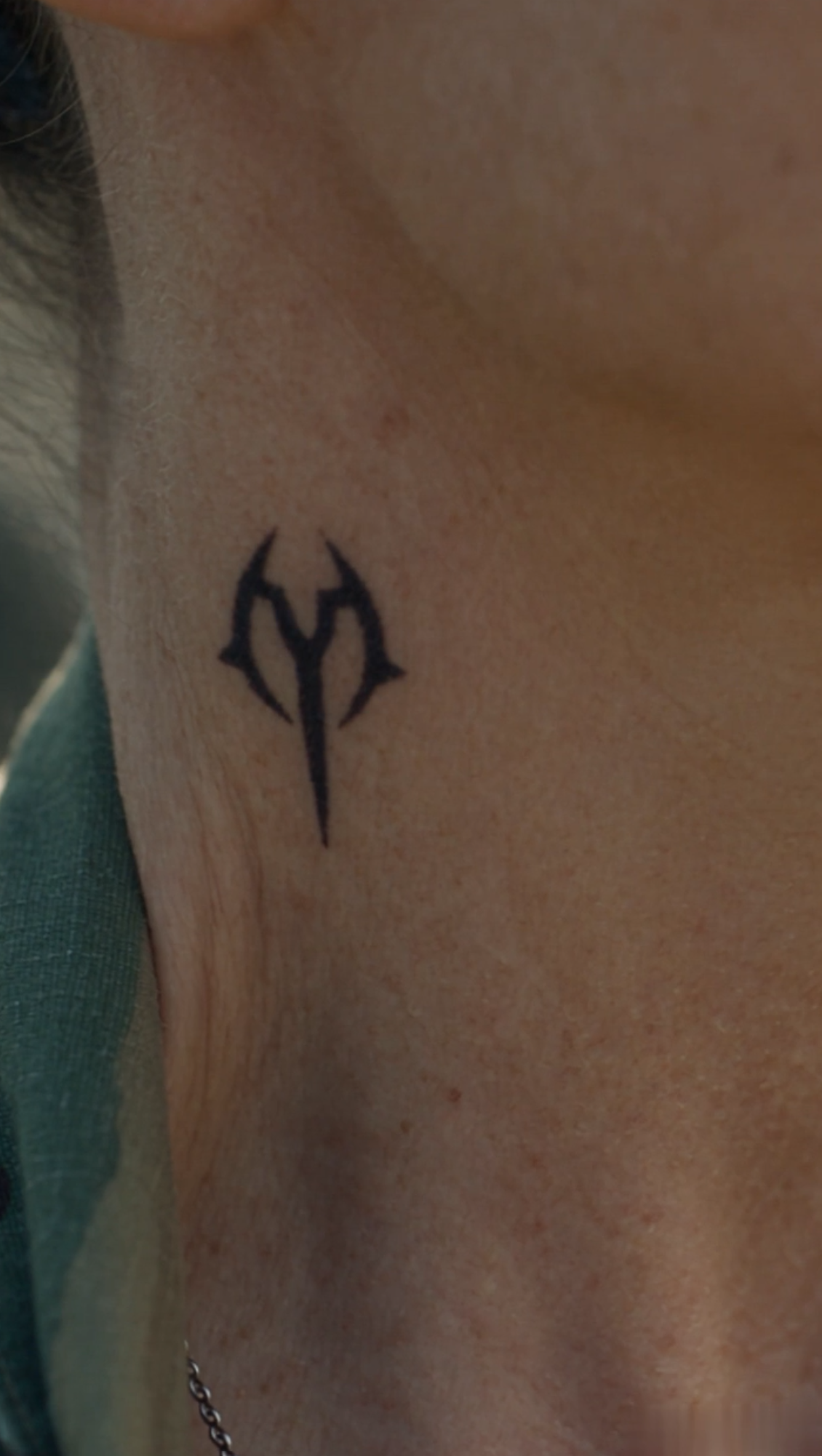
There, stamped into the pale skin just below her ear, was a tattoo.
It wasn’t a standard military insignia. It wasn’t a skull or an eagle or anything I recognized.
It was a series of jagged, intertwined numbers and a symbol that looked like a broken spearhead.
I didn’t know what it meant.
But Commander Hayes did.
The transformation was instantaneous and terrifying.
Hayes was mid-scream, his mouth open to roar another insult, when his eyes locked onto the black ink on her neck.
His voice simply vanished.
The angry, flushed color in the Commander’s face completely drained away, leaving him looking like a sick, pale ghost.
He didn’t just stop yelling. He physically recoiled.
He dropped her collar like it was made of boiling iron.
Hayes stumbled backward, his heavy boots scraping against the asphalt as he lost his balance.
His eyes were wide, darting from the tattoo to Miller’s cold, smiling face.
For ten agonizing seconds, the absolute silence in the courtyard was deafening.
Commander Hayes, the man who made grown men cry, was visibly shaking.
He slowly lowered his head, not looking at Sterling, not looking at the platoon.
He looked at the ground, took a deep, trembling breath, and said something that sent a massive wave of pure ice down my spine.
“I… I am so sorry, ma’am. I didn’t know.”
CHAPTER 2
The silence that followed Commander Hayes’s apology didn’t just hang in the air; it suffocated us.
Four hundred recruits stood frozen, our eyes locked straight ahead, but our minds racing at a million miles an hour.
I could hear the distant buzz of a generator and the harsh, rhythmic breathing of Cadet Sterling next to me.
Sterling’s face was a map of utter confusion and rapidly growing rage.
His billionaire father had promised him that the military would be his playground, a place where his family’s name would buy absolute immunity.
Yet here was the most feared man on the base, a battle-hardened commander, practically bowing to a woman who had just been slapped.
Commander Hayes cleared his throat, a sound that cracked like dry wood in the dead quiet courtyard.
He looked around frantically, his eyes scanning the sea of recruits as if realizing for the first time that he had just broken character in front of everyone.
“Platoon sergeants,” Hayes barked, though his voice lacked the ferocious bite it possessed just moments before. “Dismiss your columns. Now.”
The drill sergeants, usually loud and efficient, hesitated for a split second, looking at each other in sheer disbelief.
“You heard the Commander!” Sergeant Miller shouted, his voice tight. “Right face! Forward, march!”
The spell was broken, and the courtyard erupted into the heavy, synchronized thud of combat boots hitting the asphalt.
But the discipline was gone. The rigid focus that defined basic training had completely shattered.
As we marched back toward the barracks, the columns began to warp as recruits leaned into each other, whispering furiously.
“Did he just call her ma’am?” a recruit behind me muttered, his voice trembling with adrenaline.
“What the hell was that tattoo?” another whispered from the row over. “Did you see his face? He looked like he saw a ghost.”
I didn’t say a word. I just kept my eyes fixed on the back of Private Miller’s head, a few yards in front of me.
She was marching perfectly, her spine straight, her arms swinging in flawless rhythm, as if nothing had happened.
The thin line of blood on her lip had dried into a dark, sinister crust, but she didn’t even bother to wipe it away.
Beside her, Sterling was practically vibrating with fury, his fists clenched so tightly his knuckles were stark white.
The moment we crossed the threshold of the barracks and the drill sergeants stepped away, the entire floor exploded into chaos.
Recruits swarmed the center aisle, talking over one another, gesturing wildly, the collective anxiety of the room reaching a boiling point.
“She’s CID,” someone yelled. “She’s a plant from Criminal Investigation! They’re investigating the base!”
“No way,” another countered. “Did you see the numbers? That’s a black-ops designation. My brother’s in Special Forces, he told me about those.”
A heavy silence suddenly fell over the immediate area as Private Miller walked past the crowd toward her bunk.
The crowd parted instantly, giving her a wide, respectful, and deeply terrified berth.
She sat down on the edge of her neatly made cot, unlacing her boots with slow, deliberate movements.
She didn’t look at any of us. She didn’t acknowledge the whispers, the staring, or the palpable fear radiating from the room.
Suddenly, a loud slam echoed from the far end of the barracks.
Sterling had kicked his foot locker, the heavy metal clanging violently against the concrete floor.
“This is total bull!” Sterling roared, his voice cracking as he stormed down the center of the room.
He stopped right in front of Miller’s bunk, his chest heaving, his face red and sweating.
“Who the hell do you think you are?” he hissed, pointing an aggressive finger at her face. “You think some stupid ink makes you special?”
Miller didn’t look up immediately. She finished unlacing her left boot, placed it neatly next to her right, and then slowly raised her eyes.
Those gray, icy eyes locked onto Sterling, and for a second, I thought he was going to take a step back.
But his pride was too massive, his ego too bruised in front of the entire platoon.
“My dad is going to find out exactly what kind of game you’re playing,” Sterling threatened, his voice dropping to a vicious whisper. “He’s on the phone with the Pentagon right now.”
Miller finally spoke, her voice low, smooth, and entirely devoid of fear or anger.
“Tell your father I said hello, Sterling,” she murmured. “And tell him the ledger is still open.”
Sterling froze, his mouth opening slightly as if he wanted to speak, but the words died in his throat.
How did she know about a ledger? What did a private in basic training know about a multi-millionaire defense contractor’s business?
Before Sterling could recover, the heavy wooden doors of the barracks flew open with a violent bang.
Sergeant Davis stepped inside, his face grim, his eyes scanning the room until they landed on Miller.
“Private Miller,” Davis barked, his usual aggressive tone replaced by a strange, stiff formality. “The Commander wants to see you in his office. Immediately.”
Miller stood up, smoothed down the front of her uniform, and walked toward the door without a single glance back.
The moment the door closed behind her, Sterling whipped around, looking at the rest of us with a frantic, wild expression.
“She’s a fraud,” Sterling insisted, looking for anyone to agree with him. “She’s got to be. Hayes is just an old coward who got scared of a shadow.”
But nobody agreed with him. The mood in the barracks had shifted dramatically.
Recruits who had previously laughed at Sterling’s jokes or tried to stay on his good side were now quietly backing away.
They were choosing sides, and nobody wanted to be on the side that had just assaulted a woman who made a base commander tremble.
I walked over to my own bunk, sitting down heavily as my mind tried to piece together the fragments of what I knew.
I had noticed Miller’s tattoo once before, during a chaotic night drill when her collar had slipped, but I had dismissed it as old ink.
Now, looking back, everything about her behavior since day one made a disturbing kind of sense.
She didn’t train like a recruit; she moved like a weapon that had already been honed, just going through the motions to blend in.
An hour passed in tense, agonizing anticipation.
Every time the door handle jiggled, the entire barracks went dead silent, expecting Miller to walk through.
When the door finally opened, it wasn’t Miller. It was a pair of military MPs, heavily armed and wearing stern expressions.
They marched straight down the aisle, stopping directly in front of Sterling’s bunk.
“Cadet Sterling,” the lead MP stated, his voice echoing off the concrete walls. “You are ordered to report to administration for an emergency phone call.”
Sterling’s face instantly lit up with a smug, arrogant grin as he looked around the room, vindicated.
“See?” Sterling gloated, throwing his shoulders back. “I told you. My dad handled it. That bitch is done.”
He marched out between the two MPs like a conquering hero, convinced his wealth had won the day once again.
But as I watched him leave, a strange knot of dread formed in the pit of my stomach.
If Miller was just a fraud or a low-level agent, the Commander wouldn’t have looked like he was facing his own executioner.
Ten minutes later, the base sirens began to wail, a long, piercing scream that signaled an immediate, full-base lockdown.
“All personnel report to your sectors! This is not a drill! All personnel report to your sectors!” the speakers bellowed.
Chaos erupted again as we scrambled to grab our gear, the sudden escalation throwing everyone into a panic.
We lined up in the hallway, waiting for our drill sergeants, but when they appeared, they looked pale and distracted.
They weren’t shouting at us to hurry up; they were whispering to each other, looking nervously out the narrow barracks windows.
Through the glass, I could see tactical vehicles pulling up to the main administration building, blacked-out SUVs with civilian plates.
Men in dark, tailored suits stepped out, moving with an eerie, coordinated speed that didn’t belong on a standard military base.
“Move it, recruits!” Sergeant Davis finally shouted, his voice shaking slightly as he tried to maintain control. “To the briefing theater! Now!”
We hurried down the concrete corridors, the atmosphere heavy with the sense that something massive was unfolding just out of sight.
As we filed into the large, tiered briefing theater, I noticed that the stage was already occupied.
Commander Hayes was standing to the side, his head bowed, looking completely defeated.
In the center of the stage stood one of the men in the dark suits, his arms crossed, watching us enter with a cold, analytical gaze.
And standing right next to him, completely clean, her uniform pristine, and her split lip neatly bandaged, was Private Miller.
But she wasn’t standing at attention like a recruit anymore.
She was standing with her hands clasped loosely behind her back, her posture commanding, looking down at us like a judge delivering a verdict.
The four hundred recruits took their seats in a heavy, terrified silence that filled the entire auditorium.
Where was Sterling? He hadn’t marched down with us, and his seat in the front row remained conspicuously empty.
The man in the suit stepped up to the microphone, his voice cutting through the tension like a razor blade.
“Listen to me very carefully,” the man stated, his tone chillingly calm. “What you are about to witness is a matter of national security.”
He signaled to the back of the theater, and the heavy double doors opened, revealing the two MPs from earlier.
Between them, they were dragging Cadet Sterling.
His uniform was disheveled, his face was pale as paper, and his eyes were wide with a level of terror I had never seen in another human being.
He wasn’t walking; his legs were completely dead beneath him, his boots scraping uselessly against the floor as the MPs dragged him toward the stage.
“Please!” Sterling sobbed, his voice echoing pathetically through the microphone system. “You don’t understand! My dad will pay whatever you want!”
The man in the suit didn’t even blink. He looked at Private Miller, waiting for her signal.
Miller slowly stepped forward, taking the microphone from the stand, her eyes locking onto the weeping billionaire’s son.
“Your father can’t help you, Sterling,” Miller said, her voice echoing with absolute authority. “Because your father was arrested twenty minutes ago.”
A collective gasp shook the theater, four hundred hearts skipping a beat simultaneously as the reality of the situation began to dawn on us.
“He thought his money could buy silence,” Miller continued, looking out over the crowd. “He thought he could sell classified weapons schematics to our enemies and use this base to launder the tracking codes.”
She slowly reached up, undoing the top button of her uniform, pulling the collar down completely to reveal the full tattoo.
Now that the fabric was completely out of the way, the true nature of the mark became clear to everyone in the room.
It wasn’t just a symbol; it was the official, classified seal of the Joint Chiefs’ internal counter-espionage division, a unit that technically didn’t exist.
“I didn’t come to this base to be a soldier,” Miller whispered into the microphone, her gaze returning to the trembling boy on the floor. “I came here to catch a traitor. And you just handed me the key.”
Sterling let out a strangled, pathetic cry as the MPs pinned him to the floor, waiting for the final order.
But just as the tension reached its absolute peak, the man in the suit leaned over and whispered something into Miller’s ear.
I watched as her face, previously an unreadable mask of ice, suddenly tightened, her eyes widening with shock.
She dropped the microphone, the loud electronic screech causing everyone in the theater to wince and cover their ears.
Miller whipped around to face Commander Hayes, her hand moving instantly toward the side of her uniform where a hidden holster was concealed.
“Hayes!” Miller roared, her voice echoing with raw panic. “Where is the second transport?!”
Commander Hayes didn’t answer. He just looked up at her, a slow, terrifying smile spreading across his scarred face.
And that was the exact moment the lights in the entire theater completely went out, plunging us into pitch-black horror.
CHAPTER 3
The darkness did not fall like a curtain; it crashed down on us like a concrete vault.
One second, the briefing theater was blindingly bright, and the next, there was absolutely nothing.
Just a suffocating, pitch-black void.
For two agonizing seconds, nobody made a sound. The shock of the sudden plunge into darkness paralyzed four hundred trained recruits.
Then, the absolute chaos began.
Someone screamed in the back row. A chair violently scraped against the wooden floorboards.
Bodies slammed into each other as the panicked recruits immediately broke protocol, blindly scrambling to get away from the stage.
“Hold your positions! Do not move!” Sergeant Davis bellowed, his voice cracking with a fear I had never heard from him before.
But his orders were useless. The discipline we had spent weeks building evaporated in the dark.
I was shoved hard from behind, my knees slamming into the heavy metal frame of the chair in front of me.
Pain shot up my leg, but I bit my lip and stayed low, my hands desperately feeling the floor to keep my balance.
Up on the stage, the sounds of a brutal, unseen struggle echoed through the chaotic theater.
It wasn’t the Hollywood sound of a fistfight. It was the terrifying, heavy thud of flesh tearing and bone snapping.
I heard a wet, sickening crunch, followed by a sharp, guttural gasp that sounded entirely too much like the federal agent in the suit.
“Drop it! I said drop it!” one of the MPs shouted.
His command was instantly cut short by the sharp, electrical crackle of a heavy-duty stun gun.
A flash of blue voltage briefly illuminated the stage, casting horrifying, distorted shadows against the back wall.
In that split second of blue light, I saw Commander Hayes.
He wasn’t running. He wasn’t hiding. He was standing directly over the federal agent, his scarred face twisted into a mask of pure, concentrated malice.
And his massive hands were wrapped tightly around the agent’s throat.
The blue light vanished. The darkness returned, heavier and more terrifying than before.
Then came the sound of a heavy metal door slamming shut with the finality of a tomb.
Suddenly, the emergency backup generators kicked in with a loud, mechanical whine.
The theater was instantly bathed in a sinister, pulsing red light from the emergency exit signs lining the walls.
The low-visibility lighting cast long, bloody shadows across the panicked faces of the recruits.
I blinked against the harsh red glare and looked frantically toward the stage.
The sight made my stomach drop entirely out of my body.
Commander Hayes was gone.
The two heavily armed military police officers were sprawled unconscious across the wooden floorboards, their weapons stripped from their holsters.
The federal agent in the dark suit lay completely motionless near the podium, a dark pool of blood slowly expanding around his head.
And Private Miller was on her knees, clutching her right side.
Bright crimson blood was seeping violently through the fingers of her pristine uniform, dripping onto the floor in heavy, rhythmic splatters.
She was gasping for air, her face pale, but her icy gray eyes were wide with a frantic, desperate realization.
Sterling was the only one entirely unharmed.
He was huddled in a fetal position beneath the main podium, weeping hysterically, his hands clamped over his ears.
“The master drive,” Miller gasped, coughing up a terrifying splatter of blood onto the stage. “He took the master drive.”
A terrifying wave of realization crashed over me.
Sterling wasn’t the mastermind. His billionaire father wasn’t even the real threat.
They were just the middle-men, the stupid, wealthy distractions moving the money around.
Commander Hayes was the insider. He was the one facilitating the sale of classified military assets right under the Pentagon’s nose.
And now, he had the encrypted drive containing every single piece of black-ops data the base held.
“Sergeants! Secure the doors! Nobody leaves!” Sergeant Davis yelled, finally regaining his footing and charging toward the stage.
He reached the heavy double doors at the main entrance and pushed the crash bar with all his weight.
It didn’t budge.
He threw his shoulder against the thick metal, grunting with exertion.
“They’re locked!” Davis shouted, panic bleeding back into his voice. “The external mag-locks have been engaged!”
A terrifying murmur rippled through the hundreds of recruits.
“Try the side exits!” another drill sergeant yelled, sprinting down the aisle.
He slammed his hands against the reinforced glass of the emergency doors.
Nothing. The electronic deadbolts were firmly in place.
We were completely sealed inside the briefing theater. Four hundred highly trained bodies trapped in a concrete box.
“He’s initiated a Code Black,” Miller wheezed, forcing herself to stand. Her legs were shaking, but she refused to stay down.
“A what?!” Davis yelled, grabbing a medical kit from the wall and rushing to her side.
“A total base lockdown protocol,” Miller explained, wincing as Davis pressed a heavy gauze pad against her bleeding side.
“It seals every sector. It cuts outside communications. And it treats anyone moving outside designated zones as a hostile threat.”
She looked up, locking eyes with the panicked recruits in the front rows.
“To the rest of the base, we aren’t trapped in here,” she said, her voice dropping to a terrifying whisper. “We’re the terrorists holding the auditorium hostage.”
Right on cue, a loud, mechanical hissing sound echoed from the ceiling.
I looked up toward the massive steel ventilation grates.
Thick, white chemical smoke was beginning to pour steadily into the auditorium.
“Gas!” someone shrieked from the middle of the crowd.
Absolute pandemonium erupted.
Recruits began trampling each other, clawing frantically at the locked doors, screaming for help that wasn’t coming.
The air instantly grew thick and acrid, burning my throat and watering my eyes the moment I took a breath.
“It’s not nerve gas!” Miller shouted, trying to cut through the panic. “It’s the halon fire suppression system! He triggered the fire alarms!”
It didn’t matter what it was. Halon displaces oxygen.
If we stayed in this room for more than five minutes, four hundred people would suffocate to death.
Commander Hayes wasn’t just trying to escape. He was burying the witnesses.
“We have to break the glass!” I yelled, my voice surprising me as it cut through the chaos.
I pointed to the large, reinforced viewing window near the control booth at the back of the theater.
It wasn’t a door, but it was the only thing standing between us and the main hallway.
Sergeant Davis looked at me, his eyes wide, then nodded frantically.
“Grab that equipment trunk!” Davis ordered, pointing to a massive, steel-reinforced case housing the audio cables.
I rushed forward, my lungs already burning from the displaced oxygen.
Another recruit grabbed the other side.
“On three!” Davis yelled. “One! Two! Three!”
We hoisted the heavy trunk and slammed it with all our combined momentum into the reinforced glass.
The glass spider-webbed, a massive crack splitting the surface, but it held.
My vision was starting to blur. The white smoke was sinking lower, filling the room with an unnatural, toxic fog.
Sterling was screaming from the stage, completely paralyzed by fear, doing nothing to help.
“Again!” I roared, coughing violently as the chemical suppression agent filled my throat.
We pulled the trunk back and launched it forward with everything we had left.
CRASH.
The reinforced window shattered outward, sending a cascade of jagged safety glass pouring into the hallway.
Fresh, clean oxygen rushed into the theater through the broken frame.
I collapsed onto my knees, gasping for air, my chest heaving as the toxic smoke began to clear.
Recruits immediately began pouring through the broken window, scrambling over the jagged edges in a desperate bid for survival.
“Move! Everyone out!” Sergeant Davis barked, hauling recruits up and pushing them through the gap.
I pulled myself up and climbed through the window, tumbling onto the cold tile of the administration hallway.
The moment I hit the ground, the base-wide alarms were deafening.
Red strobe lights flashed violently along the corridor, painting the walls in an apocalyptic glare.
But the hallway was empty. There were no MPs waiting for us. No base security.
Commander Hayes had diverted everyone.
“Where is he going?” I heard someone ask from behind me.
I turned to see Private Miller climbing through the broken window, refusing any help from the drill sergeants.
She looked pale, her uniform soaked in blood, but she had managed to secure one of the unconscious MP’s sidearms.
She checked the magazine with frightening efficiency, slapping it back into the grip.
“The airfield,” Miller said coldly. “He’s not driving off this base. He’s flying.”
“The second transport,” I whispered, remembering the panic in her voice just before the lights went out.
Miller snapped her head toward me, her icy eyes piercing right through my skull.
“Exactly,” she said. “The Pentagon thought Sterling’s dad was moving the data via ground convoy tomorrow morning. That was the decoy.”
She wiped a streak of blood from her forehead, her face hardening into stone.
“Hayes called an unscheduled C-130 transport. It’s sitting on the tarmac right now, prepping for takeoff under the guise of an emergency medical supply run.”
If that plane left the ground, the most sensitive military intelligence in the country would be gone forever.
Our identities, the locations of undercover operatives, structural weaknesses of global defense systems—everything was on that drive.
“We need to call base command!” Sergeant Davis argued. “We need to get the general on the horn!”
“Base command is locked out!” Miller snapped. “Hayes controls the comms array. He’s painted us as the hostiles. If you poke your head out there, the tower snipers will take it off.”
The reality of the situation crashed down on us.
We were the good guys, but the entire military base was currently programmed to kill us on sight.
“So what do we do?” I asked, my heart hammering furiously against my ribs.
Miller looked at the sidearm in her hand, then looked back at me.
“We don’t have time for a tactical sweep. We don’t have time to convince the tower,” she said.
She cocked the weapon, chambering a round with a sharp, metallic click.
“We stop the plane.”
It was a suicide mission.
A bleeding CID agent and a handful of unarmed recruits against a fully operational military base under a rogue commander’s control.
But there was no choice.
“Follow me,” Miller ordered. “Stay low and stick to the shadows. If you see laser sights, hit the dirt.”
We sprinted down the hallway, bursting through the double doors leading to the western courtyard.
The night air was thick and humid, but it felt like ice against my sweating skin.
The base was in absolute chaos. Sirens blared endlessly. Spotlights frantically swept across the empty parade grounds.
We hugged the concrete walls of the barracks, moving rapidly toward the heavy chain-link fence that separated the training grounds from the airfield.
As we rounded the final corner of the supply depot, the tarmac came into full view.
There it was.
A massive, gray C-130 Hercules cargo plane sat on the runway, its four massive turboprop engines whining with a deafening roar.
The loading ramp at the back of the aircraft was lowered, bathed in harsh yellow floodlights.
And walking calmly up that ramp was Commander Hayes.
He had a thick, heavily armored briefcase handcuffed to his left wrist. The master drive.
But he wasn’t alone.
Surrounding the ramp were eight heavily armed men wearing completely unmarked black tactical gear.
They weren’t military police. They weren’t U.S. soldiers.
They were private mercenaries, brought in specifically to secure the extraction.
“He’s boarding!” Sergeant Davis hissed from behind a stack of wooden pallets. “We’re too late.”
Miller didn’t hesitate.
She leaned out from cover, raised her stolen sidearm, and fired three rapid shots at the mercenaries.
Crack. Crack. Crack.
One of the men in black stumbled backward, gripping his shoulder, but the heavy Kevlar absorbed the worst of it.
Instantly, the entire tarmac erupted into a blinding storm of suppressive fire.
The mercenaries raised heavily modified assault rifles and unleashed a terrifying wall of lead directly at our position.
Concrete exploded all around us.
Wooden splinters rained down as the pallets we were hiding behind were shredded into toothpicks.
I hit the asphalt, covering my head as the deafening roar of automatic weapons tore through the night.
“Keep your heads down!” Davis screamed, pinning another recruit to the ground as bullets skipped off the pavement inches from their faces.
We were completely pinned down. We had absolutely zero tactical advantage.
Miller was trying to return fire, but her weapon jammed, and the blood loss was making her hands shake violently.
Through the storm of gunfire, I looked past the barricade.
The C-130’s engines were roaring to maximum capacity.
The heavy hydraulic whine of the loading ramp echoed across the tarmac as it slowly began to close.
Commander Hayes stood at the top of the ramp, looking directly at our destroyed cover.
Even from a hundred yards away, I could see that same arrogant, terrifying smile on his face.
He raised his hand and offered a slow, mocking salute.
He had won.
The plane began to roll forward, picking up speed down the runway.
The mercenaries were advancing on our position, their weapons raised, moving in to execute the survivors.
I pressed my face into the dirt, waiting for the inevitable crack of a bullet.
Everything was completely collapsing.
But just as I closed my eyes, preparing for the end, I heard a sound that didn’t belong.
It wasn’t a siren. It wasn’t a gun.
It was a low, rhythmic vibration coming from the ground beneath us.
Miller suddenly stopped trying to unjam her weapon.
She slowly lowered the gun, leaning her head back against the shattered concrete barricade.
She looked at me, and to my absolute horror, the cold, predatory smile had returned to her bleeding face.
“They’re late,” she whispered.
CHAPTER 4
The rumble didn’t stay beneath our feet.
It climbed up our spines.
The low vibration rapidly tore through the humid night air, escalating into a terrifying, mechanical roar that drowned out the C-130’s engines.
I pushed my face further into the dirt, expecting the mercenaries’ advance, but the gunfire suddenly stopped.
The men in black tactical gear didn’t fire another round.
They froze.
Every single one of them spun around toward the dark expanse of the northern sky, their assault rifles dropping from their shoulders in sheer confusion.
I risked everything and lifted my chin off the asphalt.
Two massive, unmarked Black Hawk helicopters broke through the low-hanging clouds.
They were flying without running lights, completely blacked-out, skimming the treetops with terrifying, aggressive precision.
They didn’t land on the runway.
They dropped onto the taxiway with violent force, kicking up a blinding cyclone of dust and loose gravel right behind the advancing mercenaries.
Before the landing gear had even fully settled, the side doors of both helicopters blew open.
Men poured out.
They weren’t wearing standard camouflage. They were dressed in slate-gray tactical gear with absolutely no insignias, moving with a chilling, synchronized brutality.
It took them less than three seconds to flank the mercenaries.
“Drop your weapons! Do it now!” a deep, electronically altered voice boomed through the chaos.
The mercenaries didn’t have time to raise their rifles.
Within the blink of an eye, the heavily armed men who had been hunting us were disarmed, zip-tied, and violently slammed face-first onto the tarmac.
The speed of the takedown was inhuman.
Up on the runway, the C-130 Hercules attempted to throttle up, its massive engines screaming as it tried to force an emergency takeoff.
But it was too late for Commander Hayes.
A third helicopter, an attack variant, dropped out of the dark directly in front of the taxiing aircraft, its heavy nose-cannon pivoting to lock onto the plane’s landing gear.
The C-130’s engines abruptly whined down.
The massive aircraft shuddered to a halt, trapped on the concrete with nowhere to go.
The loading ramp slowly lowered once more.
Commander Hayes stood at the edge of the ramp, his left hand still handcuffed to the armored briefcase containing the master drive.
He looked down at the tarmac, his arrogant smile completely wiped away, replaced by the hollow, dead-eyed stare of a cornered animal.
Beside me, Private Miller stood up.
She didn’t flinch at the wind from the helicopters. She didn’t look like a wounded private who had just been beaten and shot at.
She walked out from behind the shredded pallets, her posture rigid, her injured side bleeding but completely ignored.
The slate-gray operators parted instantly, creating a wide, perfectly straight path for her.
The lead operator stepped forward, offering a crisp, formal salute.
“Director, we have the perimeter secured,” he said, his voice flat and entirely professional. “The extraction team is in custody.”
I sat up on the asphalt, my brain desperately trying to process the words.
Director?
Miller wasn’t a private. She wasn’t a low-level CID investigator testing the base.
She was the head of the entire operation.
She walked slowly toward the C-130 ramp, her boots clicking rhythmically against the concrete.
Commander Hayes watched her approach, his breathing ragged, the color completely drained from his scarred face.
“You’re dead,” Hayes whispered, his voice cracking. “I saw the manifest. I authorized the strike on your safehouse in Berlin.”
Miller stopped ten feet from the ramp.
She looked up at the man who had ordered her assassination, the man who had sold out thousands of American soldiers for a quick fortune.
“You authorized a strike on an empty decoy, Hayes,” Miller said. Her voice was ice.
“Your handler in the defense department gave you bad intel. He’s been working for us for six months.”
Hayes staggered backward, his eyes darting to the armed operators surrounding the tarmac, realizing the absolute totality of his defeat.
“Why?” Hayes hissed, a desperate edge creeping into his tone.
“Why send a director into my basic training yard as a private? Why let yourself get beaten by a cadet?”
Miller reached up and slowly unbuttoned the top pocket of her pristine OCP jacket.
She pulled out a small, encrypted thumb drive—the real master drive—and held it up in the harsh yellow floodlights.
“Because I needed a paper trail,” Miller answered smoothly.
“I needed absolute, undeniable proof that you were not just leaking data, but actively laundering the payoffs through domestic defense contractors.”
She took a step closer, her gray eyes locking onto his soul.
“And I needed Cadet Sterling to strike a superior officer on a live military installation in front of four hundred witnesses.”
The sheer weight of the trap finally slammed into my brain.
It was all a setup.
The bullying, the broken ankle, the slap—it was all engineered to force a court-martial so severe it would trigger a federal investigation, allowing Miller’s team to legally seize the base’s financial records.
“Sterling’s father is the primary contractor funding your treason, Hayes,” Miller continued, her tone relentless.
“By allowing the kid to assault me, we established probable cause to raid his corporate headquarters tonight.”
She gestured to the surrounding operators.
“The FBI arrested his father in Virginia twenty minutes ago. Your network is completely dismantled.”
Commander Hayes let out a dry, hollow laugh.
He looked down at the handcuffs securing the decoy briefcase to his wrist, then dropped his arms in defeat.
“You’re a monster, Miller,” Hayes spat, shaking his head. “You let that kid hit you. You let yourself bleed for a damn sting operation.”
Miller didn’t blink. She didn’t look angry.
“I’ve buried thirty-two operatives because of the intelligence you sold to the highest bidder, Hayes,” she whispered.
“A split lip is cheap rent to pay for justice.”
She nodded to the operators.
“Take him down. Put him in the black site. He doesn’t see a lawyer. He doesn’t see a courtroom.”
Four slate-gray operators surged up the ramp.
They grabbed Hayes, stripped the briefcase from his handcuffed wrist, and forcefully dragged him down onto the tarmac.
He didn’t fight back. He just stared at the ground, his military career, his freedom, and his life evaporating into the night air.
“Ma’am, you need medical attention,” the lead operator said, stepping toward Miller and looking at the dark stain soaking her uniform.
“The medevac is on standby.”
“I’m fine, Captain,” Miller dismissed, waving him away with a sharp gesture.
She turned around and began walking back toward the destruction of the training courtyard.
I scrambled to my feet, my legs shaking, and hurried to catch up with her alongside Sergeant Davis and the rest of the terrified platoon.
The four hundred recruits were still standing near the broken window of the briefing theater, shivering in the cold night wind.
They were covered in chemical ash, bleeding from minor cuts, and utterly bewildered by the warzone unfolding on their base.
As Miller approached the crowd, the sea of recruits parted instantly.
There were no whispers. There were no jokes.
Just an overwhelming, palpable sense of awe for the silent, bleeding woman in the center of the yard.
She stopped ten yards from the front row, looking out over the terrified faces of the young men and women who had been dragged into her crosshairs.
“You recruits have been through a highly irregular training cycle,” Miller said. Her voice carried across the silent asphalt with perfect, commanding clarity.
“You have witnessed treason. You have witnessed violence that has no place in the United States military.”
She reached up, casually wiping a dry crust of blood from her split lip.
“But you held the line. You didn’t break when the lights went out, and you didn’t run when the gas dropped.”
She stood a little straighter, her posture a perfect monument to the institution she served.
“Tomorrow, a transport will arrive to take you all to a secure facility in the interior.”
“You will be processed, debriefed, and your records will be scrubbed of this facility’s designation.”
She paused, letting her cold, gray eyes scan every single one of us one last time.
“But make no mistake,” she whispered. “The training you received here was real. The steel in your spine is real.”
She snapped a crisp, flawless salute to the four hundred recruits standing in the dark.
“You are soldiers now. Welcome to the real fight.”
Sergeant Davis immediately raised his hand, returning the salute, his eyes shining with profound respect.
Slowly, across the entire courtyard, four hundred hands rose to the brims of their patrol caps.
I raised mine, feeling the throbbing pain in my knee and the burn in my lungs, but none of it mattered anymore.
I looked at Miller standing in the crimson glow of the emergency strobes, the jagged classified seal clearly visible on her neck.
She had sacrificed her safety, her comfort, and her body to root out the rot at the very top of the chain of command.
She didn’t want glory. She didn’t want a medal.
She just wanted the truth to win.
The helicopters overhead began to lift off, their massive downdraft sweeping the chemical smoke away into the clear, starry sky.
The base sirens finally cut out, leaving behind a profound, heavy quiet that promised a new beginning.
Miller turned on her heel and walked away toward the waiting transport, alone in the dark, leaving us to face the dawn.








