𝗣𝗔𝗥𝗧 𝟮 Everyone Laughed When I Bought 50 Rusty Cast-Iron Pans — Then an Appraiser Saw the Mark Under the Rust
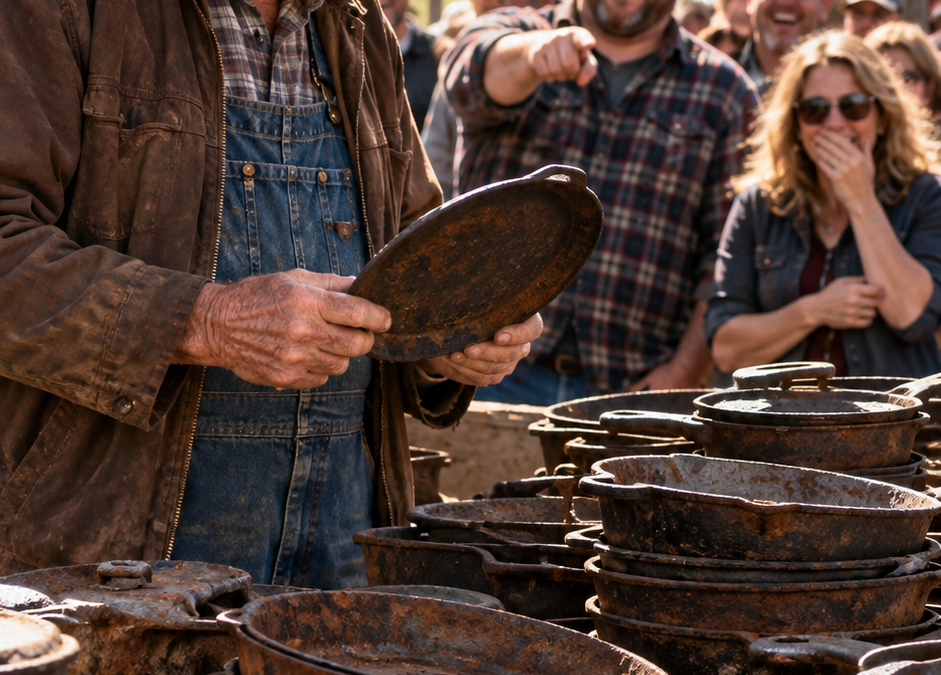
𝗣𝗔𝗥𝗧 𝟮
I started loading the pots myself.
The crowd gradually moved toward the next lot.
A tractor attachment.
Something shiny enough to deserve respect.
Dale lingered.
Of course he did.
“Fifty bucks,” he said.
I tightened a strap.
“Yep.”
“For scrap.”
“Apparently.”
“You keep buying junk, you’re going to need another barn for all your bad decisions.”
I looked at him.
Then at his spotless boots.
“Could be.”
He waited for more.
I didn’t give it.
That frustrated people like Dale.
They wanted resistance because resistance made their cruelty feel like sport.
Silence gave them nowhere to put it.
When the trailer was secure, I walked along the row of iron again.
Lifted lids.
Tapped rims.
Checked casting shapes.
Then I reached a deep three-legged pot near the bottom.
Its handle had been bent nearly flat.
The rust was heavy.
But the proportions were familiar.
Very familiar.
I ran my thumb over the underside.
Something was there.
Not enough to identify.
But enough to make my throat tighten.
I put it back carefully.
Then drove home.
As I passed Miller’s Diner, I could see people inside pointing toward my trailer.
Dale had beaten me there somehow.
Probably telling the story already.
That was Pine Hollow.
News traveled faster than weather and with considerably less accuracy.
I backed the trailer into my equipment shed.
Then unloaded all fifty pieces.
One by one.
I arranged them in rows across the dirt floor.
By sunset, my back hurt.
My hands were black.
And the shed looked like a cookware graveyard.
I sat on an overturned feed bucket.
For a long time, I said nothing.
Then I looked toward the three-legged pot.
“Well, Ruthie.”
The shed remained quiet.
My wife had been gone six years.
Cancer.
Fast at the end.
Slow before that.
There are people who say grief softens with time.
Maybe.
I think it changes shape.
At first it is an animal living inside your chest.
Later it becomes furniture.
You stop running into it every day, but it never really leaves the room.
I still talked to Ruthie.
Not because I expected an answer.
Because forty-two years of marriage creates habits death does not automatically cancel.
“Looks like I finally found them.”
The next morning, the Pine Hollow Facebook page discovered me.
Somebody posted the auction video.
There I was.
Old overalls.
Weathered face.
Dale grinning beside me while fifty rusted pots sat on a trailer.
The comments started.
Poor Walt.
Somebody should check on him.
Ruthie’s death broke that man.
Fifty dollars for scrap?
He hasn’t been right since the bank took half his cattle.
That last part stung.
Fifteen years earlier, drought and feed prices had nearly buried us.
The bank took part of my herd.
I survived.
But Pine Hollow remembered the failure better than the recovery.
People often do.
Frank Delgado came by two days later.
Frank had known me since we were boys.
Retired mechanic.
Good man.
He had stood beside me at my wedding.
Then beside me again when we buried Ruthie.
He walked into the shed and looked around.
“So.”
“So.”
“You bought all this.”
“I did.”
“Dale says you paid fifty dollars.”
“That part of Dale’s story is accurate.”
Frank crouched beside a pot.
Turned it over.
Rust.
Pitting.
Nothing impressive.
“Want to tell me why?”
I took the pot.
Found the right angle beneath the doorway light.
“Look.”
“At what?”
“There.”
He leaned closer.
A faint circle.
Almost erased.
Inside it, a stylized C.
“What is that?”
“Cassidy.”
He looked at me.
“Cassidy what?”
“Cassidy Iron Works.”
No recognition.
I wasn’t surprised.
“They operated three counties east from 1963 until 1974.”
“Never heard of them.”
“Most people haven’t.”
“So?”
“They made cookware.”
Frank looked around.
“That much I gathered.”
I smiled.
“Hand poured. Small batches. Excellent iron. Some unusual molds.”
“And?”
“The foundry burned.”
“When?”
“Seventy-five.”
“Records?”
“Mostly gone.”
Frank picked up the pot again.
“And collectors want this?”
“If it’s authentic.”
“How much?”
“Depends.”
“Walt.”
“Some pieces bring thousands.”
He nearly dropped it.
I reached out.
“Careful.”
“You just told me this rusted thing might be worth thousands.”
“Might.”
Frank stared at the rows.
“How many?”
“I don’t know.”
I pointed.
“Some are ordinary. Some probably got mixed in over the years.”
“But some are Cassidy.”
“Yes.”
“How do you know?”
I looked toward the three-legged pot.
Then back at him.
“Because I worked there.”
Frank stopped.
“You what?”
“One summer.”
“You never told me that.”
“You never asked.”
“We’ve been friends fifty years.”
“Still never asked.”
“When?”
“I was seventeen.”
“That would’ve been…”
“1961.”
Frank sat down on the bucket I had used.
“You worked in a foundry at seventeen?”
“Twelve-hour shifts.”
“What did your father say?”
“He said congratulations on getting a job.”
Frank laughed.
“What was it like?”
“Hot.”
“I guessed that.”
“Loud.”
“Also guessed.”
“Dangerous.”
He looked toward the iron.
“And you remember the mark.”
“I stamped some of them myself.”
That finally silenced him.
I picked up another pan.
“Workers didn’t cast the trademark. It was part of the mold, but we cleaned flash, ground edges, finished surfaces. You saw that symbol all day.”
Frank looked at the fifty pieces again.
This time differently.
That is one of my favorite things about value.
Nothing physically changes.
Only understanding.
Five minutes earlier he had been looking at junk.
Now he was afraid to step too close.
“How many do you think?”
“Maybe ten.”
“You think ten of these are collectible?”
“Could be more.”
I didn’t tell him my real reason for buying them.
Not yet.
Frank pointed toward the separate three-legged pot.
“What about that one?”
“That one stays here.”
“You haven’t even cleaned it.”
“I know.”
“What’s special?”
“Long story.”
“Since when have we been in a hurry?”
I looked at him.
“Let me make sure first.”
He nodded.
Frank knew when not to press.
Before leaving, he stood in the doorway.
“For what it’s worth…”
“What?”
“I hope every damn one of them is worth something.”
“Why?”
“Because I’m tired of listening to Dale Kersh laugh.”
“That’s not a good reason.”
“It’s an excellent reason.”
After he left, I began cleaning.
Slowly.
No aggressive grinders.
No harsh chemical stripping.
Old iron deserves patience.
Rust came away under oil, salt, steel wool, and hours of circular work.
My hands hurt every night.
I didn’t mind.
The first confirmed Cassidy mark appeared on pot number three.
The second on seven.
Then nine.
Twelve.
Fourteen.
I started a notebook.
Piece number.
Size.
Condition.
Mark clarity.
Casting features.
By the end of the first week, I had fifteen confirmed.
By the second, twenty-four.
By the time I finished forty-nine pieces, the number stood at twenty-nine.
Twenty-nine authentic Cassidy Iron Works pieces.
I should have been thinking about money.
I wasn’t.
Because one pot remained.
The three-legged one.
I had set it on the workbench.
Every night I passed it.
Every night I told myself:
Tomorrow.
Then one cold evening, I finally sat down beneath the bare bulb and pulled it into my lap.
My hands shook.
Not badly.
Enough.
I began cleaning.
The rust came slowly.
Two hours.
Then almost three.
The Cassidy mark appeared first.
Circle.
C.
Clear enough.
My chest tightened.
Then beneath it, I saw scratches.
Not casting marks.
Hand marks.
I rubbed oil over them.
Three characters.
Then a number.
RM 61
I stopped breathing.
For a second, I was seventeen again.
The foundry roof was leaking.
Molten iron glowed orange in the molds.
My shirt was soaked with sweat.
And a girl named Rose Merritt was standing behind the office door holding a mason jar of cold water.
“There you are,” I whispered.
The shed blurred.
I put the pot down.
Rose had worked in the Cassidy front office that summer.
She was eighteen.
Dark hair.
Quick laugh.
The kind of person who could talk to anybody but somehow chose to spend her lunch breaks sitting behind the foundry with a soot-covered farm boy who barely knew what to say to her.
The foreman hated breaks.
Rose used to bring me water anyway.
One afternoon, she found a rejected three-legged pot.
Casting flaw near the handle.
It couldn’t be sold commercially.
She scratched her initials into the bottom.
RM
Then:
61
She showed me.
“Now I own something the company made.”
“You planning to carry that home?”
“If I can lift it.”
“You can’t.”
“Then you carry it.”
I did.
We hid it near the storage shed until her father could collect her after work.
That summer, I thought Rose might be my future.
Seventeen-year-old boys are good at imagining futures.
Then my father’s farm failed.
We moved.
I left Cassidy with almost no warning.
Rose and I wrote letters for a while.
Then fewer.
Then none.
Three years later, I heard she had married.
Years after that, I met Ruthie.
And Ruthie became my life.
I never regretted that.
Not once.
Rose became something else.
A memory of who I had been before adulthood narrowed everything into bills, cattle, weather, mortgages, children, responsibility, survival.
The pot was not a lost love.
It was evidence.
Proof that the boy I remembered being had actually existed.
I sat under that shed light with the iron on my knees and cried.
Quietly.
Not for Rose.
Not exactly.
For time.
The way it disappears while you are busy living.
The way whole versions of yourself vanish until even you begin wondering whether they were real.
Then fifty years later, somebody puts one on an auction trailer and a crowd laughs at you for wanting it.
I put the pot on the shelf above my workbench.
“That one’s staying,” I told Ruthie.
I could almost hear her answer.
Obviously.
Lacy called Sunday.
My daughter lived two states away.
Three hundred miles.
She had seen the video.
Of course she had.
“Dad.”
“Hi, Lace.”
“Can we talk?”
“We are.”
“You know what I mean.”
I sat in Ruthie’s old kitchen chair.
The vinyl seat had cracked years earlier.
I had never replaced it.
“I saw the auction video.”
“I figured.”
“People are saying awful things.”
“People usually run out eventually.”
“I care.”
“I know.”
“You paid fifty dollars for rusted pots.”
“I did.”
“Why?”
“I’ll explain.”
“When?”
“Soon.”
“Dad.”
Her voice cracked.
That got me.
Not the Facebook comments.
Not Dale.
My daughter worrying from three hundred miles away.
“I’m fine.”
“That’s what Mom said for months.”
Silence.
Cancer had taught us both that sentence could be dangerous.
“I’m sorry.”
Lacy breathed.
“I can’t check on you.”
“I know.”
“You live alone.”
“I know.”
“Everybody says you’re buying weird things.”
“I’ve always bought weird things.”
“This is different.”
“No.”
I looked through the window toward the shed.
“It just looks different from where you are.”
“What does that mean?”
“You remember your mom talking about the summer I worked at a foundry?”
“She said you came home black with soot.”
“That’s the one.”
“What does that have to do with fifty pans?”
“Everything.”
I smiled.
“Trust me a little longer.”
Long pause.
Then:
“I trust you.”
“Thank you.”
“I’m still worried.”
“That’s allowed.”
“Promise me you’ll tell me.”
“I promise.”
Three weeks after the auction, a truck I didn’t recognize pulled into the driveway.
The man introduced himself as Elliot Vance.
Antique appraiser.
Early American cast iron specialist.
He handed me a card.
“Mr. Pruitt, this may sound strange.”
“I’ve had a strange month.”
“A client sent me the auction video.”
I sighed.
“Of course.”
“I wasn’t interested in the joke.”
“Good.”
“I was interested in the cookware.”
Now I listened.
He continued.
“One shape near the lower corner of the trailer looked familiar.”
“Cassidy?”
His eyes widened.
“You know.”
“I worked there.”
He actually took half a step backward.
“You worked at Cassidy?”
“One summer.”
“What year?”
“Sixty-one.”
Elliot stared at me.
“May I see them?”
I opened the shed.
He stepped inside.
Stopped.
Twenty-nine cleaned Cassidy pieces sat organized across the shelves.
The remaining ordinary pieces were stacked separately.
Elliot did not speak for several seconds.
Then:
“Oh my God.”
“Good sign?”
“Mr. Pruitt, please don’t touch anything.”
I looked at my hands.
“I’ve been touching them for three weeks.”
“Right.”
He laughed nervously.
“Sorry.”
He put on gloves.
Magnifying loupe.
Camera.
Measuring tools.
For three hours, he worked.
He examined casting textures.
Marks.
Handles.
Lids.
Gate scars.
Pouring characteristics.
Some pieces he recognized immediately.
Others took longer.
Finally, he removed his glasses.
“Twenty-nine.”
“Same count I got.”
“You really did work there.”
“Told you.”
He looked almost offended by my calm.
“Mr. Pruitt, do you understand what you have?”
“Old cookware.”
“You have what may be the largest documented private group of Cassidy Iron Works cookware still together.”
I sat down.
“How certain?”
“Very.”
“Value?”
He hesitated.
“Conservative?”
“Preferably.”
“Sixty to ninety thousand for the authenticated collection.”
I looked at him.
He waited.
“That all?”
His mouth opened.
Then I laughed.
He realized I was joking.
Barely.
“Some individual pieces could go into five figures.”
“Which?”
He pointed.
“Deep camp ovens. Rare lid patterns.”
Then his eyes moved toward the shelf above the workbench.
“The three-legged piece.”
“No.”
“What?”
“Not included.”
“I haven’t examined it.”
“You can.”
I took it down.
“But it isn’t for sale.”
He saw the Cassidy mark.
Then:
RM 61.
His posture changed.
“Personal mark?”
“Yes.”
“Do you know whose?”
“Yes.”
I told him enough.
Not everything.
Foundry office worker.
Known provenance through my own employment.
Elliot turned it slowly.
“This could be the most important piece.”
“I figured.”
“With a documented personal history, you could create extraordinary collector interest.”
“No.”
“Mr. Pruitt—”
“It isn’t for sale.”
He looked at me.
Then understood.
“Okay.”
He set it down gently.
“Then it isn’t for sale.”
Elliot offered to broker the collection.
I agreed.
That night, I sat in my kitchen.
Sixty to ninety thousand dollars.
Maybe more.
The farm had not made that much net income in years.
I looked across the table at Ruthie’s empty chair.
“You’d enjoy this.”
Nothing.
“Dale Kersh is going to choke on his coffee.”
That thought pleased me.
But not as much as I expected.
That surprised me.
For fifteen years, I had imagined what it might feel like if Pine Hollow finally discovered I wasn’t the fool they thought I was.
I assumed vindication would be loud.
Turns out it was quieter.
A warm kitchen.
Cold coffee.
One old pot on a shelf.
The story escaped anyway.
An appraiser told another appraiser.
Someone told a regional antiques reporter.
A county newspaper called.
I wanted to say no.
Frank changed my mind.
“If you don’t talk, somebody else will tell it wrong.”
“They always do.”
“Exactly.”
The article ran Thursday.
Photograph of me in the shed.
Twenty-nine Cassidy pieces behind me.
Headline:
LOCAL FARMER’S $50 “JUNK” PURCHASE MAY BE RARE HISTORIC COLLECTION
By Friday, Pine Hollow became extremely interested in cast iron.
Funny how that works.
Dale arrived Saturday.
New truck.
Clean flannel.
Cleaner smile.
“Walt!”
I stayed on the porch.
“Dale.”
“Hell of a story.”
“Seems so.”
“I always said you had an eye.”
“No, you didn’t.”
His smile faltered.
“Well, you know how auctions are.”
“Yep.”
“People joke.”
“You did.”
“Just having fun.”
“Looked fun.”
He shifted.
“Anyway, I’m happy for you.”
“Thank you.”
“I’ve actually always appreciated old American iron.”
I nearly admired him for being able to say that without laughing.
“Is that right?”
“Sure.”
He put his hands in his pockets.
“I thought maybe you’d sell me a couple pieces.”
“No.”
He blinked.
“I haven’t made an offer.”
“Still no.”
“Walt, come on.”
“Why?”
“We’re neighbors.”
I looked at him.
“You were my neighbor at the auction.”
His face reddened.
“That was joking around.”
“You recorded it.”
“Everybody records everything now.”
“You told people I’d lost my mind.”
“I didn’t mean—”
“You meant it.”
He stopped.
I stepped down from the porch.
“You laughed because you thought I bought worthless scrap.”
Dale looked away.
“Now you think it’s valuable and suddenly we’re neighbors.”
“I said I’d pay.”
“You said friendly deal.”
“That’s normal.”
“No.”
I shook my head.
“That’s greed wearing a neighbor’s coat.”
His jaw tightened.
“So this is punishment?”
“No.”
“What do you call it?”
“A no.”
He stared at me.
People like Dale are often most offended by the idea that access to you is not automatic.
He walked back to his truck.
Several more people tried over the next weeks.
Cash offers.
Partnerships.
Local-history arguments.
One man told me the collection “belonged to Pine Hollow.”
Interesting, considering Pine Hollow had called it scrap three weeks earlier.
I said no.
Elliot arranged private collectors instead.
A regional museum wanted four pieces.
That pleased me.
I liked the thought of part of the collection being seen.
The sale closed in early December.
Twenty-eight pieces sold.
The three-legged pot stayed.
Final amount:
A little over ninety-four thousand dollars.
Fifty dollars had become ninety-four thousand.
Dale Kersh would probably call that a good investment.
I still did not think of it that way.
The first thing I did was pay the farm loan.
That debt had lived beside me for years.
The bank had taken half my herd during the bad year.
Ruthie and I survived it.
Barely.
I walked into the branch with the payoff amount.
The young loan officer looked at the check.
Then at me.
“Congratulations, Mr. Pruitt.”
I nodded.
“Feels strange.”
“Good strange?”
I thought.
“Yes.”
I drove home lighter.
The next amount went to Lacy.
She and her husband had been saving for a house.
Prices kept moving faster than their savings.
I called.
“How much do you still need?”
“For what?”
“The down payment.”
“Dad.”
“How much?”
“No.”
“That wasn’t a number.”
“You are not giving me that money.”
“I’m not asking.”
“We’re fine.”
“So was I when you called worried about me.”
“That’s different.”
“How?”
“Because you’re my father.”
“And you’re my daughter.”
Silence.
“Let me do this.”
She cried.
I pretended not to hear.
Fathers learn that skill.
Then I went to see Carl Hensley’s sons.
That surprised everyone.
Especially them.
I handed each an envelope.
Eight thousand dollars.
The older brother stared at the check.
“What is this?”
“Your share.”
“Our share of what?”
“The cookware.”
“We sold it.”
“I know.”
“Fair auction.”
“I know.”
“You paid what was asked.”
“I know.”
“Then you don’t owe us anything.”
“I know.”
He looked frustrated.
“Then why?”
“Your father kept those pieces under a roof for decades.”
“He didn’t know what they were.”
“Maybe.”
“So?”
“He preserved them.”
I shrugged.
“That counts for something.”
The younger brother looked at his check.
“Walt, this is sixteen thousand dollars.”
“Yes.”
“You could keep it.”
“Yes.”
“Then why don’t you?”
I thought of Ruthie.
Then Rose.
Then Carl’s smokehouse.
“Because not everything worth having has to be squeezed for every dollar.”
They took the checks.
Eventually.
The volunteer fire department got money too.
Years earlier, during the worst winter of my financial life, men from that department had repaired part of my barn roof before a snowstorm.
They refused payment.
I had never forgotten.
Then there was Mara Denning.
Her husband had died in a combine accident that spring.
Her mortgage was behind.
Everyone knew.
Nobody talked about it directly.
Pine Hollow was excellent at gossip and terrible at discussing suffering to somebody’s face.
Mara had been at the auction.
She laughed.
Not as loudly as Dale.
But she laughed.
I remembered.
I drove to her place.
She opened the door.
“Walt?”
“Morning.”
“What are you doing here?”
I handed her an envelope.
She opened it.
Then immediately tried to give it back.
“No.”
“Yes.”
“I can’t take this.”
“You can.”
“I laughed at you.”
“I remember.”
Her face collapsed.
“I’m sorry.”
“I know.”
“No, Walt. I stood there and laughed.”
“Yep.”
“And now you’re giving me enough money to catch up the house?”
“That’s the idea.”
“Why?”
I looked across her yard.
A broken swing moved in the wind.
Her husband had built it.
“Because one hard year is enough.”
She cried.
I didn’t know what to do with that.
So I stood there holding my hat.
Finally she hugged me.
That was worse.
I never know what to do with hugs.
When I got home, Frank was waiting on my porch.
“You heard?”
“Mara called my wife.”
“Of course she did.”
Frank handed me a beer.
“You could’ve kept all that money.”
“Yes.”
“You could’ve bought a new truck.”
“My truck works.”
“Your truck is older than my youngest child.”
“Still works.”
“You could’ve rebuilt the kitchen.”
“Kitchen works.”
Frank laughed.
“So what are you going to do for yourself?”
I thought.
“I kept the pot.”
His smile disappeared.
“The three-legged one?”
“Yes.”
“Tell me.”
So I did.
All of it.
Rose Merritt.
Cassidy Iron Works.
The summer of 1961.
Cold water in mason jars.
A boy who thought his future was wide open.
A farm that failed.
Leaving.
Ruthie.
Marriage.
Children.
Loss.
Then finding RM 61 under half a century of rust.
When I finished, Frank sat quietly.
“I loved Ruthie,” I said.
“I know.”
“More than anybody.”
“I know.”
“This isn’t about wishing I had married Rose.”
“I know.”
I looked at him.
“You keep saying that.”
“Because you keep explaining something you don’t need to defend.”
That shut me up.
Frank took a drink.
“You found a piece of yourself.”
I looked toward the shed.
“That’s about right.”
“A piece from before everything.”
“Yes.”
He nodded.
“Then I’d say fifty dollars was cheap.”
Winter settled over Pine Hollow.
The town changed toward me.
Not dramatically.
Small towns rarely apologize in complete sentences.
People waved.
Women at the grocery store asked how I was doing.
The diner waitress stopped charging me for pie.
A man who had not spoken to me in years asked for my opinion on an antique stove.
Dale stopped joking.
He never apologized.
I didn’t need him to.
That was the biggest surprise.
For years, I had wanted Pine Hollow to admit they were wrong about me.
After Ruthie died, I became quiet.
People mistook quiet for brokenness.
Then financial trouble arrived.
They mistook trouble for failure.
Then I started buying old things.
They mistook curiosity for senility.
I spent fifteen years wanting them to correct their opinion.
Then one day they did.
And it turned out their opinion had never been worth as much as I thought.
That was freedom.
Not the ninety-four thousand dollars.
Not the newspaper story.
Not Dale’s silence.
Freedom was realizing I did not require a town vote to know who I was.
Late in December, snow fell over Pine Hollow.
Heavy flakes.
Quiet roads.
I took the three-legged Cassidy pot from the shelf and carried it into the kitchen.
For weeks, I had kept it polished.
Protected.
Almost sacred.
Then I realized something.
Rose had not scratched her initials into that pot so it could spend eternity behind glass.
Cast iron was made for fire.
So I put it on the stove.
Added oil.
Beef.
Onion.
Carrots.
Potatoes.
The beginning of the stew Ruthie used to make.
When the smell filled the kitchen, I sat down.
The pot simmered.
Ruthie’s chair remained empty.
But for once the empty chair did not make the whole room feel empty.
Lacy called.
“Dad?”
“Evening.”
“What are you doing?”
“Cooking.”
“You?”
“I have been capable of cooking for decades.”
“Toast does not count.”
“Stew.”
She laughed.
“In what?”
“The Cassidy pot.”
Silence.
“The special one?”
“Yes.”
“You’re using it?”
“That’s what pots are for.”
“Dad, an appraiser said it could be worth—”
“It isn’t for sale.”
“I know, but shouldn’t you preserve it?”
“I am.”
“By cooking stew?”
“Yes.”
She laughed again.
Then I told her the whole story.
Rose.
The initials.
The foundry.
Everything.
Lacy listened.
When I finished, her voice was soft.
“Did Mom know?”
“About Rose?”
“Yes.”
“Some of it.”
“She wasn’t jealous?”
“Your mother?”
I laughed.
“Ruthie once told me if Rose had wanted me badly enough, she had fifty years to come collect me.”
Lacy laughed so hard she coughed.
“That sounds like Mom.”
“It does.”
Then her voice changed.
“I wish she could see all this.”
I looked at Ruthie’s chair.
“She saw plenty.”
“You know what I mean.”
“I do.”
The stew bubbled.
Outside, snow covered the field.
“I think she’d be glad.”
“For the money?”
“No.”
“For what?”
“That I found something I thought was gone.”
Lacy went quiet.
“So am I.”
After we hung up, I ate stew from a bowl at the kitchen table.
The three-legged pot sat on the stove.
Cassidy Iron Works.
RM 61.
A teenage summer.
A middle-aged marriage.
A widowhood.
A farm nearly lost.
A town’s laughter.
All of it somehow connected by a piece of iron that had survived fire, rust, neglect, death, storage, an estate auction, and fifty years of nobody recognizing it.
That seemed appropriate.
Cast iron is like that.
People see rust and assume ruin.
But rust is surface.
Sometimes the structure underneath is still sound.
Sometimes all it needs is time.
Oil.
Work.
Patience.
Maybe people are not so different.
By spring, the story had mostly faded.
Something else happened in Pine Hollow.
Something always does.
A barn burned.
A school-board argument started.
Someone’s bull got loose and spent half a day standing in front of the bank.
My pots stopped being the biggest topic.
That suited me.
I returned to ordinary life.
Cattle.
Fence repair.
Equipment.
Coffee.
Auctions.
Yes, I still went.
The first auction after the article, everybody watched what I bid on.
That was irritating.
I picked up a broken clock for six dollars.
Dale watched.
“Know something about that one too?”
“No.”
He looked disappointed.
“I just like it.”
It turned out to be worth about twelve dollars.
I considered that an excellent outcome.
Frank came over when I repaired it.
“Town waiting for another miracle?”
“Let them wait.”
“You going to tell them this one’s worth a fortune?”
“No.”
“Why not?”
“Because then Dale will offer me twenty.”
We laughed.
That was another thing the pots gave me back.
Laughter that did not feel like a weapon.
The following fall, Elliot Vance contacted me about the museum exhibit.
The regional museum had restored a small gallery devoted to Cassidy Iron Works.
Four of my former pots were included.
He asked if I wanted to attend the opening.
I nearly said no.
Then he mentioned they had found records.
Not much.
A partial payroll ledger from 1961.
I went.
Lacy came too.
We drove three hours.
The exhibit was small.
Old photographs.
Sand molds.
Foundry tools.
Cookware.
There was a black-and-white photograph of men standing outside the Cassidy building.
I studied every face.
I wasn’t there.
Different year.
Then Lacy called me over.
“Dad.”
In a display case was a payroll ledger.
Names.
Dates.
Weekly hours.
I found mine.
Walter Pruitt — Molding/Finishing — Temporary Summer Labor
Age seventeen.
There it was.
Another little piece of proof.
Lacy touched the glass.
“You weren’t making it up.”
“I’ve been waiting sixty years for somebody to accuse me of inventing factory labor.”
She smiled.
Then we found another name.
Rose Merritt — Office Clerk
I stopped.
Lacy read it.
“Rose.”
“Yes.”
She looked at me.
“You okay?”
“Yeah.”
“You sure?”
I nodded.
“Just strange.”
In the museum gift shop, Lacy bought a postcard showing Cassidy cookware.
She mailed it to me after we got home.
On the back she wrote:
Some things survive because somebody finally notices them.
I kept that postcard beside the pot.
Dale Kersh never became my friend.
That is fine.
Not every story needs reconciliation.
One afternoon at the feed store, we crossed paths.
He nodded.
“Walt.”
“Dale.”
“Still got that special pot?”
“Yes.”
“Heard it might be worth a pile.”
“Maybe.”
“You’ll never sell?”
“No.”
He shook his head.
“Don’t understand that.”
“I know.”
For once, there was no insult in it.
Just honesty.
He valued price.
I valued something else.
Neither explanation would change the other.
That too was fine.
Mara kept her farm.
The Hensley boys used part of the money I gave them to repair their father’s grave marker.
The volunteer fire department replaced two ancient breathing units.
Lacy and her husband bought a modest house with a maple tree out front.
She sent me photographs every week for the first month.
And the farm loan?
Gone.
The first morning after I received the paid-in-full paperwork, I walked to the barn before sunrise.
Nothing looked different.
Same roof.
Same cattle.
Same mud.
But for the first time in years, the bank had no claim on any of it.
I stood there with the document in my coat pocket.
“Not bad, Ruthie.”
A cow sneezed.
That was the only response.
I took it.
People sometimes ask what the fifty-dollar purchase earned me.
Ninety-four thousand dollars is the easy answer.
It is also the least important.
The pots paid my debt.
Helped my daughter.
Helped Carl Hensley’s sons.
Helped the fire department.
Helped Mara keep her home.
All of that mattered.
But the thing I still think about happened before the appraisal.
Before the newspaper.
Before Pine Hollow stopped laughing.
It happened under one bare light in my equipment shed.
I rubbed fifty years of rust off one piece of iron.
Saw three letters and two numbers.
And suddenly remembered who I had been before anybody in Pine Hollow had formed an opinion about me.
That was worth more.
Age is strange.
By the time you are sixty-eight, people often think they are looking at the complete version of you.
Old farmer.
Widower.
Bad year.
Quiet man.
Patched overalls.
They see the final chapter sitting in front of them and assume the pages before it were blank.
They were not.
I was seventeen once.
I stood near molten iron.
I loved a girl named Rose for one summer.
I lost a farm with my father.
Built another.
Met Ruthie.
Raised a daughter.
Survived drought.
Debt.
Cancer.
Loneliness.
I made good decisions.
Bad decisions.
Some embarrassing ones.
Some brave ones.
I was all of those people.
The rusty pot did not make me valuable.
It reminded me I had always contained more history than the people laughing at the auction knew.
That is why I stopped caring what Pine Hollow thought.
They were judging only what they could see.
And people who only look at surfaces are constantly surprised by what survives underneath.
The three-legged pot is still in my kitchen.
I cook with it.
Stew mostly.
Cornbread sometimes.
Lacy thinks that is reckless.
Elliot Vance thinks it is borderline sacrilege.
Frank thinks it makes perfect sense.
I think Rose would laugh.
I know Ruthie would.
The bottom has darkened from use.
You can still see the Cassidy circle.
And if you turn it toward the light, the scratched initials remain.
RM 61.
I run my thumb across them sometimes.
Not sadly.
Not anymore.
Just grateful.
Because some things are not meant to take you backward.
They remind you how far you traveled.
And if I ever think about the auction, I do not remember the laughter first anymore.
I remember the gavel.
Fifty dollars.
Sold.
Dale Kersh smiling because he thought an old farmer had just bought fifty pieces of worthless rust.
Maybe that is the lesson Pine Hollow eventually learned.
Rust does not tell you what iron is worth.
Age does not tell you what a man remembers.
A bad year does not tell you what a life amounts to.
And laughter from people who never bothered to look closely has never been a reliable appraisal of anything.
They laughed when I bought those fifty rusty pots.
I let them.
Because beneath the rust was history.
Beneath the history was value.
And beneath one bent three-legged pot was a small hand-scratched mark that proved something I had almost forgotten myself:
Just because the world stops noticing something does not mean it has stopped being worth finding.
Have you finished reading the story and want to read it again?
Everyone Laughed When I Bought 50 Rusty Cast-Iron Pans — Then an Appraiser Saw the Mark Under the Rust
They laughed when I paid fifty dollars for the whole rusty pile.
They thought grief had finally ruined my judgment.
Then I cleaned the bottom of one pot and found a mark I had not seen in fifty years.
My name is Walt Pruitt. I was sixty-eight years old that October morning, and by then Pine Hollow had spent about fifteen years deciding what kind of man I was.
Poor.
Stubborn.
Lonely.
A little strange since my wife Ruthie died.
Possibly worse than strange, depending on which table you sat at in Miller’s Diner.
I knew all of it.
People sometimes assumed I didn’t hear them because I rarely answered.
That wasn’t true.
I heard plenty.
I had simply reached an age where I understood that answering every fool who formed an opinion about you was a good way to spend your whole life working for free.
The auction was held at the Hensley place on a gray Saturday morning.
Carl Hensley had died the previous spring. His sons lived in the city and wanted the farm cleared quickly, so everything was being sold.
Tractors.
Tools.
Old furniture.
Barn equipment.
Boxes nobody had opened in decades.
Then the auctioneer reached a flatbed trailer loaded with cast iron.
Fifty pieces.
Pots.
Camp ovens.
Lids.
Skillets.
Three-legged kettles.
Most were covered in rust so thick they looked like they had been dug out of a creek.
A few were dented.
Some were missing handles.
Nobody wanted them.
Except me.
“Forty dollars,” the auctioneer called.
Silence.
Then somebody laughed.
“Forty dollars for that?”
I knew the voice.
Dale Kersh.
Dale was built like a man who wanted strangers to assume he worked hard. Big shoulders. Expensive flannel. Clean boots.
His boots were always clean.
That told me more about him than anything else.
“Somebody get Walt a doctor,” Dale called.
A few men laughed.
I kept looking at the trailer.
The auctioneer lowered his hand.
“Anybody at forty?”
I raised mine.
“Forty.”
More laughter.
Dale turned around like he had been given a stage.
“Walt, Tractor Supply sells new pans.”
“I’m aware.”
“You planning to open a museum for tetanus?”
That got a bigger laugh.
The auctioneer tried for forty-five.
Nobody bid.
I did.
Then fifty.
Still nobody.
The gavel came down.
“Sold. Fifty dollars.”
The crowd laughed like I had just paid fifty thousand.
A couple younger men pulled out phones.
One recorded me as I walked toward the trailer.
I didn’t care.
Because they were looking at rust.
I was looking underneath it.
Two days earlier, during the preview, I had walked through Carl Hensley’s smokehouse.
Most people had gone straight toward the tractors.
I went where nobody else was going.
That habit had saved me money my whole life.
Back behind a broken plow and two feed barrels, I found the cast iron.
I wiped dirt from the underside of one pot.
There was almost nothing visible.
Almost.
A small circular stamp.
A shape inside it.
My heart had stopped for a second.
Cassidy Iron Works.
I knew that mark.
I had been seventeen years old the last time I saw it.
So when everyone laughed Saturday morning, I let them.
Because I had already seen something none of them had bothered to notice.
And buried somewhere in those fifty rusted pieces, I was hoping to find something far more valuable to me than money.
PART2
I started loading the pots myself.
The crowd gradually moved toward the next lot.
A tractor attachment.
Something shiny enough to deserve respect.
Dale lingered.
Of course he did.
“Fifty bucks,” he said.
I tightened a strap.
“Yep.”
“For scrap.”
“Apparently.”
“You keep buying junk, you’re going to need another barn for all your bad decisions.”
I looked at him.
Then at his spotless boots.
“Could be.”
He waited for more.
I didn’t give it.
That frustrated people like Dale.
They wanted resistance because resistance made their cruelty feel like sport.
Silence gave them nowhere to put it.
When the trailer was secure, I walked along the row of iron again.
Lifted lids.
Tapped rims.
Checked casting shapes.
Then I reached a deep three-legged pot near the bottom.
Its handle had been bent nearly flat.
The rust was heavy.
But the proportions were familiar.
Very familiar.
I ran my thumb over the underside.
Something was there.
Not enough to identify.
But enough to make my throat tighten.
I put it back carefully.
Then drove home.
As I passed Miller’s Diner, I could see people inside pointing toward my trailer.
Dale had beaten me there somehow.
Probably telling the story already.
That was Pine Hollow.
News traveled faster than weather and with considerably less accuracy.
I backed the trailer into my equipment shed.
Then unloaded all fifty pieces.
One by one.
I arranged them in rows across the dirt floor.
By sunset, my back hurt.
My hands were black.
And the shed looked like a cookware graveyard.
I sat on an overturned feed bucket.
For a long time, I said nothing.
Then I looked toward the three-legged pot.
“Well, Ruthie.”
The shed remained quiet.
My wife had been gone six years.
Cancer.
Fast at the end.
Slow before that.
There are people who say grief softens with time.
Maybe.
I think it changes shape.
At first it is an animal living inside your chest.
Later it becomes furniture.
You stop running into it every day, but it never really leaves the room.
I still talked to Ruthie.
Not because I expected an answer.
Because forty-two years of marriage creates habits death does not automatically cancel.
“Looks like I finally found them.”
The next morning, the Pine Hollow Facebook page discovered me.
Somebody posted the auction video.
There I was.
Old overalls.
Weathered face.
Dale grinning beside me while fifty rusted pots sat on a trailer.
The comments started.
Poor Walt.
Somebody should check on him.
Ruthie’s death broke that man.
Fifty dollars for scrap?
He hasn’t been right since the bank took half his cattle.
That last part stung.
Fifteen years earlier, drought and feed prices had nearly buried us.
The bank took part of my herd.
I survived.
But Pine Hollow remembered the failure better than the recovery.
People often do.
Frank Delgado came by two days later.
Frank had known me since we were boys.
Retired mechanic.
Good man.
He had stood beside me at my wedding.
Then beside me again when we buried Ruthie.
He walked into the shed and looked around.
“So.”
“So.”
“You bought all this.”
“I did.”
“Dale says you paid fifty dollars.”
“That part of Dale’s story is accurate.”
Frank crouched beside a pot.
Turned it over.
Rust.
Pitting.
Nothing impressive.
“Want to tell me why?”
I took the pot.
Found the right angle beneath the doorway light.
“Look.”
“At what?”
“There.”
He leaned closer.
A faint circle.
Almost erased.
Inside it, a stylized C.
“What is that?”
“Cassidy.”
He looked at me.
“Cassidy what?”
“Cassidy Iron Works.”
No recognition.
I wasn’t surprised.
“They operated three counties east from 1963 until 1974.”
“Never heard of them.”
“Most people haven’t.”
“So?”
“They made cookware.”
Frank looked around.
“That much I gathered.”
I smiled.
“Hand poured. Small batches. Excellent iron. Some unusual molds.”
“And?”
“The foundry burned.”
“When?”
“Seventy-five.”
“Records?”
“Mostly gone.”
Frank picked up the pot again.
“And collectors want this?”
“If it’s authentic.”
“How much?”
“Depends.”
“Walt.”
“Some pieces bring thousands.”
He nearly dropped it.
I reached out.
“Careful.”
“You just told me this rusted thing might be worth thousands.”
“Might.”
Frank stared at the rows.
“How many?”
“I don’t know.”
I pointed.
“Some are ordinary. Some probably got mixed in over the years.”
“But some are Cassidy.”
“Yes.”
“How do you know?”
I looked toward the three-legged pot.
Then back at him.
“Because I worked there.”
Frank stopped.
“You what?”
“One summer.”
“You never told me that.”
“You never asked.”
“We’ve been friends fifty years.”
“Still never asked.”
“When?”
“I was seventeen.”
“That would’ve been…”
“1961.”
Frank sat down on the bucket I had used.
“You worked in a foundry at seventeen?”
“Twelve-hour shifts.”
“What did your father say?”
“He said congratulations on getting a job.”
Frank laughed.
“What was it like?”
“Hot.”
“I guessed that.”
“Loud.”
“Also guessed.”
“Dangerous.”
He looked toward the iron.
“And you remember the mark.”
“I stamped some of them myself.”
That finally silenced him.
I picked up another pan.
“Workers didn’t cast the trademark. It was part of the mold, but we cleaned flash, ground edges, finished surfaces. You saw that symbol all day.”
Frank looked at the fifty pieces again.
This time differently.
That is one of my favorite things about value.
Nothing physically changes.
Only understanding.
Five minutes earlier he had been looking at junk.
Now he was afraid to step too close.
“How many do you think?”
“Maybe ten.”
“You think ten of these are collectible?”
“Could be more.”
I didn’t tell him my real reason for buying them.
Not yet.
Frank pointed toward the separate three-legged pot.
“What about that one?”
“That one stays here.”
“You haven’t even cleaned it.”
“I know.”
“What’s special?”
“Long story.”
“Since when have we been in a hurry?”
I looked at him.
“Let me make sure first.”
He nodded.
Frank knew when not to press.
Before leaving, he stood in the doorway.
“For what it’s worth…”
“What?”
“I hope every damn one of them is worth something.”
“Why?”
“Because I’m tired of listening to Dale Kersh laugh.”
“That’s not a good reason.”
“It’s an excellent reason.”
After he left, I began cleaning.
Slowly.
No aggressive grinders.
No harsh chemical stripping.
Old iron deserves patience.
Rust came away under oil, salt, steel wool, and hours of circular work.
My hands hurt every night.
I didn’t mind.
The first confirmed Cassidy mark appeared on pot number three.
The second on seven.
Then nine.
Twelve.
Fourteen.
I started a notebook.
Piece number.
Size.
Condition.
Mark clarity.
Casting features.
By the end of the first week, I had fifteen confirmed.
By the second, twenty-four.
By the time I finished forty-nine pieces, the number stood at twenty-nine.
Twenty-nine authentic Cassidy Iron Works pieces.
I should have been thinking about money.
I wasn’t.
Because one pot remained.
The three-legged one.
I had set it on the workbench.
Every night I passed it.
Every night I told myself:
Tomorrow.
Then one cold evening, I finally sat down beneath the bare bulb and pulled it into my lap.
My hands shook.
Not badly.
Enough.
I began cleaning.
The rust came slowly.
Two hours.
Then almost three.
The Cassidy mark appeared first.
Circle.
C.
Clear enough.
My chest tightened.
Then beneath it, I saw scratches.
Not casting marks.
Hand marks.
I rubbed oil over them.
Three characters.
Then a number.
RM 61
I stopped breathing.
For a second, I was seventeen again.
The foundry roof was leaking.
Molten iron glowed orange in the molds.
My shirt was soaked with sweat.
And a girl named Rose Merritt was standing behind the office door holding a mason jar of cold water.
“There you are,” I whispered.
The shed blurred.
I put the pot down.
Rose had worked in the Cassidy front office that summer.
She was eighteen.
Dark hair.
Quick laugh.
The kind of person who could talk to anybody but somehow chose to spend her lunch breaks sitting behind the foundry with a soot-covered farm boy who barely knew what to say to her.
The foreman hated breaks.
Rose used to bring me water anyway.
One afternoon, she found a rejected three-legged pot.
Casting flaw near the handle.
It couldn’t be sold commercially.
She scratched her initials into the bottom.
RM
Then:
61
She showed me.
“Now I own something the company made.”
“You planning to carry that home?”
“If I can lift it.”
“You can’t.”
“Then you carry it.”
I did.
We hid it near the storage shed until her father could collect her after work.
That summer, I thought Rose might be my future.
Seventeen-year-old boys are good at imagining futures.
Then my father’s farm failed.
We moved.
I left Cassidy with almost no warning.
Rose and I wrote letters for a while.
Then fewer.
Then none.
Three years later, I heard she had married.
Years after that, I met Ruthie.
And Ruthie became my life.
I never regretted that.
Not once.
Rose became something else.
A memory of who I had been before adulthood narrowed everything into bills, cattle, weather, mortgages, children, responsibility, survival.
The pot was not a lost love.
It was evidence.
Proof that the boy I remembered being had actually existed.
I sat under that shed light with the iron on my knees and cried.
Quietly.
Not for Rose.
Not exactly.
For time.
The way it disappears while you are busy living.
The way whole versions of yourself vanish until even you begin wondering whether they were real.
Then fifty years later, somebody puts one on an auction trailer and a crowd laughs at you for wanting it.
I put the pot on the shelf above my workbench.
“That one’s staying,” I told Ruthie.
I could almost hear her answer.
Obviously.
Lacy called Sunday.
My daughter lived two states away.
Three hundred miles.
She had seen the video.
Of course she had.
“Dad.”
“Hi, Lace.”
“Can we talk?”
“We are.”
“You know what I mean.”
I sat in Ruthie’s old kitchen chair.
The vinyl seat had cracked years earlier.
I had never replaced it.
“I saw the auction video.”
“I figured.”
“People are saying awful things.”
“People usually run out eventually.”
“I care.”
“I know.”
“You paid fifty dollars for rusted pots.”
“I did.”
“Why?”
“I’ll explain.”
“When?”
“Soon.”
“Dad.”
Her voice cracked.
That got me.
Not the Facebook comments.
Not Dale.
My daughter worrying from three hundred miles away.
“I’m fine.”
“That’s what Mom said for months.”
Silence.
Cancer had taught us both that sentence could be dangerous.
“I’m sorry.”
Lacy breathed.
“I can’t check on you.”
“I know.”
“You live alone.”
“I know.”
“Everybody says you’re buying weird things.”
“I’ve always bought weird things.”
“This is different.”
“No.”
I looked through the window toward the shed.
“It just looks different from where you are.”
“What does that mean?”
“You remember your mom talking about the summer I worked at a foundry?”
“She said you came home black with soot.”
“That’s the one.”
“What does that have to do with fifty pans?”
“Everything.”
I smiled.
“Trust me a little longer.”
Long pause.
Then:
“I trust you.”
“Thank you.”
“I’m still worried.”
“That’s allowed.”
“Promise me you’ll tell me.”
“I promise.”
Three weeks after the auction, a truck I didn’t recognize pulled into the driveway.
The man introduced himself as Elliot Vance.
Antique appraiser.
Early American cast iron specialist.
He handed me a card.
“Mr. Pruitt, this may sound strange.”
“I’ve had a strange month.”
“A client sent me the auction video.”
I sighed.
“Of course.”
“I wasn’t interested in the joke.”
“Good.”
“I was interested in the cookware.”
Now I listened.
He continued.
“One shape near the lower corner of the trailer looked familiar.”
“Cassidy?”
His eyes widened.
“You know.”
“I worked there.”
He actually took half a step backward.
“You worked at Cassidy?”
“One summer.”
“What year?”
“Sixty-one.”
Elliot stared at me.
“May I see them?”
I opened the shed.
He stepped inside.
Stopped.
Twenty-nine cleaned Cassidy pieces sat organized across the shelves.
The remaining ordinary pieces were stacked separately.
Elliot did not speak for several seconds.
Then:
“Oh my God.”
“Good sign?”
“Mr. Pruitt, please don’t touch anything.”
I looked at my hands.
“I’ve been touching them for three weeks.”
“Right.”
He laughed nervously.
“Sorry.”
He put on gloves.
Magnifying loupe.
Camera.
Measuring tools.
For three hours, he worked.
He examined casting textures.
Marks.
Handles.
Lids.
Gate scars.
Pouring characteristics.
Some pieces he recognized immediately.
Others took longer.
Finally, he removed his glasses.
“Twenty-nine.”
“Same count I got.”
“You really did work there.”
“Told you.”
He looked almost offended by my calm.
“Mr. Pruitt, do you understand what you have?”
“Old cookware.”
“You have what may be the largest documented private group of Cassidy Iron Works cookware still together.”
I sat down.
“How certain?”
“Very.”
“Value?”
He hesitated.
“Conservative?”
“Preferably.”
“Sixty to ninety thousand for the authenticated collection.”
I looked at him.
He waited.
“That all?”
His mouth opened.
Then I laughed.
He realized I was joking.
Barely.
“Some individual pieces could go into five figures.”
“Which?”
He pointed.
“Deep camp ovens. Rare lid patterns.”
Then his eyes moved toward the shelf above the workbench.
“The three-legged piece.”
“No.”
“What?”
“Not included.”
“I haven’t examined it.”
“You can.”
I took it down.
“But it isn’t for sale.”
He saw the Cassidy mark.
Then:
RM 61.
His posture changed.
“Personal mark?”
“Yes.”
“Do you know whose?”
“Yes.”
I told him enough.
Not everything.
Foundry office worker.
Known provenance through my own employment.
Elliot turned it slowly.
“This could be the most important piece.”
“I figured.”
“With a documented personal history, you could create extraordinary collector interest.”
“No.”
“Mr. Pruitt—”
“It isn’t for sale.”
He looked at me.
Then understood.
“Okay.”
He set it down gently.
“Then it isn’t for sale.”
Elliot offered to broker the collection.
I agreed.
That night, I sat in my kitchen.
Sixty to ninety thousand dollars.
Maybe more.
The farm had not made that much net income in years.
I looked across the table at Ruthie’s empty chair.
“You’d enjoy this.”
Nothing.
“Dale Kersh is going to choke on his coffee.”
That thought pleased me.
But not as much as I expected.
That surprised me.
For fifteen years, I had imagined what it might feel like if Pine Hollow finally discovered I wasn’t the fool they thought I was.
I assumed vindication would be loud.
Turns out it was quieter.
A warm kitchen.
Cold coffee.
One old pot on a shelf.
The story escaped anyway.
An appraiser told another appraiser.
Someone told a regional antiques reporter.
A county newspaper called.
I wanted to say no.
Frank changed my mind.
“If you don’t talk, somebody else will tell it wrong.”
“They always do.”
“Exactly.”
The article ran Thursday.
Photograph of me in the shed.
Twenty-nine Cassidy pieces behind me.
Headline:
LOCAL FARMER’S $50 “JUNK” PURCHASE MAY BE RARE HISTORIC COLLECTION
By Friday, Pine Hollow became extremely interested in cast iron.
Funny how that works.
Dale arrived Saturday.
New truck.
Clean flannel.
Cleaner smile.
“Walt!”
I stayed on the porch.
“Dale.”
“Hell of a story.”
“Seems so.”
“I always said you had an eye.”
“No, you didn’t.”
His smile faltered.
“Well, you know how auctions are.”
“Yep.”
“People joke.”
“You did.”
“Just having fun.”
“Looked fun.”
He shifted.
“Anyway, I’m happy for you.”
“Thank you.”
“I’ve actually always appreciated old American iron.”
I nearly admired him for being able to say that without laughing.
“Is that right?”
“Sure.”
He put his hands in his pockets.
“I thought maybe you’d sell me a couple pieces.”
“No.”
He blinked.
“I haven’t made an offer.”
“Still no.”
“Walt, come on.”
“Why?”
“We’re neighbors.”
I looked at him.
“You were my neighbor at the auction.”
His face reddened.
“That was joking around.”
“You recorded it.”
“Everybody records everything now.”
“You told people I’d lost my mind.”
“I didn’t mean—”
“You meant it.”
He stopped.
I stepped down from the porch.
“You laughed because you thought I bought worthless scrap.”
Dale looked away.
“Now you think it’s valuable and suddenly we’re neighbors.”
“I said I’d pay.”
“You said friendly deal.”
“That’s normal.”
“No.”
I shook my head.
“That’s greed wearing a neighbor’s coat.”
His jaw tightened.
“So this is punishment?”
“No.”
“What do you call it?”
“A no.”
He stared at me.
People like Dale are often most offended by the idea that access to you is not automatic.
He walked back to his truck.
Several more people tried over the next weeks.
Cash offers.
Partnerships.
Local-history arguments.
One man told me the collection “belonged to Pine Hollow.”
Interesting, considering Pine Hollow had called it scrap three weeks earlier.
I said no.
Elliot arranged private collectors instead.
A regional museum wanted four pieces.
That pleased me.
I liked the thought of part of the collection being seen.
The sale closed in early December.
Twenty-eight pieces sold.
The three-legged pot stayed.
Final amount:
A little over ninety-four thousand dollars.
Fifty dollars had become ninety-four thousand.
Dale Kersh would probably call that a good investment.
I still did not think of it that way.
The first thing I did was pay the farm loan.
That debt had lived beside me for years.
The bank had taken half my herd during the bad year.
Ruthie and I survived it.
Barely.
I walked into the branch with the payoff amount.
The young loan officer looked at the check.
Then at me.
“Congratulations, Mr. Pruitt.”
I nodded.
“Feels strange.”
“Good strange?”
I thought.
“Yes.”
I drove home lighter.
The next amount went to Lacy.
She and her husband had been saving for a house.
Prices kept moving faster than their savings.
I called.
“How much do you still need?”
“For what?”
“The down payment.”
“Dad.”
“How much?”
“No.”
“That wasn’t a number.”
“You are not giving me that money.”
“I’m not asking.”
“We’re fine.”
“So was I when you called worried about me.”
“That’s different.”
“How?”
“Because you’re my father.”
“And you’re my daughter.”
Silence.
“Let me do this.”
She cried.
I pretended not to hear.
Fathers learn that skill.
Then I went to see Carl Hensley’s sons.
That surprised everyone.
Especially them.
I handed each an envelope.
Eight thousand dollars.
The older brother stared at the check.
“What is this?”
“Your share.”
“Our share of what?”
“The cookware.”
“We sold it.”
“I know.”
“Fair auction.”
“I know.”
“You paid what was asked.”
“I know.”
“Then you don’t owe us anything.”
“I know.”
He looked frustrated.
“Then why?”
“Your father kept those pieces under a roof for decades.”
“He didn’t know what they were.”
“Maybe.”
“So?”
“He preserved them.”
I shrugged.
“That counts for something.”
The younger brother looked at his check.
“Walt, this is sixteen thousand dollars.”
“Yes.”
“You could keep it.”
“Yes.”
“Then why don’t you?”
I thought of Ruthie.
Then Rose.
Then Carl’s smokehouse.
“Because not everything worth having has to be squeezed for every dollar.”
They took the checks.
Eventually.
The volunteer fire department got money too.
Years earlier, during the worst winter of my financial life, men from that department had repaired part of my barn roof before a snowstorm.
They refused payment.
I had never forgotten.
Then there was Mara Denning.
Her husband had died in a combine accident that spring.
Her mortgage was behind.
Everyone knew.
Nobody talked about it directly.
Pine Hollow was excellent at gossip and terrible at discussing suffering to somebody’s face.
Mara had been at the auction.
She laughed.
Not as loudly as Dale.
But she laughed.
I remembered.
I drove to her place.
She opened the door.
“Walt?”
“Morning.”
“What are you doing here?”
I handed her an envelope.
She opened it.
Then immediately tried to give it back.
“No.”
“Yes.”
“I can’t take this.”
“You can.”
“I laughed at you.”
“I remember.”
Her face collapsed.
“I’m sorry.”
“I know.”
“No, Walt. I stood there and laughed.”
“Yep.”
“And now you’re giving me enough money to catch up the house?”
“That’s the idea.”
“Why?”
I looked across her yard.
A broken swing moved in the wind.
Her husband had built it.
“Because one hard year is enough.”
She cried.
I didn’t know what to do with that.
So I stood there holding my hat.
Finally she hugged me.
That was worse.
I never know what to do with hugs.
When I got home, Frank was waiting on my porch.
“You heard?”
“Mara called my wife.”
“Of course she did.”
Frank handed me a beer.
“You could’ve kept all that money.”
“Yes.”
“You could’ve bought a new truck.”
“My truck works.”
“Your truck is older than my youngest child.”
“Still works.”
“You could’ve rebuilt the kitchen.”
“Kitchen works.”
Frank laughed.
“So what are you going to do for yourself?”
I thought.
“I kept the pot.”
His smile disappeared.
“The three-legged one?”
“Yes.”
“Tell me.”
So I did.
All of it.
Rose Merritt.
Cassidy Iron Works.
The summer of 1961.
Cold water in mason jars.
A boy who thought his future was wide open.
A farm that failed.
Leaving.
Ruthie.
Marriage.
Children.
Loss.
Then finding RM 61 under half a century of rust.
When I finished, Frank sat quietly.
“I loved Ruthie,” I said.
“I know.”
“More than anybody.”
“I know.”
“This isn’t about wishing I had married Rose.”
“I know.”
I looked at him.
“You keep saying that.”
“Because you keep explaining something you don’t need to defend.”
That shut me up.
Frank took a drink.
“You found a piece of yourself.”
I looked toward the shed.
“That’s about right.”
“A piece from before everything.”
“Yes.”
He nodded.
“Then I’d say fifty dollars was cheap.”
Winter settled over Pine Hollow.
The town changed toward me.
Not dramatically.
Small towns rarely apologize in complete sentences.
People waved.
Women at the grocery store asked how I was doing.
The diner waitress stopped charging me for pie.
A man who had not spoken to me in years asked for my opinion on an antique stove.
Dale stopped joking.
He never apologized.
I didn’t need him to.
That was the biggest surprise.
For years, I had wanted Pine Hollow to admit they were wrong about me.
After Ruthie died, I became quiet.
People mistook quiet for brokenness.
Then financial trouble arrived.
They mistook trouble for failure.
Then I started buying old things.
They mistook curiosity for senility.
I spent fifteen years wanting them to correct their opinion.
Then one day they did.
And it turned out their opinion had never been worth as much as I thought.
That was freedom.
Not the ninety-four thousand dollars.
Not the newspaper story.
Not Dale’s silence.
Freedom was realizing I did not require a town vote to know who I was.
Late in December, snow fell over Pine Hollow.
Heavy flakes.
Quiet roads.
I took the three-legged Cassidy pot from the shelf and carried it into the kitchen.
For weeks, I had kept it polished.
Protected.
Almost sacred.
Then I realized something.
Rose had not scratched her initials into that pot so it could spend eternity behind glass.
Cast iron was made for fire.
So I put it on the stove.
Added oil.
Beef.
Onion.
Carrots.
Potatoes.
The beginning of the stew Ruthie used to make.
When the smell filled the kitchen, I sat down.
The pot simmered.
Ruthie’s chair remained empty.
But for once the empty chair did not make the whole room feel empty.
Lacy called.
“Dad?”
“Evening.”
“What are you doing?”
“Cooking.”
“You?”
“I have been capable of cooking for decades.”
“Toast does not count.”
“Stew.”
She laughed.
“In what?”
“The Cassidy pot.”
Silence.
“The special one?”
“Yes.”
“You’re using it?”
“That’s what pots are for.”
“Dad, an appraiser said it could be worth—”
“It isn’t for sale.”
“I know, but shouldn’t you preserve it?”
“I am.”
“By cooking stew?”
“Yes.”
She laughed again.
Then I told her the whole story.
Rose.
The initials.
The foundry.
Everything.
Lacy listened.
When I finished, her voice was soft.
“Did Mom know?”
“About Rose?”
“Yes.”
“Some of it.”
“She wasn’t jealous?”
“Your mother?”
I laughed.
“Ruthie once told me if Rose had wanted me badly enough, she had fifty years to come collect me.”
Lacy laughed so hard she coughed.
“That sounds like Mom.”
“It does.”
Then her voice changed.
“I wish she could see all this.”
I looked at Ruthie’s chair.
“She saw plenty.”
“You know what I mean.”
“I do.”
The stew bubbled.
Outside, snow covered the field.
“I think she’d be glad.”
“For the money?”
“No.”
“For what?”
“That I found something I thought was gone.”
Lacy went quiet.
“So am I.”
After we hung up, I ate stew from a bowl at the kitchen table.
The three-legged pot sat on the stove.
Cassidy Iron Works.
RM 61.
A teenage summer.
A middle-aged marriage.
A widowhood.
A farm nearly lost.
A town’s laughter.
All of it somehow connected by a piece of iron that had survived fire, rust, neglect, death, storage, an estate auction, and fifty years of nobody recognizing it.
That seemed appropriate.
Cast iron is like that.
People see rust and assume ruin.
But rust is surface.
Sometimes the structure underneath is still sound.
Sometimes all it needs is time.
Oil.
Work.
Patience.
Maybe people are not so different.
By spring, the story had mostly faded.
Something else happened in Pine Hollow.
Something always does.
A barn burned.
A school-board argument started.
Someone’s bull got loose and spent half a day standing in front of the bank.
My pots stopped being the biggest topic.
That suited me.
I returned to ordinary life.
Cattle.
Fence repair.
Equipment.
Coffee.
Auctions.
Yes, I still went.
The first auction after the article, everybody watched what I bid on.
That was irritating.
I picked up a broken clock for six dollars.
Dale watched.
“Know something about that one too?”
“No.”
He looked disappointed.
“I just like it.”
It turned out to be worth about twelve dollars.
I considered that an excellent outcome.
Frank came over when I repaired it.
“Town waiting for another miracle?”
“Let them wait.”
“You going to tell them this one’s worth a fortune?”
“No.”
“Why not?”
“Because then Dale will offer me twenty.”
We laughed.
That was another thing the pots gave me back.
Laughter that did not feel like a weapon.
The following fall, Elliot Vance contacted me about the museum exhibit.
The regional museum had restored a small gallery devoted to Cassidy Iron Works.
Four of my former pots were included.
He asked if I wanted to attend the opening.
I nearly said no.
Then he mentioned they had found records.
Not much.
A partial payroll ledger from 1961.
I went.
Lacy came too.
We drove three hours.
The exhibit was small.
Old photographs.
Sand molds.
Foundry tools.
Cookware.
There was a black-and-white photograph of men standing outside the Cassidy building.
I studied every face.
I wasn’t there.
Different year.
Then Lacy called me over.
“Dad.”
In a display case was a payroll ledger.
Names.
Dates.
Weekly hours.
I found mine.
Walter Pruitt — Molding/Finishing — Temporary Summer Labor
Age seventeen.
There it was.
Another little piece of proof.
Lacy touched the glass.
“You weren’t making it up.”
“I’ve been waiting sixty years for somebody to accuse me of inventing factory labor.”
She smiled.
Then we found another name.
Rose Merritt — Office Clerk
I stopped.
Lacy read it.
“Rose.”
“Yes.”
She looked at me.
“You okay?”
“Yeah.”
“You sure?”
I nodded.
“Just strange.”
In the museum gift shop, Lacy bought a postcard showing Cassidy cookware.
She mailed it to me after we got home.
On the back she wrote:
Some things survive because somebody finally notices them.
I kept that postcard beside the pot.
Dale Kersh never became my friend.
That is fine.
Not every story needs reconciliation.
One afternoon at the feed store, we crossed paths.
He nodded.
“Walt.”
“Dale.”
“Still got that special pot?”
“Yes.”
“Heard it might be worth a pile.”
“Maybe.”
“You’ll never sell?”
“No.”
He shook his head.
“Don’t understand that.”
“I know.”
For once, there was no insult in it.
Just honesty.
He valued price.
I valued something else.
Neither explanation would change the other.
That too was fine.
Mara kept her farm.
The Hensley boys used part of the money I gave them to repair their father’s grave marker.
The volunteer fire department replaced two ancient breathing units.
Lacy and her husband bought a modest house with a maple tree out front.
She sent me photographs every week for the first month.
And the farm loan?
Gone.
The first morning after I received the paid-in-full paperwork, I walked to the barn before sunrise.
Nothing looked different.
Same roof.
Same cattle.
Same mud.
But for the first time in years, the bank had no claim on any of it.
I stood there with the document in my coat pocket.
“Not bad, Ruthie.”
A cow sneezed.
That was the only response.
I took it.
People sometimes ask what the fifty-dollar purchase earned me.
Ninety-four thousand dollars is the easy answer.
It is also the least important.
The pots paid my debt.
Helped my daughter.
Helped Carl Hensley’s sons.
Helped the fire department.
Helped Mara keep her home.
All of that mattered.
But the thing I still think about happened before the appraisal.
Before the newspaper.
Before Pine Hollow stopped laughing.
It happened under one bare light in my equipment shed.
I rubbed fifty years of rust off one piece of iron.
Saw three letters and two numbers.
And suddenly remembered who I had been before anybody in Pine Hollow had formed an opinion about me.
That was worth more.
Age is strange.
By the time you are sixty-eight, people often think they are looking at the complete version of you.
Old farmer.
Widower.
Bad year.
Quiet man.
Patched overalls.
They see the final chapter sitting in front of them and assume the pages before it were blank.
They were not.
I was seventeen once.
I stood near molten iron.
I loved a girl named Rose for one summer.
I lost a farm with my father.
Built another.
Met Ruthie.
Raised a daughter.
Survived drought.
Debt.
Cancer.
Loneliness.
I made good decisions.
Bad decisions.
Some embarrassing ones.
Some brave ones.
I was all of those people.
The rusty pot did not make me valuable.
It reminded me I had always contained more history than the people laughing at the auction knew.
That is why I stopped caring what Pine Hollow thought.
They were judging only what they could see.
And people who only look at surfaces are constantly surprised by what survives underneath.
The three-legged pot is still in my kitchen.
I cook with it.
Stew mostly.
Cornbread sometimes.
Lacy thinks that is reckless.
Elliot Vance thinks it is borderline sacrilege.
Frank thinks it makes perfect sense.
I think Rose would laugh.
I know Ruthie would.
The bottom has darkened from use.
You can still see the Cassidy circle.
And if you turn it toward the light, the scratched initials remain.
RM 61.
I run my thumb across them sometimes.
Not sadly.
Not anymore.
Just grateful.
Because some things are not meant to take you backward.
They remind you how far you traveled.
And if I ever think about the auction, I do not remember the laughter first anymore.
I remember the gavel.
Fifty dollars.
Sold.
Dale Kersh smiling because he thought an old farmer had just bought fifty pieces of worthless rust.
Maybe that is the lesson Pine Hollow eventually learned.
Rust does not tell you what iron is worth.
Age does not tell you what a man remembers.
A bad year does not tell you what a life amounts to.
And laughter from people who never bothered to look closely has never been a reliable appraisal of anything.
They laughed when I bought those fifty rusty pots.
I let them.
Because beneath the rust was history.
Beneath the history was value.
And beneath one bent three-legged pot was a small hand-scratched mark that proved something I had almost forgotten myself:
Just because the world stops noticing something does not mean it has stopped being worth finding.








