𝗙𝗨𝗟𝗟 𝗦𝗧𝗢𝗥𝗬 Everyone at the ER Thought Evelyn Carter Was Just Another Homeless Woman Who Would Be Gone by Morning
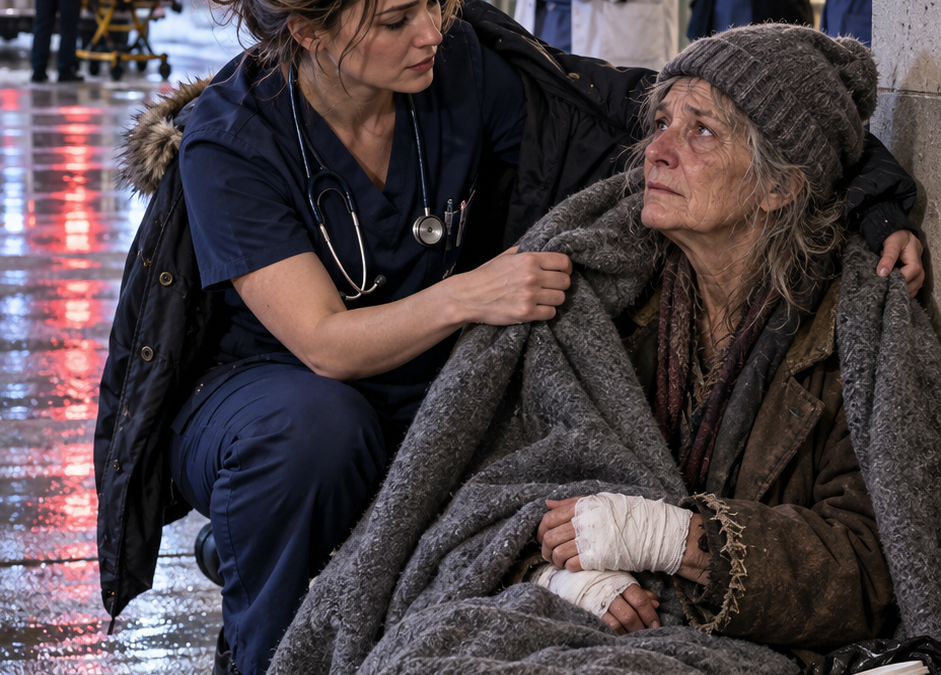
𝗣𝗔𝗥𝗧 𝟮
He took a drink of coffee.
“You planning to drive her too?”
Two people behind the desk smiled.
Evelyn lowered her eyes.
That time, I understood exactly what the laughter was doing.
It wasn’t making her angry.
It was teaching her not to accept help.
Every joke made her feel that needing something was an offense.
Every laugh made her hesitate before saying yes.
I finished the call and wrote the shelter address on Evelyn’s discharge envelope.
Then I went to my locker.
When I came back, I was carrying my navy winter coat.
It wasn’t expensive.
It was plain, slightly oversized, and warm enough for the walk from the employee lot on early winter mornings.
I held it out.
Evelyn stared at it.
“No.”
“It’s cold.”
“That’s yours.”
“Tonight it’s yours.”
She didn’t reach for it.
Her eyes moved past me toward the nurses’ station.
“They’re already laughing at you because of me.”
I looked over my shoulder.
Mercer was watching.
So were the two nurses who had been laughing earlier.
I could have lowered the coat.
I could have made the moment private.
Instead, I kept my hand where it was.
“Then let them laugh.”
Evelyn looked at me as if she didn’t understand.
“Why?”
I thought about that question.
Most of the things we gave people in emergency medicine had conditions attached to them.
You got medication because your pain score qualified.
A bed because your condition qualified.
Oxygen because your saturation qualified.
A meal because policy allowed it.
Transportation because a box could be checked.
Evelyn was asking why she deserved something without first proving that she did.
“Because you shouldn’t have to earn being warm.”
For several seconds, she just stared at me.
Then her fingers closed around the coat.
The laughter stopped.
Not because anyone had suddenly become ashamed.
Not because they understood.
It stopped because Evelyn had accepted the thing they had been making her embarrassed to need.
I arranged a ride through the hospital’s approved transportation-assistance account.
When the car arrived, I walked Evelyn to the curb.
I checked the license plate before opening the rear door.
She was wearing my navy coat now.
It hung loose around her shoulders.
She held the battered canvas bag against her chest.
Before I shut the door, she reached out and caught my wrist.
“Claire Bennett?”
She had read my badge.
“Yes.”
She repeated my name quietly.
“Claire Bennett.”
The way she said it made me look at her more carefully.
She wasn’t thanking me.
Not exactly.
She was memorizing it.
Then she released my wrist.
The car pulled away.
I watched until the navy coat disappeared beyond the hospital entrance.
When I went back inside, Mercer raised his coffee toward me like a toast.
“Save the world?”
I picked up my bag.
“No.”
I glanced at the empty chair where Evelyn had been sitting.
“Just helped one woman get through tonight.”
Then I clocked out.
To everyone else, that should have been the end of it.
A homeless woman had needed a blanket.
Claire Bennett had cared too much.
The hospital moved on.
I moved on too.
Or I thought I did.
By nine the next morning, my kindness had acquired a dollar amount.
My supervisor, Rebecca Sloan, stood at the charge desk tapping a transportation report with one finger.
“You authorized a hospital-funded ride for a discharged patient after your shift ended.”
“Yes.”
“Without asking me.”
“You were handling the trauma admission.”
“That isn’t the point.”
Rebecca wasn’t cruel.
That mattered.
She was the kind of supervisor who could run a chaotic emergency department without raising her voice. She cared about patients, but she also understood something I sometimes resisted: hospitals survived on systems, and systems fell apart if every employee invented new rules whenever compassion made the existing ones feel insufficient.
She lowered her voice.
“The assistance account has eligibility requirements. You cannot decide on your own that every discharged person without transportation becomes the hospital’s responsibility.”
I looked at the form.
There was one line I cared about.
“Did the driver confirm drop-off?”
Rebecca’s expression tightened.
“Claire.”
“Did he?”
She turned the page.
“No electronic confirmation. The ride was closed as completed.”
I reached for the report.
Rebecca kept one hand on it.
“You are not calling the transportation company from the floor.”
“I’ll call on break.”
“You’ll let social services handle it.”
My eyes remained on the missing confirmation line.
Across the desk, Mercer had heard enough to understand.
He gave a tired half-smile.
“Maybe your rescue mission didn’t want rescuing.”
I looked at him.
“I’m not trying to rescue her.”
His smile faded slightly.
“I need to know whether the plan I made actually got her somewhere safe.”
Rebecca finally released the report.
“One call on your break.”
“Okay.”
“After that, you hand it off.”
Three hours later, I sat in the employee stairwell with my phone pressed against one ear and the transportation record balanced on my knee.
The rideshare coordinator confirmed that Evelyn had been picked up from the hospital.
Then she said something that made me sit straighter.
“She never reached the destination you entered.”
“Where did she go?”
“The passenger requested a stop.”
“Where?”
Keyboard clicks.
“West Franklin Public Library.”
I checked the timestamp.
11:18 p.m.
The library would have been closed for hours.
“Did she get back into the vehicle?”
Another pause.
“No. Driver marked the trip ended at passenger request.”
I closed my eyes.
For one second.
No panic.
Just calculation.
Evelyn had been alert.
She had been oriented.
She was an adult.
She was allowed to change her mind.
All of that was true.
It was also true that she had been cold, exhausted, and carrying everything she owned in one canvas bag.
I called the overnight center.
No Evelyn Carter had checked in.
When I returned to the floor, Rebecca was waiting for me.
“You made your call?”
“She didn’t reach the shelter.”
Rebecca exhaled.
“Then social services gets the information.”
“I already sent them the drop-off location.”
She studied my face.
“Good.”
I handed her the paper.
“Then you’re done.”
I nodded.
But my hand stayed on the edge of the desk.
“If she comes back here, page me.”
Rebecca gave me a look.
“Claire.”
“I’m not asking anybody to search for her. I’m not asking security to hunt her down. I’m asking that if she walks through our doors again, we don’t treat her like a nuisance because she was discharged once.”
Rebecca glanced toward the waiting room.
Then back at me.
“I can put a note on the nonclinical handoff board for this shift.”
“That’s enough.”
“It expires at shift change.”
“That’s enough.”
She wrote the note.
I went back to work.
Near the end of the shift, one of our security officers appeared at the nurses’ station holding a clear property bag.
I recognized the frayed strap before he set it down.
Evelyn’s canvas bag.
“Found this outside near the ambulance entrance,” he said. “Figured it belonged to your woman from last night.”
My eyes went immediately to the glass doors.
Nothing.
No navy coat.
No Evelyn.
Only the empty curb.
I took the property sack.
I did not open the bag.
“If she comes back, don’t put this into general lost property.”
The officer looked at me.
“Why?”
“Because she may come looking for it.”
“And if she doesn’t?”
I looked at the frayed canvas handle.
“Keep it behind the desk until she gets the chance to decide what happens to it.”
He hesitated.
Then he moved it behind security.
The next afternoon, I saw Evelyn’s hand before I saw her face.
I had just entered the lobby when I noticed a thin hand reaching toward the security desk.
The officer bent down and pulled out the clear property sack.
I crossed the lobby.
Evelyn turned.
She was still wearing my navy coat.
Relief moved through me so quickly that I almost said her name too loudly.
Instead, I stopped beside her.
The officer lifted the bag.
“We kept it.”
I removed the old canvas bag from the clear sack and held it out.
I didn’t touch the zipper.
Evelyn looked at me.
“You didn’t look inside?”
“No.”
“Why not?”
“It wasn’t mine.”
Something changed in her face.
Not trust.
Not yet.
Maybe the first possibility of it.
She took the bag.
For a second, I thought she was going to leave.
Her body turned toward the sliding doors.
Then her eyes moved toward the public phones across the lobby.
I followed her gaze.
“You need a phone?”
Her grip tightened on the canvas strap.
“One people aren’t listening to.”
I could have asked why.
I didn’t.
There was a small consultation room nearby that we used for private conversations with patients and families.
It was empty.
I checked.
Unlocked.
I opened the door.
“You can use this.”
Evelyn looked from the room to me.
“You’re not going to ask who I’m calling?”
“No.”
That seemed to confuse her more than curiosity would have.
I brought her the cordless guest phone.
“Dial nine for an outside line.”
She looked down at it.
“Can they see the number?”
I could have reassured her without thinking.
Instead, I told her the truth.
“The hospital system logs outgoing calls. If that’s a problem, there’s a public phone near the pharmacy entrance, but you won’t have privacy there.”
She looked through the glass.
People were crossing the lobby.
A transport aide rolled an empty wheelchair past.
A family stood beside the vending machines.
Two choices.
Neither perfect.
I left both with her.
Finally, she entered the consultation room.
I placed a paper cup of water on the table beside the phone.
Then I turned toward the door.
“Claire.”
I looked back.
She was sitting now, the canvas bag pressed against one leg.
“Stay close.”
“I will.”
I sat on a bench outside the room.
Close enough that she could see me through the narrow glass panel.
Far enough that I couldn’t hear a normal conversation.
Inside, Evelyn rested her hand on the receiver.
Once.
Twice.
Then she opened the canvas bag.
I deliberately turned my eyes toward the nurses’ station.
A moment later, I heard the faint electronic tones of numbers being pressed.
Then silence.
Several minutes passed.
I heard almost nothing.
Until Evelyn’s voice rose just enough to cross the door.
“It’s Evelyn Carter.”
Silence.
Her hand closed around the sleeve of my navy coat.
Then she said something that would stay with me.
“Yes.”
Another pause.
“I’m ready to talk.”
I did not move closer.
I didn’t ask who was on the other end when the call ended.
Evelyn came out holding the canvas bag tightly against her side.
But she didn’t walk toward the exit.
She looked at the bench where I had been sitting.
“I need to stay here for a while.”
I nodded.
“All right.”
Until that moment, every problem I had tried to solve for Evelyn had been about movement.
Where could she go?
How could she get there?
Which shelter had space?
Which ride could take her?
Now she was asking for the opposite.
She wanted to stay.
And for the first time, staying seemed connected to something she had chosen rather than somewhere life had stranded her.
I didn’t ask who she was waiting for.
The consultation room couldn’t remain hers indefinitely, so I told her that.
“You can stay here until a family needs the room. After that, we’ll need to use public space.”
Evelyn held the canvas bag tighter.
“But I can stay in the hospital?”
“As long as you’re in the public area and you’re not interfering with patient care.”
She nodded.
For the next forty minutes, it worked.
I passed the consultation room carrying linens.
I crossed again on my way from triage.
Once, I looked through the glass and saw Evelyn pacing three slow steps from the chair to the wall and back.
I did not enter.
The phone remained untouched.
Whatever she had begun with that call was hers.
Then an orderly appeared at the consultation room with a man and his teenage daughter.
I crossed the corridor.
“We need the room.”
Evelyn stood immediately.
No complaint.
No request for special treatment.
She gathered her bag and draped my coat over one arm.
I could have pointed toward the lobby.
Instead, I picked up her water.
I led her down the public side of the ER toward the chapel corridor, where two chairs sat beneath soft wall lights.
Quieter.
Still inside.
Still easy to find.
Still out of the clinical flow.
“You can wait here.”
She sat.
“For how long?”
I looked around.
“As long as this remains public space and nobody needs you to move.”
She nodded.
I returned to work.
Twenty minutes later, a security officer stopped me.
“Carter still waiting for somebody?”
“Yes.”
“Do we know who?”
“No.”
He looked toward the chapel corridor.
“How long is this going to continue?”
“I don’t know.”
“If the corridor gets busy, she’ll need to move.”
“Then come to me first.”
He studied me.
“You handling it?”
I looked at Evelyn.
“Yes.”
The word left my mouth easily.
Too easily.
I didn’t understand yet what it meant.
For the rest of that hour, I behaved as though Evelyn’s waiting were another clinical problem requiring management.
Whenever I passed the corridor, I looked at her.
Was she cold?
Was the water empty?
Did she need another chair?
Was she getting tired?
Was someone coming?
I told myself I was protecting her.
Eventually, Evelyn stood.
I changed direction immediately.
I had a fresh cup of water in my hand.
She was holding my folded coat.
I reached toward it.
She pulled it slightly away.
“I’m not leaving.”
My hand stopped.
“Then what happened?”
She looked at the water.
“Nothing happened.”
A transport aide rolled past us.
She waited until the wheelchair was gone.
“That’s the problem.”
I frowned.
“I don’t understand.”
“You found me a private room.”
“Yes.”
“When they needed it, you found me another place.”
“Yes.”
“You keep checking the water.”
I looked down at the cup in my hand.
“Every time I stand up, you come over like I need somewhere else to go.”
I didn’t know what to say.
Evelyn placed my folded coat on the empty chair.
“I asked to wait, Claire.”
Her voice wasn’t angry.
That made it harder.
“I didn’t ask you to keep fixing the waiting.”
For several seconds, all I could hear was the distant electronic rhythm of the emergency department.
Monitor alarms.
Phones.
Wheels crossing tile.
I looked at the water again.
I had filled it without asking.
I had relocated her without asking what she wanted after the consultation room was needed.
I had put myself between her and security without letting her speak.
None of those things had been malicious.
Every one of them had come from compassion.
That didn’t automatically make them right.
“What do you need from me right now?”
Evelyn looked toward the ER entrance.
“Nothing.”
I waited.
Then she looked at me.
“Just let me be here.”
I set the cup on a counter several feet away.
“Okay.”
I walked back to the nurses’ station.
The next time Evelyn stood, I saw her.
And stayed where I was.
It was harder than it should have been.
Helping people had become part of the way I understood myself.
I was a nurse.
You saw discomfort, you reduced it.
You saw danger, you intervened.
You saw a person struggling, you stepped closer.
But there are moments when stepping closer is not kindness.
Sometimes it is simply control wearing a gentle face.
A few minutes later, the same security officer approached.
“Carter still waiting for someone?”
My instinct was immediate.
“Yes, she—”
I stopped.
Evelyn was within speaking distance.
I shifted half a step aside.
“Evelyn?”
The officer looked at her.
“Are you waiting for somebody?”
“Yes.”
“Do you know when they’ll arrive?”
“No.”
He glanced at me.
I said nothing.
Evelyn tightened one hand around the canvas strap.
“If I’m causing a problem, tell me.”
“You’re not.”
“Then I’d like to keep waiting.”
The officer nodded.
“Okay.”
And walked away.
Evelyn did not thank me.
I didn’t need her to.
That was part of the lesson too.
If help requires gratitude to feel worthwhile, it isn’t entirely help.
Later, Rebecca approached the nurses’ station and looked toward the chapel corridor.
“Are we still handling this?”
I almost gave her an explanation.
Instead, I said, “Ask Evelyn what she wants.”
Rebecca looked at me for a second.
Then she walked down the corridor.
I remained behind the desk.
When she returned, she carried a single-page handoff note.
“Evelyn wants to stay after shift change.”
She placed the page beside my keyboard.
“Security needs to know whether we are treating her as someone appropriately using the public waiting area or whether they need to manage the situation.”
I looked toward Evelyn.
She was sitting beneath the chapel light.
Her canvas bag rested between her shoes.
She wasn’t watching us.
Rebecca tapped the page.
“You can hand this off without attaching yourself to it.”
I looked at her.
“She’s discharged. You don’t have to own what happens next.”
I understood what she was offering me.
Distance.
Not emotional distance.
Professional distance.
If I wrote nothing, the evening staff could reassess.
Security could decide.
Administration would not have my name attached to Evelyn’s continued presence after my shift ended.
Rebecca lowered her voice.
“If you sign off on her staying, understand what that means.”
“What?”
“If something happens after shift change, your judgment is part of the record. Security asks why she was allowed to remain, your name is there. Administration reviews it, your name is there.”
“Even after I clock out?”
“Especially then. You won’t be here to manage what happens afterward.”
A day earlier, that warning would have sent me directly to Evelyn.
I would have asked whether she still wanted to wait.
Whether she knew who was coming.
Whether the person was safe.
Whether there was a backup plan.
I would have turned my anxiety into questions she hadn’t asked for.
Instead, I looked at her.
She had already told us what she wanted.
My job was not to manufacture certainty around her decision.
My job was to decide whether what I had personally observed supported allowing her to make it.
I picked up the pen.
Rebecca watched me.
I wrote:
Evelyn Carter is alert, using the public waiting area appropriately, understands she may leave at any time, and has chosen to remain while expecting someone.
Then I signed my name.
Rebecca read it.
“You’re putting your professional judgment behind this.”
“I’m putting my name behind what I know.”
“And what you don’t know?”
I glanced toward Evelyn.
“I’m leaving that hers.”
Rebecca studied me.
Then she nodded.
“All right.”
She placed the note in the evening handoff folder.
A few minutes later, security reviewed it.
The officer read my statement, looked toward Evelyn, then looked at my signature.
“You’re comfortable leaving this in place after your shift?”
“Yes.”
He handed the page back.
“Then if she remains in the public area and nothing changes, we leave her alone. If something changes, evening staff handles what’s actually happening.”
“Thank you.”
For the first time, Evelyn’s waiting no longer depended on me moving her from chair to chair.
It could survive without my constant intervention.
Near the end of my shift, she walked toward the nurses’ station carrying my folded coat.
She placed it beside my keyboard.
“You’ll need this.”
I looked at her.
“Are you leaving?”
“Not yet.”
She glanced toward the entrance.
“But whoever comes, I want to meet them standing on my own.”
I picked up the coat.
“Okay.”
That was all.
No questions.
No warning.
No speech.
She returned to the chapel corridor carrying only the canvas bag.
I put the coat on.
My shift was almost finished.
I completed my final chart.
And then the windows began to vibrate.
At first, I thought a heavy truck had entered the ambulance drive.
It was a low tremor.
More sensation than sound.
The glass behind the nurses’ station rattled faintly.
Rebecca looked up.
“What is that?”
The vibration came again.
Deeper.
Rhythmic.
Conversations slowed.
I turned toward the chapel corridor.
Evelyn was already standing.
Her canvas bag sat beside the chair.
She faced the main entrance.
She didn’t move toward it.
Then two dark shapes crossed the upper windows.
Someone near triage said, “What the hell?”
Staff began drifting toward the glass.
Mercer stepped out from behind the desk.
Outside, rotor wash suddenly flattened the winter grass beyond the ambulance drive.
Loose leaves exploded across the pavement.
The sound intensified until I felt it in my ribs.
Two UH-60 Black Hawk helicopters descended toward the hospital’s emergency landing area.
One nurse beside me whispered, “Are those military?”
I barely looked at them.
I was watching Evelyn.
Her hands were empty.
One hung stiffly at her side.
The other closed once around the edge of her sleeve.
She did not retreat.
I left the nurses’ station.
Old instincts told me to go directly to her.
I stopped several feet away.
Not in front of her.
Not beside her.
Close enough to be available.
Far enough that she still had space.
The automatic doors opened.
Four uniformed service members entered first.
They moved with the controlled awareness of people accustomed to walking into uncertain situations.
Behind them came a gray-haired man in flight gear.
He stepped into the lobby.
His eyes swept the room once.
Then found Evelyn.
He stopped.
Every person behind him stopped too.
No one rushed toward her.
No one reached out.
The man removed his flight gloves.
“Evelyn.”
Her chin lifted.
“I said I’d talk.”
Her voice was steady.
“I didn’t say I was going anywhere.”
The man nodded immediately.
“Understood.”
No argument.
No persuasion.
“The aircraft are here because you called. What happens next is your decision.”
Something in Evelyn’s shoulders loosened.
Only slightly.
Then the man noticed me.
“Nurse Bennett?”
I nodded.
“Yes.”
He extended one hand.
“Daniel Hayes. Vermont Army National Guard Aviation.”
I shook it.
His attention returned to Evelyn.
“Our unit has been trying to hear from her for years.”
I looked at Evelyn.
She was watching the helicopters through the glass.
Hayes continued carefully.
“Both crews were already airborne on a scheduled training flight when her call reached us. We were operating in the region. This hospital fell within the route we could request.”
He glanced outside.
“When we received clearance to divert, both crews asked to come.”
Then he looked at me.
“She told us about the nurse who gave her a room, a telephone, and enough space to make the call herself.”
Across the nurses’ station, Mercer had gone completely still.
Hayes turned back toward Evelyn.
“We came here because this is where you asked us to meet you.”
He paused.
“Nothing happens unless you say it does.”
No one spoke.
The Black Hawks continued beating the air beyond the glass.
The four service members remained back.
The path toward the helicopters was open.
So was the path back to Evelyn’s chair.
I felt my hand start to move.
The old impulse.
Touch her shoulder.
Reassure her.
Tell her it was okay.
I stopped myself.
Evelyn noticed.
For several long seconds, she stood still.
Then she stepped forward.
The canvas bag remained beside the chair.
Hayes moved aside instead of leading.
The others did the same.
I walked level with Evelyn for several steps, leaving space between us.
At the automatic doors, she stopped.
Outside, rotor lights flashed against the dark.
She stared at the two helicopters.
Then she looked at me.
I did not nod.
I did not say, Go.
I did not say, You’re safe.
I did not say anything.
Evelyn turned back toward the doors.
And pushed them open herself.
Hayes followed only after she had crossed the threshold.
Mercer watched from the desk.
The woman he had mocked for needing a blanket had just walked outside toward two military helicopters.
Nobody laughed.
Not one person.
I followed as far as the entrance canopy.
Then I stopped.
Evelyn stood several feet beyond the doors.
Hayes stopped with her.
He raised one hand.
The four service members behind him halted instantly.
Nobody touched Evelyn.
Nobody gestured toward the aircraft.
The helicopters waited.
Evelyn stared at them.
“I remember when people used to decide where I was going before they asked me.”
Hayes lowered his hand.
“We won’t.”
She looked at him.
“Then give me a minute.”
“Take it.”
He stepped back.
So did the others.
For a while, Evelyn stood in open space between the hospital and the aircraft.
I stayed beneath the canopy.
I had spent two days doing things for her.
Calling shelters.
Finding rides.
Holding doors.
Moving chairs.
Refilling water.
Protecting space.
Now she had asked for nothing.
So I offered nothing.
Footsteps sounded behind me.
Mercer came through the doors.
He was carrying Evelyn’s battered canvas bag.
He started toward me.
Then slowed.
His eyes met mine.
I did not take it from him.
I looked toward Evelyn.
Mercer understood.
He walked past me.
He approached Evelyn carefully and stopped an arm’s length away.
“Ms. Carter.”
She turned.
He held the bag out with both hands.
“You left this.”
She took it.
“Thank you.”
He nodded.
There was no joke.
No speech.
No dramatic apology because uniformed soldiers were watching.
Part of me appreciated that.
An apology can become another performance when someone waits until witnesses make decency useful.
Mercer simply returned something that belonged to her.
Then he backed away.
Evelyn slid the strap over her shoulder.
Her hand stayed there.
She looked toward the helicopters again.
I wanted to ask if she was okay.
I wanted to ask whether she wanted me beside her.
I wanted to know what had happened years earlier.
Why the National Guard had been trying to contact her.
Why she had been homeless.
Why a military aviation unit knew her name.
Why both crews had chosen to come.
Questions crowded my mind.
I asked none of them.
Evelyn turned toward me.
Her eyes moved to my navy coat.
Then she walked closer.
“You know what was different about you?”
I shook my head.
She touched two fingers lightly to the sleeve.
“You kept giving me choices.”
The words landed harder than praise.
Because she didn’t know how close I had come to getting that wrong.
“I tried.”
“No.”
She looked directly at me.
“You learned.”
I swallowed.
“You told me.”
“And you listened.”
Her hand dropped.
That was the greatest thing she ever gave me.
Not the explanation behind the helicopters.
Not some hidden identity.
Not a dramatic revelation.
The truth.
I had helped her.
Then I had almost turned helping into management.
She had told me to stop.
And I had listened.
Evelyn turned toward Hayes.
“I need another minute.”
He nodded.
Nobody moved.
She stood there with the canvas bag on her shoulder while two military aircraft waited for her decision.
For once, no institution was telling her where she belonged.
Not the hospital.
Not the shelter.
Not security.
Not the National Guard.
Not me.
Everyone waited.
For her.
Then she looked back at me.
“You can come with me.”
The offer caught me by surprise.
My hand tightened against the sleeve of my coat.
For two days, whenever Evelyn had needed something, I had stepped toward the problem.
A phone.
A room.
A blanket.
A chair.
A ride.
I could walk with her now.
I could carry the bag.
I could stay beside her until the helicopter door closed.
I took one step out from beneath the canopy.
Then stopped.
“I think this part belongs to you.”
She looked toward the first Black Hawk.
Hayes stood beside it.
His hands remained at his sides.
“And if I change my mind?”
I glanced behind me.
The hospital doors were open.
White light spilled across the pavement.
Nothing blocked the entrance.
“Then you change your mind.”
Her eyes stayed on mine.
“You’d let me walk back inside?”
“You don’t need me to let you.”
Something almost like amusement appeared in her face.
“There you go.”
I smiled.
Evelyn turned toward the aircraft.
And began walking.
I stayed at the edge of the covered walkway.
Halfway across the landing area, she slowed.
Her hand tightened around the canvas strap.
Then she looked back.
Every part of me wanted to encourage her.
A nod.
A wave.
Anything.
I did none of it.
I simply remained where she had left me.
Visible.
Available.
Not pulling.
The decision was still hers.
After several seconds, Evelyn faced forward again.
This time, she kept walking.
Hayes waited until she reached him before opening the Black Hawk door.
He did not take her bag.
He did not touch her arm.
He offered one hand.
Only when Evelyn reached for it.
She shifted the canvas bag higher on her shoulder and took his hand.
Then she climbed aboard.
Carrying her own bag.
Making her own choice.
The door closed.
Rotor speed increased.
Cold air swept beneath the canopy.
My coat pressed hard against my arms.
The first Black Hawk lifted.
The second rose behind it.
For several seconds, both aircraft hovered above the landing area, navigation lights flashing in the dark.
Then they climbed over the hospital.
I watched until they disappeared.
Only after the rotor thunder faded did I realize Rebecca was standing a few steps behind me.
Mercer was farther back.
Neither said anything.
The night felt strangely quiet without the helicopters.
Rebecca finally spoke.
“Do you know who she was?”
I looked toward the empty sky.
“No.”
Mercer frowned.
“You never asked?”
“No.”
He looked genuinely confused.
“Two Black Hawks just came for her.”
“I noticed.”
“And you’re not curious?”
“Of course I’m curious.”
“Then why didn’t you ask?”
I turned toward him.
“Because she didn’t owe me her story in exchange for being treated like a person.”
Mercer looked away.
We walked back inside.
The automatic doors closed behind us.
The emergency department had not changed.
Phones rang.
A child cried in triage.
Someone called for respiratory therapy.
A stretcher came through the ambulance entrance.
Two families argued quietly beside the vending machines.
Within minutes, the hospital was moving again.
That was what emergency rooms did.
Extraordinary moments entered.
Then ordinary suffering demanded attention.
I returned to the nurses’ station.
Evelyn’s chair was empty.
Her paper cup was gone.
The consultation room was occupied by another family.
The blanket from the night before had already gone to laundry.
Nothing dramatic remained.
Except us.
Mercer stood beside the computer for a while.
Then he cleared his throat.
“Claire.”
I looked up.
He glanced toward the ambulance entrance.
“I was an ass.”
I said nothing.
He rubbed one hand against the back of his neck.
“I don’t mean because of the helicopters.”
“Good.”
His eyes met mine.
“I mean before.”
I waited.
He continued.
“I saw a discharged patient. You saw someone who was cold.”
I shook my head slightly.
“I saw a discharged patient too.”
“Then what was different?”
“I didn’t think the discharge paperwork erased everything else.”
He nodded.
After a moment, he said, “I thought you were trying to save her.”
“So did I, for a while.”
That surprised him.
I looked toward the chapel corridor.
“She reminded me there’s a difference between helping somebody and deciding for them.”
Mercer followed my gaze.
“She really said that?”
“Not in those exact words.”
He nodded slowly.
Then he looked toward the ambulance entrance.
“When she came in, I thought the problem was that she didn’t have somewhere to go.”
“So did I.”
“What was the problem?”
I thought about Evelyn standing between the hospital and the Black Hawks.
“The problem was everybody kept assuming movement was the same thing as progress.”
Mercer said nothing.
I gathered my bag.
My shift had ended.
This time, when I walked toward the exit, nobody called me Saint Claire.
Nobody joked about saving the world.
I stepped outside.
The landing area was empty.
Wind moved through the grass where the helicopters had been.
For the first time since meeting Evelyn, I had no idea where she was.
And I was okay with that.
That surprised me.
For most of my career, caring had meant knowing.
Know the blood pressure.
Know the allergy.
Know the medication.
Know the destination.
Know who is responsible.
Know what happens next.
Evelyn taught me that there are parts of another person’s life you are not entitled to know just because you helped them through one difficult night.
I went home.
For several weeks, I heard nothing.
No military officer called.
No social worker updated me.
No mysterious letter arrived explaining who Evelyn had been.
Life continued.
Then one afternoon, I found a plain envelope in my staff mailbox.
No return address.
My name was handwritten on the front.
Claire Bennett.
I recognized the careful lettering.
Inside was a single piece of paper.
No long explanation.
No dramatic history.
Just a short note.
Claire,
I found a place to stay.
I am safe.
The people who came for me kept their promise. They asked before every decision.
So did I.
Thank you for the coat.
More importantly, thank you for giving it back when I was ready.
Evelyn
I read the note twice.
Then a third time.
Rebecca passed behind me.
“Good news?”
I folded the paper.
“Yes.”
“Everything okay?”
I looked toward the ER entrance.
“Everything she wanted me to know.”
Rebecca smiled slightly.
“That enough for you?”
I thought about it.
“Yes.”
And it was.
Months passed.
Winter softened.
The trees outside the hospital regained their leaves.
Staff changed.
Residents rotated.
New nurses came.
Old ones left.
The gray blanket became one of hundreds moving through laundry.
The chair in the chapel corridor held dozens of other people.
The consultation room hosted arguments, tears, prayers, diagnoses, and goodbyes.
Hospitals are good at swallowing history.
But sometimes, on cold nights, I would pass the ambulance entrance and remember Evelyn against the concrete wall.
Not the helicopters.
Not first.
I remembered her fingers struggling with the zipper of that canvas bag while people laughed.
I remembered how quickly shame could make a human being try to disappear.
I remembered the way she had said, Don’t get yourself in trouble over me.
And I remembered how close I came to making a different mistake.
I had thought compassion meant doing more.
More calls.
More chairs.
More water.
More protection.
Evelyn taught me that sometimes compassion means doing less.
Listening before intervening.
Standing nearby without stepping in front.
Offering a hand without closing it around someone.
Leaving a door open without deciding which side of it they should choose.
Mercer changed too.
Not overnight.
People rarely do.
But I noticed things.
One evening, an older man was discharged after treatment for cellulitis. His shoes were soaked, and he had nowhere to wait for the bus except outside.
Mercer finished his chart.
Then stopped.
I watched him look at the man.
Then at the doors.
Then at me.
He rolled his eyes before I could say anything.
“Don’t.”
“I didn’t say a word.”
“You were thinking one.”
“I wasn’t.”
“You absolutely were.”
He disappeared into the supply room.
A minute later, he came back with dry hospital socks and a warm blanket.
He handed them to the man.
No speech.
No audience.
No joke.
I looked away before Mercer caught me smiling.
Another night, security asked a woman sleeping in the waiting room to leave.
Mercer paused while signing an order.
“Has anyone asked why she’s here?”
The officer shrugged.
“She’s not registered.”
“That wasn’t my question.”
I heard it from across the desk.
So did Rebecca.
She looked at me.
I pretended not to notice.
Evelyn’s story did not transform our hospital into some perfect place.
We still had policies.
We still had limited resources.
People still became impatient.
Staff still got tired.
Sometimes discharged patients really did need to leave.
Sometimes security interventions were necessary.
Sometimes compassion could not create a bed where none existed.
But after Evelyn, there was one question I heard more often.
“What does this person want?”
It was such a small question.
It changed everything.
Several months after that night, I was walking toward the employee entrance when I heard helicopters.
I stopped automatically.
Two aircraft were crossing high above the city.
Not landing.
Not ours.
Just moving across the afternoon sky.
For a moment, I saw Evelyn again beneath the ambulance lights in my navy coat.
Then I saw her standing between two Black Hawks, with an open hospital behind her and a military crew ahead.
Nobody touching her.
Nobody directing her.
Everybody waiting.
That was the part people at the hospital remembered least accurately.
For weeks afterward, staff retold the story as if the helicopters had been the miracle.
“You remember that homeless woman two Black Hawks came for?”
Of course I remembered.
But that wasn’t the miracle.
The helicopters were simply aircraft.
Expensive, dramatic, loud aircraft.
They didn’t make Evelyn important.
She had been important when she was sitting on cold concrete.
She had been important when her hands were scraped and she smelled like rain and exhaustion.
She had been important before anyone knew military crews recognized her name.
Before uniforms walked through our doors.
Before rotor wash shook the windows.
Before every person who had ignored her suddenly wanted to know who she was.
The real test of how we treated Evelyn happened when we thought she was nobody.
That was the part I never forgot.
One night, nearly a year later, I worked another late shift.
The temperature had dropped sharply.
A young woman came through the ER after a minor asthma exacerbation. She was treated, stabilized, and discharged.
Twenty minutes later, I saw her sitting near the vestibule.
She had no coat.
My first instinct was immediate.
Blanket.
Call shelter.
Transportation.
Fix.
Then I stopped.
I walked over.
“Do you need anything?”
She looked up.
“No.”
I nodded.
“All right.”
I started to leave.
She hesitated.
“Actually…”
I turned.
“Can I just stay here until the first bus?”
I looked at the clock.
About ninety minutes.
“As long as you stay in the public waiting area.”
“That’s all I need.”
I nodded.
Then I walked away.
No extra water.
No questions.
No moving her to another room because I thought it would be better.
Twenty minutes later, she approached the desk herself and asked for a blanket.
I gave her one.
She smiled.
“Thank you.”
“You’re welcome.”
Then she went back to her chair.
Mercer happened to be working that night.
He watched from the far end of the desk.
After the woman sat down, he leaned toward me.
“You’re improving.”
I looked at him.
“So are you.”
He laughed.
“Fair.”
We returned to work.
Around four in the morning, the young woman caught her bus.
No helicopters arrived.
Nobody important came through the doors.
No dramatic secret was revealed.
And that was exactly the point.
She deserved the same dignity anyway.
So did Evelyn.
So did every person whose value was easy to overlook because nothing impressive seemed to be waiting behind them.
People sometimes ask why I remember Evelyn Carter so clearly.
They expect me to say it was because of the Black Hawks.
It wasn’t.
I remember her because she changed the meaning of help for me.
I had believed there were two kinds of people in moments of crisis: the one who needed help and the one who gave it.
Evelyn showed me how arrogant that division could become.
She needed warmth.
I gave her a coat.
She needed privacy.
I found her a room.
But later, I needed something from her too.
I needed her to teach me when to stop.
I needed her to remind me that dignity does not mean making every decision easier.
Sometimes dignity means allowing a difficult decision to remain someone else’s.
That night beneath the canopy, I finally understood.
I could have walked Evelyn to the helicopter.
I could have carried the bag.
I could have taken her arm.
I could have reassured her.
Nobody would have criticized me.
It would have looked compassionate.
Maybe even beautiful.
But Evelyn did not need me to complete the moment.
She needed the freedom to complete it herself.
So I stayed where I was.
And she walked.
Sometimes I still think about the moment she stopped halfway across that landing area.
She looked back at me.
For a second, I could see uncertainty in her.
Years of something I would never fully know were standing between her and that aircraft.
Maybe fear.
Maybe grief.
Maybe betrayal.
Maybe all of them.
Every instinct in me wanted to tell her what to do.
Instead, I remained still.
She looked at me.
I looked back.
Then she turned forward.
And kept walking.
That is how I choose to remember Evelyn Carter.
Not homeless.
Not helpless.
Not mysterious.
Not the woman two Black Hawks came to collect.
Just Evelyn.
A woman who had spent too long with other people deciding what happened to her.
A woman who finally made a phone call when she was ready.
A woman who stood between an open hospital and a waiting helicopter and understood that either direction belonged to her.
And me?
I was the nurse who happened to be there long enough to learn that kindness is not measured by how much of someone’s burden you carry.
Sometimes it is measured by whether you know when to put your hands down.
The night I first met Evelyn, my coworkers laughed because I gave a homeless woman a clean blanket.
They laughed when I stayed late.
They laughed when I found her transportation.
They laughed when I gave her my coat.
None of us understood that the most important thing I would eventually give her wasn’t warmth, a ride, a room, or even a phone.
It was space.
Space to speak.
Space to wait.
Space to refuse.
Space to change her mind.
Space to walk forward.
And space to walk back if that was what she chose.
When the Black Hawks finally disappeared beyond the hospital roof, there was no applause.
There didn’t need to be.
The emergency department simply returned to work.
So did I.
But from that night forward, every time someone entered our doors looking cold, tired, frightened, dirty, difficult, forgotten, or small, I tried to remember the woman everyone assumed had nothing waiting for her.
And before I decided what she needed, I learned to ask.
Before I stepped in front of her, I learned to stand beside her.
Before I tried to save her, I learned to listen.
Because Evelyn Carter had taught me something no nursing school ever had.
A human being does not become worthy when two military helicopters arrive for her.
She was worthy when she was sitting alone against a cold concrete wall.
We just should have known it then.








