𝗙𝗨𝗟𝗟 𝗦𝗧𝗢𝗥𝗬 Every Year, Five SEALs Left One Chair Empty for Their Fallen Medic. This Year, I Was Their Waitress.
𝗣𝗔𝗥𝗧 𝟮
Sometimes courage does not create more options.
Sometimes courage only makes the existing options hurt more.
Bennett had five men still mobile.
The position was collapsing.
An airstrike had already been approved.
Enemy forces were closing fast enough that another few minutes would have converted an extraction into a recovery operation for everyone involved.
Cole was on my radio.
I remember his breathing.
That sounds strange considering everything else happening around me, but that’s what I remember.
Not the gunfire.
Not concrete dust filling the room.
Not the wounded operator beside me asking whether he still had a foot.
Cole’s breathing.
Fast.
Controlled.
Too controlled.
He kept telling me they were coming back.
I knew they weren’t.
More importantly, I knew they couldn’t.
“Don’t,” I told him.
Static cracked across the connection.
“What?”
“Do not come back in here.”
“Liv—”
“Get them out.”
“We have time.”
“No, you don’t.”
I heard Bennett in the background.
Couldn’t make out every word.
Didn’t need to.
I knew what was happening outside.
The same calculations were happening inside my head.
Distance.
Time.
Casualties.
Fire superiority.
Strike window.
Probability.
For once, probability was in charge.
Cole refused.
He kept trying to make a plan out of nothing.
That was who he was.
Then I heard Bennett give the withdrawal order.
Cole’s breathing changed.
I’ve heard men receive death sentences more calmly.
“Liv.”
“I’m here.”
“I can come back.”
“No.”
“I can reach you.”
“You can’t.”
“Don’t tell me that.”
“You know I’m right.”
Silence.
For maybe two seconds.
Maybe ten.
Time behaved strangely then.
I could hear the wounded men beside me.
One had stopped speaking.
The other was praying under his breath.
Cole said my name again.
And because I thought I was about to die, because there are moments when all the tactical language falls away and the only thing left is the human being beneath the equipment, I told him what I needed him to hear.
“Get them out and live long enough to annoy me about it later.”
He made a sound halfway between a laugh and something else.
I closed my eyes.
Then I said, “Whatever happens next, I’m glad it was your voice in my ear.”
Static.
“Liv—”
“And not anybody else’s.”
That was the last private thing I ever said to him.
Minutes later, communication was gone.
What Cole never knew was that my understanding of the situation became obsolete almost immediately afterward.
People entered that structure.
Not Bennett’s people.
Not anyone attached to our mission.
Their presence belonged to an operation so deeply compartmentalized that our team wasn’t supposed to know it existed.
They moved me.
I did not understand who they were.
I did not understand why they were there.
I only understood that approximately forty minutes before the strike came down, I was no longer inside the structure where Bennett and Cole believed I remained.
The two wounded men were separated from me during what followed.
For years, I wasn’t allowed to discuss even that.
I still won’t discuss some of it.
There are memories a person owns.
There are other memories governments insist on owning with you.
I was held for eleven months.
That sentence is enough.
Eleven months.
People sometimes ask survivors how they made it through long periods of captivity, as though there must have been a philosophy.
A mantra.
Some grand internal speech.
There wasn’t one for me.
I survived Tuesday because Wednesday had not happened yet.
Then I survived Wednesday.
Then Thursday.
You shrink time.
That is how you survive things too large to imagine whole.
You stop thinking about rescue.
You stop thinking about years.
Eventually you stop thinking about months.
You think about the next hour.
The next drink of water.
The next sunrise you might not see but can imagine happening somewhere beyond the walls.
I thought about my mother.
I thought about Bennett.
I thought about Cole’s stupid jokes.
Sometimes I repeated that final sentence I had said over the radio.
I’m glad it was your voice.
The sentence became proof that another version of me had once existed.
A woman with a team.
A woman with a name people spoke out loud.
A woman who belonged somewhere.
Eleven months after I disappeared, an operation I am still not permitted to describe brought me home.
Home.
Even now, I dislike that word for what happened.
They brought my body back to American custody.
That was not the same thing.
I had imagined rescue so many times that when it finally happened, reality felt almost insulting in its ordinary details.
Fluorescent lights.
Paper cup.
Scratchy blanket.
A doctor whose name I don’t remember.
Someone asking whether I knew what year it was.
Then came the paperwork.
The first time they told me I could not contact anyone connected to my former mission, I thought I had misunderstood.
I had been awake for something like thirty hours.
Medication floated at the edge of my thoughts.
I asked them to repeat it.
The man across from me did.
Calmly.
Professionally.
My recovery itself risked exposing an operation whose existence remained compartmentalized beyond the clearances of the team that had lost me.
My survival created a problem.
That was not the phrase they used.
It was what they meant.
There could be no contact.
No disclosure.
No attempt to reach former teammates.
No attempt to correct unofficial assumptions.
I laughed.
I actually laughed.
Not because it was funny.
Because sometimes reality crosses a line where anger no longer knows what sound to make.
“My mother thinks I’m dead.”
Nobody answered immediately.
That pause told me more than the eventual response.
I leaned forward.
“My mother thinks I am dead.”
“We understand.”
“No, you don’t.”
The official across from me folded his hands.
There are people trained to look sympathetic without giving you anything.
He was excellent at it.
“Your next of kin received the appropriate notifications based on the information available at the time.”
“The appropriate notification?”
My voice broke.
“You gave her a flag.”
He didn’t deny it.
For three years afterward I would sometimes dream about that folded flag without ever having seen it.
In my dreams my mother held it against her chest like a child.
I asked what would happen if I refused the restrictions.
No one threatened me.
Threats would have been easier.
They explained consequences.
Investigations.
Containment.
Security reviews.
Indefinite complications surrounding my status.
The door into civilian life stood open, but somebody had put a price on the threshold.
Silence.
I signed.
I have been blamed for that decision exactly once.
By myself.
Thousands of times.
For the next two years, I lived under a name that was legally mine and socially useless.
I moved two states away from the places that carried my history.
I rented apartments with cash deposits.
I worked jobs that required more stamina than explanation.
Warehouse.
Night inventory.
Private caregiving for an elderly woman who died six months after I met her.
Eventually restaurant work.
I was alive.
That fact should have felt miraculous.
Instead it often felt administrative.
My mother visited a grave marker containing nothing.
Cole believed he had abandoned me.
Bennett believed he had ordered me to my death.
And I bought groceries.
I paid electric bills.
I learned to sleep with doors locked in ways that made no sense in safe neighborhoods.
I avoided mirrors when I was tired because sometimes I saw someone from eleven months I refused to describe.
Then, three months before the night at Murphy’s, an envelope arrived.
No warning.
No ceremony.
Government envelopes have an astonishing ability to make life-changing information look like a utility notice.
The language was dry.
The relevant program had been formally closed.
Certain restrictions associated with my recovery and disposition were terminated.
The prohibition against contacting personnel connected to my former mission was no longer in effect.
I read the letter nine times.
Then I put it on the kitchen table.
Then I walked outside.
Then I came back and read it again.
Freedom is supposed to feel like movement.
Mine felt like standing in an open doorway after spending years being told the door was electrified.
Nobody called.
Nobody came to explain.
Nobody said, Olivia, we’re sorry.
Nobody said, Your mother has spent years believing she buried you.
Nobody said, Five men have built an annual ritual around an empty chair.
The government did what institutions often do after rearranging human lives.
It updated the file.
I already knew about Bennett’s anniversary tradition.
Not every detail.
Enough.
We had talked years earlier about men we’d lost and the odd rituals units developed afterward.
Bennett believed remembering people required something physical.
A place.
A drink.
A chair.
“Otherwise,” he once told me, “memory becomes another thing you postpone.”
I knew the bar.
Murphy’s.
Colby Street.
I knew the date.
And three months after receiving that letter, I moved close enough to reach it.
I told myself that was not why.
I found an apartment twenty minutes away.
I told myself the rent was cheap.
I applied at Murphy’s.
I told myself they were hiring.
Every lie we tell ourselves contains a small piece of truth.
The rent was cheap.
They were hiring.
But I chose Murphy’s because somewhere inside me, a woman who had survived captivity and bureaucracy and two years of mandatory silence was still trying to get within speaking distance of home.
During my first three months there, I saw members of the old team more than once.
Sometimes two came in.
Once Bennett and Vance sat at the bar for half an hour.
Another night Cole came alone, ordered one drink, barely touched it, and left.
Each time, I found reasons not to speak.
Maybe tonight isn’t right.
Maybe I need documents.
Maybe Bennett will react badly.
Maybe Cole has moved on.
Maybe seeing me will hurt them more.
Maybe I should warn my mother first.
Maybe tomorrow.
Fear becomes sophisticated when you give it enough time.
It stops saying I’m scared.
It starts making reasonable arguments.
Then came the anniversary.
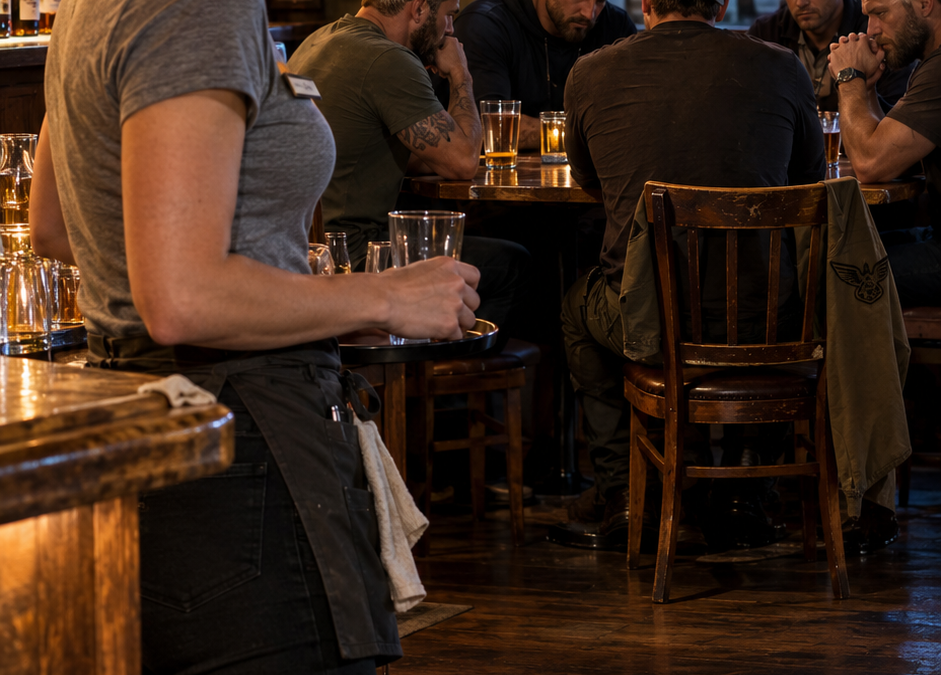
Five men entered at 7:12 in the evening.
I knew the date before I looked at the calendar.
My body knew it.
Bennett came first.
Still straight-backed.
More silver now.
Dwarte behind him.
Shaw.
Vance.
Cole last.
Cole was the one who stopped me.
Not physically.
Just the sight of him.
He had aged.
They all had.
But the others had aged three years.
Cole looked like he’d aged ten.
There are kinds of suffering that leave visible evidence even when the body remains healthy.
He was thinner.
His eyes had developed the permanently exhausted look of someone who had forgotten what rest felt like.
He noticed me looking and gave a polite nod.
A stranger’s nod.
I nearly broke right there.
Instead I picked up five menus.
I walked them to the table.
The empty chair was waiting.
Bennett didn’t have to ask for it.
One of the other servers started toward the table to remove the sixth place setting.
I stopped her.
“I’ve got it.”
She shrugged.
I removed the silverware but left the chair.
My hands were steady.
Nine years of trauma medicine will teach your hands how to function independently from your heart.
I took five drink orders.
Bennett: bourbon.
Dwarte: whiskey.
Shaw: beer.
Vance: rye.
Cole: bourbon he would barely drink.
On my order pad, there was space for six.
I wrote five.
For twenty minutes they talked like men trying not to approach a grave too quickly.
Small things.
Someone’s knee surgery.
A former teammate’s new baby.
A motorcycle Dwarte had apparently bought despite unanimous agreement that he was too old to be trusted with one.
I moved around them.
Filled water.
Delivered food.
Cleared an empty basket.
Eight feet away, maybe less.
Vance watched me twice.
That bothered me.
Of all of them, Vance had always been the most observant.
Years earlier he once identified a surveillance vehicle because the windshield had been cleaned too recently compared with every other car on the road.
People mocked him until he was proven right.
Now his gaze followed me for half a second longer than a customer’s should.
I turned away.
At 7:39, Bennett stood.
The room didn’t become silent.
Only their table did.
But I felt it anyway.
I was carrying a tray with three empty glasses.
Bennett lifted his bourbon.
The others followed.
Cole’s hand shook almost imperceptibly.
Bennett said, “To our fallen medic.”
Five glasses rose.
I stopped walking.
Three years.
For three years those words had existed in rooms I wasn’t allowed to enter.
For three years my mother had heard some version of them.
For three years men I loved had converted me into the past tense because everyone with authority had told them that was the truth.
To our fallen medic.
My throat closed.
They touched glasses.
Four men drank.
Cole didn’t.
He lowered his glass.
Set it on the table.
And said the sentence that ended my silence.
“I heard her.”
Nobody asked what he meant.
They had heard this before.
“I heard her on comms before we pulled out.”
Dwarte stared at his own drink.
Cole continued.
“She was still there.”
Bennett’s jaw tightened.
“Cole.”
“I heard her, Master Chief.”
“I know.”
“And I left anyway.”
There it was.
Not a fresh wound.
A ritual wound.
Something he reopened every year because pain had convinced him he owed it blood.
“I left her there.”
Bennett sat down.
“You followed the order.”
“Doesn’t change what happened.”
“It wasn’t your decision alone.”
“Still heard her.”
Shaw rubbed his hand across his face.
Dwarte whispered, “Not tonight, brother.”
Cole gave a dry laugh.
“When, then?”
Nobody answered.
“I got out. She didn’t.”
I looked at him.
Really looked.
And suddenly I could see the full cost of every month I had spent standing behind legal language.
I had known some of it already.
Bits of conversation overheard during the previous weeks.
Bennett once mentioning Cole’s divorce.
Vance saying therapy hadn’t helped enough.
A passing comment about a promotion Cole had refused.
I had assembled the pieces without letting myself see the picture.
Now I saw it.
Cole had built his entire life around the conclusion that the worst thing that ever happened to me had been his fault.
And until three months ago, I had no power to correct him.
But for three months I had.
The restrictions were gone.
Nobody was keeping me silent anymore.
Only me.
I looked down at the tray.
There is a strange thing about guilt.
It can make self-protection feel moral.
I had told myself I was protecting them from shock.
Protecting myself from rejection.
Protecting classified information.
Protecting fragile lives from a truth too complicated to deliver cleanly.
But standing there listening to Cole sentence himself for a crime he had never committed, every argument collapsed.
My silence was no longer imposed.
It was chosen.
And that changed everything.
I set the tray on the service counter.
My manager looked over.
“You okay?”
“Yeah.”
It was a lie.
But I was walking before fear could reorganize itself.
Eight feet.
I had crossed distances under fire that frightened me less.
Seven.
Dwarte noticed first.
Six.
Then Bennett.
Five.
Cole stared at his drink.
Four.
Vance’s eyes narrowed.
Three.
Shaw stopped speaking.
Two.
I reached the empty chair.
One.
Bennett looked up with the polite expression customers give a server waiting to ask a question.
I put one hand on the back of the chair.
My chair.
The one they had kept empty for three years.
Then I looked directly at Cole.
“I’m right here.”
Nobody moved.
The human mind is not built to absorb certain sentences on first contact.
Bennett blinked.
Dwarte frowned.
Shaw stared.
Cole looked at me without recognition for one second.
Then two.
Then something changed.
Not certainty.
Recognition is too simple a word.
It was more like his brain found an old map beneath the new face.
Eleven months had changed me.
The years after had changed me more.
I was thinner than the woman he remembered.
My hair was longer.
A pale scar crossed the edge of my jaw.
I carried myself differently.
Captivity teaches the body habits that survival no longer requires.
Still, I was me.
Cole’s face emptied.
The chair beneath him scraped backward violently.
He tried to stand.
Didn’t quite manage it.
One hand hit the table.
His glass tipped.
Bourbon spilled across the wood.
“No.”
It came out as a breath.
I didn’t move.
His eyes searched my face.
“No.”
Bennett stood.
Fast.
His hand flattened against the table.
Whatever emotion hit him first was not joy.
It was protection.
That told me exactly what the last three years had done to these men.
“Ma’am,” he said.
Formal.
Controlled.
Dangerous.
“You need to step away from this table.”
“Ray—”
His entire body changed when I used his first name.
But he held the line.
“Back away.”
Dwarte stood too.
“What the hell is this?”
“It’s me.”
“No.”
Dwarte’s voice rose.
“No, it isn’t.”
“Dwarte—”
“Don’t.”
He pointed at me.
His face had gone red.
“This is sick.”
I expected disbelief.
I had rehearsed disbelief.
I had not rehearsed the fury.
“This is sick,” he said again.
Other customers were beginning to look over.
My manager started toward us.
I raised a hand without turning.
“Give us a minute.”
Bennett stared at me.
I saw a calculation happening behind his eyes.
He wasn’t deciding whether he recognized me.
He was deciding whether recognition could be trusted.
That distinction mattered.
“Who are you?” he asked.
“Olivia Carter.”
Cole made another sound.
Dwarte swore.
Bennett’s expression hardened.
“Leave.”
“Ray.”
“I said leave.”
“I’m not trying to hurt him.”
“You already are.”
That hit harder than I expected.
His voice stayed quiet.
“I watched that man tear himself apart for three years. I watched him lose his marriage. I watched him turn down advancement because he decided surviving made him undeserving. I don’t know who you are or what you think you’ve learned, but you don’t get to walk in here wearing her face and—”
“Wearing her face?”
My own temper surfaced.
Good.
Anger was easier than fear.
“You think I wanted this?”
“I think you need to leave.”
“I was in the south room when Mercer lost his foot.”
Bennett’s eyes sharpened.
“I treated Hall near the stairwell.”
“Those details are in reports.”
“The east wall collapsed at 0216.”
“Also in reports.”
“You pulled back after the second attempt to reach us.”
“Reports.”
“Air authorization was already active before comms failed.”
“Reports.”
He was right.
That was the worst part.
Everything I could offer from the mission could be stolen by anyone with enough access.
Bennett would have failed his team if he’d believed me because I knew facts.
Dwarte looked almost relieved every time Bennett dismissed a detail.
Anger was easier for him too.
Then Vance spoke for the first time.
“Let her talk.”
Bennett glanced at him.
Vance never looked away from me.
“Why?”
“Because she keeps favoring her left side when somebody moves behind her.”
My stomach tightened.
Vance continued.
“Olivia did that after Kandahar.”
Dwarte turned.
“Lots of people do that.”
“She also checks the mirror over the bar every time the entrance opens.”
“She’s a bartender.”
“Waitress.”
Vance’s eyes stayed on mine.
“And she just called you Ray.”
Bennett said nothing.
Vance added, “She never called you Master Chief off mission.”
I swallowed.
“Still don’t.”
For half a second, something almost human moved through Bennett’s face.
Then Cole spoke.
His voice sounded wrecked.
“Prove it.”
I looked at him.
He was sitting again.
Barely.
“How?”
“I don’t know.”
His eyes filled.
That was the first moment I nearly lost the nerve to continue.
“Prove it.”
I thought about the operation.
Training.
Nicknames.
Injuries.
Arguments.
Everything had probably existed somewhere in a file.
Then I remembered the radio.
The final seconds.
The one thing I knew Cole had never put into an after-action report because it served no operational purpose.
I asked, “Did you ever tell anyone the last thing I said to you?”
Cole stopped breathing.
Bennett looked at him.
“What last thing?”
Cole’s eyes did not leave mine.
“No.”
I stepped around the chair.
“Nobody?”
“No.”
His voice cracked.
“Not Bennett?”
“No.”
“Not your wife?”
His expression changed at the word wife.
“Ex-wife.”
“I’m sorry.”
“Don’t.”
He pressed his palms against the table.
“I never told anyone.”
“Why?”
He looked down.
For several seconds I thought he wouldn’t answer.
Then he said, “Because it was mine.”
My eyes burned.
Cole continued.
“It wasn’t tactical. It wasn’t important.”
“It was important.”
“Not to the report.”
“No.”
He looked at me again.
“I kept it because it was the last thing I had that nobody else got.”
The bar disappeared.
Not literally.
I could still hear silverware.
A television over the bar.
Somebody laughing near the pool table.
But my mind returned to concrete dust and radio static.
Cole’s voice in my ear.
My certainty that I was about to die.
I said, “You told me you were coming back.”
His mouth opened.
“I told you not to.”
No one moved.
“I said, ‘Get them out and live long enough to annoy me about it later.'”
Cole’s lower lip trembled.
Dwarte slowly sat down.
I continued because if I stopped, I knew I might never finish.
“And then I told you that whatever happened next, I was glad it was your voice in my ear.”
Cole covered his mouth with one hand.
I was crying now.
I didn’t notice until I tasted salt.
“And not anybody else’s.”
Cole broke.
There is no cleaner way to say it.
The sound that came out of him was not the controlled grief I’d seen soldiers permit themselves at funerals.
It was not dignified.
It was not quiet.
It was the sound of something sealed under pressure for three years finally rupturing.
He bent forward.
Both hands covered his face.
His shoulders shook.
Dwarte turned away.
Shaw wiped at his eyes and pretended he hadn’t.
Bennett stood perfectly still.
Vance closed his eyes.
I wanted to touch Cole.
I didn’t.
I had forfeited the right to assume what he needed.
For several seconds, maybe a minute, the table existed inside a silence no one else in the bar understood.
Then Bennett looked at the empty chair.
He pulled it away from the table.
Turned it toward me.
“Sit.”
His voice was different.
Still commanding.
But no longer hostile.
I sat.
For three years the chair had been reserved for a dead woman.
The first time I occupied it, I felt more like a ghost than I ever had while hiding.
Bennett remained standing.
“Start talking.”
So I did.
Not everything.
I couldn’t.
Some details remain classified even now.
Some details I would not have told them even if classification disappeared because surviving something does not create an obligation to relive it for anyone else’s understanding.
I gave them what they needed.
“I got moved before the strike.”
Bennett’s eyes narrowed.
“By whom?”
“Can’t tell you.”
“Military?”
“I can’t tell you.”
“American?”
“Ray.”
He leaned back slightly.
Old habit.
He knew the tone I used when a boundary was real.
“How long before?”
“Roughly forty minutes.”
Cole slowly lowered his hands.
His face was wet.
“You were out?”
“Yes.”
“Before the strike?”
“Yes.”
“You’re sure?”
The question hurt because I understood what he was really asking.
Was there still some version of history in which he had left me inside?
“No, Cole. Listen to me.”
I leaned forward.
“I was not inside that building when the strike hit.”
His face tightened.
“I heard you.”
“I know.”
“You were there.”
“When you heard me, yes.”
“Then—”
“Things changed after comms went down.”
He stared.
“I was moved.”
“Why?”
“I didn’t understand then. I barely understand all of it now.”
“By who?”
“People attached to something we didn’t know existed.”
Bennett’s anger returned, but this time it wasn’t aimed at me.
“Compartmented above us?”
“Far enough that your clearance wouldn’t have touched it.”
He looked away.
I knew that expression.
Bennett hated two things: losing people and not understanding the battlefield.
My story combined both.
“What happened after?”
I wrapped my hands around each other beneath the table.
“I was held.”
“For how long?”
“Eleven months.”
Shaw whispered something I couldn’t hear.
Dwarte closed his eyes.
Cole looked like he’d been hit.
Bennett sat at last.
“Eleven?”
“Yes.”
“What did they—”
He stopped himself.
“Never mind.”
“Thank you.”
I meant it.
I could have described rooms.
Hunger.
Interrogations.
Injuries.
The psychological engineering of captivity.
None of it would have helped the five men sitting around me.
Some trauma becomes less bearable, not more, when translated into detail.
“They recovered me after eleven months.”
“Who?”
“Another question I can’t fully answer.”
Bennett’s jaw flexed.
“They brought you home and never told us?”
“Correct.”
“Your mother?”
“No.”
His eyes changed.
That was the first moment his anger became personal.
“They let your mother believe you were dead?”
“Yes.”
“For how long?”
“Until now.”
Cole whispered, “Jesus Christ.”
I told them about the paperwork.
The restrictions.
No contact with mission personnel.
No disclosure that I had survived.
No attempt to correct the official narrative.
Bennett listened without interrupting for almost two minutes.
That was more intimidating than if he’d yelled.
When I finished, he asked, “And if you refused?”
“I asked.”
“What did they say?”
“They explained that my recovery was tied to information that could not be exposed without compromising active architecture.”
“That’s not what I asked.”
“No.”
He leaned closer.
“What happened if you refused?”
“I don’t know exactly.”
“Olivia.”
“I knew enough.”
His face went hard.
“Containment?”
“Maybe.”
“Administrative detention?”
“I don’t know.”
“Security review?”
“Definitely.”
He pushed his chair backward a few inches and stared at the wall.
Dwarte muttered, “They buried you twice.”
I turned toward him.
“What?”
He looked at me.
“Once on paper. Once while you were breathing.”
Nobody had a response to that.
Neither did I.
Cole asked, “How long were you under the restriction?”
“Two years after I came back.”
His eyebrows pulled together.
“Two years.”
“Yes.”
“And three months ago?”
I nodded.
“The program closed. I received written notification that the contact restrictions had lapsed.”
“Three months ago.”
“Yes.”
He looked toward my apron.
Then around the bar.
Understanding arrived painfully.
“You came here.”
“Yes.”
“Because of us?”
I hesitated.
“Partly.”
“Partly?”
“The rent really is cheap.”
For one second, Dwarte laughed.
It came out broken and inappropriate and absolutely necessary.
Then Shaw laughed once too.
Even Bennett’s mouth twitched.
Cole didn’t.
He asked, “How many times did you see us?”
“Before tonight?”
“Yes.”
“A few.”
His face went pale again.
“And you said nothing.”
There it was.
The question I’d feared more than disbelief.
Not Are you really alive?
Why didn’t you tell me?
“I couldn’t at first.”
“I’m not asking about at first.”
I held his gaze.
“No.”
His voice remained quiet.
“You’ve been free to contact us for three months.”
“Yes.”
“And you didn’t.”
“Yes.”
Bennett started, “Cole—”
“No.”
Cole raised a hand.
“Let her answer.”
He looked at me.
“You knew what I thought.”
“Some of it.”
“You knew I blamed myself.”
“Yes.”
“How much?”
I couldn’t lie.
“I knew about the insomnia.”
His expression hardened.
“The divorce?”
“I overheard Bennett mention it.”
“The promotion?”
“Yes.”
Cole stood and walked three steps away from the table.
He put both hands on the back of another empty chair.
I let him be angry.
He deserved that more than he deserved my excuses.
“I am sorry,” I said.
He stared toward the window.
“I received the letter and thought everything would change immediately. Then nothing changed. I woke up the next morning and was still me.”
He didn’t move.
“I had spent two years training myself not to call you. Not to call my mother. Not to search names. Not to drive past places I knew. Every instinct became a rule.”
Cole looked back.
“The rule ended.”
“I know.”
“Three months ago.”
“I know.”
My voice cracked.
“I was terrified.”
That stopped him.
I had been shot at beside these men.
I had treated casualties while rounds hit walls close enough to throw concrete against my face.
I had been the person who told everyone else to keep moving.
Admitting fear to them felt more intimate than describing captivity.
“I was afraid you’d think I was lying.”
I looked at Bennett.
“Which you did.”
He accepted that with a small nod.
“I was afraid you’d be angry.”
Dwarte sighed.
“Also correct.”
“I was afraid my mother would look at me and see eleven months of everything she imagined happening to me. I was afraid the government would decide the letter had been a mistake. I was afraid if I stepped back into the life I had before, I’d discover there was no place for me in it anymore.”
Cole released the chair.
“And you were afraid of me.”
“Yes.”
That hurt him.
I continued before he could misunderstand.
“Not that you would hurt me.”
“Then what?”
“That you would forgive me.”
He frowned.
I looked down.
“Because I wasn’t sure I had forgiven myself.”
Silence.
“I knew you were suffering. I knew my mother was suffering. But during those two years, there was nothing I could do without risking the only freedom I’d been given. So I learned to live with helplessness. Then suddenly the restriction disappeared.”
I looked at Cole.
“And helplessness disappeared with it.”
He understood.
I saw it.
“Which meant anything I didn’t do after that was mine.”
“Yes.”
“I needed time to understand that.”
His anger didn’t disappear.
I didn’t expect it to.
But it softened around the edges.
Bennett asked, “Why tonight?”
I looked at Cole’s untouched drink.
“Because he said it again.”
Cole closed his eyes.
“‘I heard her and I left anyway.'”
He nodded.
“I realized there was a point where protecting myself became letting him drown because I was afraid to get wet.”
Cole’s face broke again, but more quietly.
I turned fully toward him.
“This is the part you need to hear.”
He sat slowly.
I waited until he looked at me.
“You did not leave me to die.”
His jaw tightened.
“Liv—”
“No.”
I used the voice I once used on wounded men when panic tried to take them from me.
“Listen.”
He did.
“When Bennett gave the withdrawal order, he had the information available at that moment. So did you. You believed I was still inside. You believed coming back might save me.”
His eyes filled.
“But it wouldn’t have.”
He looked away.
“It wouldn’t have, Cole.”
“You don’t know that.”
“I do.”
“How?”
“Because the people who moved me were already operating independently of you. You couldn’t have known where I went. You couldn’t have stopped what came after. And if you had disobeyed Bennett and gone back, best case you would have reached a location I no longer occupied.”
His breathing became uneven.
“Worst case?”
“You would have died.”
He shut his eyes.
“Maybe.”
“No.”
I leaned forward.
“You need to stop turning certainty into maybe because maybe lets you keep punishing yourself.”
Bennett looked at me sharply.
Cole’s eyes opened.
“You made the right decision with information that later turned out to be incomplete.”
“I left you.”
“You obeyed an extraction order.”
“I heard you.”
“And I told you not to come back.”
“I should’ve ignored you.”
“Why?”
“Because—”
“Because I died?”
He flinched.
“But I didn’t.”
I spread my hands.
“I’m sitting here.”
His gaze dropped to them.
I continued more gently.
“The thing you’ve been punishing yourself for has never existed in the way you believed it did.”
Cole shook his head.
“Eleven months happened.”
“Yes.”
“And I wasn’t there.”
“No.”
“I could’ve—”
“No.”
“How can you know?”
“Because I was the one there.”
That stopped him.
I had not meant it harshly.
Sometimes truth arrives with edges anyway.
I softened my voice.
“What happened during those eleven months belongs to the people who caused it. Not you.”
His face twisted.
“Say it again.”
I swallowed.
“It was not your fault.”
He lowered his head.
“Again.”
“You did not abandon me.”
His shoulders began shaking.
“Again.”
“You did not leave me to die.”
He covered his face.
Bennett’s hand landed on Cole’s shoulder.
For the first time in three years, according to what they later told me, Cole let himself cry without apologizing for it.
Nobody tried to stop him.
We sat around that table until Murphy’s closed.
My manager turned off the television.
The last regular left.
Chairs went upside down onto other tables.
Our table remained untouched.
I told them enough.
They told me things I had missed.
Some hurt worse than I expected.
My memorial had been held four weeks after the review declared there was no plausible chance I had survived.
Bennett spoke.
Cole didn’t.
He had stood in the back and left before anyone could approach him.
My mother received the flag.
That detail nearly ended me.
“What did she look like?” I asked.
Nobody answered immediately.
Finally Bennett said, “Strong.”
That meant devastated.
Soldiers use words like strong when the actual word feels disrespectful.
“Was she alone?”
“No.”
“Who stayed with her?”
“We all did.”
I closed my eyes.
“Thank you.”
Bennett looked offended.
“Don’t thank us for that.”
“I wasn’t there.”
“Wasn’t your choice.”
The sentence echoed beyond what he intended.
Wasn’t your choice.
How much of the last three years had not been anybody’s choice?
That question sat with me for a long time.
Bennett told me about the empty chair.
I had assumed it was memorial symbolism.
It wasn’t.
Not entirely.
He leaned back and looked at it.
“The first year, Dwarte tried to remove it.”
Dwarte frowned.
“I did not.”
“You absolutely did.”
“I moved it six inches.”
“You said it was morbid.”
“It was morbid.”
Bennett continued.
“I put it back.”
“Why?” I asked.
He looked at me.
“Because I wasn’t convinced.”
The table went quiet again.
“Of what?”
“That you were dead.”
My heart stopped for a beat.
“Ray.”
“I accepted the finding.”
“That’s not what you said.”
“I signed the acknowledgment. Doesn’t mean I liked it.”
He told me he had requested review twice.
Both requests came back unchanged.
No recoverable remains.
No evidence of survival.
Strike pattern incompatible with survivability.
Case closed.
“Then why the chair?”
He stared at the worn tabletop.
“Because I had no body.”
“Bennett.”
“I know.”
“Nobody could’ve survived that strike.”
“Correct.”
“But?”
“But I spent a career learning that certainty is expensive.”
His eyes met mine.
“I wasn’t willing to pay for it without proof.”
Dwarte muttered, “Stubborn bastard.”
Bennett ignored him.
“So I left the chair.”
“For three years?”
“For three years.”
I looked at it.
The chair beneath me.
I’d thought they had reserved it for the dead.
Some part of Bennett had reserved it for uncertainty.
That mattered more than he could possibly know.
At 2:10 in the morning, we finally stood.
Cole remained after the others walked toward the door.
I was removing my apron when he said, “I heard your voice every night for a year.”
I froze.
He stood beside the table.
“The radio.”
I didn’t speak.
“Every time I slept, I heard you say not to come back.”
He rubbed one hand over his face.
“And every time, I went back anyway.”
I understood immediately.
Dreams.
“In the dream?”
“Yeah.”
“What happened?”
“I never reached you.”
Of course he didn’t.
Trauma rarely allows the dreamer mercy.
“I’m sorry.”
He shook his head.
“Don’t say that.”
“What should I say?”
“I don’t know.”
Neither did I.
So I walked closer.
Not close enough to touch.
Just closer.
Cole looked at me.
“Are you real?”
The question shattered whatever composure I had left.
“Yeah.”
“You sure?”
I laughed through tears.
“Mostly.”
He laughed too.
Then his face folded.
He covered his mouth.
I stepped forward.
This time, he didn’t move away.
I put my arms around him.
For one second he stood rigid.
Then he held on.
Not romantically.
Not ceremonially.
Like a man grabbing the edge of something after years in deep water.
His forehead pressed against my shoulder.
“I’m sorry,” he whispered.
“No.”
“I am.”
“You don’t owe me that.”
“I should’ve come back.”
“Stop.”
“I—”
“Stop.”
I pulled back enough to look at him.
“If you apologize to me for surviving one more time, I’m going to hit you.”
He stared.
A tiny smile appeared.
“There she is.”
That nearly broke me again.
“There who is?”
“Olivia.”
I went home at dawn.
I did not sleep.
At 8:06, I called my mother.
Then hung up before the call connected.
At 8:14, I tried again.
Same result.
At 9:32, Bennett called.
“You told her yet?”
“No.”
“You need me there?”
“No.”
“You sure?”
“No.”
A pause.
“Fair.”
“I have to do it myself.”
“I know.”
My mother lived nearly six hours away.
I drove there the next morning.
The folded flag was in her house.
I didn’t know that until later.
For three years she had kept it in the bottom drawer of a bedroom dresser because putting it on display felt, in her words, like accepting something she had never accepted.
She had also kept my childhood baseball glove.
My high school graduation photograph.
A ceramic mug I made when I was eleven that said WORLD’S BEST MOM in letters so crooked they looked intoxicated.
Grief makes archivists of people.
I parked two houses down because I couldn’t make myself stop directly in front.
Then I laughed at the stupidity of that.
She was going to see me.
Walking an extra thirty yards wasn’t going to soften it.
My mother opened the door after my second knock.
She had aged.
That was my first thought.
Not because she looked old.
Because I could see years I had missed sitting visibly on her face.
She stared at me.
No recognition.
Then recognition.
Then rejection of recognition.
Her hand went to the doorframe.
“Mom.”
She made a sound.
I will never reproduce it accurately.
People write that someone screamed.
She didn’t.
It was quieter.
More frightened.
My name came out of her like a question she had asked God too many times.
“Olivia?”
“Yeah.”
She stepped backward.
For one terrible moment I thought she might close the door.
Instead her knees gave out.
I caught her before she hit the floor.
She touched my face.
Both hands.
Hard enough to hurt.
“You’re warm.”
That destroyed me.
“I’m sorry.”
“You’re warm.”
“I’m here.”
“They said—”
“I know.”
“They said you were—”
“I know.”
She hit me.
Once.
Open hand against my chest.
Then again.
Not hard.
Grief does not always return as tenderness.
“Three years.”
“I know.”
“Three years.”
“I couldn’t—”
“You let me bury you.”
The sentence was unfair.
The sentence was completely fair.
Both things can be true.
I let her hit me again.
Then she collapsed against me.
We sat on the floor inside her doorway and cried like there was no dignified version of either of us left to protect.
Later, when words became possible, I explained what I could.
She hated the government.
She hated Bennett for approximately nine minutes until I explained he hadn’t known.
She hated me.
Then apologized for hating me.
Then hated herself for apologizing.
Grief and relief fought through her for hours.
That was normal.
Neither of us knew it yet.
At some point she brought out the folded flag.
She placed it on the kitchen table between us.
“I didn’t know what to do with it.”
I stared at the triangle of blue and white stars.
A piece of ceremony built around the fiction of my death.
My mother touched it.
“I used to open the drawer just to make sure it was still there.”
I swallowed.
“Why?”
“Because if it disappeared, I thought maybe that meant you were really gone.”
I took her hand.
“I’m not.”
She looked at me for a long time.
“No.”
Then she smiled through tears.
“No, you’re not.”
The practical corrections took weeks.
The government is faster at declaring death than undoing it.
There were forms.
Reviews.
Identity verifications.
Security meetings.
More forms.
My record had to be amended.
Benefits corrected.
Notifications generated.
My name had to be removed from a memorial wall.
That process took long enough for Bennett to threaten several offices with increasingly creative expressions of professional displeasure.
He never told me exactly what he said.
Vance did.
It was impressive.
Life did not become normal afterward.
There was no single sunrise where three stolen years vanished.
My mother woke me twice in the first month just to hear my voice because she had dreamed I was dead again.
Cole still had nightmares.
So did I.
Bennett remained furious for longer than was healthy, though fury looked natural on him.
Dwarte began bringing me food as though captivity had reduced my ability to grocery shop.
Shaw fixed a loose cabinet hinge in my apartment without asking.
Vance sat at the bar one night and said, “I knew your walk looked wrong.”
“Wrong?”
“Familiar.”
“That’s not better.”
“It wasn’t supposed to be.”
Then he drank his beer.
That was Vance’s version of affection.
Cole’s recovery was slow.
It should be.
Stories lie when they make revelation equivalent to healing.
Truth can remove poison.
The body still needs time to recover from having carried it.
For three years, guilt had become architecture inside him.
It had shaped where he slept.
How he worked.
Who he loved.
What he believed he deserved.
Learning the foundation was false didn’t instantly remove the building.
But cracks appeared.
Good ones.
Two weeks after the reunion, Bennett told me Cole had slept six uninterrupted hours.
Apparently this was newsworthy enough to call me at 6:30 in the morning.
“Six?”
“Six.”
“Why are you telling me?”
“Because I figured you’d want to know.”
“I do.”
Pause.
“Then stop complaining.”
He hung up.
Cole began coming to Murphy’s on ordinary nights.
Not every night.
Not even every week.
He would sit at the counter.
Sometimes we talked about the mission.
Usually we didn’t.
We talked about bad movies.
Baseball.
The insanity of grocery prices.
The motorcycle Dwarte still had no business owning.
Sometimes we sat in silence.
Silence felt different now.
That mattered.
One evening, months after I returned, Cole asked the question I knew would eventually come.
“Do you wish I’d come back?”
I set down the glass I was polishing.
“No.”
He waited.
“No hesitation?”
“None.”
“Why?”
“Because you would’ve died.”
“Maybe.”
I pointed a bar towel at him.
“We discussed your relationship with maybe.”
He smiled.
“Right.”
I leaned against the counter.
“I wanted you to come back.”
He looked surprised.
“That’s different.”
“How?”
“Of course I wanted you to. I was terrified. I didn’t want to be alone. I didn’t want to die there.”
I took a breath.
“But wanting something doesn’t make it right.”
Cole stared at the counter.
“I needed you to leave.”
He nodded.
“That’s why I told you.”
“Yeah.”
“And you listened.”
“Eventually.”
“Good.”
He looked up.
“Liv?”
“What?”
“Thank you.”
“For what?”
“For saying it until I could hear it.”
I understood.
Sometimes healing isn’t receiving new information.
It’s receiving old information enough times that pain finally stops arguing.
A year passed.
Not cleanly.
Not easily.
But it passed.
On the anniversary, I asked Murphy’s manager for the night off.
He stared at me.
“You?”
“Yes.”
“Voluntarily?”
“Don’t make this emotional.”
He laughed.
I arrived at 7:00 wearing jeans, boots, and a dark blue blouse my mother had insisted I buy because, according to her, my civilian wardrobe suggested I was “hiding from fabric.”
The table near the back window was reserved.
Six places.
Six glasses.
No empty chair.
I stood just inside the bar and looked at it.
A year earlier, that chair had held the shape of my death.
Now it was simply furniture.
Bennett entered first.
He saw me.
Stopped.
Then nodded toward the table.
“You’re early.”
“I learned punctuality somewhere.”
“Wasn’t from Cole.”
Cole entered behind him.
“I heard that.”
Dwarte arrived carrying something wrapped in paper.
It was whiskey.
Expensive enough that I accused him of stealing it.
Shaw brought nothing and claimed his presence was gift enough.
Vance looked at the six chairs and said, “About time.”
We sat.
For the first time, I was not serving them.
I was not watching from eight feet away.
I was inside the circle.
Cole sat on my right.
Bennett at the head.
Dwarte poured.
Six glasses.
When everyone had one, Bennett stood.
The movement pulled me backward in time instantly.
Same table.
Same anniversary.
Same man.
For half a second I could hear last year’s words.
To our fallen medic.
My hand tightened around the glass.
Cole noticed.
His hand touched the table near mine.
Not holding.
Just there.
An anchor offered without demand.
Bennett looked at me.
His face had changed during the year too.
Not younger.
Lighter.
He raised his glass.
The table went quiet.
Then Bennett said, “To the ones who found their way back.”
Nobody looked toward an empty chair.
There wasn’t one.
Six glasses rose.
Mine among them.
The sound of them touching was small.
Ordinary.
Perfect.
I drank.
Cole smiled at me.
Dwarte complained about the whiskey.
Shaw told him expensive alcohol was wasted on him.
Vance watched the entrance because some habits survived everything.
Bennett sat down.
And for a moment, I let myself see the strange shape of what had happened to us.
Five men had buried me without a body.
My mother had loved a ghost.
Cole had punished himself for a death that never occurred.
I had survived captivity only to spend two more years locked behind silence.
None of us came through untouched.
That is the part people misunderstand about coming home.
Home is not a location.
It is not an airport.
It is not a flag.
It is not paperwork changing from deceased to living.
Sometimes coming home takes years after your body arrives.
Sometimes it requires walking eight feet across a bar.
Sometimes it requires letting people be angry that you survived badly.
Sometimes it means sitting in a chair they kept empty because part of them refused to stop waiting.
I spent years believing silence was the price of survival.
For a time, it was.
Then one day it wasn’t.
I simply hadn’t noticed the price had changed.
By the time I finally spoke, silence was costing all of us more than the truth.
Cole did not get his three years back.
My mother did not get hers.
Bennett did not get to erase the memorial speech.
I did not get to become the woman I had been before that mission.
There are losses truth cannot reverse.
But truth can stop the losing.
That was what I finally understood.
After the toast, conversation moved on.
Dwarte told a story he’d already told twice.
Shaw corrected him.
Bennett accused both of them of lying.
Cole leaned toward me.
“You know what the best part is?”
“What?”
He nodded toward my glass.
“You finally get to buy the next round.”
I stared at him.
“I was held captive for eleven months.”
“That excuse isn’t going to work forever.”
“I was legally dead.”
“Also getting old.”
“I served you drinks for three months.”
“And now you’re off shift.”
I shook my head.
“There it is.”
He grinned.
“What?”
“The annoying.”
His smile faded into something warmer.
“You told me to live long enough to annoy you about it later.”
I felt the old radio static in my memory.
Concrete.
Darkness.
Fear.
A voice telling me he was coming back.
My own voice ordering him not to.
Three years of grief built from a misunderstanding neither of us had created.
And now this.
A table.
Six glasses.
A terrible joke.
A man alive beside me.
I lifted my drink.
“Mission accomplished.”
Cole laughed.
This time, I laughed with him.
And for the first time since the night everyone thought I died, I did not feel like a woman who had survived something.
I felt like a woman who was still living.








