𝗙𝗨𝗟𝗟 𝗦𝗧𝗢𝗥𝗬 Deputies Blocked the HOA’s Only Marina Road—Then Its President Read One Line and Stopped Smiling
𝗙𝗨𝗟𝗟 𝗦𝗧𝗢𝗥𝗬
“I think so.”
“I’ll bring the historical maps.”
Three days later, his pickup arrived loaded with steel probes, tripods, GPS receivers, and weathered tubes containing survey plats.
He began near the fence line where Diane had confronted me.
Samuel did not start with the pavement or Harbor Ridge’s glossy maps. He searched for original evidence.
He moved through waist-high grass until his probe struck metal.
“There you are.”
He dug carefully and exposed an iron survey pin beneath decades of packed earth.
“This marker predates Harbor Ridge.”
He verified the coordinates, recorded them, and moved south.
By lunchtime, we had recovered four original monuments. Their positions matched my deed, but not the simplified maps Harbor Ridge displayed at community meetings.
Samuel spread both maps across my truck hood.
“The subdivision map straightens this line.”
He traced the western boundary.
“According to the recorded survey, it curves toward the lake.”
His finger crossed the marina access road.
Neither of us spoke for several seconds.
“Could it be a drafting error?” I asked.
“Presentation maps simplify boundaries. Recorded surveys can’t.”
He looked toward the road.
“That’s interesting.”
“You’ve used that word three times.”
“I’m not ready to use the dangerous one.”
“Which is?”
“Wrong.”
That afternoon, I parked near a public overlook and watched traffic enter the marina.
Contractors, fuel trucks, employees, homeowners, charter customers, delivery vans, and golf carts crossed the road without slowing.
I counted almost sixty vehicles in less than an hour.
No one wondered who owned the ground beneath their tires. The pavement felt permanent, and permanence has a way of disguising assumptions as facts.
The following week, orange stakes appeared along the marina entrance.
They were not mine.
Fresh utility markings extended beyond Harbor Ridge and into my parcel. I photographed every stake, painted line, and contractor vehicle.
One foreman noticed me.
“We’re working from HOA plans,” he said.
“Do those plans include permission from the property owner?”
His expression changed.
“I don’t know.”
That was the problem.
No one knew because no one had asked.
Samuel called that evening.
“I found another monument referenced in the original field books.”
“What does it control?”
“The entire corridor leading to the marina.”
The next morning, we hiked through neglected timber where roots and brush had swallowed the old boundary.
Samuel cleared leaves from a granite marker almost completely buried beside a cedar stump. A reference number had been engraved into the stone.
He checked it against his notebook and became very quiet.
“This monument controls every boundary south of the ranch.”
“Including the marina road?”
“Including the road.”
He folded the notebook.
“If this matches the original deed chain, someone has made an expensive assumption for a very long time.”
Samuel refused to declare victory.
“A monument tells us where to look,” he said. “The chain of title tells us what happened.”
That was when I called Laura Bennett.
Laura specialized in ranch easements, water access, mineral rights, and land disputes developers assumed were too old to challenge.
When I described what Samuel had found, she did not sound surprised.
“Bring every document from your purchase. Meet me at the county archive.”
By noon, Samuel, Laura, and I sat beneath fluorescent lights surrounded by subdivision filings, transfer deeds, old plats, access agreements, and county indexes.
Laura ignored the polished maps on the public computers.
“Pretty maps don’t win lawsuits,” she said. “Recorded documents do.”
For hours, she followed the title from one owner to the next, marking every conveyance with colored tabs.
Then she stopped.
“Here’s Harbor Ridge.”
She placed an old agreement before us.
Years before the subdivision existed, the original marina developer had negotiated access across the ranch parcel.
I read the first page.
“This doesn’t transfer ownership.”
“Because ownership was never transferred.”
Laura tapped a paragraph.
“It granted temporary access during construction and for a defined period of marina operations.”
The agreement contained a termination clause.
Twelve years after the final development phase, the access rights expired unless the parties executed and recorded a renewal.
“Was there a renewal?” I asked.
Laura checked the index.
Then the digital archive.
Then a supplemental recording file.
Nothing.
“They let it expire,” she said.
“So after twelve years, access ended?”
“The agreement ended. Ownership never changed at all.”
Harbor Ridge had paved the road, installed signs, patrolled it, and charged residents for using it. None of those actions transferred title.
The corridor remained attached to the ranch parcel now recorded in my name.
Samuel exhaled slowly.
“I’ve seen people assume ownership. I’ve never seen an entire marina do it.”
Laura kept searching.
She found maintenance permits, resurfacing applications, utility trenches, gate improvements, and drainage work.
“They filed permits and hired contractors,” she said. “But they never obtained title or renewed the access agreement.”
“Everyone accepted their claim.”
“Because no one opened the original file.”
I thought about Diane’s blue folder.
Community asset.
Community infrastructure.
The phrases no longer sounded like legal descriptions. They sounded like incantations—words repeated until no one remembered to ask whether they were true.
Laura’s phone rang as we organized the records.
She listened for almost a minute.
“Are you willing to put that in writing?” she asked.
Another pause.
“Your identity will remain confidential until you’re ready.”
When she ended the call, her expression had changed.
“That was Megan Collins, the HOA treasurer.”
“What does she know?”
“According to her, Diane has known about the expired agreement for months.”
Megan had discovered correspondence while reviewing financial records. One of Harbor Ridge’s consulting attorneys had warned Diane that ownership of the road needed to be verified before the marina expansion received final approval.
Diane had ignored him.
“She ordered the board to move forward before the title problem became public,” Laura said.
“Why?”
“Megan quoted her: ‘Once construction begins, ownership questions will be harder to unwind.’”
Until then, I had allowed for the possibility that Harbor Ridge misunderstood its own history.
That excuse disappeared.
This was no longer ignorance.
It was a race.
Diane did not own the corridor, but she believed that if she built enough infrastructure across it, the cost of correcting her would become unbearable.
Laura closed the archive files.
“We’re finished investigating assumptions. Now we collect proof.”
For two weeks, she instructed me not to confront Diane.
“You know she’s wrong,” Laura said. “What we need is evidence that she knows.”
Harbor Ridge moved quickly.
The HOA announced a massive marina expansion: forty new boat slips, a waterfront restaurant, a private fueling station, additional parking, and a gated security entrance controlling every vehicle.
Every rendering showed the same road.
My road.
At a packed HOA meeting, Diane stood beside glossy presentation boards.
“This investment secures Harbor Ridge’s future,” she said. “Property values will rise, memberships will expand, and our community will finally control access.”
Laura replayed the recording twice.
“Control,” she said. “Interesting word.”
The HOA approved a multimillion-dollar special assessment.
Homeowners received invoices. Investors paid deposits. Contractors submitted bids. Every agreement described the road as permanent HOA-controlled infrastructure.
Not one mentioned the expired access agreement.
Then Diane called me.
“Mr. Mercer, I believe we should have lunch.”
“I’m busy.”
“This conversation could be worth a substantial amount of money.”
That changed my schedule.
We met at a restaurant overlooking the marina. Diane arrived with a leather portfolio.
After ordering coffee, she slid a proposal toward me.
Three hundred thousand dollars.
“For what?” I asked.
“A cooperation agreement.”
The document avoided the word ownership. It asked me to surrender all future objections to roadway improvements, utilities, commercial access, construction, and marina expansion.
“You mean you want permanent rights across my property.”
“I prefer to think of it as eliminating uncertainty.”
I closed the portfolio.
“No.”
“I expected you to negotiate.”
“I’m not negotiating.”
She removed a second document.
Seven hundred fifty thousand dollars.
The amendment had been prepared before she arrived.
“I didn’t make a counteroffer.”
“Harbor Ridge dislikes uncertainty.”
“So do people hiding title defects.”
Her expression cooled.
I leaned forward.
“When you collected special assessments, did you tell the homeowners the road might not belong to Harbor Ridge?”
The silence became her answer.
“The community has relied on that road for decades,” she finally said.
“That wasn’t my question.”
“We maintained it.”
“Also not my question.”
“I don’t see how old paperwork changes present reality.”
“It changes ownership.”
“It changes nothing that matters.”
I stood.
“It matters to the deed.”
As I walked away, she called after me.
“You’ll regret making this difficult.”
I turned.
“No, Diane. You’ll regret believing convenience is stronger than recorded property.”
Three mornings later, diesel engines woke me before dawn.
Excavators, paving trucks, utility trailers, and concrete barriers rolled toward the marina entrance. More than twenty workers spread across the corridor.
Laura answered my call immediately.
“They started.”
“They filed something late yesterday,” she said. “I’m going to the county office.”
An hour later, she called back.
“They’re claiming an emergency infrastructure easement.”
“I never signed one.”
“I know. And whoever prepared this apparently expected no one to read it.”
By the time I reached the road, an excavator was peeling gravel from the shoulder. Paving trucks idled behind it.
Orange paint marked a widening project that crossed my parcel.
Diane stood beside a black pickup holding the supposed easement.
“You need to move your truck,” she said.
“My truck is on the ranch entrance.”
“This is essential marina infrastructure.”
“Show me who granted you access.”
She raised the filing.
“The county accepted this.”
Laura arrived seconds later. She stepped from her vehicle carrying a printed copy covered in red markings.
“Stop the equipment.”
Diane did not look at her.
“The work is authorized.”
“The filing is defective.”
That got Diane’s attention.
Laura held up the first page.
“This parcel number became obsolete when the ranch was consolidated fifteen years ago.”
She turned to the signature page.
“The company supposedly granting the easement dissolved before Harbor Ridge was built.”
Then she pointed to the legal description.
“And this boundary terminates eight hundred feet before the marina.”
The foreman looked at Diane.
“Is that correct?”
“Our legal team reviewed it. Continue working.”
The excavator moved.
Its bucket scraped the shoulder and pushed dirt toward an old stone wall near the lake.
Rachel and I had built that wall years earlier.
We collected flat stones from the shoreline and fitted them together by hand. She laughed every time one split beneath my hammer, then insisted the broken pieces looked better anyway.
After she died, that wall became one of the few places where I could still see the shape of something we had made together.
The excavator’s steel teeth stopped less than ten feet from it.
Anger moved through me so quickly that I nearly stepped into the machine’s path.
For one dangerous second, I wanted to drag the operator from the cab.
Then I saw Laura watching me.
Evidence, not anger.
I took out my phone and began recording.
“Diane, you’ve been informed that the easement is invalid. Are you ordering this crew to continue?”
She looked directly into the camera.
“Yes. Harbor Ridge has a duty to protect community access.”
The foreman hesitated.
Diane pointed toward Rachel’s wall.
“Remove anything interfering with the widening.”
The excavator bucket rose.
I called Sheriff Cole Ramsey.
“They’re actively cutting into my parcel under a defective easement.”
“Any threat to people?”
“No.”
“Property damage?”
“It’s starting now.”
“Keep recording. Don’t interfere physically.”
The bucket began lowering.
The operator noticed my camera. His hands froze.
“Keep moving!” Diane shouted.
Sirens sounded from the highway.
Deputy Ryan Holt arrived first. A second patrol vehicle followed.
Holt stepped between the machinery and the wall.
“Shut down every engine.”
The excavator went silent. Then the paving trucks.
Dust drifted over the road while the bucket hung above Rachel’s stones.
Holt reviewed Laura’s documents.
“No further work until ownership and access are verified.”
Diane stepped forward.
“You cannot allow one ranch owner to shut down a marina serving hundreds of families.”
“This isn’t about how many people use the road,” Holt said. “It’s about who has the right to alter it.”
“No judge will let one man control the entire marina.”
I lowered my phone.
“You should have considered that before selling a future built across my land.”
Laura’s phone vibrated.
She read the message.
“Megan has the emails.”
“How many?”
“All of them.”
Diane had ordered construction after being told the filing was defective.
Now we had proof that the decision had been planned.
Deputy Holt closed the work site. The crew packed its equipment without looking at Diane.
For the first time, her authority had failed the moment someone demanded evidence.
Megan was waiting at Laura’s office with two file boxes and a laptop.
She looked exhausted.
“I downloaded everything before Diane could lock me out.”
Laura closed the blinds.
“What did you bring?”
“Board emails, investor agreements, assessment ledgers, marina fee reports, and the legal warnings she kept from the board.”
The first email came from Harbor Ridge’s consulting attorney four months earlier.
Before approving expansion, the HOA was advised to verify ownership of the marina road and renew any expired access rights. Proceeding without recorded authority could expose the association and individual directors to liability.
Diane’s response appeared beneath it:
Proceed with planning. Do not circulate this concern until we have physical control of the corridor.
Laura read the sentence twice.
Megan opened another email.
Once construction begins, Mercer will be forced to accept the project. No county office will shut down infrastructure serving hundreds of residents.
“That proves intent,” Laura said.
“There’s more.”
Harbor Ridge had already collected over two million dollars in special assessments. Investors had paid deposits based on written guarantees of permanent access.
Residents were also being charged annual road and gate fees for a corridor the HOA had never purchased.
“Did the board know?” I asked.
“They knew only what Diane told them—that the title issue was technical and had already been resolved.”
“What made you come forward?”
Megan looked down at her hands.
“Yesterday she ordered me to move part of the assessment money into a construction account before the county could freeze it.”
Her fingers trembled, but her voice remained steady.
“I realized she wasn’t protecting the community. She was protecting herself.”
Sheriff Ramsey arrived within the hour.
He reviewed the expired agreement, defective filing, internal emails, financial records, and my construction video.
“This began as a civil property dispute,” he said. “Now we may have fraudulent filings, intentional trespass, and financial misrepresentation.”
Laura handed him Diane’s email.
“She proceeded after receiving written legal advice.”
“I see that.”
He looked at Megan.
“Will you provide a formal statement?”
“Yes.”
While Ramsey contacted county investigators, Laura drafted an emergency petition requesting a restraining order, preservation of HOA records, and temporary control of the corridor until ownership could be decided.
Near sunset, Deputy Holt called from the construction site.
County utility workers had inspected the disturbed shoulder.
They found two buried systems crossing my parcel.
A water line supplied the marina.
An emergency power conduit served the docks, fuel pumps, security gates, and fire-suppression equipment.
Neither appeared in the current easement index.
Laura placed the call on speaker.
“Are you saying Harbor Ridge has no documented right to those utilities?”
“That’s what the preliminary search indicates.”
The road had been enough to stop Diane’s expansion.
Now we knew the marina’s water and emergency power also crossed land covered by my deed.
Laura closed her laptop.
“We file tonight.”
Judge Eleanor Hayes reviewed the petition before sunrise.
It included Samuel’s survey, the expired agreement, the defective easement, Diane’s emails, my video, Megan’s statement, and the utility report.
At 5:20 a.m., she issued a temporary restraining order blocking further alteration—and restricting general access—until the court could verify ownership and safety.
Sheriff Ramsey moved immediately.
Deputies parked across the marina road, erected barricades, and posted the order.
That was the closure I watched from the ridge.
Diane arrived less than thirty minutes later.
“Remove these barricades,” she ordered.
Ramsey handed her a certified copy.
“You’ve been served.”
“This is temporary.”
“So is the closure. Emergency access remains available under county supervision.”
She looked for another argument, but the order had anticipated each one.
Residents crowded around the notice.
“Why is Ethan Mercer’s parcel number on this?”
“What happened to our assessments?”
“Does the HOA own the road or not?”
A homeowner pointed toward me.
Diane followed his hand and saw me standing on the ridge.
“This is extortion!” she announced. “One man is shutting down an entire community.”
I walked toward the barricade.
“No. One community built its future across property no one bothered to verify.”
Samuel arrived with his survey tube. Laura followed with the title file.
On the hood of a county SUV, Samuel placed the historical plat beside a modern aerial image.
“The boundary follows these original monuments,” he explained. “Every one matches the recorded deed chain and the current Mercer parcel.”
Laura set the expired agreement beside the survey.
“Harbor Ridge received temporary access. That access expired twelve years ago.”
A boat owner near the front shook his head.
“We’ve paid road fees every year.”
Megan stepped from the crowd.
“Those fees were collected under Diane’s claim that Harbor Ridge owned permanent access.”
Diane turned on her.
“You had no authority to release confidential records.”
Megan did not move.
“You had no authority to collect the money.”
The crowd’s anger shifted.
Ramsey directed county engineers toward two utility covers beside the road.
Laura raised the preliminary report.
“The road is only part of the dispute. Harbor Ridge has not yet produced valid easements for the marina waterline or emergency power conduit.”
A marina employee stared toward the fuel dock.
“No power means no fuel pumps.”
“And no water compromises fire protection,” someone else said.
Diane stepped close to Laura.
“You wouldn’t dare interrupt essential services.”
“We haven’t interrupted them,” Laura said. “The court has preserved essential operations under county supervision.”
Then she looked at me.
“But Mr. Mercer may have the right to demand relocation.”
Every face turned toward me.
I could have sought removal of the road, waterline, and power conduit. I could have left the marina fighting for years to rebuild access.
Diane had spent six months mistaking restraint for weakness.
Now she understood how much restraint I had shown.
The hearing began three days later.
Inside Judge Hayes’s courtroom, no one shouted. There were no barricades, idling boat trailers, or glossy development renderings.
There were only documents.
Laura began with the original ranch deed.
Then Samuel’s certified survey.
Next came the temporary access agreement and the county recording index showing no renewal after its expiration.
Diane’s attorney objected.
“Harbor Ridge’s continuous use establishes practical reliance.”
“Reliance does not transfer title,” Laura replied.
Judge Hayes nodded. “Proceed.”
Samuel explained the monuments, bearings, and boundary calls connecting the highway to the marina entrance.
His testimony remained simple because the measurements were simple.
The corridor belonged to my parcel.
Diane’s experts could not contradict him.
Laura played my construction video.
The courtroom watched Diane order the excavator forward after being told the easement was defective.
They watched her direct the operator toward Rachel’s wall.
Then Megan testified.
She confirmed the legal warning, identified Diane’s emails, and explained that homeowners had never been informed about the expired agreement.
She described the special assessments and investor guarantees.
Laura displayed one sentence on the courtroom screen:
Once construction begins, Mercer will be forced to accept the project.
The words looked uglier enlarged.
Diane eventually took the witness stand.
She insisted she had acted for Harbor Ridge’s benefit. Hundreds of families depended on the marina. The HOA had maintained the road for years. Closing access would damage property values and punish innocent homeowners.
Judge Hayes listened.
Then she asked one question.
“When did you first learn the recorded access agreement had expired?”
Diane hesitated.
“Approximately four months ago.”
“And you approved construction afterward?”
“We believed ownership would eventually be confirmed.”
“You approved construction before confirming ownership.”
Diane said nothing.
Laura stood one final time.
“Mr. Mercer could request removal of every unauthorized improvement crossing his land. That could include the roadway, utility systems, emergency power infrastructure, and related marina facilities.”
Several residents in the gallery shifted uneasily.
Someone whispered, “He could shut down everything.”
Laura looked at me.
“But that is not what my client is asking the court to do.”
Judge Hayes turned toward me.
“Mr. Mercer?”
I stood.
“I did not buy this ranch to destroy a community.”
The room became still.
“I bought it to protect land my wife loved. Harbor Ridge residents were not told the truth. They paid assessments based on promises made by someone who knew the road was in question.”
I unfolded my proposal.
“I’m willing to grant Harbor Ridge a new long-term recorded easement.”
Diane stared at me.
Laura read the seven conditions aloud.
Harbor Ridge would repair every damaged section of the ranch.
The association would reimburse my documented survey, engineering, and legal expenses.
The western shoreline adjoining my property would receive permanent environmental protection.
No future marina expansion could occur without written consent from the recorded landowner and all required public approvals.
The special assessments and marina fees would undergo an independent audit.
The utility crossings would receive properly surveyed and recorded easements.
Finally, Diane Whitaker would resign from the HOA board before the new agreement became effective.
Diane stood so abruptly that her chair scraped across the floor.
“That is outrageous.”
Laura remained calm.
“It is considerably more generous than removal.”
Judge Hayes looked toward the board members seated behind Diane.
“The court will recess for thirty minutes. The association should decide whether it wishes to continue litigating or begin correcting the problem.”
In the hallway, Diane insisted the board could not accept.
She reminded members that she had negotiated the marina contracts, raised the investment capital, and led Harbor Ridge for seven years.
But the decision no longer belonged to her.
When court resumed, the board returned without Diane at its table.
Megan sat beside the HOA’s attorney.
Judge Hayes looked over the courtroom.
“Has the association reached a decision?”
The attorney stood.
“Yes, Your Honor. The board has voted to accept Mr. Mercer’s proposal.”
Diane rose again.
“You can’t do that.”
One board member finally faced her.
“We already did.”
“You agreed with me.”
“We agreed with the information you gave us.”
Another member spoke.
“You never told us the agreement expired. You never showed us the attorney’s warning. You never told us the road might not be ours.”
Diane looked from one face to another.
No one defended her.
Judge Hayes reviewed the settlement.
The access corridor would remain open under a newly recorded easement. Harbor Ridge would restore the ranch, reimburse documented expenses, execute lawful utility agreements, complete an independent audit, and comply with permanent conservation protections.
Then Judge Hayes looked directly at Diane.
“The disputed filing and relevant financial records will be referred to the district attorney for review.”
Diane lowered herself into her chair.
For the first time since she stopped beside my fence, she had no instruction to give and no one left willing to follow it.
Outside the courthouse, residents gathered around Megan.
“How much money was collected?”
“Where did it go?”
“Who approved the investor guarantees?”
The independent audit answered those questions over the following weeks.
Consulting payments had been approved without full board review. Assessment money had been moved between accounts to accelerate construction. Investor presentations promised permanent access that Harbor Ridge had never secured.
The HOA’s insurance carrier opened a separate investigation.
Because Diane had continued after receiving a written legal warning, the carrier denied personal coverage for her intentional actions. Her defense costs and potential liability would not simply be passed to the same homeowners she had misled.
Harbor Ridge held a special election before the end of the month.
Megan agreed to serve as interim president on one condition:
“No project moves forward until ownership, authority, and funding are verified in writing.”
The motion passed unanimously.
Crews eventually returned to the marina road.
This time, they were not widening it.
They restored the damaged shoulder, repaired drainage, removed unauthorized markings, and reseeded the disturbed pasture.
Rachel’s stone wall remained untouched.
One morning, I found a mason replacing two stones loosened by the excavator’s vibration. I knelt beside him and fitted the final piece myself.
It was not perfectly straight.
Rachel would have preferred it that way.
A few weeks later, Samuel supervised the final survey before the new easement was recorded.
He placed his equipment back in the truck and looked toward the marina.
“I’ve spent forty years proving where lines belong,” he said. “People think a survey changes the land.”
“It doesn’t?”
“It reminds them where the land has always been.”
Sheriff Ramsey stopped by that autumn.
He leaned against my fence while boat trailers moved smoothly toward the marina.
“No more barricades,” he said.
“No more barricades.”
“You could have shut the place down.”
“I know.”
“Why didn’t you?”
I watched a family towing a small fishing boat along the road.
“Hundreds of homeowners didn’t hide the deed. Their children didn’t create the false filing. Justice shouldn’t manufacture new victims just because revenge is available.”
Ramsey nodded.
“That’s rarer than it should be.”
After he left, I walked to the ridge Rachel had loved.
The conservation agreement protecting the western shoreline had been recorded beside the new access easement. No future HOA board could quietly expand onto the ranch. The road, waterline, and power conduit now had exact legal descriptions, maintenance responsibilities, and limits.
From above, Harbor Ridge Marina looked almost unchanged.
Boats moved through the water. Fuel trucks followed the familiar road. Families carried coolers toward the docks.
But beneath that ordinary movement, everything was different.
The road remained open because permission had finally been requested from the person who owned it.
The marina survived because legal access had finally been recorded instead of assumed.
And the shoreline remained protected because Rachel’s wish had been written into documents that would outlive everyone involved.
Diane believed confidence created authority.
It did not.
She believed repeated claims could become facts if enough people relied on them.
They could not.
A deed does not care how confidently someone misquotes it. A survey does not bend toward the loudest voice. And land does not forget its boundaries simply because generations of people stop reading them.
It waits.
Sometimes for years.
Sometimes until two patrol SUVs block a road before sunrise and an entire community finally asks the question it should have asked from the beginning:
Who actually owns the ground beneath us?
Have you finished reading the story and want to read it again?
Deputies Blocked the HOA’s Only Marina Road—Then Its President Read One Line and Stopped Smiling
The marina went silent before sunrise.
Two patrol SUVs sealed its only road.
Then the HOA president read one line and realized the ground beneath her wasn’t hers.
I bought 9,200 acres because I wanted peace.
After my wife, Rachel, died, peace was no longer an abstract idea. It was the difference between waking up in a place filled with memories and waking up somewhere that asked me to pretend those memories had never existed.
The ranch lay along the western shore of a Colorado lake, beyond the legal boundaries of Harbor Ridge Estates. It had open pasture, timbered slopes, old cattle fences, and nearly three miles of rocky shoreline Rachel had loved from the first time we saw it.
I thought I had purchased solitude.
Instead, six months later, I stood among the pines above Harbor Ridge Marina and watched sheriff’s deputies close its only access road.
Two patrol SUVs sat nose to nose across the pavement. Orange barricades blocked both lanes, reflective tape stretched between them, and an official county notice had been mounted beneath a clear plastic cover.
Boat trailers backed around the curve. A fuel truck stopped where the road narrowed. Golf carts crowded the shoulder while marina employees stood outside locked gates holding coffee cups and asking one another what had happened.
No one knew.
The marina usually came alive before daylight. Charter captains filled bait tanks, dockworkers unlocked storage buildings, and fuel pumps hummed beneath the cries of gulls.
That morning, the only sounds were idling engines and impatient horns.
Then a white Cadillac SUV swept around the bend.
People moved aside before the driver even opened her door.
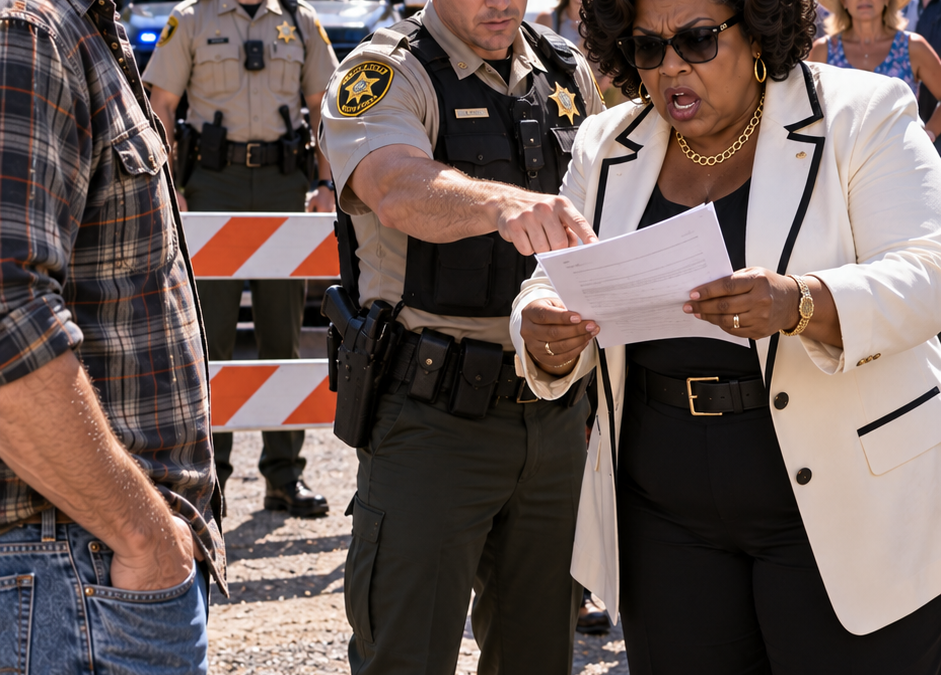
Diane Whitaker, president of the Harbor Ridge Homeowners Association, stepped out wearing a white blazer and the expression of a woman arriving to correct someone else’s clerical error.
“What is this?” she demanded.
Deputy Ryan Holt stood beside the notice board.
“A temporary access restriction.”
“Who authorized it?”
“The county, pursuant to a court order.”
“This marina serves hundreds of residents. Remove the barricades.”
“I can’t do that.”
“You don’t understand the consequences.”
Holt’s expression did not change.
“No, ma’am. I believe you don’t.”
The crowd quieted.
Diane glanced at the posted notice for barely a second.
“A property dispute?” She laughed. “This road belongs to Harbor Ridge.”
“According to the documents under review, ownership is disputed.”
“How can a road suddenly belong to someone else?” a homeowner asked.
Deputy Holt removed another document from his folder and handed it to Diane.
She scanned the first page with visible impatience. Then she reached the parcel number.
Her confidence flickered.
“That’s impossible.”
I knew the number by heart.
It appeared on my deed, my tax records, and the certified survey completed two months earlier.
The asphalt everyone trusted had been built across land attached to my ranch.
Diane looked up from the order. Residents crowded closer, asking whose name appeared beside the parcel.
From the ridge, I said nothing.
The barricades had not started the fight. They were simply the moment everyone else finally saw it.
The fight had begun six months earlier, when Diane Whitaker decided she could control land she had never purchased—and I opened the first of several documents she never expected anyone to read.
PART2
The day I signed the ranch papers, I did not celebrate with champagne.
I drove to the old house, carried every deed, survey, plat, and legal description into the dining room, and spread them across the table.
Rachel used to tease me for trusting paper more than promises.
She was right.
A promise could change depending on who repeated it. A recorded deed stayed exactly where it had been placed, waiting patiently for someone to read it.
The ranch stretched from high pasture through dense pine before reaching the western shoreline. Rachel and I had hiked that shoreline years earlier, long before we had any hope of owning it.
She had stopped on a ridge above the water and looked across the undeveloped land.
“If anyone ever buys this,” she said, “I hope they leave it alone.”
I had promised her that if we ever had the chance, we would protect it.
Cancer took her before that chance arrived.
When the property came onto the market, buying it became more than an investment. It was the last promise I still had the power to keep.
The first month passed quietly. I hired a local crew to replace several miles of aging cattle fence damaged by snow and time. Rotten posts came out. New cedar went in. Survey flags marked each verified corner.
Then a white Range Rover appeared on the ranch road.
It stopped beside my crew without permission.
Diane stepped out before the engine shut off. Her attention went immediately to the survey stakes.
“What exactly are you doing?”
“Replacing my fence.”
“I can see that. Harbor Ridge residents have been asking questions.”
I looked toward the development, nearly a mile away.
“My ranch isn’t inside Harbor Ridge.”
“It’s close enough to affect it.”
That answer told me what I needed to know.
Diane walked the fence line as though conducting an inspection. She stopped beside a recently recovered boundary marker but did not bend down to read it.
“Harbor Ridge has long-term plans involving the marina,” she said. “We need to remain informed about changes near community infrastructure.”
“This fence isn’t near your infrastructure.”
“It borders the area.”
“It borders my property. There’s a difference.”
Her smile remained in place, but warmth disappeared from it.
Before leaving, she handed me a thick blue folder embossed with the Harbor Ridge logo.
“Community guidelines. They should answer most of your questions.”
I looked at the cover.
“My deed already answered the important ones.”
“Everyone around this lake works together, Mr. Mercer.”
“I agree.”
“Good.”
“As long as everyone remembers where the property lines are.”
She studied me for several seconds before returning to her vehicle.
One of my contractors watched the Range Rover disappear.
“Is she always like that?”
“I think she’s accustomed to people agreeing before she finishes speaking.”
The fence went up without further interruption.
Then Harbor Ridge directional signs began appearing farther beyond the subdivision than before.
A drone hovered over my western pasture. Utility trucks slowed outside my gate. Their drivers studied the ranch road and shoreline as though measuring something.
Two weeks later, I received a formal letter.
It requested my cooperation with “future planning, utility coordination, marina improvements, and transportation access affecting Harbor Ridge community infrastructure.”
One phrase appeared three times:
THE MARINA ACCESS ROAD—A COMMUNITY ASSET.
I read it repeatedly.
People who truly owned something rarely needed to keep reminding everyone.
I folded the letter and looked through the window at the paved corridor winding between my ranch and the marina.
Until then, I had considered it an ordinary access road.
Diane’s insistence made me wonder why she needed everyone to believe it belonged to Harbor Ridge.
I did not call an attorney immediately. Questions should come before accusations.
Instead, I called Samuel Price.
Samuel had spent nearly forty years retracing ranch boundaries across three counties. He had recovered monuments buried beneath highways, located corners everyone believed had vanished, and untangled ownership disputes older than some of the attorneys arguing them.
When I asked him to examine my western boundary, he asked one question.
“Has someone started behaving like they own land they never purchased?”
“I think so.”
“I’ll bring the historical maps.”
Three days later, his pickup arrived loaded with steel probes, tripods, GPS receivers, and weathered tubes containing survey plats.
He began near the fence line where Diane had confronted me.
Samuel did not start with the pavement or Harbor Ridge’s glossy maps. He searched for original evidence.
He moved through waist-high grass until his probe struck metal.
“There you are.”
He dug carefully and exposed an iron survey pin beneath decades of packed earth.
“This marker predates Harbor Ridge.”
He verified the coordinates, recorded them, and moved south.
By lunchtime, we had recovered four original monuments. Their positions matched my deed, but not the simplified maps Harbor Ridge displayed at community meetings.
Samuel spread both maps across my truck hood.
“The subdivision map straightens this line.”
He traced the western boundary.
“According to the recorded survey, it curves toward the lake.”
His finger crossed the marina access road.
Neither of us spoke for several seconds.
“Could it be a drafting error?” I asked.
“Presentation maps simplify boundaries. Recorded surveys can’t.”
He looked toward the road.
“That’s interesting.”
“You’ve used that word three times.”
“I’m not ready to use the dangerous one.”
“Which is?”
“Wrong.”
That afternoon, I parked near a public overlook and watched traffic enter the marina.
Contractors, fuel trucks, employees, homeowners, charter customers, delivery vans, and golf carts crossed the road without slowing.
I counted almost sixty vehicles in less than an hour.
No one wondered who owned the ground beneath their tires. The pavement felt permanent, and permanence has a way of disguising assumptions as facts.
The following week, orange stakes appeared along the marina entrance.
They were not mine.
Fresh utility markings extended beyond Harbor Ridge and into my parcel. I photographed every stake, painted line, and contractor vehicle.
One foreman noticed me.
“We’re working from HOA plans,” he said.
“Do those plans include permission from the property owner?”
His expression changed.
“I don’t know.”
That was the problem.
No one knew because no one had asked.
Samuel called that evening.
“I found another monument referenced in the original field books.”
“What does it control?”
“The entire corridor leading to the marina.”
The next morning, we hiked through neglected timber where roots and brush had swallowed the old boundary.
Samuel cleared leaves from a granite marker almost completely buried beside a cedar stump. A reference number had been engraved into the stone.
He checked it against his notebook and became very quiet.
“This monument controls every boundary south of the ranch.”
“Including the marina road?”
“Including the road.”
He folded the notebook.
“If this matches the original deed chain, someone has made an expensive assumption for a very long time.”
Samuel refused to declare victory.
“A monument tells us where to look,” he said. “The chain of title tells us what happened.”
That was when I called Laura Bennett.
Laura specialized in ranch easements, water access, mineral rights, and land disputes developers assumed were too old to challenge.
When I described what Samuel had found, she did not sound surprised.
“Bring every document from your purchase. Meet me at the county archive.”
By noon, Samuel, Laura, and I sat beneath fluorescent lights surrounded by subdivision filings, transfer deeds, old plats, access agreements, and county indexes.
Laura ignored the polished maps on the public computers.
“Pretty maps don’t win lawsuits,” she said. “Recorded documents do.”
For hours, she followed the title from one owner to the next, marking every conveyance with colored tabs.
Then she stopped.
“Here’s Harbor Ridge.”
She placed an old agreement before us.
Years before the subdivision existed, the original marina developer had negotiated access across the ranch parcel.
I read the first page.
“This doesn’t transfer ownership.”
“Because ownership was never transferred.”
Laura tapped a paragraph.
“It granted temporary access during construction and for a defined period of marina operations.”
The agreement contained a termination clause.
Twelve years after the final development phase, the access rights expired unless the parties executed and recorded a renewal.
“Was there a renewal?” I asked.
Laura checked the index.
Then the digital archive.
Then a supplemental recording file.
Nothing.
“They let it expire,” she said.
“So after twelve years, access ended?”
“The agreement ended. Ownership never changed at all.”
Harbor Ridge had paved the road, installed signs, patrolled it, and charged residents for using it. None of those actions transferred title.
The corridor remained attached to the ranch parcel now recorded in my name.
Samuel exhaled slowly.
“I’ve seen people assume ownership. I’ve never seen an entire marina do it.”
Laura kept searching.
She found maintenance permits, resurfacing applications, utility trenches, gate improvements, and drainage work.
“They filed permits and hired contractors,” she said. “But they never obtained title or renewed the access agreement.”
“Everyone accepted their claim.”
“Because no one opened the original file.”
I thought about Diane’s blue folder.
Community asset.
Community infrastructure.
The phrases no longer sounded like legal descriptions. They sounded like incantations—words repeated until no one remembered to ask whether they were true.
Laura’s phone rang as we organized the records.
She listened for almost a minute.
“Are you willing to put that in writing?” she asked.
Another pause.
“Your identity will remain confidential until you’re ready.”
When she ended the call, her expression had changed.
“That was Megan Collins, the HOA treasurer.”
“What does she know?”
“According to her, Diane has known about the expired agreement for months.”
Megan had discovered correspondence while reviewing financial records. One of Harbor Ridge’s consulting attorneys had warned Diane that ownership of the road needed to be verified before the marina expansion received final approval.
Diane had ignored him.
“She ordered the board to move forward before the title problem became public,” Laura said.
“Why?”
“Megan quoted her: ‘Once construction begins, ownership questions will be harder to unwind.’”
Until then, I had allowed for the possibility that Harbor Ridge misunderstood its own history.
That excuse disappeared.
This was no longer ignorance.
It was a race.
Diane did not own the corridor, but she believed that if she built enough infrastructure across it, the cost of correcting her would become unbearable.
Laura closed the archive files.
“We’re finished investigating assumptions. Now we collect proof.”
For two weeks, she instructed me not to confront Diane.
“You know she’s wrong,” Laura said. “What we need is evidence that she knows.”
Harbor Ridge moved quickly.
The HOA announced a massive marina expansion: forty new boat slips, a waterfront restaurant, a private fueling station, additional parking, and a gated security entrance controlling every vehicle.
Every rendering showed the same road.
My road.
At a packed HOA meeting, Diane stood beside glossy presentation boards.
“This investment secures Harbor Ridge’s future,” she said. “Property values will rise, memberships will expand, and our community will finally control access.”
Laura replayed the recording twice.
“Control,” she said. “Interesting word.”
The HOA approved a multimillion-dollar special assessment.
Homeowners received invoices. Investors paid deposits. Contractors submitted bids. Every agreement described the road as permanent HOA-controlled infrastructure.
Not one mentioned the expired access agreement.
Then Diane called me.
“Mr. Mercer, I believe we should have lunch.”
“I’m busy.”
“This conversation could be worth a substantial amount of money.”
That changed my schedule.
We met at a restaurant overlooking the marina. Diane arrived with a leather portfolio.
After ordering coffee, she slid a proposal toward me.
Three hundred thousand dollars.
“For what?” I asked.
“A cooperation agreement.”
The document avoided the word ownership. It asked me to surrender all future objections to roadway improvements, utilities, commercial access, construction, and marina expansion.
“You mean you want permanent rights across my property.”
“I prefer to think of it as eliminating uncertainty.”
I closed the portfolio.
“No.”
“I expected you to negotiate.”
“I’m not negotiating.”
She removed a second document.
Seven hundred fifty thousand dollars.
The amendment had been prepared before she arrived.
“I didn’t make a counteroffer.”
“Harbor Ridge dislikes uncertainty.”
“So do people hiding title defects.”
Her expression cooled.
I leaned forward.
“When you collected special assessments, did you tell the homeowners the road might not belong to Harbor Ridge?”
The silence became her answer.
“The community has relied on that road for decades,” she finally said.
“That wasn’t my question.”
“We maintained it.”
“Also not my question.”
“I don’t see how old paperwork changes present reality.”
“It changes ownership.”
“It changes nothing that matters.”
I stood.
“It matters to the deed.”
As I walked away, she called after me.
“You’ll regret making this difficult.”
I turned.
“No, Diane. You’ll regret believing convenience is stronger than recorded property.”
Three mornings later, diesel engines woke me before dawn.
Excavators, paving trucks, utility trailers, and concrete barriers rolled toward the marina entrance. More than twenty workers spread across the corridor.
Laura answered my call immediately.
“They started.”
“They filed something late yesterday,” she said. “I’m going to the county office.”
An hour later, she called back.
“They’re claiming an emergency infrastructure easement.”
“I never signed one.”
“I know. And whoever prepared this apparently expected no one to read it.”
By the time I reached the road, an excavator was peeling gravel from the shoulder. Paving trucks idled behind it.
Orange paint marked a widening project that crossed my parcel.
Diane stood beside a black pickup holding the supposed easement.
“You need to move your truck,” she said.
“My truck is on the ranch entrance.”
“This is essential marina infrastructure.”
“Show me who granted you access.”
She raised the filing.
“The county accepted this.”
Laura arrived seconds later. She stepped from her vehicle carrying a printed copy covered in red markings.
“Stop the equipment.”
Diane did not look at her.
“The work is authorized.”
“The filing is defective.”
That got Diane’s attention.
Laura held up the first page.
“This parcel number became obsolete when the ranch was consolidated fifteen years ago.”
She turned to the signature page.
“The company supposedly granting the easement dissolved before Harbor Ridge was built.”
Then she pointed to the legal description.
“And this boundary terminates eight hundred feet before the marina.”
The foreman looked at Diane.
“Is that correct?”
“Our legal team reviewed it. Continue working.”
The excavator moved.
Its bucket scraped the shoulder and pushed dirt toward an old stone wall near the lake.
Rachel and I had built that wall years earlier.
We collected flat stones from the shoreline and fitted them together by hand. She laughed every time one split beneath my hammer, then insisted the broken pieces looked better anyway.
After she died, that wall became one of the few places where I could still see the shape of something we had made together.
The excavator’s steel teeth stopped less than ten feet from it.
Anger moved through me so quickly that I nearly stepped into the machine’s path.
For one dangerous second, I wanted to drag the operator from the cab.
Then I saw Laura watching me.
Evidence, not anger.
I took out my phone and began recording.
“Diane, you’ve been informed that the easement is invalid. Are you ordering this crew to continue?”
She looked directly into the camera.
“Yes. Harbor Ridge has a duty to protect community access.”
The foreman hesitated.
Diane pointed toward Rachel’s wall.
“Remove anything interfering with the widening.”
The excavator bucket rose.
I called Sheriff Cole Ramsey.
“They’re actively cutting into my parcel under a defective easement.”
“Any threat to people?”
“No.”
“Property damage?”
“It’s starting now.”
“Keep recording. Don’t interfere physically.”
The bucket began lowering.
The operator noticed my camera. His hands froze.
“Keep moving!” Diane shouted.
Sirens sounded from the highway.
Deputy Ryan Holt arrived first. A second patrol vehicle followed.
Holt stepped between the machinery and the wall.
“Shut down every engine.”
The excavator went silent. Then the paving trucks.
Dust drifted over the road while the bucket hung above Rachel’s stones.
Holt reviewed Laura’s documents.
“No further work until ownership and access are verified.”
Diane stepped forward.
“You cannot allow one ranch owner to shut down a marina serving hundreds of families.”
“This isn’t about how many people use the road,” Holt said. “It’s about who has the right to alter it.”
“No judge will let one man control the entire marina.”
I lowered my phone.
“You should have considered that before selling a future built across my land.”
Laura’s phone vibrated.
She read the message.
“Megan has the emails.”
“How many?”
“All of them.”
Diane had ordered construction after being told the filing was defective.
Now we had proof that the decision had been planned.
Deputy Holt closed the work site. The crew packed its equipment without looking at Diane.
For the first time, her authority had failed the moment someone demanded evidence.
Megan was waiting at Laura’s office with two file boxes and a laptop.
She looked exhausted.
“I downloaded everything before Diane could lock me out.”
Laura closed the blinds.
“What did you bring?”
“Board emails, investor agreements, assessment ledgers, marina fee reports, and the legal warnings she kept from the board.”
The first email came from Harbor Ridge’s consulting attorney four months earlier.
Before approving expansion, the HOA was advised to verify ownership of the marina road and renew any expired access rights. Proceeding without recorded authority could expose the association and individual directors to liability.
Diane’s response appeared beneath it:
Proceed with planning. Do not circulate this concern until we have physical control of the corridor.
Laura read the sentence twice.
Megan opened another email.
Once construction begins, Mercer will be forced to accept the project. No county office will shut down infrastructure serving hundreds of residents.
“That proves intent,” Laura said.
“There’s more.”
Harbor Ridge had already collected over two million dollars in special assessments. Investors had paid deposits based on written guarantees of permanent access.
Residents were also being charged annual road and gate fees for a corridor the HOA had never purchased.
“Did the board know?” I asked.
“They knew only what Diane told them—that the title issue was technical and had already been resolved.”
“What made you come forward?”
Megan looked down at her hands.
“Yesterday she ordered me to move part of the assessment money into a construction account before the county could freeze it.”
Her fingers trembled, but her voice remained steady.
“I realized she wasn’t protecting the community. She was protecting herself.”
Sheriff Ramsey arrived within the hour.
He reviewed the expired agreement, defective filing, internal emails, financial records, and my construction video.
“This began as a civil property dispute,” he said. “Now we may have fraudulent filings, intentional trespass, and financial misrepresentation.”
Laura handed him Diane’s email.
“She proceeded after receiving written legal advice.”
“I see that.”
He looked at Megan.
“Will you provide a formal statement?”
“Yes.”
While Ramsey contacted county investigators, Laura drafted an emergency petition requesting a restraining order, preservation of HOA records, and temporary control of the corridor until ownership could be decided.
Near sunset, Deputy Holt called from the construction site.
County utility workers had inspected the disturbed shoulder.
They found two buried systems crossing my parcel.
A water line supplied the marina.
An emergency power conduit served the docks, fuel pumps, security gates, and fire-suppression equipment.
Neither appeared in the current easement index.
Laura placed the call on speaker.
“Are you saying Harbor Ridge has no documented right to those utilities?”
“That’s what the preliminary search indicates.”
The road had been enough to stop Diane’s expansion.
Now we knew the marina’s water and emergency power also crossed land covered by my deed.
Laura closed her laptop.
“We file tonight.”
Judge Eleanor Hayes reviewed the petition before sunrise.
It included Samuel’s survey, the expired agreement, the defective easement, Diane’s emails, my video, Megan’s statement, and the utility report.
At 5:20 a.m., she issued a temporary restraining order blocking further alteration—and restricting general access—until the court could verify ownership and safety.
Sheriff Ramsey moved immediately.
Deputies parked across the marina road, erected barricades, and posted the order.
That was the closure I watched from the ridge.
Diane arrived less than thirty minutes later.
“Remove these barricades,” she ordered.
Ramsey handed her a certified copy.
“You’ve been served.”
“This is temporary.”
“So is the closure. Emergency access remains available under county supervision.”
She looked for another argument, but the order had anticipated each one.
Residents crowded around the notice.
“Why is Ethan Mercer’s parcel number on this?”
“What happened to our assessments?”
“Does the HOA own the road or not?”
A homeowner pointed toward me.
Diane followed his hand and saw me standing on the ridge.
“This is extortion!” she announced. “One man is shutting down an entire community.”
I walked toward the barricade.
“No. One community built its future across property no one bothered to verify.”
Samuel arrived with his survey tube. Laura followed with the title file.
On the hood of a county SUV, Samuel placed the historical plat beside a modern aerial image.
“The boundary follows these original monuments,” he explained. “Every one matches the recorded deed chain and the current Mercer parcel.”
Laura set the expired agreement beside the survey.
“Harbor Ridge received temporary access. That access expired twelve years ago.”
A boat owner near the front shook his head.
“We’ve paid road fees every year.”
Megan stepped from the crowd.
“Those fees were collected under Diane’s claim that Harbor Ridge owned permanent access.”
Diane turned on her.
“You had no authority to release confidential records.”
Megan did not move.
“You had no authority to collect the money.”
The crowd’s anger shifted.
Ramsey directed county engineers toward two utility covers beside the road.
Laura raised the preliminary report.
“The road is only part of the dispute. Harbor Ridge has not yet produced valid easements for the marina waterline or emergency power conduit.”
A marina employee stared toward the fuel dock.
“No power means no fuel pumps.”
“And no water compromises fire protection,” someone else said.
Diane stepped close to Laura.
“You wouldn’t dare interrupt essential services.”
“We haven’t interrupted them,” Laura said. “The court has preserved essential operations under county supervision.”
Then she looked at me.
“But Mr. Mercer may have the right to demand relocation.”
Every face turned toward me.
I could have sought removal of the road, waterline, and power conduit. I could have left the marina fighting for years to rebuild access.
Diane had spent six months mistaking restraint for weakness.
Now she understood how much restraint I had shown.
The hearing began three days later.
Inside Judge Hayes’s courtroom, no one shouted. There were no barricades, idling boat trailers, or glossy development renderings.
There were only documents.
Laura began with the original ranch deed.
Then Samuel’s certified survey.
Next came the temporary access agreement and the county recording index showing no renewal after its expiration.
Diane’s attorney objected.
“Harbor Ridge’s continuous use establishes practical reliance.”
“Reliance does not transfer title,” Laura replied.
Judge Hayes nodded. “Proceed.”
Samuel explained the monuments, bearings, and boundary calls connecting the highway to the marina entrance.
His testimony remained simple because the measurements were simple.
The corridor belonged to my parcel.
Diane’s experts could not contradict him.
Laura played my construction video.
The courtroom watched Diane order the excavator forward after being told the easement was defective.
They watched her direct the operator toward Rachel’s wall.
Then Megan testified.
She confirmed the legal warning, identified Diane’s emails, and explained that homeowners had never been informed about the expired agreement.
She described the special assessments and investor guarantees.
Laura displayed one sentence on the courtroom screen:
Once construction begins, Mercer will be forced to accept the project.
The words looked uglier enlarged.
Diane eventually took the witness stand.
She insisted she had acted for Harbor Ridge’s benefit. Hundreds of families depended on the marina. The HOA had maintained the road for years. Closing access would damage property values and punish innocent homeowners.
Judge Hayes listened.
Then she asked one question.
“When did you first learn the recorded access agreement had expired?”
Diane hesitated.
“Approximately four months ago.”
“And you approved construction afterward?”
“We believed ownership would eventually be confirmed.”
“You approved construction before confirming ownership.”
Diane said nothing.
Laura stood one final time.
“Mr. Mercer could request removal of every unauthorized improvement crossing his land. That could include the roadway, utility systems, emergency power infrastructure, and related marina facilities.”
Several residents in the gallery shifted uneasily.
Someone whispered, “He could shut down everything.”
Laura looked at me.
“But that is not what my client is asking the court to do.”
Judge Hayes turned toward me.
“Mr. Mercer?”
I stood.
“I did not buy this ranch to destroy a community.”
The room became still.
“I bought it to protect land my wife loved. Harbor Ridge residents were not told the truth. They paid assessments based on promises made by someone who knew the road was in question.”
I unfolded my proposal.
“I’m willing to grant Harbor Ridge a new long-term recorded easement.”
Diane stared at me.
Laura read the seven conditions aloud.
Harbor Ridge would repair every damaged section of the ranch.
The association would reimburse my documented survey, engineering, and legal expenses.
The western shoreline adjoining my property would receive permanent environmental protection.
No future marina expansion could occur without written consent from the recorded landowner and all required public approvals.
The special assessments and marina fees would undergo an independent audit.
The utility crossings would receive properly surveyed and recorded easements.
Finally, Diane Whitaker would resign from the HOA board before the new agreement became effective.
Diane stood so abruptly that her chair scraped across the floor.
“That is outrageous.”
Laura remained calm.
“It is considerably more generous than removal.”
Judge Hayes looked toward the board members seated behind Diane.
“The court will recess for thirty minutes. The association should decide whether it wishes to continue litigating or begin correcting the problem.”
In the hallway, Diane insisted the board could not accept.
She reminded members that she had negotiated the marina contracts, raised the investment capital, and led Harbor Ridge for seven years.
But the decision no longer belonged to her.
When court resumed, the board returned without Diane at its table.
Megan sat beside the HOA’s attorney.
Judge Hayes looked over the courtroom.
“Has the association reached a decision?”
The attorney stood.
“Yes, Your Honor. The board has voted to accept Mr. Mercer’s proposal.”
Diane rose again.
“You can’t do that.”
One board member finally faced her.
“We already did.”
“You agreed with me.”
“We agreed with the information you gave us.”
Another member spoke.
“You never told us the agreement expired. You never showed us the attorney’s warning. You never told us the road might not be ours.”
Diane looked from one face to another.
No one defended her.
Judge Hayes reviewed the settlement.
The access corridor would remain open under a newly recorded easement. Harbor Ridge would restore the ranch, reimburse documented expenses, execute lawful utility agreements, complete an independent audit, and comply with permanent conservation protections.
Then Judge Hayes looked directly at Diane.
“The disputed filing and relevant financial records will be referred to the district attorney for review.”
Diane lowered herself into her chair.
For the first time since she stopped beside my fence, she had no instruction to give and no one left willing to follow it.
Outside the courthouse, residents gathered around Megan.
“How much money was collected?”
“Where did it go?”
“Who approved the investor guarantees?”
The independent audit answered those questions over the following weeks.
Consulting payments had been approved without full board review. Assessment money had been moved between accounts to accelerate construction. Investor presentations promised permanent access that Harbor Ridge had never secured.
The HOA’s insurance carrier opened a separate investigation.
Because Diane had continued after receiving a written legal warning, the carrier denied personal coverage for her intentional actions. Her defense costs and potential liability would not simply be passed to the same homeowners she had misled.
Harbor Ridge held a special election before the end of the month.
Megan agreed to serve as interim president on one condition:
“No project moves forward until ownership, authority, and funding are verified in writing.”
The motion passed unanimously.
Crews eventually returned to the marina road.
This time, they were not widening it.
They restored the damaged shoulder, repaired drainage, removed unauthorized markings, and reseeded the disturbed pasture.
Rachel’s stone wall remained untouched.
One morning, I found a mason replacing two stones loosened by the excavator’s vibration. I knelt beside him and fitted the final piece myself.
It was not perfectly straight.
Rachel would have preferred it that way.
A few weeks later, Samuel supervised the final survey before the new easement was recorded.
He placed his equipment back in the truck and looked toward the marina.
“I’ve spent forty years proving where lines belong,” he said. “People think a survey changes the land.”
“It doesn’t?”
“It reminds them where the land has always been.”
Sheriff Ramsey stopped by that autumn.
He leaned against my fence while boat trailers moved smoothly toward the marina.
“No more barricades,” he said.
“No more barricades.”
“You could have shut the place down.”
“I know.”
“Why didn’t you?”
I watched a family towing a small fishing boat along the road.
“Hundreds of homeowners didn’t hide the deed. Their children didn’t create the false filing. Justice shouldn’t manufacture new victims just because revenge is available.”
Ramsey nodded.
“That’s rarer than it should be.”
After he left, I walked to the ridge Rachel had loved.
The conservation agreement protecting the western shoreline had been recorded beside the new access easement. No future HOA board could quietly expand onto the ranch. The road, waterline, and power conduit now had exact legal descriptions, maintenance responsibilities, and limits.
From above, Harbor Ridge Marina looked almost unchanged.
Boats moved through the water. Fuel trucks followed the familiar road. Families carried coolers toward the docks.
But beneath that ordinary movement, everything was different.
The road remained open because permission had finally been requested from the person who owned it.
The marina survived because legal access had finally been recorded instead of assumed.
And the shoreline remained protected because Rachel’s wish had been written into documents that would outlive everyone involved.
Diane believed confidence created authority.
It did not.
She believed repeated claims could become facts if enough people relied on them.
They could not.
A deed does not care how confidently someone misquotes it. A survey does not bend toward the loudest voice. And land does not forget its boundaries simply because generations of people stop reading them.
It waits.
Sometimes for years.
Sometimes until two patrol SUVs block a road before sunrise and an entire community finally asks the question it should have asked from the beginning:
Who actually owns the ground beneath us?








