𝗙𝗨𝗟𝗟 𝗦𝗧𝗢𝗥𝗬 Celeste Had My Workboats Towed Before Sunrise, but the Bill Reached Her Before the Yachts Did
𝗙𝗨𝗟𝗟 𝗦𝗧𝗢𝗥𝗬
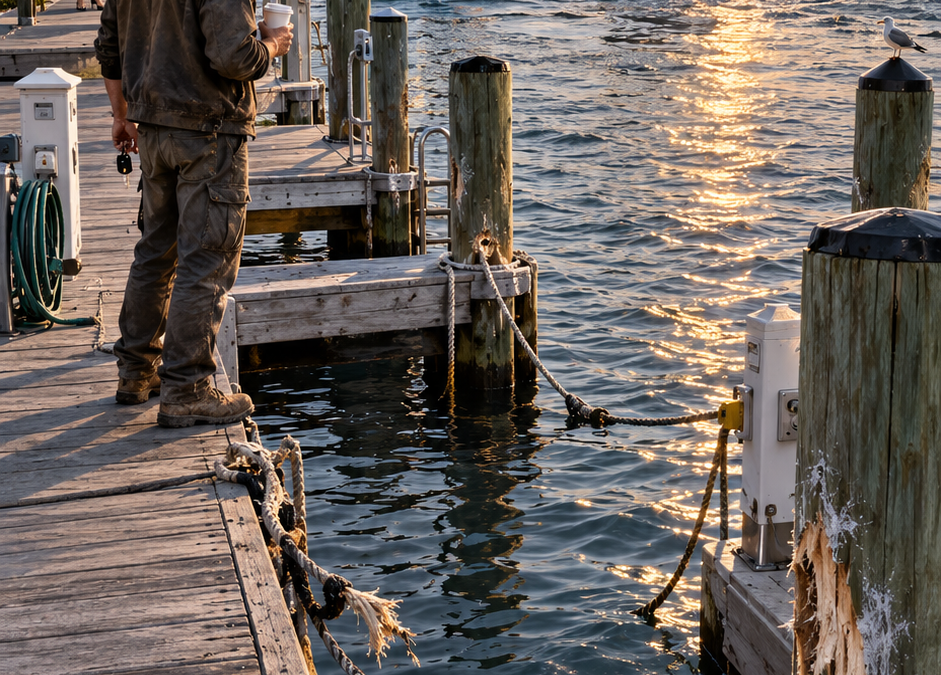
He was one of my crewmen, twenty-nine, sharp with lines, fearless around bad weather, and still young enough to think coffee counted as breakfast.
“We still doing the McCall piling job?” he asked.
I looked toward the empty slip where Marlin should have been.
“Not today.”
“What happened?”
“They towed Marlin.”
A silence.
“Who?”
“HOA. From my dock.”
Another silence.
Longer this time.
“That’s impressive.”
“Not the word I used.”
I told him I would pay the crew for the morning and call once I knew more.
Then I walked back down the dock.
Celeste had left, but her contractors were still working. White cylindrical fenders now covered most of the outer face. They looked clean enough for a yacht brochure.
At pedestal four, an electrician had the cover open.
I stopped several feet away.
“You energizing that?”
He glanced over.
“Not yet.”
“Good.”
He looked at the cracked lower housing, then at me.
“This yours?”
“The pedestal is.”
“HOA said they control event service.”
“They can say what they want. That housing took a hit during the tow.”
He frowned and crouched closer.
“Nobody mentioned that.”
“I just did.”
I kept walking.
Near the end of the dock sat my old aluminum line cart loaded with two hundred feet of three-quarter-inch double braid, chafe guards, spare fenders, shackles, and a portable load tester. Ray had welded that cart himself. One wheel had always pulled left.
A contractor called after me when I grabbed the handle and rolled it toward shore.
“We need that stuff Friday.”
I kept walking.
“Then you need to rent some.”
That afternoon, I drove past the Harbor Crest marina office and saw a glossy rendering propped inside the window.
Polished yachts.
Cocktail tables.
White flowers.
Reed Point dock transformed into something that had never existed outside somebody’s presentation deck.
I did not need to read the display to understand it.
Celeste wanted the dock because it looked effortless.
That was the part that bothered me most.
For eighteen years, effortless had been my job.
I replaced hardware before it failed. I moved boats before weather arrived. I knew which pedestal tripped under sustained load and which piling had six good seasons left instead of ten. All those invisible hours had created the illusion that the waterfront simply worked.
Now my boats were sitting behind a chain-link gate twelve miles away while Celeste prepared to prove she could run the place without me.
I drove home with Ray’s crooked line cart rattling in the truck bed. At a red light, my phone buzzed with an email from the towing yard.
Storage charges had started at 7 that morning.
I read the number twice, locked the screen, and set the phone face down on the passenger seat.
Friday was three days away.
Celeste had her empty dock.
I had canceled work, two boats I could not use, and a growing bill.
At that moment, I still thought getting those boats back was the only fight that mattered.
I spent Tuesday morning chasing my boats instead of running my business.
The impound yard sat behind a chain-link fence at the far end of a commercial marina where the air smelled like hot asphalt, salt, and old diesel. Marlin was blocked behind two cabin cruisers with orange tow tags hanging from their rails. My utility skiff sat twenty yards away on a temporary side tie, looking small and embarrassed.
The yard manager met me at the gate with a tablet tucked under his arm.
“I need both released,” I said.
He pulled up the account.
“HOA authorization says hold pending charges.”
“They had no authority to tow them.”
“That’s between you and Harbor Crest. I’ve got a signed work order.”
“Those boats came off my private dock.”
He gave me the tired look of a man who had heard every version of that sentence.
“I don’t decide property disputes, Mr. Reed. I move boats.”
He glanced at the tablet.
“And whoever ordered this didn’t book a basic tow. They booked expedited marine support and held equipment through Friday.”
I called Celeste.
She answered on the fourth ring. Behind her voice, I could hear drills and somebody backing a truck.
“Reverse the tow order.”
“No.”
“I’m losing jobs.”
“Then you should have complied when you were notified.”
My hand tightened around the phone.
“You sent that notice seven hours before you took two working boats.”
“Founders Weekend is not being reorganized around your schedule.”
I looked through the fence at Marlin.
“Neither is my dock.”
“We disagree.”
She hung up.
By noon, I had a choice between spending another day fighting over both boats or paying enough to get the skiff released so Danny and I could salvage at least one smaller job.
I paid.
The card reader chirped, and the number on the receipt felt heavier than the paper.
We launched the skiff after 1:30. I missed the McCall piling repair entirely and pushed the seawall inspection to Thursday. By the time I returned to Reed Point, anger had burned down into something less useful.
Celeste had added two private security guards at the shore entrance.
The white yacht fenders were almost finished.
I walked toward the outer slip and reached for the first temporary mounting strap.
One guard stepped between me and it.
“Sir, don’t remove event equipment.”
“It’s attached to my dock.”
“I’m not arguing ownership. I’m telling you what I was instructed to prevent.”
Celeste appeared halfway down the dock, red pantsuit bright against the gray boards.
“Mason.”
I let go of the strap.
“You really want security protecting my dock from me?”
“I want Friday to happen without another scene.”
“You created the scene and you’re prolonging it.”
For half a second, I wanted to rip every white fender off the rail and throw it onto the grass.
Instead, I looked around.
Two guards.
Six contractors.
Fresh hardware.
A delivery truck waiting near the marina road.
Every minute I stood there arguing was another minute Celeste used to move forward.
My phone buzzed.
Danny again.
I already knew why.
Another customer needed an answer.
I stepped away from the fender.
Celeste mistook it for surrender. I saw it in the small relaxation of her shoulders.
“Good,” she said. “We can be reasonable.”
I looked past her toward pedestal four. Its cover was closed now, but the crack from the tow was still visible near the base.
Then I noticed my portable hose reel had been moved beside the outer slip. Two of my spare chafe guards were lying on a contractor’s cart.
They were not stealing the dock in one dramatic piece.
They were treating everything that made it work as if it had always belonged to them.
I picked up the chafe guards, tucked them under my arm, and rolled the hose reel toward shore.
“What are you doing?” Celeste called.
“Taking my equipment home.”
“We need that Friday.”
I stopped just long enough to look back at the polished fenders, the empty slips, and the workers waiting for her next instruction.
“Then I guess you’ll need your own.”
I loaded everything into my truck beside Ray’s crooked line cart.
Driving away, I finally understood why fighting for the dock had gotten me nowhere.
Celeste had a deadline.
I had been helping her meet it every time I reacted.
That ended Tuesday afternoon.
Wednesday morning, I made one phone call before I left my driveway.
Not to Celeste.
Not to the towing yard.
I called every vendor whose equipment or standing service agreement I personally carried at Reed Point.
By 8:15, my portable line gear was locked in my shop. My pumpout arrangement was suspended. The routine dock inspection I normally performed every Thursday had been removed from my schedule.
I canceled nothing that belonged to Harbor Crest.
I disconnected nothing.
I touched none of their temporary equipment.
I simply stopped providing mine.
Then I emailed Celeste and the HOA treasurer a short notice stating that because Harbor Crest had assumed operational control of the slips for Founders Weekend, I could no longer inspect, certify, maintain, or supply private equipment for their event.
At 9:40, Celeste called.
“What exactly are you trying to do?”
I was standing in my shop checking a hydraulic hose on the skiff.
“Work.”
“You can’t withhold services.”
“My services?”
“Those services have always been part of Reed Point.”
“Those services have always been available because I provided them.”
Silence.
Then her voice hardened.
“You’re deliberately interfering with an HOA event.”
“No. Your contractors are free to provide everything you need.”
“At three days’ notice?”
“Two now.”
She hung up.
I set the phone down and went back to the hose.
Around noon, Danny and I took the skiff to a seawall inspection I should have completed the day before. The smaller boat carried maybe half the equipment Marlin did, so we made two trips and finished after four. My shoulders hurt from hauling gear by hand, and I had lost enough work by then that I stopped checking the total in my head.
On the return run, I passed Reed Point.
A white service van was parked near the dock entrance. Another truck carried coils of heavy shore power cable. Celeste stood beside them in her red pantsuit, one hand on her hip, while three contractors talked over each other.
I kept the skiff at idle and watched from thirty yards out.
An electrician opened pedestal four, shined a light into the cracked housing, and shook his head.
Celeste pointed toward the outer slips.
He shook his head again.
I almost smiled.
Almost.
Marlin was still behind a fence, and every day she stayed there cost me money.
That evening, Richard Vale called.
Richard was the HOA treasurer, a careful man with a cautious voice and the permanent tone of someone trying not to admit he had just discovered a problem.
“Mason,” he said, “did you normally handle the shore power checks?”
“Routine checks, yes.”
“And the mooring hardware on your dock?”
“Yes.”
“What about pumpout?”
“I had a standing arrangement.”
He paused.
“Was the HOA paying for any of that?”
I looked through my shop door at Ray’s crooked aluminum cart.
“No.”
Another pause.
“Celeste said these were community waterfront services.”
“They were services I let people use. That’s not quite the same thing.”
“No,” Richard said quietly. “It isn’t.”
The next morning, I drove past Reed Point on my way to another job.
The dock looked better than it had Tuesday. Fresh white fenders ran along the outer face. Stainless hardware flashed in the sun. A rented line cart sat near the gangway, brand new and bright orange.
Two electricians worked at pedestal four. A marine carpenter was kneeling beside the bent cleat with several deck boards removed, exposing the steel backing underneath. Celeste stood in the center of it all, pointing from one crew to another.
For a second, the place looked exactly like she wanted it to look.
Organized.
Expensive.
Controlled.
Then I saw three contractor trucks parked along the road and a rental equipment trailer blocking half the shoulder. None of that had been there when my boats were tied up.
Celeste spotted my truck slowing. She lifted her chin as if the crews around her proved something.
I gave her a small nod and kept driving.
She had wanted Reed Point without Mason Reed.
Now she had it.
For the first time, she was paying full price.
By Thursday afternoon, Reed Point looked less like a private dock and more like a job site somebody was desperately trying to hide before guests arrived. Extension cords crossed the grass under rubber covers. A rental pumpout unit sat beside the gangway. Two electricians had the faceplate off pedestal four again, and the new orange line cart was already missing one wheel.
I only stopped because Richard Vale was standing beside the road waving both arms at my truck.
I rolled down the window.
“Please tell me you have five minutes,” he said.
“Depends.”
“The marina contractor says we need an independent load test before they’ll connect the temporary shore power distribution.”
“Then get one.”
Richard rubbed his forehead.
“Friday afternoon is the earliest.”
“Sounds like Friday afternoon.”
“The yachts start arriving at eleven.”
There it was.
The clock Celeste had built for herself.
I looked toward the dock. She was coming up the gangway fast, red pantsuit sharp against the water, ponytail moving behind her.
“Richard,” she snapped, “stop negotiating with him.”
She reached us and pointed toward the dock.
“Mason, you’ve maintained that system for years. You know it works.”
“I knew what it looked like before your tow crew dragged Marlin sideways against pedestal four.”
Her expression tightened.
“You’re blaming us for damaged electrical equipment now?”
“I’m telling you I’m not putting my name on equipment I haven’t inspected since it was hit.”
Richard glanced at her.
“Hit?”
“Cosmetic damage,” Celeste said.
“Then your contractor can certify it.”
I started to raise the window.
“Wait,” Richard said, stepping closer. “What would it take for you to inspect it?”
I looked at Celeste.
She folded her arms.
She expected a number.
“My boats returned to Reed Point. Tow charges reimbursed. Written acknowledgment that the outer dock is private property and that nobody touches my vessels again without my permission or lawful authority.”
Celeste gave a short laugh.
“Absolutely not.”
“Then you already have your answer.”
I drove away.
For about six hours, I thought that was the turning point.
At 7:30 that evening, Richard emailed me. The board had called an emergency vote. Four members approved reimbursement of my direct towing costs and suspension of Celeste’s temporary marina control order. Marlin and the skiff could return immediately.
I read the message twice.
Danny was standing beside my workbench.
“That’s it?” he asked.
“Looks like it.”
It felt too clean, but I wanted it to be true.
Friday morning, I retrieved Marlin.
The diesel turned over on the second crank, and hearing that engine again loosened something in my chest.
By nine, both boats were back at Reed Point.
Celeste was not there.
Richard handed me a check at the gangway and a signed board resolution. I inspected pedestal four myself. The housing was cracked, one mounting bracket had shifted, and the internal connections needed work, but nothing suggested catastrophe.
“I can make the repairs safely after the weekend,” I told him.
His face fell.
“After?”
“I’m not rushing electrical work because Celeste scheduled yachts before asking whether the dock was ready.”
He nodded slowly.
“Fair.”
At 10:15, three black SUVs arrived.
Celeste stepped out of the first one with two event coordinators and a man carrying a marina operations binder. She walked straight toward me.
No shouting this time.
That worried me more.
“Congratulations,” she said. “You got your boats back.”
“That was the idea.”
“And the board got its event back.”
She nodded toward the water.
Beyond the point, the first white yacht was working its way up the channel toward Reed Point. Then the man with the binder opened it and began directing contractors toward the temporary slips.
Celeste gave me a thin smile.
“We hired a full-service marina company overnight. Power, docking crews, pumpout, everything.”
Richard looked relieved.
For one brief moment, Celeste appeared to have solved the problem.
Then a heavy tow vessel came around the opposite side of the point carrying a floating fuel and service platform behind it.
I stared at the steel structure as it approached Reed Point.
Celeste followed my eyes.
“Now,” she said quietly, “we don’t need anything from you.”
The tow captain throttled down fifty yards offshore. His deckhand lifted a radio. The captain looked toward our dock, then toward the floating platform, then back at the chart display beside his wheel.
A few seconds later, my phone rang.
It was the harbor office.
“Mason,” the dispatcher said, “did Harbor Crest authorize a commercial service platform inside your recorded access corridor?”
I looked at Celeste.
Her smile was still there.
Mine was not.
“They authorized something,” I said. “But they never asked me where that corridor ends.”
The harbor dispatcher stayed on the line while the tow captain held position beyond the point, his engines pushing a low vibration across the water.
“I’m looking at the recorded harbor plan now,” she said. “Your access corridor runs from the Reed Point parcel boundary through the marked approach lane to open channel.”
“Correct.”
“And you never authorized a fixed or floating commercial installation inside it?”
“No.”
Celeste stepped closer.
“What are they saying?”
I held up one finger, not to silence her, but to hear.
The dispatcher continued.
“Then the platform cannot be anchored there without resolving the access conflict. The captain already flagged it.”
I looked across the water.
The floating service platform was almost forty feet long, loaded with pumps, hose reels, storage lockers, and temporary utility equipment. It was exactly the kind of shortcut Celeste loved: expensive enough to look official, fast enough to avoid asking inconvenient questions.
“Can they move it outside the corridor?” I asked.
“Possibly,” the dispatcher said. “But the operator has to maintain clearance from the navigation lane and neighboring moorings.”
“That’s their problem to solve.”
“Understood.”
I ended the call.
Celeste’s jaw was tight.
“Well?”
“Your platform can’t be anchored in my access corridor.”
“It’s water, Mason.”
“It’s protected access to my dock.”
The marina operations manager opened his binder and walked toward us.
“Ms. Harrow, we need to relocate the service barge.”
“Then relocate it.”
He pointed toward the channel.
“There isn’t enough safe room on the east side without interfering with traffic. West side puts us outside practical hose range.”
The first yacht was less than ten minutes away now. Its white bow rose cleanly through the afternoon chop. Another appeared near the channel marker.
Celeste looked from them to the platform.
“Use Mason’s dock.”
“No,” I said.
Her eyes snapped toward me.
“You wanted your property back. You have it.”
“And you wanted an event that didn’t need me.”
Richard stepped between us without actually standing between us.
“Celeste, we can’t restart this.”
The operations manager was already talking into his radio. Dockhands began pulling temporary lines away from the outer slips. The arriving yacht slowed. Its engines dropped to idle. A horn sounded once across the water.
Then another yacht appeared behind it.
The schedule was beginning to stack up.
Celeste turned to the manager.
“Bring them in. We have slips.”
“Not without the service plan active.”
“They can dock without fuel.”
“Some can. Our contract requires the support package you ordered, and the captains were told this was a full-service event berth.”
That changed her expression just slightly.
She had sold certainty before she possessed it.
I walked down the gangway toward Marlin. Danny was checking a stern line.
“You leaving?” he asked.
“No.”
I stepped aboard and opened the dock locker where I kept Ray’s old laminated harbor chart. The corners were yellow and curled from years of damp air. He had drawn the access corridor in grease pencil long before anybody at Harbor Crest cared about yacht weekends.
I carried it back up.
Richard studied it while the marina manager compared it with the chart on his tablet.
“Same corridor,” the manager said. “Same narrow approach.”
“How long has this existed?” Richard asked.
“Since before Harbor Crest built the first clubhouse,” I said.
Celeste stared at the faded chart.
“And you waited until now to mention it.”
“Nobody asked me to install a commercial platform in it until now.”
Her nostrils flared.
“You could solve this in five minutes.”
She was right.
That was the part I hated.
I could let the platform use the edge of my corridor temporarily and make the immediate problem disappear.
I looked toward Marlin, then at the fresh scrape still visible along her rub rail from Monday’s tow.
“I’ll consider temporary access,” I said.
Celeste’s shoulders loosened.
“Good.”
“One condition.”
Her expression cooled again.
“The HOA signs responsibility for the dock, the corridor, and every dollar caused by Monday’s tow.”
“You already got reimbursed.”
“For my release charges. Not the rest.”
“There is no rest.”
Before I could answer, the marina manager’s phone rang.
He listened, turned away, then looked back at us with an expression that made Richard stop breathing for a second.
“Ms. Harrow,” he said. “The towing company has just submitted its consolidated event invoice to Harbor Crest.”
Celeste frowned.
“For what?”
He lowered the phone.
“Emergency vessel removal, heavy marine towing, reserved storage, standby crews, rescheduling penalties, and the full yacht handling package bundled into your authorization.”
Richard asked the question first.
“How much?”
The manager looked at Celeste.
“Eighty-six thousand dollars.”
Out on the channel, the first yacht sounded its horn again.
For three seconds, nobody said anything.
The horn faded across the water, and all I could hear was chop slapping against the pilings and the tow vessel idling offshore.
Celeste recovered first.
“That invoice is wrong.”
The marina manager kept his phone at his side.
“It’s itemized.”
“Then dispute it.”
Richard turned toward her.
“Eighty-six thousand dollars for moving Mason’s boats?”
“Not just moving them,” the manager said. “The original work order reserved heavy marine equipment, secured storage capacity, added standby crews, and bundled Friday yacht handling under the same expedited service agreement.”
Monday came back to me in pieces.
The tow captain maneuvering Marlin sideways.
The second crew waiting offshore.
The speed with which everything had happened.
She had not hired somebody for a simple tow.
She had bought an entire emergency marine package because she wanted my dock cleared immediately.
“Who authorized the package?” Richard asked.
Celeste’s eyes stayed on the approaching yachts.
“I authorized necessary event operations.”
“That wasn’t my question.”
Another horn sounded.
The marina manager glanced toward the channel.
“We need a decision. Those captains cannot circle indefinitely.”
Celeste pointed at me.
“He’s withholding access.”
“No,” Richard said.
His voice was quiet now.
“We created this.”
That landed harder than shouting would have.
Celeste turned on him.
“You approved Founders Weekend.”
“I approved an event. I did not approve an eighty-six-thousand-dollar towing commitment.”
“The board gave me operational authority.”
“Temporary operational authority over HOA facilities.”
Richard looked toward my dock.
“Apparently, this wasn’t one.”
Her face changed then.
Not fear.
Calculation.
She stepped closer to me and lowered her voice.
“Temporary corridor access for a few hours. Name your price.”
“I already did.”
“You want an admission?”
“I want responsibility.”
“Same thing.”
“No,” I said. “One costs pride. The other costs money.”
The marina manager interrupted.
“First yacht is requesting instructions.”
I looked at the boats waiting beyond Reed Point.
Their captains had not caused this. Neither had their crews. I was not interested in trapping innocent people offshore just to watch Celeste sweat. That would have made me exactly the kind of man she kept pretending I was.
“They can use my outer slips,” I said.
Celeste blinked.
Richard looked at me.
“Without the service platform,” I added. “Temporary docking only. No platform in the corridor. No unauthorized shore power connection. My dock, my conditions.”
The marina manager nodded immediately and raised his radio.
“That gives us something.”
Celeste almost smiled.
“So we’re done.”
“Not even close.”
I pointed toward the floating platform.
“That stays out.”
The first yacht eased toward Reed Point under its own power. Dockhands moved into position. I stepped aboard Marlin and shifted her twenty feet along the inside face to open additional maneuvering room. Danny handled the stern line.
It cost me something to help them.
Not money this time.
Pride.
But watching the first yacht settle safely against the outer fenders reminded me what the dock had always been for.
Boats first.
Arguments second.
Then the tow captain came ashore carrying a waterproof document pouch.
He walked past Celeste and handed the invoice directly to Richard.
“Your board is the contracting party.”
Richard opened it on the dock box.
Celeste reached for the top page.
He moved it away.
“I need to read this.”
“Richard, not now.”
His finger traveled down the charges, then stopped.
“What is this authorization number?”
Celeste said nothing.
He looked up.
“This purchase order was issued against the Marina Improvement Reserve.”
Her mouth tightened.
“It was an event-related waterfront expense.”
“That reserve requires two board signatures above twenty-five thousand.”
The tow captain shifted his weight.
“We received an electronic approval representing that authorization had been obtained.”
Richard stared at Celeste.
“Who was the second approval?”
The red in her pantsuit suddenly seemed brighter than everything around her.
She answered carefully.
“The system processed the request.”
Richard pulled out his phone.
“Then the system can show me who approved it.”
For the first time all week, Celeste stopped looking at me like I was the problem.
Behind her, the second yacht entered the approach lane.
In front of her, the eighty-six-thousand-dollar invoice fluttered in the wind.
And between those two things, the power she had been throwing around all week finally had somewhere else to go.
Richard did not have to wait long.
The board’s accounting portal was open on his phone before the third yacht reached the channel marker. He stepped into the shade beside the dock box, shielding the screen from the glare while Celeste stood five feet away with both arms folded.
The marina manager kept directing arrivals, and I stayed near Marlin’s stern, helping Danny manage the traffic Celeste had created.
“There,” Richard said.
His voice cut through the engine noise.
Celeste did not move.
“The second approval came through your administrative account.”
“I’m the board president.”
“That account can initiate purchases. It cannot provide the second authorization.”
“The software accepted it.”
Richard looked up.
“Because you submitted the same credential through two approval fields.”
Celeste’s expression stayed controlled, but her right hand closed around her left wrist.
“We had a deadline.”
“You bypassed a spending control.”
“I prevented the event from collapsing.”
A yacht captain called for another line.
I caught it, wrapped it around the cleat, and felt the load tighten through the wet rope.
The irony was not lost on me.
I was helping secure the boats she had removed mine to accommodate while her own decisions came apart twenty feet away.
Richard called the other board members.
He did not make a speech. He put the phone on speaker and asked three questions.
Had they approved the tow package?
Had they approved using the Marina Improvement Reserve?
Had anyone authorized Celeste to enter both approvals herself?
The answers came back one after another.
No.
No.
No.
Celeste walked toward the parking lot.
“Where are you going?” Richard asked.
“To manage the event.”
“You’re done managing expenditures.”
She stopped.
“Excuse me?”
“Effective now. I’m freezing your purchasing access until the board meets.”
“You cannot do that by yourself.”
“I’m not.”
He lifted the phone.
“Four directors are on this call.”
The marina manager looked away.
Two dockhands suddenly became very interested in a coil of rope.
Celeste’s face lost none of its polish, but the authority behind it had changed. She was still standing straight.
People had simply stopped waiting for her instructions.
Then the tow captain cleared his throat.
“There’s another issue.”
Richard looked at him.
“Of course there is.”
He tapped the invoice.
“The eighty-six thousand includes services already committed for today. If you terminate the package now, some standby charges remain, but we can release the unused yacht-handling portion.”
“How much?”
“Roughly twenty-three thousand, depending on final hours.”
Richard exhaled.
That was the first useful choice anybody had been offered all day.
“Terminate everything we don’t need.”
Celeste stepped forward.
“You’ll strand the event.”
I looked toward the dock. Three yachts were already tied safely without the floating platform.
“No,” I said. “You’ll just lose the version you promised.”
She looked at me with enough anger to heat the air between us.
“You think this proves you were right?”
“I think my boats should never have been touched.”
That was all.
No victory speech.
No need for one.
Richard authorized the cancellation. The tow captain radioed his crew, and within minutes, the service platform began moving back toward open water. Its wake rolled under Reed Point, lifting Marlin gently against her lines.
The same operation Celeste had ordered to make me disappear was now leaving because her authority had disappeared first.
But the day was not over.
Around three, clouds built over the bay, and the wind turned hard from the southwest. The fourth arriving yacht requested a berth, and the marina manager told Richard the remaining outer slip needed additional fendering before he would accept it in rising chop.
Celeste heard him and gave me a cold look.
“There. Now you need what I ordered.”
I glanced at Ray’s old line cart in the back of my truck.
“My gear. My dock. My choice.”
I pulled off my brown cowboy hat and set it on the passenger seat. Danny grabbed the chafe guards. We rigged the slip ourselves.
Not for Celeste.
For the captain waiting outside the point.
Twenty minutes later, the yacht came in clean.
As we secured the last stern line, Richard walked down carrying the invoice and a yellow legal pad.
“Emergency board meeting tomorrow morning,” he said. “The HOA’s insurer wants the tow authorization, reserve records, and your damage claim.”
“My damage claim?”
Richard nodded toward Marlin’s scraped rail, pedestal four, and the workboats she had kept from earning money all week.
“All of it.”
I looked at the eighty-six-thousand-dollar invoice in his hand.
Monday, Celeste had used money and authority to remove two boats she considered inconvenient. By Friday afternoon, the boats were back, the yachts were docking under my conditions, her spending access was frozen, and the bill she created was sitting in someone else’s hands waiting to be accounted for.
The wind snapped one loose white fender against the dock.
Celeste looked at it.
Then at me.
This time, she did not point.
Saturday morning, the clubhouse smelled like coffee, wet canvas, and the bay blowing through an open side door. I arrived in my navy work shirt, faded jeans, brown belt, and cowboy hat with a folder under one arm.
Celeste was already seated at the end of the conference table in the same red pantsuit she had worn like armor all week.
Richard sat opposite her with the eighty-six-thousand-dollar invoice, the reserve account ledger, and the board’s insurance representative beside him.
Nobody raised a voice.
They did not need to.
The numbers did the work.
The towing company had reduced the final invoice after Richard canceled unused services, but the charges already incurred remained substantial. My reimbursement was separate. So were the repairs to pedestal four, the bent cleat, Marlin’s damaged rub rail, and the documented jobs I had lost while my workboats were impounded.
The insurance representative asked how much of my claim I could support.
“Every dollar.”
I placed canceled work orders, repair estimates, towing receipts, photographs, and customer messages on the table.
I did not ask for anything beyond what I had actually lost.
Celeste leaned back.
“This is retaliation disguised as accounting.”
Richard looked at her.
“No. The retaliation was towing his boats.”
That ended the argument.
The board voted before noon.
Celeste was removed as president and stripped of purchasing authority immediately. Harbor Crest accepted responsibility for the unauthorized tow and property damage, agreed to reimburse my verified losses, and formally recognized Reed Point’s private dock and access corridor.
The remaining tow package charges stayed with the HOA because the HOA had signed the contract. The board referred the duplicated approval and any uninsured unauthorized expenses to counsel for a separate recovery review involving Celeste.
She stood before the meeting officially ended. Her chair rolled backward across the hardwood.
“You’re making me the scapegoat for an event every one of you wanted.”
Richard did not move.
“We wanted the event. You wanted control.”
She looked at me then.
For most of the week, every look she had given me had been an order waiting to happen.
This one was not.
I touched the brim of my hat once and let her leave.
By Monday, the white yacht fenders were gone.
The rental line cart disappeared. Contractors replaced the damaged electrical housing and reset the cleat properly. Danny and I brought Ray’s crooked aluminum cart back down to the dock.
One wheel still pulled left.
I never fixed it.
Marlin needed a new section of rub rail and some gel coat work, but she was earning money again by Tuesday. The first job was a piling repair six miles down the bay. I pushed the throttle forward just after sunrise, and the diesel settled into the deep, steady rhythm I had missed all week.
A month later, Harbor Crest paid my documented claim.
The board adopted a rule requiring written owner consent before any private vessel could be removed from waterfront property except for an actual emergency or lawful order. The board’s recovery process involving Celeste continued without me.
I had already received what I fought for.
One cool morning that fall, I was tightening a line at Reed Point when Richard walked down carrying two cups of coffee.
He handed me one and looked at Ray’s old cart.
“You know that thing rolls crooked.”
“Always has.”
“Why keep it?”
I pulled the line tight around the cleat.
“Reminds me not everything needs fixing just because somebody thinks they can improve it.”
Richard smiled and looked across the water.
I did too.
No security guards.
No temporary equipment.
No white fenders pretending the place belonged to somebody else.
Just Marlin moving gently against the dock and my skiff tied behind her. The boards were still scarred where the tow crew had worked that Monday morning. I could have replaced them.
I left those marks too.
Celeste had spent a week trying to prove authority by removing what stood in her way.
In the end, the boats came home, the dock stayed mine, and the eighty-six-thousand-dollar decision she made to clear the water arrived before the yachts she had cleared it for.
The bill was never the victory.
It was the receipt.
𝗧𝗛𝗘 𝗘𝗡𝗗
Celeste Had My Workboats Towed Before Sunrise, but the Bill Reached Her Before the Yachts Did
The towboat was already halfway across the harbor when I realized the blue hull behind it was mine.
By the time I reached the end of Reed Point dock, my workboats were gone, my cleat was bent, and Celeste Harrow was standing there like she had just improved the waterfront.
She thought removing my boats would make Founders Weekend look perfect, but she had no idea what else she had just removed.
My name is Mason Reed, and for eighteen years, Reed Point dock had worked because I made sure it worked.
That was the part people never saw.
They saw the boards in the morning sun, weathered gray and salt-stained, running nearly two hundred feet out into the harbor. They saw the pilings, the cleats, the hose reels, the shore power pedestals, the lines coiled neatly on hooks, and the workboats shifting gently with the tide. They saw the dock as part of Harbor Crest’s waterfront, as if it had always been there and always would be.
They did not see the Monday walks with a flashlight and probing hammer.
They did not see me checking backing plates every spring, tightening bolts before they loosened enough to matter, replacing chafe guards before line wear became failure, or testing pedestals after every storm because salt air does not forgive laziness.
They did not see me moving someone’s skiff before a blow came in from the southwest. They did not see me helping an elderly neighbor schedule a pumpout because she did not know who to call. They did not see me dragging a jump pack down the gangway at nine at night because someone’s battery died after they left the radio on all afternoon.
Nobody voted on those things.
Nobody thanked me in a newsletter.
They simply became part of how Reed Point functioned.
My uncle Ray had built most of that dock when I was twenty-six. Not by himself, of course, but close enough that everyone still said Ray built it. He had driven pilings, set backing plates, welded his own aluminum line cart, and taught me that waterfront property was not maintained by looking at it. A dock told you what it needed if you paid attention.
A fender squeaking differently meant the tide had shifted a hull.
A warm breaker meant someone was pulling more power than they admitted.
A line humming tight in a crosswind meant you moved it before the cleat started taking the load.
After Ray died, I kept doing what he had done.
That was why people called it Mason’s Dock.
Not because I wanted a title.
Because my name was on the property records, and my work was in the boards.
Harbor Crest Homeowners Association never called it Mason’s maintenance bill.
They called it waterfront character.
That told me everything.
The morning Celeste towed my boats, I had a paper coffee cup in one hand and my truck keys in the other. I had stopped at the top of Reed Point dock expecting to load gear for an afternoon piling repair and check the Marlin’s fuel before a seawall inspection scheduled the next morning.
The air was cool. Diesel fumes hung low over the water. Gulls were working the marina pilings, and the harbor had that early shine it gets before the breeze roughens the surface.
Then I heard the towboat.
I looked toward the channel and saw a blue hull rolling awkwardly in the wake.
For half a second, my mind did not accept it.
Then I saw the stern line.
Then the cabin profile.
Then the name.
Marlin.
My thirty-two-foot workboat was halfway across the harbor behind a tow vessel.
Fifty yards behind her, another crew had my utility skiff hooked alongside a second boat. Both of my slips below were empty. Fresh rope fibers clung to one cleat where somebody had removed a line in a hurry. A white scrape ran down the nearest piling.
“You’ve got to be kidding me.”
Three workers near the end of the dock turned.
Behind them stood Celeste Harrow in a red pantsuit and light blouse, brown hair pulled into the high, precise ponytail she wore to every HOA meeting.
At 6:20 in the morning, surrounded by toolboxes, temporary dock equipment, and men in work shirts, she looked dressed for a television interview.
“Morning, Mason,” she said.
I walked past her toward my slips.
The smell of salt water mixed with diesel and freshly cut rubber. Workers were fastening oversized white yacht fenders along the dock face. One of my heavy cleats sat crooked, its base pulled slightly away from the decking. The shore power pedestal beside it had a fresh crack near the lower housing.
I crouched and touched the scrape on the piling. The wood was still damp beneath the exposed grain.
“Who authorized the tow?” I asked.
“Harbor Crest did.”
I stood.
“Harbor Crest doesn’t own this dock.”
“We’ve been through this.”
“No,” I said. “You’ve talked about this. That’s different.”
Celeste folded her arms.
“Your commercial vessels were occupying berths required for Founders Weekend.”
“My commercial vessels were tied to my private dock.”
One of the workers stopped tightening a fender and looked between us.
Celeste lowered her voice, but that only made it sharper.
“Three yacht owners are arriving Friday. These slips need to meet the presentation standard we approved.”
I looked past her.
A stack of new dock lines sat beside polished stainless hardware. Someone had pressure washed the boards around my slips. They had taken a working dock and started dressing it like a hotel lobby.
“Where are my boats?”
“The towing company has them.”
“Which company?”
She gave me the name.
I knew the yard.
Twelve miles around the point by road. Farther by water. Storage charges began the minute a boat crossed their gate.
I pulled out my phone.
Celeste stepped aside as two workers carried another fender toward the edge.
“You should have received notice,” she said.
“I received an email at 11:40 last night telling me the HOA wanted the slips cleared.”
“Then you received notice.”
I stared at her.
“Seven hours isn’t notice.”
“The event schedule changed.”
The towboat in the channel grew smaller. Marlin’s stern lifted once on the wake, then disappeared behind the marina breakwater.
That boat paid my crew.
It carried pumps, compressors, line gear, and enough tools to handle half the jobs on my calendar. I had a piling repair scheduled that afternoon and a seawall inspection the next morning.
Celeste glanced toward the empty slips.
“Honestly, Mason, this is better for everyone. Look at it.”
I did.
The dock looked clean.
Expensive.
Empty.
Then my eyes went back to the damaged cleat.
My uncle had installed that hardware eighteen years earlier, backing each cleat with steel plate because he never trusted surface bolts with heavy boats. Celeste saw a piece of metal.
I saw the force required to move it.
I slipped my phone back into my pocket.
“Nobody uses that pedestal,” I said, pointing toward the cracked shore power housing. “Nobody ties anything heavy to that cleat. Not until I inspect both.”
Her expression barely changed.
“Our contractors will handle it.”
“Your contractors didn’t build this dock.”
“Neither did you.”
That one landed.
My uncle had.
I looked at the two empty slips again, then at the white fenders going up where my workboats had been tied less than an hour earlier.
Celeste turned toward the crew and pointed to the next section.
“Keep going.”
The impact driver started again, hard metallic bursts carrying across the water.
I stood there while they prepared my dock for yachts that had not even arrived yet.
And for the first time that morning, I stopped thinking about how to get Celeste off my property.
I started thinking about how to get my boats back.
By 7:30, I was sitting on the tailgate of my truck with my coffee gone cold and three missed calls from customers lighting up my phone. Reed Point stretched behind me into the morning glare. Nearly two hundred feet of weathered timber, galvanized hardware, electrical pedestals, hose reels, and pilings my family had kept alive longer than most Harbor Crest residents had lived on the bay.
My phone rang again.
Danny.
He was one of my crewmen, twenty-nine, sharp with lines, fearless around bad weather, and still young enough to think coffee counted as breakfast.
“We still doing the McCall piling job?” he asked.
I looked toward the empty slip where Marlin should have been.
“Not today.”
“What happened?”
“They towed Marlin.”
A silence.
“Who?”
“HOA. From my dock.”
Another silence.
Longer this time.
“That’s impressive.”
“Not the word I used.”
I told him I would pay the crew for the morning and call once I knew more.
Then I walked back down the dock.
Celeste had left, but her contractors were still working. White cylindrical fenders now covered most of the outer face. They looked clean enough for a yacht brochure.
At pedestal four, an electrician had the cover open.
I stopped several feet away.
“You energizing that?”
He glanced over.
“Not yet.”
“Good.”
He looked at the cracked lower housing, then at me.
“This yours?”
“The pedestal is.”
“HOA said they control event service.”
“They can say what they want. That housing took a hit during the tow.”
He frowned and crouched closer.
“Nobody mentioned that.”
“I just did.”
I kept walking.
Near the end of the dock sat my old aluminum line cart loaded with two hundred feet of three-quarter-inch double braid, chafe guards, spare fenders, shackles, and a portable load tester. Ray had welded that cart himself. One wheel had always pulled left.
A contractor called after me when I grabbed the handle and rolled it toward shore.
“We need that stuff Friday.”
I kept walking.
“Then you need to rent some.”
That afternoon, I drove past the Harbor Crest marina office and saw a glossy rendering propped inside the window.
Polished yachts.
Cocktail tables.
White flowers.
Reed Point dock transformed into something that had never existed outside somebody’s presentation deck.
I did not need to read the display to understand it.
Celeste wanted the dock because it looked effortless.
That was the part that bothered me most.
For eighteen years, effortless had been my job.
I replaced hardware before it failed. I moved boats before weather arrived. I knew which pedestal tripped under sustained load and which piling had six good seasons left instead of ten. All those invisible hours had created the illusion that the waterfront simply worked.
Now my boats were sitting behind a chain-link gate twelve miles away while Celeste prepared to prove she could run the place without me.
I drove home with Ray’s crooked line cart rattling in the truck bed. At a red light, my phone buzzed with an email from the towing yard.
Storage charges had started at 7 that morning.
I read the number twice, locked the screen, and set the phone face down on the passenger seat.
Friday was three days away.
Celeste had her empty dock.
I had canceled work, two boats I could not use, and a growing bill.
At that moment, I still thought getting those boats back was the only fight that mattered.
I spent Tuesday morning chasing my boats instead of running my business.
The impound yard sat behind a chain-link fence at the far end of a commercial marina where the air smelled like hot asphalt, salt, and old diesel. Marlin was blocked behind two cabin cruisers with orange tow tags hanging from their rails. My utility skiff sat twenty yards away on a temporary side tie, looking small and embarrassed.
The yard manager met me at the gate with a tablet tucked under his arm.
“I need both released,” I said.
He pulled up the account.
“HOA authorization says hold pending charges.”
“They had no authority to tow them.”
“That’s between you and Harbor Crest. I’ve got a signed work order.”
“Those boats came off my private dock.”
He gave me the tired look of a man who had heard every version of that sentence.
“I don’t decide property disputes, Mr. Reed. I move boats.”
He glanced at the tablet.
“And whoever ordered this didn’t book a basic tow. They booked expedited marine support and held equipment through Friday.”
I called Celeste.
She answered on the fourth ring. Behind her voice, I could hear drills and somebody backing a truck.
“Reverse the tow order.”
“No.”
“I’m losing jobs.”
“Then you should have complied when you were notified.”
My hand tightened around the phone.
“You sent that notice seven hours before you took two working boats.”
“Founders Weekend is not being reorganized around your schedule.”
I looked through the fence at Marlin.
“Neither is my dock.”
“We disagree.”
She hung up.
By noon, I had a choice between spending another day fighting over both boats or paying enough to get the skiff released so Danny and I could salvage at least one smaller job.
I paid.
The card reader chirped, and the number on the receipt felt heavier than the paper.
We launched the skiff after 1:30. I missed the McCall piling repair entirely and pushed the seawall inspection to Thursday. By the time I returned to Reed Point, anger had burned down into something less useful.
Celeste had added two private security guards at the shore entrance.
The white yacht fenders were almost finished.
I walked toward the outer slip and reached for the first temporary mounting strap.
One guard stepped between me and it.
“Sir, don’t remove event equipment.”
“It’s attached to my dock.”
“I’m not arguing ownership. I’m telling you what I was instructed to prevent.”
Celeste appeared halfway down the dock, red pantsuit bright against the gray boards.
“Mason.”
I let go of the strap.
“You really want security protecting my dock from me?”
“I want Friday to happen without another scene.”
“You created the scene and you’re prolonging it.”
For half a second, I wanted to rip every white fender off the rail and throw it onto the grass.
Instead, I looked around.
Two guards.
Six contractors.
Fresh hardware.
A delivery truck waiting near the marina road.
Every minute I stood there arguing was another minute Celeste used to move forward.
My phone buzzed.
Danny again.
I already knew why.
Another customer needed an answer.
I stepped away from the fender.
Celeste mistook it for surrender. I saw it in the small relaxation of her shoulders.
“Good,” she said. “We can be reasonable.”
I looked past her toward pedestal four. Its cover was closed now, but the crack from the tow was still visible near the base.
Then I noticed my portable hose reel had been moved beside the outer slip. Two of my spare chafe guards were lying on a contractor’s cart.
They were not stealing the dock in one dramatic piece.
They were treating everything that made it work as if it had always belonged to them.
I picked up the chafe guards, tucked them under my arm, and rolled the hose reel toward shore.
“What are you doing?” Celeste called.
“Taking my equipment home.”
“We need that Friday.”
I stopped just long enough to look back at the polished fenders, the empty slips, and the workers waiting for her next instruction.
“Then I guess you’ll need your own.”
I loaded everything into my truck beside Ray’s crooked line cart.
Driving away, I finally understood why fighting for the dock had gotten me nowhere.
Celeste had a deadline.
I had been helping her meet it every time I reacted.
That ended Tuesday afternoon.
Wednesday morning, I made one phone call before I left my driveway.
Not to Celeste.
Not to the towing yard.
I called every vendor whose equipment or standing service agreement I personally carried at Reed Point.
By 8:15, my portable line gear was locked in my shop. My pumpout arrangement was suspended. The routine dock inspection I normally performed every Thursday had been removed from my schedule.
I canceled nothing that belonged to Harbor Crest.
I disconnected nothing.
I touched none of their temporary equipment.
I simply stopped providing mine.
Then I emailed Celeste and the HOA treasurer a short notice stating that because Harbor Crest had assumed operational control of the slips for Founders Weekend, I could no longer inspect, certify, maintain, or supply private equipment for their event.
At 9:40, Celeste called.
“What exactly are you trying to do?”
I was standing in my shop checking a hydraulic hose on the skiff.
“Work.”
“You can’t withhold services.”
“My services?”
“Those services have always been part of Reed Point.”
“Those services have always been available because I provided them.”
Silence.
Then her voice hardened.
“You’re deliberately interfering with an HOA event.”
“No. Your contractors are free to provide everything you need.”
“At three days’ notice?”
“Two now.”
She hung up.
I set the phone down and went back to the hose.
Around noon, Danny and I took the skiff to a seawall inspection I should have completed the day before. The smaller boat carried maybe half the equipment Marlin did, so we made two trips and finished after four. My shoulders hurt from hauling gear by hand, and I had lost enough work by then that I stopped checking the total in my head.
On the return run, I passed Reed Point.
A white service van was parked near the dock entrance. Another truck carried coils of heavy shore power cable. Celeste stood beside them in her red pantsuit, one hand on her hip, while three contractors talked over each other.
I kept the skiff at idle and watched from thirty yards out.
An electrician opened pedestal four, shined a light into the cracked housing, and shook his head.
Celeste pointed toward the outer slips.
He shook his head again.
I almost smiled.
Almost.
Marlin was still behind a fence, and every day she stayed there cost me money.
That evening, Richard Vale called.
Richard was the HOA treasurer, a careful man with a cautious voice and the permanent tone of someone trying not to admit he had just discovered a problem.
“Mason,” he said, “did you normally handle the shore power checks?”
“Routine checks, yes.”
“And the mooring hardware on your dock?”
“Yes.”
“What about pumpout?”
“I had a standing arrangement.”
He paused.
“Was the HOA paying for any of that?”
I looked through my shop door at Ray’s crooked aluminum cart.
“No.”
Another pause.
“Celeste said these were community waterfront services.”
“They were services I let people use. That’s not quite the same thing.”
“No,” Richard said quietly. “It isn’t.”
The next morning, I drove past Reed Point on my way to another job.
The dock looked better than it had Tuesday. Fresh white fenders ran along the outer face. Stainless hardware flashed in the sun. A rented line cart sat near the gangway, brand new and bright orange.
Two electricians worked at pedestal four. A marine carpenter was kneeling beside the bent cleat with several deck boards removed, exposing the steel backing underneath. Celeste stood in the center of it all, pointing from one crew to another.
For a second, the place looked exactly like she wanted it to look.
Organized.
Expensive.
Controlled.
Then I saw three contractor trucks parked along the road and a rental equipment trailer blocking half the shoulder. None of that had been there when my boats were tied up.
Celeste spotted my truck slowing. She lifted her chin as if the crews around her proved something.
I gave her a small nod and kept driving.
She had wanted Reed Point without Mason Reed.
Now she had it.
For the first time, she was paying full price.
By Thursday afternoon, Reed Point looked less like a private dock and more like a job site somebody was desperately trying to hide before guests arrived. Extension cords crossed the grass under rubber covers. A rental pumpout unit sat beside the gangway. Two electricians had the faceplate off pedestal four again, and the new orange line cart was already missing one wheel.
I only stopped because Richard Vale was standing beside the road waving both arms at my truck.
I rolled down the window.
“Please tell me you have five minutes,” he said.
“Depends.”
“The marina contractor says we need an independent load test before they’ll connect the temporary shore power distribution.”
“Then get one.”
Richard rubbed his forehead.
“Friday afternoon is the earliest.”
“Sounds like Friday afternoon.”
“The yachts start arriving at eleven.”
There it was.
The clock Celeste had built for herself.
I looked toward the dock. She was coming up the gangway fast, red pantsuit sharp against the water, ponytail moving behind her.
“Richard,” she snapped, “stop negotiating with him.”
She reached us and pointed toward the dock.
“Mason, you’ve maintained that system for years. You know it works.”
“I knew what it looked like before your tow crew dragged Marlin sideways against pedestal four.”
Her expression tightened.
“You’re blaming us for damaged electrical equipment now?”
“I’m telling you I’m not putting my name on equipment I haven’t inspected since it was hit.”
Richard glanced at her.
“Hit?”
“Cosmetic damage,” Celeste said.
“Then your contractor can certify it.”
I started to raise the window.
“Wait,” Richard said, stepping closer. “What would it take for you to inspect it?”
I looked at Celeste.
She folded her arms.
She expected a number.
“My boats returned to Reed Point. Tow charges reimbursed. Written acknowledgment that the outer dock is private property and that nobody touches my vessels again without my permission or lawful authority.”
Celeste gave a short laugh.
“Absolutely not.”
“Then you already have your answer.”
I drove away.
For about six hours, I thought that was the turning point.
At 7:30 that evening, Richard emailed me. The board had called an emergency vote. Four members approved reimbursement of my direct towing costs and suspension of Celeste’s temporary marina control order. Marlin and the skiff could return immediately.
I read the message twice.
Danny was standing beside my workbench.
“That’s it?” he asked.
“Looks like it.”
It felt too clean, but I wanted it to be true.
Friday morning, I retrieved Marlin.
The diesel turned over on the second crank, and hearing that engine again loosened something in my chest.
By nine, both boats were back at Reed Point.
Celeste was not there.
Richard handed me a check at the gangway and a signed board resolution. I inspected pedestal four myself. The housing was cracked, one mounting bracket had shifted, and the internal connections needed work, but nothing suggested catastrophe.
“I can make the repairs safely after the weekend,” I told him.
His face fell.
“After?”
“I’m not rushing electrical work because Celeste scheduled yachts before asking whether the dock was ready.”
He nodded slowly.
“Fair.”
At 10:15, three black SUVs arrived.
Celeste stepped out of the first one with two event coordinators and a man carrying a marina operations binder. She walked straight toward me.
No shouting this time.
That worried me more.
“Congratulations,” she said. “You got your boats back.”
“That was the idea.”
“And the board got its event back.”
She nodded toward the water.
Beyond the point, the first white yacht was working its way up the channel toward Reed Point. Then the man with the binder opened it and began directing contractors toward the temporary slips.
Celeste gave me a thin smile.
“We hired a full-service marina company overnight. Power, docking crews, pumpout, everything.”
Richard looked relieved.
For one brief moment, Celeste appeared to have solved the problem.
Then a heavy tow vessel came around the opposite side of the point carrying a floating fuel and service platform behind it.
I stared at the steel structure as it approached Reed Point.
Celeste followed my eyes.
“Now,” she said quietly, “we don’t need anything from you.”
The tow captain throttled down fifty yards offshore. His deckhand lifted a radio. The captain looked toward our dock, then toward the floating platform, then back at the chart display beside his wheel.
A few seconds later, my phone rang.
It was the harbor office.
“Mason,” the dispatcher said, “did Harbor Crest authorize a commercial service platform inside your recorded access corridor?”
I looked at Celeste.
Her smile was still there.
Mine was not.
“They authorized something,” I said. “But they never asked me where that corridor ends.”
The harbor dispatcher stayed on the line while the tow captain held position beyond the point, his engines pushing a low vibration across the water.
“I’m looking at the recorded harbor plan now,” she said. “Your access corridor runs from the Reed Point parcel boundary through the marked approach lane to open channel.”
“Correct.”
“And you never authorized a fixed or floating commercial installation inside it?”
“No.”
Celeste stepped closer.
“What are they saying?”
I held up one finger, not to silence her, but to hear.
The dispatcher continued.
“Then the platform cannot be anchored there without resolving the access conflict. The captain already flagged it.”
I looked across the water.
The floating service platform was almost forty feet long, loaded with pumps, hose reels, storage lockers, and temporary utility equipment. It was exactly the kind of shortcut Celeste loved: expensive enough to look official, fast enough to avoid asking inconvenient questions.
“Can they move it outside the corridor?” I asked.
“Possibly,” the dispatcher said. “But the operator has to maintain clearance from the navigation lane and neighboring moorings.”
“That’s their problem to solve.”
“Understood.”
I ended the call.
Celeste’s jaw was tight.
“Well?”
“Your platform can’t be anchored in my access corridor.”
“It’s water, Mason.”
“It’s protected access to my dock.”
The marina operations manager opened his binder and walked toward us.
“Ms. Harrow, we need to relocate the service barge.”
“Then relocate it.”
He pointed toward the channel.
“There isn’t enough safe room on the east side without interfering with traffic. West side puts us outside practical hose range.”
The first yacht was less than ten minutes away now. Its white bow rose cleanly through the afternoon chop. Another appeared near the channel marker.
Celeste looked from them to the platform.
“Use Mason’s dock.”
“No,” I said.
Her eyes snapped toward me.
“You wanted your property back. You have it.”
“And you wanted an event that didn’t need me.”
Richard stepped between us without actually standing between us.
“Celeste, we can’t restart this.”
The operations manager was already talking into his radio. Dockhands began pulling temporary lines away from the outer slips. The arriving yacht slowed. Its engines dropped to idle. A horn sounded once across the water.
Then another yacht appeared behind it.
The schedule was beginning to stack up.
Celeste turned to the manager.
“Bring them in. We have slips.”
“Not without the service plan active.”
“They can dock without fuel.”
“Some can. Our contract requires the support package you ordered, and the captains were told this was a full-service event berth.”
That changed her expression just slightly.
She had sold certainty before she possessed it.
I walked down the gangway toward Marlin. Danny was checking a stern line.
“You leaving?” he asked.
“No.”
I stepped aboard and opened the dock locker where I kept Ray’s old laminated harbor chart. The corners were yellow and curled from years of damp air. He had drawn the access corridor in grease pencil long before anybody at Harbor Crest cared about yacht weekends.
I carried it back up.
Richard studied it while the marina manager compared it with the chart on his tablet.
“Same corridor,” the manager said. “Same narrow approach.”
“How long has this existed?” Richard asked.
“Since before Harbor Crest built the first clubhouse,” I said.
Celeste stared at the faded chart.
“And you waited until now to mention it.”
“Nobody asked me to install a commercial platform in it until now.”
Her nostrils flared.
“You could solve this in five minutes.”
She was right.
That was the part I hated.
I could let the platform use the edge of my corridor temporarily and make the immediate problem disappear.
I looked toward Marlin, then at the fresh scrape still visible along her rub rail from Monday’s tow.
“I’ll consider temporary access,” I said.
Celeste’s shoulders loosened.
“Good.”
“One condition.”
Her expression cooled again.
“The HOA signs responsibility for the dock, the corridor, and every dollar caused by Monday’s tow.”
“You already got reimbursed.”
“For my release charges. Not the rest.”
“There is no rest.”
Before I could answer, the marina manager’s phone rang.
He listened, turned away, then looked back at us with an expression that made Richard stop breathing for a second.
“Ms. Harrow,” he said. “The towing company has just submitted its consolidated event invoice to Harbor Crest.”
Celeste frowned.
“For what?”
He lowered the phone.
“Emergency vessel removal, heavy marine towing, reserved storage, standby crews, rescheduling penalties, and the full yacht handling package bundled into your authorization.”
Richard asked the question first.
“How much?”
The manager looked at Celeste.
“Eighty-six thousand dollars.”
Out on the channel, the first yacht sounded its horn again.
For three seconds, nobody said anything.
The horn faded across the water, and all I could hear was chop slapping against the pilings and the tow vessel idling offshore.
Celeste recovered first.
“That invoice is wrong.”
The marina manager kept his phone at his side.
“It’s itemized.”
“Then dispute it.”
Richard turned toward her.
“Eighty-six thousand dollars for moving Mason’s boats?”
“Not just moving them,” the manager said. “The original work order reserved heavy marine equipment, secured storage capacity, added standby crews, and bundled Friday yacht handling under the same expedited service agreement.”
Monday came back to me in pieces.
The tow captain maneuvering Marlin sideways.
The second crew waiting offshore.
The speed with which everything had happened.
She had not hired somebody for a simple tow.
She had bought an entire emergency marine package because she wanted my dock cleared immediately.
“Who authorized the package?” Richard asked.
Celeste’s eyes stayed on the approaching yachts.
“I authorized necessary event operations.”
“That wasn’t my question.”
Another horn sounded.
The marina manager glanced toward the channel.
“We need a decision. Those captains cannot circle indefinitely.”
Celeste pointed at me.
“He’s withholding access.”
“No,” Richard said.
His voice was quiet now.
“We created this.”
That landed harder than shouting would have.
Celeste turned on him.
“You approved Founders Weekend.”
“I approved an event. I did not approve an eighty-six-thousand-dollar towing commitment.”
“The board gave me operational authority.”
“Temporary operational authority over HOA facilities.”
Richard looked toward my dock.
“Apparently, this wasn’t one.”
Her face changed then.
Not fear.
Calculation.
She stepped closer to me and lowered her voice.
“Temporary corridor access for a few hours. Name your price.”
“I already did.”
“You want an admission?”
“I want responsibility.”
“Same thing.”
“No,” I said. “One costs pride. The other costs money.”
The marina manager interrupted.
“First yacht is requesting instructions.”
I looked at the boats waiting beyond Reed Point.
Their captains had not caused this. Neither had their crews. I was not interested in trapping innocent people offshore just to watch Celeste sweat. That would have made me exactly the kind of man she kept pretending I was.
“They can use my outer slips,” I said.
Celeste blinked.
Richard looked at me.
“Without the service platform,” I added. “Temporary docking only. No platform in the corridor. No unauthorized shore power connection. My dock, my conditions.”
The marina manager nodded immediately and raised his radio.
“That gives us something.”
Celeste almost smiled.
“So we’re done.”
“Not even close.”
I pointed toward the floating platform.
“That stays out.”
The first yacht eased toward Reed Point under its own power. Dockhands moved into position. I stepped aboard Marlin and shifted her twenty feet along the inside face to open additional maneuvering room. Danny handled the stern line.
It cost me something to help them.
Not money this time.
Pride.
But watching the first yacht settle safely against the outer fenders reminded me what the dock had always been for.
Boats first.
Arguments second.
Then the tow captain came ashore carrying a waterproof document pouch.
He walked past Celeste and handed the invoice directly to Richard.
“Your board is the contracting party.”
Richard opened it on the dock box.
Celeste reached for the top page.
He moved it away.
“I need to read this.”
“Richard, not now.”
His finger traveled down the charges, then stopped.
“What is this authorization number?”
Celeste said nothing.
He looked up.
“This purchase order was issued against the Marina Improvement Reserve.”
Her mouth tightened.
“It was an event-related waterfront expense.”
“That reserve requires two board signatures above twenty-five thousand.”
The tow captain shifted his weight.
“We received an electronic approval representing that authorization had been obtained.”
Richard stared at Celeste.
“Who was the second approval?”
The red in her pantsuit suddenly seemed brighter than everything around her.
She answered carefully.
“The system processed the request.”
Richard pulled out his phone.
“Then the system can show me who approved it.”
For the first time all week, Celeste stopped looking at me like I was the problem.
Behind her, the second yacht entered the approach lane.
In front of her, the eighty-six-thousand-dollar invoice fluttered in the wind.
And between those two things, the power she had been throwing around all week finally had somewhere else to go.
Richard did not have to wait long.
The board’s accounting portal was open on his phone before the third yacht reached the channel marker. He stepped into the shade beside the dock box, shielding the screen from the glare while Celeste stood five feet away with both arms folded.
The marina manager kept directing arrivals, and I stayed near Marlin’s stern, helping Danny manage the traffic Celeste had created.
“There,” Richard said.
His voice cut through the engine noise.
Celeste did not move.
“The second approval came through your administrative account.”
“I’m the board president.”
“That account can initiate purchases. It cannot provide the second authorization.”
“The software accepted it.”
Richard looked up.
“Because you submitted the same credential through two approval fields.”
Celeste’s expression stayed controlled, but her right hand closed around her left wrist.
“We had a deadline.”
“You bypassed a spending control.”
“I prevented the event from collapsing.”
A yacht captain called for another line.
I caught it, wrapped it around the cleat, and felt the load tighten through the wet rope.
The irony was not lost on me.
I was helping secure the boats she had removed mine to accommodate while her own decisions came apart twenty feet away.
Richard called the other board members.
He did not make a speech. He put the phone on speaker and asked three questions.
Had they approved the tow package?
Had they approved using the Marina Improvement Reserve?
Had anyone authorized Celeste to enter both approvals herself?
The answers came back one after another.
No.
No.
No.
Celeste walked toward the parking lot.
“Where are you going?” Richard asked.
“To manage the event.”
“You’re done managing expenditures.”
She stopped.
“Excuse me?”
“Effective now. I’m freezing your purchasing access until the board meets.”
“You cannot do that by yourself.”
“I’m not.”
He lifted the phone.
“Four directors are on this call.”
The marina manager looked away.
Two dockhands suddenly became very interested in a coil of rope.
Celeste’s face lost none of its polish, but the authority behind it had changed. She was still standing straight.
People had simply stopped waiting for her instructions.
Then the tow captain cleared his throat.
“There’s another issue.”
Richard looked at him.
“Of course there is.”
He tapped the invoice.
“The eighty-six thousand includes services already committed for today. If you terminate the package now, some standby charges remain, but we can release the unused yacht-handling portion.”
“How much?”
“Roughly twenty-three thousand, depending on final hours.”
Richard exhaled.
That was the first useful choice anybody had been offered all day.
“Terminate everything we don’t need.”
Celeste stepped forward.
“You’ll strand the event.”
I looked toward the dock. Three yachts were already tied safely without the floating platform.
“No,” I said. “You’ll just lose the version you promised.”
She looked at me with enough anger to heat the air between us.
“You think this proves you were right?”
“I think my boats should never have been touched.”
That was all.
No victory speech.
No need for one.
Richard authorized the cancellation. The tow captain radioed his crew, and within minutes, the service platform began moving back toward open water. Its wake rolled under Reed Point, lifting Marlin gently against her lines.
The same operation Celeste had ordered to make me disappear was now leaving because her authority had disappeared first.
But the day was not over.
Around three, clouds built over the bay, and the wind turned hard from the southwest. The fourth arriving yacht requested a berth, and the marina manager told Richard the remaining outer slip needed additional fendering before he would accept it in rising chop.
Celeste heard him and gave me a cold look.
“There. Now you need what I ordered.”
I glanced at Ray’s old line cart in the back of my truck.
“My gear. My dock. My choice.”
I pulled off my brown cowboy hat and set it on the passenger seat. Danny grabbed the chafe guards. We rigged the slip ourselves.
Not for Celeste.
For the captain waiting outside the point.
Twenty minutes later, the yacht came in clean.
As we secured the last stern line, Richard walked down carrying the invoice and a yellow legal pad.
“Emergency board meeting tomorrow morning,” he said. “The HOA’s insurer wants the tow authorization, reserve records, and your damage claim.”
“My damage claim?”
Richard nodded toward Marlin’s scraped rail, pedestal four, and the workboats she had kept from earning money all week.
“All of it.”
I looked at the eighty-six-thousand-dollar invoice in his hand.
Monday, Celeste had used money and authority to remove two boats she considered inconvenient. By Friday afternoon, the boats were back, the yachts were docking under my conditions, her spending access was frozen, and the bill she created was sitting in someone else’s hands waiting to be accounted for.
The wind snapped one loose white fender against the dock.
Celeste looked at it.
Then at me.
This time, she did not point.
Saturday morning, the clubhouse smelled like coffee, wet canvas, and the bay blowing through an open side door. I arrived in my navy work shirt, faded jeans, brown belt, and cowboy hat with a folder under one arm.
Celeste was already seated at the end of the conference table in the same red pantsuit she had worn like armor all week.
Richard sat opposite her with the eighty-six-thousand-dollar invoice, the reserve account ledger, and the board’s insurance representative beside him.
Nobody raised a voice.
They did not need to.
The numbers did the work.
The towing company had reduced the final invoice after Richard canceled unused services, but the charges already incurred remained substantial. My reimbursement was separate. So were the repairs to pedestal four, the bent cleat, Marlin’s damaged rub rail, and the documented jobs I had lost while my workboats were impounded.
The insurance representative asked how much of my claim I could support.
“Every dollar.”
I placed canceled work orders, repair estimates, towing receipts, photographs, and customer messages on the table.
I did not ask for anything beyond what I had actually lost.
Celeste leaned back.
“This is retaliation disguised as accounting.”
Richard looked at her.
“No. The retaliation was towing his boats.”
That ended the argument.
The board voted before noon.
Celeste was removed as president and stripped of purchasing authority immediately. Harbor Crest accepted responsibility for the unauthorized tow and property damage, agreed to reimburse my verified losses, and formally recognized Reed Point’s private dock and access corridor.
The remaining tow package charges stayed with the HOA because the HOA had signed the contract. The board referred the duplicated approval and any uninsured unauthorized expenses to counsel for a separate recovery review involving Celeste.
She stood before the meeting officially ended. Her chair rolled backward across the hardwood.
“You’re making me the scapegoat for an event every one of you wanted.”
Richard did not move.
“We wanted the event. You wanted control.”
She looked at me then.
For most of the week, every look she had given me had been an order waiting to happen.
This one was not.
I touched the brim of my hat once and let her leave.
By Monday, the white yacht fenders were gone.
The rental line cart disappeared. Contractors replaced the damaged electrical housing and reset the cleat properly. Danny and I brought Ray’s crooked aluminum cart back down to the dock.
One wheel still pulled left.
I never fixed it.
Marlin needed a new section of rub rail and some gel coat work, but she was earning money again by Tuesday. The first job was a piling repair six miles down the bay. I pushed the throttle forward just after sunrise, and the diesel settled into the deep, steady rhythm I had missed all week.
A month later, Harbor Crest paid my documented claim.
The board adopted a rule requiring written owner consent before any private vessel could be removed from waterfront property except for an actual emergency or lawful order. The board’s recovery process involving Celeste continued without me.
I had already received what I fought for.
One cool morning that fall, I was tightening a line at Reed Point when Richard walked down carrying two cups of coffee.
He handed me one and looked at Ray’s old cart.
“You know that thing rolls crooked.”
“Always has.”
“Why keep it?”
I pulled the line tight around the cleat.
“Reminds me not everything needs fixing just because somebody thinks they can improve it.”
Richard smiled and looked across the water.
I did too.
No security guards.
No temporary equipment.
No white fenders pretending the place belonged to somebody else.
Just Marlin moving gently against the dock and my skiff tied behind her. The boards were still scarred where the tow crew had worked that Monday morning. I could have replaced them.
I left those marks too.
Celeste had spent a week trying to prove authority by removing what stood in her way.
In the end, the boats came home, the dock stayed mine, and the eighty-six-thousand-dollar decision she made to clear the water arrived before the yachts she had cleared it for.
The bill was never the victory.
It was the receipt.








