𝗙𝗨𝗟𝗟 𝗦𝗧𝗢𝗥𝗬 By the time Karen pointed at my pond and said the fish were going in anyway, I knew somebody had made a mistake too big to bury.
𝗙𝗨𝗟𝗟 𝗦𝗧𝗢𝗥𝗬
Then he examined the fish.
He worked methodically, asking the driver for load records, checking samples from the water, confirming species and size class, studying tag information and hatchery identifiers. He didn’t rush, and he didn’t accept anybody’s assumptions—not mine, not Karen’s, not the driver’s.
Karen tried to recover her authority the moment he stepped out of his truck.
“Our association purchased these fish for a community improvement project,” she said, extending a folder she had produced from somewhere. “We’ve simply had to make a temporary placement adjustment.”
Inspector Hale took the folder, looked through a few pages, and asked a question so simple it would have been funny if the whole situation hadn’t made me so angry.
“Do you have proof of ownership?”
Karen blinked. “We budgeted for the purchase.”
“That is not what I asked.”
She drew herself up. “The community approved the project.”
He looked at her calmly. “Do you have proof that your association owns this shipment and had authorization to place it in this pond?”
She didn’t answer immediately.
The inspector waited.
The driver looked at his boots.
I felt the breeze across the water and heard a fish slap near the reeds behind us.
Finally Karen said, “The documentation is being updated.”
The inspector handed the folder back. “Then as of now, you do not have proof.”
He spent another half hour examining the inlet and outlet structures on my pond. He asked whether there was any flow connection to public waters. I showed him the contained spring feed, the bermed edges, the screened overflow route, and the drainage pattern across my land. He documented everything carefully. Privately stocked fish, he explained, could trigger state oversight depending on species, containment, and possible environmental impact. If the fish could escape downstream into public systems, the matter would become more serious.
That question changed the temperature of the whole afternoon.
Until then, Karen had treated the fish like misplaced furniture.
Now there was an inspector documenting containment pathways, ownership records, transport manifests, and unauthorized delivery on private land. Her confidence began to fray around the edges.
When Hale finished his inspection circuit, he returned to the tanker and asked the driver to walk him through the route from dispatch to arrival.
The driver looked relieved, like he had been wanting somebody official to ask.
“My original load assignment wasn’t for this address,” he said. “It was supposed to go to a private aquaculture facility south of here.”
“Why didn’t it?” Hale asked.
“I got a redirection notice through a contact claiming the receiving pond had become inaccessible. I was told the alternate site had been approved and that time was critical for the fish.”
“Who issued the redirection?”
The driver glanced toward Karen, then back at the inspector. “The communications came through parties connected to the HOA project.”
“And when did you realize there might be a problem?”
“When I got here and the property owner was clearly not expecting us.”
Karen cut in. “That’s not an accurate characterization.”
The driver turned to her with controlled frustration. “Ma’am, nobody here seemed to have permission except you.”
That shut her up for a moment.
By evening, more cars started arriving.
HOA board members.
I recognized two of them on sight and another from a prior meeting where they had tried to lecture the county about road runoff while misreading their own engineering packet. Men in pressed shirts and women in designer sunglasses, all of them wearing expressions that said they had come expecting to manage a narrative, not walk into an investigation.
Karen hurried over to them before they reached us. There was a fast cluster of whispering, sharp glances toward me, and then the board president—a man named Douglas Pritchard—stepped forward with the smug composure of somebody accustomed to sounding reasonable while saying absurd things.
“Let’s not turn this into something adversarial,” he said.
I looked at him. “You stocked my private pond without permission.”
He gave a little sympathetic nod, the kind people use when they’re about to insult your intelligence. “There appears to have been confusion.”
Inspector Hale spoke before I could.
“There is no confusion about the current problem,” he said. “A high-value commercial fish shipment was delivered to a location not listed as the authorized destination, and no one from the association has yet provided proof of ownership or authority.”
Douglas turned toward him and smiled too hard. “I’m sure our counsel can clear that up.”
“Tonight?” Hale asked.
Douglas’s smile thinned. “Maybe not tonight.”
“Then tonight,” the inspector said, “nobody moves these fish except under supervised direction once ownership is confirmed.”
One of the board members—a woman with a pearl necklace and a voice like clipped paper—said, “Those fish were meant for the community.”
The inspector looked at her. “That is a statement of intent, not evidence of ownership.”
I stood there, mud on my boots, anger cooling into something sharper and steadier. I had spent enough years dealing with institutions, agencies, and people with titles to know that panic often begins the moment facts stop being optional. The HOA board had come prepared to intimidate. They had not come prepared for records.
The driver handed the inspector the full transport packet. Hale reviewed the manifest line by line, asked for dispatch contact numbers, and reached the hatchery and the listed recipient facility before the sun dropped behind the cottonwoods.
The truth surfaced piece by piece.
The fish were indeed commercial inventory.
The hatchery had released them pursuant to a paid order connected to a private aquaculture operation. Somewhere between dispatch and final placement, the delivery had been diverted. The HOA, whose own pond project had apparently lost access to its intended water body, had tried to commandeer the shipment rather than lose face—or money, or both.
But they didn’t actually own what was in my pond.
At best, they had inserted themselves into a transaction already in motion and then treated my land as a convenient emergency container.
At worst, they had attempted to seize possession of a six-hundred-thousand-dollar live shipment and relocate it without authority.
Neither explanation made them look better.
When the hatchery representative finally got on speakerphone, his voice came through strained and furious.
“Those fish are not the association’s property,” he said. “They were to be received only under documented transfer conditions. Who authorized this relocation?”
Nobody on the HOA side answered.
The silence was thick enough to feel.
Inspector Hale held the phone and asked, “Can your company arrange proper handling and supervised recovery?”
“We’re already working on it,” the hatchery rep said. “But every hour matters.”
It was almost sunset by then, the sky turning copper over the water, the kind of beautiful evening that usually made me feel lucky to live where I did. Instead, I stood there listening to professionals discuss how to unwind an act of trespass so outrageous it almost felt fictional.
But there it was, alive and flashing in my pond.
The inspector laid out the next steps clearly. Nobody from the HOA would touch the fish. The original hatchery and intended recipient would coordinate proper transfer under supervision. Documentation would be made of the delivery, temporary holding, and recovery process. My pond had to be assessed to ensure the fish were handled without environmental damage. Every movement from that point forward had to be recorded.
Douglas tried once more to salvage control.
“My understanding,” he said carefully, “is that the association did invest substantial funds toward these fish.”
The hatchery representative answered before Hale could. “If your association has a financial dispute, that is between you and the contracting parties. It does not create ownership of live inventory placed without authorization.”
I watched Douglas absorb that.
Watched Karen look at the pond and, for the first time, truly understand the scale of what she had done.
She had arrived thinking she could bully me with urgency.
Thinking private property would bend if she used enough confidence.
Thinking a ranch owner on the edge of their development was just a logistical obstacle with boots.
Now she stood on my bank while a state inspector documented an unauthorized delivery, a commercial supplier asserted ownership, and her own board searched each other’s faces for someone to blame.
The last light slid across the water.
A second transport team arrived shortly after with temporary containment equipment and aeration support. The recovery couldn’t all happen instantly, but the supervision began that night, and the paperwork started flowing in earnest. Names, times, conditions, counts, species records, transfer notes. The kind of paper trail bureaucratic arrogance never imagines until it’s too late.
Inspector Hale asked me a few final questions privately while the crews worked.
“Have you had prior access issues with this association?” he asked.
I laughed once without humor. “Not like this.”
He nodded. “Document everything. Every conversation, every vehicle, every person on site. Keep copies of your photos and communications. If they entered without permission and altered your property use, you may want counsel.”
“I already know a good land attorney,” I said.
That was true. After years of boundary squabbles and nuisance complaints, I had learned not to wait until after the damage to start collecting allies.
When I looked back toward the water, Karen was standing alone a few yards from everyone else, arms wrapped around herself now, not in confidence but in containment. She caught me looking and held my gaze for half a second before turning away.
I wondered what, exactly, had gone through her mind earlier that day. Whether she had truly believed I would just accept it. Whether she thought she could frame it later as a misunderstanding. Whether people like her become so accustomed to small violations that eventually they stop recognizing the line between arrogance and theft.
Because that was what stayed with me most.
Not just that they had dumped the fish.
But that they had expected to get away with it.
Night had nearly settled by the time most of the board members left. Their cars rolled out in a silent line, expensive paintwork reflecting the last of the work lights set up along the bank. No victory. No statements. No authority. Just retreat.
Karen was among the last to go.
She approached me once, slowly, stopping several feet away.
“This got more complicated than it should have,” she said.
I looked at her in disbelief.
More complicated than it should have.
As if complication were the crime.
As if the problem was not trespass, unauthorized use, interference with a commercial shipment, and the breathtaking assumption that my pond existed for her convenience.
“You came onto my ranch and used my property like it belonged to your board,” I said. “The only complicated part is how any of you thought that was normal.”
Her jaw tightened.
“We were under pressure.”
“From who?”
She didn’t answer.
Maybe from angry homeowners who had paid for a community fishing feature that had fallen apart. Maybe from contractors. Maybe from their own bad planning. Maybe from the simple terror of public embarrassment among people whose lives are built on curated appearances.
I didn’t much care.
She glanced toward the crews. “No permanent harm was intended.”
“That doesn’t matter as much as you think it does.”
That was the last thing I said to her that day.
She left without another word.
I stayed by the pond until nearly midnight while the initial transfer controls were completed and the temporary holding situation stabilized. By then, the inspector had gone, the crews had their instructions, and the hatchery’s recovery plan was in motion for the following morning.
When the property finally quieted, I stood alone at the water’s edge.
The stars were out. The ranch house glowed behind me. Frogs had resumed their low sounds along the reeds as if trying to reclaim the night from the machinery and voices that had invaded it. The pond looked peaceful again from a distance, which somehow made the whole thing feel even stranger.
I thought about my father.
About how furious he would have been and how amused, later, once the danger passed, at the sheer nerve of it. He used to say that some people mistake proximity for entitlement. If your fence line touched theirs, they eventually convinced themselves your time, your land, your patience, and your silence came with the view.
He had been right.
The next several days were consumed by follow-up. Recovery operations. Written statements. Photos. Calls with the hatchery, the inspector’s office, and my attorney. By the time it was all organized, the story was clear enough to hold in one sentence:
The HOA had tried to use my private pond as emergency storage for a commercial fish shipment they did not own and had no authority to place there.
There would be arguments later about who contracted what, who redirected whom, who paid deposits, who made promises, who exceeded authority, and who ignored warnings. There would be letters sent by lawyers who charged by the hour to repackage recklessness as confusion. There would be meetings, denials, carefully phrased regret, and people suddenly pretending they had not been present when they absolutely had.
But the essential truth never moved.
I came home and found strangers putting a six-hundred-thousand-dollar problem into my water because they believed my land was easier to take than permission was to ask.
That realization changed something in me.
Not because I had still believed the HOA respected boundaries. I didn’t. That illusion had died years earlier. But until that day, some part of me had assumed there was still a practical ceiling to how far they would go before common sense, liability, or simple decency stopped them.
I was wrong.
What stopped them wasn’t decency.
It was documentation.
It was an invoice.
It was a driver with a manifest.
It was a state inspector asking one simple question: Do you have proof?
And it was the fact that for once, they had chosen a target that could answer back with evidence.
A week later, I saw Karen again at a county land-use hearing unrelated to any of this. She was seated two rows ahead of me, dressed neatly, posture perfect, face composed. If someone had met her there for the first time, they might have thought she was the most organized person in the room.
She never turned around.
She didn’t need to.
She knew I was there.
And I think she also knew that whatever quiet authority she once carried onto my property had drowned in that pond the moment the paperwork surfaced.
People sometimes ask—carefully, curiously—what it felt like to see that much value splashing in my water.
The honest answer is this: at first, it felt unreal.
Then insulting.
Then dangerous.
And finally clarifying.
Because the fish themselves were never really the whole story.
The fish were just proof.
Proof of how far people will go when they believe rules are for other people.
Proof that wealth and titles and board positions can make ordinary trespass look acceptable to the ones committing it.
Proof that a person can stand on land he has cared for all his life and still be looked at like the obstacle instead of the owner.
But it was also proof of something else.
That the truth becomes a lot harder to bully once it’s written down.
In the end, the shipment was documented, the ownership identified, the unauthorized delivery exposed, and the transfer supervised the way it should have been from the start. The HOA did not leave with the victory Karen had arrived expecting. They left with questions they couldn’t answer and records they couldn’t control.
And I was left with my pond, my land, and a story I never should have had to live through in the first place.
Even now, when I drive past that bank at sunset, I sometimes picture the tanker there again—the hoses, the churned water, Karen pointing like she had every right in the world.
Then I remember the look on her face when she realized those fish were worth six hundred thousand dollars and didn’t belong to her.
That was the moment the balance shifted.
Not when I argued.
Not when I told her to stop.
Not even when the inspector arrived.
It shifted when arrogance met a fact it couldn’t talk over.
And if there’s one thing I know for certain after all of it, it’s this:
My pond was never their backup plan.
It was their gamble.
They just lost.
𝗧𝗛𝗘 𝗘𝗡𝗗
By the time Karen pointed at my pond and said the fish were going in anyway, I knew somebody had made a mistake too big to bury.
I should have turned around when I saw the tanker.
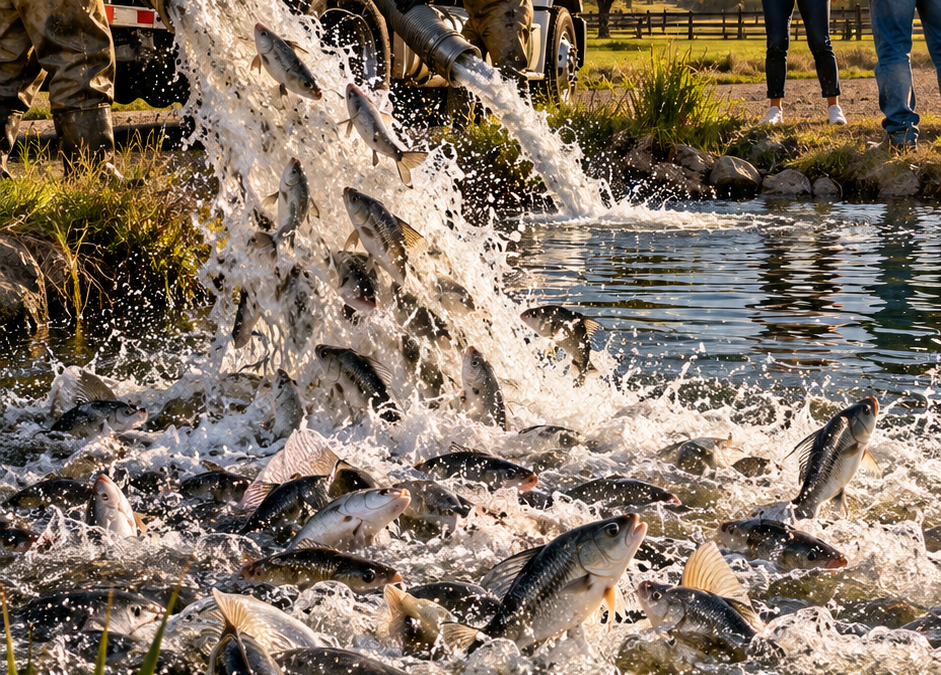
Even from the far end of my gravel drive, I could tell it didn’t belong on my land. It sat there hulking beside my pond like a silver animal that had crawled out of the highway and stopped to die, its engine rattling low, its hoses stretched toward the water. Men were moving fast around it. Water churned near the bank. And the surface of my pond—usually calm that time of day, usually glassy and dark under the late afternoon sun—was breaking apart in flashes.
At first, I didn’t understand what I was seeing.
Then I got close enough to hear the water slapping.
Close enough to see fish.
Thousands of them.
I slammed my truck into park so hard the whole cab jerked.
I stepped out before the engine had fully died, and the first thing I heard was Karen’s voice carrying across my property in that same sharp, self-assured tone I had spent the last three years learning to hate.
“There he is,” she called, turning and pointing straight at me as if I had been the missing piece in some perfectly reasonable plan. “Those fish are going into your pond.”
For a second, I just stared at her.
Karen Dorsey was a board representative for the HOA that bordered the western side of my ranch. Pinon Bluffs Estates. A place full of expensive entry signs, copied rustic charm, and people who loved using words like community standards when they meant we think we own whatever we can reach. She stood on my bank in white sneakers already sinking into the mud, dressed like she was there for a committee luncheon instead of what looked an awful lot like a commercial stocking operation happening on land she had no right to set foot on.
I walked toward her, hearing the wet rush from the hoses and the frantic splash of fish entering water that wasn’t theirs.
“What did you just say?” I asked.
Karen crossed her arms as if I were the one being difficult. “I said those fish are going into your pond. The HOA needed somewhere to place them immediately.”
I looked from her to the tanker, then to the men handling the hoses. “Who gave you permission?”
She didn’t answer right away, which was answer enough.
“Our community pond project hit an unexpected problem,” she said. “We had to adapt quickly.”
“This is private property.”
“Yes, and this pond is suitable,” she replied, already irritated, already acting like the issue wasn’t that she had trespassed and begun unloading a live shipment onto my land, but that I was being impolite about it.
The driver—a broad-shouldered man in a faded cap, maybe in his fifties—glanced between us with the uneasy look of someone who had just realized the delivery he was in the middle of might become a legal problem before sunset.
I took another step toward the water. Fish boiled near the shallows in tight silver movement. Not little bluegill, not feeder minnows, not the kind of stock some weekend fisherman tosses into a private pond and forgets about. These fish were large, uniform, healthy, and energetic. They moved like a shipment, not a random catch.
I turned back to Karen. “Nobody asked me. Nobody called me. Nobody gets to use my land as a backup plan.”
Karen lifted one hand dismissively. “It’s temporary.”
That word hit me wrong.
Temporary.
Like that made it nothing.
Like thousands of living animals entering a contained body of water on private land was the same as borrowing folding chairs.
I faced the driver. “How many fish are in that truck?”
He hesitated. “Several thousand.”
“What kind?”
He named the species—sport fish, premium stock, professionally raised for private waters and commercial fishing use. The kind people paid serious money to get. The kind that came from hatcheries, not bait buckets.
Then I asked the question Karen clearly didn’t want asked.
“Who owns the shipment?”
The driver wiped one hand on his jeans and looked toward his cab. “I’ve got the delivery paperwork.”
“Bring it.”
Karen stepped in. “The HOA paid for those fish.”
I looked at her. “That’s not what I asked.”
The driver walked to the truck, reached inside, and returned with a clipboard. He handed it to me carefully, like it had already become evidence.
I read the top line once.
Then again.
The shipment wasn’t listed as HOA property.
It was invoiced to a commercial aquaculture operation.
I let my eyes move farther down the page, and when I saw the declared value, I stopped breathing for half a second.
I actually looked twice to make sure I hadn’t misplaced a decimal.
The full shipment value was listed at approximately six hundred thousand dollars.
I lowered the clipboard slowly and looked at Karen.
“Why,” I asked, very quietly, “is six hundred thousand dollars’ worth of fish being dumped into my pond?”
For the first time since I’d arrived, she looked unsure.
It was small. Barely a flicker. But I saw it.
Then she straightened up again. “The HOA already budgeted for the fish.”
“That invoice doesn’t say the fish belong to the HOA.”
She looked at the driver as if this were his fault. “Then the paperwork must have been changed.”
The driver frowned. “Ma’am, I can’t say that. I just transport what I’m assigned. But I do still need authorization from the actual recipient.”
I handed the clipboard back, then turned and walked the edge of my pond.
It covered several acres and sat low in a basin behind my main pasture, fed by runoff and a contained spring system I’d maintained for years. It wasn’t decorative. It wasn’t a neighborhood amenity. It was part of the ranch. My father had deepened it with rented equipment when I was a teenager. I’d repaired the embankments myself after heavy rains. I knew every foot of that water.
And now the surface looked alive.
Fish rolled under the light in dense movement from one end to the other. The water had taken on that restless, metallic shimmer that comes when too many bodies occupy too small a space all at once. The delivery wasn’t some accidental handful. It was massive.
I crouched near the bank and studied them more closely. Clean fins. even sizing. excellent condition. Hatchery fish, no question. Whatever mess the HOA had created, it wasn’t small and it wasn’t cheap.
Then I noticed the labels on the side of the tanker.
I walked back to the truck and read them.
Company name. Load code. Destination reference.
The manifest matched what the driver had handed me: a private aquaculture facility, not my ranch, not the HOA, not even this county. Someone had redirected the delivery.
I turned to Karen again. “Where did you get the idea you could send this here?”
She gave a brittle laugh. “We had to act fast. Our own pond became unavailable.”
“Unavailable how?”
She pressed her lips together. “That’s an internal community matter.”
I almost laughed at that.
She was standing on my land, using my pond, dumping fish worth more than some houses, and she thought she could still hide behind the phrase internal community matter.
I took my phone out of my pocket.
“What are you doing?” she asked.
“Calling the state fisheries office.”
That finally rattled her.
“There’s no need to escalate this,” she said quickly.
I started dialing. “You escalated it when you brought a tanker onto my property.”
She took a step toward me. “We can work this out.”
“No,” I said. “You can explain it.”
The nearest regional fisheries inspector said he could be there that afternoon. I gave him my address, described the unauthorized stocking, read off the species listed on the manifest, and mentioned the declared shipment value.
There was a pause on the line after that last part.
Then the inspector said, “Do not let anyone move anything else. I’m on my way.”
So we waited.
The driver shut down active transfer until things were clarified. His crew stayed near the truck, uncomfortable and quiet. Karen paced in short angry lines with her phone in one hand, calling people, lowering her voice when she passed far enough from me, then raising it again when frustration got the better of her.
I stood by my pond and watched thousands of чуж—no, not strangers, I thought, not a good enough word. Intruders. Thousands of expensive, living intruders move through water my father and I had built into existence with sweat and stubbornness.
My ranch sits on land my family has held for nearly eighty years. It isn’t the largest spread in the county, and it sure isn’t the richest, but it’s ours. My grandfather bought the original acreage after the war with money earned doing dangerous work nobody wanted. My father added to it in pieces over decades. Fences got repaired, barns got rebuilt, dry years got endured, cattle markets rose and collapsed and rose again. Nothing about the place came easy.
Then, about five years earlier, the development came.
A hill scraped flat. Roads cut in. Rows of expensive homes built where pasture used to roll open and quiet. They sold the view of ranch country to people who mostly wanted ranch country not to behave like ranch country. The HOA arrived like a little government nobody had elected outside its own gates, and from the beginning, Karen had acted like the existence of my land beside their subdivision was some kind of administrative inconvenience.
There had been complaints about my fencing. Complaints about dust from my access road. Complaints about tractors moving before eight in the morning. Complaints about cattle visible from their walking trail, as if livestock were somehow offensive in a county built on livestock.
Every time I thought I had seen the limit of their arrogance, they found another foot to climb.
But this?
This was different.
This was no longer petty. No longer annoying. This was bold enough to be dangerous.
The inspector arrived just after four.
His name was Martin Hale. Mid-sixties, lean, sun-browned, wearing state khaki and the expression of a man who had seen enough human foolishness to no longer be surprised by it, though not yet numb to it either.
He listened without interrupting while I explained what I had found.
Then he examined the fish.
He worked methodically, asking the driver for load records, checking samples from the water, confirming species and size class, studying tag information and hatchery identifiers. He didn’t rush, and he didn’t accept anybody’s assumptions—not mine, not Karen’s, not the driver’s.
Karen tried to recover her authority the moment he stepped out of his truck.
“Our association purchased these fish for a community improvement project,” she said, extending a folder she had produced from somewhere. “We’ve simply had to make a temporary placement adjustment.”
Inspector Hale took the folder, looked through a few pages, and asked a question so simple it would have been funny if the whole situation hadn’t made me so angry.
“Do you have proof of ownership?”
Karen blinked. “We budgeted for the purchase.”
“That is not what I asked.”
She drew herself up. “The community approved the project.”
He looked at her calmly. “Do you have proof that your association owns this shipment and had authorization to place it in this pond?”
She didn’t answer immediately.
The inspector waited.
The driver looked at his boots.
I felt the breeze across the water and heard a fish slap near the reeds behind us.
Finally Karen said, “The documentation is being updated.”
The inspector handed the folder back. “Then as of now, you do not have proof.”
He spent another half hour examining the inlet and outlet structures on my pond. He asked whether there was any flow connection to public waters. I showed him the contained spring feed, the bermed edges, the screened overflow route, and the drainage pattern across my land. He documented everything carefully. Privately stocked fish, he explained, could trigger state oversight depending on species, containment, and possible environmental impact. If the fish could escape downstream into public systems, the matter would become more serious.
That question changed the temperature of the whole afternoon.
Until then, Karen had treated the fish like misplaced furniture.
Now there was an inspector documenting containment pathways, ownership records, transport manifests, and unauthorized delivery on private land. Her confidence began to fray around the edges.
When Hale finished his inspection circuit, he returned to the tanker and asked the driver to walk him through the route from dispatch to arrival.
The driver looked relieved, like he had been wanting somebody official to ask.
“My original load assignment wasn’t for this address,” he said. “It was supposed to go to a private aquaculture facility south of here.”
“Why didn’t it?” Hale asked.
“I got a redirection notice through a contact claiming the receiving pond had become inaccessible. I was told the alternate site had been approved and that time was critical for the fish.”
“Who issued the redirection?”
The driver glanced toward Karen, then back at the inspector. “The communications came through parties connected to the HOA project.”
“And when did you realize there might be a problem?”
“When I got here and the property owner was clearly not expecting us.”
Karen cut in. “That’s not an accurate characterization.”
The driver turned to her with controlled frustration. “Ma’am, nobody here seemed to have permission except you.”
That shut her up for a moment.
By evening, more cars started arriving.
HOA board members.
I recognized two of them on sight and another from a prior meeting where they had tried to lecture the county about road runoff while misreading their own engineering packet. Men in pressed shirts and women in designer sunglasses, all of them wearing expressions that said they had come expecting to manage a narrative, not walk into an investigation.
Karen hurried over to them before they reached us. There was a fast cluster of whispering, sharp glances toward me, and then the board president—a man named Douglas Pritchard—stepped forward with the smug composure of somebody accustomed to sounding reasonable while saying absurd things.
“Let’s not turn this into something adversarial,” he said.
I looked at him. “You stocked my private pond without permission.”
He gave a little sympathetic nod, the kind people use when they’re about to insult your intelligence. “There appears to have been confusion.”
Inspector Hale spoke before I could.
“There is no confusion about the current problem,” he said. “A high-value commercial fish shipment was delivered to a location not listed as the authorized destination, and no one from the association has yet provided proof of ownership or authority.”
Douglas turned toward him and smiled too hard. “I’m sure our counsel can clear that up.”
“Tonight?” Hale asked.
Douglas’s smile thinned. “Maybe not tonight.”
“Then tonight,” the inspector said, “nobody moves these fish except under supervised direction once ownership is confirmed.”
One of the board members—a woman with a pearl necklace and a voice like clipped paper—said, “Those fish were meant for the community.”
The inspector looked at her. “That is a statement of intent, not evidence of ownership.”
I stood there, mud on my boots, anger cooling into something sharper and steadier. I had spent enough years dealing with institutions, agencies, and people with titles to know that panic often begins the moment facts stop being optional. The HOA board had come prepared to intimidate. They had not come prepared for records.
The driver handed the inspector the full transport packet. Hale reviewed the manifest line by line, asked for dispatch contact numbers, and reached the hatchery and the listed recipient facility before the sun dropped behind the cottonwoods.
The truth surfaced piece by piece.
The fish were indeed commercial inventory.
The hatchery had released them pursuant to a paid order connected to a private aquaculture operation. Somewhere between dispatch and final placement, the delivery had been diverted. The HOA, whose own pond project had apparently lost access to its intended water body, had tried to commandeer the shipment rather than lose face—or money, or both.
But they didn’t actually own what was in my pond.
At best, they had inserted themselves into a transaction already in motion and then treated my land as a convenient emergency container.
At worst, they had attempted to seize possession of a six-hundred-thousand-dollar live shipment and relocate it without authority.
Neither explanation made them look better.
When the hatchery representative finally got on speakerphone, his voice came through strained and furious.
“Those fish are not the association’s property,” he said. “They were to be received only under documented transfer conditions. Who authorized this relocation?”
Nobody on the HOA side answered.
The silence was thick enough to feel.
Inspector Hale held the phone and asked, “Can your company arrange proper handling and supervised recovery?”
“We’re already working on it,” the hatchery rep said. “But every hour matters.”
It was almost sunset by then, the sky turning copper over the water, the kind of beautiful evening that usually made me feel lucky to live where I did. Instead, I stood there listening to professionals discuss how to unwind an act of trespass so outrageous it almost felt fictional.
But there it was, alive and flashing in my pond.
The inspector laid out the next steps clearly. Nobody from the HOA would touch the fish. The original hatchery and intended recipient would coordinate proper transfer under supervision. Documentation would be made of the delivery, temporary holding, and recovery process. My pond had to be assessed to ensure the fish were handled without environmental damage. Every movement from that point forward had to be recorded.
Douglas tried once more to salvage control.
“My understanding,” he said carefully, “is that the association did invest substantial funds toward these fish.”
The hatchery representative answered before Hale could. “If your association has a financial dispute, that is between you and the contracting parties. It does not create ownership of live inventory placed without authorization.”
I watched Douglas absorb that.
Watched Karen look at the pond and, for the first time, truly understand the scale of what she had done.
She had arrived thinking she could bully me with urgency.
Thinking private property would bend if she used enough confidence.
Thinking a ranch owner on the edge of their development was just a logistical obstacle with boots.
Now she stood on my bank while a state inspector documented an unauthorized delivery, a commercial supplier asserted ownership, and her own board searched each other’s faces for someone to blame.
The last light slid across the water.
A second transport team arrived shortly after with temporary containment equipment and aeration support. The recovery couldn’t all happen instantly, but the supervision began that night, and the paperwork started flowing in earnest. Names, times, conditions, counts, species records, transfer notes. The kind of paper trail bureaucratic arrogance never imagines until it’s too late.
Inspector Hale asked me a few final questions privately while the crews worked.
“Have you had prior access issues with this association?” he asked.
I laughed once without humor. “Not like this.”
He nodded. “Document everything. Every conversation, every vehicle, every person on site. Keep copies of your photos and communications. If they entered without permission and altered your property use, you may want counsel.”
“I already know a good land attorney,” I said.
That was true. After years of boundary squabbles and nuisance complaints, I had learned not to wait until after the damage to start collecting allies.
When I looked back toward the water, Karen was standing alone a few yards from everyone else, arms wrapped around herself now, not in confidence but in containment. She caught me looking and held my gaze for half a second before turning away.
I wondered what, exactly, had gone through her mind earlier that day. Whether she had truly believed I would just accept it. Whether she thought she could frame it later as a misunderstanding. Whether people like her become so accustomed to small violations that eventually they stop recognizing the line between arrogance and theft.
Because that was what stayed with me most.
Not just that they had dumped the fish.
But that they had expected to get away with it.
Night had nearly settled by the time most of the board members left. Their cars rolled out in a silent line, expensive paintwork reflecting the last of the work lights set up along the bank. No victory. No statements. No authority. Just retreat.
Karen was among the last to go.
She approached me once, slowly, stopping several feet away.
“This got more complicated than it should have,” she said.
I looked at her in disbelief.
More complicated than it should have.
As if complication were the crime.
As if the problem was not trespass, unauthorized use, interference with a commercial shipment, and the breathtaking assumption that my pond existed for her convenience.
“You came onto my ranch and used my property like it belonged to your board,” I said. “The only complicated part is how any of you thought that was normal.”
Her jaw tightened.
“We were under pressure.”
“From who?”
She didn’t answer.
Maybe from angry homeowners who had paid for a community fishing feature that had fallen apart. Maybe from contractors. Maybe from their own bad planning. Maybe from the simple terror of public embarrassment among people whose lives are built on curated appearances.
I didn’t much care.
She glanced toward the crews. “No permanent harm was intended.”
“That doesn’t matter as much as you think it does.”
That was the last thing I said to her that day.
She left without another word.
I stayed by the pond until nearly midnight while the initial transfer controls were completed and the temporary holding situation stabilized. By then, the inspector had gone, the crews had their instructions, and the hatchery’s recovery plan was in motion for the following morning.
When the property finally quieted, I stood alone at the water’s edge.
The stars were out. The ranch house glowed behind me. Frogs had resumed their low sounds along the reeds as if trying to reclaim the night from the machinery and voices that had invaded it. The pond looked peaceful again from a distance, which somehow made the whole thing feel even stranger.
I thought about my father.
About how furious he would have been and how amused, later, once the danger passed, at the sheer nerve of it. He used to say that some people mistake proximity for entitlement. If your fence line touched theirs, they eventually convinced themselves your time, your land, your patience, and your silence came with the view.
He had been right.
The next several days were consumed by follow-up. Recovery operations. Written statements. Photos. Calls with the hatchery, the inspector’s office, and my attorney. By the time it was all organized, the story was clear enough to hold in one sentence:
The HOA had tried to use my private pond as emergency storage for a commercial fish shipment they did not own and had no authority to place there.
There would be arguments later about who contracted what, who redirected whom, who paid deposits, who made promises, who exceeded authority, and who ignored warnings. There would be letters sent by lawyers who charged by the hour to repackage recklessness as confusion. There would be meetings, denials, carefully phrased regret, and people suddenly pretending they had not been present when they absolutely had.
But the essential truth never moved.
I came home and found strangers putting a six-hundred-thousand-dollar problem into my water because they believed my land was easier to take than permission was to ask.
That realization changed something in me.
Not because I had still believed the HOA respected boundaries. I didn’t. That illusion had died years earlier. But until that day, some part of me had assumed there was still a practical ceiling to how far they would go before common sense, liability, or simple decency stopped them.
I was wrong.
What stopped them wasn’t decency.
It was documentation.
It was an invoice.
It was a driver with a manifest.
It was a state inspector asking one simple question: Do you have proof?
And it was the fact that for once, they had chosen a target that could answer back with evidence.
A week later, I saw Karen again at a county land-use hearing unrelated to any of this. She was seated two rows ahead of me, dressed neatly, posture perfect, face composed. If someone had met her there for the first time, they might have thought she was the most organized person in the room.
She never turned around.
She didn’t need to.
She knew I was there.
And I think she also knew that whatever quiet authority she once carried onto my property had drowned in that pond the moment the paperwork surfaced.
People sometimes ask—carefully, curiously—what it felt like to see that much value splashing in my water.
The honest answer is this: at first, it felt unreal.
Then insulting.
Then dangerous.
And finally clarifying.
Because the fish themselves were never really the whole story.
The fish were just proof.
Proof of how far people will go when they believe rules are for other people.
Proof that wealth and titles and board positions can make ordinary trespass look acceptable to the ones committing it.
Proof that a person can stand on land he has cared for all his life and still be looked at like the obstacle instead of the owner.
But it was also proof of something else.
That the truth becomes a lot harder to bully once it’s written down.
In the end, the shipment was documented, the ownership identified, the unauthorized delivery exposed, and the transfer supervised the way it should have been from the start. The HOA did not leave with the victory Karen had arrived expecting. They left with questions they couldn’t answer and records they couldn’t control.
And I was left with my pond, my land, and a story I never should have had to live through in the first place.
Even now, when I drive past that bank at sunset, I sometimes picture the tanker there again—the hoses, the churned water, Karen pointing like she had every right in the world.
Then I remember the look on her face when she realized those fish were worth six hundred thousand dollars and didn’t belong to her.
That was the moment the balance shifted.
Not when I argued.
Not when I told her to stop.
Not even when the inspector arrived.
It shifted when arrogance met a fact it couldn’t talk over.
And if there’s one thing I know for certain after all of it, it’s this:
My pond was never their backup plan.
It was their gamble.
They just lost.








