At the Airport Gate, I Used a Hand Signal I Hadn’t Needed in Years—Because the Man Beside Me Was Watching Everything I Did
𝗣𝗔𝗥𝗧 𝟮
I left because I could no longer tolerate the distance between the people who made decisions and the people who had to survive those decisions.
Austin was supposed to be different.
The bar was supposed to be small.
Ordinary.
Human.
And for two years, it almost was.
Wade Coulter seemed like the kind of man I wanted to believe existed.
He was fifty-five.
Gray beginning at the sides of his dark hair.
Always dressed slightly better than necessary.
Never so expensive that he appeared vain.
Never so casual that anyone forgot he owned the place.
He had built three successful bars across Texas.
The flagship in Austin was his pride.
So was his charity.
The Lone Star Valor Fund.
The name appeared everywhere.
On framed posters.
Donation jars.
Event banners.
Menus during fundraiser weekends.
Wade raised money for veterans who needed wheelchair ramps, emergency rent, home repairs, service dogs, medical equipment, transportation.
He shook veterans’ hands with both of his.
Remembered wives.
Remembered grandchildren.
Remembered units.
If a veteran came into the bar wearing a cap from Korea, Vietnam, Iraq, or Afghanistan, Wade would eventually make his way over.
He had a gift for making a person feel seen.
Local television loved him.
Reporters called him a businessman with a servant’s heart.
I saw him pay for meals.
I saw him sit with grieving widows after everyone else had gone home.
I saw him personally drive groceries to a veteran who had broken his hip.
That mattered to me.
I wanted to trust him.
Maybe that made what I found harder to accept.
Walter Higgs was the first crack.
Walter came every Friday at 6:15.
Never 6:10.
Never 6:20.
Always 6:15.
He had lost his left leg below the knee in Afghanistan.
He used a cane and insisted the cane was temporary.
I had watched his balance get worse for months.
He refused to admit it.
“You want the booth tonight?”
I asked one Friday.
“No.”
“The stool is harder for you.”
“The stool makes me look handsome.”
“The stool makes you look eighty.”
“I’m sixty-eight.”
“Exactly.”
He grinned.
“Coffee.”
“Decaf?”
“Don’t insult me.”
Walter had been approved by Wade’s charity five months earlier for three things.
Bathroom safety rails.
A short ramp at the entrance to his house.
And a trained service dog.
Scout.
Yellow Labrador.
Walter had met him twice.
The training organization had already matched them.
Walter carried a photograph of Scout behind his driver’s license.
He showed it to me more often than he probably realized.
The first time, he was openly excited.
The second, he pretended he was only showing me because I had asked.
The fifth time, he barely smiled.
Something had changed.
“Still waiting?”
I asked.
He put the photograph away.
“Paperwork.”
“That’s what Wade said?”
“Another release form.”
“You already signed three.”
Walter shrugged.
“They know what they’re doing.”
The bathroom rails had not been installed either.
The ramp contractor stopped returning calls.
Scout’s final payment had never reached the training center.
Wade always had an explanation.
Board authorization.
Quarterly release.
Administrative delay.
Contractor scheduling.
Every promise ended the same way.
Monday.
It will be fixed Monday.
Walter believed him.
Or tried to.
Walter was the kind of man who found it easier to be grateful than angry.
That bothered me.
Men like Walter could be failed for months because they felt guilty demanding what had already been promised.
One Friday, I watched him lower himself onto the last stool near my service station.
His cane slipped half an inch.
He caught himself on the bar.
“You okay?”
“Perfect.”
“That looked perfect.”
“As long as I don’t fall, I’m doing just fine.”
He smiled.
I didn’t.
Six weeks earlier, the Lone Star Valor Fund had held its largest charity dinner of the year.
More than three hundred people attended.
Veterans.
Business owners.
Local politicians.
Police officers.
Donors.
Wade stood beneath a huge banner that said:
HONORING THOSE WHO SERVED.
At the end of the night, he took the microphone.
“We raised one hundred eighty-four thousand dollars.”
The room erupted.
People stood.
Applauded.
Walter clapped harder than almost anyone.
I remember looking at Wade onstage and feeling proud to work for him.
Two nights later, that pride began to die.
I was carrying coffee into his office before opening.
The door was unlocked.
Wade wasn’t there.
He had asked me to leave the pot on the side table.
I stepped inside.
I did not search anything.
I did not open a drawer.
I did not touch a file.
I saw a printed event summary lying beside the register reports.
The number caught my eye.
$141,600.
Cleared donations.
I stopped.
Maybe the rest was pending.
Maybe pledges had been included in the announcement.
That happens.
One number was not proof of anything.
Then I saw the beneficiary page beneath it.
Walter Higgs.
Service dog.
Home modifications.
Status: COMPLETED.
I stared at the word.
Completed.
Scout was still waiting.
Walter still had no rail beside his bathtub.
Another name caught my attention.
A veteran I knew from the bar.
Also listed completed.
He had told me four days earlier that he was still waiting on emergency roof repair.
Another.
Still waiting for medical transport.
Then three names I did not recognize at all.
Maybe they were legitimate.
Austin was large.
The charity helped people outside the bar.
But six questionable entries beside a missing forty-two thousand four hundred dollars were no longer one mistake.
They were a pattern.
I put the coffee down.
Walked out.
Said nothing.
For three days, I told myself there could be a reasonable explanation.
Then I heard Wade’s phone call.
I was restocking glasses in the narrow supply alcove behind the service bar.
His office wall shared the other side.
The ventilation fan had been broken for weeks, so the wall carried sound better than it should have.
Wade’s voice came through clearly.
“Keep Higgs under completed.”
I froze.
There was a pause.
Someone answered through his speakerphone, too faint for me to understand.
Wade continued.
“The board sees categories, not installation dates.”
Another pause.
“Use the adjusted figure.”
Silence.
“Round it for the quarter.”
I put the glass in my hand down very carefully.
Then Wade said the sentence that removed almost every innocent explanation I had left.
“No, don’t remove the names. We announced the placements already. Moving them backward creates questions.”
My pulse changed.
He was not discussing delayed paperwork.
He was discussing presentation.
Managing appearances.
Walter’s name was not a person to him in that moment.
It was a line that had already been publicly declared successful.
Correcting it would expose the lie.
I stayed still until the call ended.
Then I returned to the dining room.
I refilled coffee.
Delivered food.
Smiled.
Asked Walter whether he wanted pie.
No one looking at me would have known anything had changed.
That was an old skill.
Near closing, I stepped behind the service station and removed a small notebook from my apron.
I had started carrying it after the charity dinner.
Originally, I told myself I was recording details because I wanted the numbers to make sense.
That night, I stopped pretending.
I wrote the time.
The wording of Wade’s call.
Adjusted figure.
Round it for the quarter.
Keep Higgs under completed.
I wrote the announced total.
$184,000.
The cleared total.
$141,600.
Difference:
$42,400.
My handwriting stayed steady.
My heartbeat didn’t.
I had challenged respected institutions before.
I knew what happened when the institution had better lawyers, better public relations, and a stronger reputation than the person asking questions.
You get called emotional.
Confused.
Disgruntled.
Not qualified to understand the larger picture.
They thank you for your concern.
Then somebody rewrites the language until the problem becomes impossible to recognize.
I was not going through that again.
This time, I would build the record first.
Walter called good night from the front.
I watched him move toward the exit.
His cane slipped slightly on the tile.
He caught himself.
Again.
Then a shadow crossed my notebook.
I looked up.
Wade stood three feet away.
Smiling.
“What are you writing?”
His voice was friendly.
My body reacted before my thoughts did.
Close notebook.
Slowly.
No sudden movement.
Control breathing.
Read eyes.
His smile looked normal.
His eyes did not.
“Inventory notes.”
“Inventory?”
“We were short two bourbon bottles last weekend.”
He glanced toward my apron pocket as I slid the notebook inside.
“Need help checking the numbers?”
“I’ve got it.”
“You sure?”
“Yes.”
He held my eyes a second longer than normal.
Then smiled again.
“Don’t stay too late.”
He walked away.
Only after his office door closed did I breathe normally.
He had not asked because he was curious.
He had asked because he was afraid I might be writing down something he didn’t control.
The next two days were almost worse.
Wade behaved beautifully.
Praised my work in front of customers.
Left a handwritten thank-you beside the register.
Asked whether I needed anything.
Men who become suddenly kind after suspecting you know something are rarely being kind.
Walter came in Sunday.
Moving more carefully than usual.
The service-dog organization had called him again.
“If the charity doesn’t release the payment by Friday, Scout could be matched with somebody else.”
Walter said it lightly.
Too lightly.
“What did Wade say?”
“Administrative issue.”
“Again?”
“Probably for the best.”
I stared at him.
“What is?”
“If Scout goes to someone else.”
“Walter.”
“Somebody else might need him more.”
He looked down at his cane.
That was when I understood something I wish more charities understood.
People like Walter often make exploitation easy because they would rather sacrifice their own help than feel demanding.
He was preparing himself to lose something he had already been promised.
Not because he didn’t need Scout.
Because disappointment hurt less when he could call it generosity.
Monday morning, Wade summoned me into his office before opening.
Sunlight crossed framed photographs covering the walls.
Wade beside a governor.
Wade beside retired generals.
Wade presenting oversized checks.
Wade kneeling beside wheelchair users.
Wade shaking Walter’s hand.
He offered me coffee.
I declined.
He sat behind the desk.
“I’ve been thinking about your future.”
My stomach tightened.
“Oh?”
“You’ve been excellent here.”
“Thank you.”
“Dependable. Calm. Customers love you.”
He smiled.
“That’s why I want to promote you.”
I said nothing.
“We’re opening the new location in Denver.”
I knew about the location.
Opening was still weeks away.
“I want you as floor manager.”
He turned a document toward me.
Salary.
Housing deposit.
Temporary hotel.
Transportation.
Then I saw the airline confirmation beside his hand.
Thursday morning.
Three days away.
Already booked.
I looked up.
“When did you decide this?”
“Recently.”
“The ticket is already purchased.”
“I wanted to make it easy.”
“You didn’t ask whether I wanted to move.”
His smile tightened.
“Opportunity doesn’t always wait for permission.”
That sentence told me more than the paperwork.
I glanced at the flight.
Austin to Denver.
Specific seat.
Specific gate.
Everything arranged.
“Why me?”
“I told you.”
“No. Why now?”
His eyes hardened for less than a second.
Then warmth returned.
“Because I’ve always looked out for you.”
There it was.
A reminder.
He had hired me when my civilian résumé was thin.
He paid me.
He controlled references.
He knew I lived alone.
“I gave you a chance when a lot of employers would’ve asked questions about gaps.”
My voice stayed neutral.
“I appreciate that.”
“I hope so.”
The threat was soft enough to deny later.
That made it worse.
I asked for the day to think.
“The ticket is already paid for.”
“I understand.”
“You’d be wasting a lot of company money.”
“Then I’ll let you know before closing.”
His expression said that was not the answer he wanted.
I accepted before the shift ended.
Not because I intended to leave Austin.
Because refusing immediately would confirm his suspicion.
For the next two days, I worked normally.
And collected proof.
I photographed the event summary.
$184,000 publicly announced.
$141,600 cleared.
I photographed the beneficiary sheet listing Walter as completed.
I found two other veterans I personally knew were still waiting.
Then I saw a folder showing repeated payments to a consulting company.
The address was a mailbox outside San Antonio.
No office.
No staff names.
The payments nearly matched the missing money.
I photographed every relevant page.
Sent everything to a private email account Wade did not know existed.
Then deleted the photographs from my phone.
Not the email.
The email stayed.
That detail would matter later.
Wednesday night, the office keypad rejected the code employees had used for months.
Wade opened the door from inside.
“Code changed.”
“When?”
“Security update.”
He smiled.
Neither of us mentioned why.
Thursday morning, he arrived at my apartment in a black company SUV.
That was when the last illusion of a normal promotion disappeared.
He was wearing a sport coat.
Travel bag in the back.
“I’m coming with you.”
“To Denver?”
“I’ll introduce you to the staff.”
His boarding pass was already on his phone.
Of course it was.
During the drive, he talked constantly.
The Denver market.
Hotel.
Training.
My future.
Loyalty.
Especially loyalty.
“If you stay close to the people who helped you,” he said, “life gets easier.”
I looked out the window.
“And if you don’t?”
He laughed.
“Why make life harder?”
My canvas shoulder bag stayed between my feet.
Inside were printed copies of the financial pages.
My notebook.
Two years of employment documents.
Wade looked at the bag more than once.
At security, he reached for it.
“I’ve got it.”
“I can lift it.”
“I said I’ve got it.”
Our eyes met.
Then he smiled.
“Of course.”
I kept the strap in my hand after that.
The airport was crowded.
Families.
Business travelers.
Children dragging rolling suitcases.
A group of soldiers near a coffee stand.
Gate agents calling names.
Announcements echoing from overhead speakers.
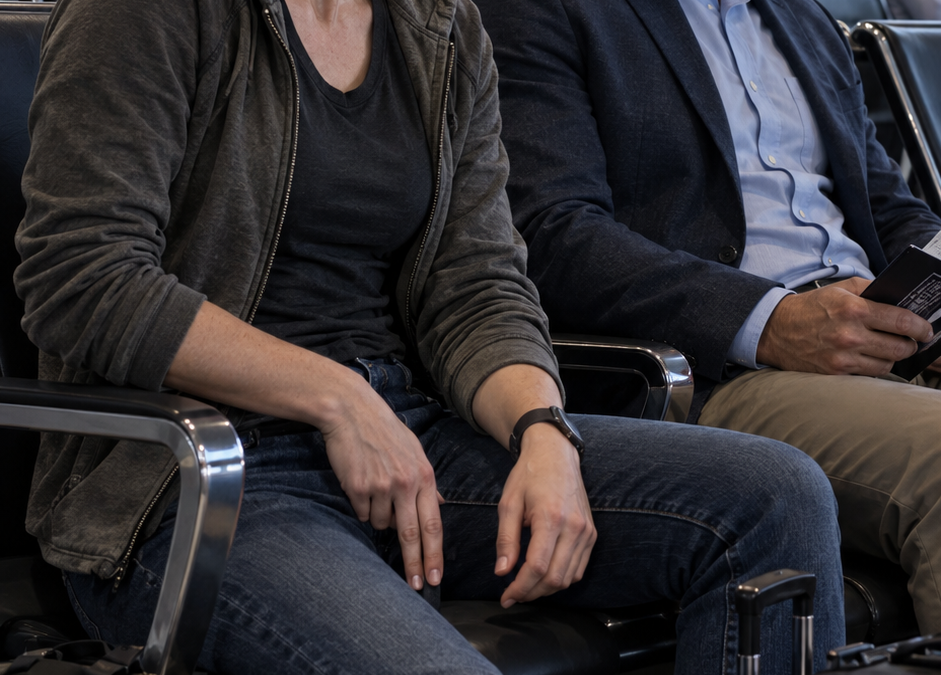
Wade chose two seats near the boarding desk.
Not randomly.
From there, he could watch me.
The gate.
The main corridor.
My bag.
I sat.
He sat beside me.
Across the aisle, a man in Navy dress blues held a newspaper.
Silver at his temples.
Four rows of ribbons.
The SEAL trident above them.
His posture was too balanced for someone casually waiting on a flight.
He had a clear view of both exits.
His newspaper had been open to the same page for too long.
Commander, I guessed.
Operational background.
Maybe retired from the teams.
Maybe still serving.
I did not know him.
I did not expect help.
I simply noticed him because noticing was what I did.
Wade saw where I was looking.
He leaned closer.
“Once we board, all this uncertainty will be behind you.”
I turned toward him.
I had never said I felt uncertain.
My phone vibrated.
Walter’s daughter Aaron.
I answered immediately.
“Aaron?”
She was crying.
Not soft crying.
The kind that fractures words.
“Olivia, Dad fell.”
Everything inside me stopped.
“When?”
“This morning.”
“Where?”
“Bathroom.”
My eyes closed.
No handrails.
“He tried getting out of the tub. His cane slipped.”
“Is he awake?”
“Yes. Ambulance took him to St. David’s.”
“Are you there?”
“I’m driving.”
Her breathing shook.
“He didn’t want me to call you.”
“Why?”
“He said you had your promotion. He didn’t want to ruin it.”
My hand went completely still.
Walter was in an ambulance because the rails listed as completed five months earlier did not exist.
Wade leaned toward me.
“Problem?”
I looked at him.
Then across the terminal.
The man in dress blues lowered his newspaper less than an inch.
Not enough to attract attention.
Enough for me to know he had heard the tension in my voice.
I ended the call.
Placed my phone face down.
Wade watched me.
“Well?”
“Walter Higgs fell.”
His face changed.
Only for a second.
Not concern.
Calculation.
That was the moment I stopped giving him the benefit of any doubt.
“He’s in the hospital.”
Wade exhaled.
“I’m sorry to hear that.”
“The bathroom rails were never installed.”
“We can discuss that later.”
“They’re marked completed.”
“Olivia.”
“Scout isn’t paid for either.”
He glanced toward the boarding desk.
“Not here.”
“Why?”
His jaw tightened.
“Because this is an airport.”
I understood the threat beneath the ordinary sentence.
Public place.
Security.
Potential scene.
Easy to portray me as unstable.
He leaned closer.
“Boarding begins in twelve minutes.”
“I’m not getting on that plane.”
His eyes changed.
Not dramatically.
Enough.
“You need to think very carefully.”
I looked at him.
“I have.”
He lowered his voice.
“You walk away now, you lose the Denver position.”
“I don’t want it.”
“Severance.”
“Keep it.”
“My reference.”
I said nothing.
Then he said the line he had probably been holding back all week.
“Who do you think people are going to believe?”
There it was.
The real weapon.
Not force.
Reputation.
He had built his.
I had hidden mine.
“A respected charity board,” he continued, “or a bartender who stole internal documents?”
Across the aisle, the commander raised his newspaper again.
I could feel him listening without looking.
My right hand rested beside my thigh.
Hidden partially by my bag.
The signal came back to me from years earlier.
Small.
Designed to be missed by everyone except the person trained to see it.
Two fingers extended.
Fold inward.
Wrist turn.
Three ideas.
Pressure.
Do not reveal yourself.
Watch.
I made the movement once.
Nothing dramatic happened.
The commander did not look up.
Did not nod.
Did not shift his chair.
But the newspaper stopped moving.
That was enough.
Wade had not noticed.
He was still watching my bag.
I turned toward him.
“Walter fell because your charity reported work that was never done.”
“You have no idea how nonprofits operate.”
“I know what completed means.”
“You read documents you weren’t authorized to see.”
“I saw records.”
“You stole them.”
“I preserved them.”
He gave a short laugh.
“You think changing vocabulary changes what you did?”
“No.”
I held his gaze.
“I learned that lesson from people better at it than you.”
He did not understand the reference.
That was fine.
Boarding was announced.
Zone one.
Wade stood.
“So are you.”
I remained seated.
“What?”
“You’re getting up.”
“No.”
His public smile returned.
The transformation was almost impressive.
“Olivia, don’t make this difficult.”
“I’m not boarding.”
He leaned closer.
“You accepted the position.”
“Because I wanted to know how far you were willing to push this.”
His eyes went flat.
“You called me a manager Monday.”
He looked at me.
“You stopped being one the moment you decided to become a problem.”
Across the aisle, the newspaper folded.
Slowly.
The commander stood.
He was taller than I expected.
Broad through the shoulders.
Calm.
Not aggressive.
That mattered.
Men who know exactly what they are capable of rarely need to advertise it.
He approached.
Wade saw the uniform and immediately changed again.
Shoulders relaxed.
Voice warmed.
Smile returned.
The commander stopped a respectful distance from me.
“Ma’am.”
“Yes?”
“My name is Commander Daniel Mercer.”
His eyes stayed on me.
“Are you safe?”
Four words.
Simple.
No assumptions.
No lecture.
No explanation of what I should do.
Just a question.
I cannot explain why it hit me as hard as it did.
For six weeks, people had spoken around what was happening.
Wade told Walter to wait.
Told me to trust him.
Told me what documents meant.
Told me what my future would be.
Mercer asked.
Wade stood before I answered.
“Commander, Wade Coulter.”
He extended his hand.
Mercer did not take it.
Wade continued as if he had.
“This is an employee issue. Olivia got some bad news this morning and she’s understandably upset.”
Mercer looked at me.
Not Wade.
Wade laughed lightly.
“I’m taking her to Denver. Fresh start. Big promotion.”
Mercer waited.
That silence gave me room.
“I am not traveling voluntarily anymore.”
The air around the gate changed.
A woman nearby lowered her coffee.
The gate agent looked up.
Wade’s smile held another second.
Then fractured.
“She’s exhausted.”
Mercer said nothing.
“Emotional.”
Nothing.
“She’s misinterpreting confidential charity records.”
Mercer finally spoke.
“I didn’t ask whether she was confused.”
Wade stopped.
“I asked whether she was safe.”
For the first time since the office meeting, Wade looked genuinely uncertain.
Mercer turned back to me.
“Do you want airport security?”
“No,” Wade answered.
Mercer’s eyes moved toward him.
“Sir, I asked her.”
The gate agent reached for a phone.
Wade noticed.
“This is unnecessary.”
I stood.
“I want security.”
The words came out calmer than I felt.
Wade looked at me.
“This is what you want?”
“No.”
I tightened my grip on the bag.
“This is what you made necessary.”
Two airport officers started toward the gate.
Wade lowered his voice.
“You’re destroying your career over accounting delays.”
“Walter is in the hospital.”
“That has nothing to do with me.”
“His rails were marked completed.”
“Because funding was allocated.”
“That is not what completed means.”
“You are not an accountant.”
“No.”
I looked at him.
“I’m someone who knows when reality and paperwork stop matching.”
Mercer stayed nearby.
Did not interrupt.
Did not turn himself into the center of the moment.
That made me trust him more.
One of the officers asked what was happening.
Wade immediately stepped forward.
“I own a hospitality company. She’s an employee attempting to leave with confidential business records.”
The officer looked at me.
“Ma’am?”
“I’m carrying my personal bag.”
“Any company property?”
“Printed copies of records related to a veteran charity.”
Wade pointed toward the bag.
“Those belong to us.”
Mercer spoke for the first time.
“She stated before you arrived that she does not want to travel. Mr. Coulter has repeatedly attempted to answer questions directed to her.”
The gate agent added, “I heard her say she was not boarding voluntarily.”
Wade’s face flushed.
“This is absurd.”
The officer said, “Sir, step back.”
Instead, Wade reached for my bag.
Maybe instinct.
Maybe panic.
Maybe he believed possession was still control.
His hand closed around the upper strap.
He pulled.
Hard.
The bag jerked across my lap.
I moved without thinking.
Left hand caught the lower strap.
Feet repositioned.
Body turned.
Bag locked against my side.
Years disappeared for one second.
My body remembered exactly how to protect control of an object without striking the person grabbing it.
Mercer stepped between us.
“Release the bag.”
His voice never rose.
Wade looked past him at me.
“You are getting on that plane.”
This time, everyone heard.
The gate went silent.
One of the officers moved closer.
“Sir. Let go.”
Wade released the strap.
Too late.
The moment had been witnessed.
Recorded.
He pointed toward me.
“She stole company records.”
Mercer answered.
“Then ownership can be investigated without physically taking her property or forcing her onto a flight.”
Wade opened his mouth.
Nothing useful came out.
Two airport officers separated us.
One took Wade several feet away.
The other asked me for identification.
Then:
“Do you want to make a report about the bag?”
“Yes.”
“Do you believe this man was attempting to compel you to travel?”
I looked toward Wade.
He was arguing with the other officer.
“Yes.”
The word hurt more than I expected.
Because saying it made the situation real.
I unlocked my phone.
Opened my private email.
The first photograph appeared.
The charity dinner report.
Then the beneficiary list.
Then the consulting payments.
Across the gate, Wade saw the screen.
The color drained from his face.
He had thought the evidence was inside the bag.
That was why he kept watching it.
He had believed getting control of the bag might get control of the situation.
It was the first time that morning I saw him understand he had already lost that option.
The officer scrolled carefully.
“Explain this.”
I pointed.
“Public announcement: one hundred eighty-four thousand dollars.”
“Okay.”
“This internal summary shows one hundred forty-one thousand six hundred cleared.”
“Difference?”
“Forty-two thousand four hundred.”
I pulled up the beneficiary list.
“Walter Higgs.”
“Who is he?”
“Afghanistan veteran. Left leg amputated below the knee.”
I pointed.
“Service dog and home safety modifications listed completed.”
“Were they?”
“No.”
“How do you know?”
“I know him personally.”
I showed Scout’s status.
“Training organization still waiting for final payment.”
Then the consulting company.
“Repeated payments here.”
The officer studied the address.
“Mailbox?”
“Yes.”
Wade called from several yards away.
“She has incomplete records.”
I ignored him.
The officer did too.
Then my phone rang.
St. David’s Medical Center.
My stomach dropped.
I answered.
“This is Olivia Hart.”
A nurse confirmed my identity.
“Aaron Higgs asked us to contact you.”
“Is Walter okay?”
“He is awake.”
I closed my eyes.
“Okay.”
“But new imaging came back.”
Everything inside me tightened.
“What happened?”
“Mr. Higgs has a pelvic fracture.”
I gripped the phone.
“He also has a concussion and a deep laceration above his right eye.”
“Does he need surgery?”
“Possibly. Orthopedics is evaluating once swelling is better controlled.”
“Is he stable?”
“Yes.”
I exhaled.
Then the nurse continued.
“His daughter told us there was supposed to be a bathroom support rail.”
“There was.”
“It was not installed?”
“No.”
“One physician has documented that appropriate support could likely have reduced the risk of the fall.”
My eyes opened.
Wade stood twenty feet away.
Watching me.
For five months, his reports had claimed Walter was helped.
For five months, Walter stepped into an unsafe bathroom with one leg and a cane.
Because he trusted people who had already taken credit for helping him.
I ended the call.
Mercer was standing several feet away.
“What happened?”
“Pelvis fracture.”
His expression hardened.
“Walter?”
“Yes.”
I looked toward Wade.
“This is not just missing money anymore.”
Mercer waited.
“A man is in the hospital because they lied about work being completed.”
The sentence changed something in me.
Until then, part of me had still approached the situation as a record problem.
Numbers.
Documents.
Evidence.
Now I saw Walter’s bathroom floor.
His cane somewhere beside him.
His daughter receiving the call.
Scout waiting at a training center.
That was what false reporting looked like in real life.
Mercer asked, “Would you be comfortable speaking with a charity investigator?”
“Yes.”
“I know one through a veteran housing case.”
He did not say he could fix anything.
He did not promise arrests.
He did not throw his rank around.
He simply asked permission.
I nodded.
He made one call.
Only described what he personally witnessed.
That distinction told me he understood investigations.
No exaggeration.
No assumptions.
Facts.
Within twenty minutes, an investigator called me.
I forwarded everything from my private account.
Wade heard me talking.
He started arguing again.
“She’s distributing proprietary documents.”
The airport officer told him ownership could be addressed later.
The evidence had already been preserved.
The gate cameras had recorded the confrontation.
Passengers had seen him grab the bag.
The gate agent had heard me say I was not traveling willingly.
The story could no longer be reduced to Wade’s word against mine.
His flight boarded without him.
He watched passengers disappear down the jet bridge.
I expected him to look furious.
He looked stunned.
That was more revealing.
Wade had built his protection on a particular belief.
That reputation could outvote evidence.
That gratitude could silence veterans.
That employees could be moved.
That paperwork could replace reality.
That if someone raised a concern, he could define the concern before anyone else heard it.
At the airport, for the first time, he lost control of the definition.
I did not fly to Denver.
Mercer changed his own travel arrangements.
I told him he did not need to.
“I know.”
“Then why?”
“You shouldn’t be alone right now.”
Not sentimental.
Not heroic.
Just practical.
Aaron picked me up outside the terminal.
Mercer waited until she arrived.
Before leaving, he handed me a card.
“If investigators need a witness statement, they can reach me.”
“Thank you.”
He nodded.
“You did the hard part.”
I looked at him.
“I moved two fingers.”
“No.”
His eyes went toward the terminal.
“You noticed something was wrong six weeks ago and kept looking.”
Then he left.
By noon, the charity investigator had requested an emergency preservation order for financial and electronic records.
The Lone Star Valor Fund board received formal notice.
Wade’s accountant resigned that afternoon.
Through an attorney, he offered access to emails I had never seen.
A former bookkeeper contacted investigators before sunset.
She had kept copies of payment instructions.
Why?
Because Wade once blamed her for a transfer he had personally approved.
Fear had made her keep evidence.
My photographs had not solved the case.
They did something more important.
They showed other frightened people that someone was finally willing to listen.
The San Antonio consulting company led to Wade’s brother-in-law.
More records followed.
Repeated payments.
Inflated event expenses.
Projects marked completed months before work began.
Beneficiary lists manipulated to make quarterly success rates look stronger.
The pattern went back nearly three years.
Some board members claimed ignorance.
Investigators tested that claim.
Two had received earlier complaints and done nothing meaningful.
One had asked questions and been quietly pushed off the finance committee.
The Lone Star Valor Fund suspended Wade that evening.
Six days later, he was removed from the board.
Months passed before prosecutors filed formal charges.
That surprised people.
The public always thinks major cases happen at the speed of television.
They do not.
Forensic audits are slow.
Bank records take time.
Interviews contradict each other.
Lawyers argue.
Intent has to be established.
Money has to be traced.
The airport was dramatic.
The case was not.
But the case held.
Hundreds of thousands of dollars had been redirected through consulting fees, inflated event costs, and veteran projects reported complete before veterans received anything.
Not every dollar was stolen personally by Wade.
That distinction mattered legally.
But the reporting system had been manipulated under his authority.
And he had personally intervened to keep false beneficiary entries classified as completed.
The surviving board placed the charity under independent supervision.
Every delayed veteran case had to be reopened.
Every “completed” project was verified directly with the veteran.
Not through a contractor.
Not through a spreadsheet.
With the person.
That policy came from me.
Because I had learned what happens when paper becomes more important than reality.
Walter’s surgery took place the morning after the airport confrontation.
I sat beside Aaron in the waiting room.
She held Scout’s photograph.
I had seen Walter carry it so many times.
Now she was holding it.
“He’s going to be furious.”
“About what?”
“That I called you.”
“He can survive being furious.”
Aaron laughed through tears.
The surgeon eventually came out.
Walter would walk again.
Rehabilitation would take months.
His concussion appeared manageable.
The pelvic fracture was serious but repairable.
I closed my eyes when the doctor said those words.
Repairable.
There are times when one medical word feels like mercy.
The charity released Scout’s payment immediately.
Not because suddenly they cared more.
Because investigators were now watching every decision.
I hated that it required pressure.
But Walter did not need the moral purity of the process.
He needed his dog.
Twelve days later, Scout was brought to the rehabilitation center.
I was there.
Walter sat in a wheelchair near the window.
A bandage still crossed his eyebrow.
His face had lost weight.
Scout entered the room.
The yellow Lab stopped.
Then pulled forward.
Walter tried to stand.
Three people shouted at him at once.
He swore at all of us.
Then Scout reached him.
Walter put both hands around the dog’s neck.
Pressed his forehead against Scout’s head.
And cried.
Not loudly.
Walter did nothing loudly.
His shoulders simply shook.
Aaron turned away.
I looked at the floor.
Scout did not move.
When Walter finally looked up, he saw me.
“You.”
“Me.”
“I told my daughter not to call you.”
“I know.”
“You had a promotion.”
“There was never a promotion.”
Walter stared.
I explained.
Not every detail.
Enough.
When I finished, he looked at Scout.
“So my fall did one useful thing.”
“No.”
He looked at me.
“Don’t do that.”
“Do what?”
“Turn what happened to you into something necessary.”
He was quiet.
“You should never have had to fall.”
Walter rubbed Scout’s ears.
“Fair.”
“The case was already moving.”
“You sure?”
“Yes.”
That was not entirely true.
I had evidence.
But Walter’s fall changed the urgency.
He knew it.
I knew it.
He did not challenge me.
Instead, he said, “Then make sure they don’t do it to the next old fool too proud to complain.”
“That I can do.”
The bathroom rails were installed before Walter returned home.
So was the ramp.
I inspected them myself.
Walter complained the entire time.
“You’re not a contractor.”
“No.”
“Then stop staring at the bolts.”
“No.”
“You always this difficult?”
“Yes.”
Scout sat beside us looking pleased with himself.
Commander Mercer stayed in contact.
Not constantly.
That mattered.
He never turned what happened at the airport into a friendship I had not asked for.
He sent a short message after Walter’s surgery.
Asked whether investigators had contacted me.
Provided his statement when prosecutors requested it.
Later, he introduced me to several veterans helping rebuild the charity’s procedures.
They offered me a permanent position.
Director of Beneficiary Integrity.
The title was ridiculous.
I told them so.
One of them laughed.
“What would you call it?”
“Checking whether the thing you said happened actually happened.”
“That doesn’t fit on a business card.”
“Then use smaller print.”
I declined the permanent job.
But I agreed to help rebuild the process temporarily.
My first rule was simple.
No case could be marked completed without direct confirmation from the veteran or family.
Not contractor confirmation.
Not internal accounting.
The veteran.
Second:
Every beneficiary received a direct contact number for delays.
Third:
No public announcement could include future or pending assistance as though it had already been delivered.
Fourth:
If money raised for a named veteran changed purpose, the change had to be documented and disclosed.
None of those rules were revolutionary.
That was what bothered me most.
Most institutional failures are not prevented by brilliance.
They are prevented by somebody refusing to accept a convenient fiction.
Within three months, all delayed cases on the old list had been reviewed.
Eighteen veterans received assistance they had nearly stopped expecting.
Wheelchair ramps.
Emergency housing.
Roof repairs.
Transportation.
Service animals.
A bathroom widened for a Vietnam veteran using a chair.
A broken air-conditioning system replaced for an elderly widow.
Small things on spreadsheets.
Huge things in a life.
I began thinking about my last deployment differently.
For years, I had remembered the failed medical valve.
The official language.
The procurement excuses.
The feeling that truth had been diluted until nobody could be held responsible.
That experience was why Wade’s numbers bothered me so quickly.
Not because I distrusted everyone.
Because I knew what institutional language looks like when it starts separating paperwork from consequences.
Adjusted figure.
Acceptable risk.
Completed.
Pending.
These words can be accurate.
They can also be hiding places.
I was not going to let Walter become a hiding place.
Wade’s lawyers argued that I had violated company confidentiality.
The claim did not disappear simply because his records contained evidence.
My attorney warned me that whistleblower situations are rarely clean.
We dealt with it.
The charity records were preserved through lawful investigative channels.
The prosecutors determined what could be used.
I learned something important during that process.
Doing the right thing does not mean every method automatically becomes legally perfect.
Intent does not replace procedure.
That was another lesson from my service.
Evidence matters.
So does how you handle it.
Months later, Wade accepted responsibility for several offenses tied to financial reporting and misuse of charity funds.
Other charges continued through separate proceedings.
I did not attend every hearing.
I did not need to watch him lose.
That surprised me.
At first, I thought I would.
I imagined sitting behind prosecutors.
Watching the man who tried to put me on a plane answer questions he could not control.
When the day came, I stayed with Walter instead.
He was learning to walk longer distances again.
Scout moved beside him.
Slowly.
Patiently.
Walter hated the pace.
“I used to move faster.”
“You also used to fall in bathrooms.”
He glared at me.
“You’ve gotten mean.”
“I’ve always been mean.”
Scout looked between us.
Walter pointed at him.
“See what I deal with?”
The dog yawned.
That felt more useful than court.
Later that year, I left Austin.
Not because Wade had wanted me gone.
Because staying there had begun to make my life about him.
I refused to give him that much space.
I returned to my hometown.
Took a job in a family-owned bar.
Smaller.
No national press.
No charity banners covering every wall.
The owners donated quietly to local veteran organizations and kept receipts where anyone could see them.
I liked that.
I still carried trays.
Still remembered orders.
Still watched exits.
Some habits do not disappear.
One Friday night, a new waitress named Marissa asked me a question while we were polishing glasses.
“Is the airport story true?”
I looked at her.
“What airport story?”
She stared.
“Come on.”
“I don’t know what you mean.”
“The secret SEAL signal.”
I groaned.
Apparently the story had grown online.
According to one version, I identified Commander Mercer from across the terminal because we had served together.
We had not.
Another claimed he arrested Wade himself.
He did not.
One version said I used a classified hand signal that summoned an entire security unit.
That made me laugh.
Marissa leaned closer.
“So what really happened?”
I put the glass down.
“I moved my hand.”
“That’s it?”
“That’s it.”
“And he knew?”
“He understood enough to watch.”
“And then Wade got arrested?”
“Not exactly.”
She looked disappointed.
“That’s less dramatic.”
“Reality usually is.”
She thought for a moment.
“What did you actually do?”
That question stayed with me.
What had I actually done?
I had not conducted an undercover operation.
Had not hacked accounts.
Had not trapped Wade with some brilliant plan.
I noticed that numbers did not match.
I listened when someone gave an explanation that did not fit reality.
I wrote things down.
Preserved evidence.
And when Wade tried to remove me from the situation, I refused to leave.
So I told Marissa that.
“I noticed something was wrong.”
She waited.
“I wrote it down.”
“And?”
“When they tried to make me go away, I stayed.”
The front door opened.
Cold evening air moved through the room.
Walter came in.
Scout beside him.
No cane.
He still limped.
Probably always would.
Aaron followed.
Then Mercer.
He was in civilian clothes.
I had only seen him out of uniform twice before.
Marissa stared.
“Is that—”
“Don’t.”
I pointed at her.
“Do not make this weird.”
She immediately made it weird.
Walter reached the bar.
“My coffee.”
“You haven’t even sat down.”
“I traveled here.”
“Six blocks.”
“Still travel.”
Scout settled beside the stool.
I poured coffee.
Mercer sat two seats away.
“You doing all right?”
I looked around the room.
Ordinary conversations.
A game on television.
Somebody laughing near the window.
A couple arguing quietly over appetizers.
Scout asleep under the bar.
Walter complaining about coffee temperature.
Nothing happening.
Nothing urgent.
Once, ordinary life had been something I hid inside.
A disguise.
After everything with Wade, ordinary felt different.
It felt earned.
“I’m good.”
Mercer nodded.
Walter tasted his coffee.
“Too hot.”
“You complain when it’s cold.”
“I contain multitudes.”
Aaron rolled her eyes.
I looked at Scout.
The dog lifted his head.
His harness read SERVICE DOG.
Walter noticed me looking.
“He wakes me if I try walking to the bathroom without him.”
“Smart dog.”
“Traitor.”
Scout put his head back down.
I thought about the first day Walter showed me the photograph.
Five months of promises.
Five months of delays.
Five months of a charity calling him completed while he was still waiting.
Then I thought about the airport.
The bag.
Wade’s hand on the strap.
Mercer asking whether I was safe.
The gate agent reaching for the phone.
The moment Wade saw my evidence already existed outside his reach.
People later described that morning as Wade Coulter’s downfall.
I never liked that phrase.
It made the story sound like it was about him.
It wasn’t.
It was about Walter.
About all the other veterans represented by names on a spreadsheet.
About a former bookkeeper who finally decided to speak.
Board members who were forced to look at what they had ignored.
Investigators who followed records instead of reputations.
A gate agent who paid attention.
An officer who asked questions.
And one commander who saw a tiny signal from a stranger and understood that the most useful thing he could do was not take control.
It was to create enough space for her to speak.
That distinction mattered to me.
Because for years, I thought strength meant being the person who solved the emergency.
Then I learned sometimes strength is recognizing when your job is simply to stop another person from being silenced.
Wade believed my silence meant weakness.
It never did.
Silence had once been part of my training.
You do not announce every observation.
You do not react to every threat.
You do not reveal what you know before you understand the room.
You watch.
You remember.
You wait until action matters.
For two years, Wade watched me carry drinks and assumed that was the whole woman standing in front of him.
He saw an employee with a quiet voice.
A thin civilian résumé.
Someone grateful for work.
Someone he could move three states away with an airline ticket and a smile.
He never understood that I had spent years in places where one wrong assumption could get someone killed.
By the time he realized what I had noticed, it was too late to make me unnotice it.
Walter eventually walked without the cane most days.
Scout remained beside him.
The charity survived.
Smaller.
Less glamorous.
Better supervised.
Some donors left after the scandal.
Others returned only after seeing the new controls.
The huge annual gala disappeared.
Nobody missed it much.
The organization spent less time celebrating itself and more time completing projects.
I preferred that.
My notebook stayed with me.
I never threw it away.
Not because I wanted to remember Wade.
Because the first page held Walter’s name.
Underlined twice.
Every few months, I opened it.
Read the original entry.
Higgs — service dog/home modifications — listed completed, not completed.
That line reminded me of something I wish I had understood earlier in my life.
Courage is not always the moment you confront someone.
Sometimes it begins much earlier.
When you notice that something everyone accepts does not match what you can see.
When you resist the temptation to explain it away.
When you write the truth down before somebody with more authority changes the language.
The airport signal became the part everyone remembered.
It was cinematic.
A woman under pressure.
A SEAL commander.
A silent gesture.
A powerful man suddenly losing control.
But the signal was not what brought Wade down.
The signal lasted less than two seconds.
The important part had taken six weeks.
Listening.
Checking.
Remembering.
Preserving.
Refusing to let Walter’s missing handrails become an accounting detail.
One night, months after everything ended, Walter stayed after closing.
Scout slept beneath his stool.
The room was almost empty.
I was wiping down the bar.
Walter looked at me.
“Can I ask you something?”
“You usually do whether I say yes or not.”
He ignored that.
“Were you scared at the airport?”
I kept wiping the counter.
“Yes.”
He seemed surprised.
“You didn’t look scared.”
“I learned a long time ago that looking calm and being calm are different things.”
“What were you afraid of?”
I thought about it.
Not Wade physically hurting me.
The airport was crowded.
Security was nearby.
My fear was older.
More familiar.
“That I had done all the work and it still wouldn’t matter.”
Walter said nothing.
“That people would believe him.”
“Because he owned the charity?”
“Because he looked like the kind of man people wanted to believe.”
Walter nodded slowly.
“And you?”
“I was the waitress with stolen documents.”
“You weren’t just a waitress.”
I looked at him.
“There’s nothing wrong with being just a waitress.”
“You know what I mean.”
“I do.”
I leaned against the bar.
“But Wade’s mistake wasn’t thinking waitresses are weak.”
Walter waited.
“It was thinking a person’s current job tells you everything they’ve survived.”
He considered that.
Then pointed toward Scout.
“He thinks I’m weak.”
Scout remained asleep.
“No. He thinks you’re stupid enough to fall over when unsupervised.”
Walter looked offended.
“That dog has turned you against me.”
I laughed.
And something about that moment stayed with me.
Not because it was important to the investigation.
Because it was not.
That was the point.
Walter was alive.
Complaining.
Drinking coffee.
Insulting his service dog.
Doing ordinary things.
The bathroom rails worked.
The ramp existed.
Scout existed beside him.
The paperwork finally matched reality.
For me, that became the only ending that mattered.
Not Wade leaving in handcuffs.
Not newspaper stories.
Not board resignations.
Not the airport footage.
A man who had once been marked “completed” while waiting alone was no longer waiting.
That was enough.
Sometimes I still think about that morning at the gate.
The terminal noise.
Wade beside me.
My bag against my leg.
Mercer pretending to read.
The tiny movement of my fingers.
I remember wondering whether he had seen it.
Then the newspaper stopped.
That was all.
No dramatic nod.
No rescue.
Just confirmation that I was no longer the only person in the room paying attention.
Maybe that is why the moment mattered so much.
For years, I had carried things alone because I trusted observation more than people.
Wade had reinforced that instinct.
Mercer challenged it.
Not by saving me.
By believing the signal before he knew the story.
And when he approached, he did not tell me what was happening.
He asked.
Are you safe?
That question returned something Wade had been trying to take from me.
Choice.
I chose not to board.
I chose to speak.
I chose to make the report.
After that, the consequences belonged to the evidence.
The next time someone asked whether the airport story was true, I gave them the shortest answer I knew.
“Yes.”
Then they usually asked if the secret signal really worked.
I always smiled.
Because they were asking the wrong question.
The signal worked because somebody was paying attention.
The case worked because I had been paying attention long before that.
And Walter lived long enough to remind me why attention matters.
For two years, Wade Coulter believed I was simply the woman carrying drinks through his bar.
He was wrong.
But not because I had once worn a uniform.
Not because I knew military hand signals.
Not because a SEAL commander happened to be sitting across the terminal.
He was wrong because he confused quiet with unaware.
He confused gratitude with obedience.
And he confused a good reputation with permanent protection from the truth.
I had seen that mistake before.
The uniforms had been different.
The language had been different.
The consequences had been different.
But the pattern was the same.
Somebody far from the harm decided paperwork mattered more than the person living with the result.
The first time, I left.
The second time, I stayed.
And that difference changed everything.








