𝗙𝗨𝗟𝗟 𝗦𝗧𝗢𝗥𝗬 At ten thousand feet, the Atlantic looked almost peaceful enough to forgive anything.
𝗙𝗨𝗟𝗟 𝗦𝗧𝗢𝗥𝗬
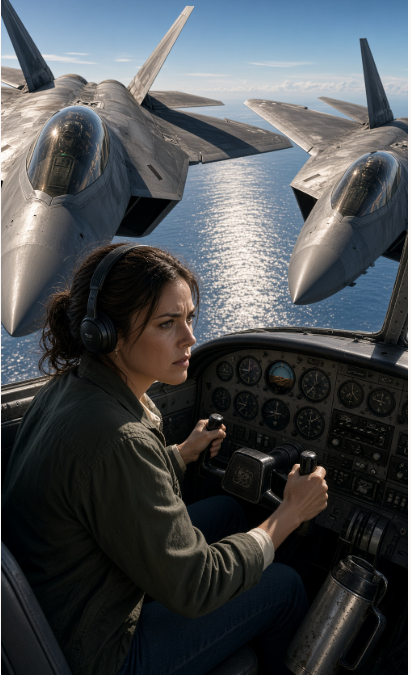
The ocean beneath me was no longer empty.
Gray shapes cut through the water in formation.
Destroyers.
Cruisers.
Support ships.
And at the center of them, enormous even from ten thousand feet, was the unmistakable rectangular flight deck of an aircraft carrier.
My breath stopped again.
A carrier strike group.
Directly beneath my approved civilian route.
For a few seconds, I simply stared.
I had spent enough years around classified operations to understand what that meant.
Something had gone badly wrong.
Either civilian airspace management had failed to distribute a restriction, or this exercise was so compartmentalized that the restriction itself had been intentionally suppressed until the final moment.
Neither possibility comforted me.
The lead fighter banked again.
I saw the underside of the aircraft.
And this time, the signal was not merely directional.
It was a warning.
My headset cracked.
“Begin descent.”
I glanced at my instruments.
“Specify altitude.”
“Five thousand. Immediate.”
The tone had changed.
He was no longer merely redirecting me.
He was managing a threat.
I looked down at the carrier again.
Even from altitude, I could see aircraft arranged along portions of the flight deck.
I had crossed into the protective bubble of a naval force engaged in something important enough that nobody had warned the civilian world it existed.
From their perspective, I had appeared above them unexpectedly.
A civilian aircraft.
Unknown intent.
Unclear access.
Anomalous route.
And if the exercise involved electronic warfare, surveillance testing, or an asset whose presence was not supposed to be observed, then a perfectly innocent Cessna could suddenly resemble something else.
A reconnaissance platform.
A distraction.
A threat.
I understood their fear.
That did not make mine smaller.
“Descending five thousand,” I said.
I eased the nose down.
The F-22 remained beside me.
Then I saw movement beneath its fuselage.
The weapons bay doors shifted.
My mouth went dry.
Training changed the way fear behaved inside me.
Most people imagine courage as an absence of fear.
It isn’t.
Fear is chemistry.
It happens whether you approve of it or not.
Your heart accelerates.
Blood leaves unnecessary systems.
Your vision narrows.
Your muscles prepare to act.
Training simply teaches you what to do while your body is trying to become an animal.
Mine wanted to panic.
Instead, I checked airspeed.
I adjusted power.
I kept descending.
“Air Force aircraft,” I said, “my flight plan was approved. I received no restriction from ATC.”
“Maintain heading and descent.”
“I’m complying.”
“Continue to comply.”
I almost laughed.
Not because anything was funny.
Because I knew that voice.
Not the man himself.
The voice.
The clipped cadence of someone carrying authority and fear at the same time.
I had sounded exactly like that once.
More times than I liked remembering.
The part of me called Sarah Jenkins wanted to keep descending, let them escort me away, file an incident report, answer questions, and go home.
That would have been sensible.
It might even have worked.
But another part of me had started noticing details.
The F-22s.
The carrier.
The absence of a civilian restriction.
The fact that the fighters had approached at my altitude before directing me away.
The rapid escalation.
Something about the geometry bothered me.
If I were simply an accidental civilian intrusion, they should have intercepted farther out.
Much farther.
A carrier strike group does not casually allow an unidentified aircraft to wander overhead before reacting.
Unless the aircraft had crossed a boundary nobody outside the operation knew existed.
Or unless the group had been operating under a communications condition so restrictive that civilian coordination had failed.
Either way, I was no longer comfortable being treated as the sole problem.
I looked toward the left Raptor.
The pilot pointed down.
Again.
Then he pointed west.
His movements were sharper now.
I could feel his urgency through fifty feet of air.
“Three-One-Zero,” he said, “increase descent.”
I checked my vertical speed.
“I am already descending.”
“Increase descent.”
That was when the old instinct surfaced completely.
Something was happening beneath me.
Something they wanted cleared immediately.
I looked at the carrier.
Its deck activity had changed.
Even from altitude, I could see movement.
Aircraft taxiing.
Maybe launching.
Maybe recovering.
Maybe neither.
I couldn’t tell.
What I could tell was that I did not want to make a panicked maneuver inside a formation with two fighters close aboard.
“I will not exceed a safe descent rate with aircraft positioned this close,” I said.
Silence.
Then:
“You are ordered to comply.”
My jaw tightened.
There it was.
The line I had heard too many times in too many rooms.
Comply.
As if the word removed physics.
As if authority made aircraft stronger.
As if fear became safe when spoken through a radio.
I looked left.
The F-22’s weapons bay remained partially open.
That changed the calculation.
I had one identity that could solve this.
And using it could destroy the life I had spent five years building.
My left hand stayed on the yoke.
My right hand rested near the center console.
Under my seat, behind a panel that should not have existed, was a second radio system.
I had built it into the Cessna years earlier.
Not because I expected to use it.
Because some habits survive death.
The system was old compared with front-line equipment, but it had been maintained through channels that belonged to a world Sarah Jenkins supposedly knew nothing about.
A world I had promised never to touch again.
I looked at the little photograph clipped near the right side of my panel.
It showed three of my students standing in front of a training aircraft after their first solo flights.
I had taken the picture the previous summer.
All three were smiling.
One of them, Cody, had vomited behind a hangar ten minutes before his check ride because he had been so nervous.
Another, Lena, had hugged me after her first solo and cried so hard she could barely speak.
Those were my emergencies now.
Bad landings.
Crosswinds.
Engine roughness.
Young pilots discovering that fear and competence can occupy the same cockpit.
I had built an entire life around teaching people not to panic.
And now I was about to destroy that life with one radio call.
The lead pilot transmitted again.
“Three-One-Zero, final warning. Increase descent and maintain assigned heading.”
The words final warning settled everything.
I reached beneath the seat.
My fingers found the metal cover.
For a moment, I did nothing.
Five years disappeared.
Afghanistan returned.
Snow.
Rotor noise.
Blood on white ground.
A helicopter burning against a mountainside.
A voice telling me there was no recovery team coming for another six hours.
Another voice saying the mission had to remain deniable.
Men dying under a sky that looked impossibly clean.
And later, a room without windows.
A man in a dark suit sliding a folder across a table.
Sarah Jenkins.
Ohio.
Flight instructor.
No decorations.
No service record.
No past.
“You understand,” he had said, “that once this is done, Echo Actual is dead.”
I had signed the paper.
I had meant it.
Until now.
I opened the cover under my seat.
A small green indicator waited in darkness.
I flipped the switch.
The transceiver came alive.
The first thing I heard was encrypted traffic resolving into clipped voices.
Different channel.
Different world.
Carrier operations.
Air-defense coordination.
Call signs I had not heard in years.
My chest tightened.
I had forgotten how instantly those voices could pull me backward in time.
I removed the secondary microphone.
For a moment, my hand trembled.
Not from the fighters.
From memory.
The lead pilot spoke again on Guard.
“Three-One-Zero—”
I transmitted on the secure circuit.
“Strike Command, this is Echo Actual.”
Silence.
Not ordinary radio silence.
The kind created when several trained people hear something impossible at the same time.
I could almost see the operations center below me.
Heads turning.
Hands pausing over consoles.
Someone checking a display.
Someone asking whether they had heard correctly.
The F-22 pilot stopped talking.
Three seconds passed.
Maybe four.
Then another voice came over the secure channel.
Not the fighter pilot.
Older.
Calmer.
“Station calling Strike Command, authenticate.”
My throat tightened.
Of course.
Names do not prove identity.
Especially names belonging to dead people.
I gave the authentication response I had been taught never to speak outside a secure circuit.
Silence again.
Longer this time.
I looked left.
The F-22 pilot had stopped gesturing.
His aircraft remained beside me, but something had changed.
I could not see his eyes.
I didn’t need to.
His posture had gone completely still.
Then the lead pilot’s voice entered the secure channel.
“Strike, Talon One.”
The older voice answered immediately.
“Talon One, maintain position.”
“Sir, confirm identity of civilian aircraft.”
“Maintain position.”
There was a pause.
Then the pilot spoke again.
“Copy.”
The aggression was gone.
Every trace of it.
What replaced it was uncertainty.
I had heard that sound before too.
It is what happens when a soldier realizes the person he has been threatening may belong to a chain of command he does not understand.
The pilot switched to my frequency.
“Three-One-Zero…”
He hesitated.
Then he abandoned the tail number.
“Echo Actual, confirm…”
Another pause.
“Confirm that’s your call sign.”
I looked at him through the window.
“That’s what I said.”
He stared at me.
Then came the question that stripped away the last of his composure.
“Who the hell are you?”
The question should not have hurt.
It did.
Because for five years, I had asked myself the same thing.
I kept my voice even.
“Right now, I’m the civilian pilot you’ve got boxed between two fighters.”
There was no answer.
I continued.
“My flight plan was legally filed. There was no published restriction. If you’ve got an airspace coordination failure, resolve it without forcing me into an unsafe descent.”
The old command voice came out before I could stop it.
Cold.
Measured.
Unmistakable.
I hated how easily it returned.
The older voice from Strike Command interrupted.
“Echo Actual, maintain present heading and altitude.”
The lead pilot answered almost simultaneously.
“Strike, she was directed to five thousand.”
“Negative. Echo Actual maintains seven thousand until separation is increased.”
“Copy.”
Immediately, the fighter on my right slid farther away.
The left aircraft followed.
The Cessna stopped shaking as violently.
I hadn’t realized how much jet wash had been affecting me until it eased.
I exhaled slowly.
“Echo Actual,” Strike Command said, “state intentions.”
“I intend to leave your restricted area and continue civilian flight.”
A pause.
“Unable.”
My eyes narrowed.
“Explain.”
“You’re going to be escorted to Naval Air Station Oceana.”
“No.”
Another silence.
The fighter pilot beside me seemed to turn his helmet slightly, as if he had just heard someone tell gravity no.
The voice below remained composed.
“Echo Actual, this is not optional.”
“I’ve spent five years with people telling me things aren’t optional.”
I tightened my grip on the yoke.
“I’ve complied with the intercept. I’m exiting the area. You can send questions through the appropriate channels.”
“Your presence on this network requires immediate security review.”
There it was.
Of course.
The moment I had touched the secure network, Sarah Jenkins’s quiet life had effectively caught fire.
I looked out across the Atlantic.
For a few seconds, I wanted to pretend I could simply keep flying.
West.
Home.
Land at my usual field.
Taxi to my hangar.
Teach my afternoon student how to handle crosswind landings.
Maybe nobody would come.
Maybe the old world would let me close the door again.
I knew better.
“You still there?” the fighter pilot asked quietly.
He wasn’t threatening me anymore.
He sounded almost human.
“I’m here.”
“For what it’s worth,” he said, “we didn’t know your flight plan had been cleared.”
I looked toward his aircraft.
That surprised me.
“That’s worth something.”
“The track came through as unidentified after our civilian feed dropped.”
That explained part of it.
Electronic isolation.
Classified exercise.
Civilian coordination failure.
I sighed.
“Then somebody almost killed me because two systems stopped talking to each other.”
He did not answer immediately.
“No one wanted that.”
“People rarely want the worst thing they almost cause.”
Silence again.
Then Strike Command returned.
“Echo Actual, proceed heading two-eight-five. Talon flight will escort. Oceana has been notified.”
I closed my eyes for half a second.
There was no point fighting it.
Not anymore.
“Copy two-eight-five.”
The fighters repositioned.
No longer trapping me.
Escorting me.
The distinction should have felt comforting.
It didn’t.
As we turned toward Virginia, the carrier group slowly disappeared behind us.
I watched it vanish beneath the haze.
Five years of silence had ended in less than five minutes.
The flight to Oceana took less than an hour.
It felt longer than some deployments.
The lead Raptor stayed off my left side at a respectful distance.
We barely spoke.
At one point he asked about my fuel.
Another time he confirmed my altitude.
The exchanges were professional.
Almost painfully so.
Neither of us mentioned the moment he had threatened to fire.
Neither of us mentioned my name.
But I could feel the question sitting inside his cockpit.
Who are you?
I spent the flight trying to remember the answer.
Sarah Jenkins was real.
That mattered.
People sometimes talk about cover identities as if they are costumes.
Mine had not been.
I had paid rent under that name.
I had sat beside a fourteen-year-old student named Emily after her father died and listened while she told me she wanted to keep flying because he had loved airplanes.
I had spent Sundays fixing a leaking hangar roof with my neighbor Frank.
I had eaten Christmas dinner with my elderly landlady when her children couldn’t make it through a snowstorm.
I had built friendships.
Habits.
Memories.
A life.
Sarah Jenkins was not fake.
She was the first person I had ever been allowed to choose.
Echo Actual had been assigned to me.
Sarah had been mine.
That was why speaking the old call sign felt less like revealing a secret and more like opening a grave.
Oceana appeared ahead beneath a thin layer of haze.
Military fields have a visual order civilian airports rarely possess.
Everything is deliberate.
Taxiways.
Security.
Spacing.
Aircraft.
Even from the air, you can feel that the ground is controlled.
Tower gave me landing clearance.
The two Raptors peeled away before final.
I watched the lead aircraft climb.
For a moment, sunlight flashed across its canopy.
Then it was gone.
I touched down harder than I wanted.
Not dangerous.
Just inelegant.
Five years teaching students not to force landings, and here I was planting a Cessna on a military runway like a first-year trainee.
“Nice landing,” tower said.
I couldn’t tell whether he was joking.
“Long morning.”
“Understood.”
I taxied where directed.
Then I saw the vehicles.
Black SUVs.
Security trucks.
A fire vehicle farther back.
Armed personnel positioned at a distance.
Of course.
I shut down the engines.
The sudden silence inside the cockpit felt enormous.
For several seconds, I simply sat there.
My hands rested on the yoke.
The engines ticked as they cooled.
Outside, people waited for a dead woman to climb out of an airplane.
I looked at the photograph of my students again.
Then I opened the door.
The wind hit me first.
Salt air.
Jet fuel.
Warm pavement.
A security officer approached but stopped several yards away.
“Ma’am, step clear of the aircraft.”
I climbed down.
“Hands visible.”
I held them out.
Old reflexes told me to identify fields of fire, distances, cover, numbers.
I hated that those calculations still arrived without permission.
A man in a Navy uniform walked toward me from the nearest SUV.
Late fifties.
Silver at his temples.
Admiral stars.
He stopped ten feet away.
For a long moment, neither of us spoke.
Then his face changed.
Not shock.
Recognition.
Something sadder.
“Jesus,” he said quietly.
I knew him.
Rear Admiral Daniel Mercer.
Five years earlier, he had been a captain attached to a joint operations command.
He had sat across from me in rooms where the lights never turned off.
He had once spent thirty-six straight hours coordinating extraction support after a mission collapsed near the Afghan border.
He had also attended my funeral.
I knew because I had seen the classified photographs afterward.
“Hello, Daniel.”
Every security officer within earshot seemed to become more alert.
He took one step closer.
“They told us you were gone.”
“I was.”
“That’s not an answer.”
“It was the only answer anybody wanted.”
His jaw tightened.
He looked at me the way people look at someone returned from a war they had already mourned.
“Did you know we were operating out there?”
“No.”
“Did you know the exercise window?”
“No.”
“Did anyone contact you?”
“No.”
He studied me.
“Then how did you access our tactical network?”
I glanced back at the Cessna.
“That question has an answer you won’t like.”
His eyes closed briefly.
“Of course it does.”
One of the security officers moved closer.
Mercer lifted a hand.
“Stand down.”
“Sir—”
“I said stand down.”
The officer stopped.
Mercer looked at me again.
“Is there anything on that aircraft that presents a threat?”
“No.”
“Classified equipment?”
“Yes.”
He stared at me.
“Still operational?”
“Apparently.”
For the first time, something almost resembling disbelief crossed his face.
“Five years, Sarah.”
“That’s what the calendar says.”
He looked at the airplane.
Then at me.
“Come inside.”
The room they put me in was exactly the kind of room I had hoped never to see again.
No windows.
Plain table.
Four chairs.
A camera in one corner.
A clock designed to make waiting feel longer.
Someone brought me water.
I drank half the bottle and waited.
Twenty minutes later, Mercer entered with two people in civilian clothes.
They did not introduce themselves.
They didn’t need to.
One carried a thick folder.
The other carried nothing.
That one worried me more.
Mercer sat across from me.
“Your civilian identity is valid,” he said.
“I know.”
“The flight plan was valid.”
“I know.”
“There was a coordination failure between the exercise air-defense picture and civilian traffic feeds.”
I said nothing.
“The restriction wasn’t publicly distributed because of the classification level of the exercise.”
I looked at him.
“Then you created an invisible wall in public airspace.”
His expression hardened.
“It’s more complicated.”
“It always is when somebody almost dies.”
The civilian with the folder opened it.
“Ms. Jenkins—”
“Which one?”
He paused.
Good.
“You used the call sign Echo Actual.”
“Yes.”
“That designation was retired five years ago.”
“I know.”
“The individual associated with it is legally deceased.”
I leaned back in the chair.
“So I’ve heard.”
He looked down at the file.
“Colonel Sarah Elizabeth Walker.”
Hearing the name aloud felt like being struck.
Not because I had forgotten it.
Because nobody had spoken it to my face in five years.
Mercer watched me carefully.
The man continued.
“Joint special operations aviation coordination. Compartmented mission authority. Multiple theaters. Decorations sealed. Service record administratively terminated following the Nuristan incident.”
I kept my face still.
Inside, something old was breaking open.
Snow.
Rotor blades.
Burning hydraulic fluid.
A medic screaming for morphine.
A pilot pinned beneath twisted metal.
My own blood freezing against my sleeve.
I forced the images back down.
The civilian closed the folder.
“How did you survive?”
I looked at Mercer.
He knew enough to understand why I didn’t answer immediately.
“That isn’t relevant to today’s airspace violation.”
The man stared at me.
“Everything about you is relevant.”
“No.”
My voice came out colder than I intended.
“You people made sure it wasn’t. Remember?”
The room went silent.
Mercer looked away.
That told me more than words could.
Five years earlier, the official solution had been simple.
The helicopter crash occurred during an operation whose existence could not become public.
Several people were actually killed.
My survival created complications.
I knew too much.
I had operated under authorities that would have created political problems if examined outside classified channels.
And I had already given eleven years to a system that had begun consuming every part of me.
Someone decided a dead officer could disappear more cleanly than a living one could retire.
I had agreed.
That was the part no one liked discussing.
I had agreed.
At the time, it felt like mercy.
A new identity.
A civilian life.
No more deployments.
No more rooms without windows.
No more names whispered only once and then erased.
I thought death had purchased my freedom.
Five years later, two F-22s had shown me the receipt was still open.
The civilian without the folder finally spoke.
“Why retain access capability?”
I looked at him.
“Because the people who told me I’d never need it were the same people who had just told the world I was dead.”
He didn’t react.
Mercer almost did.
“You didn’t trust the arrangement,” he said.
“I trusted it enough to live inside it.”
“That’s not the same thing.”
“No.”
He rubbed one hand across his face.
“Did you ever use the radio before today?”
“No.”
“Contact anyone from the old network?”
“No.”
“Conduct any operational activity?”
“No.”
“Collect intelligence?”
I laughed once.
It sounded tired.
“I teach sixteen-year-olds how to land Cessnas.”
No one smiled.
I looked at Mercer.
“My most dangerous operation last month involved a student trying to take off with the parking brake partially set.”
That finally broke something in him.
A small breath escaped through his nose.
Almost a laugh.
Then he became serious again.
“The pilot who intercepted you has been grounded pending review.”
My stomach tightened.
“Why?”
“Standard procedure after a weapons authorization event.”
“He followed the information he had.”
Mercer raised an eyebrow.
“He threatened to fire.”
“He had an unidentified aircraft over a carrier group during a compartmented exercise.”
“You defending him?”
“I’m explaining him.”
The civilians exchanged a glance.
I continued.
“If you punish the last person in the chain because the systems above him failed, you learn nothing.”
Mercer studied me.
“There she is.”
I knew what he meant.
The old commander.
The woman who could walk into a room furious and leave having redesigned the entire failure chain.
I looked down at my hands.
“No.”
“Sarah—”
“No.”
I raised my eyes.
“Don’t do that.”
“Do what?”
“Look at me like she’s coming back.”
His expression softened.
For the first time that day, I felt something more dangerous than fear.
Grief.
“I buried her,” I said.
Mercer’s voice dropped.
“So did I.”
That stopped me.
He leaned back.
“I stood beside an empty coffin while your sister cried so hard she couldn’t breathe.”
My chest constricted.
The room disappeared for a second.
My sister.
Rebecca.
The one person I had never been allowed to contact.
That had been the price.
My death had to be real.
Not metaphorically.
Not bureaucratically.
Real to everyone outside the compartment.
Rebecca had believed I died.
I knew that.
I had always known it.
But hearing someone describe her grief made the knowledge physical.
I turned away.
“You don’t get to use her.”
“I’m not.”
“Then don’t.”
“I’m telling you what this cost.”
I looked back at him.
“You think I don’t know?”
My voice broke on the last word.
I hated that.
For years, I had learned to control tone even when people were dying.
Now one mention of my sister and the discipline cracked.
Mercer’s face changed immediately.
The officials across from me became less important.
For a moment, it was only two people who had lived through the same terrible machinery from different sides.
“I know you know,” he said.
I stared at the table.
“I watched her funeral message.”
Mercer went still.
“I wasn’t supposed to have access. Someone left it in the file.”
“What message?”
“She recorded something after the service.”
I swallowed.
“She said she hated me because I always promised I’d come home.”
Nobody spoke.
“I watched it once.”
I rubbed my thumb across the side of the water bottle.
“Then I deleted it.”
The room remained silent.
“I spent five years becoming somebody else because that was the agreement. I did everything asked of me. I stayed quiet. I disappeared.”
I looked at the civilian officials.
“And today your people nearly killed that person because your classified exercise failed to coordinate with civilian aviation.”
The man with the folder opened his mouth.
I cut him off.
“No. You don’t get to turn this into an interrogation about why I survived while ignoring why I was in the wrong airspace without knowing it.”
His jaw tightened.
Mercer intervened.
“She’s right.”
The civilian looked at him.
“Admiral—”
“The flight plan was valid.”
Mercer’s voice hardened.
“The aircraft complied once intercepted. The security issue surrounding her retained equipment is separate.”
I looked at him.
He continued.
“And it will remain separate in my report.”
The two civilians clearly disliked that.
Good.
I had forgotten how satisfying competent disagreement could feel.
The interview lasted another two hours.
They asked about the Cessna.
The hidden radio.
My contacts.
My life in Ohio.
Whether anyone had approached me.
Whether I had ever disclosed my history.
I answered enough to satisfy the immediate security concern and refused questions that drifted beyond it.
Eventually, the two civilians left.
Mercer remained.
The clock on the wall showed almost three in the afternoon.
My morning flight had been supposed to end before lunch.
I thought about the student waiting at my home airport.
I pictured him checking his phone, wondering why his instructor had vanished somewhere over Virginia.
Again.
Apparently disappearance was becoming a professional habit.
Mercer slid a temporary access badge across the table.
“Your aircraft is being inspected.”
“Of course it is.”
“You’ll get it back.”
“Today?”
He hesitated.
“Daniel.”
“Probably not today.”
I leaned back.
“Perfect.”
“We can arrange transportation.”
“Back to Ohio?”
“Wherever you’re cleared to go.”
I looked at him sharply.
He sighed.
“That came out wrong.”
“It came out accurately.”
He said nothing.
There was a question sitting between us.
I finally asked it.
“What happens to Sarah Jenkins?”
Mercer’s eyes changed.
There it was.
The only question that mattered.
“I don’t know yet.”
I looked away.
“That’s what I was afraid of.”
“The identity is legally supported.”
“Legal support can be withdrawn.”
“Not casually.”
I looked back at him.
“You and I both know casual isn’t the danger.”
He knew exactly what I meant.
Classification.
Containment.
Risk mitigation.
Words that could erase a human life without ever sounding violent.
“I won’t let them disappear you again.”
I almost smiled.
“You didn’t stop them the first time.”
His face tightened.
“No.”
The word carried five years.
He stood and walked toward the door.
Then stopped.
“The pilot wants to speak with you.”
I blinked.
“Talon One?”
“Major Evan Hale.”
“Why?”
“He asked.”
“That’s not an answer.”
“It’s the only one I have.”
Twenty minutes later, I was standing near a secure hangar when a man in a green flight suit approached.
Early thirties.
Tall.
Helmet bag in one hand.
He looked different without the visor.
Younger than the voice had sounded.
He stopped several feet away.
“Ms. Jenkins?”
“Depends who’s asking.”
He almost smiled.
“Major Hale.”
“I gathered.”
For a moment, he seemed unsure where to put his hands.
That surprised me more than the fighters had.
Finally, he said, “I wanted to apologize.”
“You were executing an intercept.”
“I threatened to kill you.”
“You didn’t know who I was.”
“That shouldn’t matter.”
I studied him.
Good answer.
He looked toward the hangar.
“Our track system lost the civilian identification feed during the exercise. We were told an unknown aircraft had penetrated the outer zone.”
“I know.”
“By the time we got visual, you were almost over the group.”
“I know.”
“We had intelligence injects running at the same time.”
“Simulated threats.”
He nodded.
“You looked exactly like something we were being told to expect.”
That was the part I had suspected.
I crossed my arms.
“So you weren’t trigger-happy.”
His face tightened.
“I’d prefer not to be remembered that way.”
“I wasn’t planning to remember you at all.”
That startled a laugh out of him.
A real one.
Brief.
Then he became serious.
“When you said Echo Actual…”
He stopped.
I waited.
“I’d heard the call sign before.”
My stomach tightened.
“Where?”
“Training.”
Of course.
He looked embarrassed now.
“There was a case study.”
I closed my eyes.
“Wonderful.”
“Not by name.”
“Naturally.”
“It was about an extraction operation in Afghanistan. Air assets were being denied because of conflicting authorities. One commander forced the issue and got a team out before the weather closed.”
I remembered.
I wished I didn’t.
Twenty-three people trapped in a valley.
Incoming snowstorm.
Ground force commander wounded.
Three separate authorities arguing over who could release support.
I had bypassed all of them.
People had been furious afterward.
Twenty-three soldiers had lived long enough to be angry too.
Hale looked at me.
“That was you, wasn’t it?”
I said nothing.
He didn’t need an answer.
His expression shifted.
Not awe.
Thank God.
Something quieter.
Understanding.
“When you came over the secure channel, I thought I was hearing a ghost.”
I looked toward the runway.
“So did I.”
We stood there for a moment.
Jets moved in the distance.
Ground crews shouted.
Somewhere, an engine started.
Life continued with military efficiency.
Hale cleared his throat.
“I really am sorry.”
I looked at him.
“You kept your wingman controlled.”
He nodded.
“You maintained visual identification.”
Another nod.
“You gave me clear instructions.”
“Yes.”
“You also let adrenaline into your voice and crowded a civilian aircraft more aggressively than necessary.”
His mouth tightened.
“Yes.”
“And if someone hadn’t lost the traffic feed, none of us would have met.”
“No.”
I held out my hand.
“Learn the right lesson.”
He looked at it.
Then shook it.
His grip was firm.
“What lesson is that?”
“That the person in front of you is never the whole failure.”
He nodded slowly.
“I think I understand.”
“You will.”
He released my hand.
Then he asked, “What should I call you?”
The question struck deeper than he intended.
I looked at the Cessna inside the hangar.
Then at my temporary badge.
Then at the man who had met both versions of me in the same morning.
“Sarah.”
He nodded.
“Sarah.”
That evening, Mercer arranged a flight back to Ohio.
Not military.
Civilian charter.
I appreciated that.
Before I left, he found me near the terminal entrance.
“We’ll contact you about the aircraft.”
“Through Sarah?”
“Through Sarah.”
I searched his face.
“And afterward?”
He knew what I meant.
“Your identity remains active.”
“For now.”
“For good, if I have anything to say about it.”
I nodded.
I wanted to believe him.
Maybe part of me did.
He put his hands in his pockets.
“There’s something else.”
I waited.
“Rebecca still lives in Maryland.”
My entire body went rigid.
“Don’t.”
“She never stopped asking questions.”
“Daniel.”
“I haven’t contacted her.”
“Don’t.”
He watched me carefully.
“You could.”
I looked away.
“No.”
“Why?”
“Because she’s spent five years learning how to live with my death.”
“Have you?”
The question angered me because it was good.
I looked back at him.
“That’s not your decision.”
“No.”
He nodded.
“It isn’t.”
He handed me a small card.
No markings except a secure number written by hand.
“If you ever want the situation reviewed…”
I stared at the card.
“You mean contact.”
“I mean options.”
I took it.
Not because I intended to use it.
Because I had learned a long time ago never to reject an exit before knowing where it led.
The charter lifted out after sunset.
I sat alone in the back.
No yoke.
No instruments.
No responsibility for the airplane.
I hated it.
Pilots are terrible passengers because we spend the entire flight imagining all the things the person in front might be doing wrong.
But eventually the lights of Virginia disappeared beneath the wing.
The sky became dark.
And for the first time since morning, nobody was speaking into my headset.
I took the card Mercer had given me from my pocket.
I turned it over.
Blank.
I thought about Rebecca.
I thought about the funeral I had never attended.
The life I had allowed her to believe had ended.
Then I thought about my students.
My hangar.
The little kitchen in Ohio with the cabinet door I kept meaning to repair.
The version of myself I had created from nothing.
I understood something then.
For five years, I had believed survival required choosing between the two women.
Sarah Jenkins or Echo Actual.
Civilian or commander.
Living or dead.
That morning had proved the division was never that clean.
Echo Actual had saved Sarah’s life.
Sarah had reminded Echo Actual why a life was worth saving.
Neither was entirely false.
Neither was entirely gone.
When I finally reached my home airfield, it was almost midnight.
Frank, my hangar neighbor, was waiting beside his pickup.
He hurried toward me the moment I stepped out of the charter terminal.
“Where the hell have you been?”
I stared at him.
His face was full of ordinary worry.
The best kind.
“My aircraft got diverted.”
“Diverted where?”
“Virginia.”
He frowned.
“You flew east.”
“Apparently I was ambitious.”
He stared at me another second.
Then shook his head.
“I called you twelve times.”
“I know.”
“I thought you ditched in the Atlantic.”
The words hit me harder than he could have known.
I forced a small smile.
“Not today.”
He pulled me into a hug.
Frank was sixty-three, smelled like engine oil and peppermint gum, and had absolutely no idea that half the national security apparatus had spent the afternoon arguing about whether I legally existed.
I hugged him back.
That simple act nearly broke me.
When he finally let go, he pointed toward the parking lot.
“Come on. I’ll drive you home.”
“I can get a cab.”
“No.”
“Frank.”
“Sarah, you look like you’ve been interrogated by the Pentagon.”
I froze.
He squinted at me.
“That was a joke.”
“Right.”
He opened the passenger door.
“Get in.”
I did.
We drove through dark country roads toward town.
Nothing dramatic happened.
No black SUVs followed us.
No helicopters appeared.
No one called me Echo.
Frank complained about fuel prices and told me Cody had shown up for his lesson, waited two hours, then left convinced I hated him.
I laughed for the first time all day.
“I’ll call him tomorrow.”
“You’d better.”
At my house, Frank waited until I unlocked the front door.
“You okay?”
I looked at him.
The truthful answer was complicated.
So I gave him a truthful piece.
“I will be.”
He nodded.
“See you tomorrow.”
“Tomorrow.”
I went inside.
The house was dark.
I turned on the kitchen light.
Everything looked exactly as I had left it.
One mug in the sink.
A stack of mail.
A grocery list attached to the refrigerator.
Milk.
Eggs.
Coffee.
Ordinary life.
I stood there for a long time.
Then I took Mercer’s card from my pocket.
I placed it on the kitchen table.
Beside it, I put my pilot certificate.
Sarah Jenkins.
Two pieces of paper.
Two possible doors.
For five years, I had believed peace meant never looking backward.
That night, I understood peace differently.
It wasn’t forgetting.
It wasn’t pretending the person you had been never existed.
It was reaching the point where the past no longer got to choose what happened next.
The secure phone number stayed on my table for three days.
On the fourth morning, I called it.
Not to return to service.
Not to become Echo Actual again.
I called because there was one thing I wanted.
One thing I had wanted every day for five years and had never allowed myself to say aloud.
When Mercer answered, I spoke before fear could stop me.
“I want to talk to my sister.”
There was silence on the line.
Then he said, very quietly, “I’ll see what can be done.”
Three weeks later, I stood outside a small house in Maryland with my hands shaking worse than they had between the two F-22s.
The government had arranged it carefully.
Rebecca had been told only that information surrounding my death required correction.
No details.
No explanation that could compromise anything.
She opened the door.
For a second, she didn’t recognize me.
Then she did.
Her face lost all color.
I had imagined that moment thousands of times.
In some versions, she screamed.
In others, she slapped me.
Sometimes she shut the door.
Sometimes she hugged me.
Reality was quieter.
She simply stared.
Her mouth opened.
Nothing came out.
“Becca.”
Her knees nearly gave way.
I stepped forward.
She backed away.
That hurt more than I expected.
“You died.”
Three words.
Almost a whisper.
“I know.”
“I buried you.”
“I know.”
“I stood there.”
Tears filled her eyes.
“You let me stand there.”
There was no defense.
So I didn’t offer one.
“Yes.”
She struck me across the face.
I accepted it.
Then she struck my chest with both hands.
Again.
Again.
“You let me think you were dead.”
“I’m sorry.”
“I hated you.”
“I know.”
“I missed you every day.”
My throat closed.
“I know.”
“You don’t know.”
She hit my chest once more.
Then her strength disappeared.
She collapsed against me.
I caught her.
And for the first time in five years, my sister held me.
She cried so hard she could barely breathe.
Eventually, so did I.
There were no classified words in that moment.
No call signs.
No ranks.
No operations.
No dead officers.
Only two sisters standing in a doorway trying to understand how love survives a lie large enough to contain a funeral.
I did not tell her everything.
I never could.
But I told her the one truth that mattered.
“I didn’t leave because I stopped loving you.”
She looked at me through tears.
“Then why?”
“Because at the time, I thought disappearing was the only way I could stay alive.”
She wiped her face.
“And now?”
I thought of the Atlantic.
The F-22 beside my wing.
The weapons bay opening.
The green light beneath my seat.
Echo Actual returning from the dead because Sarah Jenkins needed her.
“Now I’m trying to learn another way.”
Rebecca stared at me for a long time.
Then she nodded.
Not forgiveness.
Not yet.
But a beginning.
Sometimes that is all a person gets.
Months later, the investigation into the intercept was closed.
The official version was dry and bloodless.
A coordination failure between classified military operations and civilian aviation systems had allowed an authorized aircraft to enter an active security zone without either side possessing a complete operational picture.
Procedures were changed.
Data-sharing safeguards were added.
The pilots were cleared.
Major Hale returned to flying.
My Cessna came back to Ohio with several panels cleaner than they had been when it left.
The hidden transceiver did not.
I didn’t ask for it.
I didn’t need it anymore.
One afternoon, Hale sent a short message through an approved channel.
Three words.
Still teaching pilots?
I replied.
Every day.
He sent back:
Good.
That was enough.
I kept flying.
I kept teaching.
I repaired the kitchen cabinet.
Rebecca and I started speaking once a week.
Some conversations were easy.
Others ended with both of us crying.
We had five stolen years to cross, and no aircraft in the world could make that distance disappear instantly.
But we were crossing it.
Slowly.
Honestly.
One day at the airfield, Cody asked me whether I had ever been truly afraid in an airplane.
We were sitting inside a trainer before his first solo cross-country.
His hands were shaking.
I looked through the windshield at the clear blue sky.
For an instant, I saw gray wings beside me.
I heard the warning in my headset.
I felt my fingers opening a switch beneath the seat.
Then the memory passed.
“Yes,” I told him.
He looked surprised.
“But you’re never scared.”
“That’s not true.”
“What did you do?”
I smiled.
“I flew the airplane.”
He frowned.
“That’s it?”
“That’s usually the first thing.”
He thought about that.
Then he nodded.
I closed his door and stepped away from the aircraft.
A few minutes later, he taxied toward the runway alone.
I watched him take off.
The little airplane climbed against a cloudless sky.
No shadows crossed it.
No fighters appeared.
Nothing dramatic happened.
And standing there in the sunlight, listening to a student’s engine fade into the distance, I realized something that would once have seemed impossible.
I no longer needed the world to know who Echo Actual had been.
I no longer needed anyone to fear the name.
I had used it once because I had to.
It had saved my life.
Then I had put it back where it belonged.
In the past.
My name was Sarah Jenkins.
I was a flight instructor from Ohio.
I had a sister who was learning how to forgive me, students who trusted me with their fear, a battered thermos that never kept coffee warm, and a restored Cessna waiting in my hangar.
That life was not a cover anymore.
It was mine.
And whenever I flew east and saw the Atlantic shining beneath my wings, I remembered the morning two F-22 Raptors appeared beside me at ten thousand feet.
I remembered how close I came to losing everything.
But what stayed with me most wasn’t the missiles.
It wasn’t the carrier.
It wasn’t even the silence after I spoke the forbidden call sign.
It was the moment afterward, when a fighter pilot who had been ready to shoot me asked who I was.
For years, I had thought I didn’t know the answer.
Now I did.
I was the woman who had survived being declared dead.
I was the woman who had built another life from the wreckage.
And I was finally done letting either version of me erase the other.








