𝗙𝗨𝗟𝗟 𝗦𝗧𝗢𝗥𝗬 After 12 Years of Facing Danger Together, His K9 Lifted His Paws for One Final Goodbye
𝗣𝗔𝗥𝗧 𝟮
Michael shook his head.
“He heard me fall.”
He became quiet.
“Turned around and came back.”
I looked at Rex through the vehicle window.
“He abandoned the pursuit?”
“Immediately.”
“Was that what he was trained to do?”
“No.”
Michael smiled slightly.
“Not exactly.”
“What happened?”
“He sat next to me.”
“That’s it?”
“He wouldn’t leave.”
Michael’s expression changed when he remembered it.
“He knew something was wrong.”
Backup arrived several minutes later.
Another officer eventually continued the pursuit.
But Rex remained with Michael the entire time.
“That was when I understood,” Michael told me.
“Understood what?”
“He wasn’t just doing a job.”
Michael looked toward Rex.
“He had decided I was his responsibility.”
Years later, sitting outside that veterinary room, I remembered that conversation.
Because the roles had reversed.
For twelve years, Rex had protected Michael.
Now Michael was the one responsible for protecting Rex.
Even from suffering.
The illness began quietly.
At first, none of us thought much about it.
Rex was aging.
Older dogs slowed down.
He took longer getting out of the vehicle.
His hips were stiff after lying down too long.
Sometimes he stayed asleep while the rest of us talked nearby.
Michael joked about it.
“Retirement attitude.”
Rex would lift his head, look offended, then go back to sleep.
But then came the weight loss.
Not dramatic.
Just enough that Michael noticed before anyone else.
“He isn’t finishing meals.”
I remember him telling me that one morning.
“Maybe he’s tired of your cooking.”
“It’s dog food.”
“Exactly.”
Michael didn’t laugh.
That was when I realized he was worried.
Veterinary appointments followed.
Tests.
Bloodwork.
Scans.
More appointments.
Then the diagnosis.
Michael never told me every detail.
He didn’t need to.
It was serious.
Progressive.
Treatable for a while.
Not curable.
He said one sentence after the veterinarian confirmed it.
“They can give us time.”
Us.
Not Rex.
Us.
That mattered.
For months, Michael reorganized everything around the dog.
Medication schedules.
Special food.
Appointments.
Shorter walks.
Longer rests.
Rex officially left active service.
That alone was difficult.
On his last day at the unit, several of us gathered outside.
Nothing formal.
Michael didn’t want a ceremony.
“He’s retiring, not running for office.”
Still, people came.
Some had worked operations with him years earlier.
Others barely knew him but had heard the stories.
Rex sat beside Michael.
Older.
Gray around the muzzle.
Still alert.
Someone handed Michael an old leather training ball.
Rex saw it.
His ears went up.
For a moment, he looked five years younger.
Everyone laughed.
Michael threw it only a short distance.
Rex went after it.
Slowly.
Retrieved it.
Returned.
Dropped it at Michael’s boots.
Michael crouched.
“That’s enough, partner.”
He touched Rex’s head.
“You’re off duty.”
Rex looked up.
I don’t know whether dogs understand retirement.
I doubt they understand the concept the way we do.
But I know Rex understood that his days had changed.
For the first few weeks, he reportedly waited by the door every morning at the time Michael used to prepare for work.
If Michael picked up his keys, Rex stood.
If he put on his work boots, Rex walked toward him.
Michael eventually started dressing in another room because watching Rex expect to come along hurt too much.
Then, gradually, Rex adjusted.
Or maybe Michael did.
They developed new routines.
Slow walks.
Long afternoons in the yard.
Car rides with no destination.
Michael bought Rex a ridiculous orthopedic bed large enough for a small horse.
Rex ignored it for three days and slept on the floor beside Michael’s chair.
“How much did that bed cost?” I asked.
“Don’t ask.”
“And he won’t use it?”
“He uses it.”
“When?”
“When I sit on it.”
That was Michael.
Even in the middle of something terrible, he found small places to laugh.
For a while, the treatment helped.
Rex gained some energy.
He ate again.
On good days, he carried his ball.
On very good days, he waited by the back door for Michael to take him outside.
We all began doing what people do when they are frightened of an ending.
We mistook temporary improvement for permission to hope the ending had disappeared.
Then the illness progressed.
The first sign was Rex having trouble standing.
Michael would place a hand beneath his chest and help.
Rex hated the assistance.
You could see it.
His body still believed it should be strong enough.
Michael would say, “Easy.”
Rex would look at him.
“It’s okay.”
That word became common.
Okay.
It’s okay.
You’re okay.
I’ve got you.
Maybe Michael was speaking to Rex.
Maybe he was speaking to himself.
Then came the day when Rex no longer tried to stand when Michael entered the room.
That frightened Michael more than anything before it.
For twelve years, Rex had reacted to him.
Tail.
Head.
Ears.
Something.
Now he simply lay there.
His eyes moved.
His tail tapped weakly once.
Michael sat beside him.
That evening he called me.
He rarely called without a reason.
“Marcus.”
“What’s wrong?”
A long pause.
“I think we’re close.”
I knew exactly what he meant.
I leaned against my kitchen counter.
“I’m sorry.”
“Yeah.”
Silence.
Then Michael said, “How do you know?”
“Know what?”
“When it’s time.”
That question is easy to answer when you’re not the one who has to make the decision.
People say:
You’ll know.
You’ll see it in their eyes.
Don’t let them suffer.
Think about quality of life.
All true.
None useful enough when the animal in question has carried twelve years of your life beside you.
“I don’t know,” I said.
Michael was quiet.
“But you’ll make the right choice.”
“How do you know?”
“Because you’ve been making choices for him his whole life.”
Another pause.
“And he trusted you.”
Michael breathed out.
“I don’t want the last thing I do for him to feel like betrayal.”
“It won’t.”
“You can’t know that.”
“No.”
I swallowed.
“But Rex does.”
Michael said nothing.
“He spent twelve years trusting you to decide when to go forward, when to stop, when to enter, when to come back.”
I heard Michael’s breathing through the phone.
“This is still you protecting him.”
He didn’t answer for a long time.
Then:
“Can you come tomorrow?”
“Where?”
He gave me the name of the veterinary clinic.
“I’ll be there.”
The next morning, I arrived early.
Too early.
I sat in my vehicle outside the clinic for nearly twenty minutes.
The sky was pale.
Quiet morning.
People came and went carrying cats in boxes and dogs on leashes.
Ordinary appointments.
Vaccinations.
Checkups.
Nothing about the building looked like a place where someone’s world was about to end.
Then Michael’s vehicle pulled in.
I got out.
He opened the rear door.
Rex was lying on a thick blanket.
Michael stood there for a moment.
Didn’t move.
I approached slowly.
“Need help?”
Michael shook his head.
“I’ve got him.”
He slipped one arm beneath Rex’s chest and the other beneath his hindquarters.
For twelve years, Rex had moved under his own strength.
Now Michael lifted him.
Gently.
Carefully.
The German Shepherd who had once pulled grown men to the ground felt frighteningly light.
Michael carried him toward the entrance.
I opened the door.
The receptionist already knew why we were there.
Her face changed the moment she saw Michael.
“Dr. Turner is ready.”
Michael nodded.
Nothing else.
We walked down a hallway.
I stayed several steps behind.
That is the image I still remember.
Michael carrying Rex.
The dog’s head resting against his arm.
Michael walking slowly.
Not because Rex was heavy.
Because every step took them closer to goodbye.
Dr. Turner met us in a quiet room at the end of the corridor.
It was softer than most examination rooms.
Blankets.
Low lighting.
A rug.
No stainless-steel table in the middle.
The kind of room designed for exactly what was about to happen.
Michael lowered Rex onto the blanket.
Dr. Turner examined him.
Spoke quietly.
Explained that Rex’s condition had declined.
Pain.
Weakness.
Breathing.
The treatment was no longer giving him comfort.
Michael listened.
He asked practical questions.
Of course he did.
“Will he be afraid?”
“We’ll keep him comfortable.”
“Will it hurt?”
“No.”
“Will he know I’m here?”
Dr. Turner looked at him.
“Yes.”
Michael’s eyes closed for one second.
“Good.”
The veterinarian continued explaining the process.
Michael nodded.
I heard almost none of it.
I watched his face.
He had faced danger hundreds of times.
I had seen him injured.
Seen blood on his uniform.
Seen him walk into buildings while everybody outside knew someone armed might be waiting.
Never had he looked as vulnerable as he did listening to a veterinarian explain how his dog would die peacefully.
Dr. Turner eventually asked, “Would you like some time?”
Michael nodded.
The veterinarian left.
An assistant remained briefly, then stepped out too.
I moved toward the door.
Michael looked at me.
“You don’t have to go.”
I stopped.
“You sure?”
He looked at Rex.
“Yeah.”
I stayed.
But I moved to the side of the room.
Not because I was uncomfortable.
Because what existed between them deserved space.
Michael lowered himself onto the floor.
His knees cracked.
Under any other circumstance I would have made a joke.
Not that morning.
He sat beside Rex.
Rex’s eyes were half open.
Breathing shallow.
Michael placed one hand on his head.
The other along his ribs.
For several seconds he said nothing.
Then he whispered:
“Hey, partner.”
Rex’s ear moved.
Barely.
Michael smiled.
“There you are.”
His thumb stroked the fur between Rex’s eyes.
“You know, you scared the hell out of me the first day.”
I looked down.
I had heard parts of that story, but never the whole thing.
Michael continued talking to Rex.
“They told me you were difficult.”
A weak laugh.
“Too aggressive. Too stubborn.”
Rex breathed.
“They told me not to expect much.”
Michael shook his head.
“They were idiots.”
His voice broke slightly.
“You walked over and sat right in front of me.”
I could picture it.
Young Rex.
One year old.
Too much energy.
Too much drive.
People seeing a problem.
Then Michael approaching the kennel.
The dog sitting.
Choosing.
Michael leaned closer.
“I didn’t pick you.”
His hand stopped.
“You picked me.”
The room became even quieter.
Outside, someone walked down the hallway.
A door opened.
Closed.
Life continuing.
Inside, Michael began thanking his dog.
Not with grand words.
With memories.
“Thank you for every night.”
His fingers moved along Rex’s coat.
“Every call.”
His voice trembled.
“Every search.”
Rex’s eyes remained on him.
“Every time you went first because I asked.”
Michael swallowed.
“Every time you came back.”
I had to look away.
He kept talking.
“Remember the warehouse?”
A smile touched his face.
“You made me look stupid.”
His shoulders shook once with a quiet laugh.
“Guy thought he was hiding. You found him in about thirty seconds.”
Rex breathed slowly.
“And that field search.”
Michael looked down.
“Eight hours.”
I remembered that one.
A missing child.
Cold night.
Hundreds of acres.
Rex found the boy huddled near a drainage area just before dawn.
The kid was freezing but alive.
Michael never accepted praise for it.
“Rex found him.”
That was all he said.
In the clinic, Michael touched Rex’s paw.
“You found that kid.”
His voice softened.
“His mom probably never knew your name.”
Rex’s eyes moved.
“But I remember.”
He shifted closer.
“I remember all of it.”
Then his voice dropped lower.
“Do you remember when I fell?”
I knew the story.
Second year.
Warehouse district.
Twisted ankle.
Rex abandoning the pursuit.
“You came back.”
Michael’s face tightened.
“You always came back.”
He looked at Rex for a long time.
“And now I’m supposed to let you go.”
That was the first moment his control truly broke.
He lowered his head.
Tears fell onto Rex’s fur.
“I’m sorry.”
I wanted to say something.
Didn’t.
Some pain should not be interrupted just because the people watching feel helpless.
Michael pressed his forehead against Rex’s.
“I wish I could do this for you.”
He laughed once through tears.
“Take it. Whatever hurts. Give it to me.”
His hand moved along Rex’s side.
“But that’s not how it works, is it?”
Rex exhaled.
Michael closed his eyes.
Then said the words I will never forget.
“You made me a better man.”
His voice was barely audible.
“I didn’t know how to take care of anybody before you.”
He rubbed Rex’s ear.
“You taught me.”
I had known pieces of Michael’s childhood.
Not many.
He didn’t talk about family.
His parents existed mostly as names.
No wife.
No children.
Relationships had come and gone.
Work remained.
Rex remained.
Michael whispered:
“You were my family.”
My throat tightened.
“You were my partner.”
He paused.
“My best friend.”
Then:
“I love you, buddy.”
That was when Rex moved.
At first, I thought it was involuntary.
His front leg twitched.
Michael stopped talking.
“Easy.”
The second leg moved.
Rex tried to push himself upward.
Michael immediately shifted to help.
“No, no. You don’t have to.”
But Rex kept trying.
His body had almost no strength.
For days, he had barely moved.
Still, he lifted his chest several inches.
One paw rose.
Then the other.
Michael leaned closer.
“Rex?”
Slowly, impossibly, Rex placed both front paws against Michael’s shoulders.
The room stopped.
I don’t mean it became quiet.
It was already quiet.
I mean everything inside me stopped.
Michael froze.
His eyes widened.
Rex’s paws remained there.
Weak.
Barely holding.
Michael understood first.
His face collapsed.
“Oh, buddy.”
He wrapped both arms around Rex.
Held him.
Rex’s head rested against Michael’s neck.
The dog’s paws stayed on his shoulders.
I turned toward the wall.
Not because I didn’t want to see.
Because suddenly the moment felt too private to witness directly.
A goodbye that had taken twelve years to earn.
Michael whispered something.
I couldn’t hear it.
Then louder:
“I’ve got you.”
That sentence broke me.
How many times had Rex’s presence told Michael the same thing?
In buildings.
On roads.
During searches.
I’ve got you.
Now Michael said it back.
“I’ve got you.”
Rex’s muzzle touched his cheek.
Barely.
A soft movement.
Almost nothing.
But Michael felt it.
His breath caught.
“Yeah.”
He kissed Rex’s head.
“I know.”
Dr. Turner had returned quietly.
He stood near the door.
One of the veterinary nurses covered her mouth with her hand.
Nobody spoke.
Rex’s paws slowly lost strength.
Michael guided him down.
But he never let go.
Dr. Turner approached.
Placed a hand gently on Michael’s shoulder.
Michael looked up.
His face was wet.
No embarrassment.
No attempt to hide it.
The veterinarian asked softly, “Are you ready?”
Michael looked at Rex.
For a long time.
Then he nodded.
I don’t believe anyone is ready for that moment.
Not really.
“Ready” simply means love has become stronger than the desire to keep someone beside you at any cost.
Dr. Turner explained everything again.
Michael listened.
Rex remained in his arms.
The first medication helped him relax.
His breathing became slower.
The tension disappeared from his body.
Michael kept talking.
“Good boy.”
The phrase came again and again.
“Good boy.”
Words Rex had heard thousands of times.
Training fields.
Vehicles.
Operations.
Home.
And now here.
“You’re okay.”
Michael’s voice steadied.
“You can rest.”
Rex’s eyes were almost closed.
“I’m right here.”
His fingers moved behind Rex’s ear.
“I’m not going anywhere.”
Dr. Turner administered the final medication.
There was no drama.
No sudden movement.
Rex simply became quieter.
His breathing slowed.
One breath.
Then another.
Then one more.
Michael pressed his face against Rex’s head.
“Thank you.”
The room remained still.
Dr. Turner checked gently.
Then whispered:
“He’s gone.”
Michael did not move.
Neither did I.
There was grief in the room.
Of course there was.
But there was something else too.
Something almost sacred.
Rex was no longer hurting.
That mattered.
His body, which had carried him through twelve years of service, had finally been allowed to stop.
Michael held him.
Minutes passed.
The veterinarian stepped away.
The nurses left quietly.
I stayed.
Eventually, Michael said:
“Marcus.”
“Yeah.”
“Sit with me.”
I lowered myself onto the floor.
Not close enough to crowd him.
Close enough that he wasn’t alone.
For a while, neither of us spoke.
Sunlight had begun entering through the window.
It fell across Rex’s coat.
He looked asleep.
Not sick.
Not weak.
Just asleep beside Michael.
Then Michael said, “You know what he did?”
I knew he wasn’t asking about the final hug.
“What?”
He stroked Rex’s head.
“The first time I met him.”
“Tell me.”
Michael took a breath.
“He was about a year old.”
His voice sounded distant now.
“They said he had too much drive. Couldn’t settle. Too aggressive around certain handlers.”
“What did you do?”
“I walked over.”
Michael smiled slightly.
“Everybody told me to give him space.”
“Did you?”
“No.”
I almost laughed.
“Of course not.”
“He looked at me.”
Michael stared at Rex.
“And then he sat.”
“Just like that?”
“Just like that.”
“No barking?”
“Nothing.”
Michael shook his head.
“Like he’d been waiting.”
His thumb moved across the fur above Rex’s eye.
“I think he chose me.”
“I think so too.”
Michael became quiet.
Then said:
“I never had much family.”
I didn’t interrupt.
“My parents weren’t bad people.”
He looked toward the window.
“We just weren’t close.”
He swallowed.
“I got used to being alone.”
His eyes returned to Rex.
“Then this animal came into my life and suddenly somebody cared whether I got up in the morning.”
A weak laugh.
“Somebody waited at the door.”
His hand tightened slightly.
“Somebody noticed when I came home.”
I understood more clearly than I ever had.
Rex hadn’t just been Michael’s working partner.
He had been the first living thing Michael fully allowed himself to need.
“He taught me how to care for somebody,” Michael said.
His voice cracked.
“And how to let somebody care about me.”
He stared down.
“And now it feels like I’m abandoning him.”
“No.”
Michael looked at me.
“You aren’t.”
“I made the decision.”
“Exactly.”
“Marcus—”
“You made the decision because he trusted you.”
He shook his head.
“It still feels wrong.”
“I know.”
I leaned forward.
“But letting him suffer because you couldn’t bear losing him would have been about you.”
Michael said nothing.
“This was about Rex.”
His eyes filled again.
“You didn’t abandon him.”
I nodded toward the dog.
“You stayed until the last second.”
Michael’s jaw trembled.
“You protected him from a pain he couldn’t escape on his own.”
I put my hand on Michael’s shoulder.
“That’s not leaving him.”
Michael looked at Rex.
“It’s finishing the job.”
He cried again.
Quietly.
But this time there was something else beneath it.
Acceptance.
Not peace yet.
Peace would take longer.
But the beginning of it.
When we finally left the room, Michael stopped at the door.
Turned around.
Looked at Rex one last time.
Then whispered:
“End of watch, partner.”
I will carry those words for the rest of my life.
The days after were hard.
Michael returned to work sooner than I expected.
Too soon, maybe.
But I understood why.
His house was empty.
Work gave him noise.
People.
Structure.
The first morning he walked into the unit without Rex, conversations stopped.
Not because anyone planned it.
We simply noticed the absence.
For twelve years, Michael and Rex had entered together.
Now Michael walked in alone.
Someone handed him coffee.
Another officer touched his shoulder.
Nobody asked him how he was.
Sometimes asking forces a man to lie.
Instead, we let him be there.
A few days later, we organized a small memorial gathering.
Michael initially refused.
“No funeral.”
“It’s not a funeral.”
“Then what?”
“A chance to remember him.”
Michael looked skeptical.
But he came.
We set out photographs.
Rex during training.
Rex beside a patrol vehicle.
Rex after searches.
Rex covered in mud.
Rex wearing a ridiculous holiday bandanna someone had forced on him one December.
That photograph finally made Michael laugh.
“I hated that thing.”
Someone said, “Rex didn’t.”
“Rex tolerated it.”
We shared stories.
A younger officer described how Rex had once found evidence everyone else missed.
Another remembered the missing child search.
Someone told the story of Rex stealing a sandwich from an unattended desk.
Michael protested.
“He did not steal it.”
“He absolutely did.”
“It was unsecured food.”
We laughed.
Michael did too.
For a few minutes, grief loosened its grip.
Then one officer stood and said:
“When I was new, I was scared of Rex.”
Michael raised an eyebrow.
“You should’ve been.”
More laughter.
The officer continued.
“But Michael told me something.”
He looked at him.
“You said, ‘Don’t try to impress him. Just be honest.'”
Michael smiled.
“I remember.”
“I thought that was dog advice.”
The officer looked around the room.
“Took me years to realize it was people advice too.”
Michael lowered his eyes.
That was the kind of influence Rex had.
Not because he was magical.
Because watching a working partnership built entirely on trust teaches you things.
Trust cannot be performed.
It has to be repeated.
Day after day.
Command after command.
Return after return.
After the memorial, I found Michael sitting alone with coffee.
“How are you?”
He stared into the cup.
“House is too quiet.”
I waited.
“I keep waking up before my alarm.”
“Why?”
“I expect to hear him moving.”
Michael smiled sadly.
“His nails on the floor.”
He looked away.
“I still avoid stepping near his water bowl.”
“You haven’t moved it?”
“No.”
“That’s okay.”
“I know.”
He sighed.
“The strange thing is I’m not as destroyed as I thought I’d be.”
“What do you mean?”
“I am.”
He rubbed his face.
“But there’s gratitude too.”
He looked at one of the photographs.
“I had twelve years.”
His voice softened.
“Twelve.”
He smiled.
“How many people get that?”
I nodded.
“Not enough.”
“I keep thinking about all the times I complained.”
“About Rex?”
“About work.”
He shook his head.
“Long shifts. Calls. Training.”
His eyes stayed on the photograph.
“I’d give anything for one more boring night sitting in that vehicle with him.”
That is how grief changes value.
Things that once annoyed us become sacred after they’re gone.
Michael’s grief didn’t disappear over the following weeks.
It changed shape.
At first, everything reminded him of Rex.
Then memories became less sharp.
He could tell a story without stopping halfway.
He could say Rex’s name and smile before the sadness came.
Eventually, he began thinking about what should happen to everything Rex had taught him.
That was when he came into my office carrying a folder.
“I’ve got an idea.”
That sentence was dangerous when Michael said it.
“How expensive?”
“Not very.”
“Illegal?”
“Not currently.”
I leaned back.
“What is it?”
He handed me the folder.
On the front were three words.
REX’S LEGACY PROGRAM.
I looked at him.
“What’s this?”
“Training initiative.”
“For dogs?”
“For handlers.”
I opened it.
Michael had written pages.
Not a formal K9 training curriculum.
Something different.
A program for new officers paired with working dogs.
Communication.
Trust.
Reading body language.
Understanding stress.
The responsibilities that came with asking an animal to enter dangerous situations for you.
Retirement planning.
Medical awareness.
And, perhaps most importantly, what Michael called “partnership beyond commands.”
I looked up.
“You wrote all this?”
“Couldn’t sleep.”
“Apparently.”
He sat.
“New handlers learn technique.”
“Right.”
“They learn commands. Procedures. Safety.”
“Right.”
“But nobody can really explain what happens after years together.”
He paused.
“Rex taught me things no manual did.”
I looked at the pages.
“You want to teach that.”
“I want to try.”
He leaned forward.
“I don’t want his influence to end in that clinic.”
That sentence settled it for me.
We developed the program.
It began small.
One seminar.
Six new handlers.
Michael standing at the front of a training room looking deeply uncomfortable because he hated public speaking.
The first thing he told them was:
“Your dog doesn’t work for you.”
Several people looked confused.
Michael continued.
“He works with you.”
Then he added:
“If you remember only one thing today, remember that.”
He told them that obedience was not the same as trust.
That a dog could follow a command without understanding the person giving it.
That partnership required the human to learn too.
“Everybody talks about dogs reading us,” Michael said.
“Your posture. Heart rate. Tone.”
He looked around the room.
“Your job is to read them back.”
He talked about Rex.
Not sentimentally.
Practically.
How Rex signaled uncertainty.
How fatigue looked different from distraction.
How trust grew through consistency.
And finally, how responsibility did not end when service did.
“One day your partner will get old.”
The room became quiet.
“One day he may not be able to do what he used to.”
Michael paused.
“That doesn’t make him less valuable.”
His voice almost broke.
He steadied it.
“And when the time comes, your responsibility is still the same.”
A young handler asked:
“To protect him?”
Michael nodded.
“Until the end.”
Rex’s Legacy grew.
Other departments asked about it.
More handlers attended.
Veterinary specialists contributed.
Experienced K9 officers shared retirement experiences.
What had begun as Michael’s grief became a place where others learned to prevent mistakes.
We added sessions about transition after service.
Medical monitoring.
Bond preservation.
Handler grief.
People sometimes underestimate grief after losing a working animal because they say:
It was a dog.
Anyone who says that has never understood what twelve years of partnership can become.
A working dog goes home with you.
Sleeps near you.
Trains with you.
Risks himself beside you.
Learns your mood.
Your walk.
Your smell.
Your fear.
Your silence.
You spend more waking hours with that dog than with most humans.
Then one day he’s gone.
The absence is enormous.
Michael understood that.
He made sure new handlers did too.
Months passed.
Then nearly a year.
I started noticing another change.
Michael lingered near the shelter dogs whenever our department partnered with local rescues.
He never said anything.
Just looked.
One Saturday, he called.
“Busy?”
“Depends.”
“Come with me.”
“Where?”
“Animal shelter.”
I smiled.
“Michael.”
“What?”
“Are you getting a dog?”
“No.”
“You’re getting a dog.”
“I’m looking.”
“That’s what people say before getting a dog.”
“Just come.”
I did.
The shelter had a German Shepherd in one of the rear kennels.
His name was Harper.
About four years old.
Abandoned near a highway.
Thin when he arrived.
Nervous around sudden movements.
No service training.
No dramatic background.
Just a dog who had been left.
Michael stopped at the kennel.
Harper was lying near the back.
He lifted his head.
Looked at Michael.
Michael crouched.
He did not call.
Didn’t push his hand through the bars.
Didn’t make baby noises.
He simply waited.
Five minutes passed.
Harper stood.
Slowly approached.
Stopped a few feet away.
Michael remained still.
Harper came closer.
Sniffed.
Then sat.
I felt something move through me.
Michael did too.
I could see it.
He whispered:
“Well.”
I smiled.
“What?”
“Nothing.”
“Looks familiar.”
“Don’t start.”
Harper pressed his nose against the bars.
Michael raised one hand.
The dog leaned into it.
I looked away for a second.
Not because Harper was Rex.
He wasn’t.
That was precisely why the moment mattered.
Love does not require replacement.
It requires room.
Michael visited Harper several times before making a decision.
He wanted to be sure.
Not that Harper was right for him.
That he was ready to love another dog without asking that dog to become Rex.
One afternoon, he said:
“I feel guilty.”
“Why?”
“Because part of me is happy around him.”
“That’s not betrayal.”
“I know that logically.”
“Rex didn’t spend twelve years teaching you how to care for a dog so you could stop forever after he died.”
Michael looked at me.
“You think he’d approve?”
“I think Rex would steal Harper’s food.”
Michael laughed.
“Definitely.”
A week later, Harper went home with him.
Not as a service dog.
Not as a replacement partner.
Just a dog.
The first time I visited, Harper was sitting beside Michael’s chair.
Michael looked different.
Softer.
The house sounded different too.
Nails on the floor again.
A water bowl.
A leash by the door.
Life.
Harper looked up at Michael with open curiosity.
Not the disciplined focus Rex had carried.
Something younger.
Uncertain.
Michael touched his head.
“It’s weird.”
“What?”
“Having a dog who doesn’t understand commands before I finish thinking them.”
I laughed.
“Welcome to normal dog ownership.”
Harper brought Michael a chewed toy.
Michael took it.
Then looked at me.
“It feels like coming home.”
I nodded.
“Rex would be proud.”
Michael looked toward a framed photograph on the wall.
Rex sitting beside him during their early service years.
He smiled.
“I think he knows.”
I’m not usually sentimental enough to claim certainty about things like that.
But I didn’t argue.
Today, Rex’s Legacy remains part of our department’s training.
The program has changed over time.
Expanded.
Improved.
But the reason for it has not changed.
A German Shepherd once spent twelve years teaching one man what partnership meant.
That man refused to let the lesson disappear when the dog did.
New handlers sometimes ask why the program is named Rex’s Legacy.
If Michael is teaching, he doesn’t begin with the clinic.
He begins with the first meeting.
“Everybody said he was difficult.”
He tells them.
“Then he sat down in front of me.”
Eventually, though, he tells the whole story.
Including the end.
Not because he wants sympathy.
Because people entering working partnerships need to understand that every beginning carries a responsibility for how the ending is handled.
The exciting parts are easy to celebrate.
Training.
Success.
Searches.
Courage.
The harder part is honoring the animal when courage can no longer defeat age or illness.
I still remember that veterinary room.
More clearly than I want to.
The weak breathing.
Michael’s hand moving over Rex’s head.
The sunlight.
Dr. Turner standing quietly.
But most of all, the paws.
Rex had barely moved for days.
Then somehow, with whatever strength remained, he lifted both front legs.
Placed them around the man who had spent twelve years beside him.
People can explain it however they want.
Instinct.
Muscle movement.
Response to Michael’s position.
I don’t need to argue.
I know what it meant to Michael.
I know what it meant to me.
For twelve years, Rex had said the same thing in a hundred different ways.
I’m here.
When Michael entered danger:
I’m here.
When he fell:
I’m here.
When he came home exhausted:
I’m here.
When the house was empty except for the two of them:
I’m here.
And in the final moments, when Rex’s body had almost nothing left to give, he found one more way to say it.
I’m still here.
That is what changed my understanding of loyalty.
Before Rex, I thought loyalty meant staying.
Now I think it means something larger.
Sometimes loyalty means going first.
Sometimes coming back.
Sometimes waiting.
Sometimes protecting.
Sometimes trusting another being enough to place your life in their hands.
And sometimes, at the end, loyalty means allowing the person you love to help you stop fighting.
Michael once told me the worst part of Rex’s death was making the decision.
The best part, if there could be one, was knowing Rex never experienced the end alone.
“He heard my voice,” Michael said.
“He had my hands on him.”
He looked down.
“If I could choose anything for my own last moment, that wouldn’t be bad.”
I understood.
None of us wants goodbye.
But if goodbye must come, there are worse things than leaving while somebody who loves you says your name.
Last month, I watched Michael teach another class.
Harper was not with him.
Harper’s career consists mostly of stealing socks and barking at delivery trucks.
But Rex was there.
A photograph on the screen.
Young.
Strong.
Alert.
Michael looked at the group.
“That dog saved lives.”
Then he shook his head.
“But that’s not why we’re talking about him.”
He changed the slide.
Another photograph.
Older Rex lying beside Michael at home after retirement.
“We’re talking about him because service doesn’t define the entire relationship.”
Michael’s voice was calm.
“One day the uniform comes off.”
He looked around.
“The dog remains.”
Nobody spoke.
“And what you built together has to be worth something when there is no mission left.”
I sat at the back of the room.
For a second, I saw that clinic again.
Then Michael continued.
“Take care of your partner when he can no longer take care of you.”
That was Rex’s legacy.
Not only heroism.
Reciprocity.
A few days after that class, I stopped by Michael’s house.
Harper was asleep on the floor.
Michael handed me coffee.
On one wall were two photographs.
One of Rex.
One of Harper.
Separate frames.
Separate lives.
Exactly as they should be.
I looked at Rex’s photograph.
It was from the early years.
Michael younger.
Rex sitting upright beside him.
Both facing the camera.
I said, “You ever think about that morning?”
“The clinic?”
“Yeah.”
“Every day.”
I looked at him.
“Still hurts?”
“Of course.”
He rubbed the edge of his coffee mug.
“But it doesn’t hurt the same.”
Harper stretched.
Michael smiled.
“At first, all I could see was the last day.”
He looked at Rex’s picture.
“Now I remember the other twelve years first.”
That is healing, I think.
Not forgetting the final room.
Putting it back where it belongs.
At the end of a much larger story.
Rex’s life was not the clinic.
It was thousands of mornings before it.
Thousands of steps.
Car rides.
Training sessions.
Searches.
Rain.
Mud.
Quiet evenings.
A stolen sandwich or two.
A child found alive.
A partner protected.
A home made less empty.
The clinic mattered because everything before it mattered.
Without twelve years of love, the final hug would have been only movement.
Because of those twelve years, it became a goodbye.
Tonight, I am sitting in my office writing this.
Rain is hitting the windows.
The building is mostly empty.
Tomorrow morning, another group of new K9 handlers will arrive for the Rex’s Legacy program.
Most of them will be excited.
They should be.
They are at the beginning.
New dogs.
New partnerships.
Years ahead.
They will learn commands.
Search patterns.
Care routines.
Safety procedures.
Then Michael will eventually stand in front of them and explain what no technical manual can completely teach.
Trust is built in ordinary moments.
Loyalty is mutual.
And a working dog does not stop being your responsibility when he stops being useful to the job.
Before I leave, I turn off the office light.
The hallway is dim.
Near the training room hangs a photograph of Michael and Rex.
I stop in front of it.
I’ve done that many times.
Rex is younger in the picture.
Michael too.
The dog sits beside him.
Alert.
Ready.
Michael has one hand resting lightly on Rex’s shoulder.
At the time the photograph was taken, neither of them could have known what twelve years would hold.
The danger.
The rescues.
The injuries.
The ordinary days.
The illness.
The final room.
Maybe that’s a mercy.
If we knew every goodbye at the beginning, perhaps we’d be too afraid to begin.
Instead, we love without guarantees.
We work.
We trust.
We stay.
I look at Rex’s photograph.
Then I remember his paws around Michael’s shoulders.
“Thank you, Rex,” I whisper.
Not for the dramatic things.
Not only for the lives saved.
Thank you for teaching one stubborn man how to love.
Thank you for giving him twelve years.
Thank you for coming back when he fell.
Thank you for trusting him when your own body failed.
And thank you for spending the last strength you had to tell him, in the only language available:
I know you’re here.
I know what you did for me.
I know what we were.
Michael once believed he was the one who had to let Rex go.
I don’t think of it that way anymore.
I think Rex spent twelve years teaching Michael how to hold on to something properly.
Then, in that final room, he taught him one last lesson.
How to let go without abandoning love.
The distinction matters.
Michael walked out of the clinic without Rex.
But he did not walk out without what Rex had given him.
That followed him home.
It followed him into the training room.
Into Rex’s Legacy.
Into the shelter where Harper waited.
Into every new relationship built because Michael had learned that loving one dog deeply did not mean he had only one love to give.
That’s how loyalty outlives a body.
Not through refusing to move forward.
Through carrying forward what the other life taught you.
Rex is gone.
I will not pretend otherwise.
But because he lived, young handlers enter partnerships differently.
Retired dogs receive better care.
Michael’s house has warmth again.
Harper has a home.
And every person who hears Rex’s story understands that the most heroic moment of a working dog’s life may not happen in a dangerous building or on a difficult search.
Sometimes it happens on the floor of a quiet veterinary room.
No uniform.
No badge.
No crowd.
No mission left.
Only an old German Shepherd.
The man he chose twelve years earlier.
And enough strength for one final embrace.
My name is Marcus Kelley.
I have witnessed courage in many forms.
I have seen people run toward danger.
I have seen men remain calm when fear would have excused almost anything.
I have seen working dogs perform things that seemed impossible.
But if you ask me today what loyalty looks like, I do not picture a chase, an arrest, or a rescue.
I picture Rex.
Weak.
Tired.
Breathing softly.
Michael beside him saying, “I love you, my boy.”
And then those two paws slowly rising.
Reaching.
Resting on Michael’s shoulders.
One last time.
As if after twelve years of always coming back to his partner, Rex needed to make absolutely certain Michael understood.
I came back again.
I’m here.
You can let me rest now.
And Michael finally did.
Have you finished reading the story and want to read it again?
After 12 Years of Facing Danger Together, His K9 Lifted His Paws for One Final Goodbye
For twelve years, Michael Hayes and his German Shepherd, Rex, had walked into danger side by side, trusting each other in places where one wrong move could mean someone never came home.
I had watched Michael remain calm through violent calls, midnight searches, abandoned buildings, and nights when the rest of us were barely holding ourselves together, but nothing had ever broken his composure like the quiet veterinary room where Rex was taking his final breaths.
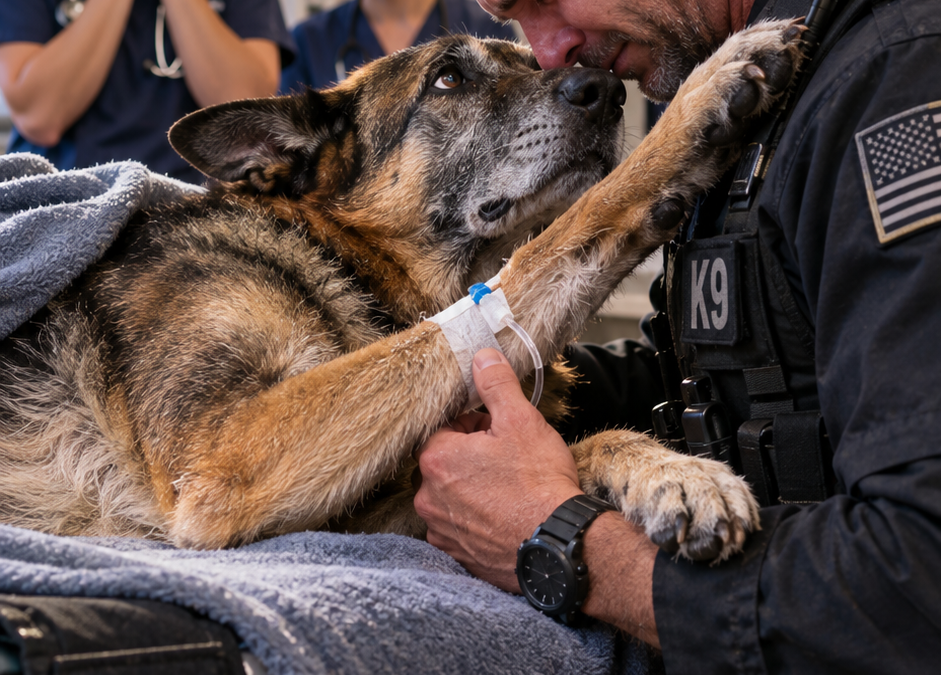
And just when Michael believed his partner no longer had the strength to move, Rex lifted his front paws toward the man he had protected for most of his life—and everyone in that room understood exactly what he was trying to say.
My name is Marcus Kelley.
I worked alongside Michael Hayes for eight years, though I had known him for more than a decade.
There are men you work with because a schedule puts you together.
There are men you trust because experience proves you can.
Then there are people you want standing beside you when everything begins to go wrong.
Michael was that kind of man.
He wasn’t loud.
He never needed to be.
He didn’t enter a room demanding attention, and he didn’t talk endlessly about courage, duty, or sacrifice.
Men who actually understand those words rarely do.
When something became unpredictable, Michael became quieter.
When somebody else panicked, he slowed down.
When a shift stretched hours beyond what any of us expected, he didn’t complain about being hungry or tired.
He checked the others first.
That was who he was.
Or at least that was who I thought he was when I first met him.
It took Rex for me to understand the rest.
Rex was a German Shepherd with a dark sable coat, a black mask across his muzzle, and eyes that seemed to notice things before the rest of us understood there was anything worth noticing.
By the time I started working closely with Michael, Rex was already experienced.
He wasn’t young anymore.
He didn’t have the uncontrolled energy of a new working dog desperate to respond to every movement.
His intensity had become refined.
He could sit perfectly still and somehow seem more alert than every human in the room.
If Michael looked toward a doorway, Rex’s ears shifted.
If Michael changed his breathing, Rex noticed.
If Michael gave the smallest hand signal, Rex moved.
There were commands, of course.
Every working K9 learns commands.
But after enough years, what existed between those two had moved beyond commands.
It became something quieter.
A language nobody else could hear.
I first understood it during a night operation several years earlier.
We were searching an abandoned industrial building after a suspect had disappeared inside.
The place was a mess.
Broken windows.
Rusting equipment.
Water dripping from pipes.
The kind of building where every dark corner looked like it could hide somebody.
Michael stood near the entrance with Rex.
I was behind them.
He didn’t say anything.
He simply touched two fingers against his leg.
Rex moved forward.
No hesitation.
No confusion.
Just trust.
We followed.
Halfway through the building, Rex stopped.
His entire posture changed.
Michael stopped instantly too.
I barely noticed what had happened.
Michael did.
He placed one hand down.
Rex remained frozen.
Then Michael pointed toward a corridor.
Rex advanced.
Minutes later, we located the suspect hiding behind broken storage racks.
Afterward, when everything had calmed, I said to Michael, “You didn’t even say anything to him.”
Michael looked confused.
“To Rex.”
“I didn’t need to.”
“How did he know?”
Michael glanced down.
Rex was sitting beside his leg.
“He pays attention.”
“That’s it?”
Michael smiled.
“I pay attention too.”
That was their relationship.
Two beings who had spent enough time watching each other that movement itself had become conversation.
For twelve years, they did almost everything together.
Search operations.
Patrols.
Late-night calls.
Long drives.
Training days.
Hours when nothing happened.
Moments when everything happened at once.
I saw Rex enter places none of us wanted to enter.
I saw him move toward danger while everyone else’s instincts told them to move away.
But what people misunderstood about Rex was that he wasn’t fearless.
No good working dog is.
Fear exists for a reason.
Rex simply trusted Michael more than he trusted the warning inside his own body.
And Michael trusted him exactly the same way.
One night during Rex’s second year of service, long before I worked directly with them, that trust was tested.
Michael told me the story only once.
We were sitting in the parking lot after a difficult shift, Rex asleep in the back of the vehicle.
Michael looked toward him and said, “He could’ve kept going.”
“What?”
“Rex.”
I waited.
“We were chasing a guy through a warehouse district.”
Michael stared at the pavement while he spoke.
“Dark. Wet. Concrete everywhere. I slipped.”
“You?”
He gave me a look.
“Yes, Marcus. Even I occasionally obey gravity.”
I smiled.
“What happened?”
“Ankle folded underneath me.”
I winced.
“Bad?”
“Bad enough I couldn’t stand.”
“And Rex?”
“He was ahead.”
“Did he get the guy?”
Michael shook his head.
“He heard me fall.”
He became quiet.
“Turned around and came back.”
I looked at Rex through the vehicle window.
“He abandoned the pursuit?”
“Immediately.”
“Was that what he was trained to do?”
“No.”
Michael smiled slightly.
“Not exactly.”
“What happened?”
“He sat next to me.”
“That’s it?”
“He wouldn’t leave.”
Michael’s expression changed when he remembered it.
“He knew something was wrong.”
Backup arrived several minutes later.
Another officer eventually continued the pursuit.
But Rex remained with Michael the entire time.
“That was when I understood,” Michael told me.
“Understood what?”
“He wasn’t just doing a job.”
Michael looked toward Rex.
“He had decided I was his responsibility.”
Years later, sitting outside that veterinary room, I remembered that conversation.
Because the roles had reversed.
For twelve years, Rex had protected Michael.
Now Michael was the one responsible for protecting Rex.
Even from suffering.
The illness began quietly.
At first, none of us thought much about it.
Rex was aging.
Older dogs slowed down.
He took longer getting out of the vehicle.
His hips were stiff after lying down too long.
Sometimes he stayed asleep while the rest of us talked nearby.
Michael joked about it.
“Retirement attitude.”
Rex would lift his head, look offended, then go back to sleep.
But then came the weight loss.
Not dramatic.
Just enough that Michael noticed before anyone else.
“He isn’t finishing meals.”
I remember him telling me that one morning.
“Maybe he’s tired of your cooking.”
“It’s dog food.”
“Exactly.”
Michael didn’t laugh.
That was when I realized he was worried.
Veterinary appointments followed.
Tests.
Bloodwork.
Scans.
More appointments.
Then the diagnosis.
Michael never told me every detail.
He didn’t need to.
It was serious.
Progressive.
Treatable for a while.
Not curable.
He said one sentence after the veterinarian confirmed it.
“They can give us time.”
Us.
Not Rex.
Us.
That mattered.
For months, Michael reorganized everything around the dog.
Medication schedules.
Special food.
Appointments.
Shorter walks.
Longer rests.
Rex officially left active service.
That alone was difficult.
On his last day at the unit, several of us gathered outside.
Nothing formal.
Michael didn’t want a ceremony.
“He’s retiring, not running for office.”
Still, people came.
Some had worked operations with him years earlier.
Others barely knew him but had heard the stories.
Rex sat beside Michael.
Older.
Gray around the muzzle.
Still alert.
Someone handed Michael an old leather training ball.
Rex saw it.
His ears went up.
For a moment, he looked five years younger.
Everyone laughed.
Michael threw it only a short distance.
Rex went after it.
Slowly.
Retrieved it.
Returned.
Dropped it at Michael’s boots.
Michael crouched.
“That’s enough, partner.”
He touched Rex’s head.
“You’re off duty.”
Rex looked up.
I don’t know whether dogs understand retirement.
I doubt they understand the concept the way we do.
But I know Rex understood that his days had changed.
For the first few weeks, he reportedly waited by the door every morning at the time Michael used to prepare for work.
If Michael picked up his keys, Rex stood.
If he put on his work boots, Rex walked toward him.
Michael eventually started dressing in another room because watching Rex expect to come along hurt too much.
Then, gradually, Rex adjusted.
Or maybe Michael did.
They developed new routines.
Slow walks.
Long afternoons in the yard.
Car rides with no destination.
Michael bought Rex a ridiculous orthopedic bed large enough for a small horse.
Rex ignored it for three days and slept on the floor beside Michael’s chair.
“How much did that bed cost?” I asked.
“Don’t ask.”
“And he won’t use it?”
“He uses it.”
“When?”
“When I sit on it.”
That was Michael.
Even in the middle of something terrible, he found small places to laugh.
For a while, the treatment helped.
Rex gained some energy.
He ate again.
On good days, he carried his ball.
On very good days, he waited by the back door for Michael to take him outside.
We all began doing what people do when they are frightened of an ending.
We mistook temporary improvement for permission to hope the ending had disappeared.
Then the illness progressed.
The first sign was Rex having trouble standing.
Michael would place a hand beneath his chest and help.
Rex hated the assistance.
You could see it.
His body still believed it should be strong enough.
Michael would say, “Easy.”
Rex would look at him.
“It’s okay.”
That word became common.
Okay.
It’s okay.
You’re okay.
I’ve got you.
Maybe Michael was speaking to Rex.
Maybe he was speaking to himself.
Then came the day when Rex no longer tried to stand when Michael entered the room.
That frightened Michael more than anything before it.
For twelve years, Rex had reacted to him.
Tail.
Head.
Ears.
Something.
Now he simply lay there.
His eyes moved.
His tail tapped weakly once.
Michael sat beside him.
That evening he called me.
He rarely called without a reason.
“Marcus.”
“What’s wrong?”
A long pause.
“I think we’re close.”
I knew exactly what he meant.
I leaned against my kitchen counter.
“I’m sorry.”
“Yeah.”
Silence.
Then Michael said, “How do you know?”
“Know what?”
“When it’s time.”
That question is easy to answer when you’re not the one who has to make the decision.
People say:
You’ll know.
You’ll see it in their eyes.
Don’t let them suffer.
Think about quality of life.
All true.
None useful enough when the animal in question has carried twelve years of your life beside you.
“I don’t know,” I said.
Michael was quiet.
“But you’ll make the right choice.”
“How do you know?”
“Because you’ve been making choices for him his whole life.”
Another pause.
“And he trusted you.”
Michael breathed out.
“I don’t want the last thing I do for him to feel like betrayal.”
“It won’t.”
“You can’t know that.”
“No.”
I swallowed.
“But Rex does.”
Michael said nothing.
“He spent twelve years trusting you to decide when to go forward, when to stop, when to enter, when to come back.”
I heard Michael’s breathing through the phone.
“This is still you protecting him.”
He didn’t answer for a long time.
Then:
“Can you come tomorrow?”
“Where?”
He gave me the name of the veterinary clinic.
“I’ll be there.”
The next morning, I arrived early.
Too early.
I sat in my vehicle outside the clinic for nearly twenty minutes.
The sky was pale.
Quiet morning.
People came and went carrying cats in boxes and dogs on leashes.
Ordinary appointments.
Vaccinations.
Checkups.
Nothing about the building looked like a place where someone’s world was about to end.
Then Michael’s vehicle pulled in.
I got out.
He opened the rear door.
Rex was lying on a thick blanket.
Michael stood there for a moment.
Didn’t move.
I approached slowly.
“Need help?”
Michael shook his head.
“I’ve got him.”
He slipped one arm beneath Rex’s chest and the other beneath his hindquarters.
For twelve years, Rex had moved under his own strength.
Now Michael lifted him.
Gently.
Carefully.
The German Shepherd who had once pulled grown men to the ground felt frighteningly light.
Michael carried him toward the entrance.
I opened the door.
The receptionist already knew why we were there.
Her face changed the moment she saw Michael.
“Dr. Turner is ready.”
Michael nodded.
Nothing else.
We walked down a hallway.
I stayed several steps behind.
That is the image I still remember.
Michael carrying Rex.
The dog’s head resting against his arm.
Michael walking slowly.
Not because Rex was heavy.
Because every step took them closer to goodbye.
Dr. Turner met us in a quiet room at the end of the corridor.
It was softer than most examination rooms.
Blankets.
Low lighting.
A rug.
No stainless-steel table in the middle.
The kind of room designed for exactly what was about to happen.
Michael lowered Rex onto the blanket.
Dr. Turner examined him.
Spoke quietly.
Explained that Rex’s condition had declined.
Pain.
Weakness.
Breathing.
The treatment was no longer giving him comfort.
Michael listened.
He asked practical questions.
Of course he did.
“Will he be afraid?”
“We’ll keep him comfortable.”
“Will it hurt?”
“No.”
“Will he know I’m here?”
Dr. Turner looked at him.
“Yes.”
Michael’s eyes closed for one second.
“Good.”
The veterinarian continued explaining the process.
Michael nodded.
I heard almost none of it.
I watched his face.
He had faced danger hundreds of times.
I had seen him injured.
Seen blood on his uniform.
Seen him walk into buildings while everybody outside knew someone armed might be waiting.
Never had he looked as vulnerable as he did listening to a veterinarian explain how his dog would die peacefully.
Dr. Turner eventually asked, “Would you like some time?”
Michael nodded.
The veterinarian left.
An assistant remained briefly, then stepped out too.
I moved toward the door.
Michael looked at me.
“You don’t have to go.”
I stopped.
“You sure?”
He looked at Rex.
“Yeah.”
I stayed.
But I moved to the side of the room.
Not because I was uncomfortable.
Because what existed between them deserved space.
Michael lowered himself onto the floor.
His knees cracked.
Under any other circumstance I would have made a joke.
Not that morning.
He sat beside Rex.
Rex’s eyes were half open.
Breathing shallow.
Michael placed one hand on his head.
The other along his ribs.
For several seconds he said nothing.
Then he whispered:
“Hey, partner.”
Rex’s ear moved.
Barely.
Michael smiled.
“There you are.”
His thumb stroked the fur between Rex’s eyes.
“You know, you scared the hell out of me the first day.”
I looked down.
I had heard parts of that story, but never the whole thing.
Michael continued talking to Rex.
“They told me you were difficult.”
A weak laugh.
“Too aggressive. Too stubborn.”
Rex breathed.
“They told me not to expect much.”
Michael shook his head.
“They were idiots.”
His voice broke slightly.
“You walked over and sat right in front of me.”
I could picture it.
Young Rex.
One year old.
Too much energy.
Too much drive.
People seeing a problem.
Then Michael approaching the kennel.
The dog sitting.
Choosing.
Michael leaned closer.
“I didn’t pick you.”
His hand stopped.
“You picked me.”
The room became even quieter.
Outside, someone walked down the hallway.
A door opened.
Closed.
Life continuing.
Inside, Michael began thanking his dog.
Not with grand words.
With memories.
“Thank you for every night.”
His fingers moved along Rex’s coat.
“Every call.”
His voice trembled.
“Every search.”
Rex’s eyes remained on him.
“Every time you went first because I asked.”
Michael swallowed.
“Every time you came back.”
I had to look away.
He kept talking.
“Remember the warehouse?”
A smile touched his face.
“You made me look stupid.”
His shoulders shook once with a quiet laugh.
“Guy thought he was hiding. You found him in about thirty seconds.”
Rex breathed slowly.
“And that field search.”
Michael looked down.
“Eight hours.”
I remembered that one.
A missing child.
Cold night.
Hundreds of acres.
Rex found the boy huddled near a drainage area just before dawn.
The kid was freezing but alive.
Michael never accepted praise for it.
“Rex found him.”
That was all he said.
In the clinic, Michael touched Rex’s paw.
“You found that kid.”
His voice softened.
“His mom probably never knew your name.”
Rex’s eyes moved.
“But I remember.”
He shifted closer.
“I remember all of it.”
Then his voice dropped lower.
“Do you remember when I fell?”
I knew the story.
Second year.
Warehouse district.
Twisted ankle.
Rex abandoning the pursuit.
“You came back.”
Michael’s face tightened.
“You always came back.”
He looked at Rex for a long time.
“And now I’m supposed to let you go.”
That was the first moment his control truly broke.
He lowered his head.
Tears fell onto Rex’s fur.
“I’m sorry.”
I wanted to say something.
Didn’t.
Some pain should not be interrupted just because the people watching feel helpless.
Michael pressed his forehead against Rex’s.
“I wish I could do this for you.”
He laughed once through tears.
“Take it. Whatever hurts. Give it to me.”
His hand moved along Rex’s side.
“But that’s not how it works, is it?”
Rex exhaled.
Michael closed his eyes.
Then said the words I will never forget.
“You made me a better man.”
His voice was barely audible.
“I didn’t know how to take care of anybody before you.”
He rubbed Rex’s ear.
“You taught me.”
I had known pieces of Michael’s childhood.
Not many.
He didn’t talk about family.
His parents existed mostly as names.
No wife.
No children.
Relationships had come and gone.
Work remained.
Rex remained.
Michael whispered:
“You were my family.”
My throat tightened.
“You were my partner.”
He paused.
“My best friend.”
Then:
“I love you, buddy.”
That was when Rex moved.
At first, I thought it was involuntary.
His front leg twitched.
Michael stopped talking.
“Easy.”
The second leg moved.
Rex tried to push himself upward.
Michael immediately shifted to help.
“No, no. You don’t have to.”
But Rex kept trying.
His body had almost no strength.
For days, he had barely moved.
Still, he lifted his chest several inches.
One paw rose.
Then the other.
Michael leaned closer.
“Rex?”
Slowly, impossibly, Rex placed both front paws against Michael’s shoulders.
The room stopped.
I don’t mean it became quiet.
It was already quiet.
I mean everything inside me stopped.
Michael froze.
His eyes widened.
Rex’s paws remained there.
Weak.
Barely holding.
Michael understood first.
His face collapsed.
“Oh, buddy.”
He wrapped both arms around Rex.
Held him.
Rex’s head rested against Michael’s neck.
The dog’s paws stayed on his shoulders.
I turned toward the wall.
Not because I didn’t want to see.
Because suddenly the moment felt too private to witness directly.
A goodbye that had taken twelve years to earn.
Michael whispered something.
I couldn’t hear it.
Then louder:
“I’ve got you.”
That sentence broke me.
How many times had Rex’s presence told Michael the same thing?
In buildings.
On roads.
During searches.
I’ve got you.
Now Michael said it back.
“I’ve got you.”
Rex’s muzzle touched his cheek.
Barely.
A soft movement.
Almost nothing.
But Michael felt it.
His breath caught.
“Yeah.”
He kissed Rex’s head.
“I know.”
Dr. Turner had returned quietly.
He stood near the door.
One of the veterinary nurses covered her mouth with her hand.
Nobody spoke.
Rex’s paws slowly lost strength.
Michael guided him down.
But he never let go.
Dr. Turner approached.
Placed a hand gently on Michael’s shoulder.
Michael looked up.
His face was wet.
No embarrassment.
No attempt to hide it.
The veterinarian asked softly, “Are you ready?”
Michael looked at Rex.
For a long time.
Then he nodded.
I don’t believe anyone is ready for that moment.
Not really.
“Ready” simply means love has become stronger than the desire to keep someone beside you at any cost.
Dr. Turner explained everything again.
Michael listened.
Rex remained in his arms.
The first medication helped him relax.
His breathing became slower.
The tension disappeared from his body.
Michael kept talking.
“Good boy.”
The phrase came again and again.
“Good boy.”
Words Rex had heard thousands of times.
Training fields.
Vehicles.
Operations.
Home.
And now here.
“You’re okay.”
Michael’s voice steadied.
“You can rest.”
Rex’s eyes were almost closed.
“I’m right here.”
His fingers moved behind Rex’s ear.
“I’m not going anywhere.”
Dr. Turner administered the final medication.
There was no drama.
No sudden movement.
Rex simply became quieter.
His breathing slowed.
One breath.
Then another.
Then one more.
Michael pressed his face against Rex’s head.
“Thank you.”
The room remained still.
Dr. Turner checked gently.
Then whispered:
“He’s gone.”
Michael did not move.
Neither did I.
There was grief in the room.
Of course there was.
But there was something else too.
Something almost sacred.
Rex was no longer hurting.
That mattered.
His body, which had carried him through twelve years of service, had finally been allowed to stop.
Michael held him.
Minutes passed.
The veterinarian stepped away.
The nurses left quietly.
I stayed.
Eventually, Michael said:
“Marcus.”
“Yeah.”
“Sit with me.”
I lowered myself onto the floor.
Not close enough to crowd him.
Close enough that he wasn’t alone.
For a while, neither of us spoke.
Sunlight had begun entering through the window.
It fell across Rex’s coat.
He looked asleep.
Not sick.
Not weak.
Just asleep beside Michael.
Then Michael said, “You know what he did?”
I knew he wasn’t asking about the final hug.
“What?”
He stroked Rex’s head.
“The first time I met him.”
“Tell me.”
Michael took a breath.
“He was about a year old.”
His voice sounded distant now.
“They said he had too much drive. Couldn’t settle. Too aggressive around certain handlers.”
“What did you do?”
“I walked over.”
Michael smiled slightly.
“Everybody told me to give him space.”
“Did you?”
“No.”
I almost laughed.
“Of course not.”
“He looked at me.”
Michael stared at Rex.
“And then he sat.”
“Just like that?”
“Just like that.”
“No barking?”
“Nothing.”
Michael shook his head.
“Like he’d been waiting.”
His thumb moved across the fur above Rex’s eye.
“I think he chose me.”
“I think so too.”
Michael became quiet.
Then said:
“I never had much family.”
I didn’t interrupt.
“My parents weren’t bad people.”
He looked toward the window.
“We just weren’t close.”
He swallowed.
“I got used to being alone.”
His eyes returned to Rex.
“Then this animal came into my life and suddenly somebody cared whether I got up in the morning.”
A weak laugh.
“Somebody waited at the door.”
His hand tightened slightly.
“Somebody noticed when I came home.”
I understood more clearly than I ever had.
Rex hadn’t just been Michael’s working partner.
He had been the first living thing Michael fully allowed himself to need.
“He taught me how to care for somebody,” Michael said.
His voice cracked.
“And how to let somebody care about me.”
He stared down.
“And now it feels like I’m abandoning him.”
“No.”
Michael looked at me.
“You aren’t.”
“I made the decision.”
“Exactly.”
“Marcus—”
“You made the decision because he trusted you.”
He shook his head.
“It still feels wrong.”
“I know.”
I leaned forward.
“But letting him suffer because you couldn’t bear losing him would have been about you.”
Michael said nothing.
“This was about Rex.”
His eyes filled again.
“You didn’t abandon him.”
I nodded toward the dog.
“You stayed until the last second.”
Michael’s jaw trembled.
“You protected him from a pain he couldn’t escape on his own.”
I put my hand on Michael’s shoulder.
“That’s not leaving him.”
Michael looked at Rex.
“It’s finishing the job.”
He cried again.
Quietly.
But this time there was something else beneath it.
Acceptance.
Not peace yet.
Peace would take longer.
But the beginning of it.
When we finally left the room, Michael stopped at the door.
Turned around.
Looked at Rex one last time.
Then whispered:
“End of watch, partner.”
I will carry those words for the rest of my life.
The days after were hard.
Michael returned to work sooner than I expected.
Too soon, maybe.
But I understood why.
His house was empty.
Work gave him noise.
People.
Structure.
The first morning he walked into the unit without Rex, conversations stopped.
Not because anyone planned it.
We simply noticed the absence.
For twelve years, Michael and Rex had entered together.
Now Michael walked in alone.
Someone handed him coffee.
Another officer touched his shoulder.
Nobody asked him how he was.
Sometimes asking forces a man to lie.
Instead, we let him be there.
A few days later, we organized a small memorial gathering.
Michael initially refused.
“No funeral.”
“It’s not a funeral.”
“Then what?”
“A chance to remember him.”
Michael looked skeptical.
But he came.
We set out photographs.
Rex during training.
Rex beside a patrol vehicle.
Rex after searches.
Rex covered in mud.
Rex wearing a ridiculous holiday bandanna someone had forced on him one December.
That photograph finally made Michael laugh.
“I hated that thing.”
Someone said, “Rex didn’t.”
“Rex tolerated it.”
We shared stories.
A younger officer described how Rex had once found evidence everyone else missed.
Another remembered the missing child search.
Someone told the story of Rex stealing a sandwich from an unattended desk.
Michael protested.
“He did not steal it.”
“He absolutely did.”
“It was unsecured food.”
We laughed.
Michael did too.
For a few minutes, grief loosened its grip.
Then one officer stood and said:
“When I was new, I was scared of Rex.”
Michael raised an eyebrow.
“You should’ve been.”
More laughter.
The officer continued.
“But Michael told me something.”
He looked at him.
“You said, ‘Don’t try to impress him. Just be honest.'”
Michael smiled.
“I remember.”
“I thought that was dog advice.”
The officer looked around the room.
“Took me years to realize it was people advice too.”
Michael lowered his eyes.
That was the kind of influence Rex had.
Not because he was magical.
Because watching a working partnership built entirely on trust teaches you things.
Trust cannot be performed.
It has to be repeated.
Day after day.
Command after command.
Return after return.
After the memorial, I found Michael sitting alone with coffee.
“How are you?”
He stared into the cup.
“House is too quiet.”
I waited.
“I keep waking up before my alarm.”
“Why?”
“I expect to hear him moving.”
Michael smiled sadly.
“His nails on the floor.”
He looked away.
“I still avoid stepping near his water bowl.”
“You haven’t moved it?”
“No.”
“That’s okay.”
“I know.”
He sighed.
“The strange thing is I’m not as destroyed as I thought I’d be.”
“What do you mean?”
“I am.”
He rubbed his face.
“But there’s gratitude too.”
He looked at one of the photographs.
“I had twelve years.”
His voice softened.
“Twelve.”
He smiled.
“How many people get that?”
I nodded.
“Not enough.”
“I keep thinking about all the times I complained.”
“About Rex?”
“About work.”
He shook his head.
“Long shifts. Calls. Training.”
His eyes stayed on the photograph.
“I’d give anything for one more boring night sitting in that vehicle with him.”
That is how grief changes value.
Things that once annoyed us become sacred after they’re gone.
Michael’s grief didn’t disappear over the following weeks.
It changed shape.
At first, everything reminded him of Rex.
Then memories became less sharp.
He could tell a story without stopping halfway.
He could say Rex’s name and smile before the sadness came.
Eventually, he began thinking about what should happen to everything Rex had taught him.
That was when he came into my office carrying a folder.
“I’ve got an idea.”
That sentence was dangerous when Michael said it.
“How expensive?”
“Not very.”
“Illegal?”
“Not currently.”
I leaned back.
“What is it?”
He handed me the folder.
On the front were three words.
REX’S LEGACY PROGRAM.
I looked at him.
“What’s this?”
“Training initiative.”
“For dogs?”
“For handlers.”
I opened it.
Michael had written pages.
Not a formal K9 training curriculum.
Something different.
A program for new officers paired with working dogs.
Communication.
Trust.
Reading body language.
Understanding stress.
The responsibilities that came with asking an animal to enter dangerous situations for you.
Retirement planning.
Medical awareness.
And, perhaps most importantly, what Michael called “partnership beyond commands.”
I looked up.
“You wrote all this?”
“Couldn’t sleep.”
“Apparently.”
He sat.
“New handlers learn technique.”
“Right.”
“They learn commands. Procedures. Safety.”
“Right.”
“But nobody can really explain what happens after years together.”
He paused.
“Rex taught me things no manual did.”
I looked at the pages.
“You want to teach that.”
“I want to try.”
He leaned forward.
“I don’t want his influence to end in that clinic.”
That sentence settled it for me.
We developed the program.
It began small.
One seminar.
Six new handlers.
Michael standing at the front of a training room looking deeply uncomfortable because he hated public speaking.
The first thing he told them was:
“Your dog doesn’t work for you.”
Several people looked confused.
Michael continued.
“He works with you.”
Then he added:
“If you remember only one thing today, remember that.”
He told them that obedience was not the same as trust.
That a dog could follow a command without understanding the person giving it.
That partnership required the human to learn too.
“Everybody talks about dogs reading us,” Michael said.
“Your posture. Heart rate. Tone.”
He looked around the room.
“Your job is to read them back.”
He talked about Rex.
Not sentimentally.
Practically.
How Rex signaled uncertainty.
How fatigue looked different from distraction.
How trust grew through consistency.
And finally, how responsibility did not end when service did.
“One day your partner will get old.”
The room became quiet.
“One day he may not be able to do what he used to.”
Michael paused.
“That doesn’t make him less valuable.”
His voice almost broke.
He steadied it.
“And when the time comes, your responsibility is still the same.”
A young handler asked:
“To protect him?”
Michael nodded.
“Until the end.”
Rex’s Legacy grew.
Other departments asked about it.
More handlers attended.
Veterinary specialists contributed.
Experienced K9 officers shared retirement experiences.
What had begun as Michael’s grief became a place where others learned to prevent mistakes.
We added sessions about transition after service.
Medical monitoring.
Bond preservation.
Handler grief.
People sometimes underestimate grief after losing a working animal because they say:
It was a dog.
Anyone who says that has never understood what twelve years of partnership can become.
A working dog goes home with you.
Sleeps near you.
Trains with you.
Risks himself beside you.
Learns your mood.
Your walk.
Your smell.
Your fear.
Your silence.
You spend more waking hours with that dog than with most humans.
Then one day he’s gone.
The absence is enormous.
Michael understood that.
He made sure new handlers did too.
Months passed.
Then nearly a year.
I started noticing another change.
Michael lingered near the shelter dogs whenever our department partnered with local rescues.
He never said anything.
Just looked.
One Saturday, he called.
“Busy?”
“Depends.”
“Come with me.”
“Where?”
“Animal shelter.”
I smiled.
“Michael.”
“What?”
“Are you getting a dog?”
“No.”
“You’re getting a dog.”
“I’m looking.”
“That’s what people say before getting a dog.”
“Just come.”
I did.
The shelter had a German Shepherd in one of the rear kennels.
His name was Harper.
About four years old.
Abandoned near a highway.
Thin when he arrived.
Nervous around sudden movements.
No service training.
No dramatic background.
Just a dog who had been left.
Michael stopped at the kennel.
Harper was lying near the back.
He lifted his head.
Looked at Michael.
Michael crouched.
He did not call.
Didn’t push his hand through the bars.
Didn’t make baby noises.
He simply waited.
Five minutes passed.
Harper stood.
Slowly approached.
Stopped a few feet away.
Michael remained still.
Harper came closer.
Sniffed.
Then sat.
I felt something move through me.
Michael did too.
I could see it.
He whispered:
“Well.”
I smiled.
“What?”
“Nothing.”
“Looks familiar.”
“Don’t start.”
Harper pressed his nose against the bars.
Michael raised one hand.
The dog leaned into it.
I looked away for a second.
Not because Harper was Rex.
He wasn’t.
That was precisely why the moment mattered.
Love does not require replacement.
It requires room.
Michael visited Harper several times before making a decision.
He wanted to be sure.
Not that Harper was right for him.
That he was ready to love another dog without asking that dog to become Rex.
One afternoon, he said:
“I feel guilty.”
“Why?”
“Because part of me is happy around him.”
“That’s not betrayal.”
“I know that logically.”
“Rex didn’t spend twelve years teaching you how to care for a dog so you could stop forever after he died.”
Michael looked at me.
“You think he’d approve?”
“I think Rex would steal Harper’s food.”
Michael laughed.
“Definitely.”
A week later, Harper went home with him.
Not as a service dog.
Not as a replacement partner.
Just a dog.
The first time I visited, Harper was sitting beside Michael’s chair.
Michael looked different.
Softer.
The house sounded different too.
Nails on the floor again.
A water bowl.
A leash by the door.
Life.
Harper looked up at Michael with open curiosity.
Not the disciplined focus Rex had carried.
Something younger.
Uncertain.
Michael touched his head.
“It’s weird.”
“What?”
“Having a dog who doesn’t understand commands before I finish thinking them.”
I laughed.
“Welcome to normal dog ownership.”
Harper brought Michael a chewed toy.
Michael took it.
Then looked at me.
“It feels like coming home.”
I nodded.
“Rex would be proud.”
Michael looked toward a framed photograph on the wall.
Rex sitting beside him during their early service years.
He smiled.
“I think he knows.”
I’m not usually sentimental enough to claim certainty about things like that.
But I didn’t argue.
Today, Rex’s Legacy remains part of our department’s training.
The program has changed over time.
Expanded.
Improved.
But the reason for it has not changed.
A German Shepherd once spent twelve years teaching one man what partnership meant.
That man refused to let the lesson disappear when the dog did.
New handlers sometimes ask why the program is named Rex’s Legacy.
If Michael is teaching, he doesn’t begin with the clinic.
He begins with the first meeting.
“Everybody said he was difficult.”
He tells them.
“Then he sat down in front of me.”
Eventually, though, he tells the whole story.
Including the end.
Not because he wants sympathy.
Because people entering working partnerships need to understand that every beginning carries a responsibility for how the ending is handled.
The exciting parts are easy to celebrate.
Training.
Success.
Searches.
Courage.
The harder part is honoring the animal when courage can no longer defeat age or illness.
I still remember that veterinary room.
More clearly than I want to.
The weak breathing.
Michael’s hand moving over Rex’s head.
The sunlight.
Dr. Turner standing quietly.
But most of all, the paws.
Rex had barely moved for days.
Then somehow, with whatever strength remained, he lifted both front legs.
Placed them around the man who had spent twelve years beside him.
People can explain it however they want.
Instinct.
Muscle movement.
Response to Michael’s position.
I don’t need to argue.
I know what it meant to Michael.
I know what it meant to me.
For twelve years, Rex had said the same thing in a hundred different ways.
I’m here.
When Michael entered danger:
I’m here.
When he fell:
I’m here.
When he came home exhausted:
I’m here.
When the house was empty except for the two of them:
I’m here.
And in the final moments, when Rex’s body had almost nothing left to give, he found one more way to say it.
I’m still here.
That is what changed my understanding of loyalty.
Before Rex, I thought loyalty meant staying.
Now I think it means something larger.
Sometimes loyalty means going first.
Sometimes coming back.
Sometimes waiting.
Sometimes protecting.
Sometimes trusting another being enough to place your life in their hands.
And sometimes, at the end, loyalty means allowing the person you love to help you stop fighting.
Michael once told me the worst part of Rex’s death was making the decision.
The best part, if there could be one, was knowing Rex never experienced the end alone.
“He heard my voice,” Michael said.
“He had my hands on him.”
He looked down.
“If I could choose anything for my own last moment, that wouldn’t be bad.”
I understood.
None of us wants goodbye.
But if goodbye must come, there are worse things than leaving while somebody who loves you says your name.
Last month, I watched Michael teach another class.
Harper was not with him.
Harper’s career consists mostly of stealing socks and barking at delivery trucks.
But Rex was there.
A photograph on the screen.
Young.
Strong.
Alert.
Michael looked at the group.
“That dog saved lives.”
Then he shook his head.
“But that’s not why we’re talking about him.”
He changed the slide.
Another photograph.
Older Rex lying beside Michael at home after retirement.
“We’re talking about him because service doesn’t define the entire relationship.”
Michael’s voice was calm.
“One day the uniform comes off.”
He looked around.
“The dog remains.”
Nobody spoke.
“And what you built together has to be worth something when there is no mission left.”
I sat at the back of the room.
For a second, I saw that clinic again.
Then Michael continued.
“Take care of your partner when he can no longer take care of you.”
That was Rex’s legacy.
Not only heroism.
Reciprocity.
A few days after that class, I stopped by Michael’s house.
Harper was asleep on the floor.
Michael handed me coffee.
On one wall were two photographs.
One of Rex.
One of Harper.
Separate frames.
Separate lives.
Exactly as they should be.
I looked at Rex’s photograph.
It was from the early years.
Michael younger.
Rex sitting upright beside him.
Both facing the camera.
I said, “You ever think about that morning?”
“The clinic?”
“Yeah.”
“Every day.”
I looked at him.
“Still hurts?”
“Of course.”
He rubbed the edge of his coffee mug.
“But it doesn’t hurt the same.”
Harper stretched.
Michael smiled.
“At first, all I could see was the last day.”
He looked at Rex’s picture.
“Now I remember the other twelve years first.”
That is healing, I think.
Not forgetting the final room.
Putting it back where it belongs.
At the end of a much larger story.
Rex’s life was not the clinic.
It was thousands of mornings before it.
Thousands of steps.
Car rides.
Training sessions.
Searches.
Rain.
Mud.
Quiet evenings.
A stolen sandwich or two.
A child found alive.
A partner protected.
A home made less empty.
The clinic mattered because everything before it mattered.
Without twelve years of love, the final hug would have been only movement.
Because of those twelve years, it became a goodbye.
Tonight, I am sitting in my office writing this.
Rain is hitting the windows.
The building is mostly empty.
Tomorrow morning, another group of new K9 handlers will arrive for the Rex’s Legacy program.
Most of them will be excited.
They should be.
They are at the beginning.
New dogs.
New partnerships.
Years ahead.
They will learn commands.
Search patterns.
Care routines.
Safety procedures.
Then Michael will eventually stand in front of them and explain what no technical manual can completely teach.
Trust is built in ordinary moments.
Loyalty is mutual.
And a working dog does not stop being your responsibility when he stops being useful to the job.
Before I leave, I turn off the office light.
The hallway is dim.
Near the training room hangs a photograph of Michael and Rex.
I stop in front of it.
I’ve done that many times.
Rex is younger in the picture.
Michael too.
The dog sits beside him.
Alert.
Ready.
Michael has one hand resting lightly on Rex’s shoulder.
At the time the photograph was taken, neither of them could have known what twelve years would hold.
The danger.
The rescues.
The injuries.
The ordinary days.
The illness.
The final room.
Maybe that’s a mercy.
If we knew every goodbye at the beginning, perhaps we’d be too afraid to begin.
Instead, we love without guarantees.
We work.
We trust.
We stay.
I look at Rex’s photograph.
Then I remember his paws around Michael’s shoulders.
“Thank you, Rex,” I whisper.
Not for the dramatic things.
Not only for the lives saved.
Thank you for teaching one stubborn man how to love.
Thank you for giving him twelve years.
Thank you for coming back when he fell.
Thank you for trusting him when your own body failed.
And thank you for spending the last strength you had to tell him, in the only language available:
I know you’re here.
I know what you did for me.
I know what we were.
Michael once believed he was the one who had to let Rex go.
I don’t think of it that way anymore.
I think Rex spent twelve years teaching Michael how to hold on to something properly.
Then, in that final room, he taught him one last lesson.
How to let go without abandoning love.
The distinction matters.
Michael walked out of the clinic without Rex.
But he did not walk out without what Rex had given him.
That followed him home.
It followed him into the training room.
Into Rex’s Legacy.
Into the shelter where Harper waited.
Into every new relationship built because Michael had learned that loving one dog deeply did not mean he had only one love to give.
That’s how loyalty outlives a body.
Not through refusing to move forward.
Through carrying forward what the other life taught you.
Rex is gone.
I will not pretend otherwise.
But because he lived, young handlers enter partnerships differently.
Retired dogs receive better care.
Michael’s house has warmth again.
Harper has a home.
And every person who hears Rex’s story understands that the most heroic moment of a working dog’s life may not happen in a dangerous building or on a difficult search.
Sometimes it happens on the floor of a quiet veterinary room.
No uniform.
No badge.
No crowd.
No mission left.
Only an old German Shepherd.
The man he chose twelve years earlier.
And enough strength for one final embrace.
My name is Marcus Kelley.
I have witnessed courage in many forms.
I have seen people run toward danger.
I have seen men remain calm when fear would have excused almost anything.
I have seen working dogs perform things that seemed impossible.
But if you ask me today what loyalty looks like, I do not picture a chase, an arrest, or a rescue.
I picture Rex.
Weak.
Tired.
Breathing softly.
Michael beside him saying, “I love you, my boy.”
And then those two paws slowly rising.
Reaching.
Resting on Michael’s shoulders.
One last time.
As if after twelve years of always coming back to his partner, Rex needed to make absolutely certain Michael understood.
I came back again.
I’m here.
You can let me rest now.
And Michael finally did.








