𝗣𝗔𝗥𝗧 𝟮 A Wounded Puppy Brought a Broken Phone to Our Fire Station—What Was Still Inside Sent Us Running
𝗣𝗔𝗥𝗧 𝟮
The warehouse looked dead.
That’s the best way I can describe it.
No vehicles.
No lights.
No smoke visible from outside.
Broken windows reflected a white afternoon sky.
Weeds pushed through cracked asphalt.
The chain across the main gate had rusted so badly I doubted anyone had opened it in years.
Hill checked the coordinates again.
“This is it.”
Mason looked at the building.
“Could be somebody squatting.”
“Could be.”
“Could be a prank.”
I looked back at the puppy.
“No.”
Rachel was trying to keep him on the mat.
“Stay.”
He wasn’t listening.
His nose worked furiously.
Ears forward.
Body trembling.
I opened the rear door.
“Don’t.”
Rachel caught my arm.
“He needs fluids.”
“I know.”
“His paw is shredded.”
“I know.”
The puppy stepped toward the edge.
Rachel swore.
“At least carry him.”
I reached.
He dodged me.
Jumped.
Landed badly.
Almost went down.
Then limped toward the rear corner of the property.
Mason muttered, “That’s not random.”
No.
It wasn’t.
We went after him.
He ignored the main entrance completely.
Instead, he followed the wall to a warped metal service door half hidden behind vines and stacked pallets.
The puppy scratched.
Once.
Twice.
Then looked at us.
“Open it.”
Mason used a Halligan bar.
The hinges screamed.
Inside smelled like dust, wet wood, old oil, and something burned.
Rachel covered her nose.
“That dog has been in here.”
Soot on his coat.
River mud.
Cuts.
Everything aligned.
I crouched.
“Show me.”
The puppy moved.
He knew the route.
Through an old machine bay.
Around a fallen steel rack.
Between warped pallets.
He never explored.
He remembered.
That distinction made my skin crawl.
We passed a blackened section of wall.
Evidence of a small fire.
Recent.
Not fully involved, but enough to damage already rotten material.
At the rear of the building, the puppy stopped.
Wooden loading floor.
Old boards.
Some newer sheets of aluminum laid across sections.
The puppy scratched one spot.
Frantic now.
His injured paw reopened.
“Stop.”
He didn’t.
I pulled him back.
Mason knelt.
“Floor sounds hollow.”
Hill tapped.
Definitely.
We cleared debris.
Found a sheet of rusted metal screwed over an opening.
Mason pried.
The panel lifted.
Darkness underneath.
Crawl space.
Then—
Coughing.
All of us froze.
“Fire department!”
A faint voice.
Female.
“Here.”
Rachel dropped to her knees and aimed a flashlight inside.
The beam found a woman.
Mid-thirties.
Soot across her face.
Blood at one temple.
She was curled over a boy.
Maybe six.
Her body wrapped around him.
“Oh, thank God.”
Her voice cracked.
“Ma’am, don’t move.”
“The floor—”
“We know.”
“The fire—”
“We’re getting you out.”
Her eyes shifted past me.
Toward the opening.
“Finn?”
The puppy pushed forward.
His ears lifted.
I looked at him.
“Finn?”
His tail moved once.
The woman began crying.
“He came back.”
I understood.
This wasn’t a stray.
This was their dog.
“We’ve got him.”
Her eyes closed.
“Good.”
Mason radioed our location and requested full medical response.
I crawled down.
The boy was barely responsive but breathing.
Light burns along one arm.
Smoke exposure.
Rachel guided from above.
We passed him up carefully.
Then returned for the mother.
“What happened?”
“Floor gave way.”
“How long?”
“I don’t know.”
“Phone?”
“I sent Finn.”
I stopped.
“You gave him the phone?”
She nodded weakly.
“Fire started near the loading area. We dropped through. My phone still worked.”
Her breathing hitched.
“I tied it in his collar at first, but it broke loose.”
She looked toward the puppy.
“I told him to find help.”
That dog had not merely found help.
He’d carried the phone in his mouth after whatever had held it failed.
Five blocks.
Injury.
Heat.
Smoke.
Broken glass.
I reached for her.
“Let’s get you out.”
The floor groaned.
Mason’s voice sharpened.
“Jack.”
“I heard it.”
We moved faster.
The woman screamed when we lifted her.
Possible ankle injury.
Maybe ribs.
I got one arm around her.
Then something cracked behind us.
A beam.
Metal sheet dropped into the crawl space where she had been lying seconds earlier.
“Move!”
We pulled her upward.
Rachel had the boy.
Hill cleared the route.
Then we heard another sound.
Hiss.
Low.
Continuous.
Mason looked down.
“Gas.”
My stomach dropped.
“What line?”
“Doesn’t matter.”
The old building was supposed to have utilities shut off.
Apparently “supposed to” had failed again.
“We’re leaving now.”
Finn stood at the opening.
I pointed toward the exit we’d used.
“Go!”
He didn’t.
Instead, he turned.
Ran down another corridor.
“Finn!”
Nothing.
Rachel shouted, “Leave him!”
I almost did.
Then he barked.
One sharp bark.
From the far hallway.
Mason looked at me.
“He knows another way.”
Maybe.
Or maybe we were about to follow an injured puppy deeper into a collapsing industrial building.
I chose the puppy.
“Follow him.”
Rachel carried the boy.
Hill supported her.
Mason and I half-carried the woman.
The hallway narrowed.
Plaster fell.
Somewhere behind us, something metal crashed.
Finn waited at a broken service door.
Outside.
Daylight.
He barked again.
We made it through.
I had barely gotten the woman ten yards away when the building exhaled.
Not a Hollywood fireball.
A violent pressure wave.
Dust.
Wood.
Metal.
A section of roof collapsed inward.
We hit the ground.
Rachel covered the child.
I shielded the woman.
Mason rolled behind a concrete barrier.
For several seconds, I heard nothing but ringing.
Then coughing.
“Everyone!”
Hill’s voice.
“Sound off!”
“Jack!”
“Mason!”
“Rachel!”
“Boy’s breathing!”
“Woman’s conscious!”
Then I remembered.
“Finn!”
No answer.
I pushed up.
Dust swallowed the lot.
“FINN!”
Movement.
Across the gravel.
A black-and-sable shape.
Limping.
One ear bloodied.
Still coming toward us.
I ran.
He staggered once.
I reached him before he fell.
Scooped him up.
This time he didn’t resist.
His head dropped against my chest.
The dog who had fought us for a shattered phone simply stopped fighting anything.
He had delivered the message.
Shown us the victims.
Led us out.
Now he was finished.
“Good boy.”
His eyes closed.
“Good boy.”
Backup arrived minutes later.
Ambulances.
Police.
Additional engine.
Hazmat.
The mother was transferred first.
Smoke inhalation.
Possible fractures.
The boy was unconscious but stable.
Rachel rode with him.
Finn stayed at the station initially under our on-call veterinary partner’s guidance until transport could be arranged.
But before the ambulance pulled away, the mother woke enough to ask one thing.
“Finn?”
I carried him to her stretcher.
Her eyes filled instantly.
“I told you to find help.”
Finn lifted his head.
She touched his forehead.
“You did.”
He licked her wrist once.
That was the first time I saw his body truly relax.
Back at Station 27, Finn slept beneath a heat lamp while a veterinarian from an emergency clinic examined him.
Torn paw pads.
Mild smoke inhalation.
Dehydration.
Cuts.
No fractures.
The wound near his ear needed stitches.
He had been unbelievably lucky.
Mason stood beside me.
“I’ve been doing this twenty years.”
“I know.”
“I’ve seen search dogs.”
“I know.”
“I’ve never seen that.”
Neither had I.
Rachel returned from the hospital near midnight.
“The kid’s stable.”
We all exhaled.
“Mother?”
“Stable too. Burns minor. Ankle fracture.”
She looked at Finn.
“That dog saved them.”
Hill crouched.
“He is them.”
“What?”
“The phone.”
We all looked.
Hill held the damaged device inside an evidence bag.
Once we dried it carefully, parts of the lock screen became clearer.
A photograph appeared.
Finn.
Smaller.
Sitting beside the same little boy.
Below the image was text added to the wallpaper.
FINN
There was no mystery anymore.
No stray.
No ghost dog.
Finn.
His family had trusted him with an impossible task.
And somehow, he’d understood enough.
Not language in the way we understand it.
Not directions and coordinates.
But urgency.
Routine.
A familiar fire station perhaps seen on walks.
Human scent.
The phone.
The command to go.
Whatever pieces a dog’s mind had assembled, they had been enough.
The next morning, Finn woke before most of us.
He lay in the medic bay.
Every time a firefighter entered, his eyes followed.
Counting.
That’s what it looked like.
Mason.
Hill.
Rachel.
Me.
Lily Chen, our youngest cadet, came through the door carrying coffee.
Finn’s ears rose.
She knelt.
“Hey, hero.”
I winced.
“Don’t start.”
“What?”
“Hero.”
“He is.”
“He’s a puppy.”
“Both can be true.”
Finn sniffed her hand.
Then accepted a piece of banana.
We discovered that morning that he loved bananas.
An important fact after a dramatic rescue.
At noon, his family came.
The mother, Sarah Bennett.
Her son, Owen.
Both had insisted on seeing him immediately after discharge.
Sarah was on crutches.
Owen had a bandage near his temple.
Finn saw them through the glass bay door.
Everything changed.
He tried standing too fast.
Legs buckled.
Owen ran.
Dropped to his knees.
Wrapped both arms around him.
Finn made a sound.
Not the controlled growl from the steps.
Not the bark from the warehouse.
A whimper.
High.
Fragile.
He buried his head beneath Owen’s chin.
Sarah knelt awkwardly beside them.
Her hand rested on Finn’s back.
For a full minute, none of us said anything.
Then Sarah looked at me.
“He carried the phone?”
“Yes.”
“I attached it to his collar using a strap.”
“It must’ve broken.”
“I thought he ran because he was scared.”
“No.”
Tears filled her eyes.
“He ran because I told him to.”
I nodded.
“Looks that way.”
Owen wouldn’t release him.
Finn didn’t want release either.
Eventually Sarah said something unexpected.
“We can’t take him home.”
I stared.
“What?”
“Our house was already unsafe.”
She explained.
They weren’t living at the warehouse.
Her estranged brother had been using part of it illegally for storage.
Sarah had gone there with Owen to retrieve belongings.
The fire started from faulty wiring.
Their own apartment had recently suffered a severe mold issue, and temporary housing did not allow animals.
Her voice shook.
“I don’t want him separated from people again.”
“You don’t have to decide today.”
“I’ve decided.”
She looked around the station.
Then at Finn.
“He chose where to go.”
I shook my head.
“He chose help.”
“Maybe both.”
Owen looked up.
“Can he stay here?”
That is not normally how municipal fire departments acquire dogs.
There are policies.
Liability.
Insurance.
Veterinary responsibility.
Housing rules.
A mountain of paperwork tall enough to put out its own fire.
But Chief Reynolds came into the bay at exactly the wrong—or right—moment.
He listened.
Looked at Finn.
Then said:
“Temporary foster.”
I turned.
“Chief—”
“Temporary.”
Hill smiled.
Mason covered his mouth.
Lily whispered, “We’re keeping him.”
“Nobody said that.”
Everyone looked at me.
“Stop.”
We became Finn’s foster family.
Officially, the department partnered with a rescue organization to handle medical and legal custody while Sarah stabilized her housing situation.
Unofficially, Finn became Station 27’s most closely supervised probationary employee.
He slept near the lockers.
Not because we trained him to.
Because from that position he could see both the apparatus bay and the kitchen.
Strategic.
He watched the trucks.
Watched us suit up.
Reacted to tones but never panicked.
For the first several weeks, his only job was healing.
No response rides.
No training stunts.
No heroic expectations.
Rachel was strict about that.
“He doesn’t owe the city anything.”
I agreed.
Others needed reminding.
People began appearing after news coverage.
Reporters.
Neighbors.
Children with drawings.
Someone taped a sign to the fence:
THANK YOU, FINN
Another:
HE FOUND HELP
Finn did not care.
Banana?
Interested.
Cameras?
Boring.
We limited exposure.
The department issued one short statement.
Then closed access.
He needed sleep.
Routine.
Veterinary care.
Not a media tour.
Two weeks in, Chief Reynolds brought out a red collar.
Attached was a small silver tag.
Not a badge.
Not an official operational designation.
Just engraving.
FINN — STATION 27
On the back:
RESCUER
Lily cried.
Mason claimed dust.
There was no dust.
Finn shook his neck.
Tag jingled.
Then he stole half a sandwich from Hill.
Ceremony concluded.
Sarah visited every few days with Owen.
Their housing problems were worse than expected.
Eventually she signed Finn permanently over to the rescue partner with one condition.
“If Station 27 wants him, he stays there.”
Chief Reynolds looked at me.
I looked at Finn.
Finn was asleep on my turnout boots.
“Apparently.”
That was how a wounded puppy carrying a broken phone became ours.
Not department property.
Never that.
Legally, he was adopted by me, because somebody had to be responsible outside city policy.
Practically, he belonged to all of us.
Finn came home with me on off days.
Returned to the station during shifts when permitted.
He learned two homes.
Two routines.
Same people.
His paw healed.
The limp faded.
His coat cleaned up.
Sable fur turned deep bronze and black.
He filled out.
At six months, he had looked like a survivor.
By ten months, he looked like a shepherd.
Then came the carbon-monoxide call.
That story grew wildly afterward.
People said Finn predicted it.
He didn’t.
The truth was more interesting because it was real.
We returned from a welfare check where a CO alarm had triggered at a house on the east side.
Finn had stayed at the station with Rachel.
When I walked in, he became unusually agitated.
Sniffing my turnout pants.
The gear.
My gloves.
Then tugging at my jacket.
Rachel said he’d been restless since our return.
Before I could think much about it, tones dropped again.
Structure instability.
Possible worker trapped.
Same general block.
Chief Reynolds hesitated when Finn reacted strongly to the gear.
He had already begun basic scent and obedience work through a professional trainer because of his unusual drive.
Still, he wasn’t a certified search dog.
We did not throw him into emergencies because he was famous.
That matters.
He stayed outside with Rachel during the initial sweep.
Then our thermal camera and search produced nothing.
A crawl-space vent stood open.
Finn became focused on it.
Rachel let him approach on leash.
He sniffed.
Pulled.
Barked.
One clear alert.
We checked.
A boot.
Movement.
Worker trapped beneath a sagging section of floor.
Alive.
Later, the trainer explained that Finn may have detected human scent and stress odor moving through the vent.
No magic.
No prophecy.
A dog’s nose.
Experience.
Drive.
And a handler willing to pay attention.
That changed our approach.
Chief Reynolds contacted a certified K9 training organization.
Not because Finn was already qualified.
Because he might be.
Evaluation followed.
Confidence.
Environmental stability.
Search drive.
Scent discrimination.
Recovery after stress.
Finn was promising.
Very promising.
But young.
We trained slowly.
Months.
No shortcuts.
He learned rubble.
Dark rooms.
Ladders only where safe.
Surface changes.
Recall.
Human-remains scent was not part of his work.
Live-find only.
He learned that finding a hidden person produced reward.
Usually a ball.
Eventually Finn discovered tennis balls.
That changed his entire personality.
The solemn dog from the warehouse became a lunatic if fluorescent felt appeared.
Good.
We wanted that.
Work drive should coexist with joy.
Lily read her EMT manuals beside him.
Finn chewed a ball.
Mason ran obedience drills.
Hill pretended not to love him.
Failed spectacularly.
Owen visited when he could.
Whenever Finn saw him, professionalism ended completely.
Tail.
Whining.
Spinning.
Old family was still family.
Nobody tried to replace that.
A year after the warehouse, Finn completed formal certification through a regional search-and-rescue partner.
Not a firefighter.
Not a psychic.
A trained live-find K9 working under controlled protocols with approved handlers.
I became one of those handlers.
That took almost as much training for me as for him.
Dogs read handlers brutally well.
Tension travels down leash.
Confusion becomes confusion.
Bad timing ruins communication.
Finn trained me quickly.
The first major search after certification involved a renovation collapse.
Old craftsman house.
Partial floor failure.
Electrician missing.
Initial crews heard nothing.
Finn was deployed after structural safety assessment.
He worked the perimeter.
Then an accessible crawl-space route.
His body changed near one vent.
Nose.
Breathing.
Tail.
He gave the trained alert.
We entered.
Found the electrician barely conscious.
Gas exposure.
Crush injury.
Alive.
News called Finn a miracle.
Our trainer called it a successful scent indication.
I preferred the second.
Miracles make people forget the work.
Finn had trained hundreds of hours.
So had the team.
That man survived because many systems worked.
Finn was one of them.
A very good one.
His role expanded carefully.
Community events.
Fire-safety education.
School visits.
Not operational every day.
Rest was protected.
On one tour, third graders poured through the bay.
Thirty-three yellow safety vests.
Maximum volume.
Finn handled it well.
Then I noticed one boy standing apart.
Jonah.
Quiet.
Teacher whispered that he’d recently survived a residential fire and lost a pet.
He wasn’t participating.
Finn saw him.
Approached slowly.
No command.
Jonah put one hand on Finn’s shoulder.
Stayed.
The other children gathered.
Jonah didn’t move.
Finally he whispered:
“Finn.”
His teacher started crying.
Someone later exaggerated the story and said the boy hadn’t spoken in months and somehow knew Finn’s name telepathically.
No.
He had seen the name stitched on the dog’s vest.
Reality did not need embellishment.
The remarkable part was that he chose to speak while touching him.
That was enough.
After that, Chief Reynolds explored a second role for Finn.
Community support.
Not formal psychotherapy.
Not medical treatment.
Calm presence during outreach.
We worked with professionals to make sure we weren’t turning him into a prop.
Finn enjoyed people.
When he didn’t, we stopped.
Simple.
Veterans visited.
Burn survivors.
Children.
Finn sat.
Accepted touch.
Sometimes brought his ball.
Sometimes walked away.
Consent worked both directions.
One older veteran in a wheelchair rested his shaking hand on Finn’s head.
Finn leaned gently into it.
The man said:
“I’ve worked with military dogs.”
Pause.
“This one’s got patience.”
That compliment meant more than “hero.”
Patience was earned.
Another rescue that later made headlines started at the station door.
A frantic mother rushed in carrying a tablet.
Her nine-year-old son had gone missing near an alley three blocks away.
Police had been notified, despite later versions claiming otherwise.
Search resources were mobilizing.
Because we were close and an immediate life-safety concern existed, we assisted.
Security footage showed the boy running into an alley after being frightened by an adult confrontation nearby.
The internet later turned that into an abduction story.
It wasn’t.
The boy had hidden.
Finn was deployed only after law enforcement coordination.
He searched.
At stacked pallets near a rear access point, he alerted.
Behind them was a damaged service hatch leading into a basement.
We found the child curled behind shelving.
Terrified.
Dehydrated.
Uninjured.
When Finn entered after the space was made safe, the boy reached for him.
Wrapped both arms around his neck.
Finn stood still.
That image became national news.
Again, people called him supernatural.
Again, I wanted to scream.
He had a trained nose.
A trained search pattern.
A team.
That’s extraordinary enough.
Then came the abandoned laundromat.
That incident was more complicated.
Two children had been reported missing from a nearby housing complex.
Police search overlapped with a fire inspection response after someone reported noises in a condemned property.
Finn indicated human scent near a basement access.
We entered with proper support.
Two children were found hiding beneath an overturned desk in a damaged lower room.
They had apparently entered the building following a loose dog and become trapped after debris shifted.
One held a chewed pink leash.
Somebody later claimed Finn had “come back for them.”
He hadn’t known them.
But the children associated him with the dog they had followed.
That confusion became part of the story.
I never corrected the children.
Adults?
Absolutely.
Finn didn’t need mythology.
His actual record was enough.
By two years old, his name had spread far beyond Detroit.
That worried me.
Fame is useless to a dog.
Worse, it can become harmful when humans expect constant access.
We declined appearances.
Limited visits.
Maintained training.
Protected sleep.
Finn worked no more than recommended.
Some weeks, he did nothing operational.
Excellent.
A bored dog with a ball is better than an overworked legend.
At home, he was ridiculous.
Stole laundry.
Slept upside down.
Hated the vacuum.
Loved snow.
Refused carrots.
Would climb into my shower after muddy training, then object personally to shampoo.
At the station, he learned everyone’s schedule.
He knew who dropped food.
Hill.
Who carried banana.
Lily.
Who threw balls farthest.
Mason.
Who enforced rules.
Me.
He ignored that last category when convenient.
Sarah and Owen remained part of his life.
Their circumstances stabilized.
Eventually they moved into safe housing that allowed dogs.
The question arose.
Should Finn return?
That conversation hurt everyone.
Sarah invited me to dinner.
Finn lay between Owen’s feet.
She said:
“He belongs with you now.”
I shook my head.
“He belongs with you too.”
“That’s different.”
She smiled.
“He saved us. But his life became this.”
Finn looked toward me when my chair scraped.
Then back to Owen.
Sarah noticed.
“He has two families.”
That was the answer.
Finn stayed with me.
Visited them.
Sometimes weekends.
No custody drama.
No emotional ownership contest.
Love expanded.
Nobody lost.
Owen grew.
Finn grew.
The photograph from the broken phone was eventually printed properly.
Young Finn beside a six-year-old boy.
It hung at Station 27.
Not under a slogan.
Just framed.
A reminder of before.
On the shelf beneath it sat the shattered phone after the case was closed and Sarah permitted it.
We removed the damaged battery.
Made it safe.
Kept it.
Not as a trophy.
As evidence of the impossible chain that brought him through our door.
Years passed.
Finn’s operational record grew.
So did the myths.
I became increasingly stubborn about correcting them.
No, he didn’t smell emergencies before dispatch.
No, he didn’t understand English sentences like a human.
No, he didn’t sense death.
No, he wasn’t deployed without incident command.
No, he wasn’t invincible.
He was a dog.
An exceptional dog.
Which should have been enough.
What he could do was astonishing.
Find human scent through voids.
Read airflow.
Work rubble.
Track trained odors.
Remember routes.
Recognize emotional states.
Associate gear with work.
Choose humans.
Persist.
Those are real abilities.
Real is better than magic.
At six, Finn began slowing slightly.
Not in work quality.
Recovery.
Longer naps after deployment.
Stiffness in the paw he’d injured as a puppy.
Veterinary imaging showed early arthritis.
We adjusted.
Fewer heavy searches.
More community work.
Training remained but lighter.
Finn did not protest.
He enjoyed schools.
Especially children who dropped food.
Retirement approached gradually.
No ceremony initially.
Just fewer roster entries.
More days beside the bay.
At seven, we formally retired him from operational search.
The department held a small gathering.
No massive press event.
Sarah came.
Owen, now a teenager.
Lily, now a full firefighter and paramedic.
Mason.
Hill.
Rachel.
Chief Reynolds, retired but still incapable of missing free cake.
Finn wore his red collar.
Silver tag scratched from years.
Reynolds knelt.
“You did your job.”
Finn licked frosting from his finger.
“Apparently still doing it.”
We laughed.
The framed lock-screen photo was brought down.
Owen held it beside Finn.
Someone took another photograph.
Boy now nearly grown.
Dog gray beginning around the muzzle.
Two points in a life connected by a shattered phone.
After retirement, Finn still visited Station 27.
Of course.
Try keeping him away.
He slept near the lockers.
Watched tones.
No longer rose every time.
That took months.
Eventually sirens became background.
I was grateful.
Work had been his life.
But it didn’t need to be his entire identity.
At home, we walked along the river.
Slow.
He sniffed every tree.
Retirement transformed him into a professional smell inspector.
At eight, he developed more arthritis.
At nine, heart changes appeared.
Manageable.
Medication.
Diet.
Monitoring.
At ten, stairs became difficult.
I installed ramps.
Hill came over to build one.
It was terrible.
Mason rebuilt it.
We never told Hill the truth.
Finn used it anyway.
Good dog.
Owen visited often.
Now in college.
He once sat on my porch with Finn’s head in his lap.
“Do you think he remembers that day?”
“The warehouse?”
“Yeah.”
I thought.
“Parts.”
“The phone?”
“Probably as an object.”
“Mom?”
“Definitely.”
“Me?”
Finn’s tail moved at Owen’s voice.
I smiled.
“Ask him.”
Owen scratched behind his ears.
Finn leaned harder.
Answer enough.
By eleven, gray covered most of his face.
His operational vest remained stored away.
Sometimes I’d take it out.
Not to put on him.
Just memory.
The shattered phone sat in a display box at the station.
One percent battery had changed several lives.
But the phone wasn’t the hero either.
No object was.
The message mattered because Finn carried it.
Finn mattered because Sarah trusted him enough to send him.
We mattered because someone read it and moved.
Rescue is a chain.
Remove one link, outcome changes.
That became the real lesson.
Not “dogs are angels.”
Not “heroes always know.”
Listen when information arrives in an unexpected form.
A broken phone.
A dog.
A sound beneath a floor.
Pay attention.
Finn’s final year began with appetite changes.
Then weight loss.
Bloodwork.
Ultrasound.
Cancer.
Splenic mass.
At eleven and a half, surgery was possible but high-risk.
We consulted.
Sarah came.
Owen.
Rachel.
Veterinarian.
No decisions made for symbolism.
Only quality of life.
We chose surgery.
He made it through.
Got another seven months.
Good months.
Worth it.
He returned to Station 27 once after recovery.
Walked into the bay.
Everyone stopped.
Lily crouched.
“Rescuer.”
Finn’s tail wagged.
He walked to the whiteboard.
The original word had long since been erased.
But a photograph remained.
Finn as a puppy.
Phone.
Soot.
Bandaged paw.
I looked from it to the old dog beside me.
“You were tiny.”
He ignored me.
“Rude.”
He found Mason’s dropped glove and carried it away.
Some habits survive everything.
Eventually cancer returned.
Slower this time.
No emergency.
No warehouse.
No heroic task.
Just biology.
He stopped eating breakfast one morning.
Then ate chicken.
Then refused that too.
Walking became difficult.
Sleep longer.
We knew.
I called Sarah.
Owen drove in that night.
Station 27 crew visited in shifts.
Not all at once.
Too much.
Finn lay in my living room beside the same red collar he’d worn for years.
His silver tag read:
FINN — STATION 27
RESCUER
I took it off because his neck had become tender.
Set it beside him.
Owen lay on the floor.
Finn’s nose rested against his arm.
Sarah sat on the couch.
She looked at me.
“Do you remember when I told him to find help?”
“Every day.”
“I thought I was sending him away to die.”
Her voice broke.
“You sent him somewhere he could live.”
She cried.
So did I.
The veterinarian arrived the next afternoon.
Home euthanasia.
Quiet.
No fluorescent clinic.
No alarms.
Finn lay on a blanket.
Owen on one side.
Me on the other.
Sarah’s hand on his back.
The same people connected by the first rescue.
I held the old broken phone case in my hand.
Not the phone itself.
Just the rubber case we’d saved.
Bit marks still visible.
I placed it nearby.
Finn sniffed once.
No reaction.
Of course.
It no longer mattered.
Good.
He had spent a life moving beyond it.
I put my hand on his chest.
“Hey, buddy.”
Eyes opened.
Still clear.
Still Finn.
“You found help.”
Tail moved once.
Owen covered his mouth.
I continued.
“You found us.”
Another breath.
“We found them.”
Sarah cried harder.
“You did enough.”
Sedative.
Finn relaxed.
His head grew heavy against my arm.
For the first time since the day he came to Station 27, there was nothing left for him to monitor.
No phone.
No trapped family.
No tones.
No gear.
No missing person.
No child beneath rubble.
No firefighter moving toward danger.
Just home.
People.
Warm floor.
Hands.
“Off shift,” Lily whispered from the doorway.
That destroyed all of us.
I laughed through tears.
“Yeah.”
I touched Finn’s ear.
“You’re off shift.”
The final medication entered.
His breathing slowed.
One.
Two.
Three.
Then stillness.
Nobody moved.
A dog who had spent his life finding people was surrounded by everyone who knew exactly where he was.
That felt right.
The department held no giant memorial.
Again, Finn wasn’t a politician.
He didn’t need spectacle.
His ashes were split.
Some with me.
Some with Sarah and Owen.
A small amount placed beneath a tree behind Station 27 with city approval.
The silver tag remained in the bay.
So did the photograph.
The shattered phone display was eventually removed.
I chose that.
People had begun treating it like a relic.
Finn’s story was larger than the object.
Instead, we hung two photographs.
First:
Finn as a wounded puppy wrapped in a station blanket.
Second:
Finn at retirement beside Owen.
Under them, a simple line.
HE BROUGHT THE FIRST CALL HIMSELF.
That’s enough.
New recruits ask about him.
I tell them the real version.
Not the viral one.
No psychic dog.
No magical rescues every week.
A badly injured puppy was given a desperate instruction by someone he trusted.
He carried a damaged phone five blocks.
That phone contained enough information for firefighters to locate two trapped people.
Finn then led us through a familiar building and helped us find a safer exit.
Later, training transformed natural ability into reliable search work.
He found real people.
He comforted real people.
He also stole real sandwiches.
All of it matters.
I tell recruits something else.
The first day Finn appeared, we could have misread him.
Growling over the phone.
Bleeding.
Dirty.
Unknown dog.
Easy to call animal control and step back.
Instead, we paid attention to what he was guarding.
That lesson followed me through the rest of my career.
Behavior is information.
Panic is information.
Silence is information.
Animals communicate.
People do too.
The job is noticing before deciding what the signal means.
Years after Finn died, I still sometimes hear nails on the bay floor in memory.
Especially when tones drop.
A phantom rhythm.
Click.
Click.
Click.
Then nothing.
Lily once caught me staring at his old spot.
“You hear him?”
I looked at her.
“Sometimes.”
She nodded.
“Me too.”
No shame.
Memory has sounds.
Station 27 eventually got another dog.
Not another Finn.
Important distinction.
A Labrador named Cooper trained for community support.
Different temperament.
Different story.
We never compared them.
That would have been unfair.
Cooper loved everyone indiscriminately and had the tactical awareness of a pillow.
Perfect.
Children adored him.
Finn’s photograph stayed on the wall.
No competition.
The past doesn’t have to surrender space for the future.
It can make room.
Owen became an EMT.
I didn’t see that coming.
Or maybe I should have.
At his graduation, Sarah sat beside me.
Finn’s old red collar was looped around her wrist.
Owen accepted his certificate.
She whispered:
“He started this.”
I shook my head.
“No.”
She looked at me.
“You did.”
“What?”
“You told Finn to find help.”
Her eyes filled.
“Maybe.”
“Finn carried the message.”
I pointed toward Owen.
“He carried the rest.”
Years earlier, a six-year-old boy had been lifted out of a collapsing warehouse because his dog refused to stop.
Now that boy was training to answer calls for strangers.
That was a better legacy than any medal.
I retired two years later.
Last shift.
Station 27.
Everyone did the traditional nonsense.
Cake.
Photographs.
Terrible speeches.
Mason, who had also retired, came back specifically to insult me.
Hill brought coffee.
Lily was now captain.
Time is cruel and hilarious.
Before I left, I stood beneath Finn’s photos.
Young puppy.
Old dog.
I touched the frame.
“Coming?”
Ridiculous.
But it felt normal.
Then I walked out.
Same front steps.
The ones where he’d collapsed with the phone.
I stood there longer than expected.
Traffic moved.
Detroit heat.
Sirens somewhere distant.
For a second, I could see him again.
Soot.
Mud.
Blood.
Shattered phone.
Eyes saying:
Understand this.
We did.
Eventually.
Finn’s first rescue is still the one that matters most to me.
Not because it was the most dramatic.
Because he had no training.
No vest.
No handler.
No idea what a fire station was supposed to do.
He only knew that somewhere behind him were two people he loved.
One of them had asked him to go.
So he went.
Across debris.
Through heat.
Over broken pavement.
On a torn paw.
Carrying the only message he had.
He arrived before his strength did.
Collapsed when the job was finished.
Then got up again when we needed him to show us where to go.
Everything after that—certification, searches, community visits, retirement—grew from that one act of loyalty.
But I don’t think Finn saw it as loyalty.
Dogs don’t need our words.
He probably understood something much simpler.
My people are in trouble.
Find someone.
Bring them back.
That was enough.
Sometimes courage is complicated.
Training.
Risk assessment.
Procedure.
Command.
Sometimes it is just refusing to drop the thing that matters.
Finn held a shattered phone between his teeth until strangers finally understood.
And when he let go, we ran.
Two people lived.
Then others.
Then Finn lived too.
For more than eleven years after the afternoon he collapsed at Station 27.
Eleven years of food bowls.
Tennis balls.
Snow.
Firehouse naps.
Search training.
Owen.
Sarah.
Bananas from Lily.
Stolen sandwiches.
Gray fur.
Arthritis.
Home.
That is the part viral headlines always miss.
They focus on the five blocks he ran bleeding.
I understand why.
It’s dramatic.
But rescue is not five blocks.
Rescue is what happens after someone opens the door.
Finn opened ours.
We opened his.
And the puppy who once arrived carrying a dying phone spent the rest of his life surrounded by people who answered whenever he called.
Even when the call was only a look.
A paw.
A head on a boot.
We learned to listen.
On Finn’s final day, nothing rang.
No dispatch tone.
No phone.
No alarm.
No one needed saving.
For once, that was the gift.
He had spent his whole life answering emergencies.
His last hours belonged only to him.
Warm.
Quiet.
Loved.
Off shift.
And that is how I choose to remember him.
Not as Detroit’s hero dog.
Not as a legend.
Not as a miracle.
As a wounded German Shepherd puppy who limped up our steps carrying one broken phone and trusted a room full of strangers to understand what he couldn’t say.
We did.
And because we did, a mother and her son came home.
So did Finn.
Have you finished reading the story and want to read it again?
A Wounded Puppy Brought a Broken Phone to Our Fire Station—What Was Still Inside Sent Us Running
The puppy came to our firehouse bleeding.
He carried a shattered phone in his mouth.
Then the screen lit up.
My name is Jack Mercer, and I had been a firefighter in Detroit for fourteen years when Finn limped into Station 27.
At the time, of course, I didn’t know his name.
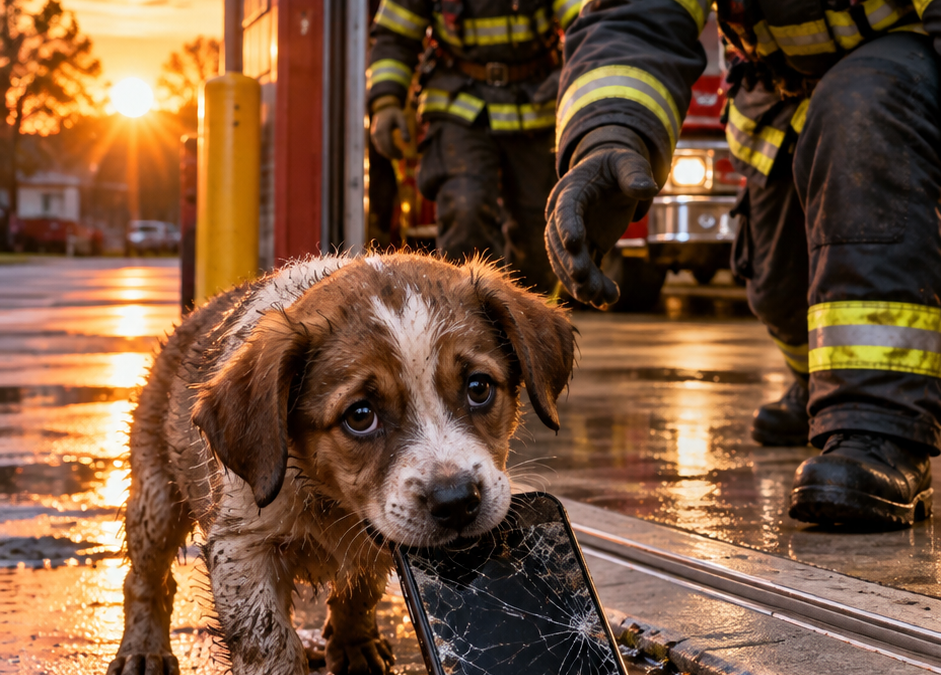
To us, he was just a soot-covered German Shepherd puppy walking through the August heat with blood on one front paw and a destroyed phone clenched between his teeth.
I was stepping outside between calls with a paper cup of water in my hand when I saw him through the shimmer rising off the pavement.
At first, I thought he was carrying trash.
Dogs pick up strange things.
Then the sunlight flashed off broken glass.
I stopped.
The puppy kept coming.
Six months old, maybe seven.
Sable coat blackened with soot.
River mud dried along his belly.
One ear nicked.
Paw pads torn.
His tongue hung around the object in his mouth, but he refused to drop it.
He made it to our front steps.
Then his legs folded.
My cup hit the pavement.
“Hey!”
I ran to him.
The puppy lifted his head.
His eyes were exhausted but frighteningly focused.
He wasn’t looking at the station.
He was looking at me.
That distinction has stayed with me.
He had not wandered there accidentally.
He wanted a person.
“Easy, buddy.”
I crouched.
The object was definitely a phone.
Screen destroyed.
Case cracked.
Water dripping from one corner.
The puppy had bitten the casing so hard his teeth had punched marks into the rubber.
I reached for it.
A low growl came from his chest.
I stopped instantly.
“Okay.”
His lips never lifted.
No teeth.
No aggression.
Just warning.
The phone mattered.
I called over my shoulder.
“Mason! Hill! Get out here.”
Boots pounded inside the bay.
Mason appeared first, wiping grease from his hands.
Hill followed.
“What happened?”
I pointed.
Mason stared.
“Is that a phone?”
“Apparently.”
The puppy tried standing.
Couldn’t.
Hill grabbed a towel.
We wrapped it loosely around his shoulders, keeping our movements slow.
“Nobody’s taking you anywhere,” I said.
The puppy watched my hands.
Mason crouched opposite me.
“You think he’ll release it?”
“Eventually.”
We offered water.
The puppy ignored it.
Chicken from the station refrigerator.
Ignored.
Then Mason held out one palm and gently touched the phone.
The puppy resisted.
Mason stopped.
“It’s all right.”
For several seconds, man and dog stayed frozen.
Then the puppy’s jaw opened.
The phone dropped into Mason’s hand.
The dog exhaled.
Not a normal breath.
A collapse.
Like he had been carrying more than plastic and glass.
Mason pressed the power button.
Nothing.
Again.
The screen flickered.
Hill leaned closer.
“Still alive.”
Battery showed one percent.
The lock screen appeared beneath a web of cracks.
Then a notification banner flashed across the top.
A message.
Only fragments were readable.
HELP US
Then:
UNDER FLOOR
Then:
CAN’T—
The rest dissolved beneath dead pixels.
All three of us went silent.
Mason looked at me.
“This isn’t random.”
“No.”
Hill grabbed the phone.
“GPS?”
“Check it.”
The puppy made a weak sound.
I turned.
His eyes were on the phone.
Then on us.
“Where did you come from?”
His tail moved once.
Barely.
Rachel, our medic, came outside and knelt beside him.
She had worked with search-and-rescue dogs before joining the department.
Her face changed the moment she saw his paws.
“He’s run hard.”
“How hard?”
She touched the torn pad gently.
“Farther than he should have.”
Mason held up the screen.
“Last GPS ping.”
“Where?”
“Old warehouse district near the river.”
Hill checked the map.
“Abandoned mill complex.”
“Distance?”
“Little over five blocks.”
I looked down at the puppy.
Five blocks.
In August heat.
On shredded paws.
Carrying a phone.
Rachel began cleaning the blood.
“He didn’t come here for himself.”
I knew.
I don’t know how.
I simply knew.
Mason zoomed in on the coordinates.
“Signal came from inside the old Morrow warehouse.”
That building had been condemned for years.
Part of the roof had collapsed two winters earlier.
No utilities were supposed to be active.
No legal occupancy.
But the message hadn’t said help me.
It said help us.
I stood.
“Gear up.”
Hill hesitated.
“Dispatch?”
“Call it in while we move.”
Rachel looked at the puppy.
“He shouldn’t go.”
The moment she said it, his head lifted.
I pointed at him.
“You stay with Rachel.”
He tried standing.
Collapsed.
Then tried again.
Mason stared.
“Jack.”
“I see.”
We loaded him into the rear medical compartment on a padded mat.
Rachel stayed with him.
No siren at first.
Just engines.
Coordinates.
A dying phone.
And one German Shepherd puppy who had crossed half the neighborhood bleeding because someone, somewhere, had asked for help.
We turned onto the warehouse road.
The puppy stood.
Not fully.
Enough.
His nose lifted.
His entire body tightened.
Rachel called through the partition.
“Jack.”
I looked back.
“He knows this place.”
Ahead of us, behind a rusted gate and weeds tall enough to hide a child, stood the old mill.
And before the engine had even stopped, the puppy began to whine.
PART2
The warehouse looked dead.
That’s the best way I can describe it.
No vehicles.
No lights.
No smoke visible from outside.
Broken windows reflected a white afternoon sky.
Weeds pushed through cracked asphalt.
The chain across the main gate had rusted so badly I doubted anyone had opened it in years.
Hill checked the coordinates again.
“This is it.”
Mason looked at the building.
“Could be somebody squatting.”
“Could be.”
“Could be a prank.”
I looked back at the puppy.
“No.”
Rachel was trying to keep him on the mat.
“Stay.”
He wasn’t listening.
His nose worked furiously.
Ears forward.
Body trembling.
I opened the rear door.
“Don’t.”
Rachel caught my arm.
“He needs fluids.”
“I know.”
“His paw is shredded.”
“I know.”
The puppy stepped toward the edge.
Rachel swore.
“At least carry him.”
I reached.
He dodged me.
Jumped.
Landed badly.
Almost went down.
Then limped toward the rear corner of the property.
Mason muttered, “That’s not random.”
No.
It wasn’t.
We went after him.
He ignored the main entrance completely.
Instead, he followed the wall to a warped metal service door half hidden behind vines and stacked pallets.
The puppy scratched.
Once.
Twice.
Then looked at us.
“Open it.”
Mason used a Halligan bar.
The hinges screamed.
Inside smelled like dust, wet wood, old oil, and something burned.
Rachel covered her nose.
“That dog has been in here.”
Soot on his coat.
River mud.
Cuts.
Everything aligned.
I crouched.
“Show me.”
The puppy moved.
He knew the route.
Through an old machine bay.
Around a fallen steel rack.
Between warped pallets.
He never explored.
He remembered.
That distinction made my skin crawl.
We passed a blackened section of wall.
Evidence of a small fire.
Recent.
Not fully involved, but enough to damage already rotten material.
At the rear of the building, the puppy stopped.
Wooden loading floor.
Old boards.
Some newer sheets of aluminum laid across sections.
The puppy scratched one spot.
Frantic now.
His injured paw reopened.
“Stop.”
He didn’t.
I pulled him back.
Mason knelt.
“Floor sounds hollow.”
Hill tapped.
Definitely.
We cleared debris.
Found a sheet of rusted metal screwed over an opening.
Mason pried.
The panel lifted.
Darkness underneath.
Crawl space.
Then—
Coughing.
All of us froze.
“Fire department!”
A faint voice.
Female.
“Here.”
Rachel dropped to her knees and aimed a flashlight inside.
The beam found a woman.
Mid-thirties.
Soot across her face.
Blood at one temple.
She was curled over a boy.
Maybe six.
Her body wrapped around him.
“Oh, thank God.”
Her voice cracked.
“Ma’am, don’t move.”
“The floor—”
“We know.”
“The fire—”
“We’re getting you out.”
Her eyes shifted past me.
Toward the opening.
“Finn?”
The puppy pushed forward.
His ears lifted.
I looked at him.
“Finn?”
His tail moved once.
The woman began crying.
“He came back.”
I understood.
This wasn’t a stray.
This was their dog.
“We’ve got him.”
Her eyes closed.
“Good.”
Mason radioed our location and requested full medical response.
I crawled down.
The boy was barely responsive but breathing.
Light burns along one arm.
Smoke exposure.
Rachel guided from above.
We passed him up carefully.
Then returned for the mother.
“What happened?”
“Floor gave way.”
“How long?”
“I don’t know.”
“Phone?”
“I sent Finn.”
I stopped.
“You gave him the phone?”
She nodded weakly.
“Fire started near the loading area. We dropped through. My phone still worked.”
Her breathing hitched.
“I tied it in his collar at first, but it broke loose.”
She looked toward the puppy.
“I told him to find help.”
That dog had not merely found help.
He’d carried the phone in his mouth after whatever had held it failed.
Five blocks.
Injury.
Heat.
Smoke.
Broken glass.
I reached for her.
“Let’s get you out.”
The floor groaned.
Mason’s voice sharpened.
“Jack.”
“I heard it.”
We moved faster.
The woman screamed when we lifted her.
Possible ankle injury.
Maybe ribs.
I got one arm around her.
Then something cracked behind us.
A beam.
Metal sheet dropped into the crawl space where she had been lying seconds earlier.
“Move!”
We pulled her upward.
Rachel had the boy.
Hill cleared the route.
Then we heard another sound.
Hiss.
Low.
Continuous.
Mason looked down.
“Gas.”
My stomach dropped.
“What line?”
“Doesn’t matter.”
The old building was supposed to have utilities shut off.
Apparently “supposed to” had failed again.
“We’re leaving now.”
Finn stood at the opening.
I pointed toward the exit we’d used.
“Go!”
He didn’t.
Instead, he turned.
Ran down another corridor.
“Finn!”
Nothing.
Rachel shouted, “Leave him!”
I almost did.
Then he barked.
One sharp bark.
From the far hallway.
Mason looked at me.
“He knows another way.”
Maybe.
Or maybe we were about to follow an injured puppy deeper into a collapsing industrial building.
I chose the puppy.
“Follow him.”
Rachel carried the boy.
Hill supported her.
Mason and I half-carried the woman.
The hallway narrowed.
Plaster fell.
Somewhere behind us, something metal crashed.
Finn waited at a broken service door.
Outside.
Daylight.
He barked again.
We made it through.
I had barely gotten the woman ten yards away when the building exhaled.
Not a Hollywood fireball.
A violent pressure wave.
Dust.
Wood.
Metal.
A section of roof collapsed inward.
We hit the ground.
Rachel covered the child.
I shielded the woman.
Mason rolled behind a concrete barrier.
For several seconds, I heard nothing but ringing.
Then coughing.
“Everyone!”
Hill’s voice.
“Sound off!”
“Jack!”
“Mason!”
“Rachel!”
“Boy’s breathing!”
“Woman’s conscious!”
Then I remembered.
“Finn!”
No answer.
I pushed up.
Dust swallowed the lot.
“FINN!”
Movement.
Across the gravel.
A black-and-sable shape.
Limping.
One ear bloodied.
Still coming toward us.
I ran.
He staggered once.
I reached him before he fell.
Scooped him up.
This time he didn’t resist.
His head dropped against my chest.
The dog who had fought us for a shattered phone simply stopped fighting anything.
He had delivered the message.
Shown us the victims.
Led us out.
Now he was finished.
“Good boy.”
His eyes closed.
“Good boy.”
Backup arrived minutes later.
Ambulances.
Police.
Additional engine.
Hazmat.
The mother was transferred first.
Smoke inhalation.
Possible fractures.
The boy was unconscious but stable.
Rachel rode with him.
Finn stayed at the station initially under our on-call veterinary partner’s guidance until transport could be arranged.
But before the ambulance pulled away, the mother woke enough to ask one thing.
“Finn?”
I carried him to her stretcher.
Her eyes filled instantly.
“I told you to find help.”
Finn lifted his head.
She touched his forehead.
“You did.”
He licked her wrist once.
That was the first time I saw his body truly relax.
Back at Station 27, Finn slept beneath a heat lamp while a veterinarian from an emergency clinic examined him.
Torn paw pads.
Mild smoke inhalation.
Dehydration.
Cuts.
No fractures.
The wound near his ear needed stitches.
He had been unbelievably lucky.
Mason stood beside me.
“I’ve been doing this twenty years.”
“I know.”
“I’ve seen search dogs.”
“I know.”
“I’ve never seen that.”
Neither had I.
Rachel returned from the hospital near midnight.
“The kid’s stable.”
We all exhaled.
“Mother?”
“Stable too. Burns minor. Ankle fracture.”
She looked at Finn.
“That dog saved them.”
Hill crouched.
“He is them.”
“What?”
“The phone.”
We all looked.
Hill held the damaged device inside an evidence bag.
Once we dried it carefully, parts of the lock screen became clearer.
A photograph appeared.
Finn.
Smaller.
Sitting beside the same little boy.
Below the image was text added to the wallpaper.
FINN
There was no mystery anymore.
No stray.
No ghost dog.
Finn.
His family had trusted him with an impossible task.
And somehow, he’d understood enough.
Not language in the way we understand it.
Not directions and coordinates.
But urgency.
Routine.
A familiar fire station perhaps seen on walks.
Human scent.
The phone.
The command to go.
Whatever pieces a dog’s mind had assembled, they had been enough.
The next morning, Finn woke before most of us.
He lay in the medic bay.
Every time a firefighter entered, his eyes followed.
Counting.
That’s what it looked like.
Mason.
Hill.
Rachel.
Me.
Lily Chen, our youngest cadet, came through the door carrying coffee.
Finn’s ears rose.
She knelt.
“Hey, hero.”
I winced.
“Don’t start.”
“What?”
“Hero.”
“He is.”
“He’s a puppy.”
“Both can be true.”
Finn sniffed her hand.
Then accepted a piece of banana.
We discovered that morning that he loved bananas.
An important fact after a dramatic rescue.
At noon, his family came.
The mother, Sarah Bennett.
Her son, Owen.
Both had insisted on seeing him immediately after discharge.
Sarah was on crutches.
Owen had a bandage near his temple.
Finn saw them through the glass bay door.
Everything changed.
He tried standing too fast.
Legs buckled.
Owen ran.
Dropped to his knees.
Wrapped both arms around him.
Finn made a sound.
Not the controlled growl from the steps.
Not the bark from the warehouse.
A whimper.
High.
Fragile.
He buried his head beneath Owen’s chin.
Sarah knelt awkwardly beside them.
Her hand rested on Finn’s back.
For a full minute, none of us said anything.
Then Sarah looked at me.
“He carried the phone?”
“Yes.”
“I attached it to his collar using a strap.”
“It must’ve broken.”
“I thought he ran because he was scared.”
“No.”
Tears filled her eyes.
“He ran because I told him to.”
I nodded.
“Looks that way.”
Owen wouldn’t release him.
Finn didn’t want release either.
Eventually Sarah said something unexpected.
“We can’t take him home.”
I stared.
“What?”
“Our house was already unsafe.”
She explained.
They weren’t living at the warehouse.
Her estranged brother had been using part of it illegally for storage.
Sarah had gone there with Owen to retrieve belongings.
The fire started from faulty wiring.
Their own apartment had recently suffered a severe mold issue, and temporary housing did not allow animals.
Her voice shook.
“I don’t want him separated from people again.”
“You don’t have to decide today.”
“I’ve decided.”
She looked around the station.
Then at Finn.
“He chose where to go.”
I shook my head.
“He chose help.”
“Maybe both.”
Owen looked up.
“Can he stay here?”
That is not normally how municipal fire departments acquire dogs.
There are policies.
Liability.
Insurance.
Veterinary responsibility.
Housing rules.
A mountain of paperwork tall enough to put out its own fire.
But Chief Reynolds came into the bay at exactly the wrong—or right—moment.
He listened.
Looked at Finn.
Then said:
“Temporary foster.”
I turned.
“Chief—”
“Temporary.”
Hill smiled.
Mason covered his mouth.
Lily whispered, “We’re keeping him.”
“Nobody said that.”
Everyone looked at me.
“Stop.”
We became Finn’s foster family.
Officially, the department partnered with a rescue organization to handle medical and legal custody while Sarah stabilized her housing situation.
Unofficially, Finn became Station 27’s most closely supervised probationary employee.
He slept near the lockers.
Not because we trained him to.
Because from that position he could see both the apparatus bay and the kitchen.
Strategic.
He watched the trucks.
Watched us suit up.
Reacted to tones but never panicked.
For the first several weeks, his only job was healing.
No response rides.
No training stunts.
No heroic expectations.
Rachel was strict about that.
“He doesn’t owe the city anything.”
I agreed.
Others needed reminding.
People began appearing after news coverage.
Reporters.
Neighbors.
Children with drawings.
Someone taped a sign to the fence:
THANK YOU, FINN
Another:
HE FOUND HELP
Finn did not care.
Banana?
Interested.
Cameras?
Boring.
We limited exposure.
The department issued one short statement.
Then closed access.
He needed sleep.
Routine.
Veterinary care.
Not a media tour.
Two weeks in, Chief Reynolds brought out a red collar.
Attached was a small silver tag.
Not a badge.
Not an official operational designation.
Just engraving.
FINN — STATION 27
On the back:
RESCUER
Lily cried.
Mason claimed dust.
There was no dust.
Finn shook his neck.
Tag jingled.
Then he stole half a sandwich from Hill.
Ceremony concluded.
Sarah visited every few days with Owen.
Their housing problems were worse than expected.
Eventually she signed Finn permanently over to the rescue partner with one condition.
“If Station 27 wants him, he stays there.”
Chief Reynolds looked at me.
I looked at Finn.
Finn was asleep on my turnout boots.
“Apparently.”
That was how a wounded puppy carrying a broken phone became ours.
Not department property.
Never that.
Legally, he was adopted by me, because somebody had to be responsible outside city policy.
Practically, he belonged to all of us.
Finn came home with me on off days.
Returned to the station during shifts when permitted.
He learned two homes.
Two routines.
Same people.
His paw healed.
The limp faded.
His coat cleaned up.
Sable fur turned deep bronze and black.
He filled out.
At six months, he had looked like a survivor.
By ten months, he looked like a shepherd.
Then came the carbon-monoxide call.
That story grew wildly afterward.
People said Finn predicted it.
He didn’t.
The truth was more interesting because it was real.
We returned from a welfare check where a CO alarm had triggered at a house on the east side.
Finn had stayed at the station with Rachel.
When I walked in, he became unusually agitated.
Sniffing my turnout pants.
The gear.
My gloves.
Then tugging at my jacket.
Rachel said he’d been restless since our return.
Before I could think much about it, tones dropped again.
Structure instability.
Possible worker trapped.
Same general block.
Chief Reynolds hesitated when Finn reacted strongly to the gear.
He had already begun basic scent and obedience work through a professional trainer because of his unusual drive.
Still, he wasn’t a certified search dog.
We did not throw him into emergencies because he was famous.
That matters.
He stayed outside with Rachel during the initial sweep.
Then our thermal camera and search produced nothing.
A crawl-space vent stood open.
Finn became focused on it.
Rachel let him approach on leash.
He sniffed.
Pulled.
Barked.
One clear alert.
We checked.
A boot.
Movement.
Worker trapped beneath a sagging section of floor.
Alive.
Later, the trainer explained that Finn may have detected human scent and stress odor moving through the vent.
No magic.
No prophecy.
A dog’s nose.
Experience.
Drive.
And a handler willing to pay attention.
That changed our approach.
Chief Reynolds contacted a certified K9 training organization.
Not because Finn was already qualified.
Because he might be.
Evaluation followed.
Confidence.
Environmental stability.
Search drive.
Scent discrimination.
Recovery after stress.
Finn was promising.
Very promising.
But young.
We trained slowly.
Months.
No shortcuts.
He learned rubble.
Dark rooms.
Ladders only where safe.
Surface changes.
Recall.
Human-remains scent was not part of his work.
Live-find only.
He learned that finding a hidden person produced reward.
Usually a ball.
Eventually Finn discovered tennis balls.
That changed his entire personality.
The solemn dog from the warehouse became a lunatic if fluorescent felt appeared.
Good.
We wanted that.
Work drive should coexist with joy.
Lily read her EMT manuals beside him.
Finn chewed a ball.
Mason ran obedience drills.
Hill pretended not to love him.
Failed spectacularly.
Owen visited when he could.
Whenever Finn saw him, professionalism ended completely.
Tail.
Whining.
Spinning.
Old family was still family.
Nobody tried to replace that.
A year after the warehouse, Finn completed formal certification through a regional search-and-rescue partner.
Not a firefighter.
Not a psychic.
A trained live-find K9 working under controlled protocols with approved handlers.
I became one of those handlers.
That took almost as much training for me as for him.
Dogs read handlers brutally well.
Tension travels down leash.
Confusion becomes confusion.
Bad timing ruins communication.
Finn trained me quickly.
The first major search after certification involved a renovation collapse.
Old craftsman house.
Partial floor failure.
Electrician missing.
Initial crews heard nothing.
Finn was deployed after structural safety assessment.
He worked the perimeter.
Then an accessible crawl-space route.
His body changed near one vent.
Nose.
Breathing.
Tail.
He gave the trained alert.
We entered.
Found the electrician barely conscious.
Gas exposure.
Crush injury.
Alive.
News called Finn a miracle.
Our trainer called it a successful scent indication.
I preferred the second.
Miracles make people forget the work.
Finn had trained hundreds of hours.
So had the team.
That man survived because many systems worked.
Finn was one of them.
A very good one.
His role expanded carefully.
Community events.
Fire-safety education.
School visits.
Not operational every day.
Rest was protected.
On one tour, third graders poured through the bay.
Thirty-three yellow safety vests.
Maximum volume.
Finn handled it well.
Then I noticed one boy standing apart.
Jonah.
Quiet.
Teacher whispered that he’d recently survived a residential fire and lost a pet.
He wasn’t participating.
Finn saw him.
Approached slowly.
No command.
Jonah put one hand on Finn’s shoulder.
Stayed.
The other children gathered.
Jonah didn’t move.
Finally he whispered:
“Finn.”
His teacher started crying.
Someone later exaggerated the story and said the boy hadn’t spoken in months and somehow knew Finn’s name telepathically.
No.
He had seen the name stitched on the dog’s vest.
Reality did not need embellishment.
The remarkable part was that he chose to speak while touching him.
That was enough.
After that, Chief Reynolds explored a second role for Finn.
Community support.
Not formal psychotherapy.
Not medical treatment.
Calm presence during outreach.
We worked with professionals to make sure we weren’t turning him into a prop.
Finn enjoyed people.
When he didn’t, we stopped.
Simple.
Veterans visited.
Burn survivors.
Children.
Finn sat.
Accepted touch.
Sometimes brought his ball.
Sometimes walked away.
Consent worked both directions.
One older veteran in a wheelchair rested his shaking hand on Finn’s head.
Finn leaned gently into it.
The man said:
“I’ve worked with military dogs.”
Pause.
“This one’s got patience.”
That compliment meant more than “hero.”
Patience was earned.
Another rescue that later made headlines started at the station door.
A frantic mother rushed in carrying a tablet.
Her nine-year-old son had gone missing near an alley three blocks away.
Police had been notified, despite later versions claiming otherwise.
Search resources were mobilizing.
Because we were close and an immediate life-safety concern existed, we assisted.
Security footage showed the boy running into an alley after being frightened by an adult confrontation nearby.
The internet later turned that into an abduction story.
It wasn’t.
The boy had hidden.
Finn was deployed only after law enforcement coordination.
He searched.
At stacked pallets near a rear access point, he alerted.
Behind them was a damaged service hatch leading into a basement.
We found the child curled behind shelving.
Terrified.
Dehydrated.
Uninjured.
When Finn entered after the space was made safe, the boy reached for him.
Wrapped both arms around his neck.
Finn stood still.
That image became national news.
Again, people called him supernatural.
Again, I wanted to scream.
He had a trained nose.
A trained search pattern.
A team.
That’s extraordinary enough.
Then came the abandoned laundromat.
That incident was more complicated.
Two children had been reported missing from a nearby housing complex.
Police search overlapped with a fire inspection response after someone reported noises in a condemned property.
Finn indicated human scent near a basement access.
We entered with proper support.
Two children were found hiding beneath an overturned desk in a damaged lower room.
They had apparently entered the building following a loose dog and become trapped after debris shifted.
One held a chewed pink leash.
Somebody later claimed Finn had “come back for them.”
He hadn’t known them.
But the children associated him with the dog they had followed.
That confusion became part of the story.
I never corrected the children.
Adults?
Absolutely.
Finn didn’t need mythology.
His actual record was enough.
By two years old, his name had spread far beyond Detroit.
That worried me.
Fame is useless to a dog.
Worse, it can become harmful when humans expect constant access.
We declined appearances.
Limited visits.
Maintained training.
Protected sleep.
Finn worked no more than recommended.
Some weeks, he did nothing operational.
Excellent.
A bored dog with a ball is better than an overworked legend.
At home, he was ridiculous.
Stole laundry.
Slept upside down.
Hated the vacuum.
Loved snow.
Refused carrots.
Would climb into my shower after muddy training, then object personally to shampoo.
At the station, he learned everyone’s schedule.
He knew who dropped food.
Hill.
Who carried banana.
Lily.
Who threw balls farthest.
Mason.
Who enforced rules.
Me.
He ignored that last category when convenient.
Sarah and Owen remained part of his life.
Their circumstances stabilized.
Eventually they moved into safe housing that allowed dogs.
The question arose.
Should Finn return?
That conversation hurt everyone.
Sarah invited me to dinner.
Finn lay between Owen’s feet.
She said:
“He belongs with you now.”
I shook my head.
“He belongs with you too.”
“That’s different.”
She smiled.
“He saved us. But his life became this.”
Finn looked toward me when my chair scraped.
Then back to Owen.
Sarah noticed.
“He has two families.”
That was the answer.
Finn stayed with me.
Visited them.
Sometimes weekends.
No custody drama.
No emotional ownership contest.
Love expanded.
Nobody lost.
Owen grew.
Finn grew.
The photograph from the broken phone was eventually printed properly.
Young Finn beside a six-year-old boy.
It hung at Station 27.
Not under a slogan.
Just framed.
A reminder of before.
On the shelf beneath it sat the shattered phone after the case was closed and Sarah permitted it.
We removed the damaged battery.
Made it safe.
Kept it.
Not as a trophy.
As evidence of the impossible chain that brought him through our door.
Years passed.
Finn’s operational record grew.
So did the myths.
I became increasingly stubborn about correcting them.
No, he didn’t smell emergencies before dispatch.
No, he didn’t understand English sentences like a human.
No, he didn’t sense death.
No, he wasn’t deployed without incident command.
No, he wasn’t invincible.
He was a dog.
An exceptional dog.
Which should have been enough.
What he could do was astonishing.
Find human scent through voids.
Read airflow.
Work rubble.
Track trained odors.
Remember routes.
Recognize emotional states.
Associate gear with work.
Choose humans.
Persist.
Those are real abilities.
Real is better than magic.
At six, Finn began slowing slightly.
Not in work quality.
Recovery.
Longer naps after deployment.
Stiffness in the paw he’d injured as a puppy.
Veterinary imaging showed early arthritis.
We adjusted.
Fewer heavy searches.
More community work.
Training remained but lighter.
Finn did not protest.
He enjoyed schools.
Especially children who dropped food.
Retirement approached gradually.
No ceremony initially.
Just fewer roster entries.
More days beside the bay.
At seven, we formally retired him from operational search.
The department held a small gathering.
No massive press event.
Sarah came.
Owen, now a teenager.
Lily, now a full firefighter and paramedic.
Mason.
Hill.
Rachel.
Chief Reynolds, retired but still incapable of missing free cake.
Finn wore his red collar.
Silver tag scratched from years.
Reynolds knelt.
“You did your job.”
Finn licked frosting from his finger.
“Apparently still doing it.”
We laughed.
The framed lock-screen photo was brought down.
Owen held it beside Finn.
Someone took another photograph.
Boy now nearly grown.
Dog gray beginning around the muzzle.
Two points in a life connected by a shattered phone.
After retirement, Finn still visited Station 27.
Of course.
Try keeping him away.
He slept near the lockers.
Watched tones.
No longer rose every time.
That took months.
Eventually sirens became background.
I was grateful.
Work had been his life.
But it didn’t need to be his entire identity.
At home, we walked along the river.
Slow.
He sniffed every tree.
Retirement transformed him into a professional smell inspector.
At eight, he developed more arthritis.
At nine, heart changes appeared.
Manageable.
Medication.
Diet.
Monitoring.
At ten, stairs became difficult.
I installed ramps.
Hill came over to build one.
It was terrible.
Mason rebuilt it.
We never told Hill the truth.
Finn used it anyway.
Good dog.
Owen visited often.
Now in college.
He once sat on my porch with Finn’s head in his lap.
“Do you think he remembers that day?”
“The warehouse?”
“Yeah.”
I thought.
“Parts.”
“The phone?”
“Probably as an object.”
“Mom?”
“Definitely.”
“Me?”
Finn’s tail moved at Owen’s voice.
I smiled.
“Ask him.”
Owen scratched behind his ears.
Finn leaned harder.
Answer enough.
By eleven, gray covered most of his face.
His operational vest remained stored away.
Sometimes I’d take it out.
Not to put on him.
Just memory.
The shattered phone sat in a display box at the station.
One percent battery had changed several lives.
But the phone wasn’t the hero either.
No object was.
The message mattered because Finn carried it.
Finn mattered because Sarah trusted him enough to send him.
We mattered because someone read it and moved.
Rescue is a chain.
Remove one link, outcome changes.
That became the real lesson.
Not “dogs are angels.”
Not “heroes always know.”
Listen when information arrives in an unexpected form.
A broken phone.
A dog.
A sound beneath a floor.
Pay attention.
Finn’s final year began with appetite changes.
Then weight loss.
Bloodwork.
Ultrasound.
Cancer.
Splenic mass.
At eleven and a half, surgery was possible but high-risk.
We consulted.
Sarah came.
Owen.
Rachel.
Veterinarian.
No decisions made for symbolism.
Only quality of life.
We chose surgery.
He made it through.
Got another seven months.
Good months.
Worth it.
He returned to Station 27 once after recovery.
Walked into the bay.
Everyone stopped.
Lily crouched.
“Rescuer.”
Finn’s tail wagged.
He walked to the whiteboard.
The original word had long since been erased.
But a photograph remained.
Finn as a puppy.
Phone.
Soot.
Bandaged paw.
I looked from it to the old dog beside me.
“You were tiny.”
He ignored me.
“Rude.”
He found Mason’s dropped glove and carried it away.
Some habits survive everything.
Eventually cancer returned.
Slower this time.
No emergency.
No warehouse.
No heroic task.
Just biology.
He stopped eating breakfast one morning.
Then ate chicken.
Then refused that too.
Walking became difficult.
Sleep longer.
We knew.
I called Sarah.
Owen drove in that night.
Station 27 crew visited in shifts.
Not all at once.
Too much.
Finn lay in my living room beside the same red collar he’d worn for years.
His silver tag read:
FINN — STATION 27
RESCUER
I took it off because his neck had become tender.
Set it beside him.
Owen lay on the floor.
Finn’s nose rested against his arm.
Sarah sat on the couch.
She looked at me.
“Do you remember when I told him to find help?”
“Every day.”
“I thought I was sending him away to die.”
Her voice broke.
“You sent him somewhere he could live.”
She cried.
So did I.
The veterinarian arrived the next afternoon.
Home euthanasia.
Quiet.
No fluorescent clinic.
No alarms.
Finn lay on a blanket.
Owen on one side.
Me on the other.
Sarah’s hand on his back.
The same people connected by the first rescue.
I held the old broken phone case in my hand.
Not the phone itself.
Just the rubber case we’d saved.
Bit marks still visible.
I placed it nearby.
Finn sniffed once.
No reaction.
Of course.
It no longer mattered.
Good.
He had spent a life moving beyond it.
I put my hand on his chest.
“Hey, buddy.”
Eyes opened.
Still clear.
Still Finn.
“You found help.”
Tail moved once.
Owen covered his mouth.
I continued.
“You found us.”
Another breath.
“We found them.”
Sarah cried harder.
“You did enough.”
Sedative.
Finn relaxed.
His head grew heavy against my arm.
For the first time since the day he came to Station 27, there was nothing left for him to monitor.
No phone.
No trapped family.
No tones.
No gear.
No missing person.
No child beneath rubble.
No firefighter moving toward danger.
Just home.
People.
Warm floor.
Hands.
“Off shift,” Lily whispered from the doorway.
That destroyed all of us.
I laughed through tears.
“Yeah.”
I touched Finn’s ear.
“You’re off shift.”
The final medication entered.
His breathing slowed.
One.
Two.
Three.
Then stillness.
Nobody moved.
A dog who had spent his life finding people was surrounded by everyone who knew exactly where he was.
That felt right.
The department held no giant memorial.
Again, Finn wasn’t a politician.
He didn’t need spectacle.
His ashes were split.
Some with me.
Some with Sarah and Owen.
A small amount placed beneath a tree behind Station 27 with city approval.
The silver tag remained in the bay.
So did the photograph.
The shattered phone display was eventually removed.
I chose that.
People had begun treating it like a relic.
Finn’s story was larger than the object.
Instead, we hung two photographs.
First:
Finn as a wounded puppy wrapped in a station blanket.
Second:
Finn at retirement beside Owen.
Under them, a simple line.
HE BROUGHT THE FIRST CALL HIMSELF.
That’s enough.
New recruits ask about him.
I tell them the real version.
Not the viral one.
No psychic dog.
No magical rescues every week.
A badly injured puppy was given a desperate instruction by someone he trusted.
He carried a damaged phone five blocks.
That phone contained enough information for firefighters to locate two trapped people.
Finn then led us through a familiar building and helped us find a safer exit.
Later, training transformed natural ability into reliable search work.
He found real people.
He comforted real people.
He also stole real sandwiches.
All of it matters.
I tell recruits something else.
The first day Finn appeared, we could have misread him.
Growling over the phone.
Bleeding.
Dirty.
Unknown dog.
Easy to call animal control and step back.
Instead, we paid attention to what he was guarding.
That lesson followed me through the rest of my career.
Behavior is information.
Panic is information.
Silence is information.
Animals communicate.
People do too.
The job is noticing before deciding what the signal means.
Years after Finn died, I still sometimes hear nails on the bay floor in memory.
Especially when tones drop.
A phantom rhythm.
Click.
Click.
Click.
Then nothing.
Lily once caught me staring at his old spot.
“You hear him?”
I looked at her.
“Sometimes.”
She nodded.
“Me too.”
No shame.
Memory has sounds.
Station 27 eventually got another dog.
Not another Finn.
Important distinction.
A Labrador named Cooper trained for community support.
Different temperament.
Different story.
We never compared them.
That would have been unfair.
Cooper loved everyone indiscriminately and had the tactical awareness of a pillow.
Perfect.
Children adored him.
Finn’s photograph stayed on the wall.
No competition.
The past doesn’t have to surrender space for the future.
It can make room.
Owen became an EMT.
I didn’t see that coming.
Or maybe I should have.
At his graduation, Sarah sat beside me.
Finn’s old red collar was looped around her wrist.
Owen accepted his certificate.
She whispered:
“He started this.”
I shook my head.
“No.”
She looked at me.
“You did.”
“What?”
“You told Finn to find help.”
Her eyes filled.
“Maybe.”
“Finn carried the message.”
I pointed toward Owen.
“He carried the rest.”
Years earlier, a six-year-old boy had been lifted out of a collapsing warehouse because his dog refused to stop.
Now that boy was training to answer calls for strangers.
That was a better legacy than any medal.
I retired two years later.
Last shift.
Station 27.
Everyone did the traditional nonsense.
Cake.
Photographs.
Terrible speeches.
Mason, who had also retired, came back specifically to insult me.
Hill brought coffee.
Lily was now captain.
Time is cruel and hilarious.
Before I left, I stood beneath Finn’s photos.
Young puppy.
Old dog.
I touched the frame.
“Coming?”
Ridiculous.
But it felt normal.
Then I walked out.
Same front steps.
The ones where he’d collapsed with the phone.
I stood there longer than expected.
Traffic moved.
Detroit heat.
Sirens somewhere distant.
For a second, I could see him again.
Soot.
Mud.
Blood.
Shattered phone.
Eyes saying:
Understand this.
We did.
Eventually.
Finn’s first rescue is still the one that matters most to me.
Not because it was the most dramatic.
Because he had no training.
No vest.
No handler.
No idea what a fire station was supposed to do.
He only knew that somewhere behind him were two people he loved.
One of them had asked him to go.
So he went.
Across debris.
Through heat.
Over broken pavement.
On a torn paw.
Carrying the only message he had.
He arrived before his strength did.
Collapsed when the job was finished.
Then got up again when we needed him to show us where to go.
Everything after that—certification, searches, community visits, retirement—grew from that one act of loyalty.
But I don’t think Finn saw it as loyalty.
Dogs don’t need our words.
He probably understood something much simpler.
My people are in trouble.
Find someone.
Bring them back.
That was enough.
Sometimes courage is complicated.
Training.
Risk assessment.
Procedure.
Command.
Sometimes it is just refusing to drop the thing that matters.
Finn held a shattered phone between his teeth until strangers finally understood.
And when he let go, we ran.
Two people lived.
Then others.
Then Finn lived too.
For more than eleven years after the afternoon he collapsed at Station 27.
Eleven years of food bowls.
Tennis balls.
Snow.
Firehouse naps.
Search training.
Owen.
Sarah.
Bananas from Lily.
Stolen sandwiches.
Gray fur.
Arthritis.
Home.
That is the part viral headlines always miss.
They focus on the five blocks he ran bleeding.
I understand why.
It’s dramatic.
But rescue is not five blocks.
Rescue is what happens after someone opens the door.
Finn opened ours.
We opened his.
And the puppy who once arrived carrying a dying phone spent the rest of his life surrounded by people who answered whenever he called.
Even when the call was only a look.
A paw.
A head on a boot.
We learned to listen.
On Finn’s final day, nothing rang.
No dispatch tone.
No phone.
No alarm.
No one needed saving.
For once, that was the gift.
He had spent his whole life answering emergencies.
His last hours belonged only to him.
Warm.
Quiet.
Loved.
Off shift.
And that is how I choose to remember him.
Not as Detroit’s hero dog.
Not as a legend.
Not as a miracle.
As a wounded German Shepherd puppy who limped up our steps carrying one broken phone and trusted a room full of strangers to understand what he couldn’t say.
We did.
And because we did, a mother and her son came home.
So did Finn.








