𝗣𝗔𝗥𝗧 𝟮 A Taxi Driver Brought Me a Blind, Dying Cat, and I Couldn’t Believe What He Was Still Fighting Through
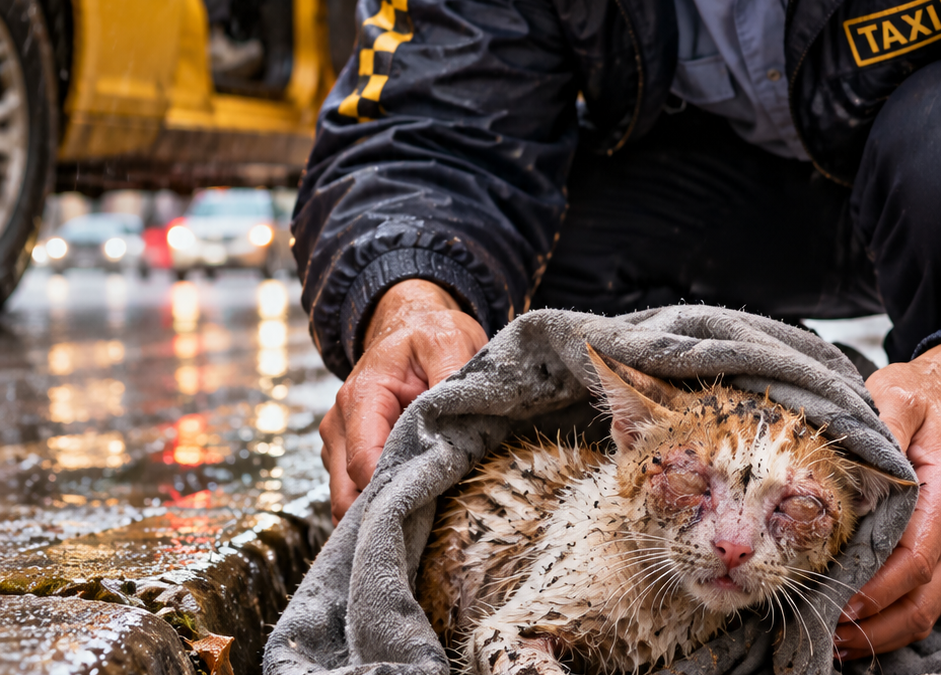
𝗣𝗔𝗥𝗧 𝟮
I stared at the cat.
He was lying quietly beneath the examination light, unable to see any of us.
Suddenly, the way he had failed to react when Miguel approached made terrible sense.
He hadn’t been too weak to look at the man who saved him.
He couldn’t see him.
I imagined lying beside a busy street, unable to see approaching traffic, unable to escape, and barely able to breathe.
The thought made my stomach tighten.
Dr. Bennett continued explaining the findings.
The cat was severely weakened. His respiratory infection required immediate treatment, and his facial injuries complicated even the simplest aspects of his care.
He would need nutritional support, pain management, careful cleaning, and constant observation.
His prognosis remained extremely guarded.
Rachel stood beside me, studying the images on the monitor.
“How is he still alive?”
Dr. Bennett shook his head.
“I don’t know how long he’s been living like this.”
The room fell silent.
For several minutes, the only sounds came from the medical equipment and the cat’s labored breathing.
Then Miguel spoke from the doorway.
“Can you help him?”
I turned.
He was standing with his hands clasped in front of him, still wearing the expression of someone who had stumbled into a situation much larger than he could understand.
Dr. Bennett approached him.
“We’re going to provide emergency care and reassess his condition as he responds. But I need you to understand that he’s critically ill.”
Miguel nodded.
“Does that mean he might not make it?”
“Yes.”
Miguel looked past him toward the table.
The cat’s chest rose again.
Then fell.
“He’s still trying,” Miguel whispered.
Nobody disagreed.
I had spent enough time in animal rescue to understand that compassion sometimes requires accepting that an animal cannot recover. We had to consider suffering, prognosis, and quality of life, not simply how desperately we wanted a rescue to succeed.
But this cat had only just reached us.
We had not yet given him the chance to respond to treatment.
And while we worked, his breathing gradually became more stable.
He was still critically ill.
He was still blind.
His injuries remained frightening.
But he was alive.
That afternoon, after Miguel had completed the necessary paperwork and we had settled the cat into intensive care, Rachel asked whether we should give him a name.
I looked through the glass door of the recovery room.
The little cat was resting beneath a warm blanket. Most of his face remained hidden by the angle of his head, but I could see his chest moving.
“Phoenix,” I said.
Rachel looked at me.
“Like the bird?”
I nodded.
“He’s already survived more than I can imagine.”
She considered the name for a moment.
Then she smiled.
“Phoenix it is.”
I wrote it on his medical chart.
PHOENIX.
It looked almost too grand for the fragile creature lying behind the glass.
But as the days passed, I would come to understand how perfectly it suited him.
The first night was terrible.
I stayed late at the shelter, checking on him between my usual responsibilities.
Every time I entered the recovery room, I was afraid of what I might find.
Sometimes Phoenix lay so still that I had to watch carefully for the movement of his chest.
Other times, his breathing became noisy and difficult, and the veterinary team had to reassess his condition.
He was frightened whenever we touched him unexpectedly.
I learned to speak before approaching.
“Phoenix, it’s Emily.”
I would wait a few seconds.
Then I would gently touch an area of his body that wasn’t injured.
Even with that warning, he sometimes flinched.
His world had been reduced to darkness, unfamiliar sounds, strange smells, and sensations he could not understand.
He couldn’t see the people trying to help him.
He couldn’t see the clean bedding beneath his body.
He couldn’t see the food and water we placed nearby.
And because his face was so badly affected, even breathing was difficult.
I began to wonder what the world must have felt like to him.
Every sound arrived without a visible source.
Every touch came from someone whose intentions he couldn’t immediately identify.
Every movement required trust.
On the second morning, I found him curled tightly against the back of his recovery enclosure.
“Good morning, Phoenix.”
His ears moved.
I stopped.
It was such a small response that I wasn’t certain I had seen it.
“Phoenix?”
His ears moved again.
I smiled.
“There you are.”
I opened the enclosure carefully and settled beside him.
He remained tense while I prepared to clean the discharge around his face.
The veterinarian had given us specific instructions for caring for the damaged areas, and every movement had to be gentle.
I spoke throughout the process.
“I’m going to touch your face now.”
He pulled backward slightly.
“I know. I’m sorry.”
I waited until he settled before continuing.
When I finished, I rested my hand near his shoulder.
For a moment, he remained completely still.
Then he moved his head toward my fingers.
The movement was so slight that I almost missed it.
But I felt it.
He had leaned toward my hand.
I remained beside him until he fell asleep.
Over the next several days, I developed a routine around his care.
I arrived early, checked his overnight medical notes, and visited him before beginning my other duties.
His respiratory symptoms remained severe, and there were mornings when the sound of his breathing frightened me.
His appetite was poor.
He tired easily.
He needed help with basic activities that a healthy cat would have managed without a second thought.
And yet I began noticing tiny changes.
He responded more consistently when I spoke.
His body didn’t stiffen quite as much when I approached.
He occasionally lifted his head when I entered the room.
One morning, I placed his food close enough that he could reach it without struggling.
“Breakfast, sweetheart.”
He turned his head toward the bowl.
At first, he seemed uncertain.
Then he leaned forward and began eating.
I watched him carefully, making sure he was comfortable and following the feeding instructions in his treatment plan.
It wasn’t much.
But he ate.
I had never imagined that watching a cat finish a small meal could make me feel so relieved.
Rachel came into the room while I was cleaning up.
“How did he do?”
“He ate almost everything.”
She smiled.
“That’s our boy.”
I looked at Phoenix.
He was resting with his head slightly raised.
For the first time since his arrival, he looked less like an animal clinging to life and more like a cat who was beginning to recognize his surroundings.
I wanted to believe we had passed the worst.
I was wrong.
Several weeks into his recovery, Phoenix developed new symptoms that concerned the veterinary team.
His skin became irritated, and some of his existing problems worsened despite the care he was receiving.
Further testing and assessment revealed that he was suffering from a severe allergic condition associated with an abnormal immune response.
His body was reacting in ways that complicated nearly every part of his treatment.
I remember sitting across from Dr. Bennett while he explained the results.
“His recovery is going to be more difficult than we originally hoped.”
I stared at the medical chart.
“How much more difficult?”
“We need to identify and manage his triggers, adjust his medications, and monitor him closely. The immune response is contributing to the inflammation we’re seeing.”
I looked through the window toward Phoenix.
He was sleeping.
His small body had already endured so much.
The idea that another condition was working against him felt unbearably unfair.
“Can we manage it?”
Dr. Bennett nodded.
“We have treatment options, but we need to proceed carefully.”
I took a breath.
“Then that’s what we’ll do.”
I said it confidently.
But later that afternoon, when I was alone with Phoenix, I sat beside his enclosure and cried.
It wasn’t a dramatic breakdown.
I didn’t sob or collapse.
I simply watched him sleeping and felt tears moving down my face.
He had survived the street.
He had survived the initial crisis.
He had endured examinations, medications, and weeks of difficult treatment.
And now another obstacle stood between him and the ordinary life he deserved.
I reached toward him.
“You’re allowed to be tired, you know.”
His ears moved at the sound of my voice.
I swallowed.
“You don’t have to be brave every second.”
He slowly lifted his head.
Then he extended one paw until it rested against my wrist.
I laughed shakily.
“All right. I know. We’re not finished.”
From that day forward, our routine became more complicated.
Phoenix needed a carefully managed diet, medication adjustments, and regular examinations to monitor his allergic and inflammatory symptoms.
We recorded his appetite, activity, respiratory comfort, and any changes in his skin or facial condition.
Some days were encouraging.
Others were exhausting.
There were mornings when he seemed eager to eat and explore.
There were afternoons when he became withdrawn and uncomfortable.
At times, a treatment that appeared helpful had to be reconsidered because his body wasn’t tolerating it as expected.
His medical chart grew thicker.
But his relationship with me grew stronger.
He began recognizing my footsteps.
I noticed it one afternoon when I approached his recovery room after spending several hours helping with another rescue.
Before I spoke, Phoenix lifted his head.
His ears turned toward the doorway.
I stopped outside.
“Phoenix?”
He immediately rose from his bedding.
I opened the door.
“How did you know it was me?”
He began moving toward my voice.
I knelt in front of him.
He approached cautiously, his whiskers extending forward as he investigated the space between us.
Then he touched his nose to my hand.
For the first time, he began purring while I stroked his head.
I had heard hundreds of cats purr during my years at the shelter.
But Phoenix’s purr was different.
It was faint at first, almost hidden beneath the remaining congestion in his breathing.
Then it grew stronger.
I sat on the floor beside him, afraid that moving would interrupt the moment.
Rachel found me there nearly twenty minutes later.
“What are you doing?”
I looked up.
“Listen.”
She crouched beside us.
Phoenix continued purring.
Rachel’s expression softened.
“Oh, Phoenix.”
He tilted his head toward her voice.
She gently touched his shoulder.
“You’re getting pretty comfortable around here, aren’t you?”
I smiled.
For the first time, I began to believe that Phoenix wasn’t merely tolerating our care.
He was learning to enjoy being alive.
His blindness presented challenges that required patience and consistency.
We kept his essential belongings in predictable locations.
His bedding remained in the same place.
His food and water bowls were arranged so he could locate them reliably.
We avoided unnecessary changes to his environment and spoke before approaching him.
Whenever he entered a new space, I allowed him to investigate at his own pace.
At first, he moved slowly, keeping his body close to familiar surfaces.
He would extend one paw, touch the floor ahead of him, and pause.
Then he would take another step.
Sometimes he stopped for several seconds, listening.
Other times, he turned toward the sound of my voice.
I learned not to rush him.
When he became disoriented, I spoke gently and gave him time to work out where he was.
“You’re okay, Phoenix.”
His ears would turn toward me.
“Your bed is right here.”
He would approach slowly, following the familiar sounds and scents.
Eventually, he began mapping his surroundings.
He learned the short distance between his sleeping area and his food bowl.
He discovered where the entrance to his enclosure was located.
He recognized the sound of Rachel preparing meals.
And he developed the habit of sitting upright on his bed whenever he heard my footsteps approaching.
It was a remarkable transformation.
The same cat who had once been unable to lift his head was now navigating his environment with increasing confidence.
But the progress demanded patience.
One afternoon, I introduced a slightly different arrangement to accommodate some medical equipment.
Phoenix became confused.
He moved toward the place where his bedding had previously been positioned and stopped when his whiskers encountered something unfamiliar.
He backed away.
Then he began searching again.
I immediately realized my mistake.
“Oh, sweetheart. I’m sorry.”
I restored the familiar arrangement and knelt beside him.
He remained unsettled for several minutes.
Then, gradually, he found his bed and climbed onto it.
I sat nearby until he relaxed.
That experience changed how I thought about his blindness.
I had been so focused on helping him overcome it that I sometimes forgot how much security he found in consistency.
Phoenix didn’t need me to turn every unfamiliar situation into a test of courage.
He needed a stable environment in which he could develop confidence.
And when we respected that need, he flourished.
As the months passed, his physical condition continued improving.
His weight increased gradually.
His coat became cleaner and healthier.
His appetite grew more reliable as the veterinary team refined his dietary plan.
The severe inflammation and damage around his face remained ongoing concerns, but he was no longer the motionless creature Miguel had carried through our doors.
He had preferences now.
He preferred one particular blanket.
He liked his meals served at predictable times.
He enjoyed having his head stroked but became impatient when someone interrupted his attempts to explore.
And he loved hearing people talk.
Sometimes I sat beside him while completing paperwork and read aloud from whatever document happened to be in front of me.
It didn’t matter whether I was reviewing vaccination records, inventory forms, or adoption applications.
As long as I spoke in a familiar tone, Phoenix seemed content.
Occasionally, he would lift his head when I paused.
“Sorry, buddy,” I would say. “I got distracted.”
Then I would continue reading.
He would settle back onto his blanket.
One evening, after a particularly difficult day at the shelter, I sat beside him long after my shift had ended.
We had received several injured animals that week, and our staff was exhausted.
I had spent the afternoon helping care for a frightened dog who had been abandoned after a serious injury.
By the time I reached Phoenix’s room, I felt emotionally drained.
I opened his enclosure and sat quietly beside him.
He immediately approached.
His whiskers brushed my hand.
Then he climbed carefully onto the edge of my lap.
I froze.
Phoenix had never done that before.
“Well, hello.”
He adjusted his position, settled against my legs, and began purring.
I rested my hand gently on his back.
For a long time, neither of us moved.
I had spent months giving him comfort.
That evening, without understanding what kind of day I had endured, he gave some of it back.
It was during this stage of his recovery that our rehabilitation specialist recommended another evaluation.
Although Phoenix had made extraordinary progress, his breathing remained compromised by the damage and obstruction affecting his nasal passages.
The inflammation around his eyes also continued to cause problems.
We arranged a detailed consultation to determine whether surgery could improve his comfort and long-term quality of life.
I accompanied him to the appointment.
He traveled in his familiar carrier with his favorite blanket beneath him.
Throughout the journey, I spoke to him.
“We’re just going to see another doctor. I’ll be right here.”
He occasionally shifted when the vehicle changed direction, but otherwise remained quiet.
The specialist examined him carefully and reviewed his medical history.
She spent a long time studying his imaging and evaluating his breathing.
Finally, she sat down with Dr. Bennett and me.
“I think surgery may offer him a meaningful improvement.”
I looked at her.
“In his breathing?”
“Yes. We may be able to clear the obstructed passages and address some of the swelling around his eyes.”
I glanced toward Phoenix.
He was resting inside his carrier.
“How risky is it?”
She didn’t minimize the situation.
Phoenix had a complicated medical history. His previous infections, facial injuries, and immune-related condition all required careful consideration.
The procedure itself would be delicate.
Recovery could be difficult.
There were no guarantees.
“But if it works,” I asked, “he could breathe more comfortably?”
“That’s the goal.”
I sat silently for a moment.
For months, I had listened to Phoenix struggle for air.
Even on his better days, his breathing reminded me of everything his body had endured.
I thought about what it might mean for him to sleep without that constant effort.
To eat comfortably.
To explore his surroundings without becoming exhausted.
To simply rest.
“When would you recommend doing it?”
The specialist explained that we would need to make sure his condition was stable enough and plan the procedure carefully.
We discussed the potential benefits, complications, and recovery requirements.
There was no easy answer.
That evening, I returned to the shelter with Phoenix and settled him into his familiar bed.
He immediately began investigating his food bowl.
I watched him eat.
Then I listened to him breathe.
The familiar congestion was still there.
It had become such a constant part of his life that I almost couldn’t imagine him without it.
I sat beside him.
“There’s something we might be able to do for you.”
He continued eating.
“It might make things easier.”
He paused briefly and turned toward my voice.
I smiled.
“But you’re going to have to trust us again.”
He approached me after finishing his meal.
I stroked his head.
The decision ultimately belonged to the veterinary professionals and the rescue organization responsible for his care.
After careful consideration, we agreed to proceed.
The morning of the surgery, I arrived before sunrise.
Phoenix was already awake.
He sat upright on his bed when he heard me enter, his ears turning toward the sound of my footsteps.
“Good morning, handsome.”
He moved toward me.
I knelt beside him and let him investigate my hand.
His whiskers brushed my fingers.
Then he pressed his head gently against my palm.
I felt an unexpected rush of fear.
I had spent months watching him survive one crisis after another.
Now we were deliberately placing him through another difficult medical procedure because we believed it could give him a better life.
I knew the decision was reasonable.
I trusted the veterinary team.
But fear does not always respond to reason.
As I helped prepare him for transport, I found myself memorizing the little details I had come to love.
The shape of his face.
The way his ears moved independently whenever he heard two people speaking.
The soft weight of his head against my hand.
The peculiar little sound he made when he wanted attention.
I was terrified of losing him.
At the surgical facility, the medical team reviewed his condition and prepared him for the procedure.
I remained with him until it was time for him to enter the treatment area.
Then I leaned close to his carrier.
“Phoenix, it’s Emily.”
His ears turned toward me.
“You’re going to be okay, sweetheart.”
I stopped.
I couldn’t promise him that.
So I changed my words.
“We’re going to do everything we can for you.”
I stroked his head one last time.
Then the veterinary technician carefully carried him away.
The waiting was agonizing.
I sat in a quiet room with a cup of coffee I never finished.
Every time someone walked down the hallway, I looked up.
I tried reading.
I tried answering messages.
I even opened Phoenix’s medical records and reviewed the progress he had made over the previous months.
Nothing helped.
I kept remembering the morning Miguel arrived.
The filthy sweatshirt.
The motionless cat.
The terrible sound of his breathing.
I thought about how far he had come.
He had learned to recognize my voice.
He had learned the layout of his recovery space.
He had gained weight, developed preferences, and discovered the comfort of human affection.
I wanted him to experience everything that still lay ahead.
A permanent home.
A family.
Years of ordinary days filled with warmth and safety.
But first, he had to make it through this one.
When the specialist finally came to speak with me, I stood so quickly that my chair scraped against the floor.
“How is he?”
“The procedure is finished.”
I held my breath.
“He’s in recovery now.”
I closed my eyes.
For several seconds, I couldn’t say anything.
The specialist explained that the surgical team had addressed the obstruction in his nasal passages and treated the affected areas according to their plan.
Phoenix would require careful monitoring as he recovered.
His medical problems were not magically gone.
But he had made it through the procedure.
“Can I see him?”
“Once he’s settled.”
I nodded.
“Thank you.”
I said it again before she left.
“Thank you so much.”
When I was finally allowed to visit him, Phoenix was resting in a carefully monitored recovery area.
He looked exhausted.
His face was swollen from the procedure, and he remained under close veterinary supervision.
But his chest was moving.
In.
Out.
In.
Out.
I sat beside him.
“Hey, little guy.”
One ear moved.
I laughed through my tears.
“There you are.”
I couldn’t hold him.
I couldn’t rush his recovery.
All I could do was sit nearby and speak in the familiar voice he had learned to trust.
So that was what I did.
The days following surgery were difficult.
Phoenix needed careful pain management, wound care, medication, and frequent examinations.
He was uncomfortable and exhausted.
Sometimes he became restless.
Sometimes he wanted nothing more than to sleep.
His appetite fluctuated, and we monitored him closely for signs of complications.
I spent as much time with him as my responsibilities allowed.
During the quieter hours, I sat beside his recovery space and spoke softly.
I told him about the other animals at the shelter.
I described the weather.
I told him when Rachel arrived with fresh blankets and when Dr. Bennett came to examine him.
Sometimes, I simply repeated his name.
“Phoenix.”
His ears would move.
“I’m here.”
He would settle again.
Then, during his recovery, something happened that none of us expected.
Phoenix expelled a long parasitic worm.
When Rachel discovered it, she immediately alerted the veterinary team.
We had already been managing an extraordinary number of medical problems, and the discovery of an additional parasitic burden was both disturbing and revealing.
Dr. Bennett arranged the necessary follow-up treatment and monitoring.
I stood beside Phoenix’s recovery area afterward, staring at him.
“Is there anything you haven’t been through?”
He lifted his head toward my voice.
His expression, as always, revealed very little about what he thought of my question.
Rachel looked at me.
“Apparently, he had one more surprise.”
I shook my head.
“Of course he did.”
We were relieved that another source of stress on his weakened body had been identified and addressed.
Gradually, as his postoperative recovery continued, we began noticing meaningful changes.
His breathing became easier.
The constant struggle that had once dominated every moment of his life began to lessen.
He slept more peacefully.
His appetite improved as he became more comfortable.
And for the first time since I had met him, I could sometimes sit beside his bed without hearing that terrible, labored sound.
The difference was extraordinary.
One afternoon, I arrived to find him asleep in a patch of sunlight.
His body was stretched comfortably across his blanket.
His breathing was quiet and steady.
I stopped in the doorway.
For several seconds, I simply watched.
Then Rachel appeared behind me.
“What’s wrong?”
I shook my head.
“Nothing.”
She followed my gaze.
Phoenix remained asleep.
I smiled.
“Listen.”
Rachel stood beside me.
The room was quiet.
No desperate gasping.
No exhausting struggle for air.
Only the soft sounds of a sleeping cat.
Rachel placed a hand over her heart.
“Oh, sweetheart.”
I leaned against the doorway.
I had never imagined silence could sound so beautiful.
Over the following weeks, Phoenix’s recovery continued.
His surgical wounds healed under veterinary supervision.
His diet was carefully adjusted to manage his allergic condition.
His medication plan became more predictable.
He gradually regained the energy he had lost during the procedure.
His blindness and facial nerve damage remained permanent.
But those conditions no longer prevented him from participating in the world around him.
He began moving through his familiar space with renewed confidence.
He explored more frequently.
He showed interest in toys that made gentle sounds.
He became more affectionate with the people he recognized.
And he developed a habit that made everyone at the shelter smile.
Whenever I laughed, his ears would twitch.
It didn’t matter whether I was sitting beside him or speaking with someone across the room.
The moment I laughed, he turned toward the sound.
Sometimes he raised his head.
Sometimes he approached.
And sometimes he remained exactly where he was, apparently satisfied that he had identified the source of the noise.
Rachel found the habit hilarious.
“He’s keeping track of you.”
I watched Phoenix sitting proudly on his bed.
“Someone has to.”
His confidence grew as the months passed.
He no longer seemed frightened by every unfamiliar sound.
He learned that footsteps usually meant someone was approaching with food, medication, or affection.
He learned that his bed would remain in the same familiar place.
He learned that when he moved toward my voice, I would be there.
And he learned that the world, although invisible to him, could be predictable and safe.
Ten months after Miguel carried him into our shelter, Phoenix was almost unrecognizable.
The emaciated body had filled out.
His coat was clean and soft.
His appetite was reliable, provided we maintained the diet necessary for his medical condition.
His breathing was dramatically more comfortable.
And although his eyes remained blind and the damage to his facial nerves had not disappeared, he carried himself with a quiet confidence that made his earlier condition difficult to imagine.
He had become one of the most beloved animals in our care.
Volunteers often stopped outside his room to greet him.
Rachel brought him extra attention whenever her schedule allowed.
Dr. Bennett checked on him during routine rounds and sometimes stayed a little longer simply to watch him investigate his surroundings.
Even Miguel called occasionally to ask how the little cat from the gutter was doing.
During one of those conversations, I told him that Phoenix was walking confidently, eating well, and recovering from surgery.
Miguel was silent for several seconds.
Then he asked, “He really made it?”
I smiled.
“He’s doing very well.”
I heard him exhale.
“I still think about that morning.”
“So do I.”
“I almost drove past him.”
I looked toward Phoenix, who was sitting on his bed with his head tilted toward Rachel’s voice.
“But you didn’t.”
Miguel was quiet.
Then he said, “I’m glad somebody was there to help him.”
I thought about the months of veterinary treatment, the difficult nights, the surgery, and the endless small acts of patience that had brought Phoenix to this point.
“You started it,” I told him.
He laughed softly.
“I just gave him a ride.”
I smiled.
“Sometimes that’s everything.”
After we ended the call, I sat beside Phoenix and told him about Miguel.
“Your taxi driver called today.”
Phoenix approached my hand.
“He wanted to know how you’re doing.”
He rubbed his cheek carefully against my fingers.
I laughed.
“I told him you’re spoiled.”
Phoenix began purring.
“And apparently, you agree.”
By then, we had begun discussing the possibility of finding him a permanent home.
The idea made me nervous.
Phoenix had complex medical needs.
He required a carefully managed diet, regular veterinary care, and people who understood how to support a blind cat.
His environment needed to remain consistent enough for him to navigate confidently.
Anyone who adopted him would have to recognize that his disabilities and medical history were permanent parts of his life.
He wasn’t a cat who could simply be placed in any household without preparation.
We wanted more than a family who admired his survival story.
We wanted people who understood the practical responsibilities of loving him.
And I wanted him to be chosen for the cat he had become, not merely because people felt sorry for the suffering he had endured.
One afternoon, a family contacted the shelter about adopting a cat.
They had originally hoped to find a straightforward, healthy companion.
Someone affectionate.
Someone who would settle comfortably into their household.
Someone who wouldn’t require extensive medical management.
They hadn’t specifically been looking for a special-needs animal.
But when they learned about Phoenix, they became curious.
I arranged for them to visit.
On the morning of their appointment, I spent more time than usual preparing his space.
I checked that his bedding was clean.
I made sure his food and water were in their familiar positions.
I placed one of his favorite toys nearby.
Then I sat beside him.
“Someone’s coming to meet you today.”
His ears turned toward my voice.
I stroked his head.
“Now, I need you to make a good impression.”
He immediately began washing one front paw.
I laughed.
“Excellent. Very professional.”
But beneath my amusement, I felt anxious.
I knew how people sometimes reacted when they first saw animals with visible disabilities.
Some were uncomfortable.
Some were overwhelmed by the thought of medical responsibility.
Others expressed sympathy but could not imagine bringing such an animal into their home.
I didn’t blame anyone for recognizing that they couldn’t meet a pet’s needs.
But I was afraid that Phoenix would spend the rest of his life waiting for someone to look beyond the damage to his face.
He had survived so much.
I wanted him to have a family of his own.
When the visitors arrived, I met them in the reception area.
They were a family of three: a father, a mother, and their teenage daughter.
They seemed friendly but slightly uncertain.
The mother asked about Phoenix’s medical condition before we entered his room.
“Will he always need special food?”
“Yes,” I explained. “His diet is part of managing his allergic condition, and he’ll need ongoing veterinary supervision.”
“And he can’t see anything?”
“No. His blindness is permanent.”
The father nodded thoughtfully.
“Does he get frightened?”
“Sometimes, especially when something unfamiliar happens without warning. But he’s learned to navigate familiar spaces very well.”
The daughter looked toward the hallway.
“Can we meet him?”
I smiled.
“Of course.”
I led them into Phoenix’s room.
He was sitting upright on his bed when we entered.
At the sound of unfamiliar footsteps, his ears turned toward the door.
The family stopped a short distance away.
For a moment, nobody spoke.
I watched their expressions carefully.
Phoenix’s face still carried visible evidence of his injuries. His eyes were blind, and the effects of his nerve damage remained noticeable.
He didn’t resemble the healthy, bright-eyed cats people usually imagined when they visited a shelter looking for a new companion.
The father looked at him for several seconds.
Then he quietly asked, “That’s Phoenix?”
I nodded.
“That’s our boy.”
The daughter took a small step forward.
“He’s beautiful.”
Something loosened inside my chest.
I smiled.
“He is.”
I explained that Phoenix preferred people to speak before approaching him.
The father crouched a few feet away.
“Hey, buddy.”
Phoenix’s ears moved.
He turned his head toward the unfamiliar voice.
The father remained still.
“How are you doing, little guy?”
Phoenix rose from his bed.
He paused, listening.
Then he took a cautious step forward.
I watched every movement.
He approached slowly, extending his whiskers as he investigated the unfamiliar space.
The father placed his hand on the floor.
He didn’t reach toward Phoenix.
He simply waited.
Another step.
Then another.
Phoenix stopped when his whiskers brushed the man’s fingers.
For a brief moment, the entire room seemed to become perfectly still.
Then Phoenix lowered his head and gently touched the man’s hand.
The father smiled.
“Well, hello there.”
Phoenix remained beside him.
The man carefully stroked his head.
A familiar sound filled the room.
Phoenix was purring.
I felt tears gathering in my eyes.
The daughter knelt beside her father.
“Can I touch him?”
“Let him know you’re here first,” I said.
She spoke softly.
“Hi, Phoenix.”
His ears turned toward her.
She extended her hand and waited.
After a moment, Phoenix moved toward her voice.
She stroked his shoulder gently.
“Oh, he’s so sweet.”
Her mother crouched nearby.
Phoenix investigated each new voice with cautious curiosity.
There was no dramatic moment when everyone suddenly announced that they had fallen in love.
Instead, something quieter happened.
They began asking questions.
Not about whether his blindness could be cured.
Not about whether his scars would disappear.
They wanted to know how he liked to sleep.
Whether he enjoyed playing.
How he reacted when someone came home.
Which sounds frightened him.
What kind of bedding he preferred.
And whether he liked being held.
As I answered, I realized their attention had shifted.
They were no longer studying a cat with severe medical problems.
They were getting to know Phoenix.
I told them about his favorite blanket.
About the way he recognized my footsteps.
About his fascination with gentle voices and his habit of turning his ears whenever I laughed.
I described how he had learned the layout of his room and how proud he seemed whenever he discovered something new.
I told them about the difficult days, too.
His medical care wasn’t optional.
His diet would need to remain carefully controlled.
He would require monitoring for allergic flare-ups and regular veterinary appointments.
His blindness meant that unfamiliar spaces could be confusing, and his new family would need to help him learn the arrangement of their home.
The father listened carefully.
“We can do that.”
I looked at him.
“He’s had a long recovery. Consistency is important.”
He nodded.
“We understand.”
The mother gently stroked Phoenix’s back.
“What happens if his allergies get worse?”
I explained that they would need to work with their veterinarian and follow his established treatment plan.
She asked several more questions.
None of them sounded like reasons to reject him.
They sounded like the questions of someone preparing to take responsibility for him.
Eventually, Phoenix climbed back onto his bed.
The father remained crouched beside him.
“You’re a pretty remarkable fellow, aren’t you?”
Phoenix settled comfortably and began washing his front paw.
The daughter laughed.
“He doesn’t seem very impressed with us.”
I smiled.
“He likes to take his time.”
The family stayed for nearly an hour.
By the end of the visit, Phoenix was resting peacefully while the three of them sat nearby discussing how they could prepare their home.
They understood that he wasn’t the uncomplicated pet they had originally expected to adopt.
But they had discovered something they hadn’t anticipated.
They wanted him.
Not despite his blindness.
Not because his injuries made them feel obligated to rescue him.
They wanted the affectionate, curious little cat who had spent the afternoon investigating their voices and accepting their gentle hands.
When the father finally looked at me and asked what they needed to do to adopt him, I felt an emotion I could barely identify.
Relief.
Joy.
And an unexpected sadness.
Phoenix had become part of my daily life.
I had spent ten months learning how to care for him.
I knew his routine, his preferences, and the little sounds he made whenever he wanted attention.
I knew how he tilted his head when he heard someone approaching.
I knew exactly where he preferred to sleep.
And I knew that when I entered his room in the morning, he would recognize my footsteps before I said a word.
For ten months, I had been one of the most familiar parts of his world.
Soon, someone else would take my place.
That was exactly what I had wanted.
But suddenly, it was difficult to imagine opening his door and finding his bed empty.
The adoption process took time.
We reviewed his medical history, discussed his ongoing care, and helped the family understand how to prepare a safe, predictable environment for a blind cat.
They arranged a comfortable space where Phoenix could gradually learn the layout of his new home.
They made plans for his dietary needs and veterinary follow-up.
They asked us to send his familiar blanket with him.
And they returned to visit before the adoption was finalized, giving Phoenix more opportunities to recognize their voices and become comfortable in their presence.
Each visit reassured me.
He approached them more confidently.
He began recognizing their footsteps.
When the father spoke, Phoenix often lifted his head immediately.
And when the daughter sat beside his bed, he sometimes moved toward her without hesitation.
Watching those interactions filled me with pride.
He was adapting.
He was trusting.
He was preparing to begin a new chapter.
The day he left the shelter arrived on a bright morning.
I had hardly slept the night before.
I arrived early and entered his room carrying the familiar blanket that would accompany him to his new home.
Phoenix was sitting on his bed.
At the sound of my footsteps, his ears lifted.
“Good morning, sweetheart.”
He rose and approached me.
I knelt beside him.
He touched my hand with his nose.
I stroked his head.
“Today’s a big day.”
He began purring.
I laughed softly.
“You have absolutely no idea what I’m talking about, do you?”
He pressed his head against my palm.
I sat on the floor beside him.
For several minutes, I said nothing.
I simply listened to him breathe.
I remembered the first time I had heard that sound.
How harsh it had been.
How frightened I had felt as his fragile chest struggled to rise and fall.
Now his breathing was calm.
His body was healthy enough to support the ordinary activities he enjoyed.
And he was about to leave the place where he had spent nearly a year recovering.
I ran my fingers gently through his fur.
“You’ve come a long way, Phoenix.”
He settled against my leg.
I thought about Miguel.
I thought about the filthy sweatshirt, the frantic drive to the shelter, and the extraordinary chain of events that had begun because one man refused to ignore a movement in the gutter.
I thought about Dr. Bennett and the medical team.
The difficult decisions.
The repeated examinations.
The surgery.
The setbacks.
And the countless hours of care that had helped Phoenix reach this moment.
But more than anything, I thought about the cat himself.
The frightened creature who had gradually learned to lean toward my hand.
The blind little survivor who had taught himself to navigate an unfamiliar world.
The affectionate companion who recognized my footsteps and purred whenever he felt safe.
I leaned close to him.
“I’m going to miss you.”
His ears turned toward me.
I smiled through my tears.
“But you’re ready.”
When his family arrived, Phoenix immediately recognized their voices.
His ears lifted, and he moved toward them with surprising confidence.
The father knelt beside him.
“Hey, buddy. Ready to go home?”
Phoenix touched his hand.
The daughter smiled.
“Look. He remembers you.”
I watched as they greeted him, allowing him to investigate their familiar scents and voices.
They had brought a comfortable carrier and prepared it with soft bedding.
We placed his favorite blanket inside.
After reviewing the final details of his medical care, I carefully settled him into the carrier.
He turned toward my voice.
For a moment, I felt my composure slipping.
I had imagined this day so many times.
I had pictured him leaving healthy, surrounded by people who understood his needs.
I had imagined smiling as I watched him begin the life he deserved.
But now that the moment had arrived, I wanted one more afternoon with him.
One more quiet hour beside his bed.
One more opportunity to hear him purr when I entered the room.
I crouched beside the carrier.
“Phoenix?”
His ears moved.
I placed my fingers near the opening.
He leaned toward them.
I gently stroked his head.
“You’re going home, sweetheart.”
My voice broke.
“You’re finally going home.”
The family waited patiently while I said goodbye.
Then the father lifted the carrier.
Phoenix settled onto his blanket.
As they walked toward the door, I followed them into the reception area.
The morning sunlight streamed through the windows.
Outside, ordinary life continued.
Cars moved along the street.
People hurried past the shelter.
Somewhere nearby, a taxi sounded its horn.
I smiled at the familiar noise.
Nearly a year earlier, another taxi had stopped beside a busy road.
Inside it, a frightened man had carried a dying cat wrapped in an old sweatshirt.
Now Phoenix was leaving in the arms of people who had chosen him as a member of their family.
I watched them carefully place his carrier inside their vehicle.
The daughter climbed into the back seat beside him.
The father turned toward me.
“Thank you for taking care of him.”
I shook my head.
“He’s a wonderful cat.”
“We know.”
The mother smiled.
“We’ll take good care of him.”
I believed her.
And that made saying goodbye just a little easier.
As their vehicle pulled away, I stood outside the shelter until it disappeared around the corner.
Then I went back inside.
The hallway seemed unusually quiet.
I returned to Phoenix’s room and found his bed empty.
His food bowl had been cleaned and put away.
The familiar blanket was gone.
Only the faint impression of his body remained in the soft bedding.
I sat down beside it.
For a moment, I allowed myself to feel the sadness.
I would miss his quiet confidence.
I would miss his unmistakable purr.
I would miss the way his ears turned whenever he heard me laugh.
But beneath the sadness was something stronger.
I remembered the way he had approached his new family.
He hadn’t been frightened.
He hadn’t withdrawn from their voices.
He had moved toward them because he had learned that people could be gentle and that unfamiliar situations did not always mean danger.
The frightened cat Miguel had discovered in the gutter had become a confident little companion, ready to explore a world he could never see.
I wiped my cheeks.
Then I smiled.
“You made it, Phoenix,” I whispered into the quiet room.
“You truly made it.”
His new life would still require care.
His blindness would never disappear.
His facial nerve damage would remain.
His allergic condition would continue to require attention, appropriate food, and veterinary supervision.
There might be difficult days ahead.
But he would face them in a home where he was wanted.
Where familiar voices would greet him each morning.
Where his food would be waiting in the same reliable place.
Where someone would speak gently before reaching toward him.
And where he would never again have to lie helpless beside a busy street, waiting for a stranger to notice that he was still breathing.
That evening, as I prepared to leave the shelter, I paused beside the reception counter.
I remembered Miguel standing there with the sweatshirt in his trembling hands.
I remembered his frightened question.
“Is he going to die?”
At the time, none of us had known the answer.
All we had known was that a terribly injured cat needed help and that we were responsible for doing everything reasonably possible to give him a chance.
Ten months later, Phoenix was beginning a new life.
Not because his recovery had been easy.
Not because his blindness had somehow disappeared.
And not because the damage he had endured could be erased.
He had survived because a taxi driver stopped, a veterinary team provided the medical care he needed, and people continued showing up for him through months of uncertainty.
He had also revealed something remarkable about himself.
Even after prolonged suffering, he could still learn to trust.
Even without sight, he could develop confidence.
And even after losing so much, he could still experience affection, comfort, curiosity, and joy.
I turned off the lights and closed the shelter door behind me.
For the first time in nearly a year, I wouldn’t be returning the next morning to hear Phoenix lift his head at the sound of my footsteps.
Somewhere else, in a home prepared especially for him, he would soon be learning an entirely different set of familiar sounds.
New footsteps.
New voices.
The gentle movements of people who loved him.
And perhaps, when he heard his new family laughing, his ears would twitch just as they always had when he heard mine.
I smiled at the thought.
Because Phoenix didn’t need to see the faces of the people who had welcomed him home.
He would come to know them through the sounds of their voices, the gentleness of their hands, and the security of their presence.
And after everything he had survived, those were the things that mattered most.








