𝗣𝗔𝗥𝗧 𝟮 A Starving Dog Stopped My Bus at 1 A.M.—Then Begged Me to Follow Her Into the Dark
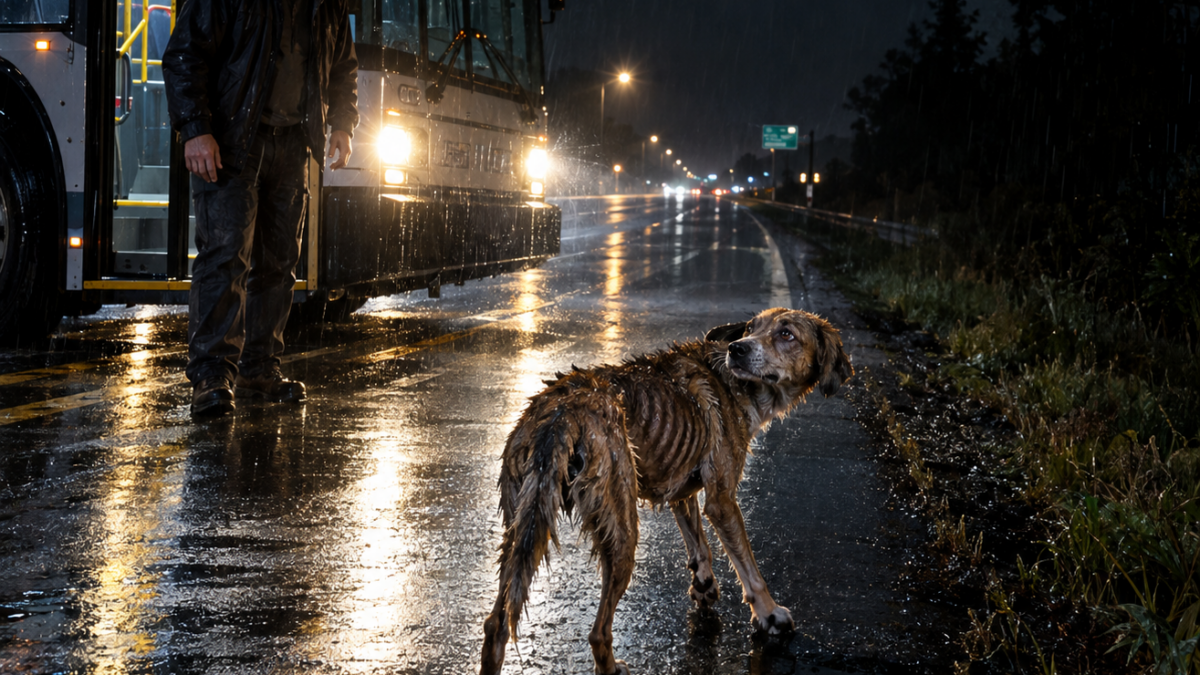
𝗣𝗔𝗥𝗧 𝟮
I held out one hand.
Most frightened dogs either retreat or approach cautiously.
She did neither.
She backed away exactly three steps.
Then she stopped.
Barked.
Ran toward the grass.
Turned around.
Waited.
“What?”
She barked again.
I stood.
“You want me to come with you?”
She turned and ran several yards.
Then looked back.
That was the moment I knew.
She was asking me to follow.
I looked at the bus.
Its hazard lights flashed red against the wet road.
I looked toward the darkness beyond the shoulder.
The sensible decision was obvious.
Get back inside.
Call animal control.
Let professionals deal with it.
But the dog had already disappeared several yards down the slope.
Then her head appeared again.
Waiting.
I remember saying aloud, “This is a terrible idea.”
Then I followed her.
The grass beyond the highway was ankle-deep and soaked.
Within seconds, water seeped through my shoes.
The dog moved quickly but never too far ahead.
Every few yards, she checked on me.
If I slowed, she slowed.
If I stopped, she stopped.
“All right,” I said. “I’m coming.”
She continued.
We moved away from the highway lights.
The sound of tires diminished behind us.
There was a drainage area below the roadway, a low stretch of grass and mud where runoff collected before passing through concrete culverts beneath the road.
I had driven over that spot thousands of times.
I had never once wondered what was underneath me.
The dog headed directly toward one of the large drainage pipes.
Then I heard it.
At first, I thought it was the squeak of wet metal.
I stopped.
There it was again.
A tiny sound.
Almost swallowed by the rain.
A whimper.
Then another.
My stomach tightened.
The dog raced toward the mouth of the culvert.
“Oh, no.”
I hurried after her.
The pipe was wide enough for a person to crawl into but not comfortably.
Rainwater ran through the bottom in a shallow stream.
I crouched and switched on my phone flashlight.
For several seconds, the beam showed nothing except slick concrete.
Then something moved.
A tiny head.
Another.
I lowered myself closer.
Five puppies were huddled together several feet inside.
They looked impossibly small.
Their fur was soaked flat against their bodies.
They pressed against one another in a trembling pile.
Some had their eyes open.
Some barely moved.
One produced another weak cry.
I stared.
“Your babies.”
The mother stood beside me.
Suddenly every detail made sense.
Her body.
Her frantic behavior.
Her refusal to leave.
The puppies were trapped.
The concrete pipe sloped downward where they had gathered, and the lip near the opening was higher than they could climb.
The inside surface was too smooth for their tiny paws to grip.
They may have crawled inside seeking shelter.
They may have been born nearby and washed down during the rain.
I didn’t know.
What I knew was that they couldn’t get out.
The mother apparently couldn’t get them out either.
She had done the only thing left to her.
She went to find help.
I looked at her.
“How long have you been trying?”
She trembled.
I don’t mean the subtle shiver of a wet dog.
Her entire body shook from exhaustion.
She was starving.
Soaked.
Probably cold.
And instead of finding shelter for herself, she had been running beside an active highway trying to make somebody stop.
I felt ashamed when I thought about how close I had been to driving away.
One of the puppies whimpered.
“Okay.”
I removed my jacket.
“Let’s see what we can do.”
I lay flat on the muddy ground and reached inside.
The nearest puppy was just beyond my fingertips.
I stretched.
My shoulder entered the pipe.
The smell was mud, wet concrete, and dirty water.
“Come on.”
My fingers touched fur.
The puppy flinched weakly.
I slid my hand beneath its body.
“Easy.”
I pulled it toward me.
The mother immediately pushed close.
“Give me a second.”
I eased the puppy out.
It couldn’t have weighed more than a few pounds.
Its body was ice-cold against my hands.
The mother sniffed it urgently, pushing her nose against its belly and face.
Then she licked it.
Again.
Again.
“He’s alive.”
I didn’t know whether it was male or female.
I didn’t care.
Alive was enough.
I wrapped the puppy in my jacket.
The mother stayed beside it.
I reached for the second.
That one whimpered when my hand touched it.
“That’s good. Keep making noise.”
I pulled it out.
Then the third.
Then the fourth.
Each time, their mother inspected them.
She licked their faces.
Nudged them.
Pressed her nose against their tiny bodies as if counting them herself.
Four puppies now lay wrapped together in my jacket.
Four.
But there had been five.
I turned the flashlight deeper into the pipe.
The fifth puppy was farther back.
Much farther.
It was also the smallest.
It lay partially separated from the others, its body against the curved side of the pipe.
I reached.
Nothing.
I pushed my arm farther.
Still nothing.
The mother whined.
“I know.”
I shifted position.
Mud covered my chest.
Rain ran down my neck.
I reached again.
My fingertips came six or eight inches short.
“Damn it.”
The puppy moved slightly.
At least I thought it did.
I backed out.
There had to be another entrance.
I stood and looked across the drainage area.
The pipe passed beneath a wide section of road.
The far side was not easily accessible from where we stood.
Even if I could reach it, I had no idea whether debris blocked the passage.
The rain had intensified.
Water inside the pipe was flowing faster.
That changed everything.
I looked at the four rescued puppies.
Then at the fifth.
“I’m getting you out.”
I lay down again.
This time I pushed my upper body farther inside.
Concrete scraped my elbow.
My shoulder pressed painfully against the curved wall.
I could barely turn my head.
I stretched.
Nothing.
I exhaled and forced myself another inch forward.
My fingertips touched the puppy’s paw.
“Got you.”
Except I didn’t.
The paw slipped away.
I muttered something I won’t repeat.
Behind me, the mother barked.
“I’m trying!”
I reached again.
My shoulder felt like it was tearing.
The puppy didn’t move.
My fingers found its side.
I couldn’t grab without squeezing too hard.
I needed to slide my hand beneath it.
I shifted.
My face touched cold concrete.
Water soaked the side of my head.
For a moment, claustrophobia hit me.
What if I got stuck?
What if water rose faster?
What if—
The puppy made a tiny sound.
All the questions disappeared.
I pushed forward.
My fingers slid beneath its belly.
“Come on.”
I pulled gently.
The puppy moved a few inches.
Then a few more.
I adjusted my grip.
Slowly.
Carefully.
Finally, I could get both hands around it.
I backed out of the pipe.
The mother rushed forward.
I sat upright.
The puppy hung limp in my hands.
My heart dropped.
“No.”
The other four were weak, but they had moved.
This one didn’t.
I placed it against my chest beneath my shirt and rubbed its back.
“Come on.”
Nothing.
The mother pushed her nose beneath my arm.
“Easy.”
She began licking the puppy’s face.
I rubbed its tiny chest.
“Come on, buddy.”
Rain hammered the ground.
Cars moved somewhere above us.
The world felt strangely far away.
There was only this tiny body.
I pressed my fingers carefully along its rib cage.
“Come on.”
Nothing.
I looked at the mother.
Her eyes were fixed on the puppy.
I don’t know whether animals understand death the way we do.
But I know she understood that something was wrong.
“I’m sorry.”
I kept rubbing.
“Come on.”
Then the puppy coughed.
I froze.
A tiny movement.
Then another.
Its mouth opened.
A weak squeak came out.
I laughed so suddenly it almost became a sob.
“Yes.”
The mother licked it furiously.
“Yeah, he’s here.”
The puppy opened its eyes for half a second.
That was all.
But it was enough.
I tucked it against the others.
The five puppies immediately began moving toward their mother.
She lay down beside them.
One crawled beneath her foreleg.
Another pressed against her belly.
The smallest disappeared between two siblings.
She curled her body around them.
And then something remarkable happened.
She stopped trembling.
Not completely.
She was still cold.
Still exhausted.
But the frantic tension left her body.
Her head lowered onto the blanket.
Her eyes closed.
For the first time since I had seen her, she looked like a dog instead of a soldier fighting a war.
I sat in the mud beside her.
And I cried.
I’m not embarrassed to admit that.
I wasn’t a particularly emotional man.
At least I hadn’t considered myself one.
But there was something overwhelming about watching those five tiny bodies pressed against a mother who had nearly destroyed herself trying to save them.
She had no phone.
No voice that people could understand.
No ability to lift them from the pipe.
All she had was persistence.
So she had gone to the highway.
Maybe she had chased cars for hours.
Maybe drivers had honked.
Maybe people had swerved around her.
Maybe someone had cursed her for being in the road.
But she kept trying.
Until my bus came.
I pulled out my phone.
The screen was wet and difficult to use.
I searched for the nearest emergency animal shelter.
After two calls, someone answered.
“County Animal Rescue, emergency line.”
“Hi. My name is James. I’m off Route 17 near mile marker forty-two. I’ve found a dog with five puppies.”
“Are they injured?”
“I don’t know. The mother is severely underweight. The puppies were trapped inside a drainage culvert. They’re soaked and very cold.”
The woman’s voice sharpened.
“Are all five breathing?”
“Yes.”
I looked at the smallest.
“I think so. One almost wasn’t.”
“Can you keep them warm?”
“I’m trying.”
“Do not separate the puppies from the mother unless absolutely necessary. We’ll send someone.”
“How long?”
“We have a team about twenty minutes away.”
“Okay.”
“Sir?”
“Yeah?”
“Stay somewhere safe. Don’t put yourself inside the drainage pipe if water is rising.”
I looked at the mud covering my clothes.
“A little late for that.”
There was a pause.
“Are you injured?”
“No.”
“All right. Stay with them.”
“I will.”
I ended the call.
The mother lifted her head.
“Help is coming.”
She stared at me.
I sat beside her.
After a minute, she crawled closer.
At first, I thought she was checking the puppies.
Instead, she rested her head on my leg.
I stopped breathing for a moment.
This dog had probably spent days frightened, hungry, and protecting her babies.
Yet she had decided to trust me.
I touched the top of her head.
“You’re okay.”
Her eyes closed.
“You did your job.”
I stroked her wet fur.
“We’ve got them now.”
She released a deep breath.
I covered as much of her body as I could with my jacket while leaving room for the puppies.
We stayed that way beneath the rain.
A bus driver.
A starving mother.
Five tiny puppies.
It should have been miserable.
Instead, it became one of the most peaceful moments I can remember.
Eventually, headlights appeared on the shoulder.
Two people came down the slope carrying portable crates, towels, blankets, and medical bags.
A woman in a blue raincoat approached first.
“James?”
“That’s me.”
“I’m Rachel. This is Tom.”
She looked at the dog.
Her face changed immediately.
“Oh, sweetheart.”
The mother raised her head.
Rachel crouched but didn’t approach.
“Can I come closer?”
Obviously, the dog couldn’t answer.
But she looked at me.
Rachel noticed.
“She trusts you.”
“Apparently.”
“Keep your hand on her.”
I did.
Rachel moved slowly.
The dog tensed but didn’t growl.
Rachel examined the puppies.
“Cold,” she said.
Tom opened a thermal blanket.
“Dehydrated too.”
I watched Rachel check each puppy.
“What are their chances?”
“Let me finish.”
Those words scared me more than I expected.
She listened to the first puppy’s breathing.
Checked its gums.
The second.
The third.
The fourth.
Then the smallest.
She spent longer with him.
“That one was almost gone when I pulled him out.”
Rachel nodded.
“He’s weak.”
“Is he going to make it?”
“I can’t promise anything.”
I looked away.
“But,” she continued, “he’s breathing on his own, and that’s a good start.”
They placed the puppies together inside a warmed carrier.
The mother stood immediately.
Her panic returned.
She pushed toward the crate.
“It’s okay,” I said.
She ignored me.
Rachel looked at me.
“We need to move her with them.”
Tom prepared a larger carrier.
“We’ll keep them side by side during transport.”
The moment the puppy carrier moved, the mother tried to follow.
Her back legs nearly collapsed.
I caught her gently.
“Easy.”
She was lighter than she looked.
Far too light.
I could feel bones beneath her wet fur.
Rachel’s expression tightened.
“She’s been nursing while severely malnourished.”
“What does that mean?”
“It means everything she’s eaten has probably gone into producing milk. Her body has been consuming itself.”
I looked down at her.
She was still focused on the puppies.
“She’s been starving for them.”
Rachel nodded.
“Basically.”
Something about that sentence hurt.
We guided the mother into the larger carrier.
She resisted until Tom placed it directly beside her babies.
Then she settled.
I crouched near the door.
“You’re going with them.”
She looked at me.
“No more highways.”
Her nose touched my fingers through the bars.
Rachel smiled.
“You’re coming to the shelter, right?”
I hesitated.
“My bus is still running on the shoulder.”
She laughed.
“Probably deal with that first.”
I suddenly remembered my job.
“Yeah. Good idea.”
I helped them carry the crates toward the rescue van.
Before Rachel closed the rear doors, I looked at the mother once more.
“You saved them.”
The doors shut.
I climbed back up the embankment.
The bus waited exactly where I’d left it, hazard lights flashing.
Inside, everything looked strangely normal.
My thermos was still on the floor.
My route paperwork sat beside the seat.
The heater hummed.
I looked at the clock.
Almost two in the morning.
I had been gone less than an hour.
It felt like half a lifetime.
At the depot, my supervisor, Carl, was waiting.
He stood with his arms folded as I pulled into the yard.
The moment I opened the door, his eyebrows rose.
“What happened to you?”
I looked down.
Mud covered my pants, shirt, hands, and shoes.
“I found a dog.”
Carl stared.
“A dog did all that?”
“Five puppies helped.”
“What?”
I told him.
By the end, his expression had changed.
“Are they okay?”
“I think so.”
He nodded.
Then he glanced toward my paperwork.
“I was about to call you.”
“Sorry.”
“Don’t be.”
That surprised me.
Carl wasn’t known for emotional speeches.
He slapped the side of the bus.
“Go home, James.”
I drove home in my own car with the heater turned all the way up.
Linda was awake.
She stood in the kitchen wearing her robe when I walked through the door.
Her eyes widened.
“What happened?”
“Before you say anything, I’m fine.”
“That is never a reassuring opening sentence.”
I laughed.
“I found a dog.”
She looked at my clothes.
“Did you wrestle it?”
“No.”
I told her the story.
Halfway through, she sat down.
When I described the puppies inside the pipe, she covered her mouth.
When I described the smallest one beginning to breathe, her eyes filled with tears.
“Are they okay?”
“The shelter has them.”
“You’re going tomorrow.”
It wasn’t a question.
“I was planning to.”
“You’d better.”
The next morning, I slept less than four hours.
By nine, I was awake.
By ten, I was at the shelter.
Rachel was behind the front desk.
She recognized me instantly.
“Well, look who’s clean.”
“Very funny.”
She smiled.
“Come on.”
My heart started beating faster.
“Are they alive?”
“All of them.”
I stopped.
“All five?”
“All five.”
I exhaled.
I hadn’t realized I’d been holding my breath.
Rachel led me into the medical area.
The mother lay inside a large kennel on clean blankets.
Her fur had dried into a softer golden color.
The puppies were beside her.
They looked smaller indoors.
More fragile somehow.
But they were warm.
One was nursing.
Another slept with its nose tucked beneath its mother’s leg.
The smallest lay near her chest.
“How is he?”
“Still weak.”
Rachel crouched beside me.
“But he’s eating.”
“That’s good?”
“Very good.”
The mother opened her eyes.
She looked at me.
For a second, nothing happened.
Then her tail moved.
One thump against the blanket.
Then another.
Rachel laughed softly.
“Well.”
“What?”
“That’s the first time I’ve seen her do that.”
I crouched.
“Hey, girl.”
Her tail moved faster.
The lump in my throat caught me off guard.
Rachel opened the kennel.
The mother stood.
She was still unsteady.
She walked toward me.
Then pressed her head against my chest.
I put both hands around her neck.
“Good to see you too.”
Rachel leaned against the wall.
“She’s decided you’re one of her people.”
“I have a wife who may have opinions about that.”
“Bring her.”
I did.
That afternoon, Linda came with me.
The mother greeted her cautiously.
Linda sat on the floor.
“Hi, sweetheart.”
She offered the back of her hand.
After a moment, the dog sniffed it.
Then moved closer.
Linda looked at me.
“She’s beautiful.”
“Last night she looked half dead.”
“She still looks rough.”
“Thanks.”
“I meant the dog.”
I smiled.
For the next several weeks, visiting the shelter became part of our routine.
Rachel eventually named the mother Maggie.
“Why Maggie?” I asked.
“She needed a name.”
“That’s your whole system?”
“Pretty much.”
I liked it.
Maggie.
It suited her.
The puppies were named too: Scout, Daisy, Max, Penny, and Little Sam.
Little Sam was the weakest puppy I’d pulled from the back of the pipe.
For several days, his survival remained uncertain.
He struggled to gain weight.
Rachel supplemented his feeding.
The first time I saw him standing without falling over, I felt absurdly proud.
“Look at him.”
Rachel smiled.
“You’d think you raised him.”
“I nearly dislocated my shoulder for him. That counts for something.”
“It counts.”
Maggie gradually changed.
At first, she slept most of the day.
Her body desperately needed rest.
She ate several small meals because too much food at once could have made her sick.
Within two weeks, the sharp outline of her ribs began disappearing.
Her coat improved.
Her eyes brightened.
But the biggest change was her personality.
Once she no longer lived in survival mode, we discovered she was incredibly gentle.
She loved people.
She leaned against anyone who scratched behind her ears.
She wagged her entire body when excited.
Most importantly, she never stopped watching her puppies.
If one wandered too far across the exercise room, Maggie followed.
If one cried, her head snapped up.
If shelter staff moved the puppies for examinations, she waited beside the door until they returned.
“She’s a helicopter mom,” Linda joked.
Rachel nodded.
“After what happened, can you blame her?”
No.
None of us could.
One Saturday, I sat in the shelter yard while Maggie’s puppies chased each other through the grass.
They were nearly unrecognizable compared with the trembling animals from the culvert.
Scout attacked a tennis ball.
Daisy chased Scout.
Max chased Daisy.
Penny became distracted by a leaf.
Little Sam climbed into my lap.
“You were supposed to die,” I whispered.
He bit my shoelace.
“Apparently you disagree.”
Maggie lay several feet away.
She watched all five.
I looked at her.
“You know they’re okay now, right?”
Her ears lifted.
“They’re not in that pipe anymore.”
She rested her chin on her paws.
I wondered if animals remembered traumatic places.
Did she dream about the rain?
Did she remember running beside cars?
Did she remember wondering whether anyone would ever stop?
I hoped not.
The puppies grew quickly.
Too quickly.
Soon they were old enough for adoption.
Rachel warned me several days before the first application was approved.
“You ready?”
“For what?”
“The puppies are going home.”
I knew it logically.
I had always known.
But hearing it hurt.
“All of them?”
“Eventually.”
“What about Maggie?”
“She’ll be available too, once they’re fully weaned.”
I looked at her.
“Do mothers get upset?”
“Sometimes. Usually briefly.”
“She went through hell for them.”
“Exactly. And because she did, they get to grow up.”
The first puppy adopted was Daisy.
A young couple came to meet her.
They sat on the floor while Daisy climbed into the woman’s lap and fell asleep.
Decision made.
I watched them carry her toward the lobby.
Maggie stood behind the kennel gate.
She watched.
My stomach tightened.
“Is this cruel?” I asked Rachel.
“No.”
“Does she understand?”
“Probably not in the way you mean.”
Maggie sniffed Daisy’s empty bed.
Then returned to the other puppies.
The next week, Scout left.
Then Max.
Penny went to a family with two children and a fenced yard.
Little Sam was last.
By then, he was no longer little.
The weakest puppy had become the boldest.
His adoptive family had another dog and lived near a large park.
Before they left, I held him one final time.
“You gave me a lot of trouble.”
He licked my chin.
“Yeah, yeah.”
Maggie watched from beside Linda.
I carried Sam to her.
She sniffed his face.
He licked hers.
For several seconds, they stood nose to nose.
Then Sam turned toward his new family.
I don’t know why that moment stayed with me.
Maybe because it felt like an ending.
Maybe because Maggie had done everything she could to give him that exact chance.
The puppy who had nearly died alone in a dark pipe was leaving with people who already loved him.
Maggie watched the door close.
Then she looked at me.
I sat beside her.
“That’s all five.”
She leaned against my leg.
I stroked her head.
“You did it.”
Now it was Maggie’s turn.
Linda and I discussed adopting her.
We discussed it seriously.
I wanted to.
A part of me felt responsible for her.
Maybe another part simply wasn’t ready to say goodbye.
But our landlord at the time didn’t allow large dogs, and moving wasn’t financially realistic.
It hurt more than I expected.
“I feel like we’re abandoning her,” I told Linda.
“We aren’t.”
“Feels that way.”
“You stopped a bus in the middle of the night and crawled into a drainage pipe for her puppies.”
“I know.”
“You didn’t promise her you’d become her owner.”
“No.”
“You promised to help.”
She touched my arm.
“And you did.”
Rachel told us several families had applied.
One application stood out.
The Harris family.
Mark and Emily Harris had two children, Sophie and Ben.
They had owned dogs for years.
Their previous Labrador had died at fourteen.
They hadn’t intended to adopt another dog immediately.
Then Emily saw a shelter post about Maggie.
Not a dramatic post.
Just a photograph and a short description of what had happened.
She showed it to her husband.
Two days later, they came to meet Maggie.
I happened to be visiting.
Sophie, who was maybe nine, sat cross-legged on the floor.
Maggie approached slowly.
Sophie didn’t grab her.
Didn’t squeal.
Didn’t throw her arms around her neck.
She simply held out her hand.
Maggie sniffed it.
Then sat beside her.
Sophie whispered something.
I couldn’t hear.
Maggie licked her cheek.
Sophie smiled.
That was it.
I knew.
Rachel looked at me.
I nodded.
Later, Mark walked over.
“You’re James?”
“Yeah.”
“The bus driver.”
“Unfortunately, that nickname appears to have stuck.”
He smiled.
“My wife told us what you did.”
“It wasn’t anything special.”
His expression became serious.
“I think it was.”
I shrugged.
“The dog did the hard part.”
We both looked toward Maggie.
Sophie was brushing her fur.
Mark nodded.
“She’s something.”
“She is.”
“We’d like to take care of her.”
I looked at him.
Not own her.
Take care of her.
That mattered.
“Good.”
The adoption was finalized several days later.
I made sure I was there.
Linda came too.
The shelter staff gathered near the lobby.
Maggie wore a new blue collar the Harris family had bought.
She looked healthy.
Strong.
Nothing like the skeletal creature from the highway.
Emily clipped the leash onto her collar.
“Ready to go home?”
Maggie’s tail wagged.
Sophie laughed.
I stayed near the wall.
I had promised myself I wouldn’t make a scene.
This wasn’t sad.
It was exactly what we’d wanted.
The puppies were safe.
Maggie was safe.
Everyone had a home.
Still, my chest hurt.
Rachel nudged me.
“You okay?”
“Fine.”
“You’re terrible at lying.”
“Thanks.”
Maggie walked toward the door with her new family.
Then she stopped.
She turned.
Looked straight at me.
For one second, I was back beside the highway.
Rain.
Headlights.
A starving dog staring at me from the darkness.
Except her eyes were different now.
That night, they had contained one question.
Will you help me?
Now there was no fear in them.
No desperation.
She simply looked at me.
Then her tail moved.
I crouched.
She pulled gently against the leash.
Emily let her come.
Maggie walked straight into my arms.
I buried my face against the fur on her neck.
“You did good.”
She licked my cheek.
“Take care of yourself.”
Her tail struck my arm.
“I mean it. No more running around highways.”
Linda laughed through tears.
Sophie asked, “Will she remember you?”
I looked at Maggie.
“I think so.”
Sophie nodded seriously.
“We’ll take good care of her.”
“I know you will.”
Maggie went to her.
I watched them leave.
She climbed into the back seat beside Sophie and Ben.
Before the door closed, she looked at me one final time.
Then the car drove away.
I stood in the shelter parking lot until it disappeared.
Rachel came outside.
“You know, most people would’ve kept driving.”
I looked at her.
“Maybe.”
“You didn’t.”
“She made it difficult.”
Rachel smiled.
“That’s what good mothers do.”
I returned to work.
The route stayed the same.
Passengers came and went.
Rainstorms passed.
Winter arrived.
Then spring.
Life resumed its ordinary rhythm.
But every night I drove that section of highway, I looked toward the shoulder.
For months, I could see Maggie there in my mind.
Running.
Stopping.
Looking back.
I sometimes wondered how close the whole thing came to ending differently.
What if I had been five minutes earlier?
What if Maggie had been farther down the highway?
What if another vehicle had hit her?
What if I had decided company policy mattered more?
What if I had simply said, Somebody else will help?
That last question bothered me the most.
Because “somebody else” is one of the easiest excuses in the world.
Somebody else will stop.
Somebody else will call.
Somebody else will notice.
Somebody else will care.
But sometimes nobody else comes.
Sometimes you’re the somebody else.
Maggie couldn’t know whether I was kind.
She couldn’t know whether I understood dogs.
She couldn’t know whether I would follow.
She only knew her puppies were dying and doing nothing was not an option.
So she took a risk.
She walked toward a giant machine filled with lights and noise.
She barked at a stranger.
And when that stranger didn’t understand, she tried again.
That was courage.
Not the kind people put in movies.
Not loud courage.
Not heroic speeches.
Desperate, exhausted courage.
The kind that keeps going when there is almost nothing left.
Several months after the adoption, I received a photograph from Rachel.
The Harris family had sent it to the shelter.
Maggie was lying on a couch.
Sophie slept beside her with one arm across Maggie’s back.
Maggie looked slightly overweight.
I laughed.
Linda looked over my shoulder.
“Is that her?”
“Yeah.”
“She’s getting spoiled.”
“Good.”
Below the photo was a message.
Maggie loves the backyard, sleeps in Sophie’s room every night, and has discovered that the refrigerator opens several times a day.
I stared at the picture for a long time.
That dog had once slept beside a drainage pipe in the rain.
Now she had a couch.
A backyard.
Children.
A refrigerator she apparently monitored professionally.
Perfect.
Later, Rachel sent updates about the puppies.
Scout became obsessed with swimming.
Daisy slept under her owner’s desk while she worked.
Max grew into the largest of the litter.
Penny apparently stole socks.
Little Sam, the puppy I had thought was dead in my hands, became a healthy dog who liked hiking.
That one got me.
I printed his picture.
Linda put it on the refrigerator.
“You realize these aren’t technically our dogs,” she said.
“Details.”
Years have passed since that night.
I’m still driving buses, though I no longer take as many late shifts.
My hair has more gray in it.
My knees complain when I climb too many stairs.
Carl retired.
Rachel eventually moved to another rescue organization.
Life moves.
That’s what it does.
But some nights remain fixed inside you.
I can still hear Maggie’s bark.
I can still feel the wet concrete against my cheek.
I can still remember the terror I felt when that fifth puppy didn’t move.
Most clearly, I remember Maggie resting her head on my knee after I pulled the last puppy out.
That moment changed how I understood animals.
Maybe how I understood people too.
Before then, I thought rescue was simple.
Someone strong saves someone weak.
But that isn’t what happened.
Maggie wasn’t weak.
She was starving, yes.
Exhausted.
Unable to solve the problem herself.
But she was the reason anyone survived.
She identified what she couldn’t do alone.
Then she found help.
There is extraordinary strength in that.
We often confuse strength with independence.
We think being strong means handling everything ourselves.
Never asking.
Never admitting we need someone.
Maggie didn’t have that luxury.
Her puppies were trapped.
Pride wasn’t useful.
Fear wasn’t useful.
All that mattered was getting someone to follow her.
I sometimes think humans could learn something from that.
When somebody is drowning, trapped, terrified, or overwhelmed, asking for help isn’t failure.
Sometimes it is the bravest thing available.
Maggie had no words.
She asked anyway.
And I nearly missed it.
That’s the part I never forget.
At first, I saw a nuisance.
A stray in the road.
A delay between me and my bed.
I didn’t immediately see a mother trying to save her children.
Most important things don’t announce themselves clearly.
Sometimes they look inconvenient.
Sometimes they’re messy.
Sometimes they’re standing in the rain when you’re tired and want to go home.
You don’t always recognize the moment when your ordinary night is about to become something you’ll remember forever.
Mine looked like a wet dog under headlights.
There is another memory I carry.
Several years later, I was driving the same stretch during another rainstorm.
Not as severe.
But enough to make the road shine the same way.
As I approached mile marker forty-two, I automatically slowed.
There was no dog.
No movement.
Nothing unusual.
I smiled anyway.
A passenger sitting near the front noticed.
“Something funny?”
“No.”
He looked through the windshield.
“What are you smiling at?”
“Just remembering something.”
He shrugged and returned to his phone.
I kept driving.
The drainage pipe passed beneath us.
Somewhere miles away, Maggie was probably sleeping in a warm house.
Five grown dogs were living lives that almost ended before they truly began.
And none of the passengers behind me knew that the ordinary patch of highway beneath our wheels had once held an entire world for me.
That’s the thing about places.
To everyone else, it was drainage infrastructure.
Concrete.
Grass.
Mud.
To me, it was where five lives came out of darkness.
It was where a mother finally stopped running.
It was where I learned that sometimes being late getting home is the best decision you’ll ever make.
I don’t pretend I performed some incredible act of heroism.
Anyone could have stopped.
Anyone could have followed.
Anyone could have reached into that pipe.
I just happened to be there.
But being there isn’t enough.
You still have to stop.
That’s what Maggie taught me.
Notice.
Stop.
Listen.
Sometimes the thing asking for your attention can’t explain why.
Sometimes you only understand after you follow.
I often think of the drivers who passed before me.
I don’t judge them.
Maybe they didn’t see her.
Maybe traffic was heavier.
Maybe they thought stopping was dangerous.
Maybe Maggie had only just reached the highway.
I’ll never know.
What matters is that eventually somebody stopped.
That night, it was me.
But if you asked Maggie, I suspect she would have considered herself the rescuer.
And she’d probably be right.
She rescued Scout.
She rescued Daisy.
She rescued Max.
She rescued Penny.
She rescued Little Sam.
She didn’t carry them out with her mouth.
She couldn’t.
Instead, she did what she could do.
She found someone with longer arms.
That thought still makes me smile.
A starving dog outsmarted an impossible situation.
She couldn’t move the wall.
Couldn’t climb the concrete.
Couldn’t stop the rain.
So she changed the problem.
She found help.
That is survival.
That is intelligence.
That is love.
People sometimes ask whether dogs really love in the way humans do.
I’m not a scientist.
I’m a bus driver.
I can’t give you studies or neurological explanations.
I can only tell you what I saw.
I saw a mother so thin her ribs showed through her skin.
I saw five puppies whose bodies had taken nearly everything she had.
I saw that mother repeatedly put herself near speeding vehicles because remaining safely beside the pipe would accomplish nothing.
She could have left.
She could have searched for food.
She could have hidden from the rain.
She didn’t.
She stayed.
And when staying wasn’t enough, she ran for help.
Call that instinct if you want.
To me, it looked exactly like love.
Linda and I eventually moved to a house where dogs were allowed.
A few years after Maggie, we adopted an older shelter dog named Cooper.
He wasn’t connected to Maggie’s family.
He was gray around the muzzle and missing part of one ear.
Nobody wanted him because he was already ten.
We did.
The first night he slept in our living room, Linda looked at me.
“Maggie’s fault.”
“What?”
“This.”
I looked at Cooper snoring on the rug.
“Probably.”
“She turned you into a rescue-dog person.”
“I was always a dog person.”
“No. You were a person who liked dogs. There’s a difference.”
She was right.
Maggie had changed something.
Once you’ve watched an animal fight that hard for another life, shelters feel different.
Strays feel different.
You start understanding that every frightened animal carries a history you can’t see.
Some histories are ugly.
Some are ordinary.
Some involve drainage pipes beneath highways.
Whenever people praised me for helping Maggie, I felt uncomfortable.
Because the story wasn’t really about me.
I was transportation.
A pair of hands.
The person who happened to arrive when she needed one.
The story belonged to her.
She was the one who refused to give up.
She was the one who ran beside the highway.
She was the one who trusted a stranger.
She was the one whose body had kept five puppies alive when she barely had enough food for herself.
She was the hero.
I was fortunate enough to meet her.
One afternoon years later, Rachel called me unexpectedly.
“James?”
“Yeah?”
“It’s Rachel.”
“Everything okay?”
“Everything’s fine. I thought you’d want to know something.”
My stomach tightened anyway.
“What?”
“Maggie passed away last week.”
I sat down.
Even though I knew years had gone by, the news hit harder than I expected.
“What happened?”
“Age. Nothing dramatic. The Harris family said she was surrounded by them.”
I closed my eyes.
“How old was she?”
“They don’t know exactly. Probably thirteen or fourteen.”
I thought about the starving animal beside the highway.
“She got a good run.”
“She did.”
Rachel paused.
“They wanted me to tell you something.”
“What?”
“Sophie is in college now. She said Maggie slept in her room every night until she left for school.”
I smiled through tears.
“That sounds like her.”
“They said she was spoiled completely rotten.”
“Good.”
“They also said that on her last day, they gave her chicken, ice cream, and let her lie in the backyard in the sun.”
I couldn’t speak for a moment.
“That’s good.”
“Yeah.”
“Thanks for telling me.”
“I thought you should know.”
After the call ended, I sat quietly.
Linda found me.
“What’s wrong?”
“Maggie died.”
She sat beside me.
For several minutes, neither of us spoke.
Then Linda said, “She had a whole lifetime after that night.”
I nodded.
That was the part worth remembering.
Not that she died.
Everything dies eventually.
The miracle was what came between the highway and the ending.
Warm beds.
Children.
Backyard grass.
Meals every day.
Veterinary care.
Car rides.
Family.
Years.
The five puppies had gotten years too.
That was what Maggie had been fighting for.
Not simply one more night.
A future.
And she got it.
I sometimes wonder whether she remembered me near the end.
Probably not.
Maybe dogs don’t hold memories the way we do.
Maybe that rainy highway faded completely once safer days replaced it.
I hope so.
I hope she forgot the hunger.
Forgot the cold.
Forgot the pipe.
Forgot the panic.
If she remembered anything, I hope it was the moment when all five puppies were finally against her body again and she realized she could close her eyes.
That’s the memory I would choose for her.
As for me, I’ll remember everything.
I’ll remember her standing beneath my headlights.
I’ll remember asking, “You want me to follow you?”
I’ll remember how quickly she turned once she realized I understood.
I’ll remember those weak cries in the darkness.
I’ll remember counting.
One.
Two.
Three.
Four.
Then looking deeper.
Five.
I’ll remember the fifth puppy breathing in my hands.
I’ll remember Maggie’s head against my knee.
I’ll remember her tail wagging at the shelter.
I’ll remember the way she looked at me before leaving with her family.
And I’ll remember the lesson she taught me without ever speaking a word.
Love can make a body keep moving long after strength should have run out.
Courage can look terrified.
Heroes don’t always know they’re heroes.
And sometimes saving a life begins with something as simple as noticing that someone is asking you to stop.
My name is James Miller.
For most of my life, I’ve been a bus driver.
I’ve carried thousands of people.
Workers.
Students.
Parents.
Children.
People going to jobs, appointments, homes, hospitals, schools, airports, funerals, weddings, and places I would never know anything about.
Most of them disappeared from my life the moment they stepped off the bus.
But one passenger never actually boarded.
She stood outside on a rainy highway.
She had four legs.
She was starving.
And she had five babies trapped beneath the road.
That night, Maggie stopped my bus because she had nowhere else to turn.
I followed her because something in her eyes told me that going home could wait.
I pulled five puppies from a drainage pipe.
For years, people told me I saved them.
Maybe I did.
But when I think about that night now, I understand the truth differently.
Maggie had already saved them long before I arrived.
Every minute she stayed beside them, she saved them.
Every ounce of food she gave up to nurse them, she saved them.
Every car she chased, she saved them.
Every time exhaustion told her to lie down and she kept running instead, she saved them.
I only finished the job she started.
And somewhere between that dark drainage pipe and the moment she rode away with a family who loved her, she changed me too.
I had spent years believing my job was to keep moving.
Stay on schedule.
Finish the route.
Return to the depot.
Get home.
That night taught me there are moments when the most important thing you can do is stop.
Stop long enough to notice.
Stop long enough to listen.
Stop long enough to follow something you don’t completely understand.
Because occasionally, just beyond the edge of the road you travel every day, someone is waiting in the darkness for a person willing to see them.
And sometimes that person turns out to be you.
Have you finished reading the story and want to read it again?
A Starving Dog Stopped My Bus at 1 A.M.—Then Begged Me to Follow Her Into the Dark
At one in the morning, on a rain-blackened highway I had driven thousands of times, a starving dog suddenly ran into my headlights and refused to let my empty bus pass.
She wasn’t trying to get inside, she wasn’t chasing me for food, and every time I stepped toward her, she ran into the darkness, turned around, and barked as if whatever waited beyond the shoulder mattered more than her own life.
I thought I was stopping to help one frightened stray—but the moment I finally followed her away from the road, I realized she had been fighting a desperate battle long before my bus ever appeared.
My name is James Miller, and for almost sixteen years, I made my living driving buses through the same part of the county.
Most people imagine bus driving as a job filled with movement, noise, conversation, and crowds.
During the day, that is mostly true.
You hear arguments over seats, children laughing too loudly, phones ringing, people asking whether you stop at a certain corner even though the route map is printed directly above their heads.
At night, though, the job becomes something else.
The final passengers disappear one by one.
The conversations stop.
The fluorescent lights inside the bus suddenly seem too bright for all those empty seats.
By the time I started the return trip to the depot each night, it was usually just me, the engine, and several miles of dark road.
I liked that part of the shift.
Or at least I thought I did.
There was a kind of peace in it.
No one asking questions.
No one rushing me.
No traffic except an occasional truck.
I could hear the steady rumble of the engine beneath my feet and think about absolutely nothing.
That night had started like hundreds before it.
Rain had been falling since late afternoon.
Not the dramatic kind of storm that makes people pull over, but the cold, persistent rain that seems determined to soak everything slowly.
By midnight, water ran in silver lines along the curb.
The road reflected the amber streetlights like polished black glass.
My last passenger got off a little after twelve-thirty.
An older man with a grocery bag thanked me, pulled his hood over his head, and hurried across the parking lot toward an apartment building.
After that, the bus was mine.
Empty.
Quiet.
Warm.
I checked the time.
1:03 a.m.
I was tired enough that my shoulders ached.
I had driven a double shift because another driver had called in sick, and all I wanted was to park the bus, clock out, go home, and stand under a hot shower until I stopped feeling like part of the driver’s seat.
My wife, Linda, had probably gone to sleep already.
She usually left the hallway light on when I worked late.
There would be leftovers in the refrigerator.
Probably coffee ready for the morning.
Ordinary things.
Comfortable things.
I remember thinking about them when the dog appeared.
One second, the highway ahead was empty.
The next, something moved at the edge of my headlights.
I instinctively eased off the accelerator.
At first, I thought it was a deer.
They sometimes came down from the tree line after midnight.
Then the shape darted closer to the shoulder.
A dog.
She ran several yards parallel to the bus.
Then she cut toward the roadway.
I hit the brakes.
“Jesus!”
The bus slowed hard enough to throw my thermos against the console.
The dog stopped inches from the right lane.
My heart slammed against my ribs.
For several seconds, I just stared through the windshield.
She stared back.
Even through rain-streaked glass, I could tell something was terribly wrong.
She was thin.
Not simply underfed.
Starving.
Her ribs stood out beneath wet fur.
Her hips looked sharp enough to break through her skin.
Her tail hung low behind her.
Water dripped from her ears and muzzle.
She looked like an animal that had been surviving instead of living.
Then she barked.
Once.
Sharp.
Urgent.
I leaned toward the windshield.
“What are you doing?”
She barked again.
Then she ran down the shoulder.
Ten yards.
Maybe fifteen.
She stopped.
Turned around.
Looked straight at the bus.
I waited.
So did she.
A strange feeling moved through me.
I put the bus in gear and rolled forward slowly.
The moment I moved, she ran again.
Then stopped again.
She was leading me.
At least that was what it looked like.
I shook my head.
“No.”
It was one in the morning.
I was exhausted.
I was driving company property.
I couldn’t go chasing a stray dog along a highway.
I started to pull back into the lane.
The dog ran toward the bus.
She barked repeatedly now.
Not aggressive.
Panicked.
She moved in front of the headlights and paced from side to side.
“You’re going to get yourself killed.”
I honked lightly.
Instead of moving away, she stared through the windshield.
Something in those eyes stopped me.
I can’t explain it better than that.
I’ve owned dogs.
I grew up with dogs.
I’ve seen frightened animals, angry animals, injured animals.
This wasn’t any of those expressions.
It was desperation.
She didn’t want me.
She needed me.
There is a difference.
I put on the hazard lights and pulled fully onto the shoulder.
The bus hissed as the parking brake engaged.
For a few seconds, I remained seated.
I could hear rain striking the roof.
My rational side listed every reason not to get out.
Dark highway.
Poor visibility.
Unknown dog.
Unknown situation.
Possibly injured animal.
Possibly aggressive.
Company rules.
Common sense.
Then the dog barked again.
I sighed.
“Fine.”
I grabbed my jacket.
“If you bite me, we’re going to have a problem.”
The hydraulic door folded open.
Cold rain hit me immediately.
I stepped down onto the wet pavement and pulled the hood over my head.
The dog stood perhaps twenty feet away.
Up close, she looked worse.
Her fur was a dirty golden-brown, though it was difficult to tell what color she was beneath the mud.
Her underside sagged slightly.
Her nipples were enlarged.
I noticed that detail without understanding it yet.
“Hey, girl.”
She watched me.
I crouched.
“Come here.”
I held out one hand.
Most frightened dogs either retreat or approach cautiously.
She did neither.
She backed away exactly three steps.
Then she stopped.
Barked.
Ran toward the grass.
Turned around.
Waited.
“What?”
She barked again.
I stood.
“You want me to come with you?”
She turned and ran several yards.
Then looked back.
That was the moment I knew.
She was asking me to follow.
I looked at the bus.
Its hazard lights flashed red against the wet road.
I looked toward the darkness beyond the shoulder.
The sensible decision was obvious.
Get back inside.
Call animal control.
Let professionals deal with it.
But the dog had already disappeared several yards down the slope.
Then her head appeared again.
Waiting.
I remember saying aloud, “This is a terrible idea.”
Then I followed her.
The grass beyond the highway was ankle-deep and soaked.
Within seconds, water seeped through my shoes.
The dog moved quickly but never too far ahead.
Every few yards, she checked on me.
If I slowed, she slowed.
If I stopped, she stopped.
“All right,” I said. “I’m coming.”
She continued.
We moved away from the highway lights.
The sound of tires diminished behind us.
There was a drainage area below the roadway, a low stretch of grass and mud where runoff collected before passing through concrete culverts beneath the road.
I had driven over that spot thousands of times.
I had never once wondered what was underneath me.
The dog headed directly toward one of the large drainage pipes.
Then I heard it.
At first, I thought it was the squeak of wet metal.
I stopped.
There it was again.
A tiny sound.
Almost swallowed by the rain.
A whimper.
Then another.
My stomach tightened.
The dog raced toward the mouth of the culvert.
“Oh, no.”
I hurried after her.
The pipe was wide enough for a person to crawl into but not comfortably.
Rainwater ran through the bottom in a shallow stream.
I crouched and switched on my phone flashlight.
For several seconds, the beam showed nothing except slick concrete.
Then something moved.
A tiny head.
Another.
I lowered myself closer.
Five puppies were huddled together several feet inside.
They looked impossibly small.
Their fur was soaked flat against their bodies.
They pressed against one another in a trembling pile.
Some had their eyes open.
Some barely moved.
One produced another weak cry.
I stared.
“Your babies.”
The mother stood beside me.
Suddenly every detail made sense.
Her body.
Her frantic behavior.
Her refusal to leave.
The puppies were trapped.
The concrete pipe sloped downward where they had gathered, and the lip near the opening was higher than they could climb.
The inside surface was too smooth for their tiny paws to grip.
They may have crawled inside seeking shelter.
They may have been born nearby and washed down during the rain.
I didn’t know.
What I knew was that they couldn’t get out.
The mother apparently couldn’t get them out either.
She had done the only thing left to her.
She went to find help.
I looked at her.
“How long have you been trying?”
She trembled.
I don’t mean the subtle shiver of a wet dog.
Her entire body shook from exhaustion.
She was starving.
Soaked.
Probably cold.
And instead of finding shelter for herself, she had been running beside an active highway trying to make somebody stop.
I felt ashamed when I thought about how close I had been to driving away.
One of the puppies whimpered.
“Okay.”
I removed my jacket.
“Let’s see what we can do.”
I lay flat on the muddy ground and reached inside.
The nearest puppy was just beyond my fingertips.
I stretched.
My shoulder entered the pipe.
The smell was mud, wet concrete, and dirty water.
“Come on.”
My fingers touched fur.
The puppy flinched weakly.
I slid my hand beneath its body.
“Easy.”
I pulled it toward me.
The mother immediately pushed close.
“Give me a second.”
I eased the puppy out.
It couldn’t have weighed more than a few pounds.
Its body was ice-cold against my hands.
The mother sniffed it urgently, pushing her nose against its belly and face.
Then she licked it.
Again.
Again.
“He’s alive.”
I didn’t know whether it was male or female.
I didn’t care.
Alive was enough.
I wrapped the puppy in my jacket.
The mother stayed beside it.
I reached for the second.
That one whimpered when my hand touched it.
“That’s good. Keep making noise.”
I pulled it out.
Then the third.
Then the fourth.
Each time, their mother inspected them.
She licked their faces.
Nudged them.
Pressed her nose against their tiny bodies as if counting them herself.
Four puppies now lay wrapped together in my jacket.
Four.
But there had been five.
I turned the flashlight deeper into the pipe.
The fifth puppy was farther back.
Much farther.
It was also the smallest.
It lay partially separated from the others, its body against the curved side of the pipe.
I reached.
Nothing.
I pushed my arm farther.
Still nothing.
The mother whined.
“I know.”
I shifted position.
Mud covered my chest.
Rain ran down my neck.
I reached again.
My fingertips came six or eight inches short.
“Damn it.”
The puppy moved slightly.
At least I thought it did.
I backed out.
There had to be another entrance.
I stood and looked across the drainage area.
The pipe passed beneath a wide section of road.
The far side was not easily accessible from where we stood.
Even if I could reach it, I had no idea whether debris blocked the passage.
The rain had intensified.
Water inside the pipe was flowing faster.
That changed everything.
I looked at the four rescued puppies.
Then at the fifth.
“I’m getting you out.”
I lay down again.
This time I pushed my upper body farther inside.
Concrete scraped my elbow.
My shoulder pressed painfully against the curved wall.
I could barely turn my head.
I stretched.
Nothing.
I exhaled and forced myself another inch forward.
My fingertips touched the puppy’s paw.
“Got you.”
Except I didn’t.
The paw slipped away.
I muttered something I won’t repeat.
Behind me, the mother barked.
“I’m trying!”
I reached again.
My shoulder felt like it was tearing.
The puppy didn’t move.
My fingers found its side.
I couldn’t grab without squeezing too hard.
I needed to slide my hand beneath it.
I shifted.
My face touched cold concrete.
Water soaked the side of my head.
For a moment, claustrophobia hit me.
What if I got stuck?
What if water rose faster?
What if—
The puppy made a tiny sound.
All the questions disappeared.
I pushed forward.
My fingers slid beneath its belly.
“Come on.”
I pulled gently.
The puppy moved a few inches.
Then a few more.
I adjusted my grip.
Slowly.
Carefully.
Finally, I could get both hands around it.
I backed out of the pipe.
The mother rushed forward.
I sat upright.
The puppy hung limp in my hands.
My heart dropped.
“No.”
The other four were weak, but they had moved.
This one didn’t.
I placed it against my chest beneath my shirt and rubbed its back.
“Come on.”
Nothing.
The mother pushed her nose beneath my arm.
“Easy.”
She began licking the puppy’s face.
I rubbed its tiny chest.
“Come on, buddy.”
Rain hammered the ground.
Cars moved somewhere above us.
The world felt strangely far away.
There was only this tiny body.
I pressed my fingers carefully along its rib cage.
“Come on.”
Nothing.
I looked at the mother.
Her eyes were fixed on the puppy.
I don’t know whether animals understand death the way we do.
But I know she understood that something was wrong.
“I’m sorry.”
I kept rubbing.
“Come on.”
Then the puppy coughed.
I froze.
A tiny movement.
Then another.
Its mouth opened.
A weak squeak came out.
I laughed so suddenly it almost became a sob.
“Yes.”
The mother licked it furiously.
“Yeah, he’s here.”
The puppy opened its eyes for half a second.
That was all.
But it was enough.
I tucked it against the others.
The five puppies immediately began moving toward their mother.
She lay down beside them.
One crawled beneath her foreleg.
Another pressed against her belly.
The smallest disappeared between two siblings.
She curled her body around them.
And then something remarkable happened.
She stopped trembling.
Not completely.
She was still cold.
Still exhausted.
But the frantic tension left her body.
Her head lowered onto the blanket.
Her eyes closed.
For the first time since I had seen her, she looked like a dog instead of a soldier fighting a war.
I sat in the mud beside her.
And I cried.
I’m not embarrassed to admit that.
I wasn’t a particularly emotional man.
At least I hadn’t considered myself one.
But there was something overwhelming about watching those five tiny bodies pressed against a mother who had nearly destroyed herself trying to save them.
She had no phone.
No voice that people could understand.
No ability to lift them from the pipe.
All she had was persistence.
So she had gone to the highway.
Maybe she had chased cars for hours.
Maybe drivers had honked.
Maybe people had swerved around her.
Maybe someone had cursed her for being in the road.
But she kept trying.
Until my bus came.
I pulled out my phone.
The screen was wet and difficult to use.
I searched for the nearest emergency animal shelter.
After two calls, someone answered.
“County Animal Rescue, emergency line.”
“Hi. My name is James. I’m off Route 17 near mile marker forty-two. I’ve found a dog with five puppies.”
“Are they injured?”
“I don’t know. The mother is severely underweight. The puppies were trapped inside a drainage culvert. They’re soaked and very cold.”
The woman’s voice sharpened.
“Are all five breathing?”
“Yes.”
I looked at the smallest.
“I think so. One almost wasn’t.”
“Can you keep them warm?”
“I’m trying.”
“Do not separate the puppies from the mother unless absolutely necessary. We’ll send someone.”
“How long?”
“We have a team about twenty minutes away.”
“Okay.”
“Sir?”
“Yeah?”
“Stay somewhere safe. Don’t put yourself inside the drainage pipe if water is rising.”
I looked at the mud covering my clothes.
“A little late for that.”
There was a pause.
“Are you injured?”
“No.”
“All right. Stay with them.”
“I will.”
I ended the call.
The mother lifted her head.
“Help is coming.”
She stared at me.
I sat beside her.
After a minute, she crawled closer.
At first, I thought she was checking the puppies.
Instead, she rested her head on my leg.
I stopped breathing for a moment.
This dog had probably spent days frightened, hungry, and protecting her babies.
Yet she had decided to trust me.
I touched the top of her head.
“You’re okay.”
Her eyes closed.
“You did your job.”
I stroked her wet fur.
“We’ve got them now.”
She released a deep breath.
I covered as much of her body as I could with my jacket while leaving room for the puppies.
We stayed that way beneath the rain.
A bus driver.
A starving mother.
Five tiny puppies.
It should have been miserable.
Instead, it became one of the most peaceful moments I can remember.
Eventually, headlights appeared on the shoulder.
Two people came down the slope carrying portable crates, towels, blankets, and medical bags.
A woman in a blue raincoat approached first.
“James?”
“That’s me.”
“I’m Rachel. This is Tom.”
She looked at the dog.
Her face changed immediately.
“Oh, sweetheart.”
The mother raised her head.
Rachel crouched but didn’t approach.
“Can I come closer?”
Obviously, the dog couldn’t answer.
But she looked at me.
Rachel noticed.
“She trusts you.”
“Apparently.”
“Keep your hand on her.”
I did.
Rachel moved slowly.
The dog tensed but didn’t growl.
Rachel examined the puppies.
“Cold,” she said.
Tom opened a thermal blanket.
“Dehydrated too.”
I watched Rachel check each puppy.
“What are their chances?”
“Let me finish.”
Those words scared me more than I expected.
She listened to the first puppy’s breathing.
Checked its gums.
The second.
The third.
The fourth.
Then the smallest.
She spent longer with him.
“That one was almost gone when I pulled him out.”
Rachel nodded.
“He’s weak.”
“Is he going to make it?”
“I can’t promise anything.”
I looked away.
“But,” she continued, “he’s breathing on his own, and that’s a good start.”
They placed the puppies together inside a warmed carrier.
The mother stood immediately.
Her panic returned.
She pushed toward the crate.
“It’s okay,” I said.
She ignored me.
Rachel looked at me.
“We need to move her with them.”
Tom prepared a larger carrier.
“We’ll keep them side by side during transport.”
The moment the puppy carrier moved, the mother tried to follow.
Her back legs nearly collapsed.
I caught her gently.
“Easy.”
She was lighter than she looked.
Far too light.
I could feel bones beneath her wet fur.
Rachel’s expression tightened.
“She’s been nursing while severely malnourished.”
“What does that mean?”
“It means everything she’s eaten has probably gone into producing milk. Her body has been consuming itself.”
I looked down at her.
She was still focused on the puppies.
“She’s been starving for them.”
Rachel nodded.
“Basically.”
Something about that sentence hurt.
We guided the mother into the larger carrier.
She resisted until Tom placed it directly beside her babies.
Then she settled.
I crouched near the door.
“You’re going with them.”
She looked at me.
“No more highways.”
Her nose touched my fingers through the bars.
Rachel smiled.
“You’re coming to the shelter, right?”
I hesitated.
“My bus is still running on the shoulder.”
She laughed.
“Probably deal with that first.”
I suddenly remembered my job.
“Yeah. Good idea.”
I helped them carry the crates toward the rescue van.
Before Rachel closed the rear doors, I looked at the mother once more.
“You saved them.”
The doors shut.
I climbed back up the embankment.
The bus waited exactly where I’d left it, hazard lights flashing.
Inside, everything looked strangely normal.
My thermos was still on the floor.
My route paperwork sat beside the seat.
The heater hummed.
I looked at the clock.
Almost two in the morning.
I had been gone less than an hour.
It felt like half a lifetime.
At the depot, my supervisor, Carl, was waiting.
He stood with his arms folded as I pulled into the yard.
The moment I opened the door, his eyebrows rose.
“What happened to you?”
I looked down.
Mud covered my pants, shirt, hands, and shoes.
“I found a dog.”
Carl stared.
“A dog did all that?”
“Five puppies helped.”
“What?”
I told him.
By the end, his expression had changed.
“Are they okay?”
“I think so.”
He nodded.
Then he glanced toward my paperwork.
“I was about to call you.”
“Sorry.”
“Don’t be.”
That surprised me.
Carl wasn’t known for emotional speeches.
He slapped the side of the bus.
“Go home, James.”
I drove home in my own car with the heater turned all the way up.
Linda was awake.
She stood in the kitchen wearing her robe when I walked through the door.
Her eyes widened.
“What happened?”
“Before you say anything, I’m fine.”
“That is never a reassuring opening sentence.”
I laughed.
“I found a dog.”
She looked at my clothes.
“Did you wrestle it?”
“No.”
I told her the story.
Halfway through, she sat down.
When I described the puppies inside the pipe, she covered her mouth.
When I described the smallest one beginning to breathe, her eyes filled with tears.
“Are they okay?”
“The shelter has them.”
“You’re going tomorrow.”
It wasn’t a question.
“I was planning to.”
“You’d better.”
The next morning, I slept less than four hours.
By nine, I was awake.
By ten, I was at the shelter.
Rachel was behind the front desk.
She recognized me instantly.
“Well, look who’s clean.”
“Very funny.”
She smiled.
“Come on.”
My heart started beating faster.
“Are they alive?”
“All of them.”
I stopped.
“All five?”
“All five.”
I exhaled.
I hadn’t realized I’d been holding my breath.
Rachel led me into the medical area.
The mother lay inside a large kennel on clean blankets.
Her fur had dried into a softer golden color.
The puppies were beside her.
They looked smaller indoors.
More fragile somehow.
But they were warm.
One was nursing.
Another slept with its nose tucked beneath its mother’s leg.
The smallest lay near her chest.
“How is he?”
“Still weak.”
Rachel crouched beside me.
“But he’s eating.”
“That’s good?”
“Very good.”
The mother opened her eyes.
She looked at me.
For a second, nothing happened.
Then her tail moved.
One thump against the blanket.
Then another.
Rachel laughed softly.
“Well.”
“What?”
“That’s the first time I’ve seen her do that.”
I crouched.
“Hey, girl.”
Her tail moved faster.
The lump in my throat caught me off guard.
Rachel opened the kennel.
The mother stood.
She was still unsteady.
She walked toward me.
Then pressed her head against my chest.
I put both hands around her neck.
“Good to see you too.”
Rachel leaned against the wall.
“She’s decided you’re one of her people.”
“I have a wife who may have opinions about that.”
“Bring her.”
I did.
That afternoon, Linda came with me.
The mother greeted her cautiously.
Linda sat on the floor.
“Hi, sweetheart.”
She offered the back of her hand.
After a moment, the dog sniffed it.
Then moved closer.
Linda looked at me.
“She’s beautiful.”
“Last night she looked half dead.”
“She still looks rough.”
“Thanks.”
“I meant the dog.”
I smiled.
For the next several weeks, visiting the shelter became part of our routine.
Rachel eventually named the mother Maggie.
“Why Maggie?” I asked.
“She needed a name.”
“That’s your whole system?”
“Pretty much.”
I liked it.
Maggie.
It suited her.
The puppies were named too: Scout, Daisy, Max, Penny, and Little Sam.
Little Sam was the weakest puppy I’d pulled from the back of the pipe.
For several days, his survival remained uncertain.
He struggled to gain weight.
Rachel supplemented his feeding.
The first time I saw him standing without falling over, I felt absurdly proud.
“Look at him.”
Rachel smiled.
“You’d think you raised him.”
“I nearly dislocated my shoulder for him. That counts for something.”
“It counts.”
Maggie gradually changed.
At first, she slept most of the day.
Her body desperately needed rest.
She ate several small meals because too much food at once could have made her sick.
Within two weeks, the sharp outline of her ribs began disappearing.
Her coat improved.
Her eyes brightened.
But the biggest change was her personality.
Once she no longer lived in survival mode, we discovered she was incredibly gentle.
She loved people.
She leaned against anyone who scratched behind her ears.
She wagged her entire body when excited.
Most importantly, she never stopped watching her puppies.
If one wandered too far across the exercise room, Maggie followed.
If one cried, her head snapped up.
If shelter staff moved the puppies for examinations, she waited beside the door until they returned.
“She’s a helicopter mom,” Linda joked.
Rachel nodded.
“After what happened, can you blame her?”
No.
None of us could.
One Saturday, I sat in the shelter yard while Maggie’s puppies chased each other through the grass.
They were nearly unrecognizable compared with the trembling animals from the culvert.
Scout attacked a tennis ball.
Daisy chased Scout.
Max chased Daisy.
Penny became distracted by a leaf.
Little Sam climbed into my lap.
“You were supposed to die,” I whispered.
He bit my shoelace.
“Apparently you disagree.”
Maggie lay several feet away.
She watched all five.
I looked at her.
“You know they’re okay now, right?”
Her ears lifted.
“They’re not in that pipe anymore.”
She rested her chin on her paws.
I wondered if animals remembered traumatic places.
Did she dream about the rain?
Did she remember running beside cars?
Did she remember wondering whether anyone would ever stop?
I hoped not.
The puppies grew quickly.
Too quickly.
Soon they were old enough for adoption.
Rachel warned me several days before the first application was approved.
“You ready?”
“For what?”
“The puppies are going home.”
I knew it logically.
I had always known.
But hearing it hurt.
“All of them?”
“Eventually.”
“What about Maggie?”
“She’ll be available too, once they’re fully weaned.”
I looked at her.
“Do mothers get upset?”
“Sometimes. Usually briefly.”
“She went through hell for them.”
“Exactly. And because she did, they get to grow up.”
The first puppy adopted was Daisy.
A young couple came to meet her.
They sat on the floor while Daisy climbed into the woman’s lap and fell asleep.
Decision made.
I watched them carry her toward the lobby.
Maggie stood behind the kennel gate.
She watched.
My stomach tightened.
“Is this cruel?” I asked Rachel.
“No.”
“Does she understand?”
“Probably not in the way you mean.”
Maggie sniffed Daisy’s empty bed.
Then returned to the other puppies.
The next week, Scout left.
Then Max.
Penny went to a family with two children and a fenced yard.
Little Sam was last.
By then, he was no longer little.
The weakest puppy had become the boldest.
His adoptive family had another dog and lived near a large park.
Before they left, I held him one final time.
“You gave me a lot of trouble.”
He licked my chin.
“Yeah, yeah.”
Maggie watched from beside Linda.
I carried Sam to her.
She sniffed his face.
He licked hers.
For several seconds, they stood nose to nose.
Then Sam turned toward his new family.
I don’t know why that moment stayed with me.
Maybe because it felt like an ending.
Maybe because Maggie had done everything she could to give him that exact chance.
The puppy who had nearly died alone in a dark pipe was leaving with people who already loved him.
Maggie watched the door close.
Then she looked at me.
I sat beside her.
“That’s all five.”
She leaned against my leg.
I stroked her head.
“You did it.”
Now it was Maggie’s turn.
Linda and I discussed adopting her.
We discussed it seriously.
I wanted to.
A part of me felt responsible for her.
Maybe another part simply wasn’t ready to say goodbye.
But our landlord at the time didn’t allow large dogs, and moving wasn’t financially realistic.
It hurt more than I expected.
“I feel like we’re abandoning her,” I told Linda.
“We aren’t.”
“Feels that way.”
“You stopped a bus in the middle of the night and crawled into a drainage pipe for her puppies.”
“I know.”
“You didn’t promise her you’d become her owner.”
“No.”
“You promised to help.”
She touched my arm.
“And you did.”
Rachel told us several families had applied.
One application stood out.
The Harris family.
Mark and Emily Harris had two children, Sophie and Ben.
They had owned dogs for years.
Their previous Labrador had died at fourteen.
They hadn’t intended to adopt another dog immediately.
Then Emily saw a shelter post about Maggie.
Not a dramatic post.
Just a photograph and a short description of what had happened.
She showed it to her husband.
Two days later, they came to meet Maggie.
I happened to be visiting.
Sophie, who was maybe nine, sat cross-legged on the floor.
Maggie approached slowly.
Sophie didn’t grab her.
Didn’t squeal.
Didn’t throw her arms around her neck.
She simply held out her hand.
Maggie sniffed it.
Then sat beside her.
Sophie whispered something.
I couldn’t hear.
Maggie licked her cheek.
Sophie smiled.
That was it.
I knew.
Rachel looked at me.
I nodded.
Later, Mark walked over.
“You’re James?”
“Yeah.”
“The bus driver.”
“Unfortunately, that nickname appears to have stuck.”
He smiled.
“My wife told us what you did.”
“It wasn’t anything special.”
His expression became serious.
“I think it was.”
I shrugged.
“The dog did the hard part.”
We both looked toward Maggie.
Sophie was brushing her fur.
Mark nodded.
“She’s something.”
“She is.”
“We’d like to take care of her.”
I looked at him.
Not own her.
Take care of her.
That mattered.
“Good.”
The adoption was finalized several days later.
I made sure I was there.
Linda came too.
The shelter staff gathered near the lobby.
Maggie wore a new blue collar the Harris family had bought.
She looked healthy.
Strong.
Nothing like the skeletal creature from the highway.
Emily clipped the leash onto her collar.
“Ready to go home?”
Maggie’s tail wagged.
Sophie laughed.
I stayed near the wall.
I had promised myself I wouldn’t make a scene.
This wasn’t sad.
It was exactly what we’d wanted.
The puppies were safe.
Maggie was safe.
Everyone had a home.
Still, my chest hurt.
Rachel nudged me.
“You okay?”
“Fine.”
“You’re terrible at lying.”
“Thanks.”
Maggie walked toward the door with her new family.
Then she stopped.
She turned.
Looked straight at me.
For one second, I was back beside the highway.
Rain.
Headlights.
A starving dog staring at me from the darkness.
Except her eyes were different now.
That night, they had contained one question.
Will you help me?
Now there was no fear in them.
No desperation.
She simply looked at me.
Then her tail moved.
I crouched.
She pulled gently against the leash.
Emily let her come.
Maggie walked straight into my arms.
I buried my face against the fur on her neck.
“You did good.”
She licked my cheek.
“Take care of yourself.”
Her tail struck my arm.
“I mean it. No more running around highways.”
Linda laughed through tears.
Sophie asked, “Will she remember you?”
I looked at Maggie.
“I think so.”
Sophie nodded seriously.
“We’ll take good care of her.”
“I know you will.”
Maggie went to her.
I watched them leave.
She climbed into the back seat beside Sophie and Ben.
Before the door closed, she looked at me one final time.
Then the car drove away.
I stood in the shelter parking lot until it disappeared.
Rachel came outside.
“You know, most people would’ve kept driving.”
I looked at her.
“Maybe.”
“You didn’t.”
“She made it difficult.”
Rachel smiled.
“That’s what good mothers do.”
I returned to work.
The route stayed the same.
Passengers came and went.
Rainstorms passed.
Winter arrived.
Then spring.
Life resumed its ordinary rhythm.
But every night I drove that section of highway, I looked toward the shoulder.
For months, I could see Maggie there in my mind.
Running.
Stopping.
Looking back.
I sometimes wondered how close the whole thing came to ending differently.
What if I had been five minutes earlier?
What if Maggie had been farther down the highway?
What if another vehicle had hit her?
What if I had decided company policy mattered more?
What if I had simply said, Somebody else will help?
That last question bothered me the most.
Because “somebody else” is one of the easiest excuses in the world.
Somebody else will stop.
Somebody else will call.
Somebody else will notice.
Somebody else will care.
But sometimes nobody else comes.
Sometimes you’re the somebody else.
Maggie couldn’t know whether I was kind.
She couldn’t know whether I understood dogs.
She couldn’t know whether I would follow.
She only knew her puppies were dying and doing nothing was not an option.
So she took a risk.
She walked toward a giant machine filled with lights and noise.
She barked at a stranger.
And when that stranger didn’t understand, she tried again.
That was courage.
Not the kind people put in movies.
Not loud courage.
Not heroic speeches.
Desperate, exhausted courage.
The kind that keeps going when there is almost nothing left.
Several months after the adoption, I received a photograph from Rachel.
The Harris family had sent it to the shelter.
Maggie was lying on a couch.
Sophie slept beside her with one arm across Maggie’s back.
Maggie looked slightly overweight.
I laughed.
Linda looked over my shoulder.
“Is that her?”
“Yeah.”
“She’s getting spoiled.”
“Good.”
Below the photo was a message.
Maggie loves the backyard, sleeps in Sophie’s room every night, and has discovered that the refrigerator opens several times a day.
I stared at the picture for a long time.
That dog had once slept beside a drainage pipe in the rain.
Now she had a couch.
A backyard.
Children.
A refrigerator she apparently monitored professionally.
Perfect.
Later, Rachel sent updates about the puppies.
Scout became obsessed with swimming.
Daisy slept under her owner’s desk while she worked.
Max grew into the largest of the litter.
Penny apparently stole socks.
Little Sam, the puppy I had thought was dead in my hands, became a healthy dog who liked hiking.
That one got me.
I printed his picture.
Linda put it on the refrigerator.
“You realize these aren’t technically our dogs,” she said.
“Details.”
Years have passed since that night.
I’m still driving buses, though I no longer take as many late shifts.
My hair has more gray in it.
My knees complain when I climb too many stairs.
Carl retired.
Rachel eventually moved to another rescue organization.
Life moves.
That’s what it does.
But some nights remain fixed inside you.
I can still hear Maggie’s bark.
I can still feel the wet concrete against my cheek.
I can still remember the terror I felt when that fifth puppy didn’t move.
Most clearly, I remember Maggie resting her head on my knee after I pulled the last puppy out.
That moment changed how I understood animals.
Maybe how I understood people too.
Before then, I thought rescue was simple.
Someone strong saves someone weak.
But that isn’t what happened.
Maggie wasn’t weak.
She was starving, yes.
Exhausted.
Unable to solve the problem herself.
But she was the reason anyone survived.
She identified what she couldn’t do alone.
Then she found help.
There is extraordinary strength in that.
We often confuse strength with independence.
We think being strong means handling everything ourselves.
Never asking.
Never admitting we need someone.
Maggie didn’t have that luxury.
Her puppies were trapped.
Pride wasn’t useful.
Fear wasn’t useful.
All that mattered was getting someone to follow her.
I sometimes think humans could learn something from that.
When somebody is drowning, trapped, terrified, or overwhelmed, asking for help isn’t failure.
Sometimes it is the bravest thing available.
Maggie had no words.
She asked anyway.
And I nearly missed it.
That’s the part I never forget.
At first, I saw a nuisance.
A stray in the road.
A delay between me and my bed.
I didn’t immediately see a mother trying to save her children.
Most important things don’t announce themselves clearly.
Sometimes they look inconvenient.
Sometimes they’re messy.
Sometimes they’re standing in the rain when you’re tired and want to go home.
You don’t always recognize the moment when your ordinary night is about to become something you’ll remember forever.
Mine looked like a wet dog under headlights.
There is another memory I carry.
Several years later, I was driving the same stretch during another rainstorm.
Not as severe.
But enough to make the road shine the same way.
As I approached mile marker forty-two, I automatically slowed.
There was no dog.
No movement.
Nothing unusual.
I smiled anyway.
A passenger sitting near the front noticed.
“Something funny?”
“No.”
He looked through the windshield.
“What are you smiling at?”
“Just remembering something.”
He shrugged and returned to his phone.
I kept driving.
The drainage pipe passed beneath us.
Somewhere miles away, Maggie was probably sleeping in a warm house.
Five grown dogs were living lives that almost ended before they truly began.
And none of the passengers behind me knew that the ordinary patch of highway beneath our wheels had once held an entire world for me.
That’s the thing about places.
To everyone else, it was drainage infrastructure.
Concrete.
Grass.
Mud.
To me, it was where five lives came out of darkness.
It was where a mother finally stopped running.
It was where I learned that sometimes being late getting home is the best decision you’ll ever make.
I don’t pretend I performed some incredible act of heroism.
Anyone could have stopped.
Anyone could have followed.
Anyone could have reached into that pipe.
I just happened to be there.
But being there isn’t enough.
You still have to stop.
That’s what Maggie taught me.
Notice.
Stop.
Listen.
Sometimes the thing asking for your attention can’t explain why.
Sometimes you only understand after you follow.
I often think of the drivers who passed before me.
I don’t judge them.
Maybe they didn’t see her.
Maybe traffic was heavier.
Maybe they thought stopping was dangerous.
Maybe Maggie had only just reached the highway.
I’ll never know.
What matters is that eventually somebody stopped.
That night, it was me.
But if you asked Maggie, I suspect she would have considered herself the rescuer.
And she’d probably be right.
She rescued Scout.
She rescued Daisy.
She rescued Max.
She rescued Penny.
She rescued Little Sam.
She didn’t carry them out with her mouth.
She couldn’t.
Instead, she did what she could do.
She found someone with longer arms.
That thought still makes me smile.
A starving dog outsmarted an impossible situation.
She couldn’t move the wall.
Couldn’t climb the concrete.
Couldn’t stop the rain.
So she changed the problem.
She found help.
That is survival.
That is intelligence.
That is love.
People sometimes ask whether dogs really love in the way humans do.
I’m not a scientist.
I’m a bus driver.
I can’t give you studies or neurological explanations.
I can only tell you what I saw.
I saw a mother so thin her ribs showed through her skin.
I saw five puppies whose bodies had taken nearly everything she had.
I saw that mother repeatedly put herself near speeding vehicles because remaining safely beside the pipe would accomplish nothing.
She could have left.
She could have searched for food.
She could have hidden from the rain.
She didn’t.
She stayed.
And when staying wasn’t enough, she ran for help.
Call that instinct if you want.
To me, it looked exactly like love.
Linda and I eventually moved to a house where dogs were allowed.
A few years after Maggie, we adopted an older shelter dog named Cooper.
He wasn’t connected to Maggie’s family.
He was gray around the muzzle and missing part of one ear.
Nobody wanted him because he was already ten.
We did.
The first night he slept in our living room, Linda looked at me.
“Maggie’s fault.”
“What?”
“This.”
I looked at Cooper snoring on the rug.
“Probably.”
“She turned you into a rescue-dog person.”
“I was always a dog person.”
“No. You were a person who liked dogs. There’s a difference.”
She was right.
Maggie had changed something.
Once you’ve watched an animal fight that hard for another life, shelters feel different.
Strays feel different.
You start understanding that every frightened animal carries a history you can’t see.
Some histories are ugly.
Some are ordinary.
Some involve drainage pipes beneath highways.
Whenever people praised me for helping Maggie, I felt uncomfortable.
Because the story wasn’t really about me.
I was transportation.
A pair of hands.
The person who happened to arrive when she needed one.
The story belonged to her.
She was the one who refused to give up.
She was the one who ran beside the highway.
She was the one who trusted a stranger.
She was the one whose body had kept five puppies alive when she barely had enough food for herself.
She was the hero.
I was fortunate enough to meet her.
One afternoon years later, Rachel called me unexpectedly.
“James?”
“Yeah?”
“It’s Rachel.”
“Everything okay?”
“Everything’s fine. I thought you’d want to know something.”
My stomach tightened anyway.
“What?”
“Maggie passed away last week.”
I sat down.
Even though I knew years had gone by, the news hit harder than I expected.
“What happened?”
“Age. Nothing dramatic. The Harris family said she was surrounded by them.”
I closed my eyes.
“How old was she?”
“They don’t know exactly. Probably thirteen or fourteen.”
I thought about the starving animal beside the highway.
“She got a good run.”
“She did.”
Rachel paused.
“They wanted me to tell you something.”
“What?”
“Sophie is in college now. She said Maggie slept in her room every night until she left for school.”
I smiled through tears.
“That sounds like her.”
“They said she was spoiled completely rotten.”
“Good.”
“They also said that on her last day, they gave her chicken, ice cream, and let her lie in the backyard in the sun.”
I couldn’t speak for a moment.
“That’s good.”
“Yeah.”
“Thanks for telling me.”
“I thought you should know.”
After the call ended, I sat quietly.
Linda found me.
“What’s wrong?”
“Maggie died.”
She sat beside me.
For several minutes, neither of us spoke.
Then Linda said, “She had a whole lifetime after that night.”
I nodded.
That was the part worth remembering.
Not that she died.
Everything dies eventually.
The miracle was what came between the highway and the ending.
Warm beds.
Children.
Backyard grass.
Meals every day.
Veterinary care.
Car rides.
Family.
Years.
The five puppies had gotten years too.
That was what Maggie had been fighting for.
Not simply one more night.
A future.
And she got it.
I sometimes wonder whether she remembered me near the end.
Probably not.
Maybe dogs don’t hold memories the way we do.
Maybe that rainy highway faded completely once safer days replaced it.
I hope so.
I hope she forgot the hunger.
Forgot the cold.
Forgot the pipe.
Forgot the panic.
If she remembered anything, I hope it was the moment when all five puppies were finally against her body again and she realized she could close her eyes.
That’s the memory I would choose for her.
As for me, I’ll remember everything.
I’ll remember her standing beneath my headlights.
I’ll remember asking, “You want me to follow you?”
I’ll remember how quickly she turned once she realized I understood.
I’ll remember those weak cries in the darkness.
I’ll remember counting.
One.
Two.
Three.
Four.
Then looking deeper.
Five.
I’ll remember the fifth puppy breathing in my hands.
I’ll remember Maggie’s head against my knee.
I’ll remember her tail wagging at the shelter.
I’ll remember the way she looked at me before leaving with her family.
And I’ll remember the lesson she taught me without ever speaking a word.
Love can make a body keep moving long after strength should have run out.
Courage can look terrified.
Heroes don’t always know they’re heroes.
And sometimes saving a life begins with something as simple as noticing that someone is asking you to stop.
My name is James Miller.
For most of my life, I’ve been a bus driver.
I’ve carried thousands of people.
Workers.
Students.
Parents.
Children.
People going to jobs, appointments, homes, hospitals, schools, airports, funerals, weddings, and places I would never know anything about.
Most of them disappeared from my life the moment they stepped off the bus.
But one passenger never actually boarded.
She stood outside on a rainy highway.
She had four legs.
She was starving.
And she had five babies trapped beneath the road.
That night, Maggie stopped my bus because she had nowhere else to turn.
I followed her because something in her eyes told me that going home could wait.
I pulled five puppies from a drainage pipe.
For years, people told me I saved them.
Maybe I did.
But when I think about that night now, I understand the truth differently.
Maggie had already saved them long before I arrived.
Every minute she stayed beside them, she saved them.
Every ounce of food she gave up to nurse them, she saved them.
Every car she chased, she saved them.
Every time exhaustion told her to lie down and she kept running instead, she saved them.
I only finished the job she started.
And somewhere between that dark drainage pipe and the moment she rode away with a family who loved her, she changed me too.
I had spent years believing my job was to keep moving.
Stay on schedule.
Finish the route.
Return to the depot.
Get home.
That night taught me there are moments when the most important thing you can do is stop.
Stop long enough to notice.
Stop long enough to listen.
Stop long enough to follow something you don’t completely understand.
Because occasionally, just beyond the edge of the road you travel every day, someone is waiting in the darkness for a person willing to see them.
And sometimes that person turns out to be you.








