𝗙𝗨𝗟𝗟 𝗦𝗧𝗢𝗥𝗬 A Paralyzed Mother Dog Dragged Herself Into Traffic to Save Her Puppies—Then the City Finally Stopped
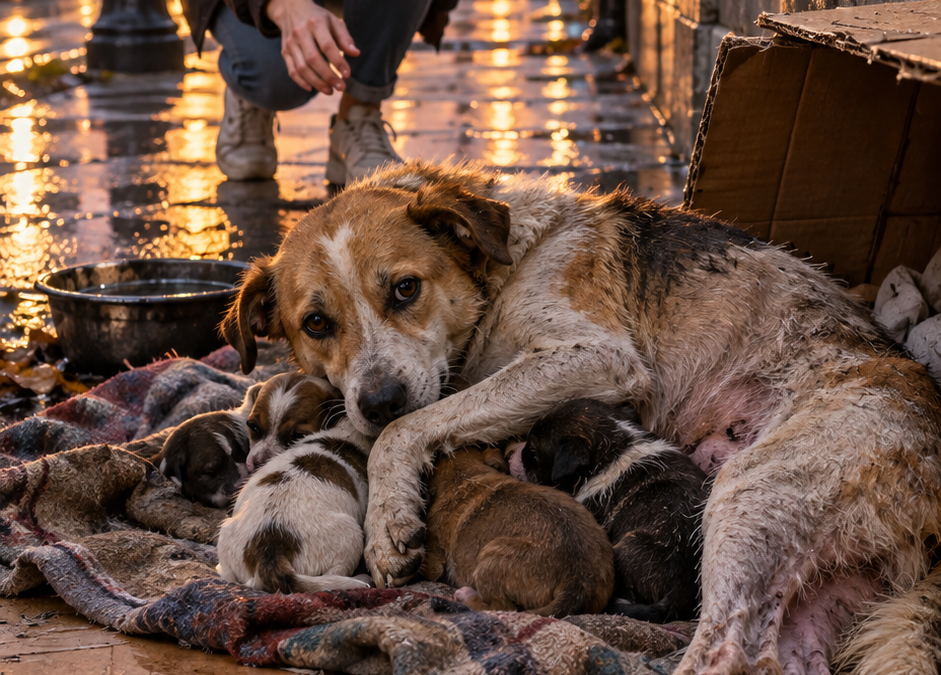
𝗣𝗔𝗥𝗧 𝟮
My building had no elevator.
Naturally.
Fourth floor.
Old walk-up.
Beautiful exposed brick, according to the real-estate listing.
Four flights of punishment, according to anyone carrying groceries.
I got the puppies upstairs first.
Backpack against my chest.
One hand on the railing.
They whimpered every few steps.
“Almost there.”
Neither believed me.
Fair.
I went back down for the mother.
The security cart would not fit through the stairwell.
I stood in the lobby staring at her.
She stared at me.
“Well.”
No solution appeared.
My neighbor from 2B opened her door.
Mrs. Kaplan.
Seventy-six.
Five feet tall.
Frightening.
She looked at me.
Then the dog.
Then my wet clothes.
“What happened to you?”
“I made choices.”
She stepped closer.
“Oh, sweetheart.”
The mother lifted her head.
Mrs. Kaplan pointed at me.
“Don’t drop her.”
“Excellent.”
“You look tired.”
“I am tired.”
“Then don’t drop her.”
We made a sling from two towels and an old blanket.
I carried most of the weight.
Mrs. Kaplan helped stabilize the hindquarters.
Four flights.
Slow.
The mother never made a sound.
At the third landing, my arms began shaking.
Mrs. Kaplan said, “Rest.”
“I’m fine.”
“You’re sweating.”
“It’s raining.”
“We are indoors.”
I stopped.
The dog looked back down the stairs.
“She’s worried about the puppies,” I said.
“Then move.”
Apparently compassion had strict pacing requirements.
We reached my apartment.
The second I placed the mother on blankets, both puppies ran toward her.
Not well.
Their legs slipped on hardwood.
The larger one crashed into her chest.
The smaller crawled beneath her neck.
She wrapped both front legs around them.
Then finally—
Finally—
closed her eyes.
I had not realized until then that she hadn’t slept.
Not on the sidewalk.
Not at intake.
Not on the trip home.
She had stayed awake until both babies were physically touching her again.
Mrs. Kaplan stood silently.
“Coffee?” I asked.
“No.”
“Tea?”
“No.”
She pointed toward the dog.
“Vet tomorrow.”
“Yes.”
“Real vet.”
“Yes.”
“Not bureaucracy.”
I smiled.
“Yes, Mrs. Kaplan.”
She left.
Then immediately returned with chicken.
Naturally.
My apartment changed in less than an hour.
Coffee table pushed aside.
Rug covered with towels.
Dog bowls borrowed from Mrs. Kaplan.
A roasting pan repurposed as a water dish because I owned exactly zero pet supplies.
The puppies ate.
The mother watched.
Same pattern.
I put food beneath her nose.
She turned away.
“Your children are finished.”
One puppy returned to the bowl.
The mother kept watching.
He ate three more bites.
Walked away.
Only then did she begin.
“Control issues.”
She looked at me.
“Fine.”
I sat on the floor.
The larger puppy climbed onto my shoe.
Black and tan.
Rounder face.
A little white patch beneath the chin.
“Nico.”
The name came quickly.
He chewed my shoelace.
“Nico it is.”
The smaller puppy was female.
Sharp little eyes.
More cautious.
She approached my hand.
Sniffed.
Then slapped my finger with one paw.
“Tali.”
She blinked.
“Short for Natalia if anyone asks.”
Nobody had asked.
The mother deserved something stronger.
I looked at her.
She had survived paralysis.
Rain.
Traffic.
Hunger.
And whatever happened before I found her.
“Vera.”
Her ears moved.
“Truth.”
I put my hand near her chest.
“Strong enough.”
She licked my fingers.
That was our introduction.
Vera.
Nico.
Tali.
Three names.
Suddenly my studio felt smaller.
And more alive.
I slept on the floor.
Not intentionally.
I sat beside Vera around midnight.
Apparently closed my eyes.
Woke at three with Nico sleeping on my ribs and Tali inside my hoodie.
Vera was awake.
Watching the door.
“You know there’s a lock.”
Her ears remained up.
“No one’s coming.”
Nothing.
I understood then.
She wasn’t protecting them from me anymore.
She was protecting them from return.
Whoever had abandoned them.
Whatever had hurt her.
Whatever memory still lived beyond that door.
I got up.
Checked the deadbolt.
“See?”
Vera watched.
I turned off the light.
“Nobody gets in without me.”
She lowered her head.
That became our first rule.
Nobody gets in without me.
Morning brought veterinary reality.
A private clinic on Tenth Avenue squeezed us into the schedule after I sent photos and explained the situation.
Dr. Elena Markovic examined Vera.
She was direct.
I liked her immediately and resented her by minute four.
“Her hind-limb paralysis isn’t recent.”
“How can you tell?”
“Muscle loss. Skin wear. She has been compensating on the front limbs.”
“How long?”
“Could be weeks.”
I stared.
“Weeks?”
“Possibly.”
My anger returned.
Vera had been dragging herself while nursing two puppies.
Markovic continued examining.
“Could be spinal trauma. Disc injury. Pelvic trauma. Neurological disease. We need imaging.”
X-rays first.
Then advanced imaging if necessary.
The puppies were approximately nine weeks old.
Underweight.
Parasites.
Mild dehydration.
Otherwise resilient.
“How?”
I looked at Markovic.
“How are they in better condition than she is?”
The veterinarian glanced toward Vera.
“Because she fed them.”
I knew.
Still, hearing it hurt.
Bloodwork showed Vera was anemic.
Malnourished.
Inflammation.
Possible infection around pressure wounds.
She had been giving milk while barely sustaining herself.
“She was starving herself for them.”
Markovic didn’t sentimentalize.
“Biologically, lactating mothers prioritize offspring heavily.”
“That’s the scientific way to ruin my morning.”
“It’s accurate.”
“Unfortunately.”
Imaging revealed severe spinal trauma around the lower thoracic-lumbar junction.
Old enough that swelling had stabilized.
Bad enough that Markovic’s face said everything before she spoke.
“Will she walk?”
“We need a neurologist.”
“Your guess.”
“Julian.”
“My guess matters less than yours.”
She exhaled.
“Prognosis for normal hind-limb function is guarded to poor.”
That sentence took the air out of the room.
“Pain?”
“She still has sensation higher up. Deep pain in the hind feet is difficult to assess.”
“Is she suffering?”
“Her abrasions hurt. The spinal injury may or may not. We can manage pain.”
“Quality of life?”
“Paralyzed dogs can have excellent lives.”
I looked at Vera.
She watched Nico and Tali wrestling with a towel.
“Then that’s what we’re doing.”
Markovic raised an eyebrow.
“You understand this is not a weekend project.”
“I understand.”
“Bladder management may be required.”
“Okay.”
“Mobility support.”
“Okay.”
“Skin care.”
“Okay.”
“Potential cart.”
“Okay.”
“Long-term cost.”
“Okay.”
She stopped.
“You’re serious.”
I looked at her.
“I dragged her five blocks through Manhattan on a stolen dolly.”
Markovic nodded.
“Fair.”
The neurologist confirmed it two days later.
Permanent paralysis was likely.
Surgery offered little realistic benefit at that stage.
Rehabilitation could strengthen Vera’s front body, improve balance, protect her skin, and give her mobility with assistance.
But her hind legs probably would never function normally again.
I took the news home.
Vera didn’t care.
That sounds flippant.
But animals don’t receive diagnoses the way humans do.
She didn’t sit by the window considering alternative futures.
She wanted dinner.
She wanted her puppies.
She wanted to inspect every noise in the hallway.
So we began with what she wanted.
Food.
Safety.
Movement.
I bought a support harness.
The first time I put it around her, Vera hated me.
Not subtly.
She turned her head.
Stared.
“This is humiliating for both of us.”
She looked away.
“Excellent.”
I lifted her back end.
Vera stood on her front legs.
For one second, she froze.
Then took a step.
Claw click.
Harness shift.
Another.
Nico barked.
Tali bounced.
Vera walked three steps.
Stopped.
Looked at me.
I laughed.
“You magnificent lunatic.”
She took a fourth.
The puppies exploded with excitement.
Nico ran around her front legs.
Tali tripped over the strap.
Vera tried turning to inspect both.
I almost dropped the harness.
“Everybody calm down.”
Nobody did.
Mrs. Kaplan stood in my doorway.
She had entered without knocking.
Rule one apparently did not apply to her.
“What is happening?”
“Physical therapy.”
“It looks terrible.”
“Thank you.”
Vera took another step.
Mrs. Kaplan’s face softened.
“Oh.”
“Yes.”
“She walked.”
“Technically I’m doing fifty percent.”
Mrs. Kaplan ignored me.
“Good girl.”
Vera’s tail didn’t move.
Couldn’t.
But her ears rose.
That was enough.
Days became structured.
Morning bathroom care.
Medication.
Breakfast.
Puppies first because Vera insisted.
Short harness walk inside.
Rest.
Lunch.
More cleaning.
More puppies.
Work, somehow.
I started working from home whenever possible.
My boss asked why.
“Family emergency.”
Technically accurate.
“What kind?”
“Complicated.”
That ended the conversation.
Nico and Tali improved fast.
Puppies have an almost rude capacity for recovery.
Within a week, they went from trembling sidewalk survivors to complete domestic terrorists.
Nico attacked socks.
Tali found electrical cords fascinating.
They discovered that my apartment contained approximately ten thousand things more interesting than the expensive toys I bought.
I found Nico standing inside my laundry basket.
“How?”
He wagged.
Tali dragged a toilet-paper roll through the hallway.
“Excellent.”
Vera watched from her blankets.
For the first time, I saw something like relaxation in her face.
Her babies were being ridiculous.
That meant they were safe.
The original shelter called.
“Kennel space opened.”
I looked at Vera.
Nico slept across one front leg.
Tali chewed the other.
“No.”
“You want to remain foster?”
“No.”
Pause.
“You adopting?”
I hadn’t intended to say it.
“Yes.”
The word arrived before fear could stop it.
All three?
“Yes.”
Silence.
Then the clerk laughed.
“What?”
“Nothing.”
“Say it.”
“We had a pool going.”
I stared at my phone.
“You gamble on emergency fosters?”
“Only emotionally.”
“Government efficiency.”
“We’re nonprofit.”
“Even worse.”
Paperwork followed.
Ownership transfer.
Medical responsibility.
Puppy licensing.
Vera’s special-needs care.
I signed everything.
My studio officially became absurd.
The adoption event at Union Square happened almost a month after I found them.
In the original plan, I was supposed to take Nico and Tali there so the rescue network could help socialize them and possibly recruit long-term support for Vera’s equipment.
I was not placing them.
That decision had already been made.
But public events mattered.
The shelter wanted photos.
Exposure.
Potential donations for mobility devices.
I agreed.
In retrospect, I should have checked the weather.
The morning started gray.
By early afternoon, thunder rolled over Manhattan.
Vera wore her support harness.
I’d borrowed a low mobility cart designed for paralyzed dogs.
Not perfect.
But better than the dolly.
Nico and Tali wore matching red leashes.
They loved the crowd.
Of course.
Nico attempted to greet everyone within a three-state radius.
Tali discovered dropped popcorn.
Vera remained focused on them.
People gathered.
Some asked questions.
“Was she born paralyzed?”
“No.”
“Can she feel her legs?”
“Not normally.”
“Will she walk again?”
“Probably not.”
People looked sad.
I hated that.
Vera wasn’t sad.
Tired occasionally.
Frustrated sometimes.
Protective always.
But not tragic.
Then thunder cracked.
Nico panicked.
The leash slipped from my wet fingers.
One second.
That’s all.
He ran.
“Tali, stay!”
Impossible request.
I grabbed her leash.
Vera barked.
Nico shot between people.
Toward the curb.
My blood went cold.
“Nico!”
Nothing.
Thunder again.
He reached a newspaper stand.
Stopped.
Traffic hissed twenty feet away.
I crouched.
“Come on.”
His eyes were wild.
Tali cried behind me.
Nico heard.
His ears moved.
Good.
Then Vera began pulling.
Hard.
Her front legs drove.
The mobility cart rolled.
She barked.
Once.
Nico looked toward her.
Rain began.
Of course.
Manhattan apparently required symmetry.
“Nico!”
He moved.
Wrong direction.
Toward the street.
I lunged.
Too far.
Vera surged.
The cart caught.
One wheel twisted.
She pulled herself partly free of the support sling.
Her chest hit pavement.
And still she moved.
Front legs scraping.
Body dragging.
Exactly as she had the day I found her.
“No!”
She ignored me.
Nico’s paw slipped off the curb.
Taxi horn.
Vera threw herself forward.
Her body crossed his path.
The cab passed.
Water exploded across them.
Nico slammed against her shoulder.
Stopped.
Vera shoved him backward with her nose.
I reached them.
Grabbed Nico.
Tali screamed until I pressed both puppies together.
Rain ran into my mouth.
My hands shook.
Vera lay beneath me.
Panting.
Her harness twisted.
Front paws bleeding slightly.
But her eyes were on Nico.
Not herself.
Never herself.
I wanted to laugh.
Cry.
Yell.
Instead I said, “You absolute maniac.”
She licked Nico’s face.
A crowd had stopped.
For once, Manhattan stopped.
Phones lowered.
People moved closer.
Not filming.
Helping.
A woman held an umbrella over Vera.
A teenager grabbed the damaged cart.
Someone brought towels.
Another person blocked the curb.
The city that had stepped around her on 34th Street was suddenly making space.
That was the moment that stayed with me.
Not the taxi.
Not the thunder.
The people.
Stopping.
A mother and her teenage son knelt beside us.
The woman asked, “Do you need help?”
“Yes.”
Simple.
Best word of the day.
They helped carry Vera beneath a rescue tent.
Nico and Tali shook against my chest.
Vera watched until both were beside her.
Only then did she lower her head.
The woman introduced herself.
Rachel Bennett.
Her son was Evan.
They had come hoping to adopt a dog.
Instead, they spent forty minutes helping dry a paralyzed shepherd and two soaked puppies who already had a home.
Evan sat with Nico.
Rachel held Tali.
Vera allowed both.
That mattered.
“She’s incredible,” Rachel said.
“She’s exhausting.”
Rachel laughed.
“Is she available?”
“No.”
The answer surprised her.
I scratched Vera’s neck.
“None of them are.”
“Yours?”
“Apparently.”
Rachel smiled.
“Good.”
Her son looked disappointed.
Then Vera pushed her nose into his hand.
He grinned.
Rachel said, “Maybe we’ll find ours inside.”
They did.
A three-year-old mixed breed from Queens.
Evan named him Marco.
We kept in touch.
Not because life needed another miracle.
Because sometimes a rescue story should produce more than one good ending.
The video of Vera blocking Nico from the street spread online anyway.
I hated that at first.
Then something useful happened.
People donated.
Enough for a custom wheelchair.
Enough for several months of rehabilitation.
Enough that the rescue organization created an emergency medical fund for other special-needs animals.
For once, being filmed actually helped the creature in the frame.
I accepted the irony.
Vera’s custom cart arrived three weeks later.
Lightweight aluminum.
Large rear wheels.
Chest support.
Adjustable saddle.
The first fitting was terrible.
She froze.
Then tried backing out.
Impossible.
Nico barked.
Tali bit one wheel.
“Excellent team.”
The rehab therapist laughed.
“Give her time.”
Vera took one step.
Then another.
The wheels rolled.
She stopped.
Looked backward.
At her body.
At the cart.
Then forward.
She moved.
Slowly.
Five feet.
Ten.
Then twenty.
Her ears went up.
Something changed in her expression.
Freedom.
Not full.
Not what she had before.
But enough.
The next week, she chased Nico.
Actually chased him.
He ran across a therapy room.
Vera rolled after him.
Front legs powerful.
Wheels spinning.
Tali sprinted behind.
I stood against the wall laughing so hard I had to wipe my eyes.
The therapist said, “She’s fast.”
“Unfortunately.”
Vera reached Nico.
Stopped.
Nudged him.
He licked her face.
That was the first time I stopped thinking of the cart as evidence of disability.
It was equipment.
Like glasses.
Like a cane.
Like an elevator in a building where I wished I had one.
Not tragedy.
Tool.
The pressure sores healed.
Her shoulders grew stronger.
Her coat improved.
Weight returned.
And her puppies grew.
Nico became the adventurous one.
Tali became strategic.
He jumped first.
She watched him get in trouble.
Then chose whether the experience seemed worth repeating.
A healthy sibling dynamic.
Training two German Shepherd puppies in a Manhattan studio while caring for their paralyzed mother is something I recommend only to people who dislike furniture.
Nico ate part of a baseboard.
Tali learned to open a cabinet.
Vera learned to ram her cart into my shin whenever breakfast was late.
“Who taught you violence?”
She stared.
Nico sat beside her.
Tali sat on the other side.
Three shepherd faces.
Judgment.
“Fine.”
Breakfast.
Mrs. Kaplan became their unofficial grandmother.
She baked dog treats.
Claimed not to spoil them.
Lied.
Nico knew the sound of her door opening from two floors away.
Tali learned that sitting politely produced cheese.
Vera adored her.
One afternoon I found Mrs. Kaplan reading a newspaper beside Vera.
“You know she can’t understand that.”
Mrs. Kaplan didn’t look up.
“Neither can half the people who buy it.”
Fair.
Months passed.
Vera adapted.
Not perfectly.
Bladder infections occasionally.
Skin monitoring.
Equipment adjustments.
Bad days.
Fatigue.
But no pity.
I banned pity in the apartment.
Concern was welcome.
Practical assistance welcome.
Pity could wait outside with flyers and political canvassers.
The puppies turned one.
Large.
Healthy.
Strong.
Nico inherited Vera’s protectiveness.
Tali inherited her stare.
Both learned to walk beside the wheelchair.
In Central Park, people stopped us constantly.
“What happened to her?”
“Old spinal injury.”
“Does she mind the cart?”
“She minds slow pedestrians.”
Sometimes they asked whether I had “saved” her.
I always disliked that phrasing.
I had stopped.
Lifted.
Signed.
Paid.
Cleaned.
Stayed awake.
Learned catheter technique with the emotional enthusiasm of a hostage.
Those things mattered.
But Vera had been saving two lives before I arrived.
She had dragged herself through rain to keep them from traffic.
Fed them before herself.
Covered them when strangers passed.
She did the first rescue.
I just joined.
One year after 34th Street, we went back.
I didn’t plan anything dramatic.
No cameras.
No rescue staff.
Just us.
Vera in her chair.
Nico and Tali on leashes.
The scaffolding had been removed.
The building looked brighter.
The exact patch of sidewalk was occupied by two tourists arguing over directions.
Perfect.
Vera rolled forward.
No reaction I could see.
Nico sniffed a lamppost.
Tali tried stealing a napkin.
I stood there.
A security guard came outside.
Not the same one.
Different shift.
Different year.
He looked at Vera.
“Cool dog.”
I laughed.
“Yeah.”
We kept walking.
That was all.
The city had nearly killed them.
Now they were just walking through it.
Victory rarely looks as dramatic as danger.
Sometimes it’s three dogs crossing the same block and having nothing happen.
The rescue eventually identified more of Vera’s history.
A microchip had migrated and was difficult to detect during her initial intake.
A later scan found it.
Registered owner.
Disconnected phone.
Old address in the Bronx.
The shelter traced previous records.
Vera had belonged to a man who bred German Shepherds informally.
No license.
No proper veterinary care.
Neighbors remembered seeing her pregnant.
Then injured.
One neighbor reported she’d fallen from an exterior stairwell or fire escape.
After the injury, the owner disappeared from the building.
Vera and the puppies disappeared too.
Animal control investigated.
The evidence suggested abandonment.
They eventually located the former owner in New Jersey.
Charges followed.
Animal cruelty.
Abandonment.
Failure to provide veterinary care.
The legal process took months.
I was called as a witness.
I described 34th Street.
Rain.
Paralysis.
Puppies.
The cardboard.
The abrasions from dragging.
The judge asked whether Vera had recovered.
“Yes.”
“Can she walk?”
“Not with her hind legs.”
“Quality of life?”
I smiled.
“Excellent.”
The former owner sat across the courtroom.
He never looked at me.
I expected rage.
Instead, I felt strangely calm.
This was the man who had decided paralysis made Vera disposable.
Who had left a nursing mother and two puppies on a Manhattan sidewalk.
He looked smaller than I’d imagined.
Not physically.
Morally.
The prosecutor displayed photographs.
Vera emaciated.
Her wounds.
The puppies.
Then newer photos.
Vera in her cart.
Nico and Tali grown.
All three in Central Park.
The contrast did more than any speech I could have made.
The defense argued financial hardship.
Overwhelm.
Panic.
I understood those things.
People can fail without being monsters.
But hardship explains why someone asks for help.
It does not excuse abandoning a paralyzed mother beside traffic.
The judge agreed.
The former owner received penalties allowed under the case circumstances, including a ban on possessing animals for a period set by the court, fines, probationary conditions, and restitution toward veterinary costs.
Was that enough?
There is no mathematical conversion between suffering and punishment.
I stopped asking.
The important part happened outside the courthouse.
Vera waited with Rachel and Evan.
They had become close friends by then.
Evan held Nico.
Tali sat beside Rachel.
I wheeled Vera toward them.
She saw the puppies.
Accelerated.
Nearly hit a lawyer.
“Sorry.”
Not very sorry.
Vera reached Nico.
Nose check.
Then Tali.
Nose check.
Everything accounted for.
The former owner exited the building behind us.
He stopped.
Saw her.
Vera saw him.
Her body went still.
For a second, I feared something.
Growl.
Panic.
Recognition.
She simply looked.
Then turned away.
Rolled toward her puppies.
That was better than anything I could have imagined.
No dramatic attack.
No barking.
No revenge.
Indifference.
He had once held power over whether she ate.
Whether she received medical care.
Whether she lived.
Now he couldn’t hold her attention for five seconds.
That was defeat.
I didn’t say anything to him.
Didn’t need to.
Vera had.
She turned away.
Life went on.
Nico and Tali eventually became too large for my studio.
Technically, this became obvious months earlier.
I was simply committed to denial.
We moved.
Not far.
A ground-floor apartment in Queens with a small fenced patio.
Elevator building.
Wide doors.
Accessible entrance.
I told people I moved because Manhattan rent was absurd.
True.
But I chose the apartment for Vera.
No stairs.
Room for her chair.
A park nearby.
Mrs. Kaplan accused me of betrayal.
Then announced she’d visit every Sunday.
She did.
Vera flourished.
She learned the patio route.
Learned where the sun hit at ten in the morning.
Learned that if she parked her chair sideways in the kitchen, no human could reach the refrigerator without negotiating.
Nico matured into a ninety-pound baby.
Tali became slightly smaller and infinitely more intelligent.
The three stayed close.
Vera no longer slept curled around them.
She didn’t need to.
They slept around her.
Nico on one side.
Tali on the other.
Guardians reversed.
When Vera needed help repositioning, one of them woke.
When her cart came out, both stood nearby.
When she moved, they moved.
Mother first.
Always.
Age came.
Slowly.
Her front shoulders, already carrying more than nature intended, began developing arthritis.
We adjusted medication.
Added hydrotherapy.
A lighter cart.
More rest.
Nico and Tali slowed automatically when she did.
No training.
They knew.
One autumn morning, I took them to Central Park.
Leaves covered the path.
Vera rolled ahead.
Nico and Tali walked beside her.
A little girl pointed.
“Why does that dog have wheels?”
Her father looked embarrassed.
“It’s okay,” I said.
I crouched.
“Her back legs don’t work.”
The girl studied Vera.
“Does she know?”
I laughed.
“She definitely knows.”
“Is she sad?”
I looked at Vera.
She was trying to eat a leaf.
“No.”
The girl nodded.
“Good.”
Then she asked if she could pet her.
Vera approved.
The girl’s hand rested on her head.
Nico watched.
Tali watched.
I watched them all.
That child understood something many adults never do.
Disability is not synonymous with misery.
Pain matters.
Access matters.
Care matters.
But Vera’s life was not a tragedy.
What had been done to her was tragic.
She wasn’t.
By eight, Vera was slowing noticeably.
The puppies were no longer puppies either.
Gray appeared around Nico’s muzzle.
Tali became calmer.
We marked birthdays based on estimated ages because nobody knew exact dates.
Their “family day” remained the anniversary of 34th Street.
Every year, Mrs. Kaplan brought chicken.
Rachel and Evan visited.
Dr. Markovic occasionally sent a message.
One year she wrote:
Still the toughest mother I’ve treated.
I showed Vera.
She attempted to eat the card.
Humility.
At nine, Vera developed kidney problems.
Manageable initially.
Diet.
Medication.
Monitoring.
Then recurrent infections.
Her front legs weakened.
I began carrying more of her weight.
The irony wasn’t lost on me.
The first day I found her, she refused to stop dragging herself for the puppies.
Years later, her puppies refused to leave her behind.
Nico often lay with his head across her shoulder.
Tali groomed her ears.
Vera accepted this with exhausted maternal patience.
One night, I woke to a soft whine.
Vera.
Not Nico.
Not Tali.
Her breathing was wrong.
I knew before the emergency vet confirmed it.
Her kidneys were failing rapidly.
We hospitalized her.
Nico and Tali waited at home.
Terrible mistake.
They paced.
Refused food.
Slept near the door.
The hospital allowed a visit.
The moment Vera heard their nails on the floor, she lifted her head.
Nico reached her first.
Licked her muzzle.
Tali pressed under her neck.
Vera closed her eyes.
Heart rate slowed.
The veterinarian watched.
“Bonded family.”
“Yes.”
“Strong.”
“Yes.”
Treatment bought us several more months.
Good months.
Not stolen.
Good.
Short park trips.
Sun on the patio.
Chicken she wasn’t technically supposed to eat.
I became flexible regarding dietary theology.
Then the bad days outnumbered the good.
Dr. Markovic came to the apartment.
Same directness.
Older now.
So was I.
“We’re close.”
I knew.
I hated her for saying it.
Loved her for not lying.
Vera no longer wanted the cart.
Food interested her less.
Sleep became difficult.
Pain management worked less consistently.
Nico stayed beside her.
Tali too.
I sat on the floor.
The same position I’d taken on 34th Street years earlier.
“Easy, girl.”
Vera looked at me.
Brown eyes.
Older.
Still Vera.
“I’m here.”
The first words.
Same promise.
She stretched her neck.
Licked my wrist.
The exact spot where her teeth had grazed me on the sidewalk.
I laughed through tears.
“You remember everything, don’t you?”
Probably not.
Maybe.
Didn’t matter.
The last morning was clear.
No rain.
We opened the patio door.
Sunlight reached her bed.
Nico lay against her left side.
Tali on the right.
I kept one hand on Vera’s chest.
Markovic administered sedation.
Vera relaxed.
For perhaps the first time in her life, every muscle stopped guarding.
No traffic.
No rain.
No puppies in danger.
No stranger approaching.
Nothing left to protect.
I whispered, “They made it.”
Her ear moved.
“Nico made it.”
His head lifted at his name.
“Tali made it.”
Tali pressed closer.
“You did it.”
My voice broke.
“You kept them alive.”
Vera breathed slowly.
“And then you let me help.”
Another breath.
“Good girl.”
Final medication.
Nico began licking her face.
Tali pushed her nose beneath Vera’s chin.
I cried openly.
No dignity required.
Vera took one last breath.
Then none.
The room went impossibly quiet.
For a while, nobody moved.
Markovic let Nico and Tali stay.
They sniffed.
Waited.
Eventually Nico lay down.
Tali too.
Not frantic.
Understanding in whatever way dogs understand.
I thought I would remember Vera as paralyzed.
I didn’t.
I remembered movement.
Always movement.
Her dragging herself from the curb.
Her pulling toward Nico at Union Square.
Her first wheelchair run.
Her racing across therapy flooring.
Her rolling through Central Park.
Her steering badly into my refrigerator.
The legs that didn’t work had never been the defining part.
The part that mattered was that Vera kept going.
After she died, Nico and Tali changed.
Quieter.
Older somehow.
They slept closer together.
For weeks, both looked toward the doorway around breakfast time.
Waiting for the wheels.
Eventually, less.
Grief softens by repetition.
Not disappearance.
Rachel gave me a framed photograph.
Union Square.
Not the frightening moment.
After.
Vera in her wheelchair.
Nico and Tali beside her.
Ears forward.
All three looking in different directions because apparently coordinated photography remained beyond us.
I put it near the entryway.
Years later, strangers would ask.
“Was that your dog?”
“Yes.”
“What happened to her?”
“Long story.”
Sometimes I told it.
Sometimes not.
Because Vera’s life eventually became too large to reduce to the sidewalk.
Yes, she was abandoned.
Yes, she was paralyzed.
Yes, she saved her puppies beside Manhattan traffic.
But she was also a dog who hated broccoli.
A dog who learned exactly how hard to ram a cabinet with her wheelchair to make me notice dinner was late.
A dog who loved Mrs. Kaplan more than me because Mrs. Kaplan carried chicken.
A dog who tolerated Halloween costumes once and never forgave me.
A dog who raised two healthy puppies.
A dog who became old.
Being allowed to become old was perhaps the greatest victory of all.
The former owner had left her as though her broken body meant her story was over.
He was wrong.
Spectacularly wrong.
He lost in court, yes.
He lost the right to dismiss what he’d done as nothing.
But that wasn’t the ending I cared about.
He lost every year afterward.
Every sunrise Vera saw.
Every park she crossed.
Every birthday.
Every time Nico and Tali curled beside her.
Every stranger who bent down and said, “Beautiful dog.”
Every moment she lived beyond the point he had decided she wasn’t worth the trouble.
That was the punishment.
His judgment became irrelevant.
Vera’s life became the answer.
Years later, I passed West 34th Street during another rainstorm.
The scaffolding was gone.
New storefront.
New security guard.
Same traffic.
I stopped at the curb.
For one second, I saw her.
Not literally.
Memory.
Wet fur.
Front legs planted.
Puppies beneath her.
The woman filming.
The man stepping around.
Me late for work.
I thought about how close I had come to becoming another pair of shoes passing by.
That’s uncomfortable to admit.
People prefer rescue stories where the rescuer is obviously destined to stop.
I wasn’t.
I was late.
Tired.
Busy.
Annoyed.
I had meetings.
Emails.
A life arranged carefully enough that strangers’ emergencies remained strangers’ emergencies.
Then Vera looked at me.
Everything changed.
Maybe compassion is less about being a special kind of person than about allowing interruption.
Letting another life ruin your schedule.
Letting need become visible.
Vera was never invisible.
People saw her.
That’s the ugly part.
They saw.
Some filmed.
Some stepped around.
Some assumed somebody else would handle it.
The city didn’t fail her because nobody noticed.
It failed because noticing wasn’t enough.
Action came later.
A towel.
A hot dog.
A backpack.
A stolen dolly.
A signature.
A support harness.
A wheelchair.
Medication.
Years.
Love is not a feeling when someone is lying helpless beside traffic.
It’s logistics.
That’s the lesson Vera taught me.
Love looks like carrying.
Cleaning.
Paying.
Learning.
Adjusting.
Showing up again tomorrow.
It is deeply unglamorous.
And stronger than pain precisely because it keeps working after emotion gets tired.
Nico and Tali eventually reached old age too.
They stayed with me.
Of course.
There was never any question.
Nico became gentler.
Tali became bossier.
Every family needs balance.
They never forgot each other.
When one went to the veterinarian, the other waited by the door.
When Nico developed arthritis, Tali slowed.
When Tali lost hearing, Nico began nudging her awake.
Their mother had taught them family before either could understand the word.
She had done it on concrete.
In rain.
With half her body useless.
How were they supposed to become anything else?
After Nico died at thirteen, Tali lasted another eighteen months.
She slept beneath Vera’s photograph near the end.
Maybe coincidence.
I chose not to investigate.
When Tali’s time came, I sat with her.
Hand on her chest.
Same words.
“I’m here.”
She went quietly.
My apartment was silent afterward.
Really silent.
For the first time in more than a decade.
I thought it would destroy me.
Instead, I sat beneath that photograph and remembered the beginning.
Vera.
Nico.
Tali.
Three lives nobody had room for.
A shelter with no kennel.
A studio with barely enough floor.
A man who had no idea what he was agreeing to.
We made room.
That’s all.
Room expands strangely when you decide something belongs.
Not physically.
My studio remained ridiculous.
But life reorganizes.
Furniture moves.
Schedules change.
Money gets spent.
You learn skills you never wanted.
You become the person who owns dog diapers, wheelchair spare parts, orthopedic mats, three types of enzymatic cleaner, and emergency chicken at all times.
Then one day none of it feels unusual.
It’s just family.
I adopted again eventually.
Not immediately.
A senior shepherd named Diego.
Eleven years old.
Owner died.
Nobody wanted an older dog with hip problems.
When the rescue volunteer told me that, I laughed.
“What?”
She looked confused.
“Nothing.”
“Would you consider fostering him?”
I thought about Vera.
“Sure.”
Two weeks later, foster became adoption.
Apparently I had a pattern.
Diego slept beside Vera’s photograph.
I told him her story once.
He snored.
Excellent listener.
I grew older.
The city kept moving.
New buildings rose.
Old businesses closed.
People hurried.
Rain still fell across 34th Street.
And somewhere, every day, somebody was deciding whether to stop.
I don’t romanticize that decision anymore.
Stopping can cost you.
Time.
Money.
Sleep.
Space.
Heartbreak.
Sometimes you stop and the animal still dies.
Sometimes you help and nobody thanks you.
Sometimes the shelter really is full.
Sometimes there is no perfect solution.
Vera taught me you don’t need a perfect solution to begin.
You need the next useful action.
Food.
Towel.
Lift.
Call.
Push.
Sign.
One step.
Then another.
That was how Vera lived too.
She never solved paralysis.
She didn’t need to.
She solved the next six inches.
The next puppy.
The next curb.
The next breath.
The next year.
That’s what made her stronger than pain.
Not because she didn’t hurt.
She did.
Not because love magically fixed her spine.
It didn’t.
Love did something less magical and more important.
It gave the pain competition.
Pain wasn’t the only force deciding her life anymore.
There were puppies.
Food.
Hands.
Wheels.
Sunlight.
Parks.
Friends.
Home.
Time.
Pain stayed.
Love simply became larger.
And in the end, larger won.
That is how I remember Vera.
Not as the paralyzed dog beneath the scaffolding.
Not as the mother abandoned beside traffic.
Not even as the dog who threw herself between Nico and a taxi.
I remember an older German Shepherd rolling across a sunny Queens patio while two grown dogs followed behind her.
Her ears forward.
Mouth open.
Completely certain the world belonged to her.
Because eventually, a small part of it did.
The former owner had broken her body and walked away.
He did not get to break her life.
Manhattan nearly swallowed her.
It didn’t.
Pain tried to define her.
It failed.
Paralysis tried to limit her.
She adapted.
Indifference stepped around her.
Then one day, people started making room.
Vera got the last word without ever speaking one.
She raised both puppies.
She grew old.
She was loved.
She died at home with Nico and Tali against her sides and my hand over the heart that had refused to quit from the moment I found her.
That was the ending.
Clear.
Complete.
And far better than the one someone else had chosen for her on a wet sidewalk.
The city kept moving.
Vera didn’t have to.
For once, the world finally moved around her.
Have you finished reading the story and want to read it again?
A Paralyzed Mother Dog Dragged Herself Into Traffic to Save Her Puppies—Then the City Finally Stopped
She could no longer move her back legs.
But when danger came for her puppies, she moved anyway.
What I saw next stopped an entire Manhattan block.
Rain was coming sideways beneath the blue scaffolding on West 34th Street when I first saw her.
Manhattan has a way of making suffering look ordinary.
Steam rises from subway grates.
Taxis lean on their horns.
Delivery bikes cut between buses.
People move fast enough to convince themselves that anything left behind must have chosen to stay there.
I was already late when I noticed the cardboard beside the curb.
My name is Julian Ortiz.
I was forty-four then, and I worked three blocks east in commercial property management, which meant most of my days were spent solving other people’s emergencies while pretending none of them qualified as mine.
A leaking ceiling?
Mine.
Elevator complaint?
Mine.
Executive locked out of his office because he forgot his keycard for the third time?
Somehow also mine.
A paralyzed German Shepherd lying beneath scaffolding with two puppies tucked under her chest?
That should not have been mine.
I stopped anyway.
At first, I thought she’d been hit by a car.
Her front half was upright.
Her back legs lay behind her at an angle that made my stomach tighten.
Rain had soaked her coat until the black along her back looked almost blue.
Her hindquarters didn’t move.
Not even when a bus roared close enough to send gutter water across the sidewalk.
But her front legs worked.
And she was using every ounce of strength in them to keep herself between the street and two tiny German Shepherd puppies.
One puppy had squeezed beneath her chest.
The other stood closer to the curb, shaking hard enough that his paws slid on the wet pavement.
The mother dragged herself forward.
Not gracefully.
Not quickly.
Her front claws scraped against concrete.
Her shoulders trembled.
Her useless hind legs followed behind her.
She moved maybe six inches.
Enough to block the puppy from the street.
People flowed around them.
A man carrying coffee stepped sideways without looking down.
A woman held her phone out, filming for several seconds, then continued walking.
A bicycle courier cursed because I was partly blocking his path.
Nobody stopped.
I crouched.
The mother immediately lifted her head.
Her lips pulled back.
Not much.
Just enough for me to see teeth.
“Easy.”
Her eyes were brown.
Exhausted.
Terrified.
And completely focused on her puppies.
“I’m not taking them.”
Her ears flattened.
A taxi sprayed dirty water across my shoes.
I didn’t move.
The smaller puppy pressed deeper beneath her ribs.
The larger one drifted toward the curb again when a horn blasted.
The mother tried to turn.
Her back legs didn’t respond.
So she dragged.
One front paw.
Then the other.
Her chest scraped along the sidewalk.
I felt something cold move through me that had nothing to do with the rain.
She wasn’t protecting them because she had strength.
She was protecting them because she was their mother and apparently nobody had informed her that paralysis was supposed to change the job description.
I bought a hot dog from the cart twenty feet away.
The vendor looked at me strangely when I asked for it plain.
“For the dogs?”
“Apparently.”
“Don’t get bit.”
“Excellent medical advice.”
I tore the meat into tiny pieces.
Placed one in front of the larger puppy.
He stared.
Then snapped it up.
Another for the smaller.
She ate.
The mother watched both.
I put food in front of her.
Nothing.
She didn’t even look.
Only after the puppies stopped eating did she lower her head.
One piece.
Then another.
“Of course.”
I almost laughed.
Even starving, she was serving dinner in order of importance.
A bus thundered past.
The larger puppy jumped.
His back paws slipped off the edge of the sidewalk.
I lunged.
My knee hit concrete.
He scrambled.
The mother exploded forward.
Her front legs pulled.
Her body dragged.
Teeth flashing.
Not at me.
At the street.
At the taxi.
At the buses.
At every moving thing that had been threatening her family while she lay helpless beside it.
I got my hand around the puppy’s chest.
Pulled him back.
The mother reached him.
Pressed her nose into his neck.
Then looked at me.
Her expression was so direct that I heard words where there were none.
Don’t lose him.
“I won’t.”
I meant it before I’d made any practical decision about what exactly I was doing.
I took off my backpack.
Dumped paperwork onto the sidewalk.
A week’s worth of building reports immediately began absorbing Manhattan rain.
Good.
Most of them deserved it.
I lined the bag with my scarf.
The puppies went inside together.
The larger one fought for half a second.
Then the smaller pressed against him and both settled.
I left the zipper open wide enough for air.
Their noses appeared.
The mother stretched her neck toward them.
“I know.”
I slipped a towel beneath her chest.
She snapped weakly toward my wrist.
Her teeth brushed skin.
Then stopped.
For one strange second, she touched the same spot with her tongue.
I swallowed.
“Apology accepted.”
I looked around.
I could carry the puppies.
I could not safely carry her several blocks in the rain.
I needed wheels.
Then I heard them.
A delivery dolly.
Metal wheels rattling fast behind me.
A man pushed stacked boxes down the sidewalk.
“Coming through!”
I turned.
Too late.
He swerved.
One box fell.
Apples exploded across the sidewalk.
People jumped aside.
The mother barked.
One loud, sharp sound.
The delivery man stopped.
“What the hell?”
I pointed to the empty dolly after he began restacking boxes.
“I need that.”
He laughed.
“No.”
The building security guard had finally stepped outside.
He looked at the dog.
Then me.
Then the rain.
“You can’t leave them here.”
My patience broke.
“I am very clearly trying not to.”
He sighed.
Looked at the dolly.
Then at the delivery man.
“Use ours.”
He disappeared inside.
Thirty seconds later, he returned with a flat metal cart.
“Bring it back.”
I almost hugged him.
Instead, I said, “You’re a prince.”
“I’m on shift until six.”
“Still counts.”
We lifted the mother using the towel as a sling.
She trembled.
Didn’t fight.
The second she landed on the cart, she turned her head toward the backpack.
One puppy whimpered.
Her ears rose.
“Still here.”
I pushed.
The wheels squealed.
People stared.
Phones appeared.
Of course.
Nobody wanted to touch the paralyzed dog, but apparently everyone had sufficient courage to record her.
I didn’t have time to be angry.
Not yet.
The shelter was five blocks away.
Five blocks in Manhattan rain can feel like crossing a continent when you’re pushing a wounded dog on a delivery cart with two puppies breathing against your spine.
The cart hit a crack.
The mother shifted.
The puppies yelped.
She barked.
“I know.”
Another crack.
“File your complaint with the city.”
The rain got harder.
We reached an intersection.
A cab cut too close.
Water hit the cart.
The mother tried lifting herself.
Her front paws slipped.
The whole frame tilted.
I threw my body against it.
My foot hit the wheel.
The cart slammed level.
One puppy screamed inside my backpack.
For half a second, all I heard was blood rushing inside my ears.
Then two small noses appeared at the zipper.
Alive.
The mother pushed her face toward them.
I bent over the handle.
“Not today.”
I don’t know whether I was talking to the cart.
The rain.
The city.
Death.
Probably all four.
I pushed again.
When the red letters of City Animal Intake finally appeared through the rain, I felt something close to relief.
It lasted less than a minute.
Because the first thing the clerk said when we rolled inside was:
“We’re full.”
I stared at him.
He looked exhausted.
Not cruel.
Possibly worse.
Used to this.
I pushed the cart against the counter.
“She’s paralyzed.”
“I can see that.”
“She has two puppies.”
“I can see that too.”
“Then you’re not sending them back outside.”
He rubbed his forehead.
“Sir, I said we’re full.”
“Then find me a hallway.”
“We have regulations.”
“Congratulations.”
A veterinary technician appeared behind him.
She stopped.
Looked at the mother.
Then at the puppies.
“How long has she been down?”
“I don’t know.”
“Hit by vehicle?”
“Maybe.”
“Any response in hind legs?”
“No.”
She crouched.
Touched one paw.
Nothing.
Then pinched gently between the toes.
Still nothing.
Her expression tightened.
“We need imaging.”
“Good.”
“But we don’t have an overnight kennel.”
There it was again.
Capacity.
Regulations.
Space.
The city had a million rooms and apparently none for one paralyzed mother with two puppies.
The mother stretched toward my backpack.
Licked the zipper where one puppy’s nose poked through.
The technician watched.
Then looked at me.
“You willing to foster overnight?”
I laughed once.
Not because it was funny.
“I live in a studio.”
“So?”
“I have beige furniture.”
She stared.
I stared back.
“That sounded more persuasive in my head.”
She grabbed a form.
“Sign.”
“What am I signing?”
“Temporary emergency foster responsibility until we can re-evaluate tomorrow.”
I signed.
My hand shook badly enough that my name looked forged.
The technician performed a basic triage.
The mother was dehydrated.
Underweight.
Abrasions across her chest and forelegs from dragging herself.
No obvious active bleeding.
The puppies were cold, hungry, and filthy but surprisingly alert.
“Names?” the tech asked.
“No.”
She wrote FEMALE SHEPHERD and PUPPY 1 / PUPPY 2.
I hated it immediately.
They sounded like evidence.
Not lives.
I looked at the mother.
“We’ll fix that.”
She stared back.
By the time we left intake, the rain had weakened to mist.
The security dolly was still technically stolen.
I promised myself I’d return it.
Eventually.
Probably.
PART2
My building had no elevator.
Naturally.
Fourth floor.
Old walk-up.
Beautiful exposed brick, according to the real-estate listing.
Four flights of punishment, according to anyone carrying groceries.
I got the puppies upstairs first.
Backpack against my chest.
One hand on the railing.
They whimpered every few steps.
“Almost there.”
Neither believed me.
Fair.
I went back down for the mother.
The security cart would not fit through the stairwell.
I stood in the lobby staring at her.
She stared at me.
“Well.”
No solution appeared.
My neighbor from 2B opened her door.
Mrs. Kaplan.
Seventy-six.
Five feet tall.
Frightening.
She looked at me.
Then the dog.
Then my wet clothes.
“What happened to you?”
“I made choices.”
She stepped closer.
“Oh, sweetheart.”
The mother lifted her head.
Mrs. Kaplan pointed at me.
“Don’t drop her.”
“Excellent.”
“You look tired.”
“I am tired.”
“Then don’t drop her.”
We made a sling from two towels and an old blanket.
I carried most of the weight.
Mrs. Kaplan helped stabilize the hindquarters.
Four flights.
Slow.
The mother never made a sound.
At the third landing, my arms began shaking.
Mrs. Kaplan said, “Rest.”
“I’m fine.”
“You’re sweating.”
“It’s raining.”
“We are indoors.”
I stopped.
The dog looked back down the stairs.
“She’s worried about the puppies,” I said.
“Then move.”
Apparently compassion had strict pacing requirements.
We reached my apartment.
The second I placed the mother on blankets, both puppies ran toward her.
Not well.
Their legs slipped on hardwood.
The larger one crashed into her chest.
The smaller crawled beneath her neck.
She wrapped both front legs around them.
Then finally—
Finally—
closed her eyes.
I had not realized until then that she hadn’t slept.
Not on the sidewalk.
Not at intake.
Not on the trip home.
She had stayed awake until both babies were physically touching her again.
Mrs. Kaplan stood silently.
“Coffee?” I asked.
“No.”
“Tea?”
“No.”
She pointed toward the dog.
“Vet tomorrow.”
“Yes.”
“Real vet.”
“Yes.”
“Not bureaucracy.”
I smiled.
“Yes, Mrs. Kaplan.”
She left.
Then immediately returned with chicken.
Naturally.
My apartment changed in less than an hour.
Coffee table pushed aside.
Rug covered with towels.
Dog bowls borrowed from Mrs. Kaplan.
A roasting pan repurposed as a water dish because I owned exactly zero pet supplies.
The puppies ate.
The mother watched.
Same pattern.
I put food beneath her nose.
She turned away.
“Your children are finished.”
One puppy returned to the bowl.
The mother kept watching.
He ate three more bites.
Walked away.
Only then did she begin.
“Control issues.”
She looked at me.
“Fine.”
I sat on the floor.
The larger puppy climbed onto my shoe.
Black and tan.
Rounder face.
A little white patch beneath the chin.
“Nico.”
The name came quickly.
He chewed my shoelace.
“Nico it is.”
The smaller puppy was female.
Sharp little eyes.
More cautious.
She approached my hand.
Sniffed.
Then slapped my finger with one paw.
“Tali.”
She blinked.
“Short for Natalia if anyone asks.”
Nobody had asked.
The mother deserved something stronger.
I looked at her.
She had survived paralysis.
Rain.
Traffic.
Hunger.
And whatever happened before I found her.
“Vera.”
Her ears moved.
“Truth.”
I put my hand near her chest.
“Strong enough.”
She licked my fingers.
That was our introduction.
Vera.
Nico.
Tali.
Three names.
Suddenly my studio felt smaller.
And more alive.
I slept on the floor.
Not intentionally.
I sat beside Vera around midnight.
Apparently closed my eyes.
Woke at three with Nico sleeping on my ribs and Tali inside my hoodie.
Vera was awake.
Watching the door.
“You know there’s a lock.”
Her ears remained up.
“No one’s coming.”
Nothing.
I understood then.
She wasn’t protecting them from me anymore.
She was protecting them from return.
Whoever had abandoned them.
Whatever had hurt her.
Whatever memory still lived beyond that door.
I got up.
Checked the deadbolt.
“See?”
Vera watched.
I turned off the light.
“Nobody gets in without me.”
She lowered her head.
That became our first rule.
Nobody gets in without me.
Morning brought veterinary reality.
A private clinic on Tenth Avenue squeezed us into the schedule after I sent photos and explained the situation.
Dr. Elena Markovic examined Vera.
She was direct.
I liked her immediately and resented her by minute four.
“Her hind-limb paralysis isn’t recent.”
“How can you tell?”
“Muscle loss. Skin wear. She has been compensating on the front limbs.”
“How long?”
“Could be weeks.”
I stared.
“Weeks?”
“Possibly.”
My anger returned.
Vera had been dragging herself while nursing two puppies.
Markovic continued examining.
“Could be spinal trauma. Disc injury. Pelvic trauma. Neurological disease. We need imaging.”
X-rays first.
Then advanced imaging if necessary.
The puppies were approximately nine weeks old.
Underweight.
Parasites.
Mild dehydration.
Otherwise resilient.
“How?”
I looked at Markovic.
“How are they in better condition than she is?”
The veterinarian glanced toward Vera.
“Because she fed them.”
I knew.
Still, hearing it hurt.
Bloodwork showed Vera was anemic.
Malnourished.
Inflammation.
Possible infection around pressure wounds.
She had been giving milk while barely sustaining herself.
“She was starving herself for them.”
Markovic didn’t sentimentalize.
“Biologically, lactating mothers prioritize offspring heavily.”
“That’s the scientific way to ruin my morning.”
“It’s accurate.”
“Unfortunately.”
Imaging revealed severe spinal trauma around the lower thoracic-lumbar junction.
Old enough that swelling had stabilized.
Bad enough that Markovic’s face said everything before she spoke.
“Will she walk?”
“We need a neurologist.”
“Your guess.”
“Julian.”
“My guess matters less than yours.”
She exhaled.
“Prognosis for normal hind-limb function is guarded to poor.”
That sentence took the air out of the room.
“Pain?”
“She still has sensation higher up. Deep pain in the hind feet is difficult to assess.”
“Is she suffering?”
“Her abrasions hurt. The spinal injury may or may not. We can manage pain.”
“Quality of life?”
“Paralyzed dogs can have excellent lives.”
I looked at Vera.
She watched Nico and Tali wrestling with a towel.
“Then that’s what we’re doing.”
Markovic raised an eyebrow.
“You understand this is not a weekend project.”
“I understand.”
“Bladder management may be required.”
“Okay.”
“Mobility support.”
“Okay.”
“Skin care.”
“Okay.”
“Potential cart.”
“Okay.”
“Long-term cost.”
“Okay.”
She stopped.
“You’re serious.”
I looked at her.
“I dragged her five blocks through Manhattan on a stolen dolly.”
Markovic nodded.
“Fair.”
The neurologist confirmed it two days later.
Permanent paralysis was likely.
Surgery offered little realistic benefit at that stage.
Rehabilitation could strengthen Vera’s front body, improve balance, protect her skin, and give her mobility with assistance.
But her hind legs probably would never function normally again.
I took the news home.
Vera didn’t care.
That sounds flippant.
But animals don’t receive diagnoses the way humans do.
She didn’t sit by the window considering alternative futures.
She wanted dinner.
She wanted her puppies.
She wanted to inspect every noise in the hallway.
So we began with what she wanted.
Food.
Safety.
Movement.
I bought a support harness.
The first time I put it around her, Vera hated me.
Not subtly.
She turned her head.
Stared.
“This is humiliating for both of us.”
She looked away.
“Excellent.”
I lifted her back end.
Vera stood on her front legs.
For one second, she froze.
Then took a step.
Claw click.
Harness shift.
Another.
Nico barked.
Tali bounced.
Vera walked three steps.
Stopped.
Looked at me.
I laughed.
“You magnificent lunatic.”
She took a fourth.
The puppies exploded with excitement.
Nico ran around her front legs.
Tali tripped over the strap.
Vera tried turning to inspect both.
I almost dropped the harness.
“Everybody calm down.”
Nobody did.
Mrs. Kaplan stood in my doorway.
She had entered without knocking.
Rule one apparently did not apply to her.
“What is happening?”
“Physical therapy.”
“It looks terrible.”
“Thank you.”
Vera took another step.
Mrs. Kaplan’s face softened.
“Oh.”
“Yes.”
“She walked.”
“Technically I’m doing fifty percent.”
Mrs. Kaplan ignored me.
“Good girl.”
Vera’s tail didn’t move.
Couldn’t.
But her ears rose.
That was enough.
Days became structured.
Morning bathroom care.
Medication.
Breakfast.
Puppies first because Vera insisted.
Short harness walk inside.
Rest.
Lunch.
More cleaning.
More puppies.
Work, somehow.
I started working from home whenever possible.
My boss asked why.
“Family emergency.”
Technically accurate.
“What kind?”
“Complicated.”
That ended the conversation.
Nico and Tali improved fast.
Puppies have an almost rude capacity for recovery.
Within a week, they went from trembling sidewalk survivors to complete domestic terrorists.
Nico attacked socks.
Tali found electrical cords fascinating.
They discovered that my apartment contained approximately ten thousand things more interesting than the expensive toys I bought.
I found Nico standing inside my laundry basket.
“How?”
He wagged.
Tali dragged a toilet-paper roll through the hallway.
“Excellent.”
Vera watched from her blankets.
For the first time, I saw something like relaxation in her face.
Her babies were being ridiculous.
That meant they were safe.
The original shelter called.
“Kennel space opened.”
I looked at Vera.
Nico slept across one front leg.
Tali chewed the other.
“No.”
“You want to remain foster?”
“No.”
Pause.
“You adopting?”
I hadn’t intended to say it.
“Yes.”
The word arrived before fear could stop it.
All three?
“Yes.”
Silence.
Then the clerk laughed.
“What?”
“Nothing.”
“Say it.”
“We had a pool going.”
I stared at my phone.
“You gamble on emergency fosters?”
“Only emotionally.”
“Government efficiency.”
“We’re nonprofit.”
“Even worse.”
Paperwork followed.
Ownership transfer.
Medical responsibility.
Puppy licensing.
Vera’s special-needs care.
I signed everything.
My studio officially became absurd.
The adoption event at Union Square happened almost a month after I found them.
In the original plan, I was supposed to take Nico and Tali there so the rescue network could help socialize them and possibly recruit long-term support for Vera’s equipment.
I was not placing them.
That decision had already been made.
But public events mattered.
The shelter wanted photos.
Exposure.
Potential donations for mobility devices.
I agreed.
In retrospect, I should have checked the weather.
The morning started gray.
By early afternoon, thunder rolled over Manhattan.
Vera wore her support harness.
I’d borrowed a low mobility cart designed for paralyzed dogs.
Not perfect.
But better than the dolly.
Nico and Tali wore matching red leashes.
They loved the crowd.
Of course.
Nico attempted to greet everyone within a three-state radius.
Tali discovered dropped popcorn.
Vera remained focused on them.
People gathered.
Some asked questions.
“Was she born paralyzed?”
“No.”
“Can she feel her legs?”
“Not normally.”
“Will she walk again?”
“Probably not.”
People looked sad.
I hated that.
Vera wasn’t sad.
Tired occasionally.
Frustrated sometimes.
Protective always.
But not tragic.
Then thunder cracked.
Nico panicked.
The leash slipped from my wet fingers.
One second.
That’s all.
He ran.
“Tali, stay!”
Impossible request.
I grabbed her leash.
Vera barked.
Nico shot between people.
Toward the curb.
My blood went cold.
“Nico!”
Nothing.
Thunder again.
He reached a newspaper stand.
Stopped.
Traffic hissed twenty feet away.
I crouched.
“Come on.”
His eyes were wild.
Tali cried behind me.
Nico heard.
His ears moved.
Good.
Then Vera began pulling.
Hard.
Her front legs drove.
The mobility cart rolled.
She barked.
Once.
Nico looked toward her.
Rain began.
Of course.
Manhattan apparently required symmetry.
“Nico!”
He moved.
Wrong direction.
Toward the street.
I lunged.
Too far.
Vera surged.
The cart caught.
One wheel twisted.
She pulled herself partly free of the support sling.
Her chest hit pavement.
And still she moved.
Front legs scraping.
Body dragging.
Exactly as she had the day I found her.
“No!”
She ignored me.
Nico’s paw slipped off the curb.
Taxi horn.
Vera threw herself forward.
Her body crossed his path.
The cab passed.
Water exploded across them.
Nico slammed against her shoulder.
Stopped.
Vera shoved him backward with her nose.
I reached them.
Grabbed Nico.
Tali screamed until I pressed both puppies together.
Rain ran into my mouth.
My hands shook.
Vera lay beneath me.
Panting.
Her harness twisted.
Front paws bleeding slightly.
But her eyes were on Nico.
Not herself.
Never herself.
I wanted to laugh.
Cry.
Yell.
Instead I said, “You absolute maniac.”
She licked Nico’s face.
A crowd had stopped.
For once, Manhattan stopped.
Phones lowered.
People moved closer.
Not filming.
Helping.
A woman held an umbrella over Vera.
A teenager grabbed the damaged cart.
Someone brought towels.
Another person blocked the curb.
The city that had stepped around her on 34th Street was suddenly making space.
That was the moment that stayed with me.
Not the taxi.
Not the thunder.
The people.
Stopping.
A mother and her teenage son knelt beside us.
The woman asked, “Do you need help?”
“Yes.”
Simple.
Best word of the day.
They helped carry Vera beneath a rescue tent.
Nico and Tali shook against my chest.
Vera watched until both were beside her.
Only then did she lower her head.
The woman introduced herself.
Rachel Bennett.
Her son was Evan.
They had come hoping to adopt a dog.
Instead, they spent forty minutes helping dry a paralyzed shepherd and two soaked puppies who already had a home.
Evan sat with Nico.
Rachel held Tali.
Vera allowed both.
That mattered.
“She’s incredible,” Rachel said.
“She’s exhausting.”
Rachel laughed.
“Is she available?”
“No.”
The answer surprised her.
I scratched Vera’s neck.
“None of them are.”
“Yours?”
“Apparently.”
Rachel smiled.
“Good.”
Her son looked disappointed.
Then Vera pushed her nose into his hand.
He grinned.
Rachel said, “Maybe we’ll find ours inside.”
They did.
A three-year-old mixed breed from Queens.
Evan named him Marco.
We kept in touch.
Not because life needed another miracle.
Because sometimes a rescue story should produce more than one good ending.
The video of Vera blocking Nico from the street spread online anyway.
I hated that at first.
Then something useful happened.
People donated.
Enough for a custom wheelchair.
Enough for several months of rehabilitation.
Enough that the rescue organization created an emergency medical fund for other special-needs animals.
For once, being filmed actually helped the creature in the frame.
I accepted the irony.
Vera’s custom cart arrived three weeks later.
Lightweight aluminum.
Large rear wheels.
Chest support.
Adjustable saddle.
The first fitting was terrible.
She froze.
Then tried backing out.
Impossible.
Nico barked.
Tali bit one wheel.
“Excellent team.”
The rehab therapist laughed.
“Give her time.”
Vera took one step.
Then another.
The wheels rolled.
She stopped.
Looked backward.
At her body.
At the cart.
Then forward.
She moved.
Slowly.
Five feet.
Ten.
Then twenty.
Her ears went up.
Something changed in her expression.
Freedom.
Not full.
Not what she had before.
But enough.
The next week, she chased Nico.
Actually chased him.
He ran across a therapy room.
Vera rolled after him.
Front legs powerful.
Wheels spinning.
Tali sprinted behind.
I stood against the wall laughing so hard I had to wipe my eyes.
The therapist said, “She’s fast.”
“Unfortunately.”
Vera reached Nico.
Stopped.
Nudged him.
He licked her face.
That was the first time I stopped thinking of the cart as evidence of disability.
It was equipment.
Like glasses.
Like a cane.
Like an elevator in a building where I wished I had one.
Not tragedy.
Tool.
The pressure sores healed.
Her shoulders grew stronger.
Her coat improved.
Weight returned.
And her puppies grew.
Nico became the adventurous one.
Tali became strategic.
He jumped first.
She watched him get in trouble.
Then chose whether the experience seemed worth repeating.
A healthy sibling dynamic.
Training two German Shepherd puppies in a Manhattan studio while caring for their paralyzed mother is something I recommend only to people who dislike furniture.
Nico ate part of a baseboard.
Tali learned to open a cabinet.
Vera learned to ram her cart into my shin whenever breakfast was late.
“Who taught you violence?”
She stared.
Nico sat beside her.
Tali sat on the other side.
Three shepherd faces.
Judgment.
“Fine.”
Breakfast.
Mrs. Kaplan became their unofficial grandmother.
She baked dog treats.
Claimed not to spoil them.
Lied.
Nico knew the sound of her door opening from two floors away.
Tali learned that sitting politely produced cheese.
Vera adored her.
One afternoon I found Mrs. Kaplan reading a newspaper beside Vera.
“You know she can’t understand that.”
Mrs. Kaplan didn’t look up.
“Neither can half the people who buy it.”
Fair.
Months passed.
Vera adapted.
Not perfectly.
Bladder infections occasionally.
Skin monitoring.
Equipment adjustments.
Bad days.
Fatigue.
But no pity.
I banned pity in the apartment.
Concern was welcome.
Practical assistance welcome.
Pity could wait outside with flyers and political canvassers.
The puppies turned one.
Large.
Healthy.
Strong.
Nico inherited Vera’s protectiveness.
Tali inherited her stare.
Both learned to walk beside the wheelchair.
In Central Park, people stopped us constantly.
“What happened to her?”
“Old spinal injury.”
“Does she mind the cart?”
“She minds slow pedestrians.”
Sometimes they asked whether I had “saved” her.
I always disliked that phrasing.
I had stopped.
Lifted.
Signed.
Paid.
Cleaned.
Stayed awake.
Learned catheter technique with the emotional enthusiasm of a hostage.
Those things mattered.
But Vera had been saving two lives before I arrived.
She had dragged herself through rain to keep them from traffic.
Fed them before herself.
Covered them when strangers passed.
She did the first rescue.
I just joined.
One year after 34th Street, we went back.
I didn’t plan anything dramatic.
No cameras.
No rescue staff.
Just us.
Vera in her chair.
Nico and Tali on leashes.
The scaffolding had been removed.
The building looked brighter.
The exact patch of sidewalk was occupied by two tourists arguing over directions.
Perfect.
Vera rolled forward.
No reaction I could see.
Nico sniffed a lamppost.
Tali tried stealing a napkin.
I stood there.
A security guard came outside.
Not the same one.
Different shift.
Different year.
He looked at Vera.
“Cool dog.”
I laughed.
“Yeah.”
We kept walking.
That was all.
The city had nearly killed them.
Now they were just walking through it.
Victory rarely looks as dramatic as danger.
Sometimes it’s three dogs crossing the same block and having nothing happen.
The rescue eventually identified more of Vera’s history.
A microchip had migrated and was difficult to detect during her initial intake.
A later scan found it.
Registered owner.
Disconnected phone.
Old address in the Bronx.
The shelter traced previous records.
Vera had belonged to a man who bred German Shepherds informally.
No license.
No proper veterinary care.
Neighbors remembered seeing her pregnant.
Then injured.
One neighbor reported she’d fallen from an exterior stairwell or fire escape.
After the injury, the owner disappeared from the building.
Vera and the puppies disappeared too.
Animal control investigated.
The evidence suggested abandonment.
They eventually located the former owner in New Jersey.
Charges followed.
Animal cruelty.
Abandonment.
Failure to provide veterinary care.
The legal process took months.
I was called as a witness.
I described 34th Street.
Rain.
Paralysis.
Puppies.
The cardboard.
The abrasions from dragging.
The judge asked whether Vera had recovered.
“Yes.”
“Can she walk?”
“Not with her hind legs.”
“Quality of life?”
I smiled.
“Excellent.”
The former owner sat across the courtroom.
He never looked at me.
I expected rage.
Instead, I felt strangely calm.
This was the man who had decided paralysis made Vera disposable.
Who had left a nursing mother and two puppies on a Manhattan sidewalk.
He looked smaller than I’d imagined.
Not physically.
Morally.
The prosecutor displayed photographs.
Vera emaciated.
Her wounds.
The puppies.
Then newer photos.
Vera in her cart.
Nico and Tali grown.
All three in Central Park.
The contrast did more than any speech I could have made.
The defense argued financial hardship.
Overwhelm.
Panic.
I understood those things.
People can fail without being monsters.
But hardship explains why someone asks for help.
It does not excuse abandoning a paralyzed mother beside traffic.
The judge agreed.
The former owner received penalties allowed under the case circumstances, including a ban on possessing animals for a period set by the court, fines, probationary conditions, and restitution toward veterinary costs.
Was that enough?
There is no mathematical conversion between suffering and punishment.
I stopped asking.
The important part happened outside the courthouse.
Vera waited with Rachel and Evan.
They had become close friends by then.
Evan held Nico.
Tali sat beside Rachel.
I wheeled Vera toward them.
She saw the puppies.
Accelerated.
Nearly hit a lawyer.
“Sorry.”
Not very sorry.
Vera reached Nico.
Nose check.
Then Tali.
Nose check.
Everything accounted for.
The former owner exited the building behind us.
He stopped.
Saw her.
Vera saw him.
Her body went still.
For a second, I feared something.
Growl.
Panic.
Recognition.
She simply looked.
Then turned away.
Rolled toward her puppies.
That was better than anything I could have imagined.
No dramatic attack.
No barking.
No revenge.
Indifference.
He had once held power over whether she ate.
Whether she received medical care.
Whether she lived.
Now he couldn’t hold her attention for five seconds.
That was defeat.
I didn’t say anything to him.
Didn’t need to.
Vera had.
She turned away.
Life went on.
Nico and Tali eventually became too large for my studio.
Technically, this became obvious months earlier.
I was simply committed to denial.
We moved.
Not far.
A ground-floor apartment in Queens with a small fenced patio.
Elevator building.
Wide doors.
Accessible entrance.
I told people I moved because Manhattan rent was absurd.
True.
But I chose the apartment for Vera.
No stairs.
Room for her chair.
A park nearby.
Mrs. Kaplan accused me of betrayal.
Then announced she’d visit every Sunday.
She did.
Vera flourished.
She learned the patio route.
Learned where the sun hit at ten in the morning.
Learned that if she parked her chair sideways in the kitchen, no human could reach the refrigerator without negotiating.
Nico matured into a ninety-pound baby.
Tali became slightly smaller and infinitely more intelligent.
The three stayed close.
Vera no longer slept curled around them.
She didn’t need to.
They slept around her.
Nico on one side.
Tali on the other.
Guardians reversed.
When Vera needed help repositioning, one of them woke.
When her cart came out, both stood nearby.
When she moved, they moved.
Mother first.
Always.
Age came.
Slowly.
Her front shoulders, already carrying more than nature intended, began developing arthritis.
We adjusted medication.
Added hydrotherapy.
A lighter cart.
More rest.
Nico and Tali slowed automatically when she did.
No training.
They knew.
One autumn morning, I took them to Central Park.
Leaves covered the path.
Vera rolled ahead.
Nico and Tali walked beside her.
A little girl pointed.
“Why does that dog have wheels?”
Her father looked embarrassed.
“It’s okay,” I said.
I crouched.
“Her back legs don’t work.”
The girl studied Vera.
“Does she know?”
I laughed.
“She definitely knows.”
“Is she sad?”
I looked at Vera.
She was trying to eat a leaf.
“No.”
The girl nodded.
“Good.”
Then she asked if she could pet her.
Vera approved.
The girl’s hand rested on her head.
Nico watched.
Tali watched.
I watched them all.
That child understood something many adults never do.
Disability is not synonymous with misery.
Pain matters.
Access matters.
Care matters.
But Vera’s life was not a tragedy.
What had been done to her was tragic.
She wasn’t.
By eight, Vera was slowing noticeably.
The puppies were no longer puppies either.
Gray appeared around Nico’s muzzle.
Tali became calmer.
We marked birthdays based on estimated ages because nobody knew exact dates.
Their “family day” remained the anniversary of 34th Street.
Every year, Mrs. Kaplan brought chicken.
Rachel and Evan visited.
Dr. Markovic occasionally sent a message.
One year she wrote:
Still the toughest mother I’ve treated.
I showed Vera.
She attempted to eat the card.
Humility.
At nine, Vera developed kidney problems.
Manageable initially.
Diet.
Medication.
Monitoring.
Then recurrent infections.
Her front legs weakened.
I began carrying more of her weight.
The irony wasn’t lost on me.
The first day I found her, she refused to stop dragging herself for the puppies.
Years later, her puppies refused to leave her behind.
Nico often lay with his head across her shoulder.
Tali groomed her ears.
Vera accepted this with exhausted maternal patience.
One night, I woke to a soft whine.
Vera.
Not Nico.
Not Tali.
Her breathing was wrong.
I knew before the emergency vet confirmed it.
Her kidneys were failing rapidly.
We hospitalized her.
Nico and Tali waited at home.
Terrible mistake.
They paced.
Refused food.
Slept near the door.
The hospital allowed a visit.
The moment Vera heard their nails on the floor, she lifted her head.
Nico reached her first.
Licked her muzzle.
Tali pressed under her neck.
Vera closed her eyes.
Heart rate slowed.
The veterinarian watched.
“Bonded family.”
“Yes.”
“Strong.”
“Yes.”
Treatment bought us several more months.
Good months.
Not stolen.
Good.
Short park trips.
Sun on the patio.
Chicken she wasn’t technically supposed to eat.
I became flexible regarding dietary theology.
Then the bad days outnumbered the good.
Dr. Markovic came to the apartment.
Same directness.
Older now.
So was I.
“We’re close.”
I knew.
I hated her for saying it.
Loved her for not lying.
Vera no longer wanted the cart.
Food interested her less.
Sleep became difficult.
Pain management worked less consistently.
Nico stayed beside her.
Tali too.
I sat on the floor.
The same position I’d taken on 34th Street years earlier.
“Easy, girl.”
Vera looked at me.
Brown eyes.
Older.
Still Vera.
“I’m here.”
The first words.
Same promise.
She stretched her neck.
Licked my wrist.
The exact spot where her teeth had grazed me on the sidewalk.
I laughed through tears.
“You remember everything, don’t you?”
Probably not.
Maybe.
Didn’t matter.
The last morning was clear.
No rain.
We opened the patio door.
Sunlight reached her bed.
Nico lay against her left side.
Tali on the right.
I kept one hand on Vera’s chest.
Markovic administered sedation.
Vera relaxed.
For perhaps the first time in her life, every muscle stopped guarding.
No traffic.
No rain.
No puppies in danger.
No stranger approaching.
Nothing left to protect.
I whispered, “They made it.”
Her ear moved.
“Nico made it.”
His head lifted at his name.
“Tali made it.”
Tali pressed closer.
“You did it.”
My voice broke.
“You kept them alive.”
Vera breathed slowly.
“And then you let me help.”
Another breath.
“Good girl.”
Final medication.
Nico began licking her face.
Tali pushed her nose beneath Vera’s chin.
I cried openly.
No dignity required.
Vera took one last breath.
Then none.
The room went impossibly quiet.
For a while, nobody moved.
Markovic let Nico and Tali stay.
They sniffed.
Waited.
Eventually Nico lay down.
Tali too.
Not frantic.
Understanding in whatever way dogs understand.
I thought I would remember Vera as paralyzed.
I didn’t.
I remembered movement.
Always movement.
Her dragging herself from the curb.
Her pulling toward Nico at Union Square.
Her first wheelchair run.
Her racing across therapy flooring.
Her rolling through Central Park.
Her steering badly into my refrigerator.
The legs that didn’t work had never been the defining part.
The part that mattered was that Vera kept going.
After she died, Nico and Tali changed.
Quieter.
Older somehow.
They slept closer together.
For weeks, both looked toward the doorway around breakfast time.
Waiting for the wheels.
Eventually, less.
Grief softens by repetition.
Not disappearance.
Rachel gave me a framed photograph.
Union Square.
Not the frightening moment.
After.
Vera in her wheelchair.
Nico and Tali beside her.
Ears forward.
All three looking in different directions because apparently coordinated photography remained beyond us.
I put it near the entryway.
Years later, strangers would ask.
“Was that your dog?”
“Yes.”
“What happened to her?”
“Long story.”
Sometimes I told it.
Sometimes not.
Because Vera’s life eventually became too large to reduce to the sidewalk.
Yes, she was abandoned.
Yes, she was paralyzed.
Yes, she saved her puppies beside Manhattan traffic.
But she was also a dog who hated broccoli.
A dog who learned exactly how hard to ram a cabinet with her wheelchair to make me notice dinner was late.
A dog who loved Mrs. Kaplan more than me because Mrs. Kaplan carried chicken.
A dog who tolerated Halloween costumes once and never forgave me.
A dog who raised two healthy puppies.
A dog who became old.
Being allowed to become old was perhaps the greatest victory of all.
The former owner had left her as though her broken body meant her story was over.
He was wrong.
Spectacularly wrong.
He lost in court, yes.
He lost the right to dismiss what he’d done as nothing.
But that wasn’t the ending I cared about.
He lost every year afterward.
Every sunrise Vera saw.
Every park she crossed.
Every birthday.
Every time Nico and Tali curled beside her.
Every stranger who bent down and said, “Beautiful dog.”
Every moment she lived beyond the point he had decided she wasn’t worth the trouble.
That was the punishment.
His judgment became irrelevant.
Vera’s life became the answer.
Years later, I passed West 34th Street during another rainstorm.
The scaffolding was gone.
New storefront.
New security guard.
Same traffic.
I stopped at the curb.
For one second, I saw her.
Not literally.
Memory.
Wet fur.
Front legs planted.
Puppies beneath her.
The woman filming.
The man stepping around.
Me late for work.
I thought about how close I had come to becoming another pair of shoes passing by.
That’s uncomfortable to admit.
People prefer rescue stories where the rescuer is obviously destined to stop.
I wasn’t.
I was late.
Tired.
Busy.
Annoyed.
I had meetings.
Emails.
A life arranged carefully enough that strangers’ emergencies remained strangers’ emergencies.
Then Vera looked at me.
Everything changed.
Maybe compassion is less about being a special kind of person than about allowing interruption.
Letting another life ruin your schedule.
Letting need become visible.
Vera was never invisible.
People saw her.
That’s the ugly part.
They saw.
Some filmed.
Some stepped around.
Some assumed somebody else would handle it.
The city didn’t fail her because nobody noticed.
It failed because noticing wasn’t enough.
Action came later.
A towel.
A hot dog.
A backpack.
A stolen dolly.
A signature.
A support harness.
A wheelchair.
Medication.
Years.
Love is not a feeling when someone is lying helpless beside traffic.
It’s logistics.
That’s the lesson Vera taught me.
Love looks like carrying.
Cleaning.
Paying.
Learning.
Adjusting.
Showing up again tomorrow.
It is deeply unglamorous.
And stronger than pain precisely because it keeps working after emotion gets tired.
Nico and Tali eventually reached old age too.
They stayed with me.
Of course.
There was never any question.
Nico became gentler.
Tali became bossier.
Every family needs balance.
They never forgot each other.
When one went to the veterinarian, the other waited by the door.
When Nico developed arthritis, Tali slowed.
When Tali lost hearing, Nico began nudging her awake.
Their mother had taught them family before either could understand the word.
She had done it on concrete.
In rain.
With half her body useless.
How were they supposed to become anything else?
After Nico died at thirteen, Tali lasted another eighteen months.
She slept beneath Vera’s photograph near the end.
Maybe coincidence.
I chose not to investigate.
When Tali’s time came, I sat with her.
Hand on her chest.
Same words.
“I’m here.”
She went quietly.
My apartment was silent afterward.
Really silent.
For the first time in more than a decade.
I thought it would destroy me.
Instead, I sat beneath that photograph and remembered the beginning.
Vera.
Nico.
Tali.
Three lives nobody had room for.
A shelter with no kennel.
A studio with barely enough floor.
A man who had no idea what he was agreeing to.
We made room.
That’s all.
Room expands strangely when you decide something belongs.
Not physically.
My studio remained ridiculous.
But life reorganizes.
Furniture moves.
Schedules change.
Money gets spent.
You learn skills you never wanted.
You become the person who owns dog diapers, wheelchair spare parts, orthopedic mats, three types of enzymatic cleaner, and emergency chicken at all times.
Then one day none of it feels unusual.
It’s just family.
I adopted again eventually.
Not immediately.
A senior shepherd named Diego.
Eleven years old.
Owner died.
Nobody wanted an older dog with hip problems.
When the rescue volunteer told me that, I laughed.
“What?”
She looked confused.
“Nothing.”
“Would you consider fostering him?”
I thought about Vera.
“Sure.”
Two weeks later, foster became adoption.
Apparently I had a pattern.
Diego slept beside Vera’s photograph.
I told him her story once.
He snored.
Excellent listener.
I grew older.
The city kept moving.
New buildings rose.
Old businesses closed.
People hurried.
Rain still fell across 34th Street.
And somewhere, every day, somebody was deciding whether to stop.
I don’t romanticize that decision anymore.
Stopping can cost you.
Time.
Money.
Sleep.
Space.
Heartbreak.
Sometimes you stop and the animal still dies.
Sometimes you help and nobody thanks you.
Sometimes the shelter really is full.
Sometimes there is no perfect solution.
Vera taught me you don’t need a perfect solution to begin.
You need the next useful action.
Food.
Towel.
Lift.
Call.
Push.
Sign.
One step.
Then another.
That was how Vera lived too.
She never solved paralysis.
She didn’t need to.
She solved the next six inches.
The next puppy.
The next curb.
The next breath.
The next year.
That’s what made her stronger than pain.
Not because she didn’t hurt.
She did.
Not because love magically fixed her spine.
It didn’t.
Love did something less magical and more important.
It gave the pain competition.
Pain wasn’t the only force deciding her life anymore.
There were puppies.
Food.
Hands.
Wheels.
Sunlight.
Parks.
Friends.
Home.
Time.
Pain stayed.
Love simply became larger.
And in the end, larger won.
That is how I remember Vera.
Not as the paralyzed dog beneath the scaffolding.
Not as the mother abandoned beside traffic.
Not even as the dog who threw herself between Nico and a taxi.
I remember an older German Shepherd rolling across a sunny Queens patio while two grown dogs followed behind her.
Her ears forward.
Mouth open.
Completely certain the world belonged to her.
Because eventually, a small part of it did.
The former owner had broken her body and walked away.
He did not get to break her life.
Manhattan nearly swallowed her.
It didn’t.
Pain tried to define her.
It failed.
Paralysis tried to limit her.
She adapted.
Indifference stepped around her.
Then one day, people started making room.
Vera got the last word without ever speaking one.
She raised both puppies.
She grew old.
She was loved.
She died at home with Nico and Tali against her sides and my hand over the heart that had refused to quit from the moment I found her.
That was the ending.
Clear.
Complete.
And far better than the one someone else had chosen for her on a wet sidewalk.
The city kept moving.
Vera didn’t have to.
For once, the world finally moved around her.








