𝗣𝗔𝗥𝗧 𝟮 A Mother German Shepherd Built a Home from Trash to Save Her Puppies—Then One Night She Vanished
𝗣𝗔𝗥𝗧 𝟮
I didn’t touch them that first evening.
That decision bothered me all the way home.
Every instinct in me wanted to crawl under the billboard, wrap the puppies in towels, get the mother into the truck, and drive straight to an emergency veterinary clinic.
But rescue work teaches you an ugly lesson quickly: good intentions can still get animals killed.
If I cornered her beneath the plywood, she might bolt.
If she ran, the puppies would be left alone.
If I grabbed the puppies while she was gone, she could return to an empty den and disappear before I found her again.
If she bit me, animal control could become involved.
If she panicked near the highway, none of us might get a second chance.
So I sat thirty feet away until the light disappeared.
I left water.
Soft food.
A handful of kibble.
Then I drove off feeling like the worst rescuer in Texas.
At six the next morning, I was back.
The water bowl was empty.
The soft food was gone.
The kibble hadn’t been touched.
That told me the mother had probably eaten during the night or carried the soft food toward the puppies.
I crouched again.
“Morning.”
Two brown eyes watched me through the gap.
“Still hate me?”
Nothing.
“That’s fair.”
I left another bowl.
This time I placed it slightly closer.
Then I backed away.
Around seven-thirty, she came out.
Seeing her stand fully for the first time made my stomach knot.
She was even thinner than I had thought.
Her legs looked too long because there was almost nothing around them.
Her teats showed she was still nursing.
She stepped over the food without touching it.
Then she looked toward the vacant lot.
Toward the road.
Toward me.
And walked away.
I almost followed immediately.
Then I stopped myself.
“Let her work,” I whispered.
Because that was what she was doing.
She wasn’t wandering.
She was providing.
I waited a full minute before following at a distance.
Her route led behind the billboard, through a drainage ditch, across a dusty lot, and toward a gas station almost half a mile away.
She knew exactly where she was going.
Behind the building sat a large green dumpster.
She circled it twice.
Checked the parking area.
Then pushed her nose beneath a plastic bag someone had dropped beside the enclosure.
She found half a hamburger bun.
A chicken bone.
A paper wrapper with dried sauce.
That was breakfast.
Not hers.
The puppies’.
She picked up the bread and started back.
I stood behind a mesquite bush feeling something between anger and shame.
People have a strange habit of calling dogs stupid right up until a dog displays a level of devotion that would embarrass half the adults we know.
This mother had almost no food.
Still, she was carrying hers home.
I returned to my truck and waited.
Ten minutes later she crossed the ditch with the bread between her teeth.
She disappeared under the billboard.
The smaller puppy lifted her head.
The mother placed the bread between them.
The male puppy—at least I thought he was male then—tried to chew it.
His jaw seemed tired.
The mother watched.
She never took a bite.
I opened a can of puppy food and placed it near the den.
She stared at it.
Then at me.
Then at it again.
“You don’t have to starve to prove you love them.”
Her expression did not change.
I backed farther away.
Eventually she crept forward, sniffed the food, and carried a mouthful back to the puppies.
Again she didn’t eat.
It took nearly an hour before she finally swallowed anything herself.
That became our routine.
Morning.
Food.
Distance.
Silence.
At first, she wouldn’t eat while I watched.
Then she would.
At first, the puppies never came out.
Then the male began crawling toward the edge of the den.
The female remained tucked against her mother.
I started calling the male “little man” in my head because naming them felt premature.
Names create responsibility.
I already had plenty.
At least that’s what I told myself.
By the second evening, I had learned the architecture of the mother’s home.
It was better constructed than I had first realized.
Not good.
Not safe.
But deliberate.
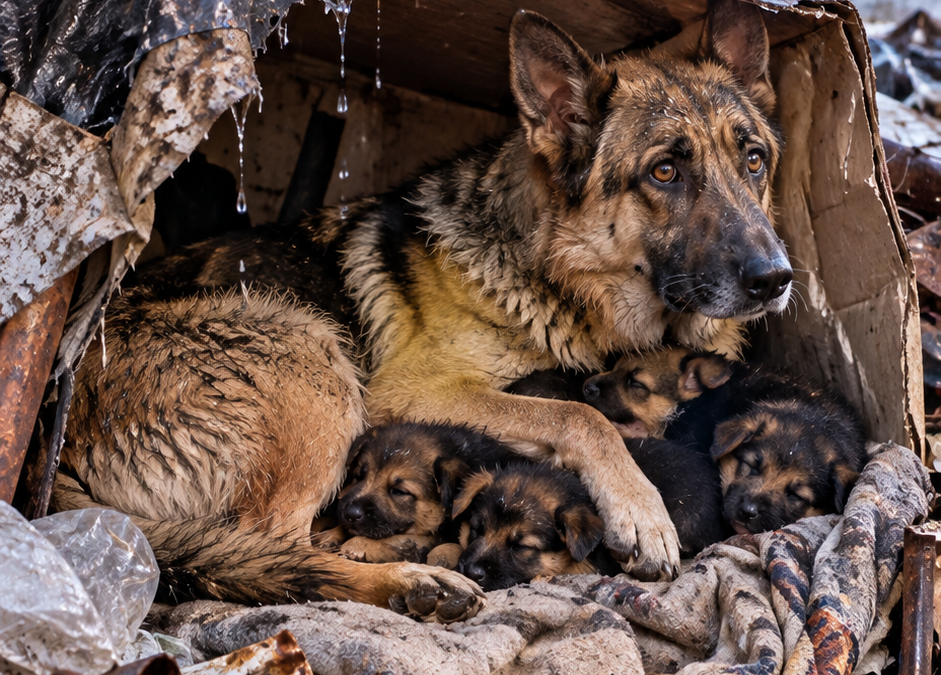
She had dragged pieces of plastic beneath the billboard to block wind.
She had flattened newspaper and cardboard across the dampest sections of dirt.
The torn jacket had been folded twice where the puppies slept.
A piece of plywood leaned against another board, making a crude barrier from the road.
Trash to us.
Building material to her.
She had taken what people threw away and used it to keep two living things alive.
There was irony in that somewhere.
People had apparently thrown her away too.
Unlike the soda cups, she had refused to stay useless.
That night I parked on the shoulder and watched from inside my truck.
The wind became colder after sunset.
Texas gets advertised as heat, sun, ranches, and dramatic sunsets.
Nobody makes postcards of the nights when wind cuts through empty lots and finds every hole in a makeshift shelter.
The mother shifted.
One puppy whimpered.
She curled around both of them.
Every gust hit her back first.
I watched her move her front leg across them.
A barrier.
A roof.
A wall.
There was a freight train in the distance.
The puppies’ ears twitched when the horn sounded.
The mother didn’t react.
Apparently trains were normal.
Humans were the unpredictable part.
That hurt.
Around ten, headlights slowed near the lot.
A small sedan stopped.
I tensed.
Three teenagers got out.
They were laughing.
One had a phone raised.
Another carried an empty drink can.
“What are you doing?” I asked through my open window.
They looked over.
“Nothing.”
The boy with the can threw it toward the billboard.
It landed twenty feet from the den with a metallic crack.
The mother flattened.
The puppies disappeared against her body.
“Pick it up.”
The boy laughed.
“Why?”
“Because you threw it.”
“It’s already trash out here.”
I opened my truck door.
Funny how quickly teenage philosophy collapses when a six-foot mechanic starts walking toward it.
He picked up the can.
His friend muttered something.
“What?”
“Nothing, man.”
“That’s twice tonight.”
They got back into the car.
The boy driving rolled his window down.
“You seriously sitting out here for dogs?”
“Yep.”
“Get a life.”
I nodded toward the billboard.
“That’s what I’m working on.”
They left.
The mother stayed motionless for another fifteen minutes.
That was what trauma looked like for her.
Not screaming.
Not running.
Waiting for danger to become bored.
Much later, another vehicle pulled over.
An old pickup.
An elderly man stepped out.
He didn’t come toward me.
Didn’t speak.
He placed a grocery bag near the ditch.
Inside was dry dog food.
He looked toward the billboard, crossed himself, climbed back into his truck, and drove away.
No camera.
No speech.
No need to announce what a good person he was.
I sat there thinking humans might be the only species capable of making you ashamed and proud within the same hour.
On the third morning, I found tracks behind the billboard.
At first I thought they belonged to the mother.
Then I saw the shape.
Wider.
Rounder.
Four toes.
Claw marks.
Coyote.
My stomach went cold.
I crouched beside the print.
It was fresh.
Maybe from overnight.
Coyotes don’t hunt with malice.
They hunt because they are hungry.
But nature’s innocence doesn’t make the outcome gentler.
Two weak puppies beneath a billboard were not competitors.
They were calories.
I immediately looked toward the den.
The mother was there.
Both puppies alive.
I let out a breath.
“You had company.”
She watched me.
The coyote tracks stopped about fifteen feet from the entrance.
Then circled.
Then moved away.
I imagined her standing at that opening in the dark.
Bones showing.
Barely enough energy to feed herself.
Still willing to fight a predator.
My admiration for her changed.
Until then I had seen a desperate mother.
Now I saw strategy.
She chose the billboard because it had only one easy entrance.
Plywood protected the back.
The road protected one side.
The narrow gap forced anything larger to come at her head-on.
She had not simply found shelter.
She had chosen a defensive position.
“Smart girl.”
Her ears shifted.
“That’s going to make convincing you to leave even more annoying, isn’t it?”
The tail did not move.
I brought a small trail camera the following day.
I positioned it far enough away that it wouldn’t disturb her.
I wanted to know what happened when I wasn’t there.
The footage changed everything.
At 1:13 a.m., the mother crawled out and dragged a sheet of plastic toward the entrance.
Wind kept catching it.
She pulled.
Lost it.
Retrieved it.
Pulled again.
Eventually she pinned one corner beneath a chunk of broken concrete.
At 2:06, the female puppy woke.
The mother licked her face until she settled.
At 3:31, the male puppy crawled away from the warmest part of the den.
The mother woke instantly and nudged him back.
At 4:52, she stood outside the entrance staring into darkness.
The coyote appeared at the edge of the frame.
My hands tightened around the camera.
The mother did not retreat.
Her body changed completely.
Head low.
Shoulders forward.
She moved between the coyote and the den.
The coyote stepped closer.
She lunged.
Not far.
Just enough.
The coyote stopped.
She barked once.
It was the first time I heard her voice.
Deep.
Hoarse.
Unmistakable.
A mother with nothing left still had one warning to give.
The coyote moved away.
The footage continued.
For eleven minutes she remained outside.
Watching.
Only when the darkness was empty again did she crawl back beneath the plywood.
I replayed that clip three times.
Then I shut the camera off.
Watching suffering can become its own kind of cowardice if you start confusing observation with help.
I needed a plan.
But the mother still wasn’t ready.
I called the rescue coordinator.
“Three shepherds,” I told her.
“Three?”
“Mother and two puppies.”
“Condition?”
“Bad.”
“How bad?”
“Mother’s underweight. Puppies dehydrated. Probably parasites. Maybe respiratory infection. One has almost no energy.”
“Can you contain them?”
“Not safely yet.”
There was a pause.
“Hector.”
“I know.”
“No, listen. Weather turns tomorrow night.”
I checked the forecast.
Dust storm.
Thunderstorms behind it.
Possible flash flooding.
The billboard sat beside a drainage ditch.
My stomach tightened.
“How long?”
“Twenty-four hours before it gets ugly.”
I looked toward the den.
“Then I’ve got twenty-four hours.”
That afternoon, I found a note beneath my windshield wiper.
White paper.
Black marker.
GET RID OF STRAYS.
No signature.
No explanation.
I held it for a second.
Then looked toward the billboard.
The mother was asleep with both puppies beneath her.
I laughed once.
“Strays.”
People love that word.
It turns living animals into a sanitation problem.
You don’t have to wonder who failed them if you call them strays.
You don’t have to ask who dumped the mother.
You don’t have to think about the tire tracks.
You don’t have to picture someone unloading a dog with nursing puppies in a vacant lot and driving away.
Just say stray.
Problem solved.
I folded the note and put it in my pocket.
A woman arrived an hour later.
Denim jacket.
Gray hair.
She carried a cracked ceramic bowl filled with warm water.
“Are they still here?” she asked.
“Yes.”
She looked toward the billboard.
“That mama?”
“Yeah.”
“She lets you near?”
“A little.”
The woman placed the bowl down.
“My daughter told me about them.”
“You live around here?”
“Two streets over.”
She looked at the mother again.
“People are angry.”
“At the dogs?”
“At everything.”
Fair answer.
She wiped her hands on her jeans.
“My husband used to say some people would rather destroy a problem than admit they helped create it.”
“Smart man.”
“Annoying man.”
I smiled.
She left towels.
Before getting into her car, she looked back.
“You get them out.”
“I’m trying.”
“No.”
Her eyes hardened.
“You get them out.”
Then she drove away.
That evening the mother disappeared.
At first I wasn’t worried.
She had gone scavenging before.
Thirty minutes became an hour.
One hour became two.
The puppies began crying.
I sat in my truck gripping the steering wheel.
Everything in me screamed to intervene.
The male puppy crawled toward the entrance.
His legs trembled.
His sister licked his face.
I opened the truck door.
Then stopped.
If I took them and the mother returned—
I shut the door.
Ten minutes later I opened it again.
This was torture.
“Come on, girl.”
Nothing.
The sun lowered.
The temperature dropped.
The puppies’ cries weakened.
“Damn it.”
I got out.
Walked halfway toward the billboard.
Stopped.
A memory from rescue training came back to me.
A nursing mother will travel farther when food becomes scarce.
If she returns to an empty den, she may panic and run.
But puppies can die quickly from exposure and dehydration.
There is no perfect rescue.
There are only decisions.
I crouched twenty feet away.
“Give her thirty more minutes.”
I said it aloud because if I didn’t make the decision audible, I knew I would break it.
Twenty-eight minutes later, I saw movement along the highway.
A dog.
Limping.
My heart jumped.
The mother came toward the lot carrying something in her mouth.
A torn fast-food bag.
One front paw barely touched the ground.
She disappeared beneath the billboard and dropped the bag.
French fries spilled onto the newspaper.
The puppies attacked them.
The mother collapsed.
Not lay down.
Collapsed.
I ran closer.
She lifted her head.
“Easy.”
Her paw was bleeding.
Probably glass or metal near the gas station.
I placed soft food near her.
She didn’t move.
I pushed water closer.
Nothing.
Her breathing was shallow.
Tomorrow, I thought.
No.
Not tomorrow.
Tomorrow was already too late.
I sat there until the puppies finished eating.
Then I spoke quietly.
“You’ve done your part.”
The mother’s eyes shifted toward me.
“Now let me do mine.”
That was when I named her.
“Vesper.”
Her ears moved.
“Evening star.”
I smiled sadly.
“Shows up when the light is almost gone.”
She blinked.
The male puppy crawled over her front leg.
“You’re Quill.”
He sneezed.
“Strong opinion.”
The female stared at me with enormous dark eyes.
“And you’re Sora.”
Three names.
Three lives.
No more “strays.”
No more “those dogs.”
Vesper.
Quill.
Sora.
Names make indifference harder.
The next morning I brought a large plastic carrier.
I lined it with towels.
Placed food inside.
Set it near the den.
Vesper stared at it like I had parked a spaceship beside her house.
“No rush.”
Quill was curious.
He crawled toward it.
Sniffed the edge.
Vesper immediately nudged him backward.
“Of course.”
I moved away.
For the next several hours, I did nothing.
That was the work.
People imagine rescue as dramatic action.
Nets.
Blankets.
Vehicles.
Veterinary teams.
Sometimes rescue is sitting in dirt pretending you don’t care whether a dog takes one step closer.
Around noon, Quill entered the carrier.
One paw.
Two.
Grabbed a piece of chicken.
Backed out.
Vesper watched.
Sora followed an hour later.
By late afternoon, both puppies were willing to lie near the entrance.
Vesper stayed outside.
Weather alerts began appearing on my phone.
HIGH WIND WARNING.
SEVERE THUNDERSTORM WATCH.
FLASH FLOOD RISK.
I looked toward the drainage ditch.
Dry now.
Not for long.
“Hate to rush our relationship.”
Vesper stared.
“But Texas has scheduled a crisis.”
I contacted a local veterinarian who worked with the rescue.
“Bring them when you can,” he said.
“You open overnight?”
“For you?”
“No.”
“For dying shepherd puppies?”
He sighed.
“Yes.”
“Thanks.”
“You owe me.”
“Add it to the pile.”
Clouds rolled in from the east before sunset.
The air changed.
Anyone who lives in open country knows that feeling.
Heat disappears.
Wind pauses.
The sky turns the wrong color.
Then everything arrives at once.
The first gust hit the billboard so hard the plastic sheet snapped loose.
Vesper stood immediately.
Quill cried.
Sora pressed underneath her.
Dust moved across the lot in a wall.
I crouched beside the carrier.
The door remained open.
“Come on.”
Vesper looked at me.
Then at the puppies.
A second gust lifted newspaper from the den.
The plywood groaned.
“Vesper.”
No movement.
Rain began.
Large drops striking dry dirt.
Then more.
Within minutes the dust became mud.
Water started running into the drainage ditch.
Quill entered the carrier on his own.
Sora followed.
Vesper remained at the den.
Of course she did.
She looked back toward the pathetic structure she had built.
Her home.
I wondered whether dogs understand possessions.
Maybe not the way we do.
But she understood effort.
Every piece of plastic.
Every scrap of fabric.
Every flattened newspaper page.
She had carried those things there.
She had made that hole survivable.
Now the wind was tearing it apart.
Another gust hit.
The tarp ripped free and flew across the lot.
Vesper flinched.
Water reached the edge of the den.
“Girl.”
I held my hand low.
“You can stay with the trash or come with your babies.”
She looked at the carrier.
Quill’s face was visible inside.
Sora pressed behind him.
Thunder cracked.
Vesper moved.
One step.
Stopped.
Another.
Her injured paw dragged.
I didn’t reach.
She sniffed the carrier.
Looked at me.
For one terrible second I thought she would bolt.
Then Sora whimpered.
Vesper climbed inside.
I closed the carrier door slowly.
The latch clicked.
Vesper spun once.
Her eyes widened.
I immediately crouched beside her.
“Easy.”
She stared through the metal.
“You chose this.”
Her breathing slowed.
I lifted the carrier.
Heavy.
Awkward.
Perfect.
Behind me, water rushed into the hollow.
The jacket floated.
Newspaper dissolved.
The broken pieces of her home shifted beneath brown water.
By the time I reached my truck, the den was gone.
Vesper watched it through the carrier.
I don’t know what she understood.
Maybe nothing.
Maybe everything.
I put the carrier in the back.
Turned the heat on low.
Drove.
At the first red light, I glanced into the mirror.
Quill lay against Sora.
Vesper curled around both.
For the first time since I had found them, she wasn’t taking the weather on her back.
She was dry.
The veterinary clinic smelled like disinfectant, wet dog, and coffee that had been sitting too long.
Dr. Benton met us at the door.
He looked at the carrier.
“That bad?”
“Worse.”
We brought them into an exam room.
Vesper refused to leave the carrier.
Nobody forced her.
Dr. Benton knelt.
“Hi, Mom.”
She stared.
He glanced at me.
“She friendly?”
“She’s tolerant.”
“That is not the same thing.”
“I’m aware.”
He smiled.
“Good.”
We removed Quill first.
He weighed almost nothing.
The scale made my chest tighten.
Dr. Benton frowned.
“Severely underweight.”
Sora weighed less.
Both were dehydrated.
Fleas.
Intestinal parasites.
Skin irritation.
Early respiratory symptoms.
But no major congenital problems.
No broken bones.
No irreversible damage.
“Fixable?” I asked.
Dr. Benton nodded.
“If we don’t find something on the bloodwork, yes.”
I exhaled.
“And Mom?”
“That paw needs cleaning.”
“Can you sedate her?”
“Prefer not to unless we need to.”
Vesper watched while the puppies received fluids.
Quill whimpered when the needle went in.
Vesper’s head shot forward.
I placed my hand near the carrier door.
“Easy.”
She looked at me.
Quill settled.
Sora tried to bite the stethoscope.
Dr. Benton laughed.
“That one has opinions.”
“That’s Sora.”
“You named them.”
“Accidentally.”
“There are no accidental names.”
Vesper finally allowed us to guide her from the carrier.
Her legs nearly folded.
The veterinary technician gasped.
Up close, Vesper was devastating.
Ribs.
Hip bones.
Patchy coat.
Old scars around one ankle.
Fresh cut in the paw.
Her gums were pale.
Dr. Benton checked her.
“Mild anemia.”
“From parasites?”
“Probably parasites and malnutrition.”
“How long?”
“What?”
“How long has she been hungry?”
He looked at her body.
“Long enough.”
Vesper stared at the door.
The technician touched her shoulder.
Vesper growled.
Not loud.
The technician immediately backed off.
“Sorry.”
Vesper looked toward her puppies.
I stepped closer.
“Hey.”
Her eyes found me.
“You beat the storm.”
I don’t know whether it was my voice or exhaustion, but she sat.
Dr. Benton cleaned her paw.
No fracture.
Deep cut between the pads.
Painful but manageable.
She needed antibiotics.
Deworming.
Vaccination once stable enough.
Fluids.
Calories.
Rest.
Rest sounded almost insulting.
When had this dog rested?
The clinic kept them overnight.
I stayed.
Technically nobody asked me to.
Technically Dr. Benton told me twice I could go home.
“No.”
“Hector.”
“No.”
“You have work tomorrow.”
“I own the shop.”
“You still work there.”
“I’m a terrible boss.”
He gave up.
Around two in the morning, somebody pushed a metal cart down the hallway.
It hit a threshold.
CLANG.
Vesper exploded.
She didn’t attack.
She threw herself over the puppies.
Growling.
Teeth visible.
Quill and Sora flattened underneath her.
Every muscle in her body shook.
I sat on the floor.
“Vesper.”
Her growl deepened.
I didn’t approach.
“It’s me.”
Nothing.
The cart moved farther away.
Her eyes stayed wild.
I placed both hands on my knees.
“Nothing is coming under the billboard.”
Her ears twitched.
“No coyotes.”
Breathing hard.
“No cars.”
She looked toward me.
“No one is leaving you.”
The growl softened.
I don’t pretend dogs understand full sentences.
But they understand voices.
Tempo.
Breathing.
Intent.
I spoke slowly.
“Quill is here.”
Her eyes flicked down.
“Sora is here.”
Another breath.
“You’re here.”
The tension began to leave her shoulders.
“That’s enough tonight.”
Eventually she lowered her chest.
Quill poked his nose out.
Sora crawled toward me.
I didn’t touch her.
She came another inch.
Then curled near my shoe.
Vesper watched.
I waited.
Minutes passed.
Finally Vesper lowered her head beside my foot.
That was the first time she slept with part of her body touching me.
Trust isn’t always a tail wag.
Sometimes it’s a traumatized mother deciding she can close her eyes for thirty seconds while you’re nearby.
I didn’t move.
My back hurt.
My legs fell asleep.
At forty-five, sleeping on veterinary clinic floors is less poetic than stories make it sound.
But I stayed.
By dawn, Quill’s paw rested across my wrist.
Sora slept against my ankle.
Vesper’s chin was near my knee.
Dr. Benton entered carrying coffee.
He stopped.
“Well.”
I opened one eye.
“Morning.”
“You look terrible.”
“Professional opinion?”
“Absolutely.”
He looked at Vesper.
She lifted her head but didn’t growl.
Dr. Benton smiled.
“That’s new.”
“Yeah.”
He handed me the coffee.
“You’re keeping her, aren’t you?”
“No.”
“Sure.”
“I foster.”
“Of course.”
“I cannot keep every dog.”
“Absolutely.”
“I mean it.”
He nodded solemnly.
“So what color collar are you buying her?”
I drank the coffee.
“I hate you.”
“Healthy boundary.”
The bloodwork came back better than expected.
No heartworm.
No major infection.
Anemia manageable.
The puppies’ parasite burden was significant but treatable.
Dr. Benton gave me instructions long enough to qualify as a small novel.
Meals every few hours.
Small portions.
Monitor hydration.
Medication.
Separate feeding.
Warm environment.
Watch for vomiting.
Watch stool.
Watch breathing.
Keep stress low.
“Anything else?”
“Don’t let them drive.”
“Good. I was worried.”
He pointed at me.
“I’m serious.”
“I know.”
“They’ve been living in survival mode. Do not mistake food intake for recovery.”
That line stayed with me.
Recovery is not the moment danger ends.
It’s what happens after the body stops believing danger is permanent.
I brought them to my house.
The first problem was the front door.
Vesper stopped on the porch.
Wouldn’t cross.
Quill was inside the carrier.
Sora beside him.
I opened the door wider.
Vesper looked into the house.
Floor.
Rug.
Furniture.
Walls.
Ceiling.
Too much.
A real house can frighten a dog who learned shelter as plywood and plastic.
I sat on the threshold.
“Take your time.”
Five minutes.
Ten.
Vesper sniffed.
One paw crossed.
Back out.
Again.
Two paws.
Back out.
Quill whined from the carrier.
Vesper entered.
Straight toward him.
I closed the door only after she was completely inside.
The first room became theirs.
Old rug.
Blankets.
Water.
Food.
Open crate.
No loud television.
No visitors.
I moved slowly.
That first night, Vesper slept beside the door.
Not the bed I bought.
Of course.
I spent sixty dollars on an orthopedic dog bed.
She selected floor.
Classic.
Quill woke every two hours.
Sora cried when she couldn’t feel her mother.
Vesper rarely slept more than twenty minutes at a time.
Every noise brought her head up.
Refrigerator compressor.
Pipes.
Cars outside.
Neighbor closing a gate.
The first time my washing machine changed cycles, she stood over the puppies growling at the laundry room.
“Dangerous appliance.”
She looked at me.
“I’ve never trusted it either.”
Within three days, Quill learned that food came in bowls.
That seems simple.
It wasn’t.
He approached every meal like someone might steal it.
Head low.
Shoulders tense.
Eating too fast.
I started sitting nearby.
Not touching.
Just existing.
If he paused to look at me, I looked away.
No threat.
Eventually he slowed.
Sora had a different fear.
Plastic bags.
The sound instantly sent her under furniture.
I understood why.
Plastic had been shelter.
Food source.
Wind noise.
Storm noise.
The sound of the den failing.
So I worked with her.
Bag on the floor.
Treat nearby.
No movement.
Next day, touch the bag.
Treat.
Next day, fold it once.
Crinkle.
Sora ran.
I stopped.
Later, try again.
A week passed.
One afternoon I folded a grocery bag.
Crinkle.
Sora’s ears lifted.
She looked at me.
Then walked over.
Nudged my knee.
I almost cried over a grocery bag.
That is rescue.
Your standards for celebration become strange.
Vesper had her own ghosts.
Men’s boots.
Sudden arm movements.
Car doors.
Engines idling nearby.
One afternoon a delivery driver backed toward my driveway.
Beep.
Beep.
Beep.
Vesper disappeared.
I found her beneath my workbench.
Body pressed against the wall.
Eyes enormous.
I sat several feet away.
“Truck’s leaving.”
She stared.
The vehicle backed up.
The sound repeated.
Vesper trembled.
Something about that noise mattered.
I remembered the tire tracks behind the billboard.
A vehicle backing in.
A human exit.
Clean.
Straight.
Final.
I felt anger rise.
Somebody had put her there.
Maybe they told themselves she would survive.
Maybe they thought someone else would find her.
Maybe they didn’t think at all.
I sat with Vesper until the delivery truck left.
She emerged slowly.
I wanted the person who abandoned her to see her then.
Not because I believed shame would change them.
Because I wanted them to understand what abandonment really looks like afterward.
It doesn’t end when the car pulls away.
It continues inside the animal.
Every reverse alarm.
Every engine.
Every closing door.
Your five-minute decision can live in someone else’s nervous system for years.
Two weeks passed.
Vesper gained weight.
Slowly.
Her coat changed.
The dullness lifted.
Quill discovered toys.
His first encounter with a squeaky rubber duck was one of the funniest things I had ever seen.
He bit it.
SQUEAK.
Quill jumped backward.
Barked.
Approached.
Bit.
SQUEAK.
Retreated.
Sora watched from the rug with an expression that clearly said her brother was an idiot.
Then she stole the duck.
Quill chased her.
They ran through the room.
Vesper lifted her head.
For a second I expected her to correct them.
Instead her mouth opened slightly.
Tongue visible.
Relaxed.
Dogs smile differently than people.
But anyone who has lived with them knows the look.
That was the first time Vesper looked young.
She had been a mother.
A scavenger.
A defender.
A construction worker.
A night guard.
A coyote deterrent.
A storm survivor.
For the first time, she simply looked like a dog.
That mattered.
Neighbors started bringing supplies.
The woman in the denim jacket brought towels.
The old man with the pickup arrived carrying a bag of puppy food.
“You got them.”
“We got them.”
He looked at Vesper through the window.
“That her?”
“Yeah.”
“Pretty girl.”
“She wasn’t sure about you.”
“Women usually aren’t.”
I laughed.
He refused coffee.
Left the food.
Drove away.
Another neighbor donated harnesses.
A local veterinary assistant brought flea treatment.
Someone mailed three blankets.
I received a letter from a woman whose name I didn’t recognize.
One sentence stayed with me.
I once drove past a crying dog because I thought someone else would stop. I don’t do that anymore.
I read it while Vesper slept near my chair.
There’s guilt that paralyzes.
Then there’s guilt that teaches.
I prefer the second kind.
Not everyone was supportive.
Someone drove past my house and shouted, “Crazy dog guy!”
I waved.
At least it was accurate.
A man at the gas station recognized me and said, “You know there are thousands of stray dogs, right?”
“Yes.”
“You can’t save all of them.”
“No.”
“So what’s the point?”
I looked at him.
“That argument work with house fires?”
He frowned.
“What?”
“You can’t stop every house from burning. So why bother with one?”
“That’s different.”
“Not to the one inside.”
He stopped talking.
Human beings love math when math excuses us.
Thousands of dogs.
Millions of problems.
Too many.
Can’t save them all.
Convenient.
Vesper never cared how many dogs were suffering somewhere else.
She cared about Quill.
She cared about Sora.
Specific love always beats abstract statistics.
By week three, Dr. Benton cleared the puppies for their next vaccines.
They were gaining weight beautifully.
Sora’s respiratory symptoms were gone.
Quill had transformed from a barely breathing bundle beneath a billboard into a professional criminal.
Shoes.
Socks.
Paper towels.
One screwdriver.
“How did you even get that?”
Quill ran.
Vesper watched.
No sympathy.
“You raised him.”
She looked away.
“Exactly.”
The question I had avoided was becoming unavoidable.
What next?
Rescue work has a cruel contradiction.
If you succeed, the animals leave.
That is the job.
You take frightened, sick, abandoned creatures.
You make them healthy.
Then you hand them to strangers.
People congratulated me.
“They’ll find great homes.”
I knew.
That wasn’t the problem.
The problem was Vesper.
She had already lost enough.
Would removing the puppies feel like another abandonment?
Dr. Benton and the rescue coordinator helped me plan it carefully.
No sudden separation.
No both puppies leaving on the same day.
Adopters would be screened.
Home checks.
References.
Experience with shepherds preferred.
Fenced yards.
No chains.
No outdoor-only placements.
The person who had dumped Vesper got to make one careless decision.
I intended to make the next decisions painfully difficult.
Quill found a home first.
A couple named Martin and Elise.
No children.
Older shepherd already in the house.
Large fenced yard.
Martin worked from home.
They visited three times.
Quill loved their dog.
Vesper tolerated them.
That was practically an endorsement.
On the third visit, Elise sat on the floor.
Quill climbed into her lap.
Vesper walked over.
Sniffed Elise’s face.
Then lay down nearby.
I held my breath.
“Is that good?” Elise whispered.
“That is a five-star review.”
Martin smiled.
Quill went home the following week.
I expected chaos.
Vesper watched the door after he left.
She paced.
Sora searched the rooms.
That night Vesper carried one of Quill’s toys to the rug.
My chest hurt.
“Did I do the right thing?”
She looked at me.
No answer.
The next day Martin sent a video.
Quill running through grass beside the older shepherd.
Tail high.
Tongue out.
Alive.
I showed Vesper.
I have no idea whether she understood the screen.
She sniffed the phone.
Heard Quill bark.
Her ears lifted.
Then she settled.
Maybe that was enough.
Sora stayed another three weeks.
Her adoption took longer because I was pickier.
That’s my official explanation.
The truth is I wasn’t ready.
Neither was Vesper.
Sora slept against her mother every night.
They groomed each other.
Played quietly.
Sora followed Vesper from room to room.
Then a woman named Rosa applied.
She taught at an elementary school.
Owned a modest house with a fenced yard.
Had lost her twelve-year-old shepherd six months earlier.
During the home visit, I watched Rosa kneel without calling Sora.
Smart.
Let the dog choose.
Sora approached.
Sniffed.
Backed away.
Returned.
Rosa didn’t touch.
Five minutes later Sora put one paw on her leg.
Rosa looked at me.
“I’m not moving.”
“Good plan.”
She smiled.
Eventually Sora climbed beside her.
That was it.
I knew.
The adoption day came.
Rosa cried.
I pretended not to.
Vesper stood beside Sora near the door.
Rosa clipped the leash.
Sora looked back.
Vesper walked forward and touched noses with her.
For several seconds they remained like that.
No dramatic sound.
Just breath.
Then Sora followed Rosa outside.
Vesper stood at the doorway.
I crouched beside her.
“She’s safe.”
Vesper watched the car leave.
My throat tightened.
“You did it.”
She looked at me.
“Both of them.”
The car turned out of sight.
Vesper remained still.
Then she walked inside.
Straight to the old rug.
Lay down.
The house became quiet.
Too quiet.
No Quill stealing things.
No Sora reacting to plastic bags.
No puppies wrestling at midnight.
Just Vesper.
And me.
I sat on the floor.
She rested her head on my leg.
“You know,” I said, “Dr. Benton thinks I’m keeping you.”
Her eyes closed.
“The rescue coordinator thinks I’m keeping you.”
Tail thump.
“One neighbor already refers to you as my dog.”
Another thump.
“I have repeatedly explained that I foster.”
Vesper sighed.
“You’re all extremely disrespectful.”
She rolled slightly onto her side.
I scratched her chest.
The adoption paperwork sat on the kitchen counter.
Mine.
I had filled it out that morning.
I just hadn’t signed.
There are moments when people pretend a decision is difficult because admitting it was made weeks ago feels embarrassing.
Vesper had already chosen where she slept.
She followed me into the garage.
Waited at the gate when I worked outside.
Knew the sound of my truck.
Had a specific spot beside the couch.
She no longer panicked at delivery vehicles if I was nearby.
She trusted me enough to sleep with her back toward the door.
That may not sound like much.
For her, it was everything.
I signed.
“Hector Vale,” I read aloud.
Vesper lifted her head.
“Permanent adopter.”
She stared.
“Apparently.”
I put the pen down.
“So congratulations.”
Her tail moved.
“You’re officially stuck with a middle-aged mechanic who talks too much.”
She stood.
Walked over.
Placed her muzzle on my knee.
That was her answer.
Months later, I drove past the old billboard.
Most of the plywood had collapsed during the storm.
The NO PARKING message was barely visible.
The den was gone.
No jacket.
No plastic.
No newspaper.
Just weeds growing through the dirt.
I pulled over.
Vesper sat in the passenger seat.
She looked toward the lot.
Her body stiffened.
For a moment I regretted stopping.
Then she sniffed through the open window.
The wind moved across the grass.
A train horn sounded in the distance.
Vesper’s ears lifted.
She didn’t shake.
Didn’t hide.
Didn’t whine.
She simply watched.
I wondered what she remembered.
Hunger?
Cold?
The puppies?
The coyote?
The storm?
The tire tracks?
Maybe dogs don’t remember places the way we do.
Maybe they remember feelings.
I looked at the ruined billboard.
Someone had chosen that place because it was hidden.
That was the cruelty of it.
They didn’t abandon Vesper outside a shelter.
They didn’t leave her where traffic would stop.
They chose somewhere people were unlikely to notice.
Whoever did it probably expected the story to disappear.
Instead Quill was sleeping on a couch across town.
Sora had a fenced yard and a teacher who sent me photographs every Sunday.
Vesper was sitting beside me wearing a red collar with her name and my phone number engraved on the tag.
The plan had failed spectacularly.
Whoever tried to turn them into trash had lost.
The puppies lived.
The mother lived.
The frightened dog who once used her ribs as a wall now slept inside a real house and complained if breakfast was more than five minutes late.
There is a satisfying kind of justice in that.
Not revenge.
Something better.
Failure.
Cruelty failed.
The note under my windshield had said:
GET RID OF STRAYS.
Well.
We did.
Quill became family.
Sora became family.
Vesper became family.
There were no strays left.
I laughed when I thought about that.
Vesper looked at me.
“What?”
She tilted her head.
“You wouldn’t appreciate the joke.”
We drove home.
That evening, Rosa sent a picture of Sora asleep on her back, paws in the air.
Martin sent one of Quill carrying a shoe he absolutely did not own.
I showed both to Vesper.
She sniffed the phone.
Then went to the window.
Sunset filled the room.
For a dog named after the evening star, she had developed an excellent appreciation for dusk.
She stood there quietly while the sky turned orange, then purple.
I remembered the first night.
Her body blocking the puppies.
Dust in her fur.
That terrible thin sound beneath the billboard.
The way she watched my flashlight.
Calculating.
How close can he come before I fight?
Now I could walk up behind her.
Touch her shoulder.
She leaned against my leg.
That was what we had won.
Not ownership.
Trust.
There is a difference.
People think rescue is about carrying an animal away from danger.
That’s only the visible part.
The real work begins after the carrier door closes.
You have to teach them that food returns tomorrow.
That hands can touch without hurting.
That engines can leave and still come back.
That loud noises don’t always mean run.
That a closed door can mean safety rather than abandonment.
That sleep is allowed.
That love does not have to be defended with teeth.
Vesper had spent her life learning the opposite.
She learned our rules slowly.
I learned hers too.
Approach gently.
Mean what you do.
Return when you say you will.
Don’t demand trust you haven’t earned.
Protect what depends on you.
Pretty good rules, actually.
Better than most human ones.
A year after I found them, we held a small reunion.
Martin and Elise brought Quill.
Rosa brought Sora.
I worried Vesper might not recognize them.
That concern lasted approximately four seconds.
Quill jumped out of the car.
Vesper froze.
Sora appeared behind Rosa.
Vesper made a sound I had never heard before.
Half whine.
Half bark.
Then chaos.
Quill ran at her.
Sora followed.
Vesper spun between them.
They sniffed.
Jumped.
Wrestled.
Quill was enormous by then.
Sora was elegant and long-legged.
Vesper had gained enough muscle that nobody would have recognized the skeletal dog beneath the billboard.
We stood in my yard laughing while all three tore through the grass.
At one point Quill crashed into a lawn chair.
Martin winced.
“Sorry.”
I looked at the chair.
“Worth it.”
They played until they collapsed beneath the tree.
Vesper lay in the middle.
Quill on one side.
Sora on the other.
Exactly like the den.
Except this time the ground was soft.
Their stomachs were full.
No wind cut through plywood.
No coyotes circled.
Nobody was leaving.
I sat nearby.
Rosa looked at them.
“Hard to believe.”
“Yeah.”
“What do you think would’ve happened if you hadn’t stopped?”
I didn’t answer immediately.
Because I knew.
Quill probably would have died first.
He had been the weakest.
Sora might have lasted another day or two.
Vesper would have fought until there was nothing left to fight with.
Maybe the coyote.
Maybe the storm.
Maybe infection from her paw.
Maybe hunger.
Three lives disappearing beneath a billboard.
Someone eventually would have cleaned up the trash.
That thought bothered me most.
A maintenance worker might have found their bodies and thought they were part of the mess.
I looked at Vesper.
She was licking Quill’s ear.
“Doesn’t matter,” I said.
Rosa glanced at me.
“Why?”
“Because that’s not what happened.”
For years I had been guilty of replaying bad possibilities.
What if I had arrived later?
What if I hadn’t heard the puppy?
What if Vesper had run?
What if the storm came sooner?
Rescue can make you obsessed with alternate endings.
But eventually you learn to respect the ending you actually earned.
Vesper survived.
Quill survived.
Sora survived.
That is enough.
The old billboard eventually came down.
A construction crew cleared the lot the following spring.
The first time I drove past and saw empty ground, I felt strangely sad.
That terrible place had become part of our story.
Then Vesper nudged my elbow from the passenger seat.
I looked at her.
Healthy coat.
Bright eyes.
Red collar.
I smiled.
“Yeah.”
The place didn’t deserve nostalgia.
She did.
Home isn’t the shelter you manage to build while the world is trying to kill you.
Home is the place where you no longer need walls made from your own body.
That was the difference.
Beneath the billboard, Vesper had been a roof.
A gate.
A furnace.
A guard.
A soldier.
At my house she was allowed to be ridiculous.
She barked at vacuum cleaners.
Stole pieces of cheese.
Snored.
Rolled in grass after baths just to insult me.
She developed a hatred of one particular garden statue for reasons known only to her.
She slept belly-up sometimes.
The first time she did that, I stopped walking across the room.
It felt sacred.
A dog exposing her stomach in sleep is a dog who believes nothing is coming.
People who haven’t lived with traumatized animals may not understand why that can bring tears to your eyes.
I understood.
Vesper had spent nights sleeping with one eye open while coyotes walked outside.
Now she slept so deeply her paws twitched in dreams.
That was victory.
Quill’s family sent updates constantly.
He became obsessed with swimming pools.
Sora discovered tennis balls and apparently intended to destroy the global supply.
They were happy.
Different houses.
Different people.
Same beginning.
Sometimes we met at my place.
Sometimes at Rosa’s.
Vesper always checked both pups carefully.
Nose to ears.
Shoulders.
Mouth.
Like she was counting again.
One.
Two.
Safe.
Then she relaxed.
That habit never disappeared.
Maybe it never should.
It was proof of who she had been when nobody else was protecting them.
Years later, I still had the note from my windshield.
GET RID OF STRAYS.
I kept it in a drawer.
Not because I enjoyed anger.
Because it reminded me how easy cruelty becomes when written in simple words.
Get rid of them.
Move them.
Remove them.
Not our problem.
People make terrible decisions more comfortably when language removes the living thing from the sentence.
Vesper was never “a stray.”
She was a mother.
Quill wasn’t “a stray puppy.”
He was a frightened little thief who would one day steal a screwdriver and then a family’s heart.
Sora wasn’t “another dog.”
She was cautious, clever, and brave enough to relearn the sound of plastic.
Specific lives.
Specific fears.
Specific futures.
That is what the person who abandoned them had refused to see.
And that is why they lost.
They reduced three lives to something disposable.
Those three lives became impossible to ignore.
The mother built a home from garbage because someone gave her garbage and expected that to be enough.
She used discarded paper as bedding.
Discarded plastic as roofing.
Discarded clothing as warmth.
Then she gave her own body to fill whatever gaps remained.
But in the end, the one thing she refused to let anyone discard was her puppies.
That stubbornness carried them until help finally arrived.
People called me the rescuer afterward.
I never liked that.
I provided transportation.
Food.
Veterinary care.
A house.
Paperwork.
Vesper did the hardest part before I ever showed up.
She kept them alive.
She walked on an injured paw for food.
She fought a coyote with an empty stomach.
She dragged plastic through the night.
She moved the puppies when water entered the den.
She starved herself so they could eat.
Then, when the storm finally destroyed the only shelter she knew, she made one more impossible decision.
She trusted me.
That was her rescue.
The rest was logistics.
On quiet evenings, she still sits by the window.
Not because she is waiting for anyone.
Not anymore.
She watches the light change.
Sometimes a freight train sounds far beyond town.
Her ears rise.
Then settle.
I sit beside her.
No billboard.
No dust.
No torn tarp snapping in the wind.
Just a house.
A rug.
A bowl filled in the kitchen.
A collar hanging comfortably around her neck.
And one German Shepherd who spent the first part of her life building walls from trash finally understanding that she doesn’t have to be the wall anymore.








