𝗣𝗔𝗥𝗧 𝟮 A Mother Dog Guarded a Puppy on a Raft for Days—Then We Learned It Wasn’t Hers
𝗣𝗔𝗥𝗧 𝟮
Getting alongside moving debris in floodwater is one of those tasks that looks simple from shore and feels suicidal once you’re actually doing it.
The current doesn’t care about your boat.
It doesn’t care about the dog.
It doesn’t care that you’ve calculated an approach angle.
One hidden branch beneath the surface can turn the whole operation into another rescue.
I brought us alongside but kept several feet of separation.
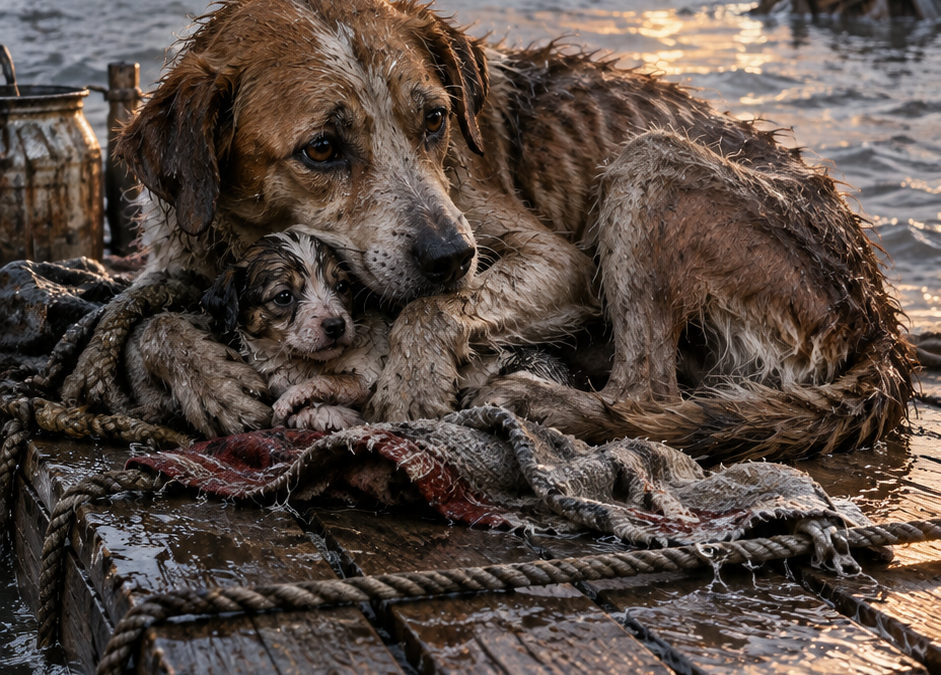
The tan dog watched every movement.
Her body trembled.
Not fear alone.
Exhaustion.
Cold.
Probably hunger.
Eli looped one line around a partially submerged pine trunk that had wedged itself near the bank.
“If we can catch the raft, we can keep it from the bridge.”
“Try.”
He tossed.
The rope landed across the boards.
The dog flinched.
Then growled.
Low.
Deep.
I stopped.
There it was.
Not aggression in the careless sense people use that word.
A boundary.
Don’t come closer.
The puppy moved beneath her.
The growl intensified.
Eli looked at me.
“She’s going to protect that pup.”
“Yeah.”
“Even from us.”
“Yeah.”
The raft lurched downstream another three feet.
We were out of time.
I picked up the hook pole.
“Hold position.”
Eli looked at me.
“You are not jumping onto that thing.”
“I am.”
“Logan.”
“Current takes them another fifty yards and they’re under the bridge.”
“Then hook it.”
“I’m trying.”
The boards spun just beyond the pole.
The dog shifted.
Puppy cried.
Current pulled harder.
I made the decision.
“Keep the line tight.”
“Logan—”
I jumped.
The raft nearly rolled.
Water hit my boots.
I dropped to one knee, arms wide.
The dog whirled toward me.
Teeth exposed.
Growl.
I froze.
“Okay.”
My pulse hammered.
“I’m not taking her from you.”
The dog stood over the puppy.
Every muscle locked.
“I’m taking both of you.”
Meaningless words to a terrified animal.
But tone isn’t meaningless.
I lowered my shoulders.
Turned slightly sideways.
No direct reach.
No staring.
The raft slammed into a submerged branch.
The puppy squealed.
The adult immediately looked down.
Then back at me.
Something shifted in her face.
Not trust.
Assessment.
I held out one hand.
“Please.”
For one long second, she didn’t move.
Then she stepped sideways.
Half a step.
The puppy appeared fully.
Black-and-tan German Shepherd.
Female.
Tiny.
Limp.
Her fur was soaked along the back but mostly dry beneath the adult dog’s chest.
I almost lost my breath.
The tan dog had truly been sheltering her.
How long?
Hours?
A night?
More?
I moved slowly.
The adult watched.
I slid both hands beneath the puppy.
She weighed almost nothing.
Her head rolled against my wrist.
“Jesus.”
Breathing.
Still there.
I tucked her inside my flotation jacket.
The adult dog’s nose immediately followed.
She sniffed the puppy.
Whined.
“I’m not leaving you.”
I looked toward Eli.
“Line!”
He threw a second line.
I caught it.
The raft suddenly spun.
One edge dipped.
The adult dog lost her footing.
Her hindquarters went into the river.
“No!”
I dropped onto my stomach and grabbed the loose skin and harnessless fur around her shoulders.
She thrashed once.
Cold water pulled.
I hauled.
Eli took tension on the line.
The dog clawed the boards.
Together we got her back onto the raft.
She coughed.
Shook once.
Then immediately turned toward my chest.
Toward the puppy.
Not herself.
The raft struck another branch.
“Now!” Eli yelled.
I caught the dog’s torso.
She resisted.
For half a second.
Then allowed me to guide her toward the skiff.
Eli grabbed her front end.
I pushed.
She landed inside.
I jumped after her.
Seconds later the line slipped from the broken raft.
The boards spun away.
Thirty yards.
Forty.
Then vanished into the timber jam.
I stared.
If we’d waited another minute…
No.
Didn’t need to finish that thought.
The adult dog crawled toward me.
Not for comfort.
For the puppy.
I opened my jacket enough for her to see.
The tiny shepherd’s chest moved.
The adult pressed her nose against the puppy’s head.
Whined.
“She’s here.”
Eli eased the throttle.
“Let’s move.”
We headed toward the temporary landing zone.
The tan dog stayed pressed against my leg, nose never more than an inch from the puppy.
I looked down at her.
Mud.
Scars.
Raw paws.
Ribs.
There was a maternal quality to everything she did.
But the more I looked, the less biology made sense.
At the bank, volunteers waited with blankets.
A vet tech named Hannah reached for the puppy.
The adult snapped the air.
Hannah pulled back instantly.
“Okay.”
“Let her see everything,” I said.
I lowered the puppy onto a towel.
The tan dog followed.
Not aggressive now.
Focused.
A medic wrapped the puppy.
The adult crawled beside her.
Someone brought water.
She ignored it.
Food.
Ignored that too.
She curled around the puppy.
Only then did her body collapse.
Not unconscious.
Just finally allowing herself to stop standing.
I crouched.
“Good girl.”
Her eyes met mine.
I had no name for her.
“Greta.”
Eli looked at me.
“Greta?”
“Temporary.”
“Why Greta?”
“No idea.”
Greta blinked.
Eli shrugged.
“Apparently approved.”
The puppy received warmed fluids under the field tent while arrangements were made for transport to the partner shelter clinic.
Her body temperature was low.
Pulse weak.
Dehydrated.
One small wound along the back leg.
Nothing obviously broken.
Greta stayed close enough that every person touching the puppy worked under her supervision.
The veterinarian on scene, Dr. Elena Ruiz, examined Greta next.
She ran one hand cautiously along the dog’s abdomen.
Paused.
“Interesting.”
“What?”
Dr. Ruiz looked at me.
“She was lactating recently.”
“So she is the mother?”
“No.”
I frowned.
“You can tell that already?”
“The puppy is at least ten to twelve weeks old, probably closer to three months. This dog looks recently postpartum.”
“How recently?”
“Could be a week. Maybe less.”
I looked at the puppy.
Then Greta.
“You’re saying she gave birth recently.”
“Yes.”
“But not to her.”
“Almost certainly not.”
Eli had been listening.
“Then where are her pups?”
Nobody answered.
Greta licked the shepherd puppy’s face.
Slow.
Careful.
Dr. Ruiz watched.
“She’s treating her like her own.”
The words followed me back to Glenwood Springs.
The temporary shelter occupied a converted community building on higher ground.
Animals rescued from flooded homes had filled almost every available room.
Cats in carriers.
Dogs in kennels.
Two goats temporarily occupying a storage area.
One extremely angry parrot shouting what sounded like profanity every time volunteers walked past.
Greta and the puppy got a quiet medical enclosure.
The staff started calling the puppy Anaka.
I asked where the name came from.
No one knew.
Hannah claimed another volunteer had suggested it.
The other volunteer denied responsibility.
The puppy responded to absolutely nothing, so democracy prevailed.
Anaka.
Greta did not care what we called her.
She cared only where we put her.
The moment staff moved Anaka into a heated crate for medical observation, Greta planted herself against it.
No food.
No water.
No sleep.
Watching.
We had to slide a second bedding pad directly beside the crate because she refused to move farther than two feet.
I stayed until nearly eleven that night.
Not because I was assigned.
My shift had ended.
I simply couldn’t leave.
Dr. Ruiz found me sitting against the wall.
“You have a house, right?”
“Technically.”
“Bed?”
“Yes.”
“Go use it.”
I looked at Greta.
“She hasn’t eaten.”
“She will.”
“How do you know?”
“I don’t.”
“Comforting.”
Dr. Ruiz sat on the opposite side.
“Logan, she’s exhausted. Sometimes animals don’t eat immediately.”
“I know.”
“You’ve done this before.”
“Not this.”
She looked through the glass.
Greta’s muzzle rested against Anaka’s blanket.
“No.”
Then the shelter radio crackled.
A volunteer from a downstream search team.
They had found two puppies caught in debris.
Dead.
Small.
Tan.
Similar coloring to Greta.
The room became very quiet.
Dr. Ruiz stood.
“I need to see.”
I followed.
Didn’t want to.
Did anyway.
The puppies had been recovered about half a mile from the approximate point where we’d found the raft.
Both looked very young.
Several weeks at most.
Same tan coats.
One darker muzzle.
No collars.
No identification.
Could we prove they were Greta’s?
Not without testing.
We didn’t need to.
Not emotionally.
When Dr. Ruiz returned to Greta, she examined her again.
Then looked at me.
“Timing matches.”
I stared through the glass.
Greta curled around the German Shepherd puppy who could not possibly have been born to her.
“She lost them.”
“Likely.”
“And then found Anaka.”
“Maybe.”
“On the raft?”
“We don’t know.”
“Before?”
“We don’t know.”
I hated those words.
But they were correct.
We had no right to manufacture a cleaner story than reality gave us.
What we knew was already enough.
Greta had recently lost a litter.
An unrelated older puppy ended up with her during the flood.
Greta protected that puppy for an unknown amount of time, to the point that her own back was soaked while the puppy’s underside remained partially dry.
That was extraordinary without invention.
I sat in my truck after midnight.
Rain ticked against the windshield.
My hands stayed on the steering wheel.
Engine off.
And for reasons that had almost nothing to do with dogs, I started crying.
Quietly.
Angrily.
The kind of crying that feels less like sadness and more like a structural failure.
I hadn’t cried in almost a year.
Not properly.
My wife, Sarah, and I had lost a baby eleven months earlier.
Twenty-three weeks.
Too early.
Far enough along that we had seen her face on ultrasound.
Far enough along that Sarah had bought a small box of clothes despite us agreeing we would wait.
Far enough along that I’d assembled a crib one Saturday afternoon while pretending not to be terrified.
Then a hospital room.
Doctors.
Words.
Silence.
We went home without her.
People told us things because people panic around grief.
“Everything happens for a reason.”
No.
“You can try again.”
Not the point.
“At least you know you can get pregnant.”
One of the cruelest accidental sentences I’ve ever heard.
At first, Sarah and I grieved together.
Then differently.
She wanted to talk.
I couldn’t.
She cried.
I fixed things around the house.
She wanted to look at photographs.
I put them away.
She wanted us to see someone.
I said I didn’t need therapy.
What I meant was I did not want to enter a room where somebody might make me say our daughter’s name.
We had named her Emma.
Eventually Sarah stopped asking me to talk.
Then we stopped touching.
Then we stopped fighting.
That was worse.
Fighting would have meant we were still reaching each other.
By the time the flood happened, we were two polite people living in the same house.
I took extra disaster shifts.
She spent more time at her sister’s.
Neither of us said divorce.
Neither said stay.
I told myself I was being strong.
Then I watched Greta.
A dog who had lost her own babies in a flood, if our conclusion was right.
A dog who had every biological and emotional reason to shut down.
Instead, somewhere in chaos, she had found Anaka.
And protected her.
Not because Anaka replaced the puppies she’d lost.
Nothing replaces anything.
That was the part that reached me.
Greta hadn’t replaced.
She had continued.
There is a difference.
I went back inside.
Greta was awake.
Anaka asleep.
I sat outside the enclosure.
“You lost them.”
Greta watched me.
“I know.”
Her eyes closed halfway.
“Or I think I know.”
I swallowed.
“You had every reason to stop caring.”
She rested her chin on Anaka’s back.
I laughed once through my nose.
“Yeah.”
Something cracked in me that night.
Not healed.
Cracked.
Sometimes that’s the first useful thing that happens.
The next morning, Greta still had not eaten.
Dr. Ruiz was annoyed.
“She’s going to create another patient.”
I brought boiled chicken.
Greta sniffed.
No.
Wet food.
No.
Anaka moved.
Greta immediately licked her.
“You’re impossible.”
Her ears shifted.
I sat beside the enclosure and ate part of the chicken myself.
Greta watched.
“See?”
I took another bite.
“Very exclusive cuisine.”
She sniffed.
I put a piece near her.
No movement.
I ignored her.
Five minutes later, chicken disappeared.
I pretended not to notice.
Second piece.
Gone.
By noon, she’d eaten a small meal.
Victory.
Anaka improved too.
Slowly.
Her temperature normalized.
She drank.
Accepted tiny amounts of food.
Her first tail wag happened when Greta nudged her awake.
One little movement.
Greta’s entire body softened.
Hannah saw it.
“Did you see that?”
“I did.”
“She’s going to be okay.”
“Don’t say things we don’t know.”
She looked at me.
“You’re fun.”
“I’ve been told.”
The flood investigation continued outside our little enclosure.
Roads opened.
Missing people accounted for.
Debris cleared.
Families returned to damaged homes.
News crews came and went.
Animals were reunited.
Some weren’t.
No one reported a missing German Shepherd puppy matching Anaka.
We posted required notices.
Checked microchip.
Nothing.
Greta had no chip either.
No collar.
No identified owner.
For the moment, they belonged to nobody.
Except apparently each other.
Three days after rescue, Anaka got sick.
Fast.
Morning: tired.
By noon: fever.
By two: pale gums.
Rapid heartbeat.
She stopped eating.
Dr. Ruiz examined her.
“Possible infection.”
“From floodwater?”
“Could be. Could be aspiration. Could be contamination through the leg wound. We need labs.”
Greta knew something had changed before any of us did.
The moment the staff lifted Anaka from the enclosure, Greta barked.
Sharp.
Once.
Then tried to follow.
Hannah held her leash.
Greta pulled.
“Easy.”
Another bark.
Anaka didn’t protest when placed on the table.
That frightened me.
Healthy puppies complain.
Anaka just lay there.
Dr. Ruiz inserted the IV.
Greta whined.
I held her harness.
“I’m here.”
She strained toward the table.
“She’s right there.”
Greta’s breathing came fast.
I understood more than I wanted to.
Standing uselessly beside someone you love while strangers do medical things you cannot understand.
Hospital lights.
Machines.
Faces trying to be reassuring.
The body knowing danger before the words arrive.
I was back in that room with Sarah.
A nurse asking if we wanted more time.
More time with what?
More time before leaving without our daughter?
I’d stood near the window because I couldn’t sit.
Sarah had held Emma.
I barely touched her.
That memory had been eating me alive for eleven months.
I had told myself I couldn’t hold her because it would have hurt too much.
Now I knew the uglier truth.
I had been afraid.
Sarah had needed me beside her.
I’d retreated inside myself.
Greta pulled again.
I sat beside her.
Not standing.
Not retreating.
“Okay.”
She looked at me.
“We stay.”
The laboratory results suggested significant bacterial infection.
Antibiotics.
Fluids.
Warming.
Monitoring.
Anaka moved into the small ICU section.
Greta lay directly outside the enclosure.
Hours passed.
She wouldn’t sleep.
Wouldn’t eat again.
Every time Anaka’s breathing changed, Greta lifted her head.
I stayed.
Around nine that night, I texted Sarah.
Not the message in my drafts.
Just three words.
Are you awake?
My phone sat in my hand for six minutes.
Then:
Yes.
I typed.
Deleted.
Typed.
Deleted.
Finally:
I’m at the shelter. There are two dogs here. One lost her puppies in the flood. She’s protecting another puppy that isn’t hers.
Sarah responded after a minute.
Are they okay?
Such a Sarah question.
Not why are you telling me.
Not where have you been.
Are they okay?
Puppy’s sick. Not sure.
Another pause.
And you?
I stared at that.
I hadn’t known how to answer for almost a year.
I typed:
No.
My thumb hovered.
Then send.
The word left my phone.
Nothing exploded.
No flood.
No judgment.
A minute later:
I know.
That hurt worse.
I closed my eyes.
Greta pressed her nose against the ICU gate.
I put my hand on her back.
For once, neither of us pretended we were fine.
Anaka’s fever climbed overnight.
Then slightly higher.
Dr. Ruiz changed antibiotics after consulting cultures and the overnight veterinary team.
They were cautious.
Nobody called it hopeless.
Nobody called it safe.
“She’s holding,” Dr. Ruiz said.
“Meaning?”
“Meaning she’s holding.”
I hated medicine.
Honest but unsatisfying.
At two in the morning, Greta began whining.
Long.
Low.
Almost musical.
Not a howl at first.
A vibration in her chest.
Then she lifted her head.
One aching note filled the room.
Every other dog went quiet.
I had heard coyotes.
Wolves from a distance.
Dogs calling for owners.
This was different only because of everything I knew—or believed I knew—about her.
Grief makes sound personal.
I sat beside her.
“I know.”
Greta leaned against me.
First time.
Her shoulder pressed into my chest.
Ribs sharp.
Body shaking.
I put my arm around her.
No resistance.
“You’ve done enough.”
She stared at Anaka.
“You hear me?”
Nothing.
“You don’t have to hold the whole thing up.”
I could have been talking to myself.
My phone vibrated.
Sarah.
Still awake?
Yes.
Can I call?
I almost said no.
Reflex.
Then:
Yes.
Her voice when I answered was cautious.
“Hi.”
“Hi.”
Silence.
Shelter monitor beep.
Greta breathed against me.
Sarah asked, “What’s her name?”
“Which one?”
“The mother.”
“Greta.”
“And the puppy?”
“Anaka.”
“Is Greta really her mother?”
“No.”
“What happened to her puppies?”
I swallowed.
“They found two in debris.”
Sarah stopped breathing for a second.
“Oh.”
“Yeah.”
“And she’s still protecting this other one.”
“Won’t leave.”
Sarah cried quietly.
I knew the sound.
Had avoided it for months.
This time I stayed on the phone.
“I’m sorry,” I said.
“For what?”
Everything.
Too big.
So I chose one piece.
“For disappearing.”
Silence.
Then:
“You were still in the house.”
“I know.”
“That wasn’t the same as being there.”
“I know.”
That one hurt because it was true.
I looked at Greta.
She remained pressed against me.
“I’m sorry.”
Sarah’s voice shook.
“I was angry at you.”
“You had every right.”
“I was angry because I needed you.”
“I know.”
“I still do.”
My eyes closed.
“I need you too.”
That was the first honest conversation we’d had since the hospital.
It lasted fifteen minutes.
No grand resolution.
No sudden forgiveness.
We didn’t fix a marriage at two-thirty in the morning beside a sick puppy.
We simply stopped pretending we didn’t have one worth talking about.
After we hung up, I looked at Greta.
“Okay.”
She looked back.
“Your turn.”
I slid the food bowl toward her.
“Eat.”
Nothing.
“You’re a terrible therapist.”
Greta sniffed the bowl.
Then ate one bite.
I laughed.
“Fine. I’ll take it.”
At four in the morning, Anaka’s heart rate changed.
The monitor alarmed.
Staff moved.
I stood.
Greta lunged toward the gate.
I caught her.
“No.”
Anaka lay too still.
Dr. Ruiz worked.
Oxygen.
Fluids adjusted.
Medication.
I could see only pieces.
A tiny paw.
Blanket.
The top of her head.
Greta barked.
Once.
Again.
Then pressed her muzzle through the bars.
“Come on.”
My voice broke.
“Come on, little girl.”
Seconds stretch strangely when you are helpless.
A minute can become a whole room.
Then Anaka moved.
One paw.
Tiny twitch.
Her chest lifted deeper.
A sound came from her throat.
Weak.
Real.
Greta stopped barking.
Dr. Ruiz looked up.
“Good.”
I nearly collapsed.
“What?”
“She’s responding.”
Greta whined.
Anaka’s head shifted toward the sound.
That did it.
I sat on the floor.
Cried.
Not elegantly.
Not quietly.
Greta paced one circle.
Then lay beside the crate.
For the first time all night, she closed her eyes.
At dawn, Sarah came.
I hadn’t asked.
She simply appeared in the doorway holding two coffees.
My wife looked exhausted.
Beautiful.
Terrified.
Familiar.
We stood ten feet apart.
Neither knew how to bridge eleven months.
So Sarah looked through the ICU glass.
“Which is Greta?”
“The tan one.”
She watched.
“And Anaka.”
I pointed.
Sarah covered her mouth.
“She’s so small.”
“Yeah.”
We sat.
Not touching.
After a few minutes, Sarah moved her hand onto the bench between us.
Palm down.
I looked at it.
Then placed mine over hers.
She didn’t pull away.
Neither did I.
Greta opened one eye.
Watched.
Then closed it.
“Judgmental dog,” I whispered.
Sarah smiled.
It was tiny.
First smile we’d shared in months.
Anaka stabilized through the morning.
Fever came down half a degree.
Then another.
She accepted a small amount of food by late afternoon.
Greta watched every bite.
Then finally ate a full meal herself.
Dr. Ruiz pointed at her bowl.
“Best lab result I’ve seen all day.”
Sarah laughed.
I had forgotten what her laugh did to a room.
The next three days were slow.
No miracle.
Anaka improved in increments.
Temperature.
Appetite.
Energy.
She stood.
Then walked three steps.
Collapsed.
Greta nudged her.
The puppy got up again.
On day four, Anaka barked.
One squeaky little sound at a volunteer carrying food.
The entire staff applauded.
Anaka panicked at the applause.
We immediately stopped.
Lesson learned.
Greta licked her face as though humans were embarrassing.
Correct.
We started required adoption and ownership procedures once both dogs were medically stable.
No owner came for Greta.
No owner came for Anaka.
A family briefly thought Anaka might be theirs, but their missing puppy was male and soon recovered elsewhere.
Days passed.
Then a week.
No claims.
Sarah visited every day.
Sometimes with me.
Sometimes alone.
She developed a relationship with Greta that surprised me.
Greta tolerated most people.
She sought Sarah.
The first time, Sarah sat on the kennel floor reading.
Greta crossed the room.
Put her head in Sarah’s lap.
Sarah froze.
Then slowly stroked behind her ears.
Greta fell asleep.
Sarah cried without making a sound.
Later, in the parking lot, she said:
“I held Emma longer than you did.”
There it was.
The sentence I’d been dreading.
“Yes.”
“I wanted you to.”
“I know.”
“I kept waiting.”
“I know.”
“Why didn’t you?”
I stared at the mountains.
There was no good answer.
“I was scared.”
Sarah looked at me.
“Of her?”
“No.”
“Then what?”
“That if I held her, she’d become real in a way I couldn’t survive.”
Sarah’s face crumpled.
“She was real.”
“I know.”
My voice broke.
“I know now.”
She turned away.
I let her.
Then she said:
“I thought you didn’t love her.”
The sentence nearly dropped me.
“Sarah.”
“That’s what it felt like.”
“I loved her before she existed.”
She wiped her face.
“Then why wouldn’t you say her name?”
Because names make absence specific.
Because Emma wasn’t “the baby.”
She was Emma.
Our daughter.
And saying it meant I couldn’t hide inside vocabulary.
I forced myself.
“Emma.”
Sarah’s shoulders shook.
I said it again.
“Emma.”
She turned.
I stepped closer.
Not touching until she did.
She wrapped both arms around me.
I held her.
In a shelter parking lot.
Beside a dumpster.
Two grown people finally grieving their daughter together because a tan rescue dog had refused to stop loving after losing her own babies.
Life has no respect for appropriate settings.
The adoption became official two weeks later.
Both dogs.
No separation.
That part was non-negotiable.
The shelter coordinator looked at our application.
“You’re adopting together?”
Sarah and I looked at each other.
“Yes,” I said.
It was true in more ways than one.
We were still married.
Still uncertain.
Still rebuilding.
But doing something together again mattered.
The coordinator pointed toward Anaka.
“Name staying?”
Sarah smiled.
“Anaka.”
“Greta?”
“Definitely Greta.”
I looked offended.
“I named her.”
“You accidentally named her.”
“Still counts.”
Greta sat beside Anaka.
The puppy chewed Greta’s tail.
Greta allowed three seconds.
Then gave a low maternal grumble.
Anaka stopped.
Parenting.
We brought them home on a clear afternoon.
Our house sat at the end of a gravel road above the floodplain.
Not large.
Enough yard.
Covered porch.
Greta entered cautiously.
Anaka entered as though she’d signed the mortgage.
She sniffed the kitchen.
Living room.
Hallway.
Found a basket of laundry and stole one of my socks within eleven minutes.
Sarah laughed.
“She’s yours.”
“Why mine?”
“Behavior.”
Greta inspected every room.
Then chose a spot near the back door.
Not the soft bed.
Hard floor.
Position facing the main rooms.
Guarding.
I moved the bed there.
She stepped around it and lay on the floor.
“Excellent.”
Sarah smiled.
“Let her decide.”
We did.
That first night, Anaka whimpered around two.
Greta stood instantly.
Walked to the puppy bed.
Anaka crawled against her.
Greta lay down.
Wrapped her body around her.
Same posture as the raft.
I stood in the hallway.
Sarah beside me.
Neither spoke.
Then Sarah slipped her hand into mine.
We watched until both dogs slept.
Three weeks after the flood, life began becoming boring.
Thank God.
Boring had never seemed so sacred.
Medication in the morning.
Breakfast.
Short walks.
Anaka trying to eat leaves.
Greta supervising.
Sarah returning to work part-time.
Me taking fewer extra rescue shifts.
Therapy on Thursdays.
That last one had been Sarah’s condition.
Not ultimatum.
Condition for rebuilding.
I went.
Hated the first session.
Then hated the second slightly less.
By the fifth, I said Emma’s name without feeling like the room was going to crush me.
Progress.
Not healing completed.
No such thing.
Greta gained weight.
Her coat improved.
Her scars became visible only if you knew where to look.
The shelter estimated her around four years old.
Anaka grew at an offensive rate.
One week puppy.
Next week legs.
Then ears.
Then more legs.
German Shepherd development appears to involve assembling a dog from mismatched spare parts and trusting proportions to arrive later.
Her ears became enormous.
Sarah loved them.
I called her Radar.
Anaka ignored me.
Greta parented her relentlessly.
If Anaka played too rough, Greta corrected.
If she wandered toward the edge of the yard, Greta followed.
If she cried, Greta appeared.
But there was a change.
Greta started allowing distance.
At first, she couldn’t let Anaka out of sight.
By month two, she could nap while the puppy played across the room.
By month three, Anaka could go on a short training walk with me while Greta remained home with Sarah.
The first time, Greta stood at the window until we returned.
But no panic.
When Anaka came through the door, Greta sniffed her from nose to tail.
Then walked away.
Sarah smiled.
“She trusts us.”
“Or she’s tired.”
“Let me have the moment.”
We trained Anaka because German Shepherd intelligence without structure is essentially organized crime.
Sit.
Down.
Stay.
Recall.
Leave it.
The last command saved numerous socks.
Greta already knew some cues.
Sit.
Come.
Wait.
Someone had trained her.
That meant she had belonged somewhere before the flood.
We searched records.
Posted photos.
Nothing.
That mystery bothered me at first.
Then less.
Whoever had once owned Greta either couldn’t find her or wasn’t looking.
We could not invent the answer.
What mattered was where she was now.
The flood sites remained part of our lives.
I kept volunteering.
More carefully.
Sarah asked me not to disappear into response work every time grief surfaced.
Fair.
One Saturday, months later, we returned near the river.
Not the original raft location exactly.
The terrain had changed too much.
Greta came.
Anaka too.
Water level normal again.
Brown-green.
Calm.
Greta stopped when she heard rushing water.
Her body stiffened.
Anaka bumped into her.
Greta didn’t move.
I shortened the leash.
“We can leave.”
Sarah stood beside us.
No pressure.
Greta stared.
Then took one step.
Stopped.
Another.
Anaka sniffed grass.
Completely unconcerned.
Greta watched her.
Something shifted.
She moved closer to the riverbank.
Not too close.
Then sat.
Anaka sat beside her.
Mother and daughter by choice.
I wondered whether dogs remember trauma as stories.
Probably not the way we do.
Scent.
Sound.
Body response.
Associations.
Whatever Greta remembered, the river meant something.
She stayed five minutes.
Then turned toward the car.
We followed.
No need to prove anything.
Months later, she could walk beside moving water calmly.
Healing.
Not forgetting.
Recovering faster.
The story of the raft spread locally because someone in emergency response mentioned it to a reporter.
I hated the first headline.
HERO MOTHER DOG SAVES ORPHAN PUPPY.
Too neat.
We didn’t know Anaka was orphaned.
Didn’t know exactly how they got onto the raft.
Didn’t know whether Greta actively rescued her from water.
We knew she protected her.
That was enough.
A reporter called me.
“Why do you think she did it?”
“I don’t know.”
“Maternal instinct?”
“Maybe.”
“Did losing her own puppies make her adopt the shepherd?”
“Maybe.”
“Do you think she understood—”
“I think we should stop pretending we know what was in her head.”
Silence.
Not the answer he wanted.
I softened.
“What I know is she could have focused entirely on herself. Instead, when we found them, her body was positioned to keep that puppy dry and protected.”
“That’s remarkable.”
“Yes.”
“Do you think it’s love?”
I looked at Greta.
She was asleep with Anaka’s paw across her face.
“Call it whatever you want.”
That quote apparently wasn’t inspirational enough.
Good.
Greta didn’t need mythology.
Her behavior was extraordinary on its own.
Sarah and I improved too.
Slowly.
There were bad nights.
Arguments.
Blame.
Silence.
Therapy.
The first anniversary of Emma’s death nearly broke us again.
I wanted to work.
Sarah knew.
“You volunteered for that shift because you don’t want to be here.”
I denied it.
Poorly.
She stood in the kitchen.
Greta between us.
Anaka lying under the table.
“Logan.”
I looked at my boots.
“I don’t know what to do here.”
“Neither do I.”
“I can help people out there.”
“And you think you can’t help me?”
That stopped me.
I canceled the shift.
We went to the cemetery.
We had never placed a large marker.
Just a small plaque.
EMMA MERCER.
Our daughter.
We brought flowers.
No dogs.
That was for us.
Sarah sat on the grass.
I sat beside her.
For a while, nothing.
Then I told Emma about Greta.
Ridiculous maybe.
Didn’t care.
I talked about the raft.
Anaka.
The socks.
The flood.
Sarah cried.
I cried.
We left together.
That evening, Greta met us at the door.
Anaka almost knocked over a lamp.
Ordinary chaos.
Exactly what I needed.
A year after the flood, we took both dogs onto the porch on a warm night.
Crickets.
Mountains black against the sky.
Anaka was nearly full-grown.
Beautiful German Shepherd.
Black saddle.
Tan chest.
Big ears now finally proportional.
Greta had filled out.
Strong.
Soft coat.
Scars hidden beneath it.
Sarah rested one hand on my knee.
Greta lay by the porch steps.
Anaka sprawled against her.
Sarah asked:
“Do you ever think about why Greta chose her?”
“Sometimes.”
“Have you figured it out?”
“No.”
She smiled.
“That’s honest.”
“I’ve been practicing.”
“Therapy?”
“Against my will.”
She laughed.
Then became quiet.
“I used to think having another baby would be the only way I could feel like myself again.”
I looked at her.
“Do you still?”
“No.”
She watched Anaka sleep.
“I don’t know what I want yet.”
“Okay.”
“You?”
“Same.”
That answer would have terrified me a year earlier.
Uncertainty felt like failure.
Now it was simply true.
We didn’t need another pregnancy to prove healing.
Didn’t need a grand plan.
We needed each other.
Present.
That’s all.
Greta lifted her head.
Checked Anaka.
Then us.
Satisfied.
Head down.
I rubbed Sarah’s hand.
“She’s supervising.”
“She’s always supervising.”
Years passed.
Anaka became enormous.
Not objectively enormous for a shepherd.
Emotionally enormous.
She believed all furniture existed for her.
Greta remained the quiet center.
Anaka brought excitement.
Greta brought gravity.
When visitors came, Anaka barked.
Greta watched.
When coyotes called at night, Anaka wanted to investigate.
Greta gave her a look that said absolutely not.
Anaka obeyed Greta faster than she obeyed me.
Humiliating.
Fair.
At age three, Anaka developed a fascination with water.
Not rivers initially.
Puddles.
Sprinklers.
Hose.
We bought a shallow plastic pool.
She jumped in.
Greta refused.
Wouldn’t even approach.
Again, history written in the body.
We never forced her.
One hot afternoon, two years later, Greta walked over while Anaka splashed.
Stood beside the pool.
Sniffed.
Placed one front paw in.
Immediately removed it.
I said nothing.
Sarah squeezed my arm.
Greta tried again.
Two paws.
Then out.
That was all.
Huge.
A month later, Greta walked through a shallow creek on a trail.
No panic.
Sarah cried.
I pretended I had dust in my eye.
Colorado was not dusty enough that day to support the lie.
My work in rescue continued.
Greta became unintentionally useful after flood deployments.
When frightened foster dogs came through our home for short decompression stays, she had a way of creating calm without interaction.
She didn’t approach.
Didn’t mother every dog.
That would have been another sentimental invention.
Some she ignored.
Some she disliked.
One young hound mix terrified of humans chose to sleep five feet from Greta.
Greta allowed it.
Three days later, he moved closer to us.
Maybe social modeling.
Maybe coincidence.
Either way, it helped.
Anaka was useless with fearful dogs.
She wanted everyone to play immediately.
Different strengths.
One winter, a young shepherd pup came through our foster network.
Abandoned.
Thin.
Male.
He crawled beneath Greta the first evening.
My heart stopped.
Same posture as the raft.
Greta looked down.
Sniffed him.
Then walked away.
The puppy looked confused.
I laughed.
Sarah looked at me.
“What?”
“Apparently motherhood has limits.”
Good.
Greta wasn’t trapped forever in a role we invented for her.
She had saved Anaka.
That didn’t mean she existed to save every puppy forever.
I liked that.
She deserved to simply be a dog.
At six, Greta started slowing.
Nothing major.
Stiffness after long walks.
Dr. Ruiz—still our vet—diagnosed early arthritis.
Medication as needed.
Joint support.
Weight management.
Anaka changed her behavior almost immediately.
Stopped body-slamming Greta during play.
Walked slower beside her.
At night, she began sleeping closer again.
Roles reversing.
The puppy Greta had shielded became the dog watching over her.
One snowy morning, I saw Anaka stand outside between Greta and a hard wind.
Coincidence.
Probably.
Still, I stood at the kitchen window with tears running down my face.
Sarah came beside me.
“What?”
I pointed.
Anaka was broadside to the wind.
Greta behind her.
Sarah saw it.
Put her head on my shoulder.
Neither of us said anything.
You don’t have to force symbolism when life offers enough on its own.
Greta reached ten.
Then eleven.
Gray muzzle.
Slower stairs.
More sleep.
Anaka remained attached.
If Greta stayed home, Anaka wanted to stay.
If Greta walked, Anaka walked.
When hearing faded, Anaka became her signal.
Doorbell?
Anaka looked.
Greta looked at Anaka.
Dinner?
Anaka stood.
Greta followed.
A communication system developed without us.
Sarah called them an old married couple.
“Except they’re mother and daughter.”
“By choice.”
“Still weird phrasing.”
“Fine.”
Greta’s decline came gradually.
Kidneys first.
Then appetite.
At twelve, treatment shifted from management toward comfort.
Dr. Ruiz was honest.
“Months maybe.”
Sarah cried immediately.
I held her hand.
Didn’t retreat.
That mattered to me.
Old Logan would have gone quiet.
This version stayed.
Greta still enjoyed the porch.
Still liked chicken.
Still disliked deep water.
Still slept with Anaka nearby.
Her last good day arrived in early autumn.
Warm sun.
Yellow leaves.
We drove to a meadow overlooking the river valley.
Not flood conditions.
Calm.
Greta walked slowly.
Anaka beside her.
Sarah and I behind.
At the overlook, Greta sat.
Wind moved through her fur.
She looked toward the water.
No tension.
Just looking.
Anaka sat beside her.
Then leaned.
Shoulder to shoulder.
I thought of the raft.
Broken boards.
Brown water.
A dying puppy beneath Greta’s chest.
All those years between.
“Look what you did,” I whispered.
Sarah heard.
Greta didn’t.
Or maybe she did.
She turned.
Walked toward us.
I knelt.
She put her head against my chest.
The same dog who once growled when I jumped onto her raft.
I wrapped my arms around her.
Carefully.
“You were right to make me work for it.”
Her tail moved.
That night, Greta ate chicken.
Stole part of Anaka’s.
Excellent.
Two weeks later, she stopped eating.
Dr. Ruiz came to the house.
Sarah sat on one side.
Me on the other.
Anaka lay near Greta’s back.
We chose home because Greta had spent enough of her life surviving strange places.
Her final place would be hers.
The first medication relaxed her.
Anaka lifted her head.
Sniffed Greta’s ear.
Greta looked at her.
Long.
Then licked her muzzle.
One slow stroke.
Anaka pressed closer.
Sarah covered her mouth.
I put my hand on Greta’s chest.
“Good girl.”
Her eyes met mine.
“You don’t have to guard anybody now.”
My voice failed.
“We’ve got her.”
Anaka’s head rested on Greta’s paw.
“We’ve got her.”
Greta exhaled.
Her body softened.
A few minutes later, her heart stopped beneath my palm.
Anaka remained beside her.
Not frantic.
She sniffed.
Waited.
Nudged once.
Then lay down.
We gave her time.
Hours.
No hurry.
Grief deserves time even when the grieving animal cannot explain it.
For weeks afterward, Anaka searched the house.
Greta’s bed.
Porch.
Back door.
Eventually she stopped.
Not forgetting.
Adapting.
Same thing we had learned.
Sarah and I grieved Greta together.
We were better at it now.
Not because losing hurt less.
Because we finally understood grief wasn’t a private test of strength.
You could let somebody witness it.
You could say:
I miss her.
You could say Emma’s name.
You could say Greta’s.
Nothing collapsed.
Years later, Anaka grew gray too.
She remained a gentle dog.
More cautious around water than a normal shepherd, perhaps because she’d learned from Greta or because the flood had left its own mark.
Impossible to know.
She loved children.
Hated the vacuum.
Carried one stuffed fox everywhere after age eight.
Slept on Greta’s old bed even though we offered three better ones.
When Anaka was ten, Sarah and I returned to the flood overlook with her.
The valley was green.
New trees had grown along repaired banks.
Most physical evidence of the disaster was gone.
People rebuilt.
Roads repaired.
Water moved where it was supposed to.
Anaka stood near us.
Wind lifted her gray muzzle.
Sarah said:
“I sometimes wonder what our lives would look like if you hadn’t found that raft.”
I looked at her.
“We’d be different.”
“Would we still be married?”
Honest question.
I considered lying.
Didn’t.
“I don’t know.”
Sarah nodded.
“Me neither.”
Anaka leaned against her.
I looked toward the river.
“Greta didn’t save our marriage.”
Sarah smiled.
“No.”
“She didn’t fix us.”
“No.”
“She just made me realize I was hiding.”
Sarah took my hand.
“And then you stopped.”
“Eventually.”
“Very eventually.”
I laughed.
Fair.
That’s another thing I became careful about when telling the story.
People wanted Greta to be magical.
The grieving mother dog who taught a grieving man how to love again.
Nice headline.
Too simple.
Greta didn’t heal my marriage.
She didn’t erase Emma’s death.
Anaka didn’t replace the child we lost.
Nothing replaced anything.
What Greta gave me was a demonstration.
Loss and love can coexist.
You can lose someone and still choose attachment afterward.
You can be broken open without becoming permanently closed.
Then the work was ours.
Therapy.
Apologies.
Conversation.
Staying.
Greta showed direction.
We walked it.
Anaka died at thirteen.
Old age and cancer.
Home again.
Sarah and I beside her.
By then, our hair had begun graying too.
Her last day was sunny.
She lay on Greta’s old bed.
I found a photograph from the flood in a drawer.
One volunteer had taken it from shore.
Broken raft.
My body crouched on one side.
Greta standing.
Tiny Anaka barely visible beneath her.
I placed the photo beside the bed.
Sarah looked at it.
“I forgot how small she was.”
“So did I.”
Anaka opened her eyes.
I scratched her chest.
“You were ridiculous.”
Tail moved.
“She stood over you for who knows how long.”
Anaka’s eyes closed.
“Best mother you could’ve stolen.”
Sarah laughed through tears.
I kissed Anaka’s forehead.
“You made it.”
That phrase had become important.
Not you won.
Not you were saved.
You made it.
Across the flood.
Through infection.
Through puppyhood.
Into a home.
Across thirteen years.
Made it.
When Anaka died, she was lying exactly where Greta had once slept.
I put one hand on Sarah’s.
We stayed.
No retreat.
That was Greta’s final lesson still operating all those years later.
Stay.
Not because staying fixes death.
It doesn’t.
Stay because love shouldn’t have to face the worst moment alone.
After Anaka was gone, the house became quieter than it had been in nearly fifteen years.
No nails on the floor.
No nose against the back door.
No German Shepherd sighing dramatically because dinner was four minutes late.
We considered another dog.
Didn’t rush.
Eventually fostered.
Some stayed a week.
Some a month.
One elderly mutt named Pepper stayed forever because apparently foster failure becomes easier with age.
We never tried to recreate Greta and Anaka.
Impossible.
Unnecessary.
Their story already had its shape.
Sometimes disaster-response trainees hear about the raft.
The story gets passed around.
Details mutate.
Greta becomes a giant mastiff in some versions.
Anaka becomes a newborn.
The raft floats for a week.
Greta supposedly swims through miles of floodwater carrying her.
None of that is true.
Reality was enough.
A recently postpartum mixed-breed dog lost her own puppies during a catastrophic flood.
Somehow, she ended up on floating debris with an unrelated German Shepherd puppy.
When we found them, Greta stood over that puppy despite exhaustion, cold, hunger, and danger.
Her body sheltered Anaka from weather.
When the raft destabilized, she maintained position.
When I approached, she guarded.
When she realized—or decided—I might help, she stepped aside.
At the shelter, she refused to abandon Anaka.
When the puppy became dangerously ill, Greta stayed.
Then she spent the rest of her life as Anaka’s family.
No mythology required.
That’s extraordinary.
People often ask the same question Sarah asked on the porch.
Why?
Why protect a puppy that wasn’t hers after losing her own litter?
Maternal hormones?
Instinct?
Social bonding?
Grief?
Opportunity?
Maybe all of them.
Maybe none in the human sense.
I don’t know.
I stopped needing to know.
We humans are obsessed with explaining love because explanation makes it feel controllable.
Greta didn’t explain anything.
She stood.
That’s what I remember.
A flooded valley.
Broken raft.
Brown water pulling hard toward a timber jam.
A thin tan dog who should have had every reason to save whatever strength remained for herself.
Instead, she widened her stance.
Put her body over someone smaller.
Held on.
Years later, whenever Sarah and I visited Emma’s grave, I sometimes thought about that.
We eventually added something to the marker.
Not another name.
Just one line beneath hers.
Loved every day.
Because that was the truth.
Even during silence.
Even when I couldn’t say her name.
Even when grief made me look indifferent.
Love had been there.
I simply hadn’t known how to carry it.
Greta did.
Not elegantly.
Not consciously in the way a person writes an essay about grief.
She carried it physically.
Her own babies gone.
Another puppy cold beneath her.
So she stood.
That’s what changed me.
Not that she loved again.
That she did something with the love that remained.
For years, I thought grief was proof that something had ended.
Greta taught me grief can also be evidence of love with nowhere obvious to go.
Sometimes, if you’re lucky, it finds somewhere.
A stranger.
A spouse you’d stopped reaching.
A puppy on a raft.
A life you didn’t expect.
And when it does, you don’t have to ask whether that new love replaces what you lost.
It doesn’t.
It simply proves your heart still knows how to move.
That’s the story I keep.
Not the flood.
Not the infection.
Not even the rescue.
A mother dog standing over a puppy that wasn’t hers while the river tried to take everything.
And refusing to move.








