𝗙𝗨𝗟𝗟 𝗦𝗧𝗢𝗥𝗬 A Military K9 Hadn’t Eaten in Twelve Days, and the Moment I Heard His Name, I Knew Exactly What He Was Waiting For
𝗣𝗔𝗥𝗧 𝟮
The youngest handler was Petty Officer Reeves.
He had an open face that made every emotion obvious no matter how hard he tried to hide it.
On the first few mornings, he ordered eggs and toast.
Then coffee only.
Then nothing.
Master Chief Doyle was different.
Broad shoulders.
Gray beginning at his temples.
A voice that never needed volume.
I later learned he had spent nineteen years around military working dogs.
He carried responsibility in the way some men carry old injuries—quietly, constantly, without expecting sympathy.
On the twelfth morning, rain had been tapping against the cafeteria windows since before dawn.
The handlers came in with wet shoulders and hollow eyes.
Reeves stopped at my counter without ordering.
Doyle stood several feet behind him talking to one of the senior handlers.
I was turning potatoes in a steel pan when I heard Doyle say that the dog had accepted hydration again overnight but had refused breakfast.
They were scheduling another evaluation.
Someone asked what happened if they couldn’t get him eating consistently.
Doyle didn’t answer immediately.
That silence told me enough.
Reeves heard it too.
He slapped the side of his fist against the counter.
Not hard.
Just hard enough to make the silverware tremble.
“How does a dog survive six deployments,” he said, “and get taken down by a damn food bowl?”
My hand stopped above the grill.
Six deployments.
Something about the sentence pulled at me.
Then Doyle said quietly, “Ranger isn’t being taken down by a bowl.”
Reeves turned.
“Then what is happening?”
“We haven’t figured out what he’s waiting for.”
The pan almost slipped from my hand.
Ranger.
For a second, the cafeteria vanished.
I smelled canvas.
Dust.
Antiseptic.
Burned meat.
And I saw amber eyes watching from beside a narrow field cot.
I set the pan down.
“What did you say his name was?”
Reeves looked at me as if he’d forgotten I was standing there.
“Ranger.”
My throat tightened.
“Belgian Malinois?”
He nodded slowly.
“Black mask?”
Another nod.
I should have stopped.
There are hundreds of military working dogs.
Names get reused.
Coincidence exists.
But my pulse had already begun climbing.
“Small white scar under his left front leg?”
This time, nobody answered.
They didn’t have to.
Doyle’s expression changed.
“How do you know that?”
I wiped my hands on my apron.
“Where’s Petty Officer Kilgore?”
The room went very still.
I had imagined West Kilgore alive for eighteen months.
Not consciously every day.
But somewhere in the background of my life, he had remained alive because nobody had told me otherwise.
I pictured him irritating medics somewhere.
Complaining about coffee.
Arguing with a physical therapist.
Ruining expensive steak.
Ranger stretched beneath his chair.
It was easier that way.
Doyle was the one who told me.
“We lost Kilgore twelve days ago.”
I looked at him.
The words were simple.
No ceremony.
No preparation.
Exactly the kind of sentence military life teaches you to survive.
“Overseas?”
Doyle nodded.
“Ranger came back with the recovery team.”
I lowered my eyes.
Twelve days.
Of course.
My palms had gone cold.
I could hear the grill behind me.
Rain against glass.
Somebody setting down a coffee cup.
But underneath all of it was West’s voice from eighteen months earlier.
He doesn’t need to know there’s food, Doc.
He needs to know I’m okay.
I turned toward the kitchen.
“Olivia?”
I heard Reeves behind me.
I didn’t answer.
I walked to the refrigerator and took out a plain cut of beef.
One of the kitchen employees looked at me.
“That’s not for breakfast service.”
“I know.”
I trimmed the heavy fat.
No seasoning.
No sauce.
Nothing complicated.
Then I put it on the hottest part of the grill.
And left it there.
Smoke curled upward.
The edges blackened.
One of the cooks leaned toward me.
“You forgot your steak.”
“No.”
I turned it.
“I didn’t.”
Eighteen months earlier, Petty Officer West Kilgore had been carried into a forward aid station after a blast threw him against a vehicle.
Cracked ribs.
A deep thigh wound.
Heavy bruising along his back and hip.
A concussion mild enough for him to remain awake and severe enough to make him furious that we wouldn’t clear him.
West treated recovery like a personal insult.
On the second morning, he asked whether I had confused a medical station with a prison.
On the third, he tried to convince me he could return to duty because he had successfully walked six feet without assistance.
I reminded him that he had then nearly passed out.
He said that was an unrelated event.
Ranger stayed beside him whenever conditions allowed.
Six years old.
Lean.
Alert.
Black mask over a face that seemed permanently serious.
He wasn’t affectionate in the conventional sense.
He didn’t climb onto West.
Didn’t constantly demand attention.
They simply tracked one another.
West shifted.
Ranger noticed.
Ranger lifted his head.
West noticed.
It was like watching two people continue a conversation nobody else could hear.
The blast had left Ranger with a cut beneath his left front leg from twisted metal.
The wound wasn’t severe.
West’s reaction to anyone trying to move Ranger out of sight was.
So I treated the dog where West could watch.
“You sew him crooked,” West told me through clenched teeth, “I’m filing a complaint.”
“You currently have six stitches in your own leg that look better than your face,” I said. “Maybe lower your standards.”
He laughed.
Then regretted laughing because of the cracked ribs.
That was West.
Even injured, he could make pain seem like an inconvenience happening to somebody else.
On his third evening at the aid station, he complained about dinner.
Again.
So I asked what he wanted.
“A steak.”
“You are aware of where we are?”
“Then make it medium rare.”
“I don’t control the kitchen.”
“Well done?”
“No.”
“Burned?”
I stared at him.
He smiled.
“Now we’re negotiating.”
Somehow, through favors and bad judgment, a piece of beef reached our station.
I cooked it far longer than any reasonable person would.
West looked at the blackened edges and said, “Perfect.”
I thought he was joking.
He wasn’t.
Ranger’s bowl had already been filled beside the cot.
The dog had ignored it.
West ate three bites.
Then he cut a small piece from the steak.
He lowered his hand.
Ranger immediately stood.
West gave him the meat.
Only after eating it did Ranger move to his own bowl.
I noticed.
Of course I noticed.
Noticing was what I did.
The next night, it happened again.
West took the first bite.
Paused.
Cut the second.
Ranger accepted it.
Then ate his meal.
On the fourth evening, I finally asked.
“Why does he wait?”
West looked down at him.
“Old habit.”
“What kind?”
“When he was younger, he wouldn’t eat in unstable environments.”
I glanced around the forward station.
“Can’t imagine why.”
West smiled.
“So I started eating first. If I could sit down, take a bite, and stay relaxed, it meant the situation was safe enough for him to shut off for five minutes.”
“You trained that?”
“Not officially.”
Ranger watched him.
West scratched one finger lightly against the edge of the cot.
“He doesn’t need someone to tell him there’s food. He knows there’s food.”
“Then what does he need?”
West looked at me.
“To know the person beside him is okay.”
I remembered that sentence.
Not because I knew it would matter.
Because people like West said hundreds of small things that lodged themselves in a medic’s mind.
Sometimes forever.
For the remainder of his recovery, Ranger followed the same sequence every evening.
West ate.
He waited.
He offered one piece.
Then Ranger ate.
Two weeks later, West was finally cleared.
Not because he had won our arguments.
Because he’d healed.
Mostly.
On the morning he left, he pointed at me while Ranger waited near the doorway.
“Next time I see you, Doc, I’m bringing you a properly ruined steak.”
“I’d settle for coffee.”
“Your standards are embarrassing.”
“Go before I revoke your clearance.”
He grinned.
Ranger glanced back at me once.
Then the two of them walked into the bright morning.
That was the last time I saw West Kilgore alive.
Standing in the cafeteria eighteen months later, I watched the steak burn until the edges looked exactly the way he liked them.
I placed it on a white plate.
Added a table knife.
A small metal saucer.
Then I carried it out front.
Doyle stared at the plate.
“What are you doing?”
“Take me to Ranger.”
“Ms. Carter—”
“Olivia.”
He looked at me carefully.
“What is your connection to Kilgore?”
“He was my patient.”
“Where?”
“Forward aid station. Eighteen months ago.”
Reeves stepped closer.
“You treated Ranger’s leg.”
“Yes.”
Doyle looked toward the steak.
“Human food isn’t part of his approved diet.”
“I’m not asking to feed him a steak.”
That confused everyone.
I continued.
“I need one small supervised attempt. Outside the gate. I won’t enter the run. I won’t interfere with his prescribed food.”
“What exactly are you trying to do?”
“Remind him of something.”
Doyle’s face gave away nothing.
“What?”
I looked at him.
“That it’s safe to eat.”
He studied me long enough that I wondered whether I’d have to explain everything there beside the grill.
Then he stepped away and called the veterinary officer.
There were questions about the meat.
Ingredients.
Portion size.
Whether Ranger had known me previously.
Whether I intended to hand-feed him.
Finally, with obvious reluctance, approval came for one controlled trial involving a small piece of unseasoned beef.
Doyle turned toward the doors.
“Let’s go.”
The kennel complex sat across the service road beyond the parking area.
Rain had slicked the asphalt black.
I walked behind Doyle carrying the plate with both hands.
Reeves and three other handlers followed us.
My cafeteria shoes weren’t meant for wet pavement.
Neither was my apron.
I must have looked ridiculous.
A civilian kitchen worker marching toward a military kennel carrying burned steak like some kind of offering.
Halfway across the yard, Reeves moved beside me.
“The scar.”
I looked at him.
“How did you know exactly where it was?”
“Broken metal caught him during the blast.”
“You were there?”
“When they brought them in.”
One of the older handlers spoke from behind us.
“With respect, ma’am, people have tried everything. Hand feeding, different textures, fresh meat, changing locations. If grief worked like a recipe, we’d have fixed this ten days ago.”
I stopped walking for half a second.
He was right to be skeptical.
That mattered.
Desperation makes people vulnerable to certainty.
I didn’t want them trusting me because I sounded confident.
“I don’t know if this will work,” I said.
The handler looked surprised.
“But you’re carrying that plate like you do.”
“I know what Ranger used to do. That’s different from knowing what he’ll do now.”
Doyle glanced back at me.
Something in his expression softened.
Then we kept walking.
Ranger was in the fourth run.
I saw him before he saw me.
He lay near the back wall.
Too thin.
Not skeletal.
Not collapsing.
But thinner than a working Malinois should be.
His ears were alert.
His eyes clear.
The prescribed food sat untouched in a steel bowl.
Twelve days earlier, he had lost the person around whom his entire world had been organized.
And every person since had apparently asked him the same question in a different form.
Why won’t you move on?
Nobody meant it that way.
But grief doesn’t care what people mean.
Doyle stopped me outside the locked gate.
Ranger lifted his head.
His nose moved.
Then his eyes found me.
For one impossible second, I was back in that aid station.
West on the cot.
Ranger beside him.
Dust glowing orange beyond the canvas.
I swallowed.
“Hey, Ranger.”
His ears shifted forward.
He did not stand.
Doyle said softly, “Don’t be discouraged. He hasn’t approached food for anyone.”
“Because everyone keeps offering him food.”
Reeves frowned.
“What else are we supposed to offer him?”
I knelt.
“Proof.”
I put the plate where Ranger could see it.
Cut a small piece.
The handlers expected me to slide it into the run.
Instead, I put the piece in my mouth.
The steak was awful.
Dry.
Burned.
Exactly how West liked it.
I chewed slowly.
Swallowed.
Then I waited.
Ranger’s head rose higher.
Nobody spoke.
I cut a second piece.
Placed it onto the metal saucer.
Slid the saucer through the feeding opening.
Then I sat back.
Hands empty in my lap.
I didn’t call him.
Didn’t tap the ground.
Didn’t encourage him.
Didn’t even stare directly at him.
Ten seconds passed.
Twenty.
Thirty.
I heard Reeves inhale.
Ranger brought his front paws beneath himself.
One of the handlers behind me shifted his weight.
Doyle didn’t move.
Ranger stood.
He looked at me.
Then at the saucer.
Then toward the kennel gate.
For a moment, his whole body seemed to hesitate between two realities.
The world he understood.
And the one that existed now.
Then he walked forward.
Slowly.
Not because he was weak.
Because he was deciding.
He reached the saucer.
Smelled the meat.
Looked at me one more time.
And ate.
Nobody cheered.
Nobody should have.
The moment was too fragile for celebration.
Ranger lifted his head.
Reeves’s eyes had already filled.
But Ranger wasn’t finished.
He turned away from the saucer.
For half a second, I thought he was retreating.
Instead, he walked to his regular bowl.
Lowered his head.
And took his first mouthful of prescribed food in twelve days.
The sound of metal scraping lightly across concrete nearly broke me.
He took another bite.
Then another.
Behind me, somebody whispered, “Jesus.”
Reeves covered his mouth.
The older handler who had doubted me turned his face away.
Doyle remained completely still.
I couldn’t.
Tears blurred the fence.
I wasn’t crying because I had been right.
I was crying because Ranger’s response made West’s death real in a way Doyle’s words hadn’t.
Ranger was waiting because West was never coming back.
That ritual had once meant:
My partner is safe.
For twelve days, nobody had been able to complete it.
Not because Ranger was stubborn.
Not because he wanted to die.
Because the man who always took the first bite had vanished.
Ranger ate nearly half the bowl.
Only then did Doyle look at me.
“Who are you?”
There was no suspicion in his voice anymore.
Just astonishment.
I stood slowly.
“My name is Olivia Carter.”
“I know your name.”
He looked at my apron.
“Who are you really?”
I breathed in.
“I served nine years as a Navy special operations corpsman.”
Reeves stared at me.
One of the handlers actually looked at my cafeteria uniform as though it had become a costume.
I almost laughed.
Instead I said, “West was under my care after that blast. Ranger stayed with him for most of the recovery.”
Doyle turned back toward the dog.
“Why would eating first matter this much?”
So I explained.
How the behavior had begun when Ranger was young.
How West used it as a signal.
How the first bite wasn’t about meat.
It communicated safety.
If West could sit calmly, eat, wait, and offer Ranger the next piece, Ranger could stop scanning long enough to take care of himself.
Doyle listened without interrupting.
Then he asked the question that worried me most.
“Why did he respond to you?”
I looked at Ranger.
“I don’t know.”
Doyle waited.
“He may remember me from the aid station.”
“After eighteen months?”
“Maybe.”
I looked at my hands.
“Or maybe he doesn’t remember me at all. Maybe he remembered the sequence.”
That answer mattered.
Because if Ranger could eat only when I performed the ritual, we hadn’t solved his problem.
We had simply discovered another dependency.
Doyle understood that immediately.
He thanked me.
Asked Reeves to walk me back to the cafeteria.
As we crossed the wet service road, Reeves stayed quiet for nearly half the distance.
Then he said, “I’m sorry.”
“For what?”
“For telling you about Kilgore like that.”
“You didn’t know.”
“Still.”
I looked ahead.
“You don’t need to apologize for telling me the truth.”
The rain had weakened to mist.
Reeves shoved his hands into his jacket pockets.
“Why did you leave?”
Normally, I would have given the standard answer.
Personal reasons.
Instead, maybe because I had just watched Ranger eat, I gave him something closer to the truth.
“There are only so many names a medic can carry.”
Reeves didn’t speak.
“Eventually,” I continued, “new people started reminding me of old people. Different faces. Same injuries. Same jokes. Same promises they’d be fine.”
“Did something happen?”
“Lots of things happened.”
I looked toward the cafeteria doors.
“I got tired of being excellent at keeping someone alive long enough to lose them later.”
The words surprised me after I said them.
They were uglier outside my head.
Reeves stared at the ground.
“Kilgore?”
“No.”
I shook my head.
“I thought West was alive when I left.”
That hurt more now.
“He was just part of the world I couldn’t keep carrying.”
At the cafeteria entrance, Reeves promised someone would update me about Ranger.
I thanked him.
Then I went inside.
I thought we had found the answer.
By the next morning, it looked as though we had been wrong.
I was technically off duty Friday.
I still arrived before six.
Sleep had been impossible.
Every time I closed my eyes, I saw Ranger crossing the kennel toward the saucer.
And West leaving the aid station eighteen months earlier.
At 6:12, Reeves came through the cafeteria doors.
I knew before he reached the counter.
“He didn’t eat.”
Reeves shook his head.
“Brandon tried the steak this morning.”
I closed my eyes.
Brandon was one of the kennel technicians.
Experienced.
Careful.
He hadn’t been present the day before.
“They cooked it the same way?”
“Plain. Burned edges. Used the same saucer.”
“And?”
“Ranger ignored it.”
“Did Brandon eat first?”
Reeves went silent.
I opened my eyes.
“Did he?”
“I don’t know.”
He grabbed his phone.
The call lasted less than thirty seconds.
When he lowered it, I already knew.
“No.”
I leaned my hands against the counter.
“It was never the steak.”
Reeves rubbed his forehead.
“He thought—”
“I know what he thought.”
“And I would have thought the same thing.”
I wasn’t angry.
Brandon had tried to help.
Human beings love objects because objects are easier than meaning.
The burned steak was visible.
The trust behind it wasn’t.
“Ranger doesn’t care how West liked his meat,” I said.
“Then yesterday—”
“The first bite was the signal.”
I walked around the counter.
“West eats. West stays calm. Ranger sees that nothing happened. West offers him the next bite.”
Reeves looked toward the distant windows facing the kennels.
“So if you do it again—”
“No.”
He looked at me.
“No?”
“I probably could.”
“Then why wouldn’t we?”
“Because I’m not the answer.”
That was the part nobody wanted to hear.
I understood why.
When something works after twelve days of failure, every instinct says repeat it.
But Ranger couldn’t build a life around waiting for the cafeteria woman.
And I couldn’t become a substitute for West simply because my hands remembered his routine.
“He needs someone else,” I said.
Reeves’s face changed.
“No.”
I didn’t need to say his name.
He knew.
“You’ve been with him every day.”
“That’s not the same thing.”
“It might become the same kind of thing.”
“Kilgore handled Ranger for almost five years.”
“I know.”
“You don’t replace five years in an afternoon.”
“No.”
I stepped closer.
“Nobody is asking Ranger to replace him.”
Reeves looked at me sharply.
“Then what are we asking?”
“Whether he can trust someone new without betraying the person he lost.”
The sentence landed harder than I intended.
Maybe because it wasn’t only about Ranger.
For eleven months, I had treated moving forward as though it would erase the people behind me.
Maybe Ranger and I had been making the same mistake in different ways.
Reeves looked out the window again.
“I’m not Kilgore.”
“Good.”
He frowned.
“Good?”
“If you try to become him, Ranger will know.”
“What am I supposed to do?”
“Be the person who’s actually there.”
Doyle agreed to another controlled test.
Not immediately.
Not casually.
We met in the kennel office with the veterinary officer on speakerphone.
Doyle made the problem clear.
Ranger responding to me proved that a remembered sequence might still trigger eating.
It did not prove the behavior could transfer to Reeves.
And if it couldn’t, Ranger needed extended behavioral evaluation.
He would be cared for.
Nobody was abandoning him.
But active work would almost certainly stop while they assessed his long-term future.
Reeves sat at the table with both hands locked together.
He had spent twelve days cleaning Ranger’s run.
Walking him.
Sitting nearby.
Following every veterinary instruction.
That did not make him Ranger’s partner.
Not yet.
Doyle turned to me.
“Can you teach Reeves exactly what Kilgore did?”
“I can show him.”
“That’s not what I asked.”
I understood.
“Yes.”
We went back to the cafeteria.
I used toast because I wasn’t going to burn six steaks while Reeves learned patience.
His first attempt was terrible.
He ate.
Cut another piece.
Set it down.
All in about four seconds.
“No.”
He looked at me.
“What?”
“You’re performing.”
“You said eat first.”
“West wasn’t demonstrating a sequence. He was having dinner.”
Reeves exhaled.
“Okay.”
“Again.”
He tried.
Bite.
Pause.
Cut.
Place.
Better.
But his shoulders were rigid.
“No.”
“What now?”
“Ranger is going to read your body before he reads the plate.”
“I’m nervous.”
“I know.”
“How am I supposed to stop being nervous?”
“You’re not.”
He stared.
“You let yourself be nervous without turning the nervousness into urgency.”
That was something I’d told wounded people for years in different words.
Reeves tried again.
This time, after eating, he looked toward where Ranger would be.
I stopped him.
“Don’t watch for obedience.”
“Why?”
“Because West never did.”
“You’re sure?”
“I watched it every night for two weeks.”
I picked up the toast.
“He took a bite because he was eating. Then he gave Ranger a piece because he trusted Ranger to understand.”
Reeves looked at the table.
“He didn’t wait to see if Ranger did it right.”
“No.”
Another attempt.
Then another.
By the sixth, Reeves had changed.
Not dramatically.
That was the point.
His movements slowed.
His breathing settled.
He ate the first bite.
Waited naturally.
Cut the second.
Set it down.
Kept his hands loose.
I nodded.
“That’s it.”
“You sure?”
“No.”
That almost made him laugh.
“But that’s as close as I can get you.”
We returned to the kennel complex.
Doyle.
The veterinary officer.
Two senior handlers.
Brandon stood near the office doorway looking miserable.
I walked over to him before the test.
“You didn’t hurt anything.”
He looked embarrassed.
“I screwed it up.”
“You tried to feed a dog who hadn’t eaten.”
“I copied the wrong part.”
“You copied the part you could see.”
His shoulders lowered slightly.
“That’s not stupidity, Brandon.”
I moved thirty feet away from Ranger’s run.
Then farther.
Around the corner of the building.
Out of sight.
That was deliberate.
If Ranger responded, I wanted there to be no question why.
Reeves went into the secured feeding lane carrying Ranger’s prescribed bowl, one small approved portion, and the metal saucer.
I couldn’t see them.
Only hear.
Rain striking the roof.
A latch.
Footsteps.
Then silence.
Reeves sat outside the gate.
Ranger remained at the back of the run.
Reeves took the first bite.
He waited.
Cut the second.
Placed it on the saucer.
Slid the saucer beneath the feeding opening.
Then did nothing.
One minute passed.
Ranger did not move.
Two minutes.
Still nothing.
My stomach tightened.
Somewhere behind the fence, I heard someone shift.
Reeves could have tried again.
He could have called Ranger.
Moved the saucer.
Made eye contact.
Anything.
He didn’t.
That was the real test.
Not whether he remembered my instructions.
Whether he could tolerate Ranger’s uncertainty without making it about his own fear.
Rain tapped against metal.
Another minute.
Then I heard claws lightly scrape concrete.
I held my breath.
Later, Reeves told me what I couldn’t see.
Ranger first looked at the saucer.
Then at Reeves.
Then toward the gate where West used to appear.
The empty space held his attention for several seconds.
Reeves wanted to call him.
Didn’t.
Ranger looked back.
One paw moved.
Then another.
He stood.
Walked halfway across the run.
Stopped.
Reeves kept his eyes lowered.
Not because he was afraid.
Because he was giving Ranger room to choose.
The dog crossed the remaining distance.
A few seconds later, I heard the smallest sound.
Metal shifting against concrete.
Somebody exhaled.
Then silence again.
Ranger had eaten the offered piece.
But the ritual wasn’t complete until he approached his normal food.
That took longer.
He stood over his bowl.
Looked at Reeves.
Looked toward the gate again.
Finally, he lowered his head.
And ate.
From around the corner, I pressed my hand over my mouth.
Brandon started crying before anyone else did.
Doyle apparently raised one hand, preventing the group from celebrating.
They let Ranger eat in peace.
He finished almost half the bowl.
The sequence had transferred.
That mattered more than the meal.
Ranger had not responded only because he remembered my face.
Or my smell.
Or some association with the aid station.
He had understood the language of the ritual when someone new spoke it correctly.
And more importantly, he had accepted the person speaking.
Not as West.
Reeves could never be West.
That wasn’t the goal.
Ranger had spent twelve days waiting for a dead man.
That morning, he allowed someone living to tell him he was safe.
Doyle suspended the paperwork that would have moved Ranger into extended behavioral evaluation.
He did not declare him recovered.
One meal didn’t erase grief.
The veterinary team placed Ranger on a monitored plan.
Food intake recorded.
Weight checked.
Hydration monitored.
Sleep observed.
Behavior documented.
Reeves would repeat the sequence at each meal.
At first, using the small approved opening portion.
Then gradually simplifying the ritual if Ranger tolerated it.
No one would rush him.
A bond built across five years could not be replaced in five days.
Nor should it be.
Reeves was assigned to remain closely involved through recovery and any future requalification.
When Doyle told him, Reeves looked less relieved than frightened.
Afterward, he found me near the kennel office.
“What if I mess this up?”
“You will.”
His eyes widened.
I almost smiled.
“You’ll give the wrong command one day. Read him wrong. Get frustrated. He’ll get frustrated with you.”
“That’s reassuring.”
“You’re asking whether you can be perfect.”
I shook my head.
“You can’t.”
“Then what if I’m not enough?”
That question I understood better than he knew.
“You stay.”
He went quiet.
“That’s what you can give him right now.”
After the others left, Doyle asked me to come inside the office.
He opened a narrow storage locker.
From a folder containing returned effects, he removed a photograph.
West.
Kneeling beside Ranger in a dusty training area.
One hand against Ranger’s shoulder.
West looking slightly away from the camera.
Laughing at something outside the frame.
I took the photograph carefully.
My chest tightened.
“He hated cameras,” I said.
Doyle smiled faintly.
“He hated being told what to do.”
“That too.”
For a moment, neither of us spoke.
Then Doyle said, “Kilgore talked about you.”
I looked up.
“What?”
“After he came back from that aid station.”
“No, he didn’t.”
Doyle raised an eyebrow.
“You calling me a liar?”
It sounded like something West would have said.
I looked down at the photograph.
“What did he say?”
“He never gave me your full name.”
Doyle leaned against the desk.
“Called you the woman who kept the steak coming.”
I laughed once despite myself.
Of course he did.
“He said you were the only medic stubborn enough to keep him on a cot when he decided he was healed.”
“He wasn’t healed.”
“I know.”
Doyle paused.
“He said you probably saved his leg.”
I stared at him.
“And more than that.”
I didn’t want to ask.
But I did.
“What do you mean?”
“He believed that if you had cleared him when he wanted, he would have gone straight back out before he was physically ready.”
Doyle glanced at the photograph.
“You forced him to recover properly.”
His voice became quieter.
“From the way he talked about it, he thought you gave him another year with the team.”
Another year.
I could not look at Doyle.
For eleven months, I had been telling myself a particular story about my old work.
I stabilized people.
Bought time.
Transferred them.
Then sometimes they died anyway.
Therefore, the time hadn’t mattered.
It was a brutal equation.
Also a convenient one.
Because if none of it mattered, then walking away required less grief.
Doyle pointed through the window.
Ranger was asleep inside his run.
His first full meal in almost two weeks resting inside him.
“Kilgore got eighteen more months after that injury.”
Doyle said.
“Ranger got eighteen more months with him.”
My eyes burned.
“You don’t know what happened in all the cases that came before this.”
“No.”
“You don’t know how many didn’t make it.”
“No.”
“You don’t know what it’s like to put somebody onto an aircraft alive and find out later—”
“I don’t.”
His voice stayed calm.
“But I know what happened here.”
That stopped me.
I looked at Ranger.
Doyle continued.
“Whatever else you couldn’t save doesn’t cancel what you did save.”
I sat down.
Maybe because my knees suddenly felt unreliable.
For years, people had called me capable.
Strong.
Professional.
Calm.
Nobody had ever given me permission to measure success in anything other than survival.
And survival is a cruel standard when your work begins at the worst moment of somebody else’s life.
“I didn’t leave because I made a mistake,” I said.
Doyle waited.
“Every review cleared me.”
“I figured.”
“I left because I couldn’t stand how temporary everything felt.”
My voice cracked.
“I could stop bleeding. Get somebody breathing. Keep a pulse going through transport. Hand him off alive.”
I looked down at my hands.
“And if he died two days later, it felt like everything I did had been meaningless.”
Doyle looked through the window again.
“It mattered to him.”
Ranger shifted in his sleep.
Something broke inside me then.
Not loudly.
Not dramatically.
It felt more like a knot finally loosening after I had forgotten it was there.
West had died.
I couldn’t change that.
My work had not made him immortal.
It had never promised to.
What it might have done was give him time.
Time to recover.
Time to work.
Time to complain.
Time to stand beside Ranger.
Time to build more mornings that neither of them would otherwise have had.
Maybe saving somebody did not require saving him forever.
Maybe nobody gets forever.
Ranger’s recovery took weeks.
I was grateful for that.
A miraculous overnight return would have felt dishonest.
The second day, he ate only part of breakfast.
Reeves worried.
The veterinary officer told him recovery wasn’t a straight line.
On the fourth day, Ranger approached the saucer before Reeves finished setting it down.
By the end of the first week, he was waiting near the front of the run when Reeves arrived.
During the second, he began carrying his training ball forward.
The first time Reeves told me, he was smiling so hard he couldn’t hide it.
“He brought the ball?”
“He shoved it against the gate.”
“That’s demanding.”
“That’s what Doyle said.”
Ranger regained weight gradually.
Light exercise came first.
Walks.
Basic obedience.
Controlled engagement.
Veterinary reassessment.
Then structured training away from the kennel.
Reeves never tried to imitate West’s voice.
That mattered.
He didn’t copy West’s posture or mannerisms.
He let Ranger learn him.
Different cadence.
Different hands.
Different expectations.
At first, Ranger would sometimes pause when Reeves gave a command, almost as though comparing the sound to one no longer available.
Reeves learned not to become offended by that pause.
Love and loyalty aren’t empty rooms where the old furniture must be removed before anything new can enter.
Ranger did not need to forget West to trust Reeves.
That became the central principle of his recovery.
Six weeks after the morning I carried burned steak across the service road, Ranger completed a full evaluation with Reeves.
I wasn’t supposed to be part of it.
I didn’t ask to be.
But Doyle told me afterward.
Ranger passed.
Not perfectly.
Nobody expected the same animal who had existed before West’s death.
Grief had altered him.
But he worked.
Responded.
Rested when directed.
Ate.
Engaged.
Recovered appropriately after stress.
The review board approved a gradual return to duty with Reeves as his assigned handler.
When Reeves brought me the news, he ordered two biscuits.
He ate both.
I pointed that out.
He looked at the empty plate.
“Guess things are changing everywhere.”
They were.
I stayed in the cafeteria.
People seemed surprised by that.
A few assumed I would reenlist.
Others thought I’d suddenly become part of the kennel program.
I wanted neither.
Healing did not require becoming the person I used to be.
That was another lesson Ranger taught me.
I could move forward without pretending the previous eleven months hadn’t happened.
I could be Olivia the former corpsman and Olivia the cafeteria worker at the same time.
Neither erased the other.
I stopped hiding quite so hard.
When someone asked where I had learned to notice injuries, I answered.
When Reeves came through breakfast, we talked about Ranger.
Brandon apologized again for his failed steak attempt.
I told him the same thing as before.
“You weren’t careless.”
“I still got it wrong.”
“Everybody gets things wrong when they don’t have the whole story.”
That conversation led to another.
Then another.
Doyle asked me to help write down the habits that had mattered to Ranger.
Not medical data.
That already existed.
He meant the small things.
Feeding sequences.
Calming cues.
Patterns.
Preferences.
The personal language that grows between an animal and the person who works beside him every day.
Information everyone assumes they’ll remember until the person who remembers it isn’t there anymore.
Soon, handlers began documenting those details for other dogs.
Not as superstition.
Not as a replacement for veterinary medicine or formal training.
As context.
Because sometimes the difference between disobedience and grief is history.
Between stubbornness and confusion.
Between refusing food and waiting for permission that can never come.
Months passed.
I started volunteering one afternoon each week with a peer-support program for former medics and handlers dealing with operational loss.
The first afternoon, I nearly turned around in the parking lot.
My hands shook on the steering wheel.
I hadn’t been that nervous walking into Ranger’s kennel.
Maybe because helping him had required action.
Talking about myself required honesty.
I went inside anyway.
I didn’t become a therapist.
Didn’t pretend I had answers.
Sometimes I made coffee.
Sometimes I listened.
Sometimes someone talked about the guilt of surviving when another person didn’t.
Sometimes they talked about the guilt of leaving a profession they had once loved.
Those conversations stopped sounding like evidence of weakness.
They sounded like injuries nobody had been trained to bandage.
Most mornings, I still arrived at the cafeteria at 4:45.
Still started coffee.
Still remembered everybody’s orders.
The difference was that tying on the apron no longer felt like disguising myself.
Somewhere along the way, it became simply what I wore to work.
Ranger continued crossing my path.
His feeding belonged to Reeves now.
As it should.
The burned steak disappeared from the routine.
Gradually, the opening cue became smaller.
Eventually, Ranger no longer required food from Reeves’s plate before beginning his own meal.
But some part of the ritual remained in simpler form.
Reeves would settle nearby.
Relax.
Give Ranger a moment.
Safety communicated without ceremony.
When I crossed the yard, Ranger often waited near the fence.
The first time he did it, I told myself it was coincidence.
By the tenth, I stopped pretending.
I would pause.
“Morning, Ranger.”
His ears lifted.
Sometimes his tail hit the ground once.
Only once.
He had standards.
One morning, Reeves joined me at the fence holding two cups of coffee.
He handed one over.
“Black.”
“You finally remembered.”
“I handle a military working dog.”
He looked offended.
“I can remember a coffee order.”
Ranger watched us.
Reeves took a sip.
Then froze.
I noticed immediately.
“What?”
He looked at his cup.
Then at Ranger.
Then at me.
“I just realized something.”
“What?”
“This is the first bite.”
I smiled.
“Kind of.”
We stood there in the cold morning.
Two living people beside a dog who had taught both of us something about the cost of remaining loyal to the dead.
In the cafeteria office, I placed West’s photograph in a simple wooden frame.
Doyle had given me a copy.
West kneeling beside Ranger.
Laughing.
Dust around them.
Nothing heroic in the picture.
That was why I loved it.
It wasn’t a photograph of sacrifice.
It was a photograph of life.
Beneath the frame sat a small card Doyle wrote for me.
Five words.
He was never broken. He was waiting.
At first, I thought Doyle meant Ranger.
Eventually, I understood he meant me too.
Ranger had not stopped eating because he wanted to die.
He had spent twelve days obeying the last structure his partner had left inside him.
Eat after me.
Relax after me.
You’re safe when I’m safe.
When West disappeared, Ranger didn’t understand that the rule had ended.
So he waited.
I had done something similar.
For eleven months, I had waited for proof that my old life had meant something.
I had wanted evidence that the people I couldn’t save forever hadn’t made every person I did help temporary.
I had spent so much time remembering endings that I forgot to count the time before them.
West had eighteen more months.
Maybe somebody else had three days.
Maybe someone had ten years.
Maybe another person only had enough time to hear a family member’s voice.
I don’t know.
A medic rarely gets to see the complete story.
We arrive in the terrible middle.
Do our part.
Then hand the person forward.
For years, I had mistaken not knowing the ending for having no impact on it.
Ranger corrected me without saying a word.
He reminded me that memory lives inside strange places.
A scar beneath a dog’s leg.
The smell of burned meat.
A metal saucer.
The pause between one bite and another.
A promise nobody realized was a promise until the person who made it was gone.
And he reminded me that moving forward isn’t betrayal.
Ranger accepting Reeves did not erase West.
My finding peace did not erase the people I had lost.
There was room for both.
One evening, long after Ranger returned to work, I stayed late at the cafeteria.
The dining room was empty.
Sunset stretched gold across the windows.
I was cleaning the grill when Reeves appeared at the side entrance.
Ranger was with him.
Working harness on.
Alert.
Strong again.
“What are you doing here?” I asked.
“Finished late.”
Reeves looked at the grill.
“You got anything left?”
“Kitchen’s closed.”
“Heartless.”
I laughed.
Ranger sat beside him.
His eyes moved from Reeves to me.
There was something familiar in the way he watched us.
I reached beneath the counter and found one last piece of plain beef we’d held back from dinner prep.
Reeves raised an eyebrow.
“No.”
I pointed the spatula at him.
“Absolutely not. I’m not restarting that habit.”
“Wouldn’t dream of it.”
I cooked the small piece.
Not burned.
Medium.
The way food deserved to be treated.
Then I sliced it into two pieces.
I put one on a plate for Reeves.
The other stayed on the counter.
Reeves looked at me.
“Seriously?”
“Eat your dinner.”
He took a bite.
Ranger watched.
For half a second, my chest tightened.
The old sequence.
The old world.
The dead man who had once sat on a cot demanding his steak be ruined.
But Ranger didn’t wait for Reeves to offer him anything.
After a moment, he looked away from the plate.
Settled beside Reeves’s leg.
And rested his head on his paws.
He wasn’t asking for permission anymore.
He already knew he was safe.
I turned back toward the grill because tears had filled my eyes.
Reeves noticed.
He had learned to notice people too.
He didn’t say anything.
That was the right thing.
I wiped the grill.
Ranger breathed quietly behind me.
And for once, West’s memory did not feel like a wound opening.
It felt like someone had walked through the room, left the door open, and allowed fresh air inside.
The next morning, I arrived at 4:45 like always.
I switched on the lights.
Started the coffee.
Tied my apron.
Outside, the base was still dark.
The world hadn’t transformed.
There were still people I missed.
Still names I sometimes heard in dreams.
Still days when certain smells made my chest tighten before I understood why.
Healing hadn’t erased any of that.
It had simply made room around it.
At 5:32, the first group came through.
At 5:47, Doyle arrived.
At 6:03, Reeves stepped into the cafeteria with wet boots and ordered eggs, potatoes, and two biscuits.
“Two?” I asked.
“Training day.”
“You always blame training.”
He grinned.
Through the window beyond him, Ranger sat beside the kennel vehicle.
Healthy.
Attentive.
Waiting for Reeves, but not in the way he once waited for West.
This waiting had a future attached to it.
I poured Reeves’s coffee.
He took the first sip.
Outside, Ranger’s ears lifted at some distant sound.
Life continued.
Not because anybody forgot.
Because eventually, memory stopped being a place where we went only to hurt.
Sometimes it became a map.
West had left one behind without knowing it.
I had remembered enough to read it.
Reeves had been brave enough to follow it without trying to become the man who drew it.
And Ranger had done the hardest thing of all.
He had trusted that loving one person until the end did not mean his own life had to end there too.
For twelve days, everyone thought a military working dog had forgotten how to eat.
He hadn’t.
Ranger remembered too well.
And in helping him understand that it was safe to keep living, I finally began to understand the same thing about myself.
Have you finished reading the story and want to read it again?
A Military K9 Hadn’t Eaten in Twelve Days, and the Moment I Heard His Name, I Knew Exactly What He Was Waiting For
For twelve days, a military working dog refused every solid meal anyone put in front of him.
The veterinarians could find nothing physically wrong, but everyone around his kennel could see him disappearing a little more each morning.
The moment I heard his name across the cafeteria counter, I realized the answer had been sitting inside a memory I had spent eleven months trying to bury.
PART2
My name is Olivia Carter.
For three months, the people on that base knew me as the woman who opened the cafeteria before sunrise.
That was all I wanted them to know.
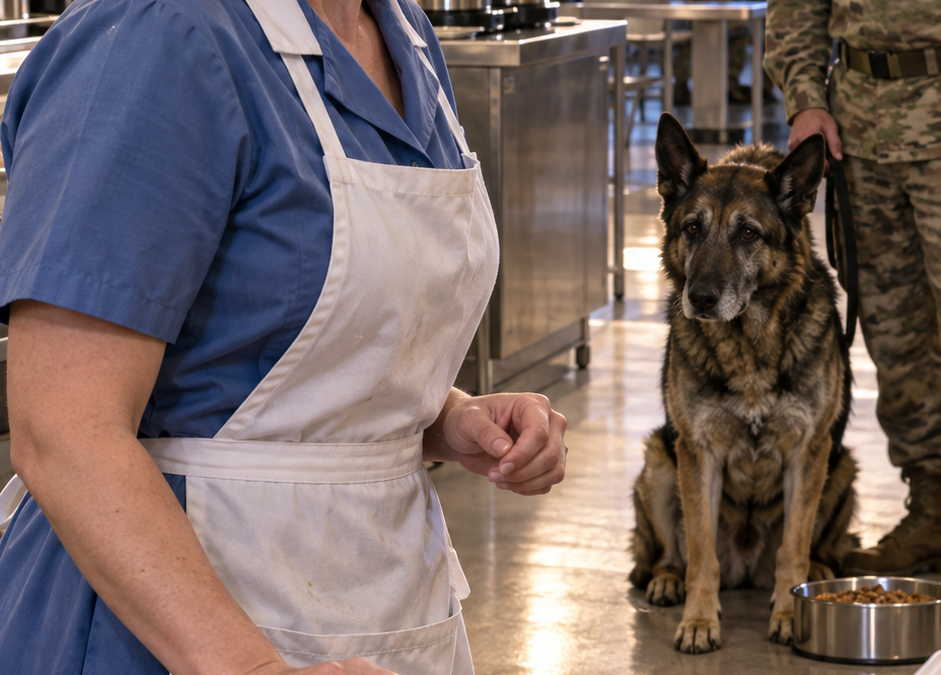
Every morning at 4:45, I unlocked the side entrance, switched on the kitchen lights, tied a white apron over my blue cafeteria dress, and started the first pots of coffee before the earliest shift came through the doors.
I knew who wanted three eggs over easy.
Who wanted black coffee strong enough to strip paint.
Who pretended to hate oatmeal but ordered it every Monday.
Which young sailor always asked for two biscuits even though he never finished the second.
I never wrote those things down.
I noticed them.
Remembering people had once been part of keeping them alive.
Now it simply made me good at breakfast.
Nobody asked why I sometimes looked toward the entrance when a tray hit the floor.
Nobody asked why I automatically counted exits whenever the dining room became crowded.
Nobody noticed that when a man limped through the line, I could usually tell whether the problem was his knee, hip, ankle, or lower back before he reached the register.
At least, I told myself they didn’t notice.
Most military people understand privacy better than civilians think they do.
They might recognize that someone carries history.
That doesn’t mean they’ll demand to see it.
So I poured coffee.
Turned hash browns.
Wiped tables.
And let everyone believe my life had begun three months earlier behind a stainless-steel counter.
Before that, I had spent nine years as a Navy special operations corpsman.
My uniform had changed depending on where I was attached.
The work hadn’t.
Keep people breathing.
Stop the bleeding.
Open the airway.
Recognize shock before the monitor did.
Decide who could wait.
Decide who couldn’t.
Know when the joke coming from the man on the litter meant he was going to be fine, and when the silence meant you were losing him.
I had worked in heat that softened asphalt and cold that made metal instruments hurt through gloves.
I had learned to sleep through aircraft engines and wake instantly when someone said my name in the wrong tone.
Operators requested me because I didn’t panic.
That was supposed to be a compliment.
For years, I treated it like one.
Then one day I realized being calm didn’t mean the things I saw weren’t reaching me.
It only meant they had learned to wait.
Eleven months before I started at the cafeteria, I signed separation papers.
The official reason was personal circumstances.
There wasn’t a box marked:
I am tired of carrying people out alive and hearing later that they died somewhere I couldn’t reach.
There wasn’t one marked:
Every new patient has started wearing the face of someone I already lost.
Or:
I no longer know whether being very good at this is saving me or destroying me.
So I checked the closest box.
Signed my name.
Left.
For eight months, I avoided installations whenever possible.
I skipped reunions.
Ignored calls from numbers I recognized.
Stored most of my old uniforms in sealed containers.
There were people I loved from that life.
There were also memories I could not separate from them.
Eventually, money and practicality won.
A civilian food-service contractor needed someone reliable at a base cafeteria.
None of the units I had served with were stationed there.
The position started before dawn, ended early, and required nobody to know what I had once done.
It seemed perfect.
For a while, it was.
Then the dog handlers started coming in.
There were usually four or five of them at the corner table.
They spoke more quietly than most military people eating breakfast.
Not secretively.
Just tired.
For nearly two weeks, I heard fragments of the same conversation while I worked.
Blood work normal.
No intestinal obstruction.
No dental injury.
No fever.
Hydration maintained.
Supplemental support.
Behavioral consult.
Another food trial.
Another refusal.
They were talking about a military working dog.
I knew that much.
What I didn’t know was his name.
For twelve days, he had refused every solid meal.
He would drink with encouragement.
Accept fluids.
Follow commands.
Walk.
Respond to familiar handlers.
But the moment anyone put food in front of him, something inside him seemed to close.
At first, the men discussed it like a medical puzzle.
By the sixth day, it became worry.
By the ninth, fear.
By the twelfth, none of them bothered pretending anymore.
The youngest handler was Petty Officer Reeves.
He had an open face that made every emotion obvious no matter how hard he tried to hide it.
On the first few mornings, he ordered eggs and toast.
Then coffee only.
Then nothing.
Master Chief Doyle was different.
Broad shoulders.
Gray beginning at his temples.
A voice that never needed volume.
I later learned he had spent nineteen years around military working dogs.
He carried responsibility in the way some men carry old injuries—quietly, constantly, without expecting sympathy.
On the twelfth morning, rain had been tapping against the cafeteria windows since before dawn.
The handlers came in with wet shoulders and hollow eyes.
Reeves stopped at my counter without ordering.
Doyle stood several feet behind him talking to one of the senior handlers.
I was turning potatoes in a steel pan when I heard Doyle say that the dog had accepted hydration again overnight but had refused breakfast.
They were scheduling another evaluation.
Someone asked what happened if they couldn’t get him eating consistently.
Doyle didn’t answer immediately.
That silence told me enough.
Reeves heard it too.
He slapped the side of his fist against the counter.
Not hard.
Just hard enough to make the silverware tremble.
“How does a dog survive six deployments,” he said, “and get taken down by a damn food bowl?”
My hand stopped above the grill.
Six deployments.
Something about the sentence pulled at me.
Then Doyle said quietly, “Ranger isn’t being taken down by a bowl.”
Reeves turned.
“Then what is happening?”
“We haven’t figured out what he’s waiting for.”
The pan almost slipped from my hand.
Ranger.
For a second, the cafeteria vanished.
I smelled canvas.
Dust.
Antiseptic.
Burned meat.
And I saw amber eyes watching from beside a narrow field cot.
I set the pan down.
“What did you say his name was?”
Reeves looked at me as if he’d forgotten I was standing there.
“Ranger.”
My throat tightened.
“Belgian Malinois?”
He nodded slowly.
“Black mask?”
Another nod.
I should have stopped.
There are hundreds of military working dogs.
Names get reused.
Coincidence exists.
But my pulse had already begun climbing.
“Small white scar under his left front leg?”
This time, nobody answered.
They didn’t have to.
Doyle’s expression changed.
“How do you know that?”
I wiped my hands on my apron.
“Where’s Petty Officer Kilgore?”
The room went very still.
I had imagined West Kilgore alive for eighteen months.
Not consciously every day.
But somewhere in the background of my life, he had remained alive because nobody had told me otherwise.
I pictured him irritating medics somewhere.
Complaining about coffee.
Arguing with a physical therapist.
Ruining expensive steak.
Ranger stretched beneath his chair.
It was easier that way.
Doyle was the one who told me.
“We lost Kilgore twelve days ago.”
I looked at him.
The words were simple.
No ceremony.
No preparation.
Exactly the kind of sentence military life teaches you to survive.
“Overseas?”
Doyle nodded.
“Ranger came back with the recovery team.”
I lowered my eyes.
Twelve days.
Of course.
My palms had gone cold.
I could hear the grill behind me.
Rain against glass.
Somebody setting down a coffee cup.
But underneath all of it was West’s voice from eighteen months earlier.
He doesn’t need to know there’s food, Doc.
He needs to know I’m okay.
I turned toward the kitchen.
“Olivia?”
I heard Reeves behind me.
I didn’t answer.
I walked to the refrigerator and took out a plain cut of beef.
One of the kitchen employees looked at me.
“That’s not for breakfast service.”
“I know.”
I trimmed the heavy fat.
No seasoning.
No sauce.
Nothing complicated.
Then I put it on the hottest part of the grill.
And left it there.
Smoke curled upward.
The edges blackened.
One of the cooks leaned toward me.
“You forgot your steak.”
“No.”
I turned it.
“I didn’t.”
Eighteen months earlier, Petty Officer West Kilgore had been carried into a forward aid station after a blast threw him against a vehicle.
Cracked ribs.
A deep thigh wound.
Heavy bruising along his back and hip.
A concussion mild enough for him to remain awake and severe enough to make him furious that we wouldn’t clear him.
West treated recovery like a personal insult.
On the second morning, he asked whether I had confused a medical station with a prison.
On the third, he tried to convince me he could return to duty because he had successfully walked six feet without assistance.
I reminded him that he had then nearly passed out.
He said that was an unrelated event.
Ranger stayed beside him whenever conditions allowed.
Six years old.
Lean.
Alert.
Black mask over a face that seemed permanently serious.
He wasn’t affectionate in the conventional sense.
He didn’t climb onto West.
Didn’t constantly demand attention.
They simply tracked one another.
West shifted.
Ranger noticed.
Ranger lifted his head.
West noticed.
It was like watching two people continue a conversation nobody else could hear.
The blast had left Ranger with a cut beneath his left front leg from twisted metal.
The wound wasn’t severe.
West’s reaction to anyone trying to move Ranger out of sight was.
So I treated the dog where West could watch.
“You sew him crooked,” West told me through clenched teeth, “I’m filing a complaint.”
“You currently have six stitches in your own leg that look better than your face,” I said. “Maybe lower your standards.”
He laughed.
Then regretted laughing because of the cracked ribs.
That was West.
Even injured, he could make pain seem like an inconvenience happening to somebody else.
On his third evening at the aid station, he complained about dinner.
Again.
So I asked what he wanted.
“A steak.”
“You are aware of where we are?”
“Then make it medium rare.”
“I don’t control the kitchen.”
“Well done?”
“No.”
“Burned?”
I stared at him.
He smiled.
“Now we’re negotiating.”
Somehow, through favors and bad judgment, a piece of beef reached our station.
I cooked it far longer than any reasonable person would.
West looked at the blackened edges and said, “Perfect.”
I thought he was joking.
He wasn’t.
Ranger’s bowl had already been filled beside the cot.
The dog had ignored it.
West ate three bites.
Then he cut a small piece from the steak.
He lowered his hand.
Ranger immediately stood.
West gave him the meat.
Only after eating it did Ranger move to his own bowl.
I noticed.
Of course I noticed.
Noticing was what I did.
The next night, it happened again.
West took the first bite.
Paused.
Cut the second.
Ranger accepted it.
Then ate his meal.
On the fourth evening, I finally asked.
“Why does he wait?”
West looked down at him.
“Old habit.”
“What kind?”
“When he was younger, he wouldn’t eat in unstable environments.”
I glanced around the forward station.
“Can’t imagine why.”
West smiled.
“So I started eating first. If I could sit down, take a bite, and stay relaxed, it meant the situation was safe enough for him to shut off for five minutes.”
“You trained that?”
“Not officially.”
Ranger watched him.
West scratched one finger lightly against the edge of the cot.
“He doesn’t need someone to tell him there’s food. He knows there’s food.”
“Then what does he need?”
West looked at me.
“To know the person beside him is okay.”
I remembered that sentence.
Not because I knew it would matter.
Because people like West said hundreds of small things that lodged themselves in a medic’s mind.
Sometimes forever.
For the remainder of his recovery, Ranger followed the same sequence every evening.
West ate.
He waited.
He offered one piece.
Then Ranger ate.
Two weeks later, West was finally cleared.
Not because he had won our arguments.
Because he’d healed.
Mostly.
On the morning he left, he pointed at me while Ranger waited near the doorway.
“Next time I see you, Doc, I’m bringing you a properly ruined steak.”
“I’d settle for coffee.”
“Your standards are embarrassing.”
“Go before I revoke your clearance.”
He grinned.
Ranger glanced back at me once.
Then the two of them walked into the bright morning.
That was the last time I saw West Kilgore alive.
Standing in the cafeteria eighteen months later, I watched the steak burn until the edges looked exactly the way he liked them.
I placed it on a white plate.
Added a table knife.
A small metal saucer.
Then I carried it out front.
Doyle stared at the plate.
“What are you doing?”
“Take me to Ranger.”
“Ms. Carter—”
“Olivia.”
He looked at me carefully.
“What is your connection to Kilgore?”
“He was my patient.”
“Where?”
“Forward aid station. Eighteen months ago.”
Reeves stepped closer.
“You treated Ranger’s leg.”
“Yes.”
Doyle looked toward the steak.
“Human food isn’t part of his approved diet.”
“I’m not asking to feed him a steak.”
That confused everyone.
I continued.
“I need one small supervised attempt. Outside the gate. I won’t enter the run. I won’t interfere with his prescribed food.”
“What exactly are you trying to do?”
“Remind him of something.”
Doyle’s face gave away nothing.
“What?”
I looked at him.
“That it’s safe to eat.”
He studied me long enough that I wondered whether I’d have to explain everything there beside the grill.
Then he stepped away and called the veterinary officer.
There were questions about the meat.
Ingredients.
Portion size.
Whether Ranger had known me previously.
Whether I intended to hand-feed him.
Finally, with obvious reluctance, approval came for one controlled trial involving a small piece of unseasoned beef.
Doyle turned toward the doors.
“Let’s go.”
The kennel complex sat across the service road beyond the parking area.
Rain had slicked the asphalt black.
I walked behind Doyle carrying the plate with both hands.
Reeves and three other handlers followed us.
My cafeteria shoes weren’t meant for wet pavement.
Neither was my apron.
I must have looked ridiculous.
A civilian kitchen worker marching toward a military kennel carrying burned steak like some kind of offering.
Halfway across the yard, Reeves moved beside me.
“The scar.”
I looked at him.
“How did you know exactly where it was?”
“Broken metal caught him during the blast.”
“You were there?”
“When they brought them in.”
One of the older handlers spoke from behind us.
“With respect, ma’am, people have tried everything. Hand feeding, different textures, fresh meat, changing locations. If grief worked like a recipe, we’d have fixed this ten days ago.”
I stopped walking for half a second.
He was right to be skeptical.
That mattered.
Desperation makes people vulnerable to certainty.
I didn’t want them trusting me because I sounded confident.
“I don’t know if this will work,” I said.
The handler looked surprised.
“But you’re carrying that plate like you do.”
“I know what Ranger used to do. That’s different from knowing what he’ll do now.”
Doyle glanced back at me.
Something in his expression softened.
Then we kept walking.
Ranger was in the fourth run.
I saw him before he saw me.
He lay near the back wall.
Too thin.
Not skeletal.
Not collapsing.
But thinner than a working Malinois should be.
His ears were alert.
His eyes clear.
The prescribed food sat untouched in a steel bowl.
Twelve days earlier, he had lost the person around whom his entire world had been organized.
And every person since had apparently asked him the same question in a different form.
Why won’t you move on?
Nobody meant it that way.
But grief doesn’t care what people mean.
Doyle stopped me outside the locked gate.
Ranger lifted his head.
His nose moved.
Then his eyes found me.
For one impossible second, I was back in that aid station.
West on the cot.
Ranger beside him.
Dust glowing orange beyond the canvas.
I swallowed.
“Hey, Ranger.”
His ears shifted forward.
He did not stand.
Doyle said softly, “Don’t be discouraged. He hasn’t approached food for anyone.”
“Because everyone keeps offering him food.”
Reeves frowned.
“What else are we supposed to offer him?”
I knelt.
“Proof.”
I put the plate where Ranger could see it.
Cut a small piece.
The handlers expected me to slide it into the run.
Instead, I put the piece in my mouth.
The steak was awful.
Dry.
Burned.
Exactly how West liked it.
I chewed slowly.
Swallowed.
Then I waited.
Ranger’s head rose higher.
Nobody spoke.
I cut a second piece.
Placed it onto the metal saucer.
Slid the saucer through the feeding opening.
Then I sat back.
Hands empty in my lap.
I didn’t call him.
Didn’t tap the ground.
Didn’t encourage him.
Didn’t even stare directly at him.
Ten seconds passed.
Twenty.
Thirty.
I heard Reeves inhale.
Ranger brought his front paws beneath himself.
One of the handlers behind me shifted his weight.
Doyle didn’t move.
Ranger stood.
He looked at me.
Then at the saucer.
Then toward the kennel gate.
For a moment, his whole body seemed to hesitate between two realities.
The world he understood.
And the one that existed now.
Then he walked forward.
Slowly.
Not because he was weak.
Because he was deciding.
He reached the saucer.
Smelled the meat.
Looked at me one more time.
And ate.
Nobody cheered.
Nobody should have.
The moment was too fragile for celebration.
Ranger lifted his head.
Reeves’s eyes had already filled.
But Ranger wasn’t finished.
He turned away from the saucer.
For half a second, I thought he was retreating.
Instead, he walked to his regular bowl.
Lowered his head.
And took his first mouthful of prescribed food in twelve days.
The sound of metal scraping lightly across concrete nearly broke me.
He took another bite.
Then another.
Behind me, somebody whispered, “Jesus.”
Reeves covered his mouth.
The older handler who had doubted me turned his face away.
Doyle remained completely still.
I couldn’t.
Tears blurred the fence.
I wasn’t crying because I had been right.
I was crying because Ranger’s response made West’s death real in a way Doyle’s words hadn’t.
Ranger was waiting because West was never coming back.
That ritual had once meant:
My partner is safe.
For twelve days, nobody had been able to complete it.
Not because Ranger was stubborn.
Not because he wanted to die.
Because the man who always took the first bite had vanished.
Ranger ate nearly half the bowl.
Only then did Doyle look at me.
“Who are you?”
There was no suspicion in his voice anymore.
Just astonishment.
I stood slowly.
“My name is Olivia Carter.”
“I know your name.”
He looked at my apron.
“Who are you really?”
I breathed in.
“I served nine years as a Navy special operations corpsman.”
Reeves stared at me.
One of the handlers actually looked at my cafeteria uniform as though it had become a costume.
I almost laughed.
Instead I said, “West was under my care after that blast. Ranger stayed with him for most of the recovery.”
Doyle turned back toward the dog.
“Why would eating first matter this much?”
So I explained.
How the behavior had begun when Ranger was young.
How West used it as a signal.
How the first bite wasn’t about meat.
It communicated safety.
If West could sit calmly, eat, wait, and offer Ranger the next piece, Ranger could stop scanning long enough to take care of himself.
Doyle listened without interrupting.
Then he asked the question that worried me most.
“Why did he respond to you?”
I looked at Ranger.
“I don’t know.”
Doyle waited.
“He may remember me from the aid station.”
“After eighteen months?”
“Maybe.”
I looked at my hands.
“Or maybe he doesn’t remember me at all. Maybe he remembered the sequence.”
That answer mattered.
Because if Ranger could eat only when I performed the ritual, we hadn’t solved his problem.
We had simply discovered another dependency.
Doyle understood that immediately.
He thanked me.
Asked Reeves to walk me back to the cafeteria.
As we crossed the wet service road, Reeves stayed quiet for nearly half the distance.
Then he said, “I’m sorry.”
“For what?”
“For telling you about Kilgore like that.”
“You didn’t know.”
“Still.”
I looked ahead.
“You don’t need to apologize for telling me the truth.”
The rain had weakened to mist.
Reeves shoved his hands into his jacket pockets.
“Why did you leave?”
Normally, I would have given the standard answer.
Personal reasons.
Instead, maybe because I had just watched Ranger eat, I gave him something closer to the truth.
“There are only so many names a medic can carry.”
Reeves didn’t speak.
“Eventually,” I continued, “new people started reminding me of old people. Different faces. Same injuries. Same jokes. Same promises they’d be fine.”
“Did something happen?”
“Lots of things happened.”
I looked toward the cafeteria doors.
“I got tired of being excellent at keeping someone alive long enough to lose them later.”
The words surprised me after I said them.
They were uglier outside my head.
Reeves stared at the ground.
“Kilgore?”
“No.”
I shook my head.
“I thought West was alive when I left.”
That hurt more now.
“He was just part of the world I couldn’t keep carrying.”
At the cafeteria entrance, Reeves promised someone would update me about Ranger.
I thanked him.
Then I went inside.
I thought we had found the answer.
By the next morning, it looked as though we had been wrong.
I was technically off duty Friday.
I still arrived before six.
Sleep had been impossible.
Every time I closed my eyes, I saw Ranger crossing the kennel toward the saucer.
And West leaving the aid station eighteen months earlier.
At 6:12, Reeves came through the cafeteria doors.
I knew before he reached the counter.
“He didn’t eat.”
Reeves shook his head.
“Brandon tried the steak this morning.”
I closed my eyes.
Brandon was one of the kennel technicians.
Experienced.
Careful.
He hadn’t been present the day before.
“They cooked it the same way?”
“Plain. Burned edges. Used the same saucer.”
“And?”
“Ranger ignored it.”
“Did Brandon eat first?”
Reeves went silent.
I opened my eyes.
“Did he?”
“I don’t know.”
He grabbed his phone.
The call lasted less than thirty seconds.
When he lowered it, I already knew.
“No.”
I leaned my hands against the counter.
“It was never the steak.”
Reeves rubbed his forehead.
“He thought—”
“I know what he thought.”
“And I would have thought the same thing.”
I wasn’t angry.
Brandon had tried to help.
Human beings love objects because objects are easier than meaning.
The burned steak was visible.
The trust behind it wasn’t.
“Ranger doesn’t care how West liked his meat,” I said.
“Then yesterday—”
“The first bite was the signal.”
I walked around the counter.
“West eats. West stays calm. Ranger sees that nothing happened. West offers him the next bite.”
Reeves looked toward the distant windows facing the kennels.
“So if you do it again—”
“No.”
He looked at me.
“No?”
“I probably could.”
“Then why wouldn’t we?”
“Because I’m not the answer.”
That was the part nobody wanted to hear.
I understood why.
When something works after twelve days of failure, every instinct says repeat it.
But Ranger couldn’t build a life around waiting for the cafeteria woman.
And I couldn’t become a substitute for West simply because my hands remembered his routine.
“He needs someone else,” I said.
Reeves’s face changed.
“No.”
I didn’t need to say his name.
He knew.
“You’ve been with him every day.”
“That’s not the same thing.”
“It might become the same kind of thing.”
“Kilgore handled Ranger for almost five years.”
“I know.”
“You don’t replace five years in an afternoon.”
“No.”
I stepped closer.
“Nobody is asking Ranger to replace him.”
Reeves looked at me sharply.
“Then what are we asking?”
“Whether he can trust someone new without betraying the person he lost.”
The sentence landed harder than I intended.
Maybe because it wasn’t only about Ranger.
For eleven months, I had treated moving forward as though it would erase the people behind me.
Maybe Ranger and I had been making the same mistake in different ways.
Reeves looked out the window again.
“I’m not Kilgore.”
“Good.”
He frowned.
“Good?”
“If you try to become him, Ranger will know.”
“What am I supposed to do?”
“Be the person who’s actually there.”
Doyle agreed to another controlled test.
Not immediately.
Not casually.
We met in the kennel office with the veterinary officer on speakerphone.
Doyle made the problem clear.
Ranger responding to me proved that a remembered sequence might still trigger eating.
It did not prove the behavior could transfer to Reeves.
And if it couldn’t, Ranger needed extended behavioral evaluation.
He would be cared for.
Nobody was abandoning him.
But active work would almost certainly stop while they assessed his long-term future.
Reeves sat at the table with both hands locked together.
He had spent twelve days cleaning Ranger’s run.
Walking him.
Sitting nearby.
Following every veterinary instruction.
That did not make him Ranger’s partner.
Not yet.
Doyle turned to me.
“Can you teach Reeves exactly what Kilgore did?”
“I can show him.”
“That’s not what I asked.”
I understood.
“Yes.”
We went back to the cafeteria.
I used toast because I wasn’t going to burn six steaks while Reeves learned patience.
His first attempt was terrible.
He ate.
Cut another piece.
Set it down.
All in about four seconds.
“No.”
He looked at me.
“What?”
“You’re performing.”
“You said eat first.”
“West wasn’t demonstrating a sequence. He was having dinner.”
Reeves exhaled.
“Okay.”
“Again.”
He tried.
Bite.
Pause.
Cut.
Place.
Better.
But his shoulders were rigid.
“No.”
“What now?”
“Ranger is going to read your body before he reads the plate.”
“I’m nervous.”
“I know.”
“How am I supposed to stop being nervous?”
“You’re not.”
He stared.
“You let yourself be nervous without turning the nervousness into urgency.”
That was something I’d told wounded people for years in different words.
Reeves tried again.
This time, after eating, he looked toward where Ranger would be.
I stopped him.
“Don’t watch for obedience.”
“Why?”
“Because West never did.”
“You’re sure?”
“I watched it every night for two weeks.”
I picked up the toast.
“He took a bite because he was eating. Then he gave Ranger a piece because he trusted Ranger to understand.”
Reeves looked at the table.
“He didn’t wait to see if Ranger did it right.”
“No.”
Another attempt.
Then another.
By the sixth, Reeves had changed.
Not dramatically.
That was the point.
His movements slowed.
His breathing settled.
He ate the first bite.
Waited naturally.
Cut the second.
Set it down.
Kept his hands loose.
I nodded.
“That’s it.”
“You sure?”
“No.”
That almost made him laugh.
“But that’s as close as I can get you.”
We returned to the kennel complex.
Doyle.
The veterinary officer.
Two senior handlers.
Brandon stood near the office doorway looking miserable.
I walked over to him before the test.
“You didn’t hurt anything.”
He looked embarrassed.
“I screwed it up.”
“You tried to feed a dog who hadn’t eaten.”
“I copied the wrong part.”
“You copied the part you could see.”
His shoulders lowered slightly.
“That’s not stupidity, Brandon.”
I moved thirty feet away from Ranger’s run.
Then farther.
Around the corner of the building.
Out of sight.
That was deliberate.
If Ranger responded, I wanted there to be no question why.
Reeves went into the secured feeding lane carrying Ranger’s prescribed bowl, one small approved portion, and the metal saucer.
I couldn’t see them.
Only hear.
Rain striking the roof.
A latch.
Footsteps.
Then silence.
Reeves sat outside the gate.
Ranger remained at the back of the run.
Reeves took the first bite.
He waited.
Cut the second.
Placed it on the saucer.
Slid the saucer beneath the feeding opening.
Then did nothing.
One minute passed.
Ranger did not move.
Two minutes.
Still nothing.
My stomach tightened.
Somewhere behind the fence, I heard someone shift.
Reeves could have tried again.
He could have called Ranger.
Moved the saucer.
Made eye contact.
Anything.
He didn’t.
That was the real test.
Not whether he remembered my instructions.
Whether he could tolerate Ranger’s uncertainty without making it about his own fear.
Rain tapped against metal.
Another minute.
Then I heard claws lightly scrape concrete.
I held my breath.
Later, Reeves told me what I couldn’t see.
Ranger first looked at the saucer.
Then at Reeves.
Then toward the gate where West used to appear.
The empty space held his attention for several seconds.
Reeves wanted to call him.
Didn’t.
Ranger looked back.
One paw moved.
Then another.
He stood.
Walked halfway across the run.
Stopped.
Reeves kept his eyes lowered.
Not because he was afraid.
Because he was giving Ranger room to choose.
The dog crossed the remaining distance.
A few seconds later, I heard the smallest sound.
Metal shifting against concrete.
Somebody exhaled.
Then silence again.
Ranger had eaten the offered piece.
But the ritual wasn’t complete until he approached his normal food.
That took longer.
He stood over his bowl.
Looked at Reeves.
Looked toward the gate again.
Finally, he lowered his head.
And ate.
From around the corner, I pressed my hand over my mouth.
Brandon started crying before anyone else did.
Doyle apparently raised one hand, preventing the group from celebrating.
They let Ranger eat in peace.
He finished almost half the bowl.
The sequence had transferred.
That mattered more than the meal.
Ranger had not responded only because he remembered my face.
Or my smell.
Or some association with the aid station.
He had understood the language of the ritual when someone new spoke it correctly.
And more importantly, he had accepted the person speaking.
Not as West.
Reeves could never be West.
That wasn’t the goal.
Ranger had spent twelve days waiting for a dead man.
That morning, he allowed someone living to tell him he was safe.
Doyle suspended the paperwork that would have moved Ranger into extended behavioral evaluation.
He did not declare him recovered.
One meal didn’t erase grief.
The veterinary team placed Ranger on a monitored plan.
Food intake recorded.
Weight checked.
Hydration monitored.
Sleep observed.
Behavior documented.
Reeves would repeat the sequence at each meal.
At first, using the small approved opening portion.
Then gradually simplifying the ritual if Ranger tolerated it.
No one would rush him.
A bond built across five years could not be replaced in five days.
Nor should it be.
Reeves was assigned to remain closely involved through recovery and any future requalification.
When Doyle told him, Reeves looked less relieved than frightened.
Afterward, he found me near the kennel office.
“What if I mess this up?”
“You will.”
His eyes widened.
I almost smiled.
“You’ll give the wrong command one day. Read him wrong. Get frustrated. He’ll get frustrated with you.”
“That’s reassuring.”
“You’re asking whether you can be perfect.”
I shook my head.
“You can’t.”
“Then what if I’m not enough?”
That question I understood better than he knew.
“You stay.”
He went quiet.
“That’s what you can give him right now.”
After the others left, Doyle asked me to come inside the office.
He opened a narrow storage locker.
From a folder containing returned effects, he removed a photograph.
West.
Kneeling beside Ranger in a dusty training area.
One hand against Ranger’s shoulder.
West looking slightly away from the camera.
Laughing at something outside the frame.
I took the photograph carefully.
My chest tightened.
“He hated cameras,” I said.
Doyle smiled faintly.
“He hated being told what to do.”
“That too.”
For a moment, neither of us spoke.
Then Doyle said, “Kilgore talked about you.”
I looked up.
“What?”
“After he came back from that aid station.”
“No, he didn’t.”
Doyle raised an eyebrow.
“You calling me a liar?”
It sounded like something West would have said.
I looked down at the photograph.
“What did he say?”
“He never gave me your full name.”
Doyle leaned against the desk.
“Called you the woman who kept the steak coming.”
I laughed once despite myself.
Of course he did.
“He said you were the only medic stubborn enough to keep him on a cot when he decided he was healed.”
“He wasn’t healed.”
“I know.”
Doyle paused.
“He said you probably saved his leg.”
I stared at him.
“And more than that.”
I didn’t want to ask.
But I did.
“What do you mean?”
“He believed that if you had cleared him when he wanted, he would have gone straight back out before he was physically ready.”
Doyle glanced at the photograph.
“You forced him to recover properly.”
His voice became quieter.
“From the way he talked about it, he thought you gave him another year with the team.”
Another year.
I could not look at Doyle.
For eleven months, I had been telling myself a particular story about my old work.
I stabilized people.
Bought time.
Transferred them.
Then sometimes they died anyway.
Therefore, the time hadn’t mattered.
It was a brutal equation.
Also a convenient one.
Because if none of it mattered, then walking away required less grief.
Doyle pointed through the window.
Ranger was asleep inside his run.
His first full meal in almost two weeks resting inside him.
“Kilgore got eighteen more months after that injury.”
Doyle said.
“Ranger got eighteen more months with him.”
My eyes burned.
“You don’t know what happened in all the cases that came before this.”
“No.”
“You don’t know how many didn’t make it.”
“No.”
“You don’t know what it’s like to put somebody onto an aircraft alive and find out later—”
“I don’t.”
His voice stayed calm.
“But I know what happened here.”
That stopped me.
I looked at Ranger.
Doyle continued.
“Whatever else you couldn’t save doesn’t cancel what you did save.”
I sat down.
Maybe because my knees suddenly felt unreliable.
For years, people had called me capable.
Strong.
Professional.
Calm.
Nobody had ever given me permission to measure success in anything other than survival.
And survival is a cruel standard when your work begins at the worst moment of somebody else’s life.
“I didn’t leave because I made a mistake,” I said.
Doyle waited.
“Every review cleared me.”
“I figured.”
“I left because I couldn’t stand how temporary everything felt.”
My voice cracked.
“I could stop bleeding. Get somebody breathing. Keep a pulse going through transport. Hand him off alive.”
I looked down at my hands.
“And if he died two days later, it felt like everything I did had been meaningless.”
Doyle looked through the window again.
“It mattered to him.”
Ranger shifted in his sleep.
Something broke inside me then.
Not loudly.
Not dramatically.
It felt more like a knot finally loosening after I had forgotten it was there.
West had died.
I couldn’t change that.
My work had not made him immortal.
It had never promised to.
What it might have done was give him time.
Time to recover.
Time to work.
Time to complain.
Time to stand beside Ranger.
Time to build more mornings that neither of them would otherwise have had.
Maybe saving somebody did not require saving him forever.
Maybe nobody gets forever.
Ranger’s recovery took weeks.
I was grateful for that.
A miraculous overnight return would have felt dishonest.
The second day, he ate only part of breakfast.
Reeves worried.
The veterinary officer told him recovery wasn’t a straight line.
On the fourth day, Ranger approached the saucer before Reeves finished setting it down.
By the end of the first week, he was waiting near the front of the run when Reeves arrived.
During the second, he began carrying his training ball forward.
The first time Reeves told me, he was smiling so hard he couldn’t hide it.
“He brought the ball?”
“He shoved it against the gate.”
“That’s demanding.”
“That’s what Doyle said.”
Ranger regained weight gradually.
Light exercise came first.
Walks.
Basic obedience.
Controlled engagement.
Veterinary reassessment.
Then structured training away from the kennel.
Reeves never tried to imitate West’s voice.
That mattered.
He didn’t copy West’s posture or mannerisms.
He let Ranger learn him.
Different cadence.
Different hands.
Different expectations.
At first, Ranger would sometimes pause when Reeves gave a command, almost as though comparing the sound to one no longer available.
Reeves learned not to become offended by that pause.
Love and loyalty aren’t empty rooms where the old furniture must be removed before anything new can enter.
Ranger did not need to forget West to trust Reeves.
That became the central principle of his recovery.
Six weeks after the morning I carried burned steak across the service road, Ranger completed a full evaluation with Reeves.
I wasn’t supposed to be part of it.
I didn’t ask to be.
But Doyle told me afterward.
Ranger passed.
Not perfectly.
Nobody expected the same animal who had existed before West’s death.
Grief had altered him.
But he worked.
Responded.
Rested when directed.
Ate.
Engaged.
Recovered appropriately after stress.
The review board approved a gradual return to duty with Reeves as his assigned handler.
When Reeves brought me the news, he ordered two biscuits.
He ate both.
I pointed that out.
He looked at the empty plate.
“Guess things are changing everywhere.”
They were.
I stayed in the cafeteria.
People seemed surprised by that.
A few assumed I would reenlist.
Others thought I’d suddenly become part of the kennel program.
I wanted neither.
Healing did not require becoming the person I used to be.
That was another lesson Ranger taught me.
I could move forward without pretending the previous eleven months hadn’t happened.
I could be Olivia the former corpsman and Olivia the cafeteria worker at the same time.
Neither erased the other.
I stopped hiding quite so hard.
When someone asked where I had learned to notice injuries, I answered.
When Reeves came through breakfast, we talked about Ranger.
Brandon apologized again for his failed steak attempt.
I told him the same thing as before.
“You weren’t careless.”
“I still got it wrong.”
“Everybody gets things wrong when they don’t have the whole story.”
That conversation led to another.
Then another.
Doyle asked me to help write down the habits that had mattered to Ranger.
Not medical data.
That already existed.
He meant the small things.
Feeding sequences.
Calming cues.
Patterns.
Preferences.
The personal language that grows between an animal and the person who works beside him every day.
Information everyone assumes they’ll remember until the person who remembers it isn’t there anymore.
Soon, handlers began documenting those details for other dogs.
Not as superstition.
Not as a replacement for veterinary medicine or formal training.
As context.
Because sometimes the difference between disobedience and grief is history.
Between stubbornness and confusion.
Between refusing food and waiting for permission that can never come.
Months passed.
I started volunteering one afternoon each week with a peer-support program for former medics and handlers dealing with operational loss.
The first afternoon, I nearly turned around in the parking lot.
My hands shook on the steering wheel.
I hadn’t been that nervous walking into Ranger’s kennel.
Maybe because helping him had required action.
Talking about myself required honesty.
I went inside anyway.
I didn’t become a therapist.
Didn’t pretend I had answers.
Sometimes I made coffee.
Sometimes I listened.
Sometimes someone talked about the guilt of surviving when another person didn’t.
Sometimes they talked about the guilt of leaving a profession they had once loved.
Those conversations stopped sounding like evidence of weakness.
They sounded like injuries nobody had been trained to bandage.
Most mornings, I still arrived at the cafeteria at 4:45.
Still started coffee.
Still remembered everybody’s orders.
The difference was that tying on the apron no longer felt like disguising myself.
Somewhere along the way, it became simply what I wore to work.
Ranger continued crossing my path.
His feeding belonged to Reeves now.
As it should.
The burned steak disappeared from the routine.
Gradually, the opening cue became smaller.
Eventually, Ranger no longer required food from Reeves’s plate before beginning his own meal.
But some part of the ritual remained in simpler form.
Reeves would settle nearby.
Relax.
Give Ranger a moment.
Safety communicated without ceremony.
When I crossed the yard, Ranger often waited near the fence.
The first time he did it, I told myself it was coincidence.
By the tenth, I stopped pretending.
I would pause.
“Morning, Ranger.”
His ears lifted.
Sometimes his tail hit the ground once.
Only once.
He had standards.
One morning, Reeves joined me at the fence holding two cups of coffee.
He handed one over.
“Black.”
“You finally remembered.”
“I handle a military working dog.”
He looked offended.
“I can remember a coffee order.”
Ranger watched us.
Reeves took a sip.
Then froze.
I noticed immediately.
“What?”
He looked at his cup.
Then at Ranger.
Then at me.
“I just realized something.”
“What?”
“This is the first bite.”
I smiled.
“Kind of.”
We stood there in the cold morning.
Two living people beside a dog who had taught both of us something about the cost of remaining loyal to the dead.
In the cafeteria office, I placed West’s photograph in a simple wooden frame.
Doyle had given me a copy.
West kneeling beside Ranger.
Laughing.
Dust around them.
Nothing heroic in the picture.
That was why I loved it.
It wasn’t a photograph of sacrifice.
It was a photograph of life.
Beneath the frame sat a small card Doyle wrote for me.
Five words.
He was never broken. He was waiting.
At first, I thought Doyle meant Ranger.
Eventually, I understood he meant me too.
Ranger had not stopped eating because he wanted to die.
He had spent twelve days obeying the last structure his partner had left inside him.
Eat after me.
Relax after me.
You’re safe when I’m safe.
When West disappeared, Ranger didn’t understand that the rule had ended.
So he waited.
I had done something similar.
For eleven months, I had waited for proof that my old life had meant something.
I had wanted evidence that the people I couldn’t save forever hadn’t made every person I did help temporary.
I had spent so much time remembering endings that I forgot to count the time before them.
West had eighteen more months.
Maybe somebody else had three days.
Maybe someone had ten years.
Maybe another person only had enough time to hear a family member’s voice.
I don’t know.
A medic rarely gets to see the complete story.
We arrive in the terrible middle.
Do our part.
Then hand the person forward.
For years, I had mistaken not knowing the ending for having no impact on it.
Ranger corrected me without saying a word.
He reminded me that memory lives inside strange places.
A scar beneath a dog’s leg.
The smell of burned meat.
A metal saucer.
The pause between one bite and another.
A promise nobody realized was a promise until the person who made it was gone.
And he reminded me that moving forward isn’t betrayal.
Ranger accepting Reeves did not erase West.
My finding peace did not erase the people I had lost.
There was room for both.
One evening, long after Ranger returned to work, I stayed late at the cafeteria.
The dining room was empty.
Sunset stretched gold across the windows.
I was cleaning the grill when Reeves appeared at the side entrance.
Ranger was with him.
Working harness on.
Alert.
Strong again.
“What are you doing here?” I asked.
“Finished late.”
Reeves looked at the grill.
“You got anything left?”
“Kitchen’s closed.”
“Heartless.”
I laughed.
Ranger sat beside him.
His eyes moved from Reeves to me.
There was something familiar in the way he watched us.
I reached beneath the counter and found one last piece of plain beef we’d held back from dinner prep.
Reeves raised an eyebrow.
“No.”
I pointed the spatula at him.
“Absolutely not. I’m not restarting that habit.”
“Wouldn’t dream of it.”
I cooked the small piece.
Not burned.
Medium.
The way food deserved to be treated.
Then I sliced it into two pieces.
I put one on a plate for Reeves.
The other stayed on the counter.
Reeves looked at me.
“Seriously?”
“Eat your dinner.”
He took a bite.
Ranger watched.
For half a second, my chest tightened.
The old sequence.
The old world.
The dead man who had once sat on a cot demanding his steak be ruined.
But Ranger didn’t wait for Reeves to offer him anything.
After a moment, he looked away from the plate.
Settled beside Reeves’s leg.
And rested his head on his paws.
He wasn’t asking for permission anymore.
He already knew he was safe.
I turned back toward the grill because tears had filled my eyes.
Reeves noticed.
He had learned to notice people too.
He didn’t say anything.
That was the right thing.
I wiped the grill.
Ranger breathed quietly behind me.
And for once, West’s memory did not feel like a wound opening.
It felt like someone had walked through the room, left the door open, and allowed fresh air inside.
The next morning, I arrived at 4:45 like always.
I switched on the lights.
Started the coffee.
Tied my apron.
Outside, the base was still dark.
The world hadn’t transformed.
There were still people I missed.
Still names I sometimes heard in dreams.
Still days when certain smells made my chest tighten before I understood why.
Healing hadn’t erased any of that.
It had simply made room around it.
At 5:32, the first group came through.
At 5:47, Doyle arrived.
At 6:03, Reeves stepped into the cafeteria with wet boots and ordered eggs, potatoes, and two biscuits.
“Two?” I asked.
“Training day.”
“You always blame training.”
He grinned.
Through the window beyond him, Ranger sat beside the kennel vehicle.
Healthy.
Attentive.
Waiting for Reeves, but not in the way he once waited for West.
This waiting had a future attached to it.
I poured Reeves’s coffee.
He took the first sip.
Outside, Ranger’s ears lifted at some distant sound.
Life continued.
Not because anybody forgot.
Because eventually, memory stopped being a place where we went only to hurt.
Sometimes it became a map.
West had left one behind without knowing it.
I had remembered enough to read it.
Reeves had been brave enough to follow it without trying to become the man who drew it.
And Ranger had done the hardest thing of all.
He had trusted that loving one person until the end did not mean his own life had to end there too.
For twelve days, everyone thought a military working dog had forgotten how to eat.
He hadn’t.
Ranger remembered too well.
And in helping him understand that it was safe to keep living, I finally began to understand the same thing about myself.








