𝗙𝗨𝗟𝗟 𝗦𝗧𝗢𝗥𝗬 A Labrador Wouldn’t Leave Our Dumpster—Then the Security Camera Revealed What She Had Chased for Miles
𝗣𝗔𝗥𝗧 𝟮
There was always a reason.
We were too busy.
We traveled too often.
The yard wasn’t ready.
Maybe next year.
Maybe after work slowed down.
Maybe later.
Later became years.
Then one cold November morning, later found me.
I had just finished an early shift and was walking from the parking lot toward home when I saw him.
He was sitting beside the curb in front of an old apartment building three blocks from our house.
A Rottweiler.
Young, but not a puppy.
Maybe a year and a half.
His coat was soaked from a steady gray rain.
He had no leash.
No collar.
No person calling his name.
He wasn’t pacing.
He wasn’t trying to follow anyone.
He was simply sitting there as if he had been placed in that exact spot and forgotten.
I slowed.
He looked at me.
Even now, I can remember his expression more clearly than I remember what I wore that day.
People who don’t know Rottweilers sometimes see the broad head and muscular body first.
I saw his eyes.
They were scared.
But underneath the fear was something worse.
Expectation.
He was still waiting for someone.
That was obvious.
He had not yet accepted that whoever had left him wasn’t coming back.
I stopped about ten feet away.
“Hey.”
His ears shifted.
He didn’t move.
I looked around.
The street was almost empty.
No one stood near the building entrance.
No one called from a window.
I waited.
Nothing.
“Are you lost?”
He stared at me.
I moved one step closer.
He remained still.
Another step.
His body tensed slightly, but he didn’t retreat.
I crouched several feet away and extended my hand.
“You don’t have to come.”
For almost a minute, neither of us moved.
Then he stood.
Slowly.
He approached like a dog negotiating with his own fear.
One step.
Pause.
Another.
When he reached me, he sniffed my fingers.
Then something happened that I still cannot explain without feeling it in my chest.
He lowered his head into my palm.
Not pushed.
Not demanded affection.
Just placed it there.
Carefully.
As though he was testing whether a human hand could still mean something safe.
I felt something inside me break open.
Or maybe come back together.
Even now, I’m not sure which.
“Okay,” I whispered.
His eyes closed.
“You’re coming with me.”
I took off my scarf, looped it gently through itself as a temporary lead, and walked him home.
Jason was in the kitchen when I opened the door.
He looked past me.
Then at the dog.
Then back at me.
“No.”
I almost laughed.
“Good morning to you too.”
“Emily.”
“He’s been sitting outside in the rain.”
“I can see that.”
“We need to get him checked for a chip.”
“Fine. Then we take him somewhere.”
“Maybe.”
Jason stared.
“Maybe?”
I knelt beside the dog and rubbed his wet neck.
“He might need a place for tonight.”
Jason folded his arms.
“One night.”
“Okay.”
One night became two.
The veterinarian found no microchip.
No collar.
No registration.
We posted online.
Called shelters.
Checked lost-dog listings.
Asked nearby residents.
Nothing.
Nobody claimed him.
I started calling him Rocky because he needed a name and because, somehow, it fit.
Jason rolled his eyes the first time he heard it.
“You named him.”
“I needed to call him something.”
“You don’t name temporary things.”
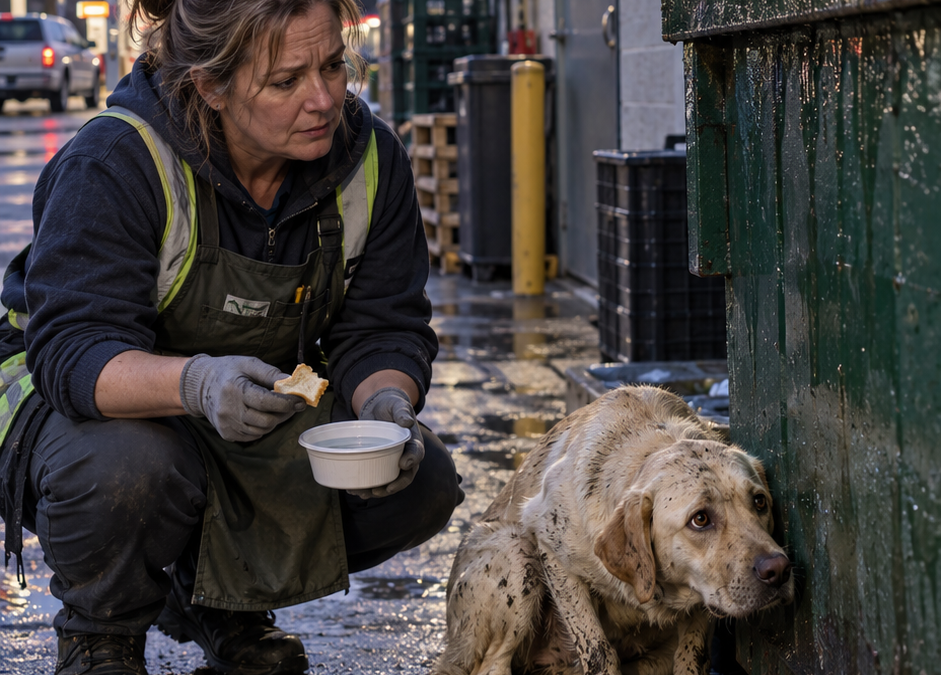
I held up the bread.
“Breakfast.”
No reaction.
I crouched several yards away.
I put the bread and bowl down.
Then backed off.
She looked at the food.
Then at me.
“Go ahead.”
Nothing.
I retreated to the service door.
Before going inside, I looked back.
She had not moved.
I told myself she needed privacy.
Fear can be stronger than hunger.
I had seen that before.
I returned to work.
For the next two hours, I did everything I normally did.
I mopped the entryway.
Cleaned fingerprints from the glass doors.
Wiped down the employee lockers.
Replaced paper towels.
Removed a sticky spot near the soda cooler that somebody had apparently created with half a bottle of orange soda.
But my mind stayed outside.
Those eyes.
There had been something in them I could not name.
Not simply fear.
Not even hunger.
Urgency.
That was closer.
Every twenty minutes, I found an excuse to glance through the narrow window in the rear door.
Sometimes I could not see the Labrador.
Then I would spot her moving behind one dumpster.
She never left.
Around eight, I went outside again.
The bread was untouched.
The water bowl appeared untouched too.
That alone changed my concern into something heavier.
A dog that had clearly been running and would not drink was not simply scavenging.
She was doing something.
Searching.
When I approached, she moved in a pattern I had not noticed before.
She walked around the last dumpster.
Nose to pavement.
Sniff.
Back away.
Circle.
Sniff the metal.
Look at me.
Circle again.
She shoved her nose beneath a piece of torn cardboard on the ground.
Nothing.
Then she returned to the same dumpster.
Her behavior became frantic for several seconds.
She stood on her back legs and placed her front paws against the metal.
Then dropped.
She looked at me.
Her mouth opened.
No bark came out.
Just breath.
“What’s in there?”
The question escaped before I understood why I was asking.
The Labrador stared.
Then moved toward the dumpster again.
Something cold ran down my spine.
I went back inside.
Marcus was at the security desk near the manager’s office.
Marcus Green had worked morning security for almost five years.
He was one of those men who seemed physically incapable of hurrying.
Tall.
Broad shoulders.
Thick glasses.
Calm enough that even angry customers lowered their voices around him.
He could watch somebody screaming about a declined credit card and respond as though discussing weather.
I liked Marcus.
If something strange happened, he was usually the person I wanted nearby.
He looked up when I entered.
“You okay, Beth?”
“There’s a dog outside.”
He stared.
“That’s the emergency?”
“She’s been there for two hours.”
“Okay.”
“She won’t eat.”
Marcus put down his pen.
“That is stranger.”
“She keeps circling one dumpster.”
He leaned back.
“Maybe there’s food inside.”
“That’s what I thought.”
“But?”
I hesitated.
“But she isn’t acting hungry.”
Marcus studied me over his glasses.
“What is she acting like?”
I pictured her face.
“Desperate.”
He stopped smiling.
“You think she’s looking for something?”
That question landed hard.
I said nothing.
Marcus noticed.
“You do.”
“I don’t know.”
“Could be another animal.”
“In the dumpster?”
“Could be.”
My stomach tightened.
Marcus turned toward the camera monitors.
“We can check.”
The store had several exterior cameras.
Mostly because people illegally dumped furniture and construction trash behind the building.
One camera faced the service doors.
Another covered the loading zone.
A third captured part of the access road and the dumpsters.
Marcus clicked through recordings.
“What time did you see her?”
“About six.”
He pulled up footage from 6:00 a.m.
There she was.
At 6:07, she moved through frame near the dumpster.
“Back earlier,” I said.
Marcus rewound.
5:45.
Nothing.
5:30.
Nothing.
Then he went farther.
5:12 a.m.
A car appeared on the edge of the camera view.
“Stop.”
Marcus paused.
It was a dark sedan.
It pulled off near the back access road.
Not into a parking space.
Just near the shoulder.
Marcus played the video.
The driver’s door opened.
A man stepped out.
Even with the grainy image, there was something deliberate about him.
He looked around.
Once toward the highway.
Once toward the building.
Then he went to the trunk.
My stomach tightened before anything happened.
The man opened the trunk.
Reached inside.
And lifted out a cardboard box.
Not a large box.
Maybe the size of something used for kitchen appliances or office supplies.
The top appeared closed.
He carried it with both hands.
Marcus leaned closer.
“What the hell?”
The man walked directly toward the last dumpster.
The same one.
He lifted the lid with one hand.
Raised the box.
Dropped it inside.
Just like that.
No hesitation.
No pause.
He shut the dumpster.
Walked back to his car.
Got in.
Drove away.
He never looked back.
The entire thing lasted less than a minute.
I felt cold despite the warm security room.
“What was in that box?”
Marcus didn’t answer.
He rewound again.
Zoomed as much as the system allowed.
The image blurred.
Nothing useful.
Then he moved the footage forward.
5:20.
5:40.
5:55.
At 6:04, motion appeared near the highway side of the frame.
The Labrador.
She came running.
Not wandering.
Running.
Her gait was uneven.
She looked exhausted.
She entered frame from the direction the sedan had gone.
Then stopped abruptly near the exact spot where the man had carried the box.
She lowered her nose.
Sniffed.
Circled.
Then went directly to the dumpster.
Marcus paused the recording.
Neither of us spoke.
He replayed it.
The Labrador’s nose followed something invisible across the pavement.
Straight to the metal container.
“She followed him,” I whispered.
Marcus stared at the screen.
“Looks that way.”
“She followed the car.”
“Maybe.”
“What else could it be?”
Marcus stood.
“We need to open that dumpster.”
I was already moving.
We hurried through the service corridor.
For the first time in fourteen years, I forgot entirely that the floor near the back entrance had not been finished.
I forgot the cart.
The schedule.
Everything.
When we pushed through the rear door, the Labrador stood.
Something had changed.
She did not flatten herself.
She watched us.
Marcus approached the dumpster.
The dog followed several feet behind.
Not close.
But close enough.
Her body was tense.
Her entire attention was fixed on the metal container.
Marcus looked at me.
“Stay back.”
Normally I would have argued.
I didn’t.
He lifted the lid.
The smell rolled out immediately.
Wet cardboard.
Rotten fruit.
Old food.
Coffee grounds.
Cleaning waste.
The ordinary sour stink of commercial trash.
Marcus leaned over.
He moved one bag.
Then another.
“There.”
I stepped closer.
A cardboard box sat wedged between black garbage bags.
One corner had collapsed.
There were dark damp stains along the bottom.
My heart started pounding.
Marcus reached in and pulled it free.
The moment the box moved, the Labrador made a sound.
A low whine.
The first sound I had heard from her.
She came forward.
I crouched.
“Easy.”
Marcus placed the box on the pavement.
It was light.
Too light.
He looked at me.
“Call animal control.”
“Wait.”
I put my hand on the top.
Something moved inside.
Barely.
I jerked my hand away.
“Oh my God.”
Marcus’s face changed.
“Beth.”
“There’s something alive.”
The Labrador whined again.
She approached until she was less than six feet away.
Her fear of us was losing to whatever was inside that box.
Marcus knelt beside me.
The cardboard was damp enough that the taped seam peeled apart when I pulled it.
My hands shook.
“Slowly,” Marcus said.
“I am.”
I opened one flap.
Then the second.
At first, all I saw was cloth.
An old towel.
Then the towel moved.
I pulled it aside.
A puppy lay curled at the bottom.
A Labrador puppy.
Tiny.
Maybe three months old.
Light golden fur.
Dark nose.
Eyes partly closed.
For one horrible second, I thought he was dead.
Then his chest moved.
Small breath.
Another.
“He’s alive.”
My voice broke.
Marcus exhaled hard.
The puppy twitched.
I reached down.
His body was warm in some places, cold in others.
He weighed almost nothing.
When I lifted him, his head fell against my wrist.
I sat directly on the pavement because my knees stopped working.
The puppy trembled.
His heart hammered.
“Hey.”
Tears blurred my eyes.
“You’re okay.”
I had no idea whether that was true.
I just needed it to become true.
The Labrador moved toward us.
Marcus shifted as though he might stop her.
“No.”
I lifted one hand.
“Wait.”
The dog came closer.
Slowly.
Her body low.
She ignored Marcus.
Ignored me.
Her nose went straight toward the puppy.
She sniffed his paws.
His face.
His belly.
Then she made that sound again.
Deeper.
Broken.
The puppy moved.
His head lifted slightly.
The adult dog’s entire body changed.
Her tail moved.
Not a happy wag.
Something uncertain.
Like relief trying to happen through exhaustion.
She licked the puppy’s head.
Once.
Then again.
The puppy made a faint squeak.
The Labrador closed her eyes.
And I understood.
“This is her baby.”
Marcus looked at me.
“You sure?”
I looked at the dog.
There was no doubt in me.
“She’s his mother.”
She moved closer.
I kept the puppy low enough for her to reach.
She licked him repeatedly.
Then looked up at me.
I have tried many times to explain that expression.
People sometimes say we project human emotion onto animals.
Maybe we do.
But I know what I saw.
She was asking.
Is he alive?
Are you taking him?
Can I stay?
All of it seemed contained in those eyes.
“You found him.”
My voice shook.
“You actually found him.”
The dog pressed her nose against the puppy’s side.
Marcus pulled out his phone.
“I’m calling the shelter.”
I sat on the pavement holding that tiny animal while his mother stood close enough that her shoulder touched my knee.
The dog who had hidden from me two hours earlier now allowed me to hold the one thing in the world she had run there to find.
That trust humbled me.
Within twenty minutes, Harper Lee from County Animal Rescue arrived with another staff member and a veterinary technician.
Harper was young.
Probably around thirty.
Dark hair tied back.
Green rescue uniform.
She moved quickly but without panic.
“What happened?”
Marcus pointed toward the cameras.
“We have video.”
I held the puppy.
“This was in the dumpster.”
Harper stared.
Then at the adult dog.
“And she?”
“We think she followed whoever dumped the puppy.”
Harper’s face hardened.
“You have the vehicle?”
“On camera.”
She knelt.
The mother tensed.
Harper stopped immediately.
“Okay.”
She lowered her eyes.
“No pressure.”
The vet technician examined the puppy first.
Dehydrated.
Weak.
But responsive.
“No obvious trauma,” she said.
I almost cried again.
“Is he going to live?”
“We need to get him checked properly.”
“That isn’t an answer.”
Harper put a hand lightly on my shoulder.
“It’s the best answer she can give you right now.”
I nodded.
The mother would not allow them to move the puppy without following.
When Harper placed him in a padded carrier, the adult Labrador stood immediately.
Her whole body became rigid.
“She needs to go with him,” I said.
“We plan to.”
They brought a second crate.
The mother refused to enter.
Harper tried treats.
Nothing.
She lowered herself.
Waited.
I crouched nearby.
“Come on.”
The Labrador looked at me.
Then at her puppy.
The puppy made a soft sound from inside the other carrier.
That decided it.
She stepped into the crate.
Harper closed the door carefully.
“She’s incredible.”
I swallowed.
“She ran all the way here.”
“We don’t know that yet.”
“No.”
I looked toward the security room.
“But I think we’re going to.”
Marcus copied the video footage.
Police were contacted because deliberately throwing a live animal into commercial trash was not something the rescue intended to treat casually.
I should have gone back to work.
Instead, I stood beside the rescue van.
Harper looked at me.
“You okay?”
“No.”
“That’s understandable.”
“I want to come.”
“To the shelter?”
“Yes.”
“You can follow us.”
So I did.
I told my supervisor I needed the rest of the morning.
I had worked there fourteen years and almost never left a shift unfinished.
He looked from me to the rescue vehicle.
“Go.”
I drove behind them.
The entire time, one question repeated in my head.
How did she know?
How did that dog find the dumpster?
The explanation came in pieces over the next several days.
Marcus’s camera provided the first.
Another traffic camera helped confirm the route.
Investigators identified the vehicle.
The registered owner lived several miles away.
He had two Labradors on the property.
Or had.
A mother and her puppy.
The mother had escaped the yard that morning.
The man had apparently decided he no longer wanted to keep both dogs.
Instead of surrendering the puppy to a shelter, asking a rescue for help, or finding a home, he had placed the three-month-old puppy inside a cardboard box.
Then he drove toward the highway.
The mother saw him take her baby.
That part mattered.
According to the information the rescue later received, she escaped through a damaged area beneath the fence shortly afterward.
Then she ran.
I pictured it more times than I wanted to.
The car disappearing down the road.
A mother dog forcing herself under a fence.
Running after a scent she understood better than we ever could.
Cars.
Dust.
Noise.
Cold morning air.
She could not keep up with a vehicle.
Of course she couldn’t.
But she followed.
Not visually forever.
By scent.
By instinct.
By whatever invisible thread exists between a mother and her young.
The security footage showed her arriving at 6:04.
Fifty-two minutes after the box was dumped.
We could not know every step of her route.
We did know where it ended.
At the exact dumpster containing her puppy.
When Harper told me investigators had confirmed the dogs came from the same property, I sat down.
“I knew it.”
“She really did follow him.”
“I knew it.”
Harper shook her head.
“I’ve been doing this for years.”
“And?”
“I’ve never personally seen anything quite like this.”
Neither had I.
The puppy spent the first day under veterinary supervision.
He was dehydrated and frightened.
His blood sugar was low.
He had inhaled some unpleasant air inside the sealed box but showed no severe respiratory damage.
The garbage had not yet compacted.
No heavy load had crushed the cardboard.
Timing had saved him.
The mother had saved him.
Chance had saved him.
I suppose I had a part too.
But I never felt comfortable taking much credit.
If she had not refused to leave that dumpster, I probably would have emptied the morning trash and returned to my routine.
The box might have disappeared beneath more waste.
A truck might have arrived.
I try not to follow that thought too far.
The mother stayed near the puppy constantly.
At the rescue facility, they placed them in a quiet recovery room together.
The first time Harper tried to move the puppy for examination, the mother stood immediately.
Not aggressive.
Alert.
She watched every hand.
Every movement.
She did not bark.
She did not growl.
She simply made it clear that the puppy was never leaving her awareness again.
Harper called me the next afternoon.
“They’re stable.”
I closed my eyes.
“Both?”
“Both.”
“Thank God.”
“The puppy drank formula and ate a little.”
“And Mom?”
“She finally ate.”
That detail hit me.
She had refused bread and water at the store because she had not been there for herself.
Even exhausted.
Even thirsty.
Her attention remained on her puppy.
“Does she have a name?”
“Not officially.”
“And the puppy?”
“One of the techs has been calling him Willow.”
“Willow?”
“Long story.”
I smiled for the first time since the dumpster.
“I like it.”
“What about Mom?”
Harper paused.
“Hope.”
The name made my throat tighten.
Hope.
I thought about her arriving breathless.
Crouching behind metal.
Watching strangers.
Refusing to leave.
Hope.
“Yes.”
I whispered it.
“That’s her.”
A week passed before I visited.
I thought about Hope and Willow constantly.
Every morning, I walked toward the dumpsters differently.
I no longer saw metal containers.
I saw her.
Nose pressed to the ground.
Circling.
Waiting for me to understand.
I had spent my life believing attention was simple.
You see what is directly in front of you.
After Hope, I learned something else.
Sometimes seeing is not enough.
You have to ask why.
Why won’t the dog eat?
Why won’t she leave?
Why does she return to the same place?
Why does fear disappear only when the dumpster opens?
Questions saved Willow as much as anything.
The following Saturday, I drove to the rescue.
The facility sat beyond the edge of town on a low green hill.
It was quiet compared with the county shelter.
Harper met me in the lobby.
“You came.”
“I said I would.”
She smiled.
“They’re in the recovery room.”
My heart began beating faster.
“Will she remember me?”
Harper opened the door.
“We’re about to find out.”
Hope lay on a blanket.
Willow slept between her front legs.
The puppy already looked different.
Cleaner.
Brighter.
More alive.
Hope lifted her head.
Her eyes met mine.
For several seconds, nothing happened.
Then she stood.
Willow rolled onto his side.
Hope walked toward me.
Slowly.
I crouched.
“Hi.”
She came directly to me.
Then placed her head against my knees.
I started crying.
Immediately.
No dignity at all.
I put both arms around her neck.
“You remember.”
Her tail moved.
I pressed my face against her fur.
“You actually remember.”
Willow woke and came wobbling toward us.
He tripped over one front paw.
Harper laughed.
“Still figuring those out.”
I held out my fingers.
Willow sniffed them.
Then bit one gently.
“Hey.”
Harper smiled.
“That’s a healthy puppy response.”
Hope watched closely.
I sat on the floor.
Willow climbed partly into my lap.
Hope lay beside me.
For almost an hour, I stayed there.
At one point, I put my palm against Hope’s side.
Her breathing was slow.
Steady.
The first morning, her breath had come in frightened bursts.
Now she allowed herself to rest.
“You knew,” I whispered.
Hope’s eyes moved toward me.
“You ran all that way because you knew.”
I did not care whether she understood the words.
I needed to say them.
Harper sat across from me.
“We’re going to keep them together.”
“Good.”
“Eventually Willow will be old enough for adoption.”
I looked at Hope immediately.
“Together?”
“If possible.”
“Has anyone asked?”
“Not yet.”
I nodded.
Something in my chest shifted.
I ignored it.
For the next month, I visited every Saturday.
Then Saturdays became Wednesdays too when my schedule allowed.
Willow grew with ridiculous speed.
Every visit seemed to add an inch to his legs.
He went from fragile puppy to chaotic puppy.
He discovered toys.
He discovered shoelaces.
He discovered that human fingers were apparently designed for chewing.
He discovered running, though he was not particularly good at stopping.
Hope watched all of it.
Always.
If Willow moved too far across the room, Hope’s head rose.
If a staff member took him around the corner, she stood.
If he squeaked during play, she was instantly beside him.
Harper called her protective but not controlling.
“She’s learning he’s safe.”
That phrase struck me.
Learning safety.
I had assumed once danger ended, safety began.
It isn’t that simple.
Hope still expected loss.
Her puppy had been taken once.
How would she know people would not do it again?
So the staff created routines.
Willow left for short veterinary exams and returned.
Hope saw him leave.
Then saw him come back.
Again.
Again.
Again.
Eventually she stopped standing every time the door opened.
That was progress.
Hope also began learning people could touch her without taking something.
At first, she tolerated affection rather than seeking it.
If I stroked her shoulder, she remained still.
Then one Saturday, I stopped.
She nudged my hand.
I stared.
“Did you just ask for more?”
She nudged again.
Harper laughed from across the room.
“You’ve been promoted.”
“To what?”
“Trusted human.”
That title mattered more to me than I expected.
Hope gradually gained weight.
The roughness left her coat.
Her eyes softened.
For the first time, I saw her play.
Willow carried a rope toy toward her.
Hope ignored him.
He shoved it into her face.
She turned away.
He climbed partially onto her back.
Hope gave him a look every mother recognizes.
Enough.
Willow did it again.
Hope suddenly grabbed the other end of the rope.
Willow froze.
Then pulled.
Hope pulled back.
They tugged for twenty seconds.
Willow’s entire body wiggled.
I laughed so loudly that Hope released the toy and looked at me.
“Sorry.”
Willow ran away proudly.
Hope’s tail wagged.
That was the moment I began seriously thinking about adoption.
Not Willow alone.
Never.
Both.
The idea terrified me.
I lived in a small apartment.
Not tiny, but not a house with acres.
The building allowed dogs, though there were size limits I needed to check.
Two Labradors meant food.
Veterinary bills.
Walks.
Hair everywhere.
Responsibility.
I was fifty-three.
I worked early mornings.
What was I thinking?
For two weeks, I said nothing.
Then Harper asked.
“You’re thinking about it.”
I pretended not to understand.
“Thinking about what?”
“Beth.”
“I’m just visiting.”
“Twice a week.”
“I like them.”
“You bought Willow a bed.”
“It was on sale.”
“You bought Hope an orthopedic mat.”
“Also on sale.”
“You bring treats.”
“They need treats.”
Harper smiled.
“Do you want to adopt them?”
My eyes immediately filled.
That annoyed me.
“I don’t know.”
“That means yes with fear attached.”
“I live alone.”
“That isn’t automatically a problem.”
“I work.”
“So do most adopters.”
“Two dogs.”
“Yes.”
“One is going to be big.”
“Yes.”
“The other has been through a lot.”
“Yes.”
“I don’t know if I’m enough.”
Harper became serious.
“Enough for what?”
“For them.”
She glanced through the glass.
Hope lay with Willow’s head across her back.
“Beth, you were the first safe person Hope found after she ran miles looking for her baby.”
“That was circumstance.”
“Maybe.”
“You all saved them.”
“Yes.”
She nodded.
“And you kept coming.”
I looked away.
Harper continued.
“They don’t need perfect.”
She lowered her voice.
“They need consistent.”
That word stayed with me.
Consistent.
I knew how to do consistent.
Fourteen years at the same store.
Same early shift.
Same responsibilities.
Same apartment for eleven years.
I was good at showing up.
Maybe that mattered more than having a large house.
I filled out the application.
Then immediately wanted to tear it up because it felt too real.
The rescue evaluated my apartment.
The building manager confirmed pets were allowed.
There was a park within walking distance.
I could come home during part of the afternoon after my early shift.
My schedule actually worked better for dogs than I had assumed.
Harper asked what I would do if Hope became anxious when Willow was separated.
“Keep routines predictable.”
“What if Willow destroys something?”
“Replace it.”
“What if veterinary care gets expensive?”
“I have savings.”
“What if they need training?”
“I’ll get help.”
“What if Hope never fully gets over what happened?”
That question stopped me.
I thought about the dumpster.
Her body flattened against concrete.
Her refusal to eat.
Then I said, “She doesn’t owe me recovery.”
Harper smiled.
That was apparently the answer she wanted.
The criminal case moved separately.
I was interviewed because I had found the dogs.
Marcus provided footage.
I learned enough to know the man responsible faced consequences related to abandonment and cruelty.
I did not follow every hearing.
I didn’t need to.
I had spent weeks imagining him.
Why?
How could anyone place a living puppy in a box?
How could anyone look at a mother dog and take her baby that way?
Eventually I realized those questions were consuming energy that belonged somewhere better.
The legal system could handle him.
My job was not to understand cruelty.
My job was to decide what I would do with what cruelty left behind.
Hope.
Willow.
That was enough.
The adoption approval came two months after I first found them.
Harper called while I was cleaning the freezer aisle.
“Beth?”
“Yes?”
“You’re approved.”
I stopped moving.
“For both?”
“For both.”
I leaned against my mop.
A customer walked past and looked at me strangely.
“Are you serious?”
“No, I called to ruin your morning.”
I laughed.
Then cried.
“Harper.”
“I know.”
“Oh my God.”
“They can go home Saturday.”
Home.
That word hit harder than adoption.
For Hope, home had once been a place where she watched someone take her puppy away.
I wanted the word to mean something different now.
I spent the next three days over-preparing.
Two beds.
Then three because I thought Hope might want one in my bedroom.
Bowls.
Leashes.
Harnesses.
A baby gate.
Toys.
Food.
Cleaning supplies.
Poop bags.
A large waterproof mat beneath the bowls.
I covered part of my sofa because Harper warned me Labrador hair would become a permanent architectural feature.
My apartment suddenly looked like I had opened a pet store.
Friday night, I barely slept.
Saturday morning, I drove to the rescue before they officially opened.
Harper was waiting.
“You’re early.”
“By six minutes.”
“Very early.”
I followed her to the room.
Willow saw me first.
He launched himself forward.
Hope stood behind him.
Her tail began moving.
“Hi.”
My voice broke.
“This is it.”
Hope approached.
I crouched.
“We’re going home.”
Willow immediately tried to eat the adoption folder.
“Your son has concerns about paperwork.”
Hope ignored him.
Harper handed me both leashes.
Then she hugged me.
“Call us.”
“I will.”
“I mean it.”
“I know.”
“If you get overwhelmed, call.”
“I will.”
“No shame.”
“I know.”
She looked at Hope.
Then Willow.
“Be good.”
Willow jumped on her.
Harper laughed through tears.
“Or be yourselves.”
Getting both dogs into my car took fifteen minutes.
Willow thought the back seat was an adventure.
Hope did not.
Cars carried complicated meaning.
The last time she had seen her puppy put into one, she had nearly lost him.
I did not pull her.
I opened the rear door.
Willow climbed in.
Hope stood outside.
I waited.
“Take your time.”
She looked at Willow.
He bounced across the seat.
Then at me.
Finally, she climbed in.
I sat in the driver’s seat without starting the engine.
I turned.
Hope stood rigid.
Willow tried chewing the seat belt.
“Everyone okay?”
No answer.
“Good meeting.”
I started the car.
Hope’s head snapped toward the sound.
I drove slowly.
For the first few miles, she remained standing.
Then Willow lay down.
His body pressed against hers.
Hope sat.
Eventually, she lowered herself beside him.
At a red light, I looked back.
Her eyes were open.
Watching.
“It’s okay.”
I smiled.
“This ride ends differently.”
I don’t know if she understood.
But I did.
When we reached my apartment, Willow jumped out like he owned the building.
Hope stayed inside.
Again, I waited.
She finally stepped down.
I let her sniff every part of the walkway.
The stairs.
The door.
The hallway.
When I unlocked my apartment, Willow entered first.
Of course.
He ran directly into the living room.
Hope stopped at the threshold.
One front paw inside.
One outside.
I remembered the dumpster.
The crate.
The shelter door.
Every threshold in her life had meant uncertainty.
I stepped inside.
I did not call.
Did not pull.
I sat on the floor.
Willow came charging back carrying a slipper he had discovered in approximately twenty seconds.
“No.”
He ignored me.
Hope watched him.
Then looked at me.
Finally, she crossed.
One step.
Two.
She came inside.
I closed the door gently.
She turned toward it immediately.
Her body stiffened.
I reopened it.
Hope stared.
I waited.
Then closed it.
Opened it again.
Closed.
Opened.
Harper had told me doors might be difficult.
So we practiced.
Door closes.
Door opens.
Nobody disappears.
Hope eventually turned away.
That tiny movement felt enormous.
The first night, Willow slept like a rock.
Puppies possess an astonishing ability to accept comfort when available.
Hope did not.
She chose the floor beside his bed.
Every time I moved, her eyes opened.
Around midnight, I woke and found her sitting.
Watching Willow.
“You can sleep.”
Her ears moved.
“He’s here.”
I reached down.
Hope sniffed my hand.
“You found him.”
Her eyes softened.
“He’s not going anywhere.”
I lay down.
Eventually, so did she.
The next morning, I woke to Willow chewing the corner of a pillow and Hope lying beside my bed.
For several seconds, I forgot everything.
Then Hope looked up.
Her tail moved.
Home began there.
Life changed quickly.
My alarm still rang early.
But now two Labradors heard it.
Willow believed 4:30 a.m. was an excellent time to celebrate existence.
Hope considered him ridiculous.
We walked before work.
At first, Hope stayed so close to Willow that their shoulders almost touched.
If another dog approached, she positioned herself slightly ahead.
Not aggressive.
Protective.
Over time, she relaxed.
I arranged for a trusted dog walker during the hours I was gone.
The first day I left for work, Hope stood by the door.
My heart broke.
I almost called in sick.
Instead, I crouched.
“I’m going to work.”
Willow tried climbing into my lap.
“I’m coming back.”
Hope stared.
I touched her chest.
“You hear me?”
She did not move.
“I come back.”
Then I left.
All morning, I was useless.
I checked my phone every twenty minutes.
The dog walker sent pictures.
Willow asleep upside down.
Hope near the window.
Both drinking.
Both okay.
When my shift ended, I drove home faster than usual while staying within the speed limit by what I considered an admirable margin.
I unlocked the door.
Willow launched himself at me.
Hope stood several feet behind.
Her body was tense.
I stepped inside.
“I came back.”
She watched.
I put down my bag.
Hope approached.
Slowly.
Then pressed her head against my stomach.
I wrapped my arms around her.
“I came back.”
That became our lesson.
Every day.
I leave.
I return.
I leave.
I return.
Trust is repetition.
Hope did not need speeches.
She needed evidence.
So I gave it.
Weeks turned into months.
Willow grew.
And grew.
And grew.
His paws became enormous.
His legs seemed to belong to three different dogs depending on how he stood.
He discovered puddles.
Mud.
Socks.
Toilet paper.
A particular kitchen cabinet he was convinced contained secrets.
Hope became more playful too.
Sometimes she chased him through the apartment.
Sometimes she corrected him when he became too wild.
Sometimes they slept so closely together I could not tell where one dog ended and the other began.
I would stand in the bedroom doorway watching them.
A mother who once ran miles behind a car.
A puppy once sealed inside a box.
Now asleep on clean blankets.
Safe.
The contrast never became ordinary.
Every few weeks, we visited Harper.
She pretended the visits were for follow-up.
I knew she simply missed them.
The first time Willow ran into the rescue lobby, Harper dropped to her knees.
“Look at you!”
Willow nearly knocked her over.
Hope followed.
She approached Harper and leaned against her.
Harper looked at me.
“She’s different.”
“Good different?”
“Very.”
Hope’s coat had become rich and golden.
Her body filled out.
She no longer crouched when strangers moved nearby.
She still watched Willow.
That never changed.
But vigilance softened into ordinary motherhood.
One afternoon at the park, Willow ran after a ball.
Farther than usual.
Hope lifted her head.
For a second, the old fear appeared.
Then Willow turned and ran back.
Hope stayed where she was.
That might sound like nothing.
To me, it was huge.
She trusted return now.
Not completely.
But enough.
The dumpster incident changed me too.
I had spent fourteen years treating my job as simple physical work.
Cleaning.
Maintaining.
Keeping things functioning.
After Hope, I started noticing more.
A stray cat near the loading dock.
A bird tangled in plastic near the fence.
An elderly customer who seemed confused and needed help finding her ride.
A teenager sitting outside in winter without a coat.
I did not become some heroic person.
I simply stopped assuming that what I first saw was the entire story.
That morning had taught me that a dog who refuses food might not be hungry for food.
Sometimes distress points somewhere else.
Sometimes the most important thing you can do is look where someone is looking.
Marcus understood that too.
For months afterward, whenever we passed the security monitors, he would joke, “Any mystery dogs today?”
“No.”
“Good.”
One morning, he showed me that he had saved a still image from the footage.
Hope arriving at 6:04.
Running toward the dumpster.
“Why keep that?”
He shrugged.
“Reminder.”
“Of what?”
He looked at the image.
“To pay attention.”
I understood.
The legal case eventually ended.
The man was held accountable under the applicable animal cruelty laws.
I did not attend every proceeding.
I testified about what I had seen.
Marcus authenticated footage.
Harper provided records.
The veterinarian documented Willow’s condition.
When it was over, I felt less satisfaction than I expected.
Justice mattered.
Absolutely.
But punishment did not undo the box.
It did not erase Hope’s run.
It did not erase fear from Willow’s first months.
The only thing that truly defeated the cruelty was the life they built afterward.
That became my focus.
Hope learned sunlight was safe.
Willow learned humans could be gentle.
Both learned cars could carry them to parks instead of dumpsters.
They learned doors could close without abandonment.
They learned bowls could always be refilled.
Those lessons felt more powerful than any courtroom statement.
Months after adopting them, I took Hope and Willow past the store on a day I was not working.
I don’t know why.
Maybe I needed to see the place with them beside me.
Marcus was on duty.
He came outside.
Willow greeted him as if they were old friends.
Hope approached more slowly.
Marcus crouched.
“Hey, Mama.”
Her tail wagged.
He looked toward the dumpsters.
Then back at her.
“You remember?”
Hope followed his gaze.
Her body became still.
My stomach tightened.
The last dumpster stood where it always had.
Green metal.
Nothing remarkable.
Hope looked at it.
Then at Willow.
Willow was trying to steal Marcus’s glove.
Hope’s tail moved.
She turned away from the dumpster.
Just like that.
I almost cried.
Marcus noticed.
“She’s done with it.”
“I hope so.”
He nodded.
“Looks like it.”
We walked around the back lot.
Willow sniffed everything.
Hope stayed near me.
At one point, she looked up.
I touched her head.
“This place gave you back your baby.”
That was how I chose to remember it.
Not only as the place someone tried to discard Willow.
As the place Hope’s refusal to give up succeeded.
The place a camera told us the truth.
The place we finally listened to a dog who could not speak.
That interpretation mattered.
Pain does not get to own every place where it happened.
Sometimes recovery changes the meaning.
A year after the rescue, Willow was almost fully grown.
He looked like Hope but lighter.
Where Hope was calm, Willow was chaos.
He loved people.
Children.
Other dogs.
Water.
Mud.
Any object forbidden to him.
Hope tolerated his nonsense with the patience of someone who had already crossed a highway for him and therefore refused to be impressed by ordinary inconvenience.
My apartment became covered in golden fur.
Every surface.
My clothes.
My car.
Food probably contained some by accident.
I bought better vacuum cleaners.
It didn’t matter.
I had never been happier.
One evening, I sat on my balcony.
Hope lay on one side of my chair.
Willow lay on the other.
The sun was dropping behind the apartment buildings.
Traffic hummed far away.
I remembered the first morning.
The cold air.
The untouched bread.
Hope’s body pressed against the ground.
I looked down.
Her head rested on my foot.
She slept deeply.
That was perhaps the greatest transformation.
Sleep.
Real sleep.
The kind that requires trust.
An animal cannot deeply rest while expecting loss.
Hope could now.
Willow twitched in a dream.
His paws moved.
I smiled.
Maybe he dreamed of running.
Maybe he remembered nothing about the box.
I hoped he remembered nothing.
Hope remembered enough for both of them.
One day Harper visited my apartment.
She brought a small gift.
A framed photograph.
It had been taken at the rescue.
Hope lying on a blanket.
Willow between her paws.
Their first week.
I stared at it.
“I look at them now and forget how small he was.”
Harper smiled.
“He nearly fit in your hands.”
“He did.”
“You know what I remember most?”
“What?”
“Your face.”
“Why?”
“You looked furious and terrified at the same time.”
“That sounds right.”
She sat.
Hope came to rest beside her.
Willow placed his head directly in Harper’s lap.
“I still tell new volunteers about them,” Harper said.
I laughed.
“Hope is famous?”
“Not exactly.”
“What do you tell them?”
“That rescue animals don’t always show you what they need directly.”
I looked at her.
“She did.”
“Eventually.”
Harper smiled.
“She spent two hours trying to make you understand.”
“Fair point.”
“Sometimes we’re slow.”
Hope opened one eye.
“Don’t judge me,” I told her.
She closed it.
That night after Harper left, I hung the photograph beside my bookshelf.
Not because I wanted to remember suffering.
Because I wanted to remember persistence.
In the picture, Hope looked exhausted.
But she was with Willow.
Mission accomplished.
That was the story.
Not the man.
Not the box.
Hope.
A mother who followed.
A dog who refused to leave.
A living creature communicating across a species barrier with nothing but behavior and eyes.
Look.
Please look.
That was what she had asked.
I nearly misunderstood.
But eventually, I looked where she was pointing.
That lesson became part of me.
Years later, when people asked how I ended up with two Labradors, I would say, “They found me behind a dumpster.”
Technically true.
Then I would tell the longer version.
Some people cried.
Some became angry.
Some said, “I could never work in animal rescue.”
I always corrected them.
“I don’t.”
“Then how did—”
“I clean a store.”
That was important to me.
You do not need a special title to notice suffering.
Marcus was a security guard.
I was a maintenance worker.
We were not veterinarians.
Not investigators.
Not professional rescuers.
We were simply the people standing closest when Hope needed somebody to understand.
That is enough sometimes.
You do not have to know how to solve the entire problem.
You have to recognize when a problem should not be ignored.
Then call someone who knows the next step.
People often imagine meaningful acts as dramatic.
Running into burning buildings.
Performing miracles.
Saving lives with extraordinary skill.
Sometimes the important act is rewinding a security camera.
Sometimes it is opening a dumpster lid.
Sometimes it is believing an animal’s behavior means something.
Hope did the extraordinary part.
She ran.
She tracked.
She refused to leave.
She trusted strangers when every reason existed not to.
I just finally listened.
As Hope aged, she remained close to Willow.
Their relationship changed.
Willow became larger than she was.
Stronger.
Faster.
But he still slept against her.
If thunder frightened him, he moved closer to Hope.
If Hope seemed stiff after a long walk, Willow slowed down.
Sometimes the puppy becomes the protector.
I watched that happen gradually.
One winter morning, Hope hesitated before going down the apartment stairs.
Arthritis had begun.
Nothing severe.
Just age.
Willow started down.
Then noticed she wasn’t beside him.
He came back up.
Waited.
Hope descended slowly.
Willow matched her pace.
I stood above them with tears in my eyes.
“Look at you.”
Willow glanced back.
Years earlier, Hope had run until exhaustion to follow him.
Now he would not leave her behind on a staircase.
Love remembers in its own way.
Hope’s health remained good for several years.
Regular checkups.
Healthy diet.
Reasonable exercise.
She became popular with neighbors because of her calm nature.
Children asked to pet her.
She allowed it.
Willow demanded it.
They were opposites.
Hope taught patience.
Willow taught joy.
Together, they changed the atmosphere of my home.
Before them, my apartment had been a place I slept between shifts.
I worked early.
Came home.
Ate.
Watched television.
Read.
Slept.
Nothing was wrong with my life.
But I had mistaken the absence of pain for fulfillment.
Hope and Willow created chaos.
Schedules.
Veterinary appointments.
Muddy floors.
Hair.
Chewed things.
Walks when I was tired.
Laughter when Willow got stuck trying to carry a branch wider than the gate.
Quiet moments when Hope rested her head against my leg.
They did not make my life easier.
They made it larger.
That distinction matters.
One morning at the store, a young employee complained because his dog had chewed a shoe.
“I’m thinking of giving him away.”
I looked at him.
“For a shoe?”
“It was expensive.”
I kept mopping.
“How old is the dog?”
“Seven months.”
“A puppy.”
“Technically.”
I stopped.
“Do you want advice?”
He shrugged.
I told him Hope and Willow’s story.
Not emotionally.
Just facts.
By the end, he was silent.
“I wasn’t going to dump him.”
“I didn’t say you were.”
“I mean, I’d find somebody.”
“I know.”
He looked uncomfortable.
The next week he showed me a picture of his dog at a training class.
“Keeping him?”
“Yeah.”
I smiled.
Hope’s run had reached another dog.
That is the thing about compassion.
It travels.
So does cruelty.
Every act teaches someone watching what is normal.
The man who threw Willow away taught one lesson.
Hope taught another.
I chose which one to repeat.
On the fifth anniversary of the rescue, Marcus and Harper joined me at the store after my shift.
We stood near the dumpsters.
Hope was older now.
Willow enormous.
Marcus brought treats.
Harper brought a camera.
“Anniversary photo,” she said.
“In front of a dumpster?”
“When you say it like that, it sounds terrible.”
“It is terrible.”
We laughed.
Hope stood near me.
Willow tried sticking his head into Marcus’s pocket.
Harper took the picture somewhere else, near the fence with the morning sunlight behind us.
Later she sent it to me.
Hope sitting beside my left leg.
Willow beside my right.
Marcus standing behind us.
Harper’s shadow visible in the corner.
The dumpster blurred in the background.
I loved that picture.
Not because it captured rescue.
Because it captured after.
The part that matters most.
We cannot always choose what happens.
We can choose what comes next.
For Hope and Willow, what came next was years.
Food.
Grass.
People.
Safety.
A home.
That was how the story defeated the box.
When Hope began moving more slowly, I became afraid.
Not immediately.
Age comes quietly.
A little stiffness.
More sleep.
Gray hairs around the muzzle.
Shorter walks.
I knew what it meant.
I hated knowing.
One evening, I sat beside her on the floor.
Willow slept nearby.
“You know you’re not allowed to get old.”
Hope sighed.
“I’m serious.”
Her tail moved.
I smiled.
“Fine. Ignore me.”
I thought about that first morning.
She had seemed almost broken then.
But she wasn’t.
She was exhausted.
Terrified.
Determined.
There is a difference between broken and wounded.
Wounds can exist alongside extraordinary strength.
Hope taught me that.
People called her brave.
They were right.
But bravery was not the absence of fear.
I saw how afraid she was.
She crouched when I first approached.
She hid.
She would not eat.
She was terrified of humans.
And she stayed.
That is courage.
Fear saying run.
Love saying stay.
Love won.
Years after adopting them, I visited the rescue with Hope and Willow for a fundraising event.
Harper asked whether I would speak.
I refused.
Then she tricked me by handing me a microphone after introducing me.
I glared at her.
She smiled.
The audience waited.
I looked down at Hope.
She sat beside me calmly.
Willow was trying to greet the front row.
I took a breath.
“I’m not a rescue worker.”
People laughed gently.
“I clean a roadside store.”
I told them what happened.
The dog.
The untouched bread.
Marcus’s question.
Do you think she’s looking for something?
The camera.
5:12.
The box.
6:04.
Hope arriving.
The dumpster.
Willow.
When I finished, the room was silent.
Then someone asked, “How did Hope know where to go?”
I looked at her.
“I don’t know exactly.”
I stroked her ear.
“But I know she refused to stop.”
Another person asked, “Why did you adopt both?”
That answer was easier.
“Because they had already chosen each other.”
Hope looked at Willow.
He sat beside her.
I added, “I just asked if I could join them.”
People laughed.
I meant it.
They were a family before I existed in their story.
I did not rescue a mother and puppy and make them mine.
They let me become part of what they already were.
That humility stayed with me.
Humans have a habit of putting ourselves at the center of every rescue narrative.
I saved the dog.
I gave the dog a home.
I changed the dog’s life.
All true sometimes.
But animals change the equation too.
Hope changed how I saw attention.
Willow changed how I understood joy after trauma.
Together they changed how I used my time.
How I spent money.
Where I walked.
Who I spoke to.
What mattered to me.
Rescue was mutual.
One spring morning, I woke before my alarm.
The bedroom was quiet.
Hope lay beside the bed.
Willow lay beside her.
His head rested across her paws.
Exactly the position he had slept in at the shelter when he was small.
I did not move.
Morning light entered through the curtain.
Hope opened her eyes.
She saw me.
Her tail moved once against the floor.
That simple sound filled the room.
I thought about the cardboard box.
A box meant to erase a life.
It failed.
Willow grew too large for any box within months.
He filled rooms.
Parks.
My entire apartment.
Hope filled even more.
She filled my understanding of loyalty.
That man had tried to reduce Willow to something disposable.
Hope answered by treating him as irreplaceable.
There is no stronger contradiction.
I reached down.
Hope lifted her head into my hand.
“Good morning.”
Willow woke.
Then all peace ended because he decided breakfast was a human rights issue.
I laughed.
Ordinary morning.
Perfect.
Today, I am older than fifty-three.
I no longer move as quickly around the store as I once did.
I still work hard.
I still begin early.
Marcus eventually transferred to another location, though we remain in touch.
Harper still works in rescue.
And I still think about that camera footage.
Not often with anger anymore.
With awe.
At 5:12, a man tried to make a puppy disappear.
At 6:04, a mother arrived and refused to let that happen.
Less than an hour separated cruelty from resistance.
Then I walked outside.
At first, I misunderstood.
I offered bread.
Hope needed me to offer attention.
That may be the deepest lesson she ever gave me.
We often try to help people—or animals—with the first thing we assume they need.
Food.
Advice.
Money.
Words.
Sometimes the greatest kindness is pausing long enough to understand the actual request.
Hope never touched the bread because the bread was irrelevant.
Her puppy was inside a dumpster.
Nothing else mattered.
Once we understood, everything changed.
Willow is older now too.
No longer the three-month-old puppy who fit between my hands.
He still behaves like one occasionally.
Hope has more gray around her face.
They both sleep a lot.
They still sleep together.
On warm evenings, I sit on my small balcony.
Hope lies near my chair.
Willow usually stretches across the doorway in the least convenient possible place.
Cars move along the road below.
Sometimes a siren passes.
Sometimes another dog barks.
Life continues.
I look at the two of them and think about distance.
The distance Hope ran.
The distance from fear to trust.
The distance from dumpster to home.
Measured in miles, the first was probably not enormous.
Measured in what it meant, it was everything.
People sometimes say animals do not understand love the way humans do.
I don’t argue.
There is no point.
I know what I saw.
I saw a mother refuse food while searching for her baby.
I saw her arrive exhausted at the exact place where he had been thrown away.
I saw her fear humans and approach anyway when I opened the box.
I saw her body relax only after she smelled him.
I saw her spend months watching every doorway he crossed.
I saw her learn, slowly, that he would return.
Call it instinct if you want.
Instinct does not make it smaller.
If anything, it makes love feel older.
Deeper.
Written into life before language existed.
Hope never told me she loved Willow.
She ran until her body nearly gave out.
That was enough.
She never told me she trusted me.
She placed her head against my knees when I visited.
That was enough.
She never asked me to adopt them.
She climbed into my car beside her son.
That was enough.
And I never needed a dramatic moment when she became “mine.”
Because that is not how I think of it anymore.
We became each other’s.
That is different.
I have a photograph on my wall now.
Not the image from the dumpster.
Not the security footage.
The picture Harper took years later.
Hope and Willow in morning sunlight.
I am between them.
Hope looks calm.
Willow looks incapable of calm.
Behind us, barely visible, is the building where everything changed.
Sometimes visitors ask about the photograph.
I tell the story.
At the end, they often say, “You saved them.”
I always answer the same way.
“No.”
Then I look toward wherever Hope and Willow are sleeping.
“Hope saved Willow.”
I pause.
“We just believed her.”
That is the truth I want remembered.
My name is Elizabeth Crawford.
Beth.
I have spent most of my working life cleaning things other people leave behind.
Trash.
Spills.
Dirt.
Mess.
That morning, someone left something behind that was never trash.
A living puppy.
A life.
And another living creature refused to accept the lie that he could simply be discarded.
Hope followed.
She searched.
She stayed.
She begged without words.
And eventually, two ordinary workers asked the right question.
What is she trying to tell us?
That question saved Willow.
It changed Hope’s life.
It changed mine.
Sometimes I still stand behind the store just after sunrise.
The highway begins waking.
Cold air moves across the loading area.
The dumpsters look exactly as they always did.
If someone drove past, they would see nothing special.
Just the back of a roadside store.
But I see something else.
I see Hope crouched in shadow.
I see her eyes.
I see the bread she would not touch.
I see Marcus leaning toward a security screen.
I see a dark sedan.
A cardboard box.
A dog running into frame fifty-two minutes later.
I see the lid lifting.
I feel the puppy moving beneath my hand.
And I remember that the difference between tragedy and rescue sometimes comes down to a few minutes and one person deciding to look twice.
Then I go home.
Hope is usually waiting near the door.
Willow somewhere behind her.
Maybe holding a sock he is not supposed to have.
Maybe asleep.
Maybe pressing against his mother the way he has his entire life.
I put down my bag.
Hope comes toward me.
I touch her head.
“I’m home.”
Her tail moves.
Willow wakes.
The apartment becomes noisy.
Alive.
Full.
And every time, some part of me returns to that first cold morning and thinks about how close all of this came to never existing.
Then I stop.
Because Hope did not stop.
She ran.
And because she ran, Willow lived.
Because Willow lived, Hope learned safety.
Because they both survived, I came home one day with two Labradors instead of an empty apartment.
That is how love works sometimes.
It does not arrive gently.
Sometimes it comes breathless down a highway.
Sometimes it hides beside a dumpster.
Sometimes it refuses food because the thing it loves is still missing.
Sometimes it makes itself understood without a single word.
And sometimes it keeps running long after anyone else would have given up, following nothing but memory, scent, instinct, and the absolute certainty that someone you love is somewhere ahead.
Hope found Willow.
Then somehow, both of them found me.
Years have passed, but when I look at them sleeping side by side, I still think of the same thing:
The man in that security footage never turned around.
Hope never stopped looking forward.
That was the difference.
He treated one small life as something he could throw away and forget.
She treated that same life as something worth crossing every mile to recover.
In the end, only one of those choices endured.
Willow is here.
Hope is here.
I am here.
We are home.
And that is the part of the story that matters most.








