𝗣𝗔𝗥𝗧 𝟮 A Giant Moose Guarded a Freezing Puppy in the Snow—Then the Puppy Led Me Back Into the Woods
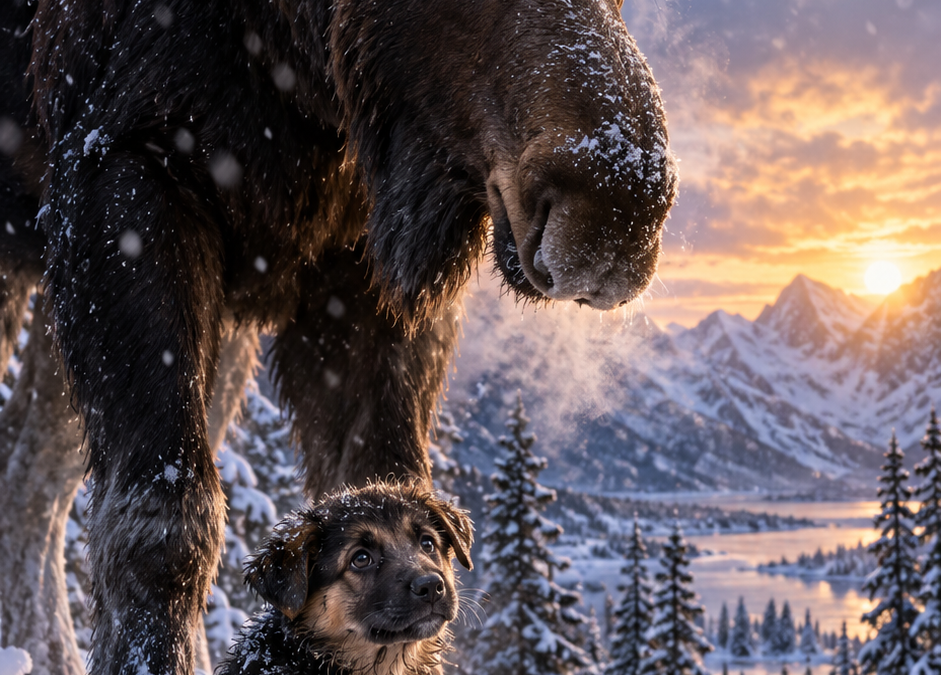
𝗣𝗔𝗥𝗧 𝟮
I carried him to the truck.
The cab heater was already running.
I spread an old flannel jacket over the passenger seat, placed him on top of it, and wrapped an emergency blanket loosely around his body.
His eyes never left the passenger window.
“You’re safe.”
He didn’t care.
The moment I started driving, he struggled to sit.
His legs shook.
He managed to raise his head and press his nose against the glass.
The forest moved past.
Spruce.
Birch.
Snowbanks.
Shadow.
He searched every gap.
At first, I assumed he was simply disoriented.
Then we passed the trailhead near where I had found him.
The puppy suddenly became alert.
Not energetic.
He didn’t have enough energy for that.
Focused.
He pawed at the door.
Once.
Again.
I slowed.
“You want to go back?”
He stared through the window.
I kept driving another hundred yards.
He whined.
The first real sound I’d heard from him.
Low.
Urgent.
I pulled over.
Sat there.
Every professional instinct told me what I was doing next was stupid.
Cold-stressed puppy.
Possibly frostbitten.
Possible infection.
Unknown injury.
Priority should have been immediate veterinary care.
Not following an injured dog into the woods because he looked emotionally persuasive.
I stared at him.
“Five minutes.”
His good paw scraped the door.
“That is not agreement.”
I turned the truck around.
Back at the trailhead, I wrapped him more securely and carried him into the trees.
The wind dropped immediately beneath the canopy.
Snow under the spruce was deeper.
The puppy squirmed.
“Not yet.”
He kept moving.
“Fine.”
I lowered him carefully.
His back legs touched snow.
Then his front.
He almost collapsed.
I reached for him.
He recovered.
Took one limping step.
Then another.
I followed.
“You’re terrible at medical priorities.”
He ignored me.
The trail he chose wasn’t much of a trail.
More like a path created by animals and repeated weather.
We went perhaps three hundred yards.
Maybe less.
The puppy stopped beside a cluster of young spruce.
His body went rigid.
I looked around.
At first, nothing.
Then I saw the tracks.
Moose.
Fresh.
Deep impressions, nearly the size of dinner plates.
They didn’t simply pass through.
They circled.
Back and forth.
Around one particular patch of disturbed snow.
The puppy limped toward it.
I followed.
Then saw the metal.
A snare.
Old cable.
Rusted clamp.
Partially pulled free from whatever had anchored it.
My stomach dropped.
“Jesus.”
The puppy stopped.
His ears flattened.
A soft whine came out.
There was fur caught in the wire.
Dark.
Sable.
And blood frozen into the snow.
Not much.
Enough.
I crouched.
The puppy began pawing at the ground.
“Hey.”
He dug faster.
His injured paw struck ice.
He yelped.
Still kept digging.
I caught his chest.
“Stop.”
He struggled weakly.
“You’re hurting yourself.”
He looked at me.
Then back at the snow.
That’s when I noticed more fur.
Not his.
Similar coloring.
Smaller clumps.
And something pink beneath a thin crust of ice.
I brushed snow away.
A torn nylon collar.
Small.
Too small for the puppy standing beside me.
Pink.
Tag scratched badly enough that I couldn’t read the engraving.
A little metal paw-print charm still hung from the ring.
The puppy froze when he saw it.
His nose moved forward.
Touched the collar.
Then he sat.
Just sat.
The air seemed to change.
Not supernatural.
Not mystical.
Just the sudden weight of understanding arriving faster than I wanted it.
“You weren’t alone.”
The puppy looked toward the thicket.
I scanned.
No second set of puppy tracks fresh enough to follow.
No obvious blood trail.
Nothing.
Whatever had happened had happened before the latest snowfall.
Maybe a day.
Maybe several.
The moose tracks looped around the area.
Again and again.
The puppy’s prints were mixed among them.
I tried to reconstruct the scene.
Two puppies.
Snare.
One trapped?
One escaped?
Moose appearing later?
No way to know.
And I needed to be careful.
Search and rescue teaches you something important about evidence.
The story you want is not always the story the ground tells.
What I knew:
There had been at least one snare.
There was dog fur caught in it.
There was a second puppy-sized collar.
The puppy with me reacted strongly to the site.
Moose tracks showed repeated movement through the clearing.
That was enough.
Anything beyond that was theory.
The puppy lowered his nose into the snow where the collar had been.
I put the collar in an evidence bag from my field kit.
He watched.
“I’m not taking her from you.”
I don’t know why I said her.
The pink collar didn’t prove anything.
Still, the word felt right.
“I’m taking this because somebody needs to explain it.”
The puppy looked at me.
I touched his shoulder.
“I’m sorry.”
His eyes closed for one second.
Then opened.
I lifted him.
This time he didn’t fight me.
On the walk back, his head remained turned toward the clearing until the trees hid it.
At the truck, he finally stopped looking.
Collapsed against the seat.
I drove straight to the ranger station first because it was closer.
Not ideal.
Necessary.
We had emergency medical supplies, radio contact, heat.
I carried the puppy inside.
Set him near the wood stove but not directly against it.
Gradual warming.
Warm water.
No forcing food.
I called a veterinary clinic in Millinocket.
Dr. Harlow answered through the emergency line.
“How cold?”
I gave him the approximate body temperature from the station’s animal thermometer.
“Bring him.”
“Road conditions.”
“Drive carefully.”
“Possible frostbite.”
“Keep warming gradually. Don’t rub the tissue. Wrap paws lightly. No direct heat.”
“Got it.”
The puppy lay curled on a blanket.
Eyes open.
I sat beside him while waiting for another ranger to arrive and cover the station.
“You need a name.”
His ear twitched.
“Temporary.”
No response.
I thought of the old collar.
The forest.
A name surfaced from nowhere.
“Lucan.”
The puppy looked at me.
“Too dramatic?”
He blinked.
“Good. Lucan.”
At the clinic, Dr. Harlow confirmed what I feared.
Early frostbite along both ear tips.
Cracked paw pads.
One pad partially torn.
Malnutrition.
Dehydration.
Minor infection in several abrasions.
No fractures.
That last part felt like winning.
Dr. Harlow examined the paw.
“He’ll keep full use.”
“Good.”
“How long outside?”
“Unknown.”
“Days at least.”
“That’s what I thought.”
“Any owner?”
“No collar on him.”
“Chip?”
Scan.
Nothing.
I showed him photographs of the snare.
The fur.
The second collar.
His face changed.
“You reported this?”
“Starting now.”
He nodded.
“Good.”
Lucan tolerated treatment with an eerie stillness.
No snapping.
Barely any struggling.
That wasn’t the same thing as bravery.
People make that mistake with injured animals.
Stillness can mean shutdown.
He had spent enough energy surviving.
There wasn’t much left for protest.
Dr. Harlow cleaned his paws.
Lucan stared past him.
When the vet touched the injured pad, Lucan flinched.
No sound.
“You’re allowed to complain,” I said.
Lucan’s eyes moved toward me.
Dr. Harlow smiled slightly.
“He may eventually.”
Treatment took two hours.
Antibiotics.
Fluids.
Wound care.
Pain medication.
Nutritional plan.
No rapid feeding.
His body needed time.
Dr. Harlow said shelter placement was technically possible.
I looked at Lucan.
He was watching the clinic door.
“No.”
The answer came faster than I expected.
“I’ll foster.”
Dr. Harlow lifted an eyebrow.
“You registered with a rescue?”
“Search-and-rescue foster network. Emergency placement authorization.”
“Then he’s going with you?”
“Yeah.”
I had a small cabin outside town.
Enough room.
Fenced section.
Experience with working dogs.
I had fostered twice before.
Never planned to again.
Plans were having a difficult week.
Lucan slept through most of the drive home.
The cabin sat back from the road beneath spruce and pine.
Wood stove.
Mudroom.
One bedroom.
The kind of place that makes loneliness look like rugged independence if you photograph it at sunset.
I prepared a corner near the stove.
Blankets.
Water.
Food.
An old stuffed fox left from a previous foster.
Lucan sniffed the toy.
Ignored it.
Then walked to the sliding glass door.
Sat.
Stared into the woods.
“You’re home.”
His ears moved.
“Temporarily.”
He kept staring.
I followed his gaze.
Dark tree line.
Snow.
Nothing.
“Looking for him?”
I meant the moose.
Lucan pressed his nose against the glass.
That first night, he barely slept.
Every time wind moved branches, his head lifted.
Every creak from the cabin.
Every distant sound.
He was listening for something.
Or someone.
I slept on the couch.
At three in the morning, I woke to silence.
Lucan was standing by the door.
I sat up.
“You need out?”
He looked at me.
I opened the door to the fenced yard.
He stepped outside.
Cold air moved through his fur.
He stood there.
Didn’t relieve himself.
Didn’t sniff.
Just stared toward the forest.
Then a branch snapped somewhere far beyond the fence.
Lucan’s entire body went alert.
“Moose?”
No way to know.
He remained outside another minute.
Then returned.
Curled beside the stove.
Slept for two hours.
The next morning, he pawed at the door repeatedly.
Not frantic.
Purposeful.
I knew what he wanted.
“You’re not medically cleared for wilderness exploration.”
Lucan pawed again.
“Compelling argument.”
I compromised.
We drove back to the trail.
Short visit.
No hiking deep.
That was the plan.
Lucan immediately ruined it.
The moment I lowered him onto the packed trail, he began walking.
Slow.
Bandaged paws protected by temporary boots.
He knew the route.
Back toward the snare.
We reached the clearing.
Fresh snow covered most of yesterday’s disturbance.
I had already reported the illegal trap.
State game wardens were scheduled to inspect later that day.
Lucan sniffed.
Then moved beyond the original site.
That’s when I noticed the broken trail marker.
Half buried.
Near it, more disturbed snow.
I walked over.
Another piece of nylon.
Not the pink collar.
A strip from what looked like a second restraint or lead.
I photographed it.
Lucan sniffed.
Then moved away.
We didn’t stay long.
He seemed dissatisfied.
Or perhaps I was assigning emotion.
Either way, he kept looking farther into the forest.
“Not today.”
I carried him back.
At the cabin, I opened my laptop.
Wrote everything.
Coordinates.
Photographs.
Observed tracks.
Condition of snare.
Dog fur.
Second collar.
State authorities took it seriously.
Illegal trapping isn’t just a wildlife issue.
Depending on method and location, traps can injure pets, working dogs, wildlife, and people.
A game warden named Kelly Moran called that afternoon.
“You sure the second collar belongs to another dog?”
“No.”
“Could be older.”
“Could.”
“Fur from snare?”
“Looks canine. Similar to Lucan.”
“We’ll collect.”
“There’s another thing.”
“The moose.”
Silence.
I had mentioned it in the report.
“You’re saying it was guarding the puppy?”
“I’m saying it stood near him on the road, shifted between him and the wind, and there were repeated moose tracks around the snare site.”
“That’s not the same as guarding.”
“I know.”
Good.
She understood evidence.
“We’ll document it as behavior observed.”
“Exactly.”
“What do you think happened?”
“I don’t know.”
Correct answer.
Wish more people used it.
For two days, Lucan recovered.
His appetite returned slowly.
He ate small meals.
Drank.
Allowed warm compresses on his paws.
Tolerated medication.
But he always returned to the window.
Morning.
Afternoon.
Night.
Watching.
Waiting.
On the third morning, Moran called.
“We found another trap.”
I stood.
“Where?”
“Quarter mile east of your original coordinates.”
“Bait?”
“Yes.”
“What kind?”
“Raw meat.”
My jaw tightened.
“Fresh?”
“Relatively.”
“So whoever set them could still be active.”
“Possibly.”
“We need cameras.”
“Already doing it.”
Lucan watched me from the window.
I looked at him.
“You’re not crazy.”
He tilted his head.
“Good news for one of us.”
Moran continued.
“We also found older animal hair around the second site. Sending samples.”
“Canine?”
“Too early.”
“Any human tracks?”
“Overlaid. Snow makes timing difficult.”
“Understood.”
She paused.
“Ethan.”
“Yeah.”
“Do not go out there alone looking for whoever did this.”
“I wasn’t planning to.”
“That’s exactly what people say before doing it.”
“Search and rescue taught me caution.”
“Search and rescue taught you to run toward problems.”
Fair.
That afternoon, against all good timing, Lucan began pawing at the door again.
I did not take him to the trap site.
Not yet.
We walked the cabin perimeter instead.
His gait had improved.
Tail remained low.
Nose active.
He found deer tracks.
Fox.
My boot prints.
Then stopped at the north fence.
Nose raised.
A scent on the wind.
His body changed.
No fear.
Recognition.
He stared into the spruce.
I saw nothing.
He whined once.
Soft.
“Friend?”
He looked at me.
Maybe.
That night, I heard something large moving beyond the property.
Too heavy for deer.
I turned on the porch light.
Nothing.
Next morning, giant hoof prints crossed the snow fifty yards beyond the fence.
Moose.
Could have been any moose.
I didn’t pretend otherwise.
Lucan sniffed the air.
Tail moved.
Once.
The state investigation expanded.
Trail cameras.
Trap removal.
Patrols.
Several devices were found.
Some old.
Some newer.
No immediate suspect.
The theory shifted toward someone targeting large wildlife illegally.
The puppies may have been dumped.
Or used as lure.
Or simply wandered into the trap line.
I hated the uncertainty.
Lucan didn’t need certainty.
He needed food.
Warmth.
Healing.
So I focused there.
Paw care.
Weight gain.
Confidence.
Short training.
Sit.
He knew it within minutes.
Down.
Fast.
Name response.
Immediate.
Recall inside the cabin.
Perfect.
Outside, more difficult because scent overwhelmed everything.
Normal.
The first time his tail wagged fully happened while I was putting on protective boots.
I expected resistance.
Instead, Lucan stood.
Allowed the first boot.
Second.
Third.
Fourth.
I tightened the final strap.
His tail moved.
One sweep.
Then another.
I stared.
“Are we celebrating footwear?”
Lucan licked my hand.
I laughed.
That was the first sound in the cabin that seemed to surprise both of us.
He tilted his head.
Then wagged harder.
“There you are.”
Recovery became visible after that.
Not linear.
But real.
Lucan began carrying the stuffed fox around.
He slept through part of the night.
Then all of it.
He stopped staring out the window for hours.
Minutes instead.
He started following me from room to room.
One afternoon, while I repaired a radio at the table, I felt something on my boot.
Lucan’s chin.
He slept there for forty minutes.
Trust.
Small.
Heavy.
Warm.
A week later, Moran called again.
“We’re setting a controlled sweep tomorrow.”
“Need SAR support?”
“Possibly.”
“I can help.”
“Not with Lucan.”
“I wasn’t suggesting.”
Lucan looked up from the floor.
“He needs rest.”
“Good.”
Then she added:
“We found something near the second trap.”
My stomach tightened.
“What?”
“More canine fur.”
“Same color?”
“Yes.”
“And?”
“No remains.”
I closed my eyes.
“Could the other puppy still be alive?”
“Possible.”
Not likely.
But possible.
That word is dangerous when hope is hungry.
I looked at Lucan.
He was chewing the fox’s ear.
“Do we search?”
“We already did a grid. No clear sign.”
“What about scent dog?”
“Conditions poor. Time elapsed unknown.”
I nodded.
Professional answer.
Still hated it.
That night, I took out the pink collar.
Cleaned gently.
Under stronger light, I managed to read one character from the tag.
Maybe an L.
Maybe an I.
Nothing useful.
Lucan approached.
Sniffed.
His body softened.
He sat beside me.
I placed the collar on the table.
“She mattered.”
His eyes moved toward it.
“That’s enough.”
I never named the missing puppy.
Didn’t feel like mine to do.
Weeks passed.
Winter deepened.
Lucan gained eight pounds.
Then twelve.
His ear tips healed with minor permanent damage.
Paw pads toughened.
Coat improved.
Sable color became beautiful—dark guard hairs along his back, warm tan beneath.
He grew into his legs.
And his mind became the most interesting part.
Working shepherds observe everything.
Lucan took that trait to an extreme.
A glove dropped behind me?
He noticed.
Footprint beside the shed?
Investigated.
I hid a treat under one of three cups.
He found it immediately.
Second round, changed positions.
Again.
Third round.
Faster.
I began simple scent games.
One glove with my scent.
One clean.
Find mine.
Easy.
Then cloth hidden across the room.
Found.
Across yard.
Found.
Through snow.
Found.
“You’re annoying.”
Tail wag.
I had trained alongside SAR dog teams before.
Not as a primary K9 handler.
But enough to recognize aptitude.
Drive.
Focus.
Nose.
Willingness to work.
Recovery after distraction.
Lucan had all of it.
Moran visited one afternoon.
She watched him find a hidden glove behind a woodpile.
“You’re thinking it.”
“Maybe.”
“Search dog.”
“Maybe.”
“He’s young.”
“Which is useful.”
“He’s traumatized.”
“Was.”
She looked at me.
“Still is.”
That correction mattered.
Recovery doesn’t delete history.
“Yes.”
“Training could help or overwhelm him.”
“I know.”
“Who’s evaluating?”
“Tom Reynolds.”
She nodded.
Experienced handler.
Good.
Tom met Lucan two weeks later.
No dramatic declarations.
No “born for it.”
He tested basics.
Food drive.
Toy drive.
Environmental stability.
Surface confidence.
Problem solving.
Response to sudden sound.
Lucan startled at a dropped metal pan.
Recovered in six seconds.
Tom noted it.
Not ideal.
Not disqualifying.
Outside, Lucan followed a simple scent trail over snow.
Lost it at a road crossing.
Circled.
Reacquired.
Tom watched without expression.
Afterward, he said:
“He has potential.”
“That’s it?”
“What did you want? Trumpets?”
“Maybe.”
“Potential means work.”
“I know.”
“And no hero narrative.”
I frowned.
“What?”
Tom pointed toward Lucan.
“People love damaged-dog-becomes-rescue-hero stories. Don’t train the story. Train the dog.”
I liked him immediately.
“Agreed.”
“He fails, he’s still a good dog.”
“Agreed.”
“He quits, you stop.”
“Agreed.”
“If the woods trigger him badly, we reassess.”
“Agreed.”
Lucan began foundation work.
Short sessions.
No pressure.
Scent discrimination.
Recall.
Directionals.
Terrain confidence.
Vehicle loading.
Crate.
Ignore wildlife.
That last one took time.
Moose scent made him freeze.
Not chase.
Freeze.
Listen.
The first time it happened during training, Tom stopped the session.
“Enough.”
Lucan stared into the trees.
I called.
“Lucan.”
His ear moved.
“Here.”
He turned.
Came back.
That was success.
Not because he ignored memory.
Because he returned when asked.
Months after finding him, I took him back to the hidden glade for the first time.
Not the snare site.
Beyond it.
We had discovered the glade by following old moose tracks during one of Lucan’s medically approved short excursions.
Fallen log.
Dense spruce.
Quiet.
Fresh hoof prints crossed it.
Lucan sat beside the log.
Calm.
I crouched.
“He was here.”
No way to know if it was the same bull.
Maine contains more than one moose despite what emotional storytelling prefers.
Then brush moved.
A bull stepped into view.
Large.
Broad antlers.
Dark face.
Lucan stood.
My body went tense.
Distance: roughly forty yards.
Enough.
But wildlife deserves distance.
I shortened Lucan’s leash without pulling.
“Stay.”
Lucan did.
The bull watched us.
Was it the same animal?
I studied the antlers.
One asymmetrical tine looked familiar.
Could still be coincidence.
I refused to pretend certainty.
Lucan made a soft sound.
The moose lowered his head slightly.
Then turned.
Walked away.
Lucan did not follow.
He watched.
Tail still.
Body soft.
When the woods closed behind the bull, Lucan looked at me.
Then leaned against my leg.
“That enough?”
Tail wag.
We left.
Afterward, he stopped obsessing over the window.
Not completely.
But something changed.
Maybe coincidence.
Maybe the return helped.
Maybe he simply matured.
I didn’t need a mystical explanation.
Dogs process place and scent in ways we barely understand.
Sometimes seeing that a place is no longer dangerous is enough.
By spring, Lucan was officially mine.
The hold period had passed long before.
No owner.
No matching report.
No one came looking.
I signed adoption paperwork without ceremony.
The clerk asked:
“Occupation?”
I wrote:
Search-and-rescue volunteer.
Lucan sat beside me.
His future uncertain.
But open.
We trained all summer.
Not every day.
Rest mattered.
Play mattered.
He discovered lakes.
Hated deep water initially.
Loved splashing.
He discovered blueberries.
Stole them directly from low bushes.
He discovered porcupines.
Once.
From a distance, thankfully.
Tom taught me more than he taught Lucan.
Timing.
Reading fatigue.
Reward.
Not drilling too long.
A working dog isn’t a machine.
The point isn’t obedience for its own sake.
It’s partnership under stress.
Lucan excelled at scent work.
He could hold odor through moderate distractions.
He learned indication bark.
One sharp bark when locating a hidden subject.
At first, he barked too much.
Then not enough.
Eventually one clear alert.
Tom nodded.
“Good.”
I almost celebrated.
Tom glared.
“Don’t make him weird about praise.”
I lowered my voice.
“Good boy.”
Lucan wagged.
We worked across forest floor, snow patches, logging roads, streams.
He failed frequently.
Important.
Training where a dog always succeeds is entertainment.
Failure teaches handling.
Once, during a long trail, Lucan lost scent near a rocky stream crossing.
Circled.
Returned to me.
Looked frustrated.
I reset.
He tried again.
Found it farther downstream.
That persistence became his defining trait.
Not magic.
Work.
By the next winter, he passed intermediate evaluations.
Not full certification yet.
He was too young.
Good.
No rush.
We returned to the original road around the anniversary of his rescue.
Fresh snow.
Same turn.
I parked.
Lucan jumped down wearing an orange training vest.
Healthy.
Strong.
I stood where the truck had skidded.
“Right around here.”
Lucan sniffed.
Nothing dramatic.
Then he walked toward the shoulder.
Looked into the trees.
A shape moved in the distance.
Moose.
Too far to identify.
Lucan watched.
Didn’t pull.
The animal crossed between spruce.
Gone.
I put a hand on Lucan’s neck.
“Still friends with the entire species?”
He sneezed.
Good answer.
Full SAR certification came six months later.
Obedience.
Search strategy.
Scent work.
Handler communication.
Human remains exclusion.
Live find.
Wilderness scenario.
Lucan passed.
Not on the first try, despite how good stories like to tell it.
He failed one component.
Vehicle loading under distraction.
A dropped metal ramp triggered an old response.
He froze.
Wouldn’t load.
Automatic failure for the scenario.
I was disappointed.
Lucan wasn’t.
He ate dinner.
Slept.
Next day, we trained.
Two months later, retest.
Passed.
I respected that outcome more.
Real competence includes recovery after failure.
Certification didn’t turn him into a hero.
It made us eligible for deployment.
Big difference.
Our first real callout came in late summer.
Thunderstorms had moved through Piscataquis County.
A family camping near the park reported an eight-year-old girl missing.
Last seen near their campsite before heavy rain.
Ground teams deployed.
Game wardens.
Volunteers.
Two dog teams.
We arrived after dark.
Lucan exited the truck focused.
No cinematic music.
No intuition.
Procedure.
Briefing.
Last known point.
Scent article.
Safety.
Storm damage.
Water risk.
I let him smell the girl’s sweatshirt.
“Find.”
He started.
We moved through soaked undergrowth.
His orange vest flashed between trees.
The trail was messy.
Rain had contaminated scent.
Other searchers crossed the area.
Lucan worked.
Lost it.
Reacquired.
At one point, he wanted to follow a path toward a creek.
I trusted him but verified terrain.
Then he turned uphill.
Thirty minutes.
Forty-five.
An hour.
My legs burned.
Lucan slowed near a cluster of fallen spruce.
Head high.
Then sharp turn.
He pulled.
Stopped.
One bark.
Clear.
I ran forward.
A small voice answered.
“Hello?”
“Search and rescue!”
We found her beneath a collapsed tarp wedged against a fallen log.
Wet.
Cold.
Scared.
Alive.
I radioed coordinates.
Then knelt.
“It’s okay.”
The girl looked past me.
At Lucan.
“Dog.”
“Yeah.”
Lucan approached slowly.
I let him.
She wrapped her arms around his neck.
He stayed.
No jumping.
No licking.
Just leaned against her.
Her crying changed.
Less panic.
More release.
I looked at Lucan.
For a moment, the forest folded in on itself.
A lost puppy once waiting for help.
Now a trained dog sitting beside a lost child.
I didn’t say anything.
Didn’t need to.
Teams arrived.
We walked her out.
Local reporters later wanted the simple version.
“Rescue dog saves child.”
I corrected them.
“Search team found child.”
They still ran the headline.
Of course.
Lucan appeared in photos.
Orange vest.
Girl hugging him.
I printed one.
Put it beneath the photograph from the glade.
Two images.
One dog.
Two directions.
First photo: looking into the forest for something he’d lost.
Second: bringing someone else back from it.
That mattered to me.
The illegal trap investigation eventually produced a suspect.
Not quickly.
Months.
Trail-camera images.
Vehicle records.
Recovered equipment.
The state charged a man with multiple wildlife-related offenses.
I won’t pretend he was proven responsible for everything connected to Lucan.
The evidence established illegal trap placement.
Not the complete story of the puppies.
The missing sister remained unresolved.
No remains conclusively identified.
No owner history.
No explanation.
That uncertainty stayed.
I learned to live with it.
Lucan did better than I did.
He carried no visible obsession as an adult.
The pink collar stayed in a small box in my desk.
Not displayed.
Not treated like a shrine.
Just kept.
Sometimes I thought about the second puppy.
Maybe she died.
Maybe someone found her.
Maybe the fur wasn’t hers.
I wanted an ending.
Life declined to provide one.
Lucan’s life didn’t wait.
Mission after mission.
Some successful.
Some not.
That’s important.
Search dogs do not always find who they’re looking for.
Weather.
Terrain.
Time.
Scent contamination.
Water.
Human decisions.
A dog can perform perfectly and still come home without the person.
Those missions were harder.
Lucan always ate afterward.
Slept.
Woke ready.
I had to learn not to attach human guilt to his work.
He searched because we’d trained.
Because the game mattered.
Because finding people earned reward, praise, connection.
The moral weight belonged to us.
Not him.
Still, he changed during deployments.
More mature.
More patient.
If we found a frightened hiker, he often lowered himself instead of charging in.
If someone cried, he leaned.
I hadn’t trained that.
That part was him.
At four years old, Lucan was one of the more reliable wilderness dogs in our volunteer network.
Tom refused to praise him excessively.
“He’s adequate.”
“He found three people this year.”
“Adequate.”
“You’re incapable of joy.”
“Correct.”
Lucan loved him anyway.
The moose became a story others told about him.
I tried to keep it grounded.
People wanted:
“The moose adopted him.”
We didn’t know that.
“The moose saved him from the trapper.”
We didn’t know that.
“The moose protected his sister.”
Unknown.
What I could say:
A bull moose remained unusually close to an injured puppy.
I observed it standing near him on a frozen road.
Tracks suggested repeated moose presence around the trap site.
Lucan later reacted calmly and attentively to a bull in the same general area.
Beyond that?
Mystery.
And mystery was enough.
You don’t have to exaggerate something strange to make it meaningful.
A giant wild animal and a starving domestic puppy stood together in winter.
That happened.
I saw it.
That’s extraordinary enough.
Years passed.
Lucan matured.
His sable coat darkened.
Chest broadened.
The frostbite left subtle notches along both ear tips.
One paw pad remained slightly sensitive in extreme cold.
We used boots on long winter missions.
He hated them.
Walked like every foot had become someone else’s property.
I laughed every time.
“Professional search dog.”
Lucan lifted one boot dramatically.
“Very dignified.”
He glared.
Then adapted.
At six, we had our hardest winter mission.
Two snowmobilers overdue after a whiteout.
One returned injured.
Second missing.
Search extended overnight.
Temperature dropped fast.
Lucan worked in shifts.
We found the missing man after dawn in a shallow depression beside a spruce stand.
Hypothermic.
Barely responsive.
Lucan alerted.
Then lay beside him while medics approached.
Later, back at the truck, Lucan curled on the seat.
Exhausted.
I looked at him.
“Cold enough?”
He opened one eye.
“I know.”
I wrapped another blanket around him.
For some reason, I remembered the first emergency blanket.
Tiny Lucan.
Shaking.
Reaching toward the trees.
The circle felt almost too neat.
But life is allowed occasional symmetry.
The ranger station eventually framed a photo of Lucan.
I hated it.
Not the photograph.
The caption.
FROM RESCUED TO RESCUER.
Too simple.
I changed it.
Tom caught me with a screwdriver.
“What are you doing?”
“Improving accuracy.”
New caption:
LUCAN — WILDERNESS SEARCH K9
That’s what he’d earned.
Not inspirational mascot.
Working dog.
His past mattered.
His competence mattered more.
At seven, Lucan slowed slightly.
Not old.
Experienced.
He knew when to conserve energy.
Younger dogs exploded into searches.
Lucan started methodically.
He read wind.
Terrain.
Handler.
He taught me patience.
He also became excellent with new K9 trainees.
One nervous young Labrador named June refused to cross a narrow footbridge.
Lucan walked across.
Returned.
Crossed again.
June watched.
Third time, she followed.
Tom pointed.
“There’s your moose.”
I looked at him.
“What?”
“He showed somebody else how.”
I understood.
Maybe that’s all the bull had done.
Stayed.
Created a pocket of safety.
No mythology required.
Just presence.
Years after finding Lucan, I returned alone to the original clearing.
He was home recovering from a minor shoulder strain.
I brought the pink collar.
Snow fell lightly.
The snare site had long since disappeared beneath regrowth and weather.
No trace.
I stood there.
Remembered the puppy digging.
The fur.
The blood.
The question I could never answer.
I didn’t leave the collar.
Again, it wasn’t mine to ritualize.
I carried it home.
Lucan sniffed it.
Then walked away to his food bowl.
That was perhaps the healthiest response available.
Memory without imprisonment.
At nine, he retired from active field work.
Arthritis beginning.
Nothing severe.
Enough.
I hated the decision.
Lucan loved retirement.
Breakfast later.
Shorter hikes.
No night callouts.
More stove time.
I discovered he had apparently been tolerating my career ambitions for years.
Younger dog teams took over.
Lucan attended training occasionally.
Demonstration work.
Simple scent games.
He still had the nose.
Body simply deserved less punishment.
One winter morning, he stood by the truck.
Looked at me.
I opened the door.
“No mission.”
He jumped in anyway.
We drove north.
Toward Baxter.
Not planned.
Felt right.
Same road.
Same forest.
Lucan stepped down carefully.
Gray had started around his muzzle.
We walked only a short distance.
The glade.
Fallen log still there, decayed.
Snow across everything.
Lucan stood beside it.
I sat.
Minutes passed.
Then branches shifted.
Far side.
A moose cow stepped through.
No antlers.
Not the bull.
Lucan watched.
She watched us.
Then moved away.
I laughed.
“Wrong one.”
Lucan looked at me.
Tail wag.
“Fair.”
Maybe the original bull had died years earlier.
Maybe not.
Wild animals don’t owe us reunion scenes.
I was grateful for what we’d had.
One observed moment.
Enough to redirect a life.
Lucan lay beside me.
Snow gathered on his coat.
I brushed it away.
“You know something?”
His eyes lifted.
“I used to tell people the moose changed your life.”
Lucan sighed.
“That’s probably wrong.”
He rested his head on my knee.
“The moose kept you company until I got there.”
That felt closer.
Then I thought again.
“No.”
I scratched behind his ear.
“You changed mine.”
Tail.
“Obnoxious.”
Retirement lasted three good years.
Hikes.
Cabin.
Training visits.
Kids from local outdoor programs learning how SAR dogs worked.
Lucan loved children.
Especially if they carried cheese.
At twelve, his arthritis worsened.
Medication.
Ramps.
Short walks.
He slept more.
Still alert.
Still searched the yard every morning with his nose as though the neighborhood might contain a missing hiker under the picnic table.
Then one February, snow began falling heavily.
Lucan stood at the glass door.
Old habit.
I opened it.
He stepped onto the porch.
Cold wind touched his face.
He looked toward the forest.
For a second, I saw the puppy again.
Not visually.
In posture.
Head lifted.
Listening.
I sat beside him.
“No hiking today.”
He leaned against my leg.
We watched snow.
A dark shape moved between distant spruce.
Too far.
Could have been deer.
Moose.
Shadow.
Lucan’s tail moved once.
I chose not to investigate.
Some mysteries get better when you stop demanding proof.
His last spring came gently.
Not one dramatic diagnosis.
Age.
Kidneys.
Joints.
Decline.
Appetite smaller.
Walks shorter.
I knew the signs.
Didn’t want to.
Dr. Harlow had retired long before.
Our current vet, Dr. Nguyen, came to the cabin when it was time.
Lucan lay on his blanket beside the stove.
Same corner where I’d placed him after the first rescue.
The stuffed fox still existed, though missing most of one ear.
I had kept it all those years.
Lucan’s head rested beside it.
I sat on the floor.
Hand on his chest.
“You remember this room?”
His eyes opened.
“Probably not.”
Tail moved faintly.
I smiled.
“Better things to remember.”
Before Dr. Nguyen arrived, I took out the pink collar.
Held it near him.
Lucan sniffed.
Eyes softened.
No distress.
No searching.
I put it away.
“She mattered.”
His breathing remained slow.
“And you stayed.”
I swallowed.
“You stayed long enough for both of you.”
Dr. Nguyen entered quietly.
Lucan knew her.
Tail moved.
She sat beside him.
Explained each step.
I already knew.
Still listened.
When the first medication relaxed him, Lucan’s head became heavy in my lap.
I ran my fingers along the notched ear tips.
The frostbite marks.
Evidence of winter.
“You did good.”
His eyes found mine.
“Really good.”
I thought of every mission.
Every trail.
Every failure.
Every find.
The little girl under the tarp.
The snowmobiler.
The nervous Labrador crossing the bridge.
Milo? No, different story.
Tom calling him adequate.
Moran warning me not to chase trappers.
The moose.
Always the moose.
Lucan exhaled.
I pressed my forehead to his.
“You’re safe.”
Those were almost the first words I had said to him.
Now they were among the last.
His breathing stopped quietly.
No storm.
No road.
No fear.
Just home.
I remained on the floor for a long time.
The stove crackled.
Snowmelt tapped from the roof.
The cabin felt too large.
When eventually I stood, I saw four faint scratches on the glass door where Lucan had spent his first week pawing to go back into the woods.
I had never repaired them.
Still haven’t.
People later asked whether I scattered his ashes at the glade.
I didn’t.
Most stayed near the cabin.
Some along one of his favorite search trails.
A small amount near the edge of the original road.
Not where the snare had been.
Where I first saw him.
I went alone.
Snow beginning.
I stood on the shoulder.
Cars rarely used that road in winter.
For a while, nothing moved.
Then, across a low clearing, a moose appeared.
Not close.
No dramatic approach.
A bull.
Smaller antlers than the one from years earlier.
He crossed the road perhaps two hundred yards away.
Paused.
Looked in my direction.
Then continued.
I laughed.
Of course.
Could have been coincidence.
Almost certainly was.
That didn’t make it meaningless.
Meaning doesn’t always require causation.
Sometimes we assign meaning because it helps us hold the shape of a life.
Lucan’s life had begun, for me, beneath a moose on a frozen road.
It ended after twelve years of warmth, work, and trust.
That’s enough.
The pink collar remains in my desk.
No name ever recovered.
I eventually stopped trying.
If Lucan had a sister, and I believe he did, then whatever happened to her remains part of the woods.
Not forgotten.
Just unresolved.
I used to think unresolved stories were failures.
Search and rescue teaches you otherwise.
Sometimes you find the person.
Sometimes you don’t.
Sometimes evidence answers questions.
Sometimes snow covers everything before you arrive.
The responsibility is not to invent certainty.
It’s to honor what you know.
I know Lucan was abandoned or lost in brutal winter conditions.
I know illegal traps were present.
I know another puppy-sized collar lay near one of them.
I know a moose repeatedly occupied the same area.
I know that when I found Lucan, that moose stood beside him.
And I know what happened afterward.
A puppy who could barely stand learned to run.
A dog once lost in the woods learned to search them.
A life that began with waiting became a career built around finding.
People liked to say:
“The moose saved him.”
Maybe.
I prefer something smaller.
The moose stayed.
Long enough.
That’s sometimes all saving is.
Stay until help arrives.
Block the wind.
Stand nearby.
Don’t leave.
Then hand the responsibility to the next living thing willing to carry it.
The bull disappeared into the trees.
I took Lucan home.
Lucan eventually ran into those same woods to bring others back.
A chain of ordinary acts.
Presence passed forward.
That’s the version I believe.
And years later, when I train new volunteers, I never begin Lucan’s story with the lost child or the certifications.
I begin on the road.
Snow.
Moose.
Puppy.
I tell them what I saw.
Then I say:
“Don’t romanticize the wildlife.”
They laugh.
I’m serious.
“Don’t make the dog a hero before he earns the work.”
That surprises them.
“And don’t confuse survival with destiny.”
Then I show them Lucan’s orange vest.
Old now.
Faded.
Patch worn.
“This came later.”
Because that matters.
Lucan did not become a search dog because suffering made him special.
Pain doesn’t automatically create purpose.
He became good because he healed.
Because he trained.
Because people invested time.
Because he liked the work.
Because his body and mind were suited to it.
His past informed him.
It did not magically qualify him.
That distinction respects him more.
The moose didn’t turn Lucan into a guardian.
It may have given him enough shelter to survive until someone else arrived.
After that, Lucan did the rest.
He ate.
He healed.
He failed tests.
He retried.
He trained.
He worked.
He grew old.
That’s a life.
Not a symbol.
Still, some mornings in deep winter, I see three sets of marks in fresh snow near the cabin.
Deer.
Fox.
Rabbit.
Normal things.
And for half a second, before logic catches up, I remember the first tracks in that clearing.
Huge hoof prints.
Small puppy prints.
Circling.
Crossing.
One enormous animal.
One tiny one.
Sharing the same piece of winter.
I don’t know what the moose understood.
Maybe nothing I would recognize as compassion.
Maybe his behavior had some entirely practical animal explanation.
Maybe the puppy simply used his body as shelter and the bull tolerated it.
I’m comfortable not knowing.
Because whatever the reason, Lucan survived long enough for me to reach him.
And after that, he spent the rest of his life returning the favor.
Not to the moose.
To the world.
One lost person at a time.
Have you finished reading the story and want to read it again?
A Giant Moose Guarded a Freezing Puppy in the Snow—Then the Puppy Led Me Back Into the Woods
The moose was standing over something tiny.
Then the tiny thing looked at me.
And before I understood why, he tried to lead me back into the forest.
My name is Ethan Cole, and I was forty-four years old the winter I found Lucan on a frozen road not far from Baxter State Park in Maine.
I had been volunteering with search and rescue in the North Woods for more than a decade by then, which meant I had developed a healthy respect for two things tourists consistently underestimated: weather and distance.
Snow makes everything look simple.
Clean.
Soft.
Almost peaceful.
Then you discover the trail marker is buried, darkness arrives at four-thirty, your phone has no signal, and a half-mile walk back to your truck suddenly feels like a negotiation with the planet.
That morning, the storm had passed but left a hard crust of snow and ice across the service road.
I was driving slowly in an old department pickup, checking several access points after reports of downed trees.
The sky was flat gray.
The woods stood silent.
Then something enormous stepped onto the road.
I hit the brakes.
The truck slid maybe six feet before stopping crooked.
My hands locked around the steering wheel.
Moose.
A bull.
Massive.
Broad dark body, long legs, heavy head, antlers spreading above him like a rack of frozen branches.
Even from inside the truck, I could see steam leaving his nostrils.
A full-grown bull moose can make a pickup suddenly feel very small.
I didn’t move.
Then I noticed he wasn’t alone.
Something stood directly beneath his lowered head.
At first, I thought calf.
Wrong color.
Too small.
The shape moved.
Black and tan.
One pointed ear.
A long puppy muzzle.
I blinked.
“No way.”
A German Shepherd puppy stood in the middle of the frozen road.
Maybe five months old.
Maybe younger.
Sable coat soaked and clumped.
Body painfully thin.
One front paw lifted because putting weight on it apparently hurt too much.
The moose stood between the puppy and the wind.
That’s the only way I can describe it.
Maybe there was another explanation.
Maybe the moose simply happened to stop there.
Maybe the puppy had approached him for shelter.
Maybe I was projecting intention onto an animal whose behavior I didn’t understand.
But when the wind gusted across the road, the bull shifted his body.
The puppy moved into the space behind his front legs.
The moose stayed.
I had worked around wildlife long enough not to romanticize it.
Nature is not a children’s book.
Animals don’t exist to teach us morality.
A moose is not a woodland saint.
It is a thousand pounds of muscle capable of turning a human being into an unfortunate statistic.
Still, whatever I was watching wasn’t normal.
The puppy tried to move.
His leg buckled.
The moose lowered his muzzle and touched the puppy’s shoulder.
Once.
The pup steadied himself.
My chest tightened.
I opened the truck door slowly.
Cold air hit me.
The bull lifted his head.
“Easy.”
Ridiculous thing to say to a moose.
He watched me.
I stepped onto the shoulder.
The puppy turned.
That’s when I saw his face properly.
Raw skin across the nose.
Frost-whitened edges of both ears.
Sunken eyes.
Blood crusted around one paw.
He looked at me without barking.
Without moving.
Just watching.
The bull snorted.
Not charging.
Not pawing.
Then he took one step backward.
Another.
He turned toward the tree line.
For several seconds, his dark body stood against the snow.
Then he disappeared between the spruce as quietly as something that large had any right to move.
The puppy stared after him.
I crouched.
“Hey, buddy.”
His ears moved.
“Don’t know what arrangement you two had going.”
I held out my gloved hand.
“But I think your partner just handed the shift to me.”
The puppy looked at my hand.
Then at the woods.
Then back at me.
He didn’t come closer.
I went to him.
Slowly.
When my fingers finally touched the fur along his shoulder, he flinched but didn’t retreat.
His body was colder than it should have been.
Much colder.
I slid one arm beneath him.
He barely weighed anything.
As I lifted him, he made the smallest sound.
Not a bark.
Not a cry.
A breath with pain inside it.
“It’s okay.”
His head fell against my chest.
“I’ve got you.”
Then, just as I turned toward the truck, the puppy twisted weakly in my arms.
He looked over my shoulder.
Toward the woods.
One front paw lifted.
Reached.
And that was the first clue that finding him on the road was not the end of whatever had happened out there.
It was only where his story crossed mine.
PART2
I carried him to the truck.
The cab heater was already running.
I spread an old flannel jacket over the passenger seat, placed him on top of it, and wrapped an emergency blanket loosely around his body.
His eyes never left the passenger window.
“You’re safe.”
He didn’t care.
The moment I started driving, he struggled to sit.
His legs shook.
He managed to raise his head and press his nose against the glass.
The forest moved past.
Spruce.
Birch.
Snowbanks.
Shadow.
He searched every gap.
At first, I assumed he was simply disoriented.
Then we passed the trailhead near where I had found him.
The puppy suddenly became alert.
Not energetic.
He didn’t have enough energy for that.
Focused.
He pawed at the door.
Once.
Again.
I slowed.
“You want to go back?”
He stared through the window.
I kept driving another hundred yards.
He whined.
The first real sound I’d heard from him.
Low.
Urgent.
I pulled over.
Sat there.
Every professional instinct told me what I was doing next was stupid.
Cold-stressed puppy.
Possibly frostbitten.
Possible infection.
Unknown injury.
Priority should have been immediate veterinary care.
Not following an injured dog into the woods because he looked emotionally persuasive.
I stared at him.
“Five minutes.”
His good paw scraped the door.
“That is not agreement.”
I turned the truck around.
Back at the trailhead, I wrapped him more securely and carried him into the trees.
The wind dropped immediately beneath the canopy.
Snow under the spruce was deeper.
The puppy squirmed.
“Not yet.”
He kept moving.
“Fine.”
I lowered him carefully.
His back legs touched snow.
Then his front.
He almost collapsed.
I reached for him.
He recovered.
Took one limping step.
Then another.
I followed.
“You’re terrible at medical priorities.”
He ignored me.
The trail he chose wasn’t much of a trail.
More like a path created by animals and repeated weather.
We went perhaps three hundred yards.
Maybe less.
The puppy stopped beside a cluster of young spruce.
His body went rigid.
I looked around.
At first, nothing.
Then I saw the tracks.
Moose.
Fresh.
Deep impressions, nearly the size of dinner plates.
They didn’t simply pass through.
They circled.
Back and forth.
Around one particular patch of disturbed snow.
The puppy limped toward it.
I followed.
Then saw the metal.
A snare.
Old cable.
Rusted clamp.
Partially pulled free from whatever had anchored it.
My stomach dropped.
“Jesus.”
The puppy stopped.
His ears flattened.
A soft whine came out.
There was fur caught in the wire.
Dark.
Sable.
And blood frozen into the snow.
Not much.
Enough.
I crouched.
The puppy began pawing at the ground.
“Hey.”
He dug faster.
His injured paw struck ice.
He yelped.
Still kept digging.
I caught his chest.
“Stop.”
He struggled weakly.
“You’re hurting yourself.”
He looked at me.
Then back at the snow.
That’s when I noticed more fur.
Not his.
Similar coloring.
Smaller clumps.
And something pink beneath a thin crust of ice.
I brushed snow away.
A torn nylon collar.
Small.
Too small for the puppy standing beside me.
Pink.
Tag scratched badly enough that I couldn’t read the engraving.
A little metal paw-print charm still hung from the ring.
The puppy froze when he saw it.
His nose moved forward.
Touched the collar.
Then he sat.
Just sat.
The air seemed to change.
Not supernatural.
Not mystical.
Just the sudden weight of understanding arriving faster than I wanted it.
“You weren’t alone.”
The puppy looked toward the thicket.
I scanned.
No second set of puppy tracks fresh enough to follow.
No obvious blood trail.
Nothing.
Whatever had happened had happened before the latest snowfall.
Maybe a day.
Maybe several.
The moose tracks looped around the area.
Again and again.
The puppy’s prints were mixed among them.
I tried to reconstruct the scene.
Two puppies.
Snare.
One trapped?
One escaped?
Moose appearing later?
No way to know.
And I needed to be careful.
Search and rescue teaches you something important about evidence.
The story you want is not always the story the ground tells.
What I knew:
There had been at least one snare.
There was dog fur caught in it.
There was a second puppy-sized collar.
The puppy with me reacted strongly to the site.
Moose tracks showed repeated movement through the clearing.
That was enough.
Anything beyond that was theory.
The puppy lowered his nose into the snow where the collar had been.
I put the collar in an evidence bag from my field kit.
He watched.
“I’m not taking her from you.”
I don’t know why I said her.
The pink collar didn’t prove anything.
Still, the word felt right.
“I’m taking this because somebody needs to explain it.”
The puppy looked at me.
I touched his shoulder.
“I’m sorry.”
His eyes closed for one second.
Then opened.
I lifted him.
This time he didn’t fight me.
On the walk back, his head remained turned toward the clearing until the trees hid it.
At the truck, he finally stopped looking.
Collapsed against the seat.
I drove straight to the ranger station first because it was closer.
Not ideal.
Necessary.
We had emergency medical supplies, radio contact, heat.
I carried the puppy inside.
Set him near the wood stove but not directly against it.
Gradual warming.
Warm water.
No forcing food.
I called a veterinary clinic in Millinocket.
Dr. Harlow answered through the emergency line.
“How cold?”
I gave him the approximate body temperature from the station’s animal thermometer.
“Bring him.”
“Road conditions.”
“Drive carefully.”
“Possible frostbite.”
“Keep warming gradually. Don’t rub the tissue. Wrap paws lightly. No direct heat.”
“Got it.”
The puppy lay curled on a blanket.
Eyes open.
I sat beside him while waiting for another ranger to arrive and cover the station.
“You need a name.”
His ear twitched.
“Temporary.”
No response.
I thought of the old collar.
The forest.
A name surfaced from nowhere.
“Lucan.”
The puppy looked at me.
“Too dramatic?”
He blinked.
“Good. Lucan.”
At the clinic, Dr. Harlow confirmed what I feared.
Early frostbite along both ear tips.
Cracked paw pads.
One pad partially torn.
Malnutrition.
Dehydration.
Minor infection in several abrasions.
No fractures.
That last part felt like winning.
Dr. Harlow examined the paw.
“He’ll keep full use.”
“Good.”
“How long outside?”
“Unknown.”
“Days at least.”
“That’s what I thought.”
“Any owner?”
“No collar on him.”
“Chip?”
Scan.
Nothing.
I showed him photographs of the snare.
The fur.
The second collar.
His face changed.
“You reported this?”
“Starting now.”
He nodded.
“Good.”
Lucan tolerated treatment with an eerie stillness.
No snapping.
Barely any struggling.
That wasn’t the same thing as bravery.
People make that mistake with injured animals.
Stillness can mean shutdown.
He had spent enough energy surviving.
There wasn’t much left for protest.
Dr. Harlow cleaned his paws.
Lucan stared past him.
When the vet touched the injured pad, Lucan flinched.
No sound.
“You’re allowed to complain,” I said.
Lucan’s eyes moved toward me.
Dr. Harlow smiled slightly.
“He may eventually.”
Treatment took two hours.
Antibiotics.
Fluids.
Wound care.
Pain medication.
Nutritional plan.
No rapid feeding.
His body needed time.
Dr. Harlow said shelter placement was technically possible.
I looked at Lucan.
He was watching the clinic door.
“No.”
The answer came faster than I expected.
“I’ll foster.”
Dr. Harlow lifted an eyebrow.
“You registered with a rescue?”
“Search-and-rescue foster network. Emergency placement authorization.”
“Then he’s going with you?”
“Yeah.”
I had a small cabin outside town.
Enough room.
Fenced section.
Experience with working dogs.
I had fostered twice before.
Never planned to again.
Plans were having a difficult week.
Lucan slept through most of the drive home.
The cabin sat back from the road beneath spruce and pine.
Wood stove.
Mudroom.
One bedroom.
The kind of place that makes loneliness look like rugged independence if you photograph it at sunset.
I prepared a corner near the stove.
Blankets.
Water.
Food.
An old stuffed fox left from a previous foster.
Lucan sniffed the toy.
Ignored it.
Then walked to the sliding glass door.
Sat.
Stared into the woods.
“You’re home.”
His ears moved.
“Temporarily.”
He kept staring.
I followed his gaze.
Dark tree line.
Snow.
Nothing.
“Looking for him?”
I meant the moose.
Lucan pressed his nose against the glass.
That first night, he barely slept.
Every time wind moved branches, his head lifted.
Every creak from the cabin.
Every distant sound.
He was listening for something.
Or someone.
I slept on the couch.
At three in the morning, I woke to silence.
Lucan was standing by the door.
I sat up.
“You need out?”
He looked at me.
I opened the door to the fenced yard.
He stepped outside.
Cold air moved through his fur.
He stood there.
Didn’t relieve himself.
Didn’t sniff.
Just stared toward the forest.
Then a branch snapped somewhere far beyond the fence.
Lucan’s entire body went alert.
“Moose?”
No way to know.
He remained outside another minute.
Then returned.
Curled beside the stove.
Slept for two hours.
The next morning, he pawed at the door repeatedly.
Not frantic.
Purposeful.
I knew what he wanted.
“You’re not medically cleared for wilderness exploration.”
Lucan pawed again.
“Compelling argument.”
I compromised.
We drove back to the trail.
Short visit.
No hiking deep.
That was the plan.
Lucan immediately ruined it.
The moment I lowered him onto the packed trail, he began walking.
Slow.
Bandaged paws protected by temporary boots.
He knew the route.
Back toward the snare.
We reached the clearing.
Fresh snow covered most of yesterday’s disturbance.
I had already reported the illegal trap.
State game wardens were scheduled to inspect later that day.
Lucan sniffed.
Then moved beyond the original site.
That’s when I noticed the broken trail marker.
Half buried.
Near it, more disturbed snow.
I walked over.
Another piece of nylon.
Not the pink collar.
A strip from what looked like a second restraint or lead.
I photographed it.
Lucan sniffed.
Then moved away.
We didn’t stay long.
He seemed dissatisfied.
Or perhaps I was assigning emotion.
Either way, he kept looking farther into the forest.
“Not today.”
I carried him back.
At the cabin, I opened my laptop.
Wrote everything.
Coordinates.
Photographs.
Observed tracks.
Condition of snare.
Dog fur.
Second collar.
State authorities took it seriously.
Illegal trapping isn’t just a wildlife issue.
Depending on method and location, traps can injure pets, working dogs, wildlife, and people.
A game warden named Kelly Moran called that afternoon.
“You sure the second collar belongs to another dog?”
“No.”
“Could be older.”
“Could.”
“Fur from snare?”
“Looks canine. Similar to Lucan.”
“We’ll collect.”
“There’s another thing.”
“The moose.”
Silence.
I had mentioned it in the report.
“You’re saying it was guarding the puppy?”
“I’m saying it stood near him on the road, shifted between him and the wind, and there were repeated moose tracks around the snare site.”
“That’s not the same as guarding.”
“I know.”
Good.
She understood evidence.
“We’ll document it as behavior observed.”
“Exactly.”
“What do you think happened?”
“I don’t know.”
Correct answer.
Wish more people used it.
For two days, Lucan recovered.
His appetite returned slowly.
He ate small meals.
Drank.
Allowed warm compresses on his paws.
Tolerated medication.
But he always returned to the window.
Morning.
Afternoon.
Night.
Watching.
Waiting.
On the third morning, Moran called.
“We found another trap.”
I stood.
“Where?”
“Quarter mile east of your original coordinates.”
“Bait?”
“Yes.”
“What kind?”
“Raw meat.”
My jaw tightened.
“Fresh?”
“Relatively.”
“So whoever set them could still be active.”
“Possibly.”
“We need cameras.”
“Already doing it.”
Lucan watched me from the window.
I looked at him.
“You’re not crazy.”
He tilted his head.
“Good news for one of us.”
Moran continued.
“We also found older animal hair around the second site. Sending samples.”
“Canine?”
“Too early.”
“Any human tracks?”
“Overlaid. Snow makes timing difficult.”
“Understood.”
She paused.
“Ethan.”
“Yeah.”
“Do not go out there alone looking for whoever did this.”
“I wasn’t planning to.”
“That’s exactly what people say before doing it.”
“Search and rescue taught me caution.”
“Search and rescue taught you to run toward problems.”
Fair.
That afternoon, against all good timing, Lucan began pawing at the door again.
I did not take him to the trap site.
Not yet.
We walked the cabin perimeter instead.
His gait had improved.
Tail remained low.
Nose active.
He found deer tracks.
Fox.
My boot prints.
Then stopped at the north fence.
Nose raised.
A scent on the wind.
His body changed.
No fear.
Recognition.
He stared into the spruce.
I saw nothing.
He whined once.
Soft.
“Friend?”
He looked at me.
Maybe.
That night, I heard something large moving beyond the property.
Too heavy for deer.
I turned on the porch light.
Nothing.
Next morning, giant hoof prints crossed the snow fifty yards beyond the fence.
Moose.
Could have been any moose.
I didn’t pretend otherwise.
Lucan sniffed the air.
Tail moved.
Once.
The state investigation expanded.
Trail cameras.
Trap removal.
Patrols.
Several devices were found.
Some old.
Some newer.
No immediate suspect.
The theory shifted toward someone targeting large wildlife illegally.
The puppies may have been dumped.
Or used as lure.
Or simply wandered into the trap line.
I hated the uncertainty.
Lucan didn’t need certainty.
He needed food.
Warmth.
Healing.
So I focused there.
Paw care.
Weight gain.
Confidence.
Short training.
Sit.
He knew it within minutes.
Down.
Fast.
Name response.
Immediate.
Recall inside the cabin.
Perfect.
Outside, more difficult because scent overwhelmed everything.
Normal.
The first time his tail wagged fully happened while I was putting on protective boots.
I expected resistance.
Instead, Lucan stood.
Allowed the first boot.
Second.
Third.
Fourth.
I tightened the final strap.
His tail moved.
One sweep.
Then another.
I stared.
“Are we celebrating footwear?”
Lucan licked my hand.
I laughed.
That was the first sound in the cabin that seemed to surprise both of us.
He tilted his head.
Then wagged harder.
“There you are.”
Recovery became visible after that.
Not linear.
But real.
Lucan began carrying the stuffed fox around.
He slept through part of the night.
Then all of it.
He stopped staring out the window for hours.
Minutes instead.
He started following me from room to room.
One afternoon, while I repaired a radio at the table, I felt something on my boot.
Lucan’s chin.
He slept there for forty minutes.
Trust.
Small.
Heavy.
Warm.
A week later, Moran called again.
“We’re setting a controlled sweep tomorrow.”
“Need SAR support?”
“Possibly.”
“I can help.”
“Not with Lucan.”
“I wasn’t suggesting.”
Lucan looked up from the floor.
“He needs rest.”
“Good.”
Then she added:
“We found something near the second trap.”
My stomach tightened.
“What?”
“More canine fur.”
“Same color?”
“Yes.”
“And?”
“No remains.”
I closed my eyes.
“Could the other puppy still be alive?”
“Possible.”
Not likely.
But possible.
That word is dangerous when hope is hungry.
I looked at Lucan.
He was chewing the fox’s ear.
“Do we search?”
“We already did a grid. No clear sign.”
“What about scent dog?”
“Conditions poor. Time elapsed unknown.”
I nodded.
Professional answer.
Still hated it.
That night, I took out the pink collar.
Cleaned gently.
Under stronger light, I managed to read one character from the tag.
Maybe an L.
Maybe an I.
Nothing useful.
Lucan approached.
Sniffed.
His body softened.
He sat beside me.
I placed the collar on the table.
“She mattered.”
His eyes moved toward it.
“That’s enough.”
I never named the missing puppy.
Didn’t feel like mine to do.
Weeks passed.
Winter deepened.
Lucan gained eight pounds.
Then twelve.
His ear tips healed with minor permanent damage.
Paw pads toughened.
Coat improved.
Sable color became beautiful—dark guard hairs along his back, warm tan beneath.
He grew into his legs.
And his mind became the most interesting part.
Working shepherds observe everything.
Lucan took that trait to an extreme.
A glove dropped behind me?
He noticed.
Footprint beside the shed?
Investigated.
I hid a treat under one of three cups.
He found it immediately.
Second round, changed positions.
Again.
Third round.
Faster.
I began simple scent games.
One glove with my scent.
One clean.
Find mine.
Easy.
Then cloth hidden across the room.
Found.
Across yard.
Found.
Through snow.
Found.
“You’re annoying.”
Tail wag.
I had trained alongside SAR dog teams before.
Not as a primary K9 handler.
But enough to recognize aptitude.
Drive.
Focus.
Nose.
Willingness to work.
Recovery after distraction.
Lucan had all of it.
Moran visited one afternoon.
She watched him find a hidden glove behind a woodpile.
“You’re thinking it.”
“Maybe.”
“Search dog.”
“Maybe.”
“He’s young.”
“Which is useful.”
“He’s traumatized.”
“Was.”
She looked at me.
“Still is.”
That correction mattered.
Recovery doesn’t delete history.
“Yes.”
“Training could help or overwhelm him.”
“I know.”
“Who’s evaluating?”
“Tom Reynolds.”
She nodded.
Experienced handler.
Good.
Tom met Lucan two weeks later.
No dramatic declarations.
No “born for it.”
He tested basics.
Food drive.
Toy drive.
Environmental stability.
Surface confidence.
Problem solving.
Response to sudden sound.
Lucan startled at a dropped metal pan.
Recovered in six seconds.
Tom noted it.
Not ideal.
Not disqualifying.
Outside, Lucan followed a simple scent trail over snow.
Lost it at a road crossing.
Circled.
Reacquired.
Tom watched without expression.
Afterward, he said:
“He has potential.”
“That’s it?”
“What did you want? Trumpets?”
“Maybe.”
“Potential means work.”
“I know.”
“And no hero narrative.”
I frowned.
“What?”
Tom pointed toward Lucan.
“People love damaged-dog-becomes-rescue-hero stories. Don’t train the story. Train the dog.”
I liked him immediately.
“Agreed.”
“He fails, he’s still a good dog.”
“Agreed.”
“He quits, you stop.”
“Agreed.”
“If the woods trigger him badly, we reassess.”
“Agreed.”
Lucan began foundation work.
Short sessions.
No pressure.
Scent discrimination.
Recall.
Directionals.
Terrain confidence.
Vehicle loading.
Crate.
Ignore wildlife.
That last one took time.
Moose scent made him freeze.
Not chase.
Freeze.
Listen.
The first time it happened during training, Tom stopped the session.
“Enough.”
Lucan stared into the trees.
I called.
“Lucan.”
His ear moved.
“Here.”
He turned.
Came back.
That was success.
Not because he ignored memory.
Because he returned when asked.
Months after finding him, I took him back to the hidden glade for the first time.
Not the snare site.
Beyond it.
We had discovered the glade by following old moose tracks during one of Lucan’s medically approved short excursions.
Fallen log.
Dense spruce.
Quiet.
Fresh hoof prints crossed it.
Lucan sat beside the log.
Calm.
I crouched.
“He was here.”
No way to know if it was the same bull.
Maine contains more than one moose despite what emotional storytelling prefers.
Then brush moved.
A bull stepped into view.
Large.
Broad antlers.
Dark face.
Lucan stood.
My body went tense.
Distance: roughly forty yards.
Enough.
But wildlife deserves distance.
I shortened Lucan’s leash without pulling.
“Stay.”
Lucan did.
The bull watched us.
Was it the same animal?
I studied the antlers.
One asymmetrical tine looked familiar.
Could still be coincidence.
I refused to pretend certainty.
Lucan made a soft sound.
The moose lowered his head slightly.
Then turned.
Walked away.
Lucan did not follow.
He watched.
Tail still.
Body soft.
When the woods closed behind the bull, Lucan looked at me.
Then leaned against my leg.
“That enough?”
Tail wag.
We left.
Afterward, he stopped obsessing over the window.
Not completely.
But something changed.
Maybe coincidence.
Maybe the return helped.
Maybe he simply matured.
I didn’t need a mystical explanation.
Dogs process place and scent in ways we barely understand.
Sometimes seeing that a place is no longer dangerous is enough.
By spring, Lucan was officially mine.
The hold period had passed long before.
No owner.
No matching report.
No one came looking.
I signed adoption paperwork without ceremony.
The clerk asked:
“Occupation?”
I wrote:
Search-and-rescue volunteer.
Lucan sat beside me.
His future uncertain.
But open.
We trained all summer.
Not every day.
Rest mattered.
Play mattered.
He discovered lakes.
Hated deep water initially.
Loved splashing.
He discovered blueberries.
Stole them directly from low bushes.
He discovered porcupines.
Once.
From a distance, thankfully.
Tom taught me more than he taught Lucan.
Timing.
Reading fatigue.
Reward.
Not drilling too long.
A working dog isn’t a machine.
The point isn’t obedience for its own sake.
It’s partnership under stress.
Lucan excelled at scent work.
He could hold odor through moderate distractions.
He learned indication bark.
One sharp bark when locating a hidden subject.
At first, he barked too much.
Then not enough.
Eventually one clear alert.
Tom nodded.
“Good.”
I almost celebrated.
Tom glared.
“Don’t make him weird about praise.”
I lowered my voice.
“Good boy.”
Lucan wagged.
We worked across forest floor, snow patches, logging roads, streams.
He failed frequently.
Important.
Training where a dog always succeeds is entertainment.
Failure teaches handling.
Once, during a long trail, Lucan lost scent near a rocky stream crossing.
Circled.
Returned to me.
Looked frustrated.
I reset.
He tried again.
Found it farther downstream.
That persistence became his defining trait.
Not magic.
Work.
By the next winter, he passed intermediate evaluations.
Not full certification yet.
He was too young.
Good.
No rush.
We returned to the original road around the anniversary of his rescue.
Fresh snow.
Same turn.
I parked.
Lucan jumped down wearing an orange training vest.
Healthy.
Strong.
I stood where the truck had skidded.
“Right around here.”
Lucan sniffed.
Nothing dramatic.
Then he walked toward the shoulder.
Looked into the trees.
A shape moved in the distance.
Moose.
Too far to identify.
Lucan watched.
Didn’t pull.
The animal crossed between spruce.
Gone.
I put a hand on Lucan’s neck.
“Still friends with the entire species?”
He sneezed.
Good answer.
Full SAR certification came six months later.
Obedience.
Search strategy.
Scent work.
Handler communication.
Human remains exclusion.
Live find.
Wilderness scenario.
Lucan passed.
Not on the first try, despite how good stories like to tell it.
He failed one component.
Vehicle loading under distraction.
A dropped metal ramp triggered an old response.
He froze.
Wouldn’t load.
Automatic failure for the scenario.
I was disappointed.
Lucan wasn’t.
He ate dinner.
Slept.
Next day, we trained.
Two months later, retest.
Passed.
I respected that outcome more.
Real competence includes recovery after failure.
Certification didn’t turn him into a hero.
It made us eligible for deployment.
Big difference.
Our first real callout came in late summer.
Thunderstorms had moved through Piscataquis County.
A family camping near the park reported an eight-year-old girl missing.
Last seen near their campsite before heavy rain.
Ground teams deployed.
Game wardens.
Volunteers.
Two dog teams.
We arrived after dark.
Lucan exited the truck focused.
No cinematic music.
No intuition.
Procedure.
Briefing.
Last known point.
Scent article.
Safety.
Storm damage.
Water risk.
I let him smell the girl’s sweatshirt.
“Find.”
He started.
We moved through soaked undergrowth.
His orange vest flashed between trees.
The trail was messy.
Rain had contaminated scent.
Other searchers crossed the area.
Lucan worked.
Lost it.
Reacquired.
At one point, he wanted to follow a path toward a creek.
I trusted him but verified terrain.
Then he turned uphill.
Thirty minutes.
Forty-five.
An hour.
My legs burned.
Lucan slowed near a cluster of fallen spruce.
Head high.
Then sharp turn.
He pulled.
Stopped.
One bark.
Clear.
I ran forward.
A small voice answered.
“Hello?”
“Search and rescue!”
We found her beneath a collapsed tarp wedged against a fallen log.
Wet.
Cold.
Scared.
Alive.
I radioed coordinates.
Then knelt.
“It’s okay.”
The girl looked past me.
At Lucan.
“Dog.”
“Yeah.”
Lucan approached slowly.
I let him.
She wrapped her arms around his neck.
He stayed.
No jumping.
No licking.
Just leaned against her.
Her crying changed.
Less panic.
More release.
I looked at Lucan.
For a moment, the forest folded in on itself.
A lost puppy once waiting for help.
Now a trained dog sitting beside a lost child.
I didn’t say anything.
Didn’t need to.
Teams arrived.
We walked her out.
Local reporters later wanted the simple version.
“Rescue dog saves child.”
I corrected them.
“Search team found child.”
They still ran the headline.
Of course.
Lucan appeared in photos.
Orange vest.
Girl hugging him.
I printed one.
Put it beneath the photograph from the glade.
Two images.
One dog.
Two directions.
First photo: looking into the forest for something he’d lost.
Second: bringing someone else back from it.
That mattered to me.
The illegal trap investigation eventually produced a suspect.
Not quickly.
Months.
Trail-camera images.
Vehicle records.
Recovered equipment.
The state charged a man with multiple wildlife-related offenses.
I won’t pretend he was proven responsible for everything connected to Lucan.
The evidence established illegal trap placement.
Not the complete story of the puppies.
The missing sister remained unresolved.
No remains conclusively identified.
No owner history.
No explanation.
That uncertainty stayed.
I learned to live with it.
Lucan did better than I did.
He carried no visible obsession as an adult.
The pink collar stayed in a small box in my desk.
Not displayed.
Not treated like a shrine.
Just kept.
Sometimes I thought about the second puppy.
Maybe she died.
Maybe someone found her.
Maybe the fur wasn’t hers.
I wanted an ending.
Life declined to provide one.
Lucan’s life didn’t wait.
Mission after mission.
Some successful.
Some not.
That’s important.
Search dogs do not always find who they’re looking for.
Weather.
Terrain.
Time.
Scent contamination.
Water.
Human decisions.
A dog can perform perfectly and still come home without the person.
Those missions were harder.
Lucan always ate afterward.
Slept.
Woke ready.
I had to learn not to attach human guilt to his work.
He searched because we’d trained.
Because the game mattered.
Because finding people earned reward, praise, connection.
The moral weight belonged to us.
Not him.
Still, he changed during deployments.
More mature.
More patient.
If we found a frightened hiker, he often lowered himself instead of charging in.
If someone cried, he leaned.
I hadn’t trained that.
That part was him.
At four years old, Lucan was one of the more reliable wilderness dogs in our volunteer network.
Tom refused to praise him excessively.
“He’s adequate.”
“He found three people this year.”
“Adequate.”
“You’re incapable of joy.”
“Correct.”
Lucan loved him anyway.
The moose became a story others told about him.
I tried to keep it grounded.
People wanted:
“The moose adopted him.”
We didn’t know that.
“The moose saved him from the trapper.”
We didn’t know that.
“The moose protected his sister.”
Unknown.
What I could say:
A bull moose remained unusually close to an injured puppy.
I observed it standing near him on a frozen road.
Tracks suggested repeated moose presence around the trap site.
Lucan later reacted calmly and attentively to a bull in the same general area.
Beyond that?
Mystery.
And mystery was enough.
You don’t have to exaggerate something strange to make it meaningful.
A giant wild animal and a starving domestic puppy stood together in winter.
That happened.
I saw it.
That’s extraordinary enough.
Years passed.
Lucan matured.
His sable coat darkened.
Chest broadened.
The frostbite left subtle notches along both ear tips.
One paw pad remained slightly sensitive in extreme cold.
We used boots on long winter missions.
He hated them.
Walked like every foot had become someone else’s property.
I laughed every time.
“Professional search dog.”
Lucan lifted one boot dramatically.
“Very dignified.”
He glared.
Then adapted.
At six, we had our hardest winter mission.
Two snowmobilers overdue after a whiteout.
One returned injured.
Second missing.
Search extended overnight.
Temperature dropped fast.
Lucan worked in shifts.
We found the missing man after dawn in a shallow depression beside a spruce stand.
Hypothermic.
Barely responsive.
Lucan alerted.
Then lay beside him while medics approached.
Later, back at the truck, Lucan curled on the seat.
Exhausted.
I looked at him.
“Cold enough?”
He opened one eye.
“I know.”
I wrapped another blanket around him.
For some reason, I remembered the first emergency blanket.
Tiny Lucan.
Shaking.
Reaching toward the trees.
The circle felt almost too neat.
But life is allowed occasional symmetry.
The ranger station eventually framed a photo of Lucan.
I hated it.
Not the photograph.
The caption.
FROM RESCUED TO RESCUER.
Too simple.
I changed it.
Tom caught me with a screwdriver.
“What are you doing?”
“Improving accuracy.”
New caption:
LUCAN — WILDERNESS SEARCH K9
That’s what he’d earned.
Not inspirational mascot.
Working dog.
His past mattered.
His competence mattered more.
At seven, Lucan slowed slightly.
Not old.
Experienced.
He knew when to conserve energy.
Younger dogs exploded into searches.
Lucan started methodically.
He read wind.
Terrain.
Handler.
He taught me patience.
He also became excellent with new K9 trainees.
One nervous young Labrador named June refused to cross a narrow footbridge.
Lucan walked across.
Returned.
Crossed again.
June watched.
Third time, she followed.
Tom pointed.
“There’s your moose.”
I looked at him.
“What?”
“He showed somebody else how.”
I understood.
Maybe that’s all the bull had done.
Stayed.
Created a pocket of safety.
No mythology required.
Just presence.
Years after finding Lucan, I returned alone to the original clearing.
He was home recovering from a minor shoulder strain.
I brought the pink collar.
Snow fell lightly.
The snare site had long since disappeared beneath regrowth and weather.
No trace.
I stood there.
Remembered the puppy digging.
The fur.
The blood.
The question I could never answer.
I didn’t leave the collar.
Again, it wasn’t mine to ritualize.
I carried it home.
Lucan sniffed it.
Then walked away to his food bowl.
That was perhaps the healthiest response available.
Memory without imprisonment.
At nine, he retired from active field work.
Arthritis beginning.
Nothing severe.
Enough.
I hated the decision.
Lucan loved retirement.
Breakfast later.
Shorter hikes.
No night callouts.
More stove time.
I discovered he had apparently been tolerating my career ambitions for years.
Younger dog teams took over.
Lucan attended training occasionally.
Demonstration work.
Simple scent games.
He still had the nose.
Body simply deserved less punishment.
One winter morning, he stood by the truck.
Looked at me.
I opened the door.
“No mission.”
He jumped in anyway.
We drove north.
Toward Baxter.
Not planned.
Felt right.
Same road.
Same forest.
Lucan stepped down carefully.
Gray had started around his muzzle.
We walked only a short distance.
The glade.
Fallen log still there, decayed.
Snow across everything.
Lucan stood beside it.
I sat.
Minutes passed.
Then branches shifted.
Far side.
A moose cow stepped through.
No antlers.
Not the bull.
Lucan watched.
She watched us.
Then moved away.
I laughed.
“Wrong one.”
Lucan looked at me.
Tail wag.
“Fair.”
Maybe the original bull had died years earlier.
Maybe not.
Wild animals don’t owe us reunion scenes.
I was grateful for what we’d had.
One observed moment.
Enough to redirect a life.
Lucan lay beside me.
Snow gathered on his coat.
I brushed it away.
“You know something?”
His eyes lifted.
“I used to tell people the moose changed your life.”
Lucan sighed.
“That’s probably wrong.”
He rested his head on my knee.
“The moose kept you company until I got there.”
That felt closer.
Then I thought again.
“No.”
I scratched behind his ear.
“You changed mine.”
Tail.
“Obnoxious.”
Retirement lasted three good years.
Hikes.
Cabin.
Training visits.
Kids from local outdoor programs learning how SAR dogs worked.
Lucan loved children.
Especially if they carried cheese.
At twelve, his arthritis worsened.
Medication.
Ramps.
Short walks.
He slept more.
Still alert.
Still searched the yard every morning with his nose as though the neighborhood might contain a missing hiker under the picnic table.
Then one February, snow began falling heavily.
Lucan stood at the glass door.
Old habit.
I opened it.
He stepped onto the porch.
Cold wind touched his face.
He looked toward the forest.
For a second, I saw the puppy again.
Not visually.
In posture.
Head lifted.
Listening.
I sat beside him.
“No hiking today.”
He leaned against my leg.
We watched snow.
A dark shape moved between distant spruce.
Too far.
Could have been deer.
Moose.
Shadow.
Lucan’s tail moved once.
I chose not to investigate.
Some mysteries get better when you stop demanding proof.
His last spring came gently.
Not one dramatic diagnosis.
Age.
Kidneys.
Joints.
Decline.
Appetite smaller.
Walks shorter.
I knew the signs.
Didn’t want to.
Dr. Harlow had retired long before.
Our current vet, Dr. Nguyen, came to the cabin when it was time.
Lucan lay on his blanket beside the stove.
Same corner where I’d placed him after the first rescue.
The stuffed fox still existed, though missing most of one ear.
I had kept it all those years.
Lucan’s head rested beside it.
I sat on the floor.
Hand on his chest.
“You remember this room?”
His eyes opened.
“Probably not.”
Tail moved faintly.
I smiled.
“Better things to remember.”
Before Dr. Nguyen arrived, I took out the pink collar.
Held it near him.
Lucan sniffed.
Eyes softened.
No distress.
No searching.
I put it away.
“She mattered.”
His breathing remained slow.
“And you stayed.”
I swallowed.
“You stayed long enough for both of you.”
Dr. Nguyen entered quietly.
Lucan knew her.
Tail moved.
She sat beside him.
Explained each step.
I already knew.
Still listened.
When the first medication relaxed him, Lucan’s head became heavy in my lap.
I ran my fingers along the notched ear tips.
The frostbite marks.
Evidence of winter.
“You did good.”
His eyes found mine.
“Really good.”
I thought of every mission.
Every trail.
Every failure.
Every find.
The little girl under the tarp.
The snowmobiler.
The nervous Labrador crossing the bridge.
Milo? No, different story.
Tom calling him adequate.
Moran warning me not to chase trappers.
The moose.
Always the moose.
Lucan exhaled.
I pressed my forehead to his.
“You’re safe.”
Those were almost the first words I had said to him.
Now they were among the last.
His breathing stopped quietly.
No storm.
No road.
No fear.
Just home.
I remained on the floor for a long time.
The stove crackled.
Snowmelt tapped from the roof.
The cabin felt too large.
When eventually I stood, I saw four faint scratches on the glass door where Lucan had spent his first week pawing to go back into the woods.
I had never repaired them.
Still haven’t.
People later asked whether I scattered his ashes at the glade.
I didn’t.
Most stayed near the cabin.
Some along one of his favorite search trails.
A small amount near the edge of the original road.
Not where the snare had been.
Where I first saw him.
I went alone.
Snow beginning.
I stood on the shoulder.
Cars rarely used that road in winter.
For a while, nothing moved.
Then, across a low clearing, a moose appeared.
Not close.
No dramatic approach.
A bull.
Smaller antlers than the one from years earlier.
He crossed the road perhaps two hundred yards away.
Paused.
Looked in my direction.
Then continued.
I laughed.
Of course.
Could have been coincidence.
Almost certainly was.
That didn’t make it meaningless.
Meaning doesn’t always require causation.
Sometimes we assign meaning because it helps us hold the shape of a life.
Lucan’s life had begun, for me, beneath a moose on a frozen road.
It ended after twelve years of warmth, work, and trust.
That’s enough.
The pink collar remains in my desk.
No name ever recovered.
I eventually stopped trying.
If Lucan had a sister, and I believe he did, then whatever happened to her remains part of the woods.
Not forgotten.
Just unresolved.
I used to think unresolved stories were failures.
Search and rescue teaches you otherwise.
Sometimes you find the person.
Sometimes you don’t.
Sometimes evidence answers questions.
Sometimes snow covers everything before you arrive.
The responsibility is not to invent certainty.
It’s to honor what you know.
I know Lucan was abandoned or lost in brutal winter conditions.
I know illegal traps were present.
I know another puppy-sized collar lay near one of them.
I know a moose repeatedly occupied the same area.
I know that when I found Lucan, that moose stood beside him.
And I know what happened afterward.
A puppy who could barely stand learned to run.
A dog once lost in the woods learned to search them.
A life that began with waiting became a career built around finding.
People liked to say:
“The moose saved him.”
Maybe.
I prefer something smaller.
The moose stayed.
Long enough.
That’s sometimes all saving is.
Stay until help arrives.
Block the wind.
Stand nearby.
Don’t leave.
Then hand the responsibility to the next living thing willing to carry it.
The bull disappeared into the trees.
I took Lucan home.
Lucan eventually ran into those same woods to bring others back.
A chain of ordinary acts.
Presence passed forward.
That’s the version I believe.
And years later, when I train new volunteers, I never begin Lucan’s story with the lost child or the certifications.
I begin on the road.
Snow.
Moose.
Puppy.
I tell them what I saw.
Then I say:
“Don’t romanticize the wildlife.”
They laugh.
I’m serious.
“Don’t make the dog a hero before he earns the work.”
That surprises them.
“And don’t confuse survival with destiny.”
Then I show them Lucan’s orange vest.
Old now.
Faded.
Patch worn.
“This came later.”
Because that matters.
Lucan did not become a search dog because suffering made him special.
Pain doesn’t automatically create purpose.
He became good because he healed.
Because he trained.
Because people invested time.
Because he liked the work.
Because his body and mind were suited to it.
His past informed him.
It did not magically qualify him.
That distinction respects him more.
The moose didn’t turn Lucan into a guardian.
It may have given him enough shelter to survive until someone else arrived.
After that, Lucan did the rest.
He ate.
He healed.
He failed tests.
He retried.
He trained.
He worked.
He grew old.
That’s a life.
Not a symbol.
Still, some mornings in deep winter, I see three sets of marks in fresh snow near the cabin.
Deer.
Fox.
Rabbit.
Normal things.
And for half a second, before logic catches up, I remember the first tracks in that clearing.
Huge hoof prints.
Small puppy prints.
Circling.
Crossing.
One enormous animal.
One tiny one.
Sharing the same piece of winter.
I don’t know what the moose understood.
Maybe nothing I would recognize as compassion.
Maybe his behavior had some entirely practical animal explanation.
Maybe the puppy simply used his body as shelter and the bull tolerated it.
I’m comfortable not knowing.
Because whatever the reason, Lucan survived long enough for me to reach him.
And after that, he spent the rest of his life returning the favor.
Not to the moose.
To the world.
One lost person at a time.








