𝗣𝗔𝗥𝗧 𝟮 A German Shepherd Puppy Was Stranded on a Floating Island—Then He Made One Choice I’ll Never Forget
𝗣𝗔𝗥𝗧 𝟮
I stood and looked upstream first.
That was the part of rescue work people don’t put into inspirational videos.
There is usually an inconvenient stretch between wanting to help and figuring out how not to turn one victim into two.
The bank was steep where I stood. The current was faster toward the center. A few hundred feet upstream, the river widened, but the approach was blocked by brush and fallen cottonwood limbs.
I considered calling for emergency services.
Then the puppy’s island shifted again.
This time a section of roots broke loose.
The entire mass rotated.
The puppy scrambled to stay on top.
That settled the debate.
Whatever professional help I called wasn’t going to teleport into the river.
He might have had minutes.
I pulled my phone from my pocket, called a friend who worked with a local rescue group, and told her where I was.
“Jack,” she said immediately, “do not do something stupid.”
“That’s hurtful.”
“I’m serious.”
“So am I.”
“How far out?”
“Thirty yards, maybe less.”
“Current?”
“Bad enough.”
“Then wait for—”
A loud crack came from the debris.
The puppy stumbled.
I watched his back paw disappear into the water and then claw its way up again.
“I’m going in.”
“Jack.”
“I’ve got rope.”
“That doesn’t magically make this smart.”
“No. But it makes it slightly less dumb.”
“Jack—”
“I’ll call you when I’ve got him.”
“If you don’t call me in ten minutes, I’m calling everybody.”
“Fair.”
I hung up before she could improve on the list of words she was already preparing for me.
There was a stout alder trunk twenty feet up the bank. I tied one end of the rope around it, tested the knot twice, then wrapped the other end around my waist in a loose rescue loop I could release if the rope became a hazard.
Was it ideal?
No.
Was I trained for swift-water rescue?
Also no.
Did I have enough sense to understand both of those facts?
Unfortunately, yes.
I removed my jacket and shoes, then reconsidered the shoes and put them back on. Bare feet on a riverbed full of broken branches and rocks would have been a particularly embarrassing way to improve an already bad situation.
The puppy watched the whole performance.
“You probably think this looks very professional,” I told him.
He blinked.
“Thank you.”
I took my first step.
The water hit just below my knees.
Cold.
Not unpleasantly cool.
Cold in the way that went straight through denim and seemed to tighten every muscle at once.
My second step sank into mud.
My third landed on a rock that rolled beneath my boot.
The current pushed against my legs.
I stopped.
Balanced.
Moved again.
The puppy lowered his chin to the roots.
His ears flattened.
“Stay there.”
Useless instruction.
But human beings have a strange need to give commands when we’re afraid.
“Just stay exactly there.”
By the time the water reached my thighs, I understood I had underestimated the current.
I also understood that turning around was no longer emotionally possible.
I’m not proud of that.
Stubbornness is useful right up until the moment it becomes evidence in an accident report.
But every time I looked toward shore, I imagined turning my back and hearing the debris break apart behind me.
So I kept moving.
One step.
Brace.
Another.
The rope tightened against my waist.
A stick struck my shin.
I cursed.
The puppy’s head lifted.
“Sorry.”
He stared at me.
“I know. Language.”
Another step.
The water pushed harder.
I angled upstream, trying to avoid letting the current hit me broadside.
The floating mat was closer now.
Close enough that I could see how young the puppy really was.
His ears hadn’t fully settled upright yet. One leaned outward more than the other.
His muzzle was narrow.
His paws looked too large for his body, like he hadn’t grown into them.
And he was painfully thin.
Mud darkened the fur on his belly.
His coat had dried in patches, then gotten wet again, giving him a rough, spiked appearance.
But his eyes were clear.
Dark brown.
Watching everything.
I was maybe ten feet away when something slammed into the far side of the debris.
A partially submerged branch.
The island lurched.
The puppy stood instinctively.
Bad idea.
His legs shook.
One front paw slipped through the roots.
He yelped.
The sound hit me harder than the current.
“Hey!”
He froze.
“Look at me.”
His head snapped toward my voice.
“That’s right.”
I moved faster.
“Look at me, buddy.”
The water climbed toward my hips.
“Don’t worry about anything else.”
A ridiculous thing to say to an animal standing on a sinking pile of garbage in the middle of a river.
Still, he kept watching me.
“Good boy.”
I reached the edge of the roots.
They were slick and unstable.
The whole platform shifted when my hand touched it.
The puppy backed away half a step.
“Okay.”
I crouched as much as the current allowed.
“You’re not sure about me.”
He stared.
“That’s reasonable.”
I extended my hand.
“Frankly, we’ve only known each other about five minutes.”
His nose moved.
He leaned forward.
Then stopped.
I didn’t grab him.
That was instinct from years around frightened dogs.
You don’t turn the first offered trust into an ambush.
“Come on.”
He sniffed again.
“You can hate me later.”
The puppy’s body trembled.
Not dramatically.
Just a fine shiver beneath the wet fur.
He moved one paw.
Then another.
I held still.
The river pulled at both of us.
The roots beneath him creaked.
And then he did something I have replayed in my mind more times than I can count.
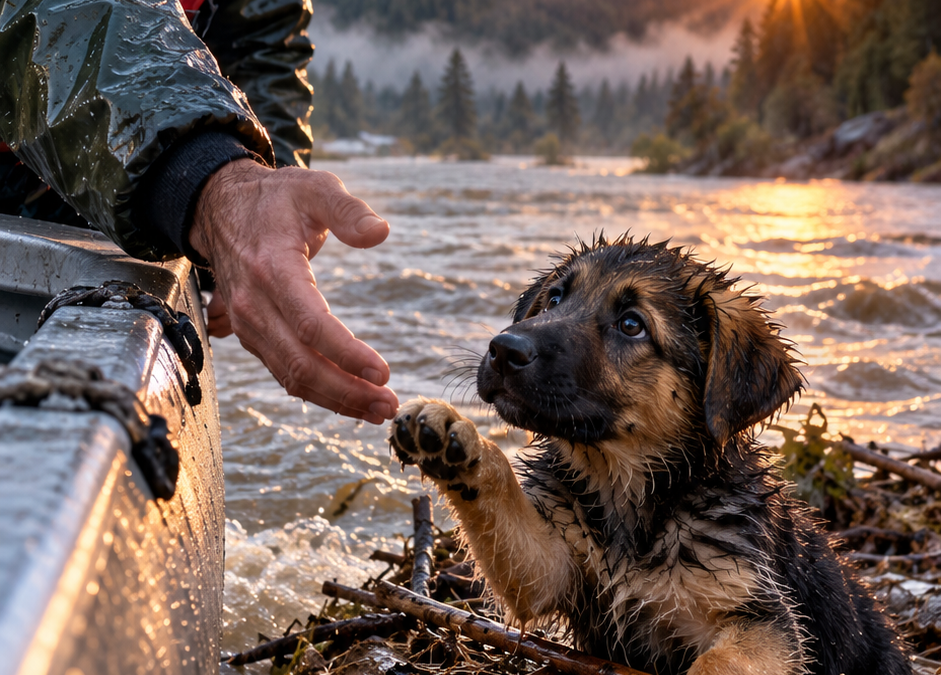
He lifted his right front paw.
Slowly.
Uncertainly.
And placed it on my wrist.
Not in my palm.
Not with confidence.
Just a tiny wet paw resting against my skin.
Testing me.
Asking a question.
I swallowed.
“Yeah,” I whispered.
My voice cracked.
“I’m here.”
His paw stayed there.
That was enough.
I slid my arm beneath his chest.
He stiffened.
For one awful second, I thought he’d panic and jump.
Instead, he leaned into me.
I lifted him.
He weighed almost nothing.
That frightened me more than his silence had.
A German Shepherd puppy that age should have felt solid, awkward, full of growing bone and badly coordinated energy.
He felt like a wet coat with a heartbeat inside it.
I pressed him against my chest.
The instant I did, his head disappeared under my chin.
He didn’t struggle.
Didn’t bite.
Didn’t squirm.
He simply folded into me.
And I knew then that whatever had happened before I found him, he was finished doing it alone.
“Got you.”
His heart hammered against my ribs.
“Got you, buddy.”
Behind us, the root mat shifted.
A section broke free.
Then another.
I turned toward shore.
The puppy tightened against me.
“Now comes the part where we pretend this was a good plan.”
The return trip was worse.
The current seemed determined to collect what I had stolen from it.
With one arm around the puppy, I had only one hand free for balance.
My boots slid over the bottom.
The rope helped, but the angle pulled awkwardly across my side.
Halfway back, my right foot landed between two rocks.
My ankle twisted.
I lost balance.
Water surged up to my chest.
The puppy yelped and tried to climb higher against me.
I grabbed the rope.
For two seconds, maybe three, I thought we were both going down.
The current pulled hard enough that I could feel the strain in my shoulder.
“Not today,” I growled.
I don’t know who I was talking to.
The river.
My ankle.
The universe.
Maybe all three.
I forced my foot free.
Found another rock.
Pushed upward.
The puppy’s claws dug into my shirt.
He was trembling hard now.
“I know.”
I sucked air through my teeth.
“I know.”
We moved again.
Step.
Brace.
Pull.
The shore looked absurdly far away.
I became aware of my breathing.
Too fast.
My fingers were numb.
The cold had worked its way through everything.
Then the puppy moved his head.
He licked my chin.
One tiny swipe.
I actually laughed.
“You have terrible timing.”
He tucked his head back under my jaw.
“All right.”
Another step.
“You win.”
When the water finally dropped below my knees, I nearly fell again from relief.
I stumbled through the shallows, reached the gravel, and climbed the bank on all fours with the puppy still pressed against me.
Then I rolled onto the grass.
For several seconds, I lay on my back staring at the sky.
The puppy lay on my chest.
The river roared below us.
Neither of us moved.
Then I felt it.
His tail.
One weak tap against my side.
I lifted my head.
“Was that a wag?”
His eyes were half closed.
The tail moved again.
Once.
“Don’t overdo it.”
I sat up and wrapped him in my jacket.
His body shook violently now that we were out of immediate danger.
I checked his paws.
One pad was scraped.
There were small cuts along one leg.
No obvious broken bones.
That was more luck than either of us had earned.
“Okay,” I said.
“We need a name.”
He stared at me from inside the jacket.
I don’t know why I chose Hondo.
The word just arrived.
Maybe I had heard it somewhere years earlier.
Maybe I wanted something strong enough to lend him a little weight.
“Hondo.”
One ear lifted.
I smiled.
“That’s either approval or a muscle spasm.”
His eyes blinked slowly.
“Hondo it is.”
I called my rescue friend.
She answered before the first ring had properly finished.
“Jack?”
“I’ve got him.”
There was silence.
Then, “You absolute idiot.”
“Good to hear your voice too.”
“Are you hurt?”
“Only in all the places I normally hurt, plus several exciting new ones.”
“The puppy?”
“Alive. Cold. Thin. Scared.”
“Bring him in.”
“I’m taking him home first. Warm him up. Then vet.”
“Jack, if he’s hypothermic—”
“I know.”
“Don’t heat him too fast.”
“I know.”
“And no full meal.”
“I know.”
“And—”
“I said I know.”
She paused.
“You sound shaken.”
I looked down at the puppy.
His head rested against my arm.
His eyes were closing.
“I am.”
I carried him up the trail.
The distance to my truck was less than half a mile.
It felt like five.
My wet jeans dragged against my legs. My ankle complained with every step. My hands were scratched and bleeding from the roots.
Hondo never made a sound.
He stayed tucked against my chest, nose buried in the fold of my jacket.
Occasionally his body jerked as though he were fighting sleep.
“Go ahead,” I murmured.
“You can sleep.”
His eyes opened.
“No?”
He stared at me.
“Fine. Supervise.”
At the truck, I opened the passenger door and laid him carefully on the seat.
I kept emergency blankets and towels behind the cab because rescue volunteering teaches you that clean upholstery is a temporary condition.
I dried him gently, then wrapped him in two towels.
The heater went on low.
Hondo curled into the corner.
He looked so small against the seat that I felt another wave of anger.
Not at the river.
The river was a river.
It had never promised kindness.
People were different.
Somewhere behind this puppy was a story.
Maybe he’d escaped.
Maybe he’d been lost.
Maybe someone had abandoned him.
I didn’t know.
What I did know was that he was underweight enough for neglect not to have started that afternoon.
That kind of thinness takes time.
I opened the console and found a packet of plain crackers.
Not ideal.
I broke off a small piece and offered it.
Hondo sniffed.
Pulled back.
Sniffed again.
Then looked at me.
“It’s not poison.”
He continued staring.
“Admittedly, that’s exactly what somebody holding poison might say.”
His tongue touched the cracker.
Then he took it carefully.
He chewed as though the act required concentration.
When he swallowed, I had to look out the windshield.
There are things that shouldn’t make a grown man emotional.
A puppy swallowing half a cracker is probably one of them.
Apparently, nobody had explained that rule to me.
“Good?”
Hondo licked my fingers.
“Yeah.”
I started the truck.
“Let’s go home.”
He watched the road for perhaps five minutes.
Then he lowered his head onto my thigh.
That was the first moment I understood I was in trouble.
Not veterinary trouble.
Not rescue trouble.
Personal trouble.
I had fostered dogs before.
Transported them.
Sat with them through surgeries.
Driven them across counties to new homes.
I knew how attachment worked.
You help.
You stabilize.
You find the right family.
You let go.
Very civilized.
Very sensible.
Hondo placed one paw on my knee and fell asleep.
And somewhere in the space of three breaths, all that civilized thinking became suspiciously theoretical.
My house sat on a few acres outside town.
Nothing fancy.
Two bedrooms, old wood floors, a detached garage, fenced yard, porch that needed repainting every year and somehow never got painted.
I carried Hondo inside.
He woke when the door shut.
His whole body tensed.
I stopped.
“New place.”
His eyes moved across the room.
“No surprises.”
I lowered him onto a blanket beside the heater.
His legs buckled.
That scared me.
He tried again.
His back legs trembled.
Then he sank down.
“Okay.”
I knelt.
“No heroics.”
That was rich coming from me.
I brought a bowl of lukewarm water.
He stared at it.
I slid it closer.
“Water.”
Nothing.
I dipped my finger into it and touched a drop to his nose.
He licked.
Then another.
Finally he leaned forward and took one small sip.
Then another.
Then another.
He tried to drink faster.
I moved the bowl back.
“Slow.”
His eyes followed it.
“I know. I’m awful.”
I let him have another little drink.
That night I called Dr. Meyers, a veterinarian who had helped several animals from the rescue group.
I described Hondo’s condition.
“Bring him first thing tomorrow unless he worsens,” he said. “If his breathing changes, gums go pale, he vomits repeatedly, or can’t stay conscious, you call me back and we’ll meet at the clinic.”
I wrote every symptom down even though I knew I would remember them all.
After the call, I sat on the floor beside Hondo.
He watched my hands.
Not my face.
My hands.
That told me something.
Whenever I moved suddenly, his shoulders tightened.
I reached toward his ear.
He flinched.
Not dramatically.
He simply pulled his head away and froze.
I stopped immediately.
“Yeah.”
I lowered my hand.
“Somebody taught you that.”
His eyes remained on my fingers.
“You didn’t learn that from the river.”
I wanted to know who had owned him.
I wanted an address.
A name.
A clean target for all the anger gathering in my chest.
But the only thing I actually had was a frightened puppy who needed me calm.
So I swallowed the anger.
“Nobody’s touching you unless you want them to.”
Hondo stared.
“I realize contracts with dogs are legally questionable.”
His ears shifted.
“But I’m saying it anyway.”
I placed my hand on the floor between us.
Didn’t move it.
A minute passed.
Maybe two.
Then he stretched his neck forward and sniffed my knuckles.
That was all.
It felt enormous.
I slept on the floor that night.
Or tried to.
Every sound woke me.
A change in breathing.
A small movement.
The heater clicking off.
Wind against the window.
At around two in the morning, Hondo whimpered in his sleep.
I opened my eyes.
His paws twitched.
His breathing quickened.
Then he jerked awake and tried to stand.
He looked around wildly.
“Hondo.”
His head snapped toward me.
“You’re here.”
He froze.
I didn’t reach for him.
“Same room.”
He stared.
“Same boring old man.”
His breathing slowed.
After a moment, he crawled toward me.
Not much.
Maybe eighteen inches.
He stopped beside my arm.
Then lowered his chin onto my sleeve.
I lay perfectly still.
For the first time that day, the anger inside me changed shape.
It became determination.
I couldn’t rewrite whatever had happened before the river.
But I could make sure the rest of his story embarrassed the beginning.
Morning came gray and cold.
Hondo looked marginally better.
Marginally was enough.
I made diluted chicken broth and let it cool until it was warm.
The smell woke him immediately.
His nose lifted.
I smiled.
“There you are.”
He tried to stand.
His front legs worked.
His back legs disagreed.
He sat down again with an expression so offended that I almost laughed.
“Take it up with management.”
He tried again.
This time he made it to the bowl.
He drank too fast.
Coughed.
Then looked at me.
“Exactly.”
I pulled the bowl away.
“Apparently neither of us understands moderation.”
He licked the floor.
“Hondo.”
He kept licking.
“That is wood.”
He looked up.
“Very nutritious.”
By nine, we were at Dr. Meyers’s clinic.
The receptionist knew me well enough to look from my scratched hands to the puppy and sigh.
“What did you do now?”
“Good morning to you too.”
“Jack.”
“River.”
She closed her eyes.
“Of course.”
Hondo pressed closer to my chest.
Her expression softened immediately.
“Oh, sweetheart.”
“He’s had a rough day.”
“Apparently so have you.”
“I’m delightful.”
“You look like you lost a fight with a tree.”
“The tree cheated.”
Dr. Meyers came out a minute later.
He was in his early sixties, calm in the way experienced veterinarians often are. Not detached. Just economical with alarm.
He took one look at Hondo.
His face changed.
“Exam room.”
That single phrase tightened my stomach.
Inside, I placed Hondo on the table.
He immediately moved toward me.
His claws clicked against the stainless steel.
I put one hand against his chest.
“I’m here.”
Dr. Meyers examined his eyes, gums, ears, belly, joints, paws.
Hondo tolerated it silently.
Too silently.
“Three months?” I asked.
“About that.”
“Weight?”
“Twenty-one pounds.”
I knew enough about German Shepherds to understand.
“Too low.”
“Very.”
Dr. Meyers ran his fingers along Hondo’s spine.
“He’s severely underweight and dehydrated. He’s got some superficial injuries, probably from debris. Mild hypothermia yesterday, from what you’re describing. No obvious fractures.”
“That’s good.”
“It’s good.”
He looked at me.
“It’s not the same as fine.”
“I know.”
“We’ll do fluids, bloodwork, fecal test, check for parasites, scan for a microchip.”
I nodded.
“What about infection?”
“Possible. His immune system is compromised. Malnutrition makes everything harder.”
Hondo turned his head and stared at me.
I felt absurdly responsible for the result of tests on a dog I’d known less than a day.
“Do what you need.”
The technician prepared fluids.
When the needle went in, Hondo stiffened.
His eyes locked on mine.
“Hey.”
I touched his cheek.
“Stay with me.”
He didn’t cry.
That almost made it worse.
Twenty minutes later, Dr. Meyers came back.
“No chip.”
I exhaled slowly.
“Of course.”
“You were hoping?”
“I was hoping there’d be a way to know what happened.”
“There still might be.”
“Lost dog reports?”
“We can check. Shelters too.”
I looked at Hondo.
“What kind of condition would a puppy have to be in before he got lost to end up this thin?”
Dr. Meyers didn’t answer immediately.
“Long enough that yesterday wasn’t the beginning of his problem.”
That was the professional version.
My private translation involved several words unsuitable for a veterinary clinic.
“Could he have been living stray?”
“Absolutely.”
“At that age?”
“Unfortunately.”
“Great.”
Dr. Meyers gave me a look.
“Jack.”
“I’m calm.”
“You have the face you get when you’re not calm.”
“I only have one face.”
“That’s unfortunate.”
Hondo’s bloodwork showed dehydration, anemia, and signs consistent with prolonged poor nutrition.
Parasites too.
Nothing immediately catastrophic.
Yet.
Dr. Meyers gave me medication, feeding instructions, warning signs, and enough paperwork to make it appear I had adopted a small corporation.
Before we left, the receptionist posted Hondo’s photo with local shelters and rescue networks.
I did the same.
Part of me hoped someone would recognize him.
Another part dreaded who might.
For the next three days, nobody claimed him.
No missing-puppy report matched.
No frantic family called.
No breeder contacted the rescue.
No owner appeared with proof.
Nothing.
It is possible that Hondo wandered farther than anyone thought.
It is possible he came from a rural property.
It is possible somebody had been looking for him.
I want to be fair about that.
But fairness has limits.
A puppy doesn’t become that thin in an afternoon.
Whatever explanation existed, Hondo had been surviving neglect long before he started surviving the river.
By the second day at my house, he could stand without falling.
Mostly.
He walked like a drunk little deer.
His paws went one direction while the rest of him negotiated.
He took three steps toward the window and collapsed onto his side.
I laughed before I could stop myself.
Hondo lifted his head.
“You look ridiculous.”
One ear rose.
“I mean dignified.”
His tail moved once.
I stared.
He did it again.
“Was that for dignified?”
Another twitch.
“Manipulative.”
Over the next few days, his appetite improved.
I divided his food into small meals.
He believed this policy was evidence of corruption at the highest level.
Every time I carried the bowl away, he stared after it with a look of betrayed outrage.
“Doctor’s orders.”
Hondo licked the empty dish.
“You’ve already removed the molecular residue.”
He looked at me.
“No.”
His ears leaned forward.
“Still no.”
He sat.
The ribs were still visible, but there was more life behind his eyes.
By day four, he followed me from room to room.
Not close enough to touch.
Just close enough to monitor.
Kitchen.
Hallway.
Office.
Garage.
If I closed a door, I would open it later and find him sitting on the other side.
The first time, I nearly tripped over him.
“Hondo.”
He looked up.
“I went to the bathroom.”
Tail thump.
“I was gone forty seconds.”
Another thump.
“Have some dignity.”
None.
That was the strange thing about living alone.
You get used to silence until silence becomes furniture.
You stop noticing it.
Then a twenty-pound dog enters the house and suddenly there are sounds everywhere.
Claws on hardwood.
Water lapping.
A collar tag clicking against a bowl.
A sigh from beside the heater.
A body settling onto a blanket.
Hondo didn’t make the house noisy.
He made it occupied.
I hadn’t realized there was a difference.
The first time he went into the yard, he stood at the open door for nearly a minute.
I didn’t push him.
“Your call.”
His nose worked furiously.
Damp earth.
Grass.
Wood smoke from somewhere down the road.
A truck in the distance.
Birds.
The world.
He placed one paw outside.
Then pulled it back.
“Fair.”
Another sniff.
One paw again.
Then two.
His whole body followed.
He froze.
I stayed in the doorway.
He looked back.
“I’m here.”
He stepped into the grass.
For maybe ten seconds, he just stood there.
Then something changed in his face.
Curiosity.
It was subtle.
His ears moved toward a bird.
His nose tracked a scent.
His head tilted at a leaf moving across the lawn.
He took a step.
Then another.
By the time he reached the edge of the porch, his tail was halfway up.
He looked back again.
I had the ridiculous urge to clap.
Instead, I nodded.
“Go ahead.”
He sniffed the grass.
Really sniffed it.
As though grass were the most astonishing invention in the history of creation.
Then he sneezed.
I laughed.
He jumped.
I stopped.
“Sorry.”
His eyes stayed on me.
Then, very slowly, his mouth opened.
Not a pant.
Something close to it.
The beginning of relaxation.
That afternoon, he fell asleep on my boot.
I didn’t move for almost an hour.
At forty-five, circulation is not something a man should casually sacrifice.
I did anyway.
The first week passed.
Then Hondo got sick.
It started so quietly that I nearly missed it.
He had been eating.
Exploring.
Getting stronger.
Then one evening he left half his meal.
For Hondo, that was the canine equivalent of writing a legal will.
“You done?”
He walked away.
I touched the bowl.
Still warm.
“Hondo?”
He curled beside the back door.
His ears were low.
I knelt.
He didn’t move toward me.
That was when I felt the fear return.
I touched his side.
Too warm.
Not heater warm.
Fever warm.
His breathing was faster.
“Hey.”
He opened his eyes.
They looked dull.
“No.”
I grabbed my phone.
Dr. Meyers answered.
“What’s his temperature?”
“I haven’t taken it.”
“Can you?”
“Yeah.”
A minute later I called back.
“One-oh-four point one.”
“Bring him.”
That was all.
I wrapped Hondo in a blanket and carried him to the truck.
He didn’t protest.
His head hung against my arm.
Five days earlier, I’d thought carrying him from the river had been frightening.
This was worse.
Then, I had been fighting something visible.
Current.
Cold.
Distance.
Now I was fighting the possibility that his body had simply reached the end of what it could repair.
“Don’t do this.”
Hondo’s eyes opened.
“I’m serious.”
I put him on the passenger seat.
“You went through all that trouble making me attached to you.”
His eyes closed.
“You don’t get to quit now.”
It was an unfair thing to say to a sick puppy.
Fear is not known for fairness.
At the clinic, Dr. Meyers met us at the side door.
He took Hondo from me.
For the first time since the river, I hated letting somebody else hold him.
“We need bloodwork again.”
“Fine.”
“Fluids.”
“Fine.”
“Antibiotics if the labs support infection.”
“Fine.”
“Jack.”
“What?”
“Sit down.”
“I’m fine.”
“You are shaking.”
I looked at my hands.
He was right.
I sat.
Hondo lay on the exam table.
The technician placed an IV catheter.
He barely reacted.
Dr. Meyers listened to his lungs.
Checked his abdomen.
Temperature again.
“Could be infection. Could be his system responding badly after prolonged malnutrition and parasite load. We need to monitor him.”
“Will he make it?”
Dr. Meyers looked at me.
Veterinarians know how to avoid lying kindly.
“I think he has a good chance.”
“That’s not what I asked.”
“It’s the best answer I have.”
I hated him for about three seconds.
Then I hated myself for hating the only person trying to help.
“Okay.”
“We’ll keep him overnight.”
“No.”
Dr. Meyers paused.
“No?”
“I’m staying.”
“Jack, there’s no reason—”
“I’m staying.”
“The floor isn’t comfortable.”
“I’ve slept on worse.”
“You need rest.”
“I’ll rest here.”
He sighed.
“You’re stubborn.”
“Doctor, I walked into the Willamette for a dog I didn’t know.”
“Point taken.”
The clinic became very quiet after closing.
Lights dimmed in the front.
Phones stopped ringing.
The smell of disinfectant seemed stronger without people moving around.
Hondo lay wrapped in a blanket with fluids running.
I sat on the floor beside the kennel.
For hours, nothing happened.
That’s another part of rescue nobody romanticizes.
Sometimes fighting for a life looks like doing nothing in a fluorescent room.
Waiting.
Watching.
Counting breaths.
At ten, Hondo shifted.
At eleven, he opened his eyes.
At eleven-thirty, he drank a little water.
At midnight, I put two fingers through the kennel door.
He moved one paw.
It landed on my hand.
The same paw.
Or maybe I only imagined it was.
Either way, I froze.
His toes tightened weakly around my fingers.
My throat closed.
“Hey.”
He looked at me.
“Remember the deal?”
His eyes stayed open.
“I don’t walk away.”
His paw remained against my hand.
“Apparently, neither do you.”
I stayed there until morning.
At seven, Dr. Meyers came in carrying coffee.
He looked at me.
“You look terrible.”
“Good morning.”
He checked Hondo.
Temperature lower.
Hydration improved.
Breathing better.
By noon, Hondo ate a few bites of boiled chicken.
I watched every bite.
Dr. Meyers leaned against the counter.
“You realize staring at him doesn’t add calories.”
“I disagree.”
“He needs rest.”
“So do you.”
“Nobody asked you.”
He smiled.
“You can take him home this afternoon if he continues improving.”
I almost didn’t understand the sentence.
“Home?”
“Yes.”
Home.
Not foster placement.
Not temporary holding.
Home.
I looked at Hondo.
He was licking chicken from my fingers.
Something settled inside me.
“Good.”
Dr. Meyers noticed.
“Have you decided something?”
“No.”
“That was a very decisive ‘good.'”
“I’m taking him home.”
“I know.”
“I mean permanently.”
He smiled.
“Yes, Jack.”
“What?”
“We’ve all known that for almost a week.”
“That’s ridiculous.”
“The receptionist started his adoption file yesterday.”
“Without asking me?”
“She has eyes.”
“This clinic has serious procedural problems.”
“Would you like me to cancel it?”
I looked at Hondo.
He looked back.
“No.”
“Thought so.”
The paperwork became official two days later, after the required stray hold and final checks.
No owner had appeared.
Nobody could prove where Hondo came from.
The mystery bothered me.
It still does.
But I learned something during those days.
Sometimes you don’t get the satisfaction of confronting the person responsible.
Sometimes there is no courtroom.
No confession.
No villain standing under perfect lighting while everybody realizes what a terrible human being he is.
Real life is often annoyingly inefficient that way.
Whoever had failed Hondo—whether through neglect, abandonment, cruelty, or simple indifference—never walked into my house and apologized.
I never got to deliver the speech I had constructed during several sleepless nights.
Probably for the best.
It was not a polite speech.
But that person didn’t get the ending either.
Hondo did.
And I decided that mattered more.
Recovery didn’t happen in a straight line.
That would have been convenient, and life rarely wastes an opportunity to be inconvenient.
Some mornings Hondo woke up energetic.
Other mornings he seemed withdrawn.
Certain noises sent him under the table.
The click of a metal tool dropping in the garage.
A raised male voice from a television.
A slammed door.
One afternoon, I lifted a broom too quickly.
Hondo flattened himself against the wall.
I stopped instantly.
The broom fell from my hand.
He stared at it.
Then at me.
I sat on the floor.
“Hondo.”
He didn’t come.
I waited.
“I’m sorry.”
His ears stayed low.
“That wasn’t for you.”
Nothing.
“You never have to run from me.”
He watched.
I wanted desperately to reach for him.
Instead, I let him choose.
Five minutes.
Ten.
Eventually he came forward.
One step at a time.
He sniffed the broom.
Then my knee.
Then he leaned against me.
I closed my eyes.
People talk about earning a dog’s trust as if it happens once.
It doesn’t.
With a frightened animal, you earn it over and over.
Every movement.
Every meal.
Every doorway.
Every night.
Trust is not a prize you win.
It’s a debt you keep paying.
Hondo taught me that.
He also taught me that a puppy recovering from starvation can become a remarkably efficient thief once his appetite returns.
The first incident involved half a chicken breast.
I had turned away for approximately six seconds.
When I looked back, the plate was empty.
Hondo sat beside the refrigerator.
Very straight.
Very innocent.
I stared at him.
He stared at me.
“Hondo.”
Nothing.
“Where is the chicken?”
His expression suggested he had never heard of poultry.
I looked at the empty plate.
Then at him.
His tail moved.
“You are a criminal.”
Tail again.
“An unrepentant criminal.”
He licked his nose.
“That’s evidence.”
His ears lifted.
I laughed.
That sound surprised both of us.
I hadn’t laughed much before Hondo.
Not really.
I worked.
I volunteered.
I kept busy.
Busy is a useful disguise.
If your calendar is full enough, nobody asks whether your life is.
I had friends.
People who cared about me.
But I had become comfortable being alone in a way that wasn’t entirely healthy.
There is a difference between solitude and retreat.
I had crossed it without noticing.
Hondo dragged me back.
Not dramatically.
He simply needed things.
Breakfast.
Walks.
Medication.
Training.
Patience.
He required me to participate in the day.
There was no staying in bed because the weather was gray.
There was a German Shepherd sitting beside the mattress at six-thirty, staring into my soul because his bladder had become a constitutional emergency.
“No.”
His nose touched my face.
“It’s Sunday.”
Nose again.
“Hondo.”
He sneezed directly on me.
I opened my eyes.
He was wagging.
“You’re disgusting.”
More wagging.
I got up.
By the third week, he had gained almost six pounds.
His coat began to shine.
The rough patches softened.
His legs strengthened.
His ears finally stood upright most of the time, though the left one occasionally folded at the top when he was tired.
I hoped it would stay that way forever.
It gave him character.
Dr. Meyers was pleased.
“Heart sounds good.”
Hondo stood on the exam table.
“Weight is moving in the right direction.”
Hondo sniffed the stethoscope.
“Energy clearly improved.”
Hondo tried to steal a treat from the technician’s pocket.
I folded my arms.
“He’s become morally compromised.”
The technician laughed.
“He feels better.”
“That’s no excuse.”
She gave him the treat.
I pointed at her.
“You’re enabling him.”
Hondo swallowed it and immediately searched for another.
Dr. Meyers looked at me.
“How’s the anxiety?”
“Better. Still startles.”
“Nightmares?”
“Sometimes.”
“Food guarding?”
“Not really. He watches the bowl like it owes him money, but no aggression.”
“Good.”
I hesitated.
“River?”
“What about it?”
“I haven’t taken him near it.”
“Don’t rush.”
“I wasn’t planning to.”
“He may not react the way you expect.”
That stayed with me.
Winter came.
Hondo grew.
German Shepherd puppies perform a fascinating trick where they somehow become taller every time you turn your back while retaining absolutely no understanding of where their legs are.
He ran into furniture.
Slid across floors.
Missed steps.
Barked at his own reflection.
One morning he discovered snow.
He stood on the porch and refused to move.
“What?”
He looked at me.
“It’s water.”
He looked at the snow.
“Cold water.”
Suspicion.
“You’ve had experience.”
He sniffed it.
Licked it.
Sneezed.
Then exploded.
He ran into the yard at full speed.
Leaped.
Landed chest-first.
Came up covered in white.
Stared at me.
Then did it again.
I laughed until my stomach hurt.
This was the same animal I’d carried from the river believing he might stop breathing in my arms.
Now he was attacking snowdrifts because apparently survival had made him arrogant.
Good.
Let him be arrogant.
Let him believe the world belonged to him.
He had earned some unreasonable confidence.
Training began once his health stabilized.
Basic commands.
Sit.
Stay.
Come.
Leave it.
Hondo learned quickly.
Too quickly, sometimes.
German Shepherds are dangerous that way.
They learn what you teach them and what you wish you hadn’t.
He understood “sit” in two sessions.
He also understood that sitting near the cabinet where treats were stored dramatically increased the probability of snacks.
Soon I couldn’t enter the kitchen without finding him already seated beside the cabinet.
“Hondo.”
Perfect posture.
“I’m making coffee.”
Focused stare.
“That is not dog food.”
Tail sweep.
“No.”
He remained sitting.
“This isn’t negotiation.”
He blinked.
“You’re a terrible negotiator.”
He continued sitting.
I gave him a treat.
Thus proving which of us was actually terrible at negotiation.
By January, he slept beside my bed.
Not on it.
I had rules.
He had not yet finished dismantling them.
One night, a thunderstorm rolled through.
Hondo woke before the first thunder.
I heard his claws scrape the floor.
Then a low whine.
“Hondo?”
Lightning flashed.
Thunder hit.
He tried to climb under the bed.
He was too big.
I sat up.
“Hey.”
Another crack.
He pushed against the mattress.
I got onto the floor.
Within seconds, he was pressed into my side.
I wrapped one arm around him.
“It’s weather.”
His entire body trembled.
“It sounds worse than it is.”
Another flash.
He buried his head under my arm.
I didn’t tell him to be brave.
I had stopped believing bravery meant not being scared.
Hondo had been terrified on the river.
He survived anyway.
That was bravery.
So I sat with him.
“You can be scared.”
His ears moved.
“I’m here.”
By the end of winter, he rarely flinched when I reached over him.
He greeted familiar visitors.
He played with other dogs from the rescue group.
He developed a particular affection for an elderly Labrador named Gus, who tolerated Hondo’s adolescent enthusiasm with the patience of a retired schoolteacher.
Hondo would launch himself at Gus.
Gus would sigh.
Hondo would bark.
Gus would lie down.
Hondo would circle him.
Gus would close his eyes.
The message was clear.
Youth was exhausting.
Spring arrived early.
The first warm week brought green back to the yard.
Hondo was nearly unrecognizable.
He was still young.
Still growing.
But the puppy from the river had become a strong, long-legged shepherd with bright eyes and a coat that caught the sunlight.
One afternoon, he ran the length of the yard carrying a stick approximately twice his size.
He hit the gate with one end.
The stick stopped.
Hondo did not.
He rolled spectacularly into the grass.
I covered my face.
“Excellent.”
He stood.
Shook.
Picked up the same stick.
“Lesson learned.”
He tried again.
Hit the other side.
I sat on the porch laughing.
Hondo looked offended.
“Sorry.”
I was not sorry.
He eventually abandoned the stick and ran toward me.
At the last second, he failed to stop.
Seventy pounds of young German Shepherd collided with my knees.
I nearly went backward over the chair.
“Hondo!”
He licked my chin.
“You are why insurance companies exist.”
His tail hammered against the porch.
That spring, I started taking him on longer trail walks.
Not near the exact rescue spot at first.
Different trails.
Different creeks.
Open fields.
He loved them.
He moved through the world with his nose first, collecting information I couldn’t perceive.
Deer.
Rabbits.
People who had passed an hour earlier.
Water.
Mud.
Things I preferred not to identify.
Whenever he got twenty or thirty feet ahead, he would stop.
Turn.
Look back.
Only when he saw me would he continue.
At first, I thought it was training.
Later, I understood it was something deeper.
He checked.
Always.
He needed to know I was still there.
Eventually, I realized I did the same thing.
One Saturday in April, I drove toward the Willamette.
I hadn’t planned to go to the rescue site.
At least that’s what I told myself.
But after months of avoiding it, the place had begun to feel larger in my mind than it probably was.
Hondo rode in the passenger seat, head near the open window.
When I turned onto the familiar road, my hands tightened around the wheel.
He noticed.
Of course he noticed.
His head turned toward me.
“I’m fine.”
He stared.
“I’m allowed to lie to myself.”
Tail thump.
When we reached the trail, I clipped on his leash.
He jumped from the truck.
For the first quarter mile, nothing changed.
He sniffed.
Marked a bush.
Tried to eat something disgusting.
I prevented it.
Normal life.
Then we came around the bend.
The river appeared through the trees.
Hondo stopped.
Not slowed.
Stopped.
His body went rigid.
I stopped too.
We were still fifty yards from the bank.
His ears moved forward.
His nose lifted.
For several seconds, he didn’t breathe visibly.
Then he took one step backward.
“Hondo.”
His eyes stayed on the water.
I crouched.
“We can leave.”
His ears turned toward my voice.
“You don’t owe this place anything.”
He looked at me.
I meant it.
I had no interest in forcing some symbolic confrontation because it would make a nice story.
Dogs don’t need human narratives.
If he wanted to turn around, we would turn around.
I stood.
“Home?”
Hondo looked toward the truck.
Then back at the river.
He took one step forward.
I waited.
Another.
We moved slowly.
The closer we got, the more alert he became.
His tail lowered.
But he kept walking.
At the bank, he stopped again.
The river was calmer than the day I found him.
Sunlight moved across the surface.
Branches drifted past.
Hondo stared.
I wondered what he remembered.
Dogs remember differently than we do.
Scent.
Sound.
Body.
Fear stored somewhere beneath thought.
I watched his breathing.
Fast.
Then slower.
He stepped toward the water.
I tightened the leash without pulling.
“Easy.”
His paws reached the damp edge.
He sniffed.
A small wave touched the mud.
Hondo jumped back.
I almost laughed but stopped myself.
“Fair.”
He looked at me.
Then something unexpected happened.
His tail moved.
Once.
He stepped forward again.
He sniffed the water.
Then he turned away.
Just like that.
No dramatic bark.
No trembling collapse.
No cinematic moment where music would swell and everybody would understand exactly what healing looked like.
He simply decided he’d seen enough.
And started sniffing a stump.
I laughed.
“That’s it?”
Hondo investigated the stump.
“I’ve been worrying about this for six months.”
He lifted one leg.
“Hondo.”
Too late.
The stump received his opinion.
I stared at him.
Then at the river.
“Actually, that’s probably appropriate.”
We sat there for a while.
Hondo beside me.
The river moving past.
I searched the water for the place where I’d first seen the floating roots.
There was nothing.
Of course there wasn’t.
The river had carried that entire little island away within minutes after I pulled him off it.
For months, I’d imagined the place as fixed.
A landmark.
But rivers don’t work like that.
Neither does pain.
The exact thing that hurts you moves on.
What stays is what your body remembers.
Hondo leaned against my leg.
I rested my hand on his neck.
“You won.”
His ear turned.
“Do you know that?”
He looked up.
“Whatever happened before I found you.”
I scratched beneath his collar.
“It didn’t get you.”
His tail swept the ground.
“And whoever decided you weren’t worth protecting?”
I looked toward the river.
“They were wrong.”
Hondo licked my wrist.
I smiled.
“Spectacularly wrong.”
That was the defeat I had wanted.
Not revenge.
Not somebody being publicly humiliated.
Not an arrest.
Not some perfect punishment wrapped in a bow.
Something better.
The abandoned puppy had become impossible to abandon.
The starving puppy was healthy.
The silent puppy barked at delivery trucks like they had personally insulted his ancestors.
The puppy afraid of hands now shoved his enormous head under mine if I stopped petting him too soon.
The animal somebody had failed was loved so thoroughly that failure no longer defined him.
Whoever had written the beginning had lost control of the ending.
And I found that deeply satisfying.
We walked back to the truck.
Halfway there, Hondo found a puddle.
He stepped in it.
Stopped.
Looked at me.
“No.”
His eyes brightened.
“Hondo.”
He jumped.
Mud exploded across my jeans.
I stared at him.
He ran in a circle.
“You know, for an inspirational symbol, you’re an enormous pain in the ass.”
He barked.
It was a deep bark now.
Strong.
Confident.
Nothing like the silence on the river.
I loved that sound.
By summer, Hondo had become my shadow.
Garage?
Hondo.
Porch?
Hondo.
Trail?
Hondo.
Bathroom?
Unfortunately, Hondo.
I had started closing that door more firmly.
He had started lying against it.
We reached an understanding.
People in town began recognizing him.
The veterinary receptionist called him “River Dog.”
Kids loved him.
Hondo loved kids carefully, as if he understood they were fragile.
He would sit while they touched his ears.
Then look at me afterward with the expression of somebody expecting compensation for professional services.
“You survived six minutes of affection.”
Tail wag.
“Heroic.”
At rescue events, people sometimes asked whether I would ever foster again.
“Probably.”
They would point to Hondo.
“You failed with him.”
“Completely.”
Foster failure.
That’s what rescue people call it when you intend to temporarily care for an animal and end up adopting it.
The phrase sounds accusatory.
I accepted it proudly.
If Hondo was failure, I hoped to fail that badly again.
Months passed.
He continued filling out.
His chest broadened.
His gait became smooth.
The awkward puppy legs disappeared.
But certain things remained.
He still checked for me on trails.
Still slept where he could see the door.
Still became uneasy around fast-moving water.
Still watched strangers’ hands carefully before accepting touch.
Healing did not erase him.
I was grateful for that.
There is a version of rescue people like to imagine in which love fixes everything.
I don’t believe that anymore.
Love doesn’t erase history.
It gives history somewhere safer to live.
Hondo remembered things.
So did I.
The difference was that memory no longer controlled every decision.
One evening, almost a year after the rescue, I sat on the porch watching him lie in the grass.
Sunset had turned everything gold.
He rolled onto his back.
Paws in the air.
Completely defenseless.
A dog sleeping like that is telling you something.
The body only exposes itself when it believes danger is gone.
I watched his chest rise.
Fall.
Rise.
A year earlier, I had counted those breaths because I feared there would not be another.
Now I counted because I could.
Hondo opened one eye.
“You look ridiculous.”
His tail moved against the grass.
“Don’t start.”
He rolled over and came toward me.
Even grown, he still sometimes tried to fit his head beneath my chin the way he had on the river.
The physics no longer supported the arrangement.
He did it anyway.
I wrapped my arms around his neck.
He exhaled.
Long.
Content.
I thought about that floating mat of roots.
How fragile it had looked.
How close he had been to slipping into the water.
How impossible the odds had seemed.
People like to say I saved him that day.
Technically, yes.
I walked into the river.
I carried him out.
I took him to the vet.
I fed him.
I stayed beside him when he got sick.
Those are facts.
But facts can be incomplete.
Before Hondo, I had built a life that was functional.
Clean.
Quiet.
Predictable.
I had mistaken predictable for peaceful.
They are not the same.
Peace feels alive.
Predictability can feel like waiting.
Hondo ruined my schedule.
He ruined one rug.
Two pairs of work gloves.
A garden hose.
Half a screen door.
Several socks.
And one extremely expensive flashlight he somehow turned into a chew toy despite having access to objects specifically manufactured for that purpose.
He also ruined my ability to pretend I didn’t need anybody.
That was harder to replace.
One afternoon, a woman at the clinic recognized Hondo from his rescue photos.
“That’s him?”
She crouched.
Hondo sniffed her hand.
“That’s the river puppy?”
“Yeah.”
She looked at him.
He was eighty pounds by then.
Healthy.
Glossy coat.
Bright eyes.
“He’s beautiful.”
“I tell him he’s average.”
Hondo leaned against her.
She laughed.
“I saw the first photo. I didn’t think he’d make it.”
“Neither did I.”
Her smile faded slightly.
“Do you know who abandoned him?”
“No.”
“You never found out?”
“No.”
“Doesn’t that bother you?”
I looked at Hondo.
He had discovered the receptionist’s treat jar.
“It used to.”
“And now?”
Hondo sat beneath the jar.
Perfect posture.
A monument to shameless greed.
I smiled.
“Now I think whoever did it has to live in a world where they missed all this.”
She looked confused.
I nodded toward Hondo.
“They lost.”
That answer surprised me even as I said it.
But it was true.
Neglect loses every time a frightened dog learns to sleep deeply.
Cruelty loses every time a hand becomes something an animal seeks instead of fears.
Abandonment loses every time the creature left behind finds a home better than the one that failed him.
Hondo’s past had taken enough from him.
It wasn’t getting the satisfaction of defining him too.
A few weeks later, we returned to the river again.
This time, he walked directly to the bank.
No hesitation.
I unclipped the leash only after we reached a broad, safe stretch set well back from the stronger current.
Hondo wandered along the gravel.
He sniffed reeds.
Watched a duck.
Ignored the water.
Then something floated past.
A small tangle of branches.
Nothing remarkable.
To me, it looked uncomfortably familiar.
I stopped breathing for a second.
Hondo saw it.
His ears rose.
The debris moved downstream.
He watched.
I expected him to tense.
He didn’t.
He simply followed it with his eyes until it passed out of sight.
Then he turned toward me.
For one strange second, the puppy from that first afternoon was there again.
Same dark eyes.
Same stillness.
But the meaning had changed.
Back then, his gaze had asked whether I was real.
Now it seemed to ask why I was standing there looking sentimental instead of continuing the walk.
“Fine.”
I cleared my throat.
“You have somewhere important to be?”
He trotted ahead.
“Apparently.”
We followed the trail along the river.
At one point Hondo stopped near the water.
He looked across it.
Then back at me.
I remembered the tiny paw touching my wrist.
That fragile moment of decision.
He hadn’t known me.
I hadn’t known him.
He could have pulled away.
I could have arrived five minutes later.
The roots could have broken sooner.
A thousand small things could have gone differently.
People call that fate.
I’m not sure.
Maybe fate is just the name we give the moments we survive long enough to understand.
What I know is this.
Hondo chose to touch my hand.
I chose not to let go.
Everything else grew from there.
That afternoon, back at home, he sprawled across the porch while I worked on a loose railing.
He had become my official supervisor.
This position required sleeping approximately ninety percent of the shift.
“Very helpful.”
One eye opened.
“I appreciate the oversight.”
His eye closed.
I tightened another screw.
The railing was nearly finished when a gust of wind moved through the trees.
Somewhere beyond the property, water rushed through a drainage ditch.
Hondo’s ears twitched.
Then relaxed.
That tiny movement would have meant nothing to anyone else.
To me, it meant everything.
The sound of moving water no longer owned him.
Fear had lost another inch of territory.
I sat down beside him.
He raised his head.
“Remember when you fit in one arm?”
He stared.
“You were much cheaper to feed.”
His tail hit the boards.
“And less destructive.”
Another thump.
“I should have left you in the river.”
His head came up sharply.
I stared at him.
Then laughed.
“I’m kidding.”
Hondo climbed half onto my lap.
At eighty pounds.
“Okay.”
I pushed at him.
“Very funny.”
He licked my face.
“You know sarcasm is wasted on you.”
More licking.
“Absolutely wasted.”
I stopped resisting.
The sun lowered through the trees.
Hondo eventually settled beside me.
His shoulder touched mine.
I listened to his breathing.
Steady.
Deep.
Easy.
The exact opposite of that first night.
I thought about the person I had been when I walked down the trail to clear storm debris.
I had expected an ordinary afternoon.
A few branches.
Maybe some mud.
Instead, a little black-and-tan animal floating on a collapsing island had quietly rearranged my life.
He never asked permission.
Typical German Shepherd.
I don’t know how Hondo reached the river.
Maybe I never will.
I don’t know where he spent the nights before that day.
I don’t know how long he’d been hungry.
I don’t know whose hands taught him to flinch.
Those missing answers used to feel like unfinished business.
Now they feel less important.
The river was not his story.
It was a chapter.
Abandonment was not his identity.
It was something done to him.
Fear was not his personality.
It was something he learned.
And learned things can sometimes be replaced.
Fear by routine.
Hunger by full bowls.
Silence by barking.
Loneliness by somebody waiting at home.
Pain by memory.
Memory by something gentler beside it.
Hondo taught me healing wasn’t the grand transformation people like to imagine.
It happened in ridiculous little pieces.
The first sip of water.
The first tail flick.
The first stolen chicken.
The first bark.
The first full night’s sleep.
The first thunderstorm he endured without hiding.
The first time he stood beside the river and chose curiosity over fear.
None of those moments looked important from the outside.
Together, they built a life.
His life.
Mine too.
By his first birthday—or the date Dr. Meyers estimated was close enough—I bought him a ridiculous dog-safe cake.
I will deny this under oath.
The rescue group came over.
So did Dr. Meyers.
Hondo wore no party hat because I had standards.
My friend from the original phone call arrived carrying a bag of toys.
She looked at Hondo.
Then at me.
“You know what I remember?”
“What?”
“You telling me you were taking him home ‘for the night.'”
“That was the plan.”
She laughed.
“You never had a chance.”
“I had excellent boundaries.”
Hondo walked past carrying a stuffed duck.
She pointed.
“He sleeps in your bedroom.”
“On the floor.”
“He has his own orthopedic bed.”
“Medical necessity.”
“He has a basket labeled ‘Hondo’s towels.'”
“Organizational efficiency.”
“You installed a camera so you could check on him when you’re out.”
“Security.”
“You canceled a weekend trip because he had diarrhea.”
“That’s enough.”
Dr. Meyers laughed.
I looked at Hondo.
He dropped the duck and leaned against my leg.
“Fine.”
I scratched his neck.
“I may have become moderately invested.”
My friend raised an eyebrow.
“Moderately.”
Hondo looked up at me.
That same look.
I smiled.
“Don’t encourage her.”
After everyone left, pieces of wrapping paper littered the room.
Dog toys covered the floor.
Hondo was exhausted.
He collapsed by the couch, surrounded by evidence that a dog nobody had claimed a year earlier now had more birthday presents than most children.
I sat beside him.
He opened one eye.
“Big day.”
His tail tapped once.
“You did all right.”
Another tap.
“You know what the best part is?”
He closed his eye.
“You don’t even know.”
I rested my hand on his side.
“You don’t know you’re supposed to be tragic.”
His breathing slowed.
“That’s why you won.”
He slept.
And for a while, I simply watched him.
The puppy who had lain silent on a floating island was gone.
Not erased.
Transformed.
He had grown into himself.
He was stubborn.
Smart.
Protective.
Goofy.
Suspicious of vacuum cleaners.
Unreasonably interested in cheese.
Completely convinced that delivery drivers represented an organized threat to national security.
He was a dog.
Not a symbol.
Not a rescue statistic.
Not a sad photograph.
A dog.
That may have been the greatest victory of all.
His past had become boring compared with his present.
Years from now, if somebody asks me what I remember most about that day on the river, I know what they expect.
They expect me to say the current.
Or the cold.
Or how close I came to falling.
Maybe the moment I lifted Hondo from the roots.
Those things remain vivid.
But they’re not what stays with me most.
It’s the paw.
That tiny paw on my wrist.
He had every reason not to trust me.
Whatever his short life had taught him about the world, it had not been particularly flattering.
Still, he tried once more.
One paw.
One decision.
One last gamble on kindness.
People sometimes say animals don’t understand hope.
I think that’s nonsense.
Maybe they don’t have a word for it.
Neither does the river.
That doesn’t mean it isn’t there.
Hope is what makes a starving puppy reach toward a stranger.
It’s what makes him drink from the bowl after being afraid of the room.
It’s what makes him walk again after his legs failed.
It’s what makes him trust sleep after nights spent surviving.
And sometimes hope looks embarrassingly ordinary.
It looks like a German Shepherd standing at the back door at six in the morning because he has decided you have slept enough.
These days, Hondo wakes me before sunrise.
He stretches beside the bed.
Shakes.
His collar tags jingle.
Then he puts his nose against my hand.
If I ignore him, he escalates.
One paw on the mattress.
Then another.
“Hondo.”
Tail wag.
“Absolutely not.”
Nose against my face.
“It’s dark.”
More wagging.
“You live here for free.”
No remorse.
Eventually, I get up.
Every time.
We go outside.
He runs into the yard.
Sometimes he stops in the grass and turns toward me.
Morning light catches his coat.
His ears stand tall.
His tail moves slowly.
And for just a second, I see both versions of him.
The puppy on the roots.
The dog in my yard.
They exist together.
One proves what happened.
The other proves it didn’t win.
That is the ending I wanted for him.
Not that he forgot.
Not that everything became perfect.
Not that whoever failed him received some dramatic punishment I could enjoy from the front row.
Something more complete.
Hondo became happy.
There is a particular kind of justice in that.
Whoever treated him as disposable was wrong.
Whoever left him hungry was wrong.
Whatever fear told him the world would always hurt was wrong.
The river was wrong.
The odds were wrong.
Even I was wrong on the nights I wondered whether his body had enough strength left.
Hondo outlived every prediction his condition seemed to make about him.
He gained weight.
He grew.
He barked.
He ran.
He stole food.
He destroyed expensive property.
He learned to sleep on his back in the middle of the living room with his paws in the air and not one ounce of dignity.
He became gloriously ordinary.
And the person who had failed him—whoever that was—became irrelevant.
That may be the most satisfying defeat possible.
A cruel person wants fear to last.
It didn’t.
Neglect wants damage to remain.
It didn’t.
Abandonment says, in one form or another, You don’t matter enough for somebody to stay.
Every morning when Hondo wakes up and finds me still there, that lie loses again.
One evening near the end of summer, we walked down to the river at sunset.
The water moved slowly under an orange sky.
Hondo was older now.
Not old.
Just past puppyhood.
Strong.
Sure of himself.
We followed the same trail.
At the place where I’d first spotted him, I stopped.
Hondo continued a few feet.
Then realized I wasn’t beside him.
He turned.
There it was.
The check.
Still there.
I smiled.
“I’m coming.”
He waited.
I joined him.
Together, we went down to the bank.
He sniffed the air.
A branch floated past.
Then leaves.
Then a clump of reeds.
Hondo watched them.
I watched him.
He stepped close enough that the water touched one paw.
He looked down.
Didn’t jump.
Didn’t retreat.
Just stood there.
Then he turned toward me and gave a single bark.
Strong.
Clear.
Confident.
The sound traveled across the water.
I laughed.
“Yeah.”
His tail wagged.
“I hear you.”
He barked again.
The river carried the sound downstream.
For a moment, I imagined it reaching the place where his little floating island had finally broken apart.
Reaching every mile of water that had once seemed too big for him.
A year earlier, that river had held a silent puppy who seemed to have used up every sound he had.
Now Hondo stood on solid ground and barked at it.
That was enough poetry for me.
“Come on.”
I turned toward the trail.
“Let’s go home.”
Hondo ran ahead.
Then stopped.
Looked back.
Waited.
I followed.
He moved again.
And that was how we left the river.
Not with a dramatic farewell.
Not with sadness.
Not with fear.
With Hondo twenty feet ahead of me, tail up, ears forward, impatient to get on with the rest of his life.
I think about that whenever someone asks whether rescuing him changed me.
The answer is yes.
But not because I became kinder.
I already cared about animals.
Not because I became brave.
I was terrified most of the time.
Hondo changed me because he made me understand that saving something isn’t one heroic moment.
Walking into the river was easy compared with what came after.
The meals.
The medicine.
The sleepless nights.
The vet visit when I thought I’d lose him.
The patience when he flinched.
The restraint when I wanted to force trust faster.
The repetition.
The ordinary days.
Love turned out to be less like jumping into dangerous water and more like staying.
Again.
And again.
And again.
Hondo understood that before I did.
Maybe that’s why he always checked to see whether I was behind him.
He wasn’t asking whether I could save him anymore.
He was asking whether I was still there.
I always was.
I still am.
Tonight, as I’m telling this, Hondo is asleep six feet from me.
He’s stretched across the rug.
One back paw twitches every few seconds.
Probably dreaming.
His coat shines under the lamp.
His ribs are hidden beneath healthy muscle.
His breathing is slow.
Deep.
Safe.
Outside, rain has started against the windows.
Somewhere beyond the trees, the Willamette is rising a little with the weather.
I can hear water in the distance.
Hondo can too.
One ear moves.
Then settles.
He doesn’t wake.
I look at him and remember the little dog who refused to bark because perhaps silence had been safer.
The puppy who clung to broken roots.
The paw against my wrist.
The weight of him in my arms.
The first weak tail wag.
The first meal.
The fever.
The first bark.
The first time he ran.
The first time he faced the river again.
All of it is still there.
But none of it hurts the way it used to.
That’s the strange thing about endings.
A good ending doesn’t delete the beginning.
It changes what the beginning means.
Hondo’s story didn’t begin with me.
There were days before the river I will never know.
Somebody failed him.
Maybe several people did.
But his life did not end at the point of their failure.
Their part became small.
Mine became bigger.
And eventually, Hondo’s own part became bigger than all of us.
He isn’t the puppy somebody left behind.
He’s Hondo.
My dog.
My shadow.
My alarm clock.
My hiking partner.
My professional kitchen thief.
My reminder that trust can come back even after somebody has given it reasons not to.
The river almost carried him away.
Neglect almost starved him.
Infection almost took the fragile strength he’d fought to rebuild.
Fear tried to convince him that every hand was dangerous and every safe place temporary.
None of it won.
Hondo did.
And every morning when he stands in my yard beneath the Oregon sky, healthy and loud and impatient for breakfast, the victory starts all over again.
Sometimes he looks back at me.
I know that look now.
It isn’t the look he gave me from the floating island.
Not exactly.
Back then, he was asking one question.
Can I trust you?
Now the question is simpler.
Are you coming?
I grab my jacket.
“Yeah, buddy.”
His ears rise.
“I’m coming.”
And he runs ahead, because he already knows I will.








