𝗣𝗔𝗥𝗧 𝟮 A German Shepherd Puppy Waited Outside Rehab for 5 Days in the Rain—But His Family Never Came Back
PART2
The next morning, I returned before four.
I told myself I was being practical.
Really, I was testing a theory.
Maybe I’d romanticized it.
People in rescue work have to be careful about that. Once you’ve seen enough dogs abandoned, injured, surrendered, or dumped, it’s easy to build stories around behavior because stories make suffering easier to organize.
Maybe the puppy lived nearby.
Maybe someone fed him around the corner.
Maybe the warm air from the automatic doors was simply his favorite place.
So I parked across the street at 3:50 p.m.
No puppy.
Rain glossed the pavement.
Cars moved slowly through the intersection.
People came and went through the lobby.
3:53.
Nothing.
3:55.
Nothing.
I started feeling foolish.
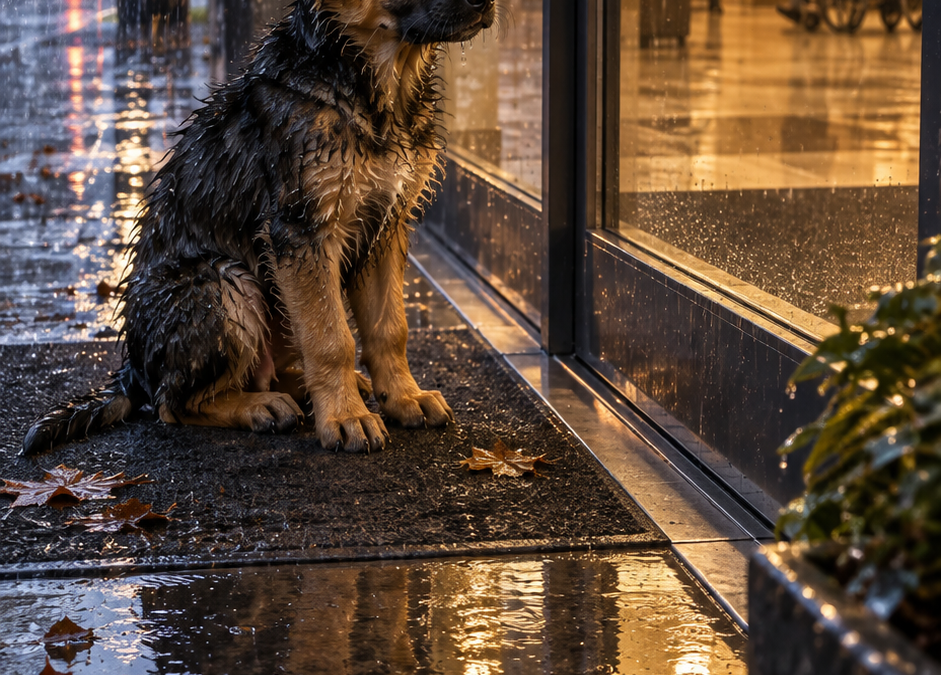
Then, at 3:57, a black-and-tan shape appeared from the residential street to the east.
The puppy.
He wasn’t wandering.
He was trotting.
Fast.
Purposeful.
Head up.
Tail low.
Eyes already locked on the building.
I stared at the clock on my dashboard.
“Are you kidding me?”
He crossed toward the rehab center and went directly to his usual spot.
Not the dry corner.
Not the covered walkway.
The wet rectangle in front of the doors.
He sat.
Four o’clock.
Exactly.
I got out carrying a stainless-steel bowl and some food.
The puppy looked at me.
Recognition flickered across his face.
Not excitement.
Just acknowledgment.
You again.
I put the bowl beneath the awning.
“Come on.”
He sniffed it.
Hunger won.
He ate quickly.
That told me something too.
He wasn’t being fed regularly.
Maybe scraps.
Maybe nothing.
When he finished, he licked the bowl once.
Then walked straight back into the rain.
I stared at him.
“You know,” I said, “most dogs have enough sense to wait somewhere dry.”
He looked through the glass.
“Right. Stupid question.”
Inside, I found the same receptionist.
She sighed when she saw me.
“I knew you’d be back.”
“I’m charming.”
“You’re persistent.”
“That too.”
I nodded toward the entrance.
“He came from three blocks away at 3:57.”
She looked through the glass.
“Same spot?”
“Same spot.”
She shook her head.
I leaned on the counter.
“I need to know something. Did that patient actually ask for him?”
The receptionist lowered her voice.
“I told you—”
The nurse from yesterday passed again.
Maybe she had the same route every afternoon.
Maybe she had simply decided she was tired of watching bureaucracy perform interpretive dance around common sense.
“She asks every day,” the nurse said.
The receptionist closed her eyes briefly.
The nurse continued.
“Every day she asks whether her family brought Cedar.”
I looked at her.
“Cedar?”
“That’s his name.”
Outside, Cedar sat in the rain.
The simple fact of his name hit me harder than I expected.
Until then he had been the puppy.
The dog at the door.
The stray.
The problem.
The abandoned animal.
A category.
Now he was Cedar.
Someone had named him.
Someone inside those walls knew exactly who he was.
“Does she know he’s outside?”
The nurse’s face changed.
“No.”
“Why?”
“We didn’t know he was hers for sure.”
“He has been sitting outside for five days.”
“I know.”
“She asks for Cedar.”
“I know.”
“And Cedar shows up at the same time she was admitted.”
The nurse gave me a tired look.
“You think I don’t see the problem?”
Fair.
I exhaled.
“Can she see him through the lobby?”
“No. Wrong wing.”
“Can I show her a picture?”
“No personal contact without approval.”
“Can someone tell her he’s safe?”
“I can try.”
“Can someone bring her outside?”
That brought the receptionist fully into the conversation.
“No.”
“Why?”
“Gabriel.”
“I’m asking.”
“This is a treatment facility.”
“And he’s a dog.”
“Exactly.”
I waited.
She apparently realized that hadn’t strengthened her position.
“He may be emotionally significant,” she said, carefully choosing each word, “but patient access is governed by clinical schedules, privacy rules, stabilization plans—”
“Does the dog need to submit a visitor request in triplicate?”
The nurse coughed.
I suspect she was hiding a laugh.
The receptionist was less amused.
“You know what I mean.”
“I do. That’s the problem.”
I stepped outside.
Cedar saw me and stood.
I clipped a leash onto the temporary slip lead I carried.
He didn’t resist.
That told me something else.
This puppy had belonged to somebody.
He knew a leash.
He knew how to follow.
He knew doors.
He knew waiting.
He followed me toward my rescue van.
Then the rehab doors hissed open behind us.
Cedar spun so quickly the leash tightened around my wrist.
His entire body angled backward.
Eyes on the entrance.
A man in a hoodie came out with his father.
Not her.
Cedar stood frozen until the doors closed.
Then he looked at me.
And there it was.
Not fear of me.
Not fear of the van.
Fear of missing her.
That was what had kept him in the rain.
He didn’t believe he could afford to look away.
I walked him back toward the entrance for another minute.
The shift supervisor appeared inside.
She was a woman in her fifties with a clipboard tucked beneath one arm and the expression of someone who had devoted her career to ensuring every box had another smaller box inside it.
She gestured toward me.
I stepped in.
Cedar remained just outside with the guard.
“We can’t have this every day,” she said.
I looked through the glass.
“He’s sitting.”
“Patients and families have to walk around him.”
“They’re walking through an automatic doorway. Civilization appears to be holding.”
Her jaw tightened.
“This is a rehabilitation facility, not an animal shelter.”
“I’m aware.”
“Then you understand the problem.”
“I understand you have a puppy outside who belongs to one of your patients.”
“We don’t know that.”
“Your nurse knows his name.”
“That does not establish ownership.”
I almost admired the sentence.
Not because it was intelligent.
Because it was so perfectly bureaucratic.
Somewhere in the history of administration, somebody had apparently decided that common sense should never be allowed into a building without proper identification.
“Fine,” I said. “Give me the emergency contact.”
“We can’t give patient information.”
“You can call them.”
“We have.”
“And?”
She looked away for half a second.
That was all I needed.
“They don’t want him.”
“I didn’t say that.”
“You didn’t have to.”
She pressed her lips together.
Then she said, “If the animal remains here, we will contact animal services.”
I stared at her.
“He’s not aggressive.”
“That’s irrelevant.”
“He’s not entering the building.”
“That’s irrelevant.”
“He’s not barking.”
“That’s irrelevant.”
“He belongs to a patient.”
“That has not been established.”
There it was again.
The beautiful circular logic of procedure.
He couldn’t be treated like her dog because ownership had not been established.
Ownership could not easily be established because she was inside under treatment restrictions.
Therefore the dog sitting outside waiting for her could be classified as unclaimed.
It was the kind of reasoning that makes perfect sense right up until you remember reality exists.
I stepped back outside and crouched beside Cedar.
“Looks like you picked a complicated human.”
His ears twitched.
The older guard came over holding a tablet.
“Hey,” he said quietly.
I stood.
He glanced toward the supervisor before turning the screen toward me.
“This is the admission activity from that day. I’m not giving you names.”
“Okay.”
“Four men checked in before three. Two alcohol detox admissions. One postsurgical transfer. Then one woman at 3:45.”
“Cedar appeared after that?”
“First time I saw him was around four.”
I nodded.
“Did she arrive in a car?”
“Family dropped her.”
“Dog with them?”
“Not that I saw.”
I looked at the rain.
Somewhere, between wherever that family lived and this building, Cedar had figured out where she had gone.
Maybe he’d been left behind and followed the vehicle scent.
Maybe he had escaped a yard.
Maybe he had tracked familiar smells through blocks of wet city streets.
I didn’t know.
But a five-month-old puppy had solved a problem that every adult around him had made more complicated.
Find her.
Wait.
Don’t leave.
Simple.
I called the emergency contact later that afternoon from my truck.
The clinic eventually agreed to make the connection after I explained that if nobody confirmed Cedar, animal services would likely treat him as abandoned.
A woman answered.
She sounded tired before I had finished introducing myself.
“Hello?”
“Hi. My name is Gabriel. I work with local dog rescues. I’m calling about a German Shepherd puppy connected to someone currently receiving treatment at the rehab center.”
Silence.
Then:
“Oh.”
That one syllable told me she already knew exactly which dog.
“His name is Cedar,” I said.
Another pause.
“We thought she didn’t have him anymore.”
I looked through my windshield.
Cedar sat in front of the doors.
“She does.”
“How do you know?”
“Because he’s been sitting outside her rehab every day at four o’clock.”
The woman exhaled.
“Look, she’s in a thirty-day program.”
“I understand.”
“She can’t have distractions.”
“He’s five months old.”
“We’re doing everything we can for her.”
“I’m sure.”
“We have jobs. Kids. Our landlord does not allow dogs.”
“Where has Cedar been living?”
“I don’t know.”
I paused.
“You don’t know?”
“She had arrangements.”
“With whom?”
“I don’t know all the details.”
“Did anyone check?”
Her voice sharpened.
“You’re making this sound like we dumped him.”
“I didn’t say that.”
“You’re implying it.”
“I’m standing twenty yards away from a wet puppy who has been waiting outside this building for five days. I don’t have to imply much.”
She was quiet.
Then she said the phrase I had heard a thousand different ways in rescue work.
“We can’t rearrange everything for a dog.”
There it was.
Not hatred.
Not cruelty.
Convenience wearing a responsible face.
I looked at Cedar.
“No,” I said. “Apparently he’s the only one doing the rearranging.”
She didn’t respond.
I explained that animal services could pick him up.
That a shelter could list him.
That once adopted, there might be no way to reunite him with his owner.
“We really can’t take him,” she said.
“Will you confirm he belongs to her?”
“I don’t want to get involved with the clinic.”
“You’re already involved.”
“No, I mean officially.”
That phrase almost made me laugh.
Everyone loved love unofficially.
Officially was where love became paperwork.
“I need confirmation.”
“I can’t help you.”
Then she hung up.
I sat in the truck for a while without moving.
Cedar remained outside.
Inside, the patient kept asking whether somebody had brought him.
Outside, the family that supposedly had her best interests at heart wouldn’t even confirm his name on a form.
That was how bonds disappeared.
Not with dramatic villains.
With people saying, I can’t right now.
The following afternoon, Portland decided regular rain had been too subtle.
At three-thirty, the sky darkened.
By four, water was blowing almost sideways across the parking lot.
I had taken Cedar home the night before.
That was the compromise.
He would stay with me.
Warm house.
Food.
Dry bedding.
No city kennel.
But I honestly assumed the storm would interrupt his ritual.
At 3:40, he proved me wrong.
He had been asleep near my kitchen.
Suddenly his head lifted.
He stood.
Walked to the front door.
Whined.
I ignored him.
He paced.
Door.
Window.
Door.
Me.
Door.
“Cedar, there is a storm.”
He stared at me.
“I know you’re a German Shepherd. I’m not sure that makes you waterproof.”
Whine.
I looked at the clock.
3:44.
“No.”
He turned a circle.
Pawed at the door.
“Absolutely not.”
He sat.
Stared.
Some dogs communicate with barking.
Cedar had perfected judgment.
I put on my coat.
“Fine.”
His tail moved once.
In his mind, apparently, my house was not home.
It was merely the waiting room before work.
When we reached the rehab center, the parking lot looked like a shallow lake.
Cedar started whining before I had parked.
I opened the door.
He jumped down.
Rain hit him immediately.
He trotted straight to the entrance.
Four o’clock.
The older security guard saw him and actually laughed.
“You’ve got to be kidding.”
“No,” I said. “He runs a tight schedule.”
The guard came out with an old towel.
A nurse brought a plastic container of food.
Another employee held the door open while Cedar ate a few bites.
For the first time, the staff weren’t treating him like an inconvenience.
They were watching him.
Really watching.
They saw what I had seen.
He would eat.
He would accept warmth.
He would take affection.
Then he would return to his post.
Food wasn’t why he came.
People weren’t why he came.
Shelter wasn’t why he came.
She was.
The shift supervisor watched through the glass.
I could almost see the argument happening behind her forehead.
Policy said remove the dog.
Reality kept sitting down in front of her door.
Eventually I loaded Cedar back into my truck.
He was shivering.
At my house, I towel-dried him, fed him, and got him onto a thick dog bed.
For maybe twenty minutes, he slept hard.
Then the clock approached four the next day.
He woke.
Door.
Window.
Pacing.
The ritual repeated.
By then I had stopped pretending I could train it out of him.
You can move a dog.
You cannot necessarily move his clock.
At four, Cedar’s entire nervous system seemed to tell him one thing:
She went somewhere.
This is when we find her.
So I kept driving him back.
The clinic administrator eventually agreed to meet with me.
Not the receptionist.
Not the sympathetic nurse.
The administrator.
She met me in the lobby with a folder in her hands.
People who carry folders during conversations always want you to know the folder is winning.
“Mr. Mercer,” she began.
“Gabriel is fine.”
“We understand you’re trying to help.”
“That sentence normally means I’m about to be told not to.”
She ignored that.
“We have confidentiality obligations.”
“I know.”
“Clinical obligations.”
“I know.”
“Patient schedules.”
“I know.”
“Emotional triggers.”
I nodded toward Cedar outside.
“He’s not a trigger.”
“You don’t know that.”
“The patient asks for him every day.”
Her eyebrows lifted.
“You should not have been told that.”
“That doesn’t make it untrue.”
She sighed.
“We can’t simply alter treatment plans because an animal appears outside.”
“He didn’t appear. He reported.”
“That distinction may feel meaningful to you—”
“It’s meaningful to him.”
She folded her arms.
“We have to prioritize human recovery.”
I looked through the glass.
Cedar was watching us.
“No argument.”
“Then you understand.”
“No. I understand recovery. I don’t understand why recovery requires pretending the thing she loves has stopped existing.”
The administrator’s expression softened slightly.
Only slightly.
“If there is a clinically appropriate opportunity, we may be able to arrange a brief outside visit.”
“When?”
“I can’t promise.”
“Today?”
“No.”
“Tomorrow?”
“I can’t promise.”
“This week?”
“I can’t promise.”
I smiled without humor.
“Fantastic. Cedar will put ‘sometime’ into his calendar.”
She didn’t smile.
“You may continue bringing him at four. If there is an opportunity, we will let you know.”
I stared at her.
“So the dog is now responsible for maintaining office hours until your schedule becomes compassionate.”
“That is not what I said.”
“No. It’s just what’s happening.”
The same afternoon, a shelter coordinator called me.
Cedar technically fell into a gray area because I had taken temporary custody through a rescue contact.
The coordinator was practical.
I liked her.
Practical people aren’t the enemy.
But practical systems can still crush things.
“Do you still have the clinic dog?” she asked.
“Yes.”
“We need a status.”
“Owner located.”
“Confirmed?”
“Patient inside the clinic asks for him.”
“Documented?”
“No.”
“Family confirmation?”
“They won’t take responsibility.”
“So not confirmed.”
“He shows up every day at four.”
“Gabe.”
“I know.”
“No, listen. I believe you. But belief isn’t ownership.”
That sentence was becoming popular.
“We have approved adopters waiting for shepherd puppies,” she continued. “He’s young. He’s social. He could place fast.”
That was exactly what frightened me.
Cedar was adoptable.
Very adoptable.
Five-month-old German Shepherd.
Good temperament.
Leash-aware.
People-friendly.
Some family could meet him, fall in love in ten minutes, sign papers, and take him home.
From the shelter’s point of view, success.
From Cedar’s point of view, he would wake up in somebody else’s house while the person he had spent every afternoon searching for eventually came outside and found an empty sidewalk.
“He’s not available,” I said.
“Legally, we may have to make him available.”
“How long do I have?”
“One week.”
I closed my eyes.
“One week?”
“One week to get something from the owner. A statement through the clinic. A call. Anything.”
I looked at Cedar.
He was lying beside my front door.
“We’re talking about a woman inside rehab.”
“I understand.”
“She’s not exactly checking voicemail between yoga and brunch.”
“I understand.”
“Do you?”
“Yes, Gabriel. I do. I’m also looking at kennels filled with dogs whose owners are never coming back.”
That stopped me.
Because she was right too.
This wasn’t good people versus bad people.
That would have been easier.
The shelter needed space.
The clinic needed structure.
The patient needed treatment.
The family had housing restrictions.
I had limited time.
Everybody had reasons.
Cedar had one reason.
Her.
Sometimes one reason is stronger than ten excuses.
Friday was the first day the clinic gave me an actual appointment.
4:10 p.m.
Outside only.
Five minutes.
Wheelchair.
Leash.
No photographs.
No physical entry.
No guarantee if her condition changed.
I repeated the details twice.
“Four-ten?”
“Yes.”
“You’re sure?”
“That is the current plan.”
I felt ridiculous for being relieved over five minutes in a parking lot.
But after more than a week of “maybe,” a specific time felt like a miracle.
That Friday, Cedar knew something was different.
At 3:30 he began pacing.
At 3:40 he was whining.
By 3:45 we were in the truck.
As soon as I turned onto the rehab street, he stood with his front paws braced against the backseat.
“Easy.”
His ears lifted.
The parking lot came into view.
His whole body trembled.
I parked.
He pulled me toward the doors.
The security guard stepped outside.
“Give them a minute.”
“They’re bringing her?”
He nodded.
“She’s getting ready.”
Cedar stared at the doors.
4:08.
4:10.
The doors opened.
A staff member came out.
Not her.
Cedar inhaled sharply.
Waited.
4:12.
4:15.
Rain began.
Light at first.
Cedar sat.
I stood beside him.
4:18.
I started feeling uneasy.
The administrator appeared inside.
My stomach dropped before she opened the door.
She stepped out.
“I’m sorry.”
“No.”
“She’s having a difficult afternoon.”
“You scheduled this.”
“I know.”
“She has been asking for him.”
“I know.”
“He has been sitting here every day.”
“Gabriel.”
“Five minutes.”
“The clinical team decided it would not be appropriate.”
I looked down at Cedar.
He was still staring at the entrance.
He had no idea his appointment had been canceled.
Dogs don’t understand calendars changing.
They understand presence.
Absence.
Promises repeated through routine.
To him, the answer wasn’t no.
It was not yet.
So he sat.
The administrator went back inside.
Cedar stayed.
Rain thickened.
I wiped water from his head with my sleeve.
“You got stood up too, huh?”
His eyes remained on the door.
My phone buzzed.
Shelter.
I read the message.
Need confirmed status ASAP. Deadline remains.
I laughed once.
Not because anything was funny.
Because sometimes the universe develops an irritating sense of comedic timing.
Cedar’s visit had been canceled.
The shelter clock was moving.
The clinic schedule remained uncertain.
His family remained conveniently unavailable.
And Cedar?
Cedar simply sat there.
The following day brought the phone call that changed the urgency completely.
The rehab administrator called me around noon.
“She’s stable,” she said.
“That’s good.”
“Yes. She’s being transferred tomorrow.”
My hand tightened around the phone.
“Transferred where?”
“Another unit initially. Then potentially a day program closer to family.”
I looked across the room.
Cedar was asleep.
“No.”
“Excuse me?”
“You cannot move her before she sees him.”
“Gabriel—”
“He knows this building.”
“We are not basing treatment decisions on a dog’s routine.”
“I’m not asking you to.”
“Then what are you asking?”
“I’m asking you to give him five minutes before you erase the only address he knows.”
Silence.
I continued.
“He followed her here. He comes every day at four. He has no idea what a treatment transfer is. If she disappears from this building, he will keep coming.”
“He’ll be with you.”
“His body will. His brain won’t.”
She didn’t answer.
“He will sit at those doors,” I said. “He’ll wait for a smell that’s gone. And somewhere else, she’ll keep asking what happened to Cedar.”
Another pause.
Then:
“Five minutes.”
I almost didn’t believe her.
“What?”
“Tomorrow. Outside. If weather permits.”
“Don’t say weather permits.”
“There’s a storm advisory.”
“He’s been sitting in rain for over a week.”
“I understand.”
“No. Cedar understands rain. You understand liability.”
For once, she actually laughed.
Just slightly.
“Four o’clock.”
“I’ll be there.”
“Do not be late.”
I looked at Cedar.
“That will not be a problem.”
The next afternoon, Portland threw everything it had at us.
Wind shoved rain across the parking lot.
Tree branches shook.
Water ran along the curb in fast gray streams.
Cedar began whining before we turned onto the street.
Not his normal whine.
This was sharper.
Urgent.
As though he sensed something was changing.
I parked.
He jumped down.
Pulled toward the building.
The doors opened and closed rapidly as staff moved equipment inside.
I stood under the overhang with Cedar.
3:58.
4:00.
4:03.
I could see the senior nurse down the hallway.
I lifted my hand.
She looked at me.
I mouthed:
Please.
She glanced behind her.
Then disappeared.
Cedar’s nails scratched once against the pavement.
“Easy.”
4:06.
The doors opened.
A nurse came first.
Then a wheelchair.
And a woman.
She looked younger than I expected.
Maybe early thirties.
Her face was pale.
Her hair was tied back loosely.
A blanket covered her legs.
She looked tired in a way that had nothing to do with sleep.
Her eyes moved through the rain.
Searching.
Cedar froze.
The woman saw him.
Everything in her face changed.
“Cedar.”
Her voice broke on his name.
The puppy did not bark.
He didn’t jump.
He didn’t explode into the wild, cinematic reunion people expect.
He simply leaned forward with his entire body.
Every muscle.
Every ounce of him.
Toward her.
I loosened the leash.
Cedar moved.
Fast, but controlled.
Straight to the wheelchair.
He pressed his chest against her knees.
His nose searched beneath the edge of the blanket until he found her hand.
Then he stopped.
Completely.
The rain hammered the pavement.
Wind pushed against us.
The automatic doors tried to close behind the nurse.
None of it mattered.
Cedar had found the answer to every afternoon he had spent waiting.
She bent over him.
“Oh my God.”
Her fingers disappeared into the wet fur around his neck.
“Cedar.”
He pushed closer.
“You came back.”
I swallowed.
“He came every day.”
She looked up at me.
“What?”
“Every day. Four o’clock.”
Her face crumpled.
“No.”
“Yes.”
She looked toward the sidewalk.
Toward the wet rectangle outside the entrance.
“That’s where?”
“Every day.”
She covered her mouth.
“He always waited for me at four.”
I looked at her.
“What do you mean?”
“When I got home from work.”
She stroked Cedar’s head.
“Four o’clock. He’d sit by the window. I’d come in and he’d wait right by the door.”
Her eyes filled.
“My family dropped me here around four. He saw me leave.”
Now everything made sense.
Not just the place.
The time.
Cedar had not invented a new ritual.
He had preserved the old one.
At four, she came back.
That was the rule.
That was what she had taught him.
When she didn’t come home, Cedar had found the last place he had seen her.
Then repeated the ritual there.
Four o’clock.
Wait.
She comes back.
Except this time she hadn’t.
Not the first day.
Not the second.
Not the fifth.
Still he returned.
There was something almost unbearable about it.
We like to make loyalty sound noble because noble things are easier to admire from a distance.
Up close, loyalty can look miserable.
Wet fur.
Empty stomach.
A puppy refusing dry shelter because the doorway matters more.
The woman looked at me.
“Where has he been sleeping?”
“With me lately.”
“Before?”
“I don’t know.”
She closed her eyes.
“My sister said they’d handle him.”
I said nothing.
That silence told her everything.
Her eyes opened.
“They didn’t?”
“No.”
Cedar leaned harder against her.
The nurse looked away.
The administrator stood inside the doorway.
Even she looked uncomfortable now.
The woman’s voice dropped.
“I can’t take him where I’m going.”
“I know.”
“My family’s apartment doesn’t allow dogs.”
“I know.”
“I can’t lose him.”
“You haven’t.”
“What happens when I transfer?”
“I’m working on it.”
She gripped Cedar’s fur.
“You don’t understand.”
“I think I do.”
“No. He was—”
Her voice cracked.
She stopped.
Then tried again.
“When everything got bad, he was the only reason I still got out of bed.”
Nobody spoke.
“He needed breakfast,” she said. “He needed walks. He needed me to come home.”
Cedar looked up at her.
She laughed through tears.
“People kept telling me I needed a reason.”
Her hand moved over his ear.
“I had one.”
That was the moment the administrator finally stopped seeing a dog at the door.
I watched it happen.
Her posture changed.
Only slightly.
But enough.
For more than a week, Cedar had been categorized as a disruption.
Now the disruption had a name.
A history.
A function.
A relationship.
Funny how compassion often arrives immediately after paperwork is forced to meet reality face-to-face.
The administrator stepped closer.
“We need to bring you inside.”
The woman nodded.
But Cedar felt her hand move away and immediately stood.
She looked panicked.
“No.”
I shortened the leash.
“He’s staying with me.”
“You’ll bring him?”
“Four o’clock.”
She laughed.
A real laugh this time.
“You’d better.”
“I’m not the one running the schedule.”
Cedar looked at me.
I sighed.
“Apparently he is.”
They rolled her back inside.
Cedar watched until the doors closed.
Then something remarkable happened.
For the first time since I had met him, he turned away from the entrance willingly.
No struggle.
No frantic look backward.
He walked beside me to the truck.
The question had been answered.
She was alive.
She was still his.
Now I had to make sure that five-minute reunion didn’t become another goodbye.
I started calling people before I left the parking lot.
Friends.
Fosters.
Rescue contacts.
Anyone who understood that I wasn’t looking for a permanent adopter.
I needed temporary housing that could eventually include both a recovering woman and a German Shepherd puppy.
That sentence eliminated options quickly.
“Dog yes, person no.”
“Person yes, dog no.”
“No shepherds.”
“No guests over fourteen days.”
“No fenced yard.”
“Not near transit.”
“Too many stairs.”
“Already fostering two dogs.”
Every answer made sense.
That was the maddening part.
Nobody was being evil.
But “reasonable” obstacles stack very quickly when someone is already trying to rebuild a life.
Finally, around seven that evening, my friend Laura called.
“What exactly do you need?”
“A miracle with a fenced yard.”
“I’m fresh out of miracles.”
“Spare room?”
“Downstairs.”
“Dog allowed?”
“It’s my house.”
“Fenced yard?”
“Yes.”
“Near the day program on the east side?”
“Twenty minutes.”
I sat up straighter.
“Laura.”
“What?”
“I may love you.”
“Don’t make this weird.”
I laughed.
“She’s finishing treatment. Needs somewhere stable. Cedar stays with her.”
“House-trained?”
“He’s five months old.”
“That was not an answer.”
“Mostly.”
“Gabriel.”
“He has spent a week sitting in Portland rain. I think your flooring can survive him.”
She was quiet.
Then:
“How long?”
“Maybe a few weeks to start.”
Another pause.
“Bring the dog tomorrow.”
“And her?”
“When they discharge her.”
I stared at the phone.
“That’s a yes?”
“That’s a yes.”
I called the clinic.
For the first time, the administrator sounded relieved to hear from me.
“You found housing?”
“A temporary placement. Private room. Dog allowed. Fenced yard.”
There was a pause.
“That changes our discharge planning.”
I smiled.
Amazing.
For ten days Cedar had supposedly complicated recovery.
Now Cedar-compatible housing had improved discharge planning.
Bureaucracy is fascinating that way.
Give it the exact same reality in a different column, and suddenly everyone discovers flexibility.
Laura met Cedar the following morning.
He sniffed her porch.
Her living room.
The downstairs room.
The yard.
Then he came back inside and sat near the front door.
Laura watched him.
“He’s waiting.”
“Yep.”
“For her?”
“Yep.”
“What time?”
I checked my phone.
3:47.
Laura gave me a look.
“You’re joking.”
“I wish.”
At 3:58, Cedar stood.
At 4:00, he went to the window.
Laura crossed her arms.
“Okay. That’s eerie.”
“It gets worse.”
“How?”
“He judges you if you’re late.”
Cedar glanced at us.
Laura laughed.
Two days later, the clinic arranged a transitional discharge.
Not the end of treatment.
Not some magical cure.
Healing doesn’t work like that.
She still had appointments.
Group sessions.
Medication management.
Rules.
Bad mornings.
Hard evenings.
A recovery plan.
What she also had now was an address that permitted Cedar.
The day she left the rehab building, I brought him with me.
Staff gathered near the lobby.
Even the receptionist who had once whispered, “We don’t treat dogs here,” came around the counter.
The older security guard opened the door.
“Your employee is here,” he told her.
She smiled.
“My employee?”
He nodded toward Cedar.
“Hasn’t missed a shift.”
Cedar saw her.
This time he did jump.
Not wildly.
Just enough to plant his front paws against her carefully as she bent down.
She laughed.
“Hey.”
His tail hit the side of the wheelchair.
Then the wall.
Then my leg.
Then everything within reach.
The administrator stood nearby holding discharge papers.
I looked at her folder.
She noticed.
“Don’t start.”
“I didn’t say anything.”
“You were about to.”
“I was just admiring the folder.”
She rolled her eyes.
I liked her better by then.
Not because she had been right.
Because she had eventually allowed reality to change her mind.
That is rarer than people think.
At Laura’s house, Cedar went inside first.
He inspected the room again.
Then paced toward the door.
When she entered, he froze.
She sat carefully on the couch.
Cedar walked over.
No hesitation.
He curled along the side of her legs.
Not in front of the door.
Not by the window.
Beside her.
Laura watched them for a long moment.
“So,” she said, “this is the famous dog.”
The woman scratched Cedar behind the ears.
“He’s trouble.”
I raised an eyebrow.
“He spent ten days running a one-dog search-and-rescue operation.”
“He steals socks.”
“Heroism is complicated.”
Laura laughed.
Then she looked at me.
“What’s the shelter status?”
“Still pending owner confirmation.”
The woman looked up.
“What do I need to do?”
“Say he’s yours.”
“He’s mine.”
I took out my phone.
“Again.”
She laughed.
I put the shelter coordinator on speaker.
After a few minutes of verifying details, the coordinator asked the question I had been waiting days to hear.
“Do you confirm Cedar is your dog and you intend to retain ownership?”
The woman’s hand rested on his back.
“Yes.”
“Are you surrendering him?”
“No.”
“Do you authorize Gabriel Mercer to continue temporary foster care while you complete your transition?”
“Yes.”
Keys clicked on the other end.
Then:
“Okay. He will not be listed for adoption.”
I closed my eyes.
Done.
One sentence.
That was all we had needed.
One sentence that could easily have never been made.
One sentence separating Cedar from being “an available shepherd puppy.”
The coordinator continued.
“I’ll mark owner reunited, temporary foster support.”
“Thank you.”
“Gabriel?”
“Yeah?”
“You were right.”
I smiled.
“Can I record that?”
“Absolutely not.”
She hung up.
At four o’clock that afternoon, Cedar woke from a nap.
His head lifted.
For a moment he seemed confused.
He looked toward the window.
Then the front door.
His old internal clock was ringing.
3:58.
The woman noticed too.
“Oh.”
Cedar stood.
Four o’clock.
No rehab.
No automatic glass doors.
No wet sidewalk.
No security guard.
No passing families.
No rain pounding against his coat.
He looked around the room.
Then he looked at her.
She was sitting on the couch beneath a blanket.
Cedar walked over.
Placed one paw on her ankle.
Then lay down.
That was it.
He didn’t need the clinic anymore.
He had found the person the clinic represented.
She covered her mouth.
Tears filled her eyes.
“He waited.”
“Yeah.”
“All that time.”
“Every day.”
She leaned down and pressed her forehead against his.
“I’m sorry.”
Cedar’s tail moved once.
Dogs are merciful in ways people rarely deserve.
They don’t demand explanations about treatment programs.
They don’t understand landlord restrictions.
They don’t care that somebody forgot a form.
Cedar did not need an apology.
He had only needed her to come back.
Over the next several weeks, I watched something happen that no intake document could have captured.
They stabilized each other.
Not magically.
Cedar did not cure her.
She did not suddenly become fine because she had a puppy.
That kind of storytelling insults people who actually fight their way through recovery.
She still struggled.
There were mornings Laura would text me saying she had barely come downstairs.
There were appointments she wanted to cancel.
There were nights Cedar paced because her anxiety made the whole room feel restless.
But every morning he needed food.
He needed outside.
He needed structure.
And at four o’clock, whether she was exhausted, angry, sad, or numb, Cedar still looked at her as though one fact remained unquestionable:
You came back.
That became their ritual.
At four, she sat with him.
Some days on the porch.
Some days in the living room.
Some days walking one quiet block around Laura’s neighborhood.
It sounds small.
Small is underrated.
People rebuilding their lives rarely need one giant heroic moment.
They need enough small reasons to survive Tuesday.
Cedar was excellent at Tuesdays.
The family called eventually.
Her sister.
The same woman who had told me they could not rearrange their lives around a dog.
She wanted to know about the housing situation.
The woman took the call herself.
I happened to be there dropping off dog food.
I didn’t intend to listen.
Laura’s kitchen was small.
And, frankly, the sister had a loud voice.
“We were worried about you,” she said through the speaker.
“I know.”
“We did what we could.”
“I know.”
“We couldn’t take Cedar.”
“I know.”
“You understand that, right?”
A pause.
The woman looked at Cedar.
He was lying against her foot.
“I understand that you couldn’t take him.”
Her sister sounded relieved.
“Exactly.”
“That’s not the same as understanding why nobody told me where he was.”
Silence.
“We thought someone had him.”
“Who?”
“We thought you arranged something.”
“I was being admitted to rehab.”
“Well—”
“You said you’d handle it.”
Another silence.
Her sister lowered her voice.
“We were dealing with a lot.”
“I was dealing with a lot too.”
“That’s not fair.”
I almost laughed.
Not because it was funny.
Because “that’s not fair” tends to appear very quickly when people are finally asked to account for things they found perfectly reasonable at the time.
The woman remained calm.
“Cedar found me before any of you did.”
“That’s dramatic.”
“No. He literally found the building.”
Her sister had no answer to that.
“He sat outside for days.”
“We didn’t know.”
“You didn’t ask.”
“We were trying to help you.”
“I know.”
She looked down at Cedar.
“And Gabriel helped me too.”
Her sister sighed.
“So what now?”
“Now I finish treatment.”
“And the dog?”
“Cedar stays.”
“You may have trouble finding an apartment.”
“I’ll find one that allows him.”
“That limits your options.”
“Yes.”
“You need to think practically.”
The woman smiled.
It wasn’t angry.
It was stronger than that.
“I am.”
Her sister waited.
“He’s part of the plan.”
There it was.
A small victory.
No shouting.
No revenge speech.
No villain dramatically defeated in a courtroom.
Just a woman deciding that convenience would no longer get to rename loyalty as a problem.
Her sister tried one more time.
“We only wanted what was best.”
“I believe you.”
That surprised me.
Then she added:
“But next time, ask me what ‘best’ means before deciding for me.”
The call ended a few minutes later.
Cedar slept through most of it.
Of course he did.
He had already won his argument.
Months later, she moved from Laura’s downstairs room into a small apartment that allowed dogs.
Nothing luxurious.
Second floor.
Old carpet.
Tiny kitchen.
A patch of grass behind the building.
But Cedar had a bed by the window.
His food bowl sat beside the refrigerator.
A leash hung near the door.
His name was on the lease paperwork.
I helped carry boxes upstairs.
At 3:55, she stopped unpacking.
I looked at the clock.
“You still do this?”
She smiled.
“He does.”
Cedar lifted his head.
3:58.
He came over.
She sat on the floor beside an unopened box.
Four o’clock.
Cedar placed his paw on her knee.
She scratched his chest.
No rain.
No glass doors.
No waiting for staff permission.
No clipboard.
No shelter deadline.
No family deciding whether keeping him was convenient.
Just Cedar.
Home.
I thought often about those first five days.
How easy it would have been for the story to end differently.
A security guard could have called animal services on day one.
The shelter could have listed Cedar before I asked questions.
A family could have adopted him because he was young and beautiful.
The patient could have finished treatment believing the dog she loved had disappeared.
Cedar could have spent the rest of his life with good people.
That is the strange part.
The wrong ending would not necessarily have looked terrible.
He might have gotten a fenced yard.
Expensive food.
A new name.
Photos at Christmas.
Everybody would have called it a successful adoption.
Except the woman inside rehab would have walked out looking for Cedar.
And Cedar would have kept listening for a person who never came through the new front door.
That is what stayed with me.
How easily love can be erased by logistics.
Not because anyone wakes up planning to destroy it.
Because someone says, “We can’t.”
Someone else says, “Policy.”
Another person says, “We need the kennel.”
A family says, “The landlord doesn’t allow pets.”
A facility says, “Our responsibility is the patient.”
Every sentence can be individually reasonable.
Together, they can still create something cruel.
Cedar’s advantage was that he refused to participate.
He didn’t understand policy.
He didn’t understand a thirty-day program.
He didn’t know that relatives were busy.
He didn’t know shelters had capacity problems.
He didn’t understand confidentiality.
He understood one thing.
At four o’clock, his person came home.
When she didn’t, he went looking.
When he found the last building that smelled like her, he sat down.
The rain came.
He stayed.
People chased him away.
He came back.
Someone fed him.
He came back.
I took him to my house.
He made me drive him back.
The clinic canceled the visit.
He waited.
They prepared to move her.
He returned.
And finally, in the middle of a Portland storm, the glass doors opened and somebody said his name.
Cedar.
He had been right all along.
She was in there.
Years of rescue work had taught me plenty about abandonment.
But Cedar taught me something slightly different.
Sometimes the dog hasn’t been abandoned by his person.
Sometimes the connection gets buried beneath circumstances.
Sometimes everybody around them assumes separation is inevitable.
And sometimes a five-month-old German Shepherd sits down in the rain and quietly refuses to accept the verdict.
The rehab administrator once told me their job was human recovery.
Technically, she was right.
But I think even she understood the irony by the end.
Because when that woman finally walked out of treatment, Cedar wasn’t an obstacle to her recovery.
He was waiting at the door as evidence that there was still something outside worth returning to.
The family had decided he was impractical.
The system had nearly classified him as unclaimed.
The shelter had nearly made him available.
The clinic had nearly transferred his person before allowing them to see each other.
Every sensible process had moved in one direction.
Cedar simply sat in the opposite one.
And eventually, all those procedures had to move around him.
I still visit them.
Cedar grew into the paws eventually.
His ears finally stood up.
Mostly.
One still tilts slightly when he is tired.
He became the kind of German Shepherd strangers cross the street to compliment.
Large.
Confident.
Black saddle across his back.
Sharp eyes.
The serious face of a dog who looks like he should be guarding an airport.
But at four o’clock, he is still the wet puppy outside those rehab doors.
His head lifts.
He checks where she is.
If she’s home, he settles.
If she’s in another room, he finds her.
If she’s late coming back from work, he waits by the window.
And every single time she opens the door, Cedar stands.
Not frantically anymore.
He knows she comes back now.
That certainty may be the greatest thing she ever gave him.
Or maybe the greatest thing they gave each other.
The last time I visited, I arrived around 3:30.
She was doing well.
Not perfect.
Doing well.
There is an important difference.
She had work again.
Appointments.
Bills.
Ordinary problems.
The kind people complain about without realizing ordinary problems are sometimes a privilege.
Cedar followed us around while we talked.
At 3:59, she smiled at me.
“Watch.”
The clock changed.
4:00.
Cedar walked over.
Sat beside her.
Placed one paw on her foot.
She looked down.
“Right on time.”
I leaned back in the chair.
“You know he trained you.”
“I know.”
“He’s very strict.”
“I know.”
“Poor attendance record could become an issue.”
She laughed.
Cedar rested his head against her leg.
Outside, rain started tapping against the window.
For one second, I could see him exactly as I had seen him that first afternoon.
Five months old.
Soaked through.
Sitting directly in the worst possible spot.
Refusing dry shelter.
Refusing to leave.
Watching automatic glass doors as though the entire world might return through them.
Back then, everyone kept asking why the dog wouldn’t go away.
By the end, that was the wrong question.
The real question was why so many people had expected him to.
Cedar had made his choice the first day.
The family chose convenience.
The clinic chose procedure.
The shelter chose capacity.
I nearly chose practicality myself.
Cedar chose her.
And out of all of us, the puppy turned out to be the one who understood exactly what mattered.








