𝗣𝗔𝗥𝗧 𝟮 A German Shepherd Puppy Refused to Leave the Cliff’s Edge—Then We Saw What He Was Guarding
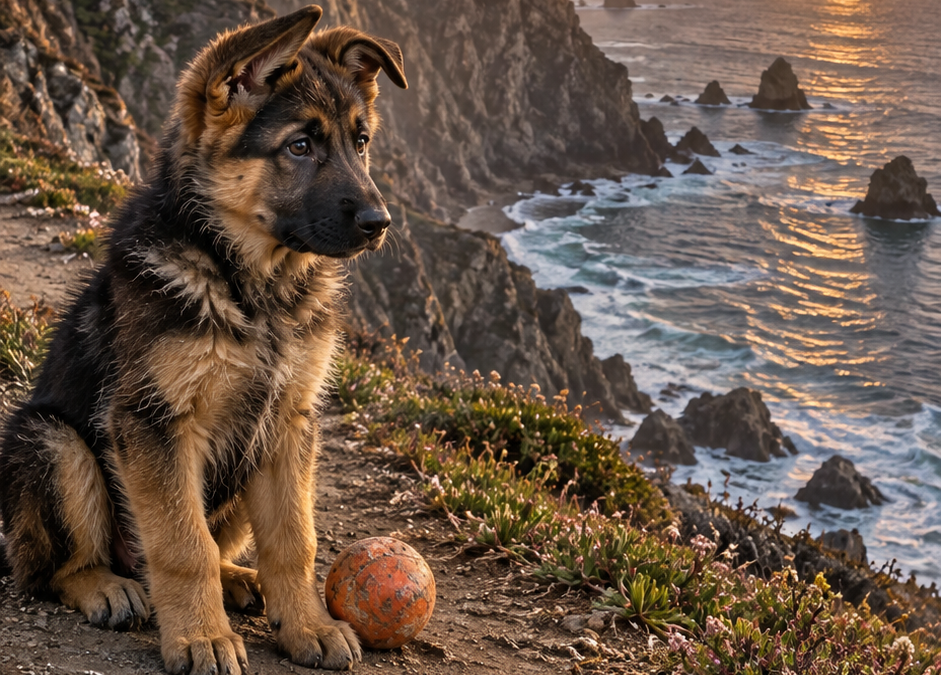
PART2
“Say again,” I told the radio.
The reply came through static.
“Small backpack. Pink. About twenty feet below the ridge, snagged between rocks. We’re trying to access from the east trail.”
“Anything identifying?”
“Not from here.”
“Don’t move it until photographed.”
“Copy.”
I lowered the radio.
Cara crouched beside me.
“We could be looking at a separate missing person.”
“Could.”
“The teenagers?”
“Wrong gear.”
She nodded.
The two teens we’d been assigned to find were seventeen and eighteen.
The backpack below us looked sized for a grade-school child.
The orange ball under the puppy’s paw was something I’d expect in a backyard.
The blanket looked small too.
Nothing fit.
The puppy kept staring toward the sea.
I moved the food a few inches closer.
“You’re starving.”
His ear turned toward my voice.
“That’s not me guessing.”
He looked at me.
“Eat.”
Nothing.
Dogs don’t obey logic just because you explain it patiently.
I sat.
Not crouched.
Sat all the way down in the dirt, turned slightly sideways, and tried to make myself less threatening.
Cara understood.
She backed away.
The puppy watched.
Wind blew dust across his coat.
His foreleg trembled.
I noticed then that his right shoulder carried a large bruise beneath the fur.
Not an open injury.
Impact maybe.
Fall.
He had been through something physical.
“Whatever you’re guarding,” I said quietly, “I’m not taking it.”
His eyes moved to the ball.
“Promise.”
That word caught in my throat.
Promises had been a problem for me for six years.
My younger brother James used to believe every promise I made.
Especially the stupid ordinary ones.
I’ll pick you up.
I’ll call.
I’ll be there.
James was fourteen years younger than me.
I was already halfway through college when he was learning multiplication.
Growing up, I often felt less like his brother than some hybrid of brother, babysitter, and badly supervised second father.
When he was six, he developed a habit of waiting for me on the front steps when I came home.
Didn’t matter if I was ten minutes late.
He would sit there.
Hands on knees.
Watching the street.
Mom asked him once why.
He said, “David said he’d come.”
Children make promises sound frighteningly absolute.
James grew up.
So did I.
The waiting didn’t completely disappear.
Six years before I found that puppy, James had been killed in a car accident outside San Diego.
He had been waiting for me that day too.
That was the part my brain never stopped chewing.
I was supposed to pick him up after a training course.
I got stuck on an emergency call farther north.
Wildland fire.
No signal for part of it.
James called.
Left a voicemail.
His exact words were:
“It’s okay, Dave. I’ll just wait here.”
Then someone he knew offered him a ride.
Twenty-seven minutes later, another driver crossed the center line.
James died before I ever heard the voicemail.
Rationally, I knew what everyone told me.
I couldn’t have predicted it.
I hadn’t caused the crash.
Staying on a rescue call wasn’t a moral failure.
None of those facts stopped me from hearing his voice at three in the morning.
I’ll just wait here.
The German Shepherd puppy looked out at the ocean.
I felt something cold settle beneath my ribs.
“Who are you waiting for?”
His ear moved.
That was all.
Cara’s radio crackled.
“Got another item.”
She answered.
“What?”
“Baby bottle. Small one with handles. Pink cap.”
Cara closed her eyes briefly.
I stood halfway, then stopped myself.
Sudden movement near a frightened dog and a cliff edge was exactly how you turn one problem into a catastrophe.
“Location?”
“Below the backpack. Sand pocket between rocks.”
“Any footprints?”
“Nothing usable. Tide and wind wiped it.”
“What about blood?”
“None visible.”
I stared at the puppy.
The ball.
The blanket.
Pink backpack.
Child’s bottle.
Too many objects.
Not enough answers.
Cara spoke quietly.
“Could have washed in from somewhere else.”
“Yes.”
“The backpack too.”
“Yes.”
“We don’t know they’re related to him.”
“I know.”
It was important to say.
Search work punishes storytelling.
You see three facts and your brain wants to make them into a fourth.
A puppy.
Child’s belongings.
Cliff.
Therefore tragedy.
Maybe.
Maybe not.
Evidence first.
Imagination later.
Still, the puppy’s behavior suggested those objects meant something to him.
I could trust behavior without inventing the history.
A gust hit us.
The blanket lifted again.
He pinned it.
His left paw slipped on loose grit.
One hind foot skidded toward the edge.
My entire body reacted.
“No!”
The puppy recovered.
He froze.
So did I.
Cara whispered, “We can’t leave him there.”
“I know.”
“Chemical restraint?”
“Not at this distance.”
“Food lure?”
“He’s refusing it.”
“Catch pole?”
I hated the idea.
Catch poles save lives.
They also look brutal when the animal doesn’t understand why a loop is tightening around his body.
We had a containment crate coming up from the lower staging area.
I radioed.
“Bring the soft catch pole and the covered crate. Slow approach.”
“Copy.”
The puppy lowered himself again.
Paw on ball.
Body facing the sea.
I waited.
For forty minutes, almost nothing changed.
Other teams searched.
The two missing teenagers were found by a southern unit on an inland spur trail.
Dehydrated.
Embarrassed.
Alive.
Their story ended well.
Ours became stranger.
The backpack was recovered and photographed.
Inside: damp snack wrappers, one child’s sweatshirt, two crayons, and a small zippered pouch containing nothing identifiable.
No wallet.
No phone.
No written name.
The bottle likewise had no identifying mark.
Then I saw the ball more clearly.
Black marker.
Faded from weather.
Letters wrapped around one side.
I leaned slightly.
E…
L…
L…
I couldn’t see the last letter.
The puppy followed my gaze.
I waited.
Then moved half a step.
No growl.
Closer.
The marker became readable.
ELLIE
I swallowed.
“Ellie.”
The puppy’s head snapped toward me.
Cara heard it.
“What?”
“Name on the ball.”
I said it again.
“Ellie.”
The puppy stood.
For the first time since we arrived.
His legs trembled.
He moved toward the blue blanket.
Nosed it.
Then turned toward the cliff.
Not down.
Out.
Toward the horizon.
Something in me broke open.
Not because I suddenly knew what had happened.
I didn’t.
But because the puppy clearly associated that sound—or perhaps simply my attention to the object—with something powerful.
“Easy.”
He remained standing.
“Okay.”
I lowered myself again.
“We’re going to take care of the ball.”
His eyes came back to me.
“And the blanket.”
A containment team arrived behind us.
Soft crate.
Heavy blanket.
Catch pole.
Water.
More food.
The handler, Sam, whispered:
“You want me?”
“Only if he moves closer to the edge.”
Sam nodded.
We tried water first.
The puppy wanted it more than food.
His tongue appeared.
He smelled.
But still didn’t leave the objects.
I placed a shallow bowl halfway between us.
Nothing.
Closer.
Nothing.
Finally, I slid the bowl toward the ball with a trekking pole.
The puppy drank.
Fast.
Too fast.
I gently pulled the bowl away after a few seconds.
He looked offended.
Good.
Offended meant engaged.
Two minutes later, more water.
Then a little food.
He ate one piece.
Then another.
Stayed beside the ball.
We repeated.
Food became possible.
Movement didn’t.
The sun climbed.
Heat increased.
The edge remained unforgiving.
Eventually Sam looked at me.
“David.”
I knew.
The longer we waited, the greater the risk.
“We do it.”
I crawled closer while Sam prepared the catch pole.
The puppy stiffened.
“I’m sorry.”
He watched.
“We can’t let you stay.”
He growled.
“I know.”
The loop passed slowly over his head and shoulders.
He snapped once.
Not trying to attack.
Panic.
His hind feet scrambled.
Sam kept tension low.
I moved immediately.
“Ball.”
I picked it up.
The puppy thrashed.
“Here.”
I held it where he could see.
“Got it.”
His body froze.
Then the blanket.
“I’ve got this too.”
I gathered the blue fabric.
The puppy’s breathing came hard.
We guided him away from the edge.
One foot.
Another.
He fought the restraint for maybe ten seconds.
Then stopped.
The sound he made after was worse.
One soft whine.
Defeated.
I hated myself.
“You can hate me.”
We got him into the crate.
Removed the pole.
Closed the door.
He backed into the corner.
I placed the blanket inside.
Then the orange ball.
The moment it rolled toward him, his paw shot out.
Stopped it.
He pulled it to his chest.
His body softened.
I crouched beside the mesh.
“I’m sorry.”
He looked away.
That drive to base was one of the quietest rides of my life.
The crate was secured behind the front seats.
Every few minutes, I checked the mirror.
The puppy faced the rear window.
Watching the coastline recede.
The orange ball beneath his chin.
The blanket under his body.
Cara drove.
I sat turned halfway around.
“You think Ellie was his kid?” she asked.
“Don’t know.”
“Could be owner.”
“Could.”
“Could be somebody he met.”
“Could.”
“Could’ve found the toy there.”
“Yes.”
She sighed.
“You always this irritating when you’re right?”
“Frequently.”
At the shelter, Dr. Naomi Bennett examined him.
She estimated six months.
Thirty-eight pounds.
At least ten pounds underweight.
Dehydrated.
Healing puncture wound on one foreleg.
Bruising.
Multiple superficial scratches.
No fractures.
No chip.
No collar.
No sign he’d been neutered yet.
She watched his behavior.
“He doesn’t look feral.”
“I agree.”
“He’s familiar with human spaces.”
“Yeah.”
“Doesn’t mean he was well socialized.”
“No.”
“He knows the ball?”
“Wouldn’t leave it.”
She examined the toy through the open kennel door.
“Ellie.”
I nodded.
“Any missing child report?”
“None matching yet.”
“That seems impossible.”
“Incomplete information often does.”
Dr. Bennett looked at the puppy.
“Name?”
“Don’t have one.”
A teenager volunteering with the rescue program stood nearby carrying towels.
Eli.
Seventeen.
Good kid.
He stared at the dog.
“He looks like Atlas.”
I turned.
“What?”
“The mythology guy.”
“I know who Atlas is.”
Eli shrugged.
“Looks like he’s holding up the whole world.”
The puppy sat rigid in the back of the kennel.
Ball between his paws.
I hated how accurate it felt.
“Atlas.”
One ear moved.
I said it again.
“Atlas.”
He looked at me.
Eli grinned.
“Done.”
“That’s not how naming works.”
“It just did.”
Atlas refused dinner.
He drank.
Not enough.
Dr. Bennett started subcutaneous fluids rather than forcing IV placement immediately because he was medically stable and severely stressed.
We gave him quiet.
Dim light.
Blanket.
Ball.
No unnecessary handling.
I stayed after everyone else left.
Around nine, Atlas started whining.
Not loud.
He lay with his nose against the orange ball and made a thin, rhythmic sound.
Over and over.
I sat outside the kennel.
“You can stop waiting.”
Whine.
“You did enough.”
He looked toward me.
Then away.
I understood the hypocrisy.
For six years, I had been waiting too.
Not for James to return.
I’m not delusional.
But waiting for a different version of the past.
One where I answered the phone.
One where the fire call ended earlier.
One where James took a bus.
One where I drove south fast enough to change an intersection.
Grief creates impossible assignments and then punishes you for failing them.
Atlas rested his nose on the ball.
I leaned against the wall.
“I had a brother.”
His eyes flicked.
“He waited for me once.”
I laughed without humor.
“More than once.”
Atlas watched.
“I didn’t make it.”
Silence.
“I’ve spent six years pretending that means I failed him.”
The puppy lowered his chin.
“Maybe you think something similar.”
I knew I was projecting.
Didn’t care.
“I don’t know where Ellie is.”
That name changed him again.
His head lifted.
“I’m sorry.”
He stared toward the kennel door.
“No one has reported a child missing around that area that matches what we found.”
His breathing quickened.
Or maybe I imagined it.
“We’ll keep looking.”
I held one hand outside the bars.
Palm up.
“That’s all I can promise.”
Hours passed.
At some point, Atlas turned.
Not toward my hand.
Toward me.
Ball still between us.
His eyes stayed on my face for almost a minute.
Then he lay down.
Not trust.
Maybe recognition of shared exhaustion.
Enough.
The next morning, I returned before sunrise.
I wasn’t scheduled.
The shelter manager, Denise, spotted me.
“You know you don’t work here.”
“I noticed.”
“Coffee?”
“Please.”
Atlas was awake.
Same corner.
Same ball.
But when I sat down, his tail moved.
One inch.
Maybe.
“Did you just wag?”
Nothing.
“Coward.”
His nose twitched.
I placed food inside.
He ate while I remained nearby.
That was new.
Afterward, I put my hand through the lower opening.
Not reaching.
Atlas stared.
Then nudged the orange ball.
It rolled three inches toward me.
I froze.
He watched.
“Is this a test?”
No movement.
I didn’t touch the ball.
After a minute, Atlas pulled it back.
Fair.
The search for Ellie’s identity continued.
No missing-child report connected directly to the coast.
No family claiming the backpack.
Rangers circulated photographs.
Local agencies checked recent rescues, accidents, and abandoned property reports.
Nothing.
A marine unit reviewed reports from the previous week.
Nothing useful.
The objects could have been older than we thought.
The ocean moves things.
Animals move things.
People leave things.
The ball might have belonged to a child named Ellie who had gone home safely months earlier.
The backpack might have come from somewhere else.
Atlas might have guarded the objects because they carried a familiar scent unrelated to any tragedy.
Every possibility mattered.
We couldn’t turn mystery into fact just because sadness made one explanation emotionally satisfying.
Still, Atlas reacted to the name Ellie.
That stayed with me.
Three days later, I officially registered as a shelter volunteer.
Denise watched me sign the form.
“You’re here for the dog.”
“I’m expanding my civic commitments.”
“You’re here for Atlas.”
“Mostly.”
She smiled.
“Knew it.”
Our first leash session was terrible.
Harness went on with patience.
Atlas tolerated it.
Leash clipped.
Fine.
Kennel door opened.
He froze.
The threshold seemed enormous.
I stepped outside.
Waited.
He looked toward the orange ball in the kennel.
I picked it up.
His body tensed.
“Coming with us.”
I held it low.
Atlas stepped.
One paw across.
Stopped.
Another.
We made it six feet down the hall.
Then someone dropped a metal bowl.
Atlas collapsed backward.
Panic.
I crouched.
No pulling.
“Okay.”
He looked at the kennel.
We returned.
Six feet.
That was the session.
Some people would call it failure.
Those people don’t understand fearful dogs.
The next day, eight feet.
Third day, outside.
Grass beneath his paws.
Atlas stopped.
Sniffed.
His whole face changed.
The world became information instead of threat.
Tree.
Bush.
Fence.
Wind.
Another dog far away.
He sniffed for five minutes.
Then turned toward me.
The orange ball was in my jacket pocket.
I took it out.
Placed it at my feet.
Atlas approached.
Picked it up.
Dropped it.
I rolled it two feet.
He stared.
Then retrieved it.
Brought it back.
Dropped it again.
I almost cried.
Instead I rolled it.
Three feet.
Atlas chased.
For the first time, I saw the puppy beneath the grief.
Awkward legs.
Oversized ears.
Tail beginning to move.
Again.
Again.
Not fetch exactly.
A ritual.
He always paused before releasing the ball.
Always checked where I was.
It became our language.
Two weeks in, he let me touch his chest.
Three weeks, shoulders.
Head took longer.
Touching the ball without permission remained forbidden.
Fair.
We kept investigating.
A partial lead surfaced from the pink backpack.
One of the crayons was wrapped in paper printed with the logo of a children’s museum in Monterey.
Meaningless on its own.
Thousands sold.
The blanket’s manufacturer likewise gave us nothing.
No fingerprints useful after exposure.
No readable label.
The bottle model was common.
The name Ellie might have been short for Eleanor, Elizabeth, Elena, anything.
Or the ball could have been secondhand.
We had clues.
No case.
I hated that.
Atlas seemed less interested in answers than I was.
He started eating normally.
Gained weight.
The leg wound healed.
His coat changed from dull gray-brown to something beautiful.
Wolf sable.
Silver-gray undercoat with dark black-tipped guard hairs.
He looked almost wild until he tilted his head at a squeaky toy.
Then he looked six months old again.
The first time he slept on his side instead of curled around the ball, Denise pointed through the observation window.
“Look.”
Atlas sprawled.
Ball two feet away.
Not touching him.
I smiled.
“That’s good.”
“Very.”
Later that week, he rolled onto his back in sleep.
Belly exposed.
Total vulnerability.
Nobody photographed it.
Good.
Some moments deserve to exist without becoming evidence.
A month after rescue, I took Atlas back to the coast.
The decision was controversial.
Dr. Bennett supported it if we kept the session controlled.
Denise thought I was projecting.
She was partly right.
I wanted closure.
For him.
For me.
Maybe mostly me.
We drove early.
Fog hanging low.
Atlas sat clipped safely in the back seat.
The blue blanket and orange ball rode beside him.
When the ocean became visible, his body stiffened.
I slowed.
“Want to turn around?”
He looked out.
No panic.
We continued.
At the trailhead, I clipped a backup line to his harness.
No heroics.
No off-leash reunion with a cliff.
We walked.
Atlas recognized something before I did.
Scent maybe.
Terrain.
His pace slowed.
At the final bend, he stopped.
The cliff appeared.
He stared.
Then moved forward.
Carefully.
We stopped well back from the edge.
I sat.
Atlas remained standing.
The wind lifted his coat.
I placed the blue blanket beside me.
Then the ball.
Atlas sniffed both.
He walked toward the safe perimeter we’d established.
Looked out over the water.
For twenty minutes, nothing happened.
No cinematic breakthrough.
No howl.
No magical sign.
Just a young dog staring at the Pacific.
I sat behind him.
Then said:
“Ellie.”
His ears moved.
He looked down.
At the ball.
I swallowed.
“I don’t know where she is.”
Atlas remained still.
“I wish I did.”
Wind.
Waves.
“Maybe she’s alive.”
I forced myself to continue.
“Maybe she lost this.”
His head turned slightly.
“Maybe something bad happened.”
That possibility sat between us.
“I don’t know.”
Important words.
“I don’t know.”
Atlas breathed.
Then sat.
I moved closer.
Placed one hand lightly against his back.
He allowed it.
“You don’t have to stay.”
We sat nearly an hour.
Then Atlas stood.
Walked toward the ball.
Picked it up.
Turned.
Walked to me.
Dropped it against my boot.
I stared.
“Ready?”
He nudged my knee.
That was enough.
We left.
He never looked back.
Something changed after the cliff.
Not overnight.
But his attachment to the ball softened.
He still slept near it.
Still carried it.
But no longer guarded it.
I could pick it up.
Throw it.
He brought it back.
Memory transformed into play.
That felt important.
Around the same time, the shelter’s legal hold expired without a claimant.
Atlas became available for adoption.
I pretended this was surprising.
Denise handed me the paperwork.
“I didn’t ask.”
“You’ve spent forty-six hours here this month.”
“Volunteerism.”
“You bought him a custom harness.”
“Equipment.”
“He cries when you leave.”
“Behavioral issue.”
“You cry when he leaves.”
“Defamation.”
She slid the form toward me.
I signed.
David Mercer.
Permanent adopter.
Atlas went home with me that afternoon.
My house was small.
Monterey County foothills.
Fenced yard.
Two bedrooms.
One mostly used for rescue gear.
Atlas inspected every inch.
Then chose the hallway outside my bedroom as his sleeping location.
First night, ball beneath his chin.
Second week, beside the bed.
Month two, on the bed despite rules clearly communicated in advance.
I woke with seventy percent of my mattress occupied by adolescent German Shepherd.
“Unacceptable.”
Atlas stretched.
“Move.”
Nothing.
“You’re not even full-grown.”
He sighed.
Rules changed.
Grief changed too.
Not disappeared.
Changed.
James’s voicemail still existed on my phone.
For years, I couldn’t delete it.
Also couldn’t listen without unraveling.
One night, Atlas was asleep beside me when I played it.
“It’s okay, Dave. I’ll just wait here.”
Atlas lifted his head.
I paused the recording.
My chest hurt.
Then I played it again.
This time I listened to the whole thing.
James continued:
“If you’re stuck, I’ll grab a ride. Don’t worry. Love you.”
I had spent six years remembering only the first sentence.
My guilt had edited my brother.
Turned him into a ghost waiting forever on a curb.
But James hadn’t blamed me.
He had solved the problem.
Made a choice.
Bad luck followed.
That wasn’t the same as abandonment.
I put the phone down.
Atlas rested his head on my thigh.
“I’m sorry.”
He looked up.
“Not to you.”
I rubbed his ear.
“I’m sorry I turned him into something he wasn’t.”
Atlas slept.
The next chapter of his life almost went wrong because I wanted meaning too badly.
Atlas had a strong nose.
Strong focus.
High environmental awareness.
On hikes, he noticed people before I did.
When someone lagged behind, he watched.
When a volunteer pretended to hide during a game, Atlas found them immediately.
I started thinking search dog.
Of course I did.
A rescue volunteer with an unusually observant German Shepherd is practically contractually required to have the thought.
But thought and suitability aren’t the same thing.
I contacted a certified K9 evaluator named Rachel Kim.
She watched Atlas work.
Toy drive.
Food motivation.
Environmental resilience.
Surfaces.
Sound recovery.
Scent games.
Then she asked:
“Why do you want this?”
“For him.”
“Wrong answer.”
I frowned.
“What?”
“Try again.”
I looked at Atlas.
“For the team.”
“Still not enough.”
She waited.
I understood.
“Because he might enjoy it.”
“Better.”
Rachel folded her arms.
“His history doesn’t make him destined for rescue work.”
“I know.”
“Doesn’t make him a healer.”
“I know.”
“Doesn’t make him responsible for finding people because he once waited for someone.”
That landed.
“I know.”
“Do you?”
I looked at the orange ball clipped in an outside pouch of my pack.
She noticed.
“If he hates training, stop.”
“I will.”
“If the cliff history makes coastal searches harder, don’t force it.”
“Agreed.”
“If he washes out, he’s still your dog.”
“Absolutely.”
Rachel smiled.
“Then we evaluate.”
Atlas loved scent work.
Not emotionally.
Practically.
It was a game.
Find hidden person.
Get ball.
The orange ball became his highest reward.
At first that felt strange.
Then perfect.
Something he’d once guarded in grief became what he chased in joy.
He didn’t begin field work immediately.
For nearly a year, he trained foundations.
Obedience.
Recall.
Directional cues.
Human scent discrimination.
Search patterns.
Alert behavior.
Environmental confidence.
He failed things.
Frequently.
Good.
People love miracle-dog narratives where a rescue puppy becomes an expert because destiny recognized his trauma.
Real training is uglier.
Atlas overshot scent cones.
Got distracted by lizards.
Once followed a sandwich wrapper thirty yards away from the exercise.
Rachel stared at me.
“Elite operational focus.”
“He was hungry.”
“He ate breakfast.”
“Second breakfast.”
Atlas passed one test.
Failed another.
Improved.
At eighteen months, he was reliable enough for controlled training scenarios.
Still not deployed.
At two years old, he qualified as a field support K9 under our volunteer team’s standards after meeting veterinary, behavioral, obedience, and search benchmarks.
Even then, he worked under experienced handlers and within defined missions.
No superhero nonsense.
His first real find involved an elderly hiker north of Carmel.
Seventy-four-year-old woman.
Separated from her group after taking what she thought was a shortcut.
Cold night.
Twisted ankle.
We had a last known location and a usable scent article.
Atlas worked for forty-three minutes.
Lost trail twice.
Recovered it.
Then turned sharply through a stand of scrub oak.
Alerted.
We found her seated beneath a rock overhang.
Alive.
Cold.
Furious at herself.
Atlas stopped several feet away.
No jumping.
No dramatic licking.
He sat.
The woman looked at him.
“That your dog?”
“Yeah.”
“He’s beautiful.”
Atlas wagged.
She cried.
He moved closer only when she reached.
Put his head under her hand.
The moment hurt me.
But not because of fate.
Because we’d trained for it.
Work had become competence.
Competence became useful.
That’s more meaningful to me than destiny.
The call involving Jeremy came another year later.
Ten-year-old boy.
Coastal family hike.
Separated in fast-moving fog.
That one scared me.
Same kind of terrain where I’d found Atlas.
Different location.
Similar cliffs.
We arrived before dark.
Atlas wore his orange working vest.
Double attachment system near the exposed sections.
No off-leash sprinting toward danger despite what people later claimed online.
We worked inland first.
Jeremy’s aunt provided a worn sweatshirt from their vehicle.
Atlas took scent.
Started.
Fog thickened.
Wind complicated everything.
We searched for nearly an hour.
Then found one red glove.
Jeremy’s.
Aunt confirmed.
Fresh scent.
Atlas pulled east.
Toward an embankment.
I slowed him.
Loose rock.
Steep.
“Easy.”
He cast.
Nose high.
Then low.
Turned back.
Moved thirty yards south.
Stopped.
Stared at dense brambles.
One bark.
Our trained alert.
“Jeremy!”
Nothing.
Again.
“Jeremy!”
A weak sound.
“Here.”
I dropped to my knees.
Pushed branches apart.
There he was.
Curled beneath the brush.
Red jacket.
One shoe soaked.
Face pale.
Conscious.
“Hey, buddy.”
His eyes opened wider.
“Are you David?”
That surprised me.
“Yeah.”
“My aunt said rescuers were coming.”
“We’re here.”
Atlas waited.
Jeremy saw him.
“Dog.”
“Atlas.”
The boy reached.
I checked him first.
Airway.
Bleeding.
Possible injury.
Hypothermia beginning.
Ankle likely sprained.
No obvious head trauma.
Then I let Atlas move in.
He lay beside Jeremy.
The boy’s hand landed on his neck.
Atlas stayed.
Warm body.
Steady.
I radioed.
“Subject located. Alive. Ten-year-old male. Conscious, mild to moderate cold exposure, lower-extremity injury. Send medical team to my coordinates.”
Static.
Then confirmation.
Jeremy whispered:
“Did he find me?”
“Yeah.”
He touched Atlas’s ear.
“Good dog.”
Atlas’s tail thumped once.
I sat back.
And suddenly James was there.
Not literally.
Memory.
The voicemail.
The school curb.
The years of guilt.
It came up hard.
I looked at a living child.
A dog beside him.
My hands started shaking.
Not now.
I turned away briefly.
Breathed.
Atlas noticed.
He left Jeremy only after another rescuer took his place.
Walked to me.
Pressed his nose against my forearm.
I knelt.
“You don’t need to take care of me.”
Tail.
I laughed shakily.
“Seriously.”
He leaned.
Tears came.
Not collapse.
Release.
Jeremy was alive.
James was still dead.
One did not cancel the other.
That was the lesson I had resisted for years.
Saving someone today doesn’t repair who you couldn’t save yesterday.
It doesn’t need to.
Life isn’t a ledger.
Atlas had taught me that without meaning to.
He hadn’t found Jeremy to redeem the cliff.
He had found Jeremy because he was trained, capable, and working.
I hadn’t helped rescue Jeremy to make up for James.
I helped because Jeremy needed help.
The past did not need repayment.
That realization loosened something inside me.
After medical teams carried Jeremy out, I stood in the fog with Atlas.
I pulled the orange ball from my pocket.
Held it.
He stared.
“Ready?”
His ears came up.
I threw it ten yards up the safe section of trail.
Atlas ran.
Grabbed it.
Returned.
No grief.
No ritual.
Just a dog wanting another throw.
Perfect.
The story of Jeremy’s rescue reached local news.
Atlas became briefly famous.
I hated most headlines.
ABANDONED CLIFF DOG SAVES CHILD.
Technically adjacent to truth.
Emotionally manipulative.
Reporters wanted the cliff story.
The ball.
Ellie.
“Do you think he knew another child was in danger because of what happened before?”
No.
Absolutely not.
Atlas was not psychic.
Trauma is not sonar.
Training mattered.
Wind mattered.
Scent mattered.
His nose mattered.
I said that.
Some articles used it.
Others preferred magic.
Eventually attention faded.
Good.
Atlas kept working.
Not every mission resulted in a find.
Important.
Sometimes another team found the person.
Sometimes subjects self-rescued.
Sometimes we searched without success.
Those were the hardest.
Atlas did not understand failure the way humans do.
He finished.
Got water.
Rested.
Wanted his ball.
I had to learn from him.
At home, he became an entirely different animal.
Working Atlas: focused.
Home Atlas: thief.
Bread unattended?
Gone.
Laundry basket?
Investigation.
Garden hose?
Mortal enemy.
He developed an inexplicable hatred for one decorative pillow.
Only that pillow.
I replaced it twice.
He destroyed both.
Eventually I accepted his design critique.
The orange ball remained special.
By age four, it was cracked.
Faded.
The name Ellie barely visible.
I considered retiring it.
Atlas rejected the replacement ball.
New one: ignored.
Old one: immediate joy.
Fine.
We reinforced the original from inside to keep it safe enough for light use.
Eventually it became too fragile.
I put it in a box.
Not displayed over his bed.
That felt wrong.
He wasn’t living beneath a shrine.
I kept it with his training records.
Occasionally I let him sniff it.
He wagged.
Then wanted the newer ball.
Progress.
The mystery of Ellie remained unresolved.
Years later, a woman contacted the ranger station after seeing an old archived post.
Her daughter was named Ellie.
They had visited the coast around the right general period.
Lost an orange ball.
For twelve hours I thought we’d solved it.
Then details failed.
Their ball had a cartoon face.
Ours didn’t.
They had never owned the blue blanket.
No puppy.
Different section of coastline.
False lead.
Another family called.
Then another.
Nothing matched.
Eventually, I accepted what evidence allowed.
Atlas had guarded objects connected somehow to his previous life or to people he encountered.
The name Ellie mattered to him.
How?
Unknown.
Maybe his former owner.
Maybe a child he lived with.
Maybe just a word he’d heard.
The backpack and bottle suggested a child had been in that area at some point, but we never established a specific missing child connected to Atlas.
No confirmed death.
No confirmed fall.
No body.
No case resolution.
I stopped turning uncertainty into tragedy.
That was part of respecting him.
Atlas didn’t need a sadder backstory to justify love.
He already had enough.
Years passed.
His wolf-gray coat darkened along the spine.
Chest broadened.
The awkward puppy disappeared into a powerful German Shepherd.
Old scars remained.
One line on the foreleg.
Thin patch over the shoulder.
Most people never noticed.
I did.
At five, he also began visiting a community grief program—not as some miracle “therapy dog” because a behaviorist looked at him once, but after a separate temperament evaluation and formal therapy-dog certification.
That took time.
Good therapy dogs aren’t just kind.
They must tolerate strange movement.
Medical equipment.
Crying.
Unexpected touch.
Crowds.
Children.
Wheelchairs.
Atlas had to learn that work too.
He surprised me.
Search work engaged his drive.
Therapy work engaged something quieter.
He never forced himself into people’s space.
He waited.
Maybe because waiting was the first thing he knew.
A girl named Malia barely spoke during her first month in group.
Her older sister had died.
She sat apart.
Atlas entered with me one Wednesday.
He approached halfway.
Stopped.
Malia looked at him.
I asked:
“Want him closer?”
Tiny nod.
I released his cue.
Atlas walked over.
Lay beside her chair.
Nothing else.
For four sessions, that was all.
Fifth session, Malia sat on the floor.
Whispered into his ear.
I did not listen.
Not my business.
Atlas remained there.
Afterward, she spoke three sentences during group.
Did Atlas heal her?
No.
People aren’t broken locks and dogs aren’t keys.
But he made a safe space easier to enter.
That’s enough.
His field career continued until age eight.
Then a shoulder injury made hard wilderness work less fair.
We retired him from active search.
I expected him to struggle.
He adapted immediately.
Apparently I had been the one emotionally invested in his résumé.
Atlas enjoyed retirement.
Long walks.
Community visits.
Training demos.
Sleeping late.
Judging younger dogs.
He mentored one shepherd named Koda through search foundations simply by existing nearby.
Koda was nervous around loose rock.
Atlas crossed slowly.
Returned.
Crossed again.
Koda followed.
I remembered the cliff.
Not because Atlas was reliving it.
Because growth leaves usable skills.
At nine, I took him back to the original location one final time.
No working vest.
Just harness.
The trail had changed.
Erosion.
New barriers.
Updated signage.
We stayed well inside the safe zone.
Atlas walked slowly now.
Gray beginning around his muzzle.
He stopped where the ocean opened below us.
Not the exact place.
Close enough.
I sat.
Pulled the orange ball from my pack.
The original.
He smelled it.
Tail moved.
I placed it beside him.
The faded name Ellie was almost gone.
I had thought the moment would destroy me.
It didn’t.
Atlas sniffed.
Then looked at me.
Then at the sea.
Five minutes later, he picked up the ball.
Brought it to my lap.
I laughed.
“Still yours.”
He dropped it.
I held it.
“Who was she?”
Atlas panted.
“No help.”
Wind moved through his fur.
I thought about James.
For years I had wanted certainty too.
Wanted someone to tell me exactly which decision would have saved him.
There wasn’t one.
Life contains events without satisfying moral explanations.
James got into a car.
A stranger crossed a line.
Atlas waited at a cliff.
A child’s name lived on a ball.
We don’t always get the missing page.
You either spend your life demanding it, or you learn to live the chapters you have.
I rubbed Atlas’s chest.
“We’re done waiting for answers.”
His tail tapped.
We walked back.
At ten, Atlas stopped therapy work too.
Not because he couldn’t.
Because I wanted retirement to mean retirement.
He deserved days without anyone needing something from him.
We hiked easy trails.
He slept.
He stole eggs once.
He barked at delivery vans.
He developed selective hearing.
Normal old dog life.
Best possible ending.
At eleven, arthritis.
Medication.
At twelve, kidney disease.
Manageable initially.
Food changes.
Fluids later.
He tolerated everything except one prescription diet he considered an insult.
I agreed.
We found another.
The hardest change was his reluctance to climb into the truck.
For a dog who had spent years riding toward searches, the hesitation hurt.
I bought a ramp.
Atlas stared.
“Use it.”
He looked at me.
“You’re eighty pounds.”
No movement.
“My spine is older than you.”
Still nothing.
I demonstrated the ramp myself.
Atlas watched with profound concern for my intelligence.
Eventually treats solved negotiations.
He used it.
At thirteen, his world became smaller.
House.
Yard.
Short walks.
Occasional beach overlook from safe ground.
He still wanted the ball.
Not Ellie’s old one.
A blue replacement.
He would carry it from room to room.
Sometimes fall asleep with his chin on it.
Echo.
Not repetition.
That distinction mattered.
His last winter was mild.
California coastal winter barely deserves the word compared with other places, but mornings were cold enough to stiffen his joints.
I put rugs over the floors.
Beds everywhere.
One beside mine.
One in the living room.
One by the window.
Atlas still sometimes chose bare tile.
Dogs undermine interior planning until the end.
The decline came in spring.
Cancer in the spleen.
Advanced.
Surgery technically possible.
Risk high.
Recovery uncertain.
Kidneys already compromised.
I asked Dr. Bennett—older now, hair silver at the temples—the question every owner eventually dreads.
“If he were yours?”
She looked at Atlas.
“He’d go home.”
I understood.
Good days first.
Then fewer.
Food remained interesting.
Walks became yard visits.
One morning, he brought the blue ball to me and couldn’t hold it.
It dropped.
He stared.
I picked it up.
Rolled it one foot.
Atlas touched it with his paw.
Didn’t chase.
My chest broke.
“That’s okay.”
He looked at me.
“Game counts.”
Tail moved.
That evening, I took the original orange ball from storage.
Placed it nearby.
Atlas sniffed.
Then rested his chin beside it.
Not on it.
Beside.
I sat on the floor.
“Ellie.”
His ear moved faintly.
All those years.
Still something.
I smiled through tears.
“Whoever she was, you didn’t forget.”
Atlas closed his eyes.
Neither had I forgotten James.
That was okay.
Memory doesn’t have to be an open wound to remain loyal.
The next morning, he couldn’t stand without help.
I called.
Dr. Bennett came to the house.
No clinic.
No car ride.
No fluorescent room.
Atlas lay on his bed beside the sliding door where he could smell outside.
The blue ball near one paw.
The orange one near the other.
I sat beside him.
Dr. Bennett explained the process.
I knew it.
Still listened.
That is part of respect.
Atlas’s breathing was slow.
He wasn’t afraid.
I put one hand on his chest.
“Remember the cliff?”
His eye opened.
“Terrible place.”
Tail moved barely.
“You almost gave me a heart attack.”
His breathing shifted.
“I thought you were guarding a tragedy.”
My voice cracked.
“Maybe you were.”
I rubbed his shoulder.
“Or maybe you were just guarding the last thing that smelled familiar.”
The uncertainty no longer hurt.
“I spent years wanting you to tell me.”
A tear hit his fur.
“Turns out you didn’t owe me the answer.”
Atlas’s eyes remained on mine.
“You did your part.”
The words returned from years earlier.
Cliff wind.
Orange ball.
“You stayed.”
I swallowed.
“You guarded.”
His tail moved.
“And then…”
I smiled.
“You left.”
Not abandoned.
Left.
Chose forward.
“That’s the part I needed.”
Dr. Bennett gave the first medication.
Atlas relaxed.
His head grew heavy.
I moved the orange ball beneath his paw.
Not because I thought he needed it.
Because I did.
I thought of James waiting outside school.
For years I’d frozen him there.
Atlas had shown me the cruelty of that.
James had lived twenty-nine years before that curb.
Jokes.
Birthdays.
Bad haircuts.
Arguments.
Girlfriends.
College.
Fishing trips.
He was more than the last voicemail.
Atlas was more than the cliff.
So was I.
I pressed my forehead against his.
“Good boy.”
His breathing slowed.
“Best boy.”
Then stopped.
I stayed with him for a long time.
No radio.
No mission.
Nothing to solve.
Just an old dog who had once been a starving puppy at the edge of the world.
Afterward, I had the orange ball cleaned carefully.
Not restored.
I wanted the wear.
The marker.
ELLIE.
Barely there.
I placed it in a small wooden box with Atlas’s collar and one photograph.
Not the cliff.
Not the rescue.
A picture from a stupid afternoon in my backyard.
Atlas was three.
Muddy.
Mouth open.
Blue plastic kiddie pool behind him.
Orange ball in his mouth.
Joy.
That’s the one.
People still ask me about him.
Some heard the exaggerated version.
The puppy who guarded a dead child’s belongings.
We never established that.
The dog who somehow became a rescue hero because grief gave him special powers.
No.
Atlas became useful because he trained.
Because he enjoyed searching.
Because dedicated people helped us.
The therapy dog who could sense anyone’s trauma.
Also no.
He was observant.
Calm.
Well trained.
People found comfort in him.
That’s enough.
The real story doesn’t need embellishment.
A young German Shepherd was found dangerously close to a coastal cliff.
He was malnourished and injured.
He refused to leave an orange ball marked with a child’s name and a weathered blue blanket.
Nearby, searchers found a child’s backpack and bottle, but no confirmed person was ever linked to those items.
We never learned his full history.
We brought him to safety anyway.
He learned to eat.
Sleep.
Play.
Trust.
He was adopted.
He trained.
He helped find people.
He sat beside grieving children.
He grew old.
And eventually, he stopped waiting at edges.
That last part matters most.
Because for years I thought loyalty meant staying.
Holding position.
Never letting go.
James waited for me.
Atlas waited for Ellie—or whoever the ball represented.
I turned waiting into proof of love.
Atlas eventually taught me something better.
Sometimes love is staying.
Sometimes love is leaving the cliff.
Sometimes it’s picking up the ball, carrying the memory with you, and walking toward the person who came back for you.
I found Atlas staring at the horizon as though the past might return if he watched long enough.
Years later, whenever we hiked, he walked ahead.
Then turned to check whether I was following.
I always was.
That became our real ritual.
Not waiting.
Moving.
Together.
And that’s the ending I keep.
Not a frightened puppy guarding a toy above crashing waves.
An old German Shepherd walking a trail in front of me, gray around the muzzle, turning every few yards to make sure I was still there.
I was.
Every time.
Have you finished reading the story and want to read it again?
A German Shepherd Puppy Refused to Leave the Cliff’s Edge—Then We Saw What He Was Guarding
He wouldn’t leave the cliff.
He wouldn’t touch the food.
Then I saw the child’s name written on the toy beneath his paw.
The puppy sat so close to the edge that one bad step would have sent him straight into the Pacific.
That was the first thing I noticed.
Not his ribs.
Not the blood dried along his front leg.
Not the strange wolf-gray sable coat that made him look almost silver where the California sun struck his shoulders.
The edge.
Maybe eighteen inches separated his front paws from a drop steep enough to make my stomach tighten.
Below him, waves broke white against black rock.
Behind him, coastal wind flattened the grass.
And underneath one paw sat an old orange rubber ball.
He was guarding it.
My name is David Mercer. I was fifty-one then, and I’d spent more than fifteen years doing volunteer search-and-rescue work along the Central California coast.
I had seen people stranded on ledges.
Hikers with broken ankles.
Cars down embankments.
Children separated from parents.
People found alive after we were certain we’d become a recovery team instead of a rescue team.
And some we didn’t bring home alive.
Those are the ones you carry.
That morning, our assignment had started as a fairly ordinary missing-person search.
Two teenagers hiking a section of coastal trail south of Big Sur had missed a planned check-in the previous evening.
Their families called before dawn.
By sunrise, teams were moving from opposite ends of the trail.
Weather was clear.
Visibility good.
No active storm.
Still, coastal terrain doesn’t need bad weather to kill you.
Loose shale.
Hidden drop-offs.
Fog arriving without invitation.
One wrong turn through chaparral and you can spend six hours ten yards from the trail without seeing it.
My partner, Cara Ruiz, was twenty yards behind me when I raised a fist.
She stopped.
“What?”
I pointed.
The German Shepherd puppy turned his head.
Barely.
Light amber eyes.
Sharp.
Exhausted.
His ears stood high despite everything.
He didn’t bark.
Didn’t run.
Didn’t come toward us.
Just watched.
Beside the orange ball lay a crumpled blue blanket, wet with salt spray and stained with dirt.
The puppy’s front paw remained on the toy.
“How long has he been there?” Cara whispered.
“No idea.”
His body answered better than I could.
Too thin.
Coat matted.
Small cuts across his chest.
A deeper gash along the left foreleg.
He looked about six months old, maybe thirty-five pounds when he should have weighed much more.
I crouched.
Slowly.
“Hey, buddy.”
Nothing.
I unwrapped half a protein bar.
The smell should have mattered.
To a puppy that thin, food should have been gravity.
I placed a piece on the dirt.
His nose moved.
That was all.
He looked at the food.
Then lowered his gaze to the orange ball.
Then back toward the ocean.
Cara stared.
“He doesn’t want it?”
“He wants it.”
I could see that.
His nostrils flared.
His body leaned almost imperceptibly toward the food.
Then stopped.
Whatever he believed his job was mattered more than hunger.
I moved one step closer.
A low sound came from his chest.
Not a full growl.
A warning.
I stopped immediately.
“All right.”
His paw pressed harder against the ball.
My radio crackled.
Another team member’s voice.
“David, we found a bag below your position.”
I lifted the radio.
“What kind?”
A pause.
Then:
“Pink backpack. Small. Looks like a child’s.”
I stared at the puppy.
Cara stared at me.
The wind moved the blue blanket.
The puppy lunged forward and caught it beneath his other paw before it could slide toward the cliff.
That was when I understood he wasn’t simply stranded there.
He was staying.
For something.
Or for someone.
PART2
“Say again,” I told the radio.
The reply came through static.
“Small backpack. Pink. About twenty feet below the ridge, snagged between rocks. We’re trying to access from the east trail.”
“Anything identifying?”
“Not from here.”
“Don’t move it until photographed.”
“Copy.”
I lowered the radio.
Cara crouched beside me.
“We could be looking at a separate missing person.”
“Could.”
“The teenagers?”
“Wrong gear.”
She nodded.
The two teens we’d been assigned to find were seventeen and eighteen.
The backpack below us looked sized for a grade-school child.
The orange ball under the puppy’s paw was something I’d expect in a backyard.
The blanket looked small too.
Nothing fit.
The puppy kept staring toward the sea.
I moved the food a few inches closer.
“You’re starving.”
His ear turned toward my voice.
“That’s not me guessing.”
He looked at me.
“Eat.”
Nothing.
Dogs don’t obey logic just because you explain it patiently.
I sat.
Not crouched.
Sat all the way down in the dirt, turned slightly sideways, and tried to make myself less threatening.
Cara understood.
She backed away.
The puppy watched.
Wind blew dust across his coat.
His foreleg trembled.
I noticed then that his right shoulder carried a large bruise beneath the fur.
Not an open injury.
Impact maybe.
Fall.
He had been through something physical.
“Whatever you’re guarding,” I said quietly, “I’m not taking it.”
His eyes moved to the ball.
“Promise.”
That word caught in my throat.
Promises had been a problem for me for six years.
My younger brother James used to believe every promise I made.
Especially the stupid ordinary ones.
I’ll pick you up.
I’ll call.
I’ll be there.
James was fourteen years younger than me.
I was already halfway through college when he was learning multiplication.
Growing up, I often felt less like his brother than some hybrid of brother, babysitter, and badly supervised second father.
When he was six, he developed a habit of waiting for me on the front steps when I came home.
Didn’t matter if I was ten minutes late.
He would sit there.
Hands on knees.
Watching the street.
Mom asked him once why.
He said, “David said he’d come.”
Children make promises sound frighteningly absolute.
James grew up.
So did I.
The waiting didn’t completely disappear.
Six years before I found that puppy, James had been killed in a car accident outside San Diego.
He had been waiting for me that day too.
That was the part my brain never stopped chewing.
I was supposed to pick him up after a training course.
I got stuck on an emergency call farther north.
Wildland fire.
No signal for part of it.
James called.
Left a voicemail.
His exact words were:
“It’s okay, Dave. I’ll just wait here.”
Then someone he knew offered him a ride.
Twenty-seven minutes later, another driver crossed the center line.
James died before I ever heard the voicemail.
Rationally, I knew what everyone told me.
I couldn’t have predicted it.
I hadn’t caused the crash.
Staying on a rescue call wasn’t a moral failure.
None of those facts stopped me from hearing his voice at three in the morning.
I’ll just wait here.
The German Shepherd puppy looked out at the ocean.
I felt something cold settle beneath my ribs.
“Who are you waiting for?”
His ear moved.
That was all.
Cara’s radio crackled.
“Got another item.”
She answered.
“What?”
“Baby bottle. Small one with handles. Pink cap.”
Cara closed her eyes briefly.
I stood halfway, then stopped myself.
Sudden movement near a frightened dog and a cliff edge was exactly how you turn one problem into a catastrophe.
“Location?”
“Below the backpack. Sand pocket between rocks.”
“Any footprints?”
“Nothing usable. Tide and wind wiped it.”
“What about blood?”
“None visible.”
I stared at the puppy.
The ball.
The blanket.
Pink backpack.
Child’s bottle.
Too many objects.
Not enough answers.
Cara spoke quietly.
“Could have washed in from somewhere else.”
“Yes.”
“The backpack too.”
“Yes.”
“We don’t know they’re related to him.”
“I know.”
It was important to say.
Search work punishes storytelling.
You see three facts and your brain wants to make them into a fourth.
A puppy.
Child’s belongings.
Cliff.
Therefore tragedy.
Maybe.
Maybe not.
Evidence first.
Imagination later.
Still, the puppy’s behavior suggested those objects meant something to him.
I could trust behavior without inventing the history.
A gust hit us.
The blanket lifted again.
He pinned it.
His left paw slipped on loose grit.
One hind foot skidded toward the edge.
My entire body reacted.
“No!”
The puppy recovered.
He froze.
So did I.
Cara whispered, “We can’t leave him there.”
“I know.”
“Chemical restraint?”
“Not at this distance.”
“Food lure?”
“He’s refusing it.”
“Catch pole?”
I hated the idea.
Catch poles save lives.
They also look brutal when the animal doesn’t understand why a loop is tightening around his body.
We had a containment crate coming up from the lower staging area.
I radioed.
“Bring the soft catch pole and the covered crate. Slow approach.”
“Copy.”
The puppy lowered himself again.
Paw on ball.
Body facing the sea.
I waited.
For forty minutes, almost nothing changed.
Other teams searched.
The two missing teenagers were found by a southern unit on an inland spur trail.
Dehydrated.
Embarrassed.
Alive.
Their story ended well.
Ours became stranger.
The backpack was recovered and photographed.
Inside: damp snack wrappers, one child’s sweatshirt, two crayons, and a small zippered pouch containing nothing identifiable.
No wallet.
No phone.
No written name.
The bottle likewise had no identifying mark.
Then I saw the ball more clearly.
Black marker.
Faded from weather.
Letters wrapped around one side.
I leaned slightly.
E…
L…
L…
I couldn’t see the last letter.
The puppy followed my gaze.
I waited.
Then moved half a step.
No growl.
Closer.
The marker became readable.
ELLIE
I swallowed.
“Ellie.”
The puppy’s head snapped toward me.
Cara heard it.
“What?”
“Name on the ball.”
I said it again.
“Ellie.”
The puppy stood.
For the first time since we arrived.
His legs trembled.
He moved toward the blue blanket.
Nosed it.
Then turned toward the cliff.
Not down.
Out.
Toward the horizon.
Something in me broke open.
Not because I suddenly knew what had happened.
I didn’t.
But because the puppy clearly associated that sound—or perhaps simply my attention to the object—with something powerful.
“Easy.”
He remained standing.
“Okay.”
I lowered myself again.
“We’re going to take care of the ball.”
His eyes came back to me.
“And the blanket.”
A containment team arrived behind us.
Soft crate.
Heavy blanket.
Catch pole.
Water.
More food.
The handler, Sam, whispered:
“You want me?”
“Only if he moves closer to the edge.”
Sam nodded.
We tried water first.
The puppy wanted it more than food.
His tongue appeared.
He smelled.
But still didn’t leave the objects.
I placed a shallow bowl halfway between us.
Nothing.
Closer.
Nothing.
Finally, I slid the bowl toward the ball with a trekking pole.
The puppy drank.
Fast.
Too fast.
I gently pulled the bowl away after a few seconds.
He looked offended.
Good.
Offended meant engaged.
Two minutes later, more water.
Then a little food.
He ate one piece.
Then another.
Stayed beside the ball.
We repeated.
Food became possible.
Movement didn’t.
The sun climbed.
Heat increased.
The edge remained unforgiving.
Eventually Sam looked at me.
“David.”
I knew.
The longer we waited, the greater the risk.
“We do it.”
I crawled closer while Sam prepared the catch pole.
The puppy stiffened.
“I’m sorry.”
He watched.
“We can’t let you stay.”
He growled.
“I know.”
The loop passed slowly over his head and shoulders.
He snapped once.
Not trying to attack.
Panic.
His hind feet scrambled.
Sam kept tension low.
I moved immediately.
“Ball.”
I picked it up.
The puppy thrashed.
“Here.”
I held it where he could see.
“Got it.”
His body froze.
Then the blanket.
“I’ve got this too.”
I gathered the blue fabric.
The puppy’s breathing came hard.
We guided him away from the edge.
One foot.
Another.
He fought the restraint for maybe ten seconds.
Then stopped.
The sound he made after was worse.
One soft whine.
Defeated.
I hated myself.
“You can hate me.”
We got him into the crate.
Removed the pole.
Closed the door.
He backed into the corner.
I placed the blanket inside.
Then the orange ball.
The moment it rolled toward him, his paw shot out.
Stopped it.
He pulled it to his chest.
His body softened.
I crouched beside the mesh.
“I’m sorry.”
He looked away.
That drive to base was one of the quietest rides of my life.
The crate was secured behind the front seats.
Every few minutes, I checked the mirror.
The puppy faced the rear window.
Watching the coastline recede.
The orange ball beneath his chin.
The blanket under his body.
Cara drove.
I sat turned halfway around.
“You think Ellie was his kid?” she asked.
“Don’t know.”
“Could be owner.”
“Could.”
“Could be somebody he met.”
“Could.”
“Could’ve found the toy there.”
“Yes.”
She sighed.
“You always this irritating when you’re right?”
“Frequently.”
At the shelter, Dr. Naomi Bennett examined him.
She estimated six months.
Thirty-eight pounds.
At least ten pounds underweight.
Dehydrated.
Healing puncture wound on one foreleg.
Bruising.
Multiple superficial scratches.
No fractures.
No chip.
No collar.
No sign he’d been neutered yet.
She watched his behavior.
“He doesn’t look feral.”
“I agree.”
“He’s familiar with human spaces.”
“Yeah.”
“Doesn’t mean he was well socialized.”
“No.”
“He knows the ball?”
“Wouldn’t leave it.”
She examined the toy through the open kennel door.
“Ellie.”
I nodded.
“Any missing child report?”
“None matching yet.”
“That seems impossible.”
“Incomplete information often does.”
Dr. Bennett looked at the puppy.
“Name?”
“Don’t have one.”
A teenager volunteering with the rescue program stood nearby carrying towels.
Eli.
Seventeen.
Good kid.
He stared at the dog.
“He looks like Atlas.”
I turned.
“What?”
“The mythology guy.”
“I know who Atlas is.”
Eli shrugged.
“Looks like he’s holding up the whole world.”
The puppy sat rigid in the back of the kennel.
Ball between his paws.
I hated how accurate it felt.
“Atlas.”
One ear moved.
I said it again.
“Atlas.”
He looked at me.
Eli grinned.
“Done.”
“That’s not how naming works.”
“It just did.”
Atlas refused dinner.
He drank.
Not enough.
Dr. Bennett started subcutaneous fluids rather than forcing IV placement immediately because he was medically stable and severely stressed.
We gave him quiet.
Dim light.
Blanket.
Ball.
No unnecessary handling.
I stayed after everyone else left.
Around nine, Atlas started whining.
Not loud.
He lay with his nose against the orange ball and made a thin, rhythmic sound.
Over and over.
I sat outside the kennel.
“You can stop waiting.”
Whine.
“You did enough.”
He looked toward me.
Then away.
I understood the hypocrisy.
For six years, I had been waiting too.
Not for James to return.
I’m not delusional.
But waiting for a different version of the past.
One where I answered the phone.
One where the fire call ended earlier.
One where James took a bus.
One where I drove south fast enough to change an intersection.
Grief creates impossible assignments and then punishes you for failing them.
Atlas rested his nose on the ball.
I leaned against the wall.
“I had a brother.”
His eyes flicked.
“He waited for me once.”
I laughed without humor.
“More than once.”
Atlas watched.
“I didn’t make it.”
Silence.
“I’ve spent six years pretending that means I failed him.”
The puppy lowered his chin.
“Maybe you think something similar.”
I knew I was projecting.
Didn’t care.
“I don’t know where Ellie is.”
That name changed him again.
His head lifted.
“I’m sorry.”
He stared toward the kennel door.
“No one has reported a child missing around that area that matches what we found.”
His breathing quickened.
Or maybe I imagined it.
“We’ll keep looking.”
I held one hand outside the bars.
Palm up.
“That’s all I can promise.”
Hours passed.
At some point, Atlas turned.
Not toward my hand.
Toward me.
Ball still between us.
His eyes stayed on my face for almost a minute.
Then he lay down.
Not trust.
Maybe recognition of shared exhaustion.
Enough.
The next morning, I returned before sunrise.
I wasn’t scheduled.
The shelter manager, Denise, spotted me.
“You know you don’t work here.”
“I noticed.”
“Coffee?”
“Please.”
Atlas was awake.
Same corner.
Same ball.
But when I sat down, his tail moved.
One inch.
Maybe.
“Did you just wag?”
Nothing.
“Coward.”
His nose twitched.
I placed food inside.
He ate while I remained nearby.
That was new.
Afterward, I put my hand through the lower opening.
Not reaching.
Atlas stared.
Then nudged the orange ball.
It rolled three inches toward me.
I froze.
He watched.
“Is this a test?”
No movement.
I didn’t touch the ball.
After a minute, Atlas pulled it back.
Fair.
The search for Ellie’s identity continued.
No missing-child report connected directly to the coast.
No family claiming the backpack.
Rangers circulated photographs.
Local agencies checked recent rescues, accidents, and abandoned property reports.
Nothing.
A marine unit reviewed reports from the previous week.
Nothing useful.
The objects could have been older than we thought.
The ocean moves things.
Animals move things.
People leave things.
The ball might have belonged to a child named Ellie who had gone home safely months earlier.
The backpack might have come from somewhere else.
Atlas might have guarded the objects because they carried a familiar scent unrelated to any tragedy.
Every possibility mattered.
We couldn’t turn mystery into fact just because sadness made one explanation emotionally satisfying.
Still, Atlas reacted to the name Ellie.
That stayed with me.
Three days later, I officially registered as a shelter volunteer.
Denise watched me sign the form.
“You’re here for the dog.”
“I’m expanding my civic commitments.”
“You’re here for Atlas.”
“Mostly.”
She smiled.
“Knew it.”
Our first leash session was terrible.
Harness went on with patience.
Atlas tolerated it.
Leash clipped.
Fine.
Kennel door opened.
He froze.
The threshold seemed enormous.
I stepped outside.
Waited.
He looked toward the orange ball in the kennel.
I picked it up.
His body tensed.
“Coming with us.”
I held it low.
Atlas stepped.
One paw across.
Stopped.
Another.
We made it six feet down the hall.
Then someone dropped a metal bowl.
Atlas collapsed backward.
Panic.
I crouched.
No pulling.
“Okay.”
He looked at the kennel.
We returned.
Six feet.
That was the session.
Some people would call it failure.
Those people don’t understand fearful dogs.
The next day, eight feet.
Third day, outside.
Grass beneath his paws.
Atlas stopped.
Sniffed.
His whole face changed.
The world became information instead of threat.
Tree.
Bush.
Fence.
Wind.
Another dog far away.
He sniffed for five minutes.
Then turned toward me.
The orange ball was in my jacket pocket.
I took it out.
Placed it at my feet.
Atlas approached.
Picked it up.
Dropped it.
I rolled it two feet.
He stared.
Then retrieved it.
Brought it back.
Dropped it again.
I almost cried.
Instead I rolled it.
Three feet.
Atlas chased.
For the first time, I saw the puppy beneath the grief.
Awkward legs.
Oversized ears.
Tail beginning to move.
Again.
Again.
Not fetch exactly.
A ritual.
He always paused before releasing the ball.
Always checked where I was.
It became our language.
Two weeks in, he let me touch his chest.
Three weeks, shoulders.
Head took longer.
Touching the ball without permission remained forbidden.
Fair.
We kept investigating.
A partial lead surfaced from the pink backpack.
One of the crayons was wrapped in paper printed with the logo of a children’s museum in Monterey.
Meaningless on its own.
Thousands sold.
The blanket’s manufacturer likewise gave us nothing.
No fingerprints useful after exposure.
No readable label.
The bottle model was common.
The name Ellie might have been short for Eleanor, Elizabeth, Elena, anything.
Or the ball could have been secondhand.
We had clues.
No case.
I hated that.
Atlas seemed less interested in answers than I was.
He started eating normally.
Gained weight.
The leg wound healed.
His coat changed from dull gray-brown to something beautiful.
Wolf sable.
Silver-gray undercoat with dark black-tipped guard hairs.
He looked almost wild until he tilted his head at a squeaky toy.
Then he looked six months old again.
The first time he slept on his side instead of curled around the ball, Denise pointed through the observation window.
“Look.”
Atlas sprawled.
Ball two feet away.
Not touching him.
I smiled.
“That’s good.”
“Very.”
Later that week, he rolled onto his back in sleep.
Belly exposed.
Total vulnerability.
Nobody photographed it.
Good.
Some moments deserve to exist without becoming evidence.
A month after rescue, I took Atlas back to the coast.
The decision was controversial.
Dr. Bennett supported it if we kept the session controlled.
Denise thought I was projecting.
She was partly right.
I wanted closure.
For him.
For me.
Maybe mostly me.
We drove early.
Fog hanging low.
Atlas sat clipped safely in the back seat.
The blue blanket and orange ball rode beside him.
When the ocean became visible, his body stiffened.
I slowed.
“Want to turn around?”
He looked out.
No panic.
We continued.
At the trailhead, I clipped a backup line to his harness.
No heroics.
No off-leash reunion with a cliff.
We walked.
Atlas recognized something before I did.
Scent maybe.
Terrain.
His pace slowed.
At the final bend, he stopped.
The cliff appeared.
He stared.
Then moved forward.
Carefully.
We stopped well back from the edge.
I sat.
Atlas remained standing.
The wind lifted his coat.
I placed the blue blanket beside me.
Then the ball.
Atlas sniffed both.
He walked toward the safe perimeter we’d established.
Looked out over the water.
For twenty minutes, nothing happened.
No cinematic breakthrough.
No howl.
No magical sign.
Just a young dog staring at the Pacific.
I sat behind him.
Then said:
“Ellie.”
His ears moved.
He looked down.
At the ball.
I swallowed.
“I don’t know where she is.”
Atlas remained still.
“I wish I did.”
Wind.
Waves.
“Maybe she’s alive.”
I forced myself to continue.
“Maybe she lost this.”
His head turned slightly.
“Maybe something bad happened.”
That possibility sat between us.
“I don’t know.”
Important words.
“I don’t know.”
Atlas breathed.
Then sat.
I moved closer.
Placed one hand lightly against his back.
He allowed it.
“You don’t have to stay.”
We sat nearly an hour.
Then Atlas stood.
Walked toward the ball.
Picked it up.
Turned.
Walked to me.
Dropped it against my boot.
I stared.
“Ready?”
He nudged my knee.
That was enough.
We left.
He never looked back.
Something changed after the cliff.
Not overnight.
But his attachment to the ball softened.
He still slept near it.
Still carried it.
But no longer guarded it.
I could pick it up.
Throw it.
He brought it back.
Memory transformed into play.
That felt important.
Around the same time, the shelter’s legal hold expired without a claimant.
Atlas became available for adoption.
I pretended this was surprising.
Denise handed me the paperwork.
“I didn’t ask.”
“You’ve spent forty-six hours here this month.”
“Volunteerism.”
“You bought him a custom harness.”
“Equipment.”
“He cries when you leave.”
“Behavioral issue.”
“You cry when he leaves.”
“Defamation.”
She slid the form toward me.
I signed.
David Mercer.
Permanent adopter.
Atlas went home with me that afternoon.
My house was small.
Monterey County foothills.
Fenced yard.
Two bedrooms.
One mostly used for rescue gear.
Atlas inspected every inch.
Then chose the hallway outside my bedroom as his sleeping location.
First night, ball beneath his chin.
Second week, beside the bed.
Month two, on the bed despite rules clearly communicated in advance.
I woke with seventy percent of my mattress occupied by adolescent German Shepherd.
“Unacceptable.”
Atlas stretched.
“Move.”
Nothing.
“You’re not even full-grown.”
He sighed.
Rules changed.
Grief changed too.
Not disappeared.
Changed.
James’s voicemail still existed on my phone.
For years, I couldn’t delete it.
Also couldn’t listen without unraveling.
One night, Atlas was asleep beside me when I played it.
“It’s okay, Dave. I’ll just wait here.”
Atlas lifted his head.
I paused the recording.
My chest hurt.
Then I played it again.
This time I listened to the whole thing.
James continued:
“If you’re stuck, I’ll grab a ride. Don’t worry. Love you.”
I had spent six years remembering only the first sentence.
My guilt had edited my brother.
Turned him into a ghost waiting forever on a curb.
But James hadn’t blamed me.
He had solved the problem.
Made a choice.
Bad luck followed.
That wasn’t the same as abandonment.
I put the phone down.
Atlas rested his head on my thigh.
“I’m sorry.”
He looked up.
“Not to you.”
I rubbed his ear.
“I’m sorry I turned him into something he wasn’t.”
Atlas slept.
The next chapter of his life almost went wrong because I wanted meaning too badly.
Atlas had a strong nose.
Strong focus.
High environmental awareness.
On hikes, he noticed people before I did.
When someone lagged behind, he watched.
When a volunteer pretended to hide during a game, Atlas found them immediately.
I started thinking search dog.
Of course I did.
A rescue volunteer with an unusually observant German Shepherd is practically contractually required to have the thought.
But thought and suitability aren’t the same thing.
I contacted a certified K9 evaluator named Rachel Kim.
She watched Atlas work.
Toy drive.
Food motivation.
Environmental resilience.
Surfaces.
Sound recovery.
Scent games.
Then she asked:
“Why do you want this?”
“For him.”
“Wrong answer.”
I frowned.
“What?”
“Try again.”
I looked at Atlas.
“For the team.”
“Still not enough.”
She waited.
I understood.
“Because he might enjoy it.”
“Better.”
Rachel folded her arms.
“His history doesn’t make him destined for rescue work.”
“I know.”
“Doesn’t make him a healer.”
“I know.”
“Doesn’t make him responsible for finding people because he once waited for someone.”
That landed.
“I know.”
“Do you?”
I looked at the orange ball clipped in an outside pouch of my pack.
She noticed.
“If he hates training, stop.”
“I will.”
“If the cliff history makes coastal searches harder, don’t force it.”
“Agreed.”
“If he washes out, he’s still your dog.”
“Absolutely.”
Rachel smiled.
“Then we evaluate.”
Atlas loved scent work.
Not emotionally.
Practically.
It was a game.
Find hidden person.
Get ball.
The orange ball became his highest reward.
At first that felt strange.
Then perfect.
Something he’d once guarded in grief became what he chased in joy.
He didn’t begin field work immediately.
For nearly a year, he trained foundations.
Obedience.
Recall.
Directional cues.
Human scent discrimination.
Search patterns.
Alert behavior.
Environmental confidence.
He failed things.
Frequently.
Good.
People love miracle-dog narratives where a rescue puppy becomes an expert because destiny recognized his trauma.
Real training is uglier.
Atlas overshot scent cones.
Got distracted by lizards.
Once followed a sandwich wrapper thirty yards away from the exercise.
Rachel stared at me.
“Elite operational focus.”
“He was hungry.”
“He ate breakfast.”
“Second breakfast.”
Atlas passed one test.
Failed another.
Improved.
At eighteen months, he was reliable enough for controlled training scenarios.
Still not deployed.
At two years old, he qualified as a field support K9 under our volunteer team’s standards after meeting veterinary, behavioral, obedience, and search benchmarks.
Even then, he worked under experienced handlers and within defined missions.
No superhero nonsense.
His first real find involved an elderly hiker north of Carmel.
Seventy-four-year-old woman.
Separated from her group after taking what she thought was a shortcut.
Cold night.
Twisted ankle.
We had a last known location and a usable scent article.
Atlas worked for forty-three minutes.
Lost trail twice.
Recovered it.
Then turned sharply through a stand of scrub oak.
Alerted.
We found her seated beneath a rock overhang.
Alive.
Cold.
Furious at herself.
Atlas stopped several feet away.
No jumping.
No dramatic licking.
He sat.
The woman looked at him.
“That your dog?”
“Yeah.”
“He’s beautiful.”
Atlas wagged.
She cried.
He moved closer only when she reached.
Put his head under her hand.
The moment hurt me.
But not because of fate.
Because we’d trained for it.
Work had become competence.
Competence became useful.
That’s more meaningful to me than destiny.
The call involving Jeremy came another year later.
Ten-year-old boy.
Coastal family hike.
Separated in fast-moving fog.
That one scared me.
Same kind of terrain where I’d found Atlas.
Different location.
Similar cliffs.
We arrived before dark.
Atlas wore his orange working vest.
Double attachment system near the exposed sections.
No off-leash sprinting toward danger despite what people later claimed online.
We worked inland first.
Jeremy’s aunt provided a worn sweatshirt from their vehicle.
Atlas took scent.
Started.
Fog thickened.
Wind complicated everything.
We searched for nearly an hour.
Then found one red glove.
Jeremy’s.
Aunt confirmed.
Fresh scent.
Atlas pulled east.
Toward an embankment.
I slowed him.
Loose rock.
Steep.
“Easy.”
He cast.
Nose high.
Then low.
Turned back.
Moved thirty yards south.
Stopped.
Stared at dense brambles.
One bark.
Our trained alert.
“Jeremy!”
Nothing.
Again.
“Jeremy!”
A weak sound.
“Here.”
I dropped to my knees.
Pushed branches apart.
There he was.
Curled beneath the brush.
Red jacket.
One shoe soaked.
Face pale.
Conscious.
“Hey, buddy.”
His eyes opened wider.
“Are you David?”
That surprised me.
“Yeah.”
“My aunt said rescuers were coming.”
“We’re here.”
Atlas waited.
Jeremy saw him.
“Dog.”
“Atlas.”
The boy reached.
I checked him first.
Airway.
Bleeding.
Possible injury.
Hypothermia beginning.
Ankle likely sprained.
No obvious head trauma.
Then I let Atlas move in.
He lay beside Jeremy.
The boy’s hand landed on his neck.
Atlas stayed.
Warm body.
Steady.
I radioed.
“Subject located. Alive. Ten-year-old male. Conscious, mild to moderate cold exposure, lower-extremity injury. Send medical team to my coordinates.”
Static.
Then confirmation.
Jeremy whispered:
“Did he find me?”
“Yeah.”
He touched Atlas’s ear.
“Good dog.”
Atlas’s tail thumped once.
I sat back.
And suddenly James was there.
Not literally.
Memory.
The voicemail.
The school curb.
The years of guilt.
It came up hard.
I looked at a living child.
A dog beside him.
My hands started shaking.
Not now.
I turned away briefly.
Breathed.
Atlas noticed.
He left Jeremy only after another rescuer took his place.
Walked to me.
Pressed his nose against my forearm.
I knelt.
“You don’t need to take care of me.”
Tail.
I laughed shakily.
“Seriously.”
He leaned.
Tears came.
Not collapse.
Release.
Jeremy was alive.
James was still dead.
One did not cancel the other.
That was the lesson I had resisted for years.
Saving someone today doesn’t repair who you couldn’t save yesterday.
It doesn’t need to.
Life isn’t a ledger.
Atlas had taught me that without meaning to.
He hadn’t found Jeremy to redeem the cliff.
He had found Jeremy because he was trained, capable, and working.
I hadn’t helped rescue Jeremy to make up for James.
I helped because Jeremy needed help.
The past did not need repayment.
That realization loosened something inside me.
After medical teams carried Jeremy out, I stood in the fog with Atlas.
I pulled the orange ball from my pocket.
Held it.
He stared.
“Ready?”
His ears came up.
I threw it ten yards up the safe section of trail.
Atlas ran.
Grabbed it.
Returned.
No grief.
No ritual.
Just a dog wanting another throw.
Perfect.
The story of Jeremy’s rescue reached local news.
Atlas became briefly famous.
I hated most headlines.
ABANDONED CLIFF DOG SAVES CHILD.
Technically adjacent to truth.
Emotionally manipulative.
Reporters wanted the cliff story.
The ball.
Ellie.
“Do you think he knew another child was in danger because of what happened before?”
No.
Absolutely not.
Atlas was not psychic.
Trauma is not sonar.
Training mattered.
Wind mattered.
Scent mattered.
His nose mattered.
I said that.
Some articles used it.
Others preferred magic.
Eventually attention faded.
Good.
Atlas kept working.
Not every mission resulted in a find.
Important.
Sometimes another team found the person.
Sometimes subjects self-rescued.
Sometimes we searched without success.
Those were the hardest.
Atlas did not understand failure the way humans do.
He finished.
Got water.
Rested.
Wanted his ball.
I had to learn from him.
At home, he became an entirely different animal.
Working Atlas: focused.
Home Atlas: thief.
Bread unattended?
Gone.
Laundry basket?
Investigation.
Garden hose?
Mortal enemy.
He developed an inexplicable hatred for one decorative pillow.
Only that pillow.
I replaced it twice.
He destroyed both.
Eventually I accepted his design critique.
The orange ball remained special.
By age four, it was cracked.
Faded.
The name Ellie barely visible.
I considered retiring it.
Atlas rejected the replacement ball.
New one: ignored.
Old one: immediate joy.
Fine.
We reinforced the original from inside to keep it safe enough for light use.
Eventually it became too fragile.
I put it in a box.
Not displayed over his bed.
That felt wrong.
He wasn’t living beneath a shrine.
I kept it with his training records.
Occasionally I let him sniff it.
He wagged.
Then wanted the newer ball.
Progress.
The mystery of Ellie remained unresolved.
Years later, a woman contacted the ranger station after seeing an old archived post.
Her daughter was named Ellie.
They had visited the coast around the right general period.
Lost an orange ball.
For twelve hours I thought we’d solved it.
Then details failed.
Their ball had a cartoon face.
Ours didn’t.
They had never owned the blue blanket.
No puppy.
Different section of coastline.
False lead.
Another family called.
Then another.
Nothing matched.
Eventually, I accepted what evidence allowed.
Atlas had guarded objects connected somehow to his previous life or to people he encountered.
The name Ellie mattered to him.
How?
Unknown.
Maybe his former owner.
Maybe a child he lived with.
Maybe just a word he’d heard.
The backpack and bottle suggested a child had been in that area at some point, but we never established a specific missing child connected to Atlas.
No confirmed death.
No confirmed fall.
No body.
No case resolution.
I stopped turning uncertainty into tragedy.
That was part of respecting him.
Atlas didn’t need a sadder backstory to justify love.
He already had enough.
Years passed.
His wolf-gray coat darkened along the spine.
Chest broadened.
The awkward puppy disappeared into a powerful German Shepherd.
Old scars remained.
One line on the foreleg.
Thin patch over the shoulder.
Most people never noticed.
I did.
At five, he also began visiting a community grief program—not as some miracle “therapy dog” because a behaviorist looked at him once, but after a separate temperament evaluation and formal therapy-dog certification.
That took time.
Good therapy dogs aren’t just kind.
They must tolerate strange movement.
Medical equipment.
Crying.
Unexpected touch.
Crowds.
Children.
Wheelchairs.
Atlas had to learn that work too.
He surprised me.
Search work engaged his drive.
Therapy work engaged something quieter.
He never forced himself into people’s space.
He waited.
Maybe because waiting was the first thing he knew.
A girl named Malia barely spoke during her first month in group.
Her older sister had died.
She sat apart.
Atlas entered with me one Wednesday.
He approached halfway.
Stopped.
Malia looked at him.
I asked:
“Want him closer?”
Tiny nod.
I released his cue.
Atlas walked over.
Lay beside her chair.
Nothing else.
For four sessions, that was all.
Fifth session, Malia sat on the floor.
Whispered into his ear.
I did not listen.
Not my business.
Atlas remained there.
Afterward, she spoke three sentences during group.
Did Atlas heal her?
No.
People aren’t broken locks and dogs aren’t keys.
But he made a safe space easier to enter.
That’s enough.
His field career continued until age eight.
Then a shoulder injury made hard wilderness work less fair.
We retired him from active search.
I expected him to struggle.
He adapted immediately.
Apparently I had been the one emotionally invested in his résumé.
Atlas enjoyed retirement.
Long walks.
Community visits.
Training demos.
Sleeping late.
Judging younger dogs.
He mentored one shepherd named Koda through search foundations simply by existing nearby.
Koda was nervous around loose rock.
Atlas crossed slowly.
Returned.
Crossed again.
Koda followed.
I remembered the cliff.
Not because Atlas was reliving it.
Because growth leaves usable skills.
At nine, I took him back to the original location one final time.
No working vest.
Just harness.
The trail had changed.
Erosion.
New barriers.
Updated signage.
We stayed well inside the safe zone.
Atlas walked slowly now.
Gray beginning around his muzzle.
He stopped where the ocean opened below us.
Not the exact place.
Close enough.
I sat.
Pulled the orange ball from my pack.
The original.
He smelled it.
Tail moved.
I placed it beside him.
The faded name Ellie was almost gone.
I had thought the moment would destroy me.
It didn’t.
Atlas sniffed.
Then looked at me.
Then at the sea.
Five minutes later, he picked up the ball.
Brought it to my lap.
I laughed.
“Still yours.”
He dropped it.
I held it.
“Who was she?”
Atlas panted.
“No help.”
Wind moved through his fur.
I thought about James.
For years I had wanted certainty too.
Wanted someone to tell me exactly which decision would have saved him.
There wasn’t one.
Life contains events without satisfying moral explanations.
James got into a car.
A stranger crossed a line.
Atlas waited at a cliff.
A child’s name lived on a ball.
We don’t always get the missing page.
You either spend your life demanding it, or you learn to live the chapters you have.
I rubbed Atlas’s chest.
“We’re done waiting for answers.”
His tail tapped.
We walked back.
At ten, Atlas stopped therapy work too.
Not because he couldn’t.
Because I wanted retirement to mean retirement.
He deserved days without anyone needing something from him.
We hiked easy trails.
He slept.
He stole eggs once.
He barked at delivery vans.
He developed selective hearing.
Normal old dog life.
Best possible ending.
At eleven, arthritis.
Medication.
At twelve, kidney disease.
Manageable initially.
Food changes.
Fluids later.
He tolerated everything except one prescription diet he considered an insult.
I agreed.
We found another.
The hardest change was his reluctance to climb into the truck.
For a dog who had spent years riding toward searches, the hesitation hurt.
I bought a ramp.
Atlas stared.
“Use it.”
He looked at me.
“You’re eighty pounds.”
No movement.
“My spine is older than you.”
Still nothing.
I demonstrated the ramp myself.
Atlas watched with profound concern for my intelligence.
Eventually treats solved negotiations.
He used it.
At thirteen, his world became smaller.
House.
Yard.
Short walks.
Occasional beach overlook from safe ground.
He still wanted the ball.
Not Ellie’s old one.
A blue replacement.
He would carry it from room to room.
Sometimes fall asleep with his chin on it.
Echo.
Not repetition.
That distinction mattered.
His last winter was mild.
California coastal winter barely deserves the word compared with other places, but mornings were cold enough to stiffen his joints.
I put rugs over the floors.
Beds everywhere.
One beside mine.
One in the living room.
One by the window.
Atlas still sometimes chose bare tile.
Dogs undermine interior planning until the end.
The decline came in spring.
Cancer in the spleen.
Advanced.
Surgery technically possible.
Risk high.
Recovery uncertain.
Kidneys already compromised.
I asked Dr. Bennett—older now, hair silver at the temples—the question every owner eventually dreads.
“If he were yours?”
She looked at Atlas.
“He’d go home.”
I understood.
Good days first.
Then fewer.
Food remained interesting.
Walks became yard visits.
One morning, he brought the blue ball to me and couldn’t hold it.
It dropped.
He stared.
I picked it up.
Rolled it one foot.
Atlas touched it with his paw.
Didn’t chase.
My chest broke.
“That’s okay.”
He looked at me.
“Game counts.”
Tail moved.
That evening, I took the original orange ball from storage.
Placed it nearby.
Atlas sniffed.
Then rested his chin beside it.
Not on it.
Beside.
I sat on the floor.
“Ellie.”
His ear moved faintly.
All those years.
Still something.
I smiled through tears.
“Whoever she was, you didn’t forget.”
Atlas closed his eyes.
Neither had I forgotten James.
That was okay.
Memory doesn’t have to be an open wound to remain loyal.
The next morning, he couldn’t stand without help.
I called.
Dr. Bennett came to the house.
No clinic.
No car ride.
No fluorescent room.
Atlas lay on his bed beside the sliding door where he could smell outside.
The blue ball near one paw.
The orange one near the other.
I sat beside him.
Dr. Bennett explained the process.
I knew it.
Still listened.
That is part of respect.
Atlas’s breathing was slow.
He wasn’t afraid.
I put one hand on his chest.
“Remember the cliff?”
His eye opened.
“Terrible place.”
Tail moved barely.
“You almost gave me a heart attack.”
His breathing shifted.
“I thought you were guarding a tragedy.”
My voice cracked.
“Maybe you were.”
I rubbed his shoulder.
“Or maybe you were just guarding the last thing that smelled familiar.”
The uncertainty no longer hurt.
“I spent years wanting you to tell me.”
A tear hit his fur.
“Turns out you didn’t owe me the answer.”
Atlas’s eyes remained on mine.
“You did your part.”
The words returned from years earlier.
Cliff wind.
Orange ball.
“You stayed.”
I swallowed.
“You guarded.”
His tail moved.
“And then…”
I smiled.
“You left.”
Not abandoned.
Left.
Chose forward.
“That’s the part I needed.”
Dr. Bennett gave the first medication.
Atlas relaxed.
His head grew heavy.
I moved the orange ball beneath his paw.
Not because I thought he needed it.
Because I did.
I thought of James waiting outside school.
For years I’d frozen him there.
Atlas had shown me the cruelty of that.
James had lived twenty-nine years before that curb.
Jokes.
Birthdays.
Bad haircuts.
Arguments.
Girlfriends.
College.
Fishing trips.
He was more than the last voicemail.
Atlas was more than the cliff.
So was I.
I pressed my forehead against his.
“Good boy.”
His breathing slowed.
“Best boy.”
Then stopped.
I stayed with him for a long time.
No radio.
No mission.
Nothing to solve.
Just an old dog who had once been a starving puppy at the edge of the world.
Afterward, I had the orange ball cleaned carefully.
Not restored.
I wanted the wear.
The marker.
ELLIE.
Barely there.
I placed it in a small wooden box with Atlas’s collar and one photograph.
Not the cliff.
Not the rescue.
A picture from a stupid afternoon in my backyard.
Atlas was three.
Muddy.
Mouth open.
Blue plastic kiddie pool behind him.
Orange ball in his mouth.
Joy.
That’s the one.
People still ask me about him.
Some heard the exaggerated version.
The puppy who guarded a dead child’s belongings.
We never established that.
The dog who somehow became a rescue hero because grief gave him special powers.
No.
Atlas became useful because he trained.
Because he enjoyed searching.
Because dedicated people helped us.
The therapy dog who could sense anyone’s trauma.
Also no.
He was observant.
Calm.
Well trained.
People found comfort in him.
That’s enough.
The real story doesn’t need embellishment.
A young German Shepherd was found dangerously close to a coastal cliff.
He was malnourished and injured.
He refused to leave an orange ball marked with a child’s name and a weathered blue blanket.
Nearby, searchers found a child’s backpack and bottle, but no confirmed person was ever linked to those items.
We never learned his full history.
We brought him to safety anyway.
He learned to eat.
Sleep.
Play.
Trust.
He was adopted.
He trained.
He helped find people.
He sat beside grieving children.
He grew old.
And eventually, he stopped waiting at edges.
That last part matters most.
Because for years I thought loyalty meant staying.
Holding position.
Never letting go.
James waited for me.
Atlas waited for Ellie—or whoever the ball represented.
I turned waiting into proof of love.
Atlas eventually taught me something better.
Sometimes love is staying.
Sometimes love is leaving the cliff.
Sometimes it’s picking up the ball, carrying the memory with you, and walking toward the person who came back for you.
I found Atlas staring at the horizon as though the past might return if he watched long enough.
Years later, whenever we hiked, he walked ahead.
Then turned to check whether I was following.
I always was.
That became our real ritual.
Not waiting.
Moving.
Together.
And that’s the ending I keep.
Not a frightened puppy guarding a toy above crashing waves.
An old German Shepherd walking a trail in front of me, gray around the muzzle, turning every few yards to make sure I was still there.
I was.
Every time.








