𝗣𝗔𝗥𝗧 𝟮 A Freezing Doberman Found Us in a Whiteout—Then We Found the Note Hidden in His Collar
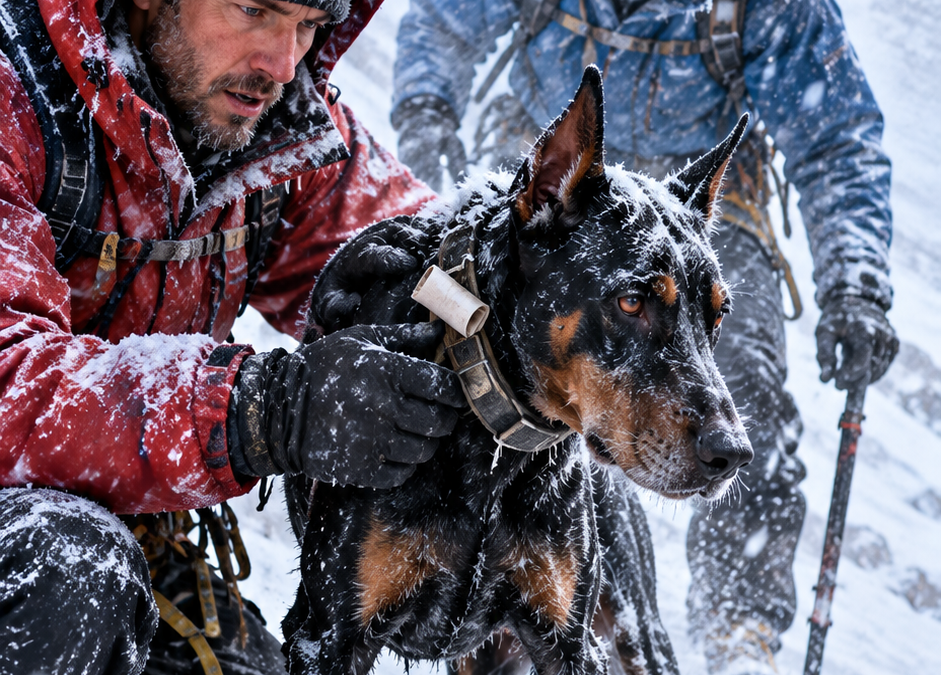
𝗣𝗔𝗥𝗧 𝟮
He dropped to one knee.
The Doberman watched him approach but showed no aggression.
No exposed teeth.
No retreat.
James placed one gloved hand along the dog’s ribs.
“He’s freezing.”
I knelt on the other side.
The dog was trembling violently now that he’d stopped moving.
His breathing was rapid.
His paws looked terrible.
Ice packed between the pads.
Small cuts.
Blood staining snow in tiny marks beneath him.
“How the hell did he get up here?”
James looked at me.
“Better question. Where did he come from?”
The Doberman turned his head uphill.
Even through blowing snow, the movement was unmistakable.
Up.
He was looking up.
James opened his pack.
“I’ve got food.”
He broke a small piece from an energy bar appropriate enough not to harm the dog and offered it.
The Doberman smelled it.
Then turned away.
“That’s not good,” James said.
“He could be too stressed.”
James tried again.
Nothing.
The dog stared uphill.
I reached to check the collar.
It was thick.
Good quality.
Not what I expected on a stray.
“Somebody owns him.”
“Tag?”
“I’m checking.”
No normal ID tag.
But there was something unusual under the collar.
A small object wrapped in clear plastic tape.
At first, I thought it might be part of a tracker.
Then I felt paper.
“James.”
He leaned closer.
“What?”
“There’s something attached.”
My gloves were too thick.
I pulled one off.
Cold bit my fingers instantly.
I worked at the tape.
The dog remained still.
His eyes stayed on my hands for a second, then returned uphill.
Whatever had been attached to his collar had been wrapped carefully.
Multiple layers.
Someone wanted it protected from snow.
When I finally loosened it, a tightly folded piece of paper came free.
James stopped moving.
We both understood at the same moment.
This wasn’t random.
I unfolded it.
Wind tried to tear it from my hands.
James shifted around me, using his body as a shield.
“Read it.”
The handwriting was uneven.
Some letters slanted badly.
A few lines were smudged despite the plastic.
The writer’s hand had clearly been shaking.
Maybe from cold.
Maybe pain.
Probably both.
I read aloud.
“If you’re reading this, my dog made it down.”
James looked at the Doberman.
The dog’s head was still turned uphill.
I continued.
“My name is Henry Whitfield. I came up with my dog, Rocky. I had an accident in a rocky section on the east slope. I fell and broke my leg. I can’t move. The storm came in and I lost all communication.”
I swallowed.
James’s expression changed completely.
No jokes now.
“I cannot get down alone. Rocky is my only chance. He knows the route. He will bring you back to me. Please, if there is any possibility, help me. I am on the east slope beneath a large overhanging rock where the wind is weaker. Rocky will show you.”
The last line was squeezed toward the bottom of the paper.
“Please follow him.”
For several seconds, the storm seemed strangely distant.
I read the note again.
Not because I hadn’t understood.
Because my brain needed confirmation.
A man was alive somewhere above us.
Injured.
Unable to walk.
In a worsening storm.
And the exhausted Doberman beside us had descended the mountain alone to find help.
James spoke first.
“We call rescue.”
I nodded.
He already had the satellite phone out.
I put the note inside my jacket to protect it.
Rocky tried to stand.
His legs shook.
“Stay down.”
He looked at me.
“It’s okay. We’re calling.”
Of course those words meant nothing.
Or maybe tone meant something.
But Rocky didn’t care what equipment we had.
Didn’t understand rescue protocols.
As far as he knew, his job was unfinished.
James got a connection.
“Mountain rescue, this is James Hall. Two climbers on descent, north approach. We’ve encountered a dog carrying a distress note.”
A pause.
“Yes. A dog.”
He listened.
“Owner is Henry Whitfield. Fall injury, suspected leg fracture. East slope beneath a large rock overhang. Communication lost. Dog apparently traveled from victim to us.”
Another pause.
I watched Rocky.
He had forced himself upright.
“Storm intensifying,” James continued. “Visibility poor. We can follow the dog back toward the casualty.”
The response must have been cautious because James’s jaw tightened.
“We understand.”
He listened.
“Yes.”
Then he gave our approximate coordinates.
The call lasted several minutes.
When he ended it, I asked, “What do they say?”
“Team mobilizing. Helicopter’s going to try to reach the area, but they don’t think it can land in this wind.”
“Ground team?”
“Coming from the opposite side.”
“How long?”
“They won’t promise.”
We both knew what that meant.
Too many variables.
Terrain.
Weather.
Visibility.
Henry’s condition.
I looked at Rocky.
The dog looked back.
James saw my expression.
“We’re going.”
It wasn’t a question.
“We just spent an hour trying to get down.”
“I know.”
“The east slope is worse.”
“I know.”
“Visibility’s getting worse.”
“I know.”
James looked uphill.
“So we go.”
I nodded.
“We go.”
There was no dramatic discussion.
No heroic speech.
That isn’t how real decisions usually happen.
A man needed help.
We were there.
We had equipment.
And we had a guide who knew where he was.
That was enough.
Before moving, I tried again to give Rocky food.
He refused.
Water was nearly as difficult.
He took only a few licks from my hand.
“Rocky.”
His ears shifted.
So he knew his name.
“Easy.”
I rubbed the side of his neck.
His whole body shivered.
“You found us.”
I don’t know why saying that affected me.
Maybe because I suddenly imagined what he had already done.
Henry falling.
The storm arriving.
The dog remaining beside him.
Henry writing the note.
Wrapping it.
Attaching it to Rocky’s collar.
Then sending away the only warm, living thing beside him.
What had that moment looked like?
Had Rocky refused to go?
Had Henry pointed downhill?
Had he said, “Find someone”?
How long had the dog traveled?
How many times had he nearly stopped?
I looked at his torn paws.
Too far.
That was the answer.
He had traveled too far already.
And now we were asking him to go back.
“Ready?” James asked.
“No.”
“Good.”
He tightened his hood.
“Let’s go.”
I touched Rocky’s shoulder.
“Take us to Henry.”
The reaction was immediate.
The name mattered.
Henry.
Rocky’s head lifted.
His posture changed.
He turned uphill.
Then started walking.
The first few minutes were brutally slow.
Rocky was exhausted.
Every ten or fifteen steps, he paused.
Sometimes he stood with one paw lifted.
Sometimes he sat for several seconds.
But every time I thought he might finally be unable to continue, he stood again.
He never looked downhill.
Only toward Henry.
James took the lead beside him when terrain allowed.
I followed close.
Our descent tracks were already disappearing.
The mountain had erased our passage.
That unnerved me.
We weren’t following ourselves anymore.
We were following Rocky.
The dog became our compass.
The wind strengthened as we climbed.
Snow blew against us so hard that breathing required turning our faces away.
I felt ice building along my eyebrows.
My thighs burned.
We had already spent energy descending.
Now we were climbing again into worse conditions.
Rocky slowed.
I moved beside him.
“You okay?”
Ridiculous question.
He wasn’t okay.
His sides moved rapidly.
James shouted, “We need to give him a break!”
We crouched behind a rock outcrop.
The wind was slightly weaker there.
Rocky immediately turned uphill again.
“No.”
I placed a hand on his chest.
“Thirty seconds.”
He tried to step around me.
“Rocky.”
He whined.
“Henry needs you alive too.”
He couldn’t understand that.
But I did.
I removed a spare insulating layer from my pack and draped it over his back while we rested.
James checked our navigation.
“East route should fork another hundred meters.”
“Assuming we’re where we think.”
“We are.”
“Confident?”
“No.”
I laughed once.
“Good.”
James looked at Rocky.
“You trust him?”
“More than me.”
“Same.”
After less than a minute, Rocky stood.
The improvised covering slid.
I secured it as best I could.
Then we moved.
At one point, Rocky left what looked like the safer route and turned sharply right.
James stopped.
“That’s not the marked path.”
Rocky continued.
I stared into the white.
“Henry said he knows the way.”
“He could be disoriented.”
“So could we.”
James considered.
Then followed the dog.
Rocky led us between two rock formations where wind exposure decreased.
It was not the marked path.
It was better.
“Okay,” James said.
“What?”
“I officially trust the dog.”
We climbed for perhaps forty minutes.
Time became strange.
Sometimes it felt like five minutes.
Sometimes hours.
Then we heard something.
At first, I thought it was wind changing pitch.
James stopped.
“Helicopter.”
I listened.
Faint.
Rhythmic.
Somewhere above and beyond the storm.
Then a distant beam of light moved through cloud.
“They found the area.”
The helicopter could not land.
We later learned it had made several attempts to approach but crosswinds were too severe.
Still, its presence mattered.
We were no longer alone.
James used the satellite phone again.
Short transmission.
Our position.
Direction.
Rocky’s guidance.
Ground rescuers approaching.
We continued.
Rocky began limping badly.
I hated every step he took.
“James.”
“I see it.”
“We might have to carry him.”
“If we do, how does he guide us?”
That was the problem.
I moved closer to Rocky.
“Come on, buddy.”
He looked at me.
For a second, I saw how tired he truly was.
Eyes half closed.
Body shaking.
Paws bleeding.
Then somewhere ahead, through all that wind, Rocky raised his nose.
He smelled something.
His entire body changed.
He pulled forward.
Not fast.
But suddenly certain.
James saw it too.
“He knows.”
Rocky moved left.
Then upward.
Then stopped and sniffed again.
A sound came from his chest.
A whine.
Low.
Emotional.
“Henry?” I shouted.
Wind swallowed the name.
“Henry Whitfield!”
Nothing.
Rocky began moving faster.
We followed.
Then lights appeared.
Not helicopter lights.
Headlamps.
Several.
Ground rescue.
Two figures emerged from the white.
Heavy packs.
Technical gear.
One raised an arm.
“You Daniel and James?”
“Yes!”
The lead rescuer was maybe fifty, thick beard crusted with ice.
His eyes went immediately to Rocky.
“That’s the dog?”
“Rocky.”
He knelt briefly.
“Good boy.”
Rocky barely acknowledged him.
The rescuer stood.
“We can’t fly the casualty out from this position yet. Aircraft’s circling lower. We need to locate and stabilize first.”
“We think Rocky smells him.”
“Then let him work.”
It was interesting hearing that phrase.
Let him work.
Rocky wasn’t a trained search-and-rescue dog.
At least not as far as we knew.
But on that mountain, he was the most experienced guide among us because only he knew exactly where Henry was.
The rescue team joined behind.
Rocky moved.
Slower now.
But never indecisive.
We entered rougher terrain.
Large exposed rock.
Deep drifts.
Snow reached my knees in places.
The rescuers helped break trail so Rocky didn’t have to push through everything himself.
Still, he insisted on staying near the front.
One rescuer tried to move ahead of him.
Rocky shifted around him.
The man laughed softly.
“All right, boss.”
We climbed another slope.
Then Rocky stopped.
His head turned left.
He sniffed.
Whined.
Then pulled hard.
The big overhanging rock appeared only when we were perhaps twenty yards away.
It blended into the storm until we reached its shelter.
Wind dropped suddenly beneath it.
Not calm.
But dramatically weaker.
And there, partially shielded by stone and snow, lay a man.
“Henry!”
Rocky ran.
Whatever pain existed in his paws vanished from his movement.
He reached the man first.
Henry Whitfield was propped awkwardly against rock.
A backpack and loose gear had been placed around his legs, probably as insulation.
His face was pale.
Lips slightly blue.
Eyes closed.
Rocky pressed his nose against his cheek.
Then licked him.
Once.
Twice.
Henry moved.
Barely.
His eyes opened.
For a second they didn’t focus.
Then he saw the dog.
His entire expression softened.
“Good boy.”
His voice was almost nothing.
Rocky’s tail moved.
The first true wag I had seen.
“Good boy, Rocky.”
The rescue team went to work instantly.
No celebration.
No wasted motion.
One checked airway and breathing.
Another assessed temperature and circulation.
A third prepared equipment for the leg.
James and I moved back to give them room.
Henry’s right leg was badly injured.
Fortunately, the fall had not produced the catastrophic spinal injury I had feared.
But he was hypothermic.
Dehydrated.
Exhausted.
And in severe pain.
One rescuer cut away material around the leg.
Another wrapped Henry in insulated blankets.
“Henry, can you hear me?”
“Yes.”
“Do you know where you are?”
“Mountain.”
“Good.”
“What day is it?”
Henry hesitated.
The rescuer gave him time.
He answered correctly.
Rocky tried to move closer.
A rescuer blocked him briefly.
Henry immediately reacted.
“My dog.”
“He’s here.”
“Rocky.”
“He’s right here.”
I stepped forward.
“Henry.”
His eyes found me.
“My name’s Daniel. James and I found Rocky.”
Henry stared.
“You… read it?”
“The note.”
His eyes closed.
A tear escaped.
“He made it.”
“Yes.”
“How far?”
“Far enough.”
Henry looked at Rocky.
The dog pushed closer.
I nodded to the rescuer.
“Let him.”
The man shifted enough to allow Rocky beside Henry’s upper body.
Rocky lay down.
Not carefully.
Collapsed.
His head rested across Henry’s chest.
Henry managed to lift one hand.
He placed it on the dog’s neck.
“Good boy.”
I turned away.
James stood beside me.
He didn’t say anything.
He didn’t need to.
The image was too much.
A half-frozen dog had crossed a mountain because this man asked him to.
Then crossed it again to come home.
Henry’s fingers moved weakly through Rocky’s fur.
“Is he hurt?”
That was his first real question after being found.
Not:
How bad is my leg?
How long was I here?
Can you get me out?
Is Rocky hurt?
“His paws are cut,” I said. “He’s exhausted and cold. But he’s here.”
Henry nodded.
“Give him my jacket.”
A rescuer almost smiled.
“We’re going to keep your jacket on you, Henry.”
“Something.”
“We’ll take care of him.”
Henry seemed dissatisfied.
I removed the spare layer I had partially used on Rocky earlier and covered him again.
“There.”
Henry looked at me.
“Thank you.”
The storm continued outside our small shelter.
But under that rock, the mood changed.
We had found him.
He was alive.
Now survival became a process instead of a mystery.
The rescue team contacted the helicopter.
No immediate extraction.
Wind remained too dangerous.
We would wait for a reduction or move Henry lower by stretcher if necessary.
The rescuers stabilized his leg.
Started warming measures.
Monitored him constantly.
James and I sat several yards away, eating quickly because our bodies were demanding fuel.
Rocky refused food again until Henry spoke.
“Rocky.”
The dog’s eyes opened.
Henry pointed weakly toward my hand.
“Eat.”
I offered food.
This time Rocky took it.
James stared.
“You’ve got to be kidding.”
Henry smiled faintly.
“He listens eventually.”
Rocky ate several small pieces.
Then drank.
After that, he immediately placed his head back against Henry.
I asked, “How long have you had him?”
Henry looked at the dog.
“Eight years.”
“Since he was a puppy?”
“Almost.”
Rocky’s ear moved at Henry’s voice.
“We’ve been everywhere together.”
Henry’s eyes became distant.
“I shouldn’t have brought him today.”
I understood the guilt immediately.
“Without him, you might not be alive.”
“That’s the problem.”
“How?”
“He nearly killed himself saving me.”
I looked at Rocky.
“He made his choice.”
Henry gave a tired laugh.
“That’s what I’m afraid of.”
We waited almost two hours.
The storm slowly weakened.
Not stopped.
Just loosened its grip.
The helicopter crew reported a possible extraction window lower on the slope.
The team prepared Henry for transport.
When rescuers lifted him onto the stretcher, Rocky stood.
His legs nearly failed.
I caught him.
“Easy.”
He pulled toward Henry.
“You’re going too.”
No one had explicitly said that yet.
I looked at the team leader.
“He’s going with him.”
The rescuer nodded.
“Absolutely.”
We began moving downhill.
Henry secured.
Rescuers rotating positions.
Rocky walked beside the stretcher.
No leash.
No command.
He simply refused to be anywhere else.
At one point, he stumbled.
I picked him up.
He resisted at first.
“Enough.”
He looked toward Henry.
“I know.”
Rocky weighed more than I wanted to carry after everything else, but I held him across my arms for several minutes.
His body finally relaxed slightly.
His head remained angled toward the stretcher.
Henry saw him.
“He’s okay?”
“He’s getting a taxi.”
That earned a weak smile.
When we reached the extraction point, helicopter noise became overwhelming.
Snow exploded around us beneath rotor wash.
Rescuers secured Henry.
Rocky became frightened by the aircraft.
For the first time all day, he tried to retreat.
Henry called him.
“Rocky!”
The dog stopped.
Looked.
Henry extended his hand.
Rocky approached.
The crew made arrangements to bring him aboard safely.
As the helicopter lifted, I saw Henry through the window.
His hand was resting against Rocky’s neck.
Then they disappeared into cloud.
James and I stood in the snow.
Neither of us spoke.
Finally James said, “We still have to walk down.”
I stared at him.
“Don’t ruin this.”
He laughed.
We descended with part of the rescue team.
The storm continued fading.
By then, my whole body hurt.
My legs felt hollow.
My hands ached.
But I didn’t care.
Somewhere above, Henry was alive.
Rocky was with him.
That was enough.
At the base, rescue staff took our statements.
We handed over the note.
I almost hated giving it away.
That little piece of paper had held one man’s entire hope.
Later, they returned it to Henry.
The next morning, I woke after barely sleeping.
My muscles protested when I moved.
My phone showed a message from James.
Henry stable.
Fractured leg. Hypothermia treated. No major head injury.
Then:
Rocky is apparently refusing to leave hospital room.
I laughed aloud.
Of course he was.
I typed back:
Would be more surprising if he left.
Three weeks later, James and I visited.
Henry was still recovering.
His leg was elevated.
The room smelled like antiseptic and coffee.
And beside the bed sat Rocky.
The transformation stopped me.
He looked rested.
Coat clean.
Paws bandaged but healing.
Body no longer trembling.
When we entered, his head lifted.
He stared at us.
Then his tail moved.
Once.
Twice.
I smiled.
“Hey, mountain guide.”
Rocky stood and came over.
He sniffed James.
Then me.
I scratched his neck.
“You look better.”
Henry laughed from the bed.
“So do you.”
I looked at him.
“You don’t.”
“Kind.”
James shook his hand.
Henry’s face became serious.
“I’ve been trying to figure out what to say to you.”
“Don’t.”
“I mean it.”
“So do I.”
“You turned around in that storm.”
I looked at Rocky.
“We followed your instructions.”
Henry’s eyes moved to his dog.
“He did the hard part.”
“That’s what I keep telling people.”
Rocky returned to the bed.
Henry rubbed behind his ears.
“Eight years.”
He looked at us.
“He’s been with me eight years. I’ve always joked that he thinks he’s responsible for me.”
James pulled up a chair.
“Seems less like a joke now.”
Henry smiled.
“No.”
He looked toward the window.
“I remember falling.”
We listened.
“A branch of rock gave way under my boot.”
His hand tightened slightly.
“I dropped hard. Heard the leg before I felt it.”
I winced.
“I tried standing.”
“Bad idea.”
“I figured that out.”
He laughed.
“Phone was gone. Radio damaged. Storm moving in.”
Rocky placed his chin on the mattress.
Henry continued.
“He wouldn’t leave.”
“How did you get him to go?”
Henry became quiet.
“I almost didn’t.”
He looked at Rocky.
“I kept telling him to go.”
His eyes filled.
“He’d run twenty feet, then come back.”
That image hurt more than I expected.
“What changed?”
“I wrote the note.”
Henry swallowed.
“Put it on him. Took off one glove and made him smell it.”
“The glove?”
“No. The route.”
He smiled faintly.
“Rocky knows a command we use when hiking. ‘Find.’ Usually means find the trail, find the truck, sometimes find me if we’re playing around.”
James leaned forward.
“So you told him to find someone?”
“I pointed downhill.”
Henry’s voice shook.
“I said, ‘Find help.'”
I looked at Rocky.
Henry wiped his eyes.
“He left.”
“That must have been hard.”
“Worst moment.”
“Why?”
“Because once he disappeared, I had nothing.”
His answer was immediate.
“No movement. No warmth. No sound.”
He stared at the dog.
“I had sent away the only reason I still felt like I wasn’t alone.”
Silence filled the room.
“But I knew if there was any chance, it was him.”
James said, “You trusted him.”
Henry shook his head.
“No.”
We both looked at him.
“I knew him.”
There was something powerful about the distinction.
Trust still contains uncertainty.
Henry had none.
He knew Rocky would try until he couldn’t.
I asked, “Did you ever think he might not find anyone?”
“Of course.”
“Then how—”
“I knew failure wouldn’t be because he stopped.”
Henry’s eyes moved to Rocky.
“That’s who he is.”
We talked for over an hour.
Before leaving, Henry reached into the drawer beside his bed.
He handed me the note.
Same paper.
Flattened now.
Protected in a clear sleeve.
“You should see it again.”
I read it.
The words looked smaller inside a hospital room than they had on the mountain.
Less dramatic.
Just ink.
But I knew what they had cost.
“I want to frame it,” Henry said.
“You should.”
“Next to Rocky’s picture.”
James laughed.
“Rocky deserves top billing.”
“He already has it.”
Before we left, I knelt beside the dog.
He looked healthier, but there were faint scars on his paws.
I touched one gently.
“You know we were going down when you found us.”
Rocky blinked.
“We were done.”
Tail movement.
“You made us climb back into a storm.”
Another wag.
I smiled.
“Best bad decision I ever made.”
Months passed.
Henry recovered.
His leg required surgery and rehabilitation, but he eventually walked normally again.
We stayed in contact.
James and I visited his home once.
Rocky greeted us at the door carrying a rope toy.
I almost didn’t recognize him as the same dog who had appeared through the storm.
There was strength in his body again.
Brightness in his eyes.
Henry laughed when Rocky dropped the toy at my feet.
“Careful.”
“Why?”
“He’ll make you work.”
I threw it.
Rocky sprinted.
I stared.
The dog that had barely lifted his paws through snow now moved like black lightning across the yard.
Something inside me tightened.
Not sadness.
Gratitude.
Henry walked up beside me.
“I still have nightmares.”
I looked at him.
“About the fall?”
“Sometimes.”
“The storm?”
He nodded.
“Mostly about sending him away.”
Rocky returned.
Henry took the toy.
“I dream he disappears into the snow and never comes back.”
He threw it again.
“Then I wake up and he’s usually sleeping on top of my feet.”
“That helps.”
“More than anything.”
We stood quietly.
Then Henry said, “Do you still climb?”
“Yes.”
“Hesitate more?”
“Definitely.”
He smiled.
“Good.”
I laughed.
“I’m not sure that’s what climbers are supposed to say.”
“I think good climbers come back.”
That stayed with me.
Before the storm, I had thought mountaineering was about pushing limits.
Endurance.
Skill.
Technical knowledge.
Courage.
Those things matter.
But Henry was right.
The mountain does not care about your ego.
The summit is not success if you don’t come home.
After Rocky, I became more cautious.
Not afraid.
Respectful.
There is a difference.
I turned around more easily when weather looked wrong.
I carried redundant communication.
I paid closer attention to other climbers.
I stopped thinking of retreat as failure.
James noticed.
“Rocky ruined you.”
“Improved me.”
“Debatable.”
But he changed too.
We both did.
One year after the rescue, Henry invited us back to the mountain.
Not the summit.
Just a lower trail.
I hesitated.
“You’re serious?”
“Completely.”
“What about Rocky?”
“Try telling him he’s staying home.”
So the four of us went.
Clear weather.
Stable conditions.
No heroic ambitions.
Rocky walked between Henry and me.
Every so often, he looked up toward the higher slopes.
I wondered what he remembered.
Dogs process memory differently, but place matters.
Scent matters.
Association matters.
Did he know this was the mountain where he nearly froze?
Where Henry fell?
Where he had been alone in a storm?
His body showed no fear.
Only attention.
We eventually reached a viewpoint below the accident area.
Henry stopped.
Rocky stopped with him.
For a long time, Henry looked upward.
“That’s enough.”
James nodded.
“Agreed.”
We sat.
Rocky lay beside Henry.
The sun was warm.
Wind mild.
Nothing like that day.
Henry reached into his pack and pulled out the framed note.
I laughed.
“You brought it?”
“Seemed appropriate.”
He held it.
The handwriting.
The desperate lines.
Rocky sleeping beside him.
Then Henry said, “You know what I keep thinking?”
“What?”
“I wrote ‘Rocky is my only hope.'”
I remembered.
“And?”
Henry looked down at the dog.
“I was wrong.”
I frowned.
“How?”
“He was my hope. But hope isn’t enough by itself.”
He looked at us.
“He found you.”
I understood.
Rocky could run.
Carry the message.
Find people.
But somebody still had to stop.
Read it.
Believe it.
Turn around.
James said quietly, “Everyone needed the next person.”
Henry nodded.
“Exactly.”
He put the frame back.
“I sent Rocky. Rocky found you. You called rescue. Rescue came.”
He rubbed Rocky’s head.
“Nobody did it alone.”
That became the second lesson Rocky taught me.
We like hero stories because they simplify things.
One person saves another.
One dog becomes extraordinary.
One rescue team wins against nature.
Reality is usually a chain.
Henry wrote.
Rocky carried.
We followed.
Rescuers climbed.
Pilots waited for the weather window.
Doctors treated.
Everyone held one piece.
Remove any of them and the ending might change.
Rocky was the heart of that chain.
But hearts work because everything around them keeps moving too.
Today, years later, I still climb.
Not professionally.
Not recklessly.
I climb because mountains make the rest of life quieter.
Because effort simplifies thought.
Because there is something humbling about standing beneath terrain that existed long before you and will remain long after you are gone.
But every time weather changes unexpectedly, I remember Rocky.
Not the dramatic version people like to tell.
Not “hero dog saves owner in blizzard.”
I remember details.
Blood in his paw prints.
The way he refused food.
The note taped beneath his collar.
The way he looked uphill every second we delayed.
His exhausted legs shaking when he stood.
The sound he made when he finally smelled Henry.
And Henry’s first words.
Good boy.
Those two words contained everything.
Fear.
Relief.
Love.
Recognition.
You did it.
You came back.
I sometimes tell the story to younger climbers.
Not because I enjoy being the older man with a mountain story.
I am not that old yet, though James insists otherwise.
I tell it because they tend to focus on Rocky’s courage.
They should.
But I want them to notice Henry too.
Henry understood something essential.
He could not save himself.
That admission may have saved his life.
He did not waste all his strength pretending otherwise.
He created a plan.
Protected the note.
Trusted Rocky.
Sent him.
Asking for help is also survival.
That is difficult for people.
Especially people drawn to mountains.
We like self-reliance.
Skill.
Control.
But mountains expose the limits of all three.
Sometimes your life depends on another climber.
A rescue worker.
A pilot.
Or an exhausted Doberman appearing through the snow.
Henry eventually adopted a second dog years later, after Rocky became older.
Not to replace him.
Never that.
A younger rescue dog named Finn.
Rocky tolerated him with the patience of an old man watching a child destroy a quiet household.
Henry sent me a photograph.
Finn was chewing a shoe.
Rocky sat in the background looking profoundly disappointed.
I laughed for five minutes.
I called Henry.
“Rocky looks offended.”
“He is.”
“At Finn?”
“At my judgment.”
“Fair.”
Rocky aged well.
His black muzzle turned gray.
Runs became walks.
Long hikes became shorter trails.
Henry adjusted everything.
No more difficult routes.
No extreme conditions.
“He’s done enough,” Henry told me.
That sentence meant more than it sounded.
Rocky did not need to prove loyalty again.
He had already written that truth across a mountain.
Once, during a visit, I saw the framed note hanging in Henry’s living room.
Beside it was a photograph taken after his recovery.
Henry sitting on a low stone wall.
Rocky beside him.
No snow.
No drama.
Just sunlight.
Under the frame, Henry had added a small brass plate.
It read:
HE FOUND HELP.
That was all.
I stood there for a long time.
Henry noticed.
“Too much?”
“No.”
“People keep telling me I should put the whole story.”
“Don’t.”
“Why?”
I pointed at the words.
“That’s enough.”
He found help.
Simple.
That was Rocky.
He did not understand rescue logistics.
He did not know what satellite communication was.
He couldn’t read Henry’s note.
He didn’t know how dangerous the storm had become.
He understood one thing.
Henry could not follow.
So someone else had to come.
And Rocky found them.
Years after the rescue, James asked me whether I still believed Rocky deliberately chose us.
We were having coffee after a climb.
“What do you mean?”
“Maybe we were just the first moving things he saw.”
“Possible.”
“He might have gone to anyone.”
“Probably.”
James smiled.
“So it wasn’t fate.”
I thought about it.
“I don’t know.”
“You’re getting philosophical.”
“Age.”
“You’re younger than me.”
“Exactly.”
I looked out the café window toward distant mountains.
“Maybe fate isn’t about choosing the perfect person.”
“What is it, then?”
“Finding someone who decides to respond.”
James considered that.
“Annoyingly reasonable.”
I smiled.
Rocky did not need heroes.
He needed humans who would listen.
That morning, he appeared through snow carrying a message without understanding a single word on the page.
We could have seen only a lost dog.
We could have assumed someone else would handle it.
We could have continued downward.
Instead, we unfolded the paper.
That’s where the story changed.
Sometimes I think life gives us messages like that more often than we notice.
Not literal notes taped beneath collars.
Signals.
Someone who is too quiet.
A stranger in trouble.
An animal behaving strangely.
A situation asking us to inconvenience ourselves.
Most opportunities to help do not arrive when we are rested and ready.
Rocky found us when we were exhausted.
Cold.
Already retreating.
That mattered.
Doing the right thing is easy when it fits your plan.
That day, it required abandoning ours.
We were headed toward safety.
Henry was behind us.
So we turned around.
I don’t say that proudly.
I say it gratefully.
Because following Rocky became one of the clearest decisions of my life.
There are many decisions I still question.
Careers.
Relationships.
Places I should have gone.
Things I should have said.
Not that one.
Never that one.
Henry is alive.
That’s enough.
The last time I saw Rocky, he was old.
Very old.
Henry had invited James and me for dinner.
Rocky did not run to the door anymore.
He stood slowly when we entered.
His legs trembled slightly.
For one awful second, the movement reminded me of the mountain.
Then he recognized us.
Tail.
Slow.
Happy.
I knelt.
“Hey, guide.”
He walked toward me.
Pressed his head against my chest.
I wrapped my arms around him.
His fur smelled like home.
Not snow.
Not fear.
Home.
Henry watched.
“He remembers you.”
“I hope not.”
Henry frowned.
“Why?”
“The first time he met me was probably the worst day of his life.”
Henry smiled.
“Maybe he remembers what happened after.”
I looked at Rocky.
That idea comforted me.
Maybe dogs do not separate memory into human categories of trauma and triumph.
Maybe Rocky remembered only:
I needed someone.
These people followed.
We found Henry.
We went home.
If so, that was enough.
After dinner, Rocky fell asleep near Henry’s chair.
We talked late.
Before I left, I crouched beside him once more.
He barely opened his eyes.
I touched the gray fur along his face.
“You did good.”
His tail tapped the floor.
Once.
I laughed.
“Still showing off.”
Henry looked away.
I knew he was emotional.
So was I.
Rocky died peacefully sometime later.
At home.
Henry beside him.
I won’t turn that into tragedy.
Every good life eventually reaches an ending we don’t want.
Rocky had years after the mountain.
Warm beds.
Easy walks.
Sunlight.
Henry.
He did not die in snow.
He did not disappear into the storm after delivering the note.
He came home.
That matters to me.
Henry called the next day.
His voice told me before the words did.
“Rocky’s gone.”
I closed my eyes.
“I’m sorry.”
“He was asleep.”
“With you?”
“Yeah.”
A pause.
“I had my hand on him.”
I swallowed.
“Then he knew.”
Henry started crying.
“So did I.”
We stayed on the phone without speaking for a long time.
Eventually Henry said, “Do you remember the first thing I said when you found me?”
“Of course.”
“Good boy.”
“Yeah.”
His voice broke.
“Last thing I told him too.”
I could not answer for several seconds.
Then I said, “That’s right.”
“What?”
“He was.”
Henry cried harder.
“So good.”
After we hung up, I went outside.
It was winter.
Not storming.
Just light snow.
I stood there watching flakes fall and thought of that black shape appearing through white chaos years earlier.
I thought of how close Rocky had been to stopping.
How badly his body had wanted rest.
How he kept walking because someone he loved could not.
People often describe loyalty as staying beside someone.
Rocky taught me another form.
Sometimes loyalty means leaving.
Leaving the person you desperately want to stay with because their survival requires you to go.
Running into uncertainty.
Trusting that you can find help.
Trusting that help will follow.
Then turning around and going back.
That is what Rocky did.
He left Henry so he could return to Henry.
There is something almost unbearable about that.
I still climb.
Every year, on the first snowfall, I think about him.
Sometimes I carry a copy of Henry’s note in my pack.
Not the original.
Henry kept that until the end of Rocky’s life and still has it now.
My copy is small.
Folded.
Worn along the creases.
I don’t need it for luck.
I carry it as perspective.
When a climb becomes frustrating, I remember Rocky’s paws.
When weather tells me to turn around, I turn around.
When ego tells me I should push farther because I planned to reach a summit, I remember Henry beneath that rock.
When someone needs help, I remember a dog who refused to rest.
Years ago, I thought becoming a mountaineer meant conquering mountains.
I don’t use that word anymore.
Nobody conquers a mountain.
At best, it allows you to cross part of it and go home.
The mountain we were on that day did not lose.
Neither did we.
There was no contest.
A storm happened.
A man fell.
A dog responded.
People helped.
A life continued.
That is enough.
If there is one image I will carry until I can no longer climb, it is not the helicopter.
Not the rescuers.
Not even Henry opening his eyes.
It is Rocky standing in front of us after we read the note.
His body exhausted.
Paws bleeding.
Snow collecting along his back.
Everything in him screaming for warmth and rest.
Yet his face turned uphill.
Toward Henry.
We had offered him food.
Shelter.
A chance to descend.
He refused all of it.
Because his person was still up there.
He had not come down to save himself.
He had come down to find us.
And the moment he did, all he wanted was to go back.
That is why, whenever people call Rocky a hero, I agree.
But not because he was fearless.
I don’t believe he was.
He trembled.
He whined.
The helicopter frightened him.
The storm hurt him.
Courage is not the absence of fear.
It is having something that matters more.
For Rocky, that was Henry.
My name is Daniel Carter.
I’m still a mountaineer.
James still climbs with me.
Henry still sends us messages occasionally, usually photographs from easier trails or memories of Rocky.
And somewhere in my house is a photograph of a black-and-rust Doberman sitting beside a hospital bed, his head resting against the leg of the man he refused to lose.
Whenever I look at it, I remember the note.
I remember the storm.
And I remember one simple truth that mountain gave me.
Hope doesn’t always look like sunlight breaking through clouds.
Sometimes hope is half frozen.
Sometimes it is exhausted.
Sometimes its paws are bleeding.
Sometimes it cannot speak at all.
Sometimes it arrives out of a whiteout, wearing a collar with a folded message beneath it, and looks directly into your eyes as if asking whether you are willing to follow.
That day, we followed.
And because we did, Rocky went back to Henry.
Henry came down alive.
And I finally learned what kind of mountaineer I wanted to be.
Not the man who could always reach the top.
The man who knew when another life mattered more than the summit.
The man who would turn around.
The man who would read the message.
And the man who, when hope appeared on four shaking legs in the middle of a storm, would be wise enough not to let it walk alone.
Have you finished reading the story and want to read it again?
A Freezing Doberman Found Us in a Whiteout—Then We Found the Note Hidden in His Collar
The Doberman appeared out of a wall of snow halfway down the mountain, barely able to stand, yet every time we tried to make him rest, he forced himself back onto his feet and stared toward the summit.
When my climbing partner found a folded piece of paper sealed beneath the dog’s collar, I realized this exhausted animal hadn’t wandered into the storm by accident—he had come looking for us.
What was written on that tiny note made James and me turn around and climb straight back into weather we had just fought desperately to escape, because somewhere above us, a man was running out of time.
My name is Daniel Carter, and before that day, I thought becoming a mountaineer was mostly about learning how to survive a mountain.
I was wrong.
The mountain taught me that survival is sometimes the least important thing you carry back down.
James and I had been descending the north side for nearly an hour when the weather broke.
Not changed.
Broke.
There is a difference.
Mountain weather can shift quickly, and anyone who spends enough time at altitude learns not to trust a blue sky simply because it was blue fifteen minutes ago. We had checked the forecast. We had proper layers, navigation equipment, emergency supplies, and a satellite phone. We were not reckless amateurs wandering upward in sneakers because a photograph looked beautiful online.
But the mountain did not care how prepared we believed we were.
The first gust hit us sideways.
James stopped and turned.
“You feel that?”
“I feel everything.”
He pulled the collar of his jacket higher.
Behind him, the distant ridge was disappearing.
Clouds rolled over it with frightening speed.
“Time to move.”
We had already decided against continuing higher. The summit wasn’t worth gambling against a storm, and we were descending well before conditions became catastrophic.
That decision probably saved our lives.
Within fifteen minutes, visibility fell to perhaps thirty yards.
Then twenty.
Then less.
Snow didn’t seem to fall so much as attack horizontally.
The wind ripped at the straps on my pack.
Ice crystals struck my exposed cheeks like sand.
We had to lean into the gusts just to remain upright.
Every few steps, one of us stopped.
Checked the other.
Checked direction.
Moved again.
James was maybe six feet ahead of me when a stronger gust hit.
He staggered.
I grabbed the back of his pack.
He reached for my arm.
For several seconds we stood locked together while the wind screamed over the ridge.
When it eased slightly, he shouted, “Still want to become a mountaineer?”
I could barely hear him.
“Ask me in a warmer location!”
He laughed.
That was James.
When things became dangerous, he joked.
When things became genuinely frightening, he joked more.
It wasn’t because he didn’t understand risk.
It was how he kept fear from owning the situation.
We continued.
Ten steps.
Stop.
Check.
Move.
The world around us became white and gray.
The path beneath our boots was disappearing as quickly as we crossed it.
I focused on small things.
Breathing.
Foot placement.
Keeping my gloves dry.
The distance between me and James.
Never the full descent.
The full mountain was too large to think about.
Then something moved to my left.
I stopped.
At first, I thought it was a shrub bending in the wind.
There were few large trees at that elevation, but low vegetation and rocks could appear alive when snow moved around them.
Then the dark shape moved again.
Toward us.
“James!”
He turned.
I pointed.
“What?”
“There.”
The shape disappeared behind blowing snow.
Then emerged.
Four legs.
Long body.
Black.
A dog.
For several seconds my brain refused to accept what my eyes were telling it.
Dogs did not simply appear on exposed mountain terrain during a whiteout.
But there he was.
A Doberman.
Black and rust.
Tall, although at that moment he seemed almost folded into himself.
His ears were flattened against the wind.
Snow clung to his coat.
Dobermans aren’t built for prolonged exposure to conditions like that. Their coats are short. They have little protection against brutal cold.
This dog looked like he’d already spent far too long in it.
He lifted one paw.
Placed it down.
Then another.
Every step was an act of will.
“Jesus,” James said.
We both moved toward him.
The dog came another ten yards downhill.
Then stopped.
He sat.
Not normally.
His back legs seemed to collapse beneath him.
He lifted his head.
And made a sound.
I’ve heard injured animals.
Scared animals.
Dogs calling for owners.
This was different.
It started as a low whine and broke into something almost like a howl, but weak.
Desperate.
Yet determined.
James reached him first.
“Easy, boy.”
He dropped to one knee.
The Doberman watched him approach but showed no aggression.
No exposed teeth.
No retreat.
James placed one gloved hand along the dog’s ribs.
“He’s freezing.”
I knelt on the other side.
The dog was trembling violently now that he’d stopped moving.
His breathing was rapid.
His paws looked terrible.
Ice packed between the pads.
Small cuts.
Blood staining snow in tiny marks beneath him.
“How the hell did he get up here?”
James looked at me.
“Better question. Where did he come from?”
The Doberman turned his head uphill.
Even through blowing snow, the movement was unmistakable.
Up.
He was looking up.
James opened his pack.
“I’ve got food.”
He broke a small piece from an energy bar appropriate enough not to harm the dog and offered it.
The Doberman smelled it.
Then turned away.
“That’s not good,” James said.
“He could be too stressed.”
James tried again.
Nothing.
The dog stared uphill.
I reached to check the collar.
It was thick.
Good quality.
Not what I expected on a stray.
“Somebody owns him.”
“Tag?”
“I’m checking.”
No normal ID tag.
But there was something unusual under the collar.
A small object wrapped in clear plastic tape.
At first, I thought it might be part of a tracker.
Then I felt paper.
“James.”
He leaned closer.
“What?”
“There’s something attached.”
My gloves were too thick.
I pulled one off.
Cold bit my fingers instantly.
I worked at the tape.
The dog remained still.
His eyes stayed on my hands for a second, then returned uphill.
Whatever had been attached to his collar had been wrapped carefully.
Multiple layers.
Someone wanted it protected from snow.
When I finally loosened it, a tightly folded piece of paper came free.
James stopped moving.
We both understood at the same moment.
This wasn’t random.
I unfolded it.
Wind tried to tear it from my hands.
James shifted around me, using his body as a shield.
“Read it.”
The handwriting was uneven.
Some letters slanted badly.
A few lines were smudged despite the plastic.
The writer’s hand had clearly been shaking.
Maybe from cold.
Maybe pain.
Probably both.
I read aloud.
“If you’re reading this, my dog made it down.”
James looked at the Doberman.
The dog’s head was still turned uphill.
I continued.
“My name is Henry Whitfield. I came up with my dog, Rocky. I had an accident in a rocky section on the east slope. I fell and broke my leg. I can’t move. The storm came in and I lost all communication.”
I swallowed.
James’s expression changed completely.
No jokes now.
“I cannot get down alone. Rocky is my only chance. He knows the route. He will bring you back to me. Please, if there is any possibility, help me. I am on the east slope beneath a large overhanging rock where the wind is weaker. Rocky will show you.”
The last line was squeezed toward the bottom of the paper.
“Please follow him.”
For several seconds, the storm seemed strangely distant.
I read the note again.
Not because I hadn’t understood.
Because my brain needed confirmation.
A man was alive somewhere above us.
Injured.
Unable to walk.
In a worsening storm.
And the exhausted Doberman beside us had descended the mountain alone to find help.
James spoke first.
“We call rescue.”
I nodded.
He already had the satellite phone out.
I put the note inside my jacket to protect it.
Rocky tried to stand.
His legs shook.
“Stay down.”
He looked at me.
“It’s okay. We’re calling.”
Of course those words meant nothing.
Or maybe tone meant something.
But Rocky didn’t care what equipment we had.
Didn’t understand rescue protocols.
As far as he knew, his job was unfinished.
James got a connection.
“Mountain rescue, this is James Hall. Two climbers on descent, north approach. We’ve encountered a dog carrying a distress note.”
A pause.
“Yes. A dog.”
He listened.
“Owner is Henry Whitfield. Fall injury, suspected leg fracture. East slope beneath a large rock overhang. Communication lost. Dog apparently traveled from victim to us.”
Another pause.
I watched Rocky.
He had forced himself upright.
“Storm intensifying,” James continued. “Visibility poor. We can follow the dog back toward the casualty.”
The response must have been cautious because James’s jaw tightened.
“We understand.”
He listened.
“Yes.”
Then he gave our approximate coordinates.
The call lasted several minutes.
When he ended it, I asked, “What do they say?”
“Team mobilizing. Helicopter’s going to try to reach the area, but they don’t think it can land in this wind.”
“Ground team?”
“Coming from the opposite side.”
“How long?”
“They won’t promise.”
We both knew what that meant.
Too many variables.
Terrain.
Weather.
Visibility.
Henry’s condition.
I looked at Rocky.
The dog looked back.
James saw my expression.
“We’re going.”
It wasn’t a question.
“We just spent an hour trying to get down.”
“I know.”
“The east slope is worse.”
“I know.”
“Visibility’s getting worse.”
“I know.”
James looked uphill.
“So we go.”
I nodded.
“We go.”
There was no dramatic discussion.
No heroic speech.
That isn’t how real decisions usually happen.
A man needed help.
We were there.
We had equipment.
And we had a guide who knew where he was.
That was enough.
Before moving, I tried again to give Rocky food.
He refused.
Water was nearly as difficult.
He took only a few licks from my hand.
“Rocky.”
His ears shifted.
So he knew his name.
“Easy.”
I rubbed the side of his neck.
His whole body shivered.
“You found us.”
I don’t know why saying that affected me.
Maybe because I suddenly imagined what he had already done.
Henry falling.
The storm arriving.
The dog remaining beside him.
Henry writing the note.
Wrapping it.
Attaching it to Rocky’s collar.
Then sending away the only warm, living thing beside him.
What had that moment looked like?
Had Rocky refused to go?
Had Henry pointed downhill?
Had he said, “Find someone”?
How long had the dog traveled?
How many times had he nearly stopped?
I looked at his torn paws.
Too far.
That was the answer.
He had traveled too far already.
And now we were asking him to go back.
“Ready?” James asked.
“No.”
“Good.”
He tightened his hood.
“Let’s go.”
I touched Rocky’s shoulder.
“Take us to Henry.”
The reaction was immediate.
The name mattered.
Henry.
Rocky’s head lifted.
His posture changed.
He turned uphill.
Then started walking.
The first few minutes were brutally slow.
Rocky was exhausted.
Every ten or fifteen steps, he paused.
Sometimes he stood with one paw lifted.
Sometimes he sat for several seconds.
But every time I thought he might finally be unable to continue, he stood again.
He never looked downhill.
Only toward Henry.
James took the lead beside him when terrain allowed.
I followed close.
Our descent tracks were already disappearing.
The mountain had erased our passage.
That unnerved me.
We weren’t following ourselves anymore.
We were following Rocky.
The dog became our compass.
The wind strengthened as we climbed.
Snow blew against us so hard that breathing required turning our faces away.
I felt ice building along my eyebrows.
My thighs burned.
We had already spent energy descending.
Now we were climbing again into worse conditions.
Rocky slowed.
I moved beside him.
“You okay?”
Ridiculous question.
He wasn’t okay.
His sides moved rapidly.
James shouted, “We need to give him a break!”
We crouched behind a rock outcrop.
The wind was slightly weaker there.
Rocky immediately turned uphill again.
“No.”
I placed a hand on his chest.
“Thirty seconds.”
He tried to step around me.
“Rocky.”
He whined.
“Henry needs you alive too.”
He couldn’t understand that.
But I did.
I removed a spare insulating layer from my pack and draped it over his back while we rested.
James checked our navigation.
“East route should fork another hundred meters.”
“Assuming we’re where we think.”
“We are.”
“Confident?”
“No.”
I laughed once.
“Good.”
James looked at Rocky.
“You trust him?”
“More than me.”
“Same.”
After less than a minute, Rocky stood.
The improvised covering slid.
I secured it as best I could.
Then we moved.
At one point, Rocky left what looked like the safer route and turned sharply right.
James stopped.
“That’s not the marked path.”
Rocky continued.
I stared into the white.
“Henry said he knows the way.”
“He could be disoriented.”
“So could we.”
James considered.
Then followed the dog.
Rocky led us between two rock formations where wind exposure decreased.
It was not the marked path.
It was better.
“Okay,” James said.
“What?”
“I officially trust the dog.”
We climbed for perhaps forty minutes.
Time became strange.
Sometimes it felt like five minutes.
Sometimes hours.
Then we heard something.
At first, I thought it was wind changing pitch.
James stopped.
“Helicopter.”
I listened.
Faint.
Rhythmic.
Somewhere above and beyond the storm.
Then a distant beam of light moved through cloud.
“They found the area.”
The helicopter could not land.
We later learned it had made several attempts to approach but crosswinds were too severe.
Still, its presence mattered.
We were no longer alone.
James used the satellite phone again.
Short transmission.
Our position.
Direction.
Rocky’s guidance.
Ground rescuers approaching.
We continued.
Rocky began limping badly.
I hated every step he took.
“James.”
“I see it.”
“We might have to carry him.”
“If we do, how does he guide us?”
That was the problem.
I moved closer to Rocky.
“Come on, buddy.”
He looked at me.
For a second, I saw how tired he truly was.
Eyes half closed.
Body shaking.
Paws bleeding.
Then somewhere ahead, through all that wind, Rocky raised his nose.
He smelled something.
His entire body changed.
He pulled forward.
Not fast.
But suddenly certain.
James saw it too.
“He knows.”
Rocky moved left.
Then upward.
Then stopped and sniffed again.
A sound came from his chest.
A whine.
Low.
Emotional.
“Henry?” I shouted.
Wind swallowed the name.
“Henry Whitfield!”
Nothing.
Rocky began moving faster.
We followed.
Then lights appeared.
Not helicopter lights.
Headlamps.
Several.
Ground rescue.
Two figures emerged from the white.
Heavy packs.
Technical gear.
One raised an arm.
“You Daniel and James?”
“Yes!”
The lead rescuer was maybe fifty, thick beard crusted with ice.
His eyes went immediately to Rocky.
“That’s the dog?”
“Rocky.”
He knelt briefly.
“Good boy.”
Rocky barely acknowledged him.
The rescuer stood.
“We can’t fly the casualty out from this position yet. Aircraft’s circling lower. We need to locate and stabilize first.”
“We think Rocky smells him.”
“Then let him work.”
It was interesting hearing that phrase.
Let him work.
Rocky wasn’t a trained search-and-rescue dog.
At least not as far as we knew.
But on that mountain, he was the most experienced guide among us because only he knew exactly where Henry was.
The rescue team joined behind.
Rocky moved.
Slower now.
But never indecisive.
We entered rougher terrain.
Large exposed rock.
Deep drifts.
Snow reached my knees in places.
The rescuers helped break trail so Rocky didn’t have to push through everything himself.
Still, he insisted on staying near the front.
One rescuer tried to move ahead of him.
Rocky shifted around him.
The man laughed softly.
“All right, boss.”
We climbed another slope.
Then Rocky stopped.
His head turned left.
He sniffed.
Whined.
Then pulled hard.
The big overhanging rock appeared only when we were perhaps twenty yards away.
It blended into the storm until we reached its shelter.
Wind dropped suddenly beneath it.
Not calm.
But dramatically weaker.
And there, partially shielded by stone and snow, lay a man.
“Henry!”
Rocky ran.
Whatever pain existed in his paws vanished from his movement.
He reached the man first.
Henry Whitfield was propped awkwardly against rock.
A backpack and loose gear had been placed around his legs, probably as insulation.
His face was pale.
Lips slightly blue.
Eyes closed.
Rocky pressed his nose against his cheek.
Then licked him.
Once.
Twice.
Henry moved.
Barely.
His eyes opened.
For a second they didn’t focus.
Then he saw the dog.
His entire expression softened.
“Good boy.”
His voice was almost nothing.
Rocky’s tail moved.
The first true wag I had seen.
“Good boy, Rocky.”
The rescue team went to work instantly.
No celebration.
No wasted motion.
One checked airway and breathing.
Another assessed temperature and circulation.
A third prepared equipment for the leg.
James and I moved back to give them room.
Henry’s right leg was badly injured.
Fortunately, the fall had not produced the catastrophic spinal injury I had feared.
But he was hypothermic.
Dehydrated.
Exhausted.
And in severe pain.
One rescuer cut away material around the leg.
Another wrapped Henry in insulated blankets.
“Henry, can you hear me?”
“Yes.”
“Do you know where you are?”
“Mountain.”
“Good.”
“What day is it?”
Henry hesitated.
The rescuer gave him time.
He answered correctly.
Rocky tried to move closer.
A rescuer blocked him briefly.
Henry immediately reacted.
“My dog.”
“He’s here.”
“Rocky.”
“He’s right here.”
I stepped forward.
“Henry.”
His eyes found me.
“My name’s Daniel. James and I found Rocky.”
Henry stared.
“You… read it?”
“The note.”
His eyes closed.
A tear escaped.
“He made it.”
“Yes.”
“How far?”
“Far enough.”
Henry looked at Rocky.
The dog pushed closer.
I nodded to the rescuer.
“Let him.”
The man shifted enough to allow Rocky beside Henry’s upper body.
Rocky lay down.
Not carefully.
Collapsed.
His head rested across Henry’s chest.
Henry managed to lift one hand.
He placed it on the dog’s neck.
“Good boy.”
I turned away.
James stood beside me.
He didn’t say anything.
He didn’t need to.
The image was too much.
A half-frozen dog had crossed a mountain because this man asked him to.
Then crossed it again to come home.
Henry’s fingers moved weakly through Rocky’s fur.
“Is he hurt?”
That was his first real question after being found.
Not:
How bad is my leg?
How long was I here?
Can you get me out?
Is Rocky hurt?
“His paws are cut,” I said. “He’s exhausted and cold. But he’s here.”
Henry nodded.
“Give him my jacket.”
A rescuer almost smiled.
“We’re going to keep your jacket on you, Henry.”
“Something.”
“We’ll take care of him.”
Henry seemed dissatisfied.
I removed the spare layer I had partially used on Rocky earlier and covered him again.
“There.”
Henry looked at me.
“Thank you.”
The storm continued outside our small shelter.
But under that rock, the mood changed.
We had found him.
He was alive.
Now survival became a process instead of a mystery.
The rescue team contacted the helicopter.
No immediate extraction.
Wind remained too dangerous.
We would wait for a reduction or move Henry lower by stretcher if necessary.
The rescuers stabilized his leg.
Started warming measures.
Monitored him constantly.
James and I sat several yards away, eating quickly because our bodies were demanding fuel.
Rocky refused food again until Henry spoke.
“Rocky.”
The dog’s eyes opened.
Henry pointed weakly toward my hand.
“Eat.”
I offered food.
This time Rocky took it.
James stared.
“You’ve got to be kidding.”
Henry smiled faintly.
“He listens eventually.”
Rocky ate several small pieces.
Then drank.
After that, he immediately placed his head back against Henry.
I asked, “How long have you had him?”
Henry looked at the dog.
“Eight years.”
“Since he was a puppy?”
“Almost.”
Rocky’s ear moved at Henry’s voice.
“We’ve been everywhere together.”
Henry’s eyes became distant.
“I shouldn’t have brought him today.”
I understood the guilt immediately.
“Without him, you might not be alive.”
“That’s the problem.”
“How?”
“He nearly killed himself saving me.”
I looked at Rocky.
“He made his choice.”
Henry gave a tired laugh.
“That’s what I’m afraid of.”
We waited almost two hours.
The storm slowly weakened.
Not stopped.
Just loosened its grip.
The helicopter crew reported a possible extraction window lower on the slope.
The team prepared Henry for transport.
When rescuers lifted him onto the stretcher, Rocky stood.
His legs nearly failed.
I caught him.
“Easy.”
He pulled toward Henry.
“You’re going too.”
No one had explicitly said that yet.
I looked at the team leader.
“He’s going with him.”
The rescuer nodded.
“Absolutely.”
We began moving downhill.
Henry secured.
Rescuers rotating positions.
Rocky walked beside the stretcher.
No leash.
No command.
He simply refused to be anywhere else.
At one point, he stumbled.
I picked him up.
He resisted at first.
“Enough.”
He looked toward Henry.
“I know.”
Rocky weighed more than I wanted to carry after everything else, but I held him across my arms for several minutes.
His body finally relaxed slightly.
His head remained angled toward the stretcher.
Henry saw him.
“He’s okay?”
“He’s getting a taxi.”
That earned a weak smile.
When we reached the extraction point, helicopter noise became overwhelming.
Snow exploded around us beneath rotor wash.
Rescuers secured Henry.
Rocky became frightened by the aircraft.
For the first time all day, he tried to retreat.
Henry called him.
“Rocky!”
The dog stopped.
Looked.
Henry extended his hand.
Rocky approached.
The crew made arrangements to bring him aboard safely.
As the helicopter lifted, I saw Henry through the window.
His hand was resting against Rocky’s neck.
Then they disappeared into cloud.
James and I stood in the snow.
Neither of us spoke.
Finally James said, “We still have to walk down.”
I stared at him.
“Don’t ruin this.”
He laughed.
We descended with part of the rescue team.
The storm continued fading.
By then, my whole body hurt.
My legs felt hollow.
My hands ached.
But I didn’t care.
Somewhere above, Henry was alive.
Rocky was with him.
That was enough.
At the base, rescue staff took our statements.
We handed over the note.
I almost hated giving it away.
That little piece of paper had held one man’s entire hope.
Later, they returned it to Henry.
The next morning, I woke after barely sleeping.
My muscles protested when I moved.
My phone showed a message from James.
Henry stable.
Fractured leg. Hypothermia treated. No major head injury.
Then:
Rocky is apparently refusing to leave hospital room.
I laughed aloud.
Of course he was.
I typed back:
Would be more surprising if he left.
Three weeks later, James and I visited.
Henry was still recovering.
His leg was elevated.
The room smelled like antiseptic and coffee.
And beside the bed sat Rocky.
The transformation stopped me.
He looked rested.
Coat clean.
Paws bandaged but healing.
Body no longer trembling.
When we entered, his head lifted.
He stared at us.
Then his tail moved.
Once.
Twice.
I smiled.
“Hey, mountain guide.”
Rocky stood and came over.
He sniffed James.
Then me.
I scratched his neck.
“You look better.”
Henry laughed from the bed.
“So do you.”
I looked at him.
“You don’t.”
“Kind.”
James shook his hand.
Henry’s face became serious.
“I’ve been trying to figure out what to say to you.”
“Don’t.”
“I mean it.”
“So do I.”
“You turned around in that storm.”
I looked at Rocky.
“We followed your instructions.”
Henry’s eyes moved to his dog.
“He did the hard part.”
“That’s what I keep telling people.”
Rocky returned to the bed.
Henry rubbed behind his ears.
“Eight years.”
He looked at us.
“He’s been with me eight years. I’ve always joked that he thinks he’s responsible for me.”
James pulled up a chair.
“Seems less like a joke now.”
Henry smiled.
“No.”
He looked toward the window.
“I remember falling.”
We listened.
“A branch of rock gave way under my boot.”
His hand tightened slightly.
“I dropped hard. Heard the leg before I felt it.”
I winced.
“I tried standing.”
“Bad idea.”
“I figured that out.”
He laughed.
“Phone was gone. Radio damaged. Storm moving in.”
Rocky placed his chin on the mattress.
Henry continued.
“He wouldn’t leave.”
“How did you get him to go?”
Henry became quiet.
“I almost didn’t.”
He looked at Rocky.
“I kept telling him to go.”
His eyes filled.
“He’d run twenty feet, then come back.”
That image hurt more than I expected.
“What changed?”
“I wrote the note.”
Henry swallowed.
“Put it on him. Took off one glove and made him smell it.”
“The glove?”
“No. The route.”
He smiled faintly.
“Rocky knows a command we use when hiking. ‘Find.’ Usually means find the trail, find the truck, sometimes find me if we’re playing around.”
James leaned forward.
“So you told him to find someone?”
“I pointed downhill.”
Henry’s voice shook.
“I said, ‘Find help.'”
I looked at Rocky.
Henry wiped his eyes.
“He left.”
“That must have been hard.”
“Worst moment.”
“Why?”
“Because once he disappeared, I had nothing.”
His answer was immediate.
“No movement. No warmth. No sound.”
He stared at the dog.
“I had sent away the only reason I still felt like I wasn’t alone.”
Silence filled the room.
“But I knew if there was any chance, it was him.”
James said, “You trusted him.”
Henry shook his head.
“No.”
We both looked at him.
“I knew him.”
There was something powerful about the distinction.
Trust still contains uncertainty.
Henry had none.
He knew Rocky would try until he couldn’t.
I asked, “Did you ever think he might not find anyone?”
“Of course.”
“Then how—”
“I knew failure wouldn’t be because he stopped.”
Henry’s eyes moved to Rocky.
“That’s who he is.”
We talked for over an hour.
Before leaving, Henry reached into the drawer beside his bed.
He handed me the note.
Same paper.
Flattened now.
Protected in a clear sleeve.
“You should see it again.”
I read it.
The words looked smaller inside a hospital room than they had on the mountain.
Less dramatic.
Just ink.
But I knew what they had cost.
“I want to frame it,” Henry said.
“You should.”
“Next to Rocky’s picture.”
James laughed.
“Rocky deserves top billing.”
“He already has it.”
Before we left, I knelt beside the dog.
He looked healthier, but there were faint scars on his paws.
I touched one gently.
“You know we were going down when you found us.”
Rocky blinked.
“We were done.”
Tail movement.
“You made us climb back into a storm.”
Another wag.
I smiled.
“Best bad decision I ever made.”
Months passed.
Henry recovered.
His leg required surgery and rehabilitation, but he eventually walked normally again.
We stayed in contact.
James and I visited his home once.
Rocky greeted us at the door carrying a rope toy.
I almost didn’t recognize him as the same dog who had appeared through the storm.
There was strength in his body again.
Brightness in his eyes.
Henry laughed when Rocky dropped the toy at my feet.
“Careful.”
“Why?”
“He’ll make you work.”
I threw it.
Rocky sprinted.
I stared.
The dog that had barely lifted his paws through snow now moved like black lightning across the yard.
Something inside me tightened.
Not sadness.
Gratitude.
Henry walked up beside me.
“I still have nightmares.”
I looked at him.
“About the fall?”
“Sometimes.”
“The storm?”
He nodded.
“Mostly about sending him away.”
Rocky returned.
Henry took the toy.
“I dream he disappears into the snow and never comes back.”
He threw it again.
“Then I wake up and he’s usually sleeping on top of my feet.”
“That helps.”
“More than anything.”
We stood quietly.
Then Henry said, “Do you still climb?”
“Yes.”
“Hesitate more?”
“Definitely.”
He smiled.
“Good.”
I laughed.
“I’m not sure that’s what climbers are supposed to say.”
“I think good climbers come back.”
That stayed with me.
Before the storm, I had thought mountaineering was about pushing limits.
Endurance.
Skill.
Technical knowledge.
Courage.
Those things matter.
But Henry was right.
The mountain does not care about your ego.
The summit is not success if you don’t come home.
After Rocky, I became more cautious.
Not afraid.
Respectful.
There is a difference.
I turned around more easily when weather looked wrong.
I carried redundant communication.
I paid closer attention to other climbers.
I stopped thinking of retreat as failure.
James noticed.
“Rocky ruined you.”
“Improved me.”
“Debatable.”
But he changed too.
We both did.
One year after the rescue, Henry invited us back to the mountain.
Not the summit.
Just a lower trail.
I hesitated.
“You’re serious?”
“Completely.”
“What about Rocky?”
“Try telling him he’s staying home.”
So the four of us went.
Clear weather.
Stable conditions.
No heroic ambitions.
Rocky walked between Henry and me.
Every so often, he looked up toward the higher slopes.
I wondered what he remembered.
Dogs process memory differently, but place matters.
Scent matters.
Association matters.
Did he know this was the mountain where he nearly froze?
Where Henry fell?
Where he had been alone in a storm?
His body showed no fear.
Only attention.
We eventually reached a viewpoint below the accident area.
Henry stopped.
Rocky stopped with him.
For a long time, Henry looked upward.
“That’s enough.”
James nodded.
“Agreed.”
We sat.
Rocky lay beside Henry.
The sun was warm.
Wind mild.
Nothing like that day.
Henry reached into his pack and pulled out the framed note.
I laughed.
“You brought it?”
“Seemed appropriate.”
He held it.
The handwriting.
The desperate lines.
Rocky sleeping beside him.
Then Henry said, “You know what I keep thinking?”
“What?”
“I wrote ‘Rocky is my only hope.'”
I remembered.
“And?”
Henry looked down at the dog.
“I was wrong.”
I frowned.
“How?”
“He was my hope. But hope isn’t enough by itself.”
He looked at us.
“He found you.”
I understood.
Rocky could run.
Carry the message.
Find people.
But somebody still had to stop.
Read it.
Believe it.
Turn around.
James said quietly, “Everyone needed the next person.”
Henry nodded.
“Exactly.”
He put the frame back.
“I sent Rocky. Rocky found you. You called rescue. Rescue came.”
He rubbed Rocky’s head.
“Nobody did it alone.”
That became the second lesson Rocky taught me.
We like hero stories because they simplify things.
One person saves another.
One dog becomes extraordinary.
One rescue team wins against nature.
Reality is usually a chain.
Henry wrote.
Rocky carried.
We followed.
Rescuers climbed.
Pilots waited for the weather window.
Doctors treated.
Everyone held one piece.
Remove any of them and the ending might change.
Rocky was the heart of that chain.
But hearts work because everything around them keeps moving too.
Today, years later, I still climb.
Not professionally.
Not recklessly.
I climb because mountains make the rest of life quieter.
Because effort simplifies thought.
Because there is something humbling about standing beneath terrain that existed long before you and will remain long after you are gone.
But every time weather changes unexpectedly, I remember Rocky.
Not the dramatic version people like to tell.
Not “hero dog saves owner in blizzard.”
I remember details.
Blood in his paw prints.
The way he refused food.
The note taped beneath his collar.
The way he looked uphill every second we delayed.
His exhausted legs shaking when he stood.
The sound he made when he finally smelled Henry.
And Henry’s first words.
Good boy.
Those two words contained everything.
Fear.
Relief.
Love.
Recognition.
You did it.
You came back.
I sometimes tell the story to younger climbers.
Not because I enjoy being the older man with a mountain story.
I am not that old yet, though James insists otherwise.
I tell it because they tend to focus on Rocky’s courage.
They should.
But I want them to notice Henry too.
Henry understood something essential.
He could not save himself.
That admission may have saved his life.
He did not waste all his strength pretending otherwise.
He created a plan.
Protected the note.
Trusted Rocky.
Sent him.
Asking for help is also survival.
That is difficult for people.
Especially people drawn to mountains.
We like self-reliance.
Skill.
Control.
But mountains expose the limits of all three.
Sometimes your life depends on another climber.
A rescue worker.
A pilot.
Or an exhausted Doberman appearing through the snow.
Henry eventually adopted a second dog years later, after Rocky became older.
Not to replace him.
Never that.
A younger rescue dog named Finn.
Rocky tolerated him with the patience of an old man watching a child destroy a quiet household.
Henry sent me a photograph.
Finn was chewing a shoe.
Rocky sat in the background looking profoundly disappointed.
I laughed for five minutes.
I called Henry.
“Rocky looks offended.”
“He is.”
“At Finn?”
“At my judgment.”
“Fair.”
Rocky aged well.
His black muzzle turned gray.
Runs became walks.
Long hikes became shorter trails.
Henry adjusted everything.
No more difficult routes.
No extreme conditions.
“He’s done enough,” Henry told me.
That sentence meant more than it sounded.
Rocky did not need to prove loyalty again.
He had already written that truth across a mountain.
Once, during a visit, I saw the framed note hanging in Henry’s living room.
Beside it was a photograph taken after his recovery.
Henry sitting on a low stone wall.
Rocky beside him.
No snow.
No drama.
Just sunlight.
Under the frame, Henry had added a small brass plate.
It read:
HE FOUND HELP.
That was all.
I stood there for a long time.
Henry noticed.
“Too much?”
“No.”
“People keep telling me I should put the whole story.”
“Don’t.”
“Why?”
I pointed at the words.
“That’s enough.”
He found help.
Simple.
That was Rocky.
He did not understand rescue logistics.
He did not know what satellite communication was.
He couldn’t read Henry’s note.
He didn’t know how dangerous the storm had become.
He understood one thing.
Henry could not follow.
So someone else had to come.
And Rocky found them.
Years after the rescue, James asked me whether I still believed Rocky deliberately chose us.
We were having coffee after a climb.
“What do you mean?”
“Maybe we were just the first moving things he saw.”
“Possible.”
“He might have gone to anyone.”
“Probably.”
James smiled.
“So it wasn’t fate.”
I thought about it.
“I don’t know.”
“You’re getting philosophical.”
“Age.”
“You’re younger than me.”
“Exactly.”
I looked out the café window toward distant mountains.
“Maybe fate isn’t about choosing the perfect person.”
“What is it, then?”
“Finding someone who decides to respond.”
James considered that.
“Annoyingly reasonable.”
I smiled.
Rocky did not need heroes.
He needed humans who would listen.
That morning, he appeared through snow carrying a message without understanding a single word on the page.
We could have seen only a lost dog.
We could have assumed someone else would handle it.
We could have continued downward.
Instead, we unfolded the paper.
That’s where the story changed.
Sometimes I think life gives us messages like that more often than we notice.
Not literal notes taped beneath collars.
Signals.
Someone who is too quiet.
A stranger in trouble.
An animal behaving strangely.
A situation asking us to inconvenience ourselves.
Most opportunities to help do not arrive when we are rested and ready.
Rocky found us when we were exhausted.
Cold.
Already retreating.
That mattered.
Doing the right thing is easy when it fits your plan.
That day, it required abandoning ours.
We were headed toward safety.
Henry was behind us.
So we turned around.
I don’t say that proudly.
I say it gratefully.
Because following Rocky became one of the clearest decisions of my life.
There are many decisions I still question.
Careers.
Relationships.
Places I should have gone.
Things I should have said.
Not that one.
Never that one.
Henry is alive.
That’s enough.
The last time I saw Rocky, he was old.
Very old.
Henry had invited James and me for dinner.
Rocky did not run to the door anymore.
He stood slowly when we entered.
His legs trembled slightly.
For one awful second, the movement reminded me of the mountain.
Then he recognized us.
Tail.
Slow.
Happy.
I knelt.
“Hey, guide.”
He walked toward me.
Pressed his head against my chest.
I wrapped my arms around him.
His fur smelled like home.
Not snow.
Not fear.
Home.
Henry watched.
“He remembers you.”
“I hope not.”
Henry frowned.
“Why?”
“The first time he met me was probably the worst day of his life.”
Henry smiled.
“Maybe he remembers what happened after.”
I looked at Rocky.
That idea comforted me.
Maybe dogs do not separate memory into human categories of trauma and triumph.
Maybe Rocky remembered only:
I needed someone.
These people followed.
We found Henry.
We went home.
If so, that was enough.
After dinner, Rocky fell asleep near Henry’s chair.
We talked late.
Before I left, I crouched beside him once more.
He barely opened his eyes.
I touched the gray fur along his face.
“You did good.”
His tail tapped the floor.
Once.
I laughed.
“Still showing off.”
Henry looked away.
I knew he was emotional.
So was I.
Rocky died peacefully sometime later.
At home.
Henry beside him.
I won’t turn that into tragedy.
Every good life eventually reaches an ending we don’t want.
Rocky had years after the mountain.
Warm beds.
Easy walks.
Sunlight.
Henry.
He did not die in snow.
He did not disappear into the storm after delivering the note.
He came home.
That matters to me.
Henry called the next day.
His voice told me before the words did.
“Rocky’s gone.”
I closed my eyes.
“I’m sorry.”
“He was asleep.”
“With you?”
“Yeah.”
A pause.
“I had my hand on him.”
I swallowed.
“Then he knew.”
Henry started crying.
“So did I.”
We stayed on the phone without speaking for a long time.
Eventually Henry said, “Do you remember the first thing I said when you found me?”
“Of course.”
“Good boy.”
“Yeah.”
His voice broke.
“Last thing I told him too.”
I could not answer for several seconds.
Then I said, “That’s right.”
“What?”
“He was.”
Henry cried harder.
“So good.”
After we hung up, I went outside.
It was winter.
Not storming.
Just light snow.
I stood there watching flakes fall and thought of that black shape appearing through white chaos years earlier.
I thought of how close Rocky had been to stopping.
How badly his body had wanted rest.
How he kept walking because someone he loved could not.
People often describe loyalty as staying beside someone.
Rocky taught me another form.
Sometimes loyalty means leaving.
Leaving the person you desperately want to stay with because their survival requires you to go.
Running into uncertainty.
Trusting that you can find help.
Trusting that help will follow.
Then turning around and going back.
That is what Rocky did.
He left Henry so he could return to Henry.
There is something almost unbearable about that.
I still climb.
Every year, on the first snowfall, I think about him.
Sometimes I carry a copy of Henry’s note in my pack.
Not the original.
Henry kept that until the end of Rocky’s life and still has it now.
My copy is small.
Folded.
Worn along the creases.
I don’t need it for luck.
I carry it as perspective.
When a climb becomes frustrating, I remember Rocky’s paws.
When weather tells me to turn around, I turn around.
When ego tells me I should push farther because I planned to reach a summit, I remember Henry beneath that rock.
When someone needs help, I remember a dog who refused to rest.
Years ago, I thought becoming a mountaineer meant conquering mountains.
I don’t use that word anymore.
Nobody conquers a mountain.
At best, it allows you to cross part of it and go home.
The mountain we were on that day did not lose.
Neither did we.
There was no contest.
A storm happened.
A man fell.
A dog responded.
People helped.
A life continued.
That is enough.
If there is one image I will carry until I can no longer climb, it is not the helicopter.
Not the rescuers.
Not even Henry opening his eyes.
It is Rocky standing in front of us after we read the note.
His body exhausted.
Paws bleeding.
Snow collecting along his back.
Everything in him screaming for warmth and rest.
Yet his face turned uphill.
Toward Henry.
We had offered him food.
Shelter.
A chance to descend.
He refused all of it.
Because his person was still up there.
He had not come down to save himself.
He had come down to find us.
And the moment he did, all he wanted was to go back.
That is why, whenever people call Rocky a hero, I agree.
But not because he was fearless.
I don’t believe he was.
He trembled.
He whined.
The helicopter frightened him.
The storm hurt him.
Courage is not the absence of fear.
It is having something that matters more.
For Rocky, that was Henry.
My name is Daniel Carter.
I’m still a mountaineer.
James still climbs with me.
Henry still sends us messages occasionally, usually photographs from easier trails or memories of Rocky.
And somewhere in my house is a photograph of a black-and-rust Doberman sitting beside a hospital bed, his head resting against the leg of the man he refused to lose.
Whenever I look at it, I remember the note.
I remember the storm.
And I remember one simple truth that mountain gave me.
Hope doesn’t always look like sunlight breaking through clouds.
Sometimes hope is half frozen.
Sometimes it is exhausted.
Sometimes its paws are bleeding.
Sometimes it cannot speak at all.
Sometimes it arrives out of a whiteout, wearing a collar with a folded message beneath it, and looks directly into your eyes as if asking whether you are willing to follow.
That day, we followed.
And because we did, Rocky went back to Henry.
Henry came down alive.
And I finally learned what kind of mountaineer I wanted to be.
Not the man who could always reach the top.
The man who knew when another life mattered more than the summit.
The man who would turn around.
The man who would read the message.
And the man who, when hope appeared on four shaking legs in the middle of a storm, would be wise enough not to let it walk alone.








