𝗙𝗨𝗟𝗟 𝗦𝗧𝗢𝗥𝗬 A Delivery Driver Saw Three Chained Pit Bulls and Made One Call—What We Found Behind the House Changed Eleven Lives
𝗣𝗔𝗥𝗧 𝟮
He shook his head immediately.
“No. I didn’t touch anything.”
“Good.”
“I wasn’t trying to snoop.”
“I know.”
He looked embarrassed anyway.
“I just… I’ve seen skinny dogs before. But this didn’t look normal.”
He was right.
It didn’t.
I walked to the fence but did not enter yet.
“Police department!” I called.
No answer.
I knocked loudly on the metal gate.
“Police! Anyone home?”
Nothing.
Melissa walked toward the front door.
I stayed by the dogs.
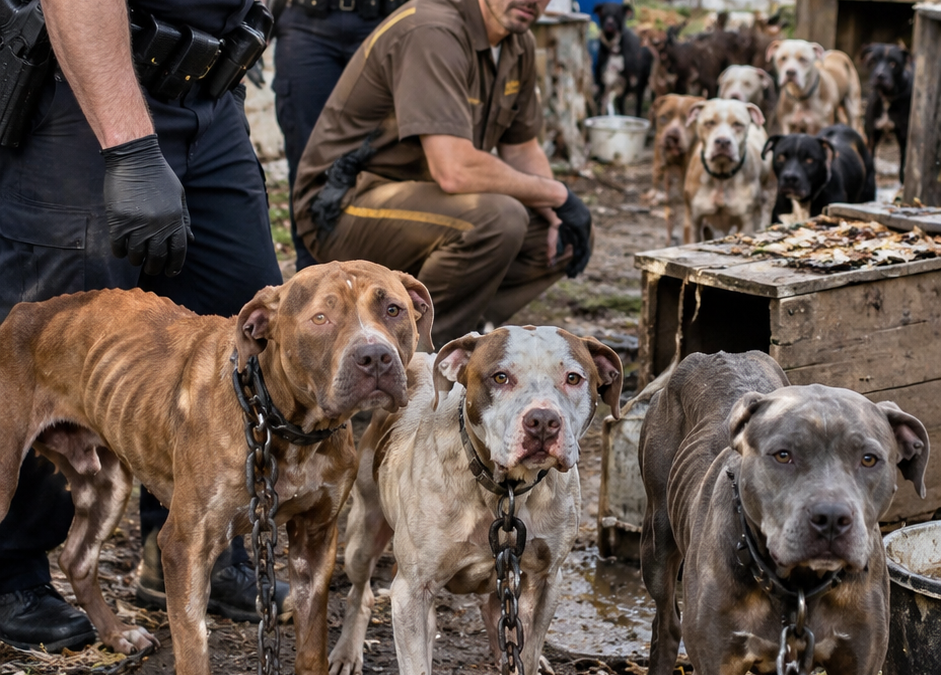
The standing pit bull looked at me.
Its eyes were dull.
There was no aggression in them.
No curiosity either.
Just exhaustion.
I felt something tighten behind my ribs.
“You see water?” Melissa called.
I looked around.
Two bowls.
One overturned.
The other contained brown rainwater.
“No clean water.”
“Food?”
“Nothing visible.”
Melissa returned.
“No answer at the door.”
I called dispatch.
“Confirm property owner information and start animal control this way.”
Dispatch acknowledged.
I turned back to Evan.
“How long ago did you arrive?”
“Maybe fifteen minutes before you.”
“And you saw all three dogs immediately?”
“The first two. The third was behind that plywood.”
He pointed toward a makeshift wall near the side yard.
“There might be more.”
Those words changed the atmosphere.
Melissa looked at me.
I looked at the house.
The front part of the property wasn’t large, but the lot extended far behind the structure.
A privacy fence blocked most of the rear.
I could see the roof of a small outbuilding.
Something about it bothered me.
It had no visible windows.
I called out again.
“Police department!”
Silence.
Animal control arrived first.
A white county truck pulled in behind us, and a woman named Denise Harper stepped out.
I knew Denise from previous cases.
She had been doing animal control long enough to walk into situations that made other people sick and stay focused on what needed to happen next.
She took one look at the dogs and stopped.
“How many?”
“Three visible.”
She studied their body condition.
“Those dogs need medical attention today.”
“Can you document from here?”
“Absolutely.”
She began taking photographs.
I called a supervisor.
Within minutes, the situation moved from a routine welfare check toward probable cause for intervention.
We continued trying to locate an owner.
Dispatch reported no immediate response at the listed phone number.
Neighbors had seen someone coming and going from the property irregularly but couldn’t say whether anyone was inside.
One neighbor told another officer that barking sometimes came from the rear building at night.
Another said vehicles occasionally arrived after dark.
Individually, none of those statements proved anything.
Together, they made me uneasy.
While paperwork and legal authority were being handled, Denise crouched near the fence.
One of the dogs finally stood.
Its legs shook.
“How bad?” I asked.
“Very.”
“Starvation?”
“Severe malnutrition at minimum.”
She pointed carefully.
“Look at the hips. Spine. Muscle loss around the rear legs.”
I looked.
Once you knew what to notice, it was impossible not to see.
These weren’t dogs that had missed meals for a day or two.
They had been deteriorating.
For a while.
Evan remained near his delivery van.
I walked over.
“You don’t have to stay.”
“I know.”
“You have a route to finish?”
He gave a small, uncomfortable smile.
“My supervisor already called twice.”
“You should probably go.”
He looked at the dogs.
“Are you going to help them?”
“Yes.”
“You’re sure?”
“As sure as I can be.”
He nodded.
Then he still didn’t leave.
“You okay?” I asked.
He looked embarrassed again.
“I keep thinking maybe I should’ve noticed something sooner.”
“You just got here.”
“I know.”
“You noticed enough.”
He looked toward the yard.
“What if I’d just put the box down?”
I didn’t answer immediately.
Because we both knew the answer.
We might never have come.
Finally, I said, “But you didn’t.”
He nodded.
That was the important part.
Authorization came through to address the immediate welfare emergency and secure the animals.
We entered the yard.
The first dog flinched when I approached.
Not a normal startle.
Its entire body folded inward.
I stopped.
“Easy.”
Denise moved beside me.
“Give him space.”
We did.
The dog stared at us.
His chain dragged through the dirt.
The collar had rubbed the fur from part of his neck.
Melissa whispered, “How does somebody look at this every day?”
I had no answer.
We gave the dogs water slowly while Denise assessed them.
Too much, too fast, could make severely compromised animals sick.
One drank.
One only stared at the bowl.
The third tried to stand and nearly fell.
We moved carefully.
Then we went around the side of the house.
That was when everything changed.
Behind the main house stood a small outbuilding.
Maybe twelve feet by sixteen.
Wood siding.
Metal roof.
No windows.
The door was secured.
Beside it hung several heavy chains.
Heavier than what you would normally expect for restraining household pets.
Melissa stared at them.
“You seeing this?”
“Yeah.”
Denise’s face hardened.
“Don’t touch anything yet.”
There were bowls near the wall.
Old stains.
Crates.
Other equipment.
None of us said what we were thinking.
Not yet.
We documented the exterior.
Then we entered.
The smell hit first.
Ammonia.
Old waste.
Wet fur.
Blood.
Not fresh blood everywhere.
But enough.
The inside was dim.
When my eyes adjusted, I saw cages.
Eight dogs.
For one second, my brain refused to count them correctly.
I saw bodies before I saw individuals.
One curled against the back wall.
Two in separate crates.
Another lying near a chain anchored low.
Another behind a partition.
Eight.
Plus the three outside.
Eleven.
No one spoke.
Then Denise whispered, “Jesus.”
One dog raised its head.
Another backed away.
One pit bull with a white patch across her chest remained completely still in the far corner.
Her eyes followed us.
Her body didn’t.
I remember that dog more clearly than almost anything else about the first entry.
She was small.
Not puppy-small.
Just smaller than the others.
Her fur was dark brown, almost black in the poor light, with white markings along her chest and muzzle.
Her ribs showed sharply.
One ear was scarred.
She looked at me as if I were not a person.
As if I were weather.
Something that might hurt her.
Something she had no ability to stop.
I took one step closer.
She closed her eyes.
That was worse than growling.
A growling dog still believes resistance might matter.
That dog seemed to believe nothing she did mattered anymore.
I stopped moving.
Melissa saw my face.
“What?”
I nodded toward the corner.
She looked.
Her voice dropped.
“Oh.”
Denise began photographing every enclosure.
We found material that indicated this was not simple neglect.
Records.
Names.
Weights.
Dates.
Instructions.
Equipment consistent with organized animal cruelty.
I will not describe all of it.
I don’t need to.
There are things that become worse when repeated in detail.
What mattered was that the pattern was clear.
The dogs had not simply been forgotten.
They had been used.
Someone had built a system around their suffering.
That distinction mattered legally.
It mattered morally too.
Neglect can come from incompetence.
Cruelty like this requires decisions.
Repeated decisions.
I stepped outside and called for detectives.
Then I requested a crime-scene team.
Evan was still by the gate.
He looked at me.
My expression must have told him enough.
“There are more?”
“Eight more.”
His face went pale.
“Eleven?”
“Eleven total.”
He looked down.
“I knew something was wrong.”
“You did.”
“I didn’t know that.”
“No.”
He stared at the outbuilding.
“What happens now?”
“We get them out.”
That became the only thing that mattered for the next few hours.
We worked one dog at a time.
Some were too weak to walk far.
Some froze when the chains were removed.
That surprised me.
You would think freedom would be immediate.
A chain falls, and the dog runs.
That isn’t what trauma looks like.
Several dogs remained where they were.
Their bodies had learned the limits of a chain so completely that removing the chain did not immediately remove the limit in their minds.
One dog took two steps and stopped, as though expecting pain.
Another tried to crawl underneath Denise’s legs.
A large male shook continuously.
One dog urinated when Melissa reached for its collar, then flattened itself to the ground.
Every reaction told a story.
Not the full story.
But enough.
The small female in the corner was last.
I don’t know why I volunteered to move her.
Maybe because I had been the first one she looked at.
Maybe because the way she closed her eyes had lodged somewhere inside me.
I crouched several feet away.
“Hey.”
Nothing.
“You’re coming out of here.”
Her eyes remained open now.
She watched me.
“I’m not going to hurt you.”
I knew how meaningless those words probably were.
People had likely said things around her before.
Words were cheap.
So I stopped talking.
I sat down.
The floor was filthy.
I didn’t care.
For several minutes, I just sat.
She watched.
Eventually Denise said quietly from behind me, “We need to move.”
“I know.”
I held out the back of my hand.
The dog did not approach.
I shifted a few inches closer.
She trembled.
I stopped.
Another minute.
Then another.
Finally, I moved slowly enough to place a towel around her body.
She flinched but did not fight.
When I lifted her, I almost lost my breath.
She weighed almost nothing.
She should have been heavier.
Much heavier.
Her head tucked against my arm.
Not affectionately.
Protectively.
As if making herself small had kept her alive before.
I carried her outside.
For the first time, sunlight touched her face.
She blinked.
The day was warm.
Birds were making noise in the trees.
Police radios crackled.
Camera shutters clicked.
Vehicles moved along the street.
Ordinary life continued twenty yards away.
She looked at the sky.
I will never forget that.
A dog leaving a dark building after God knew how long, staring upward as if she had forgotten the world was bigger than a roof.
We placed her in a transport crate.
She curled into the back corner.
No barking.
No whining.
Nothing.
I looked at the tag Denise had created.
Female.
Pit bull mix.
Approximate age unknown.
Dark coat.
White chest.
I said, “She needs a name.”
Denise looked at me.
“You naming evidence now?”
“She can’t stay ‘Dog Eleven.’”
Melissa smiled faintly.
“What do you have?”
I looked at the small white marking on her chest.
For some reason, I thought of clover.
Four leaves.
Luck.
Survival.
“Clover.”
Denise wrote it down.
“Clover it is.”
That was how she got her name.
Not because she had been lucky before.
Because I wanted her to become lucky from that moment forward.
When the last dog was loaded, I returned to the gate.
Evan was there.
He had finally contacted his supervisor and apparently been told to finish his route later.
He watched the transport vehicles.
“You got all of them?”
“All eleven.”
He closed his eyes for a second.
“Good.”
I studied him.
“You did the right thing.”
He shrugged.
“I called.”
“That’s exactly the point.”
He looked uncomfortable with praise.
“I’m not a hero.”
“I didn’t say you were.”
He smiled slightly.
Then I added, “But if you hadn’t called, they’d still be in there.”
The smile disappeared.
He looked back toward the house.
“I almost left.”
“What stopped you?”
He thought about it.
“One of the dogs looked at me.”
“Which one?”
“I don’t know. Brown one near the side.”
He swallowed.
“I’ve delivered to places with barking dogs. Angry dogs. Dogs that want to chase the truck. That dog just sat there. Like he didn’t expect anything.”
I knew exactly what he meant.
“That bothered you.”
“Yeah.”
He rubbed the back of his neck.
“I kept thinking if I drove away and found out later something happened, I’d know I saw it.”
That sentence stayed with me.
Not because it was eloquent.
Because it was honest.
He wasn’t claiming courage.
He was describing responsibility.
I shook his hand.
“Finish your route.”
He nodded.
Then he looked at me.
“Officer?”
“Yeah?”
“Let me know if they make it.”
“I will.”
The dogs were transferred to a temporary veterinary facility because the county shelter did not have room or medical capacity for all eleven at once.
I went there that evening.
Officially, I was following up for the investigation.
Unofficially, I wanted to see Clover.
Dr. Evelyn Parker was the veterinarian overseeing the initial examinations.
She had gray hair pulled into a loose knot and the calmest voice of anyone I had ever met.
She could look at terrible things without becoming cold.
That is a rare skill.
When I entered the treatment area, she was standing beside Clover’s kennel.
“How bad?” I asked.
She didn’t answer immediately.
She looked at the dog.
“Malnourished.”
I waited.
“Old injuries.”
I waited again.
“Dehydration. Skin infection. Parasites. Significant muscle wasting.”
“Anything life-threatening?”
“All of it is life-threatening if untreated long enough.”
She looked at me.
“But she’s here.”
“That’s your optimistic answer?”
“It’s the only one that matters tonight.”
Clover lay in the corner.
Her head rested on her front paws.
The kennel door was open while Dr. Parker prepared medication, but Clover did not attempt to leave.
I crouched outside.
“Hey, Clover.”
Her eyes moved toward me.
Nothing else.
Dr. Parker said, “She hasn’t made a sound.”
“Since we found her either.”
“Sometimes silence is a survival behavior.”
“What does that mean?”
“She learned not to draw attention.”
That hit me hard.
I looked at Clover.
“So how do we fix that?”
“We don’t fix her.”
I turned.
Dr. Parker’s expression was gentle but firm.
“We create conditions where she can decide she’s safe.”
“How long?”
“Could be days.”
She paused.
“Could be months.”
I nodded.
“Or longer.”
I looked back at the kennel.
“I’m going to come by tomorrow.”
Dr. Parker smiled slightly.
“That might help.”
The first week showed almost no visible progress.
Clover ate only when the room was empty.
If a person stood near the kennel, she ignored food completely.
If someone reached toward her, she folded inward.
If a metal bowl clanged somewhere in the room, she flinched.
If a door slammed, she shook.
Dr. Parker told me not to force contact.
So I didn’t.
Every afternoon after my shift, I visited.
I would bring paperwork.
Incident reports.
Witness notes.
Evidence logs.
Boring police bureaucracy.
I sat on the floor six feet from Clover’s kennel and worked.
At first, I spoke only occasionally.
“Long day.”
No response.
“Guy today tried to convince me a stop sign was optional.”
Nothing.
I wrote.
Sometimes I read parts of reports aloud.
Not the disturbing material.
Just ordinary language.
Dates.
Times.
Addresses.
Descriptions.
My voice became background noise.
That was the point.
I wanted her to learn that a human could exist near her without demanding anything.
On the fourth day, she changed position while I was there.
That sounds insignificant.
It wasn’t.
Before then, she had remained pressed into the back corner whenever anyone entered.
That afternoon, I sat reading.
Half an hour passed.
Then Clover stood.
I stopped reading.
Dr. Parker, on the other side of the room, immediately lifted one finger.
Don’t react.
Clover took two steps.
Turned in a circle.
Lay back down.
Slightly closer to the front.
I kept reading.
Inside, I wanted to celebrate.
Outside, I turned a page.
Two days later, she ate three bites of food while I remained in the room.
I pretended not to notice.
Dr. Parker noticed.
When I left, she followed me into the hallway.
“You saw that?”
“I saw.”
“That matters.”
“I know.”
“You’re becoming predictable.”
“Never been called that as a compliment before.”
“For traumatized animals, predictable is excellent.”
The second week brought more changes.
Clover began sitting near the kennel door when I arrived.
Not every day.
But often.
She watched me remove my jacket.
Watched me sit.
Watched me open the same battered notebook.
I developed a routine.
“Afternoon, Clover.”
Sit.
Notebook.
Pen.
Silence.
No reaching.
No pressure.
One afternoon, I forgot my jacket.
I had taken it off because the room was warm and placed it on a chair.
Halfway through my visit, dispatch called with a question.
I stepped into the hall.
The call lasted several minutes.
When I returned, Clover was no longer by the kennel door.
She was lying on my jacket.
Her head rested on the sleeve.
I stopped in the doorway.
Dr. Parker looked up from a table.
Then she saw it.
Her expression softened.
I stayed completely still.
Clover looked at me.
For a moment, I worried she would jump away.
She didn’t.
I walked slowly toward her.
One step.
Stop.
Another.
She remained on the jacket.
I crouched.
“Is that comfortable?”
Her ears shifted.
I held out my hand.
No sudden movement.
No expectation.
She leaned forward.
Sniffed my fingers.
My heart pounded harder than it had during armed arrests.
Then she did something I still remember with perfect clarity.
She lowered her head into my palm.
Not for long.
Maybe two seconds.
But she did it.
Her eyes closed.
My throat tightened.
I kept my hand still.
“Okay,” I whispered.
She stayed.
I stroked the side of her face once.
She did not flinch.
Dr. Parker turned away.
I later realized she was giving us privacy.
After that, progress came slowly but steadily.
Clover began eating while I worked.
She started walking around the room during controlled exercise.
One afternoon, when I appeared in the doorway, her tail lifted.
Barely.
One movement.
Then another.
I froze.
Dr. Parker laughed.
“Don’t make it weird.”
“She wagged.”
“Yes.”
“She actually wagged.”
“James.”
“She wagged.”
Clover looked between us.
I sat down.
“All right. I’m calm.”
I was not calm.
That tail wag felt like a verdict.
Not on me.
On the world.
Clover had decided there might still be something in it worth greeting.
The other dogs improved too.
Not equally.
Recovery doesn’t move in straight lines.
A large male we called Duke remained terrified of men but responded well to female handlers.
A brindle female named Rosie became obsessed with blankets and dragged every blanket she could find into one pile.
Another dog, Benny, discovered tennis balls and refused to surrender them.
One remained so emotionally shut down that the shelter staff eventually made him a permanent resident because repeated adoption attempts overwhelmed him.
But he became comfortable there.
That mattered.
The investigation continued in parallel.
Evidence from the property was processed.
Veterinary records documented the condition of every animal.
Neighbors gave statements.
The delivery driver gave a formal statement.
The owner was eventually charged with multiple counts related to animal cruelty and organized illegal activity.
Months passed before the case reached court.
By then, Clover looked like a different dog.
She had gained weight.
Her coat had become glossy.
The white patch on her chest stood out clearly.
Her scars remained.
Some always would.
But she no longer looked like an animal waiting for the next terrible thing.
She looked alert.
Curious.
Sometimes stubborn.
Once she stole half my sandwich.
I considered that excellent progress.
The morning of the trial, I arrived early.
Evan, the delivery driver, was already there.
He wore a button-down shirt instead of his company uniform.
He looked uncomfortable.
“You clean up well,” I said.
He laughed nervously.
“Rather be delivering boxes.”
“You’ll be fine.”
“I’ve never testified.”
“Answer the questions. Tell the truth. Don’t guess.”
“That’s it?”
“That’s it.”
He looked toward the courtroom doors.
“I still think about them.”
“The dogs?”
“Yeah.”
“They’re doing better.”
“All of them?”
“Most are doing very well.”
“What about the small one you named?”
“Clover?”
“Yeah.”
I pulled out my phone.
I had a photograph from the shelter.
Clover was standing in the grass with her mouth open, ears relaxed, looking almost absurdly happy.
Evan stared.
“That’s her?”
“Same dog.”
He smiled.
For a second, he said nothing.
Then: “That makes this worth it.”
His testimony came later that morning.
He was exactly as he had been on the day of the rescue.
Calm.
Measured.
No performance.
The prosecutor asked why he stopped.
Evan said, “I had a package.”
“Did delivering that package require you to inspect the backyard?”
“No.”
“Did you enter any restricted area?”
“No.”
“What did you see from the lawful delivery area?”
“Three dogs.”
“Describe them.”
He swallowed.
“They were chained. Very thin. One barely moved.”
“What did you do?”
“I called police.”
“Why?”
The defense attorney shifted in his chair.
Evan looked toward the judge.
Then he said, “Because I didn’t think leaving was something I could live with.”
The courtroom went quiet.
The prosecutor let the silence remain.
“Did anyone tell you a crime had occurred?”
“No.”
“Did you know there were eight additional dogs behind the house?”
“No.”
“Did you know what investigators would later find?”
“No.”
“So why call?”
Evan looked at his hands.
“Because the dogs looked like nobody was coming.”
I had heard hundreds of witness statements in my career.
That one stayed with me.
I testified too.
I described the scene.
The three chained dogs.
The lack of clean water.
The rear building.
The eight additional animals.
The physical condition of the dogs.
The evidence recovered.
I kept my voice professional.
That is what court requires.
Facts.
Not emotion.
Dr. Parker testified after me.
She described starvation, injuries, fear responses, physical deterioration.
At one point, the prosecutor asked whether Clover’s behavior was consistent with an animal that had endured prolonged trauma.
Dr. Parker answered, “Yes.”
“How can you tell?”
“She had learned that making herself invisible was safer than seeking interaction.”
I looked at the defendant.
He stared straight ahead.
I felt anger rise.
I pushed it down.
Court is not a place for an officer’s anger.
Evidence had to speak.
And it did.
The judge reviewed photographs.
Records.
Veterinary findings.
Recovered materials.
Witness testimony.
The process took time.
Justice usually does.
People expect courtroom moments to feel dramatic.
In reality, they often feel procedural.
Pages turning.
Lawyers standing.
Objections.
Definitions.
Schedules.
But beneath that procedure were eleven living animals who had spent months recovering from what had happened on one property.
Eventually, the judge delivered the ruling.
The owner was convicted on the applicable cruelty charges and related offenses supported by the evidence.
He was prohibited from owning animals.
Additional penalties followed under the court’s sentence.
I won’t pretend the ruling erased anything.
It didn’t.
Nothing a judge says can remove scars from a dog.
Nothing can give back time spent on a chain.
But accountability matters.
The law cannot undo suffering.
It can say the suffering was wrong.
It can stop the person responsible from repeating it.
When we left the courtroom, Evan caught up with me in the hall.
He looked drained.
“You okay?”
“Yeah.”
He exhaled.
“I’m glad I called.”
I smiled.
“You’ve said that before.”
“I didn’t know there were eleven.”
“No.”
“I didn’t know what was in that building.”
“No.”
He looked through the courthouse windows.
“I only knew something was wrong.”
“That was enough.”
He shook his head.
“Funny.”
“What?”
“I’m a delivery driver. I spend all day being told not to get involved in anything. Deliver the box. Take the photo. Go.”
“And?”
“And I almost did.”
He looked at me.
“If I had, none of this happens.”
I put out my hand.
He shook it.
“You saw something.”
“So would anybody.”
“No.”
I shook my head.
“Anybody could have seen it.”
There’s a difference.
Seeing requires eyes.
Noticing requires attention.
Acting requires character.
Evan had all three.
After the case ended, adoption planning accelerated.
Nine of the eleven dogs eventually found homes.
One remained at the rescue permanently because staff had become his family and relocation caused severe stress.
No one considered that a failure.
Home is not defined by a private house.
Home is where fear stops controlling the day.
Clover took longer.
Not because there weren’t applications.
There were.
Her story had spread locally.
People wanted the rescued pit bull with the white chest.
But Dr. Parker and the shelter team were cautious.
Traumatized animals do not need people who want a symbol.
They need people who understand routine.
Patience.
Boundaries.
Safety.
Then Margaret and Thomas Reed applied.
They were both in their late sixties.
Retired.
Quiet.
They lived in a small home outside town with a large fenced backyard and no other pets.
Their previous dog had died two years earlier.
They had waited because they didn’t want to adopt simply to replace him.
When Margaret first met Clover, she did something almost nobody else had done.
Nothing.
She sat in a chair.
She did not call Clover.
Did not pat her knees.
Did not offer constant treats.
She opened a book.
Clover watched from the other side of the room.
Thomas sat beside Margaret.
He said quietly, “She’ll come if she wants.”
Twenty minutes passed.
Then Clover stood.
Walked halfway across the room.
Stopped.
Margaret kept reading.
Clover moved closer.
Finally, she sat near Margaret’s shoe.
Margaret lowered one hand.
Clover sniffed it.
Then lay down.
Dr. Parker looked at me.
I knew.
“They’re the ones.”
She smiled.
“I think so.”
The adoption process took another week.
On the day I drove Clover to their house, the weather was clear.
Warm.
Bright blue sky.
Clover sat secured in the back of the vehicle.
She had gotten used to car rides by then, but she still preferred to watch me.
Every few minutes, I checked the mirror.
“You’re going somewhere good.”
Her ears moved.
“You know I’m not getting rid of you, right?”
That sounded stupid.
I tried again.
“You’re getting a family.”
Clover rested her head on the seat.
When we arrived, Margaret and Thomas waited near the front steps.
The backyard gate stood open into a fenced area filled with grass and shade trees.
Clover stepped out of the vehicle.
Then stopped.
Her body tightened.
New place.
New smells.
New people.
I crouched beside her.
“No rush.”
Margaret stayed where she was.
“Take all the time she needs.”
Clover looked at me.
Then at Margaret.
Then toward the yard.
She took one step.
Stopped.
Another.
We moved through the gate.
The moment her paws touched the grass, she froze.
For a second, fear hit me.
Was this too much?
Then Clover lifted her head.
The wind moved across the yard.
Leaves shifted overhead.
Sunlight touched her face.
She closed her eyes.
Just stood there.
Breathing.
Free.
Margaret slowly sat on a garden bench.
Clover opened her eyes.
Walked toward her.
I followed several steps behind.
Clover stopped at Margaret’s knees.
Margaret held out her hand.
Clover sniffed.
Then she placed her head on Margaret’s lap.
Exactly the way she had placed her head in my hand weeks earlier.
I looked away because my eyes had filled.
Thomas stood beside me.
“She’ll be okay here.”
I nodded.
“I know.”
“We’ll take care of her.”
“She likes quiet mornings.”
“So do we.”
“She doesn’t like people moving fast behind her.”
“We won’t.”
“She may hide during storms.”
“We have a spare bedroom downstairs.”
“She—”
Thomas put a hand gently on my shoulder.
“James.”
I looked at him.
“We’ve got her.”
I laughed once.
“Yeah.”
That was the sentence I needed.
I knelt beside Clover.
She came to me immediately.
I rubbed both sides of her face.
“You hear that?”
Her tail moved.
“They’ve got you.”
Leaving was harder than I expected.
I reached the gate.
Clover followed.
I stopped.
“No.”
She looked at me.
“You stay.”
Margaret called softly.
“Clover.”
Clover turned.
Looked at Margaret.
Looked back at me.
Then walked to Margaret.
That nearly broke me.
Not because she rejected me.
Because she didn’t need to follow me anymore.
She had somewhere else to stay.
I waved.
“Be good.”
Her tail wagged.
I got into the car.
For the first few miles home, I drove in silence.
A week later, Margaret sent the first photo.
Clover asleep on a couch.
Two weeks after that, Clover lying beneath a tree.
Then Clover sitting beside Thomas while he worked in the garden.
Then Clover wearing a ridiculous holiday scarf.
Recovery began looking less like medical progress and more like ordinary life.
That was better.
A year passed.
I visited whenever I could.
The first time Clover saw me after several months apart, she ran across the yard.
Ran.
The dog who once would not leave the corner of a cage crossed thirty feet of grass at full speed.
She hit me hard enough to almost knock me over.
“Hey!”
Her tail whipped side to side.
I crouched and hugged her.
Margaret laughed from the porch.
“She remembers.”
“Apparently.”
Clover licked my face.
“You have no dignity.”
She did it again.
I loved every second.
The changes in her were extraordinary.
She no longer crouched when hands moved above her.
She ate while people were nearby.
She slept stretched out instead of curled tightly.
She barked at squirrels.
She stole Thomas’s gardening gloves.
She had opinions about delivery trucks.
That last one felt ironic.
One afternoon, I took her for a walk through a nearby park.
Margaret handed me the leash.
“She still likes you best.”
“Don’t tell Thomas.”
“He knows.”
Clover trotted beside me.
We passed joggers.
Bicycles.
Other dogs.
A year earlier, any one of those things might have overwhelmed her.
Now she sniffed grass and moved at her own pace.
Near the playground, she stopped.
Children were running across the grass.
Laughing.
A boy threw a red ball.
A little girl chased him.
Clover watched.
I waited.
She stood completely still.
For a moment, I imagined the life she might have had if cruelty had never entered it.
Maybe she would have grown up in a house.
Maybe children would have thrown balls for her.
Maybe she would never have learned chains.
Maybe she would never have closed her eyes when a human hand approached.
We cannot give animals the childhoods they should have had.
We can only give them what comes next.
Clover looked up at me.
Her tail wagged.
I smiled.
“Yeah.”
She turned away from the playground and continued walking.
That was enough.
The past was behind us.
Not erased.
Behind us.
There is a difference.
Years in policing taught me that people often imagine heroism incorrectly.
They think it arrives with sirens.
Uniforms.
Badges.
Courtrooms.
Big decisions.
Sometimes it does.
But most of the important moments I have seen begin much smaller.
A neighbor noticing bruises.
A teacher listening when a child hesitates.
A cashier recognizing fear in someone’s face.
A stranger stopping beside a road.
A delivery driver looking over a fence.
Evan never wanted recognition.
I saw him again about a year and a half after the rescue.
I was getting coffee before work.
He walked in wearing the same company uniform.
He recognized me.
“Officer James?”
“Evan.”
We shook hands.
“How are you?”
“Good. Still delivering everything people order at three in the morning.”
I laughed.
“You still on that route?”
“Sometimes.”
His expression changed.
“How are the dogs?”
“Good.”
“All of them?”
“Most were adopted. One stayed with the rescue.”
“And Clover?”
I pulled out my phone.
There were several pictures.
I showed him one of Clover asleep on Margaret’s porch.
He stared for a long moment.
“That’s really her?”
“Really her.”
“She looks…”
“Normal?”
He smiled.
“Yeah.”
“That’s the goal.”
He handed the phone back.
“You know, I still think about that house.”
“So do I.”
“I remember standing at the door thinking I should leave.”
“But you didn’t.”
“No.”
He looked at the floor.
“I’ve wondered why.”
“You told me.”
“What did I say?”
“That you wouldn’t have been able to live with it if you walked away.”
He nodded slowly.
“Sounds dramatic.”
“It wasn’t.”
He thought about that.
Then said, “I’m glad I called.”
“I know.”
We stood quietly.
Finally, he smiled.
“I guess I should get to work.”
“Packages aren’t going to deliver themselves.”
He walked toward the door.
Before leaving, he turned.
“Tell Clover I said hi.”
“I will.”
I actually did.
The next time I visited, I sat beside her in the yard.
“Remember the delivery driver?”
Clover stared at me.
“The guy who started all this?”
She yawned.
“He says hello.”
Her tail moved once.
“I’ll tell him you were deeply emotional.”
Margaret brought lemonade outside.
“You talk to her like she understands everything.”
“She probably understands more than I do.”
Margaret sat beside us.
Clover moved between us and lowered herself onto the grass.
For several minutes, we simply watched her.
The sun was low.
Cicadas buzzed somewhere beyond the fence.
Clover rolled onto one side.
Her eyes closed.
No tension in her body.
No chain around her neck.
No dark outbuilding.
Just grass.
I thought back to the first time I saw her.
Corner.
Filth.
Bones.
Silence.
When I lifted her, she had made herself as small as possible.
Now she occupied space without apology.
That may be one of the purest definitions of recovery I know.
Trauma teaches living creatures to shrink.
Safety lets them expand again.
Not overnight.
Not because someone says, “You’re safe.”
Safety has to be proven repeatedly.
Morning after morning.
Meal after meal.
Hand after gentle hand.
Door after door that opens instead of closes.
Clover didn’t trust me because I wore a badge.
She trusted me because I sat on the floor and asked for nothing.
She trusted Margaret because Margaret let her choose.
I learned more about trust from that dog than from years of interviewing people.
Humans often demand trust first.
“Believe me.”
“Trust me.”
“I would never hurt you.”
Clover taught me that trust doesn’t respond to promises.
It responds to patterns.
Show up.
Stay calm.
Be predictable.
Do not punish fear.
Let time do its work.
That lesson changed how I handled people too.
Victims.
Children.
Witnesses.
People who had been hurt by someone in authority.
Sometimes the worst thing you can do is demand that a frightened person trust you because you believe you deserve it.
You don’t.
You earn it.
Clover made sure I understood that.
Dr. Parker remained involved with the rescue for years.
One afternoon, we met at a community event.
She asked about Clover.
“Still spoiled?”
“Completely.”
“Good.”
“She sleeps on furniture.”
“Excellent.”
“Margaret cooks chicken for her.”
“Medical recommendation.”
“Really?”
“No.”
We laughed.
Then she became serious.
“You know what I remember?”
“What?”
“The first week.”
“Me too.”
“I didn’t think she’d recover that quickly.”
“You said not to use that word.”
“What word?”
“Recover.”
She smiled.
“I said not to think of it like fixing something broken.”
“Right.”
“She was never broken.”
I looked at her.
“Didn’t feel that way.”
“She was injured.”
Dr. Parker pointed toward me.
“That distinction matters.”
I nodded.
She was right.
Clover had not been defective.
Her fear was not a flaw.
It was an adaptation.
She behaved exactly as an intelligent animal might behave in a dangerous environment.
Make no sound.
Avoid attention.
Expect pain.
Conserve energy.
Those behaviors had kept her alive.
Then, when the environment changed, she slowly learned new behaviors.
Approach.
Eat.
Play.
Rest.
Trust.
That was not fixing a broken dog.
That was watching a survivor realize survival was no longer the only goal.
The criminal case eventually became just one file among thousands.
Paper fades into archives.
Evidence is stored.
Court orders are entered into databases.
Officers move on.
But living outcomes keep going.
Nine adopted dogs.
One shelter resident.
One Clover.
Eleven lives continuing beyond one ugly property.
That is what I remember.
Not the defendant.
I deliberately do not use his name when I tell the story.
People like that already take enough space in the lives they damage.
This story belongs to the ones who got out.
It belongs to Evan.
It belongs to Denise.
Melissa.
Dr. Parker.
Margaret and Thomas.
And most of all, Clover.
Years later, I visited Margaret and Thomas on another warm afternoon.
Clover was older.
Gray had appeared around her muzzle.
She moved more slowly.
But when she saw me, her tail still wagged.
I sat in the grass.
She walked over and lowered herself beside me.
Then she placed her head on my thigh.
Exactly as she had done after learning to trust me.
I ran my hand over her ears.
“You know you’re getting old?”
Her eyes remained closed.
“I’m getting old too, so don’t take it personally.”
Thomas called from the porch, “She can’t hear you when she’s ignoring you.”
“She can hear fine.”
Clover’s tail thumped.
“See?”
Margaret laughed.
That day, there were no dramatic revelations.
No emergency.
No rescue.
No courtroom.
We ate lunch.
Clover slept.
I threw a ball twice.
She retrieved it once and decided the second trip was beneath her.
It was an ordinary day.
That was the victory.
People misunderstand rescue stories because they focus on the dramatic moment.
The chain being cut.
The cage opening.
The police arriving.
But real rescue is everything that comes after.
It is medication.
Quiet rooms.
Clean blankets.
Repeated meals.
Training.
Patience.
Setbacks.
Slow introductions.
Veterinary visits.
People showing up after the headlines disappear.
Freedom is not only the removal of a chain.
Freedom is learning you no longer need to fear the hand holding the leash.
Clover taught me that too.
One evening, Margaret called me.
Her voice sounded different.
My heart sank immediately.
“Is Clover okay?”
“She’s okay,” Margaret said quickly. “Just older.”
I exhaled.
“She had some tests today.”
“And?”
“Arthritis. Nothing unexpected.”
“Okay.”
“She’s slowing down.”
“I noticed.”
Margaret was quiet.
“I wanted you to know because… well, you’re family to her.”
Those words hit me.
“I appreciate that.”
“She still sleeps with your old jacket.”
I sat upright.
“What jacket?”
“The one you left with her years ago. The shelter sent it along with her things.”
I laughed softly.
“I thought that disappeared.”
“No. She sleeps on it during storms.”
I couldn’t speak for a moment.
That jacket had been nothing.
Cheap department-store fabric.
Old enough that I had planned to replace it.
To Clover, it had meant something else.
It smelled like the first safe person she had chosen.
Maybe that was why she had lain on it that second week.
Maybe scent had become memory.
I visited the next day.
Clover was in the backyard.
She came to me slowly.
I sat down before she reached me.
“Hey, old girl.”
She pressed her head against my chest.
I hugged her.
There are endings we cannot prevent.
That is part of loving anything.
But I no longer saw endings the way I had when I was younger.
The goal is not to make life permanent.
It is to make the time between rescue and goodbye worth living.
Clover had gotten that.
Years of sunlight.
Grass.
Meals.
Couches.
Margaret’s lap.
Thomas’s garden.
Children in parks.
My ridiculous conversations.
Every one of those ordinary things had been stolen from her once.
Then returned.
That mattered.
I thought about Evan again.
One decision.
One phone call.
People like to say small decisions can change lives.
Usually it sounds like a cliché.
This wasn’t.
His decision had a number.
Eleven.
Eleven dogs left that property.
Eleven breathing bodies.
Eleven futures.
One call.
That doesn’t mean everyone should put themselves in danger.
Evan didn’t enter the property.
He didn’t confront anyone.
He didn’t try to conduct his own investigation.
He noticed.
He stepped back.
He called people equipped to handle it.
That was enough.
Sometimes doing the right thing does not mean being reckless.
It means refusing to pretend you didn’t see something.
Years into this job, that remains one of the hardest things for people.
We are very good at explanations.
Not my problem.
Not my house.
Not my dog.
Not my child.
Not my responsibility.
Maybe someone else knows.
Maybe it isn’t what it looks like.
Maybe I’ll cause trouble.
Maybe I should keep moving.
Most cruelty depends on those thoughts.
Cruelty likes privacy.
It likes silence.
It likes people looking away.
That is why Evan mattered.
He looked.
Then he refused to unsee.
I don’t know whether he thinks about himself as brave.
Probably not.
He would probably laugh if I called him that.
That is fine.
Hero is an overused word.
I don’t need it.
He was decent at the exact moment decency mattered.
That is rarer than people think.
Clover eventually reached an age when long park walks became short walks to the mailbox.
Her hearing faded.
Her steps slowed.
But she never returned to being the frightened dog from the outbuilding.
Age made her vulnerable.
It did not make her afraid.
One day, I sat beside her while Margaret watered flowers.
A delivery truck stopped across the street.
Clover’s ears lifted.
The driver walked to a neighbor’s porch.
I laughed.
“What do you think?”
Clover watched him.
“You owe a delivery driver everything, you know.”
She looked at me.
“Entire life.”
Her tail moved.
“Exactly.”
I scratched under her chin.
Sometimes I imagine the story from her perspective.
A dark place.
Chains.
Hunger.
Human footsteps meaning danger.
Then unfamiliar voices.
Doors opening.
Hands.
Light.
A vehicle.
A clinic.
Another man who kept appearing and sitting on the floor.
A jacket.
A hand.
A yard.
Margaret.
Sun.
How confusing recovery must have been.
Fear is simple.
Everything is dangerous.
Safety is more complicated.
This person is safe.
That sound is harmless.
This door opens and I am allowed to return.
Food does not disappear forever.
Hands can touch without hurting.
Sleep does not require vigilance.
That is a lot to relearn.
Clover learned it anyway.
When I first became a police officer, I thought the job was about catching people who did bad things.
That is part of it.
But over time, I realized there is another part.
Standing in the place after bad things happen.
Seeing what remains.
Helping create enough order that recovery can begin.
We didn’t give Clover her life.
She kept herself alive long enough for us to enter it.
Evan opened the door by making the call.
The rest of us simply kept that door open.
I still keep a photograph of Clover at my desk.
Not the rescue photograph.
I have seen enough suffering.
The picture I keep is from Margaret’s backyard.
Clover is lying on her back in the grass.
All four legs are in the air.
Her mouth is open.
She looks ridiculous.
Completely unguarded.
That photograph means more to me than any crime-scene image.
A dog does not expose her belly like that when she expects violence.
That pose is trust.
That pose is peace.
That pose is a life reclaimed.
Whenever younger officers ask me why I still care about animal cases after years on the job, I show them that picture.
I tell them, “This is why.”
The arrest matters.
The evidence matters.
The conviction matters.
But this is the point.
A living creature gets to become ordinary again.
Years after the original case, our department received another animal welfare complaint.
A rookie officer rolled his eyes when dispatch sent it.
“Probably nothing.”
I looked at him.
“Maybe.”
He noticed my tone.
“What?”
I handed him my phone.
Clover’s photograph.
“Animal case?”
“Eleven dogs.”
He studied the picture.
“What happened?”
“Delivery driver thought something looked wrong.”
He handed the phone back.
“And it was?”
“Very.”
He nodded.
When we arrived at the new call, it turned out to be minor.
A dog had escaped its yard and gotten tangled in a temporary line.
The owner was frantic.
No cruelty.
No criminal case.
We fixed the immediate problem and left.
The rookie looked at me.
“So it was nothing.”
“No.”
He glanced back at the house.
“The dog’s fine.”
“That means it was a good outcome.”
He thought about it.
The distinction matters.
We don’t respond because every suspicion becomes a crime.
We respond because sometimes it does.
Clover’s case taught me never to resent the call that turns out to be okay.
I would rather check a hundred healthy dogs than ignore one like her.
Years after our first meeting, Clover died peacefully at Margaret and Thomas’s home.
I was there the day before.
She was tired.
Her body had grown old.
She could no longer stand for long.
But when I sat beside her, she lifted her head.
I put my palm beneath her chin.
The same way I had years earlier.
She lowered her head into my hand.
I felt tears come.
“You remember this?”
Her eyes closed.
“First time you did this, you scared me half to death.”
Her breathing was slow.
Margaret sat beside us.
Thomas stood near the window.
No one tried to pretend.
We knew the time had come.
I whispered, “You did good, Clover.”
Her tail moved once.
Tiny.
Enough.
“You were supposed to get a second chance.”
I stroked her face.
“You took the whole thing.”
I stayed until evening.
The next morning, Margaret called.
Clover had passed during the night.
She had been sleeping in her favorite place.
On my old jacket.
I drove to their house later that day.
Margaret hugged me.
Thomas shook my hand and then hugged me too.
We sat in the backyard.
There was an empty patch of grass where Clover usually slept.
It hurt.
But grief was not the only thing there.
Gratitude sat beside it.
Clover had died loved.
That should not be extraordinary.
For her, it was.
Her life had contained two worlds.
One built from chains.
One built from trust.
The second one lasted longer.
That is how I choose to measure the story.
At the funeral home for humans, people say a life should be remembered for more than its worst day.
Animals deserve the same.
So I do not remember Clover primarily as the dog in the corner.
I remember her running toward me across Margaret’s yard.
I remember her stealing my sandwich.
I remember the first tail wag.
I remember the ridiculous holiday scarf.
I remember her watching children in the park.
I remember her sleeping in sunlight.
The cruelty happened.
We do not erase it.
But it does not get the final word.
That belongs to Clover.
A few weeks after she died, I ran into Evan again.
He was older.
So was I.
He was still delivering packages.
I told him.
His face fell.
“I’m sorry.”
“She had a good life.”
“How long?”
“Years.”
He nodded.
“That matters.”
“It does.”
We stood beside his truck.
I said, “You know she slept on my old jacket when she died.”
He smiled sadly.
“You really loved that dog.”
“Yeah.”
He looked down the street.
“I think about that day sometimes.”
“I know.”
“Was it worth calling?”
I stared at him.
He immediately laughed.
“Okay, stupid question.”
“Very.”
He nodded.
“Eleven.”
“Eleven.”
We shook hands again.
Then he went back to work.
No medal.
No ceremony.
No headline.
Just a man getting into a delivery van after changing eleven lives years earlier.
That felt right.
My name is James Walker.
I’m a police officer.
I have responded to robberies, crashes, domestic disputes, missing people, medical emergencies, fights, break-ins, and calls I wish I could forget.
But one of the most important calls of my career began with a delivery driver who could have done exactly what his job required.
Place the package down.
Take the delivery photo.
Walk away.
Instead, he noticed three silent dogs.
He listened to the feeling telling him something was wrong.
He called.
Because of that call, we found eleven.
We cut chains.
We opened doors.
We carried dogs into daylight.
We built a case.
A judge issued a ruling.
Nine dogs went to adoptive homes.
One found his home at the rescue itself.
And Clover, the little pit bull who once closed her eyes when I reached toward her, eventually learned to sleep with her belly exposed beneath the sun.
People ask what heroism looks like.
Sometimes it wears a uniform.
Sometimes it has a badge.
Sometimes it holds a veterinary stethoscope.
Sometimes it sits patiently beside a frightened dog for weeks.
And sometimes it wears a delivery company polo and holds a cardboard package.
The difference is not the clothing.
The difference is the decision.
Do I keep moving?
Or do I stop?
Do I decide it is someone else’s problem?
Or do I admit that once I have seen suffering, what I do next says something about me?
Evan stopped.
That was all.
And that was everything.
I still think about the first time Clover placed her head in my palm.
She didn’t know my rank.
She didn’t know the case number.
She didn’t know who had been charged or what the evidence showed.
She only knew something simpler.
This hand did not hurt.
So she rested.
Trust returned one inch at a time.
Freedom returned one ordinary day at a time.
And a life that had once been reduced to chains and silence became a life filled with grass, couches, gardens, walks, old people who adored her, and a worn police jacket she refused to give back.
That is what one phone call changed.
Not a statistic.
Not an investigation.
Eleven lives.
And whenever I think about that afternoon, I no longer remember the property first.
I remember the gate.
I remember Evan standing beside it.
I remember him pointing quietly toward the yard and saying, “I don’t know what’s happening, but something isn’t right.”
He did not know what was behind the house.
He did not know Clover’s name because she didn’t have one yet.
He did not know that one of those dogs would someday sleep peacefully in a sunny backyard.
He only knew enough to stop.
Sometimes, that is all life asks of us.
Notice.
Care.
And refuse to walk past.








