𝗣𝗔𝗥𝗧 𝟮 A Broken Shepherd Puppy Shielded a Tiny Cat on the Pavement—What Happened After We Stopped Changed Everything
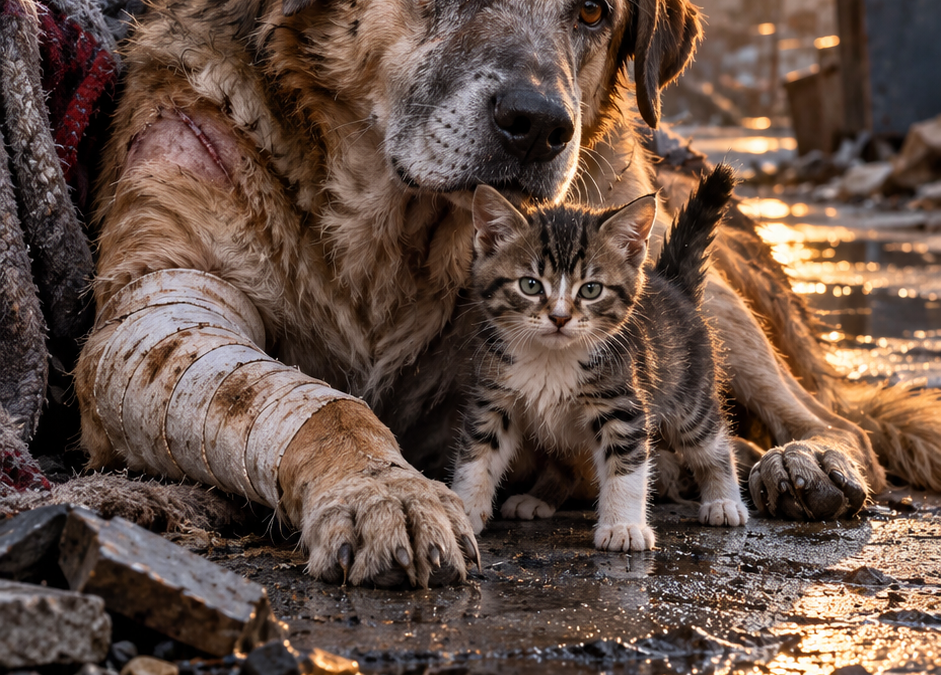
𝗣𝗔𝗥𝗧 𝟮
We carried them toward our car.
People stared now.
Naturally.
Nothing attracts public interest quite like someone finally doing the thing everybody else had been avoiding.
One man shook his head.
“Careful. They might bite.”
“Thank you,” I said.
He looked almost pleased.
“For what?”
“For arriving with that information exactly fifteen minutes too late.”
Clara shot me a warning look.
Not because she disagreed.
Because sarcasm rarely improves emergency care.
The puppy stirred in my arms.
His eyes remained fixed on the kitten.
Clara adjusted her grip so the cat stayed against him.
“It’s okay,” she whispered. “We’re keeping you together.”
The cat’s claws slowly relaxed.
We laid both of them on a blanket in the back seat.
The shepherd immediately curved around the kitten again.
His ribs looked even worse from above.
Each one clearly visible.
His belly was hollow.
There were scabs along one hip and shoulder.
One ear had a tear near the edge.
The kitten wasn’t in much better shape.
Thin.
Dirty.
Fleas visible along her neck.
A small crusted discharge around one eye.
But she had more energy.
She crawled onto the shepherd’s front leg.
Then began kneading his chest.
Tiny alternating paws.
Press.
Release.
Press.
Release.
The puppy closed his eyes.
Clara leaned against the open car door.
“Gideon.”
“I know.”
“No, look.”
The kitten was purring.
Faintly.
Her whole body vibrated against his ribs.
The dog stopped trembling.
Not completely.
But noticeably.
I had seen dogs comfort people.
I’d seen cats sleep beside sick dogs.
But this wasn’t casual affection.
This looked structural.
As though one had been holding the other together.
I closed the car door carefully.
“We need a vet.”
Clara nodded.
“Now.”
I searched on my phone.
The nearest emergency veterinary clinic was forty-eight minutes away.
Wonderful.
“Anything closer?”
“Small clinic in thirty-six.”
“Open?”
“According to the internet.”
“The internet also says I can lose thirty pounds by eating bacon.”
“Thirty-six.”
We drove.
The air conditioner blasted.
I kept it cool but not freezing.
Clara sat partly turned in her seat so she could watch them.
Every minute or so she spoke.
“You’re okay.”
“You stay with us.”
“Good babies.”
The shepherd didn’t sleep.
That worried me.
Animals in his condition should have been exhausted enough to collapse.
Instead, his eyes stayed open.
Watching us.
Every time I checked the rearview mirror, I met them.
Not angry.
Not trusting.
Monitoring.
As if sleep was something dangerous.
As if he believed we might disappear if he stopped looking.
The kitten had fewer objections.
She tucked herself against him and eventually closed her eyes.
He watched her too.
Of course.
“He’s scared she’ll vanish,” Clara said.
I glanced at her.
“Or he’s scared we will.”
We stopped at a gas station ten miles later because the puppy began licking his lips.
Dehydration.
I parked in shade.
Clara brought out a collapsible travel bowl.
We filled it with water.
I opened the back door.
The shepherd tried lifting his head.
“Easy.”
I slid the bowl toward him.
He sniffed.
Then looked at the kitten.
The kitten’s head came up.
She sniffed too.
Neither drank.
“Don’t tell me you’re both stubborn.”
Clara dipped her fingertips into the water.
Held them near the kitten.
She licked one drop.
Then another.
The puppy watched.
Only after the kitten drank did he lower his muzzle toward the bowl.
Slow lap.
Pause.
Another.
The kitten moved beside him.
They drank together.
I stared.
“You seeing this?”
Clara nodded.
“They wait for each other.”
Food showed the same pattern.
Clara opened a small package of plain cooked chicken we’d bought inside.
She tore off a tiny piece.
Held it near the dog.
He smelled it.
Looked at the cat.
The kitten meowed softly.
The dog ate.
Then the cat ate.
One bite each.
Then another.
“This is going to become medically inconvenient,” I said.
“What?”
“If they refuse to do anything separately.”
Clara looked at them.
“We’ll work around it.”
That was the beginning.
Not “we’ll see.”
Not “until the shelter takes them.”
We.
I heard it.
She heard it too.
Neither commented.
We needed names.
Calling them “dog” and “cat” already felt wrong.
The shepherd lifted his head toward the bright afternoon sky.
For a second, even sick, he looked dignified.
Not weak.
Wounded.
Different thing.
I said, “Orion.”
Clara looked at me.
“Orion?”
“Big hunter in the sky.”
“He’s thirty pounds.”
“Details.”
The puppy’s ear moved.
“Orion.”
He looked toward me.
Clara smiled.
“Okay. Orion.”
The kitten needed a name.
Clara studied her.
“Ginger?”
“No.”
“Pumpkin?”
“Absolutely not.”
“Why?”
“She has suffered enough.”
Clara laughed.
The kitten blinked at her.
“Milo.”
I looked over.
“Milo?”
“Yes.”
“Isn’t Milo usually male?”
“Are you planning to ask the cat?”
Fair.
“Milo it is.”
We later learned Milo was female.
By then nobody cared.
Orion and Milo.
Names changed the feeling in the car.
That sounds sentimental.
Maybe it is.
But nameless animals are easier to discuss as problems.
Once you call someone Orion, suddenly treatment matters differently.
Once you say Milo, you start imagining tomorrow.
The clinic sat off a frontage road south of Bakersfield.
A low tan building.
Potted cactus near the entrance.
Sign sun-faded but visible.
VALLEY CROSSING VETERINARY CLINIC.
I carried Orion.
Clara carried Milo, who immediately stretched toward him.
“She’s panicking.”
“Keep them close.”
We walked inside.
The receptionist saw us.
Everything changed.
No forms first.
No insurance questions.
She stood.
“Found strays?”
“Yes.”
“How long down?”
“Unknown. Weeks outside.”
She called toward the back.
“Dr. Chen!”
A veterinarian appeared within seconds.
Asian man in his forties.
Glasses.
Calm face.
The kind of calm that made everybody else calm by proximity.
“Exam room two.”
We followed.
Orion went onto the table.
Milo immediately climbed beside him.
Dr. Chen took one look at them.
“Bonded?”
“Very.”
“Don’t separate unless necessary.”
I liked him instantly.
He started with Orion.
Temperature.
Heart.
Gums.
Hydration.
Weight.
Skin.
Paws.
Abdomen.
Orion tried standing when Chen reached toward Milo.
His legs shook violently.
“Easy, big guy.”
Orion positioned himself between the veterinarian and the cat.
Barely.
His front legs spread.
Body swaying.
His head low.
Protective.
Dr. Chen stopped.
“He’s guarding her.”
“He’s been doing it constantly.”
Chen moved sideways.
Slowly.
“Nobody’s taking her.”
Orion remained standing.
Milo touched her nose to his front leg.
His knees buckled.
He collapsed.
Milo immediately pressed against his neck.
Chen’s expression changed.
“Okay.”
“What?” Clara asked.
“He’s worse than he looks.”
That was not comforting.
Bloodwork.
Fluids.
Fecal tests.
Skin samples.
Wound cleaning.
Temperature support.
Orion tolerated everything badly but quietly.
He hated needles.
He hated strangers.
He hated anyone touching Milo more than both.
Milo had fleas.
Mild upper respiratory infection.
Underweight.
Dehydrated but not critically.
No fractures.
No major wounds.
Orion was another story.
Severe malnutrition.
Significant dehydration.
Anemia.
Skin infection.
Several wounds that had begun healing incorrectly.
A deeper infected puncture along his flank.
Likely parasites.
Muscle wasting.
His blood glucose was low.
Dr. Chen sat with us.
“He’s in rough condition.”
“Will he make it?” Clara asked.
Chen did not answer immediately.
I disliked him for that pause.
Then respected him for it.
“I think he has a good chance.”
Think.
Chance.
Two terrible veterinary words.
“But?”
“He needs slow refeeding. Fluids. Antibiotics. Rest. Deworming once he’s stronger. We have to be careful not to overload his system.”
“What about hospitalization?”
“I’d prefer observation overnight.”
Milo cried from the carrier where a technician had placed her for three seconds.
Orion tried sitting up.
Chen looked between them.
“We can keep Milo with him.”
“Thank you.”
“They calm each other. Stress matters.”
Clara put her hand over mine.
“Do whatever you need.”
Chen nodded.
“You understand this could get expensive.”
“Yes.”
“I’m obligated to say it.”
“Say something else.”
He looked at Orion.
“We’re going to help him.”
“Better.”
We stayed for hours.
Orion received IV fluids.
Antibiotics.
His wound was cleaned.
Milo was treated for fleas and respiratory infection.
Every time Milo made a sound, Orion’s eyes opened.
Every time Orion shifted, Milo climbed closer.
At one point, the technician tried placing Milo in a separate kennel for ten minutes while Orion underwent imaging.
Milo screamed.
Not meowed.
Screamed.
Orion heard from the next room.
He began struggling against the technician.
His heart rate spiked.
Dr. Chen stopped everything.
“Bring the cat.”
Milo arrived wrapped in a towel.
The moment Orion saw her, his body relaxed.
Chen sighed.
“All right. New treatment protocol.”
“What?” I asked.
“Apparently the cat is medical equipment.”
Clara laughed for the first time all afternoon.
Milo curled against Orion’s front legs.
The procedure resumed.
No struggle.
“Remarkable,” Chen muttered.
I agreed.
That evening, we faced a choice.
Hotel.
Drive home.
Shelter intake.
Except Clara and I both knew shelter intake wasn’t happening.
We lived in a house outside San Luis Obispo, nearly two hours away.
Enough room.
Fenced yard.
No pets at the time.
We had once had dogs.
Years earlier.
Our old Labrador, June, died at fifteen.
After that, we’d said no more.
The standard lie people tell after losing a good animal.
No more.
It hurts too much.
Then time passes.
You get used to clean floors and uninterrupted sleep.
You congratulate yourself for being practical.
And then life puts a starving shepherd and a ginger cat on the pavement and laughs at your planning.
Dr. Chen asked, “Where are they going after discharge?”
I looked at Clara.
She looked at me.
“Our house.”
No discussion.
No hesitation.
Chen nodded as if he’d expected that.
“Good.”
Orion stayed overnight.
We stayed in the cheapest motel nearby.
Clara barely slept.
At 2:13 a.m. she sat up.
“What if he dies?”
“Don’t.”
“I’m serious.”
“So am I.”
“What if we finally stop and it’s too late?”
I stared at the ceiling.
“Then at least he doesn’t die on concrete.”
She went quiet.
Miserable answer.
True answer.
After a while she whispered, “I already love them.”
“I know.”
“You?”
“Obviously not.”
“Gideon.”
“I’ve known them eleven hours.”
“That’s not what I asked.”
I closed my eyes.
“Yes.”
Morning came.
Dr. Chen called at 6:40.
Orion was stable.
Stable.
One of the best boring words in the English language.
We arrived before the clinic officially opened.
Orion lay on thick bedding.
IV removed.
Milo stretched across his front paws.
The second she saw Clara, she stood.
Tail upright.
Walked over.
Rubbed against her hands.
“Well, good morning.”
Orion raised his head.
Saw us.
His tail moved.
Once.
Clara stopped breathing.
“Did you see that?”
“No.”
“Gideon.”
“Fine. Yes.”
Tail.
Weak.
Tiny.
Still a wag.
I knelt.
“Don’t get dramatic.”
Orion lowered his head into my palm.
That was our first moment of real trust.
Not surrender.
He had a choice.
He chose contact.
Dr. Chen gave us a pharmacy’s worth of instructions.
Tiny meals four times a day.
Medication schedule.
Wound care.
Restricted activity.
Water.
Monitoring.
Call immediately if vomiting.
Diarrhea.
Collapse.
Breathing change.
Pale gums.
Fever.
Essentially, watch him breathe for the next month and panic professionally.
Milo’s instructions were easier.
Medication.
Nutrition.
Parasite treatment.
Warmth.
Safety.
“Can they sleep together?” Clara asked.
“Yes, as long as she’s not climbing on his wound.”
Milo was literally sitting on Orion.
Chen looked over.
“Let me amend that.”
We drove home.
Orion and Milo shared the back seat.
The difference from the previous day was subtle.
Orion slept.
Really slept.
His eyes closed.
Head down.
Milo pressed against him.
For the first time, he trusted the world enough to stop monitoring it.
I drove slower because of him.
Clara reached across the console.
Held my hand.
No words.
We brought them into our den.
Blankets.
Dog bed.
Low cat bed Milo ignored immediately.
Bowls.
Water.
Medication.
Orion collapsed into the blankets.
Milo circled once.
Then curled into his chest.
His front leg automatically came over her.
Clara looked at me.
“Same thing.”
“Apparently he’s committed.”
“He was protecting her when he could barely stand.”
“He’s not going to stop because he owns a blanket.”
That first night was calm.
The second was not.
Orion woke repeatedly.
Any noise.
Refrigerator cycling.
Car outside.
Floor creak.
He raised his head.
Milo reacted differently.
She explored.
Couch.
Window ledge.
Under table.
Then always returned to Orion.
At midnight I woke and found her sitting beside his water bowl, waiting.
Orion smelled food.
Looked at Milo.
She ate.
Then he ate.
We had to work around it.
“If Milo becomes obese because Orion refuses meals without her participation, I’m blaming him,” I told Clara.
“He’s sixty percent skeleton.”
“Future planning.”
Recovery demanded routine.
Morning medication.
Food.
Wound cleaning.
Rest.
Lunch.
Food.
More medication.
Rest.
Short standing exercises.
Dinner.
Rest.
Milo treated the schedule as a loose suggestion.
Cats are less interested in institutional process.
Orion tried.
Every day he stood a little longer.
Every day he seemed embarrassed by weakness.
He would push himself up.
Take two steps.
Legs shake.
Try a third.
Collapse.
Milo would appear.
Always.
She rubbed her head against his muzzle.
Sometimes swatted his tail.
The first time she did that, Orion looked offended.
Clara laughed.
“That’s probably the first normal thing that’s happened to him.”
“What?”
“He’s annoyed with a cat.”
Milo swatted him again.
Orion gave a tiny woof.
Milo arched.
Then pounced on his paw.
For five seconds, they played.
Five seconds.
It was enough.
The third night, everything went wrong.
Orion had been quieter all afternoon.
Not alarming.
Just tired.
He ate less at dinner.
I made a note.
At 9:30 he stood to drink.
Wobbled.
At 10:15 he lay down.
Milo curled beside him.
At 11:03, Orion shuddered.
His whole body.
Then his head dropped heavily against Milo.
Clara sat upright.
“Gideon.”
I was already moving.
I put my hand on Orion’s ribs.
Breathing.
Fast.
Shallow.
Gums pale.
“Damn it.”
Milo cried.
High.
Sharp.
She pawed his muzzle.
Orion didn’t respond.
“Call Chen.”
Clara grabbed her phone.
I wrapped Orion in a blanket.
Milo climbed onto it.
“No.”
She clung.
“Milo.”
Claws dug in.
“Fine.”
Clara put the call on speaker.
Dr. Chen answered despite the hour.
We described everything.
“Bring him in.”
“Two-hour drive.”
Pause.
“If he loses consciousness, nearest emergency clinic. Keep him warm. Don’t force food. Small water only if he’s fully responsive.”
Orion’s eye opened.
Barely.
“He’s conscious.”
“Then move.”
We loaded the car.
I drove faster this time.
Clara sat in back.
Orion across the seat.
Milo against him.
For forty minutes, he remained weak but responsive.
Then traffic stopped.
Of course.
Roadwork.
One lane.
Orange cones.
California apparently decided our emergency needed traffic management.
I hit the steering wheel.
“Come on.”
Clara whispered, “Gideon.”
“What?”
“He’s worse.”
I looked back.
Orion’s head lay flat.
Milo was licking his ear.
I took the next exit.
Found an emergency animal hospital twenty minutes away.
We arrived in eleven.
I do not recommend my driving decisions.
The staff rushed Orion inside.
They tried taking Milo.
She turned into a tiny orange chainsaw.
Claws.
Hiss.
Teeth.
The technician nearly dropped her.
“Keep her with us,” Clara said.
They separated them physically but kept Milo in a carrier where Orion could see her.
Blood sugar dangerously low.
Dehydration recurring.
Infection stronger than expected.
Possible refeeding complication.
He went back on fluids.
Glucose.
Antibiotics adjusted.
Temperature support.
The emergency veterinarian, Dr. Patel, explained everything carefully.
I heard half.
Clara heard the other half.
Together we became one functional adult.
“Is he dying?” I asked.
Patel looked at Orion.
“He’s critically ill.”
That wasn’t an answer.
“Doctor.”
She met my eyes.
“He could.”
Clara made a sound behind me.
I hated the room.
The lights.
The smell.
The monitors.
The fact that three days earlier I had not known this dog existed.
Now the possibility of losing him felt unbearable.
Milo sat inside the carrier.
No purring.
No movement.
Just staring at Orion.
Patel allowed us into the treatment area once he was stabilized.
We sat on the floor near his kennel.
Milo came out.
Walked directly to him.
Curled against his neck.
Orion’s eyelids moved.
Milo began purring.
Loud.
Steady.
It vibrated through the blanket.
Clara cried silently.
I didn’t.
At least not immediately.
I put one hand on Orion.
“Listen to me.”
His ear twitched.
“You have put us through enough already.”
Milo purred.
“You owe me at least one ruined couch.”
Clara laughed through tears.
“And Clara apparently expects you to shed on everything we own.”
“Very much.”
Orion breathed.
Another.
Another.
We stayed all night.
At 4:00 a.m., Patel checked him.
At 5:30, his glucose improved.
At 6:10, he drank voluntarily.
At 6:42, Orion lifted his head.
Slowly.
Then touched his nose to Milo’s ear.
Milo stopped purring.
Turned.
Licked his face.
Clara covered her mouth.
I looked away because apparently the wall needed my complete attention.
Patel smiled.
“That’s good.”
“Good enough?”
“Good enough for now.”
By noon, Orion was stronger.
Not healed.
Not safe.
But back.
The second recovery was slower.
We became almost religious about his schedule.
Meals measured by grams.
Medication times set on phones.
Weight tracked.
Temperature checked.
The house turned into a small animal ward.
Clara wrote a chart.
I mocked the chart.
Then updated it hourly.
Milo considered herself head nurse.
If Orion slept too long, she touched his face.
If he refused food, she ate beside him.
If he tried standing, she walked around him as if providing emotional scaffolding.
By day six after the emergency, Orion stood for nearly a minute.
Then sat.
Deliberately.
Not collapsed.
I clapped.
He stared at me.
“What?”
Tail wag.
Milo attacked his tail.
Orion barked.
A real bark.
Deep for a puppy.
He startled himself.
We laughed.
He barked again.
Milo ran.
Orion tried chasing.
Three steps.
Almost fell.
I caught him.
“Ambitious idiot.”
He licked my wrist.
“Yes, I love you too.”
The words came out.
Clara heard.
Her smile was unbearable.
“Don’t.”
“I said nothing.”
“You don’t need to.”
Weeks passed.
Orion gained weight.
His coat changed first.
Dull fur softened.
Black deepened.
Tan markings brightened.
His ribs slowly disappeared.
His legs strengthened.
He went from three steps to ten.
Ten to the length of the room.
Then outside.
His first trip into the yard became a ceremony.
We opened the sliding door.
Orion stood at the threshold.
Milo was already outside.
Naturally.
She’d slipped through before I had fully opened it.
“Milo.”
She ignored me.
Orion watched her.
Then stepped onto the grass.
He froze.
Fresh ground under his paws.
Not hot pavement.
Not concrete.
Grass.
He sniffed.
Took another step.
Milo ran past him.
Orion turned.
His tail rose.
For the first time, he moved faster than a walk.
Not running.
A little trot.
Three seconds.
Then he stopped.
Panting.
But happy.
I knew the difference now.
Clara stood beside me.
“Look at him.”
“I am.”
“He’s beautiful.”
“He resembles a badly assembled deer.”
“He does not.”
His legs were indeed ridiculous.
“Give him six months.”
Milo stalked a leaf.
Orion followed.
He lowered his head.
Play bow.
The cat jumped.
Orion hopped sideways.
Then both took off.
Five yards.
Clara grabbed my arm.
“Gideon!”
“I’m watching.”
Orion reached the end of the grass.
Stopped.
Looked back.
Milo ran under him.
For a moment, he stood with her beneath his chest.
The same protective shape as the pavement.
But different.
No desperation.
No ribs showing.
No fear.
Just habit.
Love turned ordinary.
That became our favorite version.
The world had not been kind to them before us.
That fact did not make us special.
It made us responsible.
There’s a dangerous way people tell rescue stories.
They turn the humans into heroes.
We were not heroes.
We had a car.
A credit card.
A house.
Time.
We stopped.
That was important.
But Orion had done the difficult part long before we arrived.
He had stayed alive.
He had guarded Milo when his own body was failing.
Milo had stayed with him.
She could have wandered.
Cats wander.
She didn’t.
They had already created a survival pact.
We simply joined late.
Still, I couldn’t stop thinking about the people who had walked around them.
The vendor who said two weeks.
Two weeks.
That number haunted me.
How many saw Orion trying to stand?
How many saw Milo tucked beneath his arm?
How many thought somebody else would handle it?
I began asking around.
Not obsessively.
At first.
Clara accused me of developing “retired-detective syndrome.”
“I am not retired.”
“Then working-man detective syndrome.”
I called the market.
Talked to the owner.
Asked employees.
One security camera covered part of the area.
Footage only saved fourteen days.
Convenient.
We reviewed what remained.
Orion and Milo appeared repeatedly.
Daytime.
Night.
Always together.
Sometimes behind a dumpster.
Sometimes near the wall.
A worker left water once.
Someone tossed food.
A teenage girl sat beside them for fifteen minutes one evening.
Then left.
But there was earlier footage.
Just enough.
A pickup truck.
Backed toward the curb.
A person opened the tailgate.
Put down a cardboard box.
Orion climbed out.
Then Milo.
The person got back into the truck.
Drove away.
Clear abandonment.
License plate unreadable.
Face hidden by angle.
I felt rage build.
“Can we identify them?”
Store manager shrugged.
“Probably not.”
“Any receipt? Camera at entrance?”
“Maybe.”
The obsession grew.
I wanted a name.
I wanted to find whoever had looked at these two animals and decided the pavement was acceptable.
Clara finally stopped me.
We were sitting in the kitchen.
Orion asleep under the table.
Milo on his back.
“You need to let it go.”
“No.”
“Gideon.”
“They could do it again.”
“That’s different.”
“What?”
“Report the footage. Let animal control investigate. Fine.”
“I want to know who.”
“Why?”
I opened my mouth.
Nothing good appeared.
Clara continued.
“So you can yell at them?”
“Maybe.”
“So they can apologize?”
“Would be a start.”
“And if they don’t?”
I looked down.
Orion slept.
His paw rested across Milo.
Clara lowered her voice.
“Don’t turn their life into a story about whoever abandoned them.”
That hit harder than I wanted.
“I just want accountability.”
“So do I.”
She reached across the table.
“But they already took enough.”
I looked at her.
“Don’t give them every good day too.”
I hated wise spouses.
They complicate anger.
We gave the footage to animal control.
That was all.
No identification.
No dramatic arrest.
No confrontation.
At first, that felt unsatisfying.
Then Orion learned to run.
That helped.
His first full sprint happened six weeks after we found him.
Milo had stolen a piece of ribbon from Clara’s sewing basket.
She ran through the hallway with it trailing behind.
Orion saw.
Something primitive awakened.
He launched.
Full shepherd puppy.
Long legs.
Poor braking system.
Milo flew around the couch.
Orion followed.
They made one lap.
Two.
Three.
I stood in the doorway.
“Absolutely not.”
Ignored.
“Milo!”
Ignored.
“Orion!”
Ignored.
Clara sat on the couch laughing.
“Control your animals.”
“Our animals?”
“Convenient.”
Orion hit the rug.
Slid.
Recovered.
Milo jumped onto the back of the sofa.
Orion skidded to a stop.
Barked.
Milo swatted his nose.
Orion sneezed.
We laughed until our stomachs hurt.
That was accountability.
Somewhere, someone had decided these animals were worth leaving beside hot pavement.
Now they were destroying a perfectly good living room.
Victory.
Orion’s protective instinct remained.
At feeding time, he always checked Milo.
If she wasn’t present, he’d wait.
We worked on that.
He needed to learn eating independently.
Trauma can disguise itself as devotion.
Love does not require refusing food until someone else eats.
So we slowly separated bowls.
First three feet.
Then six.
Then different sides of the kitchen.
Orion watched Milo.
Eventually ate.
Milo could not have cared less.
Cats are useful in therapy because they refuse to participate in your emotional narrative.
At bedtime, though, they stayed together.
Milo curled near Orion’s chest.
Orion’s paw over her.
Always.
We bought two beds.
They used one.
We bought a larger bed.
Milo slept in the middle.
Orion folded himself around her.
I told Clara we’d wasted money.
“We’ve wasted money on worse.”
“Name one thing.”
“Your exercise bike.”
Unfair.
Accurate.
Milo changed too.
She went from hiding at every visitor to investigating them.
Slowly.
One person at a time.
Orion often stood nearby.
Once she decided someone was acceptable, she became shameless.
Lap.
Shoulder.
Desk.
Laptop.
A contractor came to repair our air conditioner.
He claimed not to like cats.
Milo sat on his tool bag.
Then his knee.
By lunch, he was taking photos of her.
“Traitor,” I told him.
He scratched her chin.
“I never said I hated cats.”
“You said you don’t like them.”
“That’s different.”
Milo climbed onto his shoulder.
He smiled.
I looked at Orion.
“She’s running a conversion program.”
Tail wag.
Our house changed.
Not physically.
Emotionally.
It had been comfortable before.
Quiet.
Clean.
Organized.
Now toys appeared beneath furniture.
Cat hair collected on black clothing.
Dog hair collected on everything else.
The water bowl mysteriously migrated across the kitchen because Orion drank like he was fighting it.
Milo learned to open one cabinet.
Orion learned the phrase “leave the cat alone” and treated it as a philosophical suggestion.
Clara hummed more.
I came home earlier.
We took walks.
Neighbors stopped.
Children learned their names.
Orion grew.
At five months he’d been a skeleton.
At a year, he was nearly eighty pounds.
Broad shoulders.
Strong chest.
Black-and-tan coat.
One scar remained along his flank where the infection had been.
I could feel it beneath the fur.
Sometimes I touched it.
Not because he needed reminding.
Because I did.
Milo remained small.
Seven pounds of confidence.
She strutted beneath Orion as though he was architectural shelter built specifically for her.
At the veterinarian for their one-year check, Dr. Chen barely recognized him.
He came into the room.
Stopped.
“That’s Orion?”
I smiled.
“Unfortunately.”
Chen crouched.
Orion walked over.
Sniffed.
Then licked his hand.
Dr. Chen looked genuinely moved.
“You remember me?”
Orion sat.
Milo jumped onto the exam table.
“She certainly doesn’t.”
Milo knocked over a cotton ball container.
Chen laughed.
“Healthy.”
“Criminal.”
He examined Orion.
Heart strong.
Weight excellent.
Bloodwork normal.
Coat healthy.
Muscle restored.
“No restrictions.”
I nodded.
I had waited months to hear that.
Chen scratched Orion’s neck.
“You’re officially boring.”
Best diagnosis imaginable.
Milo’s exam was similarly routine.
She protested much more loudly despite having suffered far less.
“Very brave,” I told her while she howled during nail trimming.
Clara held her.
Milo looked personally betrayed.
Orion whined from the floor.
“Don’t encourage her.”
He paced.
“She’s losing one millimeter of claw. She’ll survive.”
Milo yelled again.
Orion barked.
Dr. Chen looked at me.
“They still do this?”
“Every day.”
“Some things don’t need treatment.”
We drove home.
Milo immediately forgave everyone once food appeared.
Orion spent the ride with his head out the window.
I watched him in the mirror.
Healthy.
Strong.
Alive.
And suddenly I wanted to go back.
To the market.
Clara knew before I said anything.
“No.”
“Just once.”
“Why?”
“I want to see it.”
“You know what it looks like.”
“I want them to see it.”
“The employees?”
“The people.”
“What people?”
I didn’t know.
The world.
The pavement.
The past.
Ridiculous.
Clara eventually agreed.
We returned on a cooler fall morning.
Same building.
Same row of parking spaces.
Same wall.
Different shade.
Orion stepped from the car.
Milo stayed in a secure carrier because bringing a loose cat to a highway market would have turned a symbolic visit into a search-and-rescue operation.
Orion sniffed.
Paused.
His body changed.
Subtle.
Ears forward.
Tail lower.
He remembered something.
Not necessarily story.
Scent.
Feeling.
Association.
I let the leash remain loose.
“You don’t have to.”
He walked forward.
Toward the patch of pavement.
Stopped.
Sniffed.
Then looked at me.
A man came out of the market.
Same vendor.
He stared.
“That the dog?”
“Yes.”
“No way.”
Orion stood tall.
The man shook his head.
“Thought he’d die.”
My jaw tightened.
Clara touched my arm.
“He’s doing well,” she said.
“Looks like it.”
The man crouched.
Orion didn’t approach.
Fine.
“Cat?”
Clara lifted the carrier slightly.
Milo stared through mesh with the expression of royalty inspecting peasantry.
“She’s fine too.”
The vendor smiled.
“Good.”
I wanted to say:
You could have done something.
You could have called someone.
You watched them for weeks.
Instead, I looked at Orion.
He sniffed once more.
Then tugged gently toward the car.
He was done.
I followed.
That was the moment I finally understood what winning looked like.
Orion didn’t need the place punished.
He didn’t need strangers ashamed.
He needed to leave.
So we left.
Months later, our local rescue organization held a fundraiser.
Clara volunteered us.
By “volunteered us,” I mean she volunteered and informed me afterward.
Marriage.
Orion came.
Milo remained home because she had recently discovered how exciting portable tablecloths could be.
Orion wore a blue bandana.
People gathered around him.
“He’s gorgeous.”
“How old?”
“Was he really starving?”
I answered.
A woman brought over a nervous foster puppy.
Small mixed breed.
The pup hid behind her legs.
Orion saw him.
Immediately lowered himself.
Not approaching.
Just lying down.
The puppy watched.
Orion looked away.
The pup stepped closer.
Sniffed his paw.
Orion remained still.
Ten minutes later, the puppy was lying against his side.
Clara whispered, “Look.”
I did.
Same protector.
Different body.
When Orion had been weak, protection meant covering Milo from danger.
Now protection meant making himself gentle enough that something frightened could approach.
That hit me harder.
He had not lost the thing hardship gave him.
He had transformed it.
Milo developed her own strange gift.
She became obsessed with kittens.
The rescue occasionally asked us to foster tiny orphaned cats for short periods.
First time, we were nervous.
Milo walked into the room.
Sniffed the box.
Three kittens squeaked.
She climbed inside.
Curled around them.
Orion lay outside the box.
Guarding.
Clara looked at me.
“Here we go again.”
The arrangement became absurd.
Milo inside.
Orion around the outside.
Kittens buried between.
I took a photo.
Sent it to Dr. Chen.
His reply:
Medical equipment upgraded.
We laughed for ten minutes.
Years passed.
Orion became the dog he should always have had the chance to become.
He loved hiking.
Water.
Children.
Tennis balls.
He hated vacuum cleaners.
Distrusted plastic bags blowing in the wind.
Had zero understanding of his size.
If Clara sat on the couch, Orion believed there was room in her lap.
There wasn’t.
He disagreed.
Milo ruled the house.
She slept wherever sunlight landed.
Stole chicken.
Sat inside laundry baskets.
Used Orion as furniture.
The two remained inseparable.
Not neurotically anymore.
They could eat separately.
Sleep separately.
Spend time in different rooms.
But every night, eventually, Milo found him.
And Orion’s paw crossed her back.
Same gesture.
Always.
At first, seeing it hurt.
It reminded me of the pavement.
Later, it became beautiful without pain.
A habit no longer born from terror.
One night, Clara and I sat in the living room.
Orion asleep near the fire.
Milo beneath his chin.
She said, “Remember what you asked the first night?”
“What?”
“What if we’re not enough?”
I nodded.
“Turns out we weren’t.”
She looked at me.
I smiled.
“They were enough for each other too.”
Clara rested her head against my shoulder.
“That’s why they made it.”
“Part of why.”
“We just joined.”
“Late.”
She laughed.
I thought about everyone who had passed them.
That anger had faded.
Not disappeared.
Changed.
For years, I judged every person in the market.
But eventually, I learned something uncomfortable.
Indifference is rarely one person’s dramatic decision.
It’s a collection of tiny decisions.
Not now.
Someone else.
I don’t know how.
I’m busy.
It might bite.
It’s dirty.
It’s not my job.
Reasonable little sentences.
Stack enough of them together and something dies in public.
That was the real antagonist in Orion and Milo’s story.
Not one cruel stranger.
A crowd full of small permissions to ignore.
And that was why their survival felt so satisfying.
The crowd said:
Not my problem.
Orion said:
Milo is mine.
Milo said:
Orion is mine.
Clara and I eventually said:
Now both of you are ours.
Indifference lost because attachment kept expanding.
Years after the rescue, animal control contacted us.
I had nearly forgotten the original report.
They had connected the truck from market footage to a former tenant at a nearby property.
It wasn’t enough for serious prosecution after so much time, but the owner admitted surrendering the animals.
The story was depressingly ordinary.
Orion had belonged to a backyard litter.
Milo had been a stray kitten the household had taken in.
The owner became overwhelmed.
Complaints from landlord.
Vet costs.
Training issues.
Instead of calling a shelter, they drove away and left both.
“Did they say why together?” I asked the officer.
“They said the puppy wouldn’t stop crying when they tried separating the kitten.”
I closed my eyes.
Of course.
“They knew they were bonded.”
“Apparently.”
“And still left them.”
“Yes.”
The officer paused.
“They asked if they’re alive.”
I looked across the yard.
Orion was running toward Clara with a tennis ball.
Milo sat on the patio table.
Healthy.
Shining.
Home.
“Tell them yes.”
“Anything else?”
I thought about it.
Anger offered several speeches.
I declined.
“Tell them they’re together.”
That was enough.
The officer called later.
He’d passed on the message.
The former owner had cried.
I expected satisfaction.
Didn’t get much.
Clara asked how I felt.
“Mostly tired.”
“Good.”
“Good?”
“Means you’re done carrying them.”
She was right.
Again.
Infuriating woman.
I didn’t need the former owner ruined.
The result already existed.
They had believed Orion and Milo were disposable.
They were wrong.
They had believed leaving them ended responsibility.
Wrong.
They had believed the pair would simply disappear into the background.
Very wrong.
Orion became well known in our neighborhood.
Milo became feared by delivery drivers because she enjoyed sitting inside unattended vans.
Their former owner became irrelevant.
That was the cleanest defeat possible.
Orion and Milo’s life got larger.
The person who abandoned them got smaller.
Eventually, a footnote.
One summer, nearly six years after we found them, we returned to Bakersfield for a wedding.
We brought them because boarding Orion and Milo separately had been declared “technically possible but emotionally stupid” by Clara.
We stopped at the same market.
Not planned.
Clara needed the restroom.
I parked.
Orion looked out the window.
Milo sat in her carrier.
The pavement shimmered in heat.
Same kind of afternoon.
I opened Orion’s door.
He stepped down.
Strong.
Large.
Gray beginning beneath his muzzle.
We walked toward the wall.
He sniffed.
Nothing dramatic.
No trembling.
No recognition I could read.
A young employee came outside.
“Beautiful Shepherd.”
“Thanks.”
Orion leaned into my leg.
The worker saw Milo.
“You’ve got a cat too?”
“Yeah.”
“They get along?”
I laughed.
“You could say that.”
A family crossed the parking lot.
Little girl.
Maybe six.
She stopped.
“Can I pet your dog?”
Her father looked at me.
“Only if he wants.”
I crouched.
Orion approached the girl.
Sniffed her hand.
She stroked his neck.
Milo meowed from the carrier.
The girl turned.
“Kitty!”
Milo pressed her face to mesh.
The girl laughed.
People smiled.
No one knew.
No one knew that years earlier, these two animals had nearly died ten feet away.
That felt good.
Trauma doesn’t deserve permanent ownership over a place.
The pavement was just pavement again.
We left.
That evening, in the hotel, Orion lay beside the bed.
Milo climbed onto his back.
I watched him put one paw over her.
Clara whispered, “Still.”
“Always.”
We slept.
Orion aged faster than Milo.
Large dogs do.
By nine, his hips stiffened.
Walks shortened.
Stairs became slower.
He still guarded Milo.
Just from the floor instead of the doorway.
Milo aged too, though cats are better at pretending otherwise.
One winter, Orion needed surgery for a benign mass.
Nothing life-threatening.
I worried as if it were.
Milo went insane when he stayed overnight at the veterinary hospital.
She walked through the house screaming.
No food.
No sleep.
At two a.m., I called the clinic.
“Can she visit?”
The technician laughed.
“Seriously?”
“She is dismantling my sanity.”
Dr. Chen approved a controlled visit the next morning.
Milo walked into Orion’s recovery area.
He lifted his head.
Tail moved.
She climbed onto the edge of his bed.
Purring.
Orion relaxed.
Dr. Chen stood nearby.
“Nine years.”
“What?”
“Nine years and she’s still medical equipment.”
I smiled.
“Best prescription you ever wrote.”
Orion came home that afternoon.
Milo didn’t leave his side for three days.
When she finally did, it was to steal his medication bag.
Complicated nurse.
At ten, Orion developed arthritis.
We managed it.
Medication.
Weight control.
Short walks.
Swimming.
Ramps.
Milo hated the ramp.
Used it anyway because Orion did.
One evening, I watched them cross it together.
He moved slowly.
She matched him.
Years earlier, Orion had slowed his starving body to protect Milo.
Now Milo slowed her healthy little stride for him.
Balance.
That was their entire relationship.
One carried when the other couldn’t.
Then they switched.
I began thinking about that more as Clara and I aged too.
Her knee replacement.
My blood pressure.
Her reading glasses in every room.
My repeated insistence that hearing aids were unnecessary despite considerable evidence.
Orion and Milo had taught us something useful.
Being strong doesn’t mean never needing someone.
The strongest thing Orion ever did was allow help.
That took longer than protecting Milo.
The last year of his life arrived quietly.
He was twelve.
An extraordinary age for a German Shepherd who had once been too weak to stand.
His muzzle white.
Eyes slightly cloudy.
Hips tired.
Still enormous.
Still gentle.
Milo was curled beside him the day Dr. Chen came to the house.
Cancer.
Aggressive.
Pain increasing.
We had managed it for months.
Now management was failing.
That conversation broke me.
Chen sat with us.
“He’ll tell you.”
Orion already had.
Food less interesting.
Walks difficult.
Sleep restless.
He still touched Milo.
Still watched Clara.
Still wanted to be with us.
But pain had begun occupying too much space.
Clara cried.
I stared at Orion.
“How much time?”
“Could be days. Could be weeks.”
“Quality?”
Chen didn’t answer.
Didn’t need to.
That night, Milo curled beneath Orion’s chin.
He put his paw over her.
Weakly.
I sat on the floor.
“Big protector.”
His tail moved.
“You’ve done enough.”
Milo opened her eyes.
Orion rested his head.
For twelve years, his identity had been protecting something.
First Milo.
Then us.
Visitors.
Foster puppies.
The house.
Children.
He had built an entire life around watching.
I touched his head.
“You can stop.”
Clara sat beside me.
He slept.
Two days later, Dr. Chen returned.
We kept Orion at home.
His bed near the window.
Milo beside him.
Clara held his paw.
I held his head.
Chen gave sedation first.
Orion relaxed.
Milo sniffed his face.
She didn’t panic.
Not yet.
I whispered into his ear.
“Remember the pavement?”
Obviously he didn’t understand.
“Neither do I anymore.”
That wasn’t entirely true.
“But look at you.”
Orion breathed.
“Look what you did.”
His tail moved once.
“Good boy.”
The final medication entered.
His breathing slowed.
Milo pressed closer.
I kept my hand on him.
One breath.
Another.
Then stillness.
I thought losing him would return me to that first afternoon.
Broken body.
Hot concrete.
Fear.
Instead, I saw everything between.
Running in the yard.
Sleeping under the table.
Protecting foster kittens.
Stealing Clara’s pillow.
Swimming.
A little girl’s hand on his neck.
Milo sleeping on his back.
Twelve years.
The person who abandoned Orion had almost made his life two weeks long.
We got twelve years.
That arithmetic destroyed them more completely than anger ever could.
Milo refused to leave Orion after he died.
That was the hardest part.
She sat beside his body.
No purring.
No crying.
Just still.
We let her stay.
Chen agreed.
Animals understand absence in their own way.
Rushing it helps humans more than them.
Milo sniffed him.
Walked around.
Touched his paw.
Eventually, she stepped away.
Then came to Clara.
Climbed into her lap.
For the first time in twelve years, Milo slept that night without Orion.
She slept between us.
On the bed.
Rules had ceased to matter.
For weeks she searched certain rooms.
Then less.
Grief changed.
She grew more attached to us.
Clara especially.
At night, Milo sometimes curled against the old dog bed.
I would sit beside her.
“You miss him.”
She blinked.
“So do we.”
Eventually, we adopted another dog.
Not a replacement.
Never.
A two-year-old shepherd mix named Felix from the same rescue we’d fostered for.
Felix was afraid of cats.
Which was hilarious because Milo was not afraid of Felix.
She walked directly toward him.
He backed up.
She continued.
He hid behind me.
“Excellent.”
Milo rubbed against his leg.
Felix froze.
Then sniffed.
Within a month, they slept in the same room.
Within three, Milo occasionally curled against his side.
Not the same as Orion.
Nothing should be.
New love doesn’t erase old love.
It builds elsewhere.
Milo lived to seventeen.
By then, Clara and I were moving more slowly too.
She remained bossy until the end.
Milo, not Clara.
Although both.
Her final months were peaceful.
Kidney disease.
Managed carefully.
Warm beds.
Sunlight.
No pavement.
No hunger.
No fear.
When her time came, she died in Clara’s lap.
I held one paw.
Her purr lasted almost until she slept.
Afterward, the house felt impossibly quiet.
Felix searched.
We grieved.
Again.
And I understood something I’d resisted my entire life.
The pain at the end wasn’t proof we should have walked past that afternoon.
It was proof we hadn’t.
There are two ways to avoid grieving an animal.
One is never loving one.
The other is dying first.
Neither seemed like a strong plan.
Years after Orion and Milo were gone, their photograph still sat in our living room.
The first good photo.
Taken maybe three months after rescue.
Orion sitting in the yard.
Still thin but healthy.
Milo between his paws.
His leg draped over her.
Every visitor eventually asked.
“Were they always close?”
“Always.”
Then we’d tell the story.
Not the dramatic version.
The true one.
Hot concrete.
People walking past.
A shepherd too weak to stand.
A ginger cat refusing to leave.
Clara saying, “They’re just babies.”
Us stopping.
The clinic.
The bad night.
The recovery.
The house.
The years.
When people asked whether we ever found whoever left them, I told them yes.
Sometimes they’d lean forward.
“What happened?”
They expected revenge.
Punishment.
A scene.
I’d say:
“Nothing that mattered.”
Because by then I understood.
The former owner lost long before any official consequence.
They lost twelve years with Orion.
Seventeen with Milo.
They lost the mornings.
The walks.
The laughter.
The ridiculous things.
Orion’s first healthy bark.
Milo sleeping inside a laundry basket.
The way he leaned against your legs when he trusted you.
The way she purred before you even touched her.
They threw away what they didn’t understand.
We received everything after.
That was consequence enough.
The real villain had been abandonment.
Indifference.
The lazy little belief that if a life becomes inconvenient, you can make it someone else’s problem and walk away.
Orion defeated that idea every day he lived.
Milo too.
They became the problem nobody wanted and transformed into the center of our home.
There is something very satisfying about that.
The world had labeled them strays.
They became family.
The crowd had stepped around them.
Years later, people crossed streets to greet them.
Orion had guarded Milo because no one else would.
Eventually, he learned he didn’t need to.
But he never stopped placing that paw across her back.
At first, it meant:
I’ll protect you because we’re alone.
Later, it meant:
You’re mine, and we’re home.
That’s the image I carry.
Not the pavement.
Not his ribs.
Not Milo shaking.
I remember two old animals asleep in afternoon sunlight.
Orion gray around the face.
Milo curled beneath his chin.
His paw resting over her.
No danger anywhere.
No need for a guard.
And him guarding anyway.
Because love had outlived the emergency.
That’s what changed everything.
We thought the story began when Clara and I stopped.
It didn’t.
It began before us.
When a starving puppy decided a tiny cat was still worth protecting.
When a frightened kitten decided a broken dog was still worth trusting.
Two abandoned creatures made a family before any human offered them one.
We were simply lucky enough to be invited in.
Sometimes I still think about that first man who said, “Don’t touch strays.”
He wasn’t cruel.
Probably.
Just cautious.
Busy.
Detached.
But he was wrong in a way that mattered.
Orion and Milo were never “just strays.”
No animal is “just” anything.
A living thing can look disposable only from far enough away.
Get close and categories collapse.
Stray becomes Orion.
Cat becomes Milo.
Problem becomes patient.
Burden becomes family.
That is why stopping matters.
Distance makes indifference easy.
Nearness ruins the excuse.
I remember kneeling on that concrete.
Orion staring at me.
His body failing.
His paw still across Milo.
That dog had almost nothing.
No home.
No food.
No strength.
No guarantee of another night.
But he still had one thing he refused to surrender.
Her.
Maybe that was what saved him too.
He had somebody to stay for.
Milo had him.
Then they had us.
Then a veterinarian.
Then neighbors.
Then foster animals.
Then children who knew their story.
The circle kept getting larger.
That’s how indifference loses.
Not through one grand gesture.
Through one more person saying:
You’re mine now.
I’ll help.
I’ll stay.
At the end of their lives, Orion and Milo were not famous.
No statue.
No plaque.
No crowd.
Good.
They didn’t need any of that.
They had a house where their names were spoken a hundred times a day.
They had medical records thick enough to qualify as literature.
They had beds they ignored.
Toys they destroyed.
Windowsills.
Yards.
Sunlight.
Hands.
Voices.
Each other.
They had time.
That’s what abandonment tried to steal.
Time.
It failed.
Orion got twelve years.
Milo got seventeen.
And the person who left them on that pavement?
They got none of it.
No first healthy run.
No quiet purr at bedtime.
No ridiculous Christmas photos.
No old gray shepherd leaning against their knees.
No tiny orange cat taking over their lap.
They walked away before the story became good.
We stayed.
That was the difference.
And if you ask me now what I remember most clearly about the day we found them, it isn’t the heat.
It isn’t the crowd.
It isn’t even the anger.
It’s Orion’s paw.
One enormous puppy paw resting over Milo’s tiny back.
A protector trapped inside a broken body.
A cat barely big enough to defend herself, trusting him anyway.
He was starving.
Infected.
Weak.
Afraid.
And still thinking about someone smaller than himself.
Years later, when his body was strong and his home was safe, that paw was still there.
Only the meaning changed.
He no longer guarded Milo because the world was dangerous.
He guarded her because she was his.
And by then, so were we.
The pavement lost.
The abandonment lost.
The people who decided they weren’t worth stopping for lost.
Orion and Milo got the final word.
Not with revenge.
Not with punishment.
With years.
With safety.
With ridiculous, ordinary happiness.
With a home where nobody ever walked past them again.
And every night, until age finally separated them, the big protector curled around the little cat, placed one paw across her back, and slept.
No fear.
No hunger.
No concrete.
Just family.








