𝗙𝗨𝗟𝗟 𝗦𝗧𝗢𝗥𝗬 A Broken Doberman Had Given Up on Life—Then an Old Blind Shepherd Lay Beside Him One Night
𝗣𝗔𝗥𝗧 𝟮
We had begun calling him Rocky simply because we needed something gentler than “the Doberman from the seizure.”
His ear twitched at the sound.
That was all.
I set down fresh food.
Chicken mixed with softened kibble.
The kind of meal that usually got even anxious dogs interested.
He didn’t turn.
I sat on the floor outside the kennel.
“I’m Sloan.”
Nothing.
“I know you don’t care right now.”
I leaned against the wall.
“But I’m probably going to keep talking anyway.”
For twenty minutes, I talked to him.
Not about anything important.
Weather.
The shelter.
The old coffee machine that Daniel kept threatening to throw away.
The fact that one of the beagles had stolen a mop head the previous week and acted like he had won a military campaign.
Rocky never looked at me.
I didn’t need him to.
Sometimes rescue begins with accepting that your presence is enough.
The second day was worse.
He still would not eat.
Our veterinarian examined him as carefully as possible.
He was dehydrated, underweight, and exhausted.
But there was no immediate physical reason he couldn’t eat.
“The problem isn’t only medical,” she told me.
“I know.”
“He may need time.”
“I know.”
But time is difficult to give when you are watching an animal disappear in front of you.
We tried hand-feeding.
Nothing.
We tried different foods.
Nothing.
We placed the bowl closer.
Then farther away.
We left him alone for long stretches.
We sat outside his kennel.
At one point, we even opened the kennel into a secure indoor run and walked away, hoping curiosity might eventually overcome fear.
Rocky stayed in the corner.
Sometimes he trembled.
Sometimes he closed his eyes while we were nearby, not because he was relaxed but because he seemed to be trying to remove himself from the room.
On the third afternoon, Daniel stood beside me watching him.
“This isn’t working.”
“No.”
“What does he need?”
I sighed.
“If I knew that, I’d give it to him.”
Rocky was curled so tightly against the back wall that his body looked smaller than it really was.
Daniel glanced down the row of kennels.
“Maybe he needs another dog.”
I looked at him.
“After where he came from?”
“I’m not suggesting just any dog.”
“Who?”
Daniel didn’t answer immediately.
Then he looked toward the older-dog wing.
I knew before he said the name.
“Brunon.”
I stared at him.
Brunon was an eleven-year-old German Shepherd.
She had been blind for two years.
Her family had surrendered her several months earlier after moving somewhere they said they could not take her.
That was what the paperwork said.
Could not.
I had learned not to waste too much energy arguing with words on surrender forms.
The dog in front of me mattered more.
Brunon had adjusted to the shelter with a dignity that broke my heart.
She mapped every space through smell, sound, and memory.
She knew exactly how many steps led from her bed to her water.
She knew where the kennel gate was.
She knew my footsteps.
She knew Daniel’s whistle.
She knew which volunteer dropped treats accidentally and positioned herself accordingly.
She was calm.
Patient.
Gentle.
And almost completely ignored by adopters.
Families would stop at her kennel.
Read the card.
“Eleven?”
“She’s blind?”
Then they would move on.
Brunon always sat near the front when visitors came.
Head raised.
Ears alert.
Waiting.
Again and again, people walked past.
But she never seemed bitter.
If dogs can understand disappointment, Brunon handled it better than most humans I know.
Daniel said, “She doesn’t push.”
“That’s true.”
“She won’t crowd him.”
“Also true.”
“And she doesn’t need him to act normal.”
I looked back at Rocky.
He was trembling again.
“We’d have to supervise closely.”
“Of course.”
“If either one gets uncomfortable, we separate immediately.”
“Agreed.”
It wasn’t a perfect plan.
It wasn’t even a particularly scientific plan.
It was two shelter workers looking at one broken young dog and one lonely old dog and wondering whether perhaps one kind of loneliness might recognize another.
That evening, we prepared a larger shared enclosure.
We moved Brunon first.
She walked slowly beside me.
“Step.”
Her paw felt for the slight rise in the floor.
“Good girl.”
She entered the enclosure, sniffed the blanket, found the water, and sat.
Then we brought Rocky.
The second he realized he was somewhere unfamiliar, his body tightened.
Brunon’s ears turned toward him.
She did not move.
Rocky found a corner.
He pressed himself into it.
Brunon listened.
That was all.
For ten minutes, nothing happened.
I looked at Daniel.
He whispered, “Maybe that’s enough.”
Maybe it was.
Brunon eventually lay near the opposite side of the enclosure.
Rocky remained in his corner.
We watched for another hour.
No growling.
No barking.
No aggression.
Brunon never approached.
Rocky never looked at her.
Before leaving, I crouched beside the gate.
“Be nice to each other.”
Daniel smiled.
“They’re dogs, Sloan.”
“I know.”
“You say that like you’re leaving kids at summer camp.”
“Go clean something.”
He laughed and walked away.
I went home that night.
But I couldn’t sleep.
I kept picturing Rocky.
I kept wondering whether moving him had been a mistake.
What if another dog’s presence made him worse?
What if Brunon became stressed?
What if Rocky woke frightened and reacted badly?
At eleven thirty, I sat up in bed.
By eleven forty-five, I had my shoes on.
By midnight, I was driving back to the shelter.
I told myself I was being responsible.
The truth was simpler.
I needed to see them.
The building was almost completely quiet when I arrived.
Only the overnight lights were on.
Most of the dogs had settled.
Occasionally, a collar jingled.
A dog shifted on bedding.
I walked toward the enclosure.
Then I stopped.
Rocky was still in the corner.
But he wasn’t alone.
Brunon sat beside him.
Not touching.
Just close.
Her body faced forward.
Her head was turned slightly toward him.
She was listening to his breathing.
Rocky trembled.
Brunon stayed still.
I stood outside the kennel and watched.
Minutes passed.
Then Brunon rose.
Very slowly.
She stepped toward Rocky.
One careful paw.
Then another.
She was blind, but in those moments she seemed to know exactly where she was going.
Rocky’s eyes opened.
His body tightened.
I almost moved forward.
Then I stopped myself.
Brunon paused beside him.
Rocky did not growl.
He didn’t run.
He simply froze.
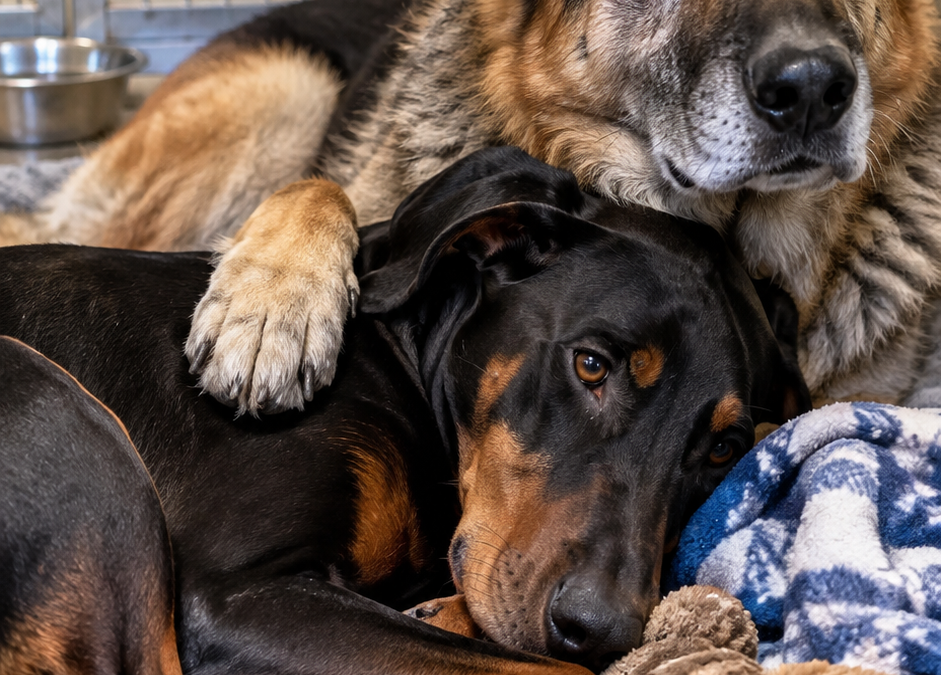
Then Brunon lowered her head.
And rested it across Rocky’s shoulders.
I will remember that moment for the rest of my life.
There was nothing dramatic about it.
No music.
No barking.
No miraculous transformation.
An old blind German Shepherd simply leaned her head against a frightened young Doberman.
Rocky went completely rigid.
His eyes widened.
His breathing stopped for a second.
He looked as though he were waiting.
Waiting for pain.
Waiting for pressure.
Waiting for whatever usually came after someone got close.
But nothing happened.
Brunon didn’t push.
She didn’t lick him.
She didn’t demand a response.
She just remained there.
Her head on him.
Her body warm beside his.
And slowly, something began to change.
Rocky’s trembling became less violent.
His breathing lengthened.
His shoulders lowered.
One muscle at a time, he stopped bracing.
I stood in the hallway with tears in my eyes.
I didn’t wipe them away.
Rocky turned his head.
For the first time since arriving, he really looked at another living creature.
He looked at Brunon.
She couldn’t look back.
Her eyes no longer worked.
But somehow that made the moment even more powerful.
She didn’t care what he looked like.
Didn’t care about his cropped ears.
His scars.
His thin body.
His history.
She couldn’t see any of the things people might have used to decide what kind of dog he was.
She only knew he was beside her.
And he was hurting.
That was enough.
I backed away.
Quietly.
I didn’t want to interfere.
When I returned early the next morning, I expected them to be in separate corners again.
They weren’t.
Rocky was asleep.
His head rested across Brunon’s front paws.
Brunon was sleeping too.
Their breathing rose and fell almost together.
I stood outside the kennel.
Daniel came up behind me.
“Sloan?”
I held up a hand.
He looked inside.
“Oh.”
That one word said everything.
I began crying again.
Daniel whispered, “You okay?”
“Don’t ask me that.”
He smiled.
“You came back last night, didn’t you?”
“Maybe.”
“You did.”
“I was checking on them.”
“Of course.”
Rocky stirred.
His eyes opened.
He saw me.
And this time, he did not turn away.
He looked directly at me.
No panic.
No emptiness.
Just a quiet, uncertain awareness.
“Morning,” I whispered.
Brunon’s ears moved.
Rocky stood.
Slowly, he walked toward me.
I stayed still.
He reached the gate.
Sniffed my fingers.
I didn’t touch him.
I let him decide.
A few seconds later, he leaned forward.
His muzzle brushed my hand.
“Hi, Rocky.”
His eyes softened.
I opened the gate and sat.
He approached cautiously.
Then, to my complete surprise, he lowered his head onto my knee.
I felt my throat tighten.
Behind him, Brunon stood and made her careful way toward us.
Rocky turned at the sound of her paws.
He waited.
When she reached him, he pressed his shoulder against hers.
Daniel whispered, “I think she told him we’re okay.”
I ran one hand gently along Rocky’s neck.
“Maybe she did.”
That morning, Rocky ate.
Not much.
Maybe half a bowl.
But when you have watched an animal refuse food for days, half a bowl feels like a feast.
Brunon ate beside him.
Rocky kept checking her.
She chewed slowly.
He watched.
Then he lowered his head and ate again.
The changes after that were not immediate.
This is the part people sometimes misunderstand about rescue.
One beautiful moment does not erase trauma.
A frightened dog does not wake the next morning healed because someone loved him correctly once.
Rocky improved.
Then retreated.
Improved again.
Some mornings, he came to the front of the enclosure when I arrived.
Other mornings, I found him back in the corner.
A metal bowl falling in the hallway could make him freeze.
A barking dog slamming against a kennel door could send him trembling to the floor.
Certain male voices seemed to frighten him more than female voices.
Fast movements frightened him.
The sound of chains was the worst.
The first time one of our workers dragged a metal chain across the floor outside, Rocky collapsed.
Not crouched.
Collapsed.
He pressed himself flat against the ground and shook so violently that his teeth clicked.
I rushed toward the enclosure.
Brunon reached him first.
She heard the sound.
Heard his breathing.
Heard the panic.
She walked directly to him and sat against his side.
Rocky buried his face beneath her chest.
I crouched nearby.
“You’re okay.”
His body shook.
Brunon stayed.
“It isn’t happening again.”
Of course he didn’t understand the words.
But I kept saying them.
“You’re here.”
Brunon lowered herself beside him.
“You’re safe.”
Rocky pressed closer.
For almost an hour, she didn’t move.
Neither did I.
Eventually, his breathing slowed.
He slept.
The next day, he ate normally again.
That became our pattern.
When Rocky became afraid, Brunon did not try to fix him.
She didn’t drag him forward.
She didn’t demand courage.
She stayed.
Sometimes for ten minutes.
Sometimes for an hour.
Once, nearly all night.
There was something extraordinary in the simplicity of it.
Humans often want to solve pain.
We want instructions.
What do I say?
What do I do?
How do I make this stop?
Brunon seemed to understand something we didn’t.
Some pain doesn’t need a solution in the moment.
It needs company.
As Rocky changed, so did Brunon.
Before him, she had begun sleeping more.
Too much, I thought.
She ate because food was placed in front of her, but rarely showed excitement.
When visitors passed her kennel, she raised her head.
Then lowered it again.
There was a tiredness to her that had nothing to do with age.
Loneliness can make a body old faster.
After Rocky moved in, Brunon became alert again.
She stood when she heard him wake.
She followed the sound of his paws.
Her appetite improved.
She began walking more.
Then one afternoon, something happened that made Daniel laugh so loudly he scared three dogs in the next wing.
Rocky had discovered a toy.
It was an old rope with knots at both ends.
For weeks, we had offered toys.
Rocky ignored them.
That afternoon, he picked up the rope.
He shook it.
Hard.
Brunon’s ears snapped forward.
Rocky froze.
Then shook it again.
The rope slapped the floor.
Brunon stood.
She turned toward the sound.
Rocky dropped into a play bow.
Brunon couldn’t see him.
I laughed.
“She has no idea what you’re doing.”
Rocky barked.
It was the first real bark I had heard from him.
Not a warning.
Not fear.
Play.
Brunon’s tail moved.
Rocky barked again.
She took two steps toward him.
He picked up the rope and ran a circle around her.
Brunon’s head turned, tracking his footsteps.
He ran another circle.
She barked once.
Rocky practically exploded with excitement.
For the next several minutes, he ran around the enclosure while Brunon followed his sounds.
She couldn’t chase him the way a younger sighted dog could.
But she participated.
Her tail moved.
Her ears tracked him.
Once, when Rocky came close, she gently bumped him with her shoulder.
He leapt sideways like a puppy.
Daniel appeared in the doorway.
“What is happening?”
“Brunon is playing.”
He stared.
She barked again.
Daniel grinned.
“I haven’t heard her do that.”
“Neither have I.”
We stood together and watched.
Rocky eventually collapsed beside her, panting.
Brunon sat with her head raised.
If you tell me dogs do not smile, I understand.
I know how canine facial anatomy works.
But I also know what happiness looks like.
Brunon was happy.
So was Rocky.
And for the first time, I began to understand that our idea had not been about one dog rescuing another.
They were changing each other.
Rocky needed Brunon’s calm.
Brunon needed Rocky’s energy.
He gave her a reason to stand up in the morning.
She gave him a reason not to hide.
He became her eyes in certain moments without ever being trained to do it.
When they went into the exercise yard, Rocky naturally stayed close to her.
If Brunon approached a step, he slowed.
If she drifted toward a fence, he walked alongside her.
We never taught him.
At first, I thought I was imagining it.
Then I watched him deliberately position his body between Brunon and a low bench.
Daniel saw it too.
“He’s guiding her.”
“I know.”
“Does he know he’s guiding her?”
“I don’t know.”
Rocky touched his nose to Brunon’s cheek.
She changed direction.
Daniel shook his head.
“That’s incredible.”
I smiled.
“No.”
“What?”
“Brunon sitting beside him that first night was incredible.”
I watched the two dogs cross the yard.
“This is just what friendship looks like after a while.”
Weeks became months.
Visitors began noticing them.
At first, people would ask about Rocky.
Dobermans draw attention.
He was young.
Handsome once his weight returned.
His dark coat shone.
His ribs disappeared.
His muscles filled out.
People stopped seeing the broken dog from the transport crate.
They saw a strong, elegant Doberman.
“Is he available?”
“Yes,” I would say.
Then Rocky would immediately look for Brunon.
I would add, “But there’s something you need to know.”
Some people listened.
Some didn’t.
One man came specifically for Rocky.
He had owned Dobermans before.
Beautiful house.
Fenced property.
Good veterinary references.
On paper, excellent.
He spent time with Rocky in the yard.
Rocky was cautious but polite.
Brunon was resting nearby.
The man said, “He’s exactly what I’m looking for.”
I nodded.
“Rocky is deeply bonded to Brunon.”
He glanced toward her.
“The blind Shepherd?”
“Yes.”
“I only want one dog.”
“I understand.”
He looked back at Rocky.
“Surely he’ll adjust.”
Maybe he would have.
Dogs survive things they should never have to survive.
That doesn’t mean we should force them to.
I said, “We’re not separating them right now.”
His expression changed.
“You’re going to make adopting a young Doberman dependent on someone taking an eleven-year-old blind dog?”
“Yes.”
“That’s ridiculous.”
Rocky walked away from him.
Straight toward Brunon.
He lay beside her.
I looked at the man.
“I don’t think Rocky agrees.”
He left without them.
For a few days, I worried.
Had we made the wrong decision?
Young dogs have better adoption chances.
Senior disabled dogs do not.
By insisting they stay together, were we making Rocky harder to place?
Daniel found me staring at their adoption profiles.
“Stop.”
I looked at him.
“Stop what?”
“Thinking about separating them.”
“I didn’t say anything.”
“You’ve been looking at those forms for twenty minutes.”
“What if nobody takes both?”
“Then we wait.”
“For how long?”
“As long as we need.”
I glanced through the kennel window.
Brunon was asleep.
Rocky was curled beside her.
“What if Brunon only has a few years?”
Daniel’s voice became softer.
“Then Rocky gets those years with her.”
That stayed with me.
People sometimes measure life the wrong way.
We want guarantees.
How long will this last?
What happens later?
Will loving something eventually hurt?
Of course it will.
Everything living changes.
Everything we love eventually becomes memory.
The answer isn’t to separate yourself from love before loss can happen.
Brunon and Rocky didn’t know how much time they had.
They only knew they had that day.
Maybe animals understand life better because they don’t waste as much time pretending otherwise.
Then came a Saturday in late spring.
I was at the front desk when a couple entered.
They were probably in their early fifties.
The woman introduced herself as Claire.
Her husband was Michael.
“We’re looking to adopt,” Claire said.
“Any particular kind of dog?”
Michael shook his head.
“Not really.”
“Age?”
“No preference.”
That caught my attention.
Most people had preferences.
Puppy.
Small.
Non-shedding.
Good with children.
Young.
Specific breed.
“Special needs?”
Claire smiled.
“We’re open.”
I don’t believe in destiny very often.
Working in rescue makes you practical.
You learn that good intentions need fences, vet care, money, time, and patience.
But when someone walks into a shelter and says they are open to an older or special-needs dog, you pay attention.
I showed them several dogs.
They were kind with each one.
Asked good questions.
Didn’t make impulsive promises.
Then we reached Rocky and Brunon’s enclosure.
Rocky stood first.
Brunon raised her head.
Claire stopped.
“Who’s this?”
I explained.
Rocky.
One year old when he arrived.
Now healthier.
Trauma history.
Brunon.
Eleven.
Blind.
Owner surrender.
Then I told them about the first night.
Not every detail.
Just enough.
Claire listened without interrupting.
Michael crouched outside the gate.
Rocky watched him.
Brunon listened.
Claire whispered, “They’re bonded.”
“Very.”
“Do they have to go together?”
I braced myself.
“Yes.”
Claire looked at Michael.
Michael looked at her.
No argument.
No hesitation.
He said, “Can we meet them?”
We took them into the yard.
I kept Rocky leashed at first.
Brunon wandered slowly.
Claire sat on the grass.
She didn’t call.
Didn’t reach.
She waited.
Brunon found her first.
The old Shepherd sniffed Claire’s sleeve.
Claire let her.
Then gently touched her neck.
“Hello, beautiful.”
Brunon’s tail moved.
Michael walked with Rocky.
He let Rocky set the pace.
When Rocky stopped, Michael stopped.
When Rocky returned to check Brunon, Michael followed without pulling.
I watched carefully.
Rocky approached Claire.
She held out the back of her hand.
He sniffed it.
Then leaned against her shoulder.
Claire’s face changed.
Michael noticed.
“Oh no.”
She laughed.
“What?”
“You’ve made the face.”
“What face?”
“The we’re-taking-them-home face.”
Claire looked at me.
“We want them.”
I didn’t answer immediately.
“Both?”
Michael nodded.
“Both.”
“You understand Brunon is blind?”
“Yes.”
“She’ll need consistency. Furniture shouldn’t be moved around constantly. Stairs need to be managed. She may need more medical care because of her age.”
“We understand.”
“Rocky still has trauma responses. Loud metal noises can trigger him. Sudden movements. Certain situations.”
Claire looked at Rocky.
“We’re not expecting perfect dogs.”
That sentence mattered.
Too many animals are adopted because people fall in love with an idea.
Then returned when the animal behaves like itself instead of the fantasy.
I asked about their home.
Large fenced yard.
Quiet neighborhood.
No other pets.
No young children.
Claire worked from home.
Michael had flexible hours.
They had owned senior dogs before.
I asked the question I always ask with a bonded pair.
“What happens if one develops expensive medical needs?”
Michael answered first.
“Then we pay for the medical care.”
“What happens if Rocky needs months to fully trust you?”
“Then it takes months.”
“What happens if Brunon’s age means you don’t get much time with her?”
Claire’s eyes filled.
“Then whatever time we get will matter.”
I had to look down at my clipboard.
Daniel later accused me of crying.
I denied it.
I was lying.
The adoption wasn’t instant.
We followed procedure.
Home check.
Veterinary references.
Meetings.
Paperwork.
Transition planning.
Every step confirmed what I had hoped.
They were right.
On the morning Rocky and Brunon were scheduled to leave, I arrived early.
I told myself I was excited.
I was.
I was also miserable.
Shelter workers live inside a strange contradiction.
Our goal is to send animals away.
We feed them.
Medicate them.
Sit beside them when they’re afraid.
Learn what foods they like.
Learn where they hate being touched.
Learn what sounds frighten them.
Learn the exact way they look at you when they need reassurance.
Then, if we do everything correctly, someone arrives and takes them from us.
That is success.
It can still hurt.
I knelt beside Brunon.
“Today’s your day.”
Her ears moved.
Rocky came over immediately.
“Don’t worry. You’re going too.”
Daniel stood behind me.
“You’re going to scare the adopters if you sob.”
“I’m not sobbing.”
“You’re talking to a blind dog like you’re sending her to college.”
I stood.
“Do you ever say anything useful?”
“Occasionally.”
Claire and Michael arrived with two beds, leashes, bowls, and enough supplies to open a pet store.
Claire crouched.
“Ready to go home?”
Rocky hesitated near the exit.
Brunon moved beside him.
He pressed his shoulder against hers.
Then they walked out together.
I followed them to the car.
Michael had prepared the back area so both dogs could ride safely side by side.
Rocky climbed in.
Brunon hesitated at the step.
Rocky turned around.
He came back toward her.
Brunon sniffed.
Rocky touched her face with his nose.
She stepped up.
I had seen him do similar things in the yard.
But watching it happen as they left nearly broke me.
Claire hugged me.
“Thank you.”
I shook my head.
“They did the hard part.”
She looked at Rocky and Brunon through the window.
“We’ll take care of them.”
“I know.”
The car pulled away.
Rocky looked through the rear window.
Brunon sat beside him.
For a few seconds, I could still see them.
Then they disappeared down the road.
The enclosure felt enormous when I walked back inside.
For days afterward, I expected to hear Rocky’s paws and Brunon’s slow steps whenever I passed.
Then the pictures started arriving.
The first showed Brunon asleep on a thick bed near a window.
Rocky was curled against her.
The second showed Rocky running across a yard.
The third showed Brunon sitting in the sun.
Claire wrote:
She loves this spot. Rocky runs circles around her and comes back every few minutes to check on her.
Another message arrived a week later.
Rocky woke frightened last night. Brunon went to him before we could. Ten minutes later they were both asleep.
I showed Daniel.
He smiled.
“Some things don’t change.”
“No.”
A month later, Claire invited me to visit.
Their house was exactly the kind of place I had hoped for.
Quiet.
Bright.
A large yard enclosed by a sturdy fence.
They had placed textured mats near doorways so Brunon could identify locations with her paws.
They kept pathways clear.
Water bowls remained in consistent places.
Rocky had a basket overflowing with toys.
When I stepped through the gate, I heard him before I saw him.
Running.
A black blur crossed the yard.
Then Rocky stopped.
He stared at me.
“Sloan?”
His whole body exploded into movement.
He ran straight at me.
For one terrible second, I wondered whether he remembered.
Then his front paws landed against my chest.
I almost fell backward.
“Okay! Okay!”
I laughed and wrapped my arms around him.
“You got bigger.”
His face pressed against mine.
“You remember me.”
Of course he did.
Behind him, Brunon stood.
Her ears turned toward my voice.
I walked to her.
“Hey, old girl.”
Her nose lifted.
She sniffed the air.
Then her tail started moving.
I knelt.
Brunon found me.
She rested her head against my shoulder.
My eyes burned.
“Yeah.”
I buried my face briefly in her fur.
“I missed you too.”
Claire came outside.
“They’re doing wonderfully.”
I looked around.
Rocky grabbed a toy.
He ran across the yard.
Brunon’s head followed the sound.
“You weren’t exaggerating about him checking on her,” Claire said.
Rocky ran toward us.
Passed Brunon.
Stopped.
Turned around.
Returned.
Touched her shoulder.
Then took off again.
I laughed.
“No.”
Claire watched them.
“It’s like she gave him peace, and now he makes sure she never feels lost.”
That described them better than anything I had said.
I visited regularly after that.
Not every week.
I had other dogs.
Other rescues.
Other animals arriving with other stories.
But whenever I had a difficult day, I found myself thinking about Rocky and Brunon.
Especially on the days when rescue felt hopeless.
There are plenty of those.
Dogs arrive faster than homes appear.
People surrender animals for reasons you understand.
And reasons you don’t.
You lose some.
You can’t fix everything.
You discover limits.
Money.
Space.
Time.
Your own strength.
But then you remember something small.
An old blind dog placing her head across the shoulders of a trembling Doberman.
And you keep going.
That summer, I went to see them again.
The day was warm but not hot.
Claire had set up shade in the yard.
Brunon sat in the grass.
Her muzzle had grown whiter.
Age was becoming more visible.
But she looked peaceful.
Rocky was running.
Not pacing.
Not escaping.
Running for the joy of running.
He chased a ball Michael threw.
He brought it back.
Dropped it.
Ran again.
I sat beside Brunon.
“Listen to him.”
Her ears tracked Rocky’s footsteps.
“You know where he is, don’t you?”
Her head turned.
Rocky barked across the yard.
Brunon’s tail moved.
I stroked her neck.
“You’re a good friend.”
She leaned slightly into my hand.
“You know that?”
Rocky raced by us.
Brunon listened.
I looked at her cloudy eyes.
“You saved him.”
I meant it.
Then, almost as soon as I said the words, I realized they weren’t quite right.
Rocky had been dying in a way that had nothing to do with his body.
He was alive.
Heart beating.
Lungs working.
But emotionally, he had disappeared.
Brunon gave him a reason to return.
She taught him closeness without pain.
Touch without fear.
Company without demands.
She saved him.
But Rocky had saved her too.
Before him, Brunon had been waiting.
Waiting while people passed.
Waiting while younger dogs left with families.
Waiting through long afternoons and quiet nights.
She had accepted loneliness with dignity, but dignity is not the same as happiness.
Rocky changed that.
He gave her purpose.
Noise.
Movement.
Someone to listen for.
Someone who needed her.
Someone who stayed.
I scratched beneath her chin.
“No.”
Brunon’s head tilted.
“I said that wrong.”
Rocky returned with the ball.
He dropped it beside Brunon.
She sniffed it.
Then he lay down next to her.
I smiled.
“You didn’t save him.”
Rocky rested his head across Brunon’s shoulders.
Exactly as she had rested hers across his that first night.
“You saved each other.”
Claire had come up behind me.
She heard.
“That’s what we think too.”
I looked at her.
She sat in the grass beside us.
“Sometimes Rocky guides her,” she said. “But when he’s scared, he still looks for her.”
“Even now?”
“Not as often. But yes.”
I looked at Rocky.
His eyes were half closed.
“Good.”
Claire smiled.
“What?”
“He still knows where to go when he’s afraid.”
We sat there together.
No dramatic ending.
No miracle.
Just two dogs in a backyard.
One old.
One young.
One blind.
One scarred.
Both alive.
Both wanted.
Both home.
When I think about Rocky and Brunon now, I don’t remember the worst parts first.
I don’t remember Rocky’s scars.
I don’t remember the empty food bowl.
I don’t remember Brunon sitting near her kennel door while families walked past.
I remember that night.
The shelter almost dark.
Rocky trembling in the corner.
Brunon rising slowly.
Feeling her way toward him.
Then resting her head on his shoulders.
No words.
No demands.
No promise that tomorrow would be better.
Just presence.
I used to believe helping meant doing something.
Fixing something.
Moving.
Treating.
Feeding.
Rescuing.
Finding the answer.
Rocky and Brunon taught me another kind of help.
Sometimes the greatest kindness is not fixing someone.
Sometimes it’s sitting beside them long enough that they remember they don’t have to survive everything alone.
Brunon couldn’t see Rocky.
But she saw exactly what he needed.
Not with her eyes.
With whatever part of us recognizes loneliness because we have known it ourselves.
And Rocky, without realizing it, returned the gift.
He gave an old dog who had been forgotten a reason to feel needed again.
I still work at the shelter.
Dogs still arrive every week.
Some are frightened.
Some are angry.
Some walk through the front door wagging their tails as if they are arriving at a hotel.
Some refuse to look at us.
Whenever a dog shuts down completely, I think of Rocky.
Whenever an older dog sits quietly while visitors move toward younger kennels, I think of Brunon.
And whenever someone asks me whether animals understand friendship, grief, compassion, or love, I don’t argue.
I don’t need to.
I have seen the answer.
It looked like an eleven-year-old blind German Shepherd sitting beside a trembling Doberman in the middle of the night.
It looked like a young dog placing his head across her shoulders months later in a sunny yard.
It looked like two animals the world had almost discarded becoming indispensable to each other.
Rocky had been one year old and had already given up on people.
Brunon had been eleven and had been passed by again and again because people saw her blindness before they saw her.
Neither one had what most adopters were looking for.
One carried too much fear.
The other carried too many years.
But when they found each other, those things stopped being the whole story.
Rocky’s fear became something Brunon could sit beside.
Brunon’s blindness became something Rocky could guide.
His youth gave her energy.
Her patience gave him peace.
And one night, inside an ordinary shelter enclosure, two dogs who had every reason to believe they were unwanted discovered that they were exactly what someone else needed.
My name is Sloan.
I have witnessed hundreds of rescues.
But Rocky and Brunon taught me what rescue really means.
It doesn’t always happen when someone opens a cage.
It doesn’t always happen when a dog gets adopted.
Sometimes rescue happens much earlier.
Quietly.
In the dark.
When one wounded creature realizes another wounded creature has chosen to stay.
And sometimes the one you save becomes the one who saves you right back.
Have you finished reading the story and want to read it again?
A Broken Doberman Had Given Up on Life—Then an Old Blind Shepherd Lay Beside Him One Night
Rocky was only one year old, but when he arrived at our shelter, he looked like a dog who had already lived through a lifetime of fear and had decided the world had nothing left worth trusting.
Brunon was eleven, completely blind, and had spent months being passed over by families who wanted younger, easier, healthier dogs—but the old German Shepherd still sat by her kennel door every day as if she were waiting for someone only she could hear coming.
The night we placed those two forgotten dogs together, I expected trouble, or at best silence—but when I returned after midnight and saw what Brunon was doing beside Rocky, I knew I was witnessing the beginning of something none of us at the shelter would ever forget.
My name is Sloan, and I have worked in animal rescue long enough to understand that every dog arrives carrying a story.
Some stories are obvious.
A dirty collar.
A torn leash.
A name written in fading marker on an old tag.
Sometimes there is a family searching desperately by the time the dog reaches us.
Sometimes there is a surrender form with a neat explanation typed into a box.
Moving.
Divorce.
New baby.
Landlord.
Allergies.
Too much work.
Not enough time.
Those words can explain how a dog came through our door, but they rarely explain what happened inside the dog after the door closed behind the person who left.
Other stories arrive without words at all.
You read them in scars.
In flinches.
In the way a dog eats too quickly, as if the bowl may disappear.
In the way another dog refuses food completely.
In the way some animals bark at every passing person because they are still hoping one of them will turn out to be familiar.
And sometimes you see a dog whose silence tells you more than barking ever could.
Rocky was one of those dogs.
It was late when the transport van arrived.
I remember the sound first.
Tires crunching over the gravel behind the shelter.
Then headlights swept across the back windows.
I was helping clean the medical room when Daniel, one of our overnight volunteers, came through the door.
“They’re here.”
I put down the towels in my hands.
“How many?”
“Six.”
“From the same place?”
He nodded.
“Yeah.”
That told me enough.
We had been warned earlier that day that a group of dogs had been removed from a property connected to illegal fighting.
I hate saying those words.
Even after years of rescue work, I hate how easily people can say them.
Dog fighting.
Two words.
As though two words can hold everything that happens to an animal in that world.
They can’t.
We had no reliable history for the dogs coming in.
No names.
No medical records.
No ages beyond estimates.
No clear information about how long any of them had been there.
And no way to ask the animals what they remembered.
When the first crate came through, the dog inside was frightened but responsive.
The second barked continuously.
The third had a torn ear and snapped at the metal door whenever anyone came close.
Then Rocky came in.
At first I thought his crate was empty.
He had pressed himself so far into the back corner that the darkness swallowed most of him.
“That’s the Doberman,” the transporter said.
I crouched.
Two eyes looked back at me.
Only for a second.
Then they turned away.
“How old?”
“Maybe a year.”
I stared at him.
A year.
He was tall and long-legged, but badly underweight.
His ribs stood out beneath his skin.
His ears had been cropped.
His tail had been docked.
There were pale scars along his shoulders, legs, and chest.
One ran across the side of his muzzle.
But it wasn’t his body that stopped me.
It was his face.
Fear has energy.
A terrified dog watches.
A frightened dog calculates distance.
Where are you?
Where is the exit?
What will happen if you move closer?
Rocky wasn’t doing any of that.
He looked absent.
As though whatever part of him had once expected something from the world had quietly shut down.
The transporter opened the crate.
Nobody reached inside.
We knew better.
“Come on, boy,” I said softly.
Nothing.
“We’re not going to hurt you.”
Nothing.
Daniel placed a slip lead near the opening.
Rocky didn’t move.
I waited several minutes.
Then ten.
Finally, with patience and almost no pressure, we managed to guide him into a quiet kennel.
He walked with his head low.
Not sniffing.
Not exploring.
Not even looking at the other dogs.
He went directly to the farthest corner.
Turned toward the wall.
And sat.
That was it.
I placed water nearby.
Then food.
“You’re safe here.”
No response.
I shut the gate and stepped away.
A few minutes later, I looked back.
He was still facing the wall.
The next morning, his food was untouched.
His water barely touched.
He had not moved far enough to disturb the blanket.
I entered slowly.
“Morning, Rocky.”
We had begun calling him Rocky simply because we needed something gentler than “the Doberman from the seizure.”
His ear twitched at the sound.
That was all.
I set down fresh food.
Chicken mixed with softened kibble.
The kind of meal that usually got even anxious dogs interested.
He didn’t turn.
I sat on the floor outside the kennel.
“I’m Sloan.”
Nothing.
“I know you don’t care right now.”
I leaned against the wall.
“But I’m probably going to keep talking anyway.”
For twenty minutes, I talked to him.
Not about anything important.
Weather.
The shelter.
The old coffee machine that Daniel kept threatening to throw away.
The fact that one of the beagles had stolen a mop head the previous week and acted like he had won a military campaign.
Rocky never looked at me.
I didn’t need him to.
Sometimes rescue begins with accepting that your presence is enough.
The second day was worse.
He still would not eat.
Our veterinarian examined him as carefully as possible.
He was dehydrated, underweight, and exhausted.
But there was no immediate physical reason he couldn’t eat.
“The problem isn’t only medical,” she told me.
“I know.”
“He may need time.”
“I know.”
But time is difficult to give when you are watching an animal disappear in front of you.
We tried hand-feeding.
Nothing.
We tried different foods.
Nothing.
We placed the bowl closer.
Then farther away.
We left him alone for long stretches.
We sat outside his kennel.
At one point, we even opened the kennel into a secure indoor run and walked away, hoping curiosity might eventually overcome fear.
Rocky stayed in the corner.
Sometimes he trembled.
Sometimes he closed his eyes while we were nearby, not because he was relaxed but because he seemed to be trying to remove himself from the room.
On the third afternoon, Daniel stood beside me watching him.
“This isn’t working.”
“No.”
“What does he need?”
I sighed.
“If I knew that, I’d give it to him.”
Rocky was curled so tightly against the back wall that his body looked smaller than it really was.
Daniel glanced down the row of kennels.
“Maybe he needs another dog.”
I looked at him.
“After where he came from?”
“I’m not suggesting just any dog.”
“Who?”
Daniel didn’t answer immediately.
Then he looked toward the older-dog wing.
I knew before he said the name.
“Brunon.”
I stared at him.
Brunon was an eleven-year-old German Shepherd.
She had been blind for two years.
Her family had surrendered her several months earlier after moving somewhere they said they could not take her.
That was what the paperwork said.
Could not.
I had learned not to waste too much energy arguing with words on surrender forms.
The dog in front of me mattered more.
Brunon had adjusted to the shelter with a dignity that broke my heart.
She mapped every space through smell, sound, and memory.
She knew exactly how many steps led from her bed to her water.
She knew where the kennel gate was.
She knew my footsteps.
She knew Daniel’s whistle.
She knew which volunteer dropped treats accidentally and positioned herself accordingly.
She was calm.
Patient.
Gentle.
And almost completely ignored by adopters.
Families would stop at her kennel.
Read the card.
“Eleven?”
“She’s blind?”
Then they would move on.
Brunon always sat near the front when visitors came.
Head raised.
Ears alert.
Waiting.
Again and again, people walked past.
But she never seemed bitter.
If dogs can understand disappointment, Brunon handled it better than most humans I know.
Daniel said, “She doesn’t push.”
“That’s true.”
“She won’t crowd him.”
“Also true.”
“And she doesn’t need him to act normal.”
I looked back at Rocky.
He was trembling again.
“We’d have to supervise closely.”
“Of course.”
“If either one gets uncomfortable, we separate immediately.”
“Agreed.”
It wasn’t a perfect plan.
It wasn’t even a particularly scientific plan.
It was two shelter workers looking at one broken young dog and one lonely old dog and wondering whether perhaps one kind of loneliness might recognize another.
That evening, we prepared a larger shared enclosure.
We moved Brunon first.
She walked slowly beside me.
“Step.”
Her paw felt for the slight rise in the floor.
“Good girl.”
She entered the enclosure, sniffed the blanket, found the water, and sat.
Then we brought Rocky.
The second he realized he was somewhere unfamiliar, his body tightened.
Brunon’s ears turned toward him.
She did not move.
Rocky found a corner.
He pressed himself into it.
Brunon listened.
That was all.
For ten minutes, nothing happened.
I looked at Daniel.
He whispered, “Maybe that’s enough.”
Maybe it was.
Brunon eventually lay near the opposite side of the enclosure.
Rocky remained in his corner.
We watched for another hour.
No growling.
No barking.
No aggression.
Brunon never approached.
Rocky never looked at her.
Before leaving, I crouched beside the gate.
“Be nice to each other.”
Daniel smiled.
“They’re dogs, Sloan.”
“I know.”
“You say that like you’re leaving kids at summer camp.”
“Go clean something.”
He laughed and walked away.
I went home that night.
But I couldn’t sleep.
I kept picturing Rocky.
I kept wondering whether moving him had been a mistake.
What if another dog’s presence made him worse?
What if Brunon became stressed?
What if Rocky woke frightened and reacted badly?
At eleven thirty, I sat up in bed.
By eleven forty-five, I had my shoes on.
By midnight, I was driving back to the shelter.
I told myself I was being responsible.
The truth was simpler.
I needed to see them.
The building was almost completely quiet when I arrived.
Only the overnight lights were on.
Most of the dogs had settled.
Occasionally, a collar jingled.
A dog shifted on bedding.
I walked toward the enclosure.
Then I stopped.
Rocky was still in the corner.
But he wasn’t alone.
Brunon sat beside him.
Not touching.
Just close.
Her body faced forward.
Her head was turned slightly toward him.
She was listening to his breathing.
Rocky trembled.
Brunon stayed still.
I stood outside the kennel and watched.
Minutes passed.
Then Brunon rose.
Very slowly.
She stepped toward Rocky.
One careful paw.
Then another.
She was blind, but in those moments she seemed to know exactly where she was going.
Rocky’s eyes opened.
His body tightened.
I almost moved forward.
Then I stopped myself.
Brunon paused beside him.
Rocky did not growl.
He didn’t run.
He simply froze.
Then Brunon lowered her head.
And rested it across Rocky’s shoulders.
I will remember that moment for the rest of my life.
There was nothing dramatic about it.
No music.
No barking.
No miraculous transformation.
An old blind German Shepherd simply leaned her head against a frightened young Doberman.
Rocky went completely rigid.
His eyes widened.
His breathing stopped for a second.
He looked as though he were waiting.
Waiting for pain.
Waiting for pressure.
Waiting for whatever usually came after someone got close.
But nothing happened.
Brunon didn’t push.
She didn’t lick him.
She didn’t demand a response.
She just remained there.
Her head on him.
Her body warm beside his.
And slowly, something began to change.
Rocky’s trembling became less violent.
His breathing lengthened.
His shoulders lowered.
One muscle at a time, he stopped bracing.
I stood in the hallway with tears in my eyes.
I didn’t wipe them away.
Rocky turned his head.
For the first time since arriving, he really looked at another living creature.
He looked at Brunon.
She couldn’t look back.
Her eyes no longer worked.
But somehow that made the moment even more powerful.
She didn’t care what he looked like.
Didn’t care about his cropped ears.
His scars.
His thin body.
His history.
She couldn’t see any of the things people might have used to decide what kind of dog he was.
She only knew he was beside her.
And he was hurting.
That was enough.
I backed away.
Quietly.
I didn’t want to interfere.
When I returned early the next morning, I expected them to be in separate corners again.
They weren’t.
Rocky was asleep.
His head rested across Brunon’s front paws.
Brunon was sleeping too.
Their breathing rose and fell almost together.
I stood outside the kennel.
Daniel came up behind me.
“Sloan?”
I held up a hand.
He looked inside.
“Oh.”
That one word said everything.
I began crying again.
Daniel whispered, “You okay?”
“Don’t ask me that.”
He smiled.
“You came back last night, didn’t you?”
“Maybe.”
“You did.”
“I was checking on them.”
“Of course.”
Rocky stirred.
His eyes opened.
He saw me.
And this time, he did not turn away.
He looked directly at me.
No panic.
No emptiness.
Just a quiet, uncertain awareness.
“Morning,” I whispered.
Brunon’s ears moved.
Rocky stood.
Slowly, he walked toward me.
I stayed still.
He reached the gate.
Sniffed my fingers.
I didn’t touch him.
I let him decide.
A few seconds later, he leaned forward.
His muzzle brushed my hand.
“Hi, Rocky.”
His eyes softened.
I opened the gate and sat.
He approached cautiously.
Then, to my complete surprise, he lowered his head onto my knee.
I felt my throat tighten.
Behind him, Brunon stood and made her careful way toward us.
Rocky turned at the sound of her paws.
He waited.
When she reached him, he pressed his shoulder against hers.
Daniel whispered, “I think she told him we’re okay.”
I ran one hand gently along Rocky’s neck.
“Maybe she did.”
That morning, Rocky ate.
Not much.
Maybe half a bowl.
But when you have watched an animal refuse food for days, half a bowl feels like a feast.
Brunon ate beside him.
Rocky kept checking her.
She chewed slowly.
He watched.
Then he lowered his head and ate again.
The changes after that were not immediate.
This is the part people sometimes misunderstand about rescue.
One beautiful moment does not erase trauma.
A frightened dog does not wake the next morning healed because someone loved him correctly once.
Rocky improved.
Then retreated.
Improved again.
Some mornings, he came to the front of the enclosure when I arrived.
Other mornings, I found him back in the corner.
A metal bowl falling in the hallway could make him freeze.
A barking dog slamming against a kennel door could send him trembling to the floor.
Certain male voices seemed to frighten him more than female voices.
Fast movements frightened him.
The sound of chains was the worst.
The first time one of our workers dragged a metal chain across the floor outside, Rocky collapsed.
Not crouched.
Collapsed.
He pressed himself flat against the ground and shook so violently that his teeth clicked.
I rushed toward the enclosure.
Brunon reached him first.
She heard the sound.
Heard his breathing.
Heard the panic.
She walked directly to him and sat against his side.
Rocky buried his face beneath her chest.
I crouched nearby.
“You’re okay.”
His body shook.
Brunon stayed.
“It isn’t happening again.”
Of course he didn’t understand the words.
But I kept saying them.
“You’re here.”
Brunon lowered herself beside him.
“You’re safe.”
Rocky pressed closer.
For almost an hour, she didn’t move.
Neither did I.
Eventually, his breathing slowed.
He slept.
The next day, he ate normally again.
That became our pattern.
When Rocky became afraid, Brunon did not try to fix him.
She didn’t drag him forward.
She didn’t demand courage.
She stayed.
Sometimes for ten minutes.
Sometimes for an hour.
Once, nearly all night.
There was something extraordinary in the simplicity of it.
Humans often want to solve pain.
We want instructions.
What do I say?
What do I do?
How do I make this stop?
Brunon seemed to understand something we didn’t.
Some pain doesn’t need a solution in the moment.
It needs company.
As Rocky changed, so did Brunon.
Before him, she had begun sleeping more.
Too much, I thought.
She ate because food was placed in front of her, but rarely showed excitement.
When visitors passed her kennel, she raised her head.
Then lowered it again.
There was a tiredness to her that had nothing to do with age.
Loneliness can make a body old faster.
After Rocky moved in, Brunon became alert again.
She stood when she heard him wake.
She followed the sound of his paws.
Her appetite improved.
She began walking more.
Then one afternoon, something happened that made Daniel laugh so loudly he scared three dogs in the next wing.
Rocky had discovered a toy.
It was an old rope with knots at both ends.
For weeks, we had offered toys.
Rocky ignored them.
That afternoon, he picked up the rope.
He shook it.
Hard.
Brunon’s ears snapped forward.
Rocky froze.
Then shook it again.
The rope slapped the floor.
Brunon stood.
She turned toward the sound.
Rocky dropped into a play bow.
Brunon couldn’t see him.
I laughed.
“She has no idea what you’re doing.”
Rocky barked.
It was the first real bark I had heard from him.
Not a warning.
Not fear.
Play.
Brunon’s tail moved.
Rocky barked again.
She took two steps toward him.
He picked up the rope and ran a circle around her.
Brunon’s head turned, tracking his footsteps.
He ran another circle.
She barked once.
Rocky practically exploded with excitement.
For the next several minutes, he ran around the enclosure while Brunon followed his sounds.
She couldn’t chase him the way a younger sighted dog could.
But she participated.
Her tail moved.
Her ears tracked him.
Once, when Rocky came close, she gently bumped him with her shoulder.
He leapt sideways like a puppy.
Daniel appeared in the doorway.
“What is happening?”
“Brunon is playing.”
He stared.
She barked again.
Daniel grinned.
“I haven’t heard her do that.”
“Neither have I.”
We stood together and watched.
Rocky eventually collapsed beside her, panting.
Brunon sat with her head raised.
If you tell me dogs do not smile, I understand.
I know how canine facial anatomy works.
But I also know what happiness looks like.
Brunon was happy.
So was Rocky.
And for the first time, I began to understand that our idea had not been about one dog rescuing another.
They were changing each other.
Rocky needed Brunon’s calm.
Brunon needed Rocky’s energy.
He gave her a reason to stand up in the morning.
She gave him a reason not to hide.
He became her eyes in certain moments without ever being trained to do it.
When they went into the exercise yard, Rocky naturally stayed close to her.
If Brunon approached a step, he slowed.
If she drifted toward a fence, he walked alongside her.
We never taught him.
At first, I thought I was imagining it.
Then I watched him deliberately position his body between Brunon and a low bench.
Daniel saw it too.
“He’s guiding her.”
“I know.”
“Does he know he’s guiding her?”
“I don’t know.”
Rocky touched his nose to Brunon’s cheek.
She changed direction.
Daniel shook his head.
“That’s incredible.”
I smiled.
“No.”
“What?”
“Brunon sitting beside him that first night was incredible.”
I watched the two dogs cross the yard.
“This is just what friendship looks like after a while.”
Weeks became months.
Visitors began noticing them.
At first, people would ask about Rocky.
Dobermans draw attention.
He was young.
Handsome once his weight returned.
His dark coat shone.
His ribs disappeared.
His muscles filled out.
People stopped seeing the broken dog from the transport crate.
They saw a strong, elegant Doberman.
“Is he available?”
“Yes,” I would say.
Then Rocky would immediately look for Brunon.
I would add, “But there’s something you need to know.”
Some people listened.
Some didn’t.
One man came specifically for Rocky.
He had owned Dobermans before.
Beautiful house.
Fenced property.
Good veterinary references.
On paper, excellent.
He spent time with Rocky in the yard.
Rocky was cautious but polite.
Brunon was resting nearby.
The man said, “He’s exactly what I’m looking for.”
I nodded.
“Rocky is deeply bonded to Brunon.”
He glanced toward her.
“The blind Shepherd?”
“Yes.”
“I only want one dog.”
“I understand.”
He looked back at Rocky.
“Surely he’ll adjust.”
Maybe he would have.
Dogs survive things they should never have to survive.
That doesn’t mean we should force them to.
I said, “We’re not separating them right now.”
His expression changed.
“You’re going to make adopting a young Doberman dependent on someone taking an eleven-year-old blind dog?”
“Yes.”
“That’s ridiculous.”
Rocky walked away from him.
Straight toward Brunon.
He lay beside her.
I looked at the man.
“I don’t think Rocky agrees.”
He left without them.
For a few days, I worried.
Had we made the wrong decision?
Young dogs have better adoption chances.
Senior disabled dogs do not.
By insisting they stay together, were we making Rocky harder to place?
Daniel found me staring at their adoption profiles.
“Stop.”
I looked at him.
“Stop what?”
“Thinking about separating them.”
“I didn’t say anything.”
“You’ve been looking at those forms for twenty minutes.”
“What if nobody takes both?”
“Then we wait.”
“For how long?”
“As long as we need.”
I glanced through the kennel window.
Brunon was asleep.
Rocky was curled beside her.
“What if Brunon only has a few years?”
Daniel’s voice became softer.
“Then Rocky gets those years with her.”
That stayed with me.
People sometimes measure life the wrong way.
We want guarantees.
How long will this last?
What happens later?
Will loving something eventually hurt?
Of course it will.
Everything living changes.
Everything we love eventually becomes memory.
The answer isn’t to separate yourself from love before loss can happen.
Brunon and Rocky didn’t know how much time they had.
They only knew they had that day.
Maybe animals understand life better because they don’t waste as much time pretending otherwise.
Then came a Saturday in late spring.
I was at the front desk when a couple entered.
They were probably in their early fifties.
The woman introduced herself as Claire.
Her husband was Michael.
“We’re looking to adopt,” Claire said.
“Any particular kind of dog?”
Michael shook his head.
“Not really.”
“Age?”
“No preference.”
That caught my attention.
Most people had preferences.
Puppy.
Small.
Non-shedding.
Good with children.
Young.
Specific breed.
“Special needs?”
Claire smiled.
“We’re open.”
I don’t believe in destiny very often.
Working in rescue makes you practical.
You learn that good intentions need fences, vet care, money, time, and patience.
But when someone walks into a shelter and says they are open to an older or special-needs dog, you pay attention.
I showed them several dogs.
They were kind with each one.
Asked good questions.
Didn’t make impulsive promises.
Then we reached Rocky and Brunon’s enclosure.
Rocky stood first.
Brunon raised her head.
Claire stopped.
“Who’s this?”
I explained.
Rocky.
One year old when he arrived.
Now healthier.
Trauma history.
Brunon.
Eleven.
Blind.
Owner surrender.
Then I told them about the first night.
Not every detail.
Just enough.
Claire listened without interrupting.
Michael crouched outside the gate.
Rocky watched him.
Brunon listened.
Claire whispered, “They’re bonded.”
“Very.”
“Do they have to go together?”
I braced myself.
“Yes.”
Claire looked at Michael.
Michael looked at her.
No argument.
No hesitation.
He said, “Can we meet them?”
We took them into the yard.
I kept Rocky leashed at first.
Brunon wandered slowly.
Claire sat on the grass.
She didn’t call.
Didn’t reach.
She waited.
Brunon found her first.
The old Shepherd sniffed Claire’s sleeve.
Claire let her.
Then gently touched her neck.
“Hello, beautiful.”
Brunon’s tail moved.
Michael walked with Rocky.
He let Rocky set the pace.
When Rocky stopped, Michael stopped.
When Rocky returned to check Brunon, Michael followed without pulling.
I watched carefully.
Rocky approached Claire.
She held out the back of her hand.
He sniffed it.
Then leaned against her shoulder.
Claire’s face changed.
Michael noticed.
“Oh no.”
She laughed.
“What?”
“You’ve made the face.”
“What face?”
“The we’re-taking-them-home face.”
Claire looked at me.
“We want them.”
I didn’t answer immediately.
“Both?”
Michael nodded.
“Both.”
“You understand Brunon is blind?”
“Yes.”
“She’ll need consistency. Furniture shouldn’t be moved around constantly. Stairs need to be managed. She may need more medical care because of her age.”
“We understand.”
“Rocky still has trauma responses. Loud metal noises can trigger him. Sudden movements. Certain situations.”
Claire looked at Rocky.
“We’re not expecting perfect dogs.”
That sentence mattered.
Too many animals are adopted because people fall in love with an idea.
Then returned when the animal behaves like itself instead of the fantasy.
I asked about their home.
Large fenced yard.
Quiet neighborhood.
No other pets.
No young children.
Claire worked from home.
Michael had flexible hours.
They had owned senior dogs before.
I asked the question I always ask with a bonded pair.
“What happens if one develops expensive medical needs?”
Michael answered first.
“Then we pay for the medical care.”
“What happens if Rocky needs months to fully trust you?”
“Then it takes months.”
“What happens if Brunon’s age means you don’t get much time with her?”
Claire’s eyes filled.
“Then whatever time we get will matter.”
I had to look down at my clipboard.
Daniel later accused me of crying.
I denied it.
I was lying.
The adoption wasn’t instant.
We followed procedure.
Home check.
Veterinary references.
Meetings.
Paperwork.
Transition planning.
Every step confirmed what I had hoped.
They were right.
On the morning Rocky and Brunon were scheduled to leave, I arrived early.
I told myself I was excited.
I was.
I was also miserable.
Shelter workers live inside a strange contradiction.
Our goal is to send animals away.
We feed them.
Medicate them.
Sit beside them when they’re afraid.
Learn what foods they like.
Learn where they hate being touched.
Learn what sounds frighten them.
Learn the exact way they look at you when they need reassurance.
Then, if we do everything correctly, someone arrives and takes them from us.
That is success.
It can still hurt.
I knelt beside Brunon.
“Today’s your day.”
Her ears moved.
Rocky came over immediately.
“Don’t worry. You’re going too.”
Daniel stood behind me.
“You’re going to scare the adopters if you sob.”
“I’m not sobbing.”
“You’re talking to a blind dog like you’re sending her to college.”
I stood.
“Do you ever say anything useful?”
“Occasionally.”
Claire and Michael arrived with two beds, leashes, bowls, and enough supplies to open a pet store.
Claire crouched.
“Ready to go home?”
Rocky hesitated near the exit.
Brunon moved beside him.
He pressed his shoulder against hers.
Then they walked out together.
I followed them to the car.
Michael had prepared the back area so both dogs could ride safely side by side.
Rocky climbed in.
Brunon hesitated at the step.
Rocky turned around.
He came back toward her.
Brunon sniffed.
Rocky touched her face with his nose.
She stepped up.
I had seen him do similar things in the yard.
But watching it happen as they left nearly broke me.
Claire hugged me.
“Thank you.”
I shook my head.
“They did the hard part.”
She looked at Rocky and Brunon through the window.
“We’ll take care of them.”
“I know.”
The car pulled away.
Rocky looked through the rear window.
Brunon sat beside him.
For a few seconds, I could still see them.
Then they disappeared down the road.
The enclosure felt enormous when I walked back inside.
For days afterward, I expected to hear Rocky’s paws and Brunon’s slow steps whenever I passed.
Then the pictures started arriving.
The first showed Brunon asleep on a thick bed near a window.
Rocky was curled against her.
The second showed Rocky running across a yard.
The third showed Brunon sitting in the sun.
Claire wrote:
She loves this spot. Rocky runs circles around her and comes back every few minutes to check on her.
Another message arrived a week later.
Rocky woke frightened last night. Brunon went to him before we could. Ten minutes later they were both asleep.
I showed Daniel.
He smiled.
“Some things don’t change.”
“No.”
A month later, Claire invited me to visit.
Their house was exactly the kind of place I had hoped for.
Quiet.
Bright.
A large yard enclosed by a sturdy fence.
They had placed textured mats near doorways so Brunon could identify locations with her paws.
They kept pathways clear.
Water bowls remained in consistent places.
Rocky had a basket overflowing with toys.
When I stepped through the gate, I heard him before I saw him.
Running.
A black blur crossed the yard.
Then Rocky stopped.
He stared at me.
“Sloan?”
His whole body exploded into movement.
He ran straight at me.
For one terrible second, I wondered whether he remembered.
Then his front paws landed against my chest.
I almost fell backward.
“Okay! Okay!”
I laughed and wrapped my arms around him.
“You got bigger.”
His face pressed against mine.
“You remember me.”
Of course he did.
Behind him, Brunon stood.
Her ears turned toward my voice.
I walked to her.
“Hey, old girl.”
Her nose lifted.
She sniffed the air.
Then her tail started moving.
I knelt.
Brunon found me.
She rested her head against my shoulder.
My eyes burned.
“Yeah.”
I buried my face briefly in her fur.
“I missed you too.”
Claire came outside.
“They’re doing wonderfully.”
I looked around.
Rocky grabbed a toy.
He ran across the yard.
Brunon’s head followed the sound.
“You weren’t exaggerating about him checking on her,” Claire said.
Rocky ran toward us.
Passed Brunon.
Stopped.
Turned around.
Returned.
Touched her shoulder.
Then took off again.
I laughed.
“No.”
Claire watched them.
“It’s like she gave him peace, and now he makes sure she never feels lost.”
That described them better than anything I had said.
I visited regularly after that.
Not every week.
I had other dogs.
Other rescues.
Other animals arriving with other stories.
But whenever I had a difficult day, I found myself thinking about Rocky and Brunon.
Especially on the days when rescue felt hopeless.
There are plenty of those.
Dogs arrive faster than homes appear.
People surrender animals for reasons you understand.
And reasons you don’t.
You lose some.
You can’t fix everything.
You discover limits.
Money.
Space.
Time.
Your own strength.
But then you remember something small.
An old blind dog placing her head across the shoulders of a trembling Doberman.
And you keep going.
That summer, I went to see them again.
The day was warm but not hot.
Claire had set up shade in the yard.
Brunon sat in the grass.
Her muzzle had grown whiter.
Age was becoming more visible.
But she looked peaceful.
Rocky was running.
Not pacing.
Not escaping.
Running for the joy of running.
He chased a ball Michael threw.
He brought it back.
Dropped it.
Ran again.
I sat beside Brunon.
“Listen to him.”
Her ears tracked Rocky’s footsteps.
“You know where he is, don’t you?”
Her head turned.
Rocky barked across the yard.
Brunon’s tail moved.
I stroked her neck.
“You’re a good friend.”
She leaned slightly into my hand.
“You know that?”
Rocky raced by us.
Brunon listened.
I looked at her cloudy eyes.
“You saved him.”
I meant it.
Then, almost as soon as I said the words, I realized they weren’t quite right.
Rocky had been dying in a way that had nothing to do with his body.
He was alive.
Heart beating.
Lungs working.
But emotionally, he had disappeared.
Brunon gave him a reason to return.
She taught him closeness without pain.
Touch without fear.
Company without demands.
She saved him.
But Rocky had saved her too.
Before him, Brunon had been waiting.
Waiting while people passed.
Waiting while younger dogs left with families.
Waiting through long afternoons and quiet nights.
She had accepted loneliness with dignity, but dignity is not the same as happiness.
Rocky changed that.
He gave her purpose.
Noise.
Movement.
Someone to listen for.
Someone who needed her.
Someone who stayed.
I scratched beneath her chin.
“No.”
Brunon’s head tilted.
“I said that wrong.”
Rocky returned with the ball.
He dropped it beside Brunon.
She sniffed it.
Then he lay down next to her.
I smiled.
“You didn’t save him.”
Rocky rested his head across Brunon’s shoulders.
Exactly as she had rested hers across his that first night.
“You saved each other.”
Claire had come up behind me.
She heard.
“That’s what we think too.”
I looked at her.
She sat in the grass beside us.
“Sometimes Rocky guides her,” she said. “But when he’s scared, he still looks for her.”
“Even now?”
“Not as often. But yes.”
I looked at Rocky.
His eyes were half closed.
“Good.”
Claire smiled.
“What?”
“He still knows where to go when he’s afraid.”
We sat there together.
No dramatic ending.
No miracle.
Just two dogs in a backyard.
One old.
One young.
One blind.
One scarred.
Both alive.
Both wanted.
Both home.
When I think about Rocky and Brunon now, I don’t remember the worst parts first.
I don’t remember Rocky’s scars.
I don’t remember the empty food bowl.
I don’t remember Brunon sitting near her kennel door while families walked past.
I remember that night.
The shelter almost dark.
Rocky trembling in the corner.
Brunon rising slowly.
Feeling her way toward him.
Then resting her head on his shoulders.
No words.
No demands.
No promise that tomorrow would be better.
Just presence.
I used to believe helping meant doing something.
Fixing something.
Moving.
Treating.
Feeding.
Rescuing.
Finding the answer.
Rocky and Brunon taught me another kind of help.
Sometimes the greatest kindness is not fixing someone.
Sometimes it’s sitting beside them long enough that they remember they don’t have to survive everything alone.
Brunon couldn’t see Rocky.
But she saw exactly what he needed.
Not with her eyes.
With whatever part of us recognizes loneliness because we have known it ourselves.
And Rocky, without realizing it, returned the gift.
He gave an old dog who had been forgotten a reason to feel needed again.
I still work at the shelter.
Dogs still arrive every week.
Some are frightened.
Some are angry.
Some walk through the front door wagging their tails as if they are arriving at a hotel.
Some refuse to look at us.
Whenever a dog shuts down completely, I think of Rocky.
Whenever an older dog sits quietly while visitors move toward younger kennels, I think of Brunon.
And whenever someone asks me whether animals understand friendship, grief, compassion, or love, I don’t argue.
I don’t need to.
I have seen the answer.
It looked like an eleven-year-old blind German Shepherd sitting beside a trembling Doberman in the middle of the night.
It looked like a young dog placing his head across her shoulders months later in a sunny yard.
It looked like two animals the world had almost discarded becoming indispensable to each other.
Rocky had been one year old and had already given up on people.
Brunon had been eleven and had been passed by again and again because people saw her blindness before they saw her.
Neither one had what most adopters were looking for.
One carried too much fear.
The other carried too many years.
But when they found each other, those things stopped being the whole story.
Rocky’s fear became something Brunon could sit beside.
Brunon’s blindness became something Rocky could guide.
His youth gave her energy.
Her patience gave him peace.
And one night, inside an ordinary shelter enclosure, two dogs who had every reason to believe they were unwanted discovered that they were exactly what someone else needed.
My name is Sloan.
I have witnessed hundreds of rescues.
But Rocky and Brunon taught me what rescue really means.
It doesn’t always happen when someone opens a cage.
It doesn’t always happen when a dog gets adopted.
Sometimes rescue happens much earlier.
Quietly.
In the dark.
When one wounded creature realizes another wounded creature has chosen to stay.
And sometimes the one you save becomes the one who saves you right back.








