𝗙𝗨𝗟𝗟 𝗦𝗧𝗢𝗥𝗬 A Black Puppy Was Left in a Baby Stroller With a Pacifier—Then We Learned What He Was Guarding
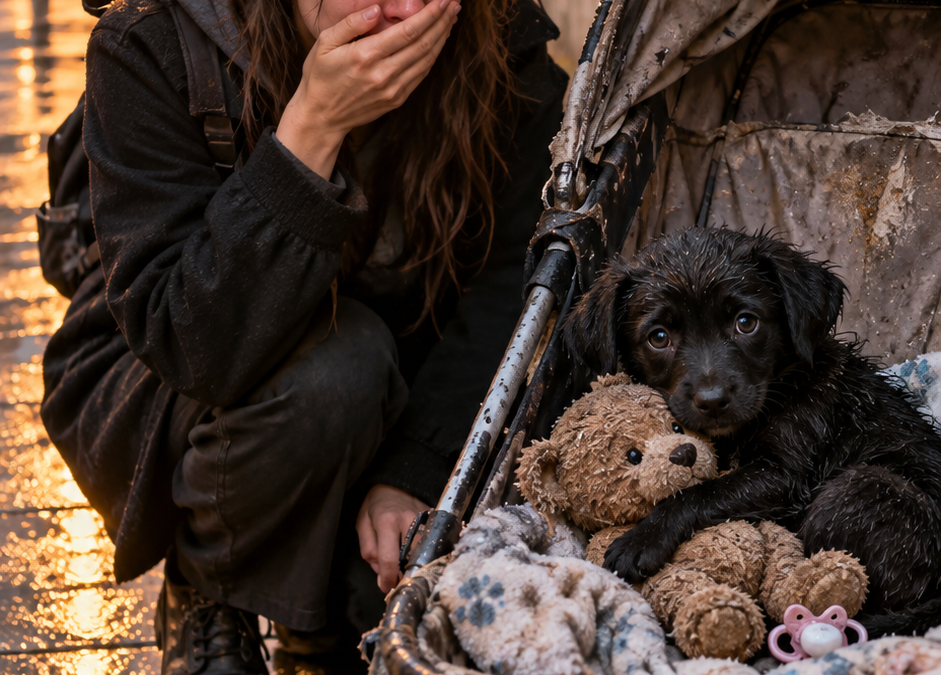
𝗙𝗨𝗟𝗟 𝗦𝗧𝗢𝗥𝗬
I named him Toby on the drive to Charleston Animal Rescue.
There was no profound reason.
The name simply came to me.
“Toby.”
One ear twitched.
“That work?”
No response.
“Excellent discussion.”
He sat on the passenger seat wrapped in the towel, his body rigid despite the soft fabric beneath him.
The pacifier remained in his mouth.
Every few blocks, I glanced over.
He wasn’t looking out the window.
He wasn’t watching traffic.
He stared forward.
Dogs that age should be chaos.
Four-month-old German Shepherds are generally all paws, ears, curiosity, and enthusiastic property damage.
Toby looked like a tiny old man attending a funeral.
When we reached the shelter, I carried him through the back entrance.
Megan, one of our veterinary technicians, looked up.
“What happened?”
“Found him in a stroller.”
She blinked.
“A what?”
“Long story.”
Then she saw the pacifier.
“Greg.”
“I know.”
We set Toby inside our quiet intake room.
Blanket.
Water.
Food.
The stuffed rabbit went beside him.
I removed the pacifier only long enough to check his mouth.
No injuries.
No broken teeth.
Then placed it on the blanket.
Toby immediately pulled it beneath one paw.
Megan noticed.
“Attachment object.”
“Looks like it.”
We scanned for a microchip.
Nothing.
Checked his temperature.
Normal.
Mild dehydration.
Scraped paw pads.
Several superficial scratches.
Underweight, but not dangerously.
Physically, he was luckier than many dogs who came through our doors.
Emotionally?
I wasn’t sure where he was.
Megan crouched.
“Shock?”
“Maybe.”
Toby didn’t react to her.
Didn’t react when another dog barked in the hallway.
Didn’t react when a stainless-steel bowl clanged against the floor outside.
He simply curled around the stuffed rabbit.
That bothered me.
A startled dog I understood.
A frightened dog I understood.
Even an aggressive dog gives you information.
Toby seemed to have stepped somewhere far away inside himself.
“He isn’t shut down completely,” I said.
Megan looked at me.
“What do you mean?”
“He’s monitoring everything.”
Toby’s eyes shifted toward the door as someone walked past.
“He just doesn’t care about us.”
Or didn’t trust us enough to care.
I stayed until after closing.
Around eleven, I checked through the observation window.
Toby hadn’t changed position.
Rabbit beneath one front paw.
Pacifier near his muzzle.
Eyes open.
Always open.
I went inside.
Sat against the wall.
“You know, you’re allowed to sleep.”
Nothing.
“You’ve had a long day.”
His eyes moved toward me.
“Mine was weird too.”
I waited.
Eventually his chin lowered.
Not sleeping.
Resting.
I looked at the rabbit.
Its fabric was worn smooth around the ears from years—or maybe months—of being handled.
Baby toy.
Not dog toy.
That note kept returning to me.
He stayed when I couldn’t.
Stayed where?
Stayed with whom?
Why couldn’t she—or he—stay?
I couldn’t answer any of it.
What I did know was that Toby did not belong in a kennel that night.
So I signed a temporary foster agreement.
It wasn’t unusual.
Shelter animals often decompress better in quiet homes.
My house was small.
Two bedrooms.
One elderly sofa.
A backyard that had survived exactly three previous foster dogs and one highly motivated raccoon.
Good enough.
Toby rode home in silence.
I laid a towel beside the couch.
Placed the rabbit and pacifier there.
He walked directly to them.
Circled once.
Curled.
Then sighed.
A heavy sound.
Far too heavy for something weighing twenty-five pounds.
“Yeah.”
I sat across from him.
“Me too.”
I went to bed around midnight.
At three, I woke to a sound.
Whimper.
Soft.
One.
Then another.
I found Toby asleep.
His paws twitched.
His mouth opened slightly.
A tiny cry escaped.
He was dreaming.
No.
Remembering.
I knelt.
Didn’t touch him.
“It’s okay.”
Another whimper.
“You’re safe.”
He kept sleeping.
His nose pushed against the stuffed rabbit.
And for the first time, something about the whole situation frightened me.
Not Toby.
The depth of whatever had happened before.
A puppy doesn’t understand bereavement the way a person does.
But dogs understand absence.
Routine interrupted.
Scent gone.
Voice gone.
Body gone.
Someone was missing.
Toby’s whole body knew it.
I just didn’t know who.
Morning brought no appetite.
Chicken.
Rice.
Scrambled egg.
Wet food.
Nothing.
He picked up the pacifier and slowly walked from the living room to the hallway.
Back.
Kitchen.
Door.
Living room.
Again.
Same route.
I watched.
“What are you doing?”
He paused near the front door.
Then continued.
Searching.
That was the first word that fit.
Toby was searching.
At the shelter later that morning, our veterinarian, Dr. Lauren Kim, examined him.
Heart.
Lungs.
Bloodwork.
Paws.
Skin.
Hydration.
“No major medical concern,” she said.
“Then why isn’t he eating?”
“Stress.”
“That much?”
She looked through the glass toward Toby.
“Absolutely.”
“How long before it becomes dangerous?”
“A healthy puppy can tolerate a little appetite disruption, but we monitor closely. If he goes another day with almost nothing, we intervene more aggressively.”
I nodded.
She studied me.
“You’ve got the rescue face.”
“What rescue face?”
“The one where you think you’re personally responsible for the emotional state of every animal within five miles.”
“I don’t have that.”
“You absolutely have that.”
Annoyingly accurate.
Before leaving, I brought the red stroller out of shelter storage.
I wasn’t sure whether that was a good idea.
Dr. Kim wasn’t either.
“We keep distance,” she said.
“Agreed.”
We placed it near the fenced play area.
Toby came outside.
The second he saw it, he stopped.
No barking.
No pulling.
His whole posture softened and tightened at the same time.
He walked toward it.
Slow.
Reached the front wheel.
Sniffed.
Then he took the pacifier from his mouth.
Placed it inside the stroller.
Carefully.
Not dropped.
Placed.
I felt my skin prickle.
Dr. Kim whispered, “Wow.”
Toby sat beside the stroller.
Looked forward.
Same posture as the church.
Waiting.
That was when I decided I needed answers.
Not because Toby required a dramatic backstory.
Animals don’t need mysteries solved to deserve care.
But his behavior was tied to something specific.
And if understanding that helped us understand him, I was going to try.
We photographed the stroller.
Toby.
Rabbit.
Not the note.
That felt private.
The shelter posted:
Does anyone recognize this puppy or this red stroller? Found near St. Paul’s Church in downtown Charleston.
Within three hours, the post had thousands of shares.
Within six, messages arrived from people convinced they knew everything.
Most knew nothing.
One claimed Toby belonged to a tourist from Ohio.
Another insisted the stroller was stolen from Savannah.
One person informed us confidently that German Shepherd puppies did not come in black.
The internet is a remarkable machine for distributing certainty independently of evidence.
Then a message arrived from a woman named Dana Pierce.
I recognize them. I used to see a woman pushing that stroller near the hospital. Black puppy always with her.
I called.
Dana worked at a coffee shop several blocks from MUSC.
“Do you know her name?”
“Claire. Or Clare.”
“Last name?”
“No.”
“Baby?”
Dana went quiet.
“That’s the strange part.”
“What?”
“I never saw a baby.”
My eyes moved toward Toby.
He lay beside the rabbit.
“Then what was in the stroller?”
“Sometimes the puppy.”
The story began opening.
Slowly.
Painfully.
A hospital volunteer remembered her.
Then a receptionist.
Then a grief counselor agreed to speak in general terms after verifying details we already had publicly and respecting privacy.
Her name was Clare Bennett.
Thirty-two.
Seven months pregnant when her daughter died before birth.
No warning.
No time to prepare.
One hospital visit.
Then another world.
The stroller had already been bought.
So had the rabbit.
Blanket.
Pacifiers.
Clothes.
A nursery waiting at home.
And Toby.
Clare had adopted him shortly before the loss.
She had imagined her daughter growing up beside a shepherd.
Photographs.
Toddler holding fur.
Dog sleeping near crib.
All the little future scenes people build before life asks permission.
None happened.
Instead, Toby grew up beside grief.
A nurse remembered seeing Clare outside the hospital weeks later.
The red stroller beside her.
Toby curled beneath the bench.
“She talked to him,” the nurse told me.
“About what?”
“Her baby.”
My throat tightened.
“He’d put his head on her knee.”
Apparently Clare started taking the stroller on walks.
Sometimes empty except for the rabbit and blanket.
Sometimes Toby rode inside.
People stared.
Some whispered.
Some assumed she was eccentric.
Some probably judged.
Grief is easy to judge when it isn’t yours.
Toby never did.
When Clare sat outside the hospital, Toby sat beside her.
When she cried on a bench, he stayed.
When she couldn’t enter the nursery, he lay near the doorway.
When insomnia kept her awake, he remained awake too.
He was not therapy-trained.
He was a puppy.
But apparently nobody had explained that to him.
He had one job.
Stay with Clare.
Then Clare died.
The details remained private, and I did not go hunting for them.
I didn’t need to.
There are facts that explain.
There are facts that become intrusion.
What mattered to Toby was simple.
One day Clare was there.
Then she wasn’t.
The stroller appeared beside the church.
The note remained.
Toby remained.
“He stayed when I couldn’t.”
I sat on my living-room floor after learning all of this.
Toby lay beside the stuffed rabbit.
I stared at him.
“You stayed with her.”
His ear moved.
“Didn’t you?”
He lifted his head.
For the first time since I had found him, he walked toward me without being called.
Then placed his head on my thigh.
I stopped.
My hand hovered.
Finally rested against his neck.
Warm fur.
Heartbeat.
Toby exhaled.
No tension.
No withdrawal.
Trust.
The kind that comes quietly.
That night, he howled.
One long, low sound.
Not frantic.
Not loud.
It moved through the house like a question nobody could answer.
I didn’t stop him.
I sat beside him.
Let him make the sound.
When it ended, Toby leaned against me.
We stayed like that.
The next morning, I found him beside the front door.
Rabbit on one side.
Pacifier between his paws.
Waiting.
“She’s not coming.”
The words left before I could stop them.
Toby looked at me.
I regretted saying them.
Then realized I had been avoiding the truth as though he might somehow hear it.
He already knew absence.
What he didn’t know was what came after.
Maybe neither did I.
The shelter’s post continued spreading.
People shared memories of Clare.
Outside the hospital.
Near a grief-counseling center.
Walking through Marion Square.
Always with Toby.
One woman wrote:
She never seemed comfortable talking, but she always touched that puppy.
Another:
I saw her crying on a bench once. He climbed into her lap even though he was getting too big.
Toby had been doing what he did naturally.
Staying near pain.
That afternoon, I took him to the hospital garden.
Not as therapy.
Not as an experiment.
Just somewhere quiet.
Toby walked slowly.
Then caught a scent.
His head lifted.
He pulled gently.
Past a fountain.
Down a stone path.
Toward an oak tree.
There was a wooden bench beneath it.
Toby stopped.
Sat.
Looked at the empty seat.
A nurse passing nearby froze.
“Oh.”
I turned.
“You know him?”
She came closer.
“That’s Clare’s puppy.”
Toby watched her.
“She sat here?”
“All the time.”
The nurse’s eyes filled.
“She wouldn’t talk much. But she’d sit. He’d lie right there.”
She pointed.
Toby was sitting almost exactly where she indicated.
I swallowed.
We stayed nearly an hour.
At first Toby stared at the bench.
Then something shifted.
His nose found the grass.
A bird landed nearby.
He watched it.
A breeze moved through the leaves.
He looked toward me.
Small things.
But they mattered.
Memory was still there.
The rest of the world had begun entering too.
I began thinking about therapy work after that.
Not immediately.
Toby was far too young for formal certification, and emotional stability mattered more than turning his history into a job.
So we did the responsible thing.
We waited.
Training came first.
Basic obedience.
Socialization.
Confidence.
Handling.
Noise.
Rest.
Play, if Toby ever wanted it.
At first, he didn’t.
Balls rolled past.
Nothing.
Rope toy.
Nothing.
Chew toy.
Nothing.
Rabbit?
Immediate attention.
Pacifier?
Sacred object.
“You’re a very strange puppy.”
Toby blinked.
“Fair.”
Food improved slowly.
He began eating if I sat nearby.
Then without me.
Weight returned.
Scratches healed.
His coat changed from dusty black to glossy charcoal.
Tan markings brightened.
His ears stood fully.
He followed me room to room.
At first, that worried me.
Attachment can become anxiety.
So we practiced separation.
Thirty seconds.
One minute.
Five.
Ten.
I always returned calmly.
No dramatic reunions.
Toby learned departure did not automatically mean disappearance.
That lesson took months.
It was perhaps the most important one.
Meanwhile, something else emerged.
At the shelter, Toby gravitated toward people who were quiet.
Not the excited volunteers.
Not the children calling his name.
The still ones.
A volunteer whose husband had recently died sat in the courtyard one afternoon.
Toby walked over.
Lay beside her.
No prompting.
Another day, a teenager waiting while his mother completed surrender paperwork sat with his head down.
Toby approached.
Rested near his shoes.
Pattern.
Dr. Kim noticed.
“So you’re thinking therapy?”
“Eventually.”
“Eventually is the key word.”
“I know.”
“He’s still a baby.”
“I know.”
“Let him be one.”
That stung.
Because she was right.
I had become fascinated by what Toby could do for others before asking whether Toby knew how to be happy for himself.
So we worked on that.
Beach.
Not crowded.
Long line.
Toby hated waves.
Good.
Normal opinion.
He barked at one.
Then jumped backward when it touched his feet.
I laughed.
He looked offended.
“Finally.”
Tail twitch.
I threw a stick.
No interest.
Another wave arrived.
Toby attacked it.
There he was.
Puppy.
Not guardian.
Not grief witness.
Not symbol.
Dog.
I nearly cried from relief.
Over the next months, play arrived.
Slowly.
He learned tug.
Then fetch, badly.
Then zoomies.
The first time Toby ran full speed around my backyard with the stuffed rabbit in his mouth, I sat on the porch laughing until my stomach hurt.
He stopped.
Looked at me.
Then ran again.
Clare had loved this dog.
I knew that now.
If there was anything I wanted to honor, it was not Toby becoming some solemn monument to her pain.
It was letting him live.
By the time he was a year old, Toby had changed.
Not unrecognizable.
More fully himself.
Still quiet.
Still observant.
But playful.
Affectionate.
Steady.
We began structured therapy-dog preparation.
Melissa Grant, a trainer with years of experience in animal-assisted interventions, evaluated him.
She watched him greet strangers.
Walk through controlled noise.
Recover from surprise.
Accept handling.
Ignore food.
Settle.
Engage.
Then she sat across from me.
“He has potential.”
I smiled.
“Potential?”
“Don’t get offended.”
“I’m already offended.”
“Toby’s temperament is excellent.”
“Better.”
“But therapy work isn’t about being emotionally profound.”
I laughed.
“Thank God.”
“It’s about stability. Predictability. Consent. Stress tolerance. Enjoying interaction.”
She looked toward Toby.
“He doesn’t owe anyone healing because he has a sad story.”
That sentence stayed with me.
He doesn’t owe anyone healing.
Exactly.
Toby trained for months.
Not every session was brilliant.
One day he decided a rolling walker was terrifying.
Another day he became obsessed with Melissa’s shoelaces.
At an outdoor session, a squirrel destroyed approximately nine minutes of professionalism.
Good.
Puppy.
Eventually, when he was old enough and behaviorally ready, Toby passed his therapy-dog evaluation through an established program.
I held the certificate.
Looked at him.
“You know this doesn’t mean you’re employed.”
Toby sniffed the paper.
“You have terrible benefits.”
Tail wag.
Our first visits were short.
Libraries.
Senior centers.
A rehabilitation facility.
No hospitals initially.
Too much stimulation.
Toby’s gift was not performing.
It was settling.
He would enter.
Look.
Choose a person.
Then lie near them.
Not every person.
That mattered.
We never forced interaction.
If Toby moved away, he moved away.
If he looked tired, visit ended.
Boundaries protect kindness.
At a nursing home, an eighty-three-year-old man named Walter had not spoken much since his wife died.
Toby lay beside his chair.
Walter placed one hand on his back.
For almost ten minutes, neither moved.
Then Walter said, “Had a shepherd in Korea.”
His daughter began crying.
Not because Toby had performed a miracle.
Because a door opened.
One sentence.
Enough.
At a children’s rehabilitation center, a little girl dropped a stuffed toy and burst into tears.
Toby approached.
Not the toy.
Her.
Sat beside her chair.
She reached down.
Touched his ear.
Stopped crying.
Melissa, observing that day, looked at me.
“See?”
“What?”
“He isn’t fixing her.”
“I know.”
“He’s giving her somewhere to put the feeling.”
That was Clare’s gift to him.
Maybe.
Or maybe Toby had always been Toby.
We humans love assigning origins to tenderness.
Sometimes kindness is simply temperament given room.
One object still traveled with us occasionally.
Not the pacifier.
I had retired that to a box at home because rubber degrades and sacred objects do not need to become choking hazards.
The stuffed rabbit came.
Cleaned.
Repaired.
Still worn.
At one pediatric visit, a boy named Sam had been withdrawn for days.
I knew none of his medical details.
Didn’t need to.
Toby entered.
Sam looked away.
Toby lay near the bed.
Rabbit beside him.
Five minutes.
Ten.
Sam looked.
Eventually whispered:
“What’s that?”
“His rabbit.”
“He likes it?”
“Very much.”
Sam reached.
Toby watched.
The boy touched the rabbit.
Then Toby.
That was all.
Later, a nurse said, “That’s the most he’s engaged all week.”
I nodded.
But I was careful.
“Toby didn’t cure anything.”
“I know.”
Good.
That distinction protected Toby.
And Sam.
We did not turn moments of connection into medical claims.
Sometimes comfort is enough.
A year after I found him, a woman came to the shelter.
Not to adopt.
Just to sit with animals.
Her name was Rachel.
She had lost a baby six weeks earlier.
Someone at a grief-support organization had suggested spending time around animals because home felt unbearable.
Our receptionist found me.
“Greg.”
I looked up.
“There’s someone Toby might want to meet.”
“Might?”
“We’ll see.”
Correct language.
Toby entered the quiet room.
Rachel sat near the window.
Arms wrapped around herself.
No eye contact.
Toby stopped.
Looked at her.
Then at me.
I loosened the leash.
He approached halfway.
Stopped.
Rachel noticed.
Her face changed.
“He’s beautiful.”
“This is Toby.”
She nodded.
Toby lay down.
Several feet away.
Silence.
Rachel cried quietly.
Toby stayed.
Eventually she extended one hand.
He moved closer.
Placed his head beneath it.
Rachel bent over him.
Not dramatic.
No collapse.
Just forehead against fur.
Breathing.
After a while she asked:
“Does he always do this?”
“Sometimes.”
She stroked his neck.
“He knows.”
I resisted saying yes.
Dogs know scent.
Posture.
Voice.
Stress.
They read us incredibly well.
But “he knows” can become mythology.
So I answered:
“He notices.”
Rachel nodded.
“That’s enough.”
Exactly.
It was enough.
Later, she volunteered.
Not because Toby healed her.
Because she wanted somewhere to put love that had nowhere to go.
I understood that.
Toby understood that better than any of us.
Eventually, I brought him back to the church.
Same sidewalk.
Different year.
The red stroller had remained in shelter storage all that time.
I didn’t bring it.
That chapter belonged where it was.
Toby sniffed the church steps.
Then grass.
Then a lamppost.
No freezing.
No searching.
He marked the lamppost.
I laughed.
“Profound.”
Tail wag.
We sat where I’d first seen the stroller.
I held the stuffed rabbit.
Toby put his chin on my knee.
“She loved you.”
His ears moved.
“I know that much.”
A carriage passed.
Horse hooves against pavement.
Tourists talked.
Life continued.
“You stayed when she couldn’t.”
Toby watched a pigeon.
“But you don’t have to stay there forever.”
He stood.
Pulled gently toward the park.
So we went.
That was the first time I felt certain Toby had not “moved on.”
I dislike that phrase.
It makes grief sound like a location you should vacate.
Toby moved forward.
Different.
Memory came with him.
But it stopped being the leash.
The Charleston newspaper eventually contacted us.
They wanted a feature on therapy animals.
I was reluctant.
Toby had become something people could easily romanticize.
Puppy in stroller.
Pacifier.
Grieving owner.
Therapy dog.
Too perfect.
Real life is never that clean.
But the reporter, Hannah Reed, understood my concern.
“This isn’t about saying grief makes animals magical,” she said.
“Good.”
“It’s about connection.”
“Better.”
We agreed.
The photographer took pictures of Toby beneath the oak near the hospital garden.
No pacifier around his neck.
No staged stroller.
Just Toby.
Rabbit nearby because he chose it.
The article ran with the headline:
TOBY, THE PUPPY WHO STAYED
Good enough.
Messages arrived.
Parents.
Veterans.
Hospice workers.
Teachers.
People grieving spouses.
Children.
People who didn’t even own dogs.
One sentence appeared repeatedly:
I know what it feels like to wait for someone who isn’t coming back.
That was Toby’s story.
Not because he understood human death the way we did.
Because waiting is physical.
Door.
Scent.
Footsteps.
Chair.
Voice.
Pattern.
Then absence.
Anyone who has grieved understands that rhythm.
Toby simply made it visible.
Requests for visits increased.
We declined most.
His schedule stayed limited.
Rest mattered.
Dog time mattered.
Beach mattered.
Squirrel surveillance mattered enormously.
A therapy animal is still an animal.
That lesson became central to everything we did.
At a trauma-support program for teenagers, Toby chose not to approach anyone for the first fifteen minutes.
Fine.
He lay beside me.
One girl sat apart.
Arms folded.
Eventually Toby wandered near her.
Stopped five feet away.
Lay down.
She ignored him.
Ten minutes.
Then she moved slightly closer.
“Can I pet him?”
“If he says yes.”
She looked confused.
“How?”
“I’ll show you.”
We invited Toby.
He approached.
Loose body.
Soft eyes.
The girl touched his shoulder.
“He’s quiet.”
“Yeah.”
She looked down.
“So am I.”
Toby leaned lightly against her leg.
Nothing else needed saying.
At another group, a woman asked if Toby still remembered Clare.
I thought about it before answering.
“I don’t know what memory feels like to a dog.”
She nodded.
“But he remembers things?”
“Of course.”
“Scent?”
“Routine. Association. People. Places.”
I looked at Toby.
“But I don’t think love has to become a haunting to remain real.”
The woman cried.
I hadn’t meant to sound profound.
Writers and rescue volunteers should both be careful with sentences.
Sometimes they land harder than intended.
Years passed.
Toby grew into a magnificent German Shepherd.
Mostly black.
Tan beneath the legs and chest.
Large.
Strong.
Calm.
Visitors who saw his puppy photo didn’t believe it was the same dog.
“He looks so confident.”
“He is.”
“Was he really that shut down?”
“Yes.”
His pacifier remained in a small memory box at home.
The original note too.
I struggled with whether to keep it.
Eventually I did.
Not as evidence against Clare.
Never.
The note was not abandonment in the simple sense.
It was a final expression from someone overwhelmed by pain I would never fully understand.
I refused to turn Clare into a villain.
She had loved Toby.
Every witness confirmed it.
She had stayed as long as she could.
Then something inside her broke in a way love alone could not repair.
Toby did not need her blamed.
He needed her remembered accurately.
As a woman.
A mother.
A person in pain.
Someone who had cared deeply for a puppy when both of them were surviving something unbearable.
That was the truth I could live with.
Toby’s therapy work changed as he matured.
Children first.
Then adult grief groups.
Hospice waiting rooms.
Rehabilitation centers.
He especially connected with people who didn’t want to talk.
One hospice chaplain joked:
“He’s the only staff member who never gives advice.”
“Best qualification he has.”
Toby slept through the compliment.
At a women’s wellness center, twelve mothers sat in a circle during a grief-support session.
We had been invited only for the final half hour.
Toby entered slowly.
No command beyond a loose “go say hello.”
He walked past several women.
Not rejecting them.
Choosing his own path.
He stopped near a woman seated slightly apart from the group.
Lay near her shoes.
The woman did not touch him.
Five minutes.
Then tears began.
Quiet.
She reached down.
Toby moved closer.
Her fingers entered his fur.
Another woman cried.
Then another.
Not because Toby caused grief.
Because the room had finally become safe enough for grief to show itself.
The woman asked me later:
“Did he lose somebody?”
“Yes.”
“Maybe that’s why.”
“Maybe.”
I smiled.
“Or maybe he’s just very good at staying.”
She looked at him.
“Sometimes that’s the same thing.”
Maybe.
On the drive home, Toby slept.
Head against the seat.
Rabbit beneath one paw.
No pacifier.
No vigilance.
I watched at a red light.
The puppy in the stroller had slept with one eye open.
The dog beside me now snored.
Healing can be measured in strange ways.
Snoring was one of mine.
At home, Toby became hilariously ordinary.
This mattered more than therapy visits.
He stole toast.
Hated the vacuum.
Loved sprinklers despite being suspicious of ocean waves.
Barked at one particular UPS driver and adored another.
Slept across doorways.
Carried socks without destroying them.
Usually.
He developed an irrational feud with a ceramic garden frog.
For six years, the frog never moved.
Toby remained unconvinced.
People who met him during visits often imagined he was permanently solemn.
Wrong.
At home, he had zero dignity.
One evening, after spending an hour calmly beside grieving families, Toby came home, ran through a mud puddle, burst into my living room, and shook himself across a newly cleaned wall.
“Thank you.”
Tail wag.
“Your emotional insight is extraordinary.”
More wagging.
That balance protected him.
Toby had a meaningful job.
He also had a life unrelated to anyone’s pain.
Everyone deserves that.
At five, Toby slowed slightly.
Not age exactly.
Maturity.
He no longer approached every situation.
He became selective.
If a room was too tense, he’d look at me and move toward the exit.
We left.
No questions.
Consent went both ways.
At six, he began mentoring another therapy dog candidate, a Golden Retriever named Maple.
Mentoring is probably too grand a word.
Maple copied him.
When Toby settled, Maple settled.
When Toby ignored dropped food, Maple eventually did too.
When Toby greeted someone calmly, Maple stopped trying to climb into their torso.
Progress.
At one shelter visit, we found a black shepherd puppy in intake.
Four months.
Fearful.
Head down.
The resemblance punched me.
Toby saw her.
Stopped.
Then lay several feet from the kennel.
Same thing he’d done countless times.
The puppy watched.
Toby yawned.
She shifted closer.
No miracle.
No touching.
Just less distance.
I sat beside Toby.
“Full circle.”
He ignored me.
Good.
He wasn’t performing symbolism for my benefit.
The puppy, named Raven, went to foster the following week.
Adopted a month later.
Toby never knew.
That’s the thing about kindness.
Most of the time, you don’t get to see where it travels.
At seven, gray appeared under Toby’s chin.
I objected.
He did not consult me.
At eight, arthritis began in one hip.
We reduced longer visits.
More rest.
More water therapy.
Medication when needed.
The pacifier remained tucked away.
The rabbit became fragile.
I repaired one seam.
Then another.
Eventually Toby stopped carrying it.
Instead, it stayed in his bed.
Memory transitioning into furniture.
I liked that.
At nine, Toby retired from regular therapy visits.
Not because he couldn’t do them.
Because he deserved retirement before work became obligation.
We still visited the shelter occasionally.
Short.
He loved the courtyard.
Loved Megan.
Loved Dr. Kim.
Still disliked one rolling laundry cart.
Some grudges deserve longevity.
Toby spent more time at home.
Garden.
Porch.
Slow walks.
He had become the kind of old shepherd people stopped to admire.
“Beautiful dog.”
“Thank you.”
“How old?”
“Nine.”
“He looks great.”
He did.
But I saw changes.
Stiffness.
Longer sleep.
Gray.
I learned not to resent them.
Age was not tragedy.
Age was victory.
A puppy abandoned in a stroller deserved wrinkles.
Gray fur.
Slow mornings.
All of it.
Clare had once feared a future that disappeared.
Toby got one.
That felt important.
At ten, a mass appeared near his spleen.
Tests.
Ultrasound.
Surgery.
Cancer.
The word entered quietly.
The room changed immediately.
Dr. Kim had known Toby since the beginning.
She sat across from me.
“I’m sorry.”
“How long?”
“Months, maybe.”
Treatment options existed.
We chose comfort-focused care after careful consultation.
Toby didn’t know.
Good.
He cared about chicken.
Sun.
Me.
The rabbit.
The garden frog, still apparently dangerous.
We gave him those.
His final summer was slow.
Beautiful.
He spent mornings beneath the porch fan.
Afternoons inside.
We visited the hospital garden once.
Not as therapy.
Just Toby.
He walked to the same oak.
Same bench.
Lay down.
I sat beside him.
“Clare used to come here.”
He sniffed grass.
“I’ve told you this.”
Nothing.
“You’re a terrible conversationalist.”
Tail movement.
A nurse passed.
Too young to know the old story.
She smiled.
“Beautiful shepherd.”
“Yeah.”
She continued.
I was grateful.
Toby no longer belonged to tragedy in strangers’ eyes.
He was just an old dog in a garden.
That was enough.
His last visit to the church happened in October.
Cool morning.
No tourists yet.
I carried the stuffed rabbit in my backpack.
Not the pacifier.
The stroller had been donated years earlier after we photographed and documented it.
Objects can serve memory without becoming shrines forever.
We reached the sidewalk.
Toby stopped.
Sniffed.
Then sat.
Not facing the old spot.
Facing me.
I lowered myself beside him.
“You know, I spent years thinking you were guarding that stroller.”
Toby breathed slowly.
“But I think you were guarding everything it meant.”
Clare.
Her daughter.
A life imagined.
A life lost.
The bond that remained.
Toby put his head against my shoulder.
I laughed softly.
“Heavy.”
He had become ninety pounds.
“Very dramatic.”
We sat until he wanted to leave.
Then we left.
That mattered.
He chose.
A month later, eating became difficult.
Then walking.
Dr. Kim came to my house.
No clinic.
No fluorescent lights.
Toby’s bed sat near the living-room window.
The rabbit beside him.
I opened the memory box.
Pacifier.
Blue.
Scuffed.
The same one from the stroller.
I held it.
Then put it on the table.
Not in his mouth.
That chapter was finished.
The note remained folded beneath it.
He stayed when I couldn’t. He’s better than me.
I had disagreed with that sentence for years.
Clare had written it from pain.
Toby wasn’t better than her.
He was a dog.
She was a human being drowning in grief.
Comparisons weren’t useful.
But she had been right about one thing.
Toby stayed.
He stayed with her.
Then with me.
Then beside children.
Parents.
Veterans.
Teenagers.
Hospice patients.
Shelter dogs.
People who couldn’t speak.
People who couldn’t stop speaking.
He stayed without demanding they become okay.
That was his gift.
Now it was my turn.
Dr. Kim knelt beside him.
“You ready?”
“No.”
She waited.
I looked at Toby.
His eyes were tired.
Body tired.
Pain managed, but increasingly present.
Ready wasn’t about me.
“Yes.”
She administered sedation.
Toby relaxed.
I sat on the floor.
His head rested in my lap.
The same black fur now silver around the face.
I stroked his ears.
“You were just a baby.”
His eye opened.
“That stroller.”
I laughed through tears.
“Most confusing rescue call of my life.”
Dr. Kim smiled.
Toby breathed.
Slow.
“You did enough.”
My voice cracked.
“You don’t have to take care of anyone.”
Another breath.
“You don’t have to stay awake.”
His body softened.
I looked at the rabbit.
“Clare loved you.”
I believed that completely.
“And I love you.”
Toby exhaled.
“You can rest.”
The final medication went in.
One breath.
Another.
Then stillness.
I cried into his fur.
No shame.
No lesson.
No metaphor.
Just loss.
Later, when the room was quiet, I found the pacifier on the table.
Held it.
Ten years earlier, Toby had gripped it as though letting go might erase somebody.
Now it was only an object.
That didn’t make Clare less real.
Didn’t make her daughter less loved.
Didn’t make Toby’s years beside her meaningless.
Memory had moved beyond the thing.
That’s what I finally understood.
We donated Toby’s therapy vest to the training program for display.
His certification records went into a folder.
The newspaper clipping stayed in my desk.
The rabbit stayed with me.
So did the pacifier.
Not because Toby needed me to guard them.
Because I wanted them.
There’s a difference.
At Charleston Animal Rescue, his photograph hangs near the quiet room.
Not the stroller photo.
A later one.
Toby lying beneath the oak tree.
Gray beginning around his muzzle.
Eyes soft.
Rabbit beside him.
Underneath is one sentence:
Sometimes comfort is simply refusing to leave someone alone with pain.
New volunteers ask about him.
I tell them.
But I always correct the part people romanticize.
Toby did not become meaningful because he became a therapy dog.
He was meaningful in the stroller.
Dirty.
Scratched.
Silent.
Holding a pacifier.
He did not need to earn rescue through helping other people.
He deserved rescue because he was alive.
Everything afterward was a gift.
That distinction matters.
Otherwise, we turn wounded animals into inspirational machines.
We ask suffering to justify itself.
Toby’s suffering did not make him special.
Toby was special before any of it.
His resilience was remarkable.
His tenderness was remarkable.
But the pain itself?
I would erase it if I could.
I would give Clare another ending.
Her daughter another future.
Toby an ordinary puppyhood.
No stroller.
No note.
No hospital bench.
No waiting.
We don’t get that choice.
We get what comes next.
Toby taught me that.
Not through therapy.
Not through newspaper stories.
Through ordinary mornings.
A dog can carry the past without living inside it forever.
A person can too.
Years after he died, I visited the hospital garden alone.
Same oak.
Same bench.
I sat.
People passed.
Nurses.
Families.
A father carrying coffee.
A woman pushing an empty wheelchair.
Life.
I thought about Clare.
Someone I had never met.
For years, I knew her only through other people’s memories and one painful sentence.
I wondered whether she would have been surprised by Toby’s life.
Therapy dog.
Beach runner.
Garden-frog enemy.
Toast thief.
Old gray shepherd sleeping in sunlight.
I think she would have liked the ordinary parts best.
At least I hope so.
She had once imagined Toby growing beside her daughter.
That future was taken.
Another future happened instead.
Not better.
Never say better about grief.
Different.
Long.
Full.
Toby became part of hundreds of lives.
But he never stopped being hers too.
Love isn’t invalidated because its original form cannot continue.
It changes containers.
Clare’s love moved through Toby.
Toby’s moved through everyone who sat beside him.
Then through the volunteers he influenced.
The families.
The children.
The shelter dogs who learned calm near his body.
Not magic.
Not destiny.
Just connection passing forward.
That’s enough.
Sometimes I still think about the first question I asked outside the church.
Was he left behind, or was he staying behind?
I know the answer now.
Both.
Clare left.
Toby stayed.
For a while, staying meant waiting.
Then it meant remembering.
Then comforting.
Then living.
Eventually, staying meant nothing dramatic at all.
Sleeping in my living room.
Following me to the kitchen.
Stealing eggs.
Waiting beside the door because he wanted a walk.
That was the ending I wanted for him.
Not endless service.
Ordinary belonging.
The stroller had looked like a ghost the morning I found it.
Red against pale stone.
Pacifier in Toby’s mouth.
Rabbit beneath his paw.
Note taped below.
Everything about it pointed backward.
Toward loss.
Toward Clare.
Toward a baby who never got to use those things.
But Toby’s life did something I didn’t expect.
It pointed forward.
Not away from them.
Forward with them.
That’s the difference.
The puppy I carried out of that stroller did not forget.
He simply discovered memory did not have to be a cage.
He could put down the pacifier.
He could leave the stroller.
He could play.
Sleep.
Trust.
Work.
Retire.
Grow old.
And when the time finally came for him to leave too, he wasn’t sitting alone on a sidewalk guarding what remained of somebody else’s life.
He was home.
His head in my lap.
His rabbit beside him.
A man who loved him holding on until he no longer needed to.
Clare’s note said Toby was better than her.
She was wrong about that.
Pain had lied to her.
But she was right about Toby staying.
He stayed longer than anyone could have imagined.
Long enough to become a puppy again.
Long enough to become a dog.
Long enough to become old.
Long enough for grief to stop being his only story.
And that, more than every hospital visit, every article, every therapy session, was the part that finally broke me.
The black puppy in the red stroller had once guarded a pacifier because it was one of the last pieces of a family he’d lost.
Years later, he didn’t need to guard anything.
He had a family again.
He had me.
And I stayed.
Have you finished reading the story and want to read it again?
A Black Puppy Was Left in a Baby Stroller With a Pacifier—Then We Learned What He Was Guarding
The puppy wouldn’t let go of the pacifier.
The stroller beside him had once belonged to someone else.
Then I found the note.
My name is Greg Lawson, and after almost nine years volunteering with animal rescue groups around Charleston, South Carolina, I thought I’d developed a fairly high tolerance for strange discoveries.
I had pulled kittens out of storm drains.
I’d chased a terrified hound through a grocery-store parking lot at three in the morning.
I’d once spent forty-five minutes negotiating with a beagle that had trapped itself inside a church nativity display and apparently considered Baby Jesus excellent defensive cover.
Animal rescue teaches you very quickly that dignity is optional.
But the red stroller outside St. Paul’s Church stopped me cold.
It was just after eight on a bright spring morning.
Charleston was already warming beneath that soft golden light that makes the old brick buildings look prettier than they have any right to look before coffee. Horse-drawn carriages were beginning their routes. Delivery trucks groaned along the narrow streets. Tourists wandered with maps open on their phones.
And against the pale stone wall of the church sat a red baby stroller.
Empty, I thought.
Then something inside moved.
Black ears.
A narrow muzzle.
Brown eyes.
I stopped halfway across the sidewalk.
A German Shepherd puppy was curled inside the stroller.
Maybe four months old.
Almost entirely black except for faint tan markings beginning to show beneath his legs and around his cheeks.
He was dirty.
His paws were scraped.
One ear stood higher than the other.
And between his teeth was a pale blue baby pacifier.
Not chewing it.
Holding it.
Carefully.
Like it mattered.
“Well,” I whispered. “That’s new.”
The puppy looked straight ahead.
Not at me.
Not at the pedestrians.
Not even at a church bell ringing somewhere above us.
His body stayed completely still.
The stroller was scuffed along one wheel, the fabric sun-faded near the canopy.
In the storage basket underneath, I found three things.
A folded baby blanket.
A stuffed rabbit with one ear almost worn through.
And a note.
The paper had been folded twice and taped near the frame.
Rain or tears—or maybe just morning humidity—had blurred one corner.
The handwriting was shaky.
Only one sentence.
He stayed when I couldn’t. He’s better than me.
I read it twice.
Then a third time.
Something cold moved through me despite the warming day.
I crouched beside the stroller.
“Hey, buddy.”
The puppy didn’t move.
“Where’s your person?”
His jaws tightened slightly around the pacifier.
I reached toward the stroller handle.
His entire body changed.
Shoulders rigid.
Eyes suddenly alert.
No growl.
No snap.
Just protection.
He wasn’t afraid I would hurt him.
He was afraid I would touch the stroller.
That distinction mattered.
I pulled my hand back.
“Okay.”
His eyes stayed on me now.
“I’m not taking anything.”
A woman passed with a shopping bag.
She slowed.
“Oh, is that some sort of display?”
“No.”
She glanced at the puppy.
“Oh.”
Then kept walking.
That happened several times.
People looked.
Some smiled.
One took a picture.
Nobody understood what they were seeing.
Honestly, neither did I.
I called Officer Daniel Rainer, a Charleston police officer I’d worked with on several animal-abandonment cases.
He arrived ten minutes later.
One look at the stroller and he stopped beside me.
“This is new.”
“That’s what I said.”
He read the note.
His expression changed.
“Any sign of the owner?”
“No.”
“Camera nearby?”
“Church might have one.”
The puppy watched us.
Rainer knelt.
“Food?”
“I’ve got treats.”
We tried chicken.
Soft food.
Water.
Nothing convinced him to leave.
He wasn’t aggressive.
He simply would not step away from the stroller.
Eventually Rainer slid one arm beneath his chest while I supported his hips.
The puppy stiffened.
But he didn’t fight.
The second his paws left the stroller, he twisted his neck backward.
Watching it.
Watching the rabbit.
Watching the blanket.
Watching the place where he’d been left.
I wrapped him in a clean towel.
He still held the pacifier.
“Easy.”
His heartbeat hammered beneath my hand.
“It’s okay.”
I had no idea whether that was true.
As I carried him toward my truck, his eyes never left the stroller.
That was when I understood the first thing about him.
He wasn’t guarding himself.
He was guarding a memory.
And whatever had happened before I found him was still sitting in that red stroller long after the person who left it had disappeared.
PART2
I named him Toby on the drive to Charleston Animal Rescue.
There was no profound reason.
The name simply came to me.
“Toby.”
One ear twitched.
“That work?”
No response.
“Excellent discussion.”
He sat on the passenger seat wrapped in the towel, his body rigid despite the soft fabric beneath him.
The pacifier remained in his mouth.
Every few blocks, I glanced over.
He wasn’t looking out the window.
He wasn’t watching traffic.
He stared forward.
Dogs that age should be chaos.
Four-month-old German Shepherds are generally all paws, ears, curiosity, and enthusiastic property damage.
Toby looked like a tiny old man attending a funeral.
When we reached the shelter, I carried him through the back entrance.
Megan, one of our veterinary technicians, looked up.
“What happened?”
“Found him in a stroller.”
She blinked.
“A what?”
“Long story.”
Then she saw the pacifier.
“Greg.”
“I know.”
We set Toby inside our quiet intake room.
Blanket.
Water.
Food.
The stuffed rabbit went beside him.
I removed the pacifier only long enough to check his mouth.
No injuries.
No broken teeth.
Then placed it on the blanket.
Toby immediately pulled it beneath one paw.
Megan noticed.
“Attachment object.”
“Looks like it.”
We scanned for a microchip.
Nothing.
Checked his temperature.
Normal.
Mild dehydration.
Scraped paw pads.
Several superficial scratches.
Underweight, but not dangerously.
Physically, he was luckier than many dogs who came through our doors.
Emotionally?
I wasn’t sure where he was.
Megan crouched.
“Shock?”
“Maybe.”
Toby didn’t react to her.
Didn’t react when another dog barked in the hallway.
Didn’t react when a stainless-steel bowl clanged against the floor outside.
He simply curled around the stuffed rabbit.
That bothered me.
A startled dog I understood.
A frightened dog I understood.
Even an aggressive dog gives you information.
Toby seemed to have stepped somewhere far away inside himself.
“He isn’t shut down completely,” I said.
Megan looked at me.
“What do you mean?”
“He’s monitoring everything.”
Toby’s eyes shifted toward the door as someone walked past.
“He just doesn’t care about us.”
Or didn’t trust us enough to care.
I stayed until after closing.
Around eleven, I checked through the observation window.
Toby hadn’t changed position.
Rabbit beneath one front paw.
Pacifier near his muzzle.
Eyes open.
Always open.
I went inside.
Sat against the wall.
“You know, you’re allowed to sleep.”
Nothing.
“You’ve had a long day.”
His eyes moved toward me.
“Mine was weird too.”
I waited.
Eventually his chin lowered.
Not sleeping.
Resting.
I looked at the rabbit.
Its fabric was worn smooth around the ears from years—or maybe months—of being handled.
Baby toy.
Not dog toy.
That note kept returning to me.
He stayed when I couldn’t.
Stayed where?
Stayed with whom?
Why couldn’t she—or he—stay?
I couldn’t answer any of it.
What I did know was that Toby did not belong in a kennel that night.
So I signed a temporary foster agreement.
It wasn’t unusual.
Shelter animals often decompress better in quiet homes.
My house was small.
Two bedrooms.
One elderly sofa.
A backyard that had survived exactly three previous foster dogs and one highly motivated raccoon.
Good enough.
Toby rode home in silence.
I laid a towel beside the couch.
Placed the rabbit and pacifier there.
He walked directly to them.
Circled once.
Curled.
Then sighed.
A heavy sound.
Far too heavy for something weighing twenty-five pounds.
“Yeah.”
I sat across from him.
“Me too.”
I went to bed around midnight.
At three, I woke to a sound.
Whimper.
Soft.
One.
Then another.
I found Toby asleep.
His paws twitched.
His mouth opened slightly.
A tiny cry escaped.
He was dreaming.
No.
Remembering.
I knelt.
Didn’t touch him.
“It’s okay.”
Another whimper.
“You’re safe.”
He kept sleeping.
His nose pushed against the stuffed rabbit.
And for the first time, something about the whole situation frightened me.
Not Toby.
The depth of whatever had happened before.
A puppy doesn’t understand bereavement the way a person does.
But dogs understand absence.
Routine interrupted.
Scent gone.
Voice gone.
Body gone.
Someone was missing.
Toby’s whole body knew it.
I just didn’t know who.
Morning brought no appetite.
Chicken.
Rice.
Scrambled egg.
Wet food.
Nothing.
He picked up the pacifier and slowly walked from the living room to the hallway.
Back.
Kitchen.
Door.
Living room.
Again.
Same route.
I watched.
“What are you doing?”
He paused near the front door.
Then continued.
Searching.
That was the first word that fit.
Toby was searching.
At the shelter later that morning, our veterinarian, Dr. Lauren Kim, examined him.
Heart.
Lungs.
Bloodwork.
Paws.
Skin.
Hydration.
“No major medical concern,” she said.
“Then why isn’t he eating?”
“Stress.”
“That much?”
She looked through the glass toward Toby.
“Absolutely.”
“How long before it becomes dangerous?”
“A healthy puppy can tolerate a little appetite disruption, but we monitor closely. If he goes another day with almost nothing, we intervene more aggressively.”
I nodded.
She studied me.
“You’ve got the rescue face.”
“What rescue face?”
“The one where you think you’re personally responsible for the emotional state of every animal within five miles.”
“I don’t have that.”
“You absolutely have that.”
Annoyingly accurate.
Before leaving, I brought the red stroller out of shelter storage.
I wasn’t sure whether that was a good idea.
Dr. Kim wasn’t either.
“We keep distance,” she said.
“Agreed.”
We placed it near the fenced play area.
Toby came outside.
The second he saw it, he stopped.
No barking.
No pulling.
His whole posture softened and tightened at the same time.
He walked toward it.
Slow.
Reached the front wheel.
Sniffed.
Then he took the pacifier from his mouth.
Placed it inside the stroller.
Carefully.
Not dropped.
Placed.
I felt my skin prickle.
Dr. Kim whispered, “Wow.”
Toby sat beside the stroller.
Looked forward.
Same posture as the church.
Waiting.
That was when I decided I needed answers.
Not because Toby required a dramatic backstory.
Animals don’t need mysteries solved to deserve care.
But his behavior was tied to something specific.
And if understanding that helped us understand him, I was going to try.
We photographed the stroller.
Toby.
Rabbit.
Not the note.
That felt private.
The shelter posted:
Does anyone recognize this puppy or this red stroller? Found near St. Paul’s Church in downtown Charleston.
Within three hours, the post had thousands of shares.
Within six, messages arrived from people convinced they knew everything.
Most knew nothing.
One claimed Toby belonged to a tourist from Ohio.
Another insisted the stroller was stolen from Savannah.
One person informed us confidently that German Shepherd puppies did not come in black.
The internet is a remarkable machine for distributing certainty independently of evidence.
Then a message arrived from a woman named Dana Pierce.
I recognize them. I used to see a woman pushing that stroller near the hospital. Black puppy always with her.
I called.
Dana worked at a coffee shop several blocks from MUSC.
“Do you know her name?”
“Claire. Or Clare.”
“Last name?”
“No.”
“Baby?”
Dana went quiet.
“That’s the strange part.”
“What?”
“I never saw a baby.”
My eyes moved toward Toby.
He lay beside the rabbit.
“Then what was in the stroller?”
“Sometimes the puppy.”
The story began opening.
Slowly.
Painfully.
A hospital volunteer remembered her.
Then a receptionist.
Then a grief counselor agreed to speak in general terms after verifying details we already had publicly and respecting privacy.
Her name was Clare Bennett.
Thirty-two.
Seven months pregnant when her daughter died before birth.
No warning.
No time to prepare.
One hospital visit.
Then another world.
The stroller had already been bought.
So had the rabbit.
Blanket.
Pacifiers.
Clothes.
A nursery waiting at home.
And Toby.
Clare had adopted him shortly before the loss.
She had imagined her daughter growing up beside a shepherd.
Photographs.
Toddler holding fur.
Dog sleeping near crib.
All the little future scenes people build before life asks permission.
None happened.
Instead, Toby grew up beside grief.
A nurse remembered seeing Clare outside the hospital weeks later.
The red stroller beside her.
Toby curled beneath the bench.
“She talked to him,” the nurse told me.
“About what?”
“Her baby.”
My throat tightened.
“He’d put his head on her knee.”
Apparently Clare started taking the stroller on walks.
Sometimes empty except for the rabbit and blanket.
Sometimes Toby rode inside.
People stared.
Some whispered.
Some assumed she was eccentric.
Some probably judged.
Grief is easy to judge when it isn’t yours.
Toby never did.
When Clare sat outside the hospital, Toby sat beside her.
When she cried on a bench, he stayed.
When she couldn’t enter the nursery, he lay near the doorway.
When insomnia kept her awake, he remained awake too.
He was not therapy-trained.
He was a puppy.
But apparently nobody had explained that to him.
He had one job.
Stay with Clare.
Then Clare died.
The details remained private, and I did not go hunting for them.
I didn’t need to.
There are facts that explain.
There are facts that become intrusion.
What mattered to Toby was simple.
One day Clare was there.
Then she wasn’t.
The stroller appeared beside the church.
The note remained.
Toby remained.
“He stayed when I couldn’t.”
I sat on my living-room floor after learning all of this.
Toby lay beside the stuffed rabbit.
I stared at him.
“You stayed with her.”
His ear moved.
“Didn’t you?”
He lifted his head.
For the first time since I had found him, he walked toward me without being called.
Then placed his head on my thigh.
I stopped.
My hand hovered.
Finally rested against his neck.
Warm fur.
Heartbeat.
Toby exhaled.
No tension.
No withdrawal.
Trust.
The kind that comes quietly.
That night, he howled.
One long, low sound.
Not frantic.
Not loud.
It moved through the house like a question nobody could answer.
I didn’t stop him.
I sat beside him.
Let him make the sound.
When it ended, Toby leaned against me.
We stayed like that.
The next morning, I found him beside the front door.
Rabbit on one side.
Pacifier between his paws.
Waiting.
“She’s not coming.”
The words left before I could stop them.
Toby looked at me.
I regretted saying them.
Then realized I had been avoiding the truth as though he might somehow hear it.
He already knew absence.
What he didn’t know was what came after.
Maybe neither did I.
The shelter’s post continued spreading.
People shared memories of Clare.
Outside the hospital.
Near a grief-counseling center.
Walking through Marion Square.
Always with Toby.
One woman wrote:
She never seemed comfortable talking, but she always touched that puppy.
Another:
I saw her crying on a bench once. He climbed into her lap even though he was getting too big.
Toby had been doing what he did naturally.
Staying near pain.
That afternoon, I took him to the hospital garden.
Not as therapy.
Not as an experiment.
Just somewhere quiet.
Toby walked slowly.
Then caught a scent.
His head lifted.
He pulled gently.
Past a fountain.
Down a stone path.
Toward an oak tree.
There was a wooden bench beneath it.
Toby stopped.
Sat.
Looked at the empty seat.
A nurse passing nearby froze.
“Oh.”
I turned.
“You know him?”
She came closer.
“That’s Clare’s puppy.”
Toby watched her.
“She sat here?”
“All the time.”
The nurse’s eyes filled.
“She wouldn’t talk much. But she’d sit. He’d lie right there.”
She pointed.
Toby was sitting almost exactly where she indicated.
I swallowed.
We stayed nearly an hour.
At first Toby stared at the bench.
Then something shifted.
His nose found the grass.
A bird landed nearby.
He watched it.
A breeze moved through the leaves.
He looked toward me.
Small things.
But they mattered.
Memory was still there.
The rest of the world had begun entering too.
I began thinking about therapy work after that.
Not immediately.
Toby was far too young for formal certification, and emotional stability mattered more than turning his history into a job.
So we did the responsible thing.
We waited.
Training came first.
Basic obedience.
Socialization.
Confidence.
Handling.
Noise.
Rest.
Play, if Toby ever wanted it.
At first, he didn’t.
Balls rolled past.
Nothing.
Rope toy.
Nothing.
Chew toy.
Nothing.
Rabbit?
Immediate attention.
Pacifier?
Sacred object.
“You’re a very strange puppy.”
Toby blinked.
“Fair.”
Food improved slowly.
He began eating if I sat nearby.
Then without me.
Weight returned.
Scratches healed.
His coat changed from dusty black to glossy charcoal.
Tan markings brightened.
His ears stood fully.
He followed me room to room.
At first, that worried me.
Attachment can become anxiety.
So we practiced separation.
Thirty seconds.
One minute.
Five.
Ten.
I always returned calmly.
No dramatic reunions.
Toby learned departure did not automatically mean disappearance.
That lesson took months.
It was perhaps the most important one.
Meanwhile, something else emerged.
At the shelter, Toby gravitated toward people who were quiet.
Not the excited volunteers.
Not the children calling his name.
The still ones.
A volunteer whose husband had recently died sat in the courtyard one afternoon.
Toby walked over.
Lay beside her.
No prompting.
Another day, a teenager waiting while his mother completed surrender paperwork sat with his head down.
Toby approached.
Rested near his shoes.
Pattern.
Dr. Kim noticed.
“So you’re thinking therapy?”
“Eventually.”
“Eventually is the key word.”
“I know.”
“He’s still a baby.”
“I know.”
“Let him be one.”
That stung.
Because she was right.
I had become fascinated by what Toby could do for others before asking whether Toby knew how to be happy for himself.
So we worked on that.
Beach.
Not crowded.
Long line.
Toby hated waves.
Good.
Normal opinion.
He barked at one.
Then jumped backward when it touched his feet.
I laughed.
He looked offended.
“Finally.”
Tail twitch.
I threw a stick.
No interest.
Another wave arrived.
Toby attacked it.
There he was.
Puppy.
Not guardian.
Not grief witness.
Not symbol.
Dog.
I nearly cried from relief.
Over the next months, play arrived.
Slowly.
He learned tug.
Then fetch, badly.
Then zoomies.
The first time Toby ran full speed around my backyard with the stuffed rabbit in his mouth, I sat on the porch laughing until my stomach hurt.
He stopped.
Looked at me.
Then ran again.
Clare had loved this dog.
I knew that now.
If there was anything I wanted to honor, it was not Toby becoming some solemn monument to her pain.
It was letting him live.
By the time he was a year old, Toby had changed.
Not unrecognizable.
More fully himself.
Still quiet.
Still observant.
But playful.
Affectionate.
Steady.
We began structured therapy-dog preparation.
Melissa Grant, a trainer with years of experience in animal-assisted interventions, evaluated him.
She watched him greet strangers.
Walk through controlled noise.
Recover from surprise.
Accept handling.
Ignore food.
Settle.
Engage.
Then she sat across from me.
“He has potential.”
I smiled.
“Potential?”
“Don’t get offended.”
“I’m already offended.”
“Toby’s temperament is excellent.”
“Better.”
“But therapy work isn’t about being emotionally profound.”
I laughed.
“Thank God.”
“It’s about stability. Predictability. Consent. Stress tolerance. Enjoying interaction.”
She looked toward Toby.
“He doesn’t owe anyone healing because he has a sad story.”
That sentence stayed with me.
He doesn’t owe anyone healing.
Exactly.
Toby trained for months.
Not every session was brilliant.
One day he decided a rolling walker was terrifying.
Another day he became obsessed with Melissa’s shoelaces.
At an outdoor session, a squirrel destroyed approximately nine minutes of professionalism.
Good.
Puppy.
Eventually, when he was old enough and behaviorally ready, Toby passed his therapy-dog evaluation through an established program.
I held the certificate.
Looked at him.
“You know this doesn’t mean you’re employed.”
Toby sniffed the paper.
“You have terrible benefits.”
Tail wag.
Our first visits were short.
Libraries.
Senior centers.
A rehabilitation facility.
No hospitals initially.
Too much stimulation.
Toby’s gift was not performing.
It was settling.
He would enter.
Look.
Choose a person.
Then lie near them.
Not every person.
That mattered.
We never forced interaction.
If Toby moved away, he moved away.
If he looked tired, visit ended.
Boundaries protect kindness.
At a nursing home, an eighty-three-year-old man named Walter had not spoken much since his wife died.
Toby lay beside his chair.
Walter placed one hand on his back.
For almost ten minutes, neither moved.
Then Walter said, “Had a shepherd in Korea.”
His daughter began crying.
Not because Toby had performed a miracle.
Because a door opened.
One sentence.
Enough.
At a children’s rehabilitation center, a little girl dropped a stuffed toy and burst into tears.
Toby approached.
Not the toy.
Her.
Sat beside her chair.
She reached down.
Touched his ear.
Stopped crying.
Melissa, observing that day, looked at me.
“See?”
“What?”
“He isn’t fixing her.”
“I know.”
“He’s giving her somewhere to put the feeling.”
That was Clare’s gift to him.
Maybe.
Or maybe Toby had always been Toby.
We humans love assigning origins to tenderness.
Sometimes kindness is simply temperament given room.
One object still traveled with us occasionally.
Not the pacifier.
I had retired that to a box at home because rubber degrades and sacred objects do not need to become choking hazards.
The stuffed rabbit came.
Cleaned.
Repaired.
Still worn.
At one pediatric visit, a boy named Sam had been withdrawn for days.
I knew none of his medical details.
Didn’t need to.
Toby entered.
Sam looked away.
Toby lay near the bed.
Rabbit beside him.
Five minutes.
Ten.
Sam looked.
Eventually whispered:
“What’s that?”
“His rabbit.”
“He likes it?”
“Very much.”
Sam reached.
Toby watched.
The boy touched the rabbit.
Then Toby.
That was all.
Later, a nurse said, “That’s the most he’s engaged all week.”
I nodded.
But I was careful.
“Toby didn’t cure anything.”
“I know.”
Good.
That distinction protected Toby.
And Sam.
We did not turn moments of connection into medical claims.
Sometimes comfort is enough.
A year after I found him, a woman came to the shelter.
Not to adopt.
Just to sit with animals.
Her name was Rachel.
She had lost a baby six weeks earlier.
Someone at a grief-support organization had suggested spending time around animals because home felt unbearable.
Our receptionist found me.
“Greg.”
I looked up.
“There’s someone Toby might want to meet.”
“Might?”
“We’ll see.”
Correct language.
Toby entered the quiet room.
Rachel sat near the window.
Arms wrapped around herself.
No eye contact.
Toby stopped.
Looked at her.
Then at me.
I loosened the leash.
He approached halfway.
Stopped.
Rachel noticed.
Her face changed.
“He’s beautiful.”
“This is Toby.”
She nodded.
Toby lay down.
Several feet away.
Silence.
Rachel cried quietly.
Toby stayed.
Eventually she extended one hand.
He moved closer.
Placed his head beneath it.
Rachel bent over him.
Not dramatic.
No collapse.
Just forehead against fur.
Breathing.
After a while she asked:
“Does he always do this?”
“Sometimes.”
She stroked his neck.
“He knows.”
I resisted saying yes.
Dogs know scent.
Posture.
Voice.
Stress.
They read us incredibly well.
But “he knows” can become mythology.
So I answered:
“He notices.”
Rachel nodded.
“That’s enough.”
Exactly.
It was enough.
Later, she volunteered.
Not because Toby healed her.
Because she wanted somewhere to put love that had nowhere to go.
I understood that.
Toby understood that better than any of us.
Eventually, I brought him back to the church.
Same sidewalk.
Different year.
The red stroller had remained in shelter storage all that time.
I didn’t bring it.
That chapter belonged where it was.
Toby sniffed the church steps.
Then grass.
Then a lamppost.
No freezing.
No searching.
He marked the lamppost.
I laughed.
“Profound.”
Tail wag.
We sat where I’d first seen the stroller.
I held the stuffed rabbit.
Toby put his chin on my knee.
“She loved you.”
His ears moved.
“I know that much.”
A carriage passed.
Horse hooves against pavement.
Tourists talked.
Life continued.
“You stayed when she couldn’t.”
Toby watched a pigeon.
“But you don’t have to stay there forever.”
He stood.
Pulled gently toward the park.
So we went.
That was the first time I felt certain Toby had not “moved on.”
I dislike that phrase.
It makes grief sound like a location you should vacate.
Toby moved forward.
Different.
Memory came with him.
But it stopped being the leash.
The Charleston newspaper eventually contacted us.
They wanted a feature on therapy animals.
I was reluctant.
Toby had become something people could easily romanticize.
Puppy in stroller.
Pacifier.
Grieving owner.
Therapy dog.
Too perfect.
Real life is never that clean.
But the reporter, Hannah Reed, understood my concern.
“This isn’t about saying grief makes animals magical,” she said.
“Good.”
“It’s about connection.”
“Better.”
We agreed.
The photographer took pictures of Toby beneath the oak near the hospital garden.
No pacifier around his neck.
No staged stroller.
Just Toby.
Rabbit nearby because he chose it.
The article ran with the headline:
TOBY, THE PUPPY WHO STAYED
Good enough.
Messages arrived.
Parents.
Veterans.
Hospice workers.
Teachers.
People grieving spouses.
Children.
People who didn’t even own dogs.
One sentence appeared repeatedly:
I know what it feels like to wait for someone who isn’t coming back.
That was Toby’s story.
Not because he understood human death the way we did.
Because waiting is physical.
Door.
Scent.
Footsteps.
Chair.
Voice.
Pattern.
Then absence.
Anyone who has grieved understands that rhythm.
Toby simply made it visible.
Requests for visits increased.
We declined most.
His schedule stayed limited.
Rest mattered.
Dog time mattered.
Beach mattered.
Squirrel surveillance mattered enormously.
A therapy animal is still an animal.
That lesson became central to everything we did.
At a trauma-support program for teenagers, Toby chose not to approach anyone for the first fifteen minutes.
Fine.
He lay beside me.
One girl sat apart.
Arms folded.
Eventually Toby wandered near her.
Stopped five feet away.
Lay down.
She ignored him.
Ten minutes.
Then she moved slightly closer.
“Can I pet him?”
“If he says yes.”
She looked confused.
“How?”
“I’ll show you.”
We invited Toby.
He approached.
Loose body.
Soft eyes.
The girl touched his shoulder.
“He’s quiet.”
“Yeah.”
She looked down.
“So am I.”
Toby leaned lightly against her leg.
Nothing else needed saying.
At another group, a woman asked if Toby still remembered Clare.
I thought about it before answering.
“I don’t know what memory feels like to a dog.”
She nodded.
“But he remembers things?”
“Of course.”
“Scent?”
“Routine. Association. People. Places.”
I looked at Toby.
“But I don’t think love has to become a haunting to remain real.”
The woman cried.
I hadn’t meant to sound profound.
Writers and rescue volunteers should both be careful with sentences.
Sometimes they land harder than intended.
Years passed.
Toby grew into a magnificent German Shepherd.
Mostly black.
Tan beneath the legs and chest.
Large.
Strong.
Calm.
Visitors who saw his puppy photo didn’t believe it was the same dog.
“He looks so confident.”
“He is.”
“Was he really that shut down?”
“Yes.”
His pacifier remained in a small memory box at home.
The original note too.
I struggled with whether to keep it.
Eventually I did.
Not as evidence against Clare.
Never.
The note was not abandonment in the simple sense.
It was a final expression from someone overwhelmed by pain I would never fully understand.
I refused to turn Clare into a villain.
She had loved Toby.
Every witness confirmed it.
She had stayed as long as she could.
Then something inside her broke in a way love alone could not repair.
Toby did not need her blamed.
He needed her remembered accurately.
As a woman.
A mother.
A person in pain.
Someone who had cared deeply for a puppy when both of them were surviving something unbearable.
That was the truth I could live with.
Toby’s therapy work changed as he matured.
Children first.
Then adult grief groups.
Hospice waiting rooms.
Rehabilitation centers.
He especially connected with people who didn’t want to talk.
One hospice chaplain joked:
“He’s the only staff member who never gives advice.”
“Best qualification he has.”
Toby slept through the compliment.
At a women’s wellness center, twelve mothers sat in a circle during a grief-support session.
We had been invited only for the final half hour.
Toby entered slowly.
No command beyond a loose “go say hello.”
He walked past several women.
Not rejecting them.
Choosing his own path.
He stopped near a woman seated slightly apart from the group.
Lay near her shoes.
The woman did not touch him.
Five minutes.
Then tears began.
Quiet.
She reached down.
Toby moved closer.
Her fingers entered his fur.
Another woman cried.
Then another.
Not because Toby caused grief.
Because the room had finally become safe enough for grief to show itself.
The woman asked me later:
“Did he lose somebody?”
“Yes.”
“Maybe that’s why.”
“Maybe.”
I smiled.
“Or maybe he’s just very good at staying.”
She looked at him.
“Sometimes that’s the same thing.”
Maybe.
On the drive home, Toby slept.
Head against the seat.
Rabbit beneath one paw.
No pacifier.
No vigilance.
I watched at a red light.
The puppy in the stroller had slept with one eye open.
The dog beside me now snored.
Healing can be measured in strange ways.
Snoring was one of mine.
At home, Toby became hilariously ordinary.
This mattered more than therapy visits.
He stole toast.
Hated the vacuum.
Loved sprinklers despite being suspicious of ocean waves.
Barked at one particular UPS driver and adored another.
Slept across doorways.
Carried socks without destroying them.
Usually.
He developed an irrational feud with a ceramic garden frog.
For six years, the frog never moved.
Toby remained unconvinced.
People who met him during visits often imagined he was permanently solemn.
Wrong.
At home, he had zero dignity.
One evening, after spending an hour calmly beside grieving families, Toby came home, ran through a mud puddle, burst into my living room, and shook himself across a newly cleaned wall.
“Thank you.”
Tail wag.
“Your emotional insight is extraordinary.”
More wagging.
That balance protected him.
Toby had a meaningful job.
He also had a life unrelated to anyone’s pain.
Everyone deserves that.
At five, Toby slowed slightly.
Not age exactly.
Maturity.
He no longer approached every situation.
He became selective.
If a room was too tense, he’d look at me and move toward the exit.
We left.
No questions.
Consent went both ways.
At six, he began mentoring another therapy dog candidate, a Golden Retriever named Maple.
Mentoring is probably too grand a word.
Maple copied him.
When Toby settled, Maple settled.
When Toby ignored dropped food, Maple eventually did too.
When Toby greeted someone calmly, Maple stopped trying to climb into their torso.
Progress.
At one shelter visit, we found a black shepherd puppy in intake.
Four months.
Fearful.
Head down.
The resemblance punched me.
Toby saw her.
Stopped.
Then lay several feet from the kennel.
Same thing he’d done countless times.
The puppy watched.
Toby yawned.
She shifted closer.
No miracle.
No touching.
Just less distance.
I sat beside Toby.
“Full circle.”
He ignored me.
Good.
He wasn’t performing symbolism for my benefit.
The puppy, named Raven, went to foster the following week.
Adopted a month later.
Toby never knew.
That’s the thing about kindness.
Most of the time, you don’t get to see where it travels.
At seven, gray appeared under Toby’s chin.
I objected.
He did not consult me.
At eight, arthritis began in one hip.
We reduced longer visits.
More rest.
More water therapy.
Medication when needed.
The pacifier remained tucked away.
The rabbit became fragile.
I repaired one seam.
Then another.
Eventually Toby stopped carrying it.
Instead, it stayed in his bed.
Memory transitioning into furniture.
I liked that.
At nine, Toby retired from regular therapy visits.
Not because he couldn’t do them.
Because he deserved retirement before work became obligation.
We still visited the shelter occasionally.
Short.
He loved the courtyard.
Loved Megan.
Loved Dr. Kim.
Still disliked one rolling laundry cart.
Some grudges deserve longevity.
Toby spent more time at home.
Garden.
Porch.
Slow walks.
He had become the kind of old shepherd people stopped to admire.
“Beautiful dog.”
“Thank you.”
“How old?”
“Nine.”
“He looks great.”
He did.
But I saw changes.
Stiffness.
Longer sleep.
Gray.
I learned not to resent them.
Age was not tragedy.
Age was victory.
A puppy abandoned in a stroller deserved wrinkles.
Gray fur.
Slow mornings.
All of it.
Clare had once feared a future that disappeared.
Toby got one.
That felt important.
At ten, a mass appeared near his spleen.
Tests.
Ultrasound.
Surgery.
Cancer.
The word entered quietly.
The room changed immediately.
Dr. Kim had known Toby since the beginning.
She sat across from me.
“I’m sorry.”
“How long?”
“Months, maybe.”
Treatment options existed.
We chose comfort-focused care after careful consultation.
Toby didn’t know.
Good.
He cared about chicken.
Sun.
Me.
The rabbit.
The garden frog, still apparently dangerous.
We gave him those.
His final summer was slow.
Beautiful.
He spent mornings beneath the porch fan.
Afternoons inside.
We visited the hospital garden once.
Not as therapy.
Just Toby.
He walked to the same oak.
Same bench.
Lay down.
I sat beside him.
“Clare used to come here.”
He sniffed grass.
“I’ve told you this.”
Nothing.
“You’re a terrible conversationalist.”
Tail movement.
A nurse passed.
Too young to know the old story.
She smiled.
“Beautiful shepherd.”
“Yeah.”
She continued.
I was grateful.
Toby no longer belonged to tragedy in strangers’ eyes.
He was just an old dog in a garden.
That was enough.
His last visit to the church happened in October.
Cool morning.
No tourists yet.
I carried the stuffed rabbit in my backpack.
Not the pacifier.
The stroller had been donated years earlier after we photographed and documented it.
Objects can serve memory without becoming shrines forever.
We reached the sidewalk.
Toby stopped.
Sniffed.
Then sat.
Not facing the old spot.
Facing me.
I lowered myself beside him.
“You know, I spent years thinking you were guarding that stroller.”
Toby breathed slowly.
“But I think you were guarding everything it meant.”
Clare.
Her daughter.
A life imagined.
A life lost.
The bond that remained.
Toby put his head against my shoulder.
I laughed softly.
“Heavy.”
He had become ninety pounds.
“Very dramatic.”
We sat until he wanted to leave.
Then we left.
That mattered.
He chose.
A month later, eating became difficult.
Then walking.
Dr. Kim came to my house.
No clinic.
No fluorescent lights.
Toby’s bed sat near the living-room window.
The rabbit beside him.
I opened the memory box.
Pacifier.
Blue.
Scuffed.
The same one from the stroller.
I held it.
Then put it on the table.
Not in his mouth.
That chapter was finished.
The note remained folded beneath it.
He stayed when I couldn’t. He’s better than me.
I had disagreed with that sentence for years.
Clare had written it from pain.
Toby wasn’t better than her.
He was a dog.
She was a human being drowning in grief.
Comparisons weren’t useful.
But she had been right about one thing.
Toby stayed.
He stayed with her.
Then with me.
Then beside children.
Parents.
Veterans.
Teenagers.
Hospice patients.
Shelter dogs.
People who couldn’t speak.
People who couldn’t stop speaking.
He stayed without demanding they become okay.
That was his gift.
Now it was my turn.
Dr. Kim knelt beside him.
“You ready?”
“No.”
She waited.
I looked at Toby.
His eyes were tired.
Body tired.
Pain managed, but increasingly present.
Ready wasn’t about me.
“Yes.”
She administered sedation.
Toby relaxed.
I sat on the floor.
His head rested in my lap.
The same black fur now silver around the face.
I stroked his ears.
“You were just a baby.”
His eye opened.
“That stroller.”
I laughed through tears.
“Most confusing rescue call of my life.”
Dr. Kim smiled.
Toby breathed.
Slow.
“You did enough.”
My voice cracked.
“You don’t have to take care of anyone.”
Another breath.
“You don’t have to stay awake.”
His body softened.
I looked at the rabbit.
“Clare loved you.”
I believed that completely.
“And I love you.”
Toby exhaled.
“You can rest.”
The final medication went in.
One breath.
Another.
Then stillness.
I cried into his fur.
No shame.
No lesson.
No metaphor.
Just loss.
Later, when the room was quiet, I found the pacifier on the table.
Held it.
Ten years earlier, Toby had gripped it as though letting go might erase somebody.
Now it was only an object.
That didn’t make Clare less real.
Didn’t make her daughter less loved.
Didn’t make Toby’s years beside her meaningless.
Memory had moved beyond the thing.
That’s what I finally understood.
We donated Toby’s therapy vest to the training program for display.
His certification records went into a folder.
The newspaper clipping stayed in my desk.
The rabbit stayed with me.
So did the pacifier.
Not because Toby needed me to guard them.
Because I wanted them.
There’s a difference.
At Charleston Animal Rescue, his photograph hangs near the quiet room.
Not the stroller photo.
A later one.
Toby lying beneath the oak tree.
Gray beginning around his muzzle.
Eyes soft.
Rabbit beside him.
Underneath is one sentence:
Sometimes comfort is simply refusing to leave someone alone with pain.
New volunteers ask about him.
I tell them.
But I always correct the part people romanticize.
Toby did not become meaningful because he became a therapy dog.
He was meaningful in the stroller.
Dirty.
Scratched.
Silent.
Holding a pacifier.
He did not need to earn rescue through helping other people.
He deserved rescue because he was alive.
Everything afterward was a gift.
That distinction matters.
Otherwise, we turn wounded animals into inspirational machines.
We ask suffering to justify itself.
Toby’s suffering did not make him special.
Toby was special before any of it.
His resilience was remarkable.
His tenderness was remarkable.
But the pain itself?
I would erase it if I could.
I would give Clare another ending.
Her daughter another future.
Toby an ordinary puppyhood.
No stroller.
No note.
No hospital bench.
No waiting.
We don’t get that choice.
We get what comes next.
Toby taught me that.
Not through therapy.
Not through newspaper stories.
Through ordinary mornings.
A dog can carry the past without living inside it forever.
A person can too.
Years after he died, I visited the hospital garden alone.
Same oak.
Same bench.
I sat.
People passed.
Nurses.
Families.
A father carrying coffee.
A woman pushing an empty wheelchair.
Life.
I thought about Clare.
Someone I had never met.
For years, I knew her only through other people’s memories and one painful sentence.
I wondered whether she would have been surprised by Toby’s life.
Therapy dog.
Beach runner.
Garden-frog enemy.
Toast thief.
Old gray shepherd sleeping in sunlight.
I think she would have liked the ordinary parts best.
At least I hope so.
She had once imagined Toby growing beside her daughter.
That future was taken.
Another future happened instead.
Not better.
Never say better about grief.
Different.
Long.
Full.
Toby became part of hundreds of lives.
But he never stopped being hers too.
Love isn’t invalidated because its original form cannot continue.
It changes containers.
Clare’s love moved through Toby.
Toby’s moved through everyone who sat beside him.
Then through the volunteers he influenced.
The families.
The children.
The shelter dogs who learned calm near his body.
Not magic.
Not destiny.
Just connection passing forward.
That’s enough.
Sometimes I still think about the first question I asked outside the church.
Was he left behind, or was he staying behind?
I know the answer now.
Both.
Clare left.
Toby stayed.
For a while, staying meant waiting.
Then it meant remembering.
Then comforting.
Then living.
Eventually, staying meant nothing dramatic at all.
Sleeping in my living room.
Following me to the kitchen.
Stealing eggs.
Waiting beside the door because he wanted a walk.
That was the ending I wanted for him.
Not endless service.
Ordinary belonging.
The stroller had looked like a ghost the morning I found it.
Red against pale stone.
Pacifier in Toby’s mouth.
Rabbit beneath his paw.
Note taped below.
Everything about it pointed backward.
Toward loss.
Toward Clare.
Toward a baby who never got to use those things.
But Toby’s life did something I didn’t expect.
It pointed forward.
Not away from them.
Forward with them.
That’s the difference.
The puppy I carried out of that stroller did not forget.
He simply discovered memory did not have to be a cage.
He could put down the pacifier.
He could leave the stroller.
He could play.
Sleep.
Trust.
Work.
Retire.
Grow old.
And when the time finally came for him to leave too, he wasn’t sitting alone on a sidewalk guarding what remained of somebody else’s life.
He was home.
His head in my lap.
His rabbit beside him.
A man who loved him holding on until he no longer needed to.
Clare’s note said Toby was better than her.
She was wrong about that.
Pain had lied to her.
But she was right about Toby staying.
He stayed longer than anyone could have imagined.
Long enough to become a puppy again.
Long enough to become a dog.
Long enough to become old.
Long enough for grief to stop being his only story.
And that, more than every hospital visit, every article, every therapy session, was the part that finally broke me.
The black puppy in the red stroller had once guarded a pacifier because it was one of the last pieces of a family he’d lost.
Years later, he didn’t need to guard anything.
He had a family again.
He had me.
And I stayed.








